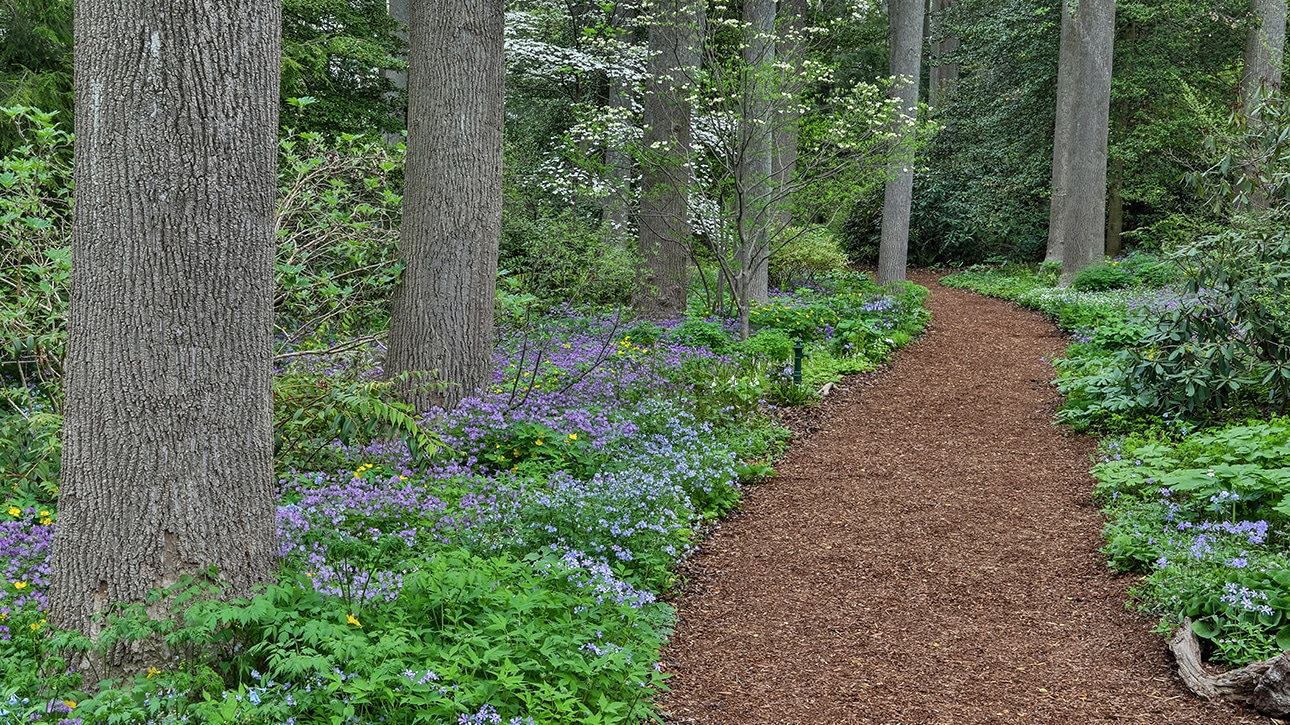
Mt. Cuba Center
Located just outside Hockessin, Delaware, Mt. Cuba Center is one of the country’s leading botanical gardens devoted exclusively to native plants of the eastern United States. Unlike grand estate gardens built for spectacle, Mt. Cuba is built around ecological integrity, scientific research, and conservation.
Origins: A Private Estate Becomes a Conservation Landmark
Mt. Cuba began as the private home of Lamot du Pont Copeland (1883–1963) and his wife, Pamela Cunningham Copeland (1901–2001). Members of the extended du Pont family, the Copelands purchased the property in the 1930s and began transforming the landscape into a naturalistic woodland garden.
Pamela Copeland, in particular, developed a deep interest in native wildflowers and ecological gardening long before it became mainstream. She worked closely with botanists and horticulturists to cultivate regionally indigenous plants rather than rely on imported ornamentals.
After Lamot’s death in 1963, Pamela continued developing the gardens. In 1983, Mt. Cuba Center was formally established as a nonprofit botanical institution. It opened to the public in 2001, aligning with Pamela Copeland’s centennial year.
A Native Plant Garden — By Design
Mt. Cuba spans roughly 1,000 acres, though the core garden area open to visitors is about 50 acres. Its defining characteristics include:
- Woodland wildflower gardens
- Meadow restoration
- Piedmont habitat plantings
- Stream valleys and rolling hills
- Formal gardens around the historic manor
Unlike traditional botanical gardens that showcase global plant collections, Mt. Cuba focuses strictly on native species from the eastern U.S. This gives it a clear ecological identity and a strong conservation mission.
Research & Plant Trials
Mt. Cuba is nationally recognized for its plant trials. These scientific evaluations test native species and cultivars for:
- Garden performance
- Ecological value
- Pollinator support
- Durability in Mid-Atlantic conditions
Their research reports are widely cited by horticulturists and landscape designers nationwide. This scientific backbone distinguishes Mt. Cuba from purely decorative gardens.
Conservation & Education
Education is central to Mt. Cuba’s mission. The Center offers:
-
Horticulture classes
-
Native gardening workshops
-
Professional training programs
-
Youth education initiatives