web analytics

Author: Kristyn Clarke

  • Strange and Unusual Candies

    Strange and Unusual Candies

    From Yum To Yuck, A Look At Some Of The Oddest Candy!

    For many of us when we think of the word candy, our mouths begin to water and we begin to acknowledge that oh so familiar feeling of needing to satisfy our sweet tooth, as that’s what candy is supposed to be …sweet! While the majority of candies, even the sour stuff, are still crafted with sugar, some candy that has been launched on the market over the years is anything but sweet. Some are downright disgusting and others are just plain odd. Who needs Peeps flavors like Hot Tamale, Pancakes with Syrup, or Candy Corn? Below you can find a list of some of the more strange candy we have discovered over the years.

    Candy Cigarettes 

    Candy cigarettes are still currently being made to this day, despite the fact that the United States has twice attempted to ban the sale of them back in 1970 and 1991. It was thought that the candy cigarettes which are crafted to look like actual cigarettes would encourage young children to smoke. They actually taste similar to chalk dust and many people feel they are the world’s worst tasting candy, even taking the title away from candy corn, which is another candy that people either hate or adore.

    Pop Rocks

    This odd candy consists of tiny sugar pieces that explode when put in your mouth. To create the effect, pressurized carbon dioxide bubbles are embedded in each piece of candy, which is what creates the popping sensation when they mix with the saliva inside your mouth. Pop Rocks are a fun candy, but certainly a bit on the odd side. 

    Candy Canes

    While candy canes themselves are not so odd, as a traditional candy cane is generally a red and white, peppermint flavored sugar stick. It is the new flavor twists over the years that raise some eyebrows. Those newer flavors include bacon, pickle, Oreo, coffee, and most recently Mac & Cheese! EWW!

    PEZ

    What is odd about PEZ candy is that the dispensers in which the candies are housed are more sought after than the candy itself. Over 3 billion PEZ candy are consumed each year and the dispensers which feature various cartoon and pop culture figures have become major collector items. There are over 550 different dispensers and one original from the 1950’s sold for over $11,000 on eBay in 2000. They hold PEZ conventions and the fan base even has their own name: PEZHeads.

    Gummies

    Lightning Bug, Maggot, and Body Part Gummies- We have to group the odd assortment of various gummy candies that exist into one group because we could easily write an entire article just based on the odd array of gummy candy available on the market today.

    There is everything from lightning bug gummies that “light up” when you pick them up using a set of tweezers with a light that shines through the gummy (sound like a lot of work to us) to gummies that resemble maggots (yuck!). There are also gummies made to look like various body parts such as brains, kidneys, heart as well as gummy bacon, gummy alien butts, boogers, and gummy worms. What is wrong with just sticking to those cute little bears?

    Razzles

    Are the candy or gum? To be honest no one really knows! Kids love them as they do come in delicious fruit flavors, but after chewing them up for a bit they turn into a rather lame piece of flavorless chewing gum. They might even be worse than Fruit Stripe gum, which loses its flavor in mere seconds. Razzles will forever remain a mystery but still have a dedicated fan base.

    Bonkers

    If there was ever a candy we could bring back this would be the one! Why, oh, why did it have to disappear? There have even been online petitions to bring back this oddly addictive candy that featured a two flavor combination which was fruity on the outside and a flavored fruity filling on the inside. Their commercials during the 1980s were especially memorable and the thought of them immediately sparks up nostalgia. Nabisco originally made the candy, but currently, other manufacturers are trying to replicate the original, but so far have had no luck!

    Wax Bottle Candy

    This candy is a bottle-shaped form of wax that contains a so-called fruit-flavored liquid that you are supposed to suck out of the bottle by biting off the tip. These are not only messy but once the minuscule amount of flavored liquid is gone you are left with nothing but a sticky waxy bottle to chew on, which you are not supposed to eat! This candy literally makes no sense.

    Atomic Fireballs and Lemonheads

    Why would you want to put yourself through the torture of these candies? One is so hot with a cinnamon flavor your mouth becomes an inferno and the other is so sour your lips may stay puckered for hours! These are not treats! They are odd little torture devices.

    Wasabi Kit-Kats

    Japan is well-known for having some rather odd flavors of Kit-Kat (which are normally chocolate wafer candies here in the U.S.) such as Baked Potato, Soy Sauce, Cherry Blossom, Blueberry Cheesecake, Soybean and Brandy and Orange. We think that Wasabi definitely takes the cake on the oddest flavor. As spicy as Wasabi can be, this cannot possibly taste good in candy form.

    Sour Flush Toilet Lollipops

    These lollipops come in a toilet shaped dispenser and are crafted to look like a plunger sticking up from the bowl. Enough said, no further explanation needed!

    Bertie Botts Every Flavor Beans (and some flavors of Jelly Belly Jelly Beans)

    Love them or hate them Jelly Beans have been around for quite some time and show no signs of going anywhere anytime soon. Now, in addition to your typical fruit flavors Bertie Botts, inspired by Harry Potter, features jelly beans in disgusting flavors such as soap, grass, dirt, black pepper, earwax, vomit, and even rotten egg. Taste at your own risk! The additional odd Jelly Belly flavors include draft beer, buttered popcorn, pancakes and maple syrup, habanero pepper, chili mango, barbeque banana, and Tabasco to name only a few.

  • Songs Based on Real Events

    Songs Based on Real Events

    How Various Actual Events, Sometimes Catastrophic Ones, Led to the Creation of Some of Music’s Biggest Hits
    Musicians are artists and their canvas is the melody and lyrics that put together their songs. Talk to any musician and they will tell you that they pull their inspirations from a wide variety of emotions including love, heartbreak, pain, rebellion, hope, imagination and so much more. Some musicians even prefer that their songs be interpreted by the listener themselves so they can take their own individual messages away from the lyrical content.

    But there are actually quite a few hit songs out there that were inspired by actual real-life events that took place throughout history, some good and some bad, but all the same, these events had a great influence on the artists and helped created some incredibly memorable songs. We have taken a look at a few hit songs that were inspired by actual events and the impact those events had on the artists, as they felt the need to immortalize them in song. Some of the songs on this list may surprise you, but it certainly provides great insight into the mind of the artist and their reactions to various life events.

    Smoke On The Water from Deep Purple – On December 4, 1971, Deep Purple was in Monteux, Switzerland recording their new album at the Casino Complex. It so happened that Frank Zappa was playing a show at the same Casino Complex when a fan set off a flare gun during the show that ended up starting a fire that burned down the entire Casino Complex. Thankfully there were no major injuries during the incident, but it led to the creation of what was to become Deep Purple’s biggest hit song.
    Ballroom Blitz from The Sweet – This song was inspired by an incident that took place in 1973 where the band was performing live and they were driven offstage by a barrage of bottles being thrown at them. The song hit the top five in 1975 and we are guessing at that point in time no more bottles were being thrown!
    The Streak from Ray Stevens – It seems that everyone was getting naked at public events in the year 1974 and this was Ray Steven’s commentary. The song was number one for roughly three weeks.
    We Didn’t Start The Fire from Billy Joel– Billy Joel is the master of crafting a song about events, he didn’t just choose a single event. Joel’s song covers nearly every world event that took place from his childhood in 1949 till the time he was forty years in 1989 when the song was released. To be exact, he mentions 117 events that changed the world, or if you want to be precise, 118 as he mentions Richard Nixon twice! The song covers a lot of ground and just try to sing it all from memory …we’ll wait!
    Castle On The Hill from Ed Sheeran– Following Billy Joel’s playbook singer/songwriter Ed Sheeran crafted this 2017 song speaking about a variety of personal events that took place for him during the trajectory of his career starting from his childhood at age six to the time in which he began his rise to superstardom.
    American Pie from Don McLean – This deeply sad song was penned by McLean after the tragic deaths of Buddy Holly, The Big Bopper, and Ritchie Valens due to a plane crash that occurred in 1959. McLean also wrote a tribute to the life and death of artist Vincent Van Gogh with the beautiful song Vincent.
    The Night Chicago Died from Paper Lace – This catchy pop tune was actually inspired by gangster Al Capone and the St. Valentine’s Day Massacre.
    When The Levee Breaks from Led Zeppelin – This song is actually is a cover song that was written during a great Mississippi River flood that occurred in 1929. Led Zeppelin without a doubt made it their own and secured the tragedy in everyone’s memory, as it will not be forgotten.
    Winds Of Change from The Scorpions – This song was inspired by the fall of the Berlin Wall and the end of the Cold War. If you truly listen to the lyrics you can definitely pick up the theme.
    Fortunate Son from Creedence Clearwater Revival – Many looked at this song as being patriotic, however, John Fogerty was actually commenting on just the opposite. It was about Fogerty’s discharge from the army during the Vietnam War and how upset he was becoming with soldiers being forced into combat.
    The Little Things You Give Away from Linkin Park – This song was penned after Hurricane Katrina devastated the South and is a call for action to correct the unjust practices that the U.S. government was taking in helping the storm victims.
    Uprising from Muse – This track was inspired by the G20 riots that took place in London in 2009 against the dishonesty of various global corporations around the world. It was Muse’s way to express their anger and commentary about the situation.
    Darkness from Eminem – This deeply haunting song off of Eminem’s recent album Music To Be Murdered By was inspired by the horrific 2017 shooting deaths of over fifty people who were attending a concert festival in Las Vegas. The song is told from the perspective of the shooter and is both deeply disturbing and thought-provoking at the same time.
    A Day In The Life from The Beatles – This song was inspired by the tragic death of one of the band’s acquaintances named Tara Browne. Browne had died in a car crash a few months prior to The Beatles entering the studio to record. The lyric “he blew his mind out in a car” is the reference as Lennon is searching through a newspaper to find the story.
    The Ballad Of The Beaconsfield Miners from the Foo Fighters – The beautiful interlude was created by The Foo Fighters frontman Dave Grohl after learning that during a coal mine collapse in Beaconsfield, Australia where two miners were trapped for two days, one of the trapped miners only requested water and an iPod containing the new Foo Fighters album. Grohl penned the track in tribute to the man’s bravery and the loyalty of their fan base. He even offered to have a beer with the man the next time the band was in town.
    Candle In The Wind from Elton John – This song is actually a twofer for Elton John as the song was originally written as a tribute to the late Marilyn Monroe, as the beginning lyric uses her real name “Goodbye Norma Jean”. The song later had a huge resurgence when Princess Diana tragically died in a car accident in 1997. Elton and Princess Di were very dear friends and the opening lyrics were changed to “Goodbye England’s Rose”.
    Alice’s Restaurant from Arlo Guthrie – This 18-minute long satire song is based on 1960’s counter culture, but is inspired on a real event that took place. It is also a Thanksgiving staple, at least on Philadelphia, PA radio, as 93.3 WMMR plays it twice on that day as a tradition.
  • The Lindbergh Kidnapping March 1, 1932

    The Lindbergh Kidnapping March 1, 1932

    The Charles A. Lindbergh Jr Kidnapping

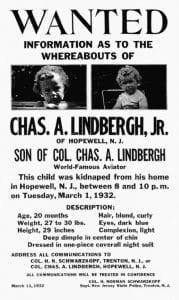
    It was on the evening of March 1, 1932, that one of the nation’s biggest mysteries and scandals occurred. World-famous aviator Colonel Charles Lindbergh and his wife had put their 20-month old son Charles Augustus Lindbergh, Jr. to bed in his upstairs nursery and within hours a nurse who went to check-in on the baby discovered him to be missing.

    All evidence supported that the baby had been kidnapped and as police investigated Lindbergh’s home, the discovered muddy footprints in the nursery, the window in the nursery wide-open, and a cryptic ransom note left on the windowsill that demanded $50,000 for the safe return of the baby. The police thoroughly searched the grounds of the Lindbergh estate and came up empty-handed. All that they were able to discover was a home-made ladder that they believe someone used to climb to the second-story window to nab baby Charlie, as there were also scrape marks discovered on the outside of the home next to the nursery window.

    It was the first time the Lindberghs were at their new home on a Tuesday night in the middle of the week. The house was not quite finished, so the family only came on weekends. They spent weekdays at Anne’s family’s estate in Englewood, New Jersey. But Charlie had a cold, and Anne didn’t want him to travel. So how did the kidnappers know they’d even be here that night?

    The ransom note was very crudely written with many misspellings which led the police to believe that the individual that kidnapped baby Charles most likely had to be a recent immigrant. The note also urged the Lindbergh’s not to involve the police as there would be trouble as a result.

    Colonel Lindbergh asked friends to communicate with the kidnappers, and they made widespread appeals for the kidnappers to start negotiations. A second ransom note was received by Colonel Lindbergh on March 6, 1932, (postmarked Brooklyn, New York, March 4), in which the ransom demand was increased to $70,000.

    About nine days after the kidnapping of baby Charles a 72-year-old retired teacher from the Bronx named Dr. John Condon called the Lindberghs and claimed that he had written a letter to the “Bronx Home News” offering to act as an intermediary between Lindbergh and the kidnapper. The story got the attention of the kidnapper who contacted Condon and in a move of desperation to get his son back alive, Lindbergh agreed to allow Condon to works as an intermediary and kept the police out of the situation.

    A month later on April 2, 1932, Dr. Condon delivered the ransom money of gold certificates (serial numbers recorded by the police) to a man at St. Raymond’s Cemetery, while Lindbergh waited in a nearby car. The man referred to as Cemetery John took the money, but failed to deliver the baby safe and sound. He instead handed Dr. Condon a note that revealed the baby’s alleged location, which was on a boat called the Nelly. Unfortunately, no boat or baby was located in the area that Cemetery John described.

    Finally on May 12, 1932, nearly three months after the kidnapping of baby Charles, a truck driver found the baby’s decomposed body in the woods a few miles from the Lindbergh estate. Police claim that the baby had been dead since the night of the kidnapping and had a fractured skull which may have occurred because he was dropped when the kidnapper was attempting to climb back down the ladder. However, there are some discrepancies in the police report describing the baby’s injuries and some do not match those that would occur during an accidental fall. There was a clear fracture line on the left side of the baby’s head, and on the right side of the head, there was a round defect behind the right ear.

    The police claim the injury to the right side of the head occurred when an officer who was trying to exhume the baby’s remains accidentally poked a hole in his skull with a stick, and thus created the round, impact-like injury on the right side. However many medical experts claim that a stick would not create enough force to break through the baby’s skull and some people began to suspect the baby was murdered rather than dying accidentally after the fall. The evidence supports the theory that the Lindbergh baby was killed intentionally by the kidnapper and the ransom notes claiming he was alive was only part of a ruse to receive higher amounts of money from the family.

    For two years the police and FBI kept close tabs on the serial numbers associated with the ransom money that was given to Cemetery John, just waiting to see if it would pop up anywhere and they could arrest a suspect. In 1934, one of the gold certificates showed up at a gas station in New York. Thanks to the suspicions of the gas station attendant, who was worried the gold certificate might be counterfeit and wrote down a license plate number, the police were able to track the gold certificate back to an illegal German immigrant named Bruno Richard Hauptmann.

    The police discovered that Hauptmann had a past criminal record, which of all things included using a ladder to climb into the second-story window of a home to steal money and watches. Police searched Hauptmann’s home and found $14,000 of the Lindbergh ransom money hidden in his garage. They also discovered missing floorboards in Hauptmann attic which matched the wood used to build the home-made ladder discovered on the Lindbergh property.

    Hauptmann was arrested on September 19, 1934, and tried for murder beginning on January 2, 1935. While Hauptmann maintained his innocence, the evidence in the case was stacked against him. Not only was there the wood from the ladder, but a writing sample from Hauptmann matched the ransom note. There was also a witness that claimed to have seen Hauptmann on the Lindbergh property the day before the crime occurred. Both Lindbergh and Dr. Condon also agreed that they recognized Hauptmann as Cemetery John who had taken the ransom money right after the crime.

    The prosecutors on the case were never completely positive that Hauptmann acted alone. They urged him to reveal his accomplices, but he never wavered from his innocence plea. Even his wife, Anna, maintained her husband’s innocence all the way up to her death in 1994. It is the ransom money that comes into question when looking into possible accomplices in committing this crime. Police only discovered Hauptmann with about $14,000 of the ransom money, so the questions became, what happened to the rest of the $50,000 in funds?

    On February 13, 1935, the jury convicted Hauptmann of first-degree murder. He was put to death by electric chair on April 3, 1936, for the murder of Charles A. Lindbergh Jr.

    The case of the Lindbergh baby is truly one of the most haunting in American History. Overall the case left many unanswered questions about who committed the crime and how they were able to pull it off. Many are still wondering if Hauptmann had any assistance when committing the crime and that there still could be perpetrators at large even to this day.

    What makes this case even more intriguing is that there are some individuals who believe that the Lindbergh baby is still very much alive and well. They claim that the poster that circulated far and wide seeking his return said he was 20 months old, weighed 27 to 30 pounds and was 29 inches tall. However, the autopsy report that was completed on the baby that was discovered on the Lindbergh property couldn’t identify the body’s sex due to “marked decomposition ” and the body was 33 inches long, -4 inches taller than Charles A. Lindbergh Jr. was supposed to be. Colonel Lindbergh and Betty Gow, the baby’s nurse,, quickly identified the body when it was discovered and it was quickly cremated right after. Definitely questionable behavior, but the theory does seem a bit far-fetched!