The holidays, especially Christmas, are filled with wonderful things to do, see and watch. As early as the silent film era Christmas movies have become a staple of the holiday season, some are well known and well done. Others are not well known and just as badly done and a few are badly done but well-loved because they are so bad.
This is a list of ten Christmas films that are as essential to Christmas as eggnog and a tree. If you haven’t seen them before most are available to purchase as a disc or in digital format or totally free on YouTube.
The Nativity Story (2006)
Directed by Catherine Hardwicke and starring Oscar Isaac as Joseph and Keisha Castle-Hughes as Mary The Nativity Story is a faithful and sometimes lighthearted look at the birth of Jesus The Christ. There have not been many movies that dealt exclusively with the birth of Jesus though there are many that allude to it. This film dramatizes the events that are chronicled in the first chapters of the books of Matthew and Luke in the Christian Bible. Jesus is the reason why we celebrate Christmas and therefore this is a must-see film to bring at least a slight feeling of reverence for the season.
Scrooge (1951)
This film version of the 1843 classic novel by Charles Dickens Stars Alastair Sim as Ebenezer Scrooge and was directed and produced by Brian Desmond Hurst. This is probably the best version of the 100s of the film version of A Christmas Carol. Alistair Sim gives a tour de force performance as an old miser who must face his past present and future self in order to be redeemed. His redemption, his total change of character is a marvel to watch on screen. It was appropriately filmed in black and white and that gives the film the sense of eeriness it needs as a true ghost story. If you only watch one version of A Christmas Carol this is the one.
Miracle on 34th Street (1947 and 1973)
Miracle on 34th Street is the story of Kris Kringle a man who believes himself to be Santa Claus and the lawyer that sets out to prove that he is. The original cast included Maureen O’Hara, John Payne, Edmond Gwenn, and a young Natalie Wood. It is interesting to note here that Miss Wood was making The Ghost and Mrs. Muir at the same time as she was making Miracle on 34th Street. I like this version, but I prefer the one that was made for my 12th Christmas in 1973. This version was made for television and starred many actors that I knew well. It was also made in color. The 1973 version starred Jane Alexander, David Hartman, Tom Bosley, Jim Backus, Roddy McDowell, David Doyle, and Sebastián Cabot. Most of these actors were from favorite TV shows or films so I had an easier time relating to them. They tried to update the film in 1994 and that didn’t work at all though I did enjoy Richard Attenborough’s portrayal of Kris it lacked something the first two versions had.
It’s A Wonderful Life or It Happened One Christmas (1946)
It’s a Wonderful Life was released in 1946. It starred James Stewart and Donna Reed and was directed by Frank Capra. The film meant extraordinarily little to me growing up. My parents did not watch it when it was on or even recommend it until it was remade in 1977. The title was changed to It Happened One Christmas and it starred Marlo Thomas, Wayne Rogers, and Chloris Leachman. I fell in love with the second production. It was years later that I saw the original and equally enjoyed it. It’s A Wonderful Life is the story of a man who is so despondent he attempts suicide only to be rescued by his guardian angel. The angel is allowed to show him what the world would be like if the man had never been born. It Happened One Christmas is the exact same story only the roles are all reversed, and it is a despondent woman who is saved by the angel.
The Homecoming A Christmas Story (1971)
This film is actually a pilot episode for the television series that would become known as The Waltons. It starred Patricia Neal, Edgar Bergen, Ellen Corby and Richard Thomas. The story revolved around a family in the 1930s striving to deal well with Christmas during The Great Depression and waiting for their father to come home for the holiday. It is a heartwarming look at how a family weathered hard times and is somewhat based on the life of its creator Earl Hamner Jr. This may be just the film for this year as we look at a Christmas that will be celebrated in a difficult time.
Meet Me in St. Louis (1944)
Directed by Vincent Minnelli and starring Judy Garland Meet me in St. Louis is the story of the Smith family and the year leading up to the Saint Louis World’s Fair not long after the turn of the century. It has songs that have long been established as a permanent part of The American Song Book, most notably The Boy Next Door and The Trolley Song. Its most touching moment comes towards the end of the film when Judy’s character, Esther, sings quietly to her little sister Tootie played by Margaret O’Brien a song that has been part of our Christmas ever since. Have Yourself A Merry Little Christmas
White Christmas (1954)
White Christmas is an all-star film featuring the talents of Bing Crosby, Danny Kaye, Rosemary Clooney, Vera-Ellen and that great character actress Mary Wickes. With music and lyrics by the most prolific songwriter of the 20th century, Irving Berlin, White Christmas is a treat for the ears and the eyes. It’s the story of two soldiers who, after the Second World War team up and become a popular song and dance team. Upon arriving at an Inn in Vermont they find Their commanding officer struggling to run a ski lodge with no snow. The two begin a scheme to make the lodge profitable and the fun begins. There are not many movies that one could consider perfect. White Christmas is one to be added to that list.
Scrooge The Musical (1970)
Starring Albert Finney this film was made in response to the popularity of Oliver. It is another treat for the senses as the streets of 1843 London are beautifully recreated and the music by Leslie Bricusse is a treat. Songs like Christmas is for Children, Thank You Very Much and my personal favorite December the 25th, stay with long after the movie ends, and that is the essence of a good musical. Of course, the story remains the same Scrooge a miserly old man is visited by 3 spirits who by showing him his past present, and possible future give him a second chance to live well.
The Gathering (1977)
Starring Ed Asner and Maureen Stapleton the Gathering is the story of a man who finds out just before Christmas that he has only a short time left to live. He is estranged from most of his family including his wife, whom he left but never divorced. He decides to go on a trip to try and see his adult children. He goes to his wife for addresses, but she finds out the truth and suggests a gathering of the family at the house. The kids arrive one by one and relationships…well you should watch it yourself. This film is expertly handled by Ed Asner the father as a curmudgeon if ever there was one and Maureen Stapleton as the wife that sees past his flaws. If you’re looking for a miraculous cure for a happy ending it doesn’t happen here, but there are things more important than cures.
The Christmas Box (1995)
The Christmas Box stars Richard Thomas, Maureen O’Hara, and Annette O’Toole. It is the story of a struggling ski shop owner who moves his wife and daughter into the wing of a mansion. The wife would become a companion to the old woman who lives there while the husband took care of the grounds. Richard, the husband, begins to have strange dreams about an angel, and the mystery of the house and the woman who lives there is slowly revealed. This is a beautiful story of people learning to open up to others and finding joy again.
So there you have it a list of ten must-see films for the season. These films did not come off any list or other published material, but they came to form my heart. Other films that deserve an honorable mention are The Christmas Miracle, Elf, Holiday Inn, Christmas in Connecticut, The Muppet’s Christmas Carol, Santa Claus The Movie, and Mrs. Santa Claus. If you have a favorite Christmas movie not listed here please share it in the comments section below. Whatever you watch or do this season may you find joy and peace and a lot of love.
Let’s start at the very beginning… Well, maybe not that far back. Music has been part of the life of human beings since the dawn of the human race. But capturing music and having the means to write it down and remember it took a little more time.
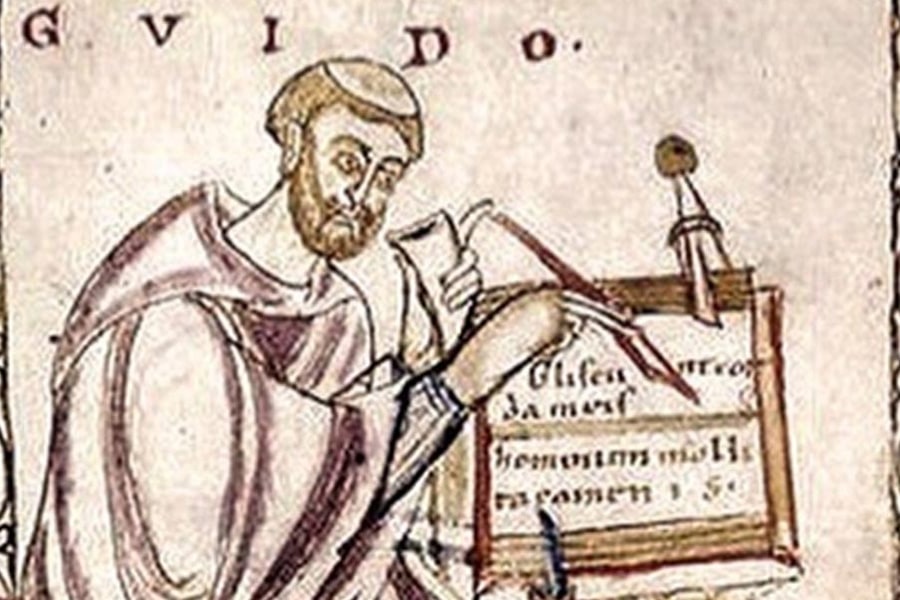
Let’s meet a musical Monk named Guido De Arezzo. At a young age, Guido was sent to a monastery for an education. This was a thousand years ago. Most specifics about Guido’s life are lost to time, but we know through surviving documents that he is the father of musical notation.
Music a thousand years ago was not what we know it as today. Music was mainly the property of the Catholic Church. And it didn’t have a melody the way music has today. It was performed in a chanting style. In a way, this was the first rap music. Music as we know it will happen, but not just yet.
Guido loved the church’s music and became quite adept at teaching it, but it was frustrating. Learning music meant listening and repeating it over and over until you got it down, ultimately. If harmonies were involved, it could take days to memorize a single piece as each section had to work separately and then be brought together as a whole. This frustrated our young music lover.
What could be done to make the teaching and learning of music simpler? Slowly, an idea came to Brother Guido’s mind. First, he came up with musical notations by using lines and spaces. What we now call a staff. He used the lines on the staff to separate the notes. He Called the notes A, B, C, D, E, F, and G. We now call this the natural minor scale; Guido called it the mode.
Quido then assigned a sound to go with each of the notes. For singers to learn his sounds, he wrote a hymn where the first note on each line was a musical note in succession. Rodgers and Hammerstein would do this a thousand years later when they wrote Do, Re, Me for The Sound of Music. Guido’s original sound for these notes was Ut Re Mi Fa Sol La. Music was taught using this method for 600 years, and then Giovanni Battista Doni suggested that Ut be changed to Do and added Si as the last note in the scale. In 1845, A Music teacher from England made a change of her own. She changed Si to Ti. She did this so that each note sound would begin with a different letter. The music teacher’s name was Sarah Ann Glover.
The story of our musical monk isn’t over. It seems his method of teaching music spread far and wide, and eventually, the news of his revolutionary work reached the ears of Pope John XIX. Pope John summoned Guido to Rome and studied music under our friend. The Pope, we know, requested that Guido stay in Rome permanently, but Guido declined the generous offer. He wanted to go home. Some believe that this was because of ill health.
Guido’s system of teaching music is called Solfege and is used worldwide. It is one of the reasons we can call music the universal language. Those seven notes are, as Maria puts it in The Sound of Music, “the tools we use to build a song. Once you have these notes, you can sing a million different tunes by mixing them up.” And for the last thousand years, composers have been mixing those notes to create symphonies, operas, pop music, rock music, ballets, and musical comedies or plays. Without Guido de Arezzo, no music we know today would have happened.
do re mi so la ti do
It is hard to believe that music education is slowly being eroded from our schools. Some public schools are losing funding for music programs, which is sad. Learning music helps in other subjects, specifically math and English. Also, learning music gives students a glimpse into other cultures as they are exposed to music from around the world.
Music in school also exposes students to the wide range of music that is out there. I remember being young and not caring for symphonic music or ballet. Still, as I got older, because I was exposed to them in elementary school, I began to appreciate them and became a fan. That can’t be said of Opera yet. But I intend to take that plunge soon.
We must keep music and the rest of the arts in schools and free of charge whenever possible. I heard recently of a school show choir who had to buy their sheet music. The students had to buy the music. That was unheard of in my time, and I feel it’s an unfair burden on the parents to add an extra expense. Also, students who can’t pay will then not be eligible to sing, and that in itself makes this very sad.
Whatever music education future is in the schools and the world, we have Brother Guido, The Musical Monk, to thank for the gift of Do, Re, Me.