Barack Obama’s Letter to Donald Trump
January 20, 2016
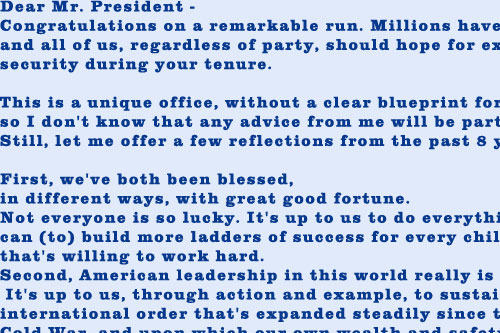
Dear Mr. President –
Congratulations on a remarkable run. Millions have placed their hopes in you, and all of us, regardless of party, should hope for expanded prosperity and security during your tenure.
This is a unique office, without a clear blueprint for success, so I don’t know that any advice from me will be particularly helpful. Still, let me offer a few reflections from the past 8 years.
First, we’ve both been blessed, in different ways, with great good fortune. Not everyone is so lucky. It’s up to us to do everything we can (to) build more ladders of success for every child and family that’s willing to work hard.
Second, American leadership in this world really is indispensable. It’s up to us, through action and example, to sustain the international order that’s expanded steadily since the end of the Cold War, and upon which our own wealth and safety depend.
Third, we are just temporary occupants of this office. That makes us guardians of those democratic institutions and traditions — like rule of law, separation of powers, equal protection and civil liberties — that our forebears fought and bled for. Regardless of the push and pull of daily politics, it’s up to us to leave those instruments of our democracy at least as strong as we found them.
And finally, take time, in the rush of events and responsibilities, for friends and family. They’ll get you through the inevitable rough patches.
Michelle and I wish you and Melania the very best as you embark on this great adventure, and know that we stand ready to help in any ways which we can.
Good luck and Godspeed,
BO
Conan O’Brien’s press release regarding the Changes in The Tonight Show January 12, 2010
People of Earth:
In the last few days, I’ve been getting a lot of sympathy calls, and I want to start by making it clear that no one should waste a second feeling sorry for me. For 17 years, I’ve been getting paid to do what I love most and, in a world with real problems, I’ve been absurdly lucky. That said, I’ve been suddenly put in a very public predicament and my bosses are demanding an immediate decision.
Six years ago, I signed a contract with NBC to take over The Tonight Show in June of 2009. Like a lot of us, I grew up watching Johnny Carson every night and the chance to one day sit in that chair has meant everything to me. I worked long and hard to get that opportunity, passed up far more lucrative offers, and since 2004 I have spent literally hundreds of hours thinking of ways to extend the franchise long into the future. It was my mistaken belief that, like my predecessor, I would have the benefit of some time and, just as important, some degree of ratings support from the prime-time schedule. Building a lasting audience at 11:30 is impossible without both.
But sadly, we were never given that chance. After only seven months, with my Tonight Show in its infancy, NBC has decided to react to their terrible difficulties in prime-time by making a change in their long-established late night schedule.
Last Thursday, NBC executives told me they intended to move The Tonight Show to 12:05 to accommodate The Jay Leno Show at 11:35. For 60 years The Tonight Show has aired immediately following the late local news. I sincerely believe that delaying The Tonight Show into the next day to accommodate another comedy program will seriously damage what I consider to be the greatest franchise in the history of broadcasting. The Tonight Show at 12:05 simply isn’t The Tonight Show. Also, if I accept this move I will be knocking the Late Night show, which I inherited from David Letterman and passed on to Jimmy Fallon, out of its long-held time slot. That would hurt the other NBC franchise that I love, and it would be unfair to Jimmy.
So it has come to this: I cannot express in words how much I enjoy hosting this program and what an enormous personal disappointment it is for me to consider losing it. My staff and I have worked unbelievably hard and we are very proud of our contribution to the legacy of The Tonight Show . But I cannot participate in what I honestly believe is its destruction. Some people will make the argument that with DVRs and the Internet a time slot doesn’t matter. But with The Tonight Show, I believe nothing could matter more.
There has been speculation about my going to another network but, to set the record straight, I currently have no other offer and honestly have no idea what happens next. My hope is that NBC and I can resolve this quickly so that my staff, crew, and I can do a show we can be proud of, for a company that values our work.
Have a great day and, for the record, I am truly sorry about my hair; it’s always been that way.
George W. Bush’s Letter to Barack Obama
January 20, 2009
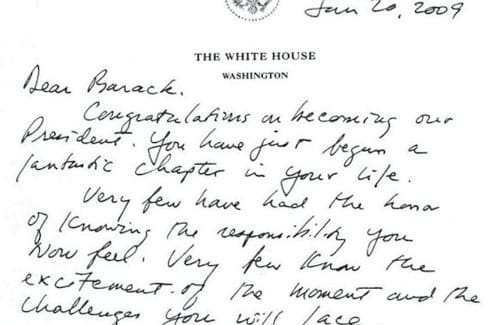
Dear Barack,
Congratulations on becoming our President. You have just begun a fantastic chapter in your life.
Very few have had the honor of knowing the responsibility you now feel. Very few know the excitement of the moment and the challenges you will face.
There will be trying moments. The critics will rage. Your “friends” will disappoint you. But, you will have an Almighty God to comfort you, a family who loves you, and a country that is pulling for you, including me. No matter what comes, you will be inspired by the character and compassion of the people you now lead.
Bobby Henderson’s (founder of Pastafarianism) Open Letter to Kansas School Board
May, 2005
I am writing you with much concern after having read of your hearing to decide whether the alternative theory of Intelligent Design should be taught along with the theory of Evolution. I think we can all agree that it is important for students to hear multiple viewpoints so they can choose for themselves the theory that makes the most sense to them. I am concerned, however, that students will only hear one theory of Intelligent Design.
Let us remember that there are multiple theories of Intelligent Design. I and many others around the world are of the strong belief that the universe was created by a Flying Spaghetti Monster. It was He who created all that we see and all that we feel. We feel strongly that the overwhelming scientific evidence pointing towards evolutionary processes is nothing but a coincidence, put in place by Him.
It is for this reason that I’m writing you today, to formally request that this alternative theory be taught in your schools, along with the other two theories. In fact, I will go so far as to say, if you do not agree to do this, we will be forced to proceed with legal action. I’m sure you see where we are coming from. If the Intelligent Design theory is not based on faith, but instead another scientific theory, as is claimed, then you must also allow our theory to be taught, as it is also based on science, not on faith.
Some find that hard to believe, so it may be helpful to tell you a little more about our beliefs. We have evidence that a Flying Spaghetti Monster created the universe. None of us, of course, were around to see it, but we have written accounts of it. We have several lengthy volumes explaining all details of His power. Also, you may be surprised to hear that there are over 10 million of us, and growing. We tend to be very secretive, as many people claim our beliefs are not substantiated by observable evidence.
What these people don’t understand is that He built the world to make us think the earth is older than it really is. For example, a scientist may perform a carbon-dating process on an artifact. He finds that approximately 75% of the Carbon-14 has decayed by electron emission to Nitrogen-14, and infers that this artifact is approximately 10,000 years old, as the half-life of Carbon-14 appears to be 5,730 years. But what our scientist does not realize is that every time he makes a measurement, the Flying Spaghetti Monster is there changing the results with His Noodly Appendage. We have numerous texts that describe in detail how this can be possible and the reasons why He does this. He is of course invisible and can pass through normal matter with ease.
I’m sure you now realize how important it is that your students are taught this alternate theory. It is absolutely imperative that they realize that observable evidence is at the discretion of a Flying Spaghetti Monster. Furthermore, it is disrespectful to teach our beliefs without wearing His chosen outfit, which of course is full pirate regalia. I cannot stress the importance of this enough, and unfortunately cannot describe in detail why this must be done as I fear this letter is already becoming too long. The concise explanation is that He becomes angry if we don’t.
You may be interested to know that global warming, earthquakes, hurricanes, and other natural disasters are a direct effect of the shrinking numbers of Pirates since the 1800s. For your interest, I have included a graph of the approximate number of pirates versus the average global temperature over the last 200 years. As you can see, there is a statistically significant inverse relationship between pirates and global temperature.
In conclusion, thank you for taking the time to hear our views and beliefs. I hope I was able to convey the importance of teaching this theory to your students. We will of course be able to train the teachers in this alternate theory. I am eagerly awaiting your response, and hope dearly that no legal action will need to be taken. I think we can all look forward to the time when these three theories are given equal time in our science classrooms across the country, and eventually the world; One third time for Intelligent Design, one third time for Flying Spaghetti Monsterism (Pastafarianism), and one third time for logical conjecture based on overwhelming observable evidence.
Sincerely Yours,
Bobby Henderson, concerned citizen.
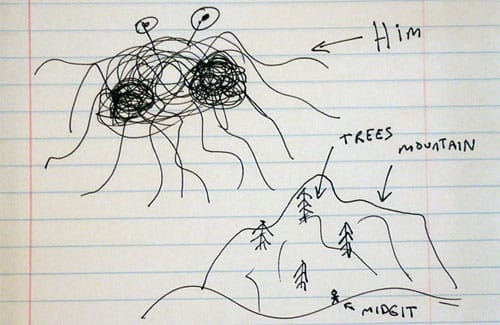
P.S. I have included an artistic drawing of Him creating a mountain, trees, and a midget. Remember, we are all His creatures.
Bill Clinton’s Letter to George W. Bush
January 20, 2001
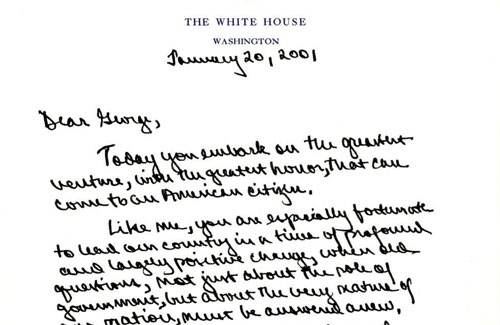
Dear George,
Today you embark on the greatest venture, with the greatest honor, that can come to an American citizen.
Like me, you are especially fortunate to lead our country in a time of profound and largely positive change, when old questions, not just about the role of government, but about the very nature of our nation, must be answered anew.
You lead a proud, decent, good people. And from this day you are President of all of us. I salute you and wish you success and much happiness.
The burdens you now shoulder are great but often exaggerated. The sheer joy of doing what you believe is right is inexpressible.
My prayers are with you and your family. Godspeed.
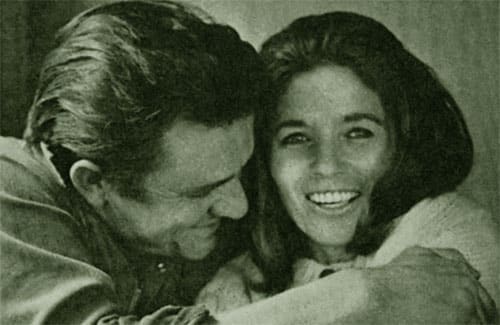
Johnny Cash’s Love Letter to his wife, June Carter Cash June 23, 1994
Happy Birthday Princess, We get old and get use to each other. We think alike. We read each others minds. We know what the other wants without asking. Sometimes we irritate each other a little bit. Maybe sometimes take each other for granted. But once in awhile, like today, I meditate on it and realize how lucky I am to share my life with the greatest woman I ever met. You still fascinate and inspire me.You influence me for the better. You’re the object of my desire, the #1 Earthly reason for my existence. I love you very much. Happy Birthday Princess. John
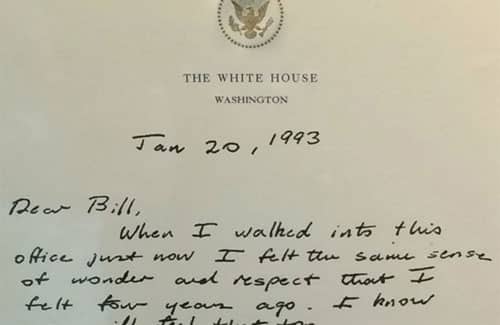
George H.W. Bush’s Letter to Bill Clinton
January 20, 1993
Dear Bill,
When I walked into this office just now I felt the same sense of wonder and respect that I felt four years ago. I know you will feel that, too.
I wish you great happiness here. I never felt the loneliness some Presidents have described.
There will be very tough times, made even more difficult by criticism you may not think is fair. I’m not a very good one to give advice; but just don’t let the critics discourage you or push you off course.
You will be our President when you read this note. I wish you well. I wish your family well.
Your success now is our country’s success. I am rooting hard for you.
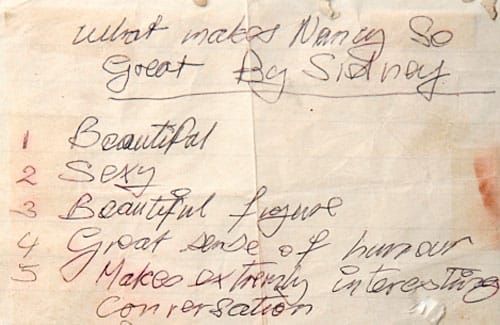
Sid Vicious’ List of his girlfriend Nancy Spungen’s Best Attributes:
~1978
What Makes Nancy So Great By Sidney
1 Beautiful
2 Sexy
3 Beautiful figure
4 Great sense of humour
5 Makes extremely interesting conversation
6 Witty
7 Has beautiful eyes
8 Has fab taste in clothes
9 Has the most beautiful wet pussy in the world
10 Even has sexy feet
11 Is extremely smart
12 A great Hustler
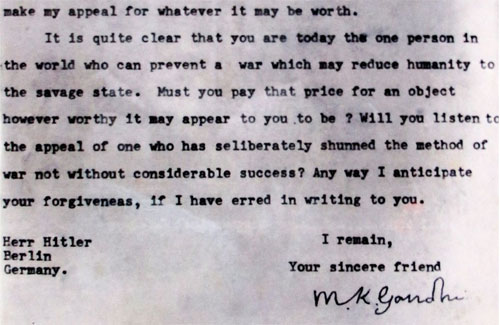
Mohandas Gandhi’s Letter to Adolf Hitler July 23, 1937
Dear friend,
Friends have been urging me to write to you for the sake of humanity. But I have resisted their request, because of the feeling that any letter from me would be an impertinence. Something tells me that I must not calculate and that I must make my appeal for whatever it may be worth.
It is quite clear that you are today the one person in the world who can prevent a war which may reduce humanity to a savage state. Must you pay that price for an object however worthy it may appear to you to be? Will you listen to the appeal of one who has deliberately shunned the method of war not without considerable success? Any way I anticipate your forgiveness, if I have erred in writing to you.
A Love Letter from Rockwell Kent to his wife, Frances
March 1926
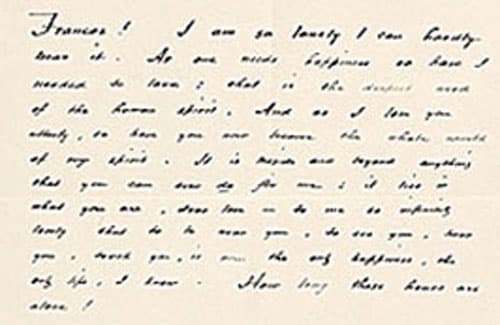
Frances!
I am so lonely I can hardly bear it. As one needs happiness so have I needed love; that is the deepest need of the human spirit. And as I love you utterly, so have you now become the whole world of my spirit. It is beside and beyond anything that you can ever do for me; it lies in what you are, dear love — to me so infinitely lovely that to be near you, to see you, hear you, is now the only happiness, the only life, I know. How long these hours are alone!
Yet is good for me to know the measure of my love and need, that I may at least be brought to so govern myself as never to lose the love and trust that you have given me.
Dear Frances, let us make and keep our love more beautiful than any love has ever been before.
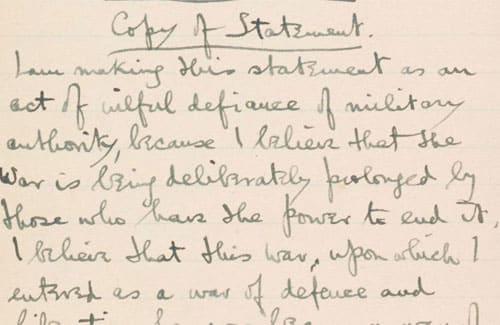
Siegfried Sassoon’s statement of willful defiance
July 17(?), 1917
I am making this statement as an act of wilful defiance of military authority because I believe that the war is being deliberately prolonged by those who have the power to end it. I am a soldier, convinced that I am acting on behalf of soldiers. I believe that the war upon which I entered as a war of defence and liberation has now become a war of agression and conquest. I believe that the purposes for which I and my fellow soldiers entered upon this war should have been so clearly stated as to have made it impossible to change them and that had this been done the objects which actuated us would now be attainable by negotiation.
I have seen and endured the sufferings of the troops and I can no longer be a party to prolong these sufferings for ends which I believe to be evil and unjust. I am not protesting against the conduct of the war, but against the political errors and insincerities for which the fighting men are being sacrificed.
On behalf of those who are suffering now, I make this protest against the deception which is being practised upon them; also I believe it may help to destroy the callous complacency with which the majority of those at home regard the continuance of agonies which they do not share and which they have not enough imagination to realise.
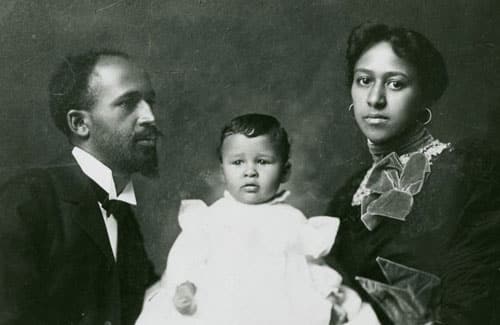
W.E.B. Du Bois’ letter to his 14 year old daughter, Yolande, as she went off to England for school October 29, 1914
Dear Little Daughter:
I have waited for you to get well settled before writing. By this time I hope some of the strangeness has worn off and that my little girl is working hard and regularly.
Of course, everything is new and unusual. You miss the newness and smartness of America. Gradually, however, you are going to sense the beauty of the old world: its calm and eternity and you will grow to love it.
Above all remember, dear, that you have a great opportunity. You are in one of the world’s best schools, in one of the world’s greatest modern empires. Millions of boys and girls all over this world would give almost anything they possess to be where you are. You are there by no desert or merit of yours, but only by lucky chance.
Deserve it, then. Study, do your work. Be honest, frank and fearless and get some grasp of the real values of life. You will meet, of course, curious little annoyances. People will wonder at your dear brown and the sweet crinkley hair. But that simply is of no importance and will soon be forgotten. Remember that most folk laugh at anything unusual, whether it is beautiful, fine or not. You, however, must not laugh at yourself. You must know that brown is as pretty as white or prettier and crinkley hair as straight even though it is harder to comb. The main thing is the YOU beneath the clothes and skin—the ability to do, the will to conquer, the determination to understand and know this great, wonderful, curious world. Don’t shrink from new experiences and custom. Take the cold bath bravely. Enter into the spirit of your big bed-room. Enjoy what is and not pine for what is not. Read some good, heavy, serious books just for discipline: Take yourself in hand and master yourself. Make yourself do unpleasant things, so as to gain the upper hand of your soul.
Above all remember: your father loves you and believes in you and expects you to be a wonderful woman.
I shall write each week and expect a weekly letter from you.
I am Tarzan of the Apes. I want you. I am yours. You are mine. We live here together always in my house. I will bring you the best of fruits, the tenderest deer, the finest meats that roam the jungle. I will hunt for you. I am the greatest of the jungle fighters. I will fight for you. I am the mightiest of the jungle fighters. You are Jane Porter, I saw it in your letter. When you see this you will know that it is for you and that Tarzan of the Apes loves you.
Samuel L. Clemen’s notice for his next burglar September 9, 1908
NOTICE.
To the next Burglar.
There is nothing but plated ware in this house, now and henceforth. You will find it in that brass thing in the dining-room over in the corner by the basket of kittens. If you want the basket, put the kittens in the brass thing. Do not make a noise- it disturbs the family. You will find rubbers in the front hall, by that thing which has the umbrellas in it, chiffonier, I think they call it, or pergola, or something like that.
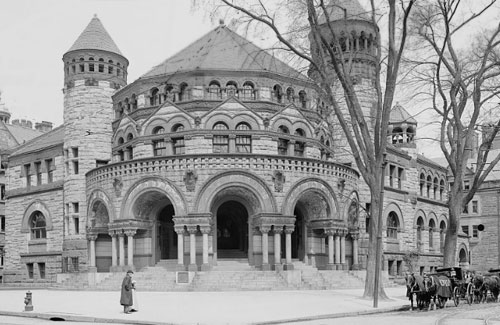
John Swain’s Letter to his son, who was entering Yale University
~1908
My Dear Son:
I am writing a few things I meant to say to you when we took our last walk together, the day before you left for Yale. l intended to say them then and I will even confess that l shamelessly inveigled you into taking a stroll on the quiet street that l might rehearse a carefully prepared bit of Chesterfield up-to-date; but somehow I could not seem to begin,—and, after all, perhaps I can write what was in my mind more freely and plainly than l could have spoken it.
I think I had never realized before that I was getting old.
Of course I have known that my hair is causing your mother much solicitude. and that l am hopelessly wedded to my pince-nez while reading my daily paper, and at the opera; but in some incomprehensible way I had forgotten to associate these trifles with the encroachments of time. It was the sudden realization that you were about to become a Freshman in the college from which, as it seems to me, l but yesterday graduated, that “froze the genial current of my soul,” and spared you my paternal lecture.
Why, l can shut my eyes and still hear the Ivy Song, as we sang it that beautiful June morning; and yet but a few nights more and you will be locked in the deadly Rush on the same field where I triumphantly received two blackened eyes, and, l trust, gave many more!
Another thing, trifling in itself, opened my eyes to the fact of my advancing years. My son, my loyal and affectionate boy, some day it may be yours to know the pain, the unreasonable pain that comes over a man to know that between him and his boy, and his boy’s friends, an unseen but unassailable barrier has arisen, erected by no human agency; and to feel that while they may experience a vague respect and even curiosity to know what exists on your side of the barrier, you on your part would give all- wealth, position, influence, honor- to get back to theirs! All the world, clumsily or gracefully, is crawling over this barrier; but not one ever crawls back again!
You have ever seemed happy to be with me; you have worked with me, read and smoked with me, even played golf with me; but the subtle change in your attitude, the kindling of your eye when we met young men of your age, is the keenest pain I have ever known; yet one which, God knows! I would not reproach you with.
It explains what I used to see on my father’s face and did not understand.
For the tyranny of youth, my son, is the one tyranny which never has been, never can be overthrown. Nothing can displace it, nothing shake its power.
I usually beat you at golf, and occasionally at tennis; I suppose that if we were to spar together I might still make a respectable showing, and at least “save my face.” It avails no thing. I am on my side of the barrier, you on yours.
It seems but a year and a day since I tucked the ball under my arm and sped down the gridiron, sustained by the yells of my partisans; and if our game lacked the machine-like precision of the mass formations you are already somewhat familiar with, it was a good game, and we were good men, and all on the right side of the barrier!
So bear with me if l pause a moment and gaze back across this inevitable gulf into the pleasant land that lies behind me, -a picture evoked by your dawning college career.
I would not have you think me regretful, or melancholy. Life has been good to me- and every age has its gifts for the man who is willing to work for them and use them temperately. And nothing is more ungraceful, more ludicrous, than the spectacle of one who attempts to linger over the pleasures of an age he had outlived, and ignore the advantages of his own time of life.
Yet, as the years bring weakness, the mind persistently drifts back to the earlier periods of life, until the aged actually enter a phase we not inaptly name “second childhood,” from which Heaven forefend me!
I can still appreciate a pair of sparkling blue eyes, and I am not oblivious to the turn of a pretty shoulder; although I devoutly trust that my interest is now impersonal, and merely artistic . . .
Some fathers say to their sons upon the first home leaving,—”Beware of wine and women!” I do not.
If your home life has not taught you the virtues of a temperate, clean life, as I hope, then no words of mine can do it, and you must learn, as too many others have, from a bitter intimacy with its antithesis.
As to women, I never avoided them; I sought them out, from the time when, a red-cheeked youngster, I trudged to school beside a red-cheeked lassìe- asleep these many years in the little village lot where lie so many with whom I fought and played these many years gone by.
I have no advice to offer you on this great subject; its ethics are not taught by letter. If I have any regrets, they are not for your ear, nor any man’s. And if, of some women I have known, I cannot say that I lifted them up, at least of no woman can it be said that I thrust her down!
I ask of you no more than this and the guidance of your own heart; that, in the latter years, when you, too, pass over the barrier, you may not leave behind you shadows on the flower-decked meadows of your youth.
You will probably play cards in college; most men do, -I did. The gambling instinct in man is primordial. Kept under due bounds, if not useful, it is at least comparatively harmless. This is the very best that I or any honest man can say of it. I should be glad if you never cared to gamble; but l do not ask it. Assuming that you will, l do not insult you, and myself equally, by warning you against unfairness; to suppose you capable of cheating at cards is to suppose an impossibility. You could not do so without forfeiting the right ever to enter your home again. But some careless and insidious practices, not unknown in my day and class, savor to the upright mind of cheating, without always incurring its penalties.
To play with men whom you know cannot afford to lose, and who must either cheat or suffer privation; to play when you yourself must win your bet to square yourself; that is, when you do not reasonably see how you are going to raise the money to pay providing you lose,—this is a gambler’s chance to which no gentleman will ever expose his fellow players.
There is nothing heroic about these desperate casts of the die; one risks only the other fellow’s money. These practices I ask and expect you to avoid.
l ask nothing of you in the way of a declared position on religion. Your mother may have demanded more of you here,—entreated more; I cannot. I ask but this: that you will give earnest, serious consideration to the fact that we exist on this planet for a shockingly brief fraction of Eternity; that it behooves every man to diligently seek an answer to the great question,—Why am I here? And then, as best he can, to live up to the ideal enjoined by his answer. And if this carries you far, and if it leads you to embrace any of the great creeds of Christendom, this will be to your mother an unspeakable joy, and perhaps not less so to me; but it is a question which cannot be settled by the mere filial desire to please.
Last of all, while you are in college, be of it and support its every healthful activity.
I ask no academic honor your natural inclinations may not lead you to strive for; no physical supremacy your animal spirits may not instinctively reach out and grasp.
You will, I presume, make the fraternity I made, and, I hope, the societies; you will probably then learn that your father was not always a dignified, bearded man in pince-nez and frock coat, and that on his side of the barrier he cut not a few capers which, seen in the clear light of his summer, gain little grace. Yet, were he to live his life over again, he would cut the same, or worse.
Finally, if you make any of the teams, never quit. That is all the secret of success. Never quit!
Quitting, I like to believe, has not been a striking characteristic of our family, and it is not tolerated in our college.
If you can’t win the scholarship, fight it out to the end of the examination.
If you can’t win your race, at least finish- somewhere.
If your boat can’t win, at least keep pulling on your oar, even if your eye glazes and the taste of blood comes into your throat with every heave.
If you cannot make your five yards in football, keep bucking the line—never let up—if you can’t see, or hear, keep plugging ahead! Never quit! If you forget all else I have said, remember these two words, through all your life, and come success or failure, I shall proudly think of you as my own dear son.
And so, from the old home-life, farewell, and Godspeed!
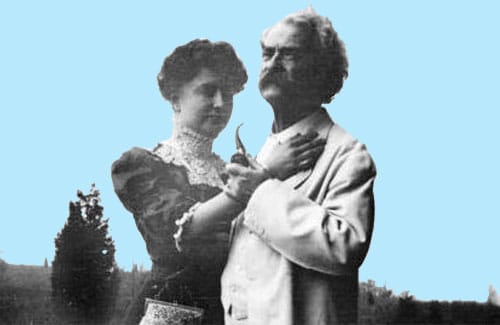
It is a great disappointment to me not to be with you and the other friends who have joined their strength to uplift the blind. The meeting in New York will be the greatest occasion in the movement which has so long engaged my heart: and I regret keenly not to be present and feel the inspiration of living contact with such an assembly of wit, wisdom and philanthropy. I shall be happy if I could have spelled into my hand the words as they fall from your lips, and receive, even as it is uttered, the eloquence of our Newest Ambassador to the blind. We have not had such advocates before. My disappointment is softened by the thought that never at any meeting was the right word so sure to be spoken. But, superfluous as all other appeals must seem after you and Mr. Choate have spoken, nevertheless, as I am a woman, I cannot be silent, and I ask you to read this letter, knowing that it will be lifted to eloquence by your kindly voice.
To know what the blind man needs, you who can see must imagine what it would be not to see, and you can imagine it more vividly if you remember that before your journey’s end you may have to go the dark way yourself. Try to realize what blindness means to those whose joyous activity is stricken to inaction.
It is to live long, long days, and life is made up of days. It is to live immured, baffled, impotent, all God’s world shut out. It is to sit helpless, defrauded, while your spirit strains and tugs at its fetters, and your shoulders ache for the burden they are denied, the rightful burden of labor.
The seeing man goes about his business confident and self-dependent. He does his share of the work of the world in mine, in quarry, in factory, in counting room, asking of others no boon, save the opportunity to do a man’s part and to receive the laborer’s guerdon. In an instant accident blinds him. The day is blotted out. Night envelops all the visible world. The feet which once bore him to his task with firm and confident stride stumble and halt and fear the forward step. He is forced to a new habit of idleness, which like a canker consumes the mind and destroys its beautiful faculties. Memory confronts him with his lighted past. Amid the tangible ruins of his life as it promised to be he gropes his pitiful way. You have met him on your busy thoroughfares with faltering feet and outstretched hands, patiently “dredging” the universal dark, holding out for sale his petty wares, or his cap for your pennies; and this was a man with ambitions and capabilities.
It is because we know that these ambitions and capabilities can be fulfilled that we are working to improve the condition of the adult blind. You cannot bring back the light of the vacant eyes; but you can give a helping hand to the sightless along their dark pilgrimage. You can teach them new skill. For work they once did with the aid of their eyes you can substitute work that they can do with their hands. They ask only opportunity, and opportunity is a torch in the darkness. They crave no charity, no pension, but the satisfaction that comes from lucrative toil, and this satisfaction is the right of every human being.
At your meeting New York will speak its word for the blind, and when New York speaks, the world listens. The true message of New York is not the commercial ticking of busy telegraphs, but the mightier utterances of such gatherings as yours. Of late our periodicals have been filled with depressing revelations of great social evils. Querulous critics have pointed to every flaw in our civic structure. We have listened long enough to the pessimists. You once told me you were a pessimist, Mr. Clemens, but great men are usually mistaken about themselves. You are an optimist. If you were not, you would not preside at the meeting. For it is an answer to pessimism. It proclaims that the heart and the wisdom of a great city are devoted to the good of mankind, that in this, busiest city in the world, no cry of distress goes up but receives a compassionate and generous answer. Rejoice that the cause of the blind has been heard in New York, for the day after it shall be heard around the world.
Asa Don Dickinson’s Letter to Mark Twain regarding taking the Tom Sawyer and Huck Finn books out of a children’s library November 19, 1905
DEAR SIR:
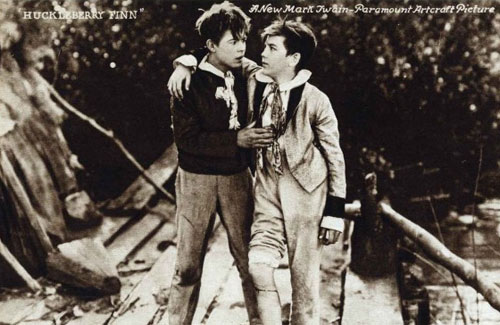
I happened to be present the other day at a meeting of the children’s librarians of the Brooklyn Public Library. In the course of the meeting it was stated that copies of “Tom Sawyer” and “Huckleberry Finn” were to be found in some of the children’s rooms of the system. The Sup’t of the Children’s Dep’t- a conscientious and enthusiastic young woman- was greatly shocked to hear this, and at once ordered that they be transferred to the adults’ department. Upon this I shamefacedly confessed to having read “Huckleberry Finn” aloud to my defenseless blind people, without regard to their age, color, or previous condition of servitude. I also reminded them of Brander Matthews’s opinion of the book, and stated the fact that I knew it almost at heart, having got more pleasure from it than from any book I have ever read, and reading is the greatest pleasure I have in life. My warm defense elicited some further discussion and criticism, from which I gathered that the prevailing opinion of Huck was that he was a deceitful boy who said “sweat” when he should have said “perspiration.” The upshot of the matter was that there is to be further consideration of these books at a meeting early in January which I am especially invited to attend. Seeing you the other night at the performance of “Peter Pan” the thought came to me that you (who know Huck as well as I- you can’t know him better or love him more—) might be willing to give me a word or two to say in witness of his good character though he “warn’t no more quality than a mud cat.”
I would ask as a favor that you regard this communication as confidential, whether you find time to reply to it or not; for I am loath for obvious reasons to bring the institution from which I draw my salary into ridicule, contempt or reproach.
Yours very respectfully,
Asa Don Dickinson.
(In charge Department for the Blind and Sheepshead Bay Branch, Brooklyn Public Library.) _______________________
I am greatly troubled by what you say. I wrote Tom Sawyer and Huck Finn for adults exclusively, and it always distresses me when I find that boys and girls have been allowed access to them. The mind that becomes soiled in youth can never again be washed clean; I know this by my own experience, and to this day I cherish an unappeasable bitterness against the unfaithful guardians of my young life, who not only permitted but compelled me to read an unexpurgated Bible through before I was 15 years old. None can do that and ever draw a clean sweet breath again this side of the grave. Ask that young lady- she will tell you so.
Most honestly do I wish I could say a softening word or two in defence of Huck’s character, since you wish it, but really in my opinion it is no better than those of Solomon, David, Satan, and the rest of the sacred brotherhood.
If there is an unexpurgated Bible in the Children’s Department, won’t you please help that young woman remove Huck and Tom from that questionable companionship?
Sincerely yours,
Signed, S. L. Clemens
I shall not show your letter to anyone- it is safe with me.
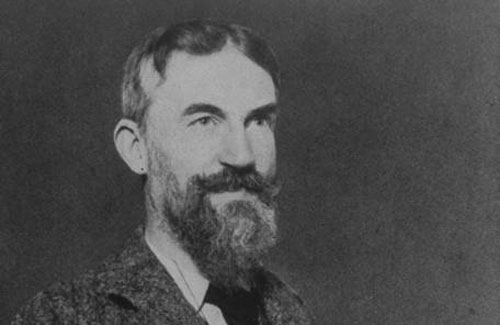
The Opera management of Covent Garden regulates the dress of its male patrons. When is it going to do the same to the women?
On Saturday night I went to the Opera. I wore the costume imposed on me by the regulations of the house. I fully recognize the advantage of those regulations. Evening dress is cheap, simple, durable, prevents rivalry and extravagance on the part of male leaders of fashion, annihilates class distinctions and gives men who are poor and doubtful of their social position (that is, the great majority of men) a sense of security and satisfaction that no clothes of their own choosing could confer, besides saving a whole sex the trouble of considering what they should wear on state occasions. The objections to it are as dust in the balance in the eyes of the ordinary Briton. These objections are that it is colourless; that it involves a whitening process that makes the shirt troublesome, slightly uncomfortable, and seriously unclean; that it acts as a passport for undesirable persons; that it fails to guarantee sobriety, cleanliness, and order on the part of the wearer; and that it reduces to a formula a very vital human habit which should be the subject of constant experiment and active private enterprise. All such objections are thoroughly un-English. They appeal only to an eccentric few, and may be left out of account with the fantastic objections of men like Ruskin, Tennyson, Carlyle, and Morris to tall hats.
But I submit that what is sauce for the gander is sauce for the goose. Every argument that applies to the regulation of the man’s dress applies equally to the regulation of the woman’s. Now let me describe what actually happened to me at the Opera. Not only was I in evening dress by compulsion, but I voluntarily added many graces of conduct as to which the management made no stipulation whatever. I was in my seat in time for the first chord of the overture. I did not chatter during the music nor raise my voice when the Opera was too loud for normal conversation. I did not get up and go out when the statue music began. My language was fairly moderate considering the number and nature of the improvements on Mozart volunteered by Signor Caruso, and the respectful ignorance of dramatic points of the score exhibited by the conductor and stage manager- if there is such a functionary at Covent Garden. In short, my behavior was exemplary.
At 9 o’clock (the Opera began at 8) a lady came in and sat down very conspicuously in my line of sight. She remained there until the beginning of the last act. I do not complain of her coming late and going early; on the contrary, I wish she had come later and gone earlier. For this lady, who had very black hair, had stuck over her right ear the pitiable corpse of a large white bird, which looked exactly if someone had killed it by stamping on the beast, and then nailed it to the lady’s temple, which was presumably of sufficient solidity to bear the operation. I am not, I hope, a morbidly squeamish person; but the spectacle sickened me. I presume that if I had presented myself at the doors with a dead snake round my neck, a collection of black beetles pinned to my shirtfront, and a grouse in my hair, I should have been refused admission. Why, then is a woman to be allowed to commit such a public outrage? Had the lady been refused admission, as she should have been, she would have soundly rated the tradesman who imposed the disgusting headdress on her under the false pretence that ‘the best people’ wear such things, and withdrawn her custom from him; and thus the root of the evil would be struck at; for your fashionable woman generally allows herself to be dressed according to the taste of a person who she would not let sit down in her presence. I once, in Drury Lane Theatre, sat behind a matinee hat decorated with the two wings of a seagull, artificially reddened at the joints so as to produce the illusion of being freshly plucked from a live bird. But even that lady stopped short of a whole seagull. Both ladies were evidently regarded by their neighbors as ridiculous and vulgar; but that is hardly enough when the offence is one which produces a sensation of physical sickness in persons of normal human sensibility.
I suggest to the Covent Garden authorities that, if they feel bound to protect their subscribers against the dangers of my shocking them with a blue tie, they are at least equally bound to protect me against the danger of a woman shocking me with a dead bird.
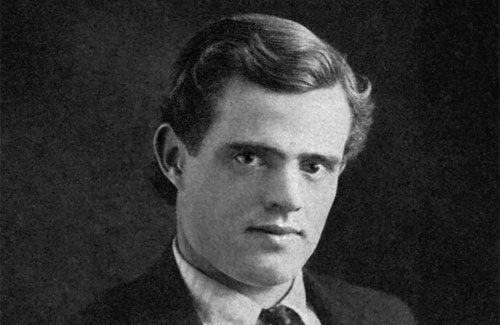
Every time a writer tells the truth about a manuscript (or book), to a friend-author, he loses that friend, or sees that friendship dim and fade away to a ghost of what it was formerly.
Every time a writer tells the truth about a manuscript (or book), to a stranger-author, he makes an enemy.
If the writer loves his friend and fears to lose him, he lies to his friend.
But what’s the good of straining himself to lie to strangers?
And, with like insistence, what’s the good of making enemies anyway?
Furthermore, a known writer is overwhelmed by requests from strangers to read their work and pass judgment upon it. This is properly the work of a literary bureau. A writer is not a literary bureau. If he is foolish enough to become a literary bureau, he will cease to be a writer. He won’t have time to write.
Also, as a charitable literary bureau, he will receive no pay. Wherefore he will soon go bankrupt and himself live upon the charity of friends (if he has not already made them all his enemies by telling them the truth), while he will behold his wife and children went their melancholy way to the poorhouse.
Sympathy for the struggling unknown is all very well. It is beautiful—but there are so many struggling unknowns, something like several millions of them. And sympathy can be worked too hard. Sympathy begins at home. The writer would far rather allow the multitudinous unknowns to remain unknown than to allow his near and dear ones to occupy pauper pallets and potter’s fields.
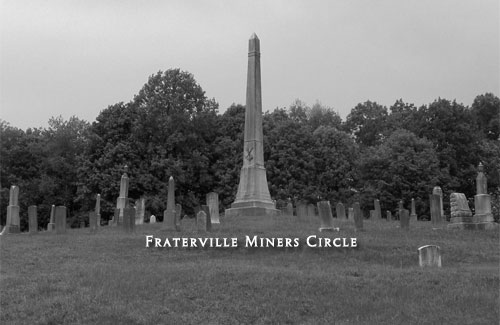
Fraterville, Tennessee Mine Disaster Victim Jacob Vowell’s farewell letter to his wife, Sarah Ellen Vowell His son, Elbert died with him. May 19, 1902
Ellen, darling, goodbye for us both. Elbert said the Lord has saved him. We are all praying for air to support us, but it is getting so bad without any air.
Ellen I want you to live right and come to heaven. Raise the children the best you can. Oh how I wish to be with you, goodbye. Bury me and Elbert in the same grave by little Eddie. Godbye Ellen, goodbye Lily, goodbye Jemmie, goodbye Horace. We are together. Is 25 minutes after two. There is a few of us alive yet.
Jake and Elbert
Oh God for one more breath. Ellen remember me as long as you live Goodbye darling.
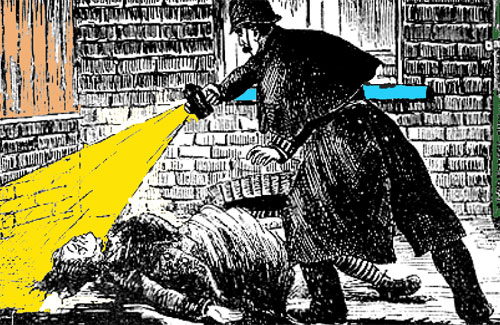
Letters from Jack The Ripper, 1888
Jack The Ripper ‘Dear Boss’ letter September 27, 1888
Dear Boss, I keep on hearing the police have caught me but they wont fix me just yet. I have laughed when they look so clever and talk about being on the right track. That joke about Leather Apron gave me real fits. I am down on whores and I shant quit ripping them till I do get buckled. Grand work the last job was. I gave the lady no time to squeal. How can they catch me now. I love my work and want to start again. You will soon hear of me with my funny little games. I saved some of the proper red stuff in a ginger beer bottle over the last job to write with but it went thick like glue and I cant use it. Red ink is fit enough I hope ha. ha. The next job I do I shall clip the ladys ears off and send to the police officers just for jolly wouldn’t you. Keep this letter back till I do a bit more work, then give it out straight. My knife’s so nice and sharp I want to get to work right away if I get a chance. Good Luck.
Yours truly Jack the Ripper
Dont mind me giving the trade name
PS Wasnt good enough to post this before I got all the red ink off my hands curse it No luck yet. They say I’m a doctor now. ha ha _________________________ Jack The Ripper ‘Saucy Jack’ postcard October 1, 1888
I was not codding dear old Boss when I gave you the tip, you’ll hear about Saucy Jacky’s work tomorrow double event this time number one squealed a bit couldn’t finish straight off. ha not the time to get ears for police. thanks for keeping last letter back till I got to work again.
Jack the Ripper _________________________ Jack The Ripper ‘From Hell’ Letter October 16, 1888
From hell. Mr Lusk, Sor I send you half the Kidne I took from one woman and prasarved it for you tother piece I fried and ate it was very nise. I may send you the bloody knif that took it out if you only wate a whil longer
signed Catch me when you can Mishter Lusk __________________________ Jack The Ripper possible fake letters October 6, 1888
You though your-self very clever I reckon when you informed the police. But you made a mistake if you though I dident see you. Now I known you know me and I see your little game, and I mean to finish you and send your ears to your wife if you show this to the police or help them if you do I will finish you. It no use your trying to get out of my way. Because I have you when you dont expect it and I keep my word as you soon see and rip you up. Yours truly Jack the Ripper.
PS You see I know your address
1888 Beware I shall be at work on the 1st and 2nd inst. in the Minories at 12 midnight and I give the authorities a good chance but there is never a policeman near when I am at work. Yours Jack the Ripper.
1988 What fools the police are. I even give them the name of the street where I am living. Prince William Street.
1888
The Juwes are the men That Will not be Blamed for nothing _________________________ Jack The Ripper (to Dr. Thomas Openshaw) October 29, 1888
Old boss you was rite it was the left kidny i was goin to hoperate agin close to you ospitle just as i was going to dror mi nife along of er bloomin throte them cusses of coppers spoilt the game but i guess i wil be on the jobn soon and will send you another bit of innerds
Jack the Ripper
O have you seen the devle with his mikerscope and scalpul a-lookin at a kidney with a slide cocked up.
Bram Stoker’s Letter to Walt Whitman February 14, 1876
My dear Mr. Whitman.
I hope you will not consider this letter from an utter stranger a liberty. Indeed, I hardly feel a stranger to you, nor is this the first letter that I have written to you. My friend Edward Dowden has told me often that you like new acquaintances or I should rather say friends. And as an old friend I send you an enclosure which may interest you. Four years ago I wrote the enclosed draft of a letter which I intended to copy out and send to you- it has lain in my desk since then- when I heard that you were addressed as Mr. Whitman. It speaks for itself and needs no comment. It is as truly what I wanted to say as that light is light.
The four years which have elapsed have made me love your work fourfold, and I can truly say that I have ever spoken as your friend. You know what hostile criticism your work sometimes evokes here, and I wage a perpetual war with many friends on your behalf. But I am glad to say that I have been the means of making your work known to many who were scoffers at first. The years which have passed have not been uneventful to me, and I have felt and thought and suffered much in them, and I can truly say that from you I have had much pleasure and much consolation- and I do believe that your open earnest speech has not been thrown away on me or that my life and thought fail to be marked with its impress. I write this openly because I feel that with you one must be open. We have just had tonight a hot debate on your genius at the Fortnightly Club in which I had the privilege of putting forward my views- I think with success.
Do not think me cheeky for writing this. I only hope we may sometime meet and I shall be able perhaps to say what I cannot write. Dowden promised to get me a copy of your new edition and I hope that for any other work which you may have you will let me always be an early subscriber. I am sorry that you’re not strong. Many of us are hoping to see you in Ireland. We had arranged to have a meeting for you. I do not know if you like getting letters. If you do I shall only be too happy to send you news of how thought goes among the men I know. With truest wishes for your health and happiness believe me,
Your letters have been most welcome to me- welcome to me as Person and as Author- I don’t know which most- You did well to write me so unconventionally, so fresh, so manly, and so affectionately, too. I too hope (though it is not probable) that we shall one day meet each other. Meantime I send you my friendship and thanks.
Edward Dowden’s letter containing among others your subscription for a copy of my new edition has just been received. I shall send the books very soon by express in a package to his address. I have just written E. D.
My physique is entirely shattered- doubtless permanently, from paralysis and other ailments. But I am up and dressed, and get out every day a little. Live here quite lonesome, but hearty, and good spirits.
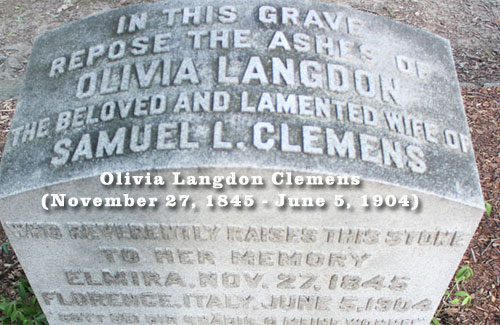
Love Letter from Samuel L. Clemens to Olivia Clemens November 27, 1875
Livy darling,
Six years have gone by since I made my first great success in life and won you, and thirty years have passed since Providence made preparation for that happy success by sending you into the world.
Every day we live together adds to the security of my confidence that we can never any more wish to be separated than that we can ever imagine a regret that we were ever joined. You are dearer to me to-day, my child, than you were upon the last anniversary of this birth-day; you were dearer then than you were a year before—you have grown more and more dear from the first of those anniversaries, and I do not doubt that this precious progression will continue on to the end.
Let us look forward to the coming anniversaries, with their age and their gray hairs without fear and without depression, trusting and believing that the love we bear each other will be sufficient to make them blessed.
So, with abounding affection for you and our babies, I hail this day that brings you matronly grace and dignity of three decades!
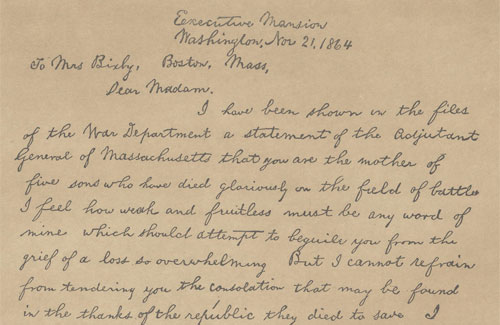
Abraham Lincoln’s letter to Lydia Bixby, who lost 5 sons in the Civil War November 21, 1864
Dear Madam,—I have been shown in the files of the War Department a statement of the Adjutant General of Massachusetts, that you are the mother of five sons who have died gloriously on the field of battle.
I feel how weak and fruitless must be any words of mine which should attempt to beguile you from the grief of a loss so overwhelming. But I cannot refrain from tendering to you the consolation that may be found in the thanks of the Republic they died to save.
I pray that our Heavenly Father may assuage the anguish of your bereavement, and leave you only the cherished memory of the loved and lost, and the solemn pride that must be yours, to have laid so costly a sacrifice upon the altar of Freedom.
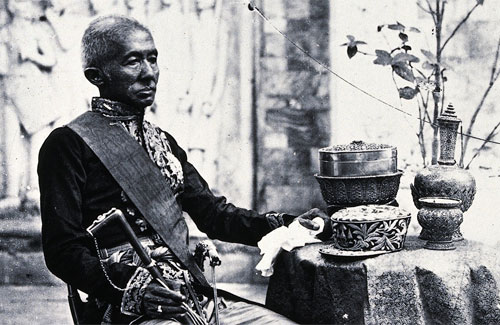
Abraham Lincoln’s Letter to the King of Siam, declining the offer of Elephants to help with the civil war. February 3, 1862
Abraham Lincoln, President of the United States of America.
To His Majesty Somdetch Phra Paramendr Maha Mongut, King of Siam,
Great and Good Friend:
I have received Your Majesty’s two letters of the date of February 14th., 1861.
I have also received in good condition the royal gifts which accompanied those letters, -namely, a sword of costly materials and exquisite workmanship; a photographic likeness of Your Majesty and of Your Majesty’s beloved daughter; and also two elephants’ tusks of length and magnitude such as indicate that they could have belonged only to an animal which was a native of Siam.
Your Majesty’s letters show an understanding that our laws forbid the President from receiving these rich presents as personal treasures. They are therefore accepted in accordance with Your Majesty’s desire as tokens of your good will and friendship for the American People. Congress being now in session at this capital, I have had great pleasure in making known to them this manifestation of Your Majesty’s munificence and kind consideration.
Under their directions the gifts will be placed among the archives of the Government, where they will remain perpetually as tokens of mutual esteem and pacific dispositions more honorable to both nations than any trophies of conquest could be.
I appreciate most highly Your Majesty’s tender of good offices in forwarding to this Government a stock from which a supply of elephants might be raised on our own soil. This Government would not hesitate to avail itself of so generous an offer if the object were one which could be made practically useful in the present condition of the United States.
Our political jurisdiction, however, does not reach a latitude so low as to favor the multiplication of the elephant, and steam on land, as well as on water, has been our best and most efficient agent of transportation in internal commerce.
I shall have occasion at no distant day to transmit to Your Majesty some token of indication of the high sense which this Government entertains of Your Majesty’s friendship.
Meantime, wishing for Your Majesty a long and happy life, and for the generous and emulous People of Siam the highest possible prosperity, I commend both to the blessing of Almighty God.
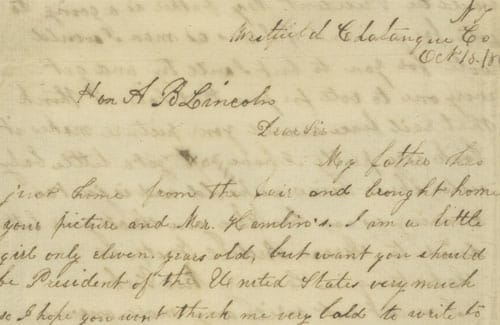
11 year-old Grace Bedell’s letter to Abraham Lincoln, advising him to grow a beard October 18, 1860
Dear Sir
My father has just home from the fair and brought home your picture and Mr. Hamlin’s. I am a little girl only eleven years old, but want you should be President of the United States very much so I hope you wont think me very bold to write to such a great man as you are. Have you any little girls about as large as I am if so give them my love and tell her to write to me if you cannot answer this letter. I have got 4 brothers and part of them will vote for you any way and if you let your whiskers grow I will try and get the rest of them to vote for you you would look a great deal better for your face is so thin. All the ladies like whiskers and they would tease their husbands to vote for you and then you would be President. My father is going to vote for you and if I was a man I would vote for you too but I will try and get every one to vote for you that I can. I think that rail fence around your picture makes it look very pretty. I have got a little baby sister she is nine weeks old and is just as cunning as can be. When you direct your letter direct to Grace Bedell Westfield Chatauque County New York. I must not write any more answer this letter right off Good bye. Grace Bedell
________________________________
Abraham Lincolns’ Response to Grace Bedell
Miss. Grace Bedell My dear little Miss. Your very agreeable letter of the 15th is received. I regret the necessity of saying I have no daughters. I have three sons — one seventeen, one nine, and one seven, years of age. They, with their mother, constitute my whole family.
As to the whiskers, having never worn any, do you not think people would call it a piece of silly affection if I were to begin it now?
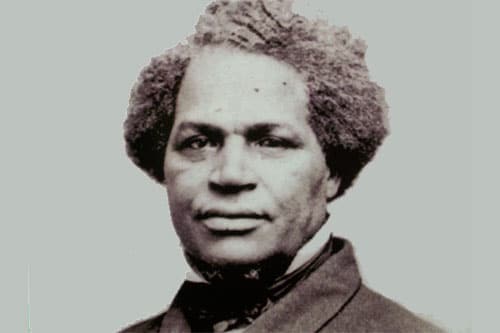
Sarah Lougue’s letter to her runaway slave Jermain Wesley Logan (Jarm Logue)
His response is included below.
February 20th, 1860.
To JARM:-
I now take my pen to write you a few lines, to let you know how well we all are. I am a cripple, but I am still able to get about. The rest of the family are all well. Cherry is as well as Common. I write you these lines to let you the situation we are in—partly in consequence of your running away and stealing Old Rock, our fine mare. Though we got the mare back, she was never worth much after you took her; and as I now stand in need of some funds, I have determined to sell you; and I have had an offer for you, but did not see fit to take it. If you will send me one thousand dollars and pay for the old mare, I will give up all claim I have to you. Write to me as soon as you get these lines, and let me know if you will accept my proposition. In consequence of your running away, we had to sell Abe and Ann and twelve acres of land; and I want you to send me the money that I may be able to redeem the land that you was the cause of our selling, and on receipt of the above named sum of money, I will send you your bill of sale. If you do not comply with my request, I will sell you to some one else, and you may rest assured that the time is not far distant when things will be changed with you. Write to me as soon as you get these lines. Direct your letter to Bigbyville, Maury County, Tennessee. You had better comply with my request.
I understand that you are a preacher. As the Southern people are so bad, you had better come and preach to your old acquaintances. I would like to know if you read your Bible? If so can you tell what will become of the thief if he does not repent? and, if the the blind lead the blind, what will the consequence be? I deem it unnecessary to say much more at present. A word to the wise is sufficient. You know where the liar has his part. You know that we reared you as we reared our own children; that you was never abused, and that shortly before you ran away, when your master asked if you would like to be sold, you said you would not leave him to go with anybody.
Sarah Logue.
Jermain Wesley Logan’s response to Sarah Logue
March 28, 1860.
MRS. SARAH LOGUE-
Yours of the 20th of February is duly received, and I thank you for it. It is a long time since I heard from my poor old mother, and I am glad to know she is yet alive, and, as you say, “as well as common.” What that means I don’t know. I wish you had said more about her.
You are a woman; but had you a woman’s heart you could never have insulted a brother by telling him you sold his only remaining brother and sister, because he put himself beyond your power to convert him into money.
You sold my brother and sister, ABE and ANN, and 12 acres of land, you say, because I ran away. Now you have the unutterable meanness to ask me to return and be your miserable chattel, or in lieu thereof send you $1000 to enable you to redeem the land, but not to redeem my poor brother and sister! If I were to send you money it would be to get my brother and sister, and not that you should get land. You say you are a cripple, and doubtless you say it to stir my pity, for you know I was susceptible in that direction. I do pity you from the bottom of my heart. Nevertheless I am indignant beyond the power of words to express, that you should be so sunken and cruel as to tear the hearts I love so much all in pieces; that you should be willing to impale and crucify us out of all compassion for your poor foot or leg. Wretched woman! Be it known to you that I value my freedom, to say nothing of my mother, brothers and sisters, more than your whole body; more, indeed, than my own life; more than all the lives of all the slaveholders and tyrants under Heaven.
You say you have offers to buy me, and that you shall sell me if I do not send you $1000, and in the same breath and almost in the same sentence, you say, “you know we raised you as we did our own children.” Woman, did you raise your own children for the market? Did you raise them for the whipping-post? Did you raise them to be driven off in a coffle in chains? Where are my poor bleeding brothers and sisters? Can you tell? Who was it that sent them off into sugar and cotton fields, to be kicked, and cuffed, and whipped, and to groan and die; and where no kin can hear their groans, or attend and sympathize at their dying bed, or follow in their funeral? Wretched woman! Do you say you did not do it? Then I reply, your husband did, and you approved the deed- and the very letter you sent me shows that your heart approves it all. Shame on you.
But, by the way, where is your husband? You don’t speak of him. I infer, therefore, that he is dead; that he has gone to his great account, with all his sins against my poor family upon his head. Poor man! gone to meet the spirits of my poor, outraged and murdered people, in a world where Liberty and Justice are MASTERS.
But you say I am a thief, because I took the old mare along with me. Have you got to learn that I had a better right to the old mare, as you call her, than MANNASSETH LOGUE had to me? Is it a greater sin for me to steal his horse, than it was for him to rob my mother’s cradle and steal me? If he and you infer that I forfeit all my rights to you, shall not I infer that you forfeit all your rights to me? Have you got to learn that human rights are mutual and reciprocal, and if you take my liberty and life, you forfeit your own liberty and life? Before God and High Heaven, is there a law for one man which is not a law for every other man?
If you or any other speculator on my body and rights, wish to know how I regard my rights, they need but come here and lay their hands on me to enslave me. Did you think to terrify me by presenting the alternative to give my money to you, or give my body to Slavery? Then let me say to you, that I meet the proposition with unutterable scorn and contempt. The proposition is an outrage and an insult. I will not budge one hair’s breadth. I will not breathe a shorter breath, even to save me from your persecutions. I stand among a free people, who, I thank God, sympathize with my rights, and the rights of mankind; and if your emissaries and venders come here to re-enslave me, and escape the unshrinking vigor of my own right arm, I trust my strong and brave friends, in this City and State, will be my rescuers and avengers.
Charles Lamb’s letter to Bernard Barton, regarding his cold
January 9th, 1824
Dear B.B.-
Do you know what it is to succumb under an insurmountable day-mare,- “a whoreson lethargy,” Falstaff calls it, -an indisposition to do anything, or to be anything, -a total deadness and distaste,-a suspension of vitality, -an indifference to locality,- a numb, soporifical, good-for-nothingness, -an ossification all over,- an oyster-like insensibility to the passing events, -a mind-stupor,- a brawny defiance to the needles of a thrusting-in conscience. Did you ever have a very bad cold, with a total irresolution to submit to water-gruel processes? This has been for many weeks my lot, and my excuse; my fingers drag heavily over this paper, and to my thinking it is three-and-twenty furlongs from here to the end of this demi-sheet.
I have not a thing to say; nothing is of more importance than another; I am flatter than a denial or a pancake; emptier than Judge Parke’s wig when the head is in it; duller than a country stage when the actors are off it; a cipher, an o! I acknowledge life at all, only by an occasional convulsional cough, and a permanent phlegmatic pain in the chest. I am weary of the world; life is weary of me. My day is gone into twilight, and I don’t think it worth the expense of candles. My wick hath a thief in it, but I can’t muster courage to snuff it.
I inhale suffocation; I can’t distinguish veal from mutton; nothing interests me. ‘Tis twelve o’clock, and Thurtell is just now coming out upon the New Drop, Jack Ketch alertly tucking up his greasy sleeves to do the last office of mortality, yet cannot I elicit a groan or a moral reflection. If you told me the world will be at an end to-morrow, I should just say, “Will it?” I have not volition enough left to dot my i’s, much less to comb my eyebrows; my eyes are set in my head; my brains are gone out to see a poor relation in Moorfields, and they did not say when they’d come back again; my skull is a Grub-street attic to let- not so much as a joint-stool or a crack’d jordan left in it; my hand writes, not I, from habit, as chickens run about a little, when their heads are off. O for a vigorous fit of gout, cholic, toothache, -an earwig in my auditory, a fly in my visual organs; pain is life- the sharper, the more evidence of life; but this apathy, this death!
Did you ever have an obstinate cold, a six or seven weeks’ unintermitting chill and suspension of hope, fear, conscience, and everything? Yet do I try all I can to cure it; I try wine, and spirits, and smoking, and snuff in unsparing quantities, but they all only seem to make me worse, instead of better. I sleep in a damp room, but it does me no good; I come home late o’nights, but do not find any visible amendment! Who shall deliver me from the body of this death?
It is just fifteen minutes after twelve; Thurtell is by this time a good way on his journey, baiting at Scorpion perhaps; Ketch is bargaining for his cast coat and waistcoat; and the Jew demurs at first at three half-crowns, but on consideration that he may get somewhat by showing ’em in the town, finally closes.
Sydney Smith’s Letter to Lady Georgiana Morpeth February 16, 1820
Dear Lady Georgiana,
Nobody has suffered more from low spirits than I have done- so I feel for you.
1st. Live as well as you dare. 2nd. Go into the shower-bath with a small quantity of water at a temperature low enough to give you a slight sensation of cold, 75° or 80°. 3rd. Amusing books. 4th. Short views of human life- not further than dinner or tea. 5th. Be as busy as you can. 6th. See as much as you can of those friends who respect and like you. 7th. And of those acquaintances who amuse you. 8th. Make no secret of low spirits to your friends, but talk of them freely- they are always worse for dignified concealment. 9th. Attend to the effects tea and coffee produce upon you. 10th. Compare your lot with that of other people. 11th. Don’t expect too much from human life- a sorry business at the best. 12th. Avoid poetry, dramatic representations (except comedy), music, serious novels, melancholy sentimental people, and every thing likely to excite feeling or emotion not ending in active benevolence. 13th. Do good, and endeavour to please everybody of every degree. 14th. Be as much as you can in the open air without fatigue. 15th. Make the room where you commonly sit, gay and pleasant. 16th. Struggle by little and little against idleness. 17th. Don’t be too severe upon yourself, or underrate yourself, but do yourself justice. 18th. Keep good blazing fires. 19th. Be firm and constant in the exercise of rational religion. 20th. Believe me, dear Georgiana, your devoted servant, Sydney Smith
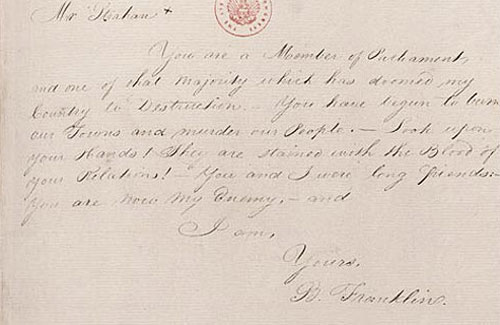
Benjamin Franklin’s Letter to William Strahan July 5, 1775
Mr. Strahan
You are a Member of Parliament, and one of that Majority which has doomed my Country to Destruction. You have begun to burn our Towns and murder our People. — Look upon your hands! They are stained with the Blood of your Relations! — You and I were long Friends:— You are now my Enemy, — and
I am,
Yours.
B. Franklin
{% if featuredImage and featuredImage != "" %}
{% endif %}
{% if excerpt %}