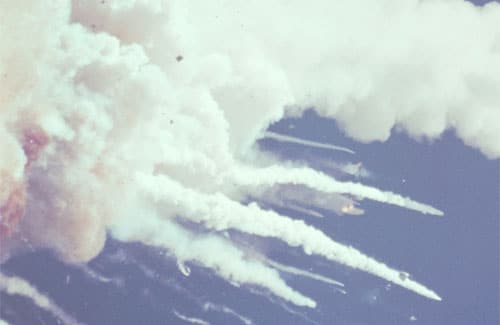
Address to the Nation on the Challenger by Ronald Reagan, on January 28, 1986, in Washington, DC
Ladies and Gentlemen, I’d planned to speak to you tonight to report on the state of the Union, but the events of earlier today have led me to change those plans. Today is a day for mourning and remembering. Nancy and I are pained to the core by the tragedy of the shuttle Challenger. We know we share this pain with all of the people of our country. This is truly a national loss.
Nineteen years ago, almost to the day, we lost three astronauts in a terrible accident on the ground. But, we’ve never lost an astronaut in flight; we’ve never had a tragedy like this. And perhaps we’ve forgotten the courage it took for the crew of the shuttle; but they, the Challenger Seven, were aware of the dangers, but overcame them and did their jobs brilliantly. We mourn seven heroes: Michael Smith, Dick Scobee, Judith Resnik, Ronald McNair, Ellison Onizuka, Gregory Jarvis, and Christa McAuliffe. We mourn their loss as a nation together.
For the families of the seven, we cannot bear, as you do, the full impact of this tragedy. But we feel the loss, and we’re thinking about you so very much. Your loved ones were daring and brave, and they had that special grace, that special spirit that says, ‘Give me a challenge and I’ll meet it with joy.’ They had a hunger to explore the universe and discover its truths. They wished to serve, and they did. They served all of us.
We’ve grown used to wonders in this century. It’s hard to dazzle us. But for twenty-five years the United States space program has been doing just that. We’ve grown used to the idea of space, and perhaps we forget that we’ve only just begun. We’re still pioneers. They, the members of the Challenger crew, were pioneers.
And I want to say something to the schoolchildren of America who were watching the live coverage of the shuttle’s takeoff. I know it is hard to understand, but sometimes painful things like this happen. It’s all part of the process of exploration and discovery. It’s all part of taking a chance and expanding man’s horizons. The future doesn’t belong to the fainthearted; it belongs to the brave. The Challenger crew was pulling us into the future, and we’ll continue to follow them.
I’ve always had great faith in and respect for our space program, and what happened today does nothing to diminish it. We don’t hide our space program. We don’t keep secrets and cover things up. We do it all up front and in public. That’s the way freedom is, and we wouldn’t change it for a minute. We’ll continue our quest in space. There will be more shuttle flights and more shuttle crews and, yes, more volunteers, more civilians, more teachers in space. Nothing ends here; our hopes and our journeys continue. I want to add that I wish I could talk to every man and woman who works for NASA or who worked on this mission and tell them: “Your dedication and professionalism have moved and impressed us for decades. And we know of your anguish. We share it.”
There’s a coincidence today. On this day 390 years ago, the great explorer Sir Francis Drake died aboard ship off the coast of Panama. In his lifetime the great frontiers were the oceans, and a historian later said, ‘He lived by the sea, died on it, and was buried in it.’ Well, today we can say of the Challenger crew: Their dedication was, like Drake’s, complete.
The crew of the space shuttle Challenger honoured us by the manner in which they lived their lives. We will never forget them, nor the last time we saw them, this morning, as they prepared for the journey and waved goodbye and ‘slipped the surly bonds of earth’ to ‘touch the face of God.’
Way back in 1963, while stationed on board the USS Piper, we pulled into the port of Djibouti, Africa as one of our scheduled Med cruise port calls. Djibouti, is a country located in the Horn of Africa in East Africa. It is bordered by Somalia in the south, Ethiopia in the south and west, Eritrea in the north, and the Red Sea and the Gulf of Aden in the east. Due to it’s history of French colonization, the country still had a big racial divide between the very poor Black population and the rich White Europeans. For example, Blacks were not allowed into the better hotels unless hey worked there as servants. As a result, the only place for a Black U. S. Navy sailor to party was in one of the interracial bars in the native section of the city. White tourists were afraid to go there.
Standing topside watch while moored along side the pier usually drew a crowd of native dock workers who were amused to see a Black man carrying a rifle, a side arm, and a baton, seemingly just strutting around while White guys did all the physical labor. and I did play this up somewhat , being the only Black in my crew, by harassing our all White deck crew doing the usual paint chipping and painting we did during every port call. Once or twice during my rounds, I’d walk over and tap one of my shipmates on the head with my baton which would draw a big round of applause from my audience.
My mentor, Beetle Bailey, the senior first class engineman, was a huge person with the temperament of a lamb. Beetle took me under his wing from the moment I reported on board and taught me all I needed to qualify as a diesel engine throttleman. Beetle also took to calling me his little “spear chukker”, to which I would just call him a stupid honky. We often exchanged racial slurs. I had decided early on that I would not go through life with a chip on my shoulder and as long as the jokes were meant to be humorous and not derogatory, I would simply respond in kind. However, I did let it be known that there was a thin line that shouldn’t be crossed and in fact did go after one of my shipmates with a jacking wrench when he crossed that line.
But in response to Beetle’s calling me his little spear chukker, I found a souvenir shop in town and purchased a twelve foot native spear, although a reproduction and not authentic. Since our only mode of transport around town was either taxi or motor scooter, I rented a Lumbretta scooter to get back to the boat. I guess the European tourist were pretty amazed to see a navy sailor in uniform, a Black navy sailor, riding a moped and carrying a twelve foot spear. I hung that spear in the forward engine room over the number one main engine where it hung long after I had transferred and up until the day Piper was decommissioned.
One day, we had to move the boat so a U. S Navy destroyer, the USS Bigelow could moor alongside the dock. We had to move since the Bigelow was the senior ship as as the senior ship could moor directly to the pier. While we were moored in Djibouti, we needed to refuel. Now the old diesel submarines used fuel ballast tanks to maintain a stable ballast. As the fuel in the tanks was used, it would be replaced with sea water. When fueling, we take on diesel fuel into the tank that would in turn push the sea water out through an overboard pipe that had a sight glass. The sight glass going black meant that the fuel tank was full to the brim and would soon be going overboard into the harbor which would be a no no. So, as we fueled, someone would have to sit topside watching the sight glass to notify the men below to stop transferring fuel.
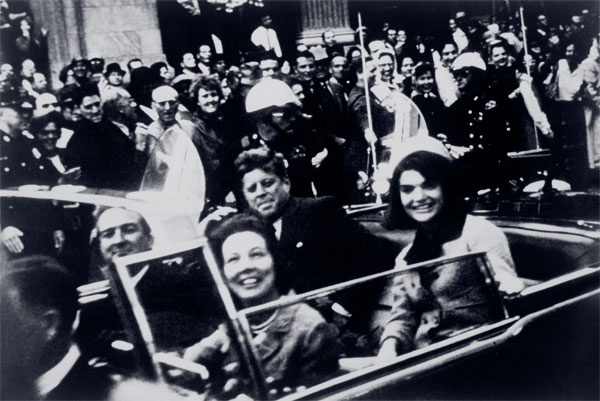
This night, as we sat alongside the Bigelow, performing our fueling operations, the night was peaceful and quiet until alarms started going on all over the Bigelow. Some sailor in a drunken stupor had climbed the Bigelow’s radar mast and got instantly fried. We were all wondering what the heck had happened. The Bigelow had lit up all of a sudden and we watched men scrambling all over her decks, some crying “Oh my God”. One of our crew came rushing back to the boat and said “The president’s dead. The president’s dead… Somebody killed JFK”.
This sent shock waves through the Piper also as some guys went through the boat turning on the lights and waking people up. We were all in shock. Were we going to war? Our radioman was in town getting drunk like all radiomen did in those days, there was no internet, email, cell phones, and diesel submarines didn’t carry televisions. The only info we received until our radioman got back was all second hand from the guys on the destroyer who didn’t know much more than we did. That was November 22, 1963.
Country music star Patsy Cline died in a plane crash in 1963, along with fellow musicians Hawkshaw Hawkins, Cowboy Copas, and pilot Randy Hughes.
On March 5, 1963, Patsy Cline, Hawkshaw Hawkins, and Cowboy Copas were traveling from Kansas City, Kansas, to Nashville, Tennessee, after performing at a benefit concert. The group was flying in a single-engine Piper Comanche aircraft, piloted by Randy Hughes, Cline’s manager and Cowboy Copas’ son-in-law. Due to inclement weather, the flight encountered difficulties and ultimately crashed near Camden, Tennessee.
Patsy Cline, born Virginia Patterson Hensley, was a leading figure in the country music scene, known for her rich, emotive voice and a string of hits, including “Crazy,” “I Fall to Pieces,” and “Sweet Dreams.” At the time of her death, she was only 30 years old and was already a member of the Grand Ole Opry, a prestigious weekly country music stage concert in Nashville.
Hawkshaw Hawkins and Cowboy Copas were also well-known country music artists. Hawkins was best known for his hits “Lonesome 7-7203” and “Slow Poke,” while Copas gained fame for songs like “Signed, Sealed, and Delivered” and “Tennessee Waltz.”
The tragic plane crash deeply impacted the country music community, and Cline’s death marked the end of an era in the genre. Patsy Cline’s influence on the country and pop music scenes, however, continues to be felt, and she remains an enduring icon of American music history.
I was only three years old when my mother and father separated and divorced, so I never knew very much about my dad except that he was a strong person with a short temper. He came to visit us a few times as I was growing up until the last time I saw him he was in the VA hospital. I knew he had been a sergeant in the army and had fought in World War Two. Given the state of photography back in the 50s, we didn’t take many pictures, so I don’t have a photograph of him.
As I grew older and realized that life wasn’t easy for Black men in the fifties, especially those who had been in combat. They may have been gallant warriors over in Europe, but back home, they were just ordinary Negroes.
Over the years, my mom never said a bad word about him., he was just gone from our lives. My mom never remarried.
One day, browsing the internet, I goggled his name only to find his obituary. Having been in combat, and much older, I realized that there was a lot that I didn’t know about him, but wanted to know. I knew that he wasn’t a bad person, but had been changed by what he had experienced. Combat changes people. He was one of those forgotten Black soldiers that landed on Normandy on D-Day and served all the way from France and into Germany.
So, one day, I gathered all the information I could find and contacted the Army.
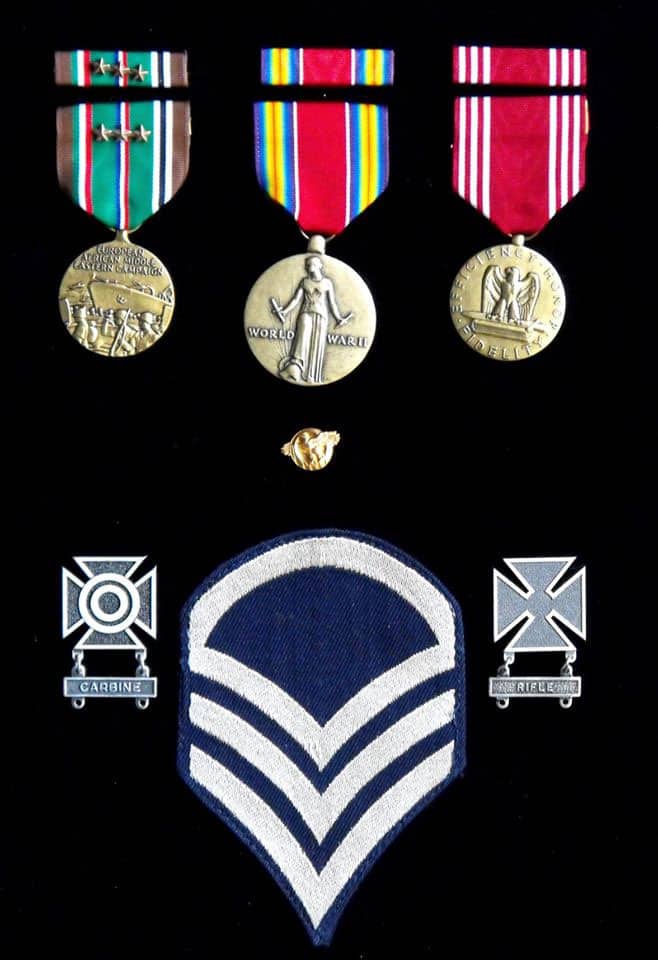
A few weeks later, I received a package with all the medals he had earned. during the war. Needless to say, even though I never really knew him, I am extremely proud to be his son. He was a true American hero.
Joseph Stalin, born Ioseb Besarionis Jughashvili, born December 6, 1878, was the leader of the Soviet Union from the mid-1920s until his death in 1953. He played a prominent role in the early years of the Soviet state and was a key figure during World War II, leading the USSR to victory against Nazi Germany. Despite his contributions to the war effort, Stalin’s rule was marked by widespread repression, mass incarceration, and executions.
Details:
On March 1, 1953, Stalin was found unconscious in his dacha (a country house) outside Moscow. He had suffered a massive stroke, and despite receiving medical attention, he died on March 5, 1953, at 74. It is widely believed that Stalin’s death was due to natural causes, although there has been some speculation over the years about possible foul play. Regardless of the cause, his death marked the end of an era for the Soviet Union and the beginning of a power struggle among his successors.
Stalin’s body was embalmed and placed on public display alongside Vladimir Lenin’s body in the Lenin Mausoleum in Red Square, Moscow. However, in 1961, during de-Stalinization, Stalin’s body was removed from the Mausoleum and buried near the Kremlin Wall.
Stalin was nominated for the Nobel Peace Prize twice, in 1945 and 1948, but never won the award.
Effects on Pop Culture: Stalin’s death and the subsequent power struggle within the Soviet Union inspired various works of fiction, such as the 1956 novel “The Thaw” by Ilya Ehrenburg and the 2017 film “The Death of Stalin” directed by Armando Iannucci. These works generally portray the intrigue and chaos that ensued in the USSR after Stalin’s death. Furthermore, the figure of Stalin remains a subject of fascination in both popular culture and academia, with numerous biographies and historical studies examining his life and rule.
Prominent People and Countries Involved:
Lavrentiy Beria: As the head of the secret police (NKVD) under Stalin, Beria was involved in the Great Purge and was responsible for numerous atrocities. After Stalin’s death, he was initially part of the ruling troika but was arrested and executed in December 1953.
Nikita Khrushchev: Khrushchev emerged as the leader of the Soviet Union after a power struggle with other high-ranking officials. He initiated the process of de-Stalinization, criticizing Stalin’s policies and practices during a secret speech in 1956 at the 20th Congress of the Communist Party of the Soviet Union.
Georgy Malenkov: Another key figure in the power struggle, Malenkov briefly served as the Premier of the Soviet Union from 1953 to 1955 before being replaced by Khrushchev.
The United States: The death of Stalin contributed to a brief thaw in Cold War tensions between the USSR and the US. However, the power struggle within the Soviet Union and Khrushchev’s rise to power soon renewed the rivalry between the two superpowers.
The death of Joseph Stalin marked the end of an era for the Soviet Union, leading to a power struggle, a brief thaw in the Cold War, and changes in domestic and foreign policies. Stalin’s death and the subsequent events have had a lasting impact on history and pop culture, with various works of fiction and non-fiction exploring the consequences of his rule and the turmoil that followed his death.
Bandleader Glenn Miller Disappeared Over The English Channel
American Army bandleader Glenn Miller (March 1, 1904 – December 15, 1944) was known not only for his conducting skills but also for a peculiar disappearance around Christmas Time.
The 40-year-old was on a flight on December 15th, 1944, from England to France. He never arrived and instead is speculated to have crashed somewhere over the English Channel due to inclement weather. Initially, Miller was supposed to fly to France on an authorized Army aircraft but instead flew with a friend of his on a small plane. Army officials did not realize this until it was too late and are often blamed for Miller’s disappearance.
A missing-aircrew report was filed on December 16th but the news didn’t break until Christmas Eve that America’s beloved bandleader who’s show tunes entered the hearts of audiences throughout the war, was missing.
The news shocked many but gave little time for reaction since the Battle of The Bulge on Christmas Eve in Belgium and France.
Miller’s band members knew something had happened to their leader when he didn’t show up in Paris to conduct. His band members, labeled the best of their time, were devastated and furious with those who hadn’t kept track of his flight activity.
Also on the plane was Lieutenant Colonel Francis Norman Baessell, as well as the pilot, John R.S. Morgan. As mentioned, Miller wasn’t authorized initially to travel on that plane but wanted a quicker trip to Paris. Miller’s whereabouts are still unknown as his body, as well as the bodies of the accompanying passengers, were never found. He would be 117 today.
Still, Miller’s story is known as one of the great American mysteries. Many still honor his legacy around the holidays by playing his classic tunes including In The Mood, Moonlight Serenade, A String of Pearls, and many more.
His disappearance is associated with those the deaths of Buddy Holly, John Lennon, and later Michael Jackson. Miller is gone but not forgotten. His music comforted and brought hope to many during the war and still serves as a jazz classic today, soothing audiences around the world.
Admiral Isoroku Yamamoto was a Japanese naval officer and the commander-in-chief of the Combined Fleet during World War II. He was responsible for planning and executing the surprise attack on Pearl Harbor on December 7, 1941, which led to the United States’ entry into the war. Yamamoto was widely respected for his strategic acumen, and his death was a significant blow to the Japanese war effort.
On April 14, 1943, U.S. intelligence intercepted and decrypted a message detailing Yamamoto’s planned inspection tour of Japanese bases in the Solomon Islands. In response, the U.S. launched Operation Vengeance, a mission to intercept and shoot down Yamamoto’s plane.
On April 18, 1943, Yamamoto boarded a Mitsubishi G4M bomber, accompanied by six Mitsubishi A6M Zero fighters, for his inspection tour. A squadron of 18 U.S. P-38 Lightning fighters, led by Major John Mitchell and including Lieutenant Rex T. Barber, was dispatched to intercept the Japanese aircraft.
The American squadron successfully located and attacked Yamamoto’s plane over Bougainville Island. Lt. Barber is credited with firing the shots that downed Yamamoto’s aircraft, which crashed into the jungle, killing Yamamoto and all other passengers on board.
Effects on Pop Culture:
The assassination of Admiral Isoroku Yamamoto has been the subject of several films and documentaries, such as the 1970 Japanese film “Rengo kantai shirei chokan: Yamamoto Isoroku” (Admiral Yamamoto) and the 2011 Japanese film “Isoroku” (The Admiral).
Yamamoto’s life and death have also been portrayed in various books, including “Yamamoto Isoroku: Nihon no gunkan” (Yamamoto Isoroku: The Japanese Battleship) by Zenji Orita and “Yamamoto Isoroku: Nihon no umi” (Yamamoto Isoroku: The Japanese Sea) by Hiroyuki Agawa.
Prominent People and Countries Involved:
Admiral Isoroku Yamamoto: As the commander-in-chief of the Combined Fleet, Yamamoto played a crucial role in Japan’s naval strategy during World War II. His death weakened Japan’s military leadership and morale.
United States: The U.S. intelligence community’s decryption of Yamamoto’s itinerary allowed them to plan and execute Operation Vengeance, leading to Yamamoto’s assassination.
Lieutenant Rex T. Barber: A U.S. fighter pilot, Barber is credited with firing the shots that downed Yamamoto’s plane, resulting in the admiral’s death.
The assassination of Admiral Isoroku Yamamoto took place on April 18, 1943, when U.S. forces intercepted and shot down his plane over Bougainville Island. Yamamoto’s death dealt a significant blow to the Japanese war effort, as he was a highly respected strategist and commander. The event has been depicted in several films and books, reflecting its significance in World War II history.
Do not stand at my grave and weep I am not there. I do not sleep. I am a thousand winds that blow. I am the diamond glints on snow. I am the sunlight on ripened grain. I am the gentle autumn rain. When you awaken in the morning’s hush I am the swift uplifting rush Of quiet birds in circled flight. I am the soft stars that shine at night. Do not stand at my grave and cry; I am not there. I did not die.
By Mary Elizabeth Frye (November 13, 1905 – September 15, 2004) was an American housewife and florist, best known as the author of the poem Do not stand at my grave and weep, written in 1932. She was born in Dayton, Ohio, United States, and was orphaned at the age of three. She moved to Baltimore, Maryland, when she was twelve. She was an avid reader with a remarkable memory. She married Claud Frye, who ran a clothing business, while she grew and sold flowers. The 12 line poem for which she became famous was originally written on a brown paper shopping bag and she never published or copyrighted the poem. In 1995, a BBC poll found that the poem “became the nation’s favorite poem”.
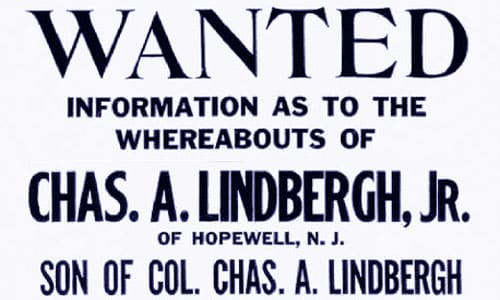
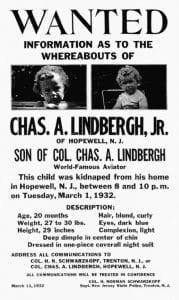
It was on the evening of March 1, 1932, that one of the nation’s biggest mysteries and scandals occurred. World-famous aviator Colonel Charles Lindbergh and his wife had put their 20-month old son Charles Augustus Lindbergh, Jr. to bed in his upstairs nursery and within hours a nurse who went to check-in on the baby discovered him to be missing.
All evidence supported that the baby had been kidnapped and as police investigated Lindbergh’s home, the discovered muddy footprints in the nursery, the window in the nursery wide-open, and a cryptic ransom note left on the windowsill that demanded $50,000 for the safe return of the baby. The police thoroughly searched the grounds of the Lindbergh estate and came up empty-handed. All that they were able to discover was a home-made ladder that they believe someone used to climb to the second-story window to nab baby Charlie, as there were also scrape marks discovered on the outside of the home next to the nursery window.
It was the first time the Lindberghs were at their new home on a Tuesday night in the middle of the week. The house was not quite finished, so the family only came on weekends. They spent weekdays at Anne’s family’s estate in Englewood, New Jersey. But Charlie had a cold, and Anne didn’t want him to travel. So how did the kidnappers know they’d even be here that night?
The ransom note was very crudely written with many misspellings which led the police to believe that the individual that kidnapped baby Charles most likely had to be a recent immigrant. The note also urged the Lindbergh’s not to involve the police as there would be trouble as a result.
Colonel Lindbergh asked friends to communicate with the kidnappers, and they made widespread appeals for the kidnappers to start negotiations. A second ransom note was received by Colonel Lindbergh on March 6, 1932, (postmarked Brooklyn, New York, March 4), in which the ransom demand was increased to $70,000.
About nine days after the kidnapping of baby Charles a 72-year-old retired teacher from the Bronx named Dr. John Condon called the Lindberghs and claimed that he had written a letter to the “Bronx Home News” offering to act as an intermediary between Lindbergh and the kidnapper. The story got the attention of the kidnapper who contacted Condon and in a move of desperation to get his son back alive, Lindbergh agreed to allow Condon to works as an intermediary and kept the police out of the situation.
A month later on April 2, 1932, Dr. Condon delivered the ransom money of gold certificates (serial numbers recorded by the police) to a man at St. Raymond’s Cemetery, while Lindbergh waited in a nearby car. The man referred to as Cemetery John took the money, but failed to deliver the baby safe and sound. He instead handed Dr. Condon a note that revealed the baby’s alleged location, which was on a boat called the Nelly. Unfortunately, no boat or baby was located in the area that Cemetery John described.
Finally on May 12, 1932, nearly three months after the kidnapping of baby Charles, a truck driver found the baby’s decomposed body in the woods a few miles from the Lindbergh estate. Police claim that the baby had been dead since the night of the kidnapping and had a fractured skull which may have occurred because he was dropped when the kidnapper was attempting to climb back down the ladder. However, there are some discrepancies in the police report describing the baby’s injuries and some do not match those that would occur during an accidental fall. There was a clear fracture line on the left side of the baby’s head, and on the right side of the head, there was a round defect behind the right ear.
The police claim the injury to the right side of the head occurred when an officer who was trying to exhume the baby’s remains accidentally poked a hole in his skull with a stick, and thus created the round, impact-like injury on the right side. However many medical experts claim that a stick would not create enough force to break through the baby’s skull and some people began to suspect the baby was murdered rather than dying accidentally after the fall. The evidence supports the theory that the Lindbergh baby was killed intentionally by the kidnapper and the ransom notes claiming he was alive was only part of a ruse to receive higher amounts of money from the family.
For two years the police and FBI kept close tabs on the serial numbers associated with the ransom money that was given to Cemetery John, just waiting to see if it would pop up anywhere and they could arrest a suspect. In 1934, one of the gold certificates showed up at a gas station in New York. Thanks to the suspicions of the gas station attendant, who was worried the gold certificate might be counterfeit and wrote down a license plate number, the police were able to track the gold certificate back to an illegal German immigrant named Bruno Richard Hauptmann.
The police discovered that Hauptmann had a past criminal record, which of all things included using a ladder to climb into the second-story window of a home to steal money and watches. Police searched Hauptmann’s home and found $14,000 of the Lindbergh ransom money hidden in his garage. They also discovered missing floorboards in Hauptmann attic which matched the wood used to build the home-made ladder discovered on the Lindbergh property.
Hauptmann was arrested on September 19, 1934, and tried for murder beginning on January 2, 1935. While Hauptmann maintained his innocence, the evidence in the case was stacked against him. Not only was there the wood from the ladder, but a writing sample from Hauptmann matched the ransom note. There was also a witness that claimed to have seen Hauptmann on the Lindbergh property the day before the crime occurred. Both Lindbergh and Dr. Condon also agreed that they recognized Hauptmann as Cemetery John who had taken the ransom money right after the crime.
The prosecutors on the case were never completely positive that Hauptmann acted alone. They urged him to reveal his accomplices, but he never wavered from his innocence plea. Even his wife, Anna, maintained her husband’s innocence all the way up to her death in 1994. It is the ransom money that comes into question when looking into possible accomplices in committing this crime. Police only discovered Hauptmann with about $14,000 of the ransom money, so the questions became, what happened to the rest of the $50,000 in funds?
On February 13, 1935, the jury convicted Hauptmann of first-degree murder. He was put to death by electric chair on April 3, 1936, for the murder of Charles A. Lindbergh Jr.
The case of the Lindbergh baby is truly one of the most haunting in American History. Overall the case left many unanswered questions about who committed the crime and how they were able to pull it off. Many are still wondering if Hauptmann had any assistance when committing the crime and that there still could be perpetrators at large even to this day.
What makes this case even more intriguing is that there are some individuals who believe that the Lindbergh baby is still very much alive and well. They claim that the poster that circulated far and wide seeking his return said he was 20 months old, weighed 27 to 30 pounds and was 29 inches tall. However, the autopsy report that was completed on the baby that was discovered on the Lindbergh property couldn’t identify the body’s sex due to “marked decomposition ” and the body was 33 inches long, -4 inches taller than Charles A. Lindbergh Jr. was supposed to be. Colonel Lindbergh and Betty Gow, the baby’s nurse,, quickly identified the body when it was discovered and it was quickly cremated right after. Definitely questionable behavior, but the theory does seem a bit far-fetched!
Amazing Event: It took only 13 months to complete the Empire State Building, the tallest structure in the world for most of the 20th century.
Influential Songs include Minnie the Moocher by Cab Calloway and Pop Standards As Time Goes By and Dancing in the Dark.
The Movies to Watch include I’m No Angel, M, City Lights, Frankenstein, The Public Enemy, Monkey Business, Little Caesar, Night Nurse, and The 3 Penny Opera.
The Most Famous Person in America was probably Nikola Tesla.
Notable books include The Good Earth by Pearl S. Buck and Grand Hotel by Vicki Baum.
Warner Brothers released the first Merrie Melodies cartoon, Lady, Play Your Mandolin.
Price of a man’s tuxedo in 1931: $25.00
The Funny Observational Humorist was Will Rogers
The hottest new movie star was: Jean Harlow
A 17-year-old female baseball pitcher, Jackie Mitchell, struck out both Babe Ruth and Lou Gehrig in the same exhibition game.
The Conversation: The Star-Spangled Banner officially became the US national anthem. Many thought (and still think) it should be America the Beautiful or God Bless America.
Top Ten Baby Names of 1931
Mary, Betty, Dorothy, Barbara, Joan, Robert, James, John, William, Richard
US Life Expectancy
(1931) Males: 59.4 years, Females: 63.1 years
The Stars
Josephine Baker, Joan Blondell, Claudette Colbert, Greta Garbo, Louise Brooks, Joan Crawford, Marion Davies, Dolores Del Rio, Marlene Dietrich, Kay Francis, Jean Harlow, Myrna Loy, Barbara Stanwyck, Thelma Todd
Entertainment History: The Oscars
The 4th Academy Awards were held on November 10, 1931, at the Biltmore Hotel in Los Angeles, California. Conrad Nagel returned as host for the ceremony. This time, the film eligibility period was August 1, 1930, to July 31, 1931. Cimarron won the Best Picture award, becoming the first Western to win. This year was also significant for Marie Dressler, who won Best Actress for her role in Min and Bill, becoming the oldest woman to win the award—a record that stood for decades. The ceremony was also noted for the absence of a Best Director nomination for Cimarron, even though the film won Best Picture. A small piece of trivia: this was the first time the awards were broadcast on the radio, allowing fans to participate in the event from their homes.
Miss America
none
Time Magazine’s Man of the Year
Pierre Laval
Firsts, Inventions, and Wonders
1931’s Golden Bat, created in Japan, is considered by many to be the world’s first true comic superhero. Golden Bat predates Superman (debut 1938) and Batman (debut 1939).
The Joy of Cooking was self-published in 1931, by Irma Rombauer.
The first time term, American Dream, was coined in James Truslow Adams’ Epic of America: “that dream of a land in which life should be better and richer and fuller for everyone, with opportunity for each according to ability or achievement. … It is not a dream of motor cars and high wages merely, but a dream of social order in which each man and each woman shall be able to attain to the fullest stature of which they are innately capable, … regardless of the fortuitous circumstances of birth or position.”
Alka Seltzer was introduced.
The Empire State Building was completed. It was nicknamed the “Empty State Building” by New Yorkers and didn’t become profitable until 1950.
The first Christmas Tree at Rockefeller Center was erected by construction workers in 1931 during the Depression. Workers pooled their money to buy the tree and decorated it with tin cans and garlands made by their families.
Dick Tracy, the comic strip detective character, by cartoonist Chester Gould, debuted in the Detroit Mirror newspaper.
The “never date anyone under half your age plus seven” rule of thumb appeared in 1931, said Maurice Chevalier, a French actor, singer, and entertainer.
Times New Roman typeface was commissioned by The Times of London in 1931.
Coaxial Cable (#1,835,031) was patented, basically running a wire wrapped around another wire.
DeVry University was established in 1931, by Herman A. DeVry.
The iconic film images of Dracula, starring Bela Lugosi, and Frankenstein’s Monster (Boris Karloff) were released within just months of each other in 1931, both by Universal Pictures.
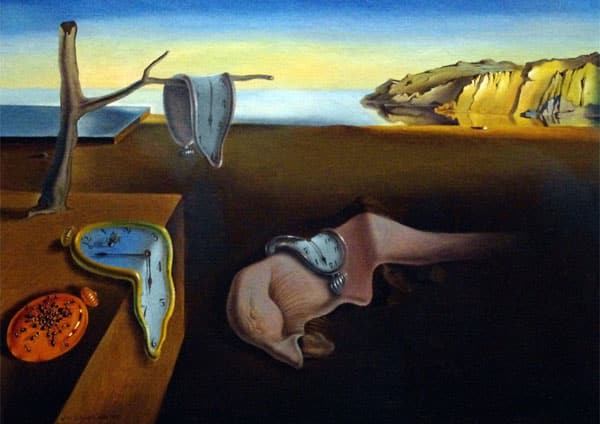
Salvador Dalí’s The Persistence of Memory was displayed in Paris at the Galerie Pierre Colle for the first time.
The Biggest Pop Artists of 1931 include
Gus Arnheim & His Orchestra, Ben Bernie & His Orchestra, The Boswell Sisters, Cab Calloway, Russ Columbo, Bing Crosby, Duke Ellington, Ruth Etting, Libby Holman, Hal Kemp, and His Orchestra, Wayne King and His Orchestra, Ted Lewis and His Band, Guy Lombardo and His Royal Canadians, Bert Lown & His Orchestra, Clyde McCoy & His Orchestra, The Mills Brothers, Ray Noble, and His Orchestra, Kate Smith, Rudy Vallée & His Connecticut Yankees, Fred Waring’s Pennsylvanians
Pop Culture Facts & History
Considered his finest film by many, Charlie Chaplin’s City Lights was released. Charlie believed that ‘talking’ was a lesser form of performing in movies, so he didn’t talk, but he did include a soundtrack and sound effects.
Airstream trailers were introduced to the public, invented by Wally Meryle Byam. They say that 2/3 of every one of these vehicles ever produced is still in use.
Hail Columbia was considered (among other songs) as the unofficial national anthem of the United States until 1931, when The Star-Spangled Banner was officially designated.
17-year-old female baseball pitcher Jackie Mitchell struck out both Babe Ruth and Lou Gehrig in the same exhibition game.
Betty Robinson, an Olympic runner, was involved in a plane crash in 1931 and was wrongly pronounced dead upon first being discovered. She spent seven months in a coma and it took her two years to learn to walk normally again. In 1936, she returned to the US Olympic team and won gold in the relay.
Alka-Seltzer was made available in 1931. The original ingredients included 325 milligrams of aspirin, 1,000 milligrams of citric acid, and 1,916 milligrams of sodium bicarbonate.
CBS went on the air.
Alice in Wonderland was banned in the Hunan province of China, because the Governor, Ho Chien, felt that: “animals should not use human language”, and that it was “disastrous to put animals and human beings on the same level.”
Karl Freund, cinematographer on Metropolis (1927), and Dracula (1931), also shot most of the I Love Lucy episodes.
In Frankenstein, the line “Now I know what it feels like to be God!” following “It’s alive! It’s alive!” was censored by audio of a clap of thunder because it was considered blasphemous and was restored decades later. Most props used in Mel Brook’s Young Frankenstein were from the original 1931 Frankenstein film. The “bolts” in the Monster’s neck in Frankenstein, are electrodes. One is positive and the other, negative.
RIP
New Zealand’s Mount Victoria Tunnel is also known as “The tooting tunnel,” and when you start tooting in there, people start tooting with you. Tooting in there is a way to pay tribute to pregnant murdered teenager Phillis Symons in 1931.
Ninety-six workers died while constructing the Hoover Dam from 1931-1935.
An 11-year-old boy, Wilbur Brink, was killed during the 1931 Indy 500 race when a tire from a race wreck flew out of the Speedway, across the street, and over his house, landing on his head as he played in his backyard.
When Thomas Edison died in 1931, Nikola Tesla was the only one to submit an unfavorable opinion of him to the NY Times: “He had no hobby, cared for no sort of amusement of any kind, and lived in utter disregard of the most elementary rules of hygiene … His method was inefficient in the extreme, for an immense ground had to be covered to get anything at all unless blind chance intervened and, at first, I was almost a sorry witness of his doings, knowing that just a little theory and calculation would have saved him 90 percent of the labor. But he had a veritable contempt for book learning and mathematical knowledge, trusting himself entirely to his inventor’s instinct and practical American sense.”
Do Not Stand At My Grave and Weep
Mary Elizabeth Frye was an American housewife and florist who scribbled a poem (‘Do not stand at my grave and weep’) on a paper bag. She circulated the poem privately, but never published or copyrighted it.
Do not stand at my grave and weep I am not there. I do not sleep. I am a thousand winds that blow. I am the diamond glints on snow. I am the sunlight on ripened grain. I am the gentle autumn rain. When you awaken in the morning’s hush I am the swift uplifting rush Of quiet birds in circled flight. I am the soft stars that shine at night. Do not stand at my grave and cry; I am not there. I did not die.
Nobel Prize Winners
Physics – not awarded Chemistry – Carl Bosch, Friedrich Bergius Physiology or Medicine – Otto Heinrich Warburg Literature – Erik Axel Karlfeldt Peace – Jane Addams, Nicholas Murray Butler
Jane Addams was nominated 91 times for the Nobel Peace Prize before becoming the first American woman to receive the award in 1931. She was the first American Woman to win the Nobel Peace Prize.
Popular and Best-selling Books From 1931
A White Bird Flying by Bess Streeter Aldrich Back Street by Fannie Hurst The Bridge of Desire by Warwick Deeping Finch’s Fortune by Mazo de la Roche The Good Earth by Pearl S. Buck Grand Hotel by Vicki Baum Maid in Waiting by John Galsworthy The Road Back by Erich Maria Remarque Shadows on the Rock by Willa Cather Years of Grace by Margaret Ayer Barnes
Sports
World Series Champions: St. Louis Cardinals Stanley Cup Champs: Montreal Canadiens U.S. Open Golf: Billy Burke U.S. Tennis (Men/Ladies): H. Ellsworth Vines/Helen Wills Moody Wimbledon (Men/Women): Sidney Wood/Cilly Aussem NCAA Football Champions: USC Kentucky Derby Winner: Twenty Grand Boston Marathon Winner: James Henigan Time: 2:46:45
In Flanders fields the poppies blow
Between the crosses, row on row,
That mark our place, and in the sky,
The larks, still bravely singing, fly,
Scarce heard amid the guns below.

We are the dead; short days ago
We lived, felt dawn, saw sunset glow,
Loved and were loved, and now we lie
In Flanders fields.

Take up our quarrel with the foe!
To you from failing hands we throw
The torch; be yours to hold it high!
If ye break faith with us who die
We shall not sleep, though poppies grow
In Flanders fields.
John McCrae (November 30, 1872 – January 28, 1918) was a Canadian soldier.
Fraterville, Tennessee Mine Disaster Victim Jacob Vowell’s farewell letter to his wife, Sarah Ellen Vowell His son, Elbert died with him. May 19, 1902
Ellen, darling, goodbye for us both. Elbert said the Lord has saved him. We are all praying for air to support us, but it is getting so bad without any air.
Ellen I want you to live right and come to heaven. Raise the children the best you can. Oh how I wish to be with you, goodbye. Bury me and Elbert in the same grave by little Eddie. Godbye Ellen, goodbye Lily, goodbye Jemmie, goodbye Horace. We are together. Is 25 minutes after two. There is a few of us alive yet.
Jake and Elbert
Oh God for one more breath. Ellen remember me as long as you live Goodbye darling.
Death of Russian composer Pyotr Ilyich Tchaikovsky
Pyotr Ilyich Tchaikovsky, a renowned Russian composer of the Romantic era, left a lasting legacy in classical music. Known for his ballets, symphonies, operas, and chamber music, Tchaikovsky’s life and untimely death have been the subject of much speculation and intrigue.
Dates: Tchaikovsky was born on May 7, 1840, and died on November 6, 1893.
Details: Tchaikovsky’s death has been the subject of numerous theories and speculation. The official cause of his death was reported as cholera, contracted after drinking a glass of unboiled water during an epidemic in St. Petersburg. However, some scholars have suggested that his death may have resulted from suicide, possibly due to personal or professional pressures, or even as the outcome of a “court of honor” held by his former classmates to protect the reputation of the Russian nobility.
Trivial Facts: Tchaikovsky’s last work was Symphony No. 6, the “Pathétique.” This symphony was premiered just nine days before his death, and some have interpreted the piece as a musical reflection on the composer’s own life and impending death. There is also a rumor that Tchaikovsky’s last words were, “Ah, music, what a beautiful art! But what a wretched profession!”
Effects on Pop Culture: Tchaikovsky’s death sparked an outpouring of grief and tributes in Russia and internationally. His music continues to be celebrated and performed around the world, with pieces such as “The Nutcracker,” “Swan Lake,” and “1812 Overture” remaining popular and influential in the world of classical music and beyond. Tchaikovsky’s life and death have also inspired various films, novels, and plays that explore his complex personal life and the mystery surrounding his demise.
Prominent People: Tchaikovsky was part of a circle of influential Russian composers and musicians, including Modest Mussorgsky, Nikolai Rimsky-Korsakov, and Alexander Borodin, who were collectively known as “The Five” or “The Mighty Handful.” Tchaikovsky’s patroness, Nadezhda von Meck, played a significant role in his life, providing him with financial support and encouragement while maintaining an exclusively epistolary relationship.
Countries Involved: Tchaikovsky was a prominent figure in Russian culture, but his music and influence extended well beyond his homeland, gaining widespread recognition and appreciation in Europe, the United States, and other parts of the world.
Pyotr Ilyich Tchaikovsky, born in 1840, was a prominent Russian composer whose sudden death in 1893 has been a subject of speculation. Although officially attributed to cholera, alternative theories suggest suicide or forced death due to societal pressures. Tchaikovsky’s music has had a lasting impact on classical music and popular culture, with his works continuing to be performed and celebrated around the world.
{% if featuredImage and featuredImage != "" %}
{% endif %}
{% if excerpt %}