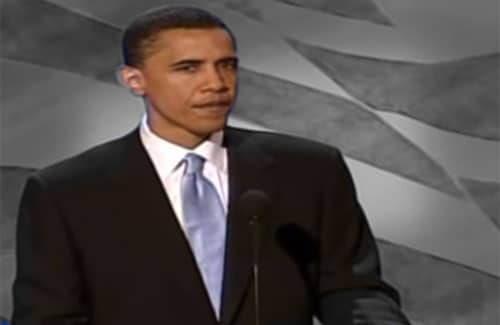
Barack Obama’s 2009 Inauguration Speech
Given on January 20, 2009, in Washington DC
My fellow citizens: I stand here today humbled by the task before us, grateful for the trust you’ve bestowed, mindful of the sacrifices borne by our ancestors.
I thank President Bush for his service to our nation — as well as the generosity and cooperation he has shown throughout this transition.
Forty-four Americans have now taken the presidential oath. The words have been spoken during rising tides of prosperity and the still waters of peace. Yet, every so often, the oath is taken amidst gathering clouds and raging storms. At these moments, America has carried on not simply because of the skill or vision of those in high office, but because we, the people, have remained faithful to the ideals of our forebears and true to our founding documents.
So it has been; so it must be with this generation of Americans.
That we are in the midst of crisis is now well understood. Our nation is at war against a far-reaching network of violence and hatred. Our economy is badly weakened, a consequence of greed and irresponsibility on the part of some, but also our collective failure to make hard choices and prepare the nation for a new age. Homes have been lost, jobs shed, businesses shuttered. Our health care is too costly, our schools fail too many — and each day brings further evidence that the ways we use energy strengthen our adversaries and threaten our planet.
These are the indicators of crisis, subject to data and statistics. Less measurable, but no less profound, is a sapping of confidence across our land; a nagging fear that America’s decline is inevitable, that the next generation must lower its sights.
Today I say to you that the challenges we face are real. They are serious and they are many. They will not be met easily or in a short span of time. But know this America: They will be met.
On this day, we gather because we have chosen hope over fear, unity of purpose over conflict and discord. On this day, we come to proclaim an end to the petty grievances and false promises, the recriminations and worn-out dogmas that for far too long have strangled our politics. We remain a young nation. But in the words of Scripture, the time has come to set aside childish things. The time has come to reaffirm our enduring spirit; to choose our better history; to carry forward that precious gift, that noble idea passed on from generation to generation: the God-given promise that all are equal, all are free, and all deserve a chance to pursue their full measure of happiness.
In reaffirming the greatness of our nation we understand that greatness is never a given. It must be earned. Our journey has never been one of short-cuts or settling for less. It has not been the path for the faint-hearted, for those that prefer leisure over work, or seek only the pleasures of riches and fame. Rather, it has been the risk-takers, the doers, the makers of things — some celebrated, but more often men and women obscure in their labor — who have carried us up the long rugged path towards prosperity and freedom.
For us, they packed up their few worldly possessions and traveled across oceans in search of a new life. For us, they toiled in sweatshops, and settled the West, endured the lash of the whip, and plowed the hard earth. For us, they fought and died in places like Concord and Gettysburg, Normandy and Khe Sahn.
Time and again these men and women struggled and sacrificed and worked till their hands were raw so that we might live a better life. They saw America as beggir than the sum of our individual ambitions, greater than all the differences of birth or wealth or faction.
This is the journey we continue today. We remain the most prosperous, powerful nation on Earth. Our workers are no less productive than when this crisis began. Our minds are no less inventive, our goods and services no less needed than they were last week, or last month, or last year. Our capacity remains undiminished. But our time of standing pat, of protecting narrow interests and putting off unpleasant decisions — that time has surely passed. Starting today, we must pick ourselves up, dust ourselves off, and begin again the work of remaking America.
For everywhere we look, there is work to be done. The state of our economy calls for action, bold and swift. And we will act, not only to create new jobs, but to lay a new foundation for growth. We will build the roads and bridges, the electric grids and digital lines that feed our commerce and bind us together. We’ll restore science to its rightful place, and wield technology’s wonders to raise health care’s quality and lower its cost. We will harness the sun and the winds and the soil to fuel our cars and run our factories. And we will transform our schools and colleges and universities to meet the demands of a new age. All this we can do. All this we will do.
Now, there are some who question the scale of our ambitions, who suggest that our system cannot tolerate too many big plans. Their memories are short, for they have forgotten what this country has already done, what free men and women can achieve when imagination is joined to common purpose, and necessity to courage. What the cynics fail to understand is that the ground has shifted beneath them, that the stale political arguments that have consumed us for so long no longer apply.
The question we ask today is not whether our government is too big or too small, but whether it works — whether it helps families find jobs at a decent wage, care they can afford, a retirement that is dignified. Where the answer is yes, we intend to move forward. Where the answer is no, programs will end. And those of us who manage the public’s dollars will be held to account, to spend wisely, reform bad habits, and do our business in the light of day, because only then can we restore the vital trust between a people and their government.
Nor is the question before us whether the market is a force for good or ill. Its power to generate wealth and expand freedom is unmatched. But this crisis has reminded us that without a watchful eye, the market can spin out of control. The nation cannot prosper long when it favors only the prosperous. The success of our economy has always depended not just on the size of our gross domestic product, but on the reach of our prosperity, on the ability to extend opportunity to every willing heart — not out of charity, but because it is the surest route to our common good.
As for our common defense, we reject as false the choice between our safety and our ideals. Our Founding Fathers- our Founding Fathers, faced with perils that we can scarcely imagine, drafted a charter to assure the rule of law and the rights of man — a charter expanded by the blood of generations. Those ideals still light the world, and we will not give them up for expedience sake.
And so, to all the other peoples and governments who are watching today, from the grandest capitals to the small village where my father was born, know that America is a friend of each nation, and every man, woman and child who seeks a future of peace and dignity. And we are ready to lead once more.
Recall that earlier generations faced down fascism and communism not just with missiles and tanks, but with the sturdy alliances and enduring convictions. They understood that our power alone cannot protect us, nor does it entitle us to do as we please. Instead they knew that our power grows through its prudent use; our security emanates from the justness of our cause, the force of our example, the tempering qualities of humility and restraint.
We are the keepers of this legacy. Guided by these principles once more we can meet those new threats that demand even greater effort, even greater cooperation and understanding between nations. We will begin to responsibly leave Iraq to its people and forge a hard-earned peace in Afghanistan. With old friends and former foes, we’ll work tirelessly to lessen the nuclear threat, and roll back the specter of a warming planet.
We will not apologize for our way of life, nor will we waver in its defense. And for those who seek to advance their aims by inducing terror and slaughtering innocents, we say to you now that our spirit is stronger and cannot be broken — you cannot outlast us, and we will defeat you.
For we know that our patchwork heritage is a strength, not a weakness. We are a nation of Christians and Muslims, Jews and Hindus, and non-believers. We are shaped by every language and culture, drawn from every end of this Earth; and because we have tasted the bitter swill of civil war and segregation, and emerged from that dark chapter stronger and more united, we cannot help but believe that the old hatreds shall someday pass; that the lines of tribe shall soon dissolve; that as the world grows smaller, our common humanity shall reveal itself; and that America must play its role in ushering in a new era of peace.
To the Muslim world, we seek a new way forward, based on mutual interest and mutual respect. To those leaders around the globe who seek to sow conflict, or blame their society’s ills on the West, know that your people will judge you on what you can build, not what you destroy.
To those who cling to power through corruption and deceit and the silencing of dissent, know that you are on the wrong side of history, but that we will extend a hand if you are willing to unclench your fist.
To the people of poor nations, we pledge to work alongside you to make your farms flourish and let clean waters flow; to nourish starved bodies and feed hungry minds. And to those nations like ours that enjoy relative plenty, we say we can no longer afford indifference to the suffering outside our borders, nor can we consume the world’s resources without regard to effect. For the world has changed, and we must change with it.
As we consider the role that unfolds before us, we remember with humble gratitude those brave Americans who at this very hour patrol far-off deserts and distant mountains. They have something to tell us, just as the fallen heroes who lie in Arlington whisper through the ages.
We honor them not only because they are the guardians of our liberty, but because they embody the spirit of service — a willingness to find meaning in something greater than themselves.
And yet at this moment, a moment that will define a generation, it is precisely this spirit that must inhabit us all. For as much as government can do, and must do, it is ultimately the faith and determination of the American people upon which this nation relies. It is the kindness to take in a stranger when the levees break, the selflessness of workers who would rather cut their hours than see a friend lose their job which sees us through our darkest hours. It is the firefighter’s courage to storm a stairway filled with smoke, but also a parent’s willingness to nurture a child that finally decides our fate.
Our challenges may be new. The instruments with which we meet them may be new. But those values upon which our success depends — honesty and hard work, courage and fair play, tolerance and curiosity, loyalty and patriotism — these things are old. These things are true. They have been the quiet force of progress throughout our history.
What is demanded, then, is a return to these truths. What is required of us now is a new era of responsibility — a recognition on the part of every American that we have duties to ourselves, our nation and the world; duties that we do not grudgingly accept, but rather seize gladly, firm in the knowledge that there is nothing so satisfying to the spirit, so defining of our character than giving our all to a difficult task.
This is the price and the promise of citizenship. This is the source of our confidence — the knowledge that God calls on us to shape an uncertain destiny. This is the meaning of our liberty and our creed, why men and women and children of every race and every faith can join in celebration across this magnificent mall; and why a man whose father less than 60 years ago might not have been served in a local restaurant can now stand before you to take a most sacred oath.
So let us mark this day with remembrance of who we are and how far we have traveled. In the year of America’s birth, in the coldest of months, a small band of patriots huddled by dying campfires on the shores of an icy river. The capital was abandoned. The enemy was advancing. The snow was stained with blood. At the moment when the outcome of our revolution was most in doubt, the father of our nation ordered these words to be read to the people:
“Let it be told to the future world…that in the depth of winter, when nothing but hope and virtue could survive… that the city and the country, alarmed at one common danger, came forth to meet [it].”
America: In the face of our common dangers, in this winter of our hardship, let us remember these timeless words. With hope and virtue, let us brave once more the icy currents, and endure what storms may come. Let it be said by our children’s children that when we were tested we refused to let this journey end, that we did not turn back nor did we falter; and with eyes fixed on the horizon and God’s grace upon us, we carried forth that great gift of freedom and delivered it safely to future generations.
Thank you. God bless you. And God bless the United States of America.
Delivered on July 27, 2004 at The Fleet Center, in Boston, Massachusetts.
Michelle, I love you. The other night, I think the entire country saw just how lucky I am. Malia and Sasha, you make me so proud…but don’t get any ideas, you’re still going to class tomorrow. And Joe Biden, thank you for being the best Vice President I could ever hope for.
Madam Chairwoman, delegates, I accept your nomination for President of the United States.
The first time I addressed this convention in 2004, I was a younger man; a Senate candidate from Illinois who spoke about hope – not blind optimism or wishful thinking, but hope in the face of difficulty; hope in the face of uncertainty; that dogged faith in the future which has pushed this nation forward, even when the odds are great; even when the road is long.
Eight years later, that hope has been tested – by the cost of war; by one of the worst economic crises in history; and by political gridlock that’s left us wondering whether it’s still possible to tackle the challenges of our time.
I know that campaigns can seem small, and even silly. Trivial things become big distractions. Serious issues become sound bites. And the truth gets buried under an avalanche of money and advertising. If you’re sick of hearing me approve this message, believe me – so am I.
But when all is said and done – when you pick up that ballot to vote – you will face the clearest choice of any time in a generation. Over the next few years, big decisions will be made in Washington, on jobs and the economy; taxes and deficits; energy and education; war and peace – decisions that will have a huge impact on our lives and our children’s lives for decades to come.
On every issue, the choice you face won’t be just between two candidates or two parties.
It will be a choice between two different paths for America.
A choice between two fundamentally different visions for the future.
Ours is a fight to restore the values that built the largest middle class and the strongest economy the world has ever known; the values my grandfather defended as a soldier in Patton’s Army; the values that drove my grandmother to work on a bomber assembly line while he was gone.
They knew they were part of something larger – a nation that triumphed over fascism and depression; a nation where the most innovative businesses turned out the world’s best products, and everyone shared in the pride and success – from the corner office to the factory floor. My grandparents were given the chance to go to college, buy their first home, and fulfill the basic bargain at the heart of America’s story: the promise that hard work will pay off; that responsibility will be rewarded; that everyone gets a fair shot, and everyone does their fair share, and everyone plays by the same rules – from Main Street to Wall Street to Washington, DC.
I ran for President because I saw that basic bargain slipping away. I began my career helping people in the shadow of a shuttered steel mill, at a time when too many good jobs were starting to move overseas. And by 2008, we had seen nearly a decade in which families struggled with costs that kept rising but paychecks that didn’t; racking up more and more debt just to make the mortgage or pay tuition; to put gas in the car or food on the table. And when the house of cards collapsed in the Great Recession, millions of innocent Americans lost their jobs, their homes, and their life savings – a tragedy from which we are still fighting to recover.
Now, our friends at the Republican convention were more than happy to talk about everything they think is wrong with America, but they didn’t have much to say about how they’d make it right. They want your vote, but they don’t want you to know their plan. And that’s because all they have to offer is the same prescription they’ve had for the last thirty years:
“Have a surplus? Try a tax cut.”
“Deficit too high? Try another.”
“Feel a cold coming on? Take two tax cuts, roll back some regulations, and call us in the morning!”
Now, I’ve cut taxes for those who need it – middle-class families and small businesses. But I don’t believe that another round of tax breaks for millionaires will bring good jobs to our shores, or pay down our deficit. I don’t believe that firing teachers or kicking students off financial aid will grow the economy, or help us compete with the scientists and engineers coming out of China. After all that we’ve been through, I don’t believe that rolling back regulations on Wall Street will help the small businesswoman expand, or the laid-off construction worker keep his home. We’ve been there, we’ve tried that, and we’re not going back. We’re moving forward.
I won’t pretend the path I’m offering is quick or easy. I never have. You didn’t elect me to tell you what you wanted to hear. You elected me to tell you the truth. And the truth is, it will take more than a few years for us to solve challenges that have built up over decades. It will require common effort, shared responsibility, and the kind of bold, persistent experimentation that Franklin Roosevelt pursued during the only crisis worse than this one. And by the way – those of us who carry on his party’s legacy should remember that not every problem can be remedied with another government program or dictate from Washington.
But know this, America: Our problems can be solved. Our challenges can be met. The path we offer may be harder, but it leads to a better place. And I’m asking you to choose that future. I’m asking you to rally around a set of goals for your country – goals in manufacturing, energy, education, national security, and the deficit; a real, achievable plan that will lead to new jobs, more opportunity, and rebuild this economy on a stronger foundation. That’s what we can do in the next four years, and that’s why I’m running for a second term as President of the United States.
We can choose a future where we export more products and outsource fewer jobs. After a decade that was defined by what we bought and borrowed, we’re getting back to basics, and doing what America has always done best:
We’re making things again.
I’ve met workers in Detroit and Toledo who feared they’d never build another American car. Today, they can’t build them fast enough, because we reinvented a dying auto industry that’s back on top of the world.
I’ve worked with business leaders who are bringing jobs back to America – not because our workers make less pay, but because we make better products. Because we work harder and smarter than anyone else.
I’ve signed trade agreements that are helping our companies sell more goods to millions of new customers – goods that are stamped with three proud words: Made in America.
After a decade of decline, this country created over half a million manufacturing jobs in the last two and a half years. And now you have a choice: we can give more tax breaks to corporations that ship jobs overseas, or we can start rewarding companies that open new plants and train new workers and create new jobs here, in the United States of America. We can help big factories and small businesses double their exports, and if we choose this path, we can create a million new manufacturing jobs in the next four years. You can make that happen. You can choose that future.
You can choose the path where we control more of our own energy. After thirty years of inaction, we raised fuel standards so that by the middle of the next decade, cars and trucks will go twice as far on a gallon of gas. We’ve doubled our use of renewable energy, and thousands of Americans have jobs today building wind turbines and long-lasting batteries. In the last year alone, we cut oil imports by one million barrels a day – more than any administration in recent history. And today, the United States of America is less dependent on foreign oil than at any time in nearly two decades.
Now you have a choice – between a strategy that reverses this progress, or one that builds on it. We’ve opened millions of new acres for oil and gas exploration in the last three years, and we’ll open more. But unlike my opponent, I will not let oil companies write this country’s energy plan, or endanger our coastlines, or collect another $4 billion in corporate welfare from our taxpayers.
We’re offering a better path – a future where we keep investing in wind and solar and clean coal; where farmers and scientists harness new biofuels to power our cars and trucks; where construction workers build homes and factories that waste less energy; where we develop a hundred year supply of natural gas that’s right beneath our feet. If you choose this path, we can cut our oil imports in half by 2020 and support more than 600,000 new jobs in natural gas alone.
And yes, my plan will continue to reduce the carbon pollution that is heating our planet – because climate change is not a hoax. More droughts and floods and wildfires are not a joke. They’re a threat to our children’s future. And in this election, you can do something about it.
You can choose a future where more Americans have the chance to gain the skills they need to compete, no matter how old they are or how much money they have. Education was the gateway to opportunity for me. It was the gateway for Michelle. And now more than ever, it is the gateway to a middle-class life.
For the first time in a generation, nearly every state has answered our call to raise their standards for teaching and learning. Some of the worst schools in the country have made real gains in math and reading. Millions of students are paying less for college today because we finally took on a system that wasted billions of taxpayer dollars on banks and lenders.
And now you have a choice – we can gut education, or we can decide that in the United States of America, no child should have her dreams deferred because of a crowded classroom or a crumbling school. No family should have to set aside a college acceptance letter because they don’t have the money. No company should have to look for workers in China because they couldn’t find any with the right skills here at home.
Government has a role in this. But teachers must inspire; principals must lead; parents must instil a thirst for learning, and students, you’ve got to do the work. And together, I promise you – we can out-educate and out-compete any country on Earth. Help me recruit 100,000 math and science teachers in the next ten years, and improve early childhood education. Help give two million workers the chance to learn skills at their community college that will lead directly to a job. Help us work with colleges and universities to cut in half the growth of tuition costs over the next ten years. We can meet that goal together. You can choose that future for America.
In a world of new threats and new challenges, you can choose leadership that has been tested and proven. Four years ago, I promised to end the war in Iraq. We did. I promised to refocus on the terrorists who actually attacked us on 9/11. We have. We’ve blunted the Taliban’s momentum in Afghanistan, and in 2014, our longest war will be over. A new tower rises above the New York skyline, al Qaeda is on the path to defeat, and Osama bin Laden is dead.
Tonight, we pay tribute to the Americans who still serve in harm’s way. We are forever in debt to a generation whose sacrifice has made this country safer and more respected. We will never forget you. And so long as I’m Commander-in-Chief, we will sustain the strongest military the world has ever known. When you take off the uniform, we will serve you as well as you’ve served us – because no one who fights for this country should have to fight for a job, or a roof over their head, or the care that they need when they come home.
Around the world, we’ve strengthened old alliances and forged new coalitions to stop the spread of nuclear weapons. We’ve reasserted our power across the Pacific and stood up to China on behalf of our workers. From Burma to Libya to South Sudan, we have advanced the rights and dignity of all human beings – men and women; Christians and Muslims and Jews.
But for all the progress we’ve made, challenges remain. Terrorist plots must be disrupted. Europe’s crisis must be contained. Our commitment to Israel’s security must not waver, and neither must our pursuit of peace. The Iranian government must face a world that stays united against its nuclear ambitions. The historic change sweeping across the Arab World must be defined not by the iron fist of a dictator or the hate of extremists, but by the hopes and aspirations of ordinary people who are reaching for the same rights that we celebrate today.
So now we face a choice. My opponent and his running mate are new to foreign policy, but from all that we’ve seen and heard, they want to take us back to an era of blustering and blundering that cost America so dearly.
After all, you don’t call Russia our number one enemy – and not al Qaeda – unless you’re still stuck in a Cold War time warp. You might not be ready for diplomacy with Beijing if you can’t visit the Olympics without insulting our closest ally. My opponent said it was “tragic” to end the war in Iraq, and he won’t tell us how he’ll end the war in Afghanistan. I have, and I will. And while my opponent would spend more money on military hardware that our Joint Chiefs don’t even want, I’ll use the money we’re no longer spending on war to pay down our debt and put more people back to work – rebuilding roads and bridges; schools and runways. After two wars that have cost us thousands of lives and over a trillion dollars, it’s time to do some nation-building right here at home.
You can choose a future where we reduce our deficit without wrecking our middle class. Independent analysis shows that my plan would cut our deficits by $4 trillion. Last summer, I worked with Republicans in Congress to cut $1 trillion in spending – because those of us who believe government can be a force for good should work harder than anyone to reform it, so that it’s leaner, more efficient, and more responsive to the American people.
I want to reform the tax code so that it’s simple, fair, and asks the wealthiest households to pay higher taxes on incomes over $250,000 – the same rate we had when Bill Clinton was president; the same rate we had when our economy created nearly 23 million new jobs, the biggest surplus in history, and a lot of millionaires to boot.
Now, I’m still eager to reach an agreement based on the principles of my bipartisan debt commission. No party has a monopoly on wisdom. No democracy works without compromise. But when Governor Romney and his allies in Congress tell us we can somehow lower our deficit by spending trillions more on new tax breaks for the wealthy – well, you do the math. I refuse to go along with that. And as long as I’m President, I never will.
I refuse to ask middle class families to give up their deductions for owning a home or raising their kids just to pay for another millionaire’s tax cut. I refuse to ask students to pay more for college; or kick children out of Head Start programs, or eliminate health insurance for millions of Americans who are poor, elderly, or disabled – all so those with the most can pay less.
And I will never turn Medicare into a voucher. No American should ever have to spend their golden years at the mercy of insurance companies. They should retire with the care and dignity they have earned. Yes, we will reform and strengthen Medicare for the long haul, but we’ll do it by reducing the cost of health care – not by asking seniors to pay thousands of dollars more. And we will keep the promise of Social Security by taking the responsible steps to strengthen it – not by turning it over to Wall Street.
This is the choice we now face. This is what the election comes down to. Over and over, we have been told by our opponents that beggir tax cuts and fewer regulations are the only way; that since government can’t do everything, it should do almost nothing. If you can’t afford health insurance, hope that you don’t get sick. If a company releases toxic pollution into the air your children breathe, well, that’s just the price of progress. If you can’t afford to start a business or go to college, take my opponent’s advice and “borrow money from your parents.”
You know what? That’s not who we are. That’s not what this country’s about. As Americans, we believe we are endowed by our Creator with certain inalienable rights – rights that no man or government can take away. We insist on personal responsibility and we celebrate individual initiative. We’re not entitled to success. We have to earn it. We honour the strivers, the dreamers, the risk-takers who have always been the driving force behind our free enterprise system – the greatest engine of growth and prosperity the world has ever known.
But we also believe in something called citizenship – a word at the very heart of our founding, at the very essence of our democracy; the idea that this country only works when we accept certain obligations to one another, and to future generations.
We believe that when a CEO pays his autoworkers enough to buy the cars that they build, the whole company does better.
We believe that when a family can no longer be tricked into signing a mortgage they can’t afford, that family is protected, but so is the value of other people’s homes, and so is the entire economy.
We believe that a little girl who’s offered an escape from poverty by a great teacher or a grant for college could become the founder of the next Google, or the scientist who cures cancer, or the President of the United States – and it’s in our power to give her that chance.
We know that churches and charities can often make more of a difference than a poverty program alone. We don’t want handouts for people who refuse to help themselves, and we don’t want bailouts for banks that break the rules. We don’t think government can solve all our problems. But we don’t think that government is the source of all our problems – any more than are welfare recipients, or corporations, or unions, or immigrants, or gays, or any other group we’re told to blame for our troubles.
Because we understand that this democracy is ours.
We, the People, recognize that we have responsibilities as well as rights; that our destinies are bound together; that a freedom which only asks what’s in it for me, a freedom without a commitment to others, a freedom without love or charity or duty or patriotism, is unworthy of our founding ideals, and those who died in their defence.
As citizens, we understand that America is not about what can be done for us. It’s about what can be done by us, together, through the hard and frustrating but necessary work of self-government.
So you see, the election four years ago wasn’t about me. It was about you. My fellow citizens – you were the change.
You’re the reason there’s a little girl with a heart disorder in Phoenix who’ll get the surgery she needs because an insurance company can’t limit her coverage. You did that.
You’re the reason a young man in Colorado who never thought he’d be able to afford his dream of earning a medical degree is about to get that chance. You made that possible.
You’re the reason a young immigrant who grew up here and went to school here and pledged allegiance to our flag will no longer be deported from the only country she’s ever called home; why selfless soldiers won’t be kicked out of the military because of who they are or who they love; why thousands of families have finally been able to say to the loved ones who served us so bravely: “Welcome home.”
If you turn away now – if you buy into the cynicism that the change we fought for isn’t possible…well, change will not happen. If you give up on the idea that your voice can make a difference, then other voices will fill the void: lobbyists and special interests; the people with the $10 million checks who are trying to buy this election and those who are making it harder for you to vote; Washington politicians who want to decide who you can marry, or control health care choices that women should make for themselves.
Only you can make sure that doesn’t happen. Only you have the power to move us forward.
I recognize that times have changed since I first spoke to this convention. The times have changed – and so have I.
I’m no longer just a candidate. I’m the President. I know what it means to send young Americans into battle, for I have held in my arms the mothers and fathers of those who didn’t return. I’ve shared the pain of families who’ve lost their homes, and the frustration of workers who’ve lost their jobs. If the critics are right that I’ve made all my decisions based on polls, then I must not be very good at reading them. And while I’m proud of what we’ve achieved together, I’m far more mindful of my own failings, knowing exactly what Lincoln meant when he said, “I have been driven to my knees many times by the overwhelming conviction that I had no place else to go.”
But as I stand here tonight, I have never been more hopeful about America. Not because I think I have all the answers. Not because I’m naive about the magnitude of our challenges.
I’m hopeful because of you.
The young woman I met at a science fair who won national recognition for her biology research while living with her family at a homeless shelter – she gives me hope.
The auto worker who won the lottery after his plant almost closed, but kept coming to work every day, and bought flags for his whole town and one of the cars that he built to surprise his wife – he gives me hope.
The family business in Warroad, Minnesota that didn’t lay off a single one of their four thousand employees during this recession, even when their competitors shut down dozens of plants, even when it meant the owners gave up some perks and pay – because they understood their biggest asset was the community and the workers who helped build that business – they give me hope.
And I think about the young sailor I met at Walter Reed hospital, still recovering from a grenade attack that would cause him to have his leg amputated above the knee. Six months ago, I would watch him walk into a White House dinner honouring those who served in Iraq, tall and twenty pounds heavier, dashing in his uniform, with a big grin on his face; sturdy on his new leg. And I remember how a few months after that I would watch him on a bicycle, racing with his fellow wounded warriors on a sparkling spring day, inspiring other heroes who had just begun the hard path he had travelled.
He gives me hope.
I don’t know what party these men and women belong to. I don’t know if they’ll vote for me. But I know that their spirit defines us. They remind me, in the words of Scripture, that ours is a “future filled with hope.”
And if you share that faith with me – if you share that hope with me – I ask you tonight for your vote.
If you reject the notion that this nation’s promise is reserved for the few, your voice must be heard in this election.
If you reject the notion that our government is forever beholden to the highest bidder, you need to stand up in this election.
If you believe that new plants and factories can dot our landscape; that new energy can power our future; that new schools can provide ladders of opportunity to this nation of dreamers; if you believe in a country where everyone gets a fair shot, and everyone does their fair share, and everyone plays by the same rules, then I need you to vote this November.
America, I never said this journey would be easy, and I won’t promise that now. Yes, our path is harder – but it leads to a better place. Yes our road is longer – but we travel it together. We don’t turn back. We leave no one behind. We pull each other up. We draw strength from our victories, and we learn from our mistakes, but we keep our eyes fixed on that distant horizon, knowing that Providence is with us, and that we are surely blessed to be citizens of the greatest nation on Earth.
Thank you, God bless you, and may God bless these United States.
Mr. Speaker, Mr. President Pro Tempore, members of Congress, and fellow Americans:
In the normal course of events, presidents come to this chamber to report on the state of the Union. Tonight, no such report is needed. It has already been delivered by the American people.
We have seen it in the courage of passengers who rushed terrorists to save others on the ground. Passengers like an exceptional man named Todd Beamer. And would you please help me welcome his wife Lisa Beamer here tonight?
We have seen the state of our Union in the endurance of rescuers working past exhaustion.
We’ve seen the unfurling of flags, the lighting of candles, the giving of blood, the saying of prayers in English, Hebrew and Arabic.
We have seen the decency of a loving and giving people who have made the grief of strangers their own.
My fellow citizens, for the last nine days, the entire world has seen for itself the state of our Union, and it is strong.
Tonight, we are a country awakened to danger and called to defend freedom. Our grief has turned to anger and anger to resolution. Whether we bring our enemies to justice or bring justice to our enemies, justice will be done.
I thank the Congress for its leadership at such an important time.
All of America was touched on the evening of the tragedy to see Republicans and Democrats joined together on the steps of this Capitol singing “God Bless America.”
And you did more than sing. You acted, by delivering $40 billion to rebuild our communities and meet the needs of our military. Speaker Hastert, Minority Leader Gephardt, Majority Leader Daschle and Senator Lott, I thank you for your friendship, for your leadership and for your service to our country.
And on behalf of the American people, I thank the world for its outpouring of support.
America will never forget the sounds of our national anthem playing at Buckingham Palace, on the streets of Paris and at Berlin’s Brandenburg Gate.
We will not forget South Korean children gathering to pray outside our embassy in Seoul, or the prayers of sympathy offered at a mosque in Cairo.
We will not forget moments of silence and days of mourning in Australia and Africa and Latin America.
Nor will we forget the citizens of 80 other nations who died with our own. Dozens of Pakistanis, more than 130 Israelis, more than 250 citizens of India, men and women from El Salvador, Iran, Mexico and Japan, and hundreds of British citizens.
America has no truer friend than Great Britain.
Once again, we are joined together in a great cause.
I’m so honored the British prime minister has crossed an ocean to show his unity with America.
Thank you for coming, friend.
On September the 11th, enemies of freedom committed an act of war against our country. Americans have known wars, but for the past 136 years they have been wars on foreign soil, except for one Sunday in 1941. Americans have known the casualties of war, but not at the center of a great city on a peaceful morning.
Americans have known surprise attacks, but never before on thousands of civilians.
All of this was brought upon us in a single day, and night fell on a different world, a world where freedom itself is under attack.
Americans have many questions tonight. Americans are asking, “Who attacked our country?”
The evidence we have gathered all points to a collection of loosely affiliated terrorist organizations known as al-Qaida. They are some of the murderers indicted for bombing American embassies in Tanzania and Kenya and responsible for bombing the USS Cole.
Al-Qaida is to terror what the Mafia is to crime. But its goal is not making money. Its goal is remaking the world and imposing its radical beliefs on people everywhere.
The terrorists practice a fringe form of Islamic extremism that has been rejected by Muslim scholars and the vast majority of Muslim clerics; a fringe movement that perverts the peaceful teachings of Islam.
The terrorists’ directive commands them to kill Christians and Jews, to kill all Americans and make no distinctions among military and civilians, including women and children.
This group and its leader, a person named Osama bin Laden, are linked to many other organizations in different countries, including the Egyptian Islamic Jihad, the Islamic Movement of Uzbekistan.
There are thousands of these terrorists in more than 60 countries.
They are recruited from their own nations and neighborhoods and brought to camps in places like Afghanistan, where they are trained in the tactics of terror. They are sent back to their homes or sent to hide in countries around the world to plot evil and destruction.
The leadership of al-Qaida has great influence in Afghanistan and supports the Taliban regime in controlling most of that country. In Afghanistan we see al-Qaida’s vision for the world. Afghanistan’s people have been brutalized, many are starving and many have fled.
Women are not allowed to attend school. You can be jailed for owning a television. Religion can be practiced only as their leaders dictate. A man can be jailed in Afghanistan if his beard is not long enough.
The United States respects the people of Afghanistan – after all, we are currently its largest source of humanitarian aid – but we condemn the Taliban regime.
It is not only repressing its own people, it is threatening people everywhere by sponsoring and sheltering and supplying terrorists.
By aiding and abetting murder, the Taliban regime is committing murder. And tonight the United States of America makes the following demands on the Taliban.
Deliver to United States authorities all of the leaders of al-Qaida who hide in your land.
Release all foreign nationals, including American citizens you have unjustly imprisoned. Protect foreign journalists, diplomats and aid workers in your country. Close immediately and permanently every terrorist training camp in Afghanistan. And hand over every terrorist and every person and their support structure to appropriate authorities.
Give the United States full access to terrorist training camps, so we can make sure they are no longer operating.
These demands are not open to negotiation or discussion.
The Taliban must act and act immediately.
They will hand over the terrorists, or they will share in their fate.
I also want to speak tonight directly to Muslims throughout the world. We respect your faith. It’s practiced freely by many millions of Americans and by millions more in countries that America counts as friends. Its teachings are good and peaceful, and those who commit evil in the name of Allah blaspheme the name of Allah.
The terrorists are traitors to their own faith, trying, in effect, to hijack Islam itself.
The enemy of America is not our many Muslim friends. It is not our many Arab friends. Our enemy is a radical network of terrorists and every government that supports them.
Our war on terror begins with al-Qaida, but it does not end there.
It will not end until every terrorist group of global reach has been found, stopped and defeated.
Americans are asking, “Why do they hate us?”
They hate what they see right here in this chamber: a democratically elected government. Their leaders are self-appointed. They hate our freedoms: our freedom of religion, our freedom of speech, our freedom to vote and assemble and disagree with each other.
They want to overthrow existing governments in many Muslim countries such as Egypt, Saudi Arabia and Jordan. They want to drive Israel out of the Middle East. They want to drive Christians and Jews out of vast regions of Asia and Africa.
These terrorists kill not merely to end lives, but to disrupt and end a way of life. With every atrocity, they hope that America grows fearful, retreating from the world and forsaking our friends. They stand against us because we stand in their way.
We’re not deceived by their pretenses to piety.
We have seen their kind before. They’re the heirs of all the murderous ideologies of the 20th century. By sacrificing human life to serve their radical visions, by abandoning every value except the will to power, they follow in the path of fascism, Nazism and totalitarianism. And they will follow that path all the way to where it ends in history’s unmarked grave of discarded lies.
Americans are asking, “How will we fight and win this war?” We will direct every resource at our command – every means of diplomacy, every tool of intelligence, every instrument of law enforcement, every financial influence and every necessary weapon of war – to the destruction and to the defeat of the global terror network.
Now this war will not be like the war against Iraq a decade ago, with a decisive liberation of territory and a swift conclusion. It will not look like the air war above Kosovo two years ago, where no ground troops were used and not a single American was lost in combat.
Our response involves far more than instant retaliation and isolated strikes. Americans should not expect one battle, but a lengthy campaign unlike any other we have ever seen. It may include dramatic strikes visible on TV and covert operations secret even in success.
We will starve terrorists of funding, turn them one against another, drive them from place to place until there is no refuge or no rest.
And we will pursue nations that provide aid or safe haven to terrorism. Every nation in every region now has a decision to make: Either you are with us, or you are with the terrorists.
From this day forward, any nation that continues to harbor or support terrorism will be regarded by the United States as a hostile regime. Our nation has been put on notice, we’re not immune from attack. We will take defensive measures against terrorism to protect Americans.
Today, dozens of federal departments and agencies, as well as state and local governments, have responsibilities affecting homeland security.
These efforts must be coordinated at the highest level. So tonight, I announce the creation of a Cabinet-level position reporting directly to me, the Office of Homeland Security.
And tonight, I also announce a distinguished American to lead this effort, to strengthen American security: a military veteran, an effective governor, a true patriot, a trusted friend, Pennsylvania’s Tom Ridge.
He will lead, oversee and coordinate a comprehensive national strategy to safeguard our country against terrorism and respond to any attacks that may come.
These measures are essential. The only way to defeat terrorism as a threat to our way of life is to stop it, eliminate it and destroy it where it grows.
Many will be involved in this effort, from FBI agents, to intelligence operatives, to the reservists we have called to active duty. All deserve our thanks, and all have our prayers.
And tonight a few miles from the damaged Pentagon, I have a message for our military: Be ready. I have called the armed forces to alert, and there is a reason.
The hour is coming when America will act, and you will make us proud.
This is not, however, just America’s fight. And what is at stake is not just America’s freedom.
This is the world’s fight. This is civilization’s fight. This is the fight of all who believe in progress and pluralism, tolerance and freedom.
We ask every nation to join us.
We will ask and we will need the help of police forces, intelligence services and banking systems around the world. The United States is grateful that many nations and many international organizations have already responded with sympathy and with support – nations from Latin America, to Asia, to Africa, to Europe, to the Islamic world.
Perhaps the NATO charter reflects best the attitude of the world: An attack on one is an attack on all. The civilized world is rallying to America’s side.
They understand that if this terror goes unpunished, their own cities, their own citizens may be next. Terror unanswered cannot only bring down buildings, it can threaten the stability of legitimate governments.
And you know what? We’re not going to allow it.
Americans are asking, “What is expected of us?”
I ask you to live your lives and hug your children.
I know many citizens have fears tonight, and I ask you to be calm and resolute, even in the face of a continuing threat.
I ask you to uphold the values of America and remember why so many have come here.
We’re in a fight for our principles, and our first responsibility is to live by them. No one should be singled out for unfair treatment or unkind words because of their ethnic background or religious faith.
I ask you to continue to support the victims of this tragedy with your contributions. Those who want to give can go to a central source of information, libertyunites.org, to find the names of groups providing direct help in New York, Pennsylvania and Virginia.
The thousands of FBI agents who are now at work in this investigation may need your cooperation, and I ask you to give it. I ask for your patience with the delays and inconveniences that may accompany tighter security and for your patience in what will be a long struggle.
I ask your continued participation and confidence in the American economy. Terrorists attacked a symbol of American prosperity; they did not touch its source.
America is successful because of the hard work and creativity and enterprise of our people. These were the true strengths of our economy before September 11th, and they are our strengths today.
And finally, please continue praying for the victims of terror and their families, for those in uniform and for our great country. Prayer has comforted us in sorrow and will help strengthen us for the journey ahead.
Tonight I thank my fellow Americans for what you have already done and for what you will do.
And ladies and gentlemen of the Congress, I thank you, their representatives, for what you have already done and for what we will do together.
Tonight we face new and sudden national challenges.
We will come together to improve air safety, to dramatically expand the number of air marshals on domestic flights and take new measures to prevent hijacking.
We will come together to promote stability and keep our airlines flying with direct assistance during this emergency.
We will come together to give law enforcement the additional tools it needs to track down terror here at home.
We will come together to strengthen our intelligence capabilities to know the plans of terrorists before they act and to find them before they strike.
We will come together to take active steps that strengthen America’s economy and put our people back to work.
Tonight, we welcome two leaders who embody the extraordinary spirit of all New Yorkers, Governor George Pataki and Mayor Rudolf Giuliani.
As a symbol of America’s resolve, my administration will work with Congress and these two leaders to show the world that we will rebuild New York City.
After all that has just passed, all the lives taken and all the possibilities and hopes that died with them, it is natural to wonder if America’s future is one of fear.
Some speak of an age of terror. I know there are struggles ahead and dangers to face. But this country will define our times, not be defined by them.
As long as the United States of America is determined and strong, this will not be an age of terror. This will be an age of liberty here and across the world.
Great harm has been done to us. We have suffered great loss. And in our grief and anger, we have found our mission and our moment.
Freedom and fear are at war. The advance of human freedom, the great achievement of our time and the great hope of every time, now depends on us.
Our nation, this generation, will lift the dark threat of violence from our people and our future. We will rally the world to this cause by our efforts, by our courage. We will not tire, we will not falter, and we will not fail.
It is my hope that in the months and years ahead life will return almost to normal. We’ll go back to our lives and routines, and that is good.
Even grief recedes with time and grace.
But our resolve must not pass. Each of us will remember what happened that day and to whom it happened. We will remember the moment the news came, where we were and what we were doing.
Some will remember an image of a fire or story of rescue. Some will carry memories of a face and a voice gone forever.
And I will carry this. It is the police shield of a man named George Howard, who died at the World Trade Center trying to save others.
It was given to me by his mom, Arlene, as a proud memorial to her son. It is my reminder of lives that ended and a task that does not end.
I will not forget the wound to our country and those who inflicted it. I will not yield, I will not rest, I will not relent in waging this struggle for freedom and security for the American people.
The course of this conflict is not known, yet its outcome is certain. Freedom and fear, justice and cruelty, have always been at war, and we know that God is not neutral between them.
Fellow citizens, we’ll meet violence with patient justice, assured of the rightness of our cause and confident of the victories to come.
In all that lies before us, may God grant us wisdom, and may he watch over the United States of America.
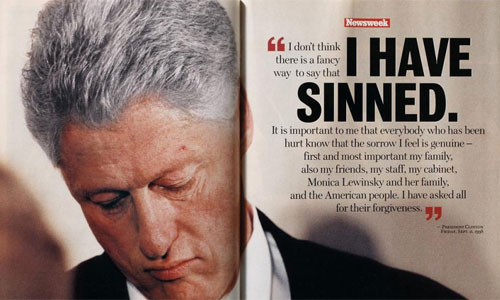
President Bill Clinton – I Have Sinned Speech September 11, 1998 Thank you very much, ladies and gentlemen. Welcome to the White House and to this day to which Hillary and the vice president and I look forward so much every year.
This is always an important day for our country, for the reasons that the vice president said. It is an unusual and, I think, unusually important day today. I may not be quite as easy with my words today as I have been in years past, and I was up rather late last night thinking about and praying about what I ought to say today. And rather unusual for me, I actually tried to write it down. So if you will forgive me, I will do my best to say what it is I want to say to you – and I may have to take my glasses out to read my own writing.
First, I want to say to all of you that, as you might imagine, I have been on quite a journey these last few weeks to get to the end of this, to the rock bottom truth of where I am and where we all are.
I agree with those who have said that in my first statement after I testified I was not contrite enough. I don’t think there is a fancy way to say that I have sinned.
It is important to me that everybody who has been hurt know that the sorrow I feel is genuine: first and most important, my family; also my friends, my staff, my Cabinet, Monica Lewinsky and her family, and the American people. I have asked all for their forgiveness.
But I believe that to be forgiven, more than sorrow is required – at least two more things. First, genuine repentance – a determination to change and to repair breaches of my own making. I have repented. Second, what my bible calls a ”broken spirit”; an understanding that I must have God’s help to be the person that I want to be; a willingness to give the very forgiveness I seek; a renunciation of the pride and the anger which cloud judgment, lead people to excuse and compare and to blame and complain.
Now, what does all this mean for me and for us? First, I will instruct my lawyers to mount a vigorous defense, using all available appropriate arguments. But legal language must not obscure the fact that I have done wrong. Second, I will continue on the path of repentance, seeking pastoral support and that of other caring people so that they can hold me accountable for my own commitment.
Third, I will intensify my efforts to lead our country and the world toward peace and freedom, prosperity and harmony, in the hope that with a broken spirit and a still strong heart I can be used for greater good, for we have many blessings and many challenges and so much work to do.
In this, I ask for your prayers and for your help in healing our nation. And though I cannot move beyond or forget this – indeed, I must always keep it as a caution light in my life – it is very important that our nation move forward.
I am very grateful for the many, many people – clergy and ordinary citizens alike – who have written me with wise counsel. I am profoundly grateful for the support of so many Americans who somehow through it all seem to still know that I care about them a great deal, that I care about their problems and their dreams. I am grateful for those who have stood by me and who say that in this case and many others, the bounds of privacy have been excessively and unwisely invaded. That may be. Nevertheless, in this case, it may be a blessing, because I still sinned. And if my repentance is genuine and sustained, and if I can maintain both a broken spirit and a strong heart, then good can come of this for our country as well as for me and my family. (Applause)
The children of this country can learn in a profound way that integrity is important and selfishness is wrong, but God can change us and make us strong at the broken places. I want to embody those lessons for the children of this country – for that little boy in Florida who came up to me and said that he wanted to grow up and be President and to be just like me. I want the parents of all the children in America to be able to say that to their children.
A couple of days ago when I was in Florida a Jewish friend of mine gave me this liturgy book called ”Gates of Repentance.” And there was this incredible passage from the Yom Kippur liturgy. I would like to read it to you:
”Now is the time for turning. The leaves are beginning to turn from green to red to orange. The birds are beginning to turn and are heading once more toward the south. The animals are beginning to turn to storing their food for the winter. For leaves, birds and animals, turning comes instinctively. But for us, turning does not come so easily. It takes an act of will for us to make a turn. It means breaking old habits. It means admitting that we have been wrong, and this is never easy. It means losing face. It means starting all over again. And this is always painful. It means saying I am sorry. It means recognizing that we have the ability to change. These things are terribly hard to do. But unless we turn, we will be trapped forever in yesterday’s ways. Lord help us to turn, from callousness to sensitivity, from hostility to love, from pettiness to purpose, from envy to contentment, from carelessness to discipline, from fear to faith. Turn us around, O Lord, and bring us back toward you. Revive our lives as at the beginning, and turn us toward each other, Lord, for in isolation there is no life.”
I thank my friend for that. I thank you for being here. I ask you to share my prayer that God will search me and know my heart, try me and know my anxious thoughts, see if there is any hurtfulness in me, and lead me toward the life everlasting. I ask that God give me a clean heart, let me walk by faith and not sight.
I ask once again to be able to love my neighbor – all my neighbors – as my self, to be an instrument of God’s peace; to let the words of my mouth and the meditations of my heart and, in the end, the work of my hands, be pleasing. This is what I wanted to say to you today.
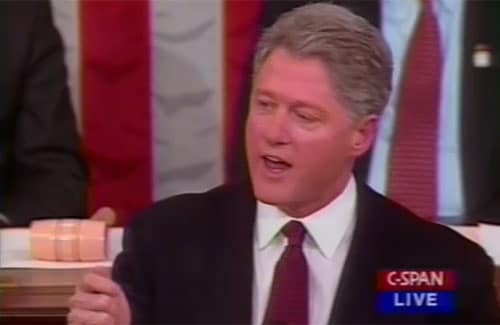
by President William Jefferson Clinton, on January 23, 1996
Mr. Speaker, Mr. Vice President, members of the 104th Congress, distinguished guests, my fellow Americans all across our land:
Let me begin tonight by saying to our men and women in uniform around the world, and especially those helping peace take root in Bosnia and to their families, I thank you. America is very, very proud of you.
My duty tonight is to report on the state of the Union- not the state of our government, but of our American community; and to set forth our responsibilities, in the words of our Founders, to form a more perfect union.
The state of the Union is strong. Our economy is the healthiest it has been in three decades. We have the lowest combined rates of unemployment and inflation in 27 years. We have created nearly 8 million new jobs, over a million of them in basic industries, like construction and automobiles. America is selling more cars than Japan for the first time since the 1970s. And for three years in a row, we have had a record number of new businesses started in our country.
Our leadership in the world is also strong, bringing hope for new peace. And perhaps most important, we are gaining ground in restoring our fundamental values. The crime rate, the welfare and food stamp rolls, the poverty rate and the teen pregnancy rate are all down. And as they go down, prospects for America’s future go up.
We live in an age of possibility. A hundred years ago we moved from farm to factory. Now we move to an age of technology, information, and global competition. These changes have opened vast new opportunities for our people, but they have also presented them with stiff challenges. While more Americans are living better, too many of our fellow citizens are working harder just to keep up, and they are rightly concerned about the security of their families.
We must answer here three fundamental questions: First, how do we make the American Dream of opportunity for all a reality for all Americans who are willing to work for it? Second, how do we preserve our old and enduring values as we move into the future? And, third, how do we meet these challenges together, as one America?
We know big government does not have all the answers. We know there’s not a program for every problem. We have worked to give the American people a smaller, less bureaucratic government in Washington. And we have to give the American people one that lives within its means.
The era of big government is over. But we cannot go back to the time when our citizens were left to fend for themselves. Instead, we must go forward as one America, one nation working together to meet the challenges we face together. Self-reliance and teamwork are not opposing virtues; we must have both.
I believe our new, smaller government must work in an old-fashioned American way, together with all of our citizens through state and local governments, in the workplace, in religious, charitable and civic associations. Our goal must be to enable all our people to make the most of their own lives- with stronger families, more educational opportunity, economic security, safer streets, a cleaner environment in a safer world.
To improve the state of our Union, we must ask more of ourselves, we must expect more of each other, and we must face our challenges together.
Here, in this place, our responsibility begins with balancing the budget in a way that is fair to all Americans. There is now broad bipartisan agreement that permanent deficit spending must come to an end.
I compliment the Republican leadership and the membership for the energy and determination you have brought to this task of balancing the budget. And I thank the Democrats for passing the largest deficit reduction plan in history in 1993, which has already cut the deficit nearly in half in three years.
Since 1993, we have all begun to see the benefits of deficit reduction. Lower interest rates have made it easier for businesses to borrow and to invest and to create new jobs. Lower interest rates have brought down the cost of home mortgages, car payments and credit card rates to ordinary citizens. Now, it is time to finish the job and balance the budget.
Though differences remain among us which are significant, the combined total of the proposed savings that are common to both plans is more than enough, using the numbers from your Congressional Budget Office to balance the budget in seven years and to provide a modest tax cut.
These cuts are real. They will require sacrifice from everyone. But these cuts do not undermine our fundamental obligations to our parents, our children, and our future, by endangering Medicare, or Medicaid, or education, or the environment, or by raising taxes on working families.
I have said before, and let me say again, many good ideas have come out of our negotiations. I have learned a lot about the way both Republicans and Democrats view the debate before us. I have learned a lot about the good ideas that we could all embrace.
We ought to resolve our remaining differences. I am willing to work to resolve them. I am ready to meet tomorrow. But I ask you to consider that we should at least enact these savings that both plans have in common and give the American people their balanced budget, a tax cut, lower interest rates, and a brighter future. We should do that now, and make permanent deficits yesterday’s legacy.
Now it is time for us to look also to the challenges of today and tomorrow, beyond the burdens of yesterday. The challenges are significant. But America was built on challenges, not promises. And when we work together to meet them, we never fail. That is the key to a more perfect Union. Our individual dreams must be realized by our common efforts.
Tonight I want to speak to you about the challenges we all face as a people.
Our first challenge is to cherish our children and strengthen America’s families. Family is the foundation of American life. If we have stronger families, we will have a stronger America.
Before I go on, I would like to take just a moment to thank my own family, and to thank the person who has taught me more than anyone else over 25 years about the importance of families and children- a wonderful wife, a magnificent mother and a great First Lady. Thank you, Hillary.
All strong families begin with taking more responsibility for our children. I have heard Mrs. Gore say that it’s hard to be a parent today, but it’s even harder to be a child. So all of us, not just as parents, but all of us in our other roles- our media, our schools, our teachers, our communities, our churches and synagogues, our businesses, our governments- all of us have a responsibility to help our children to make it and to make the most of their lives and their God-given capacities.
To the media, I say you should create movies and CDs and television shows you’d want your own children and grandchildren to enjoy.
I call on Congress to pass the requirement for a V-chip in TV sets so that parents can screen out programs they believe are inappropriate for their children. When parents control what their young children see, that is not censorship; that is enabling parents to assume more personal responsibility for their children’s upbringing. And I urge them to do it. The V-chip requirement is part of the important telecommunications bill now pending in this Congress. It has bipartisan support, and I urge you to pass it now.
To make the V-chip work, I challenge the broadcast industry to do what movies have done- to identify your programming in ways that help parents to protect their children. And I invite the leaders of major media corporations in the entertainment industry to come to the White House next month to work with us in a positive way on concrete ways to improve what our children see on television. I am ready to work with you.
I say to those who make and market cigarettes: every year a million children take up smoking, even though it is against the law. Three hundred thousand of them will have their lives shortened as a result. Our administration has taken steps to stop the massive marketing campaigns that appeal to our children. We are simply saying: Market your products to adults, if you wish, but draw the line on children.
I say to those who are on welfare, and especially to those who have been trapped on welfare for a long time: For too long our welfare system has undermined the values of family and work, instead of supporting them. The Congress and I are near agreement on sweeping welfare reform. We agree on time limits, tough work requirements, and the toughest possible child support enforcement. But I believe we must also provide child care so that mothers who are required to go to work can do so without worrying about what is happening to their children.
I challenge this Congress to send me a bipartisan welfare reform bill that will really move people from welfare to work and do the right thing by our children. I will sign it immediately.
Let us be candid about this difficult problem. Passing a law, even the best possible law, is only a first step. The next step is to make it work. I challenge people on welfare to make the most of this opportunity for independence. I challenge American businesses to give people on welfare the chance to move into the work force. I applaud the work of religious groups and others who care for the poor. More than anyone else in our society, they know the true difficulty of the task before us, and they are in a position to help. Every one of us should join them. That is the only way we can make real welfare reform a reality in the lives of the American people.
To strengthen the family we must do everything we can to keep the teen pregnancy rate going down. I am gratified, as I’m sure all Americans are, that it has dropped for two years in a row. But we all know it is still far too high.
Tonight I am pleased to announce that a group of prominent Americans is responding to that challenge by forming an organization that will support grass-roots community efforts all across our country in a national campaign against teen pregnancy. And I challenge all of us and every American to join their efforts.
I call on American men and women in families to give greater respect to one another. We must end the deadly scourge of domestic violence in our country. And I challenge America’s families to work harder to stay together. For families who stay together not only do better economically, their children do better as well.
In particular, I challenge the fathers of this country to love and care for their children. If your family has separated, you must pay your child support. We’re doing more than ever to make sure you do, and we’re going to do more, but let’s all admit something about that, too: A check will not substitute for a parent’s love and guidance. And only you — only you can make the decision to help raise your children. No matter who you are, how low or high your station in life, it is the most basic human duty of every American to do that job to the best of his or her ability.
Our second challenge is to provide Americans with the educational opportunities we will all need for this new century. In our schools, every classroom in America must be connected to the information superhighway, with computers and good software, and well-trained teachers. We are working with the telecommunications industry, educators and parents to connect 20 percent of California’s classrooms by this spring, and every classroom and every library in the entire United States by the year 2000. I ask Congress to support this education technology initiative so that we can make sure this national partnership succeeds.
Every diploma ought to mean something. I challenge every community, every school and every state to adopt national standards of excellence; to measure whether schools are meeting those standards; to cut bureaucratic red tape so that schools and teachers have more flexibility for grass-roots reform; and to hold them accountable for results. That’s what our Goals 2000 initiative is all about.
I challenge every state to give all parents the right to choose which public school their children will attend; and to let teachers form new schools with a charter they can keep only if they do a good job.
I challenge all our schools to teach character education, to teach good values and good citizenship. And if it means that teenagers will stop killing each other over designer jackets, then our public schools should be able to require their students to wear school uniforms.
I challenge our parents to become their children’s first teachers. Turn off the TV. See that the homework is done. And visit your children’s classroom. No program, no teacher, no one else can do that for you.
My fellow Americans, higher education is more important today than ever before. We’ve created a new student loan program that’s made it easier to borrow and repay those loans, and we have dramatically cut the student loan default rate. That’s something we should all be proud of, because it was unconscionably high just a few years ago. Through AmeriCorps, our national service program, this year 25,000 young people will earn college money by serving their local communities to improve the lives of their friends and neighbors. These initiatives are right for America and we should keep them going.
And we should also work hard to open the doors of college even wider. I challenge Congress to expand work-study and help one million young Americans work their way through college by the year 2000; to provide a $1000 merit scholarship for the top five percent of graduates in every high school in the United States; to expand Pell Grant scholarships for deserving and needy students; and to make up to $10,000 a year of college tuition tax deductible. It’s a good idea for America.
Our third challenge is to help every American who is willing to work for it, achieve economic security in this new age. People who work hard still need support to get ahead in the new economy. They need education and training for a lifetime. They need more support for families raising children. They need retirement security. They need access to health care. More and more Americans are finding that the education of their childhood simply doesn’t last a lifetime.
So I challenge Congress to consolidate 70 overlapping, antiquated job-training programs into a simple voucher worth $2,600 for unemployed or underemployed workers to use as they please for community college tuition or other training. This is a G.I. Bill for America’s workers we should all be able to agree on.
More and more Americans are working hard without a raise. Congress sets the minimum wage. Within a year, the minimum wage will fall to a 40-year low in purchasing power. Four dollars and 25 cents an hour is no longer a living wage, but millions of Americans and their children are trying to live on it. I challenge you to raise their minimum wage.
In 1993, Congress cut the taxes of 15 million hard-pressed working families to make sure that no parents who work full-time would have to raise their children in poverty, and to encourage people to move from welfare to work. This expanded earned income tax credit is now worth about $1,800 a year to a family of four living on $20,000. The budget bill I vetoed would have reversed this achievement and raised taxes on nearly 8 million of these people. We should not do that.
I also agree that the people who are helped under this initiative are not all those in our country who are working hard to do a good job raising their children and at work. I agree that we need a tax credit for working families with children. That’s one of the things most of us in this Chamber, I hope, can agree on. I know it is strongly supported by the Republican majority. And it should be part of any final budget agreement.
I want to challenge every business that can possibly afford it to provide pensions for your employees. And I challenge Congress to pass a proposal recommended by the White House Conference on Small Business that would make it easier for small businesses and farmers to establish their own pension plans. That is something we should all agree on.
We should also protect existing pension plans. Two years ago, with bipartisan support that was almost unanimous on both sides of the aisle, we moved to protect the pensions of 8 million working people and to stabilize the pensions of 32 million more. Congress should not now let companies endanger those workers’ pension funds. I know the proposal to liberalize the ability of employers to take money out of pension funds for other purposes would raise money for the treasury. But I believe it is false economy. I vetoed that proposal last year, and I would have to do so again.
Finally, if our working families are going to succeed in the new economy, they must be able to buy health insurance policies that they do not lose when they change jobs or when someone in their family gets sick. Over the past two years, over one million Americans in working families have lost their health insurance. We have to do more to make health care available to every American. And Congress should start by passing the bipartisan bill sponsored by Senator Kennedy and Senator Kassebaum that would require insurance companies to stop dropping people when they switch jobs, and stop denying coverage for preexisting conditions. Let’s all do that.
And even as we enact savings in these programs, we must have a common commitment to preserve the basic protections of Medicare and Medicaid — not just to the poor, but to people in working families, including children, people with disabilities, people with AIDS, and senior citizens in nursing homes.
In the past three years, we’ve saved $15 billion just by fighting health care fraud and abuse. We have all agreed to save much more. We have all agreed to stabilize the Medicare Trust Fund. But we must not abandon our fundamental obligations to the people who need Medicare and Medicaid. America cannot become stronger if they become weaker.
The G.I. Bill for workers, tax relief for education and child rearing, pension availability and protection, access to health care, preservation of Medicare and Medicaid- these things, along with the Family and Medical Leave Act passed in 1993 — these things will help responsible, hard-working American families to make the most of their own lives.
But employers and employees must do their part, as well, as they are doing in so many of our finest companies — working together, putting the long-term prosperity ahead of the short-term gain. As workers increase their hours and their productivity, employers should make sure they get the skills they need and share the benefits of the good years, as well as the burdens of the bad ones. When companies and workers work as a team they do better, and so does America.
Our fourth great challenge is to take our streets back from crime and gangs and drugs. At last we have begun to find a way to reduce crime, forming community partnerships with local police forces to catch criminals and prevent crime. This strategy, called community policing, is clearly working. Violent crime is coming down all across America. In New York City murders are down 25 percent; in St. Louis, 18 percent; in Seattle, 32 percent. But we still have a long way to go before our streets are safe and our people are free from fear.
The Crime Bill of 1994 is critical to the success of community policing. It provides funds for 100,000 new police in communities of all sizes. We’re already a third of the way there. And I challenge the Congress to finish the job. Let us stick with a strategy that’s working and keep the crime rate coming down.
Community policing also requires bonds of trust between citizens and police. I ask all Americans to respect and support our law enforcement officers. And to our police, I say, our children need you as role models and heroes. Don’t let them down.
The Brady Bill has already stopped 44,000 people with criminal records from buying guns. The assault weapons ban is keeping 19 kinds of assault weapons out of the hands of violent gangs. I challenge the Congress to keep those laws on the books.
Our next step in the fight against crime is to take on gangs the way we once took on the mob. I’m directing the FBI and other investigative agencies to target gangs that involve juveniles in violent crime, and to seek authority to prosecute as adults teenagers who maim and kill like adults.
And I challenge local housing authorities and tenant associations: Criminal gang members and drug dealers are destroying the lives of decent tenants. From now on, the rule for residents who commit crime and peddle drugs should be one strike and you’re out.
I challenge every state to match federal policy to assure that serious violent criminals serve at least 85 percent of their sentence.
More police and punishment are important, but they’re not enough. We have got to keep more of our young people out of trouble, with prevention strategies not dictated by Washington, but developed in communities. I challenge all of our communities, all of our adults, to give our children futures to say yes to. And I challenge Congress not to abandon the Crime Bill’s support of these grass-roots prevention efforts.
Finally, to reduce crime and violence we have to reduce the drug problem. The challenge begins in our homes, with parents talking to their children openly and firmly. It embraces our churches and synagogues, our youth groups and our schools.
I challenge Congress not to cut our support for drug-free schools. People like the D.A.R.E. officers are making a real impression on grade schoolchildren that will give them the strength to say no when the time comes.
Meanwhile, we continue our efforts to cut the flow of drugs into America. For the last two years, one man in particular has been on the front lines of that effort. Tonight I am nominating him- a hero of the Persian Gulf War and the Commander in Chief of the United States Military Southern Command- General Barry McCaffrey, as America’s new Drug Czar.
General McCaffrey has earned three Purple Hearts and two Silver Stars fighting for this country. Tonight I ask that he lead our nation’s battle against drugs at home and abroad. To succeed, he needs a force far larger than he has ever commanded before. He needs all of us. Every one of us has a role to play on this team.
Thank you, General McCaffrey, for agreeing to serve your country one more time.
Our fifth challenge: to leave our environment safe and clean for the next generation. Because of a generation of bipartisan effort we do have cleaner water and air, lead levels in children’s blood has been cut by 70 percent, toxic emissions from factories cut in half. Lake Erie was dead, and now it’s a thriving resource. But 10 million children under 12 still live within four miles of a toxic waste dump. A third of us breathe air that endangers our health. And in too many communities, the water is not safe to drink. We still have much to do.
Yet Congress has voted to cut environmental enforcement by 25 percent. That means more toxic chemicals in our water, more smog in our air, more pesticides in our food. Lobbyists for polluters have been allowed to write their own loopholes into bills to weaken laws that protect the health and safety of our children. Some say that the taxpayer should pick up the tab for toxic waste and let polluters who can afford to fix it off the hook. I challenge Congress to reexamine those policies and to reverse them.
This issue has not been a partisan issue. The most significant environmental gains in the last 30 years were made under a Democratic Congress and President Richard Nixon. We can work together. We have to believe some basic things. Do you believe we can expand the economy without hurting the environment? I do. Do you believe we can create more jobs over the long run by cleaning the environment up? I know we can. That should be our commitment.
We must challenge businesses and communities to take more initiative in protecting the environment, and we have to make it easier for them to do it. To businesses this administration is saying: If you can find a cheaper, more efficient way than government regulations require to meet tough pollution standards, do it — as long as you do it right. To communities we say: We must strengthen community right-to-know laws requiring polluters to disclose their emissions, but you have to use the information to work with business to cut pollution. People do have a right to know that their air and their water are safe.
Our sixth challenge is to maintain America’s leadership in the fight for freedom and peace throughout the world. Because of American leadership, more people than ever before live free and at peace. And Americans have known 50 years of prosperity and security.
We owe thanks especially to our veterans of World War II. I would like to say to Senator Bob Dole and to all others in this Chamber who fought in World War II, and to all others on both sides of the aisle who have fought bravely in all our conflicts since: I salute your service, and so do the American people.
All over the world, even after the Cold War, people still look to us and trust us to help them seek the blessings of peace and freedom. But as the Cold War fades into memory, voices of isolation say America should retreat from its responsibilities. I say they are wrong.
The threats we face today as Americans respect no nation’s borders. Think of them: terrorism, the spread of weapons of mass destruction, organized crime, drug trafficking, ethnic and religious hatred, aggression by rogue states, environmental degradation. If we fail to address these threats today, we will suffer the consequences in all our tomorrows.
Of course, we can’t be everywhere. Of course, we can’t do everything. But where our interests and our values are at stake, and where we can make a difference, America must lead. We must not be isolationist.
We must not be the world’s policeman. But we can and should be the world’s very best peacemaker. By keeping our military strong, by using diplomacy where we can and force where we must, by working with others to share the risk and the cost of our efforts, America is making a difference for people here and around the world. For the first time since the dawn of the nuclear age, there is not a single Russian missile pointed at America’s children.
North Korea has now frozen its dangerous nuclear weapons program. In Haiti, the dictators are gone, democracy has a new day, the flow of desperate refugees to our shores has subsided. Through tougher trade deals for America — over 80 of them — we have opened markets abroad, and now exports are at an all-time high, growing faster than imports and creating good American jobs.
We stood with those taking risks for peace: In Northern Ireland, where Catholic and Protestant children now tell their parents, violence must never return. In the Middle East, where Arabs and Jews who once seemed destined to fight forever now share knowledge and resources, and even dreams.
And we stood up for peace in Bosnia. Remember the skeletal prisoners, the mass graves, the campaign to rape and torture, the endless lines of refugees, the threat of a spreading war. All these threats, all these horrors have now begun to give way to the promise of peace. Now, our troops and a strong NATO, together with our new partners from Central Europe and elsewhere, are helping that peace to take hold.
As all of you know, I was just there with a bipartisan congressional group, and I was so proud not only of what our troops were doing, but of the pride they evidenced in what they were doing. They knew what America’s mission in this world is, and they were proud to be carrying it out.
Through these efforts, we have enhanced the security of the American people. But make no mistake about it:important challenges remain.
The START II Treaty with Russia will cut our nuclear stockpiles by another 25 percent. I urge the Senate to ratify it — now. We must end the race to create new nuclear weapons by signing a truly comprehensive nuclear test ban treaty — this year.
As we remember what happened in the Japanese subway, we can outlaw poison gas forever if the Senate ratifies the Chemical Weapons Convention — this year. We can intensify the fight against terrorists and organized criminals at home and abroad if Congress passes the anti-terrorism legislation I proposed after the Oklahoma City bombing- now. We can help more people move from hatred to hope all across the world in our own interest if Congress gives us the means to remain the world’s leader for peace.
My fellow Americans, the six challenges I have just discussed are for all of us. Our seventh challenge is really America’s challenge to those of us in this hallowed hall tonight: to reinvent our government and make our democracy work for them.
Last year this Congress applied to itself the laws it applies to everyone else. This Congress banned gifts and meals from lobbyists. This Congress forced lobbyists to disclose who pays them and what legislation they are trying to pass or kill. This Congress did that, and I applaud you for it.
Now I challenge Congress to go further- to curb special interest influence in politics by passing the first truly bipartisan campaign reform bill in a generation. You, Republicans and Democrats alike, can show the American people that we can limit spending and open the airwaves to all candidates.
I also appeal to Congress to pass the line-item veto you promised the American people.
Our administration is working hard to give the American people a government that works better and costs less. Thanks to the work of Vice President Gore, we are eliminating 16,000 pages of unnecessary rules and regulations, shifting more decision-making out of Washington, back to states and local communities.
As we move into the era of balanced budgets and smaller government, we must work in new ways to enable people to make the most of their own lives. We are helping America’s communities, not with more bureaucracy, but with more opportunities. Through our successful Empowerment Zones and Community Development Banks, we are helping people to find jobs, to start businesses. And with tax incentives for companies that clean up abandoned industrial property, we can bring jobs back to places that desperately, desperately need them.
But there are some areas that the federal government should not leave and should address and address strongly. One of these areas is the problem of illegal immigration. After years of neglect, this administration has taken a strong stand to stiffen the protection of our borders. We are increasing border controls by 50 percent. We are increasing inspections to prevent the hiring of illegal immigrants. And tonight, I announce I will sign an executive order to deny federal contracts to businesses that hire illegal immigrants.
Let me be very clear about this: We are still a nation of immigrants; we should be proud of it. We should honor every legal immigrant here, working hard to become a new citizen. But we are also a nation of laws.
I want to say a special word now to those who work for our federal government. Today our federal government is 200,000 employees smaller than it was the day I took office as President.
Our federal government today is the smallest it has been in 30 years, and it’s getting smaller every day. Most of our fellow Americans probably don’t know that. And there is a good reason: The remaining federal work force is composed of Americans who are now working harder and working smarter than ever before, to make sure the quality of our services does not decline.
I’d like to give you one example. His name is Richard Dean. He is a 49 year-old Vietnam veteran who’s worked for the Social Security Administration for 22 years now. Last year he was hard at work in the Federal Building in Oklahoma City when the blast killed 169 people and brought the rubble down all around him. He reentered that building four times. He saved the lives of three women. He’s here with us this evening, and I want to recognize Richard and applaud both his public service and his extraordinary personal heroism.
But Richard Dean’s story doesn’t end there. This last November, he was forced out of his office when the government shut down. And the second time the government shut down he continued helping Social Security recipients, but he was working without pay.
On behalf of Richard Dean and his family, and all the other people who are out there working every day doing a good job for the American people, I challenge all of you in this Chamber: Never, ever shut the federal government down again.
On behalf of all Americans, especially those who need their Social Security payments at the beginning of March, I also challenge the Congress to preserve the full faith and credit of the United States- to honor the obligations of this great nation as we have for 220 years; to rise above partisanship and pass a straightforward extension of the debt limit and show people America keeps its word.
I know that this evening I have asked a lot of Congress, and even more from America. But I am confident: When Americans work together in their homes, their schools, their churches, their synagogues, their civic groups, their workplace, they can meet any challenge.
I say again, the era of big government is over. But we can’t go back to the era of fending for yourself. We have to go forward to the era of working together as a community, as a team, as one America, with all of us reaching across these lines that divide us- the division, the discrimination, the rancor- we have to reach across it to find common ground. We have got to work together if we want America to work.
I want you to meet two more people tonight who do just that. Lucius Wright is a teacher in the Jackson, Mississippi, public school system. A Vietnam veteran, he has created groups to help inner-city children turn away from gangs and build futures they can believe in. Sergeant Jennifer Rodgers is a police officer in Oklahoma City. Like Richard Dean, she helped to pull her fellow citizens out of the rubble and deal with that awful tragedy. She reminds us that in their response to that atrocity the people of Oklahoma City lifted all of us with their basic sense of decency and community.
Lucius Wright and Jennifer Rodgers are special Americans. And I have the honor to announce tonight that they are the very first of several thousand Americans who will be chosen to carry the Olympic torch on its long journey from Los Angeles to the centennial of the modern Olympics in Atlanta this summer- not because they are star athletes, but because they are star citizens, community heroes meeting America’s challenges. They are our real champions.
Now, each of us must hold high the torch of citizenship in our own lives. None of us can finish the race alone. We can only achieve our destiny together — one hand, one generation, one American connecting to another.
There have always been things we could do together -dreams we could make real- which we could never have done on our own. We Americans have forged our identity, our very union, from every point of view and every point on the planet, every different opinion. But we must be bound together by a faith more powerful than any doctrine that divides us — by our belief in progress, our love of liberty, and our relentless search for common ground.
America has always sought and always risen to every challenge. Who would say that, having come so far together, we will not go forward from here? Who would say that this age of possibility is not for all Americans?
Our country is and always has been a great and good nation. But the best is yet to come, if we all do our part.
Thank you, God bless you and God bless the United States of America. Thank you.
“Remarks at the Brandenburg Gate” by Ronald Reagan, on June 12, 1987, in Berlin
Chancellor Kohl, Governing Mayor Diepgen, ladies and gentlemen: Twenty four years ago, President John F. Kennedy visited Berlin, and speaking to the people of this city and the world at the city hall. Well since then two other presidents have come, each in his turn to Berlin. And today, I, myself, make my second visit to your city.
We come to Berlin, we American Presidents, because it’s our duty to speak in this place of freedom. But I must confess, we’re drawn here by other things as well; by the feeling of history in this city- more than 500 years older than our own nation; by the beauty of the Grunewald and the Tiergarten; most of all, by your courage and determination. Perhaps the composer, Paul Linke, understood something about American Presidents. You see, like so many Presidents before me, I come here today because wherever I go, whatever I do: Ich hab noch einen Koffer in Berlin. [I still have a suitcase in Berlin.]
Our gathering today is being broadcast throughout Western Europe and North America. I understand that it is being seen and heard as well in the East. To those listening throughout Eastern Europe, I extend my warmest greetings and the good will of the American people. To those listening in East Berlin, a special word: Although I cannot be with you, I address my remarks to you just as surely as to those standing here before me. For I join you, as I join your fellow countrymen in the West, in this firm, this unalterable belief: Es gibt nur ein Berlin. [There is only one Berlin.]
Behind me stands a wall that encircles the free sectors of this city, part of a vast system of barriers that divides the entire continent of Europe. From the Baltic South, those barriers cut across Germany in a gash of barbed wire, concrete, dog runs, and guard towers. Farther south, there may be no visible, no obvious wall. But there remain armed guards and checkpoints all the same- still a restriction on the right to travel, still an instrument to impose upon ordinary men and women the will of a totalitarian state.
Yet, it is here in Berlin where the wall emerges most clearly; here, cutting across your city, where the news photo and the television screen have imprinted this brutal division of a continent upon the mind of the world.
Standing before the Brandenburg Gate, every man is a German separated from his fellow men.
Every man is a Berliner, forced to look upon a scar.
President Von Weizsäcker has said, “The German question is open as long as the Brandenburg Gate is closed.” Well today- today I say: As long as this gate is closed, as long as this scar of a wall is permitted to stand, it is not the German question alone that remains open, but the question of freedom for all mankind.
Yet, I do not come here to lament. For I find in Berlin a message of hope, even in the shadow of this wall, a message of triumph.
In this season of spring in 1945, the people of Berlin emerged from their air-raid shelters to find devastation. Thousands of miles away, the people of the United States reached out to help. And in 1947 Secretary of State- as you’ve been told- George Marshall announced the creation of what would become known as the Marshall Plan. Speaking precisely 40 years ago this month, he said: “Our policy is directed not against any country or doctrine, but against hunger, poverty, desperation, and chaos.”
In the Reichstag a few moments ago, I saw a display commemorating this 40th anniversary of the Marshall Plan. I was struck by a sign- the sign on a burnt-out, gutted structure that was being rebuilt. I understand that Berliners of my own generation can remember seeing signs like it dotted throughout the western sectors of the city. The sign read simply: “The Marshall Plan is helping here to strengthen the free world.” A strong, free world in the West- that dream became real. Japan rose from ruin to become an economic giant. Italy, France, Belgium- virtually every nation in Western Europe saw political and economic rebirth; the European Community was founded.
In West Germany and here in Berlin, there took place an economic miracle, the Wirtschaftswunder [Miracle on the Rhine]. Adenauer, Erhard, Reuter, and other leaders understood the practical importance of liberty- that just as truth can flourish only when the journalist is given freedom of speech, so prosperity can come about only when the farmer and businessman enjoy economic freedom. The German leaders- the German leaders reduced tariffs, expanded free trade, lowered taxes. From 1950 to 1960 alone, the standard of living in West Germany and Berlin doubled.
Where four decades ago there was rubble, today in West Berlin there is the greatest industrial output of any city in Germany: busy office blocks, fine homes and apartments, proud avenues, and the spreading lawns of parkland. Where a city’s culture seemed to have been destroyed, today there are two great universities, orchestras and an opera, countless theaters, and museums. Where there was want, today there’s abundance- food, clothing, automobiles- the wonderful goods of the Kudamm.1 From devastation, from utter ruin, you Berliners have, in freedom, rebuilt a city that once again ranks as one of the greatest on earth. Now the Soviets may have had other plans. But my friends, there were a few things the Soviets didn’t count on: Berliner Herz, Berliner Humor, ja, und Berliner Schnauze. [Berliner heart, Berliner humor, yes, and a Berliner Schnauze.2]
In the 1950s- In the 1950s Khrushchev predicted: “We will bury you.”
But in the West today, we see a free world that has achieved a level of prosperity and well-being unprecedented in all human history. In the Communist world, we see failure, technological backwardness, declining standards of health, even want of the most basic kind- too little food. Even today, the Soviet Union still cannot feed itself. After these four decades, then, there stands before the entire world one great and inescapable conclusion: Freedom leads to prosperity. Freedom replaces the ancient hatreds among nations with comity and peace. Freedom is the victor.
And now- now the Soviets themselves may, in a limited way, be coming to understand the importance of freedom. We hear much from Moscow about a new policy of reform and openness. Some political prisoners have been released. Certain foreign news broadcasts are no longer being jammed. Some economic enterprises have been permitted to operate with greater freedom from state control.
Are these the beginnings of profound changes in the Soviet state? Or are they token gestures intended to raise false hopes in the West, or to strengthen the Soviet system without changing it? We welcome change and openness; for we believe that freedom and security go together, that the advance of human liberty- the advance of human liberty can only strengthen the cause of world peace.
There is one sign the Soviets can make that would be unmistakable, that would advance dramatically the cause of freedom and peace.
General Secretary Gorbachev, if you seek peace, if you seek prosperity for the Soviet Union and Eastern Europe, if you seek liberalization: Come here to this gate.
Mr. Gorbachev, open this gate.
Mr. Gorbachev- Mr. Gorbachev, tear down this wall!
I understand the fear of war and the pain of division that afflict this continent, and I pledge to you my country’s efforts to help overcome these burdens. To be sure, we in the West must resist Soviet expansion. So, we must maintain defenses of unassailable strength. Yet we seek peace; so we must strive to reduce arms on both sides.
Beginning 10 years ago, the Soviets challenged the Western alliance with a grave new threat, hundreds of new and more deadly SS-20 nuclear missiles capable of striking every capital in Europe. The Western alliance responded by committing itself to a counter-deployment (unless the Soviets agreed to negotiate a better solution)- namely, the elimination of such weapons on both sides. For many months, the Soviets refused to bargain in earnestness. As the alliance, in turn, prepared to go forward with its counter-deployment, there were difficult days, days of protests like those during my 1982 visit to this city; and the Soviets later walked away from the table.
But through it all, the alliance held firm. And I invite those who protested then- I invite those who protest today- to mark this fact: Because we remained strong, the Soviets came back to the table. Because we remained strong, today we have within reach the possibility, not merely of limiting the growth of arms, but of eliminating, for the first time, an entire class of nuclear weapons from the face of the earth.
As I speak, NATO ministers are meeting in Iceland to review the progress of our proposals for eliminating these weapons. At the talks in Geneva, we have also proposed deep cuts in strategic offensive weapons. And the Western allies have likewise made far-reaching proposals to reduce the danger of conventional war and to place a total ban on chemical weapons.
While we pursue these arms reductions, I pledge to you that we will maintain the capacity to deter Soviet aggression at any level at which it might occur. And in cooperation with many of our allies, the United States is pursuing the Strategic Defense Initiative- research to base deterrence not on the threat of offensive retaliation, but on defenses that truly defend; on systems, in short, that will not target populations, but shield them. By these means we seek to increase the safety of Europe and all the world. But we must remember a crucial fact: East and West do not mistrust each other because we are armed; we are armed because we mistrust each other. And our differences are not about weapons but about liberty. When President Kennedy spoke at the City Hall those 24 years ago, freedom was encircled; Berlin was under siege. And today, despite all the pressures upon this city, Berlin stands secure in its liberty. And freedom itself is transforming the globe.
In the Philippines, in South and Central America, democracy has been given a rebirth. Throughout the Pacific, free markets are working miracle after miracle of economic growth. In the industrialized nations, a technological revolution is taking place, a revolution marked by rapid, dramatic advances in computers and telecommunications.
In Europe, only one nation and those it controls refuse to join the community of freedom. Yet in this age of redoubled economic growth, of information and innovation, the Soviet Union faces a choice: It must make fundamental changes, or it will become obsolete.
Today, thus, represents a moment of hope. We in the West stand ready to cooperate with the East to promote true openness, to break down barriers that separate people, to create a safer, freer world. And surely there is no better place than Berlin, the meeting place of East and West, to make a start.
Free people of Berlin: Today, as in the past, the United States stands for the strict observance and full implementation of all parts of the Four Power Agreement of 1971. Let us use this occasion, the 750th anniversary of this city, to usher in a new era, to seek a still fuller, richer life for the Berlin of the future. Together, let us maintain and develop the ties between the Federal Republic and the Western sectors of Berlin, which is permitted by the 1971 agreement.
And I invite Mr. Gorbachev: Let us work to bring the Eastern and Western parts of the city closer together, so that all the inhabitants of all Berlin can enjoy the benefits that come with life in one of the great cities of the world.
To open Berlin still further to all Europe, East and West, let us expand the vital air access to this city, finding ways of making commercial air service to Berlin more convenient, more comfortable, and more economical. We look to the day when West Berlin can become one of the chief aviation hubs in all central Europe.
With- With our French- With our French and British partners, the United States is prepared to help bring international meetings to Berlin. It would be only fitting for Berlin to serve as the site of United Nations meetings, or world conferences on human rights and arms control, or other issues that call for international cooperation.
There is no better way to establish hope for the future than to enlighten young minds, and we would be honored to sponsor summer youth exchanges, cultural events, and other programs for young Berliners from the East. Our French and British friends, I’m certain, will do the same. And it’s my hope that an authority can be found in East Berlin to sponsor visits from young people of the Western sectors.
One final proposal, one close to my heart: Sport represents a source of enjoyment and ennoblement, and you may have noted that the Republic of Korea- South Korea- has offered to permit certain events of the 1988 Olympics to take place in the North. International sports competitions of all kinds could take place in both parts of this city. And what better way to demonstrate to the world the openness of this city than to offer in some future year to hold the Olympic games here in Berlin, East and West.
In these four decades, as I have said, you Berliners have built a great city. You’ve done so in spite of threats- the Soviet attempts to impose the East-mark, the blockade. Today the city thrives in spite of the challenges implicit in the very presence of this wall. What keeps you here? Certainly there’s a great deal to be said for your fortitude, for your defiant courage.
But I believe there’s something deeper, something that involves Berlin’s whole look and feel and way of life- not mere sentiment. No one could live long in Berlin without being completely disabused of illusions. Something, instead, that has seen the difficulties of life in Berlin but chose to accept them, that continues to build this good and proud city in contrast to a surrounding totalitarian presence, that refuses to release human energies or aspirations, something that speaks with a powerful voice of affirmation, that says “yes” to this city, yes to the future, yes to freedom. In a word, I would submit that what keeps you in Berlin- is “love.”
Love both profound and abiding.
Perhaps this gets to the root of the matter, to the most fundamental distinction of all between East and West. The totalitarian world produces backwardness because it does such violence to the spirit, thwarting the human impulse to create, to enjoy, to worship. The totalitarian world finds even symbols of love and of worship an affront.
Years ago, before the East Germans began rebuilding their churches, they erected a secular structure: the television tower at Alexander Platz. Virtually ever since, the authorities have been working to correct what they view as the tower’s one major flaw: treating the glass sphere at the top with paints and chemicals of every kind. Yet even today when the sun strikes that sphere, that sphere that towers over all Berlin, the light makes the sign of the cross. There in Berlin, like the city itself, symbols of love, symbols of worship, cannot be suppressed.
As I looked out a moment ago from the Reichstag, that embodiment of German unity, I noticed words crudely spray-painted upon the wall, perhaps by a young Berliner (quote):
“This wall will fall. Beliefs become reality.”
Yes, across Europe, this wall will fall, for it cannot withstand faith; it cannot withstand truth. The wall cannot withstand freedom.
And I would like, before I close, to say one word. I have read, and I have been questioned since I’ve been here about certain demonstrations against my coming. And I would like to say just one thing, and to those who demonstrate so. I wonder if they have ever asked themselves that if they should have the kind of government they apparently seek, no one would ever be able to do what they’re doing again.
Address to the Nation on the Challenger by Ronald Reagan, on January 28, 1986, in Washington, DC
Ladies and Gentlemen, I’d planned to speak to you tonight to report on the state of the Union, but the events of earlier today have led me to change those plans. Today is a day for mourning and remembering. Nancy and I are pained to the core by the tragedy of the shuttle Challenger. We know we share this pain with all of the people of our country. This is truly a national loss.
Nineteen years ago, almost to the day, we lost three astronauts in a terrible accident on the ground. But, we’ve never lost an astronaut in flight; we’ve never had a tragedy like this. And perhaps we’ve forgotten the courage it took for the crew of the shuttle; but they, the Challenger Seven, were aware of the dangers, but overcame them and did their jobs brilliantly. We mourn seven heroes: Michael Smith, Dick Scobee, Judith Resnik, Ronald McNair, Ellison Onizuka, Gregory Jarvis, and Christa McAuliffe. We mourn their loss as a nation together.
For the families of the seven, we cannot bear, as you do, the full impact of this tragedy. But we feel the loss, and we’re thinking about you so very much. Your loved ones were daring and brave, and they had that special grace, that special spirit that says, ‘Give me a challenge and I’ll meet it with joy.’ They had a hunger to explore the universe and discover its truths. They wished to serve, and they did. They served all of us.
We’ve grown used to wonders in this century. It’s hard to dazzle us. But for twenty-five years the United States space program has been doing just that. We’ve grown used to the idea of space, and perhaps we forget that we’ve only just begun. We’re still pioneers. They, the members of the Challenger crew, were pioneers.
And I want to say something to the schoolchildren of America who were watching the live coverage of the shuttle’s takeoff. I know it is hard to understand, but sometimes painful things like this happen. It’s all part of the process of exploration and discovery. It’s all part of taking a chance and expanding man’s horizons. The future doesn’t belong to the fainthearted; it belongs to the brave. The Challenger crew was pulling us into the future, and we’ll continue to follow them.
I’ve always had great faith in and respect for our space program, and what happened today does nothing to diminish it. We don’t hide our space program. We don’t keep secrets and cover things up. We do it all up front and in public. That’s the way freedom is, and we wouldn’t change it for a minute. We’ll continue our quest in space. There will be more shuttle flights and more shuttle crews and, yes, more volunteers, more civilians, more teachers in space. Nothing ends here; our hopes and our journeys continue. I want to add that I wish I could talk to every man and woman who works for NASA or who worked on this mission and tell them: “Your dedication and professionalism have moved and impressed us for decades. And we know of your anguish. We share it.”
There’s a coincidence today. On this day 390 years ago, the great explorer Sir Francis Drake died aboard ship off the coast of Panama. In his lifetime the great frontiers were the oceans, and a historian later said, ‘He lived by the sea, died on it, and was buried in it.’ Well, today we can say of the Challenger crew: Their dedication was, like Drake’s, complete.
The crew of the space shuttle Challenger honoured us by the manner in which they lived their lives. We will never forget them, nor the last time we saw them, this morning, as they prepared for the journey and waved goodbye and ‘slipped the surly bonds of earth’ to ‘touch the face of God.’
“40th Anniversary of D-Day” Speech by Ronald Reagan, on June 6, 1984, in Pointe du Hoc, France
We’re here to mark that day in history when the Allied armies joined in battle to reclaim this continent to liberty. For 4 long years, much of Europe had been under a terrible shadow. Free nations had fallen, Jews cried out in the camps, millions cried out for liberation. Europe was enslaved, and the world prayed for its rescue. Here in Normandy the rescue began. Here the Allies stood and fought against tyranny in a giant undertaking unparalleled in human history.
We stand on a lonely, windswept point on the northern shore of France. The air is soft, but 40 years ago at this moment, the air was dense with smoke and the cries of men, and the air was filled with the crack of rifle fire and the roar of cannon. At dawn, on the morning of the 6th of June, 1944, 225 Rangers jumped off the British landing craft and ran to the bottom of these cliffs. Their mission was one of the most difficult and daring of the invasion: to climb these sheer and desolate cliffs and take out the enemy guns. The Allies had been told that some of the mightiest of these guns were here and they would be trained on the beaches to stop the Allied advance.
The Rangers looked up and saw the enemy soldiers- the edge of the cliffs shooting down at them with machineguns and throwing grenades. And the American Rangers began to climb. They shot rope ladders over the face of these cliffs and began to pull themselves up. When one Ranger fell, another would take his place. When one rope was cut, a Ranger would grab another and begin his climb again. They climbed, shot back, and held their footing. Soon, one by one, the Rangers pulled themselves over the top, and in seizing the firm land at the top of these cliffs, they began to seize back the continent of Europe. Two hundred and twenty-five came here. After 2 days of fighting, only 90 could still bear arms.
Behind me is a memorial that symbolizes the Ranger daggers that were thrust into the top of these cliffs. And before me are the men who put them there.
These are the boys of Pointe du Hoc. These are the men who took the cliffs. These are the champions who helped free a continent. These are the heroes who helped end a war.
Gentlemen, I look at you and I think of the words of Stephen Spender’s poem. You are men who in your “lives fought for life … and left the vivid air signed with your honor.”
I think I know what you may be thinking right now- thinking “we were just part of a beggir effort; everyone was brave that day.” Well, everyone was. Do you remember the story of Bill Millin of the 51st Highlanders? Forty years ago today, British troops were pinned down near a bridge, waiting desperately for help. Suddenly, they heard the sound of bagpipes, and some thought they were dreaming. Well, they weren’t. They looked up and saw Bill Millin with his bagpipes, leading the reinforcements and ignoring the smack of the bullets into the ground around him.
Lord Lovat was with him- Lord Lovat of Scotland, who calmly announced when he got to the bridge, “Sorry I’m a few minutes late,” as if he’d been delayed by a traffic jam, when in truth he’d just come from the bloody fighting on Sword Beach, which he and his men had just taken.
There was the impossible valor of the Poles who threw themselves between the enemy and the rest of Europe as the invasion took hold, and the unsurpassed courage of the Canadians who had already seen the horrors of war on this coast. They knew what awaited them there, but they would not be deterred. And once they hit Juno Beach, they never looked back.
All of these men were part of a rollcall of honor with names that spoke of a pride as bright as the colors they bore: the Royal Winnipeg Rifles, Poland’s 24th Lancers, the Royal Scots Fusiliers, the Screaming Eagles, the Yeomen of England’s armored divisions, the forces of Free France, the Coast Guard’s “Matchbox Fleet” and you, the American Rangers.
Forty summers have passed since the battle that you fought here. You were young the day you took these cliffs; some of you were hardly more than boys, with the deepest joys of life before you. Yet, you risked everything here. Why? Why did you do it? What impelled you to put aside the instinct for self-preservation and risk your lives to take these cliffs? What inspired all the men of the armies that met here? We look at you, and somehow we know the answer. It was faith and belief; it was loyalty and love.
The men of Normandy had faith that what they were doing was right, faith that they fought for all humanity, faith that a just God would grant them mercy on this beachhead or on the next. It was the deep knowledge- and pray God we have not lost it- that there is a profound, moral difference between the use of force for liberation and the use of force for conquest. You were here to liberate, not to conquer, and so you and those others did not doubt your cause. And you were right not to doubt.
You all knew that some things are worth dying for. One’s country is worth dying for, and democracy is worth dying for, because it’s the most deeply honorable form of government ever devised by man. All of you loved liberty. All of you were willing to fight tyranny, and you knew the people of your countries were behind you.
The Americans who fought here that morning knew word of the invasion was spreading through the darkness back home. They fought- or felt in their hearts, though they couldn’t know in fact, that in Georgia they were filling the churches at 4 a.m., in Kansas they were kneeling on their porches and praying, and in Philadelphia they were ringing the Liberty Bell.
Something else helped the men of D-day: their rockhard belief that Providence would have a great hand in the events that would unfold here; that God was an ally in this great cause. And so, the night before the invasion, when Colonel Wolverton asked his parachute troops to kneel with him in prayer he told them: Do not bow your heads, but look up so you can see God and ask His blessing in what we’re about to do. Also that night, General Matthew Ridgway on his cot, listening in the darkness for the promise God made to Joshua: “I will not fail thee nor forsake thee.”
These are the things that impelled them; these are the things that shaped the unity of the Allies.
When the war was over, there were lives to be rebuilt and governments to be returned to the people. There were nations to be reborn. Above all, there was a new peace to be assured. These were huge and daunting tasks. But the Allies summoned strength from the faith, belief, loyalty, and love of those who fell here. They rebuilt a new Europe together.
There was first a great reconciliation among those who had been enemies, all of whom had suffered so greatly. The United States did its part, creating the Marshall plan to help rebuild our allies and our former enemies. The Marshall plan led to the Atlantic alliance- a great alliance that serves to this day as our shield for freedom, for prosperity, and for peace.
In spite of our great efforts and successes, not all that followed the end of the war was happy or planned. Some liberated countries were lost. The great sadness of this loss echoes down to our own time in the streets of Warsaw, Prague, and East Berlin. Soviet troops that came to the center of this continent did not leave when peace came. They’re still there, uninvited, unwanted, unyielding, almost 40 years after the war. Because of this, allied forces still stand on this continent. Today, as 40 years ago, our armies are here for only one purpose- to protect and defend democracy. The only territories we hold are memorials like this one and graveyards where our heroes rest.
We in America have learned bitter lessons from two World Wars: It is better to be here ready to protect the peace, than to take blind shelter across the sea, rushing to respond only after freedom is lost. We’ve learned that isolationism never was and never will be an acceptable response to tyrannical governments with an expansionist intent.
But we try always to be prepared for peace; prepared to deter aggression; prepared to negotiate the reduction of arms; and, yes, prepared to reach out again in the spirit of reconciliation. In truth, there is no reconciliation we would welcome more than a reconciliation with the Soviet Union, so, together, we can lessen the risks of war, now and forever.
It’s fitting to remember here the great losses also suffered by the Russian people during World War II: 20 million perished, a terrible price that testifies to all the world the necessity of ending war. I tell you from my heart that we in the United States do not want war. We want to wipe from the face of the Earth the terrible weapons that man now has in his hands. And I tell you, we are ready to seize that beachhead. We look for some sign from the Soviet Union that they are willing to move forward, that they share our desire and love for peace, and that they will give up the ways of conquest. There must be a changing there that will allow us to turn our hope into action.
We will pray forever that some day that changing will come. But for now, particularly today, it is good and fitting to renew our commitment to each other, to our freedom, and to the alliance that protects it.
We are bound today by what bound us 40 years ago, the same loyalties, traditions, and beliefs. We’re bound by reality. The strength of America’s allies is vital to the United States, and the American security guarantee is essential to the continued freedom of Europe’s democracies. We were with you then; we are with you now. Your hopes are our hopes, and your destiny is our destiny.
Here, in this place where the West held together, let us make a vow to our dead. Let us show them by our actions that we understand what they died for. Let our actions say to them the words for which Matthew Ridgway listened: “I will not fail thee nor forsake thee.”
Strengthened by their courage, heartened by their value [valor], and borne by their memory, let us continue to stand for the ideals for which they lived and died.
Jimmy Carter – Crisis of Confidence Malaise Speech
Good evening.
This is a special night for me. Exactly 3 years ago, on July 15, 1976, I accepted the nomination of my party to run for President of the United States. I promised you a President who is not isolated from the people, who feels your pain, and who shares your dreams and who draws his strength and his wisdom from you.
During the past 3 years I’ve spoken to you on many occasions about national concerns, the energy crisis, reorganizing the Government, our Nation’s economy, and issues of war and especially peace. But over those years the subjects of the speeches, the talks, and the press conferences have become increasingly narrow, focused more and more on what the isolated world of Washington thinks is important. Gradually, you’ve heard more and more about what the Government thinks or what the Government should be doing and less and less about our Nation’s hopes, our dreams, and our vision of the future.
Ten days ago I had planned to speak to you again about a very important subject—energy. For the fifth time I would have described the urgency of the problem and laid out a series of legislative recommendations to the Congress. But as I was preparing to speak, I began to ask myself the same question that I now know has been troubling many of you. Why have we not been able to get together as a nation to resolve our serious energy problem?
It’s clear that the true problems of our Nation are much deeper—deeper than gasoline lines or energy shortages, deeper even than inflation or recession. And I realize more than ever that as President I need your help. So, I decided to reach out and listen to the voices of America.
I invited to Camp David people from almost every segment of our society—business and labor, teachers and preachers, Governors, mayors, and private citizens. And then I left Camp David to listen to other Americans, men and women like you. It has been an extraordinary 10 days, and I want to share with you what I’ve heard.
First of all, I got a lot of personal advice. Let me quote a few of the typical comments that I wrote down.
This from a southern Governor: “Mr. President, you are not leading this Nation— you’re just managing the Government.” “You don’t see the people enough any more.” “Some of your Cabinet members don’t seem loyal. There is not enough discipline among your disciples.” “Don’t talk to us about politics or the mechanics of government, but about an understanding of our common good.” “Mr. President, we’re in trouble. Talk to us about blood and sweat and tears.” “If you lead, Mr. President, we will follow.”
Many people talked about themselves and about the condition of our Nation. This from a young woman in Pennsylvania: “I feel so far from government. I feel like ordinary people are excluded from political power.”
And this from a young Chicano: “Some of us have suffered from recession all our lives.” “Some people have wasted energy, but others haven’t had anything to waste.”
And this from a religious leader: “No material shortage can touch the important things like God’s love for us or our love for one another.”
And I like this one particularly from a black woman who happens to be the mayor of a small Mississippi town: “The big-shots are not the only ones who are important. Remember, you can’t sell anything on Wall Street unless someone digs it up somewhere else first.”
This kind of summarized a lot of other statements: “Mr. President, we are confronted with a moral and a spiritual crisis.”
Several of our discussions were on energy, and I have a notebook full of comments and advice. I’ll read just a few. “We can’t go on consuming 40 percent more energy than we produce. When we import oil we are also importing inflation plus unemployment.” “We’ve got to use what we have. The Middle East has only 5 percent of the world’s energy, but the United States has 24 percent.”
And this is one of the most vivid statements: “Our neck is stretched over the fence and OPEC has a knife.””There will be other cartels and other shortages. American wisdom and courage right now can set a path to follow in the future.”
This was a good one: “Be bold, Mr. President. We may make mistakes, but we are ready to experiment.”
And this one from a labor leader got to the heart of it: “The real issue is freedom. We must deal with the energy problem on a war footing.”
And the last that I’ll read: “When we enter the moral equivalent of war, Mr. President, don’t issue us BB guns.”
These 10 days confirmed my belief in the decency and the strength and the wisdom of the American people, but it also bore out some of my longstanding concerns about our Nation’s underlying problems.
I know, of course, being President, that government actions and legislation can be very important. That’s why I’ve worked hard to put my campaign promises into law—and I have to admit, with just mixed success. But after listening to the American people I have been reminded again that all the legislation in the world can’t fix what’s wrong with America. So, I want to speak to you first tonight about a subject even more serious than energy or inflation. I want to talk to you right now about a fundamental threat to American democracy.
I do not mean our political and civil liberties. They will endure. And I do not refer to the outward strength of America, a nation that is at peace tonight everywhere in the world, with unmatched economic power and military might.
The threat is nearly invisible in ordinary ways. It is a crisis of confidence. It is a crisis that strikes at the very heart and soul and spirit of our national will. We can see this crisis in the growing doubt about the meaning of our own lives and in the loss of a unity of purpose for our Nation.
The erosion of our confidence in the future is threatening to destroy the social and the political fabric of America.
The confidence that we have always had as a people is not simply some romantic dream or a proverb in a dusty book that we read just on the Fourth of July. It is the idea which founded our Nation and has guided our development as a people. Confidence in the future has supported everything else—public institutions and private enterprise, our own families, and the very Constitution of the United States. Confidence has defined our course and has served as a link between generations. We’ve always believed in something called progress. We’ve always had a faith that the days of our children would be better than our own.
Our people are losing that faith, not only in government itself but in the ability as citizens to serve as the ultimate rulers and shapers of our democracy. As a people we know our past and we are proud of it. Our progress has been part of the living history of America, even the world. We always believed that we were part of a great movement of humanity itself called democracy, involved in the search for freedom, and that belief has always strengthened us in our purpose. But just as we are losing our confidence in the future, we are also beginning to close the door on our past.
In a nation that was proud of hard work, strong families, close-knit communities, and our faith in God, too many of us now tend to worship self-indulgence and consumption. Human identity is no longer defined by what one does, but by what one owns. But we’ve discovered that owning things and consuming things does not satisfy our longing for meaning. We’ve learned that piling up material goods cannot fill the emptiness of lives which have no confidence or purpose.
The symptoms of this crisis of the American spirit are all around us. For the first time in the history of our country a majority of our people believe that the next 5 years will be worse than the past 5 years. Two-thirds of our people do not even vote. The productivity of American workers is actually dropping, and the willingness of Americans to save for the future has fallen below that of all other people in the Western world.
As you know, there is a growing disrespect for government and for churches and for schools, the news media, and other institutions. This is not a message of happiness or reassurance, but it is the truth and it is a warning.
These changes did not happen overnight. They’ve come upon us gradually over the last generation, years that were filled with shocks and tragedy.
We were sure that ours was a nation of the ballot, not the bullet, until the murders of John Kennedy and Robert Kennedy and Martin Luther King, Jr. We were taught that our armies were always invincible and our causes were always just, only to suffer the agony of Vietnam. We respected the Presidency as a place of honor until the shock of Watergate.
We remember when the phrase “sound as a dollar” was an expression of absolute dependability, until 10 years of inflation began to shrink our dollar and our savings. We believed that our Nation’s resources were limitless until 1973, when we had to face a growing dependence on foreign oil.
These wounds are still very deep. They have never been healed.
Looking for a way out of this crisis, our people have turned to the Federal Government and found it isolated from the mainstream of our Nation’s life. Washington, D.C., has become an island. The gap between our citizens and our Government has never been so wide. The people are looking for honest answers, not easy answers; clear leadership, not false claims and evasiveness and politics as usual.
What you see too often in Washington and elsewhere around the country is a system of government that seems incapable of action. You see a Congress twisted and pulled in every direction by hundreds of well-financed and powerful special interests. You see every extreme position defended to the last vote, almost to the last breath by one unyielding group or another. You often see a balanced and a fair approach that demands sacrifice, a little sacrifice from everyone, abandoned like an orphan without support and without friends.
Often you see paralysis and stagnation and drift. You don’t like it, and neither do I. What can we do?
First of all, we must face the truth, and then we can change our course. We simply must have faith in each other, faith in our ability to govern ourselves, and faith in the future of this Nation. Restoring that faith and that confidence to America is now the most important task we face. It is a true challenge of this generation of Americans.
One of the visitors to Camp David last week put it this way: “We’ve got to stop crying and start sweating, stop talking and start walking, stop cursing and start praying. The strength we need will not come from the White House, but from every house in America.”
We know the strength of America. We are strong. We can regain our unity. We can regain our confidence. We are the heirs of generations who survived threats much more powerful and awesome than those that challenge us now. Our fathers and mothers were strong men and women who shaped a new society during the Great Depression, who fought world wars, and who carved out a new charter of peace for the world. We ourselves are the same Americans who just 10 years ago put a man on the Moon. We are the generation that dedicated our society to the pursuit of human rights and equality. And we are the generation that will win the war on the energy problem and in that process rebuild the unity and confidence of America.
We are at a turning point in our history. There are two paths to choose. One is a path I’ve warned about tonight, the path that leads to fragmentation and self-interest. Down that road lies a mistaken idea of freedom, the right to grasp for ourselves some advantage over others. That path would be one of constant conflict between narrow interests ending in chaos and immobility. It is a certain route to failure.
All the traditions of our past, all the lessons of our heritage, all the promises of our future point to another path, the path of common purpose and the restoration of American values. That path leads to true freedom for our Nation and ourselves. We can take the first steps down that path as we begin to solve our energy problem.
Energy will be the immediate test of our ability to unite this Nation, and it can also be the standard around which we rally. On the battlefield of energy we can win for our Nation a new confidence, and we can seize control again of our common destiny.
In little more than two decades we’ve gone from a position of energy independence to one in which almost half the oil we use comes from foreign countries, at prices that are going through the roof. Our excessive dependence on OPEC has already taken a tremendous toll on our economy and our people. This is the direct cause of the long lines which have made millions of you spend aggravating hours waiting for gasoline. It’s a cause of the increased inflation and unemployment that we now face. This intolerable dependence on foreign oil threatens our economic independence and the very security of our Nation.
The energy crisis is real. It is worldwide. It is a clear and present danger to our Nation. These are facts and we simply must face them:
What I have to say to you now about energy is simple and vitally important.
Point one: I am tonight setting a clear goal for the energy policy of the United States. Beginning this moment, this Nation will never use more foreign oil than we did in 1977—never. From now on, every new addition to our demand for energy will be met from our own production and our own conservation. The generation-long growth in our dependence on foreign oil will be stopped dead in its tracks right now and then reversed as we move through the 1980’s, for I am tonight setting the further goal of cutting our dependence on foreign oil by one-half by the end of the next decade—a saving of over 4 1/2 million barrels of imported oil per day.
Point two: To ensure that we meet these targets, I will use my Presidential authority to set import quotas. I’m announcing tonight that for 1979 and 1980, I will forbid the entry into this country of one drop of foreign oil more than these goals allow. These quotas will ensure a reduction in imports even below the ambitious levels we set at the recent Tokyo summit.
Point three: To give us energy security, I am asking for the most massive peacetime commitment of funds and resources in our Nation’s history to develop America’s own alternative sources of fuel—from coal, from oil shale, from plant products for gasohol, from unconventional gas, from the Sun.
I propose the creation of an energy security corporation to lead this effort to replace 2 1/2 million barrels of imported oil per day by 1990. The corporation will issue up to $5 billion in energy bonds, and I especially want them to be in small denominations so that average Americans can invest directly in America’s energy security.
Just as a similar synthetic rubber corporation helped us win World War II, so will we mobilize American determination and ability to win the energy war. Moreover, I will soon submit legislation to Congress calling for the creation of this Nation’s first solar bank, which will help us achieve the crucial goal of 20 percent of our energy coming from solar power by the year 2000.
These efforts will cost money, a lot of money, and that is why Congress must enact the windfall profits tax without delay. It will be money well spent. Unlike the billions of dollars that we ship to foreign countries to pay for foreign oil, these funds will be paid by Americans to Americans. These funds will go to fight, not to increase, inflation and unemployment.
Point four: I’m asking Congress to mandate, to require as a matter of law, that our Nation’s utility companies cut their massive use of oil by 50 percent within the next decade and switch to other fuels, especially coal, our most abundant energy source.
Point five: To make absolutely certain that nothing stands in the way of achieving these goals, I will urge Congress to create an energy mobilization board which, like the War Production Board in World War II, will have the responsibility and authority to cut through the redtape, the delays, and the endless roadblocks to completing key energy projects.
We will protect our environment. But when this Nation critically needs a refinery or a pipeline, we will build it.
Point six: I’m proposing a bold conservation program to involve every State, county, and city and every average American in our energy battle. This effort will permit you to build conservation into your homes and your lives at a cost you can afford.
I ask Congress to give me authority for mandatory conservation and for standby gasoline rationing. To further conserve energy, I’m proposing tonight an extra $10 billion over the next decade to strengthen our public transportation systems. And I’m asking you for your good and for your Nation’s security to take no unnecessary trips, to use carpools or public transportation whenever you can, to park your car one extra day per week, to obey the speed limit, and to set your thermostats to save fuel. Every act of energy conservation like this is more than just common sense—I tell you it is an act of patriotism.
Our Nation must be fair to the poorest among us, so we will increase aid to needy Americans to cope with rising energy prices. We often think of conservation only in terms of sacrifice. In fact, it is the most painless and immediate way of rebuilding our Nation’s strength. Every gallon of oil each one of us saves is a new form of production. It gives us more freedom, more confidence, that much more control over our own lives.
So, the solution of our energy crisis can also help us to conquer the crisis of the spirit in our country. It can rekindle our sense of unity, our confidence in the future, and give our Nation and all of us individually a new sense of purpose.
You know we can do it. We have the natural resources. We have more oil in our shale alone than several Saudi Arabias. We have more coal than any nation on Earth. We have the world’s highest level of technology. We have the most skilled work force, with innovative genius, and I firmly believe that we have the national will to win this war.
I do not promise you that this struggle for freedom will be easy. I do not promise a quick way out of our Nation’s problems, when the truth is that the only way out is an all-out effort. What I do promise you is that I will lead our fight, and I will enforce fairness in our struggle, and I will ensure honesty. And above all, I will act.
We can manage the short-term shortages more effectively and we will, but there are no short-term solutions to our long-range problems. There is simply no way to avoid sacrifice.
Twelve hours from now I will speak again in Kansas City, to expand and to explain further our energy program. Just as the search for solutions to our energy shortages has now led us to a new awareness of our Nation’s deeper problems, so our willingness to work for those solutions in energy can strengthen us to attack those deeper problems.
I will continue to travel this country, to hear the people of America. You can help me to develop a national agenda for the 1980s. I will listen and
I will act. We will act together. These were the promises I made 3 years ago, and I intend to keep them.
Little by little we can and we must rebuild our confidence. We can spend until we empty our treasuries, and we may summon all the wonders of science. But we can succeed only if we tap our greatest resources—America’s people, America’s values, and America’s confidence.
I have seen the strength of America in the inexhaustible resources of our people. In the days to come, let us renew that strength in the struggle for an energy secure nation.
In closing, let me say this: I will do my best, but I will not do it alone. Let your voice be heard. Whenever you have a chance, say something good about our country. With God’s help and for the sake of our Nation, it is time for us to join hands in America. Let us commit ourselves together to a rebirth of the American spirit. Working together with our common faith we cannot fail.
President Gerald R. Ford – Nixon Pardon September 8, 1974 Ladies and Gentlemen:
I have come to a decision which I felt I should tell you and all of my fellow American citizens, as soon as I was certain in my own mind and in my own conscience that it is the right thing to do.
I have learned already in this office that the difficult decisions always come to this desk. I must admit that many of them do not look at all the same as the hypothetical questions that I have answered freely and perhaps too fast on previous occasions.
My customary policy is to try and get all the facts and to consider the opinions of my countrymen and to take counsel with my most valued friends. But these seldom agree, and in the end, the decision is mine. To procrastinate, to agonize, and to wait for a more favorable turn of events that may never come or more compelling external pressures that may as well be wrong as right, is itself a decision of sorts and a weak and potentially dangerous course for a President to follow.
I have promised to uphold the Constitution, to do what is right as God gives me to see the right, and to do the very best that I can for America.
I have asked your help and your prayers, not only when I became President but many times since. The Constitution is the supreme law of our land and it governs our actions as citizens. Only the laws of God, which govern our consciences, are superior to it.
As we are a nation under God, so I am sworn to uphold our laws with the help of God. And I have sought such guidance and searched my own conscience with special diligence to determine the right thing for me to do with respect to my predecessor in this place, Richard Nixon, and his loyal wife and family.
Theirs is an American tragedy in which we all have played a part. It could go on and on and on, or someone must write the end to it. I have concluded that only I can do that, and if I can, I must.
There are no historic or legal precedents to which I can turn in this matter, none that precisely fit the circumstances of a private citizen who has resigned the Presidency of the United States. But it is common knowledge that serious allegations and accusations hang like a sword over our former President’s head, threatening his health as he tries to reshape his life, a great part of which was spent in the service of this country and by the mandate of its people.
After years of bitter controversy and divisive national debate, I have been advised, and I am compelled to conclude that many months and perhaps more years will have to pass before Richard Nixon could obtain a fair trial by jury in any jurisdiction of the United States under governing decisions of the Supreme Court.
I deeply believe in equal justice for all Americans, whatever their station or former station. The law, whether human or divine, is no respecter of persons; but the law is a respecter of reality.
The facts, as I see them, are that a former President of the United States, instead of enjoying equal treatment with any other citizen accused of violating the law, would be cruelly and excessively penalized either in preserving the presumption of his innocence or in obtaining a speedy determination of his guilt in order to repay a legal debt to society.
During this long period of delay and potential litigation, ugly passions would again be aroused. And our people would again be polarized in their opinions. And the credibility of our free institutions of government would again be challenged at home and abroad.
In the end, the courts might well hold that Richard Nixon had been denied due process, and the verdict of history would even be more inconclusive with respect to those charges arising out of the period of his Presidency, of which I am presently aware.
But it is not the ultimate fate of Richard Nixon that most concerns me, though surely it deeply troubles every decent and every compassionate person. My concern is the immediate future of this great country.
In this, I dare not depend upon my personal sympathy as a longtime friend of the former President, nor my professional judgment as a lawyer, and I do not.
As President, my primary concern must always be the greatest good of all the people of the United States whose servant I am. As a man, my first consideration is to be true to my own convictions and my own conscience.
My conscience tells me clearly and certainly that I cannot prolong the bad dreams that continue to reopen a chapter that is closed. My conscience tells me that only I, as President, have the constitutional power to firmly shut and seal this book. My conscience tells me it is my duty, not merely to proclaim domestic tranquility but to use every means that I have to insure it. I do believe that the buck stops here, that I cannot rely upon public opinion polls to tell me what is right. I do believe that right makes might and that if I am wrong, ten angels swearing I was right would make no difference. I do believe, with all my heart and mind and spirit, that I, not as President but as a humble servant of God, will receive justice without mercy if I fail to show mercy.
Finally, I feel that Richard Nixon and his loved ones have suffered enough and will continue to suffer, no matter what I do, no matter what we, as a great and good nation, can do together to make his goal of peace come true.
Now, therefore, I, Gerald R. Ford, President of the United States, pursuant to the pardon power conferred upon me by Article II, Section 2, of the Constitution, have granted and by these presents do grant a full, free, and absolute pardon unto Richard Nixon for all offenses against the United States which he, Richard Nixon, has committed or may have committed or taken part in during the period from July (January) 20, 1969, through August 9, 1974.
In witness whereof, I have hereunto set my hand this eighth day of September, in the year of our Lord nineteen hundred and seventy-four, and of the Independence of the United States of America the one hundred and ninety-ninth.
The Americans: A Canadian’s Opinion By Gordon Sinclair
Originally written for a regular broadcast on CFRB radio in Toronto on June 5, 1973.
This Canadian thinks it is time to speak up for the Americans as most generous and possibly the least appreciated people on all the earth.
Germany, Japan and, to a lesser extent, Britain and Italy were lifted out of the debris of war by the Americans who poured in billions of dollars and forgave other billions in debts. None of these countries is today paying even the interest on its remaining debts to the United States.
When the franc was in danger of collapsing in 1956, it was the Americans who propped it up, and their reward was to be insulted and swindled on the streets of Paris. I was there. I saw it. When distant cities are hit by earthquakes, it is the United States that hurries in to help. This spring, 59 American communities were flattened by tornadoes. Nobody helped.
The Marshall Plan and the Truman Policy pumped billions of dollars into discouraged countries. Now newspapers in those countries are writing about the decadent, warmongering Americans. I’d like to see just one of those countries that is gloating over the erosion of the United States Dollar build its own airplane. Does any other country in the world have a plane to equal the Boeing Jumbo Jet, the Lockheed Tristar, or the Douglas DC-10? If so, why don’t they fly them? Why do all the International lines except Russia fly American planes?
Why does no other land on earth even consider putting a man or woman on the moon? You talk about Japanese technocracy, and you get radios. You talk about German technocracy, and you get automobiles. You talk about American technocracy, and you find men on the moon — not once, but several times — and safely home again.
You talk about scandals, and the Americans put theirs right in the store window for everybody to look at. Even their draft-dodgers are not pursued and hounded. They are here on our streets, and most of them, unless they are breaking Canadian laws, are getting American dollars from ma and pa at home to spend here.
When the railways of France, Germany and India were breaking down through age, it was the American who rebuilt them. When the Pennsylvania Railroad and the New York Central went broke, nobody loaned them an old caboose. Both are still broke.
I can name you 5,000 times when the Americans raced to the help of other people in trouble. Can you name me even one time when someone else raced to the Americans in trouble? I don’t think there was outside help even during the San Francisco earthquake.
Our neighbors have faced it alone, and I’m one Canadian who is damned tired of hearing them get kicked around. They will come out of this thing with their flag high. And when they do, they are entitled to thumb their nose at the lands that are gloating over their present troubles. I hope Canada is not one of those.
President Pitzer, Mr. Vice President, Governor, Congressman Thomas, Senator Wiley, and Congressman Miller, Mr. Webb, Mr. Bell, scientists, distinguished guests, and ladies and gentlemen:
I appreciate your president having made me an honorary visiting professor, and I will assure you that my first lecture will be very brief.
I am delighted to be here, and I’m particularly delighted to be here on this occasion.
We meet at a college noted for knowledge, in a city noted for progress, in a State noted for strength, and we stand in need of all three, for we meet in an hour of change and challenge, in a decade of hope and fear, in an age of both knowledge and ignorance. The greater our knowledge increases, the greater our ignorance unfolds.
Despite the striking fact that most of the scientists that the world has ever known are alive and working today, despite the fact that this Nation¹s own scientific manpower is doubling every 12 years in a rate of growth more than three times that of our population as a whole, despite that, the vast stretches of the unknown and the unanswered and the unfinished still far outstrip our collective comprehension.
No man can fully grasp how far and how fast we have come, but condense, if you will, the 50,000 years of man¹s recorded history in a time span of but a half-century. Stated in these terms, we know very little about the first 40 years, except at the end of them advanced man had learned to use the skins of animals to cover them. Then about 10 years ago, under this standard, man emerged from his caves to construct other kinds of shelter. Only five years ago man learned to write and use a cart with wheels. Christianity began less than two years ago. The printing press came this year, and then less than two months ago, during this whole 50-year span of human history, the steam engine provided a new source of power.
Newton explored the meaning of gravity. Last month electric lights and telephones and automobiles and airplanes became available. Only last week did we develop penicillin and television and nuclear power, and now if America’s new spacecraft succeeds in reaching Venus, we will have literally reached the stars before midnight tonight.
This is a breathtaking pace, and such a pace cannot help but create new ills as it dispels old, new ignorance, new problems, new dangers. Surely the opening vistas of space promise high costs and hardships, as well as high reward.
So it is not surprising that some would have us stay where we are a little longer to rest, to wait. But this city of Houston, this State of Texas, this country of the United States was not built by those who waited and rested and wished to look behind them. This country was conquered by those who moved forward–and so will space.
William Bradford, speaking in 1630 of the founding of the Plymouth Bay Colony, said that all great and honorable actions are accompanied with great difficulties, and both must be enterprised and overcome with answerable courage.
If this capsule history of our progress teaches us anything, it is that man, in his quest for knowledge and progress, is determined and cannot be deterred. The exploration of space will go ahead, whether we join in it or not, and it is one of the great adventures of all time, and no nation which expects to be the leader of other nations can expect to stay behind in the race for space.
Those who came before us made certain that this country rode the first waves of the industrial revolutions, the first waves of modern invention, and the first wave of nuclear power, and this generation does not intend to founder in the backwash of the coming age of space. We mean to be a part of it–we mean to lead it. For the eyes of the world now look into space, to the moon and to the planets beyond, and we have vowed that we shall not see it governed by a hostile flag of conquest, but by a banner of freedom and peace. We have vowed that we shall not see space filled with weapons of mass destruction, but with instruments of knowledge and understanding.
Yet the vows of this Nation can only be fulfilled if we in this Nation are first, and, therefore, we intend to be first. In short, our leadership in science and in industry, our hopes for peace and security, our obligations to ourselves as well as others, all require us to make this effort, to solve these mysteries, to solve them for the good of all men, and to become the world’s leading space-faring nation.
We set sail on this new sea because there is new knowledge to be gained, and new rights to be won, and they must be won and used for the progress of all people. For space science, like nuclear science and all technology, has no conscience of its own. Whether it will become a force for good or ill depends on man, and only if the United States occupies a position of pre-eminence can we help decide whether this new ocean will be a sea of peace or a new terrifying theater of war. I do not say the we should or will go unprotected against the hostile misuse of space any more than we go unprotected against the hostile use of land or sea, but I do say that space can be explored and mastered without feeding the fires of war, without repeating the mistakes that man has made in extending his writ around this globe of ours.
There is no strife, no prejudice, no national conflict in outer space as yet. Its hazards are hostile to us all. Its conquest deserves the best of all mankind, and its opportunity for peaceful cooperation many never come again. But why, some say, the moon? Why choose this as our goal? And they may well ask why climb the highest mountain? Why, 35 years ago, fly the Atlantic? Why does Rice play Texas?
We choose to go to the moon. We choose to go to the moon in this decade and do the other things, not because they are easy, but because they are hard, because that goal will serve to organize and measure the best of our energies and skills, because that challenge is one that we are willing to accept, one we are unwilling to postpone, and one which we intend to win, and the others, too.
It is for these reasons that I regard the decision last year to shift our efforts in space from low to high gear as among the most important decisions that will be made during my incumbency in the office of the Presidency.
In the last 24 hours we have seen facilities now being created for the greatest and most complex exploration in man’s history. We have felt the ground shake and the air shattered by the testing of a Saturn C-1 booster rocket, many times as powerful as the Atlas which launched John Glenn, generating power equivalent to 10,000 automobiles with their accelerators on the floor. We have seen the site where the F-1 rocket engines, each one as powerful as all eight engines of the Saturn combined, will be clustered together to make the advanced Saturn missile, assembled in a new building to be built at Cape Canaveral as tall as a 48 story structure, as wide as a city block, and as long as two lengths of this field.
Within these last 19 months at least 45 satellites have circled the earth. Some 40 of them were “made in the United States of America” and they were far more sophisticated and supplied far more knowledge to the people of the world than those of the Soviet Union.
The Mariner spacecraft now on its way to Venus is the most intricate instrument in the history of space science. The accuracy of that shot is comparable to firing a missile from Cape Canaveral and dropping it in this stadium between the the 40-yard lines.
Transit satellites are helping our ships at sea to steer a safer course. Tiros satellites have given us unprecedented warnings of hurricanes and storms, and will do the same for forest fires and icebergs.
We have had our failures, but so have others, even if they do not admit them. And they may be less public.
To be sure, we are behind, and will be behind for some time in manned flight. But we do not intend to stay behind, and in this decade, we shall make up and move ahead.
The growth of our science and education will be enriched by new knowledge of our universe and environment, by new techniques of learning and mapping and observation, by new tools and computers for industry, medicine, the home as well as the school. Technical institutions, such as Rice, will reap the harvest of these gains.
And finally, the space effort itself, while still in its infancy, has already created a great number of new companies, and tens of thousands of new jobs. Space and related industries are generating new demands in investment and skilled personnel, and this city and this State, and this region, will share greatly in this growth. What was once the furthest outpost on the old frontier of the West will be the furthest outpost on the new frontier of science and space. Houston, your City of Houston, with its Manned Spacecraft Center, will become the heart of a large scientific and engineering community. During the next 5 years the National Aeronautics and Space Administration expects to double the number of scientists and engineers in this area, to increase its outlays for salaries and expenses to $60 million a year; to invest some $200 million in plant and laboratory facilities; and to direct or contract for new space efforts over $1 billion from this Center in this City.
To be sure, all this costs us all a good deal of money. This year¹s space budget is three times what it was in January 1961, and it is greater than the space budget of the previous eight years combined. That budget now stands at $5,400 million a year–a staggering sum, though somewhat less than we pay for cigarettes and cigars every year. Space expenditures will soon rise some more, from 40 cents per person per week to more than 50 cents a week for every man, woman and child in the United Stated, for we have given this program a high national priority–even though I realize that this is in some measure an act of faith and vision, for we do not now know what benefits await us.
But if I were to say, my fellow citizens, that we shall send to the moon, 240,000 miles away from the control station in Houston, a giant rocket more than 300 feet tall, the length of this football field, made of new metal alloys, some of which have not yet been invented, capable of standing heat and stresses several times more than have ever been experienced, fitted together with a precision better than the finest watch, carrying all the equipment needed for propulsion, guidance, control, communications, food and survival, on an untried mission, to an unknown celestial body, and then return it safely to earth, re-entering the atmosphere at speeds of over 25,000 miles per hour, causing heat about half that of the temperature of the sun–almost as hot as it is here today–and do all this, and do it right, and do it first before this decade is out–then we must be bold.
I’m the one who is doing all the work, so we just want you to stay cool for a minute. [laughter]
However, I think we’re going to do it, and I think that we must pay what needs to be paid. I don’t think we ought to waste any money, but I think we ought to do the job. And this will be done in the decade of the sixties. It may be done while some of you are still here at school at this college and university. It will be done during the term of office of some of the people who sit here on this platform. But it will be done. And it will be done before the end of this decade.
I am delighted that this university is playing a part in putting a man on the moon as part of a great national effort of the United States of America.
Many years ago the great British explorer George Mallory, who was to die on Mount Everest, was asked why did he want to climb it. He said, “Because it is there.”
Well, space is there, and we’re going to climb it, and the moon and the planets are there, and new hopes for knowledge and peace are there. And, therefore, as we set sail we ask God’s blessing on the most hazardous and dangerous and greatest adventure on which man has ever embarked.
by General Douglas MacArthur His Sylvanus Thayer Award Acceptance Address on May 12, 1962
General Westmoreland, General Grove, distinguished guests, and gentlemen of the Corps!
As I was leaving the hotel this morning, a doorman asked me, “Where are you bound for, General?” And when I replied, “West Point,” he remarked, “Beautiful place. Have you ever been there before?”
No human being could fail to be deeply moved by such a tribute as this Award. Coming from a profession I have served so long, and a people I have loved so well, it fills me with an emotion I cannot express. But this award is not intended primarily to honor a personality, but to symbolize a great moral code — the code of conduct and chivalry of those who guard this beloved land of culture and ancient descent. That is the animation of this medallion. For all eyes and for all time, it is an expression of the ethics of the American soldier. That I should be integrated in this way with so noble an ideal arouses a sense of pride and yet of humility which will be with me always
Duty, Honor, Country: Those three hallowed words reverently dictate what you ought to be, what you can be, what you will be. They are your rallying points: to build courage when courage seems to fail; to regain faith when there seems to be little cause for faith; to create hope when hope becomes forlorn.
Unhappily, I possess neither that eloquence of diction, that poetry of imagination, nor that brilliance of metaphor to tell you all that they mean.
The unbelievers will say they are but words, but a slogan, but a flamboyant phrase. Every pedant, every demagogue, every cynic, every hypocrite, every troublemaker, and I am sorry to say, some others of an entirely different character, will try to downgrade them even to the extent of mockery and ridicule.
But these are some of the things they do: They build your basic character. They mold you for your future roles as the custodians of the nation’s defense. They make you strong enough to know when you are weak, and brave enough to face yourself when you are afraid. They teach you to be proud and unbending in honest failure, but humble and gentle in success; not to substitute words for actions, not to seek the path of comfort, but to face the stress and spur of difficulty and challenge; to learn to stand up in the storm but to have compassion on those who fall; to master yourself before you seek to master others; to have a heart that is clean, a goal that is high; to learn to laugh, yet never forget how to weep; to reach into the future yet never neglect the past; to be serious yet never to take yourself too seriously; to be modest so that you will remember the simplicity of true greatness, the open mind of true wisdom, the meekness of true strength. They give you a temper of the will, a quality of the imagination, a vigor of the emotions, a freshness of the deep springs of life, a temperamental predominance of courage over timidity, of an appetite for adventure over love of ease. They create in your heart the sense of wonder, the unfailing hope of what next, and the joy and inspiration of life. They teach you in this way to be an officer and a gentleman.
And what sort of soldiers are those you are to lead? Are they reliable? Are they brave? Are they capable of victory? Their story is known to all of you. It is the story of the American man-at-arms. My estimate of him was formed on the battlefield many, many years ago, and has never changed. I regarded him then as I regard him now — as one of the world’s noblest figures, not only as one of the finest military characters, but also as one of the most stainless. His name and fame are the birthright of every American citizen. In his youth and strength, his love and loyalty, he gave all that mortality can give.
He needs no eulogy from me or from any other man. He has written his own history and written it in red on his enemy’s breast. But when I think of his patience under adversity, of his courage under fire, and of his modesty in victory, I am filled with an emotion of admiration I cannot put into words. He belongs to history as furnishing one of the greatest examples of successful patriotism. He belongs to posterity as the instructor of future generations in the principles of liberty and freedom. He belongs to the present, to us, by his virtues and by his achievements. In 20 campaigns, on a hundred battlefields, around a thousand campfires, I have witnessed that enduring fortitude, that patriotic self-abnegation, and that invincible determination which have carved his statue in the hearts of his people. From one end of the world to the other he has drained deep the chalice of courage.
As I listened to those songs [of the glee club], in memory’s eye I could see those staggering columns of the First World War, bending under soggy packs, on many a weary march from dripping dusk to drizzling dawn, slogging ankle-deep through the mire of shell-shocked roads, to form grimly for the attack, blue-lipped, covered with sludge and mud, chilled by the wind and rain, driving home to their objective, and for many, to the judgment seat of God.
I do not know the dignity of their birth, but I do know the glory of their death. They died unquestioning, uncomplaining, with faith in their hearts, and on their lips the hope that we would go on to victory. Always, for them: Duty, Honor, Country; always their blood and sweat and tears, as we sought the way and the light and the truth.
And 20 years after, on the other side of the globe, again the filth of murky foxholes, the stench of ghostly trenches, the slime of dripping dugouts; those boiling suns of relentless heat, those torrential rains of devastating storms; the loneliness and utter desolation of jungle trails; the bitterness of long separation from those they loved and cherished; the deadly pestilence of tropical disease; the horror of stricken areas of war; their resolute and determined defense, their swift and sure attack, their indomitable purpose, their complete and decisive victory – always victory. Always through the bloody haze of their last reverberating shot, the vision of gaunt, ghastly men reverently following your password of: Duty, Honor, Country.
The code which those words perpetuate embraces the highest moral laws and will stand the test of any ethics or philosophies ever promulgated for the uplift of mankind. Its requirements are for the things that are right, and its restraints are from the things that are wrong.
The soldier, above all other men, is required to practice the greatest act of religious training — sacrifice.
In battle and in the face of danger and death, he discloses those divine attributes which his Maker gave when he created man in his own image. No physical courage and no brute instinct can take the place of the Divine help which alone can sustain him.
However horrible the incidents of war may be, the soldier who is called upon to offer and to give his life for his country is the noblest development of mankind.
You now face a new world – a world of change. The thrust into outer space of the satellite, spheres, and missiles mark the beginning of another epoch in the long story of mankind. In the five or more billions of years the scientists tell us it has taken to form the earth, in the three or more billion years of development of the human race, there has never been a more abrupt or staggering evolution. We deal now not with things of this world alone, but with the illimitable distances and as yet unfathomed mysteries of the universe. We are reaching out for a new and boundless frontier.
We speak in strange terms: of harnessing the cosmic energy; of making winds and tides work for us; of creating unheard synthetic materials to supplement or even replace our old standard basics; to purify sea water for our drink; of mining ocean floors for new fields of wealth and food; of disease preventatives to expand life into the hundreds of years; of controlling the weather for a more equitable distribution of heat and cold, of rain and shine; of space ships to the moon; of the primary target in war, no longer limited to the armed forces of an enemy, but instead to include his civil populations; of ultimate conflict between a united human race and the sinister forces of some other planetary galaxy; of such dreams and fantasies as to make life the most exciting of all time.
And through all this welter of change and development, your mission remains fixed, determined, inviolable: it is to win our wars.
Everything else in your professional career is but corollary to this vital dedication. All other public purposes, all other public projects, all other public needs, great or small, will find others for their accomplishment. But you are the ones who are trained to fight. Yours is the profession of arms, the will to win, the sure knowledge that in war there is no substitute for victory; that if you lose, the nation will be destroyed; that the very obsession of your public service must be: Duty, Honor, Country.
Others will debate the controversial issues, national and international, which divide men’s minds; but serene, calm, aloof, you stand as the Nation’s war-guardian, as its lifeguard from the raging tides of international conflict, as its gladiator in the arena of battle. For a century and a half you have defended, guarded, and protected its hallowed traditions of liberty and freedom, of right and justice.
Let civilian voices argue the merits or demerits of our processes of government; whether our strength is being sapped by deficit financing, indulged in too long, by federal paternalism grown too mighty, by power groups grown too arrogant, by politics grown too corrupt, by crime grown too rampant, by morals grown too low, by taxes grown too high, by extremists grown too violent; whether our personal liberties are as thorough and complete as they should be. These great national problems are not for your professional participation or military solution. Your guidepost stands out like a ten-fold beacon in the night: Duty, Honor, Country.
You are the leaven which binds together the entire fabric of our national system of defense. From your ranks come the great captains who hold the nation’s destiny in their hands the moment the war tocsin sounds. The Long Gray Line has never failed us. Were you to do so, a million ghosts in olive drab, in brown khaki, in blue and gray, would rise from their white crosses thundering those magic words: Duty, Honor, Country.
This does not mean that you are war mongers.
On the contrary, the soldier, above all other people, prays for peace, for he must suffer and bear the deepest wounds and scars of war.
But always in our ears ring the ominous words of Plato, that wisest of all philosophers: “Only the dead have seen the end of war.”
The shadows are lengthening for me. The twilight is here. My days of old have vanished, tone and tint. They have gone glimmering through the dreams of things that were. Their memory is one of wondrous beauty, watered by tears, and coaxed and caressed by the smiles of yesterday. I listen vainly, but with thirsty ears, for the witching melody of faint bugles blowing reveille, of far drums beating the long roll. In my dreams I hear again the crash of guns, the rattle of musketry, the strange, mournful mutter of the battlefield.
But in the evening of my memory, always I come back to West Point.
Always there echoes and re-echoes: Duty, Honor, Country.
Today marks my final roll call with you, but I want you to know that when I cross the river my last conscious thoughts will be of The Corps, and The Corps, and The Corps.
We’re here to mark that day in history when the Allied armies joined in battle to reclaim this continent to liberty. For four long years, much of Europe had been under a terrible shadow. Free nations had fallen, Jews cried out in the camps, millions cried out for liberation. Europe was enslaved and the world prayed for its rescue. Here, in Normandy, the rescue began. Here, the Allies stood and fought against tyranny, in a giant undertaking unparalleled in human history.
We stand on a lonely, windswept point on the northern shore of France. The air is soft, but forty years ago at this moment, the air was dense with smoke and the cries of men, and the air was filled with the crack of rifle fire and the roar of cannon. At dawn, on the morning of the 6th of June, 1944, two hundred and twenty-five Rangers jumped off the British landing craft and ran to the bottom of these cliffs.
Their mission was one of the most difficult and daring of the invasion: to climb these sheer and desolate cliffs and take out the enemy guns. The Allies had been told that some of the mightiest of these guns were here, and they would be trained on the beaches to stop the Allied advance.
The Rangers looked up and saw the enemy soldiers at the edge of the cliffs, shooting down at them with machine guns and throwing grenades. And the American Rangers began to climb. They shot rope ladders over the face of these cliffs and began to pull themselves up. When one Ranger fell, another would take his place. When one rope was cut, a Ranger would grab another and begin his climb again. They climbed, shot back, and held their footing. Soon, one by one, the Rangers pulled themselves over the top, and in seizing the firm land at the top of these cliffs, they began to seize back the continent of Europe. Two hundred and twenty-five came here. After two days of fighting, only ninety could still bear arms.
And behind me is a memorial that symbolizes the Ranger daggers that were thrust into the top of these cliffs. And before me are the men who put them there. These are the boys of Pointe du Hoc. These are the men who took the cliffs. These are the champions who helped free a continent. And these are the heroes who helped end a war. Gentlemen, I look at you and I think of the words of Stephen Spender’s poem. You are men who in your “lives fought for life and left the vivid air signed with your honor.”
I think I know what you may be thinking right now — thinking “we were just part of a beggir effort; everyone was brave that day.” Well everyone was. Do you remember the story of Bill Millin of the 51st Highlanders? Forty years ago today, British troops were pinned down near a bridge, waiting desperately for help. Suddenly, they heard the sound of bagpipes, and some thought they were dreaming. Well, they weren’t. They looked up and saw Bill Millin with his bagpipes, leading the reinforcements and ignoring the smack of the bullets into the ground around him.
Lord Lovat was with him — Lord Lovat of Scotland, who calmly announced when he got to the bridge, “Sorry, I’m a few minutes late,” as if he’d been delayed by a traffic jam, when in truth he’d just come from the bloody fighting on Sword Beach, which he and his men had just taken.
There was the impossible valor of the Poles, who threw themselves between the enemy and the rest of Europe as the invasion took hold; and the unsurpassed courage of the Canadians who had already seen the horrors of war on this coast. They knew what awaited them there, but they would not be deterred. And once they hit Juno Beach, they never looked back.
All of these men were part of a roll call of honor with names that spoke of a pride as bright as the colors they bore; The Royal Winnipeg Rifles, Poland’s 24th Lancers, the Royal Scots’ Fusiliers, the Screaming Eagles, the Yeomen of England’s armored divisions, the forces of Free France, the Coast Guard’s “Matchbox Fleet,” and you, the American Rangers.
Forty summers have passed since the battle that you fought here. You were young the day you took these cliffs; some of you were hardly more than boys, with the deepest joys of life before you. Yet you risked everything here. Why? Why did you do it? What impelled you to put aside the instinct for self-preservation and risk your lives to take these cliffs? What inspired all the men of the armies that met here? We look at you, and somehow we know the answer. It was faith and belief. It was loyalty and love.
The men of Normandy had faith that what they were doing was right, faith that they fought for all humanity, faith that a just God would grant them mercy on this beachhead, or on the next. It was the deep knowledge — and pray God we have not lost it — that there is a profound moral difference between the use of force for liberation and the use of force for conquest. You were here to liberate, not to conquer, and so you and those others did not doubt your cause. And you were right not to doubt.
You all knew that some things are worth dying for. One’s country is worth dying for, and democracy is worth dying for, because it’s the most deeply honorable form of government ever devised by man. All of you loved liberty. All of you were willing to fight tyranny, and you knew the people of your countries were behind you.
The Americans who fought here that morning knew word of the invasion was spreading through the darkness back home. They fought — or felt in their hearts, though they couldn’t know in fact, that in Georgia they were filling the churches at 4:00 am. In Kansas they were kneeling on their porches and praying. And in Philadelphia they were ringing the Liberty Bell.
Something else helped the men of D-day; their rock-hard belief that Providence would have a great hand in the events that would unfold here; that God was an ally in this great cause. And so, the night before the invasion, when Colonel Wolverton asked his parachute troops to kneel with him in prayer, he told them: “Do not bow your heads, but look up so you can see God and ask His blessing in what we’re about to do.” Also, that night, General Matthew Ridgway on his cot, listening in the darkness for the promise God made to Joshua: “I will not fail thee nor forsake thee.”
These are the things that impelled them; these are the things that shaped the unity of the Allies.
When the war was over, there were lives to be rebuilt and governments to be returned to the people. There were nations to be reborn. Above all, there was a new peace to be assured. These were huge and daunting tasks. But the Allies summoned strength from the faith, belief, loyalty, and love of those who fell here. They rebuilt a new Europe together. There was first a great reconciliation among those who had been enemies, all of whom had suffered so greatly. The United States did its part, creating the Marshall Plan to help rebuild our allies and our former enemies. The Marshall Plan led to the Atlantic alliance — a great alliance that serves to this day as our shield for freedom, for prosperity, and for peace.
In spite of our great efforts and successes, not all that followed the end of the war was happy or planned. Some liberated countries were lost. The great sadness of this loss echoes down to our own time in the streets of Warsaw, Prague, and East Berlin. The Soviet troops that came to the center of this continent did not leave when peace came. They’re still there, uninvited, unwanted, unyielding, almost forty years after the war. Because of this, allied forces still stand on this continent. Today, as forty years ago, our armies are here for only one purpose: to protect and defend democracy. The only territories we hold are memorials like this one and graveyards where our heroes rest.
We in America have learned bitter lessons from two world wars. It is better to be here ready to protect the peace, than to take blind shelter across the sea, rushing to respond only after freedom is lost. We’ve learned that isolationism never was and never will be an acceptable response to tyrannical governments with an expansionist intent. But we try always to be prepared for peace, prepared to deter aggression, prepared to negotiate the reduction of arms, and yes, prepared to reach out again in the spirit of reconciliation. In truth, there is no reconciliation we would welcome more than a reconciliation with the Soviet Union, so, together, we can lessen the risks of war, now and forever.
It’s fitting to remember here the great losses also suffered by the Russian people during World War II. Twenty million perished, a terrible price that testifies to all the world the necessity of ending war. I tell you from my heart that we in the United States do not want war. We want to wipe from the face of the earth the terrible weapons that man now has in his hands. And I tell you, we are ready to seize that beachhead. We look for some sign from the Soviet Union that they are willing to move forward, that they share our desire and love for peace, and that they will give up the ways of conquest. There must be a changing there that will allow us to turn our hope into action.
We will pray forever that someday that changing will come. But for now, particularly today, it is good and fitting to renew our commitment to each other, to our freedom, and to the alliance that protects it.
We’re bound today by what bound us 40 years ago, the same loyalties, traditions, and beliefs. We’re bound by reality. The strength of America’s allies is vital to the United States, and the American security guarantee is essential to the continued freedom of Europe’s democracies. We were with you then; we’re with you now. Your hopes are our hopes, and your destiny is our destiny.
Here, in this place where the West held together, let us make a vow to our dead. Let us show them by our actions that we understand what they died for. Let our actions say to them the words for which Matthew Ridgway listened: “I will not fail thee nor forsake thee.”
Strengthened by their courage and heartened by their value [valor] and borne by their memory, let us continue to stand for the ideals for which they lived and died.
Inauguration Address by John F. Kennedy
on January 20, 1961, in Washington, DC
Vice President Johnson, Mr. Speaker, Mr. Chief Justice, President Eisenhower, Vice President Nixon, President Truman, reverend clergy, fellow citizens:
We observe today not a victory of party but a celebration of freedom – symbolizing an end as well as a beginning – signifying renewal as well as change. For I have sworn before you and Almighty God the same solemn oath our forbears prescribed nearly a century and three-quarters ago.
The world is very different now. For man holds in his mortal hands the power to abolish all forms of human poverty and all forms of human life. And yet the same revolutionary beliefs for which our forebears fought are still at issue around the globe – the belief that the rights of man come not from the generosity of the state but from the hand of God.
We dare not forget today that we are the heirs of that first revolution. Let the word go forth from this time and place, to friend and foe alike, that the torch has been passed to a new generation of Americans-born in this century, tempered by war, disciplined by a hard and bitter peace, proud of our ancient heritage-and unwilling to witness or permit the slow undoing of those human rights to which this nation has always been committed, and to which we are committed today at home and around the world.
Let every nation know, whether it wishes us well or ill, that we shall pay any price, bear any burden, meet any hardship, support any friend, oppose any foe to assure the survival and the success of liberty.
This much we pledge – and more.
To those old allies whose cultural and spiritual origins we share, we pledge the loyalty of faithful friends. United there is little we cannot do in a host of cooperative ventures. Divided there is little we can do – for we dare not meet a powerful challenge at odds and split asunder.
To those new states whom we welcome to the ranks of the free, we pledge our word that one form of colonial control shall not have passed away merely to be replaced by a far more iron tyranny. We shall not always expect to find them supporting our view. But we shall always hope to find them strongly supporting their own freedom-and to remember that, in the past, those who foolishly sought power by riding the back of the tiger ended up inside.
To those people in the huts and villages of half the globe struggling to break the bonds of mass misery, we pledge our best efforts to help them help themselves, for whatever period is required – not because the communists may be doing it, not because we seek their votes, but because it is right. If a free society cannot help the many who are poor, it cannot save the few who are rich.
To our sister republics south of our border, we offer a special pledge-to convert our good words into good deeds-in a new alliance for progress-to assist free men and free governments in casting off the chains of poverty. But this peaceful revolution of hope cannot become the prey of hostile powers. Let all our neighbors know that we shall join with them to oppose aggression or subversion anywhere in the Americas. And let every other power know that this Hemisphere intends to remain the master of its own house.
To that world assembly of sovereign states, the United Nations, our last best hope in an age where the instruments of war have far outpaced the instruments of peace, we renew our pledge of support – to prevent it from becoming merely a forum for invective – to strengthen its shield of the new and the weak – and to enlarge the area in which its writ may run.
Finally, to those nations who would make themselves our adversary, we offer not a pledge but a request: that both sides begin anew the quest for peace, before the dark powers of destruction unleashed by science engulf all humanity in planned or accidental self-destruction.
We dare not tempt them with weakness. For only when our arms are sufficient beyond doubt can we be certain beyond doubt that they will never be employed.
But neither can two great and powerful groups of nations take comfort from our present course – both sides overburdened by the cost of modern weapons, both rightly alarmed by the steady spread of the deadly atom, yet both racing to alter that uncertain balance of terror that stays the hand of mankind’s final war.
So let us begin anew – remembering on both sides that civility is not a sign of weakness, and sincerity is always subject to proof. Let us never negotiate out of fear. But let us never fear to negotiate.
Let both sides explore what problems unite us instead of belaboring those problems which divide us.
Let both sides, for the first time, formulate serious and precise proposals for the inspection and control of arms-and bring the absolute power to destroy other nations under the absolute control of all nations.
Let both sides seek to invoke the wonders of science instead of its terrors. Together let us explore the stars, conquer the deserts, eradicate disease, tap the ocean depths and encourage the arts and commerce.
Let both sides unite to heed in all corners of the earth the command of Isaiah – to “undo the heavy burdens… (and) let the oppressed go free.”
And if a beachhead of cooperation may push back the jungle of suspicion, let both sides join in creating a new endeavor, not a new balance of power, but a new world of law, where the strong are just and the weak secure and the peace preserved.
All this will not be finished in the first one hundred days. Nor will it be finished in the first one thousand days, nor in the life of this Administration, nor even perhaps in our lifetime on this planet. But let us begin.
In your hands, my fellow citizens, more than mine, will rest the final success or failure of our course. Since this country was founded, each generation of Americans has been summoned to give testimony to its national loyalty. The graves of young Americans who answered the call to service surround the globe.
Now the trumpet summons us again-not as a call to bear arms, though arms we need – not as a call to battle, though embattled we are – but a call to bear the burden of a long twilight struggle, year in and year out, “rejoicing in hope, patient in tribulation” – a struggle against the common enemies of man: tyranny, poverty, disease and war itself.
Can we forge against these enemies a grand and global alliance, North and South, East and West, that can assure a more fruitful life for all mankind? Will you join in that historic effort?
In the long history of the world, only a few generations have been granted the role of defending freedom in its hour of maximum danger. I do not shrink from this responsibility-I welcome it. I do not believe that any of us would exchange places with any other people or any other generation. The energy, the faith, the devotion which we bring to this endeavor will light our country and all who serve it-and the glow from that fire can truly light the world.
And so, my fellow Americans: ask not what your country can do for you – ask what you can do for your country.
My fellow citizens of the world: ask not what America will do for you, but what together we can do for the freedom of man.
Finally, whether you are citizens of America or citizens of the world, ask of us here the same high standards of strength and sacrifice which we ask of you. With a good conscience our only sure reward, with history the final judge of our deeds, let us go forth to lead the land we love, asking His blessing and His help, but knowing that here on earth God’s work must truly be our own.
Dwight D. Eisenhower’s Farewell Address
Given on January 17, 1961, in Washington, D.C.
My fellow Americans:
Three days from now, after half a century in the service of our country, I shall lay down the responsibilities of office as, in traditional and solemn ceremony, the authority of the Presidency is vested in my successor.
This evening I come to you with a message of leave-taking and farewell, and to share a few final thoughts with you, my countrymen.
Like every other citizen, I wish the new President, and all who will labor with him, Godspeed. I pray that the coming years will be blessed with peace and prosperity for all.
Our people expect their President and the Congress to find essential agreement on issues of great moment, the wise resolution of which will better shape the future of the Nation.
My own relations with the Congress, which began on a remote and tenuous basis when, long ago, a member of the Senate appointed me to West Point, have since ranged to the intimate during the war and immediate post-war period, and, finally, to the mutually interdependent during these past eight years.
In this final relationship, the Congress and the Administration have, on most vital issues, cooperated well, to serve the national good rather than mere partisanship, and so have assured that the business of the Nation should go forward. So, my official relationship with the Congress ends in a feeling, on my part, of gratitude that we have been able to do so much together.
II
We now stand ten years past the midpoint of a century that has witnessed four major wars among great nations. Three of these involved our own country. Despite these holocausts America is today the strongest, the most influential and most productive nation in the world. Understandably proud of this pre-eminence, we yet realize that America’s leadership and prestige depend, not merely upon our unmatched material progress, riches and military strength, but on how we use our power in the interests of world peace and human betterment.
III
Throughout America’s adventure in free government, our basic purposes have been to keep the peace; to foster progress in human achievement, and to enhance liberty, dignity and integrity among people and among nations. To strive for less would be unworthy of a free and religious people. Any failure traceable to arrogance, or our lack of comprehension or readiness to sacrifice would inflict upon us grievous hurt both at home and abroad.
Progress toward these noble goals is persistently threatened by the conflict now engulfing the world. It commands our whole attention, absorbs our very beings. We face a hostile ideology-global in scope, atheistic in character, ruthless in purpose, and insidious in method. Unhappily the danger it poses promises to be of indefinite duration. To meet it successfully, there is called for, not so much the emotional and transitory sacrifices of crisis, but rather those which enable us to carry forward steadily, surely, and without complaint the burdens of a prolonged and complex struggle-with liberty at stake. Only thus shall we remain, despite every provocation, on our charted course toward permanent peace and human betterment.
Crises there will continue to be. In meeting them, whether foreign or domestic, great or small,there is a recurring temptation to feel that some spectacular and costly action could become the miraculous solution to all current difficulties. A huge increase in newer elements of our defense; development of unrealistic programs to cure every ill in agriculture; a dramatic expansion in basic and applied research-these and many other possibilities, each possibly promising in itself, may be suggested as the only way to the road we which to travel.
But each proposal must be weighed in the light of a broader consideration: the need to maintain balance in and among national programs-balance between the private and the public economy, balance between cost and hoped for advantage-balance between the clearly necessary and the comfortably desirable; balance between our essential requirements as a nation and the duties imposed by the nation upon the individual; balance between action of the moment and the national welfare of the future. Good judgment seeks balance and progress; lack of it eventually finds imbalance and frustration.
The record of many decades stands as proof that our people and their government have, in the main, understood these truths and have responded to them well, in the face of stress and threat. But threats, new in kind or degree, constantly arise. I mention two only.
IV
A vital element in keeping the peace is our military establishment. Our arms must be mighty, ready for instant action, so that no potential aggressor may be tempted to risk his own destruction.
Our military organization today bears little relation to that known by any of my predecessors in peace time, or indeed by the fighting men of World War II or Korea.
Until the latest of our world conflicts, the United States had no armaments industry. American makers of plowshares could, with time and as required, make swords as well. But now we can no longer risk emergency improvisation of national defense; we have been compelled to create a permanent armaments industry of vast proportions. Added to this, three and a half million men and women are directly engaged in the defense establishment. We annually spend on military security more than the net income of all United State corporations.
This conjunction of an immense military establishment and a large arms industry is new in the American experience. The total influence-economic, political, even spiritual-is felt in every city, every state house, every office of the Federal government. We recognize the imperative need for this development. Yet we must not fail to comprehend its grave implications. Our toil, resources and livelihood are all involved; so is the very structure of our society.
In the councils of government, we must guard against the acquisition of unwarranted influence, whether sought or unsought, by the military-industrial complex. The potential for the disastrous rise of misplaced power exists and will persist.
We must never let the weight of this combination endanger our liberties or democratic processes. We should take nothing for granted only an alert and knowledgeable citizenry can compel the proper meshing of huge industrial and military machinery of defense with our peaceful methods and goals, so that security and liberty may prosper together.
Akin to, and largely responsible for the sweeping changes in our industrial-military posture, has been the technological revolution during recent decades.
In this revolution, research has become central; it also becomes more formalized, complex, and costly. A steadily increasing share is conducted for, by, or at the direction of, the Federal government.
Today, the solitary inventor, tinkering in his shop, has been over shadowed by task forces of scientists in laboratories and testing fields. In the same fashion, the free university, historically the fountainhead of free ideas and scientific discovery, has experienced a revolution in the conduct of research. Partly because of the huge costs involved, a government contract becomes virtually a substitute for intellectual curiosity. For every old blackboard there are now hundreds of new electronic computers.
The prospect of domination of the nation’s scholars by Federal employment, project allocations, and the power of money is ever present and is gravely to be regarded.
Yet, in holding scientific research and discovery in respect, as we should, we must also be alert to the equal and opposite danger that public policy could itself become the captive of a scientific-technological elite.
It is the task of statesmanship to mold, to balance, and to integrate these and other forces, new and old, within the principles of our democratic system-ever aiming toward the supreme goals of our free society.
V
Another factor in maintaining balance involves the element of time. As we peer into society’s future, we-you and I, and our government-must avoid the impulse to live only for today, plundering, for our own ease and convenience, the precious resources of tomorrow. We cannot mortgage the material assets of our grandchildren without risking the loss also of their political and spiritual heritage. We want democracy to survive for all generations to come, not to become the insolvent phantom of tomorrow.
VI
Down the long lane of the history yet to be written America knows that this world of ours, ever growing smaller, must avoid becoming a community of dreadful fear and hate, and be, instead, a proud confederation of mutual trust and respect.
Such a confederation must be one of equals. The weakest must come to the conference table with the same confidence as do we, protected as we are by our moral, economic, and military strength. That table, though scarred by many past frustrations, cannot be abandoned for the certain agony of the battlefield.
Disarmament, with mutual honor and confidence, is a continuing imperative. Together we must learn how to compose difference, not with arms, but with intellect and decent purpose. Because this need is so sharp and apparent I confess that I lay down my official responsibilities in this field with a definite sense of disappointment. As one who has witnessed the horror and the lingering sadness of war-as one who knows that another war could utterly destroy this civilization which has been so slowly and painfully built over thousands of years-I wish I could say tonight that a lasting peace is in sight.
Happily, I can say that war has been avoided. Steady progress toward our ultimate goal has been made. But, so much remains to be done. As a private citizen, I shall never cease to do what little I can to help the world advance along that road.
VII
So-in this my last good night to you as your President-I thank you for the many opportunities you have given me for public service in war and peace. I trust that in that service you find somethings worthy; as for the rest of it, I know you will find ways to improve performance in the future.
You and I-my fellow citizens-need to be strong in our faith that all nations, under God, will reach the goal of peace with justice. May we be ever unswerving in devotion to principle, confident but humble with power, diligent in pursuit of the Nation’s great goals.
To all the peoples of the world, I once more give expression to America’s prayerful and continuing inspiration:
We pray that peoples of all faiths, all races, all nations, may have their great human needs satisfied; that those now denied opportunity shall come to enjoy it to the full; that all who yearn for freedom may experience its spiritual blessings; that those who have freedom will understand, also, its heavy responsibilities; that all who are insensitive to the needs of others will learn charity; that the scourges of poverty, disease and ignorance will be made to disappear from the earth, and that, in the goodness of time, all peoples will come to live together in a peace guaranteed by the binding force of mutual respect and love.
Checkers Speech by Richard M. Nixon, given on September 23, 1952
My Fellow Americans,
I come before you tonight as a candidate for the Vice-presidency and as a man whose honesty and integrity has been questioned.
Now, the usual political thing to do when charges are made against you is to either ignore them or to deny them without giving details. I believe we have had enough of that in the United States, particularly with the present administration in Washington D.C.
To me, the office of the Vice-presidency of the United States is a great office, and I feel that the people have got to have confidence in the integrity of the men who run for that office and who might attain them.
I have a theory, too, that the best and only answer to a smear or an honest misunderstanding of the facts is to tell the truth. And that is why I am here tonight. I want to tell you my side of the case.
I am sure that you have read the charges, and you have heard it, that I, Senator Nixon, took $18,000 from a group of my supporters.
Now, was that wrong? And let me say that it was wrong. I am saying it, incidentally, that it was wrong, just not illegal, because it isn’t a question of whether it was legal or illegal, that isn’t enough. The question is, was it morally wrong? I say that it was morally wrong if any of that $18,000 went to Senator Nixon, for my personal use. I say that it was morally wrong if it was secretly given and secretly handled.
And I say that it was morally wrong if any of the contributors got special favors for the contributions that they made.
And to answer those questions let me say this–not a cent of the $18,000 or any other money of that type ever went to me for my personal use. Every penny of it was used to pay for political expenses that I did not think should be charged to the taxpayers of the United States.
It was not a secret fund. As a matter of fact, when I was on “Meet the Press”–some of you may have seen it last Sunday–Peter Edson came up to me after the program, and he said, “Dick, what about this fund we hear about?” And I said, “Well, there is no secret about it. Go out and see Dana Smith who was the administrator of the fund,” and I gave him his address. And I said you will find that the purpose of the fund simply was to defray political expenses that I did not feel should be charged to the government.
And third, let me point out, and I want to make this particularly clear, that no contributor to this fund, no contributor to any of my campaigns, has ever received any consideration that he would not have received as an ordinary constituent.
I just don’t believe in that, and I can say that never, while I have been in the Senate of the United States, as far as the people that contributed to this fund are concerned, have I made a telephone call to an agency, nor have I gone down to an agency on their behalf.
And the records will show that–the records which are in the hands of the administration.
Well, then, some of you will say, and rightly, “Well, what did you use the fund for, Senator? Why did you have to have it?”
Let me tell you in just a word how a Senate office operates. First of all, the Senator gets $15,000 a year in salary. He gets enough money to pay for one trip a year, a round trip, that is, for himself, and his family between his home and Washington D.C. And then he gets an allowance to handle the people that work in his office to handle his mail.
And the allowance for my State of California, is enough to hire 13 people. And let me say, incidentally, that this allowance is not paid to the Senator.
It is paid directly to the individuals, that the Senator puts on his payroll, but all of these people and all of these allowances are for strictly official business–business, for example, when a constituent writes in and wants you to go down to the Veteran’s Administration and get some information about his GI policy–items of that type for example. But there are other expenses that are not covered by the government. And I think I can best discuss those expenses by asking you some questions.
Do you think that when I or any other Senator makes a political speech, has it printed, should charge the printing of that speech and the mailing of that speech to the taxpayers?
Do you think, for example, when I or any other Senator makes a trip to his home state to make a purely political speech that the cost of that trip should be charged to the taxpayers?
Do you think when a Senator makes political broadcasts or political television broadcasts, radio or television, that the expense of those broadcasts should be charged to the taxpayers?
I know what your answer is. It is the same answer that audiences give me whenever I discuss this particular problem.
The answer is no. The taxpayers should not be required to finance items which are not official business but which are primarily political business.
Well, then the question arises, you say, “Well, how do you pay for these and how can you do it legally?” And there are several ways, that it can be done, incidentally, and it is done legally in the United States Senate and in the Congress.
The first way is to be a rich man. So I couldn’t use that.
Another way that is used is to put your wife on the payroll. Let me say, incidentally, that my opponent, my opposite number for the Vice-presidency on the Democratic ticket, does have his wife on the payroll and has had her on his payroll for the past ten years. Now let me just say this–That is his business, and I am not critical of him for doing that. You will have to pass judgment on that particular point, but I have never done that for this reason:
I have found that there are so many deserving stenographers and secretaries in Washington that needed the work that I just didn’t feel it was right to put my wife on the payroll–My wife sitting over there.
She is a wonderful stenographer. She used to teach stenography and she used to teach shorthand in high school. That was when I met her. And I can tell you folks that she has worked many hours on Saturdays and Sundays in my office, and she has done a fine job, and I am proud to say tonight that in the six years I have been in the Senate of the United States, Pat Nixon has never been on the government payroll.
What are the other ways that these finances can be taken care of? Some who are lawyers, and I happen to be a lawyer, continue to practice law, but I haven’t been able to do that.
I am so far away from California and I have been so busy with my senatorial work that I have not engaged in any legal practice, and, also, as far as law practice is concerned, it seemed to me that the relationship between an attorney and the client was so personal that you couldn’t possibly represent a man as an attorney and then have an unbiased view when he presented his case to you in the event that he had one before government.
And so I felt that the best way to handle these necessary political expenses of getting my message to the American people and the speeches I made–the speeches I had printed for the most part concerned this one message of exposing this administration, the Communism in it, the corruption in it–the only way I could do that was to accept the aid which people in my home state of California, who contributed to my campaign and who continued to make these contributions after I was elected, were glad to make.
And let me say that I am proud of the fact that not one of them has ever asked me for a special favor. I am proud of the fact that not one of them has ever asked me to vote on a bill other than my own conscience would dictate. And I am proud of the fact that the taxpayers by subterfuge or otherwise have never paid one dime for expenses which I thought were political and should not be charged to the taxpayers.
Let me say, incidentally, that some of you may say, “Well, that is all right, Senator, that is your explanation, but have you got any proof?” And I would like to tell you this evening that just an hour ago we received an independent audit of this entire fund. I suggested to Governor Sherman Adams, who is the chief of staff of the Eisenhower campaign, that an independent audit and legal report be obtained, and I have that audit in my hand.
It is an audit made by Price Waterhouse & Co. firm, and the legal opinion by Gibson, Dunn, & Crutcher, lawyers in Los Angeles, the biggest law firm, and incidentally, one of the best ones in Los Angeles.
I am proud to report to you tonight that this audit and legal opinion is being forwarded to General Eisenhower and I would like to read to you the opinion that was prepared by Gibson, Dunn, & Crutcher, based on all the pertinent laws, and statutes, together with the audit report prepared by the certified public accountants.
It is our conclusion that Senator Nixon did not obtain any financial gain from the collection and disbursement of the funds by Dana Smith; that Senator Nixon did not violate any federal or state law by reason of the operation of the fund; and that neither the portion of the fund paid by Dana Smith directly to third persons, nor the portion paid to Senator Nixon, to reimburse him for office expenses, constituted income in a sense which was either reportable or taxable as income under income tax laws.
Signed–Gibson, Dunn, & Crutcher, by Elmo Conley
That is not Nixon speaking, but it is an independent audit which was requested because I want the American people to know all the facts and I am not afraid of having independent people go in and check the facts, and that is exactly what they did.
But then I realized that there are still some who may say, and rightly so–and let me say that I recognize that some will continue to smear regardless of what the truth may be–but that there has been understandably, some honest misunderstanding on this matter, and there are some that will say, “Well, maybe you were able, Senator, to fake the thing. How can we believe what you say–after all, is there a possibility that maybe you got some sums in cash? Is there a possibility that you might have feathered your own nest?” And so now, what I am going to do–and incidentally this is unprecedented in the history of American politics–I am going at this time to give to this television and radio audience, a complete financial history, everything I have earned, everything I have spent and everything I own, and I want you to know the facts.
I will have to start early, I was born in 1913. Our family was one of modest circumstances, and most of my early life was spent in a store out in East Whittier. It was a grocery store, one of those family enterprises.
The only reason we were able to make it go was because my mother and dad had five boys, and we all worked in the store. I worked my way through college, and, to a great extent, through law school. And then in 1940, probably the best thing that ever happened to me happened. I married Pat who is sitting over here.
We had a rather difficult time after we were married, like so many of the young couples who might be listening to us. I practiced law. She continued to teach school.
Then, in 1942, I went into the service. Let me say that my service record was not a particularly unusual one. I went to the South Pacific. I guess I’m entitled to a couple of battle stars. I got a couple of letters of commendation. But I was just there when the bombs were falling. And then I returned. I returned to the United States, and in 1946, I ran for Congress. When we came out of the war–Pat and I–Pat during the war had worked as a stenographer, and in a bank, and as an economist for a government agency–and when we came out, the total of our savings, from both my law practice, her teaching and all the time I was in the war, the total for that entire period was just less than $10,000–every cent of that, incidentally, was in government bonds–well, that’s where we start, when I go into politics.
Now, whatever I earned since I went into politics–well, here it is. I jotted it down. Let me read the notes.
First of all, I have had my salary as a Congressman and as a Senator.
Second, I have received a total in this past six years of $1,600 from estates which were in my law firm at the time that I severed my connection with it. And, incidentally, as I said before, I have not engaged in any legal practice, and have not accepted any fees from business that came into the firm after I went into politics.
I have made an average of approximately $1,500 a year from nonpolitical speaking engagements and lectures.
And then, unfortunately, we have inherited little money. Pat sold her interest in her father’s estate for $3,000, and I inherited $1,500 from my grandfather. We lived rather modestly.
For four years we lived in an apartment in Parkfairfax, Alexandria Virginia. The rent was $80 a month. And we saved for a time when we could buy a house. Now that was what we took in.
What did we do with this money? What do we have today to show for it? This will surprise you because it is so little. I suppose as standards generally go of people in public life.
First of all, we’ve got a house in Washington, which cost $41,000 and on which we owe $20,000. We have a house in Whittier, California which cost $13,000 and on which we owe $3,000. My folks are living there at the present time.
I have just $4,000 in life insurance, plus my GI policy which I have never been able to convert, and which will run out in two years.
I have no life insurance whatever on Pat. I have no life insurance on our two youngsters, Patricia and Julie.
I own a 1950 Oldsmobile car. We have our furniture. We have no stocks and bonds of any type. We have no interest, direct or indirect, in any business. Now that is what we have. What do we owe?
Well, in addition to the mortgages, the $20,000 mortgage on the house in Washington and the $10,000 mortgage on the house in Whittier, I owe $4,000 to the Riggs Bank in Washington D.C. with an interest at 4 percent.
I owe $3,500 to my parents, and the interest on that loan, which I pay regularly, because it is a part of the savings they made through the years they were working so hard–I pay regularly 4 percent interest. And then I have a $500 loan, which I have on my life insurance. Well, that’s about it. That’s what we have. And that’s what we owe. It isn’t very much.
But Pat and I have the satisfaction that every dime that we have got is honestly ours.
I should say this, that Pat doesn’t have a mink coat. But she does have a respectable Republican cloth coat, and I always tell her she would look good in anything.
One other thing I probably should tell you, because if I don’t they will probably be saying this about me, too. We did get something, a gift, after the election.
A man down in Texas heard Pat on the radio mention the fact that our two youngsters would like to have a dog, and, believe it or not, the day before we left on this campaign trip we got a message from Union Station in Baltimore, saying they had a package for us. We went down to get it. You know what it was?
It was a little cocker spaniel dog, in a crate that he had sent all the way from Texas, black and white, spotted, and our little girl Tricia, the six year old, named it Checkers.
And you know, the kids, like all kids, loved the dog, and I just want to say this, right now, that regardless of what they say about it, we are going to keep it.
It isn’t easy to come before a nation-wide audience and bare your life, as I have done. But I want to say some things before I conclude, that I think most of you will agree on.
Mr. Mitchell, the Chairman of the Democratic National Committee, made this statement that if a man couldn’t afford to be in the United States Senate, he shouldn’t run for senate. And I just want to make my position clear.
I don’t agree with Mr. Mitchell when he says that only a rich man should serve his government in the United States Senate or Congress. I don’t believe that represents the thinking of the Democratic Party, and I know it doesn’t represent the thinking of the Republican Party.
I believe that it’s fine that a man like Governor Stevenson, who inherited a fortune from his father, can run for President. But I also feel that it is essential in this country of ours that a man of modest means can also run for President, because, you know–remember Abraham Lincoln–you remember what he said–“God must have loved the common people, he made so many of them.”
And now I’m going to suggest some courses of conduct.
First of all, you have read in the papers about other funds, now, Mr. Stevenson apparently had a couple. One of them in which a group of business people paid and helped to supplement the salaries of state employees. Here is where the money went directly into their pockets, and I think that what Mr. Stevenson should do should be to come before the American people, as I have, give the names of the people that contributed to that fund, give the names of the people who put this money into their pockets, at the same time that they were receiving money from their state government and see what favors, if any, they gave out for that.
I don’t condemn Mr. Stevenson for what he did, but until the facts are in, there is a doubt that would be raised. And as far as Mr. Sparkman is concerned, I would suggest the same thing. He’s had his wife on the payroll. I don’t condemn him for that, but I think that he should come before the American people and indicate what outside sources of income he has had. I would suggest that under the circumstances both Mr. Sparkman and Mr. Stevenson should come before the American people, as I have, and make a complete financial statement as to their financial history, and if they don’t, it will be an admission that they have something to hide.
And I think you will agree with me–because, folks, remember, a man that’s to be President of the United States, a man that is to be Vice President of the United States, must have the confidence of all the people. And that’s why I’m doing what I’m doing. And that is why I suggest that Mr. Stevenson and Mr. Sparkman, if they are under attack, that should be what they are doing.
Now let me say this: I know this is not the last of the smears. In spite of my explanation tonight, other smears will be made. Others have been made in the past. And the purpose of the smears, I know, is this, to silence me, to make me let up.
Well, they just don’t know who they are dealing with. I’m going to tell you this: I remember in the dark days of the Hiss trial some of the same columnists, some of the same radio commentators who are attacking me now and misrepresenting my position, were violently opposing me at the time I was after Alger Hiss. But I continued to fight because I knew I was right, and I can say to this great television and radio audience that I have no apologies to the American people for my part in putting Alger Hiss where he is today. And as far as this is concerned, I intend to continue to fight.
Why do I feel so deeply? Why do I feel that in spite of the smears, the misunderstanding, the necessity for a man to come up here and bare his soul? And I want to tell you why.
Because, you see, I love my country. And I think my country is in danger. And I think the only man that can save America at this time is the man that’s running for President, on my ticket, Dwight Eisenhower.
You say, why do I think it is in danger? And I say look at the record. Seven years of the Truman-Acheson administration, and what’s happened? Six hundred million people lost to Communists.
And a war in Korea in which we have lost 117,000 American casualties, and I say that those in the State Department that made the mistakes which caused that war and which resulted in those losses should be kicked out of the State Department just as fast as we can get them out of there.
And let me say that I know Mr. Stevenson won’t do that because he defends the Truman policy, and I know that Dwight Eisenhower will do that, and he will give America the leadership that it needs.
Take the problem of corruption. You have read about the mess in Washington. Mr. Stevenson can’t clean it up because he was picked by the man, Truman, under whose Administration the mess was made.
You wouldn’t trust the man who made the mess to clean it up. That is Truman. And by the same token you can’t trust the man who was picked by the man who made the mess to clean it up and that’s Stevenson. And so I say, Eisenhower who owes nothing to Truman, nothing to the big city bosses–he is the man who can clean up the mess in Washington.
Take Communism. I say as far as that subject is concerned the danger is greater to America. In the Hiss case they got the secrets which enabled them to break the American secret State Department code.
They got secrets in the atomic bomb case which enabled them to get the secret of the atomic bomb five years before they would have gotten it by their own devices. And I say that any man who called the Alger Hiss case a red herring isn’t fit to be President of the United States.
I say that a man who, like Mr. Stevenson, has pooh-poohed and ridiculed the Communist threat in the United States–he has accused us, that they have attempted to expose the Communists, of looking for Communists in the Bureau of Fisheries and Wildlife. I say that a man who says that isn’t qualified to be President of the United States.
And I say that the only man who can lead us into this fight to rid the government of both those who are Communists and those who have corrupted this government is Eisenhower, because General Eisenhower, you can be sure, recognizes the problem, and knows how to handle it.
Let me say this, finally. This evening I want to read to you just briefly excerpts from a letter that I received, a letter, which after all this is over, no one can take away from us. It reads as follows:
Dear Senator Nixon,
Since I am only 19 years of age, I can’t vote in this presidential election, but believe me if I could, you and General Eisenhower would certainly get my vote. My husband is in the Fleet Marines in Korea. He is in the front lines. And we have a two month old son he has never seen. And I feel confident that with great Americans like you and General Eisenhower in the White House, lonely Americans like myself will be united with their loved ones now in Korea. I only pray to God that you won’t be too late. Enclosed is a small check to help you with your campaign. Living on $85 a month it is all I can do.
Folks, it is a check for $10, and it is one that I shall never cash. And let me just say this: We hear a lot about prosperity these days, but I say why can’t we have prosperity built on peace, rather than prosperity built on war? Why can’t we have prosperity and an honest government in Washington D.C. at the same time?
Believe me, we can. And Eisenhower is the man that can lead the crusade to bring us that kind of prosperity.
And now, finally, I know that you wonder whether or not I am going to stay on the Republican ticket or resign. Let me say this: I don’t believe that I ought to quit, because I am not a quitter. And, incidentally, Pat is not a quitter. After all, her name is Patricia Ryan and she was born on St. Patrick’s day, and you know the Irish never quit.
But the decision, my friends, is not mine. I would do nothing that would harm the possibilities of Dwight Eisenhower to become President of the United States. And for that reason I am submitting to the Republican National Committee tonight through this television broadcast the decision which it is theirs to make. Let them decide whether my position on the ticket will help or hurt. And I am going to ask you to help them decide. Wire and write the Republican National Committee whether you think I should stay on or whether I should get off. And whatever their decision, I will abide by it.
But let me just say this last word. Regardless of what happens, I am going to continue this fight. I am going to campaign up and down America until we drive the crooks and the Communists and those that defend them out of Washington, and remember folks, Eisenhower is a great man. Folks, he is a great man, and a vote for Eisenhower is a vote for what is good for America.
“Farewell Address to Congress” by General Douglas MacArthur, on April 19, 1951, in Washington, DC
Mr. President, Mr. Speaker, and Distinguished Members of the Congress:
I stand on this rostrum with a sense of deep humility and great pride- humility in the wake of those great American architects of our history who have stood here before me; pride in the reflection that this forum of legislative debate represents human liberty in the purest form yet devised. Here are centered the hopes and aspirations and faith of the entire human race. I do not stand here as advocate for any partisan cause, for the issues are fundamental and reach quite beyond the realm of partisan consideration. They must be resolved on the highest plane of national interest if our course is to prove sound and our future protected. I trust, therefore, that you will do me the justice of receiving that which I have to say as solely expressing the considered viewpoint of a fellow American.
I address you with neither rancor nor bitterness in the fading twilight of life, with but one purpose in mind: to serve my country. The issues are global and so interlocked that to consider the problems of one sector, oblivious to those of another, is but to court disaster for the whole. While Asia is commonly referred to as the Gateway to Europe, it is no less true that Europe is the Gateway to Asia, and the broad influence of the one cannot fail to have its impact upon the other. There are those who claim our strength is inadequate to protect on both fronts, that we cannot divide our effort. I can think of no greater expression of defeatism. If a potential enemy can divide his strength on two fronts, it is for us to counter his effort. The Communist threat is a global one. Its successful advance in one sector threatens the destruction of every other sector. You can not appease or otherwise surrender to communism in Asia without simultaneously undermining our efforts to halt its advance in Europe.
Beyond pointing out these general truisms, I shall confine my discussion to the general areas of Asia. Before one may objectively assess the situation now existing there, he must comprehend something of Asia’s past and the revolutionary changes which are- which have marked her course up to the present. Long exploited by the so-called colonial powers, with little opportunity to achieve any degree of social justice, individual dignity, or a higher standard of life such as guided our own noble administration in the Philippines, the peoples of Asia found their opportunity in the war just past to throw off the shackles of colonialism and now see the dawn of new opportunity, a heretofore unfelt dignity, and the self-respect of political freedom.
Mustering half of the earth’s population, and 60 percent of its natural resources these peoples are rapidly consolidating a new force, both moral and material, with which to raise the living standard and erect adaptations of the design of modern progress to their own distinct cultural environments. Whether one adheres to the concept of colonization or not, this is the direction of Asian progress and it may not be stopped. It is a corollary to the shift of the world economic frontiers as the whole epicenter of world affairs rotates back toward the area whence it started.
In this situation, it becomes vital that our own country orient its policies in consonance with this basic evolutionary condition rather than pursue a course blind to the reality that the colonial era is now past and the Asian peoples covet the right to shape their own free destiny. What they seek now is friendly guidance, understanding, and support- not imperious direction- the dignity of equality and not the shame of subjugation. Their pre-war standard of life, pitifully low, is infinitely lower now in the devastation left in war’s wake. World ideologies play little part in Asian thinking and are little understood. What the peoples strive for is the opportunity for a little more food in their stomachs, a little better clothing on their backs, a little firmer roof over their heads, and the realization of the normal nationalist urge for political freedom. These political-social conditions have but an indirect bearing upon our own national security, but do form a backdrop to contemporary planning which must be thoughtfully considered if we are to avoid the pitfalls of unrealism.
Of more direct and immediate bearing upon our national security are the changes wrought in the strategic potential of the Pacific Ocean in the course of the past war. Prior thereto the western strategic frontier of the United States lay on the littoral line of the Americas, with an exposed island salient extending out through Hawaii, Midway, and Guam to the Philippines. That salient proved not an outpost of strength but an avenue of weakness along which the enemy could and did attack.
The Pacific was a potential area of advance for any predatory force intent upon striking at the bordering land areas. All this was changed by our Pacific victory. Our strategic frontier then shifted to embrace the entire Pacific Ocean, which became a vast moat to protect us as long as we held it. Indeed, it acts as a protective shield for all of the Americas and all free lands of the Pacific Ocean area. We control it to the shores of Asia by a chain of islands extending in an arc from the Aleutians to the Mariannas held by us and our free allies. From this island chain we can dominate with sea and air power every Asiatic port from Vladivostok to Singapore- with sea and air power every port, as I said, from Vladivostok to Singapore- and prevent any hostile movement into the Pacific.
*Any predatory attack from Asia must be an amphibious effort.* No amphibious force can be successful without control of the sea lanes and the air over those lanes in its avenue of advance. With naval and air supremacy and modest ground elements to defend bases, any major attack from continental Asia toward us or our friends in the Pacific would be doomed to failure.
Under such conditions, the Pacific no longer represents menacing avenues of approach for a prospective invader. It assumes, instead, the friendly aspect of a peaceful lake. Our line of defense is a natural one and can be maintained with a minimum of military effort and expense. It envisions no attack against anyone, nor does it provide the bastions essential for offensive operations, but properly maintained, would be an invincible defense against aggression. The holding of this littoral defense line in the western Pacific is entirely dependent upon holding all segments thereof; for any major breach of that line by an unfriendly power would render vulnerable to determined attack every other major segment.
This is a military estimate as to which I have yet to find a military leader who will take exception. For that reason, I have strongly recommended in the past, as a matter of military urgency, that under no circumstances must Formosa fall under Communist control. Such an eventuality would at once threaten the freedom of the Philippines and the loss of Japan and might well force our western frontier back to the coast of California, Oregon and Washington.
To understand the changes which now appear upon the Chinese mainland, one must understand the changes in Chinese character and culture over the past 50 years. China, up to 50 years ago, was completely non-homogenous, being compartmented into groups divided against each other. The war-making tendency was almost non-existent, as they still followed the tenets of the Confucian ideal of pacifist culture. At the turn of the century, under the regime of Chang Tso Lin, efforts toward greater homogeneity produced the start of a nationalist urge. This was further and more successfully developed under the leadership of Chiang Kai-Shek, but has been brought to its greatest fruition under the present regime to the point that it has now taken on the character of a united nationalism of increasingly dominant, aggressive tendencies.
Through these past 50 years the Chinese people have thus become militarized in their concepts and in their ideals. They now constitute excellent soldiers, with competent staffs and commanders. This has produced a new and dominant power in Asia, which, for its own purposes, is allied with Soviet Russia but which in its own concepts and methods has become aggressively imperialistic, with a lust for expansion and increased power normal to this type of imperialism.
There is little of the ideological concept either one way or another in the Chinese make-up. The standard of living is so low and the capital accumulation has been so thoroughly dissipated by war that the masses are desperate and eager to follow any leadership which seems to promise the alleviation of local stringencies.
I have from the beginning believed that the Chinese Communists’ support of the North Koreans was the dominant one. Their interests are, at present, parallel with those of the Soviet. But I believe that the aggressiveness recently displayed not only in Korea but also in Indo-China and Tibet and pointing potentially toward the South reflects predominantly the same lust for the expansion of power which has animated every would-be conqueror since the beginning of time.
The Japanese people, since the war, have undergone the greatest reformation recorded in modern history. With a commendable will, eagerness to learn, and marked capacity to understand, they have, from the ashes left in war’s wake, erected in Japan an edifice dedicated to the supremacy of individual liberty and personal dignity; and in the ensuing process there has been created a truly representative government committed to the advance of political morality, freedom of economic enterprise, and social justice.
Politically, economically, and socially Japan is now abreast of many free nations of the earth and will not again fail the universal trust. That it may be counted upon to wield a profoundly beneficial influence over the course of events in Asia is attested by the magnificent manner in which the Japanese people have met the recent challenge of war, unrest, and confusion surrounding them from the outside and checked communism within their own frontiers without the slightest slackening in their forward progress. I sent all four of our occupation divisions to the Korean battlefront without the slightest qualms as to the effect of the resulting power vacuum upon Japan. The results fully justified my faith. I know of no nation more serene, orderly, and industrious, nor in which higher hopes can be entertained for future constructive service in the advance of the human race.
Of our former ward, the Philippines, we can look forward in confidence that the existing unrest will be corrected and a strong and healthy nation will grow in the longer aftermath of war’s terrible destructiveness. We must be patient and understanding and never fail them- as in our hour of need, they did not fail us. A Christian nation, the Philippines stand as a mighty bulwark of Christianity in the Far East, and its capacity for high moral leadership in Asia is unlimited.
On Formosa, the government of the Republic of China has had the opportunity to refute by action much of the malicious gossip which so undermined the strength of its leadership on the Chinese mainland. The Formosan people are receiving a just and enlightened administration with majority representation on the organs of government, and politically, economically, and socially they appear to be advancing along sound and constructive lines.
With this brief insight into the surrounding areas, I now turn to the Korean conflict. While I was not consulted prior to the President’s decision to intervene in support of the Republic of Korea, that decision from a military standpoint, proved a sound one, as we- as I said, proved a sound one, as we hurled back the invader and decimated his forces. Our victory was complete, and our objectives within reach, when Red China intervened with numerically superior ground forces.
This created a new war and an entirely new situation, a situation not contemplated when our forces were committed against the North Korean invaders; a situation which called for new decisions in the diplomatic sphere to permit the realistic adjustment of military strategy.
Such decisions have not been forthcoming.
While no man in his right mind would advocate sending our ground forces into continental China, and such was never given a thought, the new situation did urgently demand a drastic revision of strategic planning if our political aim was to defeat this new enemy as we had defeated the old.
Apart from the military need, as I saw It, to neutralize the sanctuary protection given the enemy north of the Yalu, I felt that military necessity in the conduct of the war made necessary: first the intensification of our economic blockade against China; two the imposition of a naval blockade against the China coast; three removal of restrictions on air reconnaissance of China’s coastal areas and of Manchuria; four removal of restrictions on the forces of the Republic of China on Formosa, with logistical support to contribute to their effective operations against the common enemy.
For entertaining these views, all professionally designed to support our forces committed to Korea and bring hostilities to an end with the least possible delay and at a saving of countless American and allied lives, I have been severely criticized in lay circles, principally abroad, despite my understanding that from a military standpoint the above views have been fully shared in the past by practically every military leader concerned with the Korean campaign, including our own Joint Chiefs of Staff.
I called for reinforcements but was informed that reinforcements were not available. I made clear that if not permitted to destroy the enemy built-up bases north of the Yalu, if not permitted to utilize the friendly Chinese Force of some 600,000 men on Formosa, if not permitted to blockade the China coast to prevent the Chinese Reds from getting succor from without, and if there were to be no hope of major reinforcements, the position of the command from the military standpoint forbade victory.
We could hold in Korea by constant maneuver and in an approximate area where our supply line advantages were in balance with the supply line disadvantages of the enemy, but we could hope at best for only an indecisive campaign with its terrible and constant attrition upon our forces if the enemy utilized its full military potential. I have constantly called for the new political decisions essential to a solution.
Efforts have been made to distort my position. It has been said, in effect, that I was a warmonger. Nothing could be further from the truth. I know war as few other men now living know it, and nothing to me is more revolting. I have long advocated its complete abolition, as its very destructiveness on both friend and foe has rendered it useless as a means of settling international disputes. Indeed, on the second day of September, nineteen hundred and forty-five, just following the surrender of the Japanese nation on the Battleship Missouri, I formally cautioned as follows:
Men since the beginning of time have sought peace. Various methods through the ages have been attempted to devise an international process to prevent or settle disputes between nations. From the very start workable methods were found in so far as individual citizens were concerned, but the mechanics of an instrumentality of larger international scope have never been successful. Military alliances, balances of power, Leagues of Nations, all in turn failed, leaving the only path to be by way of the crucible of war. The utter destructiveness of war now blocks out this alternative. We have had our last chance. If we will not devise some greater and more equitable system, Armageddon will be at our door. The problem basically is theological and involves a spiritual recrudescence and improvement of human character that will synchronize with our almost matchless advances in science, art, literature, and all material and cultural developments of the past 2000 years. It must be of the spirit if we are to save the flesh.
But once war is forced upon us, there is no other alternative than to apply every available means to bring it to a swift end.
War’s very object is victory, not prolonged indecision.
In war there is no substitute for victory.
There are some who, for varying reasons, would appease Red China. They are blind to history’s clear lesson, for history teaches with unmistakable emphasis that appeasement but begets new and bloodier war. It points to no single instance where this end has justified that means, where appeasement has led to more than a sham peace. Like blackmail, it lays the basis for new and successively greater demands until, as in blackmail, violence becomes the only other alternative.
“Why,” my soldiers asked of me, “surrender military advantages to an enemy in the field?” I could not answer.
Some may say: to avoid spread of the conflict into an all-out war with China; others, to avoid Soviet intervention. Neither explanation seems valid, for China is already engaging with the maximum power it can commit, and the Soviet will not necessarily mesh its actions with our moves. Like a cobra, any new enemy will more likely strike whenever it feels that the relativity in military or other potential is in its favor on a world-wide basis.
The tragedy of Korea is further heightened by the fact that its military action is confined to its territorial limits. It condemns that nation, which it is our purpose to save, to suffer the devastating impact of full naval and air bombardment while the enemy’s sanctuaries are fully protected from such attack and devastation.
Of the nations of the world, Korea alone, up to now, is the sole one which has risked its all against communism. The magnificence of the courage and fortitude of the Korean people defies description.
They have chosen to risk death rather than slavery. Their last words to me were: “Don’t scuttle the Pacific!”
I have just left your fighting sons in Korea. They have met all tests there, and I can report to you without reservation that they are splendid in every way.
It was my constant effort to preserve them and end this savage conflict honorably and with the least loss of time and a minimum sacrifice of life. Its growing bloodshed has caused me the deepest anguish and anxiety.
Those gallant men will remain often in my thoughts and in my prayers always.
I am closing my 52 years of military service. When I joined the Army, even before the turn of the century, it was the fulfillment of all of my boyish hopes and dreams. The world has turned over many times since I took the oath on the plain at West Point, and the hopes and dreams have long since vanished, but I still remember the refrain of one of the most popular barrack ballads of that day which proclaimed most proudly that “old soldiers never die; they just fade away.”
And like the old soldier of that ballad, I now close my military career and just fade away, an old soldier who tried to do his duty as God gave him the light to see that duty.
Nobel Prize Acceptance Speech by William Faulkner on December 10, 1950, in Stockholm, Sweden
I feel that this award was not made to me as a man, but to my work-a life’s work in the agony and sweat of the human spirit, not for glory and least of all for profit, but to create out of the materials of the human spirit something which did not exist before. So this award is only mine in trust. It will not be difficult to find a dedication for the money part of it commensurate with the purpose and significance of its origin. But I would like to do the same with the acclaim too, by using this moment as a pinnacle from which I might be listened to by the young men and women already dedicated to the same anguish and travail, among whom is already that one who will some day stand where I am standing.
Our tragedy today is a general and universal physical fear so long sustained by now that we can even bear it. There are no longer problems of the spirit. There is only one question: When will I be blown up? Because of this, the young man or woman writing today has forgotten the problems of the human heart in conflict with itself which alone can make good writing because only that is worth writing about, worth the agony and the sweat. He must learn them again. He must teach himself that the basest of all things is to be afraid: and, teaching himself that, forget it forever, leaving no room in his workshop for anything but the old verities and truths of the heart, the universal truths lacking which any story is ephemeral and doomed-love and honor and pity and pride and compassion and sacrifice. Until he does so, he labors under a curse. He writes not of love but of lust, of defeats in which nobody loses anything of value, and victories without hope and worst of all, without pity or compassion. His griefs grieve on no universal bones, leaving no scars. He writes not of the heart but of the glands.
Until he learns these things, he will write as though he stood among and watched the end of man. I decline to accept the end of man. It is easy enough to say that man is immortal because he will endure: that when the last ding-dong of doom has clanged and faded from the last worthless rock hanging tideless in the last red and dying evening, that even then there will still be one more sound: that of his puny inexhaustible voice, still talking. I refuse to accept this. I believe that man will not merely endure: he will prevail. He is immortal, not because he alone among creatures has an inexhaustible voice, but because he has a soul, a spirit capable of compassion and sacrifice and endurance. The poet’s, the writer’s, duty is to write about these things. It is his privilege to help man endure by lifting his heart, by reminding him of the courage and honor and hope and pride and compassion and pity and sacrifice which have been the glory of his past. The poet’s voice need not merely be the record of man, it can be one of the props, the pillars to help him endure and prevail.
The Jewel Voice Broadcast was the radio broadcast in which Japanese Emperor Hirohito read out the Imperial Rescript on the Termination of the Greater East Asia War, announcing to the Japanese people that the Japanese Government had accepted the Potsdam Declaration demanding the unconditional surrender of the Japanese military to the Allied Forces at the end of World War II. Most Japanese citizens had never heard his voice before.
This speech was broadcast at noon Japan Standard Time on August 15, 1945.
To our good and loyal subjects: After pondering deeply the general trends of the world and the actual conditions obtaining in our empire today, we have decided to effect a settlement of the present situation by resorting to an extraordinary measure.
We have ordered our Government to communicate to the Governments of the United States, Great Britain, China, and the Soviet Union that our empire accepts the provisions of their joint declaration.
To strive for the common prosperity and happiness of all nations as well as the security and well-being of our subjects is the solemn obligation which has been handed down by our imperial ancestors and which we lay close to the heart.
Indeed, we declared war on America and Britain out of our sincere desire to ensure Japan’s self-preservation and the stabilization of East Asia, it being far from our thought either to infringe upon the sovereignty of other nations or to embark upon territorial aggrandizement.
But now the war has lasted for nearly four years. Despite the best that has been done by everyone–the gallant fighting of our military and naval forces, the diligence and assiduity of out servants of the State and the devoted service of our 100,000,000 people–the war situation has developed not necessarily to Japan’s advantage, while the general trends of the world have all turned against her interest.
Moreover, the enemy has begun to employ a new and most cruel bomb, the power of which to do damage is, indeed, incalculable, taking the toll of many innocent lives. Should we continue to fight, it would not only result in an ultimate collapse and obliteration of the Japanese nation but also it would lead to the total extinction of human civilization.
Such being the case, how are we to save the millions of our subjects, nor to atone ourselves before the hallowed spirits of our imperial ancestors? This is the reason why we have ordered the acceptance of the provisions of the joint declaration of the powers.
We cannot but express the deepest sense of regret to our allied nations of East Asia, who have consistently cooperated with the Empire toward the emancipation of East Asia.
The thought of those officers and men as well as others who have fallen in the fields of battle, those who died at their posts of duty, or those who met death [otherwise] and all their bereaved families, pains our heart night and day.
The welfare of the wounded and the war sufferers and of those who lost their homes and livelihood is the object of our profound solicitude. The hardships and sufferings to which our nation is to be subjected hereafter will be certainly great.
We are keenly aware of the inmost feelings of all of you, our subjects. However, it is according to the dictates of time and fate that we have resolved to pave the way for a grand peace for all the generations to come by enduring the [unavoidable] and suffering what is unsufferable. Having been able to save *** and maintain the structure of the Imperial State, we are always with you, our good and loyal subjects, relying upon your sincerity and integrity.
Beware most strictly of any outbursts of emotion that may engender needless complications, of any fraternal contention and strife that may create confusion, lead you astray and cause you to lose the confidence of the world.
Let the entire nation continue as one family from generation to generation, ever firm in its faith of the imperishableness of its divine land, and mindful of its heavy burden of responsibilities, and the long road before it. Unite your total strength to be devoted to the construction for the future. Cultivate the ways of rectitude, the nobility of spirit, and work with resolution so that you may enhance the innate glory of the Imperial State and keep pace with the progress of the world.
“Quit India” by Mahatma Gandhi, on August 8, 1942; India
Before you discuss the resolution, let me place before you one or two things, I want you to understand two things very clearly and to consider them from the same point of view from which I am placing them before you. I ask you to consider it from my point of view, because if you approve of it, you will be enjoined to carry out all I say. It will be a great responsibility. There are people who ask me whether I am the same man that I was in 1920, or whether there has been any change in me. You are right in asking that question. Let me, however, hasten to assure that I am the same Gandhi as I was in 1920. I have not changed in any fundamental respect. I attach the same importance to nonviolence that I did then. If at all, my emphasis on it has grown stronger. There is no real contradiction between the present resolution and my previous writings and utterances.
Occasions like the present do not occur in everybody’s and but rarely in anybody’s life. I want you to know and feel that there is nothing but purest Ahimsa in all that I am saying and doing today. The draft resolution of the Working Committee is based on Ahimsa, the contemplated struggle similarly has its roots in Ahimsa. If, therefore, there is any among you who has lost faith in Ahimsa or is wearied of it, let him not vote for this resolution.
Let me explain my position clearly. God has vouchsafed to me a priceless gift in the weapon of Ahimsa. I and my Ahimsa are on our trail today. If in the present crisis, when the earth is being scorched by the flames of Hims2 and crying for deliverance, I failed to make use of the God given talent, God will not forgive me and I shall be judged unwrongly of the great gift. I must act now. I may not hesitate and merely look on, when Russia and China are threatened.
Ours is not a drive for power, but purely a nonviolent fight for India’s independence. In a violent struggle, a successful general has been often known to effect a military coup and to set up a dictatorship. But under the Congress scheme of things, essentially nonviolent as it is, there can be no room for dictatorship. A non-violent soldier of freedom will covet nothing for himself, he fights only for the freedom of his country. The Congress is unconcerned as to who will rule, when freedom is attained. The power, when it comes, will belong to the people of India, and it will be for them to decide to whom it placed in the entrusted. May be that the reins will be placed in the hands of the Parsis, for instance-as I would love to see happen-or they may be handed to some others whose names are not heard in the Congress today. It will not be for you then to object saying, “This community is microscopic. That party did not play its due part in the freedom’s struggle; why should it have all the power?”
Ever since its inception the Congress has kept itself meticulously free of the communal taint. It has thought always in terms of the whole nation and has acted accordingly… I know how imperfect our Ahimsa is and how far away we are still from the ideal, but in Ahimsa there is no final failure or defeat. I have faith, therefore, that if, in spite of our shortcomings, the big thing does happen, it will be because God wanted to help us by crowning with success our silent, unremitting Sadhana1 for the last twenty-two years.
I believe that in the history of the world, there has not been a more genuinely democratic struggle for freedom than ours. I read Carlyle’s French Resolution while I was in prison, and Pandit Jawaharlal has told me something about the Russian revolution. But it is my conviction that inasmuch as these struggles were fought with the weapon of violence they failed to realize the democratic ideal. In the democracy which I have envisaged, a democracy established by nonviolence, there will be equal freedom for all. Everybody will be his own master. It is to join a struggle for such democracy that I invite you today. Once you realize this you will forget the differences between the Hindus and Muslims, and think of yourselves as Indians only, engaged in the common struggle for independence.
Then, there is the question of your attitude towards the British. I have noticed that there is hatred towards the British among the people. The people say they are disgusted with their behaviour. The people make no distinction between British imperialism and the British people. To them, the two are one This hatred would even make them welcome the Japanese. It is most dangerous. It means that they will exchange one slavery for another. We must get rid of this feeling. Our quarrel is not with the British people, we fight their imperialism. The proposal for the withdrawal of British power did not come out of anger. It came to enable India to play its due part at the present critical juncture It is not a happy position for a big country like India to be merely helping with money and material obtained willy-nilly from her while the United Nations are conducting the war. We cannot evoke the true spirit of sacrifice and velour, so long as we are not free.
I know the British Government will not be able to withhold freedom from us, when we have made enough self-sacrifice. We must, therefore, purge ourselves of hatred. Speaking for myself, I can say that I have never felt any hatred. As a matter of fact, I feel myself to be a greater friend of the British now than ever before. One reason is that they are today in distress. My very friendship, therefore, demands that I should try to save them from their mistakes. As I view the situation, they are on the brink of an abyss. It, therefore, becomes my duty to warn them of their danger even though it may, for the time being, anger them to the point of cutting off the friendly hand that is stretched out to help them. People may laugh, nevertheless that is my claim. At a time when I may have to launch the biggest struggle of my life, I may not harbour hatred against anybody.
——
I congratulate you on the resolution that you have just passed. I also congratulate the three comrades on the courage they have shown in pressing their amendments to a division, even though they knew that there was an overwhelming majority in favour of the resolution, and I congratulate the thirteen friends who voted against the resolution. In doing so, they had nothing to be ashamed of. For the last twenty years we have tried to learn not to lose courage even when we are in a hopeless minority and are laughed at. We have learned to hold on to our beliefs in the confidence that we are in the right. It behaves us to cultivate this courage of conviction, for it ennobles man and raises his moral stature. I was, therefore, glad to see that these friends had imbibed the principle which I have tried to follow for the last fifty years and more.
Having congratulated them on their courage, let me say that what they asked this Committee to accept through their amendments was not the correct representation of the situation. These friends ought to have pondered over the appeal made to them by the Maulana to withdraw their amendments; they should have carefully followed the explanations given by Jawaharlal. Had they done so, it would have been clear to them that the right which they now want the Congress to concede has already been conceded by the Congress.
Time was when every Mussalman claimed the whole of India as his motherland. During the years that the Ali brothers were with me, the assumption underlying all their talks and discussions was that India belonged as much to the Mussalmans as to the Hindus. I can testify to the fact that this was their innermost conviction and nor a mask; I lived with them for years. I spent days and nights in their company. And I make bold to say that their utterances were the honest expression of their beliefs. I know there are some who say that I take things too readily at their face value, that I am gullible. I do not think I am such a simpleton, nor am I so gullible as these friends take me to be. But their criticism does not hurt me. I should prefer to be considered gullible rather deceitful.
What these Communist friends proposed through their amendments is nothing new. It has been repeated from thousands of platforms. Thousands of Mussalmans have told me, that if Hindu-Muslim question was to be solved satisfactorily, it must be done in my lifetime. I should feel flattered at this; but how can I agree to proposal which does not appeal to my reason? Hindu-Muslim unity is not a new thing. Millions of Hindus and Mussalmans have sought after it. I consciously strove for its achievement from my boyhood. While at school, I made it a point to cultivate the friendship of Muslims and Parsi co-students.
I believed even at that tender age that the Hindus in India, if they wished to live in peace and amity with the other communities, should assiduously cultivate the virtue of neighbourliness. It did not matter, I felt, if I made no special effort to cultivate the friendship with Hindus, but I must make friends with at least a few Mussalmans. It was as counsel for a Mussalmans merchant that I went to South Africa. I made friends with other Mussalmans there, even with the opponents of my client, and gained a reputation for integrity and good faith. I had among my friends and co-workers Muslims as well as Parsis. I captured their hearts and when I left finally for India, I left them sad and shedding tears of grief at the separation.
In India too I continued my efforts and left no stone unturned to achieve that unity. It was my life-long aspiration for it that made me offer my fullest co-operation to the Mussalmans in the Khilafat movement. Muslims throughout the country accepted me as their true friend.
How then is it that I have now come to be regarded as so evil and detestable? Had I any axe to grind in supporting the Khilafat movement? True, I did in my heart of hearts cherish a hope that it might enable me to save the cow. I am a worshipper of the cow. I believe the cow and myself to be the creation of the same God, and I am prepared to sacrifice my life in order to save the cow. But, whatever my philosophy of life and my ultimate hopes, I joined the movement in no spirit of bargain. I co-operated in the struggle for the Khilafat solely on order to discharge my obligation to my neighbour who, I saw, was in distress. The Ali brothers, had they been alive today, would have testified to the truth of this assertion. And so would many others bear me out in that it was not a bargain on my part for saving the cow. The cow like the Khilafat. Stood on her own merits. As an honest man, a true neighbour and a faithful friend, it was incumbent on me to stand by the Mussalmans in the hour of their trial.
In those days, I shocked the Hindus by dinning time they have now got used to it. Maulana Bari told me, however, that through he would not allow me dine with him, lest some day he should be accused of a sinister motive. And so, whenever I had occasion to stay with him, he called a Brahmana cook and made social arrangements for separate cooking. Firangi ,Mahal, his residence, was an old-styled structure with limited accommodation; yet he cheerfully bore all hardships and carried out his resolve from which I could not dislodge him. It was the spirit of courtesy, dignity and nobility that inspired us in those days. They respected one another’s religious feelings, and considered it a privilege to do so.
Not a trace of suspicion lurked in anybody’s heart. Where has all that dignity, that nobility of spirit, disappeared now? I should ask all Mussalmans, including Quaid-I-Azam Jinnah, to recall those glorious days and to find out what has brought us to the present impasse. Quaid-i-Azam Jinnah himself was at one time a Congressman. If today the Congress has incurred his wrath, it is because the canker of suspicion has entered his heart. May God bless him with long life, but when I am gone, he will realize and admit that I had no designs on Mussalmans and that I had never betrayed their interests. Where is the escape for me, if I injure their cause or betray their interests? My life is entirely at their disposal. They are free to put an end to it, whenever they wish to do so. Assaults have been made on my life in the past, but God has spared me till now, and the assailants have repented for their action. But if someone were to shoot me in the belief that he was getting rid of a rascal, he would kill not the real Gandhi, but the one that appeared to him a rascal.
To those who have been indulging in a campaign of a abuse and vilification I would say, “Islam enjoins you not to revile even an enemy. The Prophet treated even enemies with kindness and tried to win them over by his fairness and generosity. Are you followers of that Islam or of any other? If you are followers of the true Islam, does it behave you to distrust the words of one who makes a public declaration of his faith? You may take it from me that one day you will regret the fact that you distrusted and killed one who was a true and devoted friend of yours.” It cuts me to the quick to see that the more I appeal and the more the Maulana importunes, the more intense does the campaign of vilification grow. To me, these abuses are like bullets. They can kill me, even as a bullet can put an end to my life. You may kill me. That will not hurt me. But what of those who indulge in abusing? They bring discredit to Islam. For the fair name of Islam, I appeal to you to resist this unceasing campaign of abuse and vilification.
Maulana Saheb is being made a target for the filthiest abuse. Why? Because he refuses to exert on me the pressure of his friendship. He realizes that it is a misuse of friendship to seek up to compel a friend to accept as truth what he knows is an untruth.
To the Quaid-Azam I would say: Whatever is true and valid in the claim for Pakistan is already in your hands. What is wrong and untenable is in nobody’s gift, so that it can be made over to you. Even if someone were to succeed in imposing an untruth on others, he would not be able to enjoy for long the fruits of such a coercion. God dislikes pride and keeps away from it. God would not tolerate a forcible imposition of an untruth.
The Quaid-Azam says that he is compelled to say bitter things but that he cannot help giving expression to his thoughts and his feelings. Similarly I would say : “I consider myself a friend of Mussalmans. Why should I then not give expression to the things nearest to my heart, even at the cost of displeasing them? How can I conceal my innermost thoughts from them? I should congratulate the Quaid-i-Azam on his frankness in giving expression to his thoughts and feelings, even if they sound bitter to his hearers.
But even so why should the Mussalmans sitting here be reviled, if they do not see eye to eye with him? If millions of Mussalmans are with you can you not afford to ignore the handful of Mussalmans who may appear to you to be misguided? Why should one with the following of several millions be afraid of a majority community, or of the minority being swamped by the majority? How did the Prophet work among the Arabs and the Mussalmans? How did he propagate Islam? Did he say he would propagate Islam only when he commanded a majority? I appeal to you for the sake of Islam to ponder over what I say. There is neither fair play nor justice in saying that the Congress must accept a thing, even if it does not believe in it and even if it goes counter to principles it holds dear.
Rajaji said:“I do not believe in Pakistan. But Mussalmans ask for it, Mr. Jinnah asks for it, and it has become an obsession with them. Why not then say, “yes” to them just now? The same Mr. Jinnah will later on realize the disadvantages of Pakistan and will forgo the demand.” I said : “It is not fair to accept as true a thing which I hold to be untrue, and ask others to do say in the belief that the demand will not be pressed when the time comes for settling in finally. If I hold the demand to be just, I should concede it this very day. I should not agree to it merely in order to placate Jinnah Saheb. Many friends have come and asked me to agree to it for the time being to placate Mr. Jinnah, disarm his suspicious and to see how he reacts to it. But I cannot be party to a course of action with a false promise. At any rate, it is not my method.”
The Congress as no sanction but the moral one for enforcing its decisions. It believes that true democracy can only be the outcome of non-violence. The structure of a world federation can be raised only on a foundation of non-violence, and violence will have to be totally abjured from world affairs. If this is true, the solution of Hindu-Muslim question, too, cannot be achieved by a resort to violence. If the Hindus tyrannize over the Mussalmans, with what face will they talk of a world federation? It is for the same reason that I do not believe in the possibility of establishing world peace through violence as the English and American statesmen propose to do. The Congress has agreed to submitting all the differences to an impartial international tribunal and to abide by its decisions.
If even this fairest of proposals is unacceptable, the only course that remains open is that of the sword, of violence. How can I persuade myself to agree to an impossibility? To demand the vivisection of a living organism is to ask for its very life. It is a call to war. The Congress cannot be party to such a fratricidal war. Those Hindus who, like Dr. Moonje and Shri Savarkar, believe in the doctrine of the sword may seek to keep the Mussalmans under Hindus domination. I do not represent that section. I represent the Congress. You want to kill the Congress which is the goose that lays golden eggs. If you distrust the Congress, you may rest assured that there is to be perpetual war between the Hindus and the Mussalmans, and the country will be doomed to continue warfare and bloodshed. If such warfare is to be our lot, I shall not live to witness it.
It is for that reason that I say to Jinnah Saheb, “You may take it from me that whatever in your demand for Pakistan accords with considerations of justice and equity is lying in your pocket; whatever in the demand is contrary to justice and equity you can take only by the sword and in no other manner.”
There is much in my heart that I would like to pour out before this assembly. One thing which was uppermost in my heart I have already dealt with. You may take it from me that it is with me a matter of life and death. If we Hindus and Mussalmans mean to achieve a heart unity, without the slightest mental reservation on the part of either, we must first unite in the effort to be free from the shackles of this empire. If Pakistan after all is to be a portion of India, what objection can there be for Mussalmans against joining this struggle for India’s freedom? The Hindus and Mussalmans must, therefore, unite in the first instance on the issue of fighting for freedom. Jinnah Saheb thinks the war will last long. I do not agree with him. If the war goes on for six months more, how shall we able to save China?
I, therefore, want freedom immediately, this very night, before dawn, if it can be had. Freedom cannot now wait for the realization of communal unity. If that unity is not achieved, sacrifices necessary for it will have to be much greater than would have otherwise sufficed. But the Congress must win freedom or be wiped out in the effort. And forget not that the freedom which the Congress is struggling to achieve will not be for the Congressmen alone but for all the forty cores of the Indian people. Congressmen must for ever remain humble servants of the people.
The Quaid-i-Azam has said that the Muslim League is prepared to take over the rule from the Britishers if they are prepared to hand it over to the Muslim League, for the British took over the empire from the hands of the Muslims. This, however, will be Muslim Raj. The offer made by Maulana Saheb and by me does not imply establishment of Muslim Raj or Muslim domination. The Congress does not believe in the domination of any group or any community. It believes in democracy which includes in its orpit Muslims, Hindus, Christians, Parsis, Jews-every one of the communities inhabiting this vast country. If Muslim Raj is invetable, then let it be; but how can we give it the stamp of our assent? How can we agree to the domination of one community over the others?
Millions of Mussalmans in this country come from Hindu stock. How can their homeland be any other than India? My eldest son embraced Islam some years back. What would his homeland be-Porbandar or the Punjab? I ask the Mussalmans: “If India is not your homeland, what other country do you belong to? In what separate homeland would you put my son who embraced Islam?” His mother wrote him a letter after his conversion, asking him if he had on embracing Islam given up drinking which Islam forbids to its follower.
To those who gloated over the conversion, she wrote to say: “I do not mind his becoming a Mussalmans, so much as his drinking. Will you, as pious Mussalmans, tolerate his drinking even after his conversion? He has reduced himself to the state of a rake by drinking. If you are going to make a man of him again, his conversion will have been turned to good account. You will, therefore, please see that he as a Mussalman abjures wine and woman. If that change does not come about, his conversion goes in vain and our non-co-operation with him will have to continue.”
India is without doubt the homeland of all the Mussalmans inhabiting this country. Every Mussalman should therefore co-operate in the fight for India’s freedom. The Congress does not belong to any one class or community; it belongs to the whole nation. It is open to Mussalmans to take possession of the Congress. They can, if they like, swamp the Congress by their numbers, and can steer it along the course which appeals to them. The Congress is fighting not on behalf of the Hindu but on behalf of the whole nation, including the minorities. It would hurt me to hear of a single instance of a Mussalman being killed by a Congressman. In the coming revolution, Congressmen will sacrifice their lives in order to protect the Mussalman against a Hindu’s attack and vice versa.
It is a part of their creed, and is one of the essentials of non-violence. You will be excepted on occasions like these not to lose your heads. Every Congressman, whether a Hindu or a Mussalman, owes this duty to the organization to which will render a service to Islam. Mutual trust is essential for success in the final nation-wide struggle that is to come. I have said that much greater sacrifice will have to be made this time in the wake of our struggle because of the opposition from the Muslim League and from Englishmen. You have seen the secret circular issued by Sir Frederick Puckle. It is a suicidal course that he has taken. It contains an open incitement to organizations which crop up like mushrooms to combine to fight the Congress. We have thus to deal with an empire whose ways are crooked. Ours is a straight path which we can tread even with our eyes closed. That is the beauty of Satyagraha.
In Satyagraha, there is no place for fraud or falsehood, or any kind of untruth. Fraud and untruth today are stalking the world. I cannot be a helpless witness to such a situation. I have traveled all over India as perhaps nobody in the present age has. The voiceless millions of the land saw in me their friend and representative, and I identified myself with them to an extent it was possible for a human being to do. I saw trust in their eyes, which I now want to turn to good account in fighting this empire upheld on untruth and violence. However gigantic the preparations that the empire has made, we must get out of its clutches. How can I remain silent at this supreme hour and hide my light under the bushel? Shall I ask the Japanese to tarry awhile? If today I sit quite and inactive, God will take me to task for not using up the treasure He had given me, in the midst of the conflagration that is enveloping the whole world. Had the condition been different, I should have asked you to wait yet awhile. But the situation now has become intolerable, and the Congress has no other course left for it.
Nevertheless, the actual struggle does not commence this moment. You have only placed all your powers in my hands. I will now wait upon the Viceroy and plead with him for the acceptance of the Congress demand. That process is likely to take two or three weeks. What would you do in the meanwhile? What is the programme, for the interval, in which all can participate? As you know, the spinning wheel is the first thing that occurs to me. I made the same answer to the Maulana. He would have none of it, though he understood its import later. The fourteen fold constructive programme is, of course, there for you to carry out. What more should you do? I will tell you. Every one of you should, from this moment onwards, consider yourself a free man or woman, and acts as if you are free and are no longer under the heel of this imperialism.
It is not a make-believe that I am suggesting to you. It is the very essence of freedom. The bond of the slave is snapped the moment he consider himself to be a free being. He will plainly tell the master: “I was your bond slave till this moment, but I am a slave no longer. You may kill me if you like, but if you keep me alive, I wish to tell you that if you release me from the bondage, of your own accord, I will ask for nothing more from you. You used to feed and cloth me, though I could have provided food and clothing for myself by my labour. I hitherto depended on you instead of on God, for food and raiment. But God has now inspired me with an urge for freedom and I am to day a free man, and will no longer depend on you.”
You may take it from me that I am not going to strike a bargain with the Viceroy for ministries and the like. I am not going to be satisfied with anything short of complete freedom. May be, he will propose the abolition of salt tax, the drink evil, etc. But I will say, “Nothing less than freedom.”
Here is a mantra, a short one, that I give you. You may imprint it on your hearts and let every breath of yours give expression to it. The mantra is : ‘Do or Die’. We shall either free India or die in the attempt; we shall not live to see the perpetuation of our slavery. Every true Congressman or woman will join the struggle with an inflexible determination not to remain alive to see the country in bondage and slavery. Let that be your pledge. Keep jails out of your consideration. If the Government keep me free, I will not put on the Government the strain of maintaining a large number of prisoners at a time, when it is in trouble.
Let every man and woman live every moment of his or her life hereafter in the consciousness that he or she eats or lives for achieving freedom and will die, if need be, to attain that goal. Take a pledge, with God and your own conscience as witness, that you will no longer rest till freedom is achieved and will be prepared to lay down your lives in the attempt to achieve it. He who loses his life will gain it; he who will seek to save it shall lose it. Freedom is not for the coward or the faint-hearted.
A word to the journalists. I congratulate you on the support you have hitherto given to the national demand. I know the restrictions and handicaps under which you have to labour. But I would now ask you to snap the chains that bind you. It should be the proud privilege of the newspapers to lead and set an example in laying down one’s life for freedom. You have the pen which the Government can’t suppress. I know you have large properties in the form of printing presses, etc., and you would be afraid lest the Government should attach them. I do not ask you to invite an attachment of the printing-press voluntarily.
For myself, I would not suppress my pen, even if the press was to be attached. As you know my press was attached in the past and returned later on. But I do not ask from you that final sacrifice. I suggest a middle way. You should now wind up your standing committee, and you may declare that you will give up the pen only when India has won her freedom. You may tell Sir Frederick Puckle that he can’t except from you a command performance, that his press notes are full of untruth, and that you will refuse to publish them. You will openly declare that you are wholeheartedly with the Congress. If you do this, you will have changed the atmosphere before the fight actually begins.
From the Princes I ask with all respect due to them a very small thing. I am a well-wisher of the Princes. I was born in a State. My grandfather refused to salute with his right hand any Prince other than his own. But he did not say to the Prince, as I fell he ought to have said, that even his own master could not compel him, his minister, to act against his conscience. I have eaten the Prince’s salt and I would not be false to it.
As a faithful servant, it is my duty to warn the Princes that if they will act while I am still alive, the Princes may come to occupy an honourable place in free India. In Jawaharlal’s scheme of free India, no privileges or the privileged classes have a place. Jawaharlal considers all property to be State-owned. He wants planned economy. He wants to reconstruct India according to plan. He likes to fly; I do not. I have kept a place for the Princes and the Zamindars1 in India that I envisage. I would ask the Princes in all humility to enjoy through renunciation. The Princes may renounce ownership over their properties and become their trustees in the true sense of the term.
I visualize God in the assemblage of people. The Princes may say to their people : “You are the owners and masters of the State and we are your servants.” I would ask the Princes to become servants of the people and render to them an account of their own services. The empire too bestows power on the Princes, but they should prefer to derive power from their own people; and if they want to indulge in some innocent pleasures, they may seek to do so as servants of the people. I do not want the Princes to live as paupers. But I would ask them : “Do you want to remain slaves for all time? Why should you, instead of paying homage to a foreign power, not accept the sovereignty of your own people?” You may write to the Political Department : “The people are now awake. How are we to withstand an avalanche before which even the Large empire are crumbling? We, therefore, shall belong to the people from today onwards. We shall sink or swim with them.”
Believe me, there is nothing unconstitutional in the course I am suggesting. There are, so far as I know, no treaties enabling the empire to coerce the Princes. The people of the States will also declare that though they are the Princes’ subjects, they arepart of the Indian nation and that they will accept the leadership of the Princes, if the latter cast their lot with the people, the latter will meet death bravely and unflinchingly, but will not go back on their word. Nothing, however, should be done secretly. This is an open rebellion. In this struggle secrecy is a sin. A free man would not engage in a secret movement. It is likely that when you gain freedom you will have a C.I.D. of your own, in spite of my advice to the contrary. But in the present struggle, we have to work openly and to receive bullets on our chest, without taking to heels.
I have a word to say to Government servants also. They may not, if they like, resign their posts yet. The late Justice Ranade did not resign his post, but he openly declared that he belonged to the Congress. He said to the Government that though he was a judge, he was a Congressman and would openly attend the sessions of the Congress, but that at the same time he would not let his political views warp his impartiality on the bench. He held Social Reform Conference in the very Pandal1 of the Congress. I would ask all the Government servants to follow in the footsteps of Ranade and to declare their allegiance to the Congress as an answer to the secret circular issued by Sir Frederick Puckle.
This is all that I ask of you just now. I will now write to the Viceroy. You will be able to read the correspondence not just now but when I publish it with the Viceroy’s consent. But you are free to aver that you support the demand to be put forth in my letter. A judge came to me and said : “We get secret circulars from high quarters. What are we to do?” I replied, “If I were in your place, I would ignore the circulars. You may openly say to the Government : ‘I have received your secret circular. I am, however, with the Congress. Though I serve the Government for my livelihood, I am not going to obey these secret circulars or to employ underhand methods,’”
Soldiers too are covered by the present programme. I do not ask them just now to resign their posts and to leave the army.
The soldiers come to me, Jawaharlal and the Maulana and say : “We are wholly with you. We are tired of the Governmental tyranny.” To these soldiers I would say : You may say to the Government, “Our hearts are with the Congress. We are not going to leave our posts. We will serve you so long as we receive your salaries. We will obey your just orders, but will refuse to fire on our own people.”
To those who lack the courage to do this much I have nothing to say. They will go their own way. But if you can do this much, you may take it from me that the whole atmosphere will be electrified. Let the Government then shower bombs, if they like. But no power on earth will then be able to keep you in bondage any longer.
If the students want to join the struggle only to go back to their studies after a while, I would not invite them to it. For the present, however, till the time that I frame a programme for the struggle, I would ask the students to say to their professors : “We belong to the Congress. Do you belong to the Congress, or to the Government? If you belong to the Congress, you need not vacate your posts. You will remain at your posts but teach us and lead us unto freedom.” In all fights for freedom, the world over, the students have made very large contributions.
If in the interval that is left to us before the actual fight begins, you do even the little I have suggested to you, you will have changed the atmosphere and will have prepared the ground for the next step.
There is much I should et like to say. But my heart is heavy. I have already taken up much of your time. I have yet to say a few words in English also. I thank you for the patience and attention with which you have listened to me even at this late hour. It is just what true soldiers would do. For the last twenty-two years, I have controlled my speech and pen and have stored up my energy. He is a true Brahmacharri1 who does not fritter away his energy. He will, therefore, always control his speech. That has been my conscious effort all these years. But today the occasion has come when I had to unburden my heart before you. I have done so, even though it meant putting a strain on your patience; and I do not regret having done it. I have given you my message and through you I have delivered it to the whole of India.
——
I have taken such an inordinately long time over pouring out, what was agitating my soul, to those whom I had just now the privilege of serving. I have been called their leader or, in the military language, their commander. But I do not look at my position in that light. I have no weapon but love to wield my authority over any one. I do sport a stick which you can break into bits without the slightest exertion. It is simply my staff with the help of which I walk. Such a cripple is not elated, when he has been called upon to bear the greatest burden. You can share that burden only when I appear before you not as your commander but as a humble servant. And he who serves best is the chief among equals.
Therefore, I was bound to share with you such thoughts as were welling up in my breast and tell you, in as summary a manner as I can, what I except you to do as the first step.
Let me tell you at the outset that the real struggle does not commence today. I have yet to go through much ceremonial as I always do. The burden, I confess, would be almost unbearable. I have to continue to reason in those circles with whom I have lost my credit and who have no trust left in me. I know that in the course of the last few weeks I have forfeited my credit with a large number of friends, so much so, that they have begun to doubt not only my wisdom but even my honesty. Now I hold my wisdom is not such a treasure which I cannot afford to lose; but my honesty is a precious treasure to me and I can ill-afford to lose it. I seem however to have lost it for the time being.
Friend of the Empire Such occasions arise in the life of the man who is a pure seeker after truth and who would seek to serve the humanity and his country to the best of his lights without fear or hypocrisy. For the last fifty years I have known no other way. I have been a humble servant of humanity and have rendered on more than one occasion such services as I could to the Empire, and here let me say without fear of challenge that throughout my career never have I asked for any personal favour. I have enjoyed the privilege of friendship as I enjoy it today with Lord Linlithgow. It is a friendship which has outgrown official relationship. Whether Lord Linlithgow will bear me out, I do not know, but there is a personal bond between him and myself.
He once introduced me to his daughter. His son-in law, the A.D.C. was drawn towards me. he fell in love with Mahadev more than with me and Lady Anna and he came to me. She is an obedient and favourite daughter. I take interest in their welfare. I take the liberty to give out these personal and sacred tit-bits only to give you an earnest of the personal bond will never interfere with the stubborn struggle on which, if it falls to my lot, I may have to launch against Lord Linlithgow, as the representative of the Empire.
I will have to resist the might of that Empire with the might of the dumb millions with no limit but of nonviolence as policy confined to this struggle. It is a terrible job to have to offer resistance to a Viceroy with whom I enjoy such relations. He has more than once trusted my word, often about my people. I would love to repeat that experiment, as it stands to his credit. I mention this with great pride and pleasure. I mention it as an earnest of my desire to be true to the Empire when that Empire forfeited my trust and the Englishman who was its Viceroy came to know it.
Charlie Andrews Then there is the sacred memory of Charlie Andrews which wells up within me. At this moment the spirit of Andrews hovers about me. For me he sums up the brightest traditions of English culture. I enjoyed closer relations with him than with most Indians. I enjoyed his confidence. There were no secrets between us. We exchanged our hearts every day. Whatever was in his heart, he would blurt out without the slightest hesitation or reservation. It is true he was a friend of Gurudev1 but he looked upon Gurudev with awe. He had that peculiar humility. But with me he became the closest friend. Years ago he came to me with a note of introduction from Gokhale. Pearson and he were the first-rank specimens of Englishmen. I know that his spirit is listening to me.
Then I have got a warm letter of congratulations from the Metropolitan of Calcutta. I hold him to be a man of God. Today he is opposed to me.
Voice of Conscience With all this background, I want to declare to the world, although I may have forfeited the regard of many friends in the West and I must bow my head low; but even for their friendship or love I must not suppress the voice of conscience – promoting of my inner basic nature today. There is something within me impelling me to cry out my agony. I have known humanity. I have studied something of psychology. Such a man knows exactly what it is. I do not mind how you describe it. That voice within tells me, “You have to stand against the whole world although you may have to stand alone. You have to stare in the face the whole world although the world may look at you with bloodshot eyes. Do not fear. Trust the little voice residing within your heart.” It says : “Forsake friends, wife and all; but testify to that for which you have lived and for which you have to die. I want to live my full span of life. And for me I put my span of life at 120 years. By that time India will be free, the world will be free.
Real Freedom Let me tell you that I do not regard England or for that matter America as free countries. They are free after their own fashion, free to hold in bondage coloured races of the earth. Are England and America fighting for the liberty of these races today? If not, do not ask me to wait until after the war. You shall not limit my concept of freedom. The English and American teachers, their history, their magnificent poetry have not said that you shall not broaden the interpretation of freedom. And according to my interpretation of that freedom I am constrained to say they are strangers to that freedom which their teachers and poets have described. If they will know the real freedom they should come to India. They have to come not with pride or arrogances but in the spite of real earnest seekers of truth. It is a fundamental truth which India has been experimenting with for 22 years.
Congress and Non-violence Unconsciously from its very foundations long ago the Congress has been building on non-violence known as constitutional methods. Dadabhai and Pherozeshah who had held the Congress India in the palm of their hands became rebels. They were lovers of the Congress. They were its masters. But above all they were real servants. They never countenanced murder, secrecy and the like. I confess there are many black sheep amongst us Congressmen. But I trust the whole of India today to launch upon a non-violent struggle. I trust because of my nature to rely upon the innate goodness of human nature which perceives the truth and prevails during the crisis as if by instinct.
But even if I am deceived in this I shall not swerve. I shall not flinch. From its very inception the Congress based its policy on peaceful methods, included Swaraj and the subsequent generations added non-violence. When Dadabhai entered the British Parliament, Salisbury dubbed him as a black man; but the English people defeated Salisbury and Dadabhai went to the Parliament by their vote. India was delirious with joy. These things however India has outgrown.
I will go Ahead It is, however, with all these things as the background that I want Englishmen, Europeans and all the United Nations to examine in their hearts what crime had India committed in demanding Independence. I ask, is it right for you to distrust such an organization with all its background, tradition and record of over half a century and misrepresent its endeavours before all the world by every means at your command? Is it right that by hook or by crook, aided by the foreign press, aided by the President of the U.S.A., or even by the Generalissimo of China who has yet to win his laurels, you should present India’s struggle in shocking caricature? I have met the Generalissimo. I have known him through Madame Shek who was my interpreter; and though he seemed inscrutable to me, not so Madame Shek; and he allowed me to read his mind through her. There is a chorus of disapproval and righteous protest all over the world against us.
They say we are erring, the move is inopportune. I had great regard for British diplomacy which has enabled them to hold the Empire so long. Now it stinks in my nostrils, and others have studied that diplomacy and are putting it into practice. They may succeed in getting, through these methods, world opinion on their side for a time; but India will speak against that world opinion. She will raise her voice against all the organized propaganda. I will speak against it. Even if all the United Nations opposed me, even if the whole of India forsakes me, I will say, “You are wrong. India will wrench with non-violence her liberty from unwilling hands.” I will go ahead not for India’s sake alone, but for the sake of the world. Even if my eyes close before there is freedom, non-violence will not end. They will be dealing a mortal blow to China and to Russia if they oppose the freedom of non-violent India which is pleading with bended knees for the fulfillment of debt along overdue.
Does a creditor ever go to debtor like that? And even when, India is met with such angry opposition, she says, “We won’t hit below the belt, we have learnt sufficient gentlemanliness. We are pledged to non-violence.” I have been the author of non-embarrassment policy of the Congress and yet today you find me talking this strong language. I say it is consistent with our honour. If a man holds me by the neck and wants to drawn me, may I not struggle to free myself directly? There is no inconsistency in our position today.
Appeal to United nations There are representatives of the foreign press assembled here today. Through them I wish to say to the world that the United Powers who somehow or other say that they have need for India, have the opportunity now to declare India free and prove their bona fides. If they miss it, they will be missing the opportunity of their lifetime, and history will record that they did not discharge their obligations to India in time, and lost the battle. I want the blessings of the whole world so that I may succeed with them.
I do not want the United Powers to go beyond their obvious limitations. I do not want them to accept non-violence and disarm today. There is a fundamental difference between fascism and this imperialism which I am fighting. Do the British get from India which they hold in bondage. Think what difference it would make if India was to participate as a free ally. That freedom, if it is to come, must come today.
It will have no taste left in it today you who have the power to help cannot exercise it. If you can exercise it, under the glow of freedom what seems impossible, today, will become possible tomorrow. If India feels that freedom, she will command that freedom for China. The road for running to Russia’s help will be open. The Englishmen did not die in Malaya or on Burma soil. What shall enable us to retrieve the situation? Where shall I go, and where shall I take the forty crores of India? How is this vast mass of humanity to be aglow in the cause of world deliverance, unless and until it has touched and felt freedom. Today they have no touch of life left. It has been crushed out of them. It lustre is to be put into their eyes, freedom has to come not tomorrow, but today.
Do or Die I have pledged the Congress and the Congress will do or die.
“Pearl Harbor Address to the Nation”
by Franklin Delano Roosevelt
December 8, 1941, Washington, D.C.
Mr. Vice President, Mr. Speaker, Members of the Senate, and of the House of Representatives:
Yesterday, December 7th, 1941 — a date which will live in infamy — the United States of America was suddenly and deliberately attacked by naval and air forces of the Empire of Japan.
The United States was at peace with that nation and, at the solicitation of Japan, was still in conversation with its government and its emperor looking toward the maintenance of peace in the Pacific.
Indeed, one hour after Japanese air squadrons had commenced bombing in the American island of Oahu, the Japanese ambassador to the United States and his colleague delivered to our Secretary of State a formal reply to a recent American message. And while this reply stated that it seemed useless to continue the existing diplomatic negotiations, it contained no threat or hint of war or of armed attack.
It will be recorded that the distance of Hawaii from Japan makes it obvious that the attack was deliberately planned many days or even weeks ago. During the intervening time, the Japanese government has deliberately sought to deceive the United States by false statements and expressions of hope for continued peace.
The attack yesterday on the Hawaiian islands has caused severe damage to American naval and military forces. I regret to tell you that very many American lives have been lost. In addition, American ships have been reported torpedoed on the high seas between San Francisco and Honolulu.
Yesterday, the Japanese government also launched an attack against Malaya.
Last night, Japanese forces attacked Hong Kong.
Last night, Japanese forces attacked Guam.
Last night, Japanese forces attacked the Philippine Islands.
Last night, the Japanese attacked Wake Island.
And this morning, the Japanese attacked Midway Island.
Japan has, therefore, undertaken a surprise offensive extending throughout the Pacific area. The facts of yesterday and today speak for themselves. The people of the United States have already formed their opinions and well understand the implications to the very life and safety of our nation.
As Commander in Chief of the Army and Navy, I have directed that all measures be taken for our defense. But always will our whole nation remember the character of the onslaught against us.
No matter how long it may take us to overcome this premeditated invasion, the American people in their righteous might will win through to absolute victory.
I believe that I interpret the will of the Congress and of the people when I assert that we will not only defend ourselves to the uttermost, but will make it very certain that this form of treachery shall never again endanger us.
Hostilities exist. There is no blinking at the fact that our people, our territory, and our interests are in grave danger.
With confidence in our armed forces, with the unbounding determination of our people, we will gain the inevitable triumph — so help us God.
I ask that the Congress declare that since the unprovoked and dastardly attack by Japan on Sunday, December 7th, 1941, a state of war has existed between the United States and the Japanese empire.
May 13, 1940; House of Commons, London, England
Mister Speaker, on Friday evening last I received His Majesty’s commission to form a new Administration. It was the evident wish and will of Parliament and the nation that this should be conceived on the broadest possible basis and that it should include all parties, both those who supported the late Government and also the parties of the Opposition. I have completed the most important part of this task. A War Cabinet has been formed of five Members, representing, with the Liberal Opposition, the unity of the nation. The three party Leaders have agreed to serve, either in the War Cabinet or in high executive office. The three Fighting Services have been filled. It was necessary that this should be done in one single day, on account of the extreme urgency and rigor of events. A number of other key positions were filled yesterday, and I am submitting a further list to His Majesty tonight. I hope to complete the appointment of the principal Ministers during tomorrow. The appointment of the other Ministers usually takes a little longer, but I trust that when Parliament meets again, this part of my task will be completed, and that the administration will be complete in all respects.
Sir, I considered it in the public interest to suggest that the House should be summoned to meet today. Mr. Speaker agreed, and took the necessary steps, in accordance with the powers conferred upon him by the Resolution of the House. At the end of the proceedings today, the Adjournment of the House will be proposed until Tuesday, the 21st of May, with, of course, provision for earlier meeting, if need be. The business to be considered during that week will be notified to Members at the earliest opportunity. I now invite the House, by the Resolution which stands in my name, to record its approval of the steps taken and to declare its confidence in the new Government.
Sir, to form an Administration of this scale and complexity is a serious undertaking in itself, but it must be remembered that we are in the preliminary stage of one of the greatest battles in history, that we are in action at many points in Norway and in Holland, that we have to be prepared in the Mediterranean, that the air battle is continuous and that many preparations have to be made here at home. In this crisis I hope I may be pardoned if I do not address the House at any length today. I hope that any of my friends and colleagues, or former colleagues, who are affected by the political reconstruction, will make all allowances for any lack of ceremony with which it has been necessary to act. I would say to the House, as I said to those who have joined the government: “I have nothing to offer but blood, toil, tears and sweat.”
We have before us an ordeal of the most grievous kind. We have before us many, many long months of struggle and of suffering. You ask, what is our policy? I will say: It is to wage war, by sea, land and air, with all our might and with all the strength that God can give us; to wage war against a monstrous tyranny, never surpassed in the dark and lamentable catalogue of human crime. That is our policy. You ask, what is our aim? I can answer in one word: victory; victory at all costs, victory in spite of all terror, victory, however long and hard the road may be; for without victory, there is no survival. Let that be realized; no survival for the British Empire, no survival for all that the British Empire has stood for, no survival for the urge and impulse of the ages, that mankind will move forward towards its goal. But I take up my task with buoyancy and hope. I feel sure that our cause will not be suffered to fail among men. At this time I feel entitled to claim the aid of all, and I say, “Come then, let us go forward together with our united strength.”
“The Appeal of 18 June” by Charles de Gaulle, on June 18, 1940
President Hoover, Mr. Chief Justice, my friends:
This is a day of national consecration. And I am certain that on this day my fellow Americans expect that on my induction into the Presidency, I will address them with a candor and a decision which the present situation of our people impels.
This is preeminently the time to speak the truth, the whole truth, frankly and boldly. Nor need we shrink from honestly facing conditions in our country today. This great Nation will endure, as it has endured, will revive and will prosper.
So, first of all, let me assert my firm belief that the only thing we have to fear is fear itself — nameless, unreasoning, unjustified terror which paralyzes needed efforts to convert retreat into advance. In every dark hour of our national life, a leadership of frankness and of vigor has met with that understanding and support of the people themselves which is essential to victory. And I am convinced that you will again give that support to leadership in these critical days.
In such a spirit on my part and on yours we face our common difficulties. They concern, thank God, only material things. Values have shrunk to fantastic levels; taxes have risen; our ability to pay has fallen; government of all kinds is faced by serious curtailment of income; the means of exchange are frozen in the currents of trade; the withered leaves of industrial enterprise lie on every side; farmers find no markets for their produce; and the savings of many years in thousands of families are gone. More important, a host of unemployed citizens face the grim problem of existence, and an equally great number toil with little return. Only a foolish optimist can deny the dark realities of the moment.
And yet our distress comes from no failure of substance. We are stricken by no plague of locusts. Compared with the perils which our forefathers conquered, because they believed and were not afraid, we have still much to be thankful for. Nature still offers her bounty and human efforts have multiplied it. Plenty is at our doorstep, but a generous use of it languishes in the very sight of the supply.
Primarily, this is because the rulers of the exchange of mankind’s goods have failed, through their own stubbornness and their own incompetence, have admitted their failure, and have abdicated. Practices of the unscrupulous money changers stand indicted in the court of public opinion, rejected by the hearts and minds of men.
True, they have tried. But their efforts have been cast in the pattern of an outworn tradition. Faced by failure of credit, they have proposed only the lending of more money. Stripped of the lure of profit by which to induce our people to follow their false leadership, they have resorted to exhortations, pleading tearfully for restored confidence. They only know the rules of a generation of self-seekers. They have no vision, and when there is no vision the people perish.
Yes, the money changers have fled from their high seats in the temple of our civilization. We may now restore that temple to the ancient truths. The measure of that restoration lies in the extent to which we apply social values more noble than mere monetary profit.
Happiness lies not in the mere possession of money; it lies in the joy of achievement, in the thrill of creative effort. The joy, the moral stimulation of work no longer must be forgotten in the mad chase of evanescent profits. These dark days, my friends, will be worth all they cost us if they teach us that our true destiny is not to be ministered unto but to minister to ourselves, to our fellow men.
Recognition of that falsity of material wealth as the standard of success goes hand in hand with the abandonment of the false belief that public office and high political position are to be valued only by the standards of pride of place and personal profit; and there must be an end to a conduct in banking and in business which too often has given to a sacred trust the likeness of callous and selfish wrongdoing. Small wonder that confidence languishes, for it thrives only on honesty, on honor, on the sacredness of obligations, on faithful protection, and on unselfish performance; without them it cannot live.
Restoration calls, however, not for changes in ethics alone. This Nation is asking for action, and action now.
Our greatest primary task is to put people to work. This is no unsolvable problem if we face it wisely and courageously. It can be accomplished in part by direct recruiting by the Government itself, treating the task as we would treat the emergency of a war, but at the same time, through this employment, accomplishing great — greatly needed projects to stimulate and reorganize the use of our great natural resources.
Hand in hand with that we must frankly recognize the overbalance of population in our industrial centers and, by engaging on a national scale in a redistribution, endeavor to provide a better use of the land for those best fitted for the land.
Yes, the task can be helped by definite efforts to raise the values of agricultural products, and with this the power to purchase the output of our cities. It can be helped by preventing realistically the tragedy of the growing loss through foreclosure of our small homes and our farms. It can be helped by insistence that the Federal, the State, and the local governments act forthwith on the demand that their cost be drastically reduced. It can be helped by the unifying of relief activities which today are often scattered, uneconomical, unequal. It can be helped by national planning for and supervision of all forms of transportation and of communications and other utilities that have a definitely public character. There are many ways in which it can be helped, but it can never be helped by merely talking about it.
We must act. We must act quickly.
And finally, in our progress towards a resumption of work, we require two safeguards against a return of the evils of the old order. There must be a strict supervision of all banking and credits and investments. There must be an end to speculation with other people’s money. And there must be provision for an adequate but sound currency.
These, my friends, are the lines of attack. I shall presently urge upon a new Congress in special session detailed measures for their fulfillment, and I shall seek the immediate assistance of the 48 States.
Through this program of action we address ourselves to putting our own national house in order and making income balance outgo. Our international trade relations, though vastly important, are in point of time, and necessity, secondary to the establishment of a sound national economy. I favor, as a practical policy, the putting of first things first. I shall spare no effort to restore world trade by international economic readjustment; but the emergency at home cannot wait on that accomplishment.
The basic thought that guides these specific means of national recovery is not nationally — narrowly nationalistic. It is the insistence, as a first consideration, upon the interdependence of the various elements in and parts of the United States of America — a recognition of the old and permanently important manifestation of the American spirit of the pioneer. It is the way to recovery. It is the immediate way. It is the strongest assurance that recovery will endure.
In the field of world policy, I would dedicate this Nation to the policy of the good neighbor: the neighbor who resolutely respects himself and, because he does so, respects the rights of others; the neighbor who respects his obligations and respects the sanctity of his agreements in and with a world of neighbors.
If I read the temper of our people correctly, we now realize, as we have never realized before, our interdependence on each other; that we can not merely take, but we must give as well; that if we are to go forward, we must move as a trained and loyal army willing to sacrifice for the good of a common discipline, because without such discipline no progress can be made, no leadership becomes effective.
We are, I know, ready and willing to submit our lives and our property to such discipline, because it makes possible a leadership which aims at the larger good. This, I propose to offer, pledging that the larger purposes will bind upon us, bind upon us all as a sacred obligation with a unity of duty hitherto evoked only in times of armed strife.
With this pledge taken, I assume unhesitatingly the leadership of this great army of our people dedicated to a disciplined attack upon our common problems.
Action in this image, action to this end is feasible under the form of government which we have inherited from our ancestors. Our Constitution is so simple, so practical that it is possible always to meet extraordinary needs by changes in emphasis and arrangement without loss of essential form. That is why our constitutional system has proved itself the most superbly enduring political mechanism the modern world has ever seen.
It has met every stress of vast expansion of territory, of foreign wars, of bitter internal strife, of world relations. And it is to be hoped that the normal balance of executive and legislative authority may be wholly equal, wholly adequate to meet the unprecedented task before us. But it may be that an unprecedented demand and need for undelayed action may call for temporary departure from that normal balance of public procedure.
I am prepared under my constitutional duty to recommend the measures that a stricken nation in the midst of a stricken world may require. These measures, or such other measures as the Congress may build out of its experience and wisdom, I shall seek, within my constitutional authority, to bring to speedy adoption.
But, in the event that the Congress shall fail to take one of these two courses, in the event that the national emergency is still critical, I shall not evade the clear course of duty that will then confront me. I shall ask the Congress for the one remaining instrument to meet the crisis — broad Executive power to wage a war against the emergency, as great as the power that would be given to me if we were in fact invaded by a foreign foe.
For the trust reposed in me, I will return the courage and the devotion that befit the time. I can do no less.
We face the arduous days that lie before us in the warm courage of national unity; with the clear consciousness of seeking old and precious moral values; with the clean satisfaction that comes from the stern performance of duty by old and young alike. We aim at the assurance of a rounded, a permanent national life.
We do not distrust the — the future of essential democracy. The people of the United States have not failed. In their need they have registered a mandate that they want direct, vigorous action. They have asked for discipline and direction under leadership. They have made me the present instrument of their wishes. In the spirit of the gift I take it.
In this dedication — In this dedication of a Nation, we humbly ask the blessing of God.
by Winston Churchill, on June 18, 1940, at House of Commons, London
I spoke the other day of the colossal military disaster which occurred when the French High Command failed to withdraw the northern Armies from Belgium at the moment when they knew that the French front was decisively broken at Sedan and on the Meuse. This delay entailed the loss of fifteen or sixteen French divisions and threw out of action for the critical period the whole of the British Expeditionary Force. Our Army and 120,000 French troops were indeed rescued by the British Navy from Dunkirk but only with the loss of their cannon, vehicles and modern equipment. This loss inevitably took some weeks to repair, and in the first two of those weeks the battle in France has been lost. When we consider the heroic resistance made by the French Army against heavy odds in this battle, the enormous losses inflicted upon the enemy and the evident exhaustion of the enemy, it may well be the thought that these 25 divisions of the best-trained and best-equipped troops might have turned the scale. However, General Weygand had to fight without them. Only three British divisions or their equivalent were able to stand in the line with their French comrades. They have suffered severely, but they have fought well. We sent every man we could to France as fast as we could re-equip and transport their formations.
I am not reciting these facts for the purpose of recrimination. That I judge to be utterly futile and even harmful. We cannot afford it. I recite them in order to explain why it was we did not have, as we could have had, between twelve and fourteen British divisions fighting in the line in this great battle instead of only three. Now I put all this aside. I put it on the shelf, from which the historians, when they have time, will select their documents to tell their stories. We have to think of the future and not of the past. This also applies in a small way to our own affairs at home. There are many who would hold an inquest in the House of Commons on the conduct of the Governments-and of Parliaments, for they are in it, too-during the years which led up to this catastrophe. They seek to indict those who were responsible for the guidance of our affairs. This also would be a foolish and pernicious process. There are too many in it. Let each man search his conscience and search his speeches. I frequently search mine.
Of this I am quite sure, that if we open a quarrel between the past and the present, we shall find that we have lost the future. Therefore, I cannot accept the drawing of any distinctions between Members of the present Government. It was formed at a moment of crisis in order to unite all the Parties and all sections of opinion. It has received the almost unanimous support of both Houses of Parliament. Its Members are going to stand together, and, subject to the authority of the House of Commons, we are going to govern the country and fight the war. It is absolutely necessary at a time like this that every Minister who tries each day to do his duty shall be respected; and their subordinates must know that their chiefs are not threatened men, men who are here today and gone tomorrow, but that their directions must be punctually and faithfully obeyed. Without this concentrated power we cannot face what lies before us. I should not think it would be very advantageous for the House to prolong this Debate this afternoon under conditions of public stress. Many facts are not clear that will be clear in a short time. We are to have a secret Session on Thursday, and I should think that would be a better opportunity for the many earnest expressions of opinion which Members will desire to make and for the House to discuss vital matters without having everything read the next morning by our dangerous foes. Their Finest Hour
The disastrous military events which have happened during the past fortnight have not come to me with any sense of surprise. Indeed, I indicated a fortnight ago as clearly as I could to the House that the worst possibilities were open; and I made it perfectly clear then that whatever happened in France would make no difference to the resolve of Britain and the British Empire to fight on, ‘if necessary for years, if necessary alone.” During the last few days we have successfully brought off the great majority of the troops we had on the line of communication in France; and seven-eighths of the troops we have sent to France since the beginning of the war-that is to say, about 350,000 out of 400,000 men-are safely back in this country. Others are still fighting with the French, and fighting with considerable success in their local encounters against the enemy. We have also brought back a great mass of stores, rifles and munitions of all kinds which had been accumulated in France during the last nine months.
We have, therefore, in this Island today a very large and powerful military force. This force comprises all our best-trained and our finest troops, including scores of thousands of those who have already measured their quality against the Germans and found themselves at no disadvantage. We have under arms at the present time in this Island over a million and a quarter men. Behind these we have the Local Defence Volunteers, numbering half a million, only a portion of whom, however, are yet armed with rifles or other firearms. We have incorporated into our Defence Forces every man for whom we have a weapon. We expect very large additions to our weapons in the near future, and in preparation for this we intend forthwith to call up, drill and train further large numbers. Those who are not called up, or else are employed during the vast business of munitions production in all its branches-and their ramifications are innumerable-will serve their country best by remaining at their ordinary work until they receive their summons. We have also over here Dominions armies. The Canadians had actually landed in France, but have now been safely withdrawn, much disappointed, but in perfect order, with all their artillery and equipment. And these very high-class forces from the Dominions will now take part in the defence of the Mother Country.
Lest the account which I have given of these large forces should raise the question: Why did they not take part in the great battle in France? I must make it clear that, apart from the divisions training and organizing at home, only 12 divisions were equipped to fight upon a scale which justified their being sent abroad. And this was fully up to the number which the French had been led to expect would be available in France at the ninth month of the war. The rest of our forces at home have a fighting value for home defence which will, of course, steadily increase every week that passes. Thus, the invasion of Great Britain would at this time require the transportation across the sea of hostile armies on a very large scale, and after they had been so transported they would have to be continually maintained with all the masses of munitions and supplies which are required for continuous battle-as continuous battle it will surely be.
Here is where we come to the Navy-and after all, we have a Navy. Some people seem to forget that we have a Navy. We must remind them. For the last thirty years I have been concerned in discussions about the possibilities of oversea invasion, and I took the responsibility on behalf of the Admiralty, at the beginning of the last war, of allowing all regular troops to be sent out of the country. That was a very serious step to take, because our Territorials had only just been called up and were quite untrained. Therefore, this Island was for several months particularly denuded of fighting troops. The Admiralty had confidence at that time in their ability to prevent a mass invasion even though at that time the Germans had a magnificent battle fleet in the proportion of 10 to 16, even though they were capable of fighting a general engagement every day and any day, whereas now they have only a couple of heavy ships worth speaking of-the Scharnhorst and the Gneisenau. We are also told that the Italian Navy is to come out and gain sea superiority in these waters. If they seriously intend it, I shall only say that we shall be delighted to offer Signor Mussolini a free and safeguarded passage through the Strait of Gibraltar in order that he may play the part to which he aspires. There is a general curiosity in the British Fleet to find out whether the Italians are up to the level they were at in the last war or whether they have fallen off at all.
Therefore, it seems to me that as far as sea-borne invasion on a great scale is concerned, we are far more capable of meeting it today than we were at many periods in the last war and during the early months of this war, before our other troops were trained, and while the B.E.F. had proceeded abroad. Now, the Navy have never pretended to be able to prevent raids by bodies of 5,000 or 10,000 men flung suddenly across and thrown ashore at several points on the coast some dark night or foggy morning. The efficacy of sea power, especially under modern conditions, depends upon the invading force being of large size; It has to be of large size, in view of our military strength, to be of any use. If it is of large size, then the Navy have something they can find and meet and, as it were, bite on. Now, we must remember that even five divisions, however lightly equipped, would require 200 to 250 ships, and with modern air reconnaissance and photography it would not be easy to collect such an armada, marshal it, and conduct it across the sea without any powerful naval forces to escort it; and there would be very great possibilities, to put it mildly, that this armada would be intercepted long before it reached the coast, and all the men drowned in the sea or, at the worst blown to pieces with their equipment while they were trying to land. We also have a great system of minefields, recently strongly reinforced, through which we alone know the channels. If the enemy tries to sweep passages through these minefields, it will be the task of the Navy to destroy the mine-sweepers and any other forces employed to protect them. There should be no difficulty in this, owing to our great superiority at sea.
Those are the regular, well-tested, well-proved arguments on which we have relied during many years in peace and war. But the question is whether there are any new methods by which those solid assurances can be circumvented. Odd as it may seem, some attention has been given to this by the Admiralty, whose prime duty and responsibility is to destroy any large sea-borne expedition before it reaches, or at the moment when it reaches, these shores. It would not be a good thing for me to go into details of this. It might suggest ideas to other people which they have not thought of, and they would not be likely to give us any of their ideas in exchange. All I will say is that untiring vigilance and mind-searching must be devoted to the subject, because the enemy is crafty and cunning and full of novel treacheries and stratagems. The House may be assured that the utmost ingenuity is being displayed and imagination is being evoked from large numbers of competent officers, well-trained in tactics and thoroughly up to date, to measure and counterwork novel possibilities. Untiring vigilance and untiring searching of the mind is being, and must be, devoted to the subject, because, remember, the enemy is crafty and there is no dirty trick he will not do.
Some people will ask why, then, was it that the British Navy was not able to prevent the movement of a large army from Germany into Norway across the Skagerrak? But the conditions in the Channel and in the North Sea are in no way like those which prevail in the Skagerrak. In the Skagerrak, because of the distance, we could give no air support to our surface ships, and consequently, lying as we did close to the enemy’s main air power, we were compelled to use only our submarines. We could not enforce the decisive blockade or interruption which is possible from surface vessels. Our submarines took a heavy toll but could not, by themselves, prevent the invasion of Norway. In the Channel and in the North Sea, on the other hand, our superior naval surface forces, aided by our submarines, will operate with close and effective air assistance.
This brings me, naturally, to the great question of invasion from the air, and of the impending struggle between the British and German Air Forces. It seems quite clear that no invasion on a scale beyond the capacity of our land forces to crush speedily is likely to take place from the air until our Air Force has been definitely overpowered. In the meantime, there may be raids by parachute troops and attempted descents of airborne soldiers. We should be able to give those gentry a warm reception both in the air and on the ground, if they reach it in any condition to continue the dispute. But the great question is: Can we break Hitler’s air weapon? Now, of course, it is a very great pity that we have not got an Air Force at least equal to that of the most powerful enemy within striking distance of these shores. But we have a very powerful Air Force which has proved itself far superior in quality, both in men and in many types of machine, to what we have met so far in the numerous and fierce air battles which have been fought with the Germans. In France, where we were at a considerable disadvantage and lost many machines on the ground when they were standing round the aerodromes, we were accustomed to inflict in the air losses of as much as two and two-and-a-half to one. In the fighting over Dunkirk, which was a sort of no-man’s-land, we undoubtedly beat the German Air Force, and gained the mastery of the local air, inflicting here a loss of three or four to one day after day. Anyone who looks at the photographs which were published a week or so ago of the re-embarkation, showing the masses of troops assembled on the beach and forming an ideal target for hours at a time, must realize that this re-embarkation would not have been possible unless the enemy had resigned all hope of recovering air superiority at that time and at that place.
In the defence of this Island the advantages to the defenders will be much greater than they were in the fighting around Dunkirk. We hope to improve on the rate of three or four to one which was realized at Dunkirk; and in addition all our injured machines and their crews which get down safely-and, surprisingly, a very great many injured machines and men do get down safely in modern air fighting-all of these will fall, in an attack upon these Islands, on friendly. soil and live to fight another day; whereas all the injured enemy machines and their complements will be total losses as far as the war is concerned.
During the great battle in France, we gave very powerful and continuous aid to. the French Army, both by fighters and bombers; but in spite of every kind of pressure we never would allow the entire metropolitan fighter strength of the Air Force to be consumed. This decision was painful, but it was also right, because the fortunes of the battle in France could not have been decisively affected even if we had thrown in our entire fighter force. That battle was lost by the unfortunate strategical opening, by the extraordinary and unforseen power of the armored columns, and by the great preponderance of the German Army in numbers. Our fighter Air Force might easily have been exhausted as a mere accident in that great struggle, and then we should have found ourselves at the present time in a very serious plight. But as it is, I am happy to inform the House that our fighter strength is stronger at the present time relatively to the Germans, who have suffered terrible losses, than it has ever been; and consequently we believe ourselves possessed of the capacity to continue the war in the air under better conditions than we have ever experienced before. I look forward confidently to the exploits of our fighter pilots-these splendid men, this brilliant youth-who will have the glory of saving their native land, their island home, and all they love, from the most deadly of all attacks.
There remains, of course, the danger of bombing attacks, which will certainly be made very soon upon us by the bomber forces of the enemy. It is true that the German bomber force is superior in numbers to ours; but we have a very large bomber force also, which we shall use to strike at military targets in Germany without intermission. I do not at all underrate the severity of the ordeal which lies before us; but I believe our countrymen will show themselves capable of standing up to it, like the brave men of Barcelona, and will be able to stand up to it, and carry on in spite of it, at least as well as any other people in the world. Much will depend upon this; every man and every woman will have the chance to show the finest qualities of their race, and render the highest service to their cause. For all of us, at this time, whatever our sphere, our station, our occupation or our duties, it will be a help to remember the famous lines: He nothing common did or mean, Upon that memorable scene.
I have thought it right upon this occasion to give the House and the country some indication of the solid, practical grounds upon which we base our inflexible resolve to continue the war. There are a good many people who say, “Never mind. Win or lose, sink or swim, better die than submit to tyranny-and such a tyranny.” And I do not dissociate myself from them. But I can assure them that our professional advisers of the three Services unitedly advise that we should carry on the war, and that there are good and reasonable hopes of final victory. We have fully informed and consulted all the self-governing Dominions, these great communities far beyond the oceans who have been built up on our laws and on our civilization, and who are absolutely free to choose their course, but are absolutely devoted to the ancient Motherland, and who feel themselves inspired by the same emotions which lead me to stake our all upon duty and honour. We have fully consulted them, and I have received from their Prime Ministers, Mr. Mackenzie King of Canada, Mr. Menzies of Australia, Mr. Fraser of New Zealand, and General Smuts of South Africa-that wonderful man, with his immense profound mind, and his eye watching from a distance the whole panorama of European affairs-I have received from all these eminent men, who all have Governments behind them elected on wide franchises, who are all there because they represent the will of their people, messages couched in the most moving terms in which they endorse our decision to fight on, and declare themselves ready to share our fortunes and to persevere to the end. That is what we are going to do.
We may now ask ourselves: In what way has our position worsened since the beginning of the war? It has worsened by the fact that the Germans have conquered a large part of the coast line of Western Europe, and many small countries have been overrun by them. This aggravates the possibilities of air attack and adds to our naval preoccupations. It in no way diminishes, but on the contrary definitely increases, the power of our long-distance blockade. Similarly, the entrance of Italy into the war increases the power of our long-distance blockade. We have stopped the worst leak by that. We do not know whether military resistance will come to an end in France or not, but should it do so, then of course the Germans will be able to concentrate their forces, both military and industrial, upon us. But for the reasons I have given to the House these will not be found so easy to apply. If invasion has become more imminent, as no doubt it has, we, being relieved from the task of maintaining a large army in France, have far larger and more efficient forces to meet it.
If Hitler can bring under his despotic control the industries of the countries he has conquered, this will add greatly to his already vast armament output. On the other hand, this will not happen immediately, and we are now assured of immense, continuous and increasing support in supplies and munitions of all kinds from the United States; and especially of aeroplanes and pilots from the Dominions and across the oceans coming from regions which are beyond the reach of enemy bombers.
I do not see how any of these factors can operate to our detriment on balance before the winter comes; and the winter will impose a strain upon the Nazi regime, with almost all Europe writhing and starving under its cruel heel, which, for all their ruthlessness, will run them very hard. We must not forget that from the moment when we declared war on the 3rd September it was always possible for Germany to turn all her Air Force upon this country, together with any other devices of invasion she might conceive, and that France could have done little or nothing to prevent her doing so. We have, therefore, lived under this danger, in principle and in a slightly modified form, during all these months. In the meanwhile, however, we have enormously improved our methods of defence, and we have learned what we had no right to assume at the beginning, namely, that the individual aircraft and the individual British pilot have a sure and definite superiority. Therefore, in casting up this dread balance sheet and contemplating our dangers with a disillusioned eye, I see great reason for intense vigilance and exertion, but none whatever for panic or despair.
During the first four years of the last war the Allies experienced nothing but disaster and disappointment. That was our constant fear: one blow after another, terrible losses, frightful dangers. Everything miscarried. And yet at the end of those four years the morale of the Allies was higher than that of the Germans, who had moved from one aggressive triumph to another, and who stood everywhere triumphant invaders of the lands into which they had broken. During that war we repeatedly asked ourselves the question: How are we going to win? and no one was able ever to answer it with much precision, until at the end, quite suddenly, quite unexpectedly, our terrible foe collapsed before us, and we were so glutted with victory that in our folly we threw it away.
We do not yet know what will happen in France or whether the French resistance will be prolonged, both in France and in the French Empire overseas. The French Government will be throwing away great opportunities and casting adrift their future if they do not continue the war in accordance with their Treaty obligations, from which we have not felt able to release them. The House will have read the historic declaration in which, at the desire of many Frenchmen-and of our own hearts-we have proclaimed our willingness at the darkest hour in French history to conclude a union of common citizenship in this struggle. However matters may go in France or with the French Government, or other French Governments, we in this Island and in the British Empire will never lose our sense of comradeship with the French people. If we are now called upon to endure what they have been suffering, we shall emulate their courage, and if final victory rewards our toils they shall share the gains, aye, and freedom shall be restored to all. We abate nothing of our just demands; not one jot or tittle do we recede. Czechs, Poles, Norwegians, Dutch, Belgians have joined their causes to our own. All these shall be restored.
What General Weygand called the Battle of France is over. I expect that the Battle of Britain is about to begin. Upon this battle depends the survival of Christian civilization. Upon it depends our own British life, and the long continuity of our institutions and our Empire. The whole fury and might of the enemy must very soon be turned on us. Hitler knows that he will have to break us in this Island or lose the war. If we can stand up to him, all Europe may be free and the life of the world may move forward into broad, sunlit uplands. But if we fail, then the whole world, including the United States, including all that we have known and cared for, will sink into the abyss of a new Dark Age made more sinister, and perhaps more protracted, by the lights of perverted science. Let us therefore brace ourselves to our duties, and so bear ourselves that, if the British Empire and its Commonwealth last for a thousand years, men will still say, “This was their finest hour.”
We Shall Fight on the Beaches by Winston Churchill, on June 4, 1940 at The House of Commons, London
From the moment that the French defenses at Sedan and on the Meuse were broken at the end of the second week of May, only a rapid retreat to Amiens and the south could have saved the British and French Armies who had entered Belgium at the appeal of the Belgian King; but this strategic fact was not immediately realized. The French High Command hoped they would be able to close the gap, and the Armies of the north were under their orders. Moreover, a retirement of this kind would have involved almost certainly the destruction of the fine Belgian Army of over 20 divisions and the abandonment of the whole of Belgium. Therefore, when the force and scope of the German penetration were realized and when a new French Generalissimo, General Weygand, assumed command in place of General Gamelin, an effort was made by the French and British Armies in Belgium to keep on holding the right hand of the Belgians and to give their own right hand to a newly created French Army which was to have advanced across the Somme in great strength to grasp it.
However, the German eruption swept like a sharp scythe around the right and rear of the Armies of the north. Eight or nine armored divisions, each of about four hundred armored vehicles of different kinds, but carefully assorted to be complementary and divisible into small self-contained units, cut off all communications between us and the main French Armies. It severed our own communications for food and ammunition, which ran first to Amiens and afterwards through Abbeville, and it shore its way up the coast to Boulogne and Calais, and almost to Dunkirk. Behind this armored and mechanized onslaught came a number of German divisions in lorries, and behind them again there plodded comparatively slowly the dull brute mass of the ordinary German Army and German people, always so ready to be led to the trampling down in other lands of liberties and comforts which they have never known in their own.
I have said this armored scythe-stroke almost reached Dunkirk-almost but not quite. Boulogne and Calais were the scenes of desperate fighting. The Guards defended Boulogne for a while and were then withdrawn by orders from this country. The Rifle Brigade, the 60th Rifles, and the Queen Victoria’s Rifles, with a battalion of British tanks and 1,000 Frenchmen, in all about four thousand strong, defended Calais to the last. The British Brigadier was given an hour to surrender. He spurned the offer, and four days of intense street fighting passed before silence reigned over Calais, which marked the end of a memorable resistance. Only 30 unwounded survivors were brought off by the Navy, and we do not know the fate of their comrades. Their sacrifice, however, was not in vain. At least two armored divisions, which otherwise would have been turned against the British Expeditionary Force, had to be sent to overcome them. They have added another page to the glories of the light divisions, and the time gained enabled the Graveline water lines to be flooded and to be held by the French troops.
Thus it was that the port of Dunkirk was kept open. When it was found impossible for the Armies of the north to reopen their communications to Amiens with the main French Armies, only one choice remained. It seemed, indeed, forlorn. The Belgian, British and French Armies were almost surrounded. Their sole line of retreat was to a single port and to its neighboring beaches. They were pressed on every side by heavy attacks and far outnumbered in the air.
When, a week ago today, I asked the House to fix this afternoon as the occasion for a statement, I feared it would be my hard lot to announce the greatest military disaster in our long history. I thought-and some good judges agreed with me-that perhaps 20,000 or 30,000 men might be re-embarked. But it certainly seemed that the whole of the French First Army and the whole of the British Expeditionary Force north of the Amiens-Abbeville gap would be broken up in the open field or else would have to capitulate for lack of food and ammunition. These were the hard and heavy tidings for which I called upon the House and the nation to prepare themselves a week ago. The whole root and core and brain of the British Army, on which and around which we were to build, and are to build, the great British Armies in the later years of the war, seemed about to perish upon the field or to be led into an ignominious and starving captivity.
That was the prospect a week ago. But another blow which might well have proved final was yet to fall upon us. The King of the Belgians had called upon us to come to his aid. Had not this Ruler and his Government severed themselves from the Allies, who rescued their country from extinction in the late war, and had they not sought refuge in what was proved to be a fatal neutrality, the French and British Armies might well at the outset have saved not only Belgium but perhaps even Poland. Yet at the last moment, when Belgium was already invaded, King Leopold called upon us to come to his aid, and even at the last moment we came. He and his brave, efficient Army, nearly half a million strong, guarded our left flank and thus kept open our only line of retreat to the sea. Suddenly, without prior consultation, with the least possible notice, without the advice of his Ministers and upon his own personal act, he sent a plenipotentiary to the German Command, surrendered his Army, and exposed our whole flank and means of retreat.
I asked the House a week ago to suspend its judgment because the facts were not clear, but I do not feel that any reason now exists why we should not form our own opinions upon this pitiful episode. The surrender of the Belgian Army compelled the British at the shortest notice to cover a flank to the sea more than 30 miles in length. Otherwise all would have been cut off, and all would have shared the fate to which King Leopold had condemned the finest Army his country had ever formed. So in doing this and in exposing this flank, as anyone who followed the operations on the map will see, contact was lost between the British and two out of the three corps forming the First French Army, who were still farther from the coast than we were, and it seemed impossible that any large number of Allied troops could reach the coast.
The enemy attacked on all sides with great strength and fierceness, and their main power, the power of their far more numerous Air Force, was thrown into the battle or else concentrated upon Dunkirk and the beaches. Pressing in upon the narrow exit, both from the east and from the west, the enemy began to fire with cannon upon the beaches by which alone the shipping could approach or depart. They sowed magnetic mines in the channels and seas; they sent repeated waves of hostile aircraft, sometimes more than a hundred strong in one formation, to cast their bombs upon the single pier that remained, and upon the sand dunes upon which the troops had their eyes for shelter. Their U-boats, one of which was sunk, and their motor launches took their toll of the vast traffic which now began. For four or five days an intense struggle reigned. All their armored divisions-or what Was left of them-together with great masses of infantry and artillery, hurled themselves in vain upon the ever-narrowing, ever-contracting appendix within which the British and French Armies fought.
Meanwhile, the Royal Navy, with the willing help of countless merchant seamen, strained every nerve to embark the British and Allied troops; 220 light warships and 650 other vessels were engaged. They had to operate upon the difficult coast, often in adverse weather, under an almost ceaseless hail of bombs and an increasing concentration of artillery fire. Nor were the seas, as I have said, themselves free from mines and torpedoes. It was in conditions such as these that our men carried on, with little or no rest, for days and nights on end, making trip after trip across the dangerous waters, bringing with them always men whom they had rescued. The numbers they have brought back are the measure of their devotion and their courage. The hospital ships, which brought off many thousands of British and French wounded, being so plainly marked were a special target for Nazi bombs; but the men and women on board them never faltered in their duty.
Meanwhile, the Royal Air Force, which had already been intervening in the battle, so far as its range would allow, from home bases, now used part of its main metropolitan fighter strength, and struck at the German bombers and at the fighters which in large numbers protected them. This struggle was protracted and fierce. Suddenly the scene has cleared, the crash and thunder has for the moment-but only for the moment-died away. A miracle of deliverance, achieved by valor, by perseverance, by perfect discipline, by faultless service, by resource, by skill, by unconquerable fidelity, is manifest to us all. The enemy was hurled back by the retreating British and French troops. He was so roughly handled that he did not hurry their departure seriously.
The Royal Air Force engaged the main strength of the German Air Force, and inflicted upon them losses of at least four to one; and the Navy, using nearly 1,000 ships of all kinds, carried over 335,000 men, French and British, out of the jaws of death and shame, to their native land and to the tasks which lie immediately ahead. We must be very careful not to assign to this deliverance the attributes of a victory. Wars are not won by evacuations. But there was a victory inside this deliverance, which should be noted. It was gained by the Air Force. Many of our soldiers coming back have not seen the Air Force at work; they saw only the bombers which escaped its protective attack. They underrate its achievements. I have heard much talk of this; that is why I go out of my way to say this. I will tell you about it.
This was a great trial of strength between the British and German Air Forces. Can you conceive a greater objective for the Germans in the air than to make evacuation from these beaches impossible, and to sink all these ships which were displayed, almost to the extent of thousands? Could there have been an objective of greater military importance and significance for the whole purpose of the war than this? They tried hard, and they were beaten back; they were frustrated in their task. We got the Army away; and they have paid fourfold for any losses which they have inflicted. Very large formations of German aeroplanes-and we know that they are a very brave race-have turned on several occasions from the attack of one-quarter of their number of the Royal Air Force, and have dispersed in different directions. Twelve aeroplanes have been hunted by two. One aeroplane was driven into the water and cast away by the mere charge of a British aeroplane, which had no more ammunition. All of our types-the Hurricane, the Spitfire and the new Defiant-and all our pilots have been vindicated as superior to what they have at present to face.
When we consider how much greater would be our advantage in defending the air above this Island against an overseas attack, I must say that I find in these facts a sure basis upon which practical and reassuring thoughts may rest. I will pay my tribute to these young airmen. The great French Army was very largely, for the time being, cast back and disturbed by the onrush of a few thousands of armored vehicles. May it not also be that the cause of civilization itself will be defended by the skill and devotion of a few thousand airmen? There never has been, I suppose, in all the world, in all the history of war, such an opportunity for youth. The Knights of the Round Table, the Crusaders, all fall back into the past-not only distant but prosaic; these young men, going forth every morn to guard their native land and all that we stand for, holding in their hands these instruments of colossal and shattering power, of whom it may be said that:
Every morn brought forth a noble chance And every chance brought forth a noble knight, deserve our gratitude, as do all the brave men who, in so many ways and on so many occasions, are ready, and continue ready to give life and all for their native land.
I return to the Army. In the long series of very fierce battles, now on this front, now on that, fighting on three fronts at once, battles fought by two or three divisions against an equal or somewhat larger number of the enemy, and fought fiercely on some of the old grounds that so many of us knew so well-in these battles our losses in men have exceeded 30,000 killed, wounded and missing. I take occasion to express the sympathy of the House to all who have suffered bereavement or who are still anxious. The President of the Board of Trade [Sir Andrew Duncan] is not here today. His son has been killed, and many in the House have felt the pangs of affliction in the sharpest form. But I will say this about the missing: We have had a large number of wounded come home safely to this country, but I would say about the missing that there may be very many reported missing who will come back home, some day, in one way or another. In the confusion of this fight it is inevitable that many have been left in positions where honor required no further resistance from them.
Against this loss of over 30,000 men, we can set a far heavier loss certainly inflicted upon the enemy. But our losses in material are enormous. We have perhaps lost one-third of the men we lost in the opening days of the battle of 21st March, 1918, but we have lost nearly as many guns — nearly one thousand-and all our transport, all the armored vehicles that were with the Army in the north. This loss will impose a further delay on the expansion of our military strength. That expansion had not been proceeding as far as we had hoped. The best of all we had to give had gone to the British Expeditionary Force, and although they had not the numbers of tanks and some articles of equipment which were desirable, they were a very well and finely equipped Army. They had the first-fruits of all that our industry had to give, and that is gone. And now here is this further delay. How long it will be, how long it will last, depends upon the exertions which we make in this Island. An effort the like of which has never been seen in our records is now being made. Work is proceeding everywhere, night and day, Sundays and week days. Capital and Labor have cast aside their interests, rights, and customs and put them into the common stock. Already the flow of munitions has leaped forward. There is no reason why we should not in a few months overtake the sudden and serious loss that has come upon us, without retarding the development of our general program.
Nevertheless, our thankfulness at the escape of our Army and so many men, whose loved ones have passed through an agonizing week, must not blind us to the fact that what has happened in France and Belgium is a colossal military disaster. The French Army has been weakened, the Belgian Army has been lost, a large part of those fortified lines upon which so much faith had been reposed is gone, many valuable mining districts and factories have passed into the enemy’s possession, the whole of the Channel ports are in his hands, with all the tragic consequences that follow from that, and we must expect another blow to be struck almost immediately at us or at France. We are told that Herr Hitler has a plan for invading the British Isles. This has often been thought of before. When Napoleon lay at Boulogne for a year with his flat-bottomed boats and his Grand Army, he was told by someone. “There are bitter weeds in England.” There are certainly a great many more of them since the British Expeditionary Force returned.
The whole question of home defense against invasion is, of course, powerfully affected by the fact that we have for the time being in this Island incomparably more powerful military forces than we have ever had at any moment in this war or the last. But this will not continue. We shall not be content with a defensive war. We have our duty to our Ally. We have to reconstitute and build up the British Expeditionary Force once again, under its gallant Commander-in-Chief, Lord Gort. All this is in train; but in the interval we must put our defenses in this Island into such a high state of organization that the fewest possible numbers will be required to give effective security and that the largest possible potential of offensive effort may be realized. On this we are now engaged. It will be very convenient, if it be the desire of the House, to enter upon this subject in a secret Session. Not that the government would necessarily be able to reveal in very great detail military secrets, but we like to have our discussions free, without the restraint imposed by the fact that they will be read the next day by the enemy; and the Government would benefit by views freely expressed in all parts of the House by Members with their knowledge of so many different parts of the country. I understand that some request is to be made upon this subject, which will be readily acceded to by His Majesty’s Government.
We have found it necessary to take measures of increasing stringency, not only against enemy aliens and suspicious characters of other nationalities, but also against British subjects who may become a danger or a nuisance should the war be transported to the United Kingdom. I know there are a great many people affected by the orders which we have made who are the passionate enemies of Nazi Germany. I am very sorry for them, but we cannot, at the present time and under the present stress, draw all the distinctions which we should like to do. If parachute landings were attempted and fierce fighting attendant upon them followed, these unfortunate people would be far better out of the way, for their own sakes as well as for ours. There is, however, another class, for which I feel not the slightest sympathy. Parliament has given us the powers to put down Fifth Column activities with a strong hand, and we shall use those powers subject to the supervision and correction of the House, without the slightest hesitation until we are satisfied, and more than satisfied, that this malignancy in our midst has been effectively stamped out.
Turning once again, and this time more generally, to the question of invasion, I would observe that there has never been a period in all these long centuries of which we boast when an absolute guarantee against invasion, still less against serious raids, could have been given to our people. In the days of Napoleon the same wind which would have carried his transports across the Channel might have driven away the blockading fleet. There was always the chance, and it is that chance which has excited and befooled the imaginations of many Continental tyrants. Many are the tales that are told. We are assured that novel methods will be adopted, and when we see the originality of malice, the ingenuity of aggression, which our enemy displays, we may certainly prepare ourselves for every kind of novel stratagem and every kind of brutal and treacherous maneuver. I think that no idea is so outlandish that it should not be considered and viewed with a searching, but at the same time, I hope, with a steady eye. We must never forget the solid assurances of sea power and those which belong to air power if it can be locally exercised.
I have, myself, full confidence that if all do their duty, if nothing is neglected, and if the best arrangements are made, as they are being made, we shall prove ourselves once again able to defend our Island home, to ride out the storm of war, and to outlive the menace of tyranny, if necessary for years, if necessary alone. At any rate, that is what we are going to try to do. That is the resolve of His Majesty’s Government-every man of them. That is the will of Parliament and the nation. The British Empire and the French Republic, linked together in their cause and in their need, will defend to the death their native soil, aiding each other like good comrades to the utmost of their strength. Even though large tracts of Europe and many old and famous States have fallen or may fall into the grip of the Gestapo and all the odious apparatus of Nazi rule, we shall not flag or fail. We shall go on to the end, we shall fight in France, we shall fight on the seas and oceans, we shall fight with growing confidence and growing strength in the air, we shall defend our Island, whatever the cost may be, we shall fight on the beaches, we shall fight on the landing grounds, we shall fight in the fields and in the streets, we shall fight in the hills; we shall never surrender, and even if, which I do not for a moment believe, this Island or a large part of it were subjugated and starving, then our Empire beyond the seas, armed and guarded by the British Fleet, would carry on the struggle, until, in God’s good time, the New World, with all its power and might, steps forth to the rescue and the liberation of the old.
Henry Louis Gehrig, (born Heinrich Ludwig Gehrig, June 19, 1903 – June 2, 1941), nicknamed “the Iron Horse,” was a MLB first baseman who played his entire professional career (17 seasons) for the New York Yankees, from 1923 until 1939.
Fans, for the past two weeks you have been reading about a bad break I got. Yet today I consider myself the luckiest man on the face of the earth.
I have been in ballparks for seventeen years and have never received anything but kindness and encouragement from you fans. Look at these grand men. Which of you wouldn’t consider it the highlight of his career just to associate with them for even one day?
Sure I’m lucky.
Who wouldn’t consider it an honor to have known Jacob Ruppert? Also, the builder of baseball’s greatest empire, Ed Barrow? To have spent six years with that wonderful little fellow, Miller Huggins? Then to have spent the next nine years with that outstanding leader, that smart student of psychology, the best manager in baseball today, Joe McCarthy?
Sure I’m lucky.
When the New York Giants, a team you would give your right arm to beat, and vice versa, sends you a gift – that’s something. When everybody down to the groundskeepers and those boys in white coats remember you with trophies- that’s something.
When you have a wonderful mother-in-law who takes sides with you in squabbles with her own daughter- that’s something.
When you have a father and a mother who work all their lives so you can have an education and build your body- it’s a blessing.
When you have a wife who has been a tower of strength and shown more courage than you dreamed existed- that’s the finest I know.
So, I close in saying that I might have been given a bad break, but I’ve got an awful lot to live for.
Franklin Delano Roosevelt’s First Inaugural Address
Given on March 4, 1933, in Washington, DC
I am certain that my fellow Americans expect that on my induction into the Presidency I will address them with a candor and a decision which the present situation of our Nation impels. This is preeminently the time to speak the truth, the whole truth, frankly and boldly. Nor need we shrink from honestly facing conditions in our country today. This great Nation will endure as it has endured, will revive and will prosper. So, first of all, let me assert my firm belief that the only thing we have to fear is fear itself-nameless, unreasoning, unjustified terror which paralyzes needed efforts to convert retreat into advance. In every dark hour of our national life a leadership of frankness and vigor has met with that understanding and support of the people themselves which is essential to victory. I am convinced that you will again give that support to leadership in these critical days.
In such a spirit on my part and on yours we face our common difficulties. They concern, thank God, only material things. Values have shrunken to fantastic levels; taxes have risen; our ability to pay has fallen; government of all kinds is faced by serious curtailment of income; the means of exchange are frozen in the currents of trade; the withered leaves of industrial enterprise lie on every side; farmers find no markets for their produce; the savings of many years in thousands of families are gone.
More important, a host of unemployed citizens face the grim problem of existence, and an equally great number toil with little return. Only a foolish optimist can deny the dark realities of the moment.
Yet our distress comes from no failure of substance. We are stricken by no plague of locusts. Compared with the perils which our forefathers conquered because they believed and were not afraid, we have still much to be thankful for. Nature still offers her bounty and human efforts have multiplied it. Plenty is at our doorstep, but a generous use of it languishes in the very sight of the supply. Primarily this is because the rulers of the exchange of mankind’s goods have failed, through their own stubbornness and their own incompetence, have admitted their failure, and abdicated. Practices of the unscrupulous money changers stand indicted in the court of public opinion, rejected by the hearts and minds of men.
True they have tried, but their efforts have been cast in the pattern of an outworn tradition. Faced by failure of credit they have proposed only the lending of more money. Stripped of the lure of profit by which to induce our people to follow their false leadership, they have resorted to exhortations, pleading tearfully for restored confidence. They know only the rules of a generation of self-seekers. They have no vision, and when there is no vision the people perish.
The money changers have fled from their high seats in the temple of our civilization. We may now restore that temple to the ancient truths. The measure of the restoration lies in the extent to which we apply social values more noble than mere monetary profit.
Happiness lies not in the mere possession of money; it lies in the joy of achievement, in the thrill of creative effort. The joy and moral stimulation of work no longer must be forgotten in the mad chase of evanescent profits. These dark days will be worth all they cost us if they teach us that our true destiny is not to be ministered unto but to minister to ourselves and to our fellow men.
Recognition of the falsity of material wealth as the standard of success goes hand in hand with the abandonment of the false belief that public office and high political position are to be valued only by the standards of pride of place and personal profit; and there must be an end to a conduct in banking and in business which too often has given to a sacred trust the likeness of callous and selfish wrongdoing. Small wonder that confidence languishes, for it thrives only on honesty, on honor, on the sacredness of obligations, on faithful protection, on unselfish performance; without them it cannot live.
Restoration calls, however, not for changes in ethics alone. This Nation asks for action, and action now.
Our greatest primary task is to put people to work. This is no unsolvable problem if we face it wisely and courageously. It can be accomplished in part by direct recruiting by the Government itself, treating the task as we would treat the emergency of a war, but at the same time, through this employment, accomplishing greatly needed projects to stimulate and reorganize the use of our natural resources.
Hand in hand with this we must frankly recognize the overbalance of population in our industrial centers and, by engaging on a national scale in a redistribution, endeavor to provide a better use of the land for those best fitted for the land. The task can be helped by definite efforts to raise the values of agricultural products and with this the power to purchase the output of our cities. It can be helped by preventing realistically the tragedy of the growing loss through foreclosure of our small homes and our farms. It can be helped by insistence that the Federal, State, and local governments act forthwith on the demand that their cost be drastically reduced. It can be helped by the unifying of relief activities which today are often scattered, uneconomical, and unequal. It can be helped by national planning for and supervision of all forms of transportation and of communications and other utilities which have a definitely public character. There are many ways in which it can be helped, but it can never be helped merely by talking about it. We must act and act quickly.
Finally, in our progress toward a resumption of work we require two safeguards against a return of the evils of the old order; there must be a strict supervision of all banking and credits and investments; there must be an end to speculation with other people’s money, and there must be provision for an adequate but sound currency.
There are the lines of attack. I shall presently urge upon a new Congress in special session detailed measures for their fulfillment, and I shall seek the immediate assistance of the several States.
Through this program of action we address ourselves to putting our own national house in order and making income balance outgo. Our international trade relations, though vastly important, are in point of time and necessity secondary to the establishment of a sound national economy. I favor as a practical policy the putting of first things first. I shall spare no effort to restore world trade by international economic readjustment, but the emergency at home cannot wait on that accomplishment.
The basic thought that guides these specific means of national recovery is not narrowly nationalistic. It is the insistence, as a first consideration, upon the interdependence of the various elements in all parts of the United States-a recognition of the old and permanently important manifestation of the American spirit of the pioneer. It is the way to recovery. It is the immediate way. It is the strongest assurance that the recovery will endure.
In the field of world policy I would dedicate this Nation to the policy of the good neighbor-the neighbor who resolutely respects himself and, because he does so, respects the rights of others- the neighbor who respects his obligations and respects the sanctity of his agreements in and with a world of neighbors.
If I read the temper of our people correctly, we now realize as we have never realized before our interdependence on each other; that we can not merely take but we must give as well; that if we are to go forward, we must move as a trained and loyal army willing to sacrifice for the good of a common discipline, because without such discipline no progress is made, no leadership becomes effective. We are, I know, ready and willing to submit our lives and property to such discipline, because it makes possible a leadership which aims at a larger good. This I propose to offer, pledging that the larger purposes will bind upon us all as a sacred obligation with a unity of duty hitherto evoked only in time of armed strife.
With this pledge taken, I assume unhesitatingly the leadership of this great army of our people dedicated to a disciplined attack upon our common problems.
Action in this image and to this end is feasible under the form of government which we have inherited from our ancestors. Our Constitution is so simple and practical that it is possible always to meet extraordinary needs by changes in emphasis and arrangement without loss of essential form. That is why our constitutional system has proved itself the most superbly enduring political mechanism the modern world has produced. It has met every stress of vast expansion of territory, of foreign wars, of bitter internal strife, of world relations.
It is to be hoped that the normal balance of executive and legislative authority may be wholly adequate to meet the unprecedented task before us. But it may be that an unprecedented demand and need for undelayed action may call for temporary departure from that normal balance of public procedure.
I am prepared under my constitutional duty to recommend the measures that a stricken nation in the midst of a stricken world may require. These measures, or such other measures as the Congress may build out of its experience and wisdom, I shall seek, within my constitutional authority, to bring to speedy adoption.
But in the event that the Congress shall fail to take one of these two courses, and in the event that the national emergency is still critical, I shall not evade the clear course of duty that will then confront me. I shall ask the Congress for the one remaining instrument to meet the crisis-broad Executive power to wage a war against the emergency, as great as the power that would be given to me if we were in fact invaded by a foreign foe.
For the trust reposed in me I will return the courage and the devotion that befit the time. I can do no less.
We face the arduous days that lie before us in the warm courage of the national unity; with the clear consciousness of seeking old and precious moral values; with the clean satisfaction that comes from the stem performance of duty by old and young alike. We aim at the assurance of a rounded and permanent national life.
We do not distrust the future of essential democracy. The people of the United States have not failed. In their need they have registered a mandate that they want direct, vigorous action. They have asked for discipline and direction under leadership. They have made me the present instrument of their wishes. In the spirit of the gift I take it.
In this dedication of a Nation we humbly ask the blessing of God. May He protect each and every one of us. May He guide me in the days to come.
“Citizenship In A Republic/ The Man In The Arena”
by Theodore Roosevelt
Speech at the Sorbonne, Paris, France on April 23, 1910
Strange and impressive associations rise in the mind of a man from the New World who speaks before this august body in this ancient institution of learning. Before his eyes pass the shadows of mighty kings and war-like nobles, of great masters of law and theology; through the shining dust of the dead centuries he sees crowded figures that tell of the power and learning and splendor of times gone by; and he sees also the innumerable host of humble students to whom clerkship meant emancipation, to whom it was well-nigh the only outlet from the dark thraldom of the Middle Ages.
This was the most famous university of mediaeval Europe at a time when no one dreamed that there was a New World to discover. Its services to the cause of human knowledge already stretched far back into the remote past at a time when my forefathers, three centuries ago, were among the sparse bands of traders, ploughmen, wood-choppers, and fisherfolk who, in hard struggle with the iron unfriendliness of the Indian-haunted land, were laying the foundations of what has now become the giant republic of the West.
To conquer a continent, to tame the shaggy roughness of wild nature, means grim warfare; and the generations engaged in it cannot keep, still less add to, the stores of garnered wisdom which where once theirs, and which are still in the hands of their brethren who dwell in the old land. To conquer the wilderness means to wrest victory from the same hostile forces with which mankind struggled on the immemorial infancy of our race. The primaeval conditions must be met by the primaeval qualities which are incompatible with the retention of much that has been painfully acquired by humanity as through the ages it has striven upward toward civilization. In conditions so primitive there can be but a primitive culture.
At first only the rudest school can be established, for no others would meet the needs of the hard-driven, sinewy folk who thrust forward the frontier in the teeth of savage men and savage nature; and many years elapse before any of these schools can develop into seats of higher learning and broader culture. The pioneer days pass; the stump-dotted clearings expand into vast stretches of fertile farm land; the stockaded clusters of log cabins change into towns; the hunters of game, the fellers of trees, the rude frontier traders and tillers of the soil, the men who wander all their lives long through the wilderness as the heralds and harbingers of an oncoming civilization, themselves vanish before the civilization for which they have prepared the way.
The children of their successors and supplanters, and then their children and their children and children’s children, change and develop with extraordinary rapidity. The conditions accentuate vices and virtues, energy and ruthlessness, all the good qualities and all the defects of an intense individualism, self-reliant, self-centered, far more conscious of its rights than of its duties, and blind to its own shortcomings.
To the hard materialism of the frontier days succeeds the hard materialism of an industrialism even more intense and absorbing than that of the older nations; although these themselves have likewise already entered on the age of a complex and predominantly industrial civilization. As the country grows, its people, who have won success in so many lines, turn back to try to recover the possessions of the mind and the spirit, which perforce their fathers threw aside in order better to wage the first rough battles for the continent their children inherit.
The leaders of thought and of action grope their way forward to a new life, realizing, sometimes dimly, sometimes clear-sightedly, that the life of material gain, whether for a nation or an individual, is of value only as a foundation, only as there is added to it the uplift that comes from devotion to loftier ideals. The new life thus sought can in part be developed afresh from what is roundabout in the New World; but it can developed in full only by freely drawing upon the treasure-houses of the Old World, upon the treasures stored in the ancient abodes of wisdom and learning, such as this is where I speak to-day.
It is a mistake for any nation to merely copy another; but it is even a greater mistake, it is a proof of weakness in any nation, not to be anxious to learn from one another and willing and able to adapt that learning to the new national conditions and make it fruitful and productive therein. It is for us of the New World to sit at the feet of Gamaliel of the Old; then, if we have the right stuff in us, we can show that Paul in his turn can become a teacher as well as a scholar. Today I shall speak to you on the subject of individual citizenship, the one subject of vital importance to you, my hearers, and to me and my countrymen, because you and we a great citizens of great democratic republics.
A democratic republic such as ours – an effort to realize its full sense government by, of, and for the people – represents the most gigantic of all possible social experiments, the one fraught with great responsibilities alike for good and evil. The success or republics like yours and like ours means the glory, and our failure of despair, of mankind; and for you and for us the question of the quality of the individual citizen is supreme. Under other forms of government, under the rule of one man or very few men, the quality of the leaders is all-important. If, under such governments, the quality of the rulers is high enough, then the nations for generations lead a brilliant career, and add substantially to the sum of world achievement, no matter how low the quality of average citizen; because the average citizen is an almost negligible quantity in working out the final results of that type of national greatness.
But with you and us the case is different. With you here, and with us in my own home, in the long run, success or failure will be conditioned upon the way in which the average man, the average women, does his or her duty, first in the ordinary, every-day affairs of life, and next in those great occasional cries which call for heroic virtues. The average citizen must be a good citizen if our republics are to succeed. The stream will not permanently rise higher than the main source; and the main source of national power and national greatness is found in the average citizenship of the nation. Therefore it behooves us to do our best to see that the standard of the average citizen is kept high; and the average cannot be kept high unless the standard of the leaders is very much higher.
It is well if a large proportion of the leaders in any republic, in any democracy, are, as a matter of course, drawn from the classes represented in this audience to-day; but only provided that those classes possess the gifts of sympathy with plain people and of devotion to great ideals. You and those like you have received special advantages; you have all of you had the opportunity for mental training; many of you have had leisure; most of you have had a chance for enjoyment of life far greater than comes to the majority of your fellows. To you and your kind much has been given, and from you much should be expected.
Yet there are certain failings against which it is especially incumbent that both men of trained and cultivated intellect, and men of inherited wealth and position should especially guard themselves, because to these failings they are especially liable; and if yielded to, their- your- chances of useful service are at an end. Let the man of learning, the man of lettered leisure, beware of that queer and cheap temptation to pose to himself and to others as a cynic, as the man who has outgrown emotions and beliefs, the man to whom good and evil are as one. The poorest way to face life is to face it with a sneer.
There are many men who feel a kind of twister pride in cynicism; there are many who confine themselves to criticism of the way others do what they themselves dare not even attempt. There is no more unhealthy being, no man less worthy of respect, than he who either really holds, or feigns to hold, an attitude of sneering disbelief toward all that is great and lofty, whether in achievement or in that noble effort which, even if it fails, comes to second achievement. A cynical habit of thought and speech, a readiness to criticise work which the critic himself never tries to perform, an intellectual aloofness which will not accept contact with life’s realities – all these are marks, not as the possessor would fain to think, of superiority but of weakness.
They mark the men unfit to bear their part painfully in the stern strife of living, who seek, in the affection of contempt for the achievements of others, to hide from others and from themselves in their own weakness. The rôle is easy; there is none easier, save only the rôle of the man who sneers alike at both criticism and performance. It is not the critic who counts; not the man who points out how the strong man stumbles, or where the doer of deeds could have done them better. The credit belongs to the man who is actually in the arena, whose face is marred by dust and sweat and blood; who strives valiantly; who errs, who comes short again and again, because there is no effort without error and shortcoming; but who does actually strive to do the deeds; who knows great enthusiasms, the great devotions; who spends himself in a worthy cause; who at the best knows in the end the triumph of high achievement, and who at the worst, if he fails, at least fails while daring greatly, so that his place shall never be with those cold and timid souls who neither know victory nor defeat.
Shame on the man of cultivated taste who permits refinement to develop into fastidiousness that unfits him for doing the rough work of a workaday world. Among the free peoples who govern themselves there is but a small field of usefulness open for the men of cloistered life who shrink from contact with their fellows. Still less room is there for those who deride of slight what is done by those who actually bear the brunt of the day; nor yet for those others who always profess that they would like to take action, if only the conditions of life were not exactly what they actually are. The man who does nothing cuts the same sordid figure in the pages of history, whether he be a cynic, or fop, or voluptuary.
There is little use for the being whose tepid soul knows nothing of great and generous emotion, of the high pride, the stern belief, the lofty enthusiasm, of the men who quell the storm and ride the thunder. Well for these men if they succeed; well also, though not so well, if they fail, given only that they have nobly ventured, and have put forth all their heart and strength. It is war-worn Hotspur, spent with hard fighting, he of the many errors and valiant end, over whose memory we love to linger, not over the memory of the young lord who “but for the vile guns would have been a valiant soldier.”
France has taught many lessons to other nations: surely one of the most important lesson is the lesson her whole history teaches, that a high artistic and literary development is compatible with notable leadership im arms and statecraft. The brilliant gallantry of the French soldier has for many centuries been proverbial; and during these same centuries at every court in Europe the “freemasons of fashion: have treated the French tongue as their common speech; while every artist and man of letters, and every man of science able to appreciate that marvelous instrument of precision, French prose, had turned toward France for aid and inspiration. How long the leadership in arms and letters has lasted is curiously illustrated by the fact that the earliest masterpiece in a modern tongue is the splendid French epic which tells of Roland’s doom and the vengeance of Charlemange when the lords of the Frankish hosts where stricken at Roncesvalles. Let those who have, keep, let those who have not, strive to attain, a high standard of cultivation and scholarship. Yet let us remember that these stand second to certain other things.
There is need of a sound body, and even more of a sound mind. But above mind and above body stands character – the sum of those qualities which we mean when we speak of a man’s force and courage, of his good faith and sense of honor. I believe in exercise for the body, always provided that we keep in mind that physical development is a means and not an end. I believe, of course, in giving to all the people a good education. But the education must contain much besides book-learning in order to be really good. We must ever remember that no keenness and subtleness of intellect, no polish, no cleverness, in any way make up for the lack of the great solid qualities. Self restraint, self mastery, common sense, the power of accepting individual responsibility and yet of acting in conjunction with others, courage and resolution – these are the qualities which mark a masterful people.
Without them no people can control itself, or save itself from being controlled from the outside. I speak to brilliant assemblage; I speak in a great university which represents the flower of the highest intellectual development; I pay all homage to intellect and to elaborate and specialized training of the intellect; and yet I know I shall have the assent of all of you present when I add that more important still are the commonplace, every-day qualities and virtues. Such ordinary, every-day qualities include the will and the power to work, to fight at need, and to have plenty of healthy children. The need that the average man shall work is so obvious as hardly to warrant insistence. There are a few people in every country so born that they can lead lives of leisure.
These fill a useful function if they make it evident that leisure does not mean idleness; for some of the most valuable work needed by civilization is essentially non-remunerative in its character, and of course the people who do this work should in large part be drawn from those to whom remuneration is an object of indifference. But the average man must earn his own livelihood. He should be trained to do so, and he should be trained to feel that he occupies a contemptible position if he does not do so; that he is not an object of envy if he is idle, at whichever end of the social scale he stands, but an object of contempt, an object of derision. In the next place, the good man should be both a strong and a brave man; that is, he should be able to fight, he should be able to serve his country as a soldier, if the need arises. There are well-meaning philosophers who declaim against the unrighteousness of war.
They are right only if they lay all their emphasis upon the unrighteousness. War is a dreadful thing, and unjust war is a crime against humanity. But it is such a crime because it is unjust, not because it is a war. The choice must ever be in favor of righteousness, and this is whether the alternative be peace or whether the alternative be war. The question must not be merely, Is there to be peace or war? The question must be, Is it right to prevail? Are the great laws of righteousness once more to be fulfilled? And the answer from a strong and virile people must be “Yes,” whatever the cost. Every honorable effort should always be made to avoid war, just as every honorable effort should always be made by the individual in private life to keep out of a brawl, to keep out of trouble; but no self-respecting individual, no self-respecting nation, can or ought to submit to wrong.
Finally, even more important than ability to work, even more important than ability to fight at need, is it to remember that chief of blessings for any nations is that it shall leave its seed to inherit the land. It was the crown of blessings in Biblical times and it is the crown of blessings now. The greatest of all curses in is the curse of sterility, and the severest of all condemnations should be that visited upon willful sterility. The first essential in any civilization is that the man and women shall be father and mother of healthy children, so that the race shall increase and not decrease. If that is not so, if through no fault of the society there is failure to increase, it is a great misfortune. If the failure is due to the deliberate and wilful fault, then it is not merely a misfortune, it is one of those crimes of ease and self-indulgence, of shrinking from pain and effort and risk, which in the long run Nature punishes more heavily than any other.
If we of the great republics, if we, the free people who claim to have emancipated ourselves form the thraldom of wrong and error, bring down on our heads the curse that comes upon the willfully barren, then it will be an idle waste of breath to prattle of our achievements, to boast of all that we have done. No refinement of life, no delicacy of taste, no material progress, no sordid heaping up riches, no sensuous development of art and literature, can in any way compensate for the loss of the great fundamental virtues; and of these great fundamental virtues the greatest is the race’s power to perpetuate the race. Character must show itself in the man’s performance both of the duty he owes himself and of the duty he owes the state.
The man’s foremast duty is owed to himself and his family; and he can do this duty only by earning money, by providing what is essential to material well-being; it is only after this has been done that he can hope to build a higher superstructure on the solid material foundation; it is only after this has been done that he can help in his movements for the general well-being. He must pull his own weight first, and only after this can his surplus strength be of use to the general public. It is not good to excite that bitter laughter which expresses contempt; and contempt is what we feel for the being whose enthusiasm to benefit mankind is such that he is a burden to those nearest him; who wishes to do great things for humanity in the abstract, but who cannot keep his wife in comfort or educate his children.
Nevertheless, while laying all stress on this point, while not merely acknowledging but insisting upon the fact that there must be a basis of material well-being for the individual as for the nation, let us with equal emphasis insist that this material well-being represents nothing but the foundation, and that the foundation, though indispensable, is worthless unless upon it is raised the superstructure of a higher life. That is why I decline to recognize the mere multimillionaire, the man of mere wealth, as an asset of value to any country; and especially as not an asset to my own country. If he has earned or uses his wealth in a way that makes him a real benefit, of real use- and such is often the case- why, then he does become an asset of real worth. But it is the way in which it has been earned or used, and not the mere fact of wealth, that entitles him to the credit. There is need in business, as in most other forms of human activity, of the great guiding intelligences.
Their places cannot be supplied by any number of lesser intelligences. It is a good thing that they should have ample recognition, ample reward. But we must not transfer our admiration to the reward instead of to the deed rewarded; and if what should be the reward exists without the service having been rendered, then admiration will only come from those who are mean of soul. The truth is that, after a certain measure of tangible material success or reward has been achieved, the question of increasing it becomes of constantly less importance compared to the other things that can be done in life. It is a bad thing for a nation to raise and to admire a false standard of success; and their can be no falser standard than that set by the deification of material well-being in and for itself. But the man who, having far surpassed the limits of providing for the wants; both of the body and mind, of himself and of those depending upon him, then piles up a great fortune, for the acquisition or retention of which he returns no corresponding benefit to the nation as a whole, should himself be made to feel that, so far from being desirable, he is an unworthy, citizen of the community: that he is to be neither admired nor envied; that his right-thinking fellow countrymen put him low in the scale of citizenship, and leave him to be consoled by the admiration of those whose level of purpose is even lower than his own.
My position as regards the moneyed interests can be put in a few words. In every civilized society property rights must be carefully safeguarded; ordinarily, and in the great majority of cases, human rights and property rights are fundamentally and in the long run identical; but when it clearly appears that there is a real conflict between them, human rights must have the upper hand, for property belongs to man and not man to property. In fact, it is essential to good citizenship clearly to understand that there are certain qualities which we in a democracy are prone to admire in and of themselves, which ought by rights to be judged admirable or the reverse solely from the standpoint of the use made of them. Foremost among these I should include two very distinct gifts – the gift of money-making and the gift of oratory. Money-making, the money touch I have spoken of above.
It is a quality which in a moderate degree is essential. It may be useful when developed to a very great degree, but only if accompanied and controlled by other qualities; and without such control the possessor tends to develop into one of the least attractive types produced by a modern industrial democracy. So it is with the orator. It is highly desirable that a leader of opinion in democracy should be able to state his views clearly and convincingly. But all that the oratory can do of value to the community is enable the man thus to explain himself; if it enables the orator to put false values on things, it merely makes him power for mischief. Some excellent public servants have not that gift at all, and must merely rely on their deeds to speak for them; and unless oratory does represent genuine conviction based on good common sense and able to be translated into efficient performance, then the better the oratory the greater the damage to the public it deceives. Indeed, it is a sign of marked political weakness in any commonwealth if the people tend to be carried away by mere oratory, if they tend to value words in and for themselves, as divorced from the deeds for which they are supposed to stand.
The phrase-maker, the phrase-monger, the ready talker, however great his power, whose speech does not make for courage, sobriety, and right understanding, is simply a noxious element in the body politic, and it speaks ill for the public if he has influence over them. To admire the gift of oratory without regard to the moral quality behind the gift is to do wrong to the republic. Of course all that I say of the orator applies with even greater force to the orator’s latter-day and more influential brother, the journalist. The power of the journalist is great, but he is entitled neither to respect nor admiration because of that power unless it is used aright. He cna do, and often does, great good. He can do, and he often does, infinite mischief. All journalists, all writers, for the very reason that they appreciate the vast possibilities of their profession, should bear testimony against those who deeply discredit it. Offenses against taste and morals, which are bad enough in a private citizen, are infinitely worse if made into instruments for debauching the community through a newspaper.
Mendacity, slander, sensationalism, inanity, vapid triviality, all are potent factors for the debauchery of the public mind and conscience. The excuse advanced for vicious writing, that the public demands it and that demand must be supplied, can no more be admitted than if it were advanced by purveyors of food who sell poisonous adulterations. In short, the good citizen in a republic must realize that the ought to possess two sets of qualities, and that neither avails without the other. He must have those qualities which make for efficiency; and that he also must have those qualities which direct the efficiency into channels for the public good. He is useless if he is inefficient. There is nothing to be done with that type of citizen of whom all that can be said is that he is harmless.
Virtue which is dependant upon a sluggish circulation is not impressive. There is little place in active life for the timid good man. The man who is saved by weakness from robust wickedness is likewise rendered immune from robuster virtues. The good citizen in a republic must first of all be able to hold his own. He is no good citizen unless he has the ability which will make him work hard and which at need will make him fight hard. The good citizen is not a good citizen unless he is an efficient citizen. But if a man’s efficiency is not guided and regulated by a moral sense, then the more efficient he is the worse he is, the more dangerous to the body politic. Courage, intellect, all the masterful qualities, serve but to make a man more evil if they are merely used for that man’s own advancement, with brutal indifference to the rights of others.
It speaks ill for the community if the community worships these qualities and treats their possessors as heroes regardless of whether the qualities are used rightly or wrongly. It makes no difference as to the precise way in which this sinister efficiency is shown. It makes no difference whether such a man’s force and ability betray themselves in a career of money-maker or politician, soldier or orator, journalist or popular leader. If the man works for evil, then the more successful he is the more he should be despised and condemned by all upright and far-seeing men. To judge a man merely by success is an abhorrent wrong; and if the people at large habitually so judge men, if they grow to condone wickedness because the wicked man triumphs, they show their inability to understand that in the last analysis free institutions rest upon the character of citizenship, and that by such admiration of evil they prove themselves unfit for liberty.
The homely virtues of the household, the ordinary workaday virtues which make the woman a good housewife and housemother, which make the man a hard worker, a good husband and father, a good soldier at need, stand at the bottom of character. But of course many other must be added thereto if a state is to be not only free but great. Good citizenship is not good citizenship if only exhibited in the home. There remains the duties of the individual in relation to the State, and these duties are none too easy under the conditions which exist where the effort is made to carry on the free government in a complex industrial civilization. Perhaps the most important thing the ordinary citizen, and, above all, the leader of ordinary citizens, has to remember in political life is that he must not be a sheer doctrinaire.
The closest philosopher, the refined and cultured individual who from his library tells how men ought to be governed under ideal conditions, is of no use in actual governmental work; and the one-sided fanatic, and still more the mob-leader, and the insincere man who to achieve power promises what by no possibility can be performed, are not merely useless but noxious. The citizen must have high ideals, and yet he must be able to achieve them in practical fashion. No permanent good comes from aspirations so lofty that they have grown fantastic and have become impossible and indeed undesirable to realize. The impractical visionary is far less often the guide and precursor than he is the embittered foe of the real reformer, of the man who, with stumblings and shortcoming, yet does in some shape, in practical fashion, give effect to the hopes and desires of those who strive for better things. Woe to the empty phrase-maker, to the empty idealist, who, instead of making ready the ground for the man of action, turns against him when he appears and hampers him when he does work!
Moreover, the preacher of ideals must remember how sorry and contemptible is the figure which he will cut, how great the damage that he will do, if he does not himself, in his own life, strive measurably to realize the ideals that he preaches for others. Let him remember also that the worth of the ideal must be largely determined by the success with which it can in practice be realized. We should abhor the so-called “practical” men whose practicality assumes the shape of that peculiar baseness which finds its expression in disbelief in morality and decency, in disregard of high standards of living and conduct. Such a creature is the worst enemy of the body of politic. But only less desirable as a citizen is his nominal opponent and real ally, the man of fantastic vision who makes the impossible better forever the enemy of the possible good.
We can just as little afford to follow the doctrinaires of an extreme individualism as the doctrinaires of an extreme socialism. Individual initiative, so far from being discouraged, should be stimulated; and yet we should remember that, as society develops and grows more complex, we continually find that things which once it was desirable to leave to individual initiative can, under changed conditions, be performed with better results by common effort. It is quite impossible, and equally undesirable, to draw in theory a hard-and-fast line which shall always divide the two sets of cases.
This every one who is not cursed with the pride of the closest philosopher will see, if he will only take the trouble to think about some of our closet phenomena. For instance, when people live on isolated farms or in little hamlets, each house can be left to attend to its own drainage and water-supply; but the mere multiplication of families in a given area produces new problems which, because they differ in size, are found to differ not only in degree, but in kind from the old; and the questions of drainage and water-supply have to be considered from the common standpoint. It is not a matter for abstract dogmatizing to decide when this point is reached; it is a matter to be tested by practical experiment. Much of the discussion about socialism and individualism is entirely pointless, because of the failure to agree on terminology. It is not good to be a slave of names.
I am a strong individualist by personal habit, inheritance, and conviction; but it is a mere matter of common sense to recognize that the State, the community, the citizens acting together, can do a number of things better than if they were left to individual action. The individualism which finds its expression in the abuse of physical force is checked very early in the growth of civilization, and we of to-day should in our turn strive to shackle or destroy that individualism which triumphs by greed and cunning, which exploits the weak by craft instead of ruling them by brutality. We ought to go with any man in the effort to bring about justice and the equality of opportunity, to turn the tool-user more and more into the tool-owner, to shift burdens so that they can be more equitably borne. The deadening effect on any race of the adoption of a logical and extreme socialistic system could not be overstated; it would spell sheer destruction; it would produce grosser wrong and outrage, fouler immortality, than any existing system.
But this does not mean that we may not with great advantage adopt certain of the principles professed by some given set of men who happen to call themselves Socialists; to be afraid to do so would be to make a mark of weakness on our part. But we should not take part in acting a lie any more than in telling a lie. We should not say that men are equal where they are not equal, nor proceed upon the assumption that there is an equality where it does not exist; but we should strive to bring about a measurable equality, at least to the extent of preventing the inequality which is due to force or fraud. Abraham Lincoln, a man of the plain people, blood of their blood, and bone of their bone, who all his life toiled and wrought and suffered for them, at the end died for them, who always strove to represent them, who would never tell an untruth to or for them, spoke of the doctrine of equality with his usual mixture of idealism and sound common sense.
He said (I omit what was of merely local significance): “I think the authors of the Declaration of Independence intended to include all men, but they did not mean to declare all men equal in all respects. They did not mean to say all men were equal in color, size, intellect, moral development or social capacity. They defined with tolerable distinctness in what they did consider all men created equal-equal in certain inalienable rights, among which are life, liberty and pursuit of happiness. This they said, and this they meant. They did not mean to assert the obvious untruth that all were actually enjoying that equality, or yet that they were about to confer it immediately upon them. They meant to set up a standard maxim for free society which should be familiar to all – constantly looked to, constantly labored for, and, even though never perfectly attained, constantly approximated, and thereby constantly spreading and deepening its influence, and augmenting the happiness and value of life to all people, everywhere.”
We are bound in honor to refuse to listen to those men who would make us desist from the effort to do away with the inequality which means injustice; the inequality of right, opportunity, of privilege. We are bound in honor to strive to bring ever nearer the day when, as far is humanly possible, we shall be able to realize the ideal that each man shall have an equal opportunity to show the stuff that is in him by the way in which he renders service. There should, so far as possible, be equal of opportunity to render service; but just so long as there is inequality of service there should and must be inequality of reward. We may be sorry for the general, the painter, the artists, the worker in any profession or of any kind, whose misfortune rather than whose fault it is that he does his work ill. But the reward must go to the man who does his work well; for any other course is to create a new kind of privilege, the privilege of folly and weakness; and special privilege is injustice, whatever form it takes.
To say that the thriftless, the lazy, the vicious, the incapable, ought to have reward given to those who are far-sighted, capable, and upright, is to say what is not true and cannot be true. Let us try to level up, but let us beware of the evil of leveling down. If a man stumbles, it is a good thing to help him to his feet. Every one of us needs a helping hand now and then. But if a man lies down, it is a waste of time to try and carry him; and it is a very bad thing for every one if we make men feel that the same reward will come to those who shirk their work and those who do it. Let us, then, take into account the actual facts of life, and not be misled into following any proposal for achieving the millennium, for recreating the golden age, until we have subjected it to hardheaded examination. On the other hand, it is foolish to reject a proposal merely because it is advanced by visionaries. If a given scheme is proposed, look at it on its merits, and, in considering it, disregard formulas. It does not matter in the least who proposes it, or why. If it seems good, try it. If it proves good, accept it; otherwise reject it.
There are plenty of good men calling themselves Socialists with whom, up to a certain point, it is quite possible to work. If the next step is one which both we and they wish to take, why of course take it, without any regard to the fact that our views as to the tenth step may differ. But, on the other hand, keep clearly in mind that, though it has been worth while to take one step, this does not in the least mean that it may not be highly disadvantageous to take the next. It is just as foolish to refuse all progress because people demanding it desire at some points to go to absurd extremes, as it would be to go to these absurd extremes simply because some of the measures advocated by the extremists were wise. The good citizen will demand liberty for himself, and as a matter of pride he will see to it that others receive liberty which he thus claims as his own.
Probably the best test of true love of liberty in any country in the way in which minorities are treated in that country. Not only should there be complete liberty in matters of religion and opinion, but complete liberty for each man to lead his life as he desires, provided only that in so he does not wrong his neighbor. Persecution is bad because it is persecution, and without reference to which side happens at the most to be the persecutor and which the persecuted. Class hatred is bad in just the same way, and without regard to the individual who, at a given time, substitutes loyalty to a class for loyalty to a nation, of substitutes hatred of men because they happen to come in a certain social category, for judgement awarded them according to their conduct. Remember always that the same measure of condemnation should be extended to the arrogance which would look down upon or crush any man because he is poor and to envy and hatred which would destroy a man because he is wealthy.
The overbearing brutality of the man of wealth or power, and the envious and hateful malice directed against wealth or power, are really at root merely different manifestations of the same quality, merely two sides of the same shield. The man who, if born to wealth and power, exploits and ruins his less fortunate brethren is at heart the same as the greedy and violent demagogue who excites those who have not property to plunder those who have. The gravest wrong upon his country is inflicted by that man, whatever his station, who seeks to make his countrymen divide primarily in the line that separates class from class, occupation from occupation, men of more wealth from men of less wealth, instead of remembering that the only safe standard is that which judges each man on his worth as a man, whether he be rich or whether he be poor, without regard to his profession or to his station in life. Such is the only true democratic test, the only test that can with propriety be applied in a republic. There have been many republics in the past, both in what we call antiquity and in what we call the Middle Ages. They fell, and the prime factor in their fall was the fact that the parties tended to divide along the wealth that separates wealth from poverty. It made no difference which side was successful; it made no difference whether the republic fell under the rule of and oligarchy or the rule of a mob. In either case, when once loyalty to a class had been substituted for loyalty to the republic, the end of the republic was at hand. There is no greater need to-day than the need to keep ever in mind the fact that the cleavage between right and wrong, between good citizenship and bad citizenship, runs at right angles to, and not parallel with, the lines of cleavage between class and class, between occupation and occupation. Ruin looks us in the face if we judge a man by his position instead of judging him by his conduct in that position. In a republic, to be successful we must learn to combine intensity of conviction with a broad tolerance of difference of conviction. Wide differences of opinion in matters of religious, political, and social belief must exist if conscience and intellect alike are not be stunted, if there is to be room for healthy growth.
Bitter internecine hatreds, based on such differences, are signs, not of earnestness of belief, but of that fanaticism which, whether religious or antireligious, democratic or antidemocratic, it itself but a manifestation of the gloomy bigotry which has been the chief factor in the downfall of so many, many nations. Of one man in especial, beyond any one else, the citizens of a republic should beware, and that is of the man who appeals to them to support him on the ground that he is hostile to other citizens of the republic, that he will secure for those who elect him, in one shape or another, profit at the expense of other citizens of the republic. It makes no difference whether he appeals to class hatred or class interest, to religious or antireligious prejudice.
The man who makes such an appeal should always be presumed to make it for the sake of furthering his own interest. The very last thing an intelligent and self-respecting member of a democratic community should do is to reward any public man because that public man says that he will get the private citizen something to which this private citizen is not entitled, or will gratify some emotion or animosity which this private citizen ought not to possess. Let me illustrate this by one anecdote from my own experience. A number of years ago I was engaged in cattle-ranching on the great plains of the western Unite States. There were no fences. The cattle wandered free, the ownership of each one was determined by the brand; the calves were branded with the brand of the cows they followed. If on a round-up and animal was passed by, the following year it would appear as an unbranded yearling, and was then called a maverick. By the custom of the country these mavericks were branded with the brand of the man on whose range they were found.
One day I was riding the range with a newly hired cowboy, and we came upon a maverick. We roped and threw it; then we built a fire, took out a cinch-ring, heated it in the fire; and then the cowboy started to put on the brand. I said to him, “It So-and-so’s brand,” naming the man on whose range we happened to be. He answered: “That’s all right, boss; I know my business.” In another moment I said to him: “Hold on, you are putting on my brand!” To which he answered: “That’s all right; I always put on the boss’s brand.” I answered: “Oh, very well. Now you go straight back to the ranch and get whatever is owing to you; I don’t need you any longer.” He jumped up and said: “Why, what’s the matter? I was putting on your brand.” And I answered: “Yes, my friend, and if you will steal for me then you will steal from me.” Now, the same principle which applies in private life applies also in public life. If a public man tries to get your vote by saying that he will do something wrong in your interest, you can be absolutely certain that if ever it becomes worth his while he will do something wrong against your interest. So much for the citizenship to the individual in his relations to his family, to his neighbor, to the State.
There remain duties of citizenship which the State, the aggregation of all the individuals, owes in connection with other States, with other nations. Let me say at once that I am no advocate of a foolish cosmopolitanism. I believe that a man must be a good patriot before he can be, and as the only possible way of being, a good citizen of the world. Experience teaches us that the average man who protests that his international feeling swamps his national feeling, that he does not care for his country because he cares so much for mankind, in actual practice proves himself the foe of mankind; that the man who says that he does not care to be a citizen of any one country, because he is the citizen of the world, is in fact usually and exceedingly undesirable citizen of whatever corner of the world he happens at the moment to be in. In the dim future all moral needs and moral standards may change; but at present, if a man can view his own country and all others countries from the same level with tepid indifference, it is wise to distrust him, just as it is wise to distrust the man who can take the same dispassionate view of his wife and mother. However broad and deep a man’s sympathies, however intense his activities, he need have no fear that they will be cramped by love of his native land. Now, this does not mean in the least that a man should not wish to good outside of his native land.
On the contrary, just as I think that the man who loves his family is more apt to be a good neighbor than the man who does not, so I think that the most useful member of the family of nations is normally a strongly patriotic nation. So far from patriotism being inconsistent with a proper regard for the rights of other nations, I hold that the true patriot, who is as jealous of the national honor as a gentleman of his own honor, will be careful to see that the nations neither inflicts nor suffers wrong, just as a gentleman scorns equally to wrong others or to suffer others to wrong him. I do not for one moment admit that a man should act deceitfully as a public servant in his dealing with other nations, any more than he should act deceitfully in his dealings as a private citizen with other private citizens. I do not for one moment admit that a nation should treat other nations in a different spirit from that in which an honorable man would treat other men. In practically applying this principle to the two sets of cases there is, of course, a great practical difference to be taken into account.
We speak of international law; but international law is something wholly different from private of municipal law, and the capital difference is that there is a sanction for the one and no sanction for the other; that there is an outside force which compels individuals to obey the one, while there is no such outside force to compel obedience as regards to the other. International law will, I believe, as the generations pass, grow stronger and stronger until in some way or other there develops the power to make it respected. But as yet it is only in the first formative period. As yet, as a rule, each nation is of necessity to judge for itself in matters of vital importance between it and its neighbors, and actions must be of necessity, where this is the case, be different from what they are where, as among private citizens, there is an outside force whose action is all-powerful and must be invoked in any crisis of importance.
It is the duty of wise statesman, gifted with the power of looking ahead, to try to encourage and build up every movement which will substitute or tend to substitute some other agency for force in the settlement of international disputes. It is the duty of every honest statesman to try to guide the nation so that it shall not wrong any other nation. But as yet the great civilized peoples, if they are to be true to themselves and to the cause of humanity and civilization, must keep in mind that in the last resort they must possess both the will and the power to resent wrong-doings from others. The men who sanely believe in a lofty morality preach righteousness; but they do not preach weakness, whether among private citizens or among nations. We believe that our ideals should be so high, but not so high as to make it impossible measurably to realize them. We sincerely and earnestly believe in peace; but if peace and justice conflict, we scorn the man who would not stand for justice though the whole world came in arms against him. And now, my hosts, a word in parting. You and I belong to the only two republics among the great powers of the world.
The ancient friendship between France and the United States has been, on the whole, a sincere and disinterested friendship. A calamity to you would be a sorrow to us. But it would be more than that. In the seething turmoil of the history of humanity certain nations stand out as possessing a peculiar power or charm, some special gift of beauty or wisdom of strength, which puts them among the immortals, which makes them rank forever with the leaders of mankind. France is one of these nations. For her to sink would be a loss to all the world. There are certain lessons of brilliance and of generous gallantry that she can teach better than any of her sister nations. When the French peasantry sang of Malbrook, it was to tell how the soul of this warrior-foe took flight upward through the laurels he had won.
Nearly seven centuries ago, Froisart, writing of the time of dire disaster, said that the realm of France was never so stricken that there were not left men who would valiantly fight for it. You have had a great past. I believe you will have a great future. Long may you carry yourselves proudly as citizens of a nation which bears a leading part in the teaching and uplifting of mankind.
“The Man with the Muck-rake” by President Theodore Roosevelt, on April 14, 1906, in Washington, D.C. *Given as President Roosevelt laid the cornerstone of the office of the House of Representatives
[1] Over a century ago Washington laid the corner stone of the Capitol in what was then little more than a tract of wooded wilderness here beside the Potomac. We now find it necessary to provide by great additional buildings for the business of the Government. This growth in the need for the housing of the Government is but a proof and example of the way in which the nation has grown and the sphere of action of the National Government has grown. We now administer the affairs of a nation in which the extraordinary growth of population has been outstripped by the growth of wealth and the growth in complex interests. The material problems that face us to-day are not such as they were in Washington’s time, but the underlying facts of human nature are the same now as they were then. Under altered external form we war with the same tendencies toward evil that were evident in Washington’s time, and are helped by the same tendencies for good. It is about some of these that I wish to say a word to-day.
[2] In Bunyan’s Pilgrim’s Progress you may recall the description of the Man with the Muck-rake, the man who could look no way but downward, with the muck-rake in his hand; who was offered a celestial crown for his muck-rake, but who would neither look up nor regard the crown he was offered, but continued to rake to himself the filth of the floor.
[3] In Pilgrim’s Progress the Man with the Muck-rake is set forth as the example of him whose vision is fixed on carnal instead of on spiritual things. Yet he also typifies the man who in this life consistently refuses to see aught that is lofty, and fixes his eyes with solemn intentness only on that which is vile and debasing. Now, it is very necessary that we should not flinch from seeing what is vile and debasing. There is filth on the floor, and it must be scraped up with the muck-rake; and there are times and places where this service is the most needed of all the services that can be performed. But the man who never does anything else, who never thinks or speaks or writes, save of his feats with the muck-rake, speedily becomes, not a help to society, not an incitement to good, but one of the most potent forces for evil.
[4] There are, in the body politic, economic and social, many and grave evils, and there is urgent necessity for the sternest war upon them. There should be relentless exposure of and attack upon every evil man whether politician or business man, every evil practice, whether in politics, in business, or in social life. I hail as a benefactor every writer or speaker, every man who, on the platform, or in book, magazine, or newspaper, with merciless severity makes such attack, provided always that he in his turn remembers that the attack is of use only if it is absolutely truthful. The liar is no whit better than the thief, and if his mendacity takes the form of slander, he may be worse than most thieves. It puts a premium upon knavery untruthfully to attack an honest man, or even with hysterical exaggeration to assail a bad man with untruth. An epidemic of indiscriminate assault upon character does not good, but very great harm. The soul of every scoundrel is gladdened whenever an honest man is assailed, or even when a scoundrel is untruthfully assailed.
[5] Now, it is easy to twist out of shape what I have just said, easy to affect to misunderstand it, and, if it is slurred over in repetition, not difficult really to misunderstand it. Some persons are sincerely incapable of understanding that to denounce mud slinging does not mean the endorsement of whitewashing; and both the interested individuals who need whitewashing, and those others who practice mud slinging, like to encourage such confusion of ideas. One of the chief counts against those who make indiscriminate assault upon men in business or men in public life, is that they invite a reaction which is sure to tell powerfully in favor of the unscrupulous scoundrel who really ought to be attacked, who ought to be exposed, who ought, if possible, to be put in the penitentiary. If Aristides is praised overmuch as just, people get tired of hearing it; and overcensure of the unjust finally and from similar reasons results in their favor.
[6] Any excess is almost sure to invite a reaction; and, unfortunately, the reaction, instead of taking the form of punishment of those guilty of the excess, is very apt to take the form either of punishment of the unoffending or of giving immunity, and even strength, to offenders. The effort to make financial or political profit out of the destruction of character can only result in public calamity. Gross and reckless assaults on character, whether on the stump or in newspaper, magazine, or book, create a morbid and vicious public sentiment, and at the same time act as a profound deterrent to able men of normal sensitiveness and tend to prevent them from entering the public service at any price. As an instance in point, I may mention that one serious difficulty encountered in getting the right type of men to dig the Panama Canal is the certainty that they will be exposed, both without, and, I am sorry to say, sometimes within, Congress, to utterly reckless assaults on their character and capacity.
[7] At the risk of repetition let me say again that my plea is, not for immunity to but for the most unsparing exposure of the politician who betrays his trust, of the big business man who makes or spends his fortune in illegitimate or corrupt ways. There should be a resolute effort to hunt every such man out of the position he has disgraced. Expose the crime, and hunt down the criminal; but remember that even in the case of crime, if it is attacked in sensational, lurid, and untruthful fashion, the attack may do more damage to the public mind than the crime itself. It is because I feel that there should be no rest in the endless war against the forces of evil that I ask that the war be conducted with sanity as well as with resolution. The men with the muck-rakes are often indispensable to the well-being of society; but only if they know when to stop raking the muck, and to look upward to the celestial crown above them, to the crown of worthy endeavor. There are beautiful things above and round about them; and if they gradually grow to feel that the whole world is nothing but muck, their power of usefulness is gone.
If the whole picture is painted black there remains no hue whereby to single out the rascals for distinction from their fellows. Such painting finally induces a kind of moral color-blindness; and people affected by it come to the conclusion that no man is really black, and no man really white, but they are all gray. In other words, they neither believe in the truth of the attack, nor in the honesty of the man who is attacked; they grow as suspicious of the accusation as of the offense; it becomes well-nigh hopeless to stir them either to wrath against wrongdoing or to enthusiasm for what is right; and such a mental attitude in the public gives hope to every knave, and is the despair of honest men.
[8] To assail the great and admitted evils of our political and industrial life with such crude and sweeping generalizations as to include decent men in the general condemnation means the searing of the public conscience. There results a general attitude either of cynical belief in and indifference to public corruption or else of a distrustful inability to discriminate between the good and the bad. Either attitude is fraught with untold damage to the country as a whole. The fool who has not sense to discriminate between what is good and what is bad is well-nigh as dangerous as the man who does discriminate and yet chooses the bad. There is nothing more distressing to every good patriot, to every good American, than the hard, scoffing spirit which treats the allegation of dishonesty in a public man as a cause for laughter. Such laughter is worse than the crackling of thorns under a pot, for it denotes not merely the vacant mind, but the heart in which high emotions have been choked before they could grow to fruition.
[9] There is any amount of good in the world, and there never was a time when loftier and more disinterested work for the betterment of mankind was being done than now. The forces that tend for evil are great and terrible, but the forces of truth and love and courage and honesty and generosity and sympathy are also stronger than ever before. It is a foolish and timid, no less than a wicked thing, to blink the fact that the forces of evil are strong, but it is even worse to fail to take into account the strength of the forces that tell for good. Hysterical sensationalism is the very poorest weapon wherewith to fight for lasting righteousness. The men who with stern sobriety and truth assail the many evils of our time, whether in the public press or in magazines, or in books, are the leaders and allies of all engaged in the work for social and political betterment. But if they give good reason for distrust of what they say, if they chill the ardor of those who demand truth as a primary virtue, they thereby betray the good cause, and play into the hands of the very men against whom they are nominally at war.
[10] In his “Ecclesiastical Polity” that fine old Elizabethan divine, Bishop Hooker, wrote:
[11] “He that goeth about to persuade a multitude that they are not so well governed as they ought to be, shall never want attentive and favorable hearers; because they know the manifold defects whereunto every kind of regimen is subject, but the secret lets and difficulties, which in public proceedings are innumerable and inevitable, they have not ordinarily the judgment to consider.”
[12] This truth should be kept constantly in mind by every free people desiring to preserve the sanity and poise indispensable to the permanent success of self-government. Yet, on the other hand, it is vital not to permit this spirit to sanity and self-command to degenerate into mere mental stagnation. Bad though a state of hysterical excitement is, and evil though the results are which come from the violent oscillations such excitement invariably produces, yet a sodden acquiescence in evil is even worse. At this moment we are passing through a period of great unrest- social, political, and industrial unrest.
It is of the utmost importance for our future that this should prove to be not the unrest of mere rebelliousness against life, of mere dissatisfaction with the inevitable inequality of conditions, but the unrest of a resolute and eager ambition to secure the betterment of the individual and the nation. So far as this movement of agitation throughout the country takes the form of a fierce discontent with evil, of a determination to punish the authors of evil, whether in industry or politics, the feeling is to be heartily welcomed as a sign of healthy life.
[13] If, on the other hand, it turns into a mere crusade of appetite against appetite, of a contest between the brutal greed of the “have-nots” and the brutal greed of the “haves,” then it has no significance for good, but only for evil. If it seeks to establish a line of cleavage, not along the line which divides good men from bad, but along that other line, running at right angles thereto, which divides those who are well off from those who are less well off, then it will be fraught with immeasurable harm to the body politic.
[14] We can no more and no less afford to condone evil in the man of capital than evil in the man of no capital. The wealthy man who exults because there is a failure of justice in the effort to bring some trust magnate to an account for his misdeeds is as bad as, and no worse than, the so-called labor leader who clamorously strives to excite a foul class feeling on behalf of some other labor leader who is implicated in murder. One attitude is as bad as the other, and no worse; in each case the accused is entitled to exact justice; and in neither case is there need of action by others which can be construed into an expression of sympathy for crime.
[15] It is a prime necessity that if the present unrest is to result in permanent good the emotion shall be translated into action, and that the action shall be marked by honesty, sanity, and self-restraint. There is mighty little good in a mere spasm of reform. The reform that counts is that which comes through steady, continuous growth; violent emotionalism leads to exhaustion.
[16] It is important to this people to grapple with the problems connected with the amassing of enormous fortunes, and the use of those fortunes, both corporate and individual, in business. We should discriminate in the sharpest way between fortunes well-won and fortunes ill-won; between those gained as an incident to performing great services to the community as a whole, and those gained in evil fashion by keeping just within the limits of mere law-honesty. Of course no amount of charity in spending such fortunes in any way compensates for misconduct in making them.
As a matter of personal conviction, and without pretending to discuss the details or formulate the system, I feel that we shall ultimately have to consider the adoption of some such scheme as that of a progressive tax on all fortunes, beyond a certain amount either given in life or devised or bequeathed upon death to any individual- a tax so framed as to put it out of the power of the owner of one of these enormous fortunes to hand on more than a certain amount to any one individual; the tax, of course, to be imposed by the National and not the State government. Such taxation should, of course, be aimed merely at the inheritance or transmission in their entirety of those fortunes swollen beyond all healthy limits.
[17] Again, the National Government must in some form exercise supervision over corporations engaged in interstate business- and all large corporations are engaged in interstate business- whether by license or otherwise, so as to permit us to deal with the far-reaching evils of overcapitalization. This year we are making a beginning in the direction of serious effort to settle some of these economic problems by the railway-rate legislation. Such legislation, if so framed, as I am sure it will be, as to secure definite and tangible results, will amount to something of itself; and it will amount to a great deal more in so far as it is taken as a first step in the direction of a policy of superintendence and control over corporate wealth engaged in interstate commerce, this superintendence and control not to be exercised in a spirit of malevolence toward the men who have created the wealth, but with the firm purpose both to do justice to them and to see that they in their turn do justice to the public at large.
[18] The first requisite in the public servants who are to deal in this shape with corporations, whether as legislators or as executives, is honesty. This honesty can be no respecter of persons. There can be no such thing as unilateral honesty. The danger is not really from corrupt corporations; it springs from the corruption itself, whether exercised for or against corporations.
[19] The eighth commandment reads, “Thou shalt not steal.” It does not read, “Thou shalt not steal from the rich man.” It does not read, “Thou shalt not steal from the poor man.” It reads simply and plainly, “Thou shalt not steal.” No good whatever will come from that warped and mock morality which denounces the misdeeds of men of wealth and forgets the misdeeds practiced at their expense; which denounces bribery, but blinds itself to blackmail; which foams with rage if a corporation secures favors by improper methods, and merely leers with hideous mirth if the corporation is itself wronged. The only public servant who can be trusted honestly to protect the rights of the public against the misdeed of a corporation is that public man who will just as surely protect the corporation itself from wrongful aggression. If a public man is willing to yield to popular clamor and do wrong to the men of wealth or to rich corporations, it may be set down as certain that if the opportunity comes he will secretly and furtively do wrong to the public in the interest of a corporation.
[20] But, in addition to honesty, we need sanity. No honesty will make public man useful if that man is timid or foolish, if he is a hot-headed zealot or an impracticable visionary. As we strive for reform we find that it is not at all merely the case of a long uphill pull. On the contrary, there is almost as much of breeching work as of collar work; to depend only on traces means that there will soon be a runaway and an upset. The men of wealth who to-day are trying to prevent the regulation and control of their business in the interest of the public by the proper Government authorities will not succeed, in my judgment, in checking the progress of the movement. But if they did succeed they would find that they had sown the wind and would surely reap the whirlwind, for they would ultimately provoke the violent excesses which accompany a reform coming by convulsion instead of by steady and natural growth.
[21] On the other hand, the wild preachers of unrest and discontent, the wild agitators against the entire existing order, the men who act crookedly, whether because of sinister design or from mere puzzle-headedness, the men who preach destruction without proposing any substitute for what they intend to destroy, or who propose a substitute which would be far worse than the existing evils- all these men are the most dangerous opponents of real reform. If they get their way they will lead the people into a deeper pit than any into which they could fall under the present system. If they fail to get their way they will still do incalculable harm by provoking the kind of reaction which, in its revolt against the senseless evil of their teaching, would enthrone more securely than ever the very evils which their misguided followers believe they are attacking.
[22] More important than aught else is the development of the broadest sympathy of man for man. The welfare of the wage-worker, the welfare of the tiller of the soil, upon these depend the welfare of the entire country; their good is not to be sought in pulling down others; but their good must be the prime object of all our statesmanship.
[23] Materially we must strive to secure a broader economic opportunity for all men, so that each shall have a better chance to show the stuff of which he is made. Spiritually and ethically we must strive to bring about clean living and right thinking. We appreciate that the things of the body are important; but we appreciate also that the things of the soul are immeasurably more important. The foundation stone of national life is, and ever must be, the high individual character of the average citizen.
{% if featuredImage and featuredImage != "" %}
{% endif %}
{% if excerpt %}