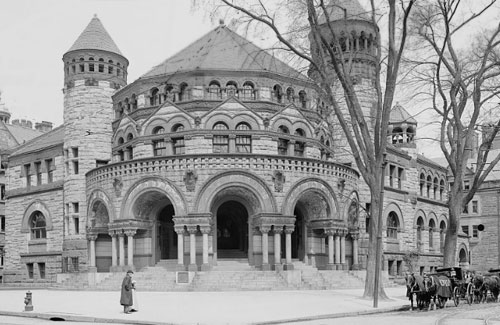
Tag: 1908
-

Early 1900s: The 100 Most Popular Songs
1. I’m a Yankee Doodle Dandy – 1904 (by George M Cohen)2. America the Beautiful – 19103. Danny Boy – 19134. Take Me Out To The Ball Game – 1908 (by Jack Norworth & Albert Von Tilzer )5. Pomp and Circumstance – 1902 (by Elgar)6. The Grand Old Rag (aka “You’re a Grand Old Flag”) – 1906 (by George M. Cohan)7. When Irish Eyes Are Smiling – 1912 (by Chauncey Olcott & George Graff Jr, . Ernest R. Ball)8. Daddy’s Little Girl – 1905 (by Edward Madden & Theodore F. Morse)9. The Bells Of St Mary’s – 1917 (by Douglas Furber & A. Emmett Adams)10. Give My Regards to Broadway – 1904 (by George M. Cohan )11. Swanee – 191912. Too-Ra-Loo-Ra-Loo-Ral (That’s An Irish Lullaby) – 1913 (by James R. Shannon )13. I Ain’t Got Nobody – 1916 (by Roger Graham, Dave Peyton & Spencer Williams)14. I Want To Be In Dixie (I’m Going Back To Dixie) – 1911 (by Irving Berlin & Ted Snyder)15. The Entertainer – 1902 (by Scott Joplin)16. Strike Up the Band (Here Comes a Sailor) – 190017. Anchors Aweigh – 1906 (by Alfred Hart Miles & R. Lovell and Charles A. Zimmerman)18. The Beer That Made Milwaukee Famous – 1903 (by Dan McAvoy)19. Colonel Bogey March – 1914 (by Kenneth J. Alford)20. Melody Of Love – 1903 (by Tom Glazer & H. Engelmann)21. Flight of the Bumble Bee – 1900 – (by N. Rimsky-Korsakov)22. Rite of Spring – 1913 (by Stravinsky)23. Over There – 1917 (by George M. Cohan)24. Yale Boola! (March and Two-Step) – 190125. Hinky Dinky Parlay Voo – 1919 (by Edward Rowland)26. March of the Toys – 1903 (by Victor Herbert, heard in Babes In Toyland)27. Frankie and Johnny – 191228. Dardanella – 1919 (by Fred Fisher & Felix Bernard, Johnny S. Black)29. You Belong To Me – 1916 (by Harry B. Smith & Victor Herbert)30. Alexander’s Ragtime Band – 1911(?)31. Hail! Hail! The Gang’s All Here – 1917 (by D. A. Esrom, Theodore F. Morse & Arthur Sullivan)32. Fascination – 1915 (by Harold Atteridge & Sigmund Romberg)33. McNamara’s Band – 1917 (by John J. Stamford & Shamus O’Connor)34. Peg O’ My Heart – 1913 (by Alfred Bryan & Fred Fisher)35. Saint Louis Blues – 1914 (by W. C. Handy)36. The Glow-Worm – 1902 (by Lilla Cayley Robinson, Heinz Bolten-Backers, Paul Lincke)37. Scott Joplin’s New Rag – 1912 (by Scott Joplin)38. Hail Hail the Gang’s All Here – 191739. Put On Your Old Grey Bonnet – 1909 (by Stanley Murphy & Percy Wenrich)40. Bye, Bye My Honey – Billy Golden (1911)41. Joe Turner Blues – 1915 (by Walter Hirsch & W. C. Handy)42. It’s a Long, Long Way to Tipperary – 191243. Ragtime Cowboy Joe – 1912 (by Grant Clarke, Lewis F. Muir & Maurice Abrahams)44. Oh! How I Hate to Get Up in the Morning – 1918 (by Irving Berlin)45. The Whiffenpoof Song – 1909 (by Meade Minnigerode & George S. Pomeroy, Tod B. Galloway)46. Alabama Jubilee – 1915 (by Jack Yellen & George L. Cobb)47. The Darktown Strutters’ Ball – 1916 (by Shelton Brooks)48. Harrigan – 1907 (by George M. Cohan)49. Bill Bailey, Won’t You Please Come Home – 190250. Let Me Call You Sweetheart – 191051. Keep On The Sunny Side – 1906 (by Jack Drislane & Theodore F. Morse)52. Because – 190253. Hiawatha (His Song to Minnehaha) – 190354. Ida! Sweet as Apple Cider – 1903 (by Eddie Leonard & Eddie Munson)55. The Aba Daba Honeymoon – 1914 (by Arthur Fields & Walter Donovan)56. Play a Simple Melody – 1914 (by Irving Berlin)57. Ah! Sweet Mystery Of Life – 1910 (by Rida Johnson Young & Victor Herbert)58. Ballin’ The Jack – 1913 (by James Henry Burris & Chris Smith)59. The Memphis Blues – 191260. American Patrol – 1901(?)61. On a Sunday Afternoon – 190262. The Saint Louis Blues – 191463. The Rose Of Tralee – 1912 (by C. Mordaunt Spencer m. Charles W. Glover)64. K-K-K-Katy – 1918 (by Geoffrey O’Hara)65. There’s A Broken Heart For Every Light On Broadway – 1915 (by Howard Johnson & Fred Fisher)66. Syncopated Walk – 1914 (by Irving Berlin)67. My Melancholy Baby – 1912 (by George A. Norton & Ernie Burnett)68. Meet Me in St. Louis, Louis – 190469. Give Us Just Another Lincoln – 190070. I Wonder Who’s Kissing Her Now – 1909 (by Will M. Hough & Frank R. Adams, Joseph E. Howard & Harold Orlob)71. In the Good Old Summer Time – 190272. Twelfth Street Rag – 1914 (by Euday L. Bowman)73. A Little Bit of Heaven – 191574. Casey Jones – 1909 (by T. Lawrence Seibert & Eddie Newton)75. Blame It on the Blues – 191476. By the Light of the Silvery Moon – 1909 (by Edward Madden & Gus Edwards)77. Waltz Around Again Willie – 1906 (‘Round, ‘Round, ‘Round)78. Alcoholic Blues – 1919 (by Edward Laska & Albert Von Tilzer)79. I Didn’t Raise My Boy to Be a Soldier – 1915 (by Alfred Bryan & Al Piantadosi )80. Shine On Harvest Moon – 1907 (by Nora Bayes & Jack Norworth)81. I Can’t Tell Why I Love You But I Do – 190082. Hungarian Rag – 1913 (by Julius Lenzberg)83. In My Merry Oldsmobile -1905 (by Vincent P. Bryan & Gus Edwards)84. And Then – 1913 (by Alfred Bryan & Herman Paley)85. Good Morning, Mr. Zip-Zip-Zip! – 191886. Goodbye, Good Luck, God Bless You – 1916 (by J. Keirn Brennan & Ernest R. Ball)87. Mary’s a Grand Old Name – 1905 (from the musical play Forty-Five Minutes from Broadway)88. Un Bel Di Madame Butterfly – 1904 (by Puccini)89. My Gal Sal – 190590. Concerto for Piano #2 – 1901 (by Rachmaninoff)91. Topsy Song – 191092. I’m Always Chasing Rainbows – 1918 (from the Musical Comedy Oh Look!)93. On The Road To Mandalay – 1907 (by Rudyard Kipling & Oley Speaks)94. Missouri Waltz (Hush-a-Bye, Ma Baby) – 191495. In the Shade of the Old Apple Tree – 190596. Beans! Beans!! Beans!!! – 1912 (by Elmer Bowman & Chris Smith)97. Tell Me Pretty Maiden (English Girls and Clerks) – 1900 (featured in Florodora)98. A Good Man Is Hard To Find – 1919(?)99. The Caissons Go Rolling Along – 1906 (by Edmund L. Gruber)100. Uncle Josh in Society – 1909 -
1908 History, Facts and Trivia
Top Ten Baby Names of 1908
Mary, Helen, Margaret, Ruth, Anna, John, William, James, George, Robert
US Life Expectancy
(1908) Males: 49.5 years, Females: 52.8 years
Firsts, Inventions and Wonders
Adolph Spreckels, of the Spreckels Sugar Company, was the first Sugar Daddy, nicknamed by his 24-years-younger wife, Alma de Bretteville.
The word “empathy” did not enter the English language until 1908.
I Got the Blues, published by New Orleans musician Antonio Maggio, and it is probably the first published “Blues” song.
Gideon Bibles started appearing in Hotel rooms.
The first ‘spork’ (cutting spoon) was patented (#904553A) 1908.
Around 400 BC, the Greek philosopher Democritus codified four basic tastes (sweet, sour, salty, bitter). No one challenged this until Auguste Escoffier, who claimed another, un-named taste, until a Japanese chemist, Kikunae Ikeda, ‘discovered’ the fifth flavor (umami) in L-glutamate.
Sunshine made Hydrox Cookies in 1908, and Oreo copied it in 1912.
Rolex founder Hans Wilsdorf came up with the name Rolex when, as he said, “I tried combining the letters of the alphabet in every possible way. This gave me some hundred names, but none felt right. One morning, a genie whispered’ Rolex’ in my ear while riding on the upper deck of a horse-drawn omnibus along Cheapside in the City of London.”
Tea Bags became popular.
The American term “Melting Pot” was first used in Israel Zangwill’s play of the same name.
The recipe for Tootsie Rolls calls for the previous day’s batch to be mixed with the new batch each day. Theoretically, this means there could be a bit of the first, starting in 1908, Tootsie Rolls in every new roll made today.
Until 1908, Philadelphia City Hall was the tallest building in the world.
The Most Popular Singers and Artists of 1908 include
John Beiling, Henry Burr, Albert Campbell, Enrico Caruso, Arthur Collins, Emilio DeGogorza, Geraldine Farrar, Byron G. Harlon, The Hayden Quartet, Harvey Hindermyer, Ada Jones, Harry Macdonough, Isabelle Marsh, Eddie Morton, Billy Murray, The Peerless Quartet, Arthur Pryor’s Band, Antonio Scotti, Frank Stanley, Cal Stewart, Elise Stevenson, Alan Turner, The Victor Orchestra, Reinald Werrenrath
Pop Culture Facts & History
London was the first city to have ever hosted the Olympics three times. 1908, 1948, and 2012.
The Tunguska Event, an explosion in Siberia in 1908, was 1,000 times greater than the atomic bomb dropped in Hiroshima, wiped out 80 million trees, and some say it was from a Nikola Tesla experiment. #itwasnt #probablyameteor
“SOS” (· · · – – – · · ·) distress signal officially became the worldwide standard for help.
Six thousand two hundred ten fans showed up to see the Cubs win the 1908 World Series, the smallest crowd for a World Series game. Chicago Cubs playoff games are scheduled at 7:08 pm or 19:08 in military time, and this is because 1908 was the last year the Cubs won the World Series. Merkle’s Boner was an incident in which rookie baseball player Fred Merkle of the New York Giants failed to advance to second base on what should have been a game-winning hit. This would lead to the Giants losing the National League pennant to the Chicago Cubs.
Take Me Out to the Ball Game is a 1908 Tin Pan Alley song by Jack Norworth and Albert Von Tilzer, which has become the unofficial anthem of North American baseball.
HIV made the jump from chimps to humans around 1908.
Ford’s Model T went on sale, at $825.00.
Mother’s Day was created by Anna Jarvis of West Virginia in 1908. It soon became so commercial that Jarvis spent the rest of her life trying to remove it from the calendar.
Sears sold mail-order homes, 75,000 between 1908 and 1940, as part of their Modern Homes program. They arrived as a kit and included many modern conveniences, such as indoor plumbing.
In 1908 in England, William “Bigfoot” Anakin, a local champion, was taken to court by a defense lawyer to help demonstrate that darts were not gambling but a game of skill. He threw three darts in the center; no other court official could do the same. The judge ruled that darts were a game of skill.
The Phaistos Disc was discovered in 1908 by the Italian archaeologist Luigi Pernier
1908 Olympics
The United States is the only country that does not ‘dip’ its flag to the host country at the Olympics opening ceremonies. When the US flag-holder, Ralph Rose, was asked to do so for King Edward VII at the 1908 London games, he supposedly responded, “This flag dips to no earthly king.”
Pistol dueling was a sport in the 1908 Summer Olympics. Contestants used wax bullets and metal masks for safety.
The United Kingdom won 146 medals in their 1908 London Olympic Games – 56 were gold medals, more than every other country in that year.
The 1908 Olympics were moved from Rome to London due to the 1906 eruption of Mount Vesuvius.
A marathon is 40.195 km (26.2 miles) because the British Queen Alexandra wanted the Olympic marathon in the 1908 Olympics in London to finish on the grass field. This changed the then-current distance of a marathon, but it was later formalized as the official distance and never changed back.
Finland and Sweden are the only countries that have earned a medal at every Olympic game since 1908.
When introduced to the Olympics in 1908, figure skating was part of the Summer Games. It remained so until 1924.
OOPS!
The Russian Olympic team arrived at the Olympics in London 12 days late because it was still using the Julian calendar instead of the Gregorian calendar.
English newspaper The Daily Telegraph printed an interview with Germany’s Emperor Wilhelm II, who characterized himself as ‘personally friendly’ to Britain but suggested the German people are hostile. It did not go well in either country, which is why, even today, it refers separately between governments and citizens of nations.
Interesting…
In his 1908 South Pole expedition, Ernest Shackleton included in his supplies cigars, 42 cases of alcohol, a car, and cocaine.
Tragedies
One hundred seventy-two students died in the Collinwood School Fire. One hundred seventy-one people died in a fire at the Rhoads Opera House. The crush of the crowds toward the exit made it impossible to open the inward-swinging doors. This is why doors now open outward in the United States.
Nobel Prize Winners
Physics – Gabriel Lippmann
Chemistry – Ernest Rutherford
Medicine – Élie Metchnikoff, Paul Ehrlich
Literature – Rudolf Christoph Eucken
Peace – Klas Pontus Arnoldson, Fredrik BajerPopular and Best-selling Books From 1908
Fiction Bestsellers
1. Mr. Crewe’s Career by Winston Churchill
2. The Barrier by Rex Beach
3. The Trail of the Lonesome Pine by John Fox Jr
4. The Lure of the Mask by Harold MacGrath
5. The Shuttle by Frances Hodgson Burnett
6. Peter by F. Hopkinson Smith
7. Lewis Rand by Mary Johnston
8. The Black Bag by Louis J. Vance
9. The Man from Brodney’s by George Barr McCutcheon,
10. The Weavers Critically Acclaimed and Historically Significant by Gilbert ParkerOther Books of Note
The Wind and The Willows by Kenneth Grahame
Process of Government by Arthur Bentley
Materialism and Empirio-Criticism by Vladimir Lenin
Human Nature and Politics by Graham Wallas
A Room with a View by E. M. Forster
The Old Wives’ Tale by Arnold Bennett
Hind Swaraj by Mohandas Gandhi
The Melting Pot by Israel ZangwillSports
World Series Champions: Chicago Cubs
Challenge Cup Champs: Montreal Wanderers
U.S. Open Golf: Fred McLeod
U.S. Tennis (Men/Ladies): William Larned/Maud Barger-Wallach
Wimbledon (Men/Women): Arthur Gore/Charlotte Sterry
NCAA Football Champions: Pennsylvania & LSU
Kentucky Derby Winner: Stone Street
Boston Marathon Winner: Thomas Morrissey Time: 2:25:43More 1908 History Resources
Most Popular Baby Names (BabyCenter.com)
Popular and Notable Books (popculture.us)
Broadway Shows that Opened in 1908
1908 Calendar, courtesy of Time and Date.com
Fact Monster
1908 in Movies (according to IMDB)
Wikipedia 1908 -
Samuel L. Clemen’s Notice for his Next Burglar
Samuel L. Clemen’s notice for his next burglar
September 9, 1908NOTICE.
To the next Burglar.
There is nothing but plated ware in this house, now and henceforth. You will find it in that brass thing in the dining-room over in the corner by the basket of kittens. If you want the basket, put the kittens in the brass thing. Do not make a noise- it disturbs the family. You will find rubbers in the front hall, by that thing which has the umbrellas in it, chiffonier, I think they call it, or pergola, or something like that.
Please close the door when you go away!
Very truly yours,
S.L. Clemens
-
John Swain’s Letter to his son, upon Entering Yale University
John Swain’s Letter to his son, who was entering Yale University
~1908My Dear Son:
I am writing a few things I meant to say to you when we took our last walk together, the day before you left for Yale. l intended to say them then and I will even confess that l shamelessly inveigled you into taking a stroll on the quiet street that l might rehearse a carefully prepared bit of Chesterfield up-to-date; but somehow I could not seem to begin,—and, after all, perhaps I can write what was in my mind more freely and plainly than l could have spoken it.
I think I had never realized before that I was getting old.
Of course I have known that my hair is causing your mother much solicitude. and that l am hopelessly wedded to my pince-nez while reading my daily paper, and at the opera; but in some incomprehensible way I had forgotten to associate these trifles with the encroachments of time. It was the sudden realization that you were about to become a Freshman in the college from which, as it seems to me, l but yesterday graduated, that “froze the genial current of my soul,” and spared you my paternal lecture.
Why, l can shut my eyes and still hear the Ivy Song, as we sang it that beautiful June morning; and yet but a few nights more and you will be locked in the deadly Rush on the same field where I triumphantly received two blackened eyes, and, l trust, gave many more!
Another thing, trifling in itself, opened my eyes to the fact of my advancing years. My son, my loyal and affectionate boy, some day it may be yours to know the pain, the unreasonable pain that comes over a man to know that between him and his boy, and his boy’s friends, an unseen but unassailable barrier has arisen, erected by no human agency; and to feel that while they may experience a vague respect and even curiosity to know what exists on your side of the barrier, you on your part would give all- wealth, position, influence, honor- to get back to theirs! All the world, clumsily or gracefully, is crawling over this barrier; but not one ever crawls back again!
You have ever seemed happy to be with me; you have worked with me, read and smoked with me, even played golf with me; but the subtle change in your attitude, the kindling of your eye when we met young men of your age, is the keenest pain I have ever known; yet one which, God knows! I would not reproach you with.
It explains what I used to see on my father’s face and did not understand.
For the tyranny of youth, my son, is the one tyranny which never has been, never can be overthrown. Nothing can displace it, nothing shake its power.
I usually beat you at golf, and occasionally at tennis; I suppose that if we were to spar together I might still make a respectable showing, and at least “save my face.” It avails no thing. I am on my side of the barrier, you on yours.
It seems but a year and a day since I tucked the ball under my arm and sped down the gridiron, sustained by the yells of my partisans; and if our game lacked the machine-like precision of the mass formations you are already somewhat familiar with, it was a good game, and we were good men, and all on the right side of the barrier!
So bear with me if l pause a moment and gaze back across this inevitable gulf into the pleasant land that lies behind me, -a picture evoked by your dawning college career.
I would not have you think me regretful, or melancholy. Life has been good to me- and every age has its gifts for the man who is willing to work for them and use them temperately. And nothing is more ungraceful, more ludicrous, than the spectacle of one who attempts to linger over the pleasures of an age he had outlived, and ignore the advantages of his own time of life.
Yet, as the years bring weakness, the mind persistently drifts back to the earlier periods of life, until the aged actually enter a phase we not inaptly name “second childhood,” from which Heaven forefend me!
I can still appreciate a pair of sparkling blue eyes, and I am not oblivious to the turn of a pretty shoulder; although I devoutly trust that my interest is now impersonal, and merely artistic . . .
Some fathers say to their sons upon the first home leaving,—”Beware of wine and women!” I do not.
If your home life has not taught you the virtues of a temperate, clean life, as I hope, then no words of mine can do it, and you must learn, as too many others have, from a bitter intimacy with its antithesis.
As to women, I never avoided them; I sought them out, from the time when, a red-cheeked youngster, I trudged to school beside a red-cheeked lassìe- asleep these many years in the little village lot where lie so many with whom I fought and played these many years gone by.
I have no advice to offer you on this great subject; its ethics are not taught by letter. If I have any regrets, they are not for your ear, nor any man’s. And if, of some women I have known, I cannot say that I lifted them up, at least of no woman can it be said that I thrust her down!
I ask of you no more than this and the guidance of your own heart; that, in the latter years, when you, too, pass over the barrier, you may not leave behind you shadows on the flower-decked meadows of your youth.
You will probably play cards in college; most men do, -I did. The gambling instinct in man is primordial. Kept under due bounds, if not useful, it is at least comparatively harmless. This is the very best that I or any honest man can say of it. I should be glad if you never cared to gamble; but l do not ask it. Assuming that you will, l do not insult you, and myself equally, by warning you against unfairness; to suppose you capable of cheating at cards is to suppose an impossibility. You could not do so without forfeiting the right ever to enter your home again. But some careless and insidious practices, not unknown in my day and class, savor to the upright mind of cheating, without always incurring its penalties.
To play with men whom you know cannot afford to lose, and who must either cheat or suffer privation; to play when you yourself must win your bet to square yourself; that is, when you do not reasonably see how you are going to raise the money to pay providing you lose,—this is a gambler’s chance to which no gentleman will ever expose his fellow players.
There is nothing heroic about these desperate casts of the die; one risks only the other fellow’s money. These practices I ask and expect you to avoid.
l ask nothing of you in the way of a declared position on religion. Your mother may have demanded more of you here,—entreated more; I cannot. I ask but this: that you will give earnest, serious consideration to the fact that we exist on this planet for a shockingly brief fraction of Eternity; that it behooves every man to diligently seek an answer to the great question,—Why am I here? And then, as best he can, to live up to the ideal enjoined by his answer. And if this carries you far, and if it leads you to embrace any of the great creeds of Christendom, this will be to your mother an unspeakable joy, and perhaps not less so to me; but it is a question which cannot be settled by the mere filial desire to please.
Last of all, while you are in college, be of it and support its every healthful activity.
I ask no academic honor your natural inclinations may not lead you to strive for; no physical supremacy your animal spirits may not instinctively reach out and grasp.
You will, I presume, make the fraternity I made, and, I hope, the societies; you will probably then learn that your father was not always a dignified, bearded man in pince-nez and frock coat, and that on his side of the barrier he cut not a few capers which, seen in the clear light of his summer, gain little grace. Yet, were he to live his life over again, he would cut the same, or worse.
Finally, if you make any of the teams, never quit. That is all the secret of success. Never quit!
Quitting, I like to believe, has not been a striking characteristic of our family, and it is not tolerated in our college.
If you can’t win the scholarship, fight it out to the end of the examination.
If you can’t win your race, at least finish- somewhere.
If your boat can’t win, at least keep pulling on your oar, even if your eye glazes and the taste of blood comes into your throat with every heave.
If you cannot make your five yards in football, keep bucking the line—never let up—if you can’t see, or hear, keep plugging ahead! Never quit! If you forget all else I have said, remember these two words, through all your life, and come success or failure, I shall proudly think of you as my own dear son.
And so, from the old home-life, farewell, and Godspeed!
Your Affectionate Father