Tag: 1917
-

Early 1900s: The 100 Most Popular Songs
1. I’m a Yankee Doodle Dandy – 1904 (by George M Cohen)2. America the Beautiful – 19103. Danny Boy – 19134. Take Me Out To The Ball Game – 1908 (by Jack Norworth & Albert Von Tilzer )5. Pomp and Circumstance – 1902 (by Elgar)6. The Grand Old Rag (aka “You’re a Grand Old Flag”) – 1906 (by George M. Cohan)7. When Irish Eyes Are Smiling – 1912 (by Chauncey Olcott & George Graff Jr, . Ernest R. Ball)8. Daddy’s Little Girl – 1905 (by Edward Madden & Theodore F. Morse)9. The Bells Of St Mary’s – 1917 (by Douglas Furber & A. Emmett Adams)10. Give My Regards to Broadway – 1904 (by George M. Cohan )11. Swanee – 191912. Too-Ra-Loo-Ra-Loo-Ral (That’s An Irish Lullaby) – 1913 (by James R. Shannon )13. I Ain’t Got Nobody – 1916 (by Roger Graham, Dave Peyton & Spencer Williams)14. I Want To Be In Dixie (I’m Going Back To Dixie) – 1911 (by Irving Berlin & Ted Snyder)15. The Entertainer – 1902 (by Scott Joplin)16. Strike Up the Band (Here Comes a Sailor) – 190017. Anchors Aweigh – 1906 (by Alfred Hart Miles & R. Lovell and Charles A. Zimmerman)18. The Beer That Made Milwaukee Famous – 1903 (by Dan McAvoy)19. Colonel Bogey March – 1914 (by Kenneth J. Alford)20. Melody Of Love – 1903 (by Tom Glazer & H. Engelmann)21. Flight of the Bumble Bee – 1900 – (by N. Rimsky-Korsakov)22. Rite of Spring – 1913 (by Stravinsky)23. Over There – 1917 (by George M. Cohan)24. Yale Boola! (March and Two-Step) – 190125. Hinky Dinky Parlay Voo – 1919 (by Edward Rowland)26. March of the Toys – 1903 (by Victor Herbert, heard in Babes In Toyland)27. Frankie and Johnny – 191228. Dardanella – 1919 (by Fred Fisher & Felix Bernard, Johnny S. Black)29. You Belong To Me – 1916 (by Harry B. Smith & Victor Herbert)30. Alexander’s Ragtime Band – 1911(?)31. Hail! Hail! The Gang’s All Here – 1917 (by D. A. Esrom, Theodore F. Morse & Arthur Sullivan)32. Fascination – 1915 (by Harold Atteridge & Sigmund Romberg)33. McNamara’s Band – 1917 (by John J. Stamford & Shamus O’Connor)34. Peg O’ My Heart – 1913 (by Alfred Bryan & Fred Fisher)35. Saint Louis Blues – 1914 (by W. C. Handy)36. The Glow-Worm – 1902 (by Lilla Cayley Robinson, Heinz Bolten-Backers, Paul Lincke)37. Scott Joplin’s New Rag – 1912 (by Scott Joplin)38. Hail Hail the Gang’s All Here – 191739. Put On Your Old Grey Bonnet – 1909 (by Stanley Murphy & Percy Wenrich)40. Bye, Bye My Honey – Billy Golden (1911)41. Joe Turner Blues – 1915 (by Walter Hirsch & W. C. Handy)42. It’s a Long, Long Way to Tipperary – 191243. Ragtime Cowboy Joe – 1912 (by Grant Clarke, Lewis F. Muir & Maurice Abrahams)44. Oh! How I Hate to Get Up in the Morning – 1918 (by Irving Berlin)45. The Whiffenpoof Song – 1909 (by Meade Minnigerode & George S. Pomeroy, Tod B. Galloway)46. Alabama Jubilee – 1915 (by Jack Yellen & George L. Cobb)47. The Darktown Strutters’ Ball – 1916 (by Shelton Brooks)48. Harrigan – 1907 (by George M. Cohan)49. Bill Bailey, Won’t You Please Come Home – 190250. Let Me Call You Sweetheart – 191051. Keep On The Sunny Side – 1906 (by Jack Drislane & Theodore F. Morse)52. Because – 190253. Hiawatha (His Song to Minnehaha) – 190354. Ida! Sweet as Apple Cider – 1903 (by Eddie Leonard & Eddie Munson)55. The Aba Daba Honeymoon – 1914 (by Arthur Fields & Walter Donovan)56. Play a Simple Melody – 1914 (by Irving Berlin)57. Ah! Sweet Mystery Of Life – 1910 (by Rida Johnson Young & Victor Herbert)58. Ballin’ The Jack – 1913 (by James Henry Burris & Chris Smith)59. The Memphis Blues – 191260. American Patrol – 1901(?)61. On a Sunday Afternoon – 190262. The Saint Louis Blues – 191463. The Rose Of Tralee – 1912 (by C. Mordaunt Spencer m. Charles W. Glover)64. K-K-K-Katy – 1918 (by Geoffrey O’Hara)65. There’s A Broken Heart For Every Light On Broadway – 1915 (by Howard Johnson & Fred Fisher)66. Syncopated Walk – 1914 (by Irving Berlin)67. My Melancholy Baby – 1912 (by George A. Norton & Ernie Burnett)68. Meet Me in St. Louis, Louis – 190469. Give Us Just Another Lincoln – 190070. I Wonder Who’s Kissing Her Now – 1909 (by Will M. Hough & Frank R. Adams, Joseph E. Howard & Harold Orlob)71. In the Good Old Summer Time – 190272. Twelfth Street Rag – 1914 (by Euday L. Bowman)73. A Little Bit of Heaven – 191574. Casey Jones – 1909 (by T. Lawrence Seibert & Eddie Newton)75. Blame It on the Blues – 191476. By the Light of the Silvery Moon – 1909 (by Edward Madden & Gus Edwards)77. Waltz Around Again Willie – 1906 (‘Round, ‘Round, ‘Round)78. Alcoholic Blues – 1919 (by Edward Laska & Albert Von Tilzer)79. I Didn’t Raise My Boy to Be a Soldier – 1915 (by Alfred Bryan & Al Piantadosi )80. Shine On Harvest Moon – 1907 (by Nora Bayes & Jack Norworth)81. I Can’t Tell Why I Love You But I Do – 190082. Hungarian Rag – 1913 (by Julius Lenzberg)83. In My Merry Oldsmobile -1905 (by Vincent P. Bryan & Gus Edwards)84. And Then – 1913 (by Alfred Bryan & Herman Paley)85. Good Morning, Mr. Zip-Zip-Zip! – 191886. Goodbye, Good Luck, God Bless You – 1916 (by J. Keirn Brennan & Ernest R. Ball)87. Mary’s a Grand Old Name – 1905 (from the musical play Forty-Five Minutes from Broadway)88. Un Bel Di Madame Butterfly – 1904 (by Puccini)89. My Gal Sal – 190590. Concerto for Piano #2 – 1901 (by Rachmaninoff)91. Topsy Song – 191092. I’m Always Chasing Rainbows – 1918 (from the Musical Comedy Oh Look!)93. On The Road To Mandalay – 1907 (by Rudyard Kipling & Oley Speaks)94. Missouri Waltz (Hush-a-Bye, Ma Baby) – 191495. In the Shade of the Old Apple Tree – 190596. Beans! Beans!! Beans!!! – 1912 (by Elmer Bowman & Chris Smith)97. Tell Me Pretty Maiden (English Girls and Clerks) – 1900 (featured in Florodora)98. A Good Man Is Hard To Find – 1919(?)99. The Caissons Go Rolling Along – 1906 (by Edmund L. Gruber)100. Uncle Josh in Society – 1909 -
1917 History, Fun Facts and Trivia
1917 History, Facts and Trivia
Top Ten Baby Names of 1917
Mary, Helen, Dorothy, Margaret, Ruth, John, William, James, Robert, Joseph
US Life Expectancy
(1917) Males: 48.4 years, Females: 54.0 years
Firsts, Inventions, and Wonders
Kiwanis International was founded in Detroit, Michigan
The term “breakfast is the most important meal of the day” was popularized by cereal companies’ marketing campaigns after appearing in Good Health Magazine.
At Piggly Wiggly grocery stores, the modern concept of a grocery store, where you get items off the shelf yourself, wasn’t invented until 1917.
The Converse All-Star “Chuck Taylor” Basketball Shoe was first produced in 1917.
The first use of OMG was in Lord Fisher’s September 9, 1917, letter to Winston Churchill.
Melvin Jones founded Lions Clubs International.
The Most Popular Singers and Artists of 1917 include
The American Quartet, Elsie Baker, Bora Bayes, Henry Burr, Albert Campbell, Byron G. Harlan, Marion Harris, Charles Harrison, Al Jolson, Ada Jones, Lucy Isabelle Marsh, John McCormack, Billy Murray, The Original Dixieland Jazz Band, The Peerless Quartet, Prince’s Orchestra, Joseph C. Smith’s Orchestra, John Philip Sousa’s Band, The Sterling Trio, Van & Schenck, The Victor Military Band, Weber & Fields, Reinald Werrenrath, Anna Wheaton
US Politics
March 5, 1917 (Monday): Second inauguration of Woodrow Wilson
Pop Culture Facts & History
Jeannette Rankin, the first Congresswoman, served just two non-consecutive terms, starting in 1917 and 1941 and was the only person to vote against the declaration of war in both WWI and WWII.
A bank in Utah was built using 80,000 bricks mailed via USPS in 50-pound packages to save on freight costs. The post office changed parcel post rules after that.
Cape Canaveral is part of the Diocese of Orlando, making its Bishop technically Bishop of the Moon, according to the 1917 Code of Canon Law (“any newly discovered territory was placed under the jurisdiction of the diocese from which the expedition which discovered that territory left”).
The Miracle of the Sun occurred in Fatima, Portugal, in 1917 and was accepted as a miracle by the Catholic Church in 1930. At least 30,000 people gathered to see a multicolored sun dancing in the sky.
The United States purchased the Danish West Indies for $25,000,000 and renamed them the Virgin Islands.
The Royal Family officially adopted ‘Windsor’ as their surname in 1917.
WWI News:
The model for Uncle Sam on the famous 1917 post I Want You is the face of the painter, James Montgomery Flagg. For effect, he aged his portrait and added the goatee beard. Flagg used his picture to avoid the need to find a model. It was partially inspired by a British recruitment poster showing Lord Kitchener in a similar pose.
US troops in Paris stopped at the grave (composed of soil from the United States) of French Revolutionary War Hero, Marquis de Lafayette, and proclaimed, “Lafayette, we are here!”
The Trading with the Enemy Act of 1917 enabled the U.S. government to seize private assets worth millions of dollars, including Bayer’s trademark on Aspirin.
The Disaster
The Halifax Explosion was a maritime disaster in Halifax, Nova Scotia, Canada, that killed 2000 people and injured 9,000.
Fake News
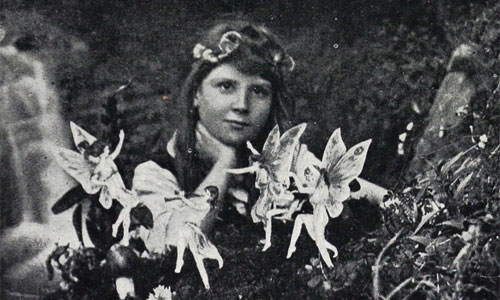
The Cottingley Fairies appeared in a series of five photographs taken by cousins Elsie Wright (1901–88) and Frances Griffiths (1907–86)
Emily Grant Hutchings tried to release a “Mark Twain” novel called Jap Herron after his death, claiming the dead author dictated the book using an Ouija board.
Journalist H.L. Mencken published a hoax news article stating bathtubs were popularized in the US by President Millard Fillmore after he had one installed in the White House. Thirty years later, even after he admitted it was false, it was still being reprinted as fact.
Spanish Flu
The 1918 Spanish Flu killed so many people in the US that it caused the average life expectancy in males to drop from 48.4 to 36.6 and 54.0 to 42.2 in females between 1917 and 1918.
Nobel Prize Winners
Physics – Charles Glover Barkla
Chemistry – not awarded
Medicine – not awarded
Literature – Karl Adolph Gjellerup, Henrik Pontoppidan
Peace – International Committee of the Red CrossPopular and Best-selling Books From 1917
Fiction Bestsellers
1. Mr. Britling Sees It Through, by H.G. Wells
2. The Light in the Clearing, by Irving Bacheller
3. The Red Planet by William J. Locke
4. The Road to Understanding by Eleanor H. Porter
5. Wildfire by Zane Grey
6. Christine by Alice Cholmondeley
7. In the Wilderness by Robert S. Hichens
8. His Family by Ernest Poole
9. The Definite Object by Jeffrey Farnol
10. The Hundredth Chance by Ethel M. DellGeneral Nonfiction Bestsellers
1. Rhymes of a Red Cross Man by Robert W. Service
2. The Plattsburg Manual by O.O. Ellis and E.B. Garey
3. Raymond by Sir Oliver Lodge,
4. Poems of Alan Seeger by Alan Seeger
5. God the Invisible King by H.G. Wells
6. Laugh and Live by Douglas Fairbanks
7. Better Meals for Less Money by Mary GreenWar Nonfiction Bestsellers
1. The First Hundred Thousand by Ian Hay
2. My Home in the Field of Honor by Frances W. Huard
3. A Student in Arms by Donald Hankey
4. Over the Top by Arthur Guy Empey
5. Carry On by Coningsby Dawson
6. Getting Together by Ian Hay
7. My Second Year of the War by Frederick Palmer
8. The Land of Deepening Shadow by D. Thomas Curtin
9. Italy, France and Britain at War by H.G. Wells
10. The Worn Doorstep by Margaret SherwoodOther Books of Note
On Growth and Form by D’Arcy Wentworth Thomas
A Theology for the Social Gospel by Walter Rauschenbusch
A Book of Prefaces by H.L. Mencken
Social Rule by Elsie Clewes Parsons
Prufrock by T.S. EliotSports
World Series Champions: Chicago White Sox
Stanley Cup Champs: Seattle Metropolitans
U.S. Open Golf: not held (WWI)
U.S. Tennis (Men/Ladies): Robert Lindley Murray/Molla Bjurstedt
Wimbledon (Men/Women): not held (WWI)
NCAA Football Champions: Georgia Tech
Kentucky Derby Winner: Omar Khayyam
Boston Marathon Winner: Bill Kennedy Time: 2:28:37More 1917 Facts & History Resources:
Most Popular Baby Names (BabyCenter.com)
Popular and Notable Books (popculture.us)
Broadway Shows that Opened in 1917
1917 Calendar, courtesy of Time and Date.com
Fact Monster
1917 in Movies (according to IMDB)
Wikipedia 1917 -
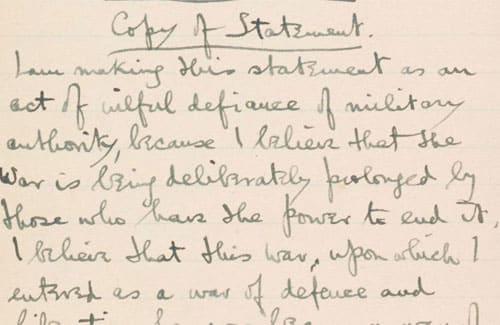
Siegfried Sassoon’s Statement of Willful Defiance
Siegfried Sassoon’s statement of willful defiance
July 17(?), 1917I am making this statement as an act of wilful defiance of military authority because I believe that the war is being deliberately prolonged by those who have the power to end it. I am a soldier, convinced that I am acting on behalf of soldiers. I believe that the war upon which I entered as a war of defence and liberation has now become a war of agression and conquest. I believe that the purposes for which I and my fellow soldiers entered upon this war should have been so clearly stated as to have made it impossible to change them and that had this been done the objects which actuated us would now be attainable by negotiation.
I have seen and endured the sufferings of the troops and I can no longer be a party to prolong these sufferings for ends which I believe to be evil and unjust. I am not protesting against the conduct of the war, but against the political errors and insincerities for which the fighting men are being sacrificed.
On behalf of those who are suffering now, I make this protest against the deception which is being practised upon them; also I believe it may help to destroy the callous complacency with which the majority of those at home regard the continuance of agonies which they do not share and which they have not enough imagination to realise.