web analytics

Tag: 1922

  • Pop Culture Trivia Quiz:  What Happened In 1922?

    Pop Culture Trivia Quiz: What Happened In 1922?

    Pop Culture Trivia Quiz: What Happened In 1922?

    22 Trivia Questions for 1922 History

    (answers)

    1. What was the Biggest Number One Song of 1922?

    2. What was the average household income in 1922?

    3. What was the original name for the Eskimo Pie ice cream bar?

    4. What was the Bestselling Fiction Book in 1922?

    5. In 1922, what was the average life expectancy in the United States?

    6. The League of Nations banned it in 1922 and the United States did not ban it until 1971. What was it?

    7. What Washington, D.C. landmark was dedicated on May 30, 1922?

    8. Who won the 1922 World Series?

    9. On June 14, 1922, what was President Warren G. Harding the first to do?

    10. What amphitheater in the Hollywood Hills neighborhood of Los Angeles, California?

    11. Who won the Stanley Cup in 1922?

    12. Who was the first General Secretary of the Communist Party of the Soviet Union?

    13. How much did a Pound of Porkchops cost in 1922?

    14. How many people lived in the United States in 1922?

    15. What female celebrity holds the Guinness Book of World Records for the longest television career, over 80 years?

    16. What California creature became extinct in 1922?

    17. F. Scott Fitzgerald named what musical era?

    18. Which celebrity was NOT born in 1922 – Stan Lee, Martin Luther King, Betty White or Judy Garland?

    19. What was the average price of a 78 RPM record?

    20. How much did an average Ford Model T cost in 1922?

    21. How much did a gallon of gas cost in 1922?

    22. What vegan and kosher Australian food product was invented by Australian entrepreneur Fred Walker?

    Trivia Team Bonus Questions:

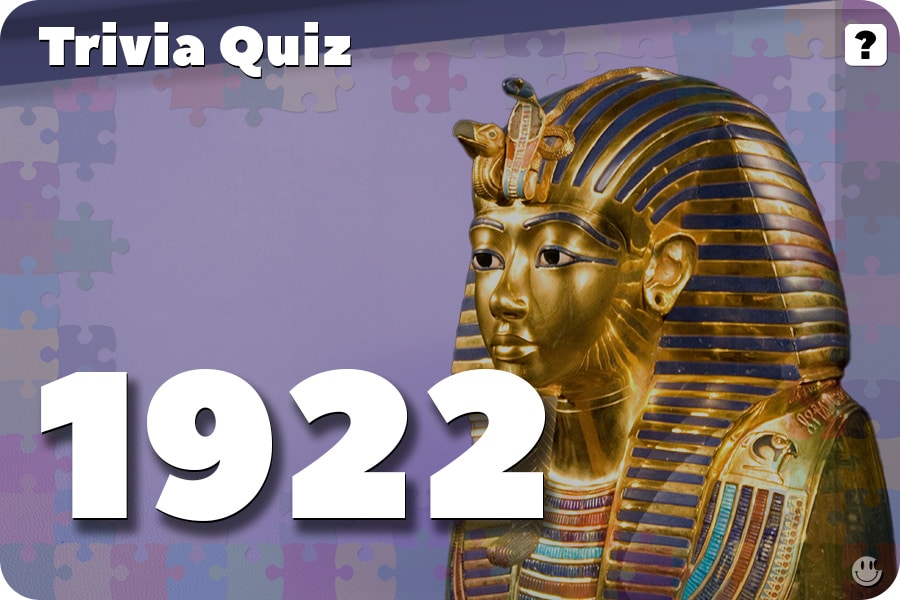
    1. What did Lord Carnarvon and Howard Carter discover?

    2. By 1922, Hollywood became the center of filmmaking in the U.S. with how much (% percentage) of American movie production?

    3. What Horse won the Kentucky Derby in 1922?

    4. What did Ralph Samuelson do on Lake Pepin in Lake City, Minnesota?

    5. Although she only served for one day, what did Rebecca Latimer Felton do on November 21, 1922?

    6. Who was the Pope in 1922?

    7. Why was all telephone service in the U.S. and Canada silenced for one minute on August 4th, 1922?

    8. Tool Trivia: What type of saw did Raymond De Walt of Bridgeton, New Jersey invent?

    9. Who was the American Vice-President in 1922?

    10. What was Walt Disney’s first animated short?

    The Answers:

    22 Trivia Answers for 1922 History

    1. What was the Biggest Number One Song of 1922?
    April Showers by Al Jolson

    2. What was the average household income in 1922?
    $3,143.46

    3. What was the original name for the Eskimo Pie ice cream bar?
    I-Scream Bar

    4. What was the Bestselling Fiction Book in 1922?
    If Winter Comes by A.S.M. Hutchinson

    5. In 1922, what was the average life expectancy in the United States?
    Men – 58.4 years, Women – 61.0 years.

    6. The League of Nations banned it in 1922 and the United States did not ban it until 1971. What was it?
    Lead paint

    7. What Washington, D.C. landmark was dedicated on May 30, 1922?
    The Lincoln Memorial

    8. Who won the 1922 World Series?
    In 1922, The New York Giants won, beating the New York Yankees (4 games to 0, 1 tie)

    9. On June 14, 1922, what was President Warren G. Harding the first to do?
    Warren G. Harding was the first president to have a speech broadcast on the radio.

    10. What amphitheater in the Hollywood Hills neighborhood of Los Angeles, California?
    The Hollywood Bowl

    11. Who won the Stanley Cup in 1922?
    In 1922, The Toronto St. Patricks won over the Vancouver Millionaires (3 games to 2)

    12. Who was the first General Secretary of the Communist Party of the Soviet Union?
    Joseph Stalin

    13. How much did a Pound of Porkchops cost in 1922?
    33 cents

    14. How many people lived in the United States in 1922?
    The population was an estimated 110,049,000 people.

    15. What female celebrity holds the Guinness Book of World Records for the longest television career, over 80 years?
    Born in 1922, Betty white started on television in 1939.

    16. What California creature became extinct in 1922?
    California grizzly bear

    17. F. Scott Fitzgerald named what musical era?
    The Jazz Age

    18. Which celebrity was NOT born in 1922 – Stan Lee, Martin Luther King, Betty White or Judy Garland?
    Martin Luther King Jr. (January 15, 1929 – April 4, 1968)

    19. What was the average price of a 78 RPM record?
    $1.75

    20. How much did an average Ford Model T cost in 1922?
    $319

    21. How much did a gallon of gas cost in 1922?
    $0.25 per gallon

    22. What vegan and kosher Australian food product was invented by Australian entrepreneur Fred Walker?
    Vegemite

    Trivia Team Bonus Questions:

    1. What did Lord Carnarvon and Howard Carter discover?
    King “Tut” Tutankhamen’s tomb.

    2. By 1922, Hollywood became the center of film making in the U.S. with how much of American movie production?
    85%

    3. What Horse won the Kentucky Derby in 1922?
    Morvich

    4. What did Ralph Samuelson do on Lake Pepin in Lake City, Minnesota?
    He invented water skiing, with rope and a pair of snow skis.

    5. Although she only served for one day, what did Rebecca Latimer Felton do on November 21, 1922?
    She became the first woman to serve in the U.S. Senate.

    6. Who was the Pope in 1922?
    Pope Benedict XV, September 3, 1914 – January 22, 1922, and Pope Pius XI, February 6, 1922 – February 10, 1939

    7. Why was all telephone service in the U.S. and Canada silenced for one minute on August 4th, 1922?
    To mark the funeral of Alexander Graham Bell.

    8. Tool Trivia: What type of saw did Raymond De Walt of Bridgeton, New Jersey invent?
    The radial arm saw

    9. Who was the American Vice-President in 1922?
    Calvin Coolidge (March 4, 1921 – August 2, 1923)

    10. What was Walt Disney’s first animated short?
    Four Musicians of Bremen, in 1922, long before Mickey Mouse or Oswald The Lucky Rabbit.
     

  • Formation of the Union of Soviet Socialist Republics (USSR)

    Formation of the Union of Soviet Socialist Republics (USSR)

    Formation of the Union of Soviet Socialist Republics (USSR)

    The formation of the Union of Soviet Socialist Republics (USSR) was a monumental event in world history that marked the establishment of the world’s first communist state. Over four decades, the USSR became a global superpower with significant influence on international relations, politics, and pop culture. The Soviet Union’s impact is still felt today, even after its dissolution in 1991.

    • Bolshevik Revolution: The seeds of the USSR were sown during the Bolshevik Revolution of October 1917 (Julian Calendar) or November 1917 (Gregorian Calendar). Led by Vladimir Lenin and the Bolshevik Party, the revolution resulted in overthrowing the Russian Provisional Government and the eventual end of the Russian Empire.
    • Russian Civil War: The Bolshevik Revolution ignited a brutal civil war from 1918 to 1922. The conflict pitted the Red Army, loyal to the Bolshevik government, against the anti-communist White Army. The war resulted in millions of casualties and widespread devastation, but the Bolsheviks emerged victorious.
    • Establishment of the USSR: On December 30, 1922, the USSR was officially established, incorporating Russia and several neighboring Soviet republics, including Ukraine, Belarus, and Transcaucasia (later divided into Georgia, Armenia, and Azerbaijan). The new state was governed by the Communist Party, with Moscow as its capital.
    • Stalin’s Rise to Power: Following Lenin’s death in 1924, Joseph Stalin emerged as the leader of the Soviet Union. Stalin’s rule was marked by rapid industrialization, forced collectivization of agriculture, and brutal repression of political dissent.
    • Effects on Pop Culture: The USSR significantly impacted global pop culture. Soviet cinema, literature, and art were often state-sponsored and used as propaganda tools. However, many talented artists and writers emerged from this period, including filmmakers Sergei Eisenstein and Andrei Tarkovsky, composer Dmitri Shostakovich, and writers Boris Pasternak and Aleksandr Solzhenitsyn.
    • Cold War: The USSR played a central role in the Cold War (1947-1991), a period of heightened tension and rivalry between the Soviet Union and the United States. The Cold War profoundly impacted global politics, economics, and culture and led to a nuclear arms race and numerous proxy wars.
    • Dissolution: The USSR was dissolved on December 26, 1991, following economic decline and political upheaval. The dissolution resulted in the emergence of 15 independent nations, including Russia, which became the successor state to the Soviet Union.

    In summary, the formation of the Union of Soviet Socialist Republics (USSR) in 1922 marked the beginning of a new era in world history. The Soviet Union played a major role in global politics, economics, and culture for much of the 20th century. While the USSR no longer exists, its legacy is still felt today through its political and cultural impact on the world.

  • 1922 History, Facts and Trivia

    1922 History, Facts and Trivia

    1922 History, Facts and Trivia

    Quick Facts from 1922

    • World Changing Event: The Ottoman Empire was abolished, and its last sultan, Mehmed VI, abdicated.
    • The Union of Soviet Socialist Republics (USSR) was created.
    • Mussolini and the Fascist Party came to power in Italy.
    • Mohandas Gandhi was arrested, tried for sedition, and sentenced to six years’ imprisonment.
    •  America’s first aircraft carrier, The USS Langley, was commissioned.
    • Influential Musical Artists include Fats Waller, Fanny Brice, Al Jolson, Marion Harris, and Ethel Waters.
    • The 2-month-long Railway Shopmen’s Strike of 1922 began, affecting 400,000 workers.
    • The Movies to Watch include Nosferatu, Dr. Mabuse: The Gambler, Foolish Wives, and Nanook of the North.
    • The Most Famous Person in America was probably Babe Ruth
    • The Rose Bowl Stadium officially opened in Pasadena, California.
    • Coca-Cola’s first polar bear print advertisement appeared in France in 1922.
    • Price of 24 Dr. Swift’s Root Beer, 8 oz in 1922: $2.25
    • The Funny Guy was Harold Lloyd
    • The (Modern) Conversation: Betty White is older than sliced bread. Betty White was born in 1922, and sliced bread was introduced in 1928.

    Top Ten Baby Names of 1922

    Mary, Dorothy, Helen, Margaret, Ruth, Betty, Virginia, Mildred, Elizabeth
    John, Robert, William, James, Charles, George, Joseph, Edward, Richard, Frank

    US Life Expectancy

    (1922) Males: 58.4 years, Females: 61.0 years

    The Stars

    Theda Bara, Marion Davies, Pola Negri, Mary Pickford

    Miss America

    Mary Katherine Campbell (Columbus, Ohio)

    Firsts, Inventions, and Wonders

    Gummy Bears were created in Germany.

    Walgreens introduced the malted milkshake in 1922.

    Jack Johnson, the first Black heavyweight boxing champion, patented a wrench (U.S. patent #1,413,121) on April 18, 1922.

    Lincoln Memorial was dedicated.

    The British Broadcasting Company (BBC) was established.

    The first-ever 3D movie was The Power Of Love, a silent film released in 1922. It was also the first film to have an alternative ending, and the viewer could choose between the happy and sad endings (both shot in 2D) by closing one eye or the other. No copies exist

    The Caterpillar Club is an association of people who have successfully used a parachute to bail out a disabled aircraft. “Life depends on a silken thread” is the club’s motto.

    The term The Jazz Age was coined by F. Scott Fitzgerald in 1922, the same year that the Great Gatsby is based.

    Christian K. Nelson patented the Eskimo Pie ice cream treat.

    In the 1897 novel by Bram Stoker, sunlight isn’t fatal to Dracula but only drains most of his powers. It wasn’t until the 1922 film Nosferatu that sunlight was first depicted as deadly to vampires.

    The first recorded use of periwinkle as an (English) color name.

    The first woman to serve in the US Senate was Rebecca Latimer Felton in 1922. She was 87 and served for only one day. She championed prison reform, women’s rights, and education. She was the last member of Congress to have owned slaves.

    Readers Digest and Ring Magazine began publication.

    When Vegemite was invented in 1922, it almost failed as a product. By 1940, it was so central to the Aussie diet that it became mandatory in their WWII military rations.

    The discovery of Tutankhamun’s tomb in 1922 influenced the Art Deco design style and repopularized the use of eyeliner in the West.

    The Bureau of Public Roads commissioned Gen. John J. Pershing to make a map for construction purposes and to highlight which roads in the U.S. were the most important in the event of war. The “Pershing Map” was the first official topographic road map of the United States.

    The Biggest Pop Artists of 1922 include

    Elsie Baker, Nora Bayes, The Benson Orchestra of Chicago, Fanny Brice, Henry Burr, Eddie Cantor, Zez Confrey & His Orchestra, Edwin Dale, Vernon Dalhart, Al Jolson, Ernest Hare, Mariona Harris, Charles Harrison, Billy Jones, Isham Jones & His Orchestra, Ted Lewis and His Band, Vincent Lopez and His Orchestra, Ray Miller and His Orchestra, Lucy Isabelle Marsh, Billy Murray, The Peerless Quartet, Joseph C. Smith’s Orchestra, Aileen Stanley, John Steel, Van & Schenck, Paul Whiteman and His Orchestra, Bert Williams

    Pop Culture Facts & History

    On February 2, 1922, it was 2:22:22 on 2/2/22.

    Film director Hal Roach released the first of many ‘short’ features called Our Gang. Considered racist by many today, it was groundbreaking to include black and white children playing together in 1922. In 1955, the series of shorts was renamed Little Rascals for television.

    The Straw Hat Riot of 1922 was an eight-day riot in New York City over men wearing straw hats past the unofficial date deemed socially acceptable, September 15th.

    Hottest day and place ever recorded on Earth: September 13, 1922 – 136 degrees in El Aziza, Libia. (or was it?)

    Although lead paint was recognized as toxic as early as 1897 and banned by the League of Nations in 1922, the US did not ban lead paint until 1971.

    Nanook of the North, the first commercially successful feature-length documentary film, was released on June 11.

    There was an all-Native American NFL team from 1922-1923 called the Oorang Indians, based out of Ohio.

    All telephone service in the US and Canada was silenced for one minute on August 4, 1922, to mark the funeral of Alexander Graham Bell.

    While incarcerated in Leavenworth, Jack Johnson, the first black world champion heavyweight boxer, modified a wrench for tightening loosened fastening devices and received a patent for his improvements on April 18, 1922 (Patent #1,413,121)

    There are no grizzly bears in California, and there haven’t been since 1922, despite one being on the state flag.

    On May 30, 1922, the St. Louis Cardinals and Chicago Cubs traded two players (Max Flack and Cliff Heathcote)between doubleheader games. Both players played for each team that day.

    The US Postmaster General declared all houses had to have mailboxes or forgo mail delivery.

    On August 25, 1922, the highest-scoring game in Major League history occurred: the Chicago Cubs defeated the Philadelphia Phillies 26–23, a total of 49 runs.

    Lord Carnarvon and Howard Carter discovered the tomb of Pharoah Tutankhamun, better known as King Tut.

    Briggs & Stratton Flyer was the least expensive car ever manufactured, selling for about $125 in 1922.

    Charles Osborne had hiccups for 68 years, from 1922 to 1990, and was entered in the Guinness World Records as the man with the longest attack of hiccups, an estimated 430 million hiccups.

    Wimbledon Center Court was completed.

    The highest-scoring baseball game was 49 runs when the Chicago Cubs beat the Phillies 26 to 23 on August 25th.

    The Bureau of Public Roads commissioned US General John J. Pershing to make a map to highlight which roads in the U.S. were the most important in the event of war. The “Pershing Map” was the first official topographic road map of the United States.

    The Hess Triangle Plate was put on an NYC sidewalk area.

    One hundred twelve people died during the Hoover Dam project. The first was J. G. Tierney, a surveyor who drowned on December 20, 1922. His son, Patrick W. Tierney, was the last man to die working on the dam, 13 years later.

    In Chicago, the Herrin Massacre occurred in June 1922 in Herrin, Illinois. 19 ‘scabs’ and two union miners (Jordie Henderson and Joe Pitkewicius) were killed in mob action between June 21-22, 1922. #scabsgetslabs

    The Cure

    Scientists went to a Toronto General Hospital’s children’s diabetes ward with comatose children, dying from diabetic ketoacidosis. They went from bed to bed, injecting the kids with a new extract, insulin. The children woke up within minutes.

    The Reward

    When Niels Bohr won the Nobel Prize, Carlsberg Brewery gave him a house. The house was located next to the brewery, and it had a direct pipeline to the brewery so that Bohr had free beer on tap whenever he wanted. They injected the last unconscious child, and the first children injected began to awaken.

    Nobel Prize Winners

    Physics – Niels Henrik David Bohr
    Chemistry – Francis William Aston
    Physiology or Medicine – Archibald Vivian Hill, Otto Fritz Meyerhof
    Literature – Jacinto Benavente
    Peace – Fridtjof Nansen

    Broadway Show

    Abie’s Irish Rose (Play) Opened on May 23, 1922, and closed on October 1, 1927

    Popular and Best-selling Books From 1922

    Babbitt by Sinclair Lewis
    The Breaking Point by Mary Roberts Rinehart
    Gentle Julia by Booth Tarkington
    The Head of the House of Coombe by Frances Hodgson Burnett
    Helen of the Old House by Harold Bell Wright
    If Winter Comes by A. S. M. Hutchinson
    Maria Chapdelaine by Louis Hémon
    The Sheik by Edith M. Hull
    Simon Called Peter by Robert Keable
    This Freedom by A. S. M. Hutchinson
    To the Last Man by Zane Grey

    Sports

    World Series Champions: New York Giants
    Stanley Cup Champs: Toronto St. Pats
    U.S. Open Golf: Gene Sarazan
    U.S. Tennis (Men/Ladies): William (Bill) T. Tilden/Molla B. Mallory
    Wimbledon (Men/Women): Gerald Patterson/Suzanne Lenglen
    NCAA Football Champions: California & Cornell & Princeton
    Kentucky Derby Winner: Morvich
    Boston Marathon Winner: Clarence DeMar Time: 2:18:10

    More 1922 Facts & History Resources:

    Most Popular Baby Names (BabyCenter.com)
    Popular and Notable Books (popculture.us)
    Broadway Shows that Opened in 1922
    1922 Calendar, courtesy of Time and Date.com
    Fact Monster
    1920s, Infoplease.com World History
    1922 in Movies (according to IMDB)
    Retrowaste Vintage Culture
    1920s Slang
    Wikipedia 1922

  • Formation of the Irish Free State

    Formation of the Irish Free State

    Formation of the Irish Free State

    The formation of the Irish Free State marked a significant milestone in Ireland’s quest for self-governance and independence from the United Kingdom. Established on December 6, 1922, the Irish Free State resulted from the Anglo-Irish Treaty, which ended the Irish War of Independence. The Free State laid the groundwork for modern-day Ireland and played a crucial role in shaping the country’s political, cultural, and social landscape.

    • Easter Rising: The 1916 Easter Rising was a key event leading to the formation of the Irish Free State. Irish Republicans staged an armed insurrection against British rule to establish an independent Irish Republic. Though the uprising was suppressed, it became a rallying point for Irish nationalists.
    • Irish War of Independence: The war lasted from 1919 to 1921, fought between the Irish Republican Army (IRA) and British forces. The IRA, led by prominent figures like Michael Collins, used guerrilla tactics against British forces and the Royal Irish Constabulary. The war fueled popular support for Irish independence.
    • Anglo-Irish Treaty: Signed on December 6, 1921, the treaty ended the Irish War of Independence. It provided for the establishment of the Irish Free State as a self-governing dominion within the British Empire. A team of Irish representatives, including Michael Collins and Arthur Griffith, and British government officials negotiated the treaty.
    • Irish Civil War: The Anglo-Irish Treaty proved divisive among Irish nationalists. Pro-Treaty supporters saw it as a significant step towards full independence, while anti-Treaty Republicans considered it a betrayal of the Irish Republic. The disagreement led to the Irish Civil War lasted from 1922 to 1923. The pro-Treaty forces emerged victorious, solidifying the Irish Free State’s establishment.
    • Constitution of the Irish Free State: Enacted on December 6, 1922, the constitution provided a bicameral parliament, an executive council headed by a president, and a governor-general representing the British monarch. It established the Free State as a constitutional monarchy with the British monarch as head of state.
    • Cultural Impact: The Irish Free State sought to foster a distinct Irish identity, promoting the Irish language and cultural heritage. The state established institutions like the national radio broadcaster, Radio Éireann, and the Abbey Theatre, which played crucial roles in shaping Irish culture.

    The formation of the Irish Free State in 1922 marked a significant step towards Irish self-governance and independence. The Free State resulted from the Anglo-Irish Treaty, which ended the Irish War of Independence and was followed by the Irish Civil War. The establishment of the Free State laid the foundation for modern-day Ireland and played an essential role in shaping the country’s political, cultural, and social landscape.

  • British Mandate for Palestine

    British Mandate for Palestine

    British Mandate for Palestine

    The British Mandate for Palestine was a League of Nations mandate granted to the United Kingdom to administer the territory of Palestine, including modern-day Israel, the West Bank, and the Gaza Strip, following the end of World War I and the dissolution of the Ottoman Empire. The mandate lasted from 1922 to 1948 and played a significant role in shaping the region’s political, cultural, and social landscape. The mandate period saw the rise of the Zionist movement, Arab nationalist sentiments, and the eventual establishment of the State of Israel.

    • Balfour Declaration: In 1917, during World War I, British Foreign Secretary Arthur Balfour issued a statement known as the Balfour Declaration, expressing British support for establishing a “national home for the Jewish people” in Palestine. The declaration was a crucial milestone in the Zionist movement and contributed to Jewish immigration to the region during the mandate period.
    • League of Nations: On July 24, 1922, the League of Nations granted the British Mandate for Palestine, formalizing British control over the region. The mandate included provisions for both the establishment of a Jewish national home and the protection of the rights of non-Jewish communities.
    • Jewish Immigration and Settlement: During the mandate period, Jewish immigration to Palestine increased significantly, driven by the Zionist movement and the rise of anti-Semitism in Europe. Jewish settlers established agricultural settlements, urban centers, and various cultural and educational institutions, laying the foundation for the future State of Israel.
    • Arab Nationalism: The mandate period also saw the rise of Arab nationalist sentiments and opposition to both British rule and Zionist settlement. Arab leaders called for greater autonomy, ending Jewish immigration, and establishing an independent Arab state in Palestine.
    • Arab Revolts and Jewish Resistance: The 1930s witnessed a series of Arab revolts against British rule and Zionist settlement. In response, the British administration implemented a series of policies to curb Jewish immigration and land purchases. Jewish resistance groups also emerged, targeting both British and Arab targets.
    • United Nations Partition Plan: In 1947, as the situation in Palestine deteriorated, the United Nations proposed a partition plan to divide Palestine into separate Jewish and Arab states, with an international administration for Jerusalem. The Jewish leadership accepted the plan but rejected by the Arab states and Palestinian leaders.
    • End of the Mandate and Establishment of Israel: The British Mandate for Palestine officially ended on May 14, 1948. On the same day, the Jewish leadership declared the establishment of the State of Israel. The declaration sparked the 1948 Arab-Israeli War, which resulted in Israel’s victory and the displacement of hundreds of thousands of Palestinian Arabs.

    In summary, the British Mandate for Palestine was a critical period in the history of the region, characterized by the rise of the Zionist movement, Arab nationalist sentiments, and the eventual establishment of the State of Israel. The mandate period saw significant Jewish immigration and settlement, as well as Arab opposition to both British rule and Zionist activities. The end of the mandate and the declaration of the State of Israel led to the 1948 Arab-Israeli War and the displacement of many Palestinian Arabs, setting the stage for the ongoing Israeli-Palestinian conflict.

  • 1922 Music: Popular Music, Songs and Artists

    1922 Music: Popular Music, Songs and Artists

    1922 Popular Music, Songs and Artists

    Carl Fenton
    I’ll Build A Stairway To Paradise
    Written by George and Ira Gershwin and premiered in the musical The George White Scandals. Described by a critic in 1922 as”The most perfect piece of jazz ever written.” The song was also used in the 1951 MGM musical “An American in Paris.”

    Club Royal led by saxophonist Clyde Doerr
    The Sheik (Also known as the Sheik of Araby.)
    This piece of music was inspired by the 1921 film The Sheik starring Rudolph Valentino.
    Clyde Doerr was a friend of Paul Whiteman. Whiteman secured a contract for Doerr to record for Victor Records. The first recording that Doerr made was The Sheik, and it was so successful that Whiteman severed all contact with Doerr out of resentment.

    Fanny Brice
    Second Hand Rose
    This song was featured as the piece Brice used to audition for Florenz Ziegfeld in the Film Funny Girl. The piece would appear again on the charts at number 32 in 1965 on the Barbra Streisand album, My name is Barbra. The album would go to number two and would go platinum.

    Fats Waller
    Waller was the son of a lay preacher. His father wanted him to pursue a religious vocation, but his talent for music took him in another direction.

    His professional career began at the age of 15 when he became the organist at the Lincoln Theater on 135th St. There is some evidence to suggest that Waller studied as a pianist under Leopold Gadowski and composition with Carl Bohm at the Julliard School. Waller was best known for his popular songs, but while in Britain on his 1939 European tour, he recorded his London Suite. This suite shows his aspirations to become a serious composer.

    Fats Waller died too soon, in 1943, of too much alcohol and hard living. His legacy is the music he left behind.

    T’Aint Nobody’s Business If I Do
    Written and Performed by Fats Waller.
    The 1970’s musical Ain’t Misbehavin, was named after a Fats Waller song. Ain’t Nobody’s Business If I do was performed by Nell Carter in the show. Carter would later star in the 1980s situation comedy Gimme a Break.

    Henry Burr
    My Buddy
    Music by Walter Donaldson and Lyrics by Gus Kahn, the song was published in 1922. The cover for the sheet music featured a picture of Al Jolson. The song has been recorded by many artists including, Bing Crosby, Rosemary Clooney, Barbara Streisand and Barry White.

    Lambert Murphy
    I Dream Of Jeannie With The Light Brown Hair
    The song was written by composer Stephen Foster. Foster composed this piece during a time that he was separated from his wife, whose name was Jenny, for an extended period of time. It is considered today as one of Foster’s finest compositions. However, when the song was introduced in 1854 it received little attention.

    Marion Harris
    I’m Just Wild About Harry
    Written by Eubie Blake, (music) and Noble Sissle, (lyrics), for the all-black musical Shuffle Along. This was the first all-black musical that was also completely written and composed by blacks. The song was also used in Harry Truman’s 1948 campaign song.

    Paul Whiteman
    Whiteman started his career in Denver playing the Viola in The Denver Symphony Orchestra in 1907. By 1914 he had moved to San Francisco. During World War I, he led a 40 piece Navy band, playing marches by day and show tunes at night.

    In 1918, Whiteman organized a dance band in San Francisco. Not long after he moved to New Jersey and finally settled in New York in 1920. He soon became the best known American band leader especially with his recordings of Whispering and Japanese Sandman.

    For his first extended concert tour in the United States, he commissioned George Gershwin to write Rhapsody in Blue.

    From 1928 to 1952 Paul Whiteman’s Orchestra was featured on many network radio shows. They also took part in several films starting in 1930 with King of Jazz. The orchestra provided music for six Broadway shows and produced more than 600 phonograph records. Later Whiteman would work as music director for ABC. He died in 1967.

    Whiteman’s musical memorabilia including his large library of more than 3000 arrangements was bequeathed to Williams College in Williamstown MA. The memorabilia and sheet music now form The Whiteman Collection.

    Three O’Clock In The Morning
    Recorded by Whiteman is 1922 it lasted 8 weeks at #1 on the charts and became Whiteman’s early signature song. The song was also referenced in F Scott Fitzgerald’s The Great Gatsby.

    Top Artists and Songs of 1922

    Al Jolson
    April Showers, Angel Child
    Give Me My Mammy
    Coo Coo
    Carl Fenton – Carl was really Walter Gustave “Gus” Haenschen. Fenton came from Fenton, Missouri. Gus legally became Carl in 1932.
    I’ll Build A Stairway To Paradise
    Club Royal Orchestra
    The Sheik
    Ernest Hare and Billy Jones
    In The Little Red Schoolhouse
    Ernest Hastings
    My Word You Do Look Queer
    Ethel Waters – Starred in Cabin in the Sky, a 1940 Broadway musical, and in the 1943 film version, featuring an all-black cast.
    There’ll Be Some Changes Made
    Fanny Brice – Brice was featured in The Ziegfeld Follies both on stage and on the screen.
    Second Hand Rose
    My Man
    Fats Waller
    Taint Nobody’s Biz-Ness If I Do (also heard in Woody Allen’s 1973 film, Sleeper)
    Frank Crumit
    Stumbling
    Gallagher & Sheen
    Mr. Gallagher and Mr. Shean
    Henry Burr (January 15, 1882 – April 6, 1941, real name Harry Haley McClaskey)
    My Buddy
    Isham Jones
    On The Alamo
    Ivy Cling To Me
    Joseph Smith and his Orchestra
    Three O’Clock in the Morning
    Lambert Murphy
    I Dream Of Jeannie With The Light Brown Hair
    Mamie Smith
    Lonesome Mama Blues
    Marion Harris
    I’m Just Wild About Harry
    Aggrivatin’ Papa
    Some Sunny Day
    Rose of the Rio Grande
    Blue (And Broken Hearted)
    Nora Bayes
    All Over Nothing At All
    Good Morning
    Paul Whiteman
    Three O’Clock In The Morning – Signature Song (one of several)
    Stumbling
    Do It Again
    Hot Lips
    I’ll Build A Stairway To Paradise
    Crinoline Days, Journey’s End
    Some Sunny Day
    Coal Black Mammy
    Oriental (Fox Trot)
    Peerless Quartet – Although record-keeping was pretty spotty at that time, the Peerless Quartet had an estimated 108 “charting” singles, between 1904–1928, the 9th-most of the pre-rock, period, according to Billboard’s Joel Whitburn.
    Way Down In New Orleans
    Ray Miller and his Orchestra
    Sheik of Araby
    Trixie Smith
    My Man Rocks Me (With a Steady Roll) -may be the first song reference with the phrase “rock and roll”
    Give Me That Slow Drag
  • USSR’s State Political Directorate (GPU)

    USSR’s State Political Directorate (GPU)

    USSR’s State Political Directorate (GPU)

    The State Political Directorate (GPU) was a Soviet secret police organization that played a critical role in the early years of the Soviet Union. Established in 1922, the GPU became an instrument of political repression and control under the leadership of prominent figures like Felix Dzerzhinsky. Its activities and legacy have left a lasting impact on Russian history, politics, and pop culture.

    • Formation: The GPU was established on February 6, 1922, as part of reorganizing the Soviet state security apparatus. It succeeded the earlier Cheka, the Soviet Union’s first secret police organization, and functioned under the direct authority of the Soviet government.
    • Leadership: Felix Dzerzhinsky, the founder of the Cheka, continued to lead the GPU. Known for his ruthlessness and dedication to the Bolshevik cause, Dzerzhinsky became a symbol of the Soviet secret police’s power and determination.
    • Functions: The GPU was responsible for political policing, counterintelligence, and internal security. It played a central role in suppressing political opposition and maintaining control over the population during the early years of the Soviet Union. The GPU also contributed to the Red Terror, a mass killings and repression campaign by the Bolshevik government.
    • Reorganization and Evolution: In 1923, the GPU was incorporated into the newly formed State Security Agency (OGPU), which continued to carry out similar functions but with an expanded mandate. Over time, the Soviet secret police apparatus underwent further transformations, eventually evolving into the notorious NKVD and, later, the KGB.
    • Impact on Pop Culture: The GPU and its successors have been featured in numerous novels, films, and television shows that explore the themes of espionage, political repression, and the struggle for power in the Soviet Union. Notable examples include John le Carré’s “Tinker, Tailor, Soldier, Spy” and the television series “The Americans.”

    The State Political Directorate was a critical component of the Soviet Union’s security apparatus during its early years, enforcing political control and suppressing opposition under the leadership of Felix Dzerzhinsky. Although the GPU was short-lived, its activities and legacy have had a lasting impact on Russian history, politics, and popular culture, with its influence still being felt in various forms of media today.