web analytics

Tag: 1932

  • Pop Culture Trivia Quiz: What Happened In 1932?

    Pop Culture Trivia Quiz: What Happened In 1932?

    Pop Culture Trivia Quiz: What Happened In 1932?

    32 Trivia Questions for 1932 History

    (answers)

    1. Opened in 1932, what is Germany’s “no speed limit” highway (in some areas)?

    2. In 1932, what was the average life expectancy in the United States?

    3. Who was the Olympic gold-winning champion who starred in the 1932 film Tarzan the Ape Man?

    4. What was the highest-grossing film of 1932?

    5. How much did a Loaf of Bread cost in 1932?

    6. How much did a Gallon of Milk cost in 1932?

    7. What was the Bestselling Fiction Book in 1932?

    8. What was the Biggest Number One Song of 1932?

    9. What was the average household income in 1932?

    10. What performance enhancement did the Ford Motor Company affordably offer in some new vehicles?

    11. What famous animated talking dog first appeared in 1932?

    12. Forrest Mars created what candy bar in 1932?

    13. Starring Paul Muni as Antonio “Tony” Camonte, what gangster film was remade in 1983?

    14. Who won the Stanley Cup in 1932?

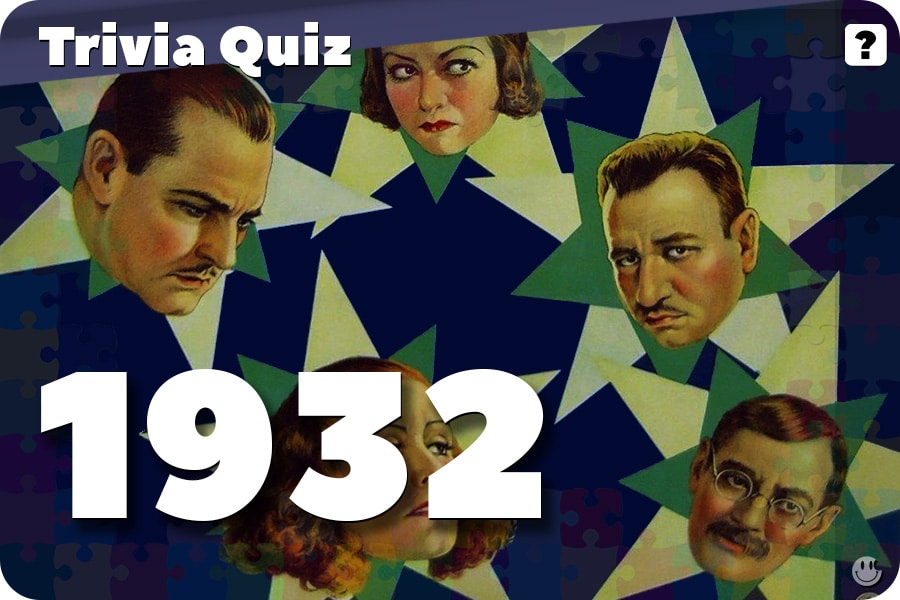
    15. Starring Greta Garbo, Lionel Barrymore, Joan Crawford, and others, it was the first “All-Star” film. What was it?

    16. What cosmetics, skincare, fragrance, and personal care company opened on March 1, 1932?

    17. How many people lived in the United States in 1932?

    18. Released in 1932, this Marx Brothers movie featured Grouch as “Quincy Adams Wagstaff”. What is the name of the film?

    19. What was Hattie W. Caraway, the first woman to become?

    20. Who was the President of the United States in 1932?

    21. They called it “The Crime of the Century,” which happened on March 1, 1932. What was it?

    22. Who did NOT debut their radio show in 1932: Fred Allen, Jack Benny, Burns and Allen, or Al Jolson?

    23. Who won the March 8, 1932, Democrat New Hampshire presidential primary?

    24. What reusable metal lighter (cigarettes, cigars) company opened in 1932?

    25. What company used the slogan: “Snap! Crackle! Pop!”?Rice Krispies

    26. How much did a gallon of gas cost in 1932?

    27. How much did a Ford Roadster cost in 1932?

    28. How much did a dozen eggs cost in 1932?

    29. Who was the Time Magazine Man of the Year in 1932?

    30. What dystopian novel by Aldous Huxley was first published?

    31. Who won the 1932 World Series?

    32. What did Babe Ruth do in the fifth inning of game 3 of the 1932 World Series, just before a home run?

    Trivia Team Bonus Questions:

    1. Held in Lake Placid, NY, United States, how many medals did the US win in the 1932 Winter Olympics?

    2. Held in Los Angeles, CA, United States, how many medals did the US win in the 1932 Summer Olympics?

    3. What Horse won the Kentucky Derby in 1932?

    4. Debuting on November 7, 1932, what was the first science fiction program on the radio?

    5. Although the child was not returned alive, how much ransom was paid in the Lindbergh kidnapping case?

    6. Who was the Pope in 1932?

    7. What is the longest ongoing annual film festival?

    8. Walt Disney’s Flowers and Trees was the first animated cartoon to be presented in what color process?

    9. Who was the American Vice-President in 1932?

    10. What product did The Revenue Act of 1932 tax?

    The Answers:

    32 Trivia Answers for 1932 History

    1. Opened in 1932, what is Germany’s “no speed limit” highway (in some areas)?
    The Autobahn

    2. In 1932, what was the average life expectancy in the United States?
    Men – 61.0 years, Women – 63.5 years.

    3. Who was the Olympic gold-winning champion who starred in the 1932 film Tarzan the Ape Man?
    Johnny Weissmuller

    4. What was the highest-grossing film of 1932?
    Shanghai Express

    5. How much did a Loaf of Bread cost in 1932?
    7 cents

    6. How much did a Gallon of Milk cost in 1932?
    42 cents

    7. What was the Bestselling Fiction Book in 1932?
    The Good Earth by Pearl S. Buck

    8. What was the Biggest Number One Song of 1932?
    (tie) Night and Day by Fred Astaire and Leo Reisman OR In a Shanty in Old Shanty Town by Ted Lewis

    9. What was the average household income in 1932?
    $3,006.05

    10. What performance enhancement did the Ford Motor Company affordably offer in some new vehicles?
    Ford Motor Company announced its V8 engine.

    11. What famous animated talking dog first appeared in 1932?
    Goofy (Disney)

    12. Forrest Mars created what candy bar in 1932?
    The Mars Bar

    13. Starring Paul Muni as Antonio “Tony” Camonte, what gangster film was remade in 1983?
    Scarface

    14. Who won the Stanley Cup in 1932?
    In 1932, The Toronto Maple Leafs won over the New York Rangers (3 games to none)

    15. Starring Greta Garbo, Lionel Barrymore, Joan Crawford, and others, it was the first “All-Star” film. What was it?
    Grand Hotel

    16. What cosmetics, skincare, fragrance, and personal care company opened on March 1, 1932?
    Revlon

    17. How many people lived in the United States in 1932?
    The population was an estimated 124,840,471 people.

    18. Released in 1932, this Marx Brothers movie featured Grouch as “Quincy Adams Wagstaff”. What is the name of the film?
    Horse Feathers

    19. What was Hattie W. Caraway, the first woman to become?
    She was first elected to the United States Senate (Arkansas).

    20. Who was the President of the United States in 1932?
    Herbert Hoover (March 4, 1929 – March 4, 1933)

    21. They called it “The Crime of the Century,” which happened on March 1, 1932. What was it?
    The Lindbergh Kidnapping

    22. Who did NOT debut their radio show in 1932: Fred Allen, Jack Benny, Burns and Allen, or Al Jolson?
    Burns and Allen

    23. Who won the March 8, 1932, Democrat New Hampshire presidential primary?
    Franklin D. Roosevelt (Herbert Hoover won the Republican primary)

    24. What reusable metal lighter (cigarettes, cigars) company opened in 1932?
    Zippo

    25. What company used the slogan: “Snap! Crackle! Pop!”?
    Kellogg’s Rice Krispies

    26. How much did a gallon of gas cost in 1932?
    18 cents per gallon

    27. How much did a Ford Roadster cost in 1932?
    base $460, coupe at $490, convertible sedan for $650.

    28. How much did a dozen eggs cost in 1932?
    30 cents

    29. Who was the Time Magazine Man of the Year in 1932?
    Franklin D. Roosevelt

    30. What dystopian novel by Aldous Huxley was first published?
    Brave New World

    31. Who won the 1932 World Series?
    In 1932, The New York Yankees won, beating the Chicago Cubs (4 games to 0)

    32. What did Babe Ruth do in the fifth inning of game 3 of the 1932 World Series, just before a home run?
    His famous “Called Shot” – he pointed where the ball would go (over centerfield) when he hit it.

    Trivia Team Bonus Questions:

    1. Held in Lake Placid, NY, United States, how many medals did the US win in the 1932 Winter Olympics?
    12.
    6 Gold, 4 Silver, 2 Bronze.

    2. Held in Los Angeles, CA, United States, how many medals did the US win in the 1932 Summer Olympics?
    103.
    41 Gold, 32 Silver, 30 Bronze.

    3. What Horse won the Kentucky Derby in 1932?
    Burgoo King

    4. Debuting on November 7, 1932, what was the first science fiction program on the radio?
    Buck Rogers in the 25th Century

    5. Although the child was not returned alive, how much ransom was paid in the Lindbergh kidnapping case?
    $50,000. The body of Charles Lindbergh, Jr was found 10 weeks after the kidnapping.

    6. Who was the Pope in 1932?
    Pope Pius XI, February 6, 1922 – February 10, 1939

    7. What is the longest ongoing annual film festival?
    The Venice Film Festival (Venice International Film Festival)

    8. Walt Disney’s Flowers and Trees was the first animated cartoon to be presented in what color process?
    Technicolor

    9. Who was the American Vice-President in 1932?
    Charles Curtis (March 4, 1929 – March 4, 1933)

    10. What product did The Revenue Act of 1932 tax?
    Fuel (gasoline)
     

  • 1932 History, Facts and Trivia

    1932 History, Facts and Trivia

    1932 History, Facts and Trivia

    Quick Facts from 1932:

    • The Crime of the Century: Charles Lindbergh Jr., the infant son of Charles and Anne Morrow Lindbergh, was kidnapped from the family home near Hopewell, New Jersey.
    • Influential Songs include Brother Can You Spare a Dime by Bing Crosby, and Night and Day by Cole Porter.
    • The Movies to Watch include Grand Hotel, Emma, Freaks, Scarface, The Mummy, Blonde Venus, White Zombie, Island of Lost Souls, and Tarzan the Ape Man.
    • The Most Infamous Person in America was probably Al Capone
    • Notable books include Brave New World by Aldous Huxley
    • Price of 1 12 oz Perrier Water in 1932: 25 cents
    • The Funny Duo was: Laurel and Hardy
      The Funny Guy was W.C. Fields
    • The Revenue Act of 1932 created the first gas tax in the United States at 1 cent per gallon.

    Top Ten Baby Names of 1932

    Mary, Betty, Barbara, Dorothy, Joan, Robert, James, John, William

    US Life Expectancy

    (1932) Males: 61.0 years, Females: 63.5 years

    The Stars

    Josephine Baker, Joan Blondell, Claudette Colbert, Greta Garbo, Louise Brooks, Joan Crawford, Marion Davies, Dolores Del Rio, Marlene Dietrich, Kay Francis, Jean Harlow, Katharine Hepburn, Myrna Loy, Barbara Stanwyck, Thelma Todd, Mae West

    Entertainment History: The Oscars

    The 5th Academy Awards unfolded on November 18, 1932, at the Fiesta Room of the Ambassador Hotel in Los Angeles. Lionel Barrymore served as the host. The movie eligibility period was August 1, 1931, to July 31, 1932. Grand Hotel won Best Picture but, interestingly, didn’t receive any other nominations, a feat unmatched in Oscar history. Walt Disney scored big with Flowers and Trees, the first-ever color cartoon, grabbing the first Academy Award for Animated Short Subject. Fredric March and Wallace Beery both won Best Actor, marking the only time in Oscar history that the category had co-winners. The ceremony also celebrated a milestone in technical advancements with the introduction of the Academy Award for Best Sound Recording.

    Miss America

    none

    Time Magazine’s Man of the Year

    Franklin D. Roosevelt

    Firsts, Inventions, and Wonders

    The 1932 Indian movie Indrasabha contained 72 songs, a record for most songs in a movie that still stands today. 2016’s Sing features 64 songs.

    The word “gunk” is a genericized trademark name for a “degreasing solvent” dating from 1932.

    The text “This is a work of fiction. Any similarity to actual persons, living or dead, is purely coincidental” is at the end of film came about because the Russian prince who killed Rasputin sued MGM for not accurately depicting Rasputin’s murder in their 1932 film Rasputin and the Empress.

    The University of Southern California (USC) was the first to print “property of” on their t-shirts in 1932.

    When the BBC World Service started broadcasting in 1932, it announced five times, “The programs will neither be very interesting nor very good.”

    The Staple Remover was invented.

    The first science fiction program on radio, Buck Rogers in the 25th Century, debuted.

    Goofy’s original name was “Dippy Dawg” when he debuted in 1932’s Mickey’s Review.

    Nielsen company founder, Arthur C. Nielsen invented “market share” in 1932, becoming the first to offer market research that now covers most TV ratings and radio charts.

    1932’s White Zombie (Directed by Victor Halperin and starring Bela Lugosi) is considered the first feature-length zombie film.

    Radio City Music Hall opened in New York City.

    Walt Disney’s Flowers and Trees, the first animated cartoon to be presented in full Technicolor, premiered in Los Angeles.

    Eddie Eagan is the only athlete to have won gold in different events, at both the Summer and Winter Olympics, winning his first while boxing in 1920, and his second while on the 4-man bobsled in 1932.

    The Betty Boop short Minnie the Moocher features the earliest known film of Cab Calloway performing. You can watch him Moonwalk during the opening credits.

    The Quote

    Grand Hotel directed by Edmund Goulding and starring Greta Garbo and John Barrymore, premiered in New York.
    “I want to be alone” – Great Garbo, as Grusinskaya.

    The Biggest Pop Artists of 1932 include

    Louis Armstrong, Ted Black & His Orchestra, Bing Crosby, Jack Denny & His Orchestra, Duke Ellington, Jimmie Grier & His Orchestra, Jack Hylton and His Orchestra, Art Kassel and His Kassels-in-the-Air, Wayne King and His Orchestra, Ted Lewis and His Band, Guy Lombardo and His Royal Canadians, The Mills Brothers, Ruby Newman & His Orchestra, Ray Noble and His Orchestra, George Olsen and His Orchestra, Leo Reisman and His Orchestra, Peter van Steeden & His Orchestra, Rudy Vallée & His Connecticut Yankees, Paul Whiteman, and His Orchestra

    The Strange

    US Navy Apprentice Seaman Charles M. “Bud” Cowart was trying to land the military airship USS Akron in New Jersey and failed to let go of the rope and had to hold on for two hours as it rose to 2000 feet over the sea until he was hoisted up. Two other men fell to their deaths.

    Despite losing 2 to 9 to Japan and 1 to 24 to India, the United States still won bronze in the field hockey competition of the 1932 Olympics in Los Angeles because only three teams participated.

    Before 1932, Macy’s Parade balloons were intentionally released into the air after the event until one wrapped itself around an airplane wing, causing a tailspin and a near-fatal crash.

    On January 15, 1932, Pasadena Junior College students left their classes and began a snowball fight that escalated into a riot that took over thirty policemen and teargas to disperse.

    The Australian Military fought against the Emu birds in 1932 in an attempt to cull the population in The Great Emu War. It was said that “The Emu command had ordered guerrilla tactics.” Not even the Royal Artillery helped. TLDR: The Emus beat the Australian Military.

    Welsh actress Peg Entwistle committed suicide by jumping from the Hollywood Sign. She jumped from the letter “H.”

    Lilly Lindeström was found murdered in her small apartment in Stockholm, Sweden. Her body had been drained of some, if not all, of her blood. Police suspected the perpetrator used the implement to drink Lilly’s blood. The case remains unsolved.

    The Ivory-Billed Woodpecker was believed to be extinct since the early 1900s. In 1932, however, to refute these claims, Mason Spencer, a Louisiana state legislator, shot and killed one of the last birds and brought the remains to their local wildlife office. The bird has been spotted as recently as 2004.

    Pop Culture Facts & History

    The text “This is a work of fiction. Any similarity to actual persons, living or dead, is purely coincidental” at the end of the film credits came about because the Russian prince who killed Rasputin sued MGM for not accurately depicting Rasputin’s murder in their 1932 film, Rasputin and the Empress. (also, Princess Irina Yusupova sued MGM for implying that Rasputin had seduced her).

    The cost of tuition for one year at Yale was $1,056 for a year.

    Carl Magee invented the first parking meter used in Oklahoma City in 1935.

    Ed McGivern could fire five shots at five yards into a silver dollar in 45/100ths of a second, shoot six hand-thrown clays, shoot a dime on the fly, and hold The Guinness World Record for “The greatest rapid-fire feat.”

    Shemp was an original member of The Three Stooges- before Curly. Curly took Shemp’s place in 1932, and Shemp returned to the role in 1946 when Curly left.

    James Chadwick discovered the neutron.
    Carl David Anderson discovered the positron.

    The demand for cash was so low during the Great Depression, the US Mint stopped the production of nickels between 1932-33.

    Babe Ruth made his famous “called shot” in the fifth inning of game 3 of the 1932 World Series.

    Eddie Eagan is the only athlete to have won gold for different events at the Summer and Winter Olympics, winning his first while boxing in 1920, and his second while on the 4-man bobsled in 1932.

    In 1932, the cost of tuition for one year at Yale was $1,056 for a year.

    5 NFL Games have ended with a 2-0 score:

    • November 29, 1923: Akron Pros 2, Buffalo All-Americans 0
    • November 21, 1926: Kansas City Cowboys 2, Buffalo Rangers 0
    • November 29, 1928: Frankford Yellow Jackets 2, Green Bay Packers 0
    • October 16, 1932: Green Bay Packers 2, Chicago Bears 0
    • September 18, 1938: Chicago Bears 2, Green Bay Packers 0

    Ethan Allen Interiors opened in Beecher Falls, Vermont.

    Radio City Music Hall opened on December 27, 1932. The first show featured Ray Bolger (vaudeville song-and-dance man, Wizard of Oz‘s Scarecrow) and dancing great Martha Graham.

    The Gift

    Neils Bohr was gifted a house with free beer for life on winning the Nobel Prize. A beer pipeline was connected to this house from the Carlsberg brewery next door. Bohr stayed there from 1932 until he died in 1962.

    Nobel Prize Winners

    Physics – Werner Karl Heisenberg
    Chemistry – Irving Langmuir
    Physiology or Medicine – Sir Charles Scott Sherrington, Edgar Douglas Adrian
    Literature – John Galsworthy
    Peace – not awarded

    Popular and Best-selling Books From 1932

    Brave New World by Aldous Huxley
    The Fountain by Charles Langbridge Morgan
    The Good Earth by Pearl S. Buck
    Inheritance by Phyllis Bentley
    Magnificent Obsession by Lloyd C. Douglas
    Magnolia Street by Louis Golding
    Mary’s Neck by Booth Tarkington
    Old Wine and New by Warwick Deeping
    The Sheltered Life by Ellen Glasgow
    Sons by Pearl S. Buck
    Three Loves by A. J. Cronin

    Sports

    World Series Champions: New York Yankees
    Stanley Cup Champs: Toronto Maple Leafs
    U.S. Open Golf: Gene Sarazan
    U.S. Tennis (Men/Ladies): H. Ellsworth Vines/Helen H. Jacobs
    Wimbledon (Men/Women): Ellsworth Vines/Helen Moody
    NCAA Football Champions: Michigan & USC
    Kentucky Derby Winner: Burgoo King
    Boston Marathon Winner: Paul de Bruyn 2:33:36

    More 1932 Facts & History Resources:

    Most Popular Baby Names (BabyCenter.com)
    Popular and Notable Books (popculture.us)
    Broadway Shows that Opened in 1932
    1932 Calendar, courtesy of Time and Date.com
    Fact Monster
    The Great Depression Investopedia
    1930s, Infoplease.com World History
    1932 in Movies (according to IMDB)
    Retrowaste Vintage Culture
    1930s Slang
    Wikipedia 1932
    WW II Timeline

  • 1932 Music: Popular Music, Songs and Artists

    1932 Music: Popular Music, Songs and Artists

    1932 Popular Music, Songs and Artists

    Bing Crosby
    Brother Can You Spare A Dime

    This song could be considered the theme song of the entire decade of the 1930s. The ’30s was the era of the Great Depression where millions of Americans were out of work and some incredibly successful people found themselves in bread lines. The lyrics to this song and the very sad music reflect the desperation of the times. Written in 1931 by lyricist E. Y. “Yip” Harburg and composer Jay Gorney, “Brother, Can You Spare a Dime?” was introduced in the 1932 musical New Americana. The song would go on to be recorded by such artists as Rudy Vallee and Bing Crosby. It would continue to be recorded throughout the century. George Michael would record the song for his 1999 album Songs from the Last Century. The song was used in a poignant moment in the television comedy The Golden Girls.

    Cab Calloway
    I’ve Got The World on a String
    The song was written in 1932 and composed by Harold Arlen, with lyrics written by Ted Koehler. The song was introduced by Cab Calloway and Bing Crosby and would continue to be recorded throughout the decade by many popular songsters including Frank Sinatra, Barry Manilow and Michael Buble.

    Fred Astaire and Leo Reisman
    Night and Day
    This song was written by Cole Porter and performed in the musical The Gay Divorcee. Fred Astaire recorded the song and it made it to the # 1 spot. He would again perform the song in the film version of the show. This song is considered to be one of Cole Porter’s finest songs. This song was so connected to Cole Porter that the biopic made in the 1940s about the composer was titled Night and Day. The song would go on to be recorded by celebrities as diverse as Frank Sinatra and Ringo Starr. The song would be recorded and song again in a second biography film of Cole Porter called Devovely. This time the song was sung by John Barrowman, TVs Captain Jack Harkness, and Keven Kline

    Paul Whiteman
    Willow Weep For Me
    The song was written by Ann Ronell. Willow Weep For ME would be considered a jazz standard but would be recorded again in 1964 by Chad and Jeremy and would make it into the top 40s that year.

    How Deep Is The Ocean is a love song by Irving Berlin. This is one of the few Berlin songs that was introduced directly by the radio and not part of a Broadway show. The song is a series of questions that describe love by comparison. “The first line sets the tone for the song, “How much do I love you, I’ll tell you no lie, how deep is the Ocean, how high is the sky?” The song would be recorded by such great 20th century artists as Frank Sinatra, Julie Andrews and Eric Clapton. Recently the song was added to the Broadway show Irving Berlins White Christmas. So the song made it to Broadway seventy years later.

    Tommy Dorsey
    Take My Hand Precious Lord
    The music for this song was adapted from a song written in the 1800s called Maitland by George N. Allen. The Lyrics are by Tommy Dorsey and were in response to the death of his wife while giving birth to a child, the child would ultimately die as well. The song would be embraced by Christians and would be recorded by many artists such as Anne Murray and Elvis Presley. The song would follow a tradition in Christian Music which started as far back as Martin Luther. The originator of the Reformation would take popular music of the day and give the tune Christian lyrics. The Hymn “A Mighty Fortress Is Our God” is a good example of this.

    Top Artists and Songs of 1932

    Al Jolson
    Hallelujah, I’m A Bum
    Bert Ambrose and his Orchestra
    The Clouds Will Soon Roll By
    Bing Crosby and the Mills Brothers
    Dinah
    Bing Crosby
    Brother, Can You Spare a Dime?
    Love Me Tonight, Please
    Where The Blue Of The Night (Meets The Gold of the Day)
    Cab Calloway and his Cotton Club Orchestra
    I’ve Got The World On A String
    Charlie Kunz
    Lovely To Look At
    Smoke Gets In Your Eyes
    Duke Ellington
    Blue Ramble
    Moon Over Dixie
    Rose Room (In Sunny Roseland),
    Fred Astaire and Leo Reisman
    Night and Day
    George Olson
    Say It Isn’t So, Lullaby of the Leaves
    Guy Lombardo
    How Deep Is The Ocean?
    Paradise
    Too Many Tears
    We Just Couldn’t Say Goodbye
    Joe Rines and his Orchestra
    Underneath the Harlem Moon
    Kate Smith and Guy Lombardo
    River, Stay ‘Way From My Door
    Kate Smith
    River, Stay ‘Way My Door, Too late
    Leo Reisman
    Paradise
    Louis Armstrong
    All of Me
    Between The Devil and the Deep Blue Sea
    Body and Soul
    China My Chinatown
    Home
    Keeping Out of Mischief Now
    Kickin’ The Gong Around
    Lawd, You Made the Night Too Long
    Love You Funny Thing
    Shine
    Sweethearts on Parade
    You Can Depend On Me
    Maurice Chevalier
    MiMi
    Pat O’Malley
    Goopy Geer
    Paul Whiteman
    All of Me
    How Deep Is The Ocean?
    I’ll Follow You
    I’ll Never Be The Same
    Let’s Put Out The Lights
    Three On a Match
    We Just Couldn’t Say Goodbye
    Willow Weep For Me
    Ray Noble
    Try A Little Tenderness
    Rudy Vallee and his Connecticut Yankees
    Brother, Can You Spare a Dime?
    Ruth Etting
    It WAs So Beautiful
    Ted Fio Rito
    Willow Weep For Me
    Ted Lewis and his Orchestra
    In a Shanty In a shanty Old Town
    Tommy Dorsey
    Take My Hand, Precious Lord
  • Do Not Stand At My Grave and Weep

    Do Not Stand At My Grave and Weep

    Do not stand at my grave and weep I am not there. I do not sleep. I am a thousand winds that blow. I am the diamond glints on snow. I am the sunlight on ripened grain. I am the gentle autumn rain. When you awaken in the morning’s hush I am the swift uplifting rush Of quiet birds in circled flight. I am the soft stars that shine at night. Do not stand at my grave and cry; I am not there. I did not die.

    By Mary Elizabeth Frye (November 13, 1905 – September 15, 2004) was an American housewife and florist, best known as the author of the poem Do not stand at my grave and weep, written in 1932. She was born in Dayton, Ohio, United States, and was orphaned at the age of three. She moved to Baltimore, Maryland, when she was twelve. She was an avid reader with a remarkable memory. She married Claud Frye, who ran a clothing business, while she grew and sold flowers. The 12 line poem for which she became famous was originally written on a brown paper shopping bag and she never published or copyrighted the poem. In 1995, a BBC poll found that the poem “became the nation’s favorite poem”.

  • The Holodomor: Man-made Famine in Soviet Ukraine

    The Holodomor: Man-made Famine in Soviet Ukraine

    The Holodomor: The Man-made Famine in Soviet Ukraine

    The Holodomor was a devastating man-made famine that occurred in Soviet Ukraine from 1932 to 1933, causing the deaths of millions of Ukrainians. It is widely regarded as a tragic example of how government policies can lead to catastrophic consequences for a nation’s people.

    • Dates: The Holodomor occurred between 1932 and 1933, during Joseph Stalin’s rule in the Soviet Union.
    • Causes: The famine was primarily caused by Soviet policies, including forced collectivization of agriculture and harsh grain requisition quotas imposed on Ukrainian farmers. These policies led to widespread food shortages and starvation.
    • Death toll: Estimates of deaths resulting from the Holodomor vary, but most sources place the figure between 3.5 and 7 million Ukrainians.
    • Soviet denial and cover-up: The Soviet government denied the existence of the famine, suppressed information about it, and punished those who spoke out about the crisis. This cover-up contributed to the lack of international awareness and assistance during the famine.
    • Recognition as genocide: In recent years, many countries and organizations have recognized the Holodomor as an act of genocide against the Ukrainian people perpetrated by the Soviet government. However, Russia continues to dispute this characterization.
    • Effects on pop culture: The Holodomor has been depicted in various films, books, and other artistic works, raising awareness of this tragic event and its impact on the Ukrainian people. Examples include the 2009 film “Bitter Harvest” and the 2017 graphic novel “Red Famine: Stalin’s War on Ukraine” by Anne Applebaum.
    • Prominent people: Key figures involved in the Holodomor include Joseph Stalin, the leader of the Soviet Union at the time, and his close associate Vyacheslav Molotov, who played a significant role in implementing the policies that led to the famine. Ukrainian writer and activist Vasily Grossman also played a crucial role in documenting and exposing the Holodomor to the world.

    In summary, the Holodomor was a man-made famine in Soviet Ukraine that killed millions of people. Caused by destructive government policies and exacerbated by the Soviet regime’s cover-up, the famine has been recognized as an act of genocide by many countries and organizations. The Holodomor has had a lasting impact on Ukraine’s national consciousness and has been depicted in various forms of popular culture, ensuring that the memory of this tragic event endures.

  • 1932 Oscars 4th Academy Awards

    1932 Oscars 4th Academy Awards

    1932 Oscars 4th Academy Awards

    • The 4th Academy Awards took place on November 10, 1931.
    • The ceremony was hosted in the Sala D’Oro at the Biltmore Hotel.
    • Lawrence Grant, a British character actor, took on hosting duties.
    • Eligibility for awards was for films released between August 1, 1930, and July 31, 1931.

    Noteworthy Moments:

    • Cimarron became the first Western to win Best Picture.
    • Marie Dressler won Best Actress for her role in Min and Bill, making her the oldest actress to win this category.
    • Wesley Ruggles won Best Director for Cimarron.
    • Cimarron earned 7 nominations, winning 3. It was the first Western to win Best Picture. The second was Dances With Wolves in 1990.
    • Charlie Chaplin’s City Lights received no nominations.
    • Also Snubbed: Dracula, Frankenstein, Little Caesar, Public Enemy, Applause

    Trivia:

    1. This was the first year where the awards started acknowledging sound in a separate category: Best Sound Recording.
    2. The film The Front Page was nominated for three major awards but won none. It would later be remade as His Girl Friday in 1940.
    3. Skippy, based on a comic strip, is the earliest film to receive a Best Director nomination that is still copyrighted.
    4. This year was the first and only time the Academy handed out an award for Best Assistant Director.
    5. This ceremony was among the shortest, lasting only about an hour.

    4th Academy Awards Oscar Nominees and Winners

    Outstanding Production:
    Cimarron – William LeBaron for RKO Pictures (WINNER)
    East Lynne – Winfield Sheehan for Fox Film Corporation
    The Front Page – Howard Hughes for United Artists
    Skippy – Adolph Zukor for Paramount Pictures
    Trader Horn – Irving Thalberg for Metro-Goldwyn-Mayer
    Best Director:
    Norman Taurog – Skippy (WINNER)
    Wesley Ruggles – Cimarron
    Clarence Brown – A Free Soul
    Lewis Milestone – The Front Page
    Josef von Sternberg – Morocco
    Best Actor:
    Lionel Barrymore – A Free Soul as Stephen Ashe (WINNER)
    Jackie Cooper – Skippy as Skippy Skinner
    Richard Dix – Cimarron as Yancey Cravat
    Fredric March – The Royal Family of Broadway as Tony Cavendish
    Adolphe Menjou – The Front Page as Walter Burns
    Best Actress:
    Marie Dressler – Min and Bill as Min Divot (WINNER)
    Marlene Dietrich – Morocco as Amy Jolly
    Irene Dunne – Cimarron as Sabra
    Ann Harding – Holiday as Linda Seton
    Norma Shearer – A Free Soul as Jan Ashe
    Best Original Story:
    The Dawn Patrol – John Monk Saunders (WINNER)
    The Doorway to Hell – Rowland Brown
    Laughter – Harry d’Abbadie d’Arrast, Douglas Doty, and Donald Ogden Stewart
    The Public Enemy – John Bright and Kubec Glasmon
    Smart Money – Lucien Hubbard and Joseph Jackson
    Best Adaptation:
    Cimarron – Howard Estabrook, based on the novel by Edna Ferber (WINNER)
    The Criminal Code – Seton I. Miller and Fred Niblo Jr., based on the play by Martin Flavin
    Holiday – Horace Jackson, based on the play by Philip Barry
    Little Caesar – Francis Edward Faragoh and Robert N. Lee, based on the novel by William R. Burnett
    Skippy – Joseph L. Mankiewicz and Sam Mintz, based on the comic strip by Percy Crosby
    Best Sound Recording:
    Paramount Publix Studio Sound Department (WINNER)
    MGM Studio Sound Department
    RKO Radio Studio Sound Department
    Samuel Goldwyn-United Artists Studio Sound Department
    Best Art Direction:
    Cimarron – Max Rée (WINNER)
    Just Imagine – Stephen Goosson and Ralph Hammeras
    Morocco – Hans Dreier
    Svengali – Anton Grot
    Whoopee! – Richard Day
    Best Cinematography:
    Tabu – Floyd Crosby (WINNER)
    Cimarron – Edward Cronjager
    Morocco – Lee Garmes
    The Right to Love – Charles Lang
    Svengali – Barney McGill
    Oscar® and Academy Awards® and Oscar® design mark are the trademarks and service marks and the Oscar© statuette the copyrighted property, of the Academy of Motion Picture Arts and Sciences. Pop Culture Madness is neither endorsed by nor affiliated with the Academy of Motion Picture Arts and Sciences.