1. Who was the President of the United States in 1933?
2. What was the Biggest Number One Song of 1933?
3. Monopoly is one of the most popular board games ever, but it was loosely based on an earlier game. What was the earlier game?
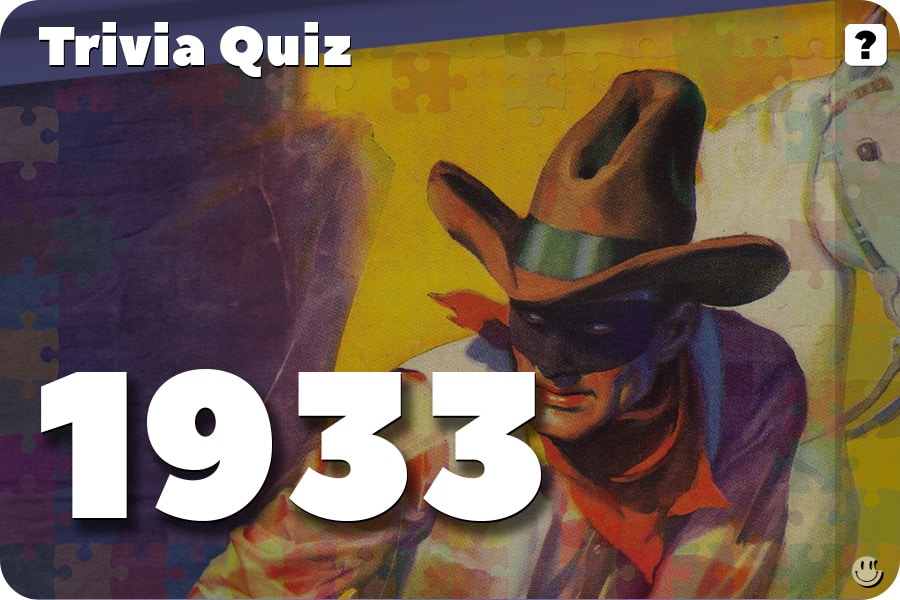
4. This masked radio hero worked in the American Wild West, and his theme was based on the William Tell Overture. Who was that masked man?
5. President Roosevelt gave the American public the first of 28 live radio broadcasts. What were they collectively called?
6. What was the highest-grossing film of 1933
7. How much did a Loaf of Bread cost in 1933?
8. How much did a Gallon of Milk cost in 1933?
9. What was the average household income in 1933?
10. How many people lived in the United States in 1933?
11. What Major League Baseball annual event began in Chicago on July 6, 1933?
12. The Century of Progress, the unofficial name for the 1933 World’s Fair, was held in what American city?
13. Who won the Stanley Cup in 1933?
14. In 1933, what was the average life expectancy in the United States?
15. Disney’s Three Little Pigs won an Academy Award for Best Animated Short Film. It also gave us a famous phrase and song. What is the name of the song?
16. What New York model boarded a train to Hollywood after an agent signed her to appear as part of the chorus (uncredited) for the Eddie Cantor film Roman Scandals?
17. What was the Bestselling Fiction Book in 1933?
18. On March 15, 1933, the Dow Jones Industrial Average gained 15.34%. What is significant about that number?
19. President Roosevelt issued Executive Order 2039, declaring what between March 6 and March 13, 1933?
20. What form of cinematic entertainment first opened in Pennsauken Township, near Camden, New Jersey?
21. Found on Skull Island, what creature was called the “Eighth Wonder of the World?”
22. What Marx Brothers’ film was released in 1933, featuring Margaret Dumont as “Mrs. Gloria Teasdale?
23. Who said, “The only thing we have to fear is fear itself?”
24. Who won the 1933 World Series?
25. Perry Mason was an American fictional criminal defense lawyer and the title character in Erle Stanley Gardner’s books about him. Who was Perry’s secretary?
26. How much did a dozen eggs cost in 1933?
27. What weekly news magazine began publication in 1933?
28. What was the purpose of Franklin D. Roosevelt signing Executive Order 6102?
29. Who was the Time Magazine Man of the Year in 1933?
30. What did telegram company Western Union offer as a new service in 1933?
31. How much did a base Ford two-door sedan cost in 1933?
32. How much did a gallon of gas cost in 1933?
33. What did Mr. and Mrs. John Mackay, George Spicer, his wife, and Hugh Gray all claim to see in 1933?
Trivia Team Bonus Questions:
1. What was the first to be chemically synthesized?
2. Fay Wray played the female lead in King Kong. What was her character’s name?
3. Who was the Pope in 1933?
4. Which token was NOT available when Monopoly was released? – Shoe, Iron, Wheelbarrow, Battleship, Thimble or Rocking Horse?
5. This comic strip, created by Chic Young, featured the wedding of Blondie Boopadoop and Dagwood Bumstead. What was the name of the comic strip?
6. Who were the 1933 NFL Champions?
7. Who was the American Vice-President in 1933?
8. What did the Twentieth Amendment to the United States Constitution do?
9. What did Mr. Wiley Post complete on July 22, 1933? HINT: It took him seven days, 18 hours 45 minutes.
10. What Horse won the Kentucky Derby in 1933?
The Answers:
33 Trivia Answers for 1933 History
1. Who was the President of the United States in 1933?
Herbert Hoover (March 4, 1929 – March 4, 1933) and Franklin D. Roosevelt (March 4, 1933 – April 12, 1945)
2. What was the Biggest Number One Song of 1933?
(tie) Stormy Weather by Leo Reisman OR The Last Round-Up by George Olson
3. Monopoly is one of the most popular board games ever, but it was loosely based on an earlier game. What was the earlier game?
The Landlord’s Game
4. This masked radio hero worked in the American Wild West, and his theme was based on the William Tell Overture. Who was that masked man?
The Lone Ranger
5. President Roosevelt gave the American public the first of 28 live radio broadcasts. What were they collectively called?
“Fireside chats”
6. What was the highest-grossing film of 1933? Cavalcade
7. How much did a Loaf of Bread cost in 1933?
7 cents
8. How much did a Gallon of Milk cost in 1933?
42 cents
9. What was the average household income in 1933?
$2,956.48
10. How many people lived in the United States in 1933?
The population was an estimated 125,578,763 people.
11. What Major League Baseball annual event began in Chicago on July 6, 1933?
The All-Star Game
12. The Century of Progress, the unofficial name for the 1933 World’s Fair, was held in what American city?
Chicago
13. Who won the Stanley Cup in 1933?
In 1933, The New York Rangers won over the Toronto Maple Leafs (3 games to 1)
14. In 1933, what was the average life expectancy in the United States?
Men – 61.7 years, Women – 65.1 years.
15. Disney’s Three Little Pigs won an Academy Award for Best Animated Short Film. It also gave us a famous phrase and song. What is the name of the song? Who’s Afraid of the Big Bad Wolf
16. What New York model boarded a train to Hollywood after an agent signed her to appear as part of the chorus (uncredited) for the Eddie Cantor film Roman Scandals?
Lucille Ball
17. What was the Bestselling Fiction Book in 1933? Anthony Adverse by Harvey Allen
18. On March 15, 1933, the Dow Jones Industrial Average gained 15.34%. What is significant about that number?
It was the biggest (percentage) one-day gain ever for the market.
19. President Roosevelt issued Executive Order 2039, declaring what between March 6 and March 13, 1933?
A nationwide “bank holiday.”
20. What form of cinematic entertainment first opened in Pennsauken Township, near Camden, New Jersey?
Drive-In movie theater
21. Found on Skull Island, what creature was called the “Eighth Wonder of the World?” King King
22. What Marx Brothers’ film was released in 1933, featuring Margaret Dumont as “Mrs. Gloria Teasdale?” Duck Soup
23. Who said, “The only thing we have to fear is fear itself?”
Franklin D. Roosevelt
24. Who won the 1933 World Series?
In 1933, The New York Giants won, beating the Washington Senators (4 games to 1)
25. Perry Mason was an American fictional criminal defense lawyer and the title character in Erle Stanley Gardner’s books about him. Who was Perry’s secretary?
Della Street. On television, she was played by Barbara Hale.
26. How much did a dozen eggs cost in 1933?
29 cents
27. What weekly news magazine began publication in 1933? Newsweek (initially called News-Week)
28. What was the purpose of Franklin D. Roosevelt signing Executive Order 6102?
It limited the amount of gold Americans could own.
29. Who was the Time Magazine Man of the Year in 1933?
Hugh S. Johnson
30. What did telegram company Western Union offer as a new service in 1933?
The Singing Telegram.
31. How much did a base Ford two-door sedan cost in 1933?
$450
32. How much did a gallon of gas cost in 1933?
$0.18 per gallon
33. What did Mr. and Mrs. John Mackay, George Spicer, his wife, and Hugh Gray all claim to see in 1933?
The Loch Ness Monster
Trivia Team Bonus Questions:
1. What was the first to be chemically synthesized?
Vitamin C
2. Fay Wray played the female lead in King Kong. What was her character’s name?
Ann Darrow
3. Who was the Pope in 1933?
Pope Pius XI, February 6, 1922 – February 10, 1939
4. Which token was NOT available when Monopoly was released? – Shoe, Iron, Wheelbarrow, Battleship, Thimble or Rocking Horse?
The Wheelbarrow entered the game board in 1946.
5. This comic strip, created by Chic Young, featured the wedding of Blondie Boopadoop and Dagwood Bumstead. What was the name of the comic strip? Blondie
6. Who were the 1933 NFL Champions?
The Chicago Bears beat the New York Giants 23 to 21.
7. Who was the American Vice-President in 1933?
Charles Curtis (March 4, 1929 – March 4, 1933) and John Garner (March 4, 1933 – January 20, 1941)
8. What did the Twentieth Amendment to the United States Constitution do?
It moved the beginning and ending of the terms of the president and vice president from March 4 to January 20 and of members of Congress from March 4 to January 3. (It also has provisions determining what to do when no president-elect is absent.)
9. What did Mr. Wiley Post complete on July 22, 1933? HINT: It took him seven days, 18 hours 45 minutes.
He was the first person to fly solo around the world.
10. What Horse won the Kentucky Derby in 1933?
Brokers Tip
World Changing Event: Adolf Hitler’s rise as Germany’s leader.
Influential Songs include The Gold Diggers Song (We’re In The Money), Who’s Afraid of the Big Bad Wolf? and Stormy Weather by Ethel Waters.
The Movies to Watch include Duck Soup, King Kong, The Invisible Man, 42nd Street, Sons of the Desert, Gold Deggirs of 1933, Son of King, and Mystery of the Wax Museum.
Pop Culture Changing Moment: US President Franklin Delano Roosevelt gave his first ‘Fireside Chat.’
Notable books include: God’s Little Acre by Erskine Caldwell and
Price of a lightbulb in 1933: 18 cents
Percy Shaw invented the ‘Cat’s Eye’ red light reflector in Yorkshire, England.
The Funny Duo was: Laurel and Hardy
The Funny Risque Lady was: Mae West
The Funny Guy was W.C. Fields
The Yacht: From 1933 until 1977, there was a Presidential Yacht, but Jimmy Carter sold it off; it is reportedly deteriorating in a Virginia boatyard.
Top Ten Baby Names of 1933
Mary, Betty, Barbara, Dorothy, Joan, Robert, James, John, William
US Life Expectancy
(1933) Males: 61.7 years, Females: 65.1 years
The Stars
Josephine Baker, Joan Blondell, Claudette Colbert, Greta Garbo, Joan Crawford, Marion Davies, Dolores Del Rio, Marlene Dietrich, Kay Francis, Jean Harlow, Katharine Hepburn, Hedy Lamarr, Myrna Loy, Ginger Rogers, Barbara Stanwyck, Thelma Todd, Raquel Torres, Mae West, Fay Wray
Miss America
Marian Bergeron (West Haven, Connecticut)
Time Magazine’s Man of the Year
Hugh Samuel Johnson
The Biggest Films of 1933
1. King Kong (Pop Culture Classic)
2. She Done Him Wrong (Crime)
3. 42nd Street (Pop Culture Classic)
4. Duck Soup (Pop Culture Classic)
5. The Invisible Man (Sci-Fi Horror)
6. I’m No Angel (Mae West)
7. Bombshell (Jean Harlow)
8. Mystery of the Wax Museum
9. Sons of the Desert
10. Little Women (Katharine Hepburn)
11. The Monkey’s Paw (Horror)
12. The Vampire Bat (Horror)
*Movies beyond the Top Five are based on (a somewhat subjective) ranking based on how much they had a long-lasting effect on Pop Culture.
Firsts, Inventions, and Wonders
The Gallo (Ernest & Julio) Winery opened.
Richard Hollingshead opened the first movie, Drive-In, in Camden, NJ.
Krispy Kreme opened in Nashville, Tennessee.
The US Federal Deposit Insurance Corporation (FDIC) was created.
The first singing telegram was delivered to actor Rudy Vallee, in New York.
The Lone Ranger debuted on Detroit’s WXYZ radio.
Chevrolet has produced the Chevy Suburban uninterrupted since 1933.
Newsweek Magazine began publication.
Esquire Magazine began publication.
Two young nerds from Cleveland, Jerome Siegel and Joseph Shuster, had a little self-published science fiction fanzine called Science Fiction. In issue #3, had a story about a super-powered telepath who attempted to take over the world. A few years later, they evolved the Super-Man idea and brought it to National Allied Publications, which later became DC Comics. The character named Superman became the most famous fictional character of all time.
The Biggest Pop Artists of 1933 include
Don Bestor and his Orchestra, Bing Crosby, Eddy Duchin and His Orchestra, Duke Ellington, Jan Garber and His Orchestra, Glen Gray and the Casa Loma Orchestra, Hal Kemp and His Orchestra, Wayne King and His Orchestra, Ted Lewis and His Band, Guy Lombardo and His Royal Canadians, Freddy Martin and His Orchestra, Clyde McCoy & His Orchestra, George Olsen and His Orchestra, Ray Noble and His Orchestra, Don Redman & His Orchestra, Leo Reisman and His Orchestra, Rudy Vallée & His Connecticut Yankees, Ethel Waters, Paul Whiteman & His Orchestra, Victor Young & His Orchestra
US Politics
March 4, 1933 (Saturday) First inauguration of Franklin D. Roosevelt
The Strange
Gloomy Sunday, also known as the Hungarian Suicide Song, was composed by Rezso Seress and published in 1933. The song is said to have led to the suicide of 19 people. #urbanlegend
The first modern sighting of the Loch Ness Monster was by Aldie and John Mackay, who saw “something resembling a whale.” The first photo of The Loch Ness monster was taken by Hugh Gray. #nessie
William Anstruther-Gray, a member of the British Parliament, asked his Government in 1933 for an “investigation to be made into the existence of a monster in Loch Ness”. The Government concluded there was “no reason to suspect the presence of any baneful monster.”
United States Representative Wesley Lloyd proposed a constitutional amendment limiting personal wealth to $1,000,000.
Richard Hollinghead opened the first drive-in theater in Camden, New Jersey.
Ten million acres of growing cotton were plowed up, bountiful crops were left to rot, and six million piglets were killed and discarded in the US to raise prices for commodities and income for farmers through ‘artificial scarcity’.
Allan Blair, a University of Alabama professor, voluntarily allowed a black widow spider to bite him as scientists recorded him suffering for several days. Before this, some skeptics believed black widows were not dangerous to humans. He recovered.
The decision of RKO Pictures to finance King Kong may have been influenced by a 1930 hoax documentary called Ingagi, about sex between human women and gorillas.
In Syria, it was once a commonly held belief that using Yo-Yos would bring drought. So, they were banned country-wide in 1933.
During Prohibition in the US, the government denatured forms of industrial alcohol with the deadly poison methanol to prevent people from drinking illicitly. By the end of Prohibition in 1933, it is estimated that over 10,000 had died from denatured alcohol poisoning. #rip
In n 1933, actress Marlene Dietrich was threatened with arrest in Paris for wearing pants, and it was officially illegal for women to wear trousers there until 2013.
America’s most senior, and most decorated Marine, General Smedley Butler, told the House of Representatives that wealthy businessmen tried to recruit him to overthrow President Roosevelt in a coup, The Business Plot, and install a fascist government. The New York Times called it a “gigantic hoax”.
Kansas City blatantly ignored Prohibition for all 13 years (1920 to 1933).
Pop Culture Facts & History
King Kong was the first over-the-top Sci-Fi Blockbuster Movie.
The Eighteenth Amendment to the United States Constitution was repealed, allowing the sale and consumption of alcoholic drinks, and ending Prohibition. The 18th Amendment was the first (and only) constitutional amendment withheld a right from American citizens – the Constitution has traditionally protected individual rights.
During prohibition in the US, an exemption was made for whiskey prescribed by a doctor and sold through a pharmacy. The Walgreens pharmacy chain grew from 20 retail stores to almost 500 during this period, from 1920 to 1933
The ‘Gold Standard’ was dropped by the United States, which opted for a ‘modified gold bullion standard.’
Frankford Yellowjackets were sold and renamed The Philadelphia Eagles
The first Major League Baseball All-Star Game was played at Comiskey Park in Chicago.
The first “Aunt Jemima” was Nancy Green, a former slave. She died in a car accident in 1923 and wasn’t replaced for ten years until Anna Robinson (Anna Short Harrington) was discovered at the Chicago World Fair in 1933.
Mount Rushmore National Memorial was dedicated. It was completed in 1939.
The first ‘Nude Scene’ in a mainstream movie is often credited to Hedy Lamarr in Extase (Ecstasy).
When MLB’s spitball was banned from baseball in 1920, 17 pitchers were grandfathered in, and the last legal spitball was thrown in 1933 by Burleigh Grimes.
Wiley Post became the first person to fly solo around the world, landing at Floyd Bennett Field in Brooklyn, New York, after traveling east about 15,596 miles, in 7 days, 18 hours, 45 minutes.
On March 15, The Dow Jones Industrial Average rose from 53.84 to 62.10. The day’s gain of 15.34%, achieved during the depths of the Great Depression, is the most significant 1-day percentage gain for the index.
President Roosevelt named Frances Perkins Secretary of Labor, the first US female cabinet member.
The first Boeing 247 took flight.
Minnie D. Craig became the Speaker of the North Dakota House of Representatives, the first female to hold a Speaker position anywhere in the United States.
The Thomas E. Wilson Company (later called Wilson Sporting Goods) introduced the R-90 sand wedge golf club.
1933 was the first time you could buy a ‘Betty Crocker’ cookbook.
Broadway Show
Tobacco Road (Play) Opened on December 4, 1933, and closed on May 31, 1941
Nobel Prize Winners
Physics – Erwin Schrödinger, and Paul Adrien Maurice Dirac
Chemistry – not awarded
Physiology or Medicine – Thomas Hunt Morgan
Literature – Ivan Alekseyevich Bunin
Peace – Sir Norman Angell (Ralph Lane)
*Paul Dirac wanted to refuse the Nobel Prize in 1933 to avoid publicity. He accepted it only when advised that, as the first person to refuse a Nobel Prize, the publicity would be even greater.
Popular and Best-selling Books From 1933
Ann Vickers by Sinclair Lewis Anthony Adverse by Hervey Allen As the Earth Turns by Gladys Hasty Carroll The Farm by Louis Bromfield Forgive Us Our Trespassers by Lloyd C. Douglas God’s Little Acre by Erskine Caldwell Little Man, What Now? by Hans Fallada Magnificent Obsession by Lloyd C. Douglas The Master of Jalna by Mazo de la Roche Miss Bishop by Bess Streeter Aldrich One More River by John Galsworthy
Sports
World Series Champions: New York Giants
Stanley Cup Champs: Chicago Bears
U.S. Open Golf: Johnny Goodman
U.S. Tennis (Men/Ladies): Fred Perry/ Helen H. Jacobs
Wimbledon (Men/Women): Jack Crawford/Helen Moody
NCAA Football Champions: Michigan
Kentucky Derby Winner: Brokers Tip
Boston Marathon Winner: Leslie S. Pawson Time: 2:31:01
Montevideo Convention on the Rights and Duties of States
The Montevideo Convention, formally known as the Montevideo Convention on the Rights and Duties of States, was an important international treaty that laid down the criteria for statehood and defined the rights and responsibilities of sovereign states.
Dates: The convention was signed on December 26, 1933, during the Seventh International Conference of American States held in Montevideo, Uruguay.
Participants: The convention was attended by representatives from 19 countries, including the United States and various Latin American nations.
Statehood criteria: The convention outlined four main criteria for statehood, which have become widely accepted in international law: (1) a permanent population, (2) a defined territory, (3) a government, and (4) the capacity to enter into relations with other states.
Non-intervention principle: The convention also emphasized the principle of non-intervention, asserting that no state has the right to intervene in another state’s internal or external affairs.
Recognition of states: The convention established that recognition of a state by other states is not a requirement for statehood but merely a political act that confirms its existence.
Significance: The Montevideo Convention was an important milestone in international law, providing a clear and widely accepted definition of statehood. This has helped resolve disputes between states and established a basis for recognizing new states as they emerge.
Effects on pop culture: Although the Montevideo Convention has not directly impacted popular culture, its principles and criteria for statehood continue to shape the international political landscape, influencing cultural trends and narratives.
Prominent people: Key figures involved in the convention included U.S. Secretary of State Cordell Hull, who led the American delegation, and Uruguayan Foreign Minister Alberto Guani, who served as the conference’s president.
The Montevideo Convention was a pivotal international treaty that established widely accepted criteria for statehood and the rights and duties of sovereign states. While its impact on popular culture is not direct, the convention has significantly shaped the international political landscape. It continues to influence the way new states are recognized and interact with one another.
Ratification of the 21st Amendment Ends Prohibition
The 21st Amendment to the United States Constitution marked the end of the Prohibition era, repealing the 18th Amendment and allowing the sale and consumption of alcohol to resume. The ratification of the 21st Amendment brought significant changes to American society, economy, and pop culture. In this article, we will discuss the key dates, details, trivial facts, effects on pop culture, and the prominent people and countries involved in ratifying the 21st Amendment.
Details:
The 18th Amendment, ratified on January 16, 1919, prohibited the manufacture, sale, and transportation of intoxicating liquors in the United States.
Prohibition led to the rise of organized crime, illegal production and sale of alcohol, and widespread corruption.
The 21st Amendment was proposed by Congress on February 20, 1933, and was ratified by the requisite number of states on December 5, 1933.
The 21st Amendment is the only amendment to the U.S. Constitution that repeals a previous amendment.
The 21st Amendment was the first and only amendment to be ratified through state ratifying conventions rather than state legislatures, ensuring a faster and more democratic process.
Utah was the 36th state to ratify the 21st Amendment, providing the three-fourths majority needed for ratification.
Effects on Pop Culture:
The end of Prohibition led to a resurgence of the brewing and distilling industries and the reopening of bars and taverns.
The celebration of the end of Prohibition influenced movies, music, and literature, reflecting the excitement and relief felt by many Americans.
The speakeasy culture that emerged during Prohibition left a lasting impact on American nightlife, with many modern establishments drawing inspiration from the clandestine bars of the era.
Prominent People and Countries Involved:
Franklin D. Roosevelt: As President of the United States, Roosevelt advocated repealing Prohibition, seeing it as a way to stimulate the economy and reduce crime during the Great Depression.
United States: The ratification of the 21st Amendment marked a significant shift in American society and culture as the government reversed its stance on alcohol prohibition.
You’re Getting To Be A Habit With Me
Young And Healthy
The Gold Diggers Song (We’re In The Money)
Shuffle Off To Buffalo
These four songs originated in the film 42nd Street. The movie musical was made by Warner Brothers Studios and starred Ruby Keeler. The musical also starred Ginger Rodgers and Dick Powell, who would go on to star in The Thin Man movie series. This movie was a milestone for the film industry. It was the first film choreographed by Busby Berkeley. Berkeley would move onto to MGM where he would be a major contributor to the films starring Mickey Rooney and Judy Garland.
42nd Street told the story of an unknown that goes to her first audition and is hired but then ends up as the star when the lead hurts herself. The movie would be popular for years, but in 1980 the movie would go to Broadway starring Jerry Orbach and Tammy Grimes. 42nd Street would the Tony Award for best musical in 1981. A major revival would be launched in 2001.
Don Bestor and his Orchestra Who’s Afraid of the Big Bad Wolf
This song was originally written for The Disney short, The Three Little Pigs. The song was written by Frank Churchill with additional lyrics by Ann Ronell. The song would become incredibly popular and would become a classic children’s song. It would last long after 1933 and be recorded by many different artists including Barbra Streisand. Significantly this song would be the first song from a Disney film to appear on the charts, there would be many more to follow.
Ethel Waters Stormy Weather This song was written in 1933 by Harold Arlen and Ted Koehler. Ethel Waters first sang it at The Cotton Club night club in Harlem in 1933 and then recorded it later that year. Stormy Weather would become even more popular when recorded by Lena Horne in 1942. She would record the song again for a film that used the song as its title.
Duke Ellington Sophisticated Lady
Was originally composed as an instrumental in 1932 by Duke Ellington and Irving Mills, Words were added by Mitchell Paris and Ellington liked them, but they didn’t go with his original conception of the song. Still the following year the song would become a hit. Linda Ronstadt and the band Chicago would also record the song.
Henry King and his Orchestra April in Paris
This song composed by Vernon Duke with lyrics by E. Y. Harburg in 1932 for the Broadway musical, Walk A Little Faster. The musical itself would be forgotten but the song would move and be recorded by Glenn Miller Doris Day and Tommy Dorsey.
Leo Reisman and Clifton Webb Easter Parade
Written by Irving Berlin in 1933 for the musical As Thousands Cheer, Easter Parade would go on to be sung by Bing Crosby in the movie Holiday Inn which would introduce the song White Christmas and then would be sung by Fred Astaire and Judy Garland in a film named after the song. Easter Parade is a song celebrating the tradition of The Easter Parade which goes on all over America on Easter Sunday.
Wayne King
Blue Danube
Was written by Johann Strauss II in 1865 and would be performed for the first time in 1866. The piece would make its American debut in 1867. The piece would have words added by poet Joseph Wey and Strauss would later write additional music for the piece. The song was not immediately popular but in the end, would be one of Strauss’s best compositions. The song would become popular again when it was used in the Stanley Kubrick film 2001: A Space Odyssey.
Top Artists and Songs of 1933
Ben Bernie
Let’s All Sing Like The Birdies Sing
Bing Crosby
Just An Echo In The Valley, You’re Getting To Be A Habit With Me, I’ve Got To Sing A Torch Song, Shadow Waltz, Thanks, Temptation, Thanks, The Day You Came Along, Did You Ever See A Dream Walking?, We’ll Make Hay While The Sun Shines, The Last Round-Up, Young and Healthy
Carmen Miranda and Mario Reis
Alo Alo
Dick Powell
Gold Deggir’s Song (We’re In The Money)
Don Bestor and his Orchestra
Who’s Afraid of the Big Bad Wolf?, Shuffle Off To Buffalo, The Last Round-Up
Duke Ellington
Sophisticated Lady, Drop Me Off At Harlem, I’m satisfied, In The Shade of the Old Apple Tree
Eddie Duchin
Hold Me, Did You Ever See A Dream Walking?, Night and Day
Ethel Waters
Stormy Weather
Gene Autry
The Last Round-Up
George Olson
The Last Round-Up
Greta Keller
Lover (Rogers and Hart)
Guy Lombardo
The Last Round Up, Lover (Rogers and Hart), Stormy Wather (Keeps Rainin’ All The Time)
Hal Kemp
Shuffle Off To Buffalo
Henry King and his Orchestra
Aoril In Paris
Joe Venuti and his Blue Six
Jazz Me Blues
Leo Reisman & Clifton Webb
Easter Parade
Leo Reisman
Yesterdays, Stormy Weather
Louis Armstrong
Hobo You can’t Ride This Train, That’s My Home, I Gotta Right To Sing The Blues
Mae West
I Like a Guy What Takes His time
Paul Whiteman
Lover (Rogers and Hart), a Faewell to Arms, It’s Only A Paper Moon, You’re An Old Smoothie, Rise N Shine, Eadie Was a Lady
Ray Noble
Love Is The Sweetest Thing
Spike Hughes and his All-American Orchestra
How Come You Do Me Like You Do
The London Economic Conference was an international gathering of representatives from 66 nations in London in 1933. The primary goal of the conference was to address the ongoing global economic crisis during the Great Depression and to stabilize international currency exchange rates. Unfortunately, the conference failed to achieve its objectives and was considered a major disappointment.
The conference was organized by the League of Nations and held at the Geological Museum in London.
The initial focus of the conference was on currency stabilization, with the intention of establishing a fixed exchange rate system to promote international trade and economic recovery.
US President Franklin D. Roosevelt initially supported the conference, sending a delegation led by Secretary of State Cordell Hull.
However, Roosevelt changed his position due to concerns that fixed exchange rates would undermine his domestic economic recovery program, known as the New Deal.
On July 3, 1933, Roosevelt sent a telegram to the conference, known as the “bombshell message,” which effectively undermined the conference’s objectives by rejecting any fixed exchange rate system.
The conference discussed other economic issues, such as trade barriers and war debts but ultimately failed to reach significant agreements.
The conference’s failure further damaged international relations and contributed to the rise of economic nationalism, which some historians argue contributed to the outbreak of World War II.
The London Economic Conference is often seen as a turning point in the decline of the League of Nations, which was unable to address the global economic crisis. effectively
The conference’s failure highlighted the need for a more effective international economic framework, which later led to the creation of institutions like the International Monetary Fund (IMF) and the World Bank after World War II.
In summary, the London Economic Conference was an international gathering in 1933 to address the global economic crisis during the Great Depression. The conference’s failure to reach significant agreements, particularly on currency stabilization, further damaged international relations and contributed to the rise of economic nationalism. The shortcomings of the conference underscored the need for more effective international economic cooperation, leading to the establishment of global financial institutions in the post-war era.
The Public Works Administration (PWA) was established by President Franklin D. Roosevelt on June 16, 1933, as part of the New Deal response to the Great Depression. The PWA aimed to stimulate the American economy by providing jobs and funding large-scale construction projects nationwide. The agency left a lasting legacy in American infrastructure and played a significant role in the nation’s economic recovery during the 1930s.
The PWA was created as a part of the National Industrial Recovery Act (NIRA), which was signed into law by President Roosevelt on June 16, 1933
The purpose of the PWA was to boost the American economy by providing jobs and funding for large-scale public works projects, such as building roads, bridges, dams, schools, hospitals, and other infrastructure.
The PWA was led by Secretary of the Interior Harold L. Ickes, who became known as the “Construction Czar”
The agency’s budget was initially set at $3.3 billion, which was a significant amount of money at the time and made the PWA the largest New Deal agency in terms of funding.
Between 1933 and 1939, the PWA funded more than 34,000 projects, employing millions of Americans in the process.
Some of the most famous PWA projects include the construction of the Hoover Dam, the Grand Coulee Dam, the Triborough Bridge in New York City, and the San Francisco-Oakland Bay Bridge.
The PWA also significantly impacted education, as it provided funding for the construction of over 70,000 school buildings across the United States.
The agency was praised for its contributions to American infrastructure but also criticized for its slow pace in allocating funds and initiating projects.
The PWA was disbanded in 1944 as the United States shifted its focus to World War II, and its remaining funds were used for the war effort.
The Public Works Administration was a critical part of the New Deal response to the Great Depression. By providing jobs and funding for large-scale public works projects, the PWA helped to revitalize the American economy and left a lasting impact on the nation’s infrastructure.
The Glass-Steagall Act, officially known as the Banking Act of 1933, was a piece of legislation passed in the United States in response to the banking crises during the Great Depression. The act aimed to restore public confidence in the banking system and regulate the financial industry. It primarily sought to separate commercial banking from investment banking activities and establish the Federal Deposit Insurance Corporation (FDIC).
The Glass-Steagall Act was named after its two main sponsors: Senator Carter Glass (D-VA) and Representative Henry B. Steagall (D-AL)
The act required commercial banks to separate their investment banking activities, such as underwriting securities, to reduce the risk of bank failures and protect depositors.
The establishment of the FDIC provided deposit insurance for individual bank accounts, initially covering up to $2,500 per depositor (later raised over time)
The act also restricted banks from paying interest on checking accounts and imposed various reserve requirements and other regulations on banks.
The Glass-Steagall Act stabilized the US banking system and prevented bank failures for several decades.
Some have criticized the act as an over-regulation of the financial industry and a hindrance to economic growth.
Over time, some provisions of the Glass-Steagall Act were relaxed or repealed, most notably with the passage of the Gramm-Leach-Bliley Act 1999, which allowed commercial banks to engage in investment banking activities again.
The repeal of key provisions of the Glass-Steagall Act has been cited by some experts as a contributing factor to the 2008 financial crisis, leading to calls for a return to stricter banking regulations.
In summary, the Glass-Steagall Act was a pivotal piece of legislation passed in the United States in 1933 in response to the banking crises during the Great Depression. The act sought to separate commercial and investment banking activities and establish the FDIC to insure individual bank accounts. Although the act successfully stabilized the US banking system for several decades, some of its key provisions were eventually repealed, leading to debates about the need for stricter banking regulations in the 21st century.
First Drive-in Movie Theater Opened in Camden, New Jersey
The first drive-in movie theater opened in Camden, New Jersey, in 1933, providing a new way for people to enjoy films. Invented by Richard M. Hollingshead Jr., the concept of the drive-in theater quickly gained popularity and spread across the United States, becoming a staple of American culture.
Richard M. Hollingshead Jr. proposed a drive-in theater as a solution for his mother, who found traditional movie theater seats uncomfortable.
Hollingshead experimented in his driveway, using a Kodak projector mounted on the hood of his car and a screen hung between two trees.
He patented the concept on May 16, 1933, and the first drive-in theater opened on June 6, 1933, in Camden, New Jersey.
The first film shown at the drive-in was “Wife Beware,” a British comedy
Drive-in theaters quickly gained popularity and peaked in the 1950s and 1960s, with over 4,000 drive-ins across the United States
Drive-ins became popular hangout spots for families, teenagers, and young couples, creating a unique social environment
Theaters often featured playgrounds, concession stands, and other amenities to attract customers
The advent of color television, VCRs, and multiplex theaters led to a decline in drive-in popularity starting in the 1970s
Today, fewer than 350 drive-in theaters remain in operation in the United States, but they still hold nostalgic appeal for many people
Drive-in theaters have experienced a resurgence in interest due to the COVID-19 pandemic, as they provide a safer, socially distanced entertainment option
In summary, the opening of the first drive-in movie theater in Camden, New Jersey, in 1933 revolutionized the film-going experience and became an iconic part of American culture. Though their numbers have dwindled, drive-in theaters still hold nostalgic appeal and have found renewed relevance in the aftermath of the COVID-19 pandemic.
The “Century of Progress” World’s Fair in Chicago was a significant event in the 1930s that celebrated the city’s progress and showcased science, technology, and architecture innovations.
Dates: The fair took place from May 27, 1933, to November 12, 1933, and later reopened for a second season on May 26, 1934, until October 31, 1934.
Location: The fair was held on Northerly Island and surrounding Burnham Park in Chicago, Illinois.
Theme: The event’s central theme was “A Century of Progress,” which aimed to showcase advancements and innovations made since the city’s founding in 1833.
Attendance: The fair attracted approximately 48 million visitors over its two seasons.
Architecture: The fair featured several striking examples of Art Deco architecture, including the Sky Ride, a futuristic cable car system, and the Hall of Science, which showcased scientific advancements.
Notable exhibits: The fair included a variety of exhibits from different industries, such as General Motors’ “Futurama,” which imagined a futuristic city with advanced transportation systems. The fair also featured the “Homes of Tomorrow” exhibit, which displayed innovative home design and construction ideas.
Impact on pop culture: The “Century of Progress” World’s Fair influenced popular culture by focusing on technology and innovation. It inspired futuristic visions of society and impacted architecture, design, and urban planning.
Prominent people: Several notable people attended the fair, including President Franklin D. Roosevelt, who gave the opening address. Many prominent architects and designers contributed to the fair’s buildings and exhibits, such as industrial designer Norman Bel Geddes and architect Raymond Hood.
In summary, the “Century of Progress” World’s Fair in Chicago was a significant event that celebrated innovation and progress in various industries. Its influence on popular culture can still be seen today through its impact on architecture, design, and urban planning.
Establishment of the Tennessee Valley Authority (TVA)
The Tennessee Valley Authority (TVA) was established as part of President Franklin D. Roosevelt’s New Deal program to provide affordable electricity, flood control, and economic development to the impoverished Tennessee Valley region. The TVA became an influential model for regional development and infrastructure projects in the United States and worldwide.
Details:
The Tennessee Valley Authority Act created the TVA, signed into law by President Franklin D. Roosevelt on May 18, 1933.
The TVA’s primary goals were to provide affordable electricity, manage the Tennessee River’s resources, and promote economic development in the region.
TVA built a network of dams, hydroelectric power plants, and coal-fired and nuclear power plants to generate electricity.
The TVA played a crucial role in rural electrification, providing power to remote areas that private utilities deemed unprofitable.
The TVA is the largest public power provider in the United States, serving over 10 million people in seven states.
The TVA’s service area covers approximately 80,000 square miles, including parts of Alabama, Georgia, Kentucky, Mississippi, North Carolina, Tennessee, and Virginia.
The TVA’s hydroelectric system includes 29 dams, generating about 10% of its electricity.
Effects on Pop Culture:
The TVA’s innovative approach to regional development has been featured in numerous books, documentaries, and films, highlighting its historical significance and impact on American society.
The TVA inspired similar regional development projects worldwide, such as the Damodar Valley Corporation in India and the Snowy Mountains Scheme in Australia.
Prominent People and Countries Involved:
Franklin D. Roosevelt: As President of the United States, Roosevelt played a key role in establishing the TVA as part of his New Deal program to combat the Great Depression.
David E. Lilienthal: He was the first director of the TVA and played a crucial role in shaping the organization’s policies and goals. Later, he became the first chairman of the U.S. Atomic Energy Commission.
United States: The establishment of the TVA marked a significant shift in the U.S. government’s approach to economic development and infrastructure projects, emphasizing public investment and regional planning.
The Tennessee Valley Authority (TVA) was established on May 18, 1933, as a cornerstone of President Franklin D. Roosevelt’s New Deal program. The TVA aimed to provide affordable electricity, flood control, and economic development in the Tennessee Valley region. It became a model for regional development and infrastructure projects in the United States and around the world, and its network of dams and power plants significantly contributed to rural electrification.
The Nazi Gestapo, or the Geheime Staatspolizei (Secret State Police), was founded by Hermann Göring in 1933 to enforce political conformity and suppress dissent in Nazi Germany. The Gestapo played a key role in the Holocaust and the widespread persecution of Jews, communists, and other targeted groups. Its operations left a lasting impact on the world and reminded them of the atrocities committed under the Nazi regime.
Hermann Göring, a prominent Nazi leader and close associate of Adolf Hitler, founded the Gestapo on April 26, 1933
The Gestapo’s initial purpose was to suppress political opposition to the Nazi regime, primarily targeting communists, socialists, and trade unionists.
In 1934, the Gestapo was incorporated into the Sicherheitspolizei (Security Police) under the leadership of Heinrich Himmler, the head of the SS.
The Gestapo operated without judicial oversight, giving its agents wide-ranging powers to arrest, interrogate, and imprison individuals without due process.
The Gestapo used various methods of torture and intimidation to extract information and confessions from suspects.
The organization played a significant role in the Holocaust, coordinating the arrests, deportations, and extermination of Jews and other targeted groups, such as Romani people, homosexuals, and people with disabilities.
The Gestapo also targeted religious organizations and individuals that opposed the Nazi regime, such as the Jehovah’s Witnesses and Catholic clergy.
The organization had a network of informants and encouraged citizens to report on their neighbors, fostering an atmosphere of fear and mistrust in German society.
After the end of World War II, the Gestapo was declared a criminal organization at the Nuremberg Trials, and many of its leaders were convicted of war crimes and crimes against humanity.
The founding of the Nazi Gestapo by Hermann Göring in 1933 led to widespread persecution and atrocities under the Nazi regime. The organization’s brutal tactics and its role in the Holocaust left a lasting impact on the world and remain a stark reminder of the horrors of unchecked power and state-sanctioned terror.
Introduction: The Civilian Conservation Corps (CCC) was a work-relief program established in the United States during the Great Depression. It aimed to provide employment opportunities for young, unemployed men while addressing the country’s environmental and infrastructure needs. The program was a part of President Franklin D. Roosevelt’s New Deal and left a lasting legacy on America’s public lands and forests. In this article, we will explore the CCC’s key dates, details, trivial facts, effects on pop culture, and the prominent people and countries involved.
Details:
The CCC was established on March 31, 1933, by President Franklin D. Roosevelt as part of his New Deal to combat the economic crisis of the Great Depression.
The program provided employment and vocational training for young, unemployed men between 18 and 25.
Over its nine-year existence, the CCC employed around 2.5 million men who worked on various projects such as building roads, bridges, trails, and campgrounds, planting trees, and fighting soil erosion.
The CCC was disbanded in 1942, as World War II shifted the government’s focus and provided employment opportunities in the defense industry.
The CCC workers were called “CCC boys” or “tree soldiers.”
The enrollees were provided with food, shelter, clothing, and a small monthly stipend of $30, out of which they were required to send $25 back to their families.
The program was racially segregated, and African American enrollees were placed in separate camps.
Effects on Pop Culture:
The CCC has been featured in various books, documentaries, and films, highlighting its impact on the lives of millions of Americans and the conservation of natural resources.
The program’s legacy can be seen in the continued existence of conservation corps across the United States, which provide employment and training opportunities in environmental stewardship and resource management.
Prominent People and Countries Involved:
Franklin D. Roosevelt: As President of the United States, Roosevelt established the CCC as a cornerstone of his New Deal policies to combat the Great Depression.
United States: The CCC was a federal program created to address the country’s economic and environmental challenges during the 1930s.
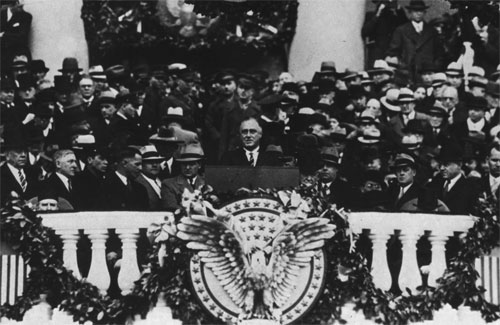
Franklin Delano Roosevelt, a Democrat and former Governor of New York, was inaugurated as the 32nd President of the United States on March 4, 1933. The event took place during the height of the Great Depression, a period of severe economic downturn that affected millions of Americans. With banks collapsing, unemployment rates soaring, and the country in despair, Roosevelt’s inauguration marked a turning point in American history.
Details:
The inauguration occurred on a rainy, cold day in Washington, D.C. Despite the weather, a large crowd gathered to witness the historic event.
This was the last presidential inauguration to be held on March 4th. The 20th Amendment to the U.S. Constitution ratified in 1933, moved the date of future inaugurations to January 20th
Roosevelt delivered his famous line during his inaugural address, “The only thing we have to fear is fear itself.” This phrase reassured the American public and became one of the most memorable quotes in U.S. history.
Effects on Pop Culture:
Roosevelt’s inauguration marked the beginning of a new era in American politics, characterized by a more active federal government and numerous social programs to alleviate poverty and stimulate economic growth. This period, known as the New Deal, profoundly impacted American society and culture.
Roosevelt’s fireside chats, a series of radio addresses delivered throughout his presidency, became an important means of communication between the president and the American public. These broadcasts helped to humanize the presidency and build trust between Roosevelt and the people.
Prominent People and Countries Involved:
Franklin D. Roosevelt – The 32nd President of the United States, served four terms in office from 1933 until he died in 1945.
During FDR’s presidency, Eleanor Roosevelt – The First Lady of the United States, played an active role in her husband’s administration, advocating for civil rights, women’s rights, and social welfare programs.
John Nance Garner – Roosevelt’s first vice president, who served from 1933 to 1941. He later became critical of the New Deal policies and did not support Roosevelt for a third term.
The United States – The country was deeply affected by the Great Depression, and Roosevelt’s inauguration marked a new beginning for the nation as it sought to recover and rebuild.
Franklin Delano Roosevelt’s First Inaugural Address
Given on March 4, 1933, in Washington, DC
I am certain that my fellow Americans expect that on my induction into the Presidency I will address them with a candor and a decision which the present situation of our Nation impels. This is preeminently the time to speak the truth, the whole truth, frankly and boldly. Nor need we shrink from honestly facing conditions in our country today. This great Nation will endure as it has endured, will revive and will prosper. So, first of all, let me assert my firm belief that the only thing we have to fear is fear itself-nameless, unreasoning, unjustified terror which paralyzes needed efforts to convert retreat into advance. In every dark hour of our national life a leadership of frankness and vigor has met with that understanding and support of the people themselves which is essential to victory. I am convinced that you will again give that support to leadership in these critical days.
In such a spirit on my part and on yours we face our common difficulties. They concern, thank God, only material things. Values have shrunken to fantastic levels; taxes have risen; our ability to pay has fallen; government of all kinds is faced by serious curtailment of income; the means of exchange are frozen in the currents of trade; the withered leaves of industrial enterprise lie on every side; farmers find no markets for their produce; the savings of many years in thousands of families are gone.
More important, a host of unemployed citizens face the grim problem of existence, and an equally great number toil with little return. Only a foolish optimist can deny the dark realities of the moment.
Yet our distress comes from no failure of substance. We are stricken by no plague of locusts. Compared with the perils which our forefathers conquered because they believed and were not afraid, we have still much to be thankful for. Nature still offers her bounty and human efforts have multiplied it. Plenty is at our doorstep, but a generous use of it languishes in the very sight of the supply. Primarily this is because the rulers of the exchange of mankind’s goods have failed, through their own stubbornness and their own incompetence, have admitted their failure, and abdicated. Practices of the unscrupulous money changers stand indicted in the court of public opinion, rejected by the hearts and minds of men.
True they have tried, but their efforts have been cast in the pattern of an outworn tradition. Faced by failure of credit they have proposed only the lending of more money. Stripped of the lure of profit by which to induce our people to follow their false leadership, they have resorted to exhortations, pleading tearfully for restored confidence. They know only the rules of a generation of self-seekers. They have no vision, and when there is no vision the people perish.
The money changers have fled from their high seats in the temple of our civilization. We may now restore that temple to the ancient truths. The measure of the restoration lies in the extent to which we apply social values more noble than mere monetary profit.
Happiness lies not in the mere possession of money; it lies in the joy of achievement, in the thrill of creative effort. The joy and moral stimulation of work no longer must be forgotten in the mad chase of evanescent profits. These dark days will be worth all they cost us if they teach us that our true destiny is not to be ministered unto but to minister to ourselves and to our fellow men.
Recognition of the falsity of material wealth as the standard of success goes hand in hand with the abandonment of the false belief that public office and high political position are to be valued only by the standards of pride of place and personal profit; and there must be an end to a conduct in banking and in business which too often has given to a sacred trust the likeness of callous and selfish wrongdoing. Small wonder that confidence languishes, for it thrives only on honesty, on honor, on the sacredness of obligations, on faithful protection, on unselfish performance; without them it cannot live.
Restoration calls, however, not for changes in ethics alone. This Nation asks for action, and action now.
Our greatest primary task is to put people to work. This is no unsolvable problem if we face it wisely and courageously. It can be accomplished in part by direct recruiting by the Government itself, treating the task as we would treat the emergency of a war, but at the same time, through this employment, accomplishing greatly needed projects to stimulate and reorganize the use of our natural resources.
Hand in hand with this we must frankly recognize the overbalance of population in our industrial centers and, by engaging on a national scale in a redistribution, endeavor to provide a better use of the land for those best fitted for the land. The task can be helped by definite efforts to raise the values of agricultural products and with this the power to purchase the output of our cities. It can be helped by preventing realistically the tragedy of the growing loss through foreclosure of our small homes and our farms. It can be helped by insistence that the Federal, State, and local governments act forthwith on the demand that their cost be drastically reduced. It can be helped by the unifying of relief activities which today are often scattered, uneconomical, and unequal. It can be helped by national planning for and supervision of all forms of transportation and of communications and other utilities which have a definitely public character. There are many ways in which it can be helped, but it can never be helped merely by talking about it. We must act and act quickly.
Finally, in our progress toward a resumption of work we require two safeguards against a return of the evils of the old order; there must be a strict supervision of all banking and credits and investments; there must be an end to speculation with other people’s money, and there must be provision for an adequate but sound currency.
There are the lines of attack. I shall presently urge upon a new Congress in special session detailed measures for their fulfillment, and I shall seek the immediate assistance of the several States.
Through this program of action we address ourselves to putting our own national house in order and making income balance outgo. Our international trade relations, though vastly important, are in point of time and necessity secondary to the establishment of a sound national economy. I favor as a practical policy the putting of first things first. I shall spare no effort to restore world trade by international economic readjustment, but the emergency at home cannot wait on that accomplishment.
The basic thought that guides these specific means of national recovery is not narrowly nationalistic. It is the insistence, as a first consideration, upon the interdependence of the various elements in all parts of the United States-a recognition of the old and permanently important manifestation of the American spirit of the pioneer. It is the way to recovery. It is the immediate way. It is the strongest assurance that the recovery will endure.
In the field of world policy I would dedicate this Nation to the policy of the good neighbor-the neighbor who resolutely respects himself and, because he does so, respects the rights of others- the neighbor who respects his obligations and respects the sanctity of his agreements in and with a world of neighbors.
If I read the temper of our people correctly, we now realize as we have never realized before our interdependence on each other; that we can not merely take but we must give as well; that if we are to go forward, we must move as a trained and loyal army willing to sacrifice for the good of a common discipline, because without such discipline no progress is made, no leadership becomes effective. We are, I know, ready and willing to submit our lives and property to such discipline, because it makes possible a leadership which aims at a larger good. This I propose to offer, pledging that the larger purposes will bind upon us all as a sacred obligation with a unity of duty hitherto evoked only in time of armed strife.
With this pledge taken, I assume unhesitatingly the leadership of this great army of our people dedicated to a disciplined attack upon our common problems.
Action in this image and to this end is feasible under the form of government which we have inherited from our ancestors. Our Constitution is so simple and practical that it is possible always to meet extraordinary needs by changes in emphasis and arrangement without loss of essential form. That is why our constitutional system has proved itself the most superbly enduring political mechanism the modern world has produced. It has met every stress of vast expansion of territory, of foreign wars, of bitter internal strife, of world relations.
It is to be hoped that the normal balance of executive and legislative authority may be wholly adequate to meet the unprecedented task before us. But it may be that an unprecedented demand and need for undelayed action may call for temporary departure from that normal balance of public procedure.
I am prepared under my constitutional duty to recommend the measures that a stricken nation in the midst of a stricken world may require. These measures, or such other measures as the Congress may build out of its experience and wisdom, I shall seek, within my constitutional authority, to bring to speedy adoption.
But in the event that the Congress shall fail to take one of these two courses, and in the event that the national emergency is still critical, I shall not evade the clear course of duty that will then confront me. I shall ask the Congress for the one remaining instrument to meet the crisis-broad Executive power to wage a war against the emergency, as great as the power that would be given to me if we were in fact invaded by a foreign foe.
For the trust reposed in me I will return the courage and the devotion that befit the time. I can do no less.
We face the arduous days that lie before us in the warm courage of the national unity; with the clear consciousness of seeking old and precious moral values; with the clean satisfaction that comes from the stem performance of duty by old and young alike. We aim at the assurance of a rounded and permanent national life.
We do not distrust the future of essential democracy. The people of the United States have not failed. In their need they have registered a mandate that they want direct, vigorous action. They have asked for discipline and direction under leadership. They have made me the present instrument of their wishes. In the spirit of the gift I take it.
In this dedication of a Nation we humbly ask the blessing of God. May He protect each and every one of us. May He guide me in the days to come.
“King Kong” is a classic adventure film that captivated audiences in the 1930s and continues influencing popular culture. Directed by Merian C. Cooper and Ernest B. Schoedsack, the movie tells the story of an enormous, prehistoric ape, Kong, who is brought to New York City from his mysterious island home. The film’s groundbreaking visual effects and thrilling storyline made it a box-office sensation and a cultural icon.
“King Kong” was produced by RKO Radio Pictures.
The film stars Fay Wray as Ann Darrow, the woman Kong becomes infatuated with, Robert Armstrong as filmmaker Carl Denham, and Bruce Cabot as Jack Driscoll, the ship’s first mate that travels to Skull Island.
The movie’s special effects, including stop-motion animation, miniatures, and rear-screen projection, were groundbreaking for their time and were overseen by Willis O’Brien.
Max Steiner composed the film’s original score, one of the first synchronized soundtracks in movie history.
“King Kong” was a box office success, grossing around $2 million during its initial release, a significant sum during the Great Depression.
The film was re-released several times over the years and has been restored and preserved by the Library of Congress.
“King Kong” has inspired numerous sequels, remakes, and adaptations, including the 1976 and 2005 remakes and the recent “MonsterVerse” films, such as “Kong: Skull Island” (2017) and “Godzilla vs. Kong” (2021)
The character of Kong has become a pop culture icon, appearing in various forms of media, including comic books, video games, and theme park attractions.
The Empire State Building, the site of the film’s climax, has become synonymous with King Kong, further cementing the movie’s place in popular culture.
The debut of “King Kong” in 1933 introduced audiences to an unforgettable cinematic experience with groundbreaking special effects and a captivating story. The film’s success and lasting impact on popular culture have solidified its place as a classic and influential piece of cinema history.
The Reichstag Fire in Germany was a significant event in the rise of the Nazi Party and Adolf Hitler’s consolidation of power. The fire broke out on February 27, 1933, at the German parliament building in Berlin. Its aftermath led to the suspension of civil liberties and a crackdown on political opposition. This crucial historical event has had lasting effects on popular culture, exploring themes of manipulation and the erosion of democratic institutions.
Details:
The Reichstag Fire occurred on February 27, 1933, when the German parliament building in Berlin was set ablaze.
The fire was a pivotal event in the establishment of Nazi Germany, as Adolf Hitler and the Nazi Party used it as a pretext to suspend civil liberties and crack down on their political opponents.
A young Dutch communist, Marinus van der Lubbe, was arrested at the scene and later convicted and executed for arson. However, the extent of his involvement in the fire and whether the Nazis themselves played a role in starting it remains a subject of debate among historians.
The Reichstag building was designed by architect Paul Wallot and completed in 1894. It was heavily damaged during the fire and was later restored after World War II.
The fire occurred just four weeks after Hitler was appointed Chancellor of Germany, providing him with a convenient opportunity to consolidate power.
President Paul von Hindenburg issued the Reichstag Fire Decree the day after the fire, which suspended civil liberties, including freedom of speech, assembly, and the press.
Effects on Pop Culture:
The Reichstag Fire has been the subject of numerous books, films, and documentaries exploring the theories and controversies surrounding the event.
It serves as a cautionary tale about the manipulation of public opinion and the erosion of democratic institutions, themes that continue to resonate in contemporary political discussions and popular culture.
Prominent People and Countries Involved:
Adolf Hitler: As Chancellor of Germany, Hitler used the Reichstag Fire as a pretext to consolidate power and further his authoritarian agenda.
Marinus van der Lubbe: The Dutch communist who was convicted of setting the fire, although the extent of his involvement remains a subject of debate.
Germany: The Reichstag Fire marked a turning point in German history, as it led to the suspension of civil liberties and the establishment of a one-party dictatorship under the Nazi regime.
Adolf Hitler’s Appointment as Chancellor of Germany
Details:
Adolf Hitler, the leader of the National Socialist German Workers’ Party (Nazi Party), was appointed as Chancellor of Germany by President Paul von Hindenburg on January 30, 1933.
The appointment came after a series of political maneuvers, economic crises, and growing support for the Nazi Party, which had become the largest party in the German parliament (Reichstag) in the elections of 1932.
Trivial Facts:
Some political elites initially saw Hitler’s appointment as chancellor as a way to control him and the Nazi Party, as they believed they could manipulate him from behind the scenes.
Hitler’s appointment marked the end of the Weimar Republic, the democratic government established in Germany after World War I, and the beginning of the Third Reich.
Within a few months of his appointment, Hitler and the Nazi Party consolidated power, suspended civil liberties, and established a dictatorship.
Hitler’s rise to power profoundly impacted global politics, culture, and art. Many artists and intellectuals fled Germany, spreading their influence to other countries.
Nazi propaganda and aesthetics influenced numerous aspects of popular culture, including film, literature, and design.
The horrors of the Holocaust and the atrocities committed by the Nazis during World War II continue to be a significant theme in movies, books, and other art forms.
Prominent People and Countries Involved:
Adolf Hitler: Leader of the Nazi Party and Chancellor of Germany from 1933 to 1945, when he committed suicide as Allied forces closed in on his bunker in Berlin.
Paul von Hindenburg: President of Germany from 1925 to 1934, who appointed Hitler as chancellor in a last-ditch effort to maintain stability in the country. Hindenburg died in August 1934, and Hitler assumed the title of Führer, combining the roles of president and chancellor.
Germany: The country was experiencing a period of political and economic instability during the Weimar Republic, and Hitler’s appointment as chancellor marked the beginning of a dark chapter in German history, culminating in World War II and the Holocaust.
The 5th Academy Awards ceremony took place on November 18, 1932.
Host Conrad Nagel returned to MC the event, which was located in the Fiesta Room at the Ambassador Hotel.
Films released between August 1, 1931, and July 31, 1932, were eligible for awards.
Noteworthy Moments:
Walt Disney won his first ever Oscar for the animated short Flowers and Trees, under a new category called Best Animated Short Film.
Grand Hotel won Best Picture without winning any other Oscars, a feat unmatched to this day.
Helen Hayes won Best Actress for her role in The Sin of Madelon Claudet, a film that was initially a commercial failure.
Flowers and Trees was the first color Academy Award winner and first animated short winner.
Arrowsmith and The Champ each earned 4 nominations.
Grand Hotel was the only Best Picture winner to be nominated for Best Picture and nothing else.
Trivia:
This was the first ceremony where the winners were kept a secret until the event.
This is the only year that the Academy did not award a Best Director.
The Best Actor category included three nominees who were non-American: Alfred Lunt, Lawrence Tibbett, and Wallace Beery.
This was the last year that write-in votes were allowed, enabling Hal Mohr to win Best Cinematography for A Midsummer Night’s Dream in a later ceremony.
The ceremony was broadcast by Los Angeles radio station KNX.
5th Academy Awards Oscar Nominees and Winners
Outstanding Production:
Grand Hotel – Irving Thalberg for Metro-Goldwyn-Mayer (WINNER)
Arrowsmith – Samuel Goldwyn for Samuel Goldwyn Prod.
Bad Girl – Winfield Sheehan for Fox Film Corp.
The Champ – King Vidor for Metro-Goldwyn-Mayer
Five Star Final – Hal B. Wallis for First National
One Hour with You – Ernst Lubitsch for Paramount Publix
Shanghai Express – Adolph Zukor for Paramount Publix
The Smiling Lieutenant – Ernst Lubitsch for Paramount Publix
Best Director:
Frank Borzage – Bad Girl (WINNER)
King Vidor – The Champ
Josef von Sternberg – Shanghai Express
Best Actor:
Fredric March – Dr. Jekyll and Mr. Hyde as Dr. Henry Jekyll/Mr Edward Hyde (WINNER)
Wallace Beery – The Champ as Champ (WINNER)
Alfred Lunt – The Guardsman as The Actor
Best Actress:
Helen Hayes – The Sin of Madelon Claudet as Madelon Claudet (WINNER)
Marie Dressler – Emma as Emma Thatcher Smith
Lynn Fontanne – The Guardsman as The Actress
Best Original Story:
The Champ – Frances Marion (WINNER)
Lady and Gent – Grover Jones and William Slavens McNutt
The Star Witness – Lucien Hubbard
What Price Hollywood? – Adela Rogers St. Johns and Jane Murfin
Best Adaptation:
Bad Girl – Edwin J. Burke, based on the novel and play by Viña Delmar (WINNER)
Arrowsmith – Sidney Howard, based on the novel by Sinclair Lewis
Dr. Jekyll and Mr. Hyde – Percy Heath and Samuel Hoffenstein, based on Strange Case of Dr. Jekyll and Mr. Hyde by Robert Louis Stevenson
Best Art Direction:
Transatlantic – Gordon Wiles (WINNER)
À Nous la Liberté – Lazare Meerson
Arrowsmith – Richard Day
Best Cinematography:
Shanghai Express – Lee Garmes (WINNER)
Arrowsmith – Ray June
Dr. Jekyll and Mr. Hyde – Karl Struss
Best Sound Recording:
Paramount Publix Studio Sound Department (WINNER)
MGM Studio Sound Department
RKO Radio Studio Sound Department
Walt Disney Productions
Warner Bros. First National Studio Sound Department
Best Short Subject, Cartoon:
Flowers and Trees – Walt Disney, Walt Disney Productions, United Artists (WINNER)
It’s Got Me Again! – Leon Schlesinger, Leon Schlesinger Productions, Warner Bros.
Mickey’s Orphans – Walt Disney, Walt Disney Productions, Columbia Pictures
Best Live Action Short Subject, Comedy:
The Music Box – Hal Roach (WINNER)
The Loud Mouth – Mack Sennett
Scratch-As-Catch-Can – RKO Radio
Best Live Action Short Subject, Novelty:
Wrestling Swordfish – Mack Sennett (WINNER)
Screen Souvenirs – Paramount Publix
Swing High – Metro-Goldwyn-Mayer
Academy Honorary Award:
Walt Disney, for the creation of Mickey Mouse