web analytics

Tag: 1934

  • Pop Culture Trivia Quiz: What Happened In 1934?

    Pop Culture Trivia Quiz: What Happened In 1934?

    Pop Culture Trivia Quiz: What Happened In 1934?

    34 Trivia Questions for 1934 History

    (answers)

    1. Created by Alex Raymond, what space adventure comic strip debuted on January 7, 1934?

    2. How many people lived in the United States in 1934?

    3. On December 27, 1934, Persia changed its name to what?

    4. Who won the Stanley Cup in 1934?

    5. What was the Biggest Number One Song of 1934?

    6. Who was the President of the United States in 1934?

    7. They made 190 short films together, and the first was called Woman Haters. Who were “they?”

    8. What was the average household income in 1934?

    9. Disney’s Silly Symphonies animated short, The Wise Little Hen, introduced Peter Pig and another famous Disney Character. Who was that character?

    10. Who was the Disney Legend who voiced Donald Duck from the beginning and for over 50 years?

    11. What was the highest-grossing film of 1934?

    12. In Fort Worth, Texas, a business named “Wash-a-Teria” was the first of its kind. What was the business?

    13. Adapted from an Edgar Allen Poe story, what horror film starred horror film icons Boris Karloff and Bela Lugosi

    14. What was the Bestselling Fiction Book in 1934?

    15. How much did a Loaf of Bread cost in 1934?

    16. How much did a Gallon of Milk cost in 1934?

    17. At what Major League Baseball event did Carl Hubbel strike out Babe Ruth, Lou Gehrig, Jimmie Foxx, Al Simmons, and Joe Cronin, all in succession?

    18. What music hall in Harlem, Manhattan, opened on January 16, 1934?

    19. In late 1934, a film called Bright Eyes was released starring one of the biggest stars of the 1930s. Who was the young star of the film?

    20. In 1934, what was the average life expectancy in the United States?

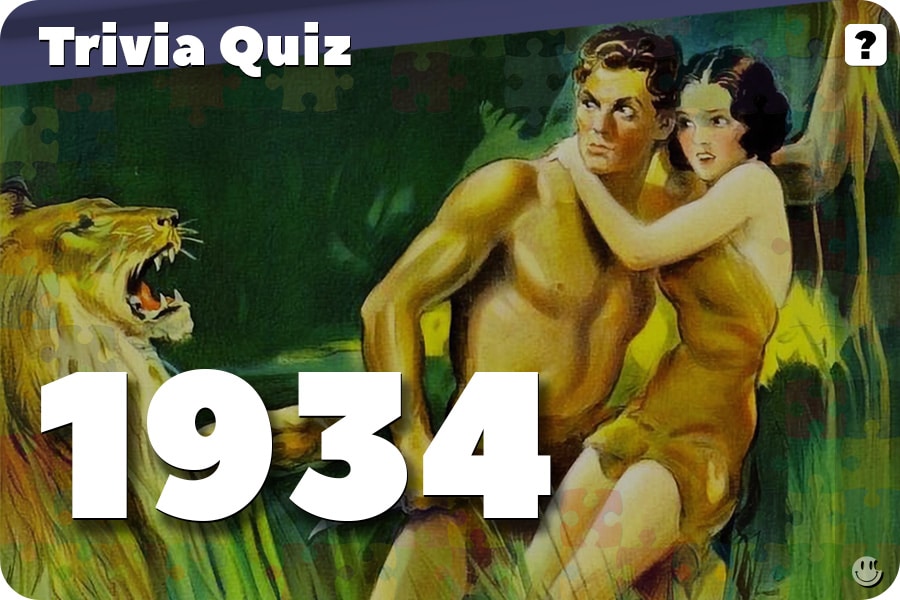
    21. Tarzan and His Mate was released on April 16, 1934. What actress played Jane in the film?

    22. Who was arrested and later convicted for the 1932 Lindbergh Baby Kidnapping?

    23. A 1934 American romantic comedy starring Claudette Colbert and Clark Cable won 5 Academy Awards – Best Picture, Best Director, Best Actor, Best Actress, and Best Adapted Screenplay. Name that film…

    24. Who won the 1934 World Series?

    25. What was the film industry code of standards that became enforced in 1934?

    26. Now a National Historic Landmark, what was an island prison between 1934 and 1963?

    27. A period of severe dust storms and droughts damaged the American and Canadian plains. What do historians call that period of history?

    28. How much did a gallon of gas cost in 1934?

    29. London gynecologist Robert Kenneth Wilson took a famous picture that was probably a hoax. What was the subject of the photograph?

    30. What bank-robbing gangster was shot and killed by police on July 22, 1934?

    31. Who was the Time Magazine Man of the Year in 1934?

    32. What company used the slogan: When you care enough to send the very best”?

    33. How much did a dozen eggs cost in 1934?

    34. What was the big story out of Bienville Parish, Louisiana, on May 23, 1934?

    Trivia Team Bonus Questions:

    1. What kind of (stolen) car were Bonnie Parker and Clyde Barrow driving when they were ambushed and killed?

    2. Who was the Mayor of New York from 1934 through 1945?

    3. Who were the 1934 NFL Champions?

    4. Who was the American Vice-President in 1934?

    5. What Horse won the Kentucky Derby in 1934?

    6. The famous gilded bronze human-figured sculpture, created by Paul Manship, was dedicated at Rockefeller Center in New York City. What is it called?

    7. Another well-known gangster was killed in The Battle of Barrington outside of Chicago a few months later. Name that gangster.

    8. What team won the FIFA World Cup in 1934?

    9. What business group used the slogan: “If You Want to Get Ahead, Get a …”?

    10. Who was the Pope in 1934?

    The Answers:

    34 Trivia Answers for 1934 History

    1. Created by Alex Raymond, what space adventure comic strip debuted on January 7, 1934?
    Flash Gordon

    2. How many people lived in the United States in 1934?
    The population was an estimated 126,373,773 people.

    3. On December 27, 1934, Persia changed its name to what?
    Iran

    4. Who won the Stanley Cup in 1934?
    In 1934, The Chicago Black Hawks won over the Detroit Red Wings (3 games to 1)

    5. What was the Biggest Number One Song of 1934?
    (tie) Smoke Gets In Your Eyes by Paul Whiteman OR June in January by Bing Crosby

    6. Who was the President of the United States in 1934?
    Franklin D. Roosevelt (March 4, 1933 – April 12, 1945)

    7. They made 190 short films together, and the first was called Woman Haters. Who were “they?”
    The Three Stooges

    8. What was the average household income in 1934?
    $3,125.42

    9. Disney’s Silly Symphonies animated short, The Wise Little Hen, introduced Peter Pig and another famous Disney Character. Who was that character?
    Donald Duck

    10. Who was the Disney Legend who voiced Donald Duck from the beginning and for over 50 years?Clarence (Charles) Nash

    11. What was the highest-grossing film of 1934?
    The Merry Widow

    12. In Fort Worth, Texas, a business named “Wash-a-Teria” was the first of its kind. What was the business?
    Laundromat (Self-service laundry)

    13. Adapted from an Edgar Allen Poe story, what horror film starred horror film icons Boris Karloff and Bela Lugosi?
    The Black Cat

    14. What was the Bestselling Fiction Book in 1934?
    Anthony Adverse by Hervey Allen

    15. How much did a Loaf of Bread cost in 1934?
    8 cents

    16. How much did a Gallon of Milk cost in 1934?
    44 cents

    17. At what Major League Baseball event did Carl Hubbel strike out Babe Ruth, Lou Gehrig, Jimmie Foxx, Al Simmons, and Joe Cronin, all in succession?
    The 1934 All-Star Game in New York City

    18. What music hall in Harlem, Manhattan, opened on January 16, 1934?
    The Apollo Theater

    19. In late 1934, a film called Bright Eyes was released starring one of the biggest stars of the 1930s. Who was the young star of the film?
    Shirley Temple

    20. In 1934, what was the average life expectancy in the United States?
    Men – 59.3 years, Women – 63.3 years.

    21. Tarzan and His Mate was released on April 16, 1934. What actress played Jane in the film?
    Maureen O’Sullivan

    22. Who was arrested and later convicted for the 1932 Lindbergh Baby Kidnapping?
    Bruno Richard Hauptmann

    23. A 1934 American romantic comedy starring Claudette Colbert and Clark Cable won 5 Academy Awards – Best Picture, Best Director, Best Actor, Best Actress, and Best Adapted Screenplay. Name that film.
    It Happened One Night

    24. Who won the 1934 World Series?
    In 1934, The St. Louis Cardinals won, beating the Detroit Tigers (4 games to 3)

    25. What was the film industry code of standards that became enforced in 1934?
    Motion Picture Production Code (aka The Hays Code)

    26. Now a National Historic Landmark, what was an island prison between 1934 and 1963?
    Alcatraz (Federal Penitentiary), off the coast of San Francisco, California.

    27. A period of severe dust storms and droughts damaged the American and Canadian plains. What do historians call that period of history?
    The Dust Bowl

    28. How much did a gallon of gas cost in 1934?
    $0.19 per gallon

    29. London gynecologist Robert Kenneth Wilson took a famous picture that was probably a hoax. What was the subject of the photograph?
    The Loch Ness Monster

    30. What bank-robbing gangster was shot and killed by police on July 22, 1934?
    John Dillinger

    31. Who was the Time Magazine Man of the Year in 1934?
    Franklin D. Roosevelt

    32. What company used the slogan: When you care enough to send the very best”?
    Hallmark

    33. How much did a dozen eggs cost in 1934?
    33 cents

    34. What was the big story out of Bienville Parish, Louisiana on May 23, 1934?
    Bonnie Parker and Clyde Barrow (Bonnie & Clyde) were ambushed and killed by police.

    Trivia Team Bonus Questions:

    1. What kind of (stolen) car were Bonnie Parker and Clyde Barrow driving when they were ambushed and killed?
    1934 Ford V-8

    2. Who was the Mayor of New York from 1934 through 1945?
    Fiorello La Guardia

    3. Who were the 1934 NFL Champions?
    New York Giants

    4. Who was the American Vice-President in 1934?
    John Garner (March 4, 1933 – January 20, 1941)

    5. What Horse won the Kentucky Derby in 1934?
    Cavalcade

    6. The famous gilded bronze human-figured sculpture, created by Paul Manship, was dedicated at Rockefeller Center in New York City. What is it called?
    Prometheus

    7. Another well-known gangster was killed in The Battle of Barrington outside of Chicago a few months later. Name that gangster.
    Baby Face Nelson (Lester Joseph Gillis)

    8. What team won the FIFA World Cup in 1934?
    Italy

    9. What business group used the slogan: “If You Want to Get Ahead, Get a …”?
    Hat Council

    10. Who was the Pope in 1934?
    Pope Pius XI, February 6, 1922 – February 10, 1939


  • 1934 History, Trivia and Fun facts

    1934 History, Trivia and Fun facts

    1934 History, Facts and Trivia

    Quick Facts from 1934:

    • World Changing Event: The first magnetic tape recorders were available, initially for radio broadcasting.
    • Influential Songs include The Good Ship Lollipop by Shirley Temple and You’re The Top by Cole Porter.
    • The Movies to Watch include It Happened One Night, Bright Eyes, The Thin Man, The Man Who Knew Too Much, The Black Cat, Babes in Toyland, Cleopatra, and Treasure Island.
    • The Most Famous Person in America was probably Will Rogers.
    • MPAA Certificate Number 1 was for The World Moves On in 1934. 2010’s Hot Tub Time Machine was Certificate Number 45912.
    • Notable books include Murder on the Orient Express by Agatha Christie
    • Price of a baseball (Wilson) in 1934: 33 cents
    • George Nissen and Larry Griswold created the home-use trampoline.
    • The Funny Duo was: Laurel and Hardy
    • The first Three Stooges short, Woman Haters, was released.
    • The Conversation: “Why is the US Government confiscating our gold?”
    • Take our 1934 Quiz!

    1934 History Roundup:

    • January 1 – Alcatraz Became a Federal Prison: Alcatraz Island in San Francisco Bay was officially designated as a federal penitentiary intended to house the most dangerous criminals.
    • January 1 – Nazi Germany Enacted Eugenics Law: The “Law for the Prevention of Genetically Diseased Offspring” was implemented, mandating compulsory sterilization for individuals deemed genetically unfit.
    • February 9 – Balkan Pact Signed: Greece, Turkey, Romania, and Yugoslavia formed a military alliance to counter the territorial ambitions of neighboring countries, particularly Italy and Bulgaria.
    • February 12–16 – Austrian Civil War: Armed conflict erupted between socialist and conservative-fascist forces in Austria, resulting in a government victory and the banning of the Socialist Party.
    • February 22 – It Happened One Night Premiered: The romantic comedy directed by Frank Capra, starring Clark Gable and Claudette Colbert, was released; it later became the first film to win all five major Academy Awards.
    • March 3 – John Dillinger’s Jail Escape: Notorious gangster John Dillinger escaped from jail in Crown Point, Indiana, using a wooden gun, furthering his criminal legend.
    • May 23 – Bonnie and Clyde Killed: Infamous outlaws Bonnie Parker and Clyde Barrow were ambushed and killed by law enforcement officers in Bienville Parish, Louisiana.
    • June 9 – Donald Duck’s Debut: The character Donald Duck made his first appearance in the Walt Disney cartoon “The Wise Little Hen,” becoming a beloved figure in animation.
    • June 30 – Night of the Long Knives: Adolf Hitler ordered a purge of the Nazi Party, targeting the SA leadership and other political adversaries, consolidating his power in Germany.
    • July 4 – Leó Szilárd Patented Nuclear Chain Reaction: Hungarian physicist Leó Szilárd filed a patent for the concept of a nuclear chain reaction, laying the groundwork for future atomic research.
    • August 2 – Hitler Became Führer: Following President Hindenburg’s death, Adolf Hitler merged the positions of Chancellor and President, declaring himself Führer and solidifying his dictatorship.
    • October 9 – Assassination of King Alexander I: King Alexander I of Yugoslavia and French Foreign Minister Louis Barthou were assassinated in Marseille by a Croatian nationalist, impacting European politics.
    • October 16 – Long March Began: Mao Zedong and approximately 25,000 Red Army troops commenced the 6,000-mile retreat known as the Long March, a pivotal event in Chinese Communist history.
    • December 1 – Assassination of Sergei Kirov: Sergei Kirov, a prominent Soviet leader, was assassinated, an event that Joseph Stalin used to initiate the Great Purge against perceived enemies.
    • December 29 – Japan Renounced Naval Treaties: Japan announced its withdrawal from the Washington and London Naval Treaties, signaling its intent to expand its naval capabilities.
    • Dust Bowl Devastated U.S. Plains: Severe dust storms plagued the American and Canadian prairies, causing widespread agricultural damage and displacement of farming communities.
    • Great Purge Initiated in USSR: Joseph Stalin began a campaign of political repression, targeting Communist Party members and civilians, leading to widespread executions and imprisonments.
    • Rise of Fascist Movements in Europe: Fascist ideologies gained traction in various European countries, influencing political landscapes and contributing to the tensions leading up to World War II.
    • Advancements in Aviation Technology: Significant progress was made in aircraft design and performance, setting the stage for the rapid development of aviation in the following years.
    • Expansion of Radio Broadcasting: Radio became an increasingly popular medium for entertainment and news, with more households acquiring radio sets and tuning in to various programs.
    • Strengthening of Totalitarian Regimes: Totalitarian governments in Germany, Italy, and the Soviet Union consolidated power, suppressing dissent and controlling various aspects of life.
    • Cultural Renaissance in Harlem: The Harlem Renaissance continued flourishing, with African American artists, writers, and musicians making significant contributions to American culture.
    • Advancements in Science and Technology: Breakthroughs in physics, chemistry, and medicine marked the year, including progress in nuclear research and synthetic materials.
    • Hollywood’s Golden Age Progressed: Iconic films like It Happened One Night and The Thin Man showcased the creativity and innovation of the burgeoning Hollywood film industry.
    • Escalation of Anti-Semitism in Nazi Germany: Policies targeting Jewish people intensified in Nazi Germany, laying the groundwork for further persecution in the coming years.

    Top Ten Baby Names of 1934

    Mary, Betty, Barbara, Shirley, Dorothy, Robert, James, John, William, Richard

    US Life Expectancy

    (1934) Males: 59.3 years, Females: 63.3 years

    The Stars

    Josephine Baker, Joan Blondell, Claudette Colbert, Joan Crawford, Marion Davies, Marlene Dietrich, Kay Francis, Jean Harlow, Katharine Hepburn, Hedy Lamarr, Myrna Loy, Ginger Rogers, Barbara Stanwyck, Thelma Todd, Mae West, Fay Wray. Jimmy the Raven, a trained crow, appeared in over 1,000 feature films between 1934 and 1954.

    Entertainment History: The Oscars

    The 6th Academy Awards took place on March 16, 1934, hosted by comedian Will Rogers at The Ambassador Hotel in Los Angeles. The film eligibility window was from August 1, 1932, to December 31, 1933. Cavalcade won the Best Picture prize, while Charles Laughton was honored as Best Actor for portraying King Henry VIII in The Private Life of Henry VIII. One notable aspect of this ceremony was the introduction of categories like Best Film Editing and Best Original Song. The first Best Original Song winner was “The Continental” from the movie The Gay Divorcee. Katharine Hepburn’s win for Best Actress in Morning Glory was the first of her four career Oscar wins, making her the actress with the most Oscars for acting to this day.

    Miss America

    none

    Time Magazine’s Man of the Year

    Franklin D. Roosevelt

    Firsts, Inventions, and Wonders

    Steve Urkel’s catchphrase, “Did I do that?”, was taken from the 1934 Three Stooges short Punch Drunks.

    The Flash Gordon comic strip was first published.

    In July of 1934, Babe Ruth paid a fan $20 for the return of the baseball he hit for his 700th career home run.

    The FDIC (Federal Deposit Insurance Corp) was established.

    Parker Brothers released the board game Sorry.

    Pennsylvania opened its first liquor stores.

    MPAA Certificate Number 1 was issued to The World Moves On, in 1934.

    DC Comics was founded in 1934. Archie Comics and Timely (Marvel) Comics were both founded in 1939.

    Jagermeister was introduced in Germany in 1934.

    The Biggest Pop Artists of 1934 include

    Don Bestor & His Orchestra, Emil Coleman & His Orchestra, Bing Crosby, Eddy Duchin and His Orchestra, Duke Ellington, Ted Fio Rito & His Orchestra, Jan Garber and His Orchestra, Benny Goodman and His Orchestra, Glen Gray and the Casa Loma Orchestra, Johnny Green & His Orchestra, Jimmie Grier & His Orchestra, Richard Himber & His Orchestra, Hal Kemp and His Orchestra, Little Jack Little & His Orchestra, Guy Lombardo and His Royal Canadians, Enric Madriguera and His Orchestra, Freddy Martin and His Orchestra, Ethel Merman, The Mills Brothers, Grace Moore, Ray Noble and His Orchestra, Ben Pollack & His Orchestra, Leo Reisman and His Orchestra, Rudy Vallée & His Connecticut Yankees, Paul Whiteman & His Orchestra

    The Strange

    The (not) word “Dord” appeared in Webster’s dictionary as a term for density in chemistry. Originally, it was meant for density to be added as a definition for the abbreviation “D or d,” but the mistake wasn’t found for another five years, and removed in 1947.

    Jimmy the Raven, a trained crow, appeared in over 1,000 feature films between 1934 and 1954.

    London gynecologist Robert Kenneth Wilson took his famous photograph of the Loch Ness Monster.

    Nikola Tesla (1856 – 1943) announced that he was working on a ‘Directed Energy Weapon’ that would be able to destroy an army 200 miles away. The super-weapon was never built, and no one knows how it was supposed to work; after his death, the FBI seized all his possessions and declared his papers Top Secret.

    From 1925 to 1934, the Eiffel Tower served as a giant, lighted billboard for Citroen.

    Created in 1908, the FBI had neither the authority to carry firearms or make an official arrest until 1934.

    With the 1934 lease agreement, the United States continues to pay $4,085 monthly rent to Cuba for the Guantanamo Naval Station. Castro has only cashed one check by accident, in the past 52 years.

    Gangster John Dillinger escaped from jail with a wooden pistol. After whittling it in his cell in March 1934, he used the fake weapon to intimidate 33 people before getting a real machine gun. “Ha, ha, ha! And I did all this with a wooden gun!” he bragged while leaving.

    On January 29, 1934, the Los Angeles Times published a front-page article about a geophysical mining engineer’s search for a lost civilization of Lizard People and their buried treasure beneath the streets of Los Angeles.

    Crime News

    Bonnie and Clyde were ambushed and killed by police in Bienville Parish, Louisiana.
    Also killed by law enforcement: John Dillinger, Charles Arthur ‘Pretty Boy’ Floyd, and George ‘Baby Face’ Nelson. #crimedoesntpay

    Pop Culture Facts & History

    President FDR enacted a Federal law requiring that all gold be turned over to the federal government at $20.67/oz. After the government acquired most of the gold, the market price changed to $35/oz.

    Future US President Gerald Ford (R) threatened not to play for the Michigan football team because the school would not let his teammate Willis Ward, who was black, play against Georgia Tech, which refused to share the field with a black player. Ward talked Ford out of it, and Michigan won.

    Donald Duck first appeared in the Silly Symphonies cartoon The Wise Little Hen on June 9, 1934, although he was mentioned in a 1931 Disney book. He was the first of many clothed cartoon characters who didn’t wear pants.

    The Apollo Theater held its first ‘Amateur Night’.

    It Happened One Night (1934) won all Big Five Academy Awards: Best Picture, Best Director, Best Actor, Best Actress, and Best Writing (Original or Adapted).

    The $500, $1000, $10,000 & $100,000 Bills were printed by the US Mint until 1934, and are still legal tender.

    Alfred Hitchcock remade his 1934 movie, The Man Who Knew Too Much, as The Man Who Knew Too Much in 1956.

    The largest pearl ever found, the ‘Pearl of Lao Tzu’ was found, weighing 31,893.5 carats (just over 14 lbs)

    The (2nd) highest wind gust ever recorded was a 231 mph gust at the summit of Mt. Washington, NH, in 1934.

    In 1934, when Disney began working on Snow White and the Seven Dwarfs, some early dwarf names included Jumpy, Deafy, Puffy, Burpy, Stuffy, Lazy, and Wheezy.

    A sad realization came to six-year-old Shirley Temple when a Los Angeles department store Santa Claus asked her for her autograph…

    Nobel Prize Winners

    Physics – Not awarded
    Chemistry – Harold Clayton Urey
    Physiology or Medicine – George Hoyt Whipple, George Richards Minot, William Parry Murphy
    Literature – Luigi Pirandello
    Peace – Arthur Henderson

    Popular and Best-selling Books From 1934

    Anthony Adverse by Hervey Allen
    Goodbye, Mr. Chips by James Hilton
    The Joy of Cooking by Irma Rombauer
    Lamb in His Bosom by Caroline Miller
    Mary Peters by Mary Ellen Chase
    Murder on the Orient Express by Agatha Christie
    Oil for the Lamps of China by Alice Tisdale Hobart
    Private Worlds by Phyllis Bottome
    Seven Gothic Tales by Isak Dinesen
    So Red the Rose by Stark Young
    Within This Present by Margaret Ayer Barnes
    Work of Art by Sinclair Lewis

    Sports

    World Series Champions: St. Louis Cardinals
    NFL Champs: New York Giants
    Stanley Cup Champs: Chicago Black Hawks
    U.S. Open Golf: Olin Dutra
    U.S. Tennis (Men/Ladies): Fred Perry/ Helen H. Jacobs
    Wimbledon (Men/Women): Fred Perry/Dorothy Round
    NCAA Football Champions: Minnesota
    Kentucky Derby Winner: Cavalcade
    FIFA World Cup: Italy
    Boston Marathon Winner: Dave Komonen Time: 2:32:53

    More 1934 Facts & History Resources:

    Most Popular Baby Names (BabyCenter.com)
    Popular and Notable Books (popculture.us)
    Broadway Shows that Opened in 1934
    1934 Calendar, courtesy of Time and Date.com
    Fact Monster
    The Great Depression Britannica
    1930s, Infoplease.com World History
    1934 in Movies (according to IMDB)
    Retrowaste Vintage Culture
    1930s Slang
    Wikipedia 1934
    Timeline of events preceding World War II


  • 1934 Music: Popular Music, Songs and Artists

    1934 Music: Popular Music, Songs and Artists

    1934 Popular Music, Songs and Artists

    Ben Selvin
    I Only Have Eyes For You
    Composed by Harry Warren with lyrics by Al Dubin, the song written in 1934 for the film Dames where Dick Powell and Ruby Keeler sang it. The song would continue to be recorded throughout the century by such artists as Frank Sinatra the Temptations and in 1959 by The Flamingos. This recording would make it to #11 on Bill Boards Top 100. The song was used in such movies as American Graffiti, The Right Stuff and Warner Brothers Merrie Melody Cartoons.

    Don Bestor
    42nd Street
    42nd St. is the title and the title song of a 1933 movie musical Starring Ruby Keeler. The song would go on to be popular the movie would end up as two major Broadway productions and many songs from the show would become standard.

    Ethel Merman
    You’re The Top
    The song comes from the 1934 musical Anything Goes whose score was written by the great Cole Porter and told the story of a ship’s stowaway that falls in love with an heiress on the ship. The song was hit at the time especially when sung by its original performer Ethel Merman. This would be the first time Miss Merman would be on the charts but her popularity on Broadway would make her a star not soon to be forgotten.
    You’re The Top would be used in many other shows and be recorded by many artists such as Barbara Streisand and John Barrowman The show would be revived many times and continues to be performed in the 21st century. Recently the song was sung by Rachel Berry’s two dads in GLEE.

    Fats Waller
    Honey Suckle Rose
    The song was originally composed in 1928 by Fats Waller, with lyrics by Andy Razaf. Waller finally recorded it in 1934, and this recording was inducted into the Grammy Hall of Fame in 1999. Lena Horne and Louis Armstrong recorded it and featured it in an MGM Musical.

    Jimmy Durante
    Inka Dinka Doo
    Inka Dinka Doo was written by Ben Ryan, with music composed by James Francis “Jimmy” Durante. The song debuted in the 1934 movie Palooka. Durante’s song would become a hit for him but it also would become his signature song. He would begin and end his radio program with it. One of the truly interesting facts about the song is one of the other top songs of the year, You’re The Top, would mention Durante’s name in the lyrics.

    Leo Reisman
    The Continental
    The song was written by Con Conrad with lyrics by Herb Magidson and introduced by Ginger Rogers in the 1934 film The Gay Divorcee, Co-starring Fred Astaire.”The Continental” was the first song to win the Academy Award for Best Original Song. It was also used in an episode of I Love Lucy.

    Ruth Etting
    Smoke Gets In Your Eyes
    This song was written by composer Jerome Kern and lyricist Otto Harbach for the 1933 musical Roberta. It was performed in the show by Tamara Drasin. In 1935, Irene Dunne would perform the song for the film adaptation of the Broadway hit. The film co-starred Fred Astaire and Ginger Rogers. The song would continue to be performed throughout the 20th century by such artists as Nat King Cole, Jody Garland and Eartha Kitt (TVs Catwoman). The song would reach number three on the R&B Charts in 1959 when recorded by The Platters

    Sons of the Pioneers
    Tumbling Tumbleweed
    The song was composed by Bob Nolan and is probably one of the most popular “cowboy” songs ever written. The interesting point of this song is that it was composed by Nolan while working as a caddy in Los Angeles. The was originally titled “Tumbling Tumble Leaves but the song was reworked and re-named. The song would gain even more success when Gene Autry sang it in his movie of the same name.

    Rudy Vallee And His Connecticut Yankees
    You Oughta Be In Pictures
    Written by Dana Seuss and Richard Heyman, the song would be first performed in The Ziegfeld Follies of 1934 by Rudy Vallee and His Connecticut Yankees who would also record the song. In the same year, Looney Toons would use the title in a song starring Porky Pig and Daffy Duck.

    Take our 1934 Quiz!

    Top Artists and Songs of 1934

    Ben Selvin
    I Only Have Eyes For You
    Benny Goodman
    Moon Glow
    Bessie Smith
    Gimme A Pigfoot and a Bottle of Beer
    Bing Crosby
    Love In Bloom, June In January, Two Cigarettes In The Dark, Little Dutch Mill, Love Is Just Around The Corner, Straight From The Shoulder
    Cab Calloway and his Orchestra
    (Hep-Hep!) The Jumpin Jive, Chinese Rhythm
    Carmen Miranda
    Na Batucada da Vida
    Chick Webb
    I Can’t Dance (I Got Ants In My Pants), What a Shuffle, Stompin’ At The Savoy
    Don Bestor
    Forty-Second Street
    Duke Ellington
    Cocktails For Two, Solitude, Delta Serenade, The Saddest Tale
    Eddie Duchin
    Let’s Fall In Love, I Only Have Eyes For You
    Emil Velasco
    Old Spinning Wheel
    Enric Madriguera
    The Carioca
    Ethel Merman
    You’re The Top
    Fats Waller
    Honeysuckle Rose
    Fred Astaire
    Flying Down To Rio
    Freddy Martin
    April In Paris, I Saw Stars
    Glen Gray
    Champagne Waltz
    Grace Moore
    One Night of Love
    Guy Lombardo
    Stars Fell on Alabama
    Harry Sosnick and the Edgewater Beach Orchestra
    The Carioca
    Henry King
    April In Paris
    Henry Rose
    Hot Lips
    Isham Jones
    For All We Know
    Jan Garber
    All I Do Is Dream Of You
    Jane Froman
    I Only Have Eyes For You
    Jimmie Lunceford
    Stratosphere
    Jimmy Durante
    Inka Dinka Dpp
    Jimmy Greer and his Orchestra
    Stay As Sweet as You Are, The Object of my Affection
    Leo Reisman
    The Continental (You Kiss While You’re Dancing)
    Lucienne Boyer
    Hands Across The Table
    Mario Reis
    Agora & Cinza
    Paul Whiteman
    I Get A Kick Out Of You, You’re The Top, Smoke Gets In Your Eyes, Wagon Wheels
    Ray Noble
    The Very Thought Of You, Old Spinning Wheel
    Rudy Vallee and his Connecticut Yankees
    You Outta Be In Pictures
    Ruth Etting
    Smoke Gets In Your eyes
    Scott Wood and His Orchestra
    I Only Have Eyes For You
    Sons of the Pioneers
    Tumbling Tumbleweeds
    Ted Fio Rito
    My Little Grass Shack in Kealakekua Hawaii, I’ll String Along With You
  • 1934 Oscars 6th Academy Awards

    1934 Oscars 6th Academy Awards

    1934 Oscars 6th Academy Awards

    • The 6th Academy Awards occurred on March 16, 1934, and broke with tradition by being held at The Ambassador Hotel in Los Angeles, California.
    • Will Rogers, the American stage and film actor, took on the role of host for the evening.
    • The eligibility period stretched from August 1, 1932, to December 31, 1933.

    Noteworthy Moments:

    • Katharine Hepburn won her first Oscar for Best Actress in Morning Glory, beginning a legendary Academy Awards career.
    • Cavalcade, a drama based on a Noel Coward play, won Best Picture.
    • The ceremony was the first to be held in March, breaking away from the early ceremonies which were usually held in November or April.
    • Cavalcade, A Farewell to Arms, and Lady for a Day each earned 6 nominations.
    • First Oscar “oops!”: Will Rogers presented the Academy Award for Best Director, and when he opened the envelope, he announced, “Come up and get it, Frank!”
      Frank Capra, certain he was the winner, ran to the podium to collect the Oscar, only to discover Rogers had meant Frank Lloyd, who won for Cavalcade, instead. Will then called the third nominee, George Cukor, to join the two Franks on stage. #oops

    Trivia:

    1. This year marked the first time that the Academy standardized its “calendar year” eligibility period.
    2. Frank Lloyd won Best Director for Cavalcade but was not nominated for Best Picture.
    3. This was the first ceremony where child actors were acknowledged; Jackie Cooper was 14 years old when he was nominated for Best Actor.
    4. A new category was introduced for Best Film Editing.
    5. This ceremony was the first to divide short subjects into two categories: comedy and Novelty, providing more opportunities for recognition.
    6. Take the PCM Hollywood Sign Quiz!

    1934 Academy Award Nominees and Winners

    Outstanding Production:
    Cavalcade – Winfield Sheehan for Fox Film Co. (WINNER)
    42nd Street – Darryl F. Zanuck for Warner Bros.
    A Farewell to Arms – Adolph Zukor for Paramount Publix
    I Am a Fugitive from a Chain Gang – Hal B. Wallis for Warner Bros.
    Lady for a Day – Frank Capra for Columbia
    Little Women – Merian C. Cooper and Kenneth Macgowan for RKO Pictures
    The Private Life of Henry VIII – Alexander Korda for London Films
    She Done Him Wrong – William LeBaron for Paramount Publix
    Smilin’ Through – Irving Thalberg for Metro-Goldwyn-Mayer
    State Fair – Winfield Sheehan for Fox Film Co.
    Best Director:
    Frank Lloyd – Cavalcade (WINNER)
    Frank Capra – Lady for a Day
    George Cukor – Little Women
    Best Actor:
    Charles Laughton – The Private Life of Henry VIII as Henry VIII (WINNER)
    Leslie Howard – Berkeley Square as Peter Standish
    Paul Muni – I Am a Fugitive from a Chain Gang as James Allen
    Best Actress:
    Katharine Hepburn – Morning Glory as Eva Lovelace (WINNER)
    May Robson – Lady for a Day as Apple Annie
    Diana Wynyard – Cavalcade as Jane Marryot
    Best Original Story:
    One Way Passage – Robert Lord (WINNER)
    The Prizefighter and the Lady – Frances Marion
    Rasputin and the Empress – Charles MacArthur
    Best Adaptation:
    Little Women – Victor Heerman and Sarah Y. Mason, based on the novel by Louisa May Alcott (WINNER)
    Lady for a Day – Robert Riskin, based on the story “Madame la Gimp” by Damon Runyon
    State Fair – Paul Green and Sonya Levien, based on the novel by Phil Strong
    Best Art Direction:
    Cavalcade – William S. Darling
    A Farewell to Arms – Hans Dreier and Roland Anderson
    When Ladies Meet – Cedric Gibbons
    Best Cinematography:
    A Farewell to Arms – Charles Lang (WINNER)
    Reunion in Vienna – George J. Folsey
    Sign of the Cross – Karl Struss
    Best Live Action Short Subject, Comedy:
    So This Is Harris! –Louis Brock and RKO Pictures (WINNER)
    Mister Mugg – Warren Doane and Universal Studios
    A Preferred List – Louis Brock and RKO Pictures
    Best Live Action Short Subject, Novelty:
    Krakatoa – Joe Rock and Educational Pictures (WINNER)
    Menu – Pete Smith and MGM
    The Sea – Educational Pictures
    Best Short Subject, Cartoon:
    The Three Little Pigs – Walt Disney and United Artists (WINNER)
    Building a Building – Walt Disney and United Artists
    The Merry Old Soul – Walter Lantz and Universal Studios
    Best Sound Recording:
    A Farewell to Arms – Franklin Hansen (WINNER)
    42nd Street – Nathan Levinson
    Gold Deggirs of 1933 – Nathan Levinson
    I Am a Fugitive from a Chain Gang – Nathan Levinson
    Best Assistant Director:
    Charles Barton – Paramount (WINNER)
    Scott Beal – Universal (WINNER)
    Charles Dorian – MGM (WINNER)
    Fred Fox – United Artists (WINNER)
    Gordon Hollingshead – Warner Bros. (WINNER)
    Dewey Starkey – RKO (WINNER)
    William Tummel – 20th Century Fox (WINNER)
    Al Alleborn – Warner Bros.
    Sid Brod – Paramount
    Orville O. Dull – MGM
    Percy Ikerd – 20th Century Fox
    Arthur Jacobson – Paramount
    Edward Killy – RKO
    Joseph A. McDonough – Universal
    William J. Reiter – Universal
    Frank Shaw – Warner Bros.
    Ben Silvey – United Artists
    John S. Waters – MGM
    Oscar® and Academy Awards® and Oscar® design mark are the trademarks and service marks and the Oscar© statuette the copyrighted property, of the Academy of Motion Picture Arts and Sciences. Pop Culture Madness is neither endorsed by nor affiliated with the Academy of Motion Picture Arts and Sciences.


  • Opera “Lady Macbeth of the Mtsensk District” by Dmitri Shostakovich

    Opera “Lady Macbeth of the Mtsensk District” by Dmitri Shostakovich

    “Lady Macbeth of the Mtsensk District” by Dmitri Shostakovich

    “Lady Macbeth of the Mtsensk District” is an opera in four acts composed by Dmitri Shostakovich, with a libretto by the composer Alexander Preis. The opera is based on an 1865 novella of the same name by Russian writer Nikolai Leskov. The story revolves around the tragic life of Katerina Izmailova, who commits multiple crimes, including murder, to escape her loveless marriage. The opera’s premiere took place on January 22, 1934, and it initially received critical acclaim, only to be denounced later by the Soviet regime.

    • Dmitri Shostakovich began composing the opera in 1930, completing it in 1932
    • The premiere took place on January 22, 1934, at the Maly Opera Theatre in Leningrad (now St. Petersburg), and Samuil Samosud conducted it
    • The opera was initially well-received and gained popularity in the Soviet Union and abroad, with performances in the United States, the United Kingdom, and other European countries.
    • The story’s protagonist, Katerina Izmailova, is a strong, independent woman who defies societal norms and expectations, a characteristic unusual for operatic heroines at the time.
    • However, in January 1936, an anonymous editorial, believed to be written by Joseph Stalin, appeared in the Soviet newspaper Pravda, harshly criticizing the opera as “chaos instead of music” and “formalist”
    • The opera was subsequently banned in the Soviet Union, and Shostakovich faced severe repercussions, including the cancellation of the premiere of his Fourth Symphony and a decline in his career prospects.
    • The ban on “Lady Macbeth of the Mtsensk District” lasted until 1956, three years after Stalin’s death, when it was performed in a revised version titled “Katerina Izmailova”
    • The opera’s controversial history and its reflection of the political climate in the Soviet Union have made it an important part of 20th-century music history.

    Dmitri Shostakovich’s “Lady Macbeth of the Mtsensk District” is a significant opera that initially enjoyed success, only to be denounced and banned due to the shifting political landscape in the Soviet Union. The opera’s controversial history and its portrayal of a strong, independent woman defying societal norms have left a lasting impact on 20th-century music and culture.