web analytics

Tag: 1939

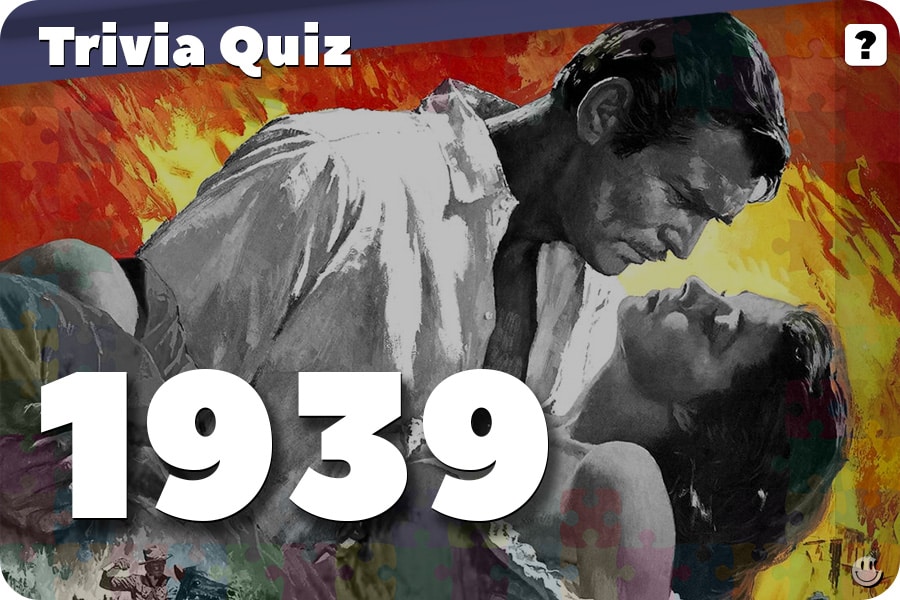
  • Pop Culture Trivia Quiz: What Happened In 1939?

    Pop Culture Trivia Quiz: What Happened In 1939?

    Pop Culture Trivia Quiz: What Happened In 1939?

    39 Trivia Questions for 1939 History

    (answers)

    1. What was the highest-grossing film of 1939?

    2. What museum and Hall of Fame opened in 1939?

    3. In 1939, what was the average life expectancy in the United States?

    4. Created by Bob Kane with Bill Finger, what costumed adventurer made his first appearance in the spring of 1939?

    5. Where did Batman make his first appearance?

    6. Starring Basil Rathbone, Boris Karloff, and Bela Lugosi, what was the third Frankenstein film

    7. What was the Biggest Number One Song of 1939?

    8. How much did a Loaf of Bread cost in 1939?

    9. 1939 Catchphrase: Who said, “Frankly, my dear, I don’t give a damn”?

    10. Directed by Frank Capra, this political comedy/drama featured Jimmy Stwart as Jefferson Smith and everyman selected to serve as a United States senator…

    11. Based on a book written in 1900, this 1939 film has become the most-watched film in movie history…

    12. Who won the Stanley Cup in 1939?

    13. How many people lived in the United States in 1939?

    14. Anticipating possible war with Germany, what famous museum packed and transported its art treasures to secret locations for safekeeping?

    15. This 1939 John Ford film gave John Wayne his breakout role…

    16. This film series went on two 14 films, all starring Basil Rathbone as the title character..

    17. This comic book featured the first appearances of the characters Sub-Mariner and the Human Torch. What was it?

    18. Who was the President of the United States in 1939?

    19. What celebrity was NOT born in April 1939: Ali McGraw, Marvin Gaye, Tammy Wynette, Francis Ford Coppola, or Paul Sorvino?

    20. What was the Bestselling Fiction Book in 1939?

    21. On June 6, 1939, Williamsport, Pennsylvania featured the debut of what activity for children?

    22. On August 26, 1939, the first televised Major League baseball game between the Cincinnati Reds and the Brooklyn Dodgers was broadcast on station W2XBS. What city was it broadcast from?

    23. Who won the 1939 World Series?

    24. What popular woman’s elastic apparel went on sale, becoming an instant affordable hit?

    25. Who were the MGM cartoon studio’s most successful (with 163 cartoon shorts) animated characters?

    26. What American event featured the motto “The World of Tomorrow”?

    27. What first-time event was held in conjunction with New York’s World’s Fair, featuring attendees like Isaac Asimov, Ray Bradbury, Jack Williamson, and Forrest J. Ackerman?

    28. How much did a gallon of gas cost in 1939?

    29. On July 2, 1939, the fourth presidential head was dedicated at Mount Rushmore. Which president was it?

    30. What was the Glen Miller Band’s biggest number-one hit?

    31. What was the title of Billie Holiday’s song protesting the lynchings of Black Americans?

    32. Adjusting for inflation, what is the biggest-grossing film ever?

    33. In March of 1939, Students at Harvard University introduced what ingestion fad?

    34. After missing for 18 months, what famous aviator was officially declared dead?
    Amelia Earhart

    35. With millions of readers, This popular Hollywood gossip columnist also had a radio show that ran alternatively on CBS, NBC, and ABC through 1951.

    36. Who were the teams that competed during the first NFL televised game?

    37. Who was the Time Magazine Man of the Year in 1939?

    38. Focusing on the Joad family, what John Steinbeck Pulitzer Prize-winning novel about Oklahoma’s Dust Bowl was released?

    39. On May 2, 1939, what baseball great retired with a (then) record 2,130 games-played streak?

    Trivia Team Bonus Questions:

    1. What was New York Yankee player Lou Gehrig’s nickname?

    2. What Horse won the Kentucky Derby in 1939?

    3. Who was the MGM cartoon studio’s first successful (with 26 cartoon shorts) animated character?

    4. Al Capone was transferred from San Fransico’s Alcatraz Federal Prison to what Los Angeles Federal Prison?

    5. Who was the Pope in 1939?

    6. Featured in the film Love Affair, what was Glen Miller’s first number-one hit?

    7. Who were the 1939 NFL Champions?

    8. What was Adolf Hitler’s ‘Plan Z’?

    9. Who was the American Vice-President in 1939?

    10. What is amyotrophic lateral sclerosis, also known as?

    The Answers:

    39 Trivia Answers for 1939 History

    1. What was the highest-grossing film of 1939?
    Gone With The Wind

    2. What museum and Hall of Fame opened in 1939?
    The National Baseball Hall of Fame and Museum

    3. In 1939, what was the average life expectancy in the United States?
    Men – 62.1 years, Women – 65.4 years.

    4. Created by Bob Kane with Bill Finger, what costumed adventurer made his first appearance in the spring of 1939?
    Batman

    5. Where did Batman make his first appearance?
    Detective Comics #27 (comic book)

    6. Starring Basil Rathbone, Boris Karloff, and Bela Lugosi, what was the third Frankenstein film?
    Son of Frankenstein

    7. What was the Biggest Number One Song of 1939?
    Deep Purple by Larry Clinton

    8. How much did a Loaf of Bread cost in 1939?
    8 cents

    9. 1939 Catchphrase: Who said, “Frankly, my dear, I don’t give a damn”?
    Rhett Butler on Gone with the Wind

    10. Directed by Frank Capra, this political comedy/drama featured Jimmy Stwart as Jefferson Smith, and everyman selected to serve as a United States senator…
    Mr. Smith Goes to Washington

    11. Based on a book written in 1900, this 1939 film has become the most-watched film in movie history…
    The Wizard of Oz

    12. Who won the Stanley Cup in 1939?
    In 1939, The Boston Bruins won over the Toronto Maple Leafs (4 games to 1)

    13. How many people lived in the United States in 1939?
    The population was an estimated 130,879,718 people.

    14. Anticipating possible war with Germany, what famous museum packed and transported its art treasures to secret locations for safekeeping?
    The Louvre, in Paris, France

    15. This 1939 John Ford film gave John Wayne his breakout role…
    Stagecoach

    16. This film series went on two 14 films, all starring Basil Rathbone as the title character…
    (The Adventures of) Sherlock Holmes

    17. This comic book featured the first appearances of the characters Sub-Mariner and the Human Torch. What was it?
    Marvel Comics #1. (cover date October 1939)

    18. Who was the President of the United States in 1939?
    Franklin D. Roosevelt (March 4, 1933 – April 12, 1945)

    19. What celebrity was NOT born in April 1939: Ali McGraw, Marvin Gaye, Tammy Wynette, Francis Ford Coppola or Paul Sorvino?
    Tammy Wynette (born May 5, 1942 – April 6, 1998)

    20. What was the Bestselling Fiction Book in 1939?
    The Grapes of Wrath by John Steinbeck

    21. On June 6, 1939, Williamsport, Pennsylvania featured the debut of what activity for children?
    Little League Baseball

    22. On August 26, 1939, the first televised Major League baseball game between the Cincinnati Reds and the Brooklyn Dodgers was broadcast on station W2XBS. What city was it broadcast from?
    New York (Ebbets Field). W2XBS later became WNBC-TV.

    23. Who won the 1939 World Series?
    In 1939, The New York Yankees won, beating the Cincinnati Reds (4 games to 0)

    24. What popular woman’s elastic apparel went on sale, becoming an instant affordable hit?
    Nylon stockings

    25. Who were the MGM cartoon studio’s most successful (with 163 cartoon shorts) animated characters?
    Tom and Jerry

    26. What American event featured the motto “The World of Tomorrow”?
    The 1939-40 New York World’s Fair

    27. What first-time event was held in conjunction with New York’s World’s Fair, featuring attendees like Isaac Asimov, Ray Bradbury, Jack Williamson, and Forrest J. Ackerman?
    The First World Science Fiction Convention

    28. How much did a gallon of gas cost in 1939?
    $0.19 per gallon

    29. On July 2, 1939, the fourth presidential head was dedicated at Mount Rushmore. Which president was it?
    Theodore ‘Teddy’ Roosevelt

    30. What was the Glen Miller Band’s biggest number-one hit?
    In The Mood (12 weeks at number one)

    31. What was the title of Billie Holiday’s song protesting the lynchings of Black Americans?
    Strange Fruit

    32. Adjusting for inflation, what is the biggest-grossing film ever?
    Gone With the Wind

    33. In March of 1939, Students at Harvard University introduced what ingestion fad?
    Swallowing goldfish

    34. After missing for 18 months, what famous aviator was officially declared dead?
    Amelia Earhart

    35. This popular Hollywood gossip columnist, with millions of readers, also had a radio show that ran alternatively on CBS, NBC, and ABC through 1951.
    Hedda Hopper

    36. Who were the teams that competed during the first NFL televised game?
    The Brooklyn Dodgers defeated the Philadelphia Eagles 23-14 at Ebbets Field.

    37. Who was the Time Magazine Man of the Year in 1939?
    Joseph Stalin

    38. Focusing on the Joad family, what John Steinbeck Pulitzer Prize-winning novel about Oklahoma’s Dust Bowl was released?
    The Grapes of Wrath

    39. On May 2, 1939, what baseball great retired with a (then) record 2,130 games-played streak?
    Lou Gehrig

    Trivia Team Bonus Questions:

    1. What was New York Yankee player Lou Gehrig’s nickname?
    The Iron Horse

    2. What Horse won the Kentucky Derby in 1939?
    Johnstown

    3. Who was the MGM cartoon studio’s first successful (with 26 cartoon shorts) animated character?
    Barney Bear

    4. Al Capone was transferred from San Fransico’s Alcatraz Federal Prison to what Los Angeles Federal Prison?
    Terminal Island Federal Prison

    5. Who was the Pope in 1939?
    Pope Pius XI, February 6, 1922 – February 10, 1939, and Pope Pius XII, March 2, 1939 – October 9, 1958

    6. Featured in the film Love Affair, what was Glen Miller’s first number-one hit?
    Wishing (Will Make It So)

    7. Who were the 1939 NFL Champions?
    Green Bay Packers

    8. What was Adolf Hitler’s ‘Plan Z’?
    He planned to build a German Navy that could overpower the United Kingdom’s Royal Navy within a few years.

    9. Who was the American Vice-President in 1939?
    John Garner (March 4, 1933 – January 20, 1941)

    10. What is amyotrophic lateral sclerosis, also known as?
    ALS, or motor neuron disease (MND), or Lou Gehrig’s disease
     

  • 1940 Oscars 12th Academy Awards

    1940 Oscars 12th Academy Awards

    1940 Oscars 12th Academy Awards

    • The 12th Academy Awards were held on February 29, 1940, at the Cocoanut Grove in the Ambassador Hotel in Los Angeles.
    • This year’s Oscars were hosted by the iconic comedian Bob Hope.
    • Films released in the eligibility year of 1939 were the show’s stars.

    Significant Moments:

    • Gone with the Wind dominated the awards, scooping up eight Oscars, including Best Picture.
    • Gone with the Wind earned 13 nominations.
    • The Wizard of Oz had six nominations, winning 2.
    • Hattie McDaniel became the first African-American to receive an Academy Award, for her performance in Gone With The Wind.
    • Gone with the Wind is an American epic historical romance film, adapted from Margaret Mitchell’s 1936 novel of the same name.
    • Mr. Smith Goes To Washington had 11 nominations, winning one.
    • The role of Scarlett O’Hara earned Vivien Leigh a Best Actress Oscar.
    • Hattie McDaniel won Best Supporting Actress for her role in the same film, making history as the first African American to win an Oscar.

    A Bit of Trivia:

    1. Gone with the Wind was the first color film to win Best Picture.
    2. Judy Garland received a Juvenile Award for her role in The Wizard of Oz, a not-so-regular category designed to honor younger performers.
    3. Bob Hope was hosting for the first time but would go on to host the Oscars a record 19 times.
    4. Take our 1940 Quiz!

    1940 Oscar Nominees and Winners

    Outstanding Production:
    Gone With the Wind – David O. Selznick for Selznick International and Metro-Goldwyn-Mayer (WINNER)
    Dark Victory – David Lewis for Warner Bros.
    Goodbye, Mr. Chips – Victor Saville for Metro-Goldwyn-Mayer
    Love Affair – Leo McCarey for RKO Radio
    Mr. Smith Goes to Washington – Frank Capra for Columbia
    Ninotchka – Sidney Franklin for Metro-Goldwyn-Mayer
    Of Mice and Men – Lewis Milestone for Hal Roach Prod. and United Artists
    Stagecoach – Walter Wanger for United Artists
    The Wizard of Oz – Mervyn LeRoy for Metro-Goldwyn-Mayer
    Wuthering Heights – Samuel Goldwyn for Samuel Goldwyn Productions and United Artists
    Best Director:
    Victor Fleming – Gone With the Wind (WINNER)
    Sam Wood – Goodbye, Mr. Chips
    Frank Capra – Mr. Smith Goes to Washington
    John Ford – Stagecoach
    William Wyler – Wuthering Heights
    Best Actor:
    Robert Donat – Goodbye, Mr. Chips as Mr Chips (WINNER)
    Clark Gable – Gone With the Wind as Rhett Butler
    Laurence Olivier – Wuthering Heights as Heathcliff
    Mickey Rooney – Babes in Arms as Mickey Moran
    James Stewart – Mr. Smith Goes to Washington as Jefferson “Jeff” Smith
    Best Actress:
    Vivien Leigh – Gone With the Wind as Scarlett O’Hara (WINNER)
    Bette Davis – Dark Victory as Judith Traherne
    Irene Dunne – Love Affair as Terry McKay
    Greta Garbo – Ninotchka as Nina Ivanovna ‘Ninotchka’ Yakushova
    Greer Garson – Goodbye, Mr. Chips as Katherine
    Best Supporting Actor:
    Thomas Mitchell – Stagecoach as Doc Boone (WINNER)
    Brian Aherne – Juarez as Maximilian I of Mexico
    Harry Carey – Mr. Smith Goes to Washington as President of the Senate
    Brian Donlevy – Beau Geste as Sergeant Markoff
    Claude Rains – Mr. Smith Goes to Washington as Senator Joseph Harrison “Joe” Paine
    Best Supporting Actress:
    Hattie McDaniel – Gone With the Wind as Mammy (WINNER)
    Olivia de Havilland – Gone with the Wind as Melanie Hamilton
    Geraldine Fitzgerald – Wuthering Heights as Isabella Linton
    Edna May Oliver – Drums Along the Mohawk as Mrs McKlennar
    Maria Ouspenskaya – Love Affair as Grandmother Janou
    Best Story:
    Mr. Smith Goes to Washington – Lewis R. Foster (WINNER)
    Bachelor Mother – Felix Jackson
    Love Affair – Mildred Cram and Leo McCarey
    Ninotchka – Melchior Lengyel
    Young Mr. Lincoln – Lamar Trotti
    Best Screenplay:
    Gone With the Wind – Sidney Howard (posthumous award), based on the novel by Margaret Mitchell (WINNER)
    Goodbye, Mr. Chips – Eric Maschwitz, R. C. Sherriff and Claudine West, based on the novel by James Hilton
    Mr. Smith Goes to Washington – Sidney Buchman, based on a story by Lewis R. Foster
    Ninotchka – Charles Brackett, Walter Reisch, and Billy Wilder, based on a story by Melchior Lengyel
    Wuthering Heights – Ben Hecht and Charles MacArthur, based on the novel by Emily Brontë
    Best Live Action Short Film, One-Reel:
    Busy Little Bears – Paramount Pictures (WINNER)
    Information Please – RKO Radio
    Prophet Without Honor – MGM
    Sword Fishing – Warner Bros.
    Best Live Action Short Film, Two-Reel:
    Sons of Liberty – Warner Bros. (WINNER)
    Drunk Driving – MGM
    Five Times Five – RKO Radio
    Best Animated Short Film:
    The Ugly Duckling – Walt Disney Productions and RKO Radio (WINNER)
    Detouring America – Warner Bros.
    Peace on Earth – MGM
    The Pointer – Walt Disney Productions and RKO Radio
    Best Score:
    Stagecoach – Richard Hageman, W. Franke Harling, John Leipold and Leo Shuken (WINNER)
    Babes in Arms – Roger Edens and Georgie Stoll
    First Love – Charles Previn
    The Great Victor Herbert – Phil Boutelje and Arthur Lange
    The Hunchback of Notre Dame – Alfred Newman
    Intermezzo – Lou Forbes
    Mr. Smith Goes to Washington – Dimitri Tiomkin
    Of Mice and Men – Aaron Copland
    The Private Lives of Elizabeth and Essex – Erich Wolfgang Korngold
    She Married a Cop – Cy Feuer
    Swanee River – Louis Silvers
    They Shall Have Music – Alfred Newman
    Way Down South – Victor Young
    Best Original Score:
    The Wizard of Oz – Herbert Stothart (WINNER)
    Dark Victory – Max Steiner
    Eternally Yours – Werner Janssen
    Golden Boy – Victor Young
    Gone With the Wind – Max Steiner
    Gulliver’s Travels – Victor Young
    The Man in the Iron Mask – Lud Gluskin and Lucien Moraweck
    Man of Conquest – Victor Young
    Nurse Edith Cavell – Anthony Collins
    Of Mice and Men – Aaron Copland
    The Rains Came – Alfred Newman
    Wuthering Heights – Alfred Newman
    Best Song:
    “Over the Rainbow” from The Wizard of Oz – Music by Harold Arlen; Lyrics by Yip Harburg (WINNER)
    “Faithful Forever” from Gulliver’s Travels – Music by Ralph Rainger; Lyrics by Leo Robin
    “I Poured My Heart Into a Song” from Second Fiddle – Music and Lyrics by Irving Berlin
    “Wishing” from Love Affair – Music and Lyrics by Buddy DeSylva
    Best Sound Recording:
    When Tomorrow Comes – Bernard B. Brown (WINNER)
    Balalaika – Douglas Shearer
    Gone With the Wind – Thomas T. Moulton
    Goodbye, Mr. Chips – A. W. Watkins
    The Great Victor Herbert – Loren L. Ryder
    The Hunchback of Notre Dame – John O. Aalberg
    Man of Conquest – Charles L. Lootens
    Mr. Smith Goes to Washington – John P. Livadary
    Of Mice and Men – Elmer Raguse
    The Private Lives of Elizabeth and Essex – Nathan Levinson
    The Rains Came – Edmund H. Hansen
    Best Art Direction:
    Gone With the Wind – Lyle R. Wheeler (WINNER)
    Beau Geste – Hans Dreier and Robert Odell
    Captain Fury – Charles D. Hall
    First Love – Jack Otterson and Martin Obzina
    Love Affair – Van Nest Polglase and Alfred Herman
    Man of Conquest – John Victor Mackay
    Mr. Smith Goes to Washington – Lionel Banks
    The Private Lives of Elizabeth and Essex – Anton Grot
    The Rains Came – William S. Darling and George Dudley
    Stagecoach – Alexander Toluboff
    The Wizard of Oz – Cedric Gibbons and William A. Horning
    Wuthering Heights – James Basevi
    Best Cinematography, Black and White:
    Wuthering Heights – Gregg Toland (WINNER)
    First Love – Joseph Valentine
    The Great Victor Herbert – Victor Milner
    Gunga Din – Joseph H. August
    Juarez – Tony Gaudio
    Intermezzo – Gregg Toland
    Lady of the Tropics – Norbert Brodine
    Of Mice and Men – George J. Folsey
    Only Angels Have Wings – Joseph Walker
    The Rains Came – Arthur Charles Miller
    Stagecoach – Bert Glennon
    Best Cinematography, Color:
    Gone With the Wind – Ernest Haller and Ray Rennahan (WINNER)
    Drums Along the Mohawk – Ray Rennahan and Bert Glennon
    The Four Feathers – Georges Périnal and Osmond Borradaile
    The Mikado – William V. Skall and Bernard Knowles
    The Private Lives of Elizabeth and Essex – Sol Polito and W. Howard Greene
    The Wizard of Oz – Hal Rosson
    Best Film Editing:
    Gone With the Wind – Hal C. Kern and James E. Newcom (WINNER)
    Goodbye, Mr. Chips – Charles Frend
    Mr. Smith Goes to Washington – Gene Havlick and Al Clark
    The Rains Came – Barbara McLean
    Stagecoach – Otho Lovering and Dorothy Spencer
    Best Special Effects:
    The Rains Came – E. H. Hansen and Fred Sersen (WINNER)
    Gone With the Wind – John R. Cosgrove, Fred Albin and Arthur Johns
    Only Angels Have Wings – Roy Davidson and Edwin C. Hahn
    The Private Lives of Elizabeth and Essex – Byron Haskin and Nathan Levinson
    Topper Takes a Trip – Roy Seawright
    Union Pacific – Farciot Edouart, Gordon Jennings and Loren L. Ryder
    The Wizard of Oz – A. Arnold Gillespie and Douglas Shearer
    Academy Honorary Awards

    Douglas Fairbanks “recognizing the unique and outstanding contribution of Douglas Fairbanks, first President of the Academy, to the international development of the motion picture.”

    Motion Picture Relief Fund “acknowledging the outstanding services to the industry during the past year of the Motion Picture Relief Fund and its progressive leadership.” Presented to Jean Hersholt, President; Ralph Morgan, Chairman of the Executive Committee; Ralph Block, First Vice-President; and Conrad Nagel.

    William Cameron Menzies “for outstanding achievement in the use of color for the enhancement of dramatic mood in the production of Gone with the Wind.”

    The Technicolor Company “for its contributions in successfully bringing three-color feature production to the screen.”

    Irving G. Thalberg Memorial Award:
    The Irving G. Thalberg Memorial Award was presented to David O. Selznick.
    Academy Juvenile Award:
    The Academy Juvenile Award was presented to Judy Garland for The Wizard of Oz.
    Oscar® and Academy Awards® and Oscar® design mark are the trademarks and service marks and the Oscar© statuette the copyrighted property, of the Academy of Motion Picture Arts and Sciences. Pop Culture Madness is neither endorsed by nor affiliated with the Academy of Motion Picture Arts and Sciences.
  • 1939 Trivia, History and Fun Facts

    1939 Trivia, History and Fun Facts

    1939 History, Facts and Trivia

    Quick Facts from 1939:

    • A World-Changing Event: General Motors introduced the Hydra-Matic drive, the first mass-produced, fully automatic transmission, as an option in 1940 model year Oldsmobile automobiles.
    • Another World-Changing Event: Batman, created by Bob Kane with Bill Finger, made his first appearance in Detective Comics #27 (May cover date)
    • Influential Songs include Over The Rainbow by Judy Garland and God Bless America by Kate Smith.
    • The Movies to Watch include The Wizard of Oz, Gone with the Wind, Son of Frankenstein, Gunga Din, Mister Smith Goes to Washington, Destry Rides Again, and Stagecoach.
    • The Most Famous Person in America was probably Lou Gehrig.
    • Notable books include And Then There Were None by Agatha Christie and The Grapes of Wrath by John Steinbeck.
    • Minimum Wage in 1939: 30 cents/hour
    • Amelia Earhart was officially declared dead after her 1937 disappearance.
    • Hedda Hopper’s Hollywood debuted on the radio with gossip columnist Hedda Hopper as host.
    • The 1939 New York World’s Fair opened on April 30th.
    • The Conversion: In 1939, Thanksgiving was moved to give merchants a more extended period to sell goods before Christmas to increase profits and spending.

    Top Ten Baby Names of 1939

    Mary, Barbara, Patricia, Betty, Shirley, Robert, James, John, William, Richard

    US Life Expectancy

    (1939) Males: 62.1 years, Females: 65.4 years

    The Stars

    Ingrid Bergman, Claudette Colbert, Olivia de Havilland, Betty Grable, Rita Hayworth, Katharine Hepburn, Hedy Lamarr, Vivien Leigh, Myrna Loy, Brenda Marshall, Ginger Rogers, Barbara Stanwyck, Lana Turner

    Entertainment History The Oscars

    The 11th Academy Awards unfolded on February 23, 1939, at the Biltmore Hotel in Los Angeles. For this ceremony, the host was none other than Frank Capra. The evening’s big winner was You Can’t Take It with You, directed by Capra, which bagged the Best Picture award. Spencer Tracy took home the Best Actor statuette for his role in Boys Town, making it his second win. Meanwhile, Bette Davis claimed Best Actress for her performance in Jezebel. This was the first time the Best Picture nominee pool was limited to 10 films, a rule that lasted until 1943. The film eligibility year was from January 1, 1938, to December 31, 1938. To spice it up with a trivia fact: Walt Disney received an Honorary Award this year for Snow White and the Seven Dwarfs, recognized as a “significant screen innovation” that “pioneered a new form of entertainment.”

    Miss America

    Patricia Donnelly (Detroit, Michigan)

    Time Magazine’s Man of the Year

    Joseph Stalin

    Firsts, Inventions, and Wonders

    The first Thin Mint cookies were baked by the Girl Scouts in 1939.

    Founded by Carl Stotz, the first Little League Baseball game was played in Williamsport, Pennsylvania.

    In the 1939 film The Women, no men or even male animals or portraits appear on-screen. The only visibly male creatures are a drawing of a bull and an advertisement.

    The Westinghouse Time Capsules are two time capsules prepared by the Westinghouse Electric & Manufacturing Company: “Time Capsule I” was created for the 1939 New York World’s Fair, and “Time Capsule II” was created for the 1964 New York World’s Fair. Both are buried 50 feet below Flushing Meadows–Corona Park, the site of both world’s fairs; the 1965 capsule was placed ten feet north of the 1939 capsule. The capsules will be opened simultaneously in 6939, five thousand years after the first capsule was sealed.

    Winston Churchill coined “a riddle wrapped in a mystery inside an enigma” during his The Russian Enigma broadcast.

    The Wizard of Oz, based on L. Frank Baum’s novel, starring Judy Garland as Dorothy, premiered at Grauman’s Chinese Theatre in Hollywood. In the original story, Dorothy wore silver slippers to protect her from the Wicked Witch of the West, but this was changed to Ruby Slippers in the film to take advantage of the new Technicolor process.

    The National Baseball Hall of Fame and Museum was officially dedicated in Cooperstown, New York.

    Ernest Vincent wrote the book Gadsby, which contains over 50,000 words, all without the letter ‘e.’

    The Quote

    David Sarnoff, the president of RCA, declared television would allow “Americans (to) attain the highest general cultural level of any people in the history of the world.”

    Pop Culture Facts & History

    Playing Card Game Canasta was created by Segundo Santos and Alberto Serrato in Montevideo, Uruguay, in 1939. It spread to the US by the late 1940s.

    In 1939, the New York Times predicted that television would fail because the average American family would not have enough time to sit around watching it.

    The Magna Carta was on display at the 1939 World’s Fair in New York, but WWII had broken out, and the Magna Carta was moved to Fort Knox for safekeeping until the end of the war.

    The Cowardly Lion costume from The Wizard of Oz was made from the skin and fur of a real lion.

    Franklin D. Roosevelt moved Thanksgiving from the last week in November to the 4th week in November to boost retail sales during the Great Depression.

    Penicillin, discovered in 1925, was tested on humans, curing many diseases, including tuberculosis and gonorrhea. It was the first proper antibiotic.

    The First World Science Fiction Convention (Worldcon) was held in the Caravan Hall in New York from July 2 to July 4, 1939.

    The American Humane Association is in charge of stating that “no animals were harmed during the making of this film.” They became involved in films because of the 1939’s Jesse James, which included a blindfolded horse forced to jump off a 70-foot cliff.

    NBC broadcast its first black-and-white television images. Only approximately 1,000 homes had television sets in the New York area.

    The current world record holder for the world’s oldest dog was Bluey, who lived from 1910 to 1939 and died at the age of 29 years and five months.

    Bob Feller pitched a game against the White Sox on Mother’s Day, 1939, with his family in attendance. One of his pitches was fouled off into the seats, into his mother’s face right above the right eye, resulting in her needing seven stitches. Feller went on to win the game.

    Futurama is named after a 1939 World’s Fair exhibit that showed what they thought the world would be like in 1959.

    The Los Angeles Times got the Oscar winner’s names before the official presentations. That’s why Price Waterhouse gained control of holding the winner’s names, although they had been tabulating the votes since 1935.

    On March 3, 1939, Harvard freshman Lothrop Withington, Jr, became the first goldfish swallower, winning a $10.00 bet. Other, less adventurous people, were reading John Steinbeck’s Grapes of Wrath or watching Gone With The Wind in movie theaters.

    The release of Gone With the Wind on December 15th was so big that the mayor of Atlanta declared a 3-day festival that concluded with a state holiday on the day of release.

    AT&T made a working answering machine in 1939 but suppressed it, thinking public fear of being recorded would lead to widespread abandonment of the telephone.

    Lina Medina, a 5-year-old Peruvian girl, gave birth to a baby boy, becoming the youngest confirmed mother in medical history.

    In 1939, 20,000 people (Americans) attended a Nazi rally at Madison Square Garden.

    Nobel Prize Winners

    Physics – Ernest Lawrence
    Chemistry – Adolf Friedrich Johann Butenandt, Leopold Ružicka
    Physiology or Medicine – Gerhard Domagk
    Literature – Frans Eemil Sillanpää
    Peace – not awarded

    Broadway Show

    Life With Father (Play) Opened on November 8, 1939, and closed on July 12, 1947

    Popular and Best-selling Books From 1939

    And Then There Were None by Agatha Christie
    All This, and Heaven Too by Rachel Field
    Disputed Passage by Lloyd C. Douglas
    Escape by Ethel Vance
    Johnny Got His Gun by Dalton Trumbo
    Kitty Foyle by Christopher Morley
    The Nazarene by Sholem Asch
    Old Possum’s Book of Practical Cats by T.S. Eliot
    The Grapes of Wrath by John Steinbeck
    Rebecca by Daphne du Maurier
    The Tree of Liberty by Elizabeth Page
    Wickford Point by John P. Marquand
    The Yearling by Marjorie Kinnan Rawlings

    Sports

    World Series Champions: New York Yankees
    NFL Champs: Green Bay Packers
    Stanley Cup Champs: Boston Bruins
    U.S. Open Golf: Byron Nelson
    U.S. Tennis (Men/Ladies): Bobby Riggs/Alice Marble
    Wimbledon (Men/Women): Bobby Riggs
    NCAA Football Champions: Texas A&M
    NCAA Basketball Champions: Oregon
    Kentucky Derby Winner: Johnstown
    Boston Marathon Winner: Ellison Brown Time: 2:28:51

    More 1939 Facts & History Resources:

    Most Popular Baby Names (BabyCenter.com)
    Popular and Notable Books (popculture.us)
    Broadway Shows that Opened in 1939
    1939 Calendar, courtesy of Time and Date.com
    Fact Monster
    The Great Depression EconLib
    1930s, Infoplease.com World History
    1939 in Movies (according to IMDB)
    Retrowaste Vintage Culture
    1930s Slang
    Wikipedia 1939
    WW II Timeline (Historic UK)


  • 1939 Music: Popular Music, Songs and Artists

    1939 Music: Popular Music, Songs and Artists

    1939 Popular Music, Songs and Artists

    Glenn Miller
    Little Brown Jug
    1869 would mark the public publishing of this song that would remain part of American culture. The song is a drinking song and though it waned popularity for a while it regained its stature during the era of the 1920s and prohibition. Glenn Miller and his orchestra would produce a swing version of the tune and it would become a standard of the Big Band Era.

    Andrews Sisters
    Beer Barrel Polka
    This song, also known as Roll Out The Barrel, was written in 1927 by a Czech musician named Jaromir Vejvoda. As originally written it was played without lyrics. The song became popular with soldiers during World War II, but it’s origins as well as lyrics and translations came much earlier. Many artists and bands would record the song. The Wiggles made a recording of it for their album and video Sailing Around The World. If you grew up in Philadelphia you would be exposed to song fairly early as it was a staple for yearly Mummers Parade.

    Judy Garland
    Over The Rainbow
    What can be said about Over The Rainbow that has not already been written? The song was created by Harold Arlen with lyrics by E.Y. Harburg for one of the most famous movies of the 20th Century, The Wizard of OZ. The song is sung by the character of Dorothy Gale played by Judy Garland as she yearns for someplace there would not be any trouble. Before the film’s release, the song was threatened to be cut, but wiser heads prevailed. The song would have had quite a different history and impact if it had starred Shirley Temple as MGM would have preferred. Temple’s little girl sweetness and attitudes would probably not have the same impact as Garlands’ more mature voice.

    The song would have very few recordings made by other artists before Barbra Streisand would use the song in her 1986 One Voice Concert that was performed on September the 6th at her Malibu home for 5000.00 dollars a ticket. Miss Streisand would pay homage to Garland before singing the song. Mr. Shue played by Mathew Morrison would sing the song in the first season finale of Glee.

    Kate Smith
    God Bless America
    Written by Irving Berlin, legend has it that Kate Smith called Berlin and asked him to give her something new for her radio program. Mr. Berlin searched through his back files and pulled out God Bless America. Kate Smith would perform the song to almost immediate popularity. The song would long be associated with Miss Smith and at the end of her life while she lived in Philadelphia she sang the song regularly at The Philadelphia Flyers home games. Philadelphia honored Miss Smith by erecting a statue of her outside The Flyers Home Stadium. Many people feel that this song would make a better national anthem that Star-Spangled Banner.

    Kay Kyser
    Three Little Fishies
    Three little Fishies is best described as a novelty song, like Shaving Cream or They’re Coming To Take Me Away. Only Three Little Fishies was is on the verge of cute and sweet and fun. Sung by Kay Kyser, with words and music by Saxie Dowell. The song would become a number one hit in 1939. But it would live on as children in the 1930s would sing this song to their children into the 1960s.

    Mary Martin
    My Heart Belongs to Daddy

    Written by Cole Porter for the musical Leave It To Me, this song would introduce the world to Miss Mary Martin. In the musical Miss Martin played the mistress of a newspaper publisher and the ‘Daddy” she is referring to is her lover. The song is also done a striptease, though, risqué, still tame by today’s standards. Gene Kelly would also make one of his early appearances in the show. Miss Martin would go on to become one of the queens of Broadway, sharing the crown with the great Ethel Merman.

    Miss Martin originated the role of Nellie Forbush in Rodger’s and Hammerstein’s South Pacific in which she starred alongside Enzio Pinza. This would be the first time a Broadway star and an Opera Star would share the spotlight together. She went on to again work with the musical team when she originated the role of Maria in The Sound Of Music. She also starred in a musical version of Peter Pan which still appears on Broadway from time to time. Miss Martin is the mother of Larry Hagman the Co-star of I Dream of Jeannie and Dallas. Mary Martin would title her autobiography My Heart Belongs.

    Solomon Linda and the Evening Birds
    The Lion Sleeps Tonight
    This song actually has two other titles Wimoweh and Mbube. The song was written in the 1920s by Solomon Linda of the Zulu tribe in Africa and first recorded there. The song would make its way across the Atlantic to become a hit in 1939. In 1961, the song would become a number one hit when recorded by The Tokens and is still played on radio stations today. Walt Disney Studios would use the Lion Sleeps Tonight in it’s animated classic The Lion King.

    Louis Armstrong
    When The Saints Go Marching In
    If Jazz and New Orleans had a theme song When The Saints Go Marching In would be it. The origin of the song is unknown, but it began as a hymn and usually used as part of the funeral profession. While the casket was being taken to the cemetery the song would be played as a dirge or as a slow march. On the return from the cemetery the song would go upbeat and would signify Jesus Christ’s Triumph over death. The New Orleans Football Team The Saints is named after this song.

    Top Artists and Songs of 1939

    Andrews Sisters
    Beer Barrel Polka
    Hold Tight Hold Tight (Want Some Seafood Mama)
    We’ll All Right (Tonight’s the Night)
    Art Tatum
    Tea For Two
    Artie Shaw
    I Poured My Heart Into A Song
    Thanks For Everything
    They Say
    Billie Holiday
    Strange Fruit
    Bing Crosby and Connee Boswell
    An Apple For Teacher
    Bing Crosby
    What’s New?
    Bob Hope & Shirley Ross
    Two Sleep People
Bob Crosby and his Orchestra
Day-In Day-Out
Carmen Miranda and Dorival Caymmi
O Que & Que a Baiana Tem?
Charlie Barnet
Cherokee
Chick Henderson
Begin the Beguine
Count Basie
Lester Leaps In
Cripple Clarence Lofton
I Don’t Know
Dick Jurgens and his Orchestra
Careless
Fats Waller
Your Feets Too Big
Frankie Masters and his Orchestra
Scatter-Brain
Gene Autry
Back in the Saddle Again
South of the Border (Down Mexico Way)
Glen Gray
Heaven Can Wait
Glenn Miller
Blue Orchid
Forever Faithful
Little Brown Jug
Man With the Mandolin
Moon Love
Moonlight Serenade
Over the Rainbow
Stairway to the Stars
Sunrise Serenade
Wishing (Will Make It So)
Guy Lombardo
Penny Serenade
South of the Border (Down Mexico Way)
Judy Garland
Over The Rainbow
The Jitterbug
Kate Smith
God Bless America
Kay Kyser
Three Little Fishes
Larry Clinton
Deep Purple
Louis Armstrong
When the Saints Go Marching In
Martha Tilton
And the Angels Sing
Mary Martin
My Heart Belongs To Daddy
Red Norvo and his Orchestra
Says My Heart
Sammy Kaye
Penny Serenade
Shep Fields and His Rippling Rhythm Orchestra
South of the Border (Down Mexico Way)
Solomon Linda and the Evening Birds
The Lion Sleeps Tonight
The Ink Spots
Address Unknown
If I Didn’t Care
My Prayer
Tommy Dorsey
Indian Summer
Our Love
Tony Martin
South of the Border (Down Mexico Way)
Vera Lynn
We’ll Meet Again
Will Glahe and his Orchestra
Beer Barrel Polka
Woody Herman
At the Woodchopper’s Ball
  • James Joyce’s “Finnegans Wake” Published

    James Joyce’s “Finnegans Wake” Published

    James Joyce’s “Finnegans Wake”

    James Joyce’s “Finnegans Wake” is a complex, experimental novel that has fascinated and confounded readers since its publication in 1939. Known for its unique language, wordplay, and non-linear narrative, the book is considered one of the most challenging works of fiction in English. Despite its difficult reputation, “Finnegans Wake” has significantly influenced modern literature and popular culture.

    • “Finnegans Wake” was written over the course of 17 years, from 1922 to 1939
    • The novel was first published by the British publisher Faber and Faber and the American publisher Viking Press.
    • James Joyce, an Irish writer, is known for his other literary works, including “Dubliners,” “A Portrait of the Artist as a Young Man,” and “Ulysses”
    • The novel’s title references the Irish-American song “Finnegan’s Wake” and explores themes of dreams, the cyclical nature of history, and the Irish experience.
    • “Finnegans Wake” is famous for its inventive language, combining multiple languages, puns, neologisms, and wordplay.
    • The book’s narrative is fragmented and dream-like, with characters and events often difficult to discern
    • Some notable scholars and writers who have studied and analyzed “Finnegans Wake” include Samuel Beckett, Joseph Campbell, and Marshall McLuhan.
    • The novel has inspired numerous adaptations, including musical compositions, stage performances, and visual art pieces.
    • “Finnegans Wake” has also influenced contemporary writers, such as Salman Rushdie, David Foster Wallace, and Thomas Pynchon.

    The publication of James Joyce’s “Finnegans Wake” introduced an innovative and challenging work of literature that has left a lasting impact on the literary world and popular culture. The novel’s unique language and narrative structure continues to inspire and influence writers and artists today.

  • 1939 Oscars 11th Academy Awards

    1939 Oscars 11th Academy Awards

    1939 Oscars 11th Academy Awards

    • The 11th Academy Awards unfolded on February 23, 1939, hosted at the Biltmore Hotel in Los Angeles, California.
    • A distinctive feature of this year’s ceremony was the lack of a formal host.
    • Movies released in 1938 were eligible for these honors.

    Noteworthy Moments:

    • You Can’t Take It With You clinched the Best Picture award. Directed by Frank Capra, the film is a comedy about a wealthy man’s son who falls in love with a woman from a quirky family.
    • Spencer Tracy received his second Best Actor Oscar for his role in Boys Town.
    • You Can’t Take It With You earned 7 nominations.
    • This was the first ceremony in which a foreign language film (Grand Illusion) was nominated for Best Picture.
    • Bette Davis won the Best Actress award for her role in Jezebel, a drama about a wilful southern belle.
    • This ceremony reflected a growing maturity in the film industry, with increasingly complex narratives and character-driven stories taking center stage. The awards also signaled a move toward greater inclusivity, with a wider range of genres and themes gaining recognition.

    Trivia:

    1. Frank Capra, winning for Best Director, also served as the President of the Academy at the time.
    2. Jezebel was conceived as a consolation for Bette Davis after she lost the role of Scarlett O’Hara in Gone with the Wind.
    3. Walt Disney’s Ferdinand the Bull won for Best Animated Short, adding to Disney’s growing collection of Oscars.
    4. This year saw the introduction of the category for Best Special Effects, with the first winner being Spawn of the North.

    1939 Oscar Nominees and Winners

    Outstanding Production:
    You Can’t Take It with You – Frank Capra for Columbia (WINNER)
    The Adventures of Robin Hood – Hal B. Wallis and Henry Blanke for Warner Bros.
    Alexander’s Ragtime Band – Darryl F. Zanuck and Harry Joe Brown for 20th Century Fox
    Boys Town – John W. Considine, Jr. for Metro-Goldwyn-Mayer
    The Citadel – Victor Saville for Metro-Goldwyn-Mayer
    Four Daughters – Hal B. Wallis and Henry Blanke for Warner Bros. and First National
    Grand Illusion – Frank Rollmer and Albert Pinkovitch for R. A. C. and World Pictures
    Jezebel – Hal B. Wallis and Henry Blanke for Warner Bros.
    Pygmalion – Gabriel Pascal for Pascal Film Productions
    Test Pilot – Louis D. Lighton for Metro-Goldwyn-Mayer
    Best Director:
    Frank Capra – You Can’t Take It with You (WINNER)
    Michael Curtiz – Angels with Dirty Faces
    Norman Taurog – Boys Town
    King Vidor – The Citadel
    Michael Curtiz – Four Daughters
    Best Actor:
    Spencer Tracy – Boys Town as Father Flanagan (WINNER)
    Charles Boyer – Algiers as Pepe le Moko
    James Cagney – Angels with Dirty Faces as William “Rocky” Sullivan
    Robert Donat – The Citadel as Dr. Andrew Manson
    Leslie Howard – Pygmalion as Professor Henry Higgins
    Best Actress:
    Bette Davis – Jezebel as Julie Marsden (WINNER)
    Fay Bainter – White Banners as Hannah Parmalee
    Wendy Hiller – Pygmalion as Eliza Doolittle
    Norma Shearer – Marie Antoinette as Marie Antoinette
    Margaret Sullavan – Three Comrades as Patricia Hollmann
    Best Supporting Actor:
    Walter Brennan – Kentucky as Peter Goodwin (WINNER)
    John Garfield – Four Daughters as Mickey Borden
    Gene Lockhart – Algiers as Regis
    Robert Morley – Marie Antoinette as King Louis XVI
    Basil Rathbone – If I Were King as King Louis XI
    Best Supporting Actress:
    Fay Bainter – Jezebel as Aunt Belle Massey (WINNER)
    Beulah Bondi – Of Human Hearts as Mary Wilkins
    Billie Burke – Merrily We Live as Emily Kilbourne
    Spring Byington – You Can’t Take It with You as Penelope “Penny” Sycamore
    Miliza Korjus – The Great Waltz as Carla Donner
    Best Original Story:
    Boys Town – Eleanore Griffin and Dore Schary (WINNER)
    Alexander’s Ragtime Band – Irving Berlin
    Angels with Dirty Faces – Rowland Brown
    Blockade – John Howard Lawson
    Mad About Music – Marcella Burke and Frederick Kohner
    Test Pilot – Frank Wead
    Best Screenplay:
    Pygmalion – George Bernard Shaw, Ian Dalrymple, Cecil Lewis, and W. P. Lipscomb, based on the play by Shaw (WINNER)
    Boys Town – John Meehan and Dore Schary, based on a story by Schary and Eleanore Griffin
    The Citadel – Ian Dalrymple, Elizabeth Hill and Frank Wead, based on the novel by A. J. Cronin
    Four Daughters – Lenore Coffee and Julius J. Epstein, based on the short story “Sister Act” by Fannie Hurst
    You Can’t Take It with You – Robert Riskin, based on the play by George S. Kaufman and Moss Hart
    Best Live Action Short Subject, One-Reel:
    That Mothers Might Live – MGM (WINNER)
    The Great Heart – MGM
    Timber Toppers – 20th Century Fox
    Best Live Action Short Subject, Two-Reel:
    Declaration of Independence – Warner Bros. (WINNER)
    Swingtime in the Movies – Warner Bros.
    They’re Always Caught – MGM
    Best Short Subject, Cartoon:
    Ferdinand the Bull – Walt Disney Productions and RKO Radio (WINNER)
    Brave Little Tailor – Walt Disney Productions and RKO Radio
    Good Scouts – Walt Disney Productions and RKO Radio
    Hunky and Spunky – Paramount
    Mother Goose Goes Hollywood – Walt Disney Productions and RKO Radio
    Best Original Score:
    The Adventures of Robin Hood – Erich Wolfgang Korngold (WINNER)
    Army Girl – Victor Young
    Block-Heads – Marvin Hatley
    Blockade – Werner Janssen
    Breaking the Ice – Victor Young
    The Cowboy and the Lady – Alfred Newman
    If I Were King – Richard Hageman
    Marie Antoinette – Herbert Stothart
    Pacific Liner – Russell Bennett
    Suez – Louis Silvers
    The Young in Heart – Franz Waxman
    Best Scoring:
    Alexander’s Ragtime Band – Alfred Newman (WINNER)
    Carefree – Victor Baravalle
    Girls’ School – Morris Stoloff and Gregory Stone
    The Goldwyn Follies – Alfred Newman
    Jezebel – Max Steiner
    Mad About Music – Charles Previn and Frank Skinner
    Storm Over Bengal – Cy Feuer
    Sweethearts – Herbert Stothart
    There Goes My Heart – Marvin Hatley
    Tropic Holiday – Boris Morros
    The Young in Heart – Franz Waxman
    Best Song:
    “Thanks for the Memory” from The Big Broadcast of 1938 – Music by Ralph Rainger; Lyrics by Leo Robin (WINNER)
    “Always and Always” from Mannequin – Music by Edward Ward; Lyrics by Chet Forrest and Bob Wright
    “Change Partners” from Carefree – Music and Lyrics by Irving Berlin
    “The Cowboy and the Lady” from The Cowboy and the Lady – Music by Lionel Newman; Lyrics by Arthur Quenzer
    “Dust” from Under Western Stars – Music and Lyrics by Johnny Marvin
    “Jeepers Creepers” from Going Places – Music by Harry Warren; Lyrics by Johnny Mercer
    “Merrily We Live” from Merrily We Live – Music by Phil Charig; Lyrics by Arthur Quenzer
    “A Mist Over the Moon” from The Lady Objects – Music by Ben Oakland; Lyrics by Oscar Hammerstein II
    “My Own” from That Certain Age – Music by Jimmy McHugh; Lyrics by Harold Adamson
    “Now It Can Be Told” from Alexander’s Ragtime Band – Music and Lyrics by Irving Berlin
    Best Sound Recording:
    The Cowboy and the Lady – Thomas T. Moulton (WINNER)
    Army Girl – Charles L. Lootens
    Four Daughters – Nathan Levinson
    If I Were King – Loren L. Ryder
    Merrily We Live – Elmer Raguse
    Suez – Edmund H. Hansen
    Sweethearts – Douglas Shearer
    That Certain Age – Bernard B. Brown
    Vivacious Lady – John O. Aalberg
    You Can’t Take It with You – John P. Livadary
    Best Art Direction:
    The Adventures of Robin Hood – Carl Jules Weyl (WINNER)
    The Adventures of Tom Sawyer – Lyle R. Wheeler
    Alexander’s Ragtime Band – Bernard Herzbrun and Boris Leven
    Algiers – Alexander Toluboff
    Carefree – Van Nest Polglase
    The Goldwyn Follies – Richard Day
    Holiday – Stephen Goosson and Lionel Banks
    If I Were King – Hans Dreier and John B. Goodman
    Mad About Music – Jack Otterson
    Marie Antoinette – Cedric Gibbons
    Merrily We Live – Charles D. Hall
    Best Cinematography:
    The Great Waltz – Joseph Ruttenberg (WINNER)
    Algiers – James Wong Howe
    Army Girl – Ernest Miller and Harry J. Wild
    The Buccaneer – Victor Milner
    Jezebel – Ernest Haller
    Mad About Music – Joseph Valentine
    Merrily We Live – Norbert Brodine
    Suez – Peverell Marley
    Vivacious Lady – Robert De Grasse
    You Can’t Take It with You – Joseph Walker
    The Young in Heart – Leon Shamroy
    Best Film Editing:
    The Adventures of Robin Hood – Ralph Dawson (WINNER)
    Alexander’s Ragtime Band – Barbara McLean
    The Great Waltz – Tom Held
    Test Pilot – Tom Held
    You Can’t Take It with You – Gene Havlick

    Academy Honorary Awards:
    J. Arthur Ball “for his outstanding contributions to the advancement of color in Motion Picture Photography.” (Scroll)

    Walt Disney “for creating Snow White and the Seven Dwarfs , recognized as a significant screen innovation which has charmed millions and pioneered a great new entertainment field for the motion picture cartoon.” (The prize was one full sized statuette and seven miniature statuettes, representing the Seven Dwarfs.)

    Gordon Jennings, Jan Domela, Dev Jennings, Irmin Roberts, Art Smith, Farciot Edouart, Loyal Griggs, Loren L. Ryder, Harry D. Mills, Louis H. Mesenkop, and Walter Oberst “for outstanding achievement in creating Special Photographic and Sound Effects in the Paramount production, Spawn of the North.” (Plaque)

    Oliver Marsh and Allen Davey “for the color cinematography of the Metro-Goldwyn-Mayer production, Sweethearts.” (Plaque)

    Harry M. Warner “in recognition of patriotic service in the production of historical short subjects presenting significant episodes in the early struggle of the American people for liberty.” (Scroll)

    Oscar® and Academy Awards® and Oscar® design mark are the trademarks and service marks and the Oscar© statuette the copyrighted property, of the Academy of Motion Picture Arts and Sciences. Pop Culture Madness is neither endorsed by nor affiliated with the Academy of Motion Picture Arts and Sciences.