1. Who was the first African-American to win an Academy Award (Best Supporting Actress)
2. This man hosted the 1940 Oscars and went on to host it 19 times. Who was he?
3. What is the name of the 1940 American comedy-western film featuring Mae West and W.C. Fields
4. What was the highest-grossing film of 1940
5. How much did a Loaf of Bread cost in 1940?
6. How much did a Gallon of Milk cost in 1940?
7. What was the Bestselling Fiction Book in 1940
8. What was the Biggest Number One Song of 1940?
9. Who was the Republican Presidential Nominee in 1940?
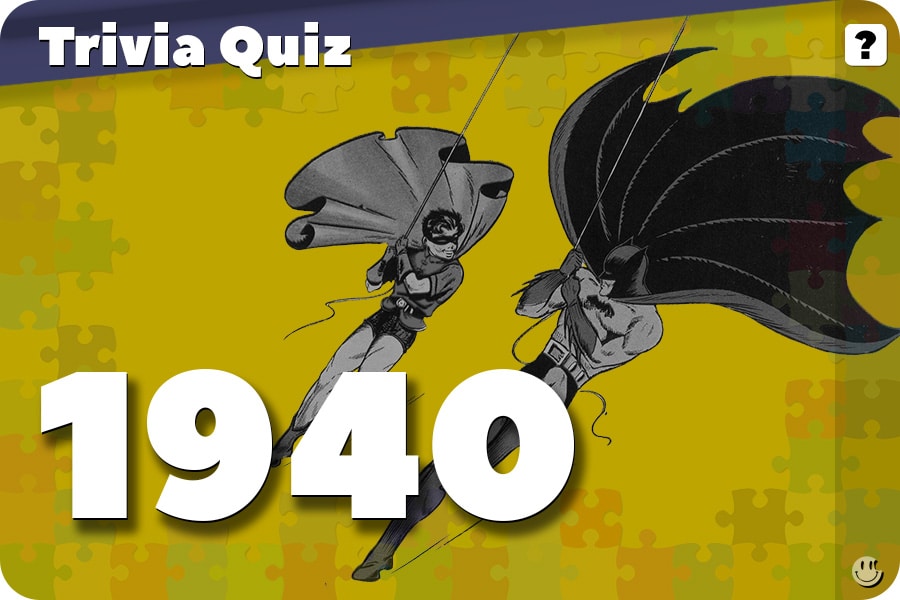
10. This masked hero sidekick debuted in April 1940…
11. This comic book villain debuted in the fourth issue of this Superhero comic book, and he has the same initials as her girlfriend. Name that villain.
12. She made her American film debut in Down Argentine Way and was known for wearing hats made of fruit. Who was she?
13. Which celebrity was NOT born in 1940: Julian Bond, Jack Nicklaus, Richard Pryor, Danny Trejo, or Al Pacino?
14. Who won the Stanley Cup in 1940?
15. Name the best-selling female fiction author of all time.
16. Released in late 1939, what was Agatha Christie’s best-selling book
17. How many people lived in the United States in 1940?
18. How many people lived in the World in 1940?
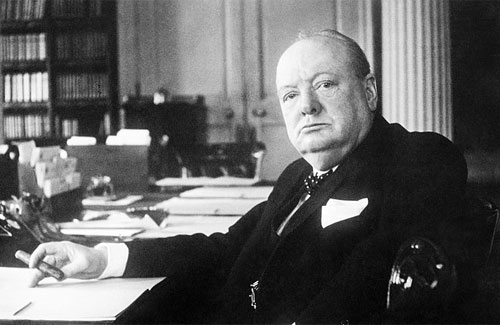
19. On May 10, 1940, Winston Churchill became the United Kingdom’s Prime Minister. Who held the position before Mr. Churchill?
20. Who was the President of the United States in 1940?
21. What comedy group filmed the first Hollywood parody of Adolf Hitler and the Nazis?
The Three Stooges (in You Nazty Spy!)
22. Nine months later, Charlie Chaplin also wrote, directed, and starred in his parody of Nazi Germany. Name that film
23. This comic book character was seen punching Adolph Hitler in the face on the cover of his first issue before the United States entered World War 2
24. Two brothers, Richard and Maurice, opened this fast food in San Bernadino, California, in 1940…
25. What World War II event occurred between 26 May and 4 June 1940?
26. What annual South Dakota Rally began in 1940?
27. Bing Crosby, Bob Hope, and Dorothy Lamour starred in 7 “Road To…” films. Name the first one
28. How much did a dozen eggs cost in 1940?
29. In 1940, what was the average life expectancy in the United States?
30. What is the United States’ first long-distance controlled-access highway?
31. What cartoon duo made their debut in Puss Gets the Boot?
32. The spring of 1940 introduced American women to this type of hosiery…
33. This 1940 gameshow debuted on NBC radio but was periodically shown on television from 1950 through 1988..
34. How much did a gallon of gas cost in 1940?
35. Who was the Time Magazine Man of the Year in 1940?
36. Who won the 1940 World Series?
37. Now considered a classic, this Disney Film took a decade to become profitable.
38. This 1940 Disney film won the Academy Awards for Best Original Song and Best Original Score…
39. Who made Pinocchio a ‘real boy’?
40. Before Bugs Bunny was officially named, this hat-wearing cohort was named first. Name that toon.
Trivia Team Bonus Questions:
1. What was Elmer Fudd’s prior nickname for several cartoons from 1937 through 1940?
2. Who was the Pope in 1940?
3. This cartoon bird debuted in 1940’s Knock Knock, but wasn’t named until 1941. Who is he?
4. Who were the 1940 NFL Champions?
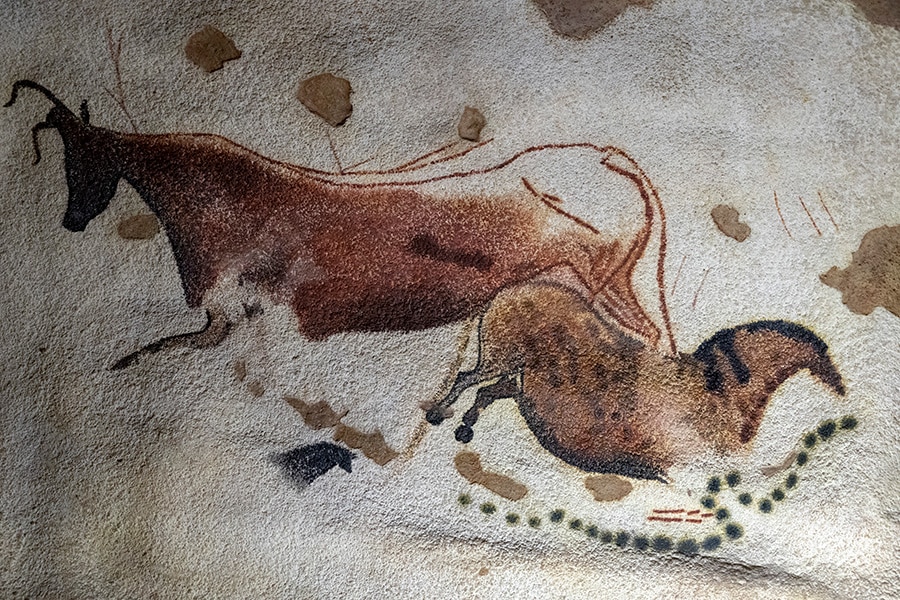
5. In Lascaux, France, some 17,000-year-old evidence of human handiwork was found. What were they?
6. Who was the American Vice-President in 1940?
7. A time capsule at Oglethorpe University, Georgia, was sealed shut and projected to open in 8113 CE. What was it named?
8. Who said, “I have nothing to offer you but blood, toil, tears, and sweat.”?
9. What Horse won the Kentucky Derby in 1940?
10. The cartoon duo Tom and Jerry debuted with other names; what were their original names?
The Answers:
40 Trivia Answers for 1940 History
1. Who was the first African-American to win an Academy Award (Best Supporting Actress)
Hattie McDaniel, for Gone With The Wind.
2. This man hosted the 1940 Oscars and went on to host it 19 times. Who was he?
Bob Hope
3. What is the name of the 1940 American comedy-western film featuring Mae West and W.C. Fields? My Little Chickadee
4. What was the highest-grossing film of 1940? Boom Town
5. How much did a Loaf of Bread cost in 1940?
8 cents
6. How much did a Gallon of Milk cost in 1940?
51 cents
7. What was the Bestselling Fiction Book in 1940? How Green Was My Valley by Richard Llewellyn
8. What was the Biggest Number One Song of 1940?
(tie) Frenesi by Artie Shaw, OR In The Mood by Glenn Miller, OR I’ll Never Smile Again by Tommy Dorsey
9. Who was the Republican Presidential Nominee in 1940?
Wendell Willkie
10. This masked hero sidekick debuted in April 1940…
Robin the Boy Wonder, in Detective Comics #38.
11. This comic book villain debuted in the fourth issue of this Superhero comic book, and he has the same initials as her girlfriend. Name that villain.
Lex Luthor (1st appearance in Superman #4)
12. She made her American film debut in Down Argentine Way and was known for wearing hats made of fruit. Who was she?
Carmen Miranda (February 9, 1909 – August 5, 1955)
13. Which celebrity was NOT born in 1940: Julian Bond, Jack Nicklaus, Richard Pryor, Danny Trejo, or Al Pacino?
Danny Trejo (born May 16, 1944)
14. Who won the Stanley Cup in 1940?
In 1940, The New York Rangers won over the Toronto Maple Leafs (4 games to 2)
15. Name the best-selling female fiction author of all time.
Agatha Christie
16. Released in late 1939, what was Agatha Christie’s best-selling book? And Then There Were None
17. How many people lived in the United States in 1940?
The population was an estimated 131,669,275 people.
18. How many people lived in the World in 1940?
The estimated world population in 1940 was 2,300,000,000 people.
19. On May 10, 1940, Winston Churchill became the United Kingdom’s Prime Minister. Who held the position before Mr. Churchill?
Neville Chamberlain
20. Who was the President of the United States in 1940?
Franklin D. Roosevelt (March 4, 1933 – April 12, 1945)
21. What comedy group filmed the first Hollywood parody of Adolf Hitler and the Nazis?
The Three Stooges (in You Nazty Spy!)
22. Nine months later, Charlie Chaplin also wrote, directed and starred in his parody of Nazi Germany. Name that film. The Great Dictator
23. This comic book character was seen punching Adolph Hitler in the face on the cover of his first issue before the United States entered World War 2. Captain America
24. Two brothers, Richard and Maurice, opened this fast food in San Bernadino, California in 1940…
McDonald’s. Ray Kroc bought it from them in 1955.
25. What World War II event occurred between 26 May and 4 June 1940?
The Dunkirk Evacuation (code-named Operation Dynamo, aka the Miracle of Dunkirk)
26. What annual South Dakota Rally began in 1940?
Sturgis Motorcycle Rally
27. Bing Crosby, Bob Hope, and Dorothy Lamour starred in 7 “Road To…” films. Name the first one. Road to Singapore
28. How much did a dozen eggs cost in 1940?
33 cents
29. In 1940, what was the average life expectancy in the United States?
Men – 60.8 years, Women – 65.2 years.
30. What is the United States’ first long-distance controlled-access highway?
The Pennsylvania Turnpike
31. What cartoon duo made their debut in Puss Gets the Boot?
Tom & Jerry (although not officially named until 1941).
32. The spring of 1940 introduced American women to this type of hosiery…
Nylon stockings
33. This 1940 gameshow debuted on NBC radio but was periodically shown on television from 1950 through 1988… Truth or Consequences
34. How much did a gallon of gas cost in 1940?
$0.18 per gallon
35. Who was the Time Magazine Man of the Year in 1940?
Winston Churchill
36. Who won the 1940 World Series?
In 1940, The Cincinnati Reds won, beating the Detroit Tigers (4 games to 3)
37. Now considered a classic, this Disney Film took a decade to become profitable. Fantasia
38. This 1940 Disney film won the Academy Awards for Best Original Song and Best Original Score… Pinocchio
39. Who made Pinocchio a ‘real boy’?
The Blue Fairy (aka Fairy with Turquoise Hair)
40. Before Bugs Bunny was officially named, this hat-wearing cohort was named first. Name that toon.
Elmer Fudd
Trivia Team Bonus Questions:
1. What was Elmer Fudd’s prior nickname for several cartoons from 1937 through 1940?
Egghead
2. Who was the Pope in 1940?
Pope Pius XII, March 2, 1939 – October 9, 1958
3. This cartoon bird debuted in 1940’s Knock Knock, but wasn’t named until 1941. Who is he?
Woody Woodpecker
4. Who were the 1940 NFL Champions?
Chicago Bears
5. In Lascaux, France, some 17,000-year-old evidence of human handiwork was found. What were they?
The Lascaux cave paintings
6. Who was the American Vice-President in 1940?
John Garner (March 4, 1933 – January 20, 1941)
7. A time capsule at Oglethorpe University, Georgia, was sealed shut and projected to open in 8113 CE. What was it named?
The Crypt of Civilization
8. Who said, “I have nothing to offer you but blood, toil, tears, and sweat.”?
Winston Churchill
9. What Horse won the Kentucky Derby in 1940?
Gallahadion
10. The cartoon duo Tom and Jerry debuted with other names; what were their original names?
Jasper and Jinx
Gentleman’s Agreement nabbed the Best Picture award, a film that tackled the issue of anti-Semitism in America.
Ronald Colman won Best Actor for A Double Life, and Loretta Young scored Best Actress for The Farmer’s Daughter.
Directing & Screenplay:
Elia Kazan was awarded Best Director for Gentleman’s Agreement, while George Seaton took home Best Screenplay for Miracle on 34th Street.
Additional Info:
Celeste Holm snagged Best Supporting Actress for her role in Gentleman’s Agreement.
Edmund Gwenn as Kris Kringle in Miracle on 34th Street charmed his way to a Best Supporting Actor Oscar.
This was the first year the Oscars were televised locally in Los Angeles, a precursor to the global telecasts we have today.
The “Jean Hersholt Humanitarian Award” was introduced this year, named after the Danish actor and humanitarian.
Black Narcissus had Jack Cardiff win for Best Cinematography, a category usually dominated by American cinematographers.
No film received more than three awards at the 20th Academy Awards.
James Baskett received an Academy Honorary Award for his portrayal of Uncle Remus in Song of the South, which made him the first African-American man and the first Walt Disney star to win an Academy Award for acting
1948 Oscar Nominees and Winners
Best Motion Picture:
Gentleman’s Agreement – Darryl F. Zanuck for 20th Century Fox (WINNER)
The Bishop’s Wife – Samuel Goldwyn for RKO Radio Pictures
Crossfire – Adrian Scott for RKO Radio Pictures
Great Expectations – Ronald Neame for Universal Studios and General Film Distributors, Ltd.
Miracle on 34th Street – William Perlberg for 20th Century Fox – Miracle on 34th Street
Best Director:
Elia Kazan – Gentleman’s Agreement (WINNER)
Henry Koster – The Bishop’s Wife
Edward Dmytryk – Crossfire
George Cukor – A Double Life
David Lean – Great Expectations
Best Actor:
Ronald Colman – A Double Life as Anthony John (WINNER)
John Garfield – Body and Soul as Charlie Davis
Gregory Peck – Gentleman’s Agreement as Philip Schuyler Green
William Powell – Life with Father as Clarence Day, Sr.
Michael Redgrave – Mourning Becomes Electra as Orin Mannon
Best Actress:
Loretta Young – The Farmer’s Daughter as Katie Holstrom (WINNER)
Joan Crawford – Possessed as Louise Howell
Susan Hayward – Smash-Up, the Story of a Woman as Angie Evans
Dorothy McGuire – Gentleman’s Agreement as Kathy Lacey
Rosalind Russell – Mourning Becomes Electra as Lavinia Mannon
Best Supporting Actor:
Edmund Gwenn – Miracle on 34th Street as Kris Kringle (WINNER)
Charles Bickford – The Farmer’s Daughter as Joseph Clancy
Thomas Gomez – Ride the Pink Horse as Pancho
Robert Ryan – Crossfire as Montgomery
Richard Widmark – Kiss of Death as Tommy Udo
Best Supporting Actress:
Celeste Holm – Gentleman’s Agreement as Anne Dettrey (WINNER)
Ethel Barrymore – The Paradine Case as Lady Sophie Horfield
Gloria Grahame – Crossfire as Ginny Tremaine
Marjorie Main – The Egg and I as Ma Kettle
Anne Revere – Gentleman’s Agreement as Mrs Green
Best Original Screenplay:
The Bachelor and the Bobby-Soxer – Sidney Sheldon (WINNER)
Body and Soul – Abraham Polonsky
A Double Life – Ruth Gordon and Garson Kanin
Monsieur Verdoux – Charlie Chaplin
Shoeshine – Sergio Amidei, Adolfo Franci, Cesare Giulio Viola and Cesare Zavattini
Best Screenplay:
Miracle on 34th Street – George Seaton from a story by Valentine Davies (WINNER)
Boomerang! – Richard Murphy from a Reader’s Digest article by Anthony Abbot
Crossfire – John Paxton from The Brick Foxhole by Richard Brooks
Gentleman’s Agreement – Moss Hart from Gentleman’s Agreement by Laura Z. Hobson
Great Expectations – David Lean, Ronald Neame and Anthony Havelock-Allan from Great Expectations by Charles Dickens
Best Motion Picture Story:
Miracle on 34th Street – Valentine Davies (WINNER)
A Cage of Nightingales – Georges Chaperot and René Wheeler
It Happened on Fifth Avenue – Herbert Clyde Lewis and Frederick Stephani
Kiss of Death – Eleazar Lipsky
Smash-Up, the Story of a Woman – Dorothy Parker and Frank Cavett
Best Short Subject – Cartoons:
Tweetie Pie – Edward Selzer (WINNER)
Chip an’ Dale – Walt Disney
Dr. Jekyll and Mr. Mouse – Fred Quimby
Pluto’s Blue Note – Walt Disney
Tubby the Tuba – George Pal
Best Documentary Feature:
Design for Death (WINNER)
Journey into Medicine
The World Is Rich
Best Documentary Short Subject:
First Steps (WINNER)
Passport to Nowhere
School in the Mailbox
Best Live Action Short Subject, One-Reel:
Goodbye, Miss Turlock – Herbert Moulton (WINNER)
Brooklyn, U.S.A. – Thomas Mead
Moon Rockets – Jerry Fairbanks
Now You See It – Pete Smith
So You Want to Be in Pictures – Gordon Hollingshead
Best Live Action Short Subject, Two-Reel:
Climbing the Matterhorn – Irving Allen (WINNER)
Champagne for Two – Harry Grey
Fight of the Wild Stallions – Thomas Mead
Give Us the Earth – Herbert Morgan
A Voice Is Born: The Story of Niklos Gafni – Ben Blake
Best Scoring of a Dramatic or Comedy Picture:
A Double Life – Miklós Rózsa (WINNER)
The Bishop’s Wife – Hugo Friedhofer
Captain from Castile – Alfred Newman
Forever Amber – David Raksin
Life with Father – Max Steiner
Best Scoring of a Musical Picture:
Mother Wore Tights – Alfred Newman (WINNER)
Fiesta – Johnny Green
My Wild Irish Rose – Ray Heindorf and Max Steiner
Road to Rio – Robert Emmett Dolan
Song of the South – Daniele Amfitheatrof, Paul J. Smith and Charles Wolcott
Best Original Song:
“Zip-a-Dee-Doo-Dah” from Song of the South – Music by Allie Wrubel; Lyrics by Ray Gilbert (WINNER)
“A Gal in Calico” from The Time, the Place and the Girl – Music by Arthur Schwartz; Lyrics by Leo Robin
“I Wish I Didn’t Love You So” from The Perils of Pauline – Music and Lyrics by Frank Loesser
“Pass That Peace Pipe” from Good News – Music and Lyrics by Ralph Blane, Hugh Martin and Roger Edens
“You Do” from Mother Wore Tights – Music by Josef Myrow; Lyrics by Mack Gordon
Best Sound Recording:
The Bishop’s Wife – Gordon E. Sawyer (WINNER)
Green Dolphin Street – Douglas Shearer
T-Men – Jack Whitney
Best Art Direction – Set Decoration, Black-and-White:
Great Expectations – Art Direction: John Bryan; Set Decoration: Wilfred Shingleton (WINNER)
The Foxes of Harrow – Art Direction: Lyle R. Wheeler and Maurice Ransford; Set Decoration: Thomas Little and Paul S. Fox
Best Art Direction – Set Decoration, Color:
Black Narcissus – Art Direction and Set Decoration: Alfred Junge (WINNER)
Life with Father – Art Direction: Robert M. Haas; Set Decoration: George James Hopkins
Best Cinematography, Black-and-White:
Great Expectations – Guy Green (WINNER)
The Ghost and Mrs. Muir – Charles Lang
Green Dolphin Street – George J. Folsey
Best Cinematography, Color:
Black Narcissus – Jack Cardiff (WINNER)
Life with Father – Peverell Marley and William V. Skall
Mother Wore Tights – Harry Jackson
Best Film Editing:
Body and Soul – Francis D. Lyon and Robert Parrish (WINNER)
The Bishop’s Wife – Monica Collingwood
Gentleman’s Agreement – Harmon Jones
Green Dolphin Street – George White
Odd Man Out – Fergus McDonell
Best Special Effects:
Green Dolphin Street – A. Arnold Gillespie and Warren Newcombe; Special Audible Effects: Douglas Shearer and Michael Steinore (WINNER)
Unconquered – Farciot Edouart, Devereux Jennings, Gordon Jennings, Wallace Kelley and Paul Lerpae; Special Audible Effects: George Dutton
Academy Honorary Awards:
James Baskett “for his able and heart-warming characterization of Uncle Remus, friend and story teller to the children of the world in Walt Disney’s Song of the South.” Bill and Coo “in which artistry and patience blended in a novel and entertaining use of the medium of motion pictures.” Colonel William N. Selig, Albert E. Smith, Thomas Armat and George K. Spoor members of “the small group of pioneers whose belief in a new medium, and whose contributions to its development, blazed the trail along which the motion picture has progressed, in their lifetime, from obscurity to world-wide acclaim.”
May 13, 1940; House of Commons, London, EnglandMister Speaker, on Friday evening last I received His Majesty’s commission to form a new Administration. It was the evident wish and will of Parliament and the nation that this should be conceived on the broadest possible basis and that it should include all parties, both those who supported the late Government and also the parties of the Opposition. I have completed the most important part of this task. A War Cabinet has been formed of five Members, representing, with the Liberal Opposition, the unity of the nation. The three party Leaders have agreed to serve, either in the War Cabinet or in high executive office. The three Fighting Services have been filled. It was necessary that this should be done in one single day, on account of the extreme urgency and rigor of events. A number of other key positions were filled yesterday, and I am submitting a further list to His Majesty tonight. I hope to complete the appointment of the principal Ministers during tomorrow. The appointment of the other Ministers usually takes a little longer, but I trust that when Parliament meets again, this part of my task will be completed, and that the administration will be complete in all respects.
Sir, I considered it in the public interest to suggest that the House should be summoned to meet today. Mr. Speaker agreed, and took the necessary steps, in accordance with the powers conferred upon him by the Resolution of the House. At the end of the proceedings today, the Adjournment of the House will be proposed until Tuesday, the 21st of May, with, of course, provision for earlier meeting, if need be. The business to be considered during that week will be notified to Members at the earliest opportunity. I now invite the House, by the Resolution which stands in my name, to record its approval of the steps taken and to declare its confidence in the new Government.
Sir, to form an Administration of this scale and complexity is a serious undertaking in itself, but it must be remembered that we are in the preliminary stage of one of the greatest battles in history, that we are in action at many points in Norway and in Holland, that we have to be prepared in the Mediterranean, that the air battle is continuous and that many preparations have to be made here at home. In this crisis I hope I may be pardoned if I do not address the House at any length today. I hope that any of my friends and colleagues, or former colleagues, who are affected by the political reconstruction, will make all allowances for any lack of ceremony with which it has been necessary to act. I would say to the House, as I said to those who have joined the government: “I have nothing to offer but blood, toil, tears and sweat.”
We have before us an ordeal of the most grievous kind. We have before us many, many long months of struggle and of suffering. You ask, what is our policy? I will say: It is to wage war, by sea, land and air, with all our might and with all the strength that God can give us; to wage war against a monstrous tyranny, never surpassed in the dark and lamentable catalogue of human crime. That is our policy. You ask, what is our aim? I can answer in one word: victory; victory at all costs, victory in spite of all terror, victory, however long and hard the road may be; for without victory, there is no survival. Let that be realized; no survival for the British Empire, no survival for all that the British Empire has stood for, no survival for the urge and impulse of the ages, that mankind will move forward towards its goal. But I take up my task with buoyancy and hope. I feel sure that our cause will not be suffered to fail among men. At this time I feel entitled to claim the aid of all, and I say, “Come then, let us go forward together with our united strength.”
Miraculous Event: The British completed the Miracle of Dunkirk (between May 26 and June 4) by evacuating 338,226 allied troops from France via a flotilla of over private and 800 military vessels.
Influential Songs include When You Wish Upon A Star, Down Argentine Way, and Beat Me Daddy Eight To The Bar.
The Movies to Watch include The Great Dictator, Fantasia, The Philadelphia Story, The Grapes of Wrath, His Girl Friday, Gaslight, My Little Chickadee, and Pinocchio.
The Most Famous Person in America was probably Pablo Picasso.
Notable books include For Whom the Bell Tolls by Ernest Hemingway, Horton Hatches the Egg by Dr. Seuss, and Pat the Bunny by Dorothy Kunhardt.
A 40-hour working week was implemented by amending the Fair Labor Standards Act.
Price of a loaf of bread in 1940: 10 cents
The discovery of element 93 – Neptunium – was announced
The Funny Trio were Bob Hope, Bing Crosby, and Dorothy Lamour
Hattie McDaniel became the first African-American to win an Academy Award.
The Conversation: “Cheese!” People started saying cheese when smiling for the camera. In the earliest days of photography, they reputedly said “prunes” to keep from smiling.
US Life Expectancy: (1940) Males: 60.8 years, Females: 65.2 years Federal spending: $9.47 billion Federal debt $50.7 billion Consumer Price Index: $14 Unemployment: 14.6% A gallon of Gas: 11 cents Issue of Life Magazine: 10 cents Cost of a first-class stamp: $0.03
The Stars
Ingrid Bergman, Lilian Bond, Claudette Colbert, Olivia de Havilland, Betty Grable, Rita Hayworth, Katharine Hepburn, Hedy Lamarr, Vivien Leigh, Myrna Loy, Brenda Marshall, Ginger Rogers, Barbara Stanwyck, Gene Tierney, Lana Turner
Entertainment History: The Oscars
The 12th Academy Awards occurred on February 29, 1940, at the Coconut Grove at The Ambassador Hotel in Los Angeles. The ceremony had Bob Hope as the host, marking his first time hosting the Oscars. Gone with the Wind was the evening’s star, clinching an impressive eight awards, including Best Picture, Best Director for Victor Fleming, and Best Actress for Vivien Leigh. Hattie McDaniel made history by becoming the first African American to win an Oscar, claiming the Best Supporting Actress award for her role as Mammy in Gone with the Wind. The evening was also remarkable for The Wizard of Oz, which won two Oscars, including Best Original Song for Over the Rainbow. The eligibility year was from January 1, 1939, to December 31, 1939.
Miss America
Frances Burke (Philadelphia, PA)
Time Magazine’s Man of the Year
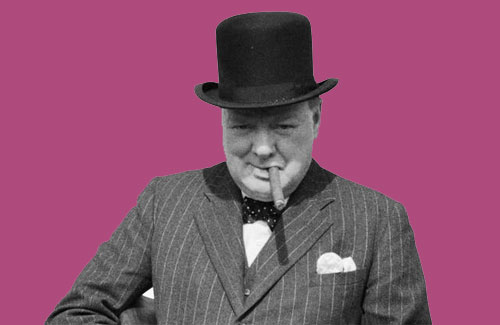
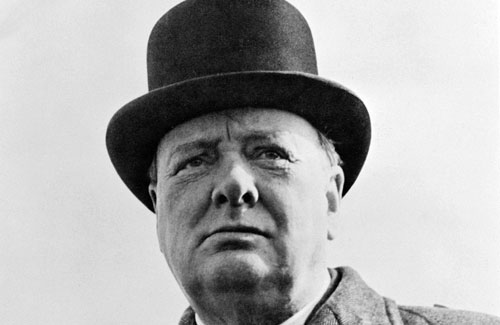
Winston Churchill
Firsts, Inventions, and Wonders
The Three Stooges short comedy film You Nazty Spy! was released. It was the first Hollywood parody of Adolf Hitler and the Nazis.
Pop Culture History
Robin, the Boy Wonder, debuted in Detective Comics #38. (April cover date)
The Superman radio show debuted.
The Pennsylvania Turnpike opened (First US Superhighway)
The Sturgis Motorcycle Rally was held for the first time in Sturgis, South Dakota.
Brenda Starr, the first newspaper comic strip by a woman, Dale Messick, appeared for the Chicago Tribune Syndicate.
First televised baseball game, WGN-TV (White Sox vs Cubs, an exhibition game)
May 15, 1940 – The first McDonald’s restaurant opened in San Bernardino, California.
Tom & Jerry cartoon shorts, created by William Hanna & Joseph Barbera, debuted by MGM in theaters.
People yell Geronimo! when jumping from things due to a private, Private Aubrey Eberhardt, who claimed he wasn’t scared while testing parachutes in 1940. He yelled the name when he jumped to prove this. The rest of the platoon did not want to be shown up, so they yelled it, and it quickly caught on.
Pop Culture Facts & History
Bugs Bunny was born in Brooklyn, New York; although a similar, unnamed rabbit was in several Warner Brothers cartoons in 1938 and 1939, his first actual appearance is considered A Wild Hare with long-time frenemy Elmer Fudd.
In 1940, scientists concluded that consumption of ice cream was the leading cause of the polio epidemic, solely based on the stats that there were more cases of polio in the summer, which was also when children ate the most ice cream.
The Lascaux prehistoric cave paintings were discovered in France.
W2XAB (now WCBS-TV) channel 2, premiered as the flagship station of the CBS television network, located in New York City.
The Great Smoky Mountains National Park was dedicated.
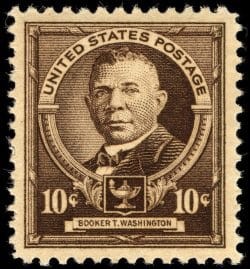
Booker T. Washington became the first African American to be depicted on a United States postage stamp.
The Philadelphia Story, directed by George Cukor, based on the Broadway play of the same name and starring Cary Grant and Katharine Hepburn, was released.
The ‘America First Committee’ was founded, and had nearly 1,000,000 members. The peace organization was designed to keep the U.S. from World War II. They disbanded on December 11, 1941.
Glenn Miller’s 1940 big band hit Pennsylvania 6-5000 is still a working telephone number (possibly the longest still in use) and calls the Hotel Pennsylvania across from Penn Station in NYC (212-736-5000). The Hotel Pennsylvania address is 401 7th Ave New York, NY 10001-3463.
Pachelbel’s Canon was written in the 1690s but forgotten. It survived in only two manuscripts, was first published in 1919, and first recorded in 1940.
When Vegemite was invented in 1922, it almost failed as a product. By 1940, it was so central to the Aussie diet that it became mandatory in their WWII military rations.
Frank Mars and Bruce Murrie manufactured candy-coated chocolate in six colors – red, green, yellow, brown, and violet. In 1949, violet was replaced by tan. M&Ms survived the red dye scare of 1976 and the rumored amourosity of the green ones.
London’s Richmond Golf Club didn’t stop playing when the Nazis were bombing them in 1940; they just adjusted their rules. “A player whose stroke is affected by the simultaneous explosion of a bomb may play another ball from the same place. Penalty one stroke.”
The Great Dictator released: a satire/ social commentary film by and starring Charlie Chaplin.
Chiune Sugihara was the Japanese consul general in Lithuania. Against tradition, and specific orders, he gave thousands of visas to nearly anyone who asked for them, and many did ask so that they could escape from the Nazi regime. He was fired, of course, and lost his entire career. Why? He later said, “They were human beings, and they needed help. I’m glad I found the strength to give it to them.”
Popular Quotes
“Now I’m going to tell you something I’ve kept to myself for years. None of you ever knew George Gipp. He was long before your time, but you all know what a tradition he is at Notre Dame. And the last thing he said to me, ‘Rock,’ he said, ‘sometime when the team is up against it, and the breaks are beating the boys, tell them to go out there with all they’ve got and win just one for the Gipper. I don’t know where I’ll be then, Rock,’ he said, ‘but I’ll know about it, and I’ll be happy’ ” – Pat O’Brien in Knute Rockne All-American
“We shall not flag or fail. We shall fight on the beaches… on the landing grounds… in the fields and the streets… We shall never surrender.” – Winston Churchill.
“I’ll be all around in the dark; I’ll be everywhere. Wherever you can look, wherever there’s a fight, so hungry people can eat, I’ll be there. Wherever there’s a cop beatin’ up a guy, I’ll be there. I’ll be there in the way guys yell when they’re mad. I’ll be there in the way kids laugh when they’re hungry, and they know supper’s ready, and when people are eatin’ the stuff they raise and livin’ in the houses they built – I’ll be there, too” – Henry Fonda, in The Grapes of Wrath.
Tragedy
The Rhythm Club fire at a dance hall in Natchez, Mississippi, killed 198 people.
Popular and Best-selling Books Popular in 1940
The Family by Nina Fedorova For Whom the Bell Tolls by Ernest Hemingway The Grapes of Wrath by John Steinbeck Horton Hatches the Egg by Dr. Seuss How Green Was My Valley by Richard Llewellyn Kitty Foyle by Christopher Morley Mrs. Miniver by Jan Struther The Nazarene by Sholem Asch Night in Bombay by Louis Bromfield Oliver Wiswell by Kenneth Roberts Pat the Bunny by Dorothy Kunhardt
Stars on the Sea by F. van Wyck Mason
Nobel Prize
Physics – not awarded
Chemistry – not awarded
Physiology or Medicine – not awarded
Literature – not awarded
Peace – not awarded
The Number One Hits of 1940
November 25, 1939 – January 26, 1940
Frankie Masters – Scatter-Brain
January 27, 1940 – February 9, 1940
Tommy Dorsey – All The Things You Are
February 3, 1940 – March 2, 1940
Glenn Miller – Careless (5 weeks*)
February 12, 1940 – May 3, 1940
Glenn Miller – In The Mood (12 weeks*)
February 24, 1940 – March 2, 1940
Tommy Dorsey – Indian Summer
March 16, 1940 – March 23, 1940
Benny Goodman – Darn That Dream
March 30, 1940 – May 3, 1940
Glenn Miller – When You Wish Upon A Star
May 4, 1940 – July 19, 1940
Glenn Miller – Tuxedo Junction (9 weeks*)
May 4, 1940 – June 28, 1940
Glenn Miller – The Woodpecker Song (7 weeks*)
June 22, 1940 – July 4, 1940
Glenn Miller – Imagination
July 10, 1940 – July 19, 1940
Artist – Song
(effective July 20, 1940, dates became (mostly) more consistent)
July 20, 1940 – July 26, 1940
Glenn Miller – Fools Rush In (Where Angels Fear To Tread)
July 27, 1940 – August 23, 1940
Tommy Dorsey – I’ll Never Smile Again
August 24, 1940 – September 6, 1940
Charlie Barnett – Where Was I?
September 7, 1940 – September 13, 1940
Jimmy Dorsey – The Breeze and I
September 14, 1940 – October 18, 1940
Bing Crosby – Sierra Sue
October 19, 1940 – November 22, 1940
Bing Crosby – Only Forever
November 23, 1940 – November 27, 1940
Glenn Miller – Blueberry Hill
November 28, 1940 – December 20, 1940
Andrews Sisters – Ferryboat Serenade*
November 28, 1940 – December 20, 1940
Bing Crosby – Trade Winds
December 21, 1940 – March 14, 1941
Artie Shaw and His Orchestra – Frenesi
1940 United States Census
Total US Population: 132,164,569
1. New York, New York – 7,457,995
2. Chicago, Illinois – 3,396,808
3. Philadelphia, Pennsylvania – 1,931,334
4. Detroit, Michigan – 1,623,452
5. Los Angeles, California – 1,504,277
6. Cleveland, Ohio – 878,336
7. Baltimore, Maryland – 859,100
8. St. Louis, Missouri – 816,048
9. Boston, Massachusetts – 770,816
10. Pittsburgh, Pennsylvania – 671,659
Sports
World Series Champions: Cincinnati Reds
NFL Champs: Chicago Bears
Stanley Cup Champs: New York Rangers
U.S. Open Golf: Lawson Little
U.S. Tennis (Men/Ladies): Donald McNeill/Alice Marble
Wimbledon (Men/Women): not held
NCAA Football Champions: Minnesota
Basketball Champions: Indiana
Kentucky Derby Winner: Gallahadion
Boston Marathon Winner: Gérard Côté Time: 2:28:28
“For Whom the Bell Tolls” by Ernest Hemingway Published
“For Whom the Bell Tolls” is a novel written by American author Ernest Hemingway. The novel is set during the Spanish Civil War (1936-1939) and tells the story of Robert Jordan, an American dynamite fighting with the International Brigades on the side of the Republican forces. The novel explores themes of love, death, and the nature of war and is considered one of Hemingway’s most significant works.
Details: Ernest Hemingway began writing “For Whom the Bell Tolls” in 1939, drawing on his experiences as a war correspondent during the Spanish Civil War. Charles Scribner’s Sons published The novel on October 21, 1940. The title of the novel is a reference to a line in John Donne’s poem “No Man Is an Island,” which states, “any man’s death diminishes me, because I am involved in mankind; and therefore never send to know for whom the bell tolls; it tolls for thee.”
The novel was met with critical acclaim and commercial success, solidifying Hemingway’s reputation as one of the leading writers of his time. It was also a finalist for the Pulitzer Prize in 1941.
Effects on Pop Culture:
“For Whom the Bell Tolls” has been adapted into various forms of media, most notably the 1943 film starring Gary Cooper and Ingrid Bergman, which received nine Academy Award nominations.
The novel has been referenced in numerous books, films, and television shows, showcasing its impact on popular culture and its continued relevance.
The novel’s title has been used as an idiom to signify a warning or a sense of impending doom.
The American heavy metal band Metallica released a song titled “For Whom the Bell Tolls” in 1984, inspired by Hemingway’s novel.
Prominent People and Countries Involved:
United States: Ernest Hemingway was an American author, and the novel was first published in the United States, where it gained significant popularity.
Ernest Hemingway: An American author and journalist, Hemingway is considered one of the most influential writers of the 20th century. “For Whom the Bell Tolls” is among his most important works, alongside novels like “The Sun Also Rises” and “A Farewell to Arms.”
In summary, “For Whom the Bell Tolls” is a critically acclaimed novel by American author Ernest Hemingway, published on October 21, 1940. Set during the Spanish Civil War, the novel explores love, death, and war themes, and is considered one of Hemingway’s most significant works. Its impact on popular culture can be seen through various adaptations, references, and idiomatic uses of its title, solidifying its place as a classic piece of literature.
Cliff Edwards When You Wish Upon A Star Pinocchio was Disney’s second full-length animated movie. Disney would add music to his storytelling using the formula he used in Snow White. When You Wish Upon a Star was written by Leigh Harline and Ned Washington and sung by Cliff Edwards, the voice of Jiminy Cricket in the film. The song was not part of the story but was sung over the credits at the film’s beginning. The film would have two more songs that would be remembered: Give A Little Whistle and An Actor Life For Me. When You Wish Upon A Star, however, would go on to be added to the list of The One Hundred Greatest Songs In Film History by The American Film Institute. The song would take its place at number seven. Walt Disney Studios would have three other songs on the list.
The Ink Spots When The Swallows Come Back From Capistrano
This song was written by Leon Rene and was recorded in May of 1940. The recording reached #4 on the charts, but the same year, Glenn Miller recorded the song, and his version would reach number two that same year. The song is a lover’s longing for the return of his or her beloved. The song was written in a tribute to the annual return of the swallow to Capistrano.
Jimmy Davis You Are My Sunshine
Many people are credited to have written You Are My Sunshine, so the truth of this popular standard may never be known. The writers that claim the credit are Oliver Hood, Jimmie Davis and Charles Mitchell are also credited with writing the song. History tells us that Davis bought the rights to the song from Paul Rice and put his name on it. This practice was not uncommon during the early days of music publishing. The song would go on to become the State Song Of Louisiana
Glenn Miller Fools Rush In
With music written by Rube Bloom and Lyrics by Johnny Mercer, this song would be recorded throughout the 20th century and into the 21st. Artists that recorded the song besides Glenn Miller include Frank Sinatra, Rick Nelson in 1963 where it would hit #12 on the charts. Elvis Presley made his recording in 1971 and in 2010 She and Him also recorded the standard.
Glenn Miller Pennsylvania 6 – 5000
PE 6 – 5000 is supposedly the oldest continuous phone number in New York City and is owned by The Hotel Pennsylvania. The story goes that many Big Bands played at The Hotel Pennsylvania and this is where the inspiration for the song came from. Written Jerry Gray and Carl Sigman the song would be #5 on The Billboard Charts when recorded by Glenn Miller.
Bob Crosby And His Orchestra Down Argentine Way
This song, with music by Harry Warren and Lyrics by Mack Gordon, was part of the movie musical by the same name. Produced by 20th Century Fox, the film starred Don Ameche and Betty Grable. The song, however, was performed by Carmen Miranda, and this was the first time American audiences would see the Cuban singer. Miss Miranda would become well known for wearing large hats that looked like they were made out of fruit, such as pineapples.
Andrews Sisters
Ferryboat Serenade
Say Si Si (Para Vigo Me Voy)
South American Way
Artie Shaw Frenesi
Benny Goodman
Seven Come Eleven
Bing Crosby
Only Forever
Sierra Sue
Trade Winds
Bob Chester Orchestra
Practice Makes Perfect
Bob Crosby and his Orchestra
Down Argentina Way
Bob Wills and his Texas Playboys
New San Antonio Rose
Bukka White
Special Stream Line
Charlie Barnet
Pompton Turnpike
Where Was I?
Cliff Edwards (Ukelele Ike)
When You Wish Upon A Star
Coleman Hawkins
Body and Soul
Connee Boswell
On The Isle of May
Dick Robertson
Ma (He’s Making Eyes at Me)
Edith Piaf
L’accordeoniste
Ella Fitzgerald
Five O’Clock Whistle
Erskine Hawkins
Dolemite
Glenn Miller
Blueberry Hill
Careless
Fools Rush In (Where Angels Fear To Tread)
I’d Know You Anywhere
Imagination
In The Mood
Pennsylvania 6-5000
The Woodpecker Song
Tuxedo Junction
When You Wish Upon A Star
Jimmy Dorsey
The Breeze And I
Jimmy Davis
You Are My Sunshine
Judy Garland
I’m Nobody’s Baby
Kate Smith
The Woodpecker Song
Kay Kyser
Ferryboat Serenade
Playmates
Leo Reisman
Down Argentina Way
Mildred Bailey
Darn That Dream
Mitchell Ayres and his Fashions In Music
Make-Believe Island
Two Dreams Met
Nat Gonella
I’m Nobody’s Baby
Paul Robeson
Ballad For Americans
Sammy Kaye
Dream Valley
Shep Fields and His Rippling Rhythm Orchestra
Down Argentina Way
The Ink Spots
Java Jive
Maybe
We Three (My Echo My Shadow and Me)
When The Swallows Come Back To Capistrano
Whispering Grass
Tommy Dorsey
All The Things You Are
I’ll Never Smile Again
Only Forever
Vaughn Monroe
There I Go
Will Bradley
Beat Me Daddy Eight To The Bar
Celery Stalks At Midnight
There I Go
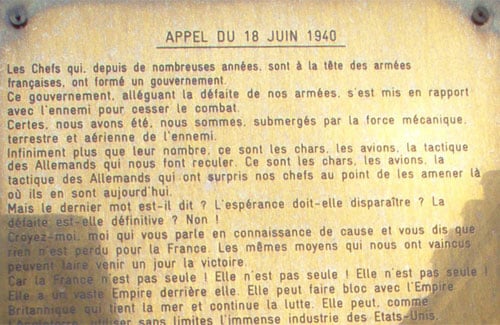
“The Appeal of 18 June”
by Charles de Gaulle, on June 18, 1940
President Hoover, Mr. Chief Justice, my friends:
This is a day of national consecration. And I am certain that on this day my fellow Americans expect that on my induction into the Presidency, I will address them with a candor and a decision which the present situation of our people impels.
This is preeminently the time to speak the truth, the whole truth, frankly and boldly. Nor need we shrink from honestly facing conditions in our country today. This great Nation will endure, as it has endured, will revive and will prosper.
So, first of all, let me assert my firm belief that the only thing we have to fear is fear itself — nameless, unreasoning, unjustified terror which paralyzes needed efforts to convert retreat into advance. In every dark hour of our national life, a leadership of frankness and of vigor has met with that understanding and support of the people themselves which is essential to victory. And I am convinced that you will again give that support to leadership in these critical days.
In such a spirit on my part and on yours we face our common difficulties. They concern, thank God, only material things. Values have shrunk to fantastic levels; taxes have risen; our ability to pay has fallen; government of all kinds is faced by serious curtailment of income; the means of exchange are frozen in the currents of trade; the withered leaves of industrial enterprise lie on every side; farmers find no markets for their produce; and the savings of many years in thousands of families are gone. More important, a host of unemployed citizens face the grim problem of existence, and an equally great number toil with little return. Only a foolish optimist can deny the dark realities of the moment.
And yet our distress comes from no failure of substance. We are stricken by no plague of locusts. Compared with the perils which our forefathers conquered, because they believed and were not afraid, we have still much to be thankful for. Nature still offers her bounty and human efforts have multiplied it. Plenty is at our doorstep, but a generous use of it languishes in the very sight of the supply.
Primarily, this is because the rulers of the exchange of mankind’s goods have failed, through their own stubbornness and their own incompetence, have admitted their failure, and have abdicated. Practices of the unscrupulous money changers stand indicted in the court of public opinion, rejected by the hearts and minds of men.
True, they have tried. But their efforts have been cast in the pattern of an outworn tradition. Faced by failure of credit, they have proposed only the lending of more money. Stripped of the lure of profit by which to induce our people to follow their false leadership, they have resorted to exhortations, pleading tearfully for restored confidence. They only know the rules of a generation of self-seekers. They have no vision, and when there is no vision the people perish.
Yes, the money changers have fled from their high seats in the temple of our civilization. We may now restore that temple to the ancient truths. The measure of that restoration lies in the extent to which we apply social values more noble than mere monetary profit.
Happiness lies not in the mere possession of money; it lies in the joy of achievement, in the thrill of creative effort. The joy, the moral stimulation of work no longer must be forgotten in the mad chase of evanescent profits. These dark days, my friends, will be worth all they cost us if they teach us that our true destiny is not to be ministered unto but to minister to ourselves, to our fellow men.
Recognition of that falsity of material wealth as the standard of success goes hand in hand with the abandonment of the false belief that public office and high political position are to be valued only by the standards of pride of place and personal profit; and there must be an end to a conduct in banking and in business which too often has given to a sacred trust the likeness of callous and selfish wrongdoing. Small wonder that confidence languishes, for it thrives only on honesty, on honor, on the sacredness of obligations, on faithful protection, and on unselfish performance; without them it cannot live.
Restoration calls, however, not for changes in ethics alone. This Nation is asking for action, and action now.
Our greatest primary task is to put people to work. This is no unsolvable problem if we face it wisely and courageously. It can be accomplished in part by direct recruiting by the Government itself, treating the task as we would treat the emergency of a war, but at the same time, through this employment, accomplishing great — greatly needed projects to stimulate and reorganize the use of our great natural resources.
Hand in hand with that we must frankly recognize the overbalance of population in our industrial centers and, by engaging on a national scale in a redistribution, endeavor to provide a better use of the land for those best fitted for the land.
Yes, the task can be helped by definite efforts to raise the values of agricultural products, and with this the power to purchase the output of our cities. It can be helped by preventing realistically the tragedy of the growing loss through foreclosure of our small homes and our farms. It can be helped by insistence that the Federal, the State, and the local governments act forthwith on the demand that their cost be drastically reduced. It can be helped by the unifying of relief activities which today are often scattered, uneconomical, unequal. It can be helped by national planning for and supervision of all forms of transportation and of communications and other utilities that have a definitely public character. There are many ways in which it can be helped, but it can never be helped by merely talking about it.
We must act. We must act quickly.
And finally, in our progress towards a resumption of work, we require two safeguards against a return of the evils of the old order. There must be a strict supervision of all banking and credits and investments. There must be an end to speculation with other people’s money. And there must be provision for an adequate but sound currency.
These, my friends, are the lines of attack. I shall presently urge upon a new Congress in special session detailed measures for their fulfillment, and I shall seek the immediate assistance of the 48 States.
Through this program of action we address ourselves to putting our own national house in order and making income balance outgo. Our international trade relations, though vastly important, are in point of time, and necessity, secondary to the establishment of a sound national economy. I favor, as a practical policy, the putting of first things first. I shall spare no effort to restore world trade by international economic readjustment; but the emergency at home cannot wait on that accomplishment.
The basic thought that guides these specific means of national recovery is not nationally — narrowly nationalistic. It is the insistence, as a first consideration, upon the interdependence of the various elements in and parts of the United States of America — a recognition of the old and permanently important manifestation of the American spirit of the pioneer. It is the way to recovery. It is the immediate way. It is the strongest assurance that recovery will endure.
In the field of world policy, I would dedicate this Nation to the policy of the good neighbor: the neighbor who resolutely respects himself and, because he does so, respects the rights of others; the neighbor who respects his obligations and respects the sanctity of his agreements in and with a world of neighbors.
If I read the temper of our people correctly, we now realize, as we have never realized before, our interdependence on each other; that we can not merely take, but we must give as well; that if we are to go forward, we must move as a trained and loyal army willing to sacrifice for the good of a common discipline, because without such discipline no progress can be made, no leadership becomes effective.
We are, I know, ready and willing to submit our lives and our property to such discipline, because it makes possible a leadership which aims at the larger good. This, I propose to offer, pledging that the larger purposes will bind upon us, bind upon us all as a sacred obligation with a unity of duty hitherto evoked only in times of armed strife.
With this pledge taken, I assume unhesitatingly the leadership of this great army of our people dedicated to a disciplined attack upon our common problems.
Action in this image, action to this end is feasible under the form of government which we have inherited from our ancestors. Our Constitution is so simple, so practical that it is possible always to meet extraordinary needs by changes in emphasis and arrangement without loss of essential form. That is why our constitutional system has proved itself the most superbly enduring political mechanism the modern world has ever seen.
It has met every stress of vast expansion of territory, of foreign wars, of bitter internal strife, of world relations. And it is to be hoped that the normal balance of executive and legislative authority may be wholly equal, wholly adequate to meet the unprecedented task before us. But it may be that an unprecedented demand and need for undelayed action may call for temporary departure from that normal balance of public procedure.
I am prepared under my constitutional duty to recommend the measures that a stricken nation in the midst of a stricken world may require. These measures, or such other measures as the Congress may build out of its experience and wisdom, I shall seek, within my constitutional authority, to bring to speedy adoption.
But, in the event that the Congress shall fail to take one of these two courses, in the event that the national emergency is still critical, I shall not evade the clear course of duty that will then confront me. I shall ask the Congress for the one remaining instrument to meet the crisis — broad Executive power to wage a war against the emergency, as great as the power that would be given to me if we were in fact invaded by a foreign foe.
For the trust reposed in me, I will return the courage and the devotion that befit the time. I can do no less.
We face the arduous days that lie before us in the warm courage of national unity; with the clear consciousness of seeking old and precious moral values; with the clean satisfaction that comes from the stern performance of duty by old and young alike. We aim at the assurance of a rounded, a permanent national life.
We do not distrust the — the future of essential democracy. The people of the United States have not failed. In their need they have registered a mandate that they want direct, vigorous action. They have asked for discipline and direction under leadership. They have made me the present instrument of their wishes. In the spirit of the gift I take it.
In this dedication — In this dedication of a Nation, we humbly ask the blessing of God.
by Winston Churchill, on June 18, 1940, at House of Commons, London
I spoke the other day of the colossal military disaster which occurred when the French High Command failed to withdraw the northern Armies from Belgium at the moment when they knew that the French front was decisively broken at Sedan and on the Meuse. This delay entailed the loss of fifteen or sixteen French divisions and threw out of action for the critical period the whole of the British Expeditionary Force. Our Army and 120,000 French troops were indeed rescued by the British Navy from Dunkirk but only with the loss of their cannon, vehicles and modern equipment. This loss inevitably took some weeks to repair, and in the first two of those weeks the battle in France has been lost. When we consider the heroic resistance made by the French Army against heavy odds in this battle, the enormous losses inflicted upon the enemy and the evident exhaustion of the enemy, it may well be the thought that these 25 divisions of the best-trained and best-equipped troops might have turned the scale. However, General Weygand had to fight without them. Only three British divisions or their equivalent were able to stand in the line with their French comrades. They have suffered severely, but they have fought well. We sent every man we could to France as fast as we could re-equip and transport their formations.
I am not reciting these facts for the purpose of recrimination. That I judge to be utterly futile and even harmful. We cannot afford it. I recite them in order to explain why it was we did not have, as we could have had, between twelve and fourteen British divisions fighting in the line in this great battle instead of only three. Now I put all this aside. I put it on the shelf, from which the historians, when they have time, will select their documents to tell their stories. We have to think of the future and not of the past. This also applies in a small way to our own affairs at home. There are many who would hold an inquest in the House of Commons on the conduct of the Governments-and of Parliaments, for they are in it, too-during the years which led up to this catastrophe. They seek to indict those who were responsible for the guidance of our affairs. This also would be a foolish and pernicious process. There are too many in it. Let each man search his conscience and search his speeches. I frequently search mine.
Of this I am quite sure, that if we open a quarrel between the past and the present, we shall find that we have lost the future. Therefore, I cannot accept the drawing of any distinctions between Members of the present Government. It was formed at a moment of crisis in order to unite all the Parties and all sections of opinion. It has received the almost unanimous support of both Houses of Parliament. Its Members are going to stand together, and, subject to the authority of the House of Commons, we are going to govern the country and fight the war. It is absolutely necessary at a time like this that every Minister who tries each day to do his duty shall be respected; and their subordinates must know that their chiefs are not threatened men, men who are here today and gone tomorrow, but that their directions must be punctually and faithfully obeyed. Without this concentrated power we cannot face what lies before us. I should not think it would be very advantageous for the House to prolong this Debate this afternoon under conditions of public stress. Many facts are not clear that will be clear in a short time. We are to have a secret Session on Thursday, and I should think that would be a better opportunity for the many earnest expressions of opinion which Members will desire to make and for the House to discuss vital matters without having everything read the next morning by our dangerous foes.
Their Finest Hour
The disastrous military events which have happened during the past fortnight have not come to me with any sense of surprise. Indeed, I indicated a fortnight ago as clearly as I could to the House that the worst possibilities were open; and I made it perfectly clear then that whatever happened in France would make no difference to the resolve of Britain and the British Empire to fight on, ‘if necessary for years, if necessary alone.” During the last few days we have successfully brought off the great majority of the troops we had on the line of communication in France; and seven-eighths of the troops we have sent to France since the beginning of the war-that is to say, about 350,000 out of 400,000 men-are safely back in this country. Others are still fighting with the French, and fighting with considerable success in their local encounters against the enemy. We have also brought back a great mass of stores, rifles and munitions of all kinds which had been accumulated in France during the last nine months.
We have, therefore, in this Island today a very large and powerful military force. This force comprises all our best-trained and our finest troops, including scores of thousands of those who have already measured their quality against the Germans and found themselves at no disadvantage. We have under arms at the present time in this Island over a million and a quarter men. Behind these we have the Local Defence Volunteers, numbering half a million, only a portion of whom, however, are yet armed with rifles or other firearms. We have incorporated into our Defence Forces every man for whom we have a weapon. We expect very large additions to our weapons in the near future, and in preparation for this we intend forthwith to call up, drill and train further large numbers. Those who are not called up, or else are employed during the vast business of munitions production in all its branches-and their ramifications are innumerable-will serve their country best by remaining at their ordinary work until they receive their summons. We have also over here Dominions armies. The Canadians had actually landed in France, but have now been safely withdrawn, much disappointed, but in perfect order, with all their artillery and equipment. And these very high-class forces from the Dominions will now take part in the defence of the Mother Country.
Lest the account which I have given of these large forces should raise the question: Why did they not take part in the great battle in France? I must make it clear that, apart from the divisions training and organizing at home, only 12 divisions were equipped to fight upon a scale which justified their being sent abroad. And this was fully up to the number which the French had been led to expect would be available in France at the ninth month of the war. The rest of our forces at home have a fighting value for home defence which will, of course, steadily increase every week that passes. Thus, the invasion of Great Britain would at this time require the transportation across the sea of hostile armies on a very large scale, and after they had been so transported they would have to be continually maintained with all the masses of munitions and supplies which are required for continuous battle-as continuous battle it will surely be.
Here is where we come to the Navy-and after all, we have a Navy. Some people seem to forget that we have a Navy. We must remind them. For the last thirty years I have been concerned in discussions about the possibilities of oversea invasion, and I took the responsibility on behalf of the Admiralty, at the beginning of the last war, of allowing all regular troops to be sent out of the country. That was a very serious step to take, because our Territorials had only just been called up and were quite untrained. Therefore, this Island was for several months particularly denuded of fighting troops. The Admiralty had confidence at that time in their ability to prevent a mass invasion even though at that time the Germans had a magnificent battle fleet in the proportion of 10 to 16, even though they were capable of fighting a general engagement every day and any day, whereas now they have only a couple of heavy ships worth speaking of-the Scharnhorst and the Gneisenau. We are also told that the Italian Navy is to come out and gain sea superiority in these waters. If they seriously intend it, I shall only say that we shall be delighted to offer Signor Mussolini a free and safeguarded passage through the Strait of Gibraltar in order that he may play the part to which he aspires. There is a general curiosity in the British Fleet to find out whether the Italians are up to the level they were at in the last war or whether they have fallen off at all.
Therefore, it seems to me that as far as sea-borne invasion on a great scale is concerned, we are far more capable of meeting it today than we were at many periods in the last war and during the early months of this war, before our other troops were trained, and while the B.E.F. had proceeded abroad. Now, the Navy have never pretended to be able to prevent raids by bodies of 5,000 or 10,000 men flung suddenly across and thrown ashore at several points on the coast some dark night or foggy morning. The efficacy of sea power, especially under modern conditions, depends upon the invading force being of large size; It has to be of large size, in view of our military strength, to be of any use. If it is of large size, then the Navy have something they can find and meet and, as it were, bite on. Now, we must remember that even five divisions, however lightly equipped, would require 200 to 250 ships, and with modern air reconnaissance and photography it would not be easy to collect such an armada, marshal it, and conduct it across the sea without any powerful naval forces to escort it; and there would be very great possibilities, to put it mildly, that this armada would be intercepted long before it reached the coast, and all the men drowned in the sea or, at the worst blown to pieces with their equipment while they were trying to land. We also have a great system of minefields, recently strongly reinforced, through which we alone know the channels. If the enemy tries to sweep passages through these minefields, it will be the task of the Navy to destroy the mine-sweepers and any other forces employed to protect them. There should be no difficulty in this, owing to our great superiority at sea.
Those are the regular, well-tested, well-proved arguments on which we have relied during many years in peace and war. But the question is whether there are any new methods by which those solid assurances can be circumvented. Odd as it may seem, some attention has been given to this by the Admiralty, whose prime duty and responsibility is to destroy any large sea-borne expedition before it reaches, or at the moment when it reaches, these shores. It would not be a good thing for me to go into details of this. It might suggest ideas to other people which they have not thought of, and they would not be likely to give us any of their ideas in exchange. All I will say is that untiring vigilance and mind-searching must be devoted to the subject, because the enemy is crafty and cunning and full of novel treacheries and stratagems. The House may be assured that the utmost ingenuity is being displayed and imagination is being evoked from large numbers of competent officers, well-trained in tactics and thoroughly up to date, to measure and counterwork novel possibilities. Untiring vigilance and untiring searching of the mind is being, and must be, devoted to the subject, because, remember, the enemy is crafty and there is no dirty trick he will not do.
Some people will ask why, then, was it that the British Navy was not able to prevent the movement of a large army from Germany into Norway across the Skagerrak? But the conditions in the Channel and in the North Sea are in no way like those which prevail in the Skagerrak. In the Skagerrak, because of the distance, we could give no air support to our surface ships, and consequently, lying as we did close to the enemy’s main air power, we were compelled to use only our submarines. We could not enforce the decisive blockade or interruption which is possible from surface vessels. Our submarines took a heavy toll but could not, by themselves, prevent the invasion of Norway. In the Channel and in the North Sea, on the other hand, our superior naval surface forces, aided by our submarines, will operate with close and effective air assistance.
This brings me, naturally, to the great question of invasion from the air, and of the impending struggle between the British and German Air Forces. It seems quite clear that no invasion on a scale beyond the capacity of our land forces to crush speedily is likely to take place from the air until our Air Force has been definitely overpowered. In the meantime, there may be raids by parachute troops and attempted descents of airborne soldiers. We should be able to give those gentry a warm reception both in the air and on the ground, if they reach it in any condition to continue the dispute. But the great question is: Can we break Hitler’s air weapon? Now, of course, it is a very great pity that we have not got an Air Force at least equal to that of the most powerful enemy within striking distance of these shores. But we have a very powerful Air Force which has proved itself far superior in quality, both in men and in many types of machine, to what we have met so far in the numerous and fierce air battles which have been fought with the Germans. In France, where we were at a considerable disadvantage and lost many machines on the ground when they were standing round the aerodromes, we were accustomed to inflict in the air losses of as much as two and two-and-a-half to one. In the fighting over Dunkirk, which was a sort of no-man’s-land, we undoubtedly beat the German Air Force, and gained the mastery of the local air, inflicting here a loss of three or four to one day after day. Anyone who looks at the photographs which were published a week or so ago of the re-embarkation, showing the masses of troops assembled on the beach and forming an ideal target for hours at a time, must realize that this re-embarkation would not have been possible unless the enemy had resigned all hope of recovering air superiority at that time and at that place.
In the defence of this Island the advantages to the defenders will be much greater than they were in the fighting around Dunkirk. We hope to improve on the rate of three or four to one which was realized at Dunkirk; and in addition all our injured machines and their crews which get down safely-and, surprisingly, a very great many injured machines and men do get down safely in modern air fighting-all of these will fall, in an attack upon these Islands, on friendly. soil and live to fight another day; whereas all the injured enemy machines and their complements will be total losses as far as the war is concerned.
During the great battle in France, we gave very powerful and continuous aid to. the French Army, both by fighters and bombers; but in spite of every kind of pressure we never would allow the entire metropolitan fighter strength of the Air Force to be consumed. This decision was painful, but it was also right, because the fortunes of the battle in France could not have been decisively affected even if we had thrown in our entire fighter force. That battle was lost by the unfortunate strategical opening, by the extraordinary and unforseen power of the armored columns, and by the great preponderance of the German Army in numbers. Our fighter Air Force might easily have been exhausted as a mere accident in that great struggle, and then we should have found ourselves at the present time in a very serious plight. But as it is, I am happy to inform the House that our fighter strength is stronger at the present time relatively to the Germans, who have suffered terrible losses, than it has ever been; and consequently we believe ourselves possessed of the capacity to continue the war in the air under better conditions than we have ever experienced before. I look forward confidently to the exploits of our fighter pilots-these splendid men, this brilliant youth-who will have the glory of saving their native land, their island home, and all they love, from the most deadly of all attacks.
There remains, of course, the danger of bombing attacks, which will certainly be made very soon upon us by the bomber forces of the enemy. It is true that the German bomber force is superior in numbers to ours; but we have a very large bomber force also, which we shall use to strike at military targets in Germany without intermission. I do not at all underrate the severity of the ordeal which lies before us; but I believe our countrymen will show themselves capable of standing up to it, like the brave men of Barcelona, and will be able to stand up to it, and carry on in spite of it, at least as well as any other people in the world. Much will depend upon this; every man and every woman will have the chance to show the finest qualities of their race, and render the highest service to their cause. For all of us, at this time, whatever our sphere, our station, our occupation or our duties, it will be a help to remember the famous lines: He nothing common did or mean, Upon that memorable scene.
I have thought it right upon this occasion to give the House and the country some indication of the solid, practical grounds upon which we base our inflexible resolve to continue the war. There are a good many people who say, “Never mind. Win or lose, sink or swim, better die than submit to tyranny-and such a tyranny.” And I do not dissociate myself from them. But I can assure them that our professional advisers of the three Services unitedly advise that we should carry on the war, and that there are good and reasonable hopes of final victory. We have fully informed and consulted all the self-governing Dominions, these great communities far beyond the oceans who have been built up on our laws and on our civilization, and who are absolutely free to choose their course, but are absolutely devoted to the ancient Motherland, and who feel themselves inspired by the same emotions which lead me to stake our all upon duty and honour. We have fully consulted them, and I have received from their Prime Ministers, Mr. Mackenzie King of Canada, Mr. Menzies of Australia, Mr. Fraser of New Zealand, and General Smuts of South Africa-that wonderful man, with his immense profound mind, and his eye watching from a distance the whole panorama of European affairs-I have received from all these eminent men, who all have Governments behind them elected on wide franchises, who are all there because they represent the will of their people, messages couched in the most moving terms in which they endorse our decision to fight on, and declare themselves ready to share our fortunes and to persevere to the end. That is what we are going to do.
We may now ask ourselves: In what way has our position worsened since the beginning of the war? It has worsened by the fact that the Germans have conquered a large part of the coast line of Western Europe, and many small countries have been overrun by them. This aggravates the possibilities of air attack and adds to our naval preoccupations. It in no way diminishes, but on the contrary definitely increases, the power of our long-distance blockade. Similarly, the entrance of Italy into the war increases the power of our long-distance blockade. We have stopped the worst leak by that. We do not know whether military resistance will come to an end in France or not, but should it do so, then of course the Germans will be able to concentrate their forces, both military and industrial, upon us. But for the reasons I have given to the House these will not be found so easy to apply. If invasion has become more imminent, as no doubt it has, we, being relieved from the task of maintaining a large army in France, have far larger and more efficient forces to meet it.
If Hitler can bring under his despotic control the industries of the countries he has conquered, this will add greatly to his already vast armament output. On the other hand, this will not happen immediately, and we are now assured of immense, continuous and increasing support in supplies and munitions of all kinds from the United States; and especially of aeroplanes and pilots from the Dominions and across the oceans coming from regions which are beyond the reach of enemy bombers.
I do not see how any of these factors can operate to our detriment on balance before the winter comes; and the winter will impose a strain upon the Nazi regime, with almost all Europe writhing and starving under its cruel heel, which, for all their ruthlessness, will run them very hard. We must not forget that from the moment when we declared war on the 3rd September it was always possible for Germany to turn all her Air Force upon this country, together with any other devices of invasion she might conceive, and that France could have done little or nothing to prevent her doing so. We have, therefore, lived under this danger, in principle and in a slightly modified form, during all these months. In the meanwhile, however, we have enormously improved our methods of defence, and we have learned what we had no right to assume at the beginning, namely, that the individual aircraft and the individual British pilot have a sure and definite superiority. Therefore, in casting up this dread balance sheet and contemplating our dangers with a disillusioned eye, I see great reason for intense vigilance and exertion, but none whatever for panic or despair.
During the first four years of the last war the Allies experienced nothing but disaster and disappointment. That was our constant fear: one blow after another, terrible losses, frightful dangers. Everything miscarried. And yet at the end of those four years the morale of the Allies was higher than that of the Germans, who had moved from one aggressive triumph to another, and who stood everywhere triumphant invaders of the lands into which they had broken. During that war we repeatedly asked ourselves the question: How are we going to win? and no one was able ever to answer it with much precision, until at the end, quite suddenly, quite unexpectedly, our terrible foe collapsed before us, and we were so glutted with victory that in our folly we threw it away.
We do not yet know what will happen in France or whether the French resistance will be prolonged, both in France and in the French Empire overseas. The French Government will be throwing away great opportunities and casting adrift their future if they do not continue the war in accordance with their Treaty obligations, from which we have not felt able to release them. The House will have read the historic declaration in which, at the desire of many Frenchmen-and of our own hearts-we have proclaimed our willingness at the darkest hour in French history to conclude a union of common citizenship in this struggle. However matters may go in France or with the French Government, or other French Governments, we in this Island and in the British Empire will never lose our sense of comradeship with the French people. If we are now called upon to endure what they have been suffering, we shall emulate their courage, and if final victory rewards our toils they shall share the gains, aye, and freedom shall be restored to all. We abate nothing of our just demands; not one jot or tittle do we recede. Czechs, Poles, Norwegians, Dutch, Belgians have joined their causes to our own. All these shall be restored.
What General Weygand called the Battle of France is over. I expect that the Battle of Britain is about to begin. Upon this battle depends the survival of Christian civilization. Upon it depends our own British life, and the long continuity of our institutions and our Empire. The whole fury and might of the enemy must very soon be turned on us. Hitler knows that he will have to break us in this Island or lose the war. If we can stand up to him, all Europe may be free and the life of the world may move forward into broad, sunlit uplands. But if we fail, then the whole world, including the United States, including all that we have known and cared for, will sink into the abyss of a new Dark Age made more sinister, and perhaps more protracted, by the lights of perverted science. Let us therefore brace ourselves to our duties, and so bear ourselves that, if the British Empire and its Commonwealth last for a thousand years, men will still say, “This was their finest hour.”
We Shall Fight on the Beaches
by Winston Churchill, on June 4, 1940 at The House of Commons, London
From the moment that the French defenses at Sedan and on the Meuse were broken at the end of the second week of May, only a rapid retreat to Amiens and the south could have saved the British and French Armies who had entered Belgium at the appeal of the Belgian King; but this strategic fact was not immediately realized. The French High Command hoped they would be able to close the gap, and the Armies of the north were under their orders. Moreover, a retirement of this kind would have involved almost certainly the destruction of the fine Belgian Army of over 20 divisions and the abandonment of the whole of Belgium. Therefore, when the force and scope of the German penetration were realized and when a new French Generalissimo, General Weygand, assumed command in place of General Gamelin, an effort was made by the French and British Armies in Belgium to keep on holding the right hand of the Belgians and to give their own right hand to a newly created French Army which was to have advanced across the Somme in great strength to grasp it.
However, the German eruption swept like a sharp scythe around the right and rear of the Armies of the north. Eight or nine armored divisions, each of about four hundred armored vehicles of different kinds, but carefully assorted to be complementary and divisible into small self-contained units, cut off all communications between us and the main French Armies. It severed our own communications for food and ammunition, which ran first to Amiens and afterwards through Abbeville, and it shore its way up the coast to Boulogne and Calais, and almost to Dunkirk. Behind this armored and mechanized onslaught came a number of German divisions in lorries, and behind them again there plodded comparatively slowly the dull brute mass of the ordinary German Army and German people, always so ready to be led to the trampling down in other lands of liberties and comforts which they have never known in their own.
I have said this armored scythe-stroke almost reached Dunkirk-almost but not quite. Boulogne and Calais were the scenes of desperate fighting. The Guards defended Boulogne for a while and were then withdrawn by orders from this country. The Rifle Brigade, the 60th Rifles, and the Queen Victoria’s Rifles, with a battalion of British tanks and 1,000 Frenchmen, in all about four thousand strong, defended Calais to the last. The British Brigadier was given an hour to surrender. He spurned the offer, and four days of intense street fighting passed before silence reigned over Calais, which marked the end of a memorable resistance. Only 30 unwounded survivors were brought off by the Navy, and we do not know the fate of their comrades. Their sacrifice, however, was not in vain. At least two armored divisions, which otherwise would have been turned against the British Expeditionary Force, had to be sent to overcome them. They have added another page to the glories of the light divisions, and the time gained enabled the Graveline water lines to be flooded and to be held by the French troops.
Thus it was that the port of Dunkirk was kept open. When it was found impossible for the Armies of the north to reopen their communications to Amiens with the main French Armies, only one choice remained. It seemed, indeed, forlorn. The Belgian, British and French Armies were almost surrounded. Their sole line of retreat was to a single port and to its neighboring beaches. They were pressed on every side by heavy attacks and far outnumbered in the air.
When, a week ago today, I asked the House to fix this afternoon as the occasion for a statement, I feared it would be my hard lot to announce the greatest military disaster in our long history. I thought-and some good judges agreed with me-that perhaps 20,000 or 30,000 men might be re-embarked. But it certainly seemed that the whole of the French First Army and the whole of the British Expeditionary Force north of the Amiens-Abbeville gap would be broken up in the open field or else would have to capitulate for lack of food and ammunition. These were the hard and heavy tidings for which I called upon the House and the nation to prepare themselves a week ago. The whole root and core and brain of the British Army, on which and around which we were to build, and are to build, the great British Armies in the later years of the war, seemed about to perish upon the field or to be led into an ignominious and starving captivity.
That was the prospect a week ago. But another blow which might well have proved final was yet to fall upon us. The King of the Belgians had called upon us to come to his aid. Had not this Ruler and his Government severed themselves from the Allies, who rescued their country from extinction in the late war, and had they not sought refuge in what was proved to be a fatal neutrality, the French and British Armies might well at the outset have saved not only Belgium but perhaps even Poland. Yet at the last moment, when Belgium was already invaded, King Leopold called upon us to come to his aid, and even at the last moment we came. He and his brave, efficient Army, nearly half a million strong, guarded our left flank and thus kept open our only line of retreat to the sea. Suddenly, without prior consultation, with the least possible notice, without the advice of his Ministers and upon his own personal act, he sent a plenipotentiary to the German Command, surrendered his Army, and exposed our whole flank and means of retreat.
I asked the House a week ago to suspend its judgment because the facts were not clear, but I do not feel that any reason now exists why we should not form our own opinions upon this pitiful episode. The surrender of the Belgian Army compelled the British at the shortest notice to cover a flank to the sea more than 30 miles in length. Otherwise all would have been cut off, and all would have shared the fate to which King Leopold had condemned the finest Army his country had ever formed. So in doing this and in exposing this flank, as anyone who followed the operations on the map will see, contact was lost between the British and two out of the three corps forming the First French Army, who were still farther from the coast than we were, and it seemed impossible that any large number of Allied troops could reach the coast.
The enemy attacked on all sides with great strength and fierceness, and their main power, the power of their far more numerous Air Force, was thrown into the battle or else concentrated upon Dunkirk and the beaches. Pressing in upon the narrow exit, both from the east and from the west, the enemy began to fire with cannon upon the beaches by which alone the shipping could approach or depart. They sowed magnetic mines in the channels and seas; they sent repeated waves of hostile aircraft, sometimes more than a hundred strong in one formation, to cast their bombs upon the single pier that remained, and upon the sand dunes upon which the troops had their eyes for shelter. Their U-boats, one of which was sunk, and their motor launches took their toll of the vast traffic which now began. For four or five days an intense struggle reigned. All their armored divisions-or what Was left of them-together with great masses of infantry and artillery, hurled themselves in vain upon the ever-narrowing, ever-contracting appendix within which the British and French Armies fought.
Meanwhile, the Royal Navy, with the willing help of countless merchant seamen, strained every nerve to embark the British and Allied troops; 220 light warships and 650 other vessels were engaged. They had to operate upon the difficult coast, often in adverse weather, under an almost ceaseless hail of bombs and an increasing concentration of artillery fire. Nor were the seas, as I have said, themselves free from mines and torpedoes. It was in conditions such as these that our men carried on, with little or no rest, for days and nights on end, making trip after trip across the dangerous waters, bringing with them always men whom they had rescued. The numbers they have brought back are the measure of their devotion and their courage. The hospital ships, which brought off many thousands of British and French wounded, being so plainly marked were a special target for Nazi bombs; but the men and women on board them never faltered in their duty.
Meanwhile, the Royal Air Force, which had already been intervening in the battle, so far as its range would allow, from home bases, now used part of its main metropolitan fighter strength, and struck at the German bombers and at the fighters which in large numbers protected them. This struggle was protracted and fierce. Suddenly the scene has cleared, the crash and thunder has for the moment-but only for the moment-died away. A miracle of deliverance, achieved by valor, by perseverance, by perfect discipline, by faultless service, by resource, by skill, by unconquerable fidelity, is manifest to us all. The enemy was hurled back by the retreating British and French troops. He was so roughly handled that he did not hurry their departure seriously.
The Royal Air Force engaged the main strength of the German Air Force, and inflicted upon them losses of at least four to one; and the Navy, using nearly 1,000 ships of all kinds, carried over 335,000 men, French and British, out of the jaws of death and shame, to their native land and to the tasks which lie immediately ahead. We must be very careful not to assign to this deliverance the attributes of a victory. Wars are not won by evacuations. But there was a victory inside this deliverance, which should be noted. It was gained by the Air Force. Many of our soldiers coming back have not seen the Air Force at work; they saw only the bombers which escaped its protective attack. They underrate its achievements. I have heard much talk of this; that is why I go out of my way to say this. I will tell you about it.
This was a great trial of strength between the British and German Air Forces. Can you conceive a greater objective for the Germans in the air than to make evacuation from these beaches impossible, and to sink all these ships which were displayed, almost to the extent of thousands? Could there have been an objective of greater military importance and significance for the whole purpose of the war than this? They tried hard, and they were beaten back; they were frustrated in their task. We got the Army away; and they have paid fourfold for any losses which they have inflicted. Very large formations of German aeroplanes-and we know that they are a very brave race-have turned on several occasions from the attack of one-quarter of their number of the Royal Air Force, and have dispersed in different directions. Twelve aeroplanes have been hunted by two. One aeroplane was driven into the water and cast away by the mere charge of a British aeroplane, which had no more ammunition. All of our types-the Hurricane, the Spitfire and the new Defiant-and all our pilots have been vindicated as superior to what they have at present to face.
When we consider how much greater would be our advantage in defending the air above this Island against an overseas attack, I must say that I find in these facts a sure basis upon which practical and reassuring thoughts may rest. I will pay my tribute to these young airmen. The great French Army was very largely, for the time being, cast back and disturbed by the onrush of a few thousands of armored vehicles. May it not also be that the cause of civilization itself will be defended by the skill and devotion of a few thousand airmen? There never has been, I suppose, in all the world, in all the history of war, such an opportunity for youth. The Knights of the Round Table, the Crusaders, all fall back into the past-not only distant but prosaic; these young men, going forth every morn to guard their native land and all that we stand for, holding in their hands these instruments of colossal and shattering power, of whom it may be said that:
Every morn brought forth a noble chance
And every chance brought forth a noble knight,
deserve our gratitude, as do all the brave men who, in so many ways and on so many occasions, are ready, and continue ready to give life and all for their native land.
I return to the Army. In the long series of very fierce battles, now on this front, now on that, fighting on three fronts at once, battles fought by two or three divisions against an equal or somewhat larger number of the enemy, and fought fiercely on some of the old grounds that so many of us knew so well-in these battles our losses in men have exceeded 30,000 killed, wounded and missing. I take occasion to express the sympathy of the House to all who have suffered bereavement or who are still anxious. The President of the Board of Trade [Sir Andrew Duncan] is not here today. His son has been killed, and many in the House have felt the pangs of affliction in the sharpest form. But I will say this about the missing: We have had a large number of wounded come home safely to this country, but I would say about the missing that there may be very many reported missing who will come back home, some day, in one way or another. In the confusion of this fight it is inevitable that many have been left in positions where honor required no further resistance from them.
Against this loss of over 30,000 men, we can set a far heavier loss certainly inflicted upon the enemy. But our losses in material are enormous. We have perhaps lost one-third of the men we lost in the opening days of the battle of 21st March, 1918, but we have lost nearly as many guns — nearly one thousand-and all our transport, all the armored vehicles that were with the Army in the north. This loss will impose a further delay on the expansion of our military strength. That expansion had not been proceeding as far as we had hoped. The best of all we had to give had gone to the British Expeditionary Force, and although they had not the numbers of tanks and some articles of equipment which were desirable, they were a very well and finely equipped Army. They had the first-fruits of all that our industry had to give, and that is gone. And now here is this further delay. How long it will be, how long it will last, depends upon the exertions which we make in this Island. An effort the like of which has never been seen in our records is now being made. Work is proceeding everywhere, night and day, Sundays and week days. Capital and Labor have cast aside their interests, rights, and customs and put them into the common stock. Already the flow of munitions has leaped forward. There is no reason why we should not in a few months overtake the sudden and serious loss that has come upon us, without retarding the development of our general program.
Nevertheless, our thankfulness at the escape of our Army and so many men, whose loved ones have passed through an agonizing week, must not blind us to the fact that what has happened in France and Belgium is a colossal military disaster. The French Army has been weakened, the Belgian Army has been lost, a large part of those fortified lines upon which so much faith had been reposed is gone, many valuable mining districts and factories have passed into the enemy’s possession, the whole of the Channel ports are in his hands, with all the tragic consequences that follow from that, and we must expect another blow to be struck almost immediately at us or at France. We are told that Herr Hitler has a plan for invading the British Isles. This has often been thought of before. When Napoleon lay at Boulogne for a year with his flat-bottomed boats and his Grand Army, he was told by someone. “There are bitter weeds in England.” There are certainly a great many more of them since the British Expeditionary Force returned.
The whole question of home defense against invasion is, of course, powerfully affected by the fact that we have for the time being in this Island incomparably more powerful military forces than we have ever had at any moment in this war or the last. But this will not continue. We shall not be content with a defensive war. We have our duty to our Ally. We have to reconstitute and build up the British Expeditionary Force once again, under its gallant Commander-in-Chief, Lord Gort. All this is in train; but in the interval we must put our defenses in this Island into such a high state of organization that the fewest possible numbers will be required to give effective security and that the largest possible potential of offensive effort may be realized. On this we are now engaged. It will be very convenient, if it be the desire of the House, to enter upon this subject in a secret Session. Not that the government would necessarily be able to reveal in very great detail military secrets, but we like to have our discussions free, without the restraint imposed by the fact that they will be read the next day by the enemy; and the Government would benefit by views freely expressed in all parts of the House by Members with their knowledge of so many different parts of the country. I understand that some request is to be made upon this subject, which will be readily acceded to by His Majesty’s Government.
We have found it necessary to take measures of increasing stringency, not only against enemy aliens and suspicious characters of other nationalities, but also against British subjects who may become a danger or a nuisance should the war be transported to the United Kingdom. I know there are a great many people affected by the orders which we have made who are the passionate enemies of Nazi Germany. I am very sorry for them, but we cannot, at the present time and under the present stress, draw all the distinctions which we should like to do. If parachute landings were attempted and fierce fighting attendant upon them followed, these unfortunate people would be far better out of the way, for their own sakes as well as for ours. There is, however, another class, for which I feel not the slightest sympathy. Parliament has given us the powers to put down Fifth Column activities with a strong hand, and we shall use those powers subject to the supervision and correction of the House, without the slightest hesitation until we are satisfied, and more than satisfied, that this malignancy in our midst has been effectively stamped out.
Turning once again, and this time more generally, to the question of invasion, I would observe that there has never been a period in all these long centuries of which we boast when an absolute guarantee against invasion, still less against serious raids, could have been given to our people. In the days of Napoleon the same wind which would have carried his transports across the Channel might have driven away the blockading fleet. There was always the chance, and it is that chance which has excited and befooled the imaginations of many Continental tyrants. Many are the tales that are told. We are assured that novel methods will be adopted, and when we see the originality of malice, the ingenuity of aggression, which our enemy displays, we may certainly prepare ourselves for every kind of novel stratagem and every kind of brutal and treacherous maneuver. I think that no idea is so outlandish that it should not be considered and viewed with a searching, but at the same time, I hope, with a steady eye. We must never forget the solid assurances of sea power and those which belong to air power if it can be locally exercised.
I have, myself, full confidence that if all do their duty, if nothing is neglected, and if the best arrangements are made, as they are being made, we shall prove ourselves once again able to defend our Island home, to ride out the storm of war, and to outlive the menace of tyranny, if necessary for years, if necessary alone. At any rate, that is what we are going to try to do. That is the resolve of His Majesty’s Government-every man of them. That is the will of Parliament and the nation. The British Empire and the French Republic, linked together in their cause and in their need, will defend to the death their native soil, aiding each other like good comrades to the utmost of their strength. Even though large tracts of Europe and many old and famous States have fallen or may fall into the grip of the Gestapo and all the odious apparatus of Nazi rule, we shall not flag or fail. We shall go on to the end, we shall fight in France, we shall fight on the seas and oceans, we shall fight with growing confidence and growing strength in the air, we shall defend our Island, whatever the cost may be, we shall fight on the beaches, we shall fight on the landing grounds, we shall fight in the fields and in the streets, we shall fight in the hills; we shall never surrender, and even if, which I do not for a moment believe, this Island or a large part of it were subjugated and starving, then our Empire beyond the seas, armed and guarded by the British Fleet, would carry on the struggle, until, in God’s good time, the New World, with all its power and might, steps forth to the rescue and the liberation of the old.