web analytics

Tag: 1941

  • Pop Culture Trivia Quiz: What Happened In 1941?

    Pop Culture Trivia Quiz: What Happened In 1941?

    Pop Culture Trivia Quiz: What Happened In 1941?

    41 Trivia Questions for 1941 History

    (answers)

    1. Who was the President of the United States in 1941?

    2. What was the Biggest Number One Song of 1941?

    3. To the nearest dime, what was the average movie theater ticket price in 1941?

    4. On July 1, 1941, what two television networks began broadcasting in New York City?

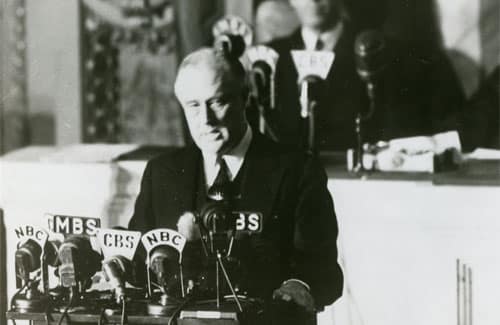
    5. What was the date that US President Franklin Roosevelt said, “which will live in infamy the United States of America was suddenly and deliberately attacked by naval and air forces of the Empire of Japan.”

    6. What did Germany and Italy do on December 11, 1941?

    7. Was this quasi-biographical film based on real-life newspapermen William Randolph Hearst and Joseph Pulitzer? Name this film.

    8. How much did a Gallon of Milk cost in 1941?

    9. How much did a Loaf of Bread cost in 1941?

    10. How many people lived in the United States in 1941?

    11. What was the highest-grossing film of 1941?

    12. What practice did the 13th Academy Awards start after a fiasco the prior year with the Los Angeles Times newspaper?

    13. Who won the Stanley Cup in 1941?

    14. In 1941, what was the average life expectancy in the United States?

    15. Who was the subject of a popular World War 2 pinup featuring the actress wearing a nightgown?

    16. True or False? Joseph Stalin decreed that every Soviet soldier should receive 100 grams (about 3.5 ounces) of vodka daily.

    17. What was the Bestselling Fiction Book in 1941

    18. What was the title of the second “Road To…” film, starring Bing Crosby, Bob Hope, and Dorothy Lamour?

    19. Amyotrophic lateral sclerosis (ALS) is also referred to as an MLB legend’s disease. Name that New York Yankee.

    20. Who won the 1941 World Series?

    21. Red Sox MLB player Ted Williams set an all-time baseball batting record on the last day of the 1941 season. What record did he set?

    22. What were the four freedoms mentioned in Franklin Roosevelt’s Four Freedoms speech?

    23. The first American television station outside New York aired in Philadelphia, Pennsylvania. Name that station.

    24. Who won the US Triple Crown of Thoroughbred Racing in 1941?

    25. Throughout 1941 and 1945, the United States built over 2,700 of this class of cargo ship. Name that class of ships.

    26. Who was the Time Magazine Man of the Year in 1941?

    27. What was the name of Franklin D. Roosevelt’s presidential yacht from 1936 until he died in 1945?

    28. Which celebrity was NOT born in 1941: Judy Blume, Joan Baez, David Ruffin, or Neil Diamond?

    29. This baseball player is the all-time MLB player with the most hits, games played, and at-bats. Born in 1941, who is he?

    30. What was Pete Rose’s nickname?

    31. A New York Yankee, Joe DiMaggio, began a record-breaking streak on May 15, 1941, that continued until July 16th. What record does he hold for that period?

    32. This group began entertaining the United States Armed Services on February 4, 1941. What is its name?

    33. This superhero, first appearing in Police Comics #1, was among the first to be a wise-cracking super-crimefighter.

    34. How much did a gallon of gas cost in 1941?

    35. This radio program started in Helena, Arkansas, and is the longest-running daily American radio broadcast in history. What is it?

    36. What Marx Brothers film featured Grouch Marx as Wolf J. Flywheel?

    37. How much did a dozen eggs cost in 1941?

    38. Plutonium was chemically identified in 1941. What is plutonium’s Atomic Number?

    39. What Andrews Sisters hit was revived by Bette Midler in 1973?

    40. Based on Dashiell Hammett’s 1930 book, this 1941 film noir starred Humphrey Bogart and Mary Aster.

    41. What 1941 film was remade as Heaven Can Wait in 1978, starring Warren Beatty, Buck Henry, and Julie Christie?

    Trivia Team Bonus Questions:

    1. What was Virginia Woolf’s final novel, published shortly after her death?

    2. This comic book publisher’s first issue was an adaptation of The Three Musketeers, and they published more stories through 1969. Name that long-running comic book company.

    3. Who was the American Vice-President in 1941?

    4. Who were the 1941 NFL Champions?

    5. Six-year-old Elaine Esposito began a world medical record on August 6, 1941. What record did she hold?

    6. What is the National Hockey League record for shots on goal in a single game?

    7. Cheerios was released by General Mills by another name in 1941. What were they called?

    8. What was the name of the Cartoon where Bugs Bunny was first named?

    9. Who was the Pope in 1941?

    10. On January 13, 1941, All persons born in what nearby American territory were declared U.S. citizens by birth, through U.S. federal law?

    The Answers:

    41 Trivia Answers for 1941 History

    1. Who was the President of the United States in 1941?
    Franklin D. Roosevelt (March 4, 1933 – April 12, 1945)

    2. What was the Biggest Number One Song of 1941?
    Amapola (Pretty Little Poppy) by Jimmy Dorsey

    3. To the nearest dime, what was the average movie theater ticket price in 1941?
    30 cents

    4. On July 1, 1941, what two television networks began broadcasting in New York City?
    CBS and NBC.

    5. What was the date that US President Franklin Roosevelt said, “which will live in infamy the United States of America was suddenly and deliberately attacked by naval and air forces of the Empire of Japan.”
    December 7, 1941

    6. What did Germany and Italy do on December 11, 1941?
    They both declared war on The United States.

    7. Was this quasi-biographical film based on real-life newspapermen William Randolph Hearst and Joseph Pulitzer? Name this film.
    Citizen Kane

    8. How much did a Gallon of Milk cost in 1941?
    54 cents

    9. How much did a Loaf of Bread cost in 1941?
    8 cents

    10. How many people lived in the United States in 1941?
    The population was an estimated 133,402,471 people.

    11. What was the highest-grossing film of 1941?
    Sergeant York

    12. What practice did the 13th Academy Awards start after a fiasco the prior year with the Los Angeles Times newspaper?
    They placed the winners’ names in envelopes. In 1940, the L.A. Times published a list of winners before they were announced.

    13. Who won the Stanley Cup in 1941?
    In 1941, The Boston Bruins won over the Detroit Red Wings (4 games to 0)

    14. In 1941, what was the average life expectancy in the United States?
    Men – 63.1 years, Women – 66.8 years.

    15. Who was the subject of a popular World War 2 pinup featuring the actress wearing a nightgown?
    Rita Hayworth

    16. True or False? Joseph Stalin decreed that every Soviet soldier should receive 100 grams (about 3.5 ounces) of vodka per day.
    True

    17. What was the Bestselling Fiction Book in 1941?
    The Keys of the Kingdom by A.J. Cronin

    18. What was the title of the second “Road To…” film, starring Bing Crosby, Bob Hope, and Dorothy Lamour?
    Road to Zanzibar

    19. Amyotrophic lateral sclerosis (ALS) is also referred to as an MLB legend’s disease. Name that New York Yankee.
    Lou Gehrig’s disease (June 19, 1903 – June 2, 1941)

    20. Who won the 1941 World Series?
    In 1941, The New York Yankees won, beating the Brooklyn Dodgers (4 games to 1)

    21. Red Sox MLB player Ted Williams set an all-time baseball batting record o the last day of the 1941 season. What record did he set?
    He the season with a batting average of .4057 (rounded up to 406)

    22. What were the four freedoms mentioned in Franklin Roosevelt’s Four Freedoms speech?
    Freedom of speech, freedom of worship, freedom from want and freedom from fear.

    23. The first American television station outside New York aired in Philadelphia, Pennsylvania. Name that station.
    KYW-TV (WPTZ at the time, an NBC affiliate)

    24. Who won the US Triple Crown of Thoroughbred Racing in 1941?
    Whirlaway

    25. Throughout 1941 and 1945, the United States built over 2,700 of this class of cargo ship. Name that class of ships.
    Liberty Ships

    26. Who was the Time Magazine Man of the Year in 1941?
    Franklin D. Roosevelt

    27. What was the name of Franklin D. Roosevelt’s presidential yacht from 1936 until he died in 1945?
    USS Potomac (AG-25)

    28. Which celebrity was NOT born in 1941: Judy Blume, Joan Baez, David Ruffin, or Neil Diamond?
    Judy Blume (born February 12, 1938)

    29. This baseball player is the all-time MLB player with the most hits, games played, and at-bats. Born in 1941, who is he?
    Pete Rose (born April 14, 1941)

    30. What was Pete Rose’s nickname?
    Charlie Hustle

    31. A New York Yankee, Joe DiMaggio, began a record-breaking streak on May 15, 1941, that continued until July 16th. What record does he hold for that period?
    A 56-game hitting streak. (the record still stands)

    32. This group began entertaining the United States Armed Services on February 4, 1941. What is its name?
    USO (United Service Organizations)

    33. This superhero, first appearing in Police Comics #1, was among the first to be a wise-cracking super-crimefighter.
    Plastic Man

    34. How much did a gallon of gas cost in 1941?
    $0.19 per gallon

    35. This radio program started in Helena, Arkansas, and is the longest-running daily American radio broadcast in history. What is it?
    King Biscuit Time, a blues radio show

    36. What Marx Brothers film featured Grouch Marx as Wolf J. Flywheel?
    The Big Store

    37. How much did a dozen eggs cost in 1941?
    40 cents

    38. Plutonium was chemically identified in 1941. What is plutonium’s Atomic Number?
    Plutonium’s atomic number is 94.

    39. What Andrews Sisters hit was revived by Bette Midler in 1973?
    Boogie Woogie Bugle Boy

    40. Based on Dashiell Hammett’s 1930 book, this 1941 film noir starred Humphrey Bogart and Mary Aster.
    The Maltese Falcon

    41. What 1941 film was remade as Heaven Can Wait in 1978, starring Warren Beatty, Buck Henry, and Julie Christie?
    Her Comes Mr. Jordan

    Trivia Team Bonus Questions:

    1. What was Virginia Woolf’s final novel, published shortly after her death?
    Between the Acts

    2. This comic book publisher’s first issue was an adaptation of The Three Musketeers, and they published more stories through 1969. Name that long-running comic book company.
    Classic Comics

    3. Who was the American Vice-President in 1941?
    John Garner (March 4, 1933 – January 20, 1941) and Henry A. Wallace (January 20, 1941 – January 20, 1945)

    4. Who were the 1941 NFL Champions?
    Chicago Bears

    5. Six-year-old Elaine Esposito began a world medical record on August 6, 1941. What record did she hold?
    The longest person in a coma – 37 years. She was anesthetized for an appendectomy and never woke up; she died in 1978.

    6. What is the National Hockey League record for shots on goal in a single game?
    The Boston Bruins took 83 shots on goal during a 3-2 win over the Chicago Black Hawks on March 4, 1941.
    This led to another NHL record in that game – Black Hawk goaltender Sam LoPresti had 80 saves.

    7. Cheerios was released by General Mills by another name in 1941. What were they called?
    CheeriOats. They were renamed Cheerios in 1945.

    8. What was the name of the Cartoon where Bugs Bunny was first named?
    Elmer’s Pet Rabbit

    9. Who was the Pope in 1941?
    Pope Pius XII, March 2, 1939 – October 9, 1958

    10. On January 13, 1941, All persons born in what nearby American territory were declared U.S. citizens by birth, through U.S. federal law?
    Puerto Rico
     
     
  • 1941 Pop Culture History, Fun Facts and Trivia

    1941 Pop Culture History, Fun Facts and Trivia

    1941 History, Facts and Trivia

    Quick Facts from 1941

    • World Changing Event: December 7, 1941 – Imperial Japanese fighter planes attacked the Pearl Harbor naval base, bringing the United States into WWII. On December 8, 1941, over 81% of American households tuned in to FDR’s “a date which will live in infamy” speech.
    • Influential Songs include God Bless The Child by Billie Holiday.
    • The Movies to Watch include The Maltese Falcon, Dumbo, Suspicion, Citizen Kane, Road to Zanzibar, The Wolf Man, Here Comes Mr. Jordan and Buck Privates.
    • The Most Famous Person in America was probably Mickey Rooney
    • Notable book: Curious George by H.A. and Margret Ray
    • Price of six 12 oz Pepsi cans in 1941: 23 cents
      Price of a movie ticket: 25 cents
    • The Funny Duo was: Abbott and Costello
    • The Funny Trio was Bob Hope, Bing Crosby, and Dorothy Lamour
    • The Escapes: Maps and other escape aids were smuggled to Allied POWs in Monopoly sets during World War II. Of the estimated 35,000 Allied POWs who successfully escaped, one-third were aided in their flight by the rigged Monopoly sets.

    Top Ten Baby Names of 1941

    Mary, Barbara, Patricia, Carol, Linda, James, Robert, John, William, Richard

    US Life Expectancy

    1941 Males: 63.1 years, Females: 66.8 years

    The Stars

    Ingrid Bergman, Betty Grable, Rita Hayworth, Katharine Hepburn, Lena Horne, Veronica Lake, Hedy Lamarr, Carole Landis, Vivien Leigh, Brenda Marshall, Alexis Smith, Barbara Stanwyck, Gene Tierney, Lana Turner

     Entertainment History: The Oscars

    The 13th Academy Awards unfolded on February 27, 1941, at the Biltmore Hotel in Los Angeles. Bob Hope reprised his role as host. Rebecca snagged Best Picture, but it was a rarity because it was the only film to win It without receiving the Best Director Award; Alfred Hitchcock didn’t win. The Grapes of Wrath fetched both Best Director for John Ford and Best Actor for Henry Fonda. Ginger Rogers won the Best Actress trophy for her role in Kitty Foyle. A monumental moment came when Walt Disney received a special Oscar for creating Fantasia, a significant accomplishment in sound design. The eligibility year for the awards was the calendar year of 1940. One piece of trivia: This was the last year the Best Picture winner was not also nominated for Best Director.

    Miss America

    Rosemary LaPlanche (Los Angeles, CA)

    Time Magazine’s Man of the Year:

    Franklin D. Roosevelt

    Firsts, Inventions, and Wonders

    M&Ms were invented in 1941 to allow soldiers to enjoy chocolate without it melting. During the war, the candy was sold exclusively to the military.

    Captain America Comics #1, the first appearance of Captain America and Bucky. (cover-dated March 1941)

    Aquaman and Green Arrow debuted in More Fun Comics, issue number 73. (cover date November)

    The first superhero comic book movie was Adventures of Captain Marvel.

    Classic Comics series launched in the United States with illustrated versions of The Three Musketeers, followed by Ivanhoe and The Count of Monte Cristo.

    The breakfast cereal Cheerios was introduced as CheeriOats by General Mills.

    Hollywood actress Hedy Lamarr invented the basis for modern WiFi and Bluetooth in 1941.

    All persons born in Puerto Rico as of January 13, 1941, were declared US citizens by birth, through federal law.

    The Quote

    “If we see that Germany is winning, we ought to help Russia, and if Russia is winning, we ought to help Germany, and that way, let them kill as many as possible, although I don’t want to see Hitler victorious under any circumstances.” – Harry S Truman

    US Politics:
    January 20, 1941 (Monday): Third inauguration of Franklin D. Roosevelt

    The Hero

    During WWII, Chiune Sugihara served as a Japanese diplomat in Lithuania. He and his wife worked 18-hour days to handwrite unlawful travel visas, which allowed an estimated 4,500-6,000 Jews to escape the Holocaust. On the day the consulate was forcibly closed, and he and his wife had to evacuate, they were still handwriting travel visas and throwing them from the train. When asked why he did it, he said: “I told the Ministry of Foreign Affairs it was a matter of humanity. I did not care if I lost my job. Anyone else would have done the same thing if they were in my place.”

    Pop Culture History

    Fantasia and Citizen Kane both bombed at the box office. Disney’s Dumbo, released on October 23, was a hit.

    The phrase “You can run but can’t hide” dates back to a taunt by boxer Joe Louis during his fight against Billy Conn in 1941.

    Coach bags, introduced in 1941, were based on a baseball glove’s design and surface wear.

    Time Magazine’s Person (Mammal) of the Year for 1941 was to be Dumbo the Elephant, but when the Pearl Harbor attack occurred, they changed their minds and gave it to Franklin Roosevelt.

    The term ‘Genocide’ was coined by Polish writer and attorney, Raphael Lemkin, in 1941 by combining the Greek word ‘genos’ (race) with the Latin word ‘cide’ (killing).

    Science fiction author Isaac Asimov coined the term “robotics” in 1941.

    December 7th was ‘a date which will live in infamy.’ Today, many Americans believe President Franklin D. Roosevelt knew about the Japanese “sneak attack” on Pearl Harbor. They say he let it happen because it was the only way he could get Americans involved in the war.

    Regis Toomey and Jane Wyman held the longest screen kiss at 3 minutes and 5 seconds in You’re In The Army Now.

    1941, more than three million cars were manufactured in the United States. Only 139 more were made for the duration of the war. Ford turned out one B-24 bomber every 63 minutes for 24 hours daily.

    Mrs. Japp’s Potato Chips (1927 to 2007, Chicago) changed their name to Jays Potato Chips, due to the negative connotation associated with the word ‘Jap’

    Using Dr. Charles Drew’s idea, the American Red Cross set up blood donor stations to collect plasma for the U.S. Armed Forces.

    Glenn Miller’s Chattanooga Choo-Choo was awarded the first Gold record.

    Plutonium was officially chemically identified on February 23rd by Dr. Glenn T. Seaborg’s team.

    NBC aired a ten-second ad for Bulova watches. This was the first television commercial and cost $7.

    According to the Guinness World Records, Elaine Esposito holds the record for the most extended coma, losing consciousness in 1941 and eventually dying in that condition in 1978.

    John Huston made his directorial debut in the gritty detective movie The Maltese Falcon starring Humphrey Bogart. Many historians consider this film to be the first example of film noir.

    Broadway Shows

    Arsenic and Old Lace (Play) Opened on January 10, 1941, and closed on June 17, 1944
     Angel Street (Play) Opened on December 5, 1941, and closed on December 30, 1944

    Nobel Prizes

    Physics – not awarded
    Chemistry – not awarded
    Medicine – not awarded
    Literature – not awarded
    Peace – not awarded

    Popular and Best-selling Books From 1941

    Curious George by H.A. and Margret Ray
    For Whom the Bell Tolls by Ernest Hemingway
    H. M. Pulham, Esquire by John P. Marquand
    The Keys of the Kingdom by A. J. Cronin
    Oliver Wiswell by Kenneth Roberts
    Make Way for Ducklings by Robert McCloskey
    Mr. and Mrs. Cugat by Isabel Scott Rorick
    Random Harvest by James Hilton
    Saratoga Trunk by Edna Ferber
    The Sun Is My Undoing by Marguerite Steen
    This Above All by Eric Knight
    Windswept by Mary Ellen Chase

    Sports

    World Series Champions: New York Yankees
    NFL Champs: Chicago Bears
    Stanley Cup Champs: Boston Bruins
    U.S. Open Golf: Craig Wood
    U.S. Tennis (Men/Ladies): Robert Riggs/Sarah Palfrey Cooke
    Wimbledon (Men/Women): not held
    NCAA Football Champions: Minnesota
    NCAA Basketball Champions: Wisconsin
    Kentucky Derby Winner: Whirlaway
    Boston Marathon Winner: Leslie S. Pawson Time: 2:30:38

    More 1941 Facts & History Resources:

    Most Popular Baby Names (BabyCenter.com)
    Popular and Notable Books (popculture.us)
    Broadway Shows that Opened in 1941
    1941 Calendar, courtesy of Time and Date.com
    Fact Monster
    Forties Nostalgia
    Attack on Pearl Harbor
    The 1940s, Infoplease.com World History
    1941 in Movies (according to IMDB)
    Retrowaste Vintage Culture
    1940s Slang
    1940 US Census Fast Facts
    Wikipedia 1941
    WW II: The Path To Pearl Harbor

  • Pearl Harbor Address to the Nation by Franklin Delano Roosevelt

    Pearl Harbor Address to the Nation by Franklin Delano Roosevelt

    “Pearl Harbor Address to the Nation”
    by Franklin Delano Roosevelt
    December 8, 1941, Washington, D.C.

    Mr. Vice President, Mr. Speaker, Members of the Senate, and of the House of Representatives:

    Yesterday, December 7th, 1941 — a date which will live in infamy — the United States of America was suddenly and deliberately attacked by naval and air forces of the Empire of Japan.

    The United States was at peace with that nation and, at the solicitation of Japan, was still in conversation with its government and its emperor looking toward the maintenance of peace in the Pacific.

    Indeed, one hour after Japanese air squadrons had commenced bombing in the American island of Oahu, the Japanese ambassador to the United States and his colleague delivered to our Secretary of State a formal reply to a recent American message. And while this reply stated that it seemed useless to continue the existing diplomatic negotiations, it contained no threat or hint of war or of armed attack.

    It will be recorded that the distance of Hawaii from Japan makes it obvious that the attack was deliberately planned many days or even weeks ago. During the intervening time, the Japanese government has deliberately sought to deceive the United States by false statements and expressions of hope for continued peace.

    The attack yesterday on the Hawaiian islands has caused severe damage to American naval and military forces. I regret to tell you that very many American lives have been lost. In addition, American ships have been reported torpedoed on the high seas between San Francisco and Honolulu.

    Yesterday, the Japanese government also launched an attack against Malaya.

    Last night, Japanese forces attacked Hong Kong.

    Last night, Japanese forces attacked Guam.

    Last night, Japanese forces attacked the Philippine Islands.

    Last night, the Japanese attacked Wake Island.

    And this morning, the Japanese attacked Midway Island.

    Japan has, therefore, undertaken a surprise offensive extending throughout the Pacific area. The facts of yesterday and today speak for themselves. The people of the United States have already formed their opinions and well understand the implications to the very life and safety of our nation.

    As Commander in Chief of the Army and Navy, I have directed that all measures be taken for our defense. But always will our whole nation remember the character of the onslaught against us.

    No matter how long it may take us to overcome this premeditated invasion, the American people in their righteous might will win through to absolute victory.

    I believe that I interpret the will of the Congress and of the people when I assert that we will not only defend ourselves to the uttermost, but will make it very certain that this form of treachery shall never again endanger us.

    Hostilities exist. There is no blinking at the fact that our people, our territory, and our interests are in grave danger.

    With confidence in our armed forces, with the unbounding determination of our people, we will gain the inevitable triumph — so help us God.

    I ask that the Congress declare that since the unprovoked and dastardly attack by Japan on Sunday, December 7th, 1941, a state of war has existed between the United States and the Japanese empire.

  • 1941 Music: Popular Music, Songs and Artists

    1941 Music: Popular Music, Songs and Artists

    1941 Popular Music, Songs and Artists

    Andrews Sisters
    Boogie Woogie Bugle Boy
    Written by Don Raye and Hughie Prince this song was the first to be directly related to World War II. The song told the story of a talented bugler that after he was drafted, could only play Reveille until his captain organizes a band for him to play with. The song would be a huge hit for the Andrew Sisters and would not be forgotten. It would make it back to the charts in 1973 as a hit for Bette Midler. It would top out at #8 on the top 100 charts and would go to #1 on the Billboard Easy Listening chart.

    Andrews Sisters
    I’ll be With You In Apple Blossom Time
    The song was written by Albert Von Tilzer and Neville Freeson, it was copyrighted in 1920 and recorded a number of times before it hit #5 on the charts when recorded by The Andrews Sisters. It would go on to be recorded by such artists as Wayne Newton and Barry Manilow It hit the charts at 31on the US charts when recorded by Tab Hunter and #41 that same year on the UK charts when recorded by Rosemary June.

    Artie Shaw
    Stardust
    This song is again hitting the charts after its initial recording in 1926, by it’s composer Hoagy Carmichael. In 1956 on a disc jockey survey of their favorite records of all time Stardust would come out as number one.

    Billie Holiday
    God Bless The Child
    This song was written by the original performer Billie Holiday along with Arthur Herzog Jr, in 1939, it took until 1941 for the song to get recorded but in 1976 this version of the song would be honored with the Grammy Hall Of Fame Award.

    The back story of the song is particularly interesting. Billie Holliday tells the tale in her autobiography Lady Sings The Blues, Holiday and her mother are having an argument over money at some point Holiday says “God bless the child that’s got his own.” This became the starting point for a song. God Bless the Child would go on to be recorded throughout the 20th century and into the 21st, by such artists as Lou Rawls, Liza Minnelli, Diana Ross and in the 21st century Moby.

    Duke Ellington
    Take The A Train
    The song was written by Billy Strayton as a new signature song for Duke Ellington and His Orchestra after Ellington found he could no longer use the song that had been his signature, “Sepia Panorama” due to issues with licensing. The song would stay Duke Ellington’s as very few others would record the song

    Eddie Duchin
    I Could Write A Book
    The Musical Pal Joey was where this song made its debut written by Richard Rodgers and Lorenz Hart. It was first sung by Gene Kelly who would go on to become one of the biggest stars in MGMs Galaxy. Pal Joey concerned the love affair between an amoral nightclub performer and the wife of a rich man. It was cynical, which was different for a Broadway show at the time. Critics would not agree about its merits, but it would be revived several times over the years. A film was made of the show which starred Frank Sinatra.

    Glenn Miller Orchestra
    Chattanooga Choo Choo
    Chattanooga Choo Choo was written by Harry Warren, the music and Mack Gordon, lyrics, and originally performed in the movie Sun Valley Serenade. The film starred Sonja Henie and Milton Berle. The Orchestra leader Glenn Miller also had a lead role in the film. The song was originally performed as a vocal number that went into a production number. It would be recorded as a single by Glenn Miller for RCA Victor and would remain 9 weeks on the Billboard charts at number one. The recording would be honored with the first Gold Record on February 10, 1942.

    Harry James
    I Don’t Want To Walk Without You
    With music by Jule Styne and lyrics by Frank Loesser and was first performed by Betty Jane Rhodes in the film Sweater Girl released by paramount Pictures. Irving Berlin would say of all the songs he had heard this song was the one he wished he had written. When recorded by Harry James and his orchestra it would hit number one and would again appear on the charts at number 36 when recorded by Barry Manilow in early 1980.

    Judy Garland
    It’s a Great Day For The Irish
    The Irish love their music especially on St. Patrick’s Day. This song was written by one of the music directors for MGM Studios, Rodger Edens. The song, written especially for Judy Garland, to show off her strong vocal talents was added to the score of the George m Cohan Musical Little Nellie Kelly. The song was sung during a recreation of New York City’s St. Patrick’s Day Parade. Garland would sing this song in many of her concerts, and for many Irish Americans this song is considered an Anthem for the St. Patrick Holiday.

    Top Artists and Songs of 1941

    Al Bowlly
    When that Man is Dead and Gone
    Al Donahue
    The Wise Old Owl
    Andrews Sisters
    Aurora
    Boogie Woogie Bugle Boy
    Bounce Me Brother
    I’ll Be With You (In Apple Blossom Time)
    Artie Shaw
    Dancing In The Dark
    Stardust
    Summit Ridge Drive
    Benny Goodman
    There’ll Be Some Changes Made
    Big Maceo Merriweather
    Worried Life Blues
    Billie Holiday
    God Bless The Child
    Bing Crosby
    Dolores
    Shepard’s Serenade
    Charlie Barnet
    I Hear A Rhapsody
    Duke Ellington
    Take the ‘A’ Train
    Eddie Duchin
    I Could Write a Book
    Ernest Tubb
    Walking the Floor Over You
    Freddy Martin
    Piano Concerto in B Flat
    Gene Krupa
    High on a Windy Hill
    Let Me Off Uptown
    Glenn Miller Orchestra
    Adios
    Chattanooga Choo Choo
    Elmer’s Tune
    Song of the Volga Boatmen
    String of Pearls
    You and I
    Guy Lombardo
    Intermezzo (Souvenir De Vienne)
    The Band Played On
    Harry James
    By The Sleepy Lagoon
    I Don’t Want To Walk Without You
    Miserlou
    You Made Me Love You (I Didn’t Want To Do It)
    Horace Heidt
    I Don’t Want To Set The World On Fire
    The Hut Hut Song (A Swedish Serenade)
    Jay McShann
    Vine Street Blues
    Jimmy Dorsey
    Amapola (Pretty Little Puppy)
    Blue Champagne
    Green Eyes
    High on a Windy Hill
    I Hear A Rhapsody
    Jim
    Maria Elena
    My Sister and I
    Yours
    Joe Loss Orchestra
    ‘V’ Stands for Victory
    Judy Garland
    It’s A Great Day For The Irish
    Kay Kyser
    Alexander the Swoose (Half Swan Half Goose)
    (Lights Out) Til Reveille
    Pedro Marcus
    Besame Mucho
    Sammy Kaye
    Daddy
    Sons of the Pioneers
    Cool Water
    The Ink Spots
    I Don’t Want To Set The World On Fire
    We Three (My Echo, My Shadow, and Me)
Tommy Dorsey and Frank Sinatra
Dolores
This Love of Mine
Two in Love
Yes Indeed
Tommy Dorsey
Do I Worry?
Let’s Get Away From It All
Tommy Tucker
I Don’t Want To Set The World On Fire
Tony Martin
The Last Time I saw Paris
Vaughn Monroe
There I Go
Vera Lynn
A Nightingale Sang in Berkeley Square
Washboard Sam
She Belongs to the Devil
Wayne King
You Are My Sunshine
Xavier Cugat
Chica Chica Boom Chic
Green Eyes
Perfida (Tonight)
  • 1941 Oscars 13th Academy Awards

    1941 Oscars 13th Academy Awards

    1941 Oscars 13th Academy Awards

    • The 13th Academy Awards were celebrated on February 27, 1941, at the Biltmore Bowl in the Biltmore Hotel, Los Angeles.
    • Walter Wanger took on the hosting duties for the evening.
    • The focus of the ceremony was on films released in the eligibility year of 1940.

    Significant Moments:

    • Rebecca, directed by Alfred Hitchcock, took home the Best Picture trophy.
    • James Stewart grabbed Best Actor for his performance in The Philadelphia Story.
    • John Ford received Best Director for The Grapes of Wrath, while Jane Darwell won Best Supporting Actress for her role in the same movie.
    • Rebecca had 11 nominations.
    • David O. Selznick was the first to produce two consecutive Best Picture Oscar winners.

    A Sprinkle of Trivia:

    1. This was Alfred Hitchcock’s only Best Picture win; he never won for Best Director.
    2. The Best Original Song category featured “When You Wish Upon a Star” from Pinocchio, which not only won but later became Disney’s anthem.
    3. Hattie McDaniel, who had won the previous year, was a presenter this year—a first for an African American.
    4. This was the first year that the winners were secret until they were announced. Price Waterhouse was hired to count the ballots, after the Los Angeles Timesleaked voting results in 1939.

    1941 Oscar Nominees and Winners

    Outstanding Production:
    Rebecca – David O. Selznick for Selznick International and United Artists (WINNER)
    All This, and Heaven Too – Jack L. Warner, Hal B. Wallis, and David Lewis for Warner Bros.
    Foreign Correspondent – Walter Wanger for Walter Wanger Productions and United Artists
    The Grapes of Wrath – Darryl F. Zanuck and Nunnally Johnson for 20th Century Fox
    The Great Dictator – Charlie Chaplin for Charlie Chaplin Productions and United Artists
    Kitty Foyle – David Hempstead for RKO Radio
    The Letter – Hal B. Wallis for Warner Bros.
    The Long Voyage Home – John Ford for Argosy Films, Walter Wanger Productions, and United Artists
    Our Town – Sol Lesser for Sol Lesser Productions and United Artists
    The Philadelphia Story – Joseph L. Mankiewicz for Metro-Goldwyn-Mayer
    Best Director:
    John Ford – The Grapes of Wrath (WINNER)
    Sam Wood – Kitty Foyle
    William Wyler – The Letter
    George Cukor – The Philadelphia Story
    Alfred Hitchcock – Rebecca
    Best Actor:
    James Stewart – The Philadelphia Story as Macaulay “Mike” Connor (WINNER)
    Charlie Chaplin – The Great Dictator as The Barber/Adenoid Hynkel
    Henry Fonda – The Grapes of Wrath as Tom Joad
    Raymond Massey – Abe Lincoln in Illinois as Abraham Lincoln
    Laurence Olivier – Rebecca as Maximilian de Winter
    Best Actress:
    Ginger Rogers – Kitty Foyle as Kitty Foyle (WINNER)
    Bette Davis – The Letter as Leslie Crosbie
    Joan Fontaine – Rebecca as the second Mrs de Winter
    Katharine Hepburn – The Philadelphia Story as Tracy Samantha Lord
    Martha Scott – Our Town as Emily Webb
    Best Supporting Actor:
    Walter Brennan – The Westerner as Judge Roy Bean (WINNER)
    Albert Bassermann – Foreign Correspondent as Van Meer
    William Gargan – They Knew What They Wanted as Joe
    Jack Oakie – The Great Dictator as Benzino Napaloni
    James Stephenson – The Letter as Howard Joyce
    Best Supporting Actress:
    Jane Darwell – The Grapes of Wrath as Ma Joad (WINNER)
    Judith Anderson – Rebecca as Mrs. Danvers
    Ruth Hussey – The Philadelphia Story as Elizabeth Imbrie
    Barbara O’Neil – All This, and Heaven Too as Francoise “Fanny” Sebastiani de-Praslin
    Marjorie Rambeau – Primrose Path as Mamie Adams
    Best Original Screenplay:
    The Great McGinty – Preston Sturges (WINNER)
    Angels Over Broadway – Ben Hecht
    Dr. Ehrlich’s Magic Bullet – Norman Burnstine, Heinz Herald, and John Huston
    Foreign Correspondent – Charles Bennett and Joan Harrison
    The Great Dictator – Charlie Chaplin
    Best Screenplay:
    The Philadelphia Story – Donald Ogden Stewart, based on the play by Philip Barry (WINNER)
    The Grapes of Wrath – Nunnally Johnson, based on the novel by John Steinbeck
    Kitty Foyle – Dalton Trumbo, based on the novel by Christopher Morley
    The Long Voyage Home – Dudley Nichols, based on the plays The Moon of the Caribees, In the Zone, Bound East for Cardiff, and The Long Voyage Home by Eugene O’Neill
    Rebecca – Robert E. Sherwood and Joan Harrison, based on the novel by Daphne du Maurier
    Best Original Story:
    Arise, My Love – Benjamin Glazer and John S. Toldy (WINNER)
    Comrade X – Walter Reisch
    Edison, the Man – Hugo Butler and Dore Schary
    My Favorite Wife – Leo McCarey, Samuel Spewack, and Bella Spewack
    The Westerner – Stuart N. Lake
    Best Live Action Short Subject, One-Reel:
    Quicker’n a Wink – Pete Smith and Metro-Goldwyn-Mayer
    London Can Take It! – Warner Bros.
    More About Nostradamus – Metro-Goldwyn-Mayer
    Siege – RKO Radio
    Best Live Action Short Subject, Two-Reel:
    Teddy, the Rough Rider – Warner Bros.
    Eyes of the Navy – Metro-Goldwyn-Mayer
    Service with the Colors – Warner Bros.
    Best Short Subject – Cartoons:
    The Milky Way – Metro-Goldwyn-Mayer (WINNER)
    Puss Gets the Boot – Metro-Goldwyn-Mayer
    A Wild Hare – Leon Schlesinger and Warner Bros.
    Best Original Score:
    Pinocchio – Leigh Harline, Paul Smith and Ned Washington (WINNER)
    Arizona – Victor Young
    Dark Command – Victor Young
    The Fight for Life – Louis Gruenberg
    The Great Dictator – Meredith Willson
    The House of the Seven Gables – Frank Skinner
    The Howards of Virginia – Richard Hageman
    The Letter – Max Steiner
    The Long Voyage Home – Richard Hageman
    The Mark of Zorro – Alfred Newman
    My Favorite Wife – Roy Webb
    North West Mounted Police – Victor Young
    One Million B.C. – Werner R. Heymann
    Our Town – Aaron Copland
    Rebecca – Franz Waxman
    The Thief of Bagdad – Miklós Rózsa
    Waterloo Bridge – Herbert Stothart
    Best Scoring:
    Tin Pan Alley – Alfred Newman (WINNER)
    Arise, My Love – Victor Young
    Hit Parade of 1941 – Cy Feuer
    Irene – Anthony Collins
    Our Town – Aaron Copland
    The Sea Hawk – Erich Wolfgang Korngold
    Second Chorus – Artie Shaw
    Spring Parade – Charles Previn
    Strike Up the Band – Georgie Stoll and Roger Edens
    Best Original Song:
    “When You Wish Upon a Star” from Pinocchio – Music by Leigh Harline; Lyrics by Ned Washington (WINNER)
    “Down Argentine Way” from Down Argentine Way – Music by Harry Warren; Lyrics by Mack Gordon
    “I’d Know You Anywhere” from You’ll Find Out – Music by Jimmy McHugh; Lyrics by Johnny Mercer
    “It’s a Blue World” from Music in My Heart – Music and Lyrics by Chet Forrest and Bob Wright
    “Love of My Life” from Second Chorus – Music by Artie Shaw; Lyrics by Johnny Mercer
    “Only Forever” from Rhythm on the River – Music by James V. Monaco; Lyrics by Johnny Burke
    “Our Love Affair” from Strike Up the Band – Music and Lyrics by Roger Edens and Arthur Freed
    “Waltzing in the Clouds” from Spring Parade – Music by Robert Stolz; Lyrics by Gus Kahn
    “Who Am I?” from Hit Parade of 1941 – Music by Jule Styne; Lyrics by Walter Bullock
    Best Sound Recording:
    Strike Up the Band – Douglas Shearer (WINNER)
    Behind the News – Charles L. Lootens
    Captain Caution – Elmer Raguse
    The Grapes of Wrath – E. H. Hansen
    The Howards of Virginia – Jack Whitney
    Kitty Foyle – John O. Aalberg
    North West Mounted Police – Loren L. Ryder
    Our Town – Thomas T. Moulton
    The Sea Hawk – Nathan Levinson
    Spring Parade – Bernard B. Brown
    Too Many Husbands – John P. Livadary
    Best Art Direction, Black-and-White:
    Pride and Prejudice – Cedric Gibbons and Paul Groesse (WINNER)
    Arise, My Love – Hans Dreier and Robert Usher
    Arizona – Lionel Banks and Robert Peterson
    The Boys from Syracuse – John Otterson
    The Dark Command – John Victor Mackay
    Foreign Correspondent – Alexander Golitzen
    Lillian Russell – Richard Day and Joseph C. Wright
    My Favorite Wife – Van Nest Polglase and Mark-Lee Kirk
    My Son, My Son! – John DuCasse Schulze
    Our Town – Lewis J. Rachmil
    Rebecca – Lyle R. Wheeler
    The Sea Hawk – Anton Grot
    The Westerner – James Basevi
    Best Art Direction, Color:
    The Thief of Bagdad – Vincent Korda (WINNER)
    Bitter Sweet – Cedric Gibbons and John S. Detlie
    Down Argentine Way – Richard Day and Joseph C. Wright
    North West Mounted Police – Hans Dreier and Roland Anderson
    Best Cinematography, Black-and-White:
    Rebecca – George Barnes (WINNER)
    Abe Lincoln in Illinois – James Wong Howe
    All This, and Heaven Too – Ernest Haller
    Arise, My Love – Charles Lang
    Boom Town – Harold Rosson
    Foreign Correspondent – Rudolph Maté
    The Letter – Tony Gaudio
    The Long Voyage Home – Gregg Toland
    Spring Parade – Joseph Valentine
    Waterloo Bridge – Joseph Ruttenberg
    Best Cinematography, Color:
    The Thief of Bagdad – Georges Périnal (WINNER)
    Bitter Sweet – Oliver T. Marsh and Allen Davey
    The Blue Bird – Arthur C. Miller and Ray Rennahan
    Down Argentine Way – Leon Shamroy and Ray Rennahan
    North West Mounted Police – Victor Milner and W. Howard Greene
    Northwest Passage – Sidney Wagner and William V. Skall
    Best Film Editing:
    North West Mounted Police – Anne Bauchens (WINNER)
    The Grapes of Wrath – Robert L. Simpson
    The Letter – Warren Low
    The Long Voyage Home – Sherman Todd
    Rebecca – Hal C. Kern
    Best Special Effect:
    The Thief of Bagdad – Photographic Effects: Lawrence W. Butler; Sound Effects: Jack Whitney (WINNER)
    The Blue Bird – Photographic Effects: Fred Sersen; Sound Effects: Edmund H. Hansen
    Boom Town – Photographic Effects: A. Arnold Gillespie; Sound Effects: Douglas Shearer
    The Boys From Syracuse – Photographic Effects: John P. Fulton; Sound Effects: Bernard B. Brown and Joe Lapis
    Dr. Cyclops – Photographic Effects: Farciot Edouart and Gordon Jennings
    Foreign Correspondent – Photographic Effects: Paul Eagler; Sound Effects: Thomas T. Moulton
    The Invisible Man Returns – Photographic Effects: John P. Fulton; Sound Effects: Bernard B. Brown and William Hedgcock
    The Long Voyage Home – Photographic Effects: R. T. Layton and Ray Binger; Sound Effects: Thomas T. Moulton
    One Million B.C. – Photographic Effects: Roy Seawright; Sound Effects: Elmer A. Raguse
    Rebecca – Photographic Effects: Jack Cosgrove; Sound Effects: Arthur Johns
    The Sea Hawk – Photographic Effects: Byron Haskin; Sound Effects Nathan Levinson
    Swiss Family Robinson – Photographic Effects Vernon L. Walker; Sound Effects: John O. Aalberg
    Typhoon – Photographic Effects: Farciot Edouart and Gordon Jennings; Sound Effects Loren L. Ryder
    Women in War – Photographic Effects: Howard J. Lydecker, William Bradford and Ellis J. Thackery; Sound Effects: Herbert Norsch

    Academy Honorary Awards:
    Bob Hope “in recognition of his unselfish services to the Motion Picture Industry.”

    Colonel Nathan Levinson “for his outstanding service to the industry and the Army during the past nine years, which has made possible the present efficient mobilization of the motion picture industry facilities for the production of Army Training Films.”

    Oscar® and Academy Awards® and Oscar® design mark are the trademarks and service marks and the Oscar© statuette the copyrighted property, of the Academy of Motion Picture Arts and Sciences. Pop Culture Madness is neither endorsed by nor affiliated with the Academy of Motion Picture Arts and Sciences.