1. This was the first major crossover release starring two monster characters from established films. Name the characters or film. Frankenstein Meets the Wolfman
2. During World War II, the National Football League merged the Philadelphia Eagles and the Pittsburgh Steelers into a single franchise. What was the name of that football team?
The Steagles (also Phil-Pitt)
3. This Broadway show opened on March 31, 1943, and ran through 1948—it became the longest-running musical play at that time. Name that show.
Oklahoma!
4. In 1943, what was the average life expectancy in the United States?
Men – 62.4 years, Women – 64.4 years.
5. Who was the President of the United States in 1943?
Franklin D. Roosevelt (March 4, 1933 – April 12, 1945)
6. This company was founded in 1943 by a 17-year-old Swedish carpenter named Ingvar Kamprad. Name his company.
IKEA
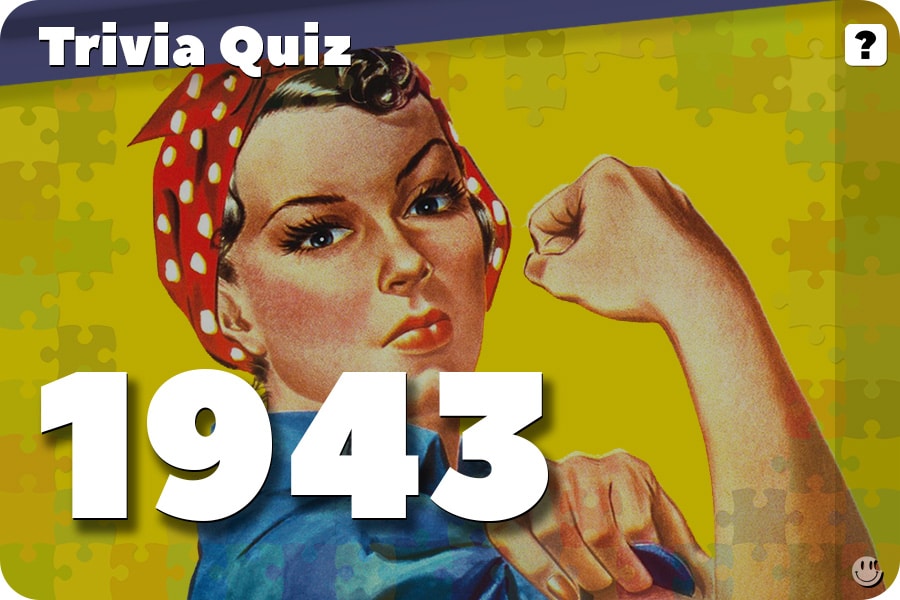
7. She was a song in 1942 and became a poster in 1943. Who was she?
Rosie the Riveter.
8. what was the average movie theater ticket price in 1943 to the nearest dime?
30 cents
9. NBC had two radio networks: the Blue Network and the Red Network. The Red Network was sold and became what radio, and later television, network?
ABC (American Broadcasting Company)
10. Born in 1943, this author wrote the second-best-selling book series, After Harry Potter. Name the author and his book series. Goosebumps by R.L. Stine
11. What was the Bestselling Fiction Book in 1943? The Robe by Lloyd C. Douglas
12. Lassie’s first movie was released in October of 1943. What was it called? Lassie Come Home
13. What was the Biggest Number One Song of 1943? I’ve Heard That Song Before by Harry James
14. What was the highest-grossing film of 1943? This is the Army
15. How many people lived in the United States in 1943?
The population was an estimated 136,739,353 people.
16. Name the Italian leader arrested on July 25, 1943…
Benito Mussolini
17. The third Dracula film was released through Universal Pictures and starred Lon Chaney Jr as Count Alucard. Name that horror sequel
Son of Dracula
18. Mexican-American youths and some members of the American military have a bit of a tussle in early June in East Los Angeles. What was that fight called?
The Zoot Suit Riots
19. Introduced in 1943, Kryptonite can injure Superman. Was it first introduced in his comic books, cartoons, or radio show?
The Adventures of Superman radio show. It gave a reason for him not to appear while his actor took a vacation.
20. Who won the Stanley Cup in 1943?
In 1943, The Detroit Red Wings won over the Boston Bruins (4 games to 0)
21. Who won the US Triple Crown of Thoroughbred Racing in 1943?
Count Fleet
22. Ignacio Anaya created this snack in Mexico, near the Texas border.
Nachos
23. This metal toy was introduced at a Gimbels department store and inducted into the Toy Hall of Fame in 2000. Later, it had its own commercial jingle.
The Slinky
24. This US Navy mystery involved the USS Eldridge, the Philadelphia Navy Shipyard, invisibility, and teleportation. Although probably a hoax, what is the name of the incident?
The Philadelphia Experiment
25. What is the all-time best-selling book originally written in French? The Little Prince (by Antoine de Saint-Exupéry)
26. How much did a gallon of gas cost in 1943?
$0.21 per gallon
27. This caped comic book hero appeared in both newspaper comic strips and a 15-part movie serial in 1943. Name that crimefighter.
Batman (and Robin)
28. It’s one of America’s most collectible coins and less than a few dozen were produced in 1943. Name that coin.
1943 Copper Penny (Most were made of steel)
29. Featuring Howard Roark, his 1943 novel by Ayn Rand was her first bestseller. The Fountainhead
30. This building was built in Washington, DC, between 1939 and 1943 in honor of an American president. Name that building.
Jefferson Memorial
31. Along with Emile Gagnan, who invented the Aqua-lung?
Jacques Cousteau
32. How much did a dozen eggs cost in 1943?
57 cents
33. Named after a trombone-like instrument, this was designed as an anti-tank weapon. Name that weapon.
Bazooka
34. Which celebrity was NOT born in 1943: John Denver, Keith Richards, Jim Morrison, Marvin Gaye Toni Basil?
Marvin Gaye (April 2, 1939 – April 1, 1984)
35. Who was the Time Magazine Man of the Year in 1943?
George Marshall
36. In the Warner Brothers cartoon Falling Hare, it didn’t happen very often, but who gets the best of Bugs Bunny?
A Gremlin.
37. Who was NOT at the WWII: Casablanca Conference: Winston Churchill, Joseph Stalin, Charles de Gaulle, or Franklin D. Roosevelt?
Joseph Stalin (he was focused on the Battle of Stalingrad)
38. What is the world’s largest office building?
The Pentagon (completed in 1943)
39. After this scientist died on January 7, 1943, the Federal Bureau of Investigation took all of his notes. Name that scientist.
Nikola Tesla (July 10, 1856 – January 7, 1943)
40. The city of Spearfish had a temperature fluctuation one morning of 49 degrees, from minus 4 to 45 degrees on January 22, 1943, within 2 minutes! In what state is Spearfish located? Hint: Rapid City had a similar rise that same day.
South Dakota
41. Who won the 1943 World Series?
In 1943, The New York Yankees won, beating the St. Louis Cardinals (4 games to 1)
42. What was the boat’s name under the command of future President John F. Kennedy’s boat?
PT-109
43. Born in 1943, this man co-founded Atari and Chuck-E-Cheese. Name him.
Nolan Bushnell
Trivia Team Bonus Questions:
1. Minister George Fox and Clark Poling, Roman Catholic priest John Washington, and Rabbi Alexander Goode all gave up their life jackets for servicemen and died at sea. What is the nickname for these men?
The Four Chaplains
2. What was the codename for World War II’s Battle of Normandy?
Operation Overlord.
3. Who were the 1943 NFL Champions?
Chicago Bears
4. In 1943, Mexican farmer Dionisio Pulido noticed a bump in his yard, which grew to 400 feet tall within a week. What was that bump in his yard?
A Volcano.
5. Who was the American Vice-President in 1943?
Henry A. Wallace (January 20, 1941 – January 20, 1945)
6. What government agency worked with Hollywood in censoring and propaganda during World War II?
(United States) Office of War Information
7. Name the star, an actor and singer, whose 20-room Hollywood mansion was destroyed by a fire while his family was taking down the Christmas tree.Bing Crosby
8. Who was the Pope in 1943?
Pope Pius XII, March 2, 1939 – October 9, 1958
9. Born this year, this actress was killed by the “Manson family” in 1969. Name that actress.
Sharon Tate
10. What Horse won the Kentucky Derby in 1943?
Count Fleet
The Answers:
43 Trivia Answers for 1943 History
1. This was the first major crossover release starring two monster characters from established films. Name the characters or film. Frankenstein Meets the Wolfman
2. During World War II, the National Football League merged the Philadelphia Eagles and the Pittsburgh Steelers into a single franchise. What was the name of that football team?
The Steagles (also Phil-Pitt)
3. This Broadway show opened on March 31, 1943, and ran through 1948—it became the longest-running musical play at that time. Name that show.
Oklahoma!
4. In 1943, what was the average life expectancy in the United States?
Men – 62.4 years, Women – 64.4 years.
5. Who was the President of the United States in 1943?
Franklin D. Roosevelt (March 4, 1933 – April 12, 1945)
6. This company was founded in 1943 by a 17-year-old Swedish carpenter named Ingvar Kamprad. Name his company.
IKEA
7. She was a song in 1942 and became a poster in 1943. Who was she?
Rosie the Riveter.
8. what was the average movie theater ticket price in 1943 to the nearest dime?
30 cents
9. NBC had two radio networks: the Blue Network and the Red Network. The Red Network was sold and became what radio, and later television, network?
ABC (American Broadcasting Company)
10. Born in 1943, this author wrote the second-best-selling book series, After Harry Potter. Name the author and his book series. Goosebumps by R.L. Stine
11. What was the Bestselling Fiction Book in 1943? The Robe by Lloyd C. Douglas
12. Lassie’s first movie was released in October of 1943. What was it called? Lassie Come Home
13. What was the Biggest Number One Song of 1943? I’ve Heard That Song Before by Harry James
14. What was the highest-grossing film of 1943? This is the Army
15. How many people lived in the United States in 1943?
The population was an estimated 136,739,353 people.
16. Name the Italian leader arrested on July 25, 1943…
Benito Mussolini
17. The third Dracula film was released through Universal Pictures and starred Lon Chaney Jr as Count Alucard. Name that horror sequel
Son of Dracula
18. Mexican-American youths and some members of the American military have a bit of a tussle in early June in East Los Angeles. What was that fight called?
The Zoot Suit Riots
19. Introduced in 1943, Kryptonite can injure Superman. Was it first introduced in his comic books, cartoons, or radio show?
The Adventures of Superman radio show. It gave a reason for him not to appear while his actor took a vacation.
20. Who won the Stanley Cup in 1943?
In 1943, The Detroit Red Wings won over the Boston Bruins (4 games to 0)
21. Who won the US Triple Crown of Thoroughbred Racing in 1943?
Count Fleet
22. Ignacio Anaya created this snack in Mexico, near the Texas border.
Nachos
23. This metal toy was introduced at a Gimbels department store and inducted into the Toy Hall of Fame in 2000. Later, it had its own commercial jingle.
The Slinky
24. This US Navy mystery involved the USS Eldridge, the Philadelphia Navy Shipyard, invisibility, and teleportation. Although probably a hoax, what is the name of the incident?
The Philadelphia Experiment
25. What is the all-time best-selling book originally written in French? The Little Prince (by Antoine de Saint-Exupéry)
26. How much did a gallon of gas cost in 1943?
$0.21 per gallon
27. This caped comic book hero appeared in both newspaper comic strips and a 15-part movie serial in 1943. Name that crimefighter.
Batman (and Robin)
28. It’s one of America’s most collectible coins and less than a few dozen were produced in 1943. Name that coin.
1943 Copper Penny (Most were made of steel)
29. Featuring Howard Roark, his 1943 novel by Ayn Rand was her first bestseller. The Fountainhead
30. This building was built in Washington, DC, between 1939 and 1943 in honor of an American president. Name that building.
Jefferson Memorial
31. Along with Emile Gagnan, who invented the Aqua-lung?
Jacques Cousteau
32. How much did a dozen eggs cost in 1943?
57 cents
33. Named after a trombone-like instrument, this was designed as an anti-tank weapon. Name that weapon.
Bazooka
34. Which celebrity was NOT born in 1943: John Denver, Keith Richards, Jim Morrison, Marvin Gaye Toni Basil?
Marvin Gaye (April 2, 1939 – April 1, 1984)
35. Who was the Time Magazine Man of the Year in 1943?
George Marshall
36. In the Warner Brothers cartoon Falling Hare, it didn’t happen very often, but who gets the best of Bugs Bunny?
A Gremlin.
37. Who was NOT at the WWII: Casablanca Conference: Winston Churchill, Joseph Stalin, Charles de Gaulle, or Franklin D. Roosevelt?
Joseph Stalin (he was focused on the Battle of Stalingrad)
38. What is the world’s largest office building?
The Pentagon (completed in 1943)
39. After this scientist died on January 7, 1943, the Federal Bureau of Investigation took all of his notes. Name that scientist.
Nikola Tesla (July 10, 1856 – January 7, 1943)
40. The city of Spearfish had a temperature fluctuation one morning of 49 degrees, from minus 4 to 45 degrees on January 22, 1943, within 2 minutes! In what state is Spearfish located? Hint: Rapid City had a similar rise that same day.
South Dakota
41. Who won the 1943 World Series?
In 1943, The New York Yankees won, beating the St. Louis Cardinals (4 games to 1)
42. What was the boat’s name under the command of future President John F. Kennedy’s boat?
PT-109
43. Born in 1943, this man co-founded Atari and Chuck-E-Cheese. Name him.
Nolan Bushnell
Trivia Team Bonus Questions:
1. Minister George Fox and Clark Poling, Roman Catholic priest John Washington, and Rabbi Alexander Goode all gave up their life jackets for servicemen and died at sea. What is the nickname for these men?
The Four Chaplains
2. What was the codename for World War II’s Battle of Normandy?
Operation Overlord.
3. Who were the 1943 NFL Champions?
Chicago Bears
4. In 1943, Mexican farmer Dionisio Pulido noticed a bump in his yard, which grew to 400 feet tall within a week. What was that bump in his yard?
A Volcano.
5. Who was the American Vice-President in 1943?
Henry A. Wallace (January 20, 1941 – January 20, 1945)
6. What government agency worked with Hollywood in censoring and propaganda during World War II?
(United States) Office of War Information
7. Name the star, an actor and singer, whose 20-room Hollywood mansion was destroyed by a fire while his family was taking down the Christmas tree.Bing Crosby
8. Who was the Pope in 1943?
Pope Pius XII, March 2, 1939 – October 9, 1958
9. Born this year, this actress was killed by the “Manson family” in 1969. Name that actress.
Sharon Tate
10. What Horse won the Kentucky Derby in 1943?
Count Fleet
The Slinky is a classic and iconic toy that has entertained children and adults for generations. A helical spring can perform a series of movements, such as “walking” down a flight of stairs or stretching and recoiling. The Slinky was invented in 1943 by Richard James, a naval engineer, and was introduced to the market in 1945.
Details: In 1943, Richard James was working at the Cramp Shipbuilding Company in Philadelphia when he accidentally knocked a tension spring off his desk. He observed the spring’s unique movement as it “walked” across the floor, which sparked the idea for the Slinky. Richard James and his wife, Betty James, experimented with different materials and sizes to perfect Slinky’s design. They eventually settled on a steel spring with 80 coils, creating the iconic Slinky that is still popular today.
After securing a $500 loan, Richard and Betty formed James Industries and began manufacturing the Slinky (US Patent #US691981A). The toy debuted at the Gimbels Department Store in Philadelphia in November 1945. All 400 Slinky toys available at the store sold out within 90 minutes, making it an instant success.
Effects on Pop Culture:
The Slinky has become a symbol of childhood nostalgia and has been featured in numerous movies, TV shows, and commercials, showcasing its enduring appeal.
The Slinky has inspired various spin-off toys and products, such as the Slinky Dog and Slinky Jr.
The Slinky has been mentioned in songs and parodies, further cementing its place in popular culture.
The Slinky was inducted into the National Toy Hall of Fame in 2000, recognizing its impact on the world of toys and play.
Prominent People and Countries Involved:
United States: The Slinky was invented and first produced in the United States, and it remains a popular toy in the country and around the world.
Richard James: The American naval engineer who invented the Slinky in 1943 and co-founded James Industries with his wife, Betty.
Betty James: The wife of Richard James, who played a crucial role in perfecting the Slinky’s design and marketing the toy. After Richard left the company in the 1960s, Betty took over and continued the success of the Slinky brand.
The Slinky was invented in 1943 by American naval engineer Richard James, who co-founded James Industries with his wife, Betty. The iconic toy debuted in 1945 and quickly became a symbol of childhood nostalgia, featured in various forms of media and inspiring spin-off products. The Slinky was inducted into the National Toy Hall of Fame in 2000, recognizing its impact on the world of toys and play.
World Changing Event: Nachos were invented circa 1943 by Ignacio “Nacho” Anaya in Piedras Negras, Coahuila, Mexico.
Influential Songs include: Paper Doll by The Mills Brothers
The Movies to Watch include The Ox-Bow Incident, Cabin in the Sky, For Whom the Bell Tolls, A Guy Named Joe, Lassie Come Home, This is the Army, Shadow of a Doubt, and The Song of Bernadette
The Most Famous Person in America was probably Betty Grable
Notable books include A Tree Grows in Brooklyn by Betty Smith
Price of 12 Quart sized Mason Jars in 1943: 98 cents
The Football Team(s): Due to a player shortage caused by WWII, The Pittsburgh Steelers and The Philadelphia Eagles merged and were known as the Steagles.
The Mystery: The USS Eldridge, docked at the Philadelphia Naval Yard, reportedly disappeared for a few minutes in a ‘transporter experiment,’ after which crew members reportedly suffered from sporadic invisibility, madness, and spontaneous combustion. The 1984 film, The Philadelphia Experiment was very loosely based on this report.
On August 13, 1943, J. Edgar Hoover received a letter alleging that the popularity of Frank Sinatra was being used to prepare the masses to accept a new “Hitler.” The FBI kept surveillance over Sinatra for the next 40 years.
Significant 1943 History:
January: The Battle of Stalingrad ended, with Soviet forces successfully driving German troops out of the city. This was a significant turning point in the war and dealt a heavy blow to German morale.
February: General Dwight D. Eisenhower was selected to command the Allied armies in Europe.
March: Rodgers and Hammerstein’s Oklahoma! opened on Broadway, heralding a new era in “integrated” stage musicals.
April: The Jefferson Memorial in Washington, DC, was dedicated on the 200th anniversary of Thomas Jefferson’s birthday.
May: The United States Army contracted with the University of Pennsylvania’s Moore School to develop the computer ENIAC.
June: The first game of the All-American Girls Professional Baseball League was played.
July: The Allies launched Operation Husky, the invasion of Sicily. This operation marked the first major Allied offensive against the Axis powers in Europe and was a prelude to the eventual invasion of mainland Italy.
August: The Allies bombed the Ploesti oil fields in Romania, a significant fuel source for the German war effort.
September: The Allies invaded Italy, with British and American forces landing on the southern coast. Italian dictator Benito Mussolini was overthrown and arrested.
October: The Battle of Kursk, the largest tank battle in history, occurred in the Soviet Union. The Soviet Red Army successfully repelled a German offensive, further turning the tide of the war on the Eastern front.
November: The Tehran Conference took place, with leaders of the Soviet Union, the United States, and the United Kingdom meeting to discuss strategy for the war.
December: The Battle of Berlin began; it was the last and one of the bloodiest battles of the Second World War in Europe.
Top Ten Baby Names of 1943
Mary, Barbara, Patricia, Linda, Carol, James, Robert, John, William, Richard
US Life Expectancy
1943 Males: 62.4 years, Females: 64.4 years
The Stars
Ingrid Bergman, Betty Grable, Rita Hayworth, Lena Horne, Veronica Lake, Hedy Lamarr, Carole Landis, Brenda Marshall, Jane Russell, Alexis Smith, Gene Tierney, Lana Turner
Entertainment History: The Oscars
The 15th Academy Awards occurred on March 4, 1943, at the Ambassador Hotel in Los Angeles. The ceremony was hosted by Bob Hope, marking his third time as the master of ceremonies. The film Mrs. Miniver was the star of the night, winning six Oscars, including Best Picture, Best Director for William Wyler, and Best Actress for Greer Garson. Her acceptance speech, clocking in at around five and a half minutes, became legendary for its length. James Cagney won Best Actor for his energetic portrayal of George M. Cohan in Yankee Doodle Dandy. The eligibility year for these awards was from January 1 to December 31, 1942. This was the first year the Best Animated Short category was introduced, with the award going to Der Fuehrer’s Face, a Walt Disney cartoon featuring Donald Duck in a satirical jab at Nazi Germany.
Miss America
Jean Bartel (Los Angeles, CA)
Time Magazine’s Man of the Year
George Marshall
Firsts, Inventions, and Wonders
Jacques-Yves Cousteau and Émile Gagnan invented the first commercially successful open circuit type of scuba diving equipment, the Aqua-lung.
A Mexican farmer, Dionisio Pulido, had a volcano (Volcán de Parícutin) start forming in his cornfield. By the early 1950s, it was over 400 meters tall. Before being evacuated and leaving his home for the last time, he left a sign that read, “This volcano is owned and operated by Dionisio Pulido.” In 1997, CNN included Parícutin in its list of the Seven Natural Wonders of the World.
Pizza Uno first created the first Deep-Dish Pizza in 1943.
Bea Arthur (Dorothy from The Golden Girls) was a US Marine from 1943 to 1945 with an honorably discharged rank of staff sergeant.
Vicodin and Lortab were first produced in Germany.
1943 ‘Wartime’ Pennies and Nickels
‘Wartime nickels’ aka ‘war nickels’ were minted from 1943 to 1945. The temporary composition was 56% copper, 35% silver, and 9% manganese. Minted in 1938, the original design of the Jefferson nickel was created by Felix Schlag.
1943 Silver Pennies – Like nickel, copper was needed for the war effort. 1943 steel pennies were made with low-grade steel and coated with zinc. They had previously been made with a 95 percent copper-based bronze. The Mint switched back to creating copper pennies in 1944.
An estimated 40 copper pennies were created by accident in 1943 and have become some of the most valuable and sought-after coins by collectors.
World War II News
In Russia, the Battle of Stalingrad came to an end with the surrender of the German 6th Army.
Stalin’s son, Yakov Dzhugashvili, was captured by the Germans during World War 2. The Germans proposed a prisoner exchange: Stalin’s son for a German Field Marshall. Stalin’s response to this request was, ”I will not trade a Marshall for a Lieutenant.” His son died in 1943.
US General Dwight D. Eisenhower became the supreme Allied commander.
On November 5th, four bombs were dropped on the neutral Vatican City. The aircraft responsible was never identified.
The Pentagon, considered to be the world’s largest office building, was completed.
During a press conference in June 1943, Congressman Andrew May noted that Japanese depth charges detonated too soon to be effective. After the press releases, the Japanese changed depth-charge tactics, killing 800 US submariners.
The Four Chaplains of the U.S. Army were among those who drowned when their ship, Dorchester, was struck by a German torpedo in the North Atlantic.
The Gloster Meteor, the first Allied jet fighter, was introduced.
In the United States, rationing included gasoline, canned food, meat, shoes, cheese, butter, and cooking oils.
Due to wartime blackouts, a no-lit New Year’s Eve Ball was held at One Times Square in 1942 and 1943.
The RMS Queen Mary carried 16,683 American troops from New York to Great Britain, the (still) standing record for the most passengers ever transported on one vessel.
Future American President John F. Kennedy’s command, the PT-109, was sunk by a Japanese destroyer, the Amagiri. Kennedy was awarded the Purple Heart for injuries he sustained in the collision.
The Rescue
Brazilian fishermen rescued Chinese steward Poon Lim after being adrift for 130 days.
Pop Culture History
Duke Ellington played at New York City’s Carnegie Hall for the first time.
The Conical Bra was made famous by Jane Russell.
January 22, 1943, the temperature in Spearfish, South Dakota, changed from -4°F to 45°F in just two minutes, setting a world record. This was caused by a Chinook wind, which eventually increased the temperature to 54°F before dying down, dropping the temperature back to -4°F.
Sliced bread was banned temporarily in the United States in 1943 for wartime conservation.
The Governor-General of Canada declared Princess Juliana of the Netherlands’ hospital room extraterritorial so that her child born would still be in the line of succession.
Because so many players joined the WWII military service, the Pittsburgh Steelers and Philadelphia Eagles combined to become the Steagles during the 1943 season.
Disney made an animated short with Donald Duck titled Der Fuehrer’s Face to mock Hitler and the Nazis.
David Niven was the only British star in Hollywood to enlist during World War 2. When suspicious American guards asked during the Battle of the Bulge who had won the World Series in 1943, he answered, “Haven’t the foggiest idea … but I did co-star with Ginger Rogers in Bachelor Mother!”
Due to a player shortage caused by WWII, The Pittsburgh Steelers and The Philadelphia Eagles merged and were known as the Steagles.
On July 1st, the U.S. government started the payroll withholding tax.
Kryptonite, the only substance that can hurt or even kill Superman, was created as a plot device to allow his radio voice actor (1943) to take some time off, not from the comic books.
The first person ever diagnosed with autism was Mississippi resident Donald Triplett in 1943.
The Zoot Suit Riots erupted between military personnel and Mexican-American youths in East Los Angeles in early June.
Philip Morris ran an ad acknowledging Smoker’s cough in 1943. They claimed it was caused by smoking brands other than Philip Morris.
Oklahoma! was the first great American Musical. It was the first musical play that genuinely added a full story to the production. Older musicals primarily had a loose plot revolving around songs and often major dance and stage productions. The show began on March 31, 1943, and ran for 2,212 performances through its initial run, ending in 1948. It has had many revivals as well.
Packard Motors promoted three blacks to work next to whites on the assembly line, causing 25,000 workers to walk off the job.
Chinese immigrants were officially banned from the United States for 61 years (1882 to 1943).
Mohandas Gandhi held a hunger strike from February 10 until March 3, to protest his imprisonment.
Norman Rockwell’s Rosie the Riveter first appeared on the cover of The Saturday Evening Post.
The Biggest Films of 1943
1. This is the Army
2. For Whom the Bell Tolls
3. The Song of Bernadette
4. Stage Door Canteen
5. Star-Spangled Rhythm
6. Casablanca (Pop Culture Classic)
7. Cabin in the Sky (Pop Culture Classic)
8. The Outlaw
9. Frankenstein Meets the Wolf Man (Pop Culture Classic)
10. Lassie Come Home (Pop Culture Classic)
11. The Ox-Bow Incident
12. To The Shores of Tripoli
13. Girl Crazy
14. Watch on the Rhine
15. A Guy Named Joe
16. Thousands Cheer
17. Jitterbugs
18. Batman (Columbia Pictures serial)
19. Cry ‘Havoc’
20. I Walked with a Zombie
*Movies beyond the Top Five are based on (a somewhat subjective) ranking based on how much they had a long-lasting effect on Pop Culture.
The Disasters
An explosion at Smith Mine #3 in Bearcreek, Montana, United States, killed 74 coal miners.
Gulf Hotel fire: A fire at the Gulf Hotel in Houston, Texas, killed 55 people.
Popular Quote
“Grown-ups never understand anything for themselves, and it is tiresome for children to be always and forever explaining things to them.”
– The Little Prince
Unpopular Quote:
Thomas Watson, chairman of IBM, said in 1943, “I think there is a world market for maybe five computers.”
Broadway Shows
The Voice of the Turtle (Play) Opened on December 8, 1943, and closed on January 3, 1948
Oklahoma! (Musical) Opened on March 31, 1943, and closed on May 29, 1948
Nobel Prizes
Physics – Otto Stern
Chemistry – George de Hevesy
Physiology or Medicine – Carl Peter Henrik Dam, Edward Adelbert Doisy
Literature – not awarded
Peace – not awarded
Popular and Best-selling Books From 1943
A Tree Grows in Brooklyn by Betty Smith
The Apostle by Sholem Asch
The Forest and the Fort by Hervey Allen
The Fountainhead – Ayn Rand
The Human Comedy by William Saroyan
Hungry Hill by Daphne du Maurier
The Little Prince by Antoine de Saint-Exupéry
Mrs. Parkington by Louis Bromfield
The Robe by Lloyd C. Douglas
So Little Time by John P. Marquand
The Song of Bernadette by Franz Werfel
The Valley of Decision by Marcia Davenport
Sports
World Series Champions: New York Yankees
NFL Champs: Chicago Bears
Stanley Cup Champs: Detroit Red Wings
U.S. Open Golf: Not played due to WWII
U.S. Tennis (Men/Ladies): Lt. Joseph R. Hunt/Pauline Betz
Wimbledon (Men/Women): not held
NCAA Football Champions: Notre Dame
NCAA Basketball Champions: Wyoming
Kentucky Derby Winner: Pensive
Boston Marathon Winner: Gérard Côté Time: 2:28:25
Tehran Conference Between the Allies’ “Big Three” Leaders
The Tehran Conference, also known as the Eureka Conference, was a critical meeting held during World War II between the “Big Three” Allied leaders: British Prime Minister Winston Churchill, U.S. President Franklin D. Roosevelt, and Soviet Premier Joseph Stalin November 28 – December 1, 1943. The conference occurred in Tehran, Iran, from November 28 to December 1, 1943. This was the first time the three leaders met in person to discuss war strategy and post-war plans, ultimately shaping the course of the conflict and the future of Europe.
The Tehran Conference focused on coordinating military strategy and discussing the opening of a second front against Nazi Germany. The major decisions made during the conference included:
Details:
The commitment to launch Operation Overlord (the invasion of German-occupied Western Europe) in June 1944, led by U.S. General Dwight D. Eisenhower.
A promise from the Soviet Union to enter the war against Japan once Germany was defeated.
The recognition of Iran’s independence and the importance of providing economic assistance to the country.
Discussions on post-war arrangements, including the division of Germany, the creation of a United Nations organization, and Soviet influence in Eastern Europe.
The Tehran Conference was held at the Soviet Embassy, with each leader staying in a separate residence for security reasons.
The nickname “Eureka” was derived from a comment made by Churchill, who reportedly exclaimed, “Eureka!” when the decision was made to launch Operation Overlord.
During the conference, the “Big Three” leaders were the target of a Nazi assassination plot known as Operation Long Jump, but the plot was foiled by Soviet intelligence.
Effects on Pop Culture: The Tehran Conference significantly impacted popular culture by shaping the narrative of World War II and its aftermath. Some of the ways it influenced pop culture include:
The conference has been depicted in numerous films, documentaries, and books, highlighting the importance of the meeting in shaping the course of the war and post-war Europe.
The term “Big Three” became synonymous with the leaders of the major Allied powers, with the trio often depicted in various forms of media as symbols of wartime cooperation and unity.
The Tehran Conference has been referenced in alternate history stories and conspiracy theories, exploring different outcomes if the conference had made different decisions or if the Nazi assassination plot had succeeded.
Prominent People and Countries Involved:
Winston Churchill: As the British Prime Minister, Churchill played a vital role in the Tehran Conference and the broader Allied war effort.
Franklin D. Roosevelt: The U.S. President’s leadership during the conference and commitment to opening a second front against Germany helped shape the war’s course.
Joseph Stalin: The Soviet Premier’s participation in the conference and pledge to join the war against Japan were critical to developing Allied strategy.
Iran: As the host country, Iran’s strategic location and significance were recognized during the conference, with discussions on the nation’s independence and future economic assistance.
The Tehran Conference between the “Big Three” Allied leaders during World War II was a pivotal event that shaped the course of the war and the future of Europe. The conference’s major decisions, such as the commitment to Operation Overlord and the Soviet Union’s promise to enter the war against Japan, played crucial roles in the eventual defeat of Nazi Germany. The Tehran Conference has had a lasting impact on popular culture, with its narrative and significance explored through various forms of media.
The Cairo Conference was a series of meetings held during World War II between leaders of the Allied powers, aimed at discussing military strategy and coordinating efforts against the Axis powers. The conference took place in Cairo, Egypt, from November 22 to 26, 1943, and involved representatives from the United States, the United Kingdom, and the Republic of China. The Soviet Union was not present at the conference, as they were not at war with Japan then.
The main participants in the Cairo Conference were U.S. President Franklin D. Roosevelt, British Prime Minister Winston Churchill, and Chinese Generalissimo Chiang Kai-shek. The leaders discussed various strategic issues, such as the progress of the war against Germany, the planned invasion of France, and future operations in the Pacific theater against Japan.
One of the key outcomes of the conference was the Cairo Declaration, which outlined the Allies’ goals concerning the Asia-Pacific region. The declaration stated that Japan must be stripped of all territories acquired since 1894 and that Korea should become independent after the war. Additionally, the Allies agreed to continue supporting China in their struggle against Japanese aggression.
Details:
The conference took place at the residence of the American ambassador to Egypt, Alexander Kirk, located in the Cairo suburb of Mena House.
The Cairo Conference was held concurrently with the Tehran Conference, where Roosevelt and Churchill met with Soviet leader Joseph Stalin to discuss European military strategy.
Effects on Pop Culture:
The Cairo Conference is not as well-known in popular culture as other wartime conferences, such as Yalta or Tehran. However, it is occasionally referenced in historical works and documentaries about World War II.
The conference has been depicted in a few films and television series focused on the broader events of World War II. Still, it typically does not receive significant attention in these productions.
Prominent People and Countries Involved:
United States: President Franklin D. Roosevelt represented the United States at the conference, playing a crucial role in shaping Allied strategy in the Asia-Pacific region.
United Kingdom: British Prime Minister Winston Churchill participated in the discussions, working closely with Roosevelt and Chiang Kai-shek to coordinate military efforts against the Axis powers.
Republic of China: Generalissimo Chiang Kai-shek represented China, a key ally in the fight against Japan.
In summary, the Cairo Conference was an important series of meetings held during World War II between leaders of the Allied powers aimed at coordinating military strategy against the Axis powers. The conference resulted in the Cairo Declaration, which outlined the Allies’ goals in the Asia-Pacific region, including the eventual independence of Korea and the return of territories seized by Japan. Although the Cairo Conference is not widely referenced in popular culture, it significantly shaped the war’s course.
United Nations Relief and Rehabilitation Administration (UNRRA)
The United Nations Relief and Rehabilitation Administration (UNRRA) was an international agency established during World War II to provide relief and assistance to war-affected countries. The Allies created the organization to help rebuild and provide humanitarian aid to countries devastated by the war, including food, clothing, medical supplies, and other necessities. UNRRA played a crucial role in post-war recovery efforts and laid the groundwork for future international humanitarian and development organizations.
Details: UNRRA was officially founded on November 9, 1943, following an agreement between 44 Allied nations at the White House. The organization focused on providing immediate relief to war-torn countries, supporting refugees and displaced persons, and facilitating the repatriation of prisoners of war. UNRRA was instrumental in rebuilding infrastructure, supporting agriculture, and providing vocational training to help people rebuild their lives.
At its peak, UNRRA employed over 25,000 people worldwide and operated in more than 25 countries. The organization’s operations were funded by member countries, with the United States, the United Kingdom, and the Soviet Union being the largest contributors.
UNRRA’s work began to wind down in 1947, with most of its responsibilities transferred to other organizations, such as the International Refugee Organization (IRO) and the World Health Organization (WHO). The UNRRA officially ceased operations in 1948.
Effects on Pop Culture: While UNRRA may not have directly impacted pop culture, it laid the foundation for future international humanitarian and development organizations, such as the United Nations High Commissioner for Refugees (UNHCR) and the United Nations Children’s Fund (UNICEF). These organizations have been depicted in various films, books, and documentaries, highlighting their work in providing aid and support to those affected by conflict, disasters, and other crises.
Prominent People and Countries Involved:
United States: As one of the main contributors to UNRRA, the U.S. played a significant role in the organization’s establishment and operations. President Franklin D. Roosevelt was instrumental in promoting UNRRA’s creation.
United Kingdom: The UK was another major contributor to UNRRA, supporting its efforts to provide relief to war-affected countries and playing a key role in its administration.
Soviet Union: As a major power in the Allied coalition and one of the main contributors to UNRRA, the Soviet Union was involved in the organization’s operations and administration.
In summary, the United Nations Relief and Rehabilitation Administration (UNRRA) was an international agency established in 1943 by 44 Allied nations to provide relief and assistance to countries affected by World War II. UNRRA played a vital role in post-war recovery efforts, helping millions of people rebuild their lives and laying the groundwork for future international humanitarian and development organizations. While the organization may not have directly impacted pop culture, its legacy continues to influence the work of modern humanitarian agencies.
The Philadelphia Experiment is an alleged military experiment said to have taken place during World War II. According to conspiracy theories, the United States Navy attempted to create an invisible ship to radar and the human eye using electromagnetic fields. The experiment supposedly occurred at the Philadelphia Naval Shipyard and involved the USS Eldridge, a Cannon-class destroyer escort. Despite numerous claims and stories, there is no substantial evidence to support the existence of this experiment, and the U.S. Navy has consistently denied its occurrence.
Details:
The story of the Philadelphia Experiment gained traction in the 1950s when Carl M. Allen, using the pseudonym Carlos Allende, sent a series of letters to Morris K. Jessup, an author who had written about UFOs. Allen claimed he had witnessed the USS Eldridge disappearing and reappearing during the alleged experiment in 1943. According to the story, the crew members on board the ship experienced severe side effects, such as disorientation, nausea, and in some cases, being fused to the ship’s hull.
The story of the Philadelphia Experiment has been largely discredited by experts and researchers, who argue that the science behind the alleged invisibility technology is implausible.
The Office of Naval Research investigated the claims made by Carlos Allende and found no evidence to support the existence of the Philadelphia Experiment.
Effects on Pop Culture: Despite the lack of evidence and official denials, the Philadelphia Experiment has become popular in conspiracy theories and science fiction. It has been referenced in various forms of media, including:
The 1984 science fiction film “The Philadelphia Experiment,” directed by Stewart Raffill, tells a fictionalized story of two sailors transported to the 1980s after being caught in the experiment.
Numerous novels, television shows, and documentaries have explored or mentioned the Philadelphia Experiment, often in the context of secret government projects or time travel.
Prominent People and Countries Involved:
United States: As the alleged location of the Philadelphia Experiment, the United States plays a central role in the conspiracy theory.
U.S. Navy: The Navy has consistently denied any involvement in the alleged experiment and has emphasized that the claims made in the story are scientifically implausible.
Ihe Philadelphia Experiment is an alleged military experiment that supposedly took place during World War II, involving the creation of an invisible ship using electromagnetic fields. Despite being widely discredited by experts and denied by the U.S. Navy, the story has become popular in conspiracy theories and science fiction, inspiring numerous films, novels, and television shows.
Streptomycin, an antibiotic, was discovered by Dr. Selman Waksman, a Ukrainian-born American biochemist and microbiologist. The discovery marked a significant milestone in the field of medicine, as streptomycin became the first antibiotic effective against tuberculosis (TB) and many other bacterial infections. The development of streptomycin paved the way for the modern use of antibiotics and revolutionized the treatment of infectious diseases.
Details:
Dr. Selman Waksman and his research team, which included Albert Schatz, a graduate student, isolated streptomycin from the soil bacterium Streptomyces griseus. The discovery was made in their laboratory at Rutgers University in New Jersey, USA. Streptomycin was effective against many bacteria, including Mycobacterium tuberculosis, the causative agent of tuberculosis. Its ability to combat TB was a major breakthrough, as TB was a leading cause of death worldwide.
Dr. Selman Waksman was awarded the Nobel Prize in Physiology or Medicine in 1952 for his discovery of streptomycin.
Waksman coined the term “antibiotics” and is often called the “Father of Antibiotics.”
Albert Schatz, who played a crucial role in the discovery, was not recognized with a Nobel Prize, leading to a legal dispute between Schatz and Waksman.
Effects on Pop Culture: While the discovery of streptomycin may not have directly impacted pop culture, its significance in the medical field has been widely recognized and celebrated. For example:
Dr. Selman Waksman’s life and achievements have been featured in various documentaries and biographical works.
The discovery has been cited in numerous books, articles, and educational materials related to the history of medicine and the development of antibiotics.
Prominent People and Countries Involved:
Dr. Selman Waksman: As the scientist who discovered streptomycin, Dr. Waksman played a crucial role in revolutionizing the treatment of infectious diseases and was awarded the Nobel Prize for his work.
Albert Schatz: Schatz, a graduate student who collaborated with Waksman on the discovery, also made significant contributions to the development of streptomycin, although his role was not as widely recognized.
United States: As the country where the discovery of streptomycin took place, the United States has played a significant role in developing and distributing this life-saving antibiotic.
In summary, the discovery of streptomycin by Dr. Selman Waksman and his team in 1943 marked a turning point in treating infectious diseases, particularly tuberculosis. The development of this antibiotic revolutionized medicine and has been celebrated for its impact on global health. Dr. Waksman’s contributions to the field earned him the Nobel Prize, and the story of streptomycin’s discovery remains an important part of the history of medical advancements.
Operation Gomorrah: Allied Bombing Campaign Against Hamburg, Germany
During World War II, Operation Gomorrah was an eight-day air raid campaign by the British Royal Air Force (RAF) and the United States Army Air Forces (USAAF). The operation targeted Hamburg, Germany’s second-largest city, and aimed to cripple the city’s industrial capacity, infrastructure, and morale. Hamburg was a strategically important location, with its port facilities, shipyards, and U-boat construction facilities, making it a prime target for the Allied forces.
Details:
Operation Gomorrah began on July 24, 1943, with the RAF launching the first of several nighttime bombing raids. The USAAF followed up with daytime raids, creating a continuous assault on the city. In total, approximately 9,000 tons of explosives were dropped on Hamburg over the course of the operation.
The bombing campaign created a firestorm, a deadly combination of fire and wind that engulfed the city. The firestorm incinerated large parts of Hamburg, causing widespread destruction and 34,000 to 42,600 civilian casualties. The operation also displaced approximately one million people, as many fled the city to escape the devastation.
Took place over July 24, 1943 – August 3, 1943
The operation was named “Gomorrah” after the biblical city was destroyed by fire and brimstone in the Old Testament, reflecting the intensity of the bombing campaign.
Operation Gomorrah marked the first use of “Window,” a radar countermeasure involving releasing thousands of small, reflective strips of aluminum foil to confuse enemy radar systems.
The bombing raids were so intense that they created a rare weather phenomenon known as a “bomb cloud,” a mix of smoke, dust, and debris from the bombing.
Effects on Pop Culture:
Operation Gomorrah has been featured in various books, documentaries, and films depicting World War II events, including the 1983 German miniseries “Das Feuerzeug” and the 1993 British film “The Fire-Raiser.”
The operation is also referenced in the 2018 novel “Munich” by Robert Harris, which is set during the early years of World War II.
Prominent People and Countries Involved:
United Kingdom: The British Royal Air Force played a significant role in carrying out nighttime bombing raids during Operation Gomorrah.
United States: The United States Army Air Forces conducted daytime bombing raids as part of the operation, contributing to the destruction of Hamburg.
Germany: As the target of Operation Gomorrah, Hamburg suffered immense destruction and civilian casualties, severely impacting the city’s industrial capacity.
In summary, Operation Gomorrah was an intense eight-day air raid campaign by the British RAF and the USAAF against the German city of Hamburg in 1943. The operation caused widespread destruction, resulting in tens of thousands of civilian casualties and displaced approximately one million people. The events of Operation Gomorrah have been featured in various forms of popular culture, serving as a reminder of the devastating impact of aerial bombing campaigns during World War II.
The Nazis established the Warsaw Ghetto in October 1940 in the occupied Polish capital of Warsaw. It was the largest ghetto in Nazi-occupied Europe, housing over 400,000 Jews in extremely cramped and unsanitary conditions. The forced deportation of Jews from the Warsaw Ghetto, known as the Grossaktion Warsaw, began on July 22, 1942, as part of the Nazis’ “Final Solution” – their plan to systematically exterminate the Jewish population.
Facts:
During the Grossaktion Warsaw, the Nazis, under the command of SS-Brigadeführer Jürgen Stroop, deported approximately 254,000-300,000 Jews from the Warsaw Ghetto to the Treblinka extermination camp. The deportations occurred daily, with thousands of Jews being rounded up, forced onto trains, and sent to their deaths.
The Nazis used the euphemism “Resettlement to the East” to describe the deportations, which were, in fact, a systematic process of sending Jews to extermination camps.
Jewish leaders in the Warsaw Ghetto, such as Adam Czerniaków, the head of the Judenrat (Jewish Council), were initially unaware of the true purpose of the deportations. When Czerniaków realized the fate that awaited his people, he committed suicide on July 23, 1942.
The deportations were temporarily halted on Yom Kippur (September 21, 1942) but resumed shortly after.
Effects on Pop Culture:
The forced deportation of Jews from the Warsaw Ghetto has been depicted in numerous films, books, and documentaries, including “The Pianist” (2002), a film directed by Roman Polanski and based on the autobiography of Polish-Jewish pianist Władysław Szpilman.
The events in the Warsaw Ghetto have also been chronicled in works such as “Mila 18” (1961), a novel by Leon Uris, and “The Wall” (1950), a novel by John Hersey, both of which are based on the broader context of the Jewish resistance during the Holocaust.
Prominent People and Countries Involved:
Nazi Germany: Under Adolf Hitler’s rule, Nazi Germany orchestrated the Holocaust, which led to the systematic extermination of approximately six million Jews, including those deported from the Warsaw Ghetto.
Poland: As the country where the Warsaw Ghetto was located, Poland was directly affected by the forced deportations and the Holocaust. It’s estimated that around 3 million Polish Jews were killed during the Holocaust.
Jewish Resistance: Some Jews in the Warsaw Ghetto, such as Mordechai Anielewicz, were involved in organizing resistance against the Nazis. This resistance culminated in the Warsaw Ghetto Uprising in 1943, ultimately suppressed by the Nazis.
In summary, the forced deportation of Jews from the Warsaw Ghetto, also known as the Grossaktion Warsaw, was a horrific event from July to September 1942. Over 250,000 Jews were forcibly deported to the Treblinka extermination camp as part of the Nazis’ “Final Solution.” The tragic events in the Warsaw Ghetto have been depicted in various forms of popular culture, including films, novels, and documentaries, and continue to serve as a somber reminder of the atrocities committed during the Holocaust.
Oklahoma!
This title song from Rodgers and Hammerstein’s Oklahoma! (1943) is a jubilant celebration that closes the musical with a rousing full-cast performance. The show, based on the play Green Grow the Lilacs, redefined musical theater by integrating songs that propelled the story forward rather than serving as stand-alone showcases. The title song became so iconic that it was later adopted as Oklahoma’s official state song, cementing its place in American history.
Frank Sinatra
People Will Say We’re in Love
This duet between Curly and Laurey, the romantic leads in Oklahoma!, explores their budding relationship and their attempts to hide their feelings from others. Frank Sinatra’s recording brought the heartfelt lyrics and lilting melody to wider audiences, helping solidify the song as one of the most beloved numbers from the musical.
Bing Crosby
Oh, What a Beautiful Morning
Rodgers and Hammerstein opened Oklahoma! with this optimistic tune, breaking from the tradition of starting musicals with a large production number. Bing Crosby’s version became a classic, embodying the pastoral charm of the American countryside. Its enduring appeal lies in its simplicity and the hope it conveys.
Anne Shelton
You’d Be So Nice to Come Home To
Written by Cole Porter for the film Something to Shout About (1943), this romantic tune became a hit for Anne Shelton and Dinah Shore in the same year. With its heartfelt lyrics and Porter’s sophisticated melody, the song resonated deeply with listeners during World War II, offering a sense of longing and comfort for soldiers and their loved ones.
Benny Goodman
Taking a Chance on Love
Originally featured in the all-Black musical Cabin in the Sky (1940), this song by Vernon Duke (music), John Latouche, and Ted Fetter (lyrics) gained widespread popularity when Benny Goodman recorded it with Helen Forrest on vocals in 1943. Goodman’s version topped the charts, bringing this jazz-infused love song to a broader audience.
Dick Haymes
You’ll Never Know
Based on a poem by war bride Dorothy Fern Norris, this song was adapted by Harry Warren (music) and Mack Gordon (lyrics). It debuted in the film Hello, Frisco, Hello (1943), sung by Alice Faye. Although Faye didn’t record it commercially, Dick Haymes’s rendition became a major hit, staying at No. 1 on the R&B charts for four weeks. The song won the Academy Award for Best Original Song and remains a poignant wartime ballad.
Duke Ellington
Don’t Get Around Much Anymore
Originally an instrumental titled Never No Lament (1940), this tune gained new life in 1942 when Bob Russell added lyrics and renamed it. Both Duke Ellington and The Ink Spots released vocal versions in 1943, with both topping the R&B charts. Ellington’s version also reached No. 8 on the pop charts, becoming a jazz standard.
Judy Garland and Gene Kelly
For Me and My Gal
This title song from the 1942 movie musical For Me and My Gal marked Gene Kelly’s screen debut alongside Judy Garland. Written by George W. Meyer, Edgar Leslie, and E. Ray Goetz, the song captures the charm of vaudeville and World War I-era romance. The film, directed by Busby Berkeley, was nominated for an Academy Award for its score, solidifying the song as a classic.
1943’s Most Popular and Influential Songs
1. Paper Doll – The Mills Brothers
2. As Time Goes By – Rudy Vallee or Jacques Renard
3. That Old Black Magic – Glenn Miller or Freddie Slack or Horace Heidt
4. Sentimental Lady – Duke Ellington and His Famous Orchestra
5. There Are Such Things – Tommy Dorsey with Frank Sinatra
6. People Will Say We’re In Love – Bing Crosby and Trudy Erwin or Frank Sinatra
7. Don’t Get Around Much Anymore – The Ink Spots or Glen Gray or Duke Ellington
8. Don’t Cry, Baby – Erskine Hawkins and His Orchestra
9. Night and Day – Frank Sinatra (a hit in 1944 too)
10. I Can’t Stand Losing You – The Ink Spots
11. All Or Nothing At All – Frank Sinatra with Harry James
12. Don’t Stop Now – Bonnie Davis
13. Oh! What A Beautiful Mornin’ – Bing Crosby and Trudy Erwin or Frank Sinatra
14. Don’t Get Around Much Anymore (Never No Lament) – Duke Ellington and His Famous Orchestra or The Ink Spots or Glen Gray
15. You’d Be So Nice To Come Home To – Dinah Shore or Dick Jurgens or Six Hits and a Miss
16. You’ll Never Know – Dick Haymes or Frank Sinatra or Willie Kelly
17. For Me and My Gal – Judy Garland and Gene Kelly or Guy Lombardo
18. Apollo Jump – Lucky Millinder and His Orchestra
19. I Heard You Cried Last Night – Harry James with Helen Forrest or Dick Haymes
20. All For You – King Cole’s Trio
21. Brazil (Aquarela Do Brasil) – Xavier Cugat or Jimmy Dorsey
22. Taking A Chance On Love – Benny Goodman or Sammy Kaye
23. In The Blue of the Evening – Tommy Dorsey featuring Frank Sinatra
24. What’s The Use Of Getting Sober (When You Gonna Get Drunk Again) – Louis Jordan and His Tympany Five
25. It’s Always You – Tommy Dorsey with Frank Sinatra
26. That Ain’t Right – King Cole Trio
27. I Had The Craziest Dream – Harry James with Helen Forrest
28. I’ve Heard That Song Before – Harry James with Helen Forrest
29. Pistol Packin’ Mama – Al Dexter and His Troopers or Bing Crosby and The Andrews Sisters
30. Sweet Slumber – Lucky Millinder and His Orchestra
Top Artists and Songs of 1943
Al Dexter & His Troops
Pistol Packin’ mama
Anne Shelton
You’d Be So Nice To Come Home To
Benny Goodman
Taking A Chance On Love, Why Don’t You Do Right?
Bing Crosby & The Andrews Sisters
Pistol Packin’ Mama
Bing Crosby and Trudy Erwin
Oh What A Beautiful Morning, People Will Say We’re In Love
Bing Crosby
Whispering Oh What a Beautiful Morning, Sunday Monday or Always, If You Please
Dick Haymes
You’ll Never Know, It Can’t Be Wrong, Put Your Arms Around Me Honey
Dick Kuhn & his Orchestra
Put Your Arms Around Me Honey
Dinah Washington
Evil Gal Blues
Dinah Shore
You’d Be So Nice To Come Home To, (As Long As You’re Not in Love with Anyone Else) Why Don’t You Fall In Love With Me?
Duke Ellington
Sentimental Lady, Don’t Get Around Much Anymore, Perdido, Slip of the Lip
Ella Mae Morse
Shoo-Shoo-Baby
Erskine Hawkins
Don’t Cry Baby
Frank Sinatra
All or Nothing at All, Sunday Monday Always, You’ll Never Know, People Will Say We’re In Love, Close To You
Freddy Slack
That Old Black Magic
Gene Autry
Deep In The Heart of Texas
Glen Gray
Don’t Get Around Much Anymore
Glenn Miller Orchestra
That Old Black Magic, Blue Rain, Rhapsody In Blue
Harry James
Two O’Clock Jump, I’ve Heard That Song Before, Mister Five By Five, I Had The Craziest Dream, Velvet Moon, I Heard You Cried Last Night
Jacques Renard & his Orchestra
As Time Goes By
Jimmy Dorsey
They’re Either Too Young Or Too Old
Jimmy Wakely
There’s A Star-Spangled Banner Waving Somewhere
Judy Garland and Gene Kelly
For Me and My Gal
Judy Garland
Zing! Went The Strings of My Heart
Kate Smith
I Don’t Want To Walk Without You
Kay Kyser
Praise The Lord and Pass the Ammunition
Kay Sherman
The Dreamer/How Sweet You Are
King Cole Trio
All For You
Lena Horne
Stormy Weather
Louis Jordan
That’ll Just ‘Bout Knock Me Out
Mills Brothers
Paper Doll
Oklahoma! Theme
Oklahoma Soundtrack
Rudy Vallee and his Connecticut Yankees
As Time Goes By
Stan Kenton
Artistry In Rhythm
The Ink Spots
Don’t Get Around Much Anymore
The Song Spinners
Johnny Zero
Tommy Dorsey and Frank Sinatra
There Are Such Things, In The Blues Of The Evening
Vaughn Monroe
When The Lights Go On Again (All Over The World), Let’s Get Lost
The Battle of Kursk was a significant engagement between the Axis powers, led by Nazi Germany, and the Soviet Union during World War II. As the German army attempted to regain the initiative on the Eastern Front after a series of defeats, they planned a large-scale offensive named Operation Citadel. The goal was to encircle and destroy Soviet forces in the Kursk salient. In response, the Soviet Union fortified the area heavily and prepared for the anticipated attack.
Details: The battle began on July 5, 1943, when German forces launched their offensive. Soviet defenses, however, were well-prepared, and they managed to absorb the brunt of the attack. The most famous portion of the battle, the Battle of Prokhorovka, took place on July 12. It involved hundreds of tanks from both sides, making it the largest tank battle in history.
The Germans could not make any significant progress, and by July 13, they began to withdraw their forces. The Soviets launched a series of counteroffensives on July 12, continuing until August 23, pushing the Germans back and regaining territory.
Effects on Pop Culture:
The Battle of Kursk has been featured in numerous books, films, and documentaries, focusing on the massive scale and intensity of the engagement.
The battle is a popular subject for military historians and has been studied extensively, influencing the understanding of armored warfare tactics.
The Battle of Kursk is a prominent topic in video games featuring World War II, allowing players to experience the historical event in an interactive setting.
Prominent People and Countries Involved:
Nazi Germany: The primary Axis power that launched Operation Citadel, attempting to regain the initiative on the Eastern Front.
Soviet Union: The country that successfully defended the Kursk salient and launched counteroffensives against the German forces.
Adolf Hitler: The dictator of Nazi Germany who ordered the Kursk offensive.
Erich von Manstein: A German field marshal who planned and led Operation Citadel.
Georgy Zhukov: A Soviet military commander who played a significant role in organizing and coordinating the defense of the Kursk salient and subsequent counteroffensives.
From July 5 to August 23, 1943, the Battle of Kursk was the largest tank battle in history and a pivotal engagement during World War II. The battle saw Nazi Germany attempt to regain the initiative on the Eastern Front, only to be repelled by the well-prepared defenses of the Soviet Union. The Battle of Kursk has left a lasting impact on popular culture, being featured in various forms of media. It has influenced the understanding of armored warfare tactics in modern military history.
The Detroit Race Riots occurred during World War II, fueled by racial tensions and social inequalities in Detroit, Michigan. The riot was one of the most violent and destructive race riots in the United States, resulting in 34 deaths, hundreds of injuries, and significant property damage. The event highlighted the need for addressing racial disparities and promoting social justice in the United States.
Details:
The Detroit Race Riots on June 20-22, 1943, after a fight broke out between Black and white individuals at Belle Isle Park, a popular recreational area in Detroit. The conflict quickly escalated, and rumors spread throughout the city, leading to widespread violence between Black and white residents. Over the course of three days, the rioting resulted in the deaths of 25 African Americans and nine white individuals, as well as around 700 injuries and the destruction of numerous buildings and properties.
The riot occurred during a significant population growth in Detroit due to the migration of African Americans from the South seeking job opportunities in the city’s booming automobile industry.
The federal government intervened to quell the violence, deploying 6,000 federal troops to restore order in the city.
The Detroit Race Riot was one of several race riots in the United States in the summer of 1943, known as the “Race Riot Year.”
Effects on Pop Culture: While the Detroit Race Riot did not have an immediate impact on pop culture, it has since been referenced in various forms of media, including:
The 2017 film “Detroit,” directed by Kathryn Bigelow, which depicts the 1967 Detroit riots, also references the 1943 race riot to provide historical context and emphasize the recurring nature of racial tensions in the city.
The riot has been the subject of numerous books, articles, and documentaries examining the historical context and consequences of the event.
Prominent People and Countries Involved:
United States: As the country where the Detroit Race Riot occurred, the United States has had to grapple with the legacy of racial tensions and social inequalities that contributed to the violence.
Franklin D. Roosevelt: As the President of the United States at the time, Roosevelt authorized the deployment of federal troops to restore order in Detroit following the outbreak of the riot.
The Detroit Race Riot of 1943 was a violent and destructive event highlighting the racial tensions and social inequalities in the United States during World War II. The event has since been referenced in various forms of media, serving as a reminder of the need for continued efforts to address racial disparities and promote social justice.
The Zoot Suit Riots were a series of violent confrontations between U.S. servicemen and Mexican American youths, primarily in Los Angeles, California. The conflict stemmed from racial tensions, social inequalities, and the cultural significance of the zoot suit, an extravagant and oversized suit worn by many young Mexican American men during the 1940s. The riots highlighted the deep-seated racial and social issues in the United States during World War II.
Details:
Details: The Zoot Suit Riots began on June 3, 1943, when U.S. servicemen clashed with Mexican American youths wearing zoot suits. The incident escalated over the following days, with hundreds of U.S. servicemen and civilians joining in the violence, often targeting young Mexican American men regardless of whether they were wearing zoot suits. The rioters would strip the victims of their suits and, in some cases, beat them.
The zoot suit was considered a symbol of rebellion and extravagance, as it defied wartime rationing regulations on fabric use.
The riots were not limited to Los Angeles; similar incidents occurred in other cities across the United States during the same period.
Although the riots were primarily directed at Mexican American youths, African American and Filipino American individuals were also targeted.
Effects on Pop Culture: The Zoot Suit Riots had a notable impact on popular culture at the time and in the years since. Some examples include:
The riots inspired literature, such as the play “Zoot Suit” (1978) by Luis Valdez, which was later adapted into a film in 1981.
The event has been the subject of documentaries, including the PBS film “Zoot Suit Riots” (2002), which explores the social and cultural context of the riots.
The Zoot Suit Riots have been referenced in music, such as the song “Zoot Suit Riot” (1997) by the Cherry Poppin’ Daddies, which, although not directly about the riots, draws upon the cultural imagery of the era.
The riots are often cited in discussions of race relations and civil rights history in the United States, as they highlighted the racial tensions that existed even during a time of national unity in the face of a global conflict.
Prominent People and Countries Involved:
Mexican Americans: The primary victims of the Zoot Suit Riots, many young Mexican American men in Los Angeles and other cities faced violence and discrimination during this period.
U.S. Servicemen: The primary instigators of the riots, U.S. servicemen stationed in Los Angeles targeted zoot suit-wearing Mexican American youths, contributing to the escalating violence.
United States: As the country grappled with racial and social inequalities during World War II, the United States provided the backdrop for the Zoot Suit Riots, which exposed underlying tensions.
The Zoot Suit Riots in Los Angeles were a series of violent clashes between U.S. servicemen and Mexican American youths, sparked by racial tensions and the cultural significance of the zoot suit. The event has had a lasting impact on popular culture, inspiring literature, film, and music, and serving as a reminder of the racial and social issues that persisted in the United States during the 1940s.
The Warsaw Ghetto Uprising was the largest Jewish insurrection during the Holocaust, aimed at resisting the Nazis’ efforts to deport the remaining inhabitants of the Warsaw Ghetto to extermination camps. The uprising occurred in the context of the broader Holocaust, during which approximately 6 million Jews were systematically murdered by the Nazis and their collaborators. The Warsaw Ghetto Uprising, despite its tragic outcome, became a symbol of Jewish resistance and courage in the face of horrific persecution.
The Warsaw Ghetto was established in 1940, confining over 400,000 Jews in a small, impoverished city area. By the time of the uprising in 1943, most of the ghetto’s inhabitants had already been deported to extermination camps, leaving about 60,000 people behind. When the Nazis began a second wave of deportations in January 1943, Jewish resistance organizations within the ghetto decided to fight back.
The uprising began on April 19, 1943, through May 16, 1943, when German troops entered the ghetto to carry out further deportations. Jewish fighters, including members of the Jewish Combat Organization (ŻOB) and the Jewish Military Union (ŻZW), launched a coordinated armed resistance using homemade weapons and a limited supply of firearms smuggled into the ghetto.
Details:
The Warsaw Ghetto Uprising lasted nearly a month, much longer than the Nazis had anticipated.
Marek Edelman, one of the leaders of the ŻOB and a key participant in the uprising, later became a prominent cardiologist and human rights activist.
The fighting tactics employed by the Jewish resistance included hit-and-run attacks, underground bunkers construction, and homemade explosives.
Effects on Pop Culture: The Warsaw Ghetto Uprising has significantly impacted popular culture, inspiring various forms of artistic expression and serving as a symbol of courage and resistance. Some examples include:
The uprising has been the subject of numerous films, such as “Uprising” (2001) and “The Pianist” (2002), as well as documentaries like “Who Will Write Our History” (2018).
The event has been referenced in literature, both in historical accounts and works of fiction, such as John Hersey’s “The Wall” (1950) and Leon Uris’s “Mila 18” (1961).
The Warsaw Ghetto Uprising has inspired various songs, poems, and works of visual art that pay tribute to the bravery of the Jewish fighters and commemorate their struggle.
Prominent People and Countries Involved:
Mordechai Anielewicz: As the Jewish Combat Organization (ŻOB) leader, Anielewicz played a key role in organizing and leading the uprising.
Marek Edelman: A prominent member of the ŻOB and one of the few surviving leaders of the uprising, Edelman became a notable human rights activist.
Nazi Germany: As the perpetrators of the Holocaust and the force responsible for creating the Warsaw Ghetto, Nazi Germany was the primary antagonist of the uprising.
Poland: The Warsaw Ghetto Uprising took place in the country’s capital, and the event is an important part of Polish history and the broader story of World War II.
The Warsaw Ghetto Uprising was a significant act of Jewish resistance during the Holocaust. Although the uprising ultimately ended in tragedy, with the vast majority of the ghetto’s remaining inhabitants killed or deported, it has become a powerful symbol of courage and resilience in the face of persecution.
Admiral Isoroku Yamamoto was a Japanese naval officer and the commander-in-chief of the Combined Fleet during World War II. He was responsible for planning and executing the surprise attack on Pearl Harbor on December 7, 1941, which led to the United States’ entry into the war. Yamamoto was widely respected for his strategic acumen, and his death was a significant blow to the Japanese war effort.
On April 14, 1943, U.S. intelligence intercepted and decrypted a message detailing Yamamoto’s planned inspection tour of Japanese bases in the Solomon Islands. In response, the U.S. launched Operation Vengeance, a mission to intercept and shoot down Yamamoto’s plane.
On April 18, 1943, Yamamoto boarded a Mitsubishi G4M bomber, accompanied by six Mitsubishi A6M Zero fighters, for his inspection tour. A squadron of 18 U.S. P-38 Lightning fighters, led by Major John Mitchell and including Lieutenant Rex T. Barber, was dispatched to intercept the Japanese aircraft.
The American squadron successfully located and attacked Yamamoto’s plane over Bougainville Island. Lt. Barber is credited with firing the shots that downed Yamamoto’s aircraft, which crashed into the jungle, killing Yamamoto and all other passengers on board.
Effects on Pop Culture:
The assassination of Admiral Isoroku Yamamoto has been the subject of several films and documentaries, such as the 1970 Japanese film “Rengo kantai shirei chokan: Yamamoto Isoroku” (Admiral Yamamoto) and the 2011 Japanese film “Isoroku” (The Admiral).
Yamamoto’s life and death have also been portrayed in various books, including “Yamamoto Isoroku: Nihon no gunkan” (Yamamoto Isoroku: The Japanese Battleship) by Zenji Orita and “Yamamoto Isoroku: Nihon no umi” (Yamamoto Isoroku: The Japanese Sea) by Hiroyuki Agawa.
Prominent People and Countries Involved:
Admiral Isoroku Yamamoto: As the commander-in-chief of the Combined Fleet, Yamamoto played a crucial role in Japan’s naval strategy during World War II. His death weakened Japan’s military leadership and morale.
United States: The U.S. intelligence community’s decryption of Yamamoto’s itinerary allowed them to plan and execute Operation Vengeance, leading to Yamamoto’s assassination.
Lieutenant Rex T. Barber: A U.S. fighter pilot, Barber is credited with firing the shots that downed Yamamoto’s plane, resulting in the admiral’s death.
The assassination of Admiral Isoroku Yamamoto took place on April 18, 1943, when U.S. forces intercepted and shot down his plane over Bougainville Island. Yamamoto’s death dealt a significant blow to the Japanese war effort, as he was a highly respected strategist and commander. The event has been depicted in several films and books, reflecting its significance in World War II history.
The African National Congress (ANC) Women’s League is an organization within the ANC that focuses on women’s rights and gender equality in South Africa, which was founded in 1943 and has played a significant role in the struggle against apartheid and women’s empowerment.
The ANC Women’s League was established on April 17, 1943, in response to the growing need to involve women in the fight against apartheid and colonialism in South Africa. It sought to mobilize women, raise their political consciousness, and address issues that specifically affected them. Ida Mntwana, a prominent anti-apartheid activist, was the first president of the ANC Women’s League.
During the apartheid era, the Women’s League was involved in numerous protests and campaigns against the discriminatory policies of the South African government. One of the most significant events was the 1956 Women’s March on August 9, when more than 20,000 women of all races marched to the Union Buildings in Pretoria to protest the pass laws. This event is now commemorated annually as South Africa’s National Women’s Day.
The ANC Women’s League has been associated with many prominent female leaders, including Lilian Ngoyi, Helen Joseph, Albertina Sisulu, and Winnie Madikizela-Mandela. These women played crucial roles in the fight against apartheid and the advancement of women’s rights in South Africa.
Following the end of apartheid in 1994 and the election of Nelson Mandela as South Africa’s first black president, the ANC Women’s League continued its efforts to promote gender equality, women’s empowerment, and social justice. The organization has been instrumental in pushing for progressive legislation and policies, such as the Domestic Violence Act of 1998 and the Employment Equity Act of 1998.
In recent years, the ANC Women’s League has faced challenges and criticisms regarding its effectiveness and internal leadership struggles. However, it remains an influential organization within the ANC and continues to advocate for women’s rights and empowerment in South Africa.
Publication of “The Little Prince” by Antoine de Saint-Exupéry
“The Little Prince,” a novella written by French writer and aviator Antoine de Saint-Exupéry, is one of the world’s most translated and best-selling books. Originally written in French, the book has been translated into more than 300 languages and dialects. Combining philosophical reflections on human nature, friendship, and the search for meaning with a simple yet captivating story, “The Little Prince” has captured the hearts of young and old readers.
“The Little Prince” tells the story of a young prince traveling from planet to planet, meeting various inhabitants, and learning valuable life and human nature lessons. The book was written while Saint-Exupéry was living in exile in the United States after the fall of France during World War II. Although the story is often categorized as a children’s book, its themes and allegorical elements resonate with adult readers, making it a beloved classic across generations.
Details:
Antoine de Saint-Exupéry drew the original illustrations for “The Little Prince,” which have become iconic in their own right.
The author was inspired by his own experiences as a pilot, including his crash in the Sahara Desert, which became the basis for the book’s setting.
Saint-Exupéry disappeared during a reconnaissance mission in 1944, just over a year after the publication of “The Little Prince.”
Effects on Pop Culture: “The Little Prince” has had a significant impact on popular culture, including:
Numerous adaptations in various media, such as film, television, theater, and even ballet and opera.
The story and its characters have inspired countless works of art, music, and literature, as well as philosophical discussions and academic analyses.
The book has been celebrated in various cultural events and exhibitions, including an interactive museum dedicated to the story in South Korea.
“What is essential is invisible to the eye,” one of the book’s most famous quotes, has become an enduring expression and a reminder of the importance of looking beyond appearances to find meaning and truth.
Prominent People and Countries Involved:
Antoine de Saint-Exupéry: As the author of “The Little Prince,” Saint-Exupéry created a timeless story that continues to enchant readers and spark conversations about human nature and the search for meaning.
France: As the country of origin for both the author and the original publication, France holds a special connection to “The Little Prince.” The book has become a symbol of French culture and is celebrated worldwide.
The publication of “The Little Prince” by Antoine de Saint-Exupéry in 1943 introduced a timeless story that has captivated generations of readers. The novella’s impact on popular culture is evident in its numerous adaptations and the enduring relevance of its themes and characters. Its author, Saint-Exupéry, remains an iconic figure in the literary world, and the book has become an emblem of French culture.
“Oklahoma!” Musical by Rodgers and Hammerstein Premieres on Broadway
“Oklahoma!” is a groundbreaking American musical with music by Richard Rodgers and lyrics and a book by Oscar Hammerstein II. The musical is based on the 1931 play “Green Grow the Lilacs” by Lynn Riggs. Set in the early 20th-century Oklahoma Territory, the story revolves around the romance between cowboy Curly McLain and farm girl Laurey Williams. “Oklahoma!” is considered a milestone in the development of musical theater, integrating songs and dialogue to advance the plot and develop characters.
“Oklahoma!” premiered on Broadway at the St. James Theatre on March 31, 1943, and was an immediate success. It ran for an unprecedented 2,212 performances, closing on May 29, 1948. The original Broadway production was directed by Rouben Mamoulian and choreographed by Agnes de Mille, whose innovative dream ballet sequence was groundbreaking then.
The musical’s memorable songs include “Oh, What a Beautiful Mornin’,” “The Surrey with the Fringe on Top,” “People Will Say We’re in Love,” and, of course, the rousing title song, “Oklahoma!” The show’s success led to a 1955 film adaptation directed by Fred Zinnemann, which won two Academy Awards.
Effects on Pop Culture:
“Oklahoma!” had a significant impact on musical theater’s development, integrating songs, dialogue, and dance to create a cohesive narrative, setting the standard for future Broadway musicals.
The musical’s popularity inspired numerous revivals, international productions, and adaptations for television and other media.
“Oklahoma!” has been referenced in various films, television shows, and books, showcasing its influence and enduring popularity in American culture.
Numerous artists and comedians have covered and parodied the songs from “Oklahoma!”, further cementing the musical’s place in popular culture.
Prominent People and Countries Involved:
United States: “Oklahoma!” was produced and premiered on Broadway in New York City, reflecting the growth and importance of American musical theater in the 20th century.
Richard Rodgers: American composer who created the music for “Oklahoma!” and collaborated with Oscar Hammerstein II on several other successful musicals.
Oscar Hammerstein II: American librettist and lyricist who wrote the book and lyrics for “Oklahoma!” and worked with Richard Rodgers on numerous other musicals.
Rouben Mamoulian: Armenian-American director of the original Broadway production of “Oklahoma!”
Agnes de Mille: American choreographer who developed the innovative dream ballet sequence for “Oklahoma!” and contributed to its groundbreaking integration of dance and storytelling.
“Oklahoma!” is a groundbreaking American musical that premiered on Broadway on March 31, 1943, with music by Richard Rodgers and lyrics and book by Oscar Hammerstein II. The musical’s integration of songs, dialogue, and dance to create a cohesive narrative set the standard for future Broadway musicals. “Oklahoma!” has had a lasting impact on popular culture, inspiring numerous revivals, adaptations, and references in various media.
On March 4, 1943, the spotlight shone on Cocoanut Grove in The Ambassador Hotel, Los Angeles, California, for the 15th Academy Awards.
Bob Hope, the perennial Oscars host, returned to keep the audience entertained.
The ceremony celebrated films released during the eligibility year of 1942.
Major Highlights:
Mrs. Miniver dominated the night, taking home the Best Picture trophy.
Mrs. Miniver received 12 nominations, winning 6.
Greer Garson won Best Actress for her role in Mrs. Miniver, while James Cagney snagged Best Actor for Yankee Doodle Dandy.
William Wyler clinched the Best Director award for Mrs. Miniver.
Irving Berlin presented the Academy Award for Best Song, which he won for White Christmas.
Best Documentary category resulted in a four-way tie, an outcome that has not happened before or since.
Pride of the Yankees received 11 nominations, winning 1.
Yankee Doodle Dandy received eight nominations, winning 3.
Trivia Tidbits:
Greer Garson’s acceptance speech lasted five and a half minutes, setting a record.
The Jungle Book, based on Rudyard Kipling’s stories, received four nominations but won no Oscars.
In Which We Serve, a British patriotic film, was given a special award for its screenplay.
1943 Oscar Nominees and Winners
Outstanding Motion Picture:
Mrs. Miniver – Sidney Franklin for Metro-Goldwyn-Mayer (WINNER)
49th Parallel – Michael Powell for Ortus
Kings Row – Hal B. Wallis for Warner Bros.
The Magnificent Ambersons – Orson Welles for Mercury and RKO Radio
The Pied Piper – Nunnally Johnson for 20th Century Fox
The Pride of the Yankees – Samuel Goldwyn for Samuel Goldwyn Productions and RKO Radio
Random Harvest – Sidney Franklin for Metro-Goldwyn-Mayer
The Talk of the Town – George Stevens for Columbia
Wake Island – Joseph Sistrom for Paramount
Yankee Doodle Dandy – Jack L. Warner, Hal B. Wallis, and William Cagney for Warner Bros.
Best Director:
William Wyler – Mrs. Miniver (WINNER)
Sam Wood – Kings Row
Mervyn LeRoy – Random Harvest
John Farrow – Wake Island
Michael Curtiz – Yankee Doodle Dandy
Best Actor:
James Cagney – Yankee Doodle Dandy as George M. Cohan (WINNER)
Ronald Colman – Random Harvest as Charles Rainier
Gary Cooper – The Pride of the Yankees as Lou Gehrig
Walter Pidgeon – Mrs. Miniver as Clem Miniver
Monty Woolley – The Pied Piper as Howard
Best Actress:
Greer Garson – Mrs. Miniver as Kay Miniver (WINNER)
Bette Davis – Now, Voyager as Charlotte Vale
Katharine Hepburn – Woman of the Year as Tess Harding
Rosalind Russell – My Sister Eileen as Ruth Sherwood
Teresa Wright – The Pride of the Yankees as Eleanor Gehrig
Best Supporting Actor:
Van Heflin – Johnny Eager as Jeff Hartnett (WINNER)
William Bendix – Wake Island as Private Aloysius K. Randall
Walter Huston – Yankee Doodle Dandy as Jerry Cohan
Frank Morgan – Tortilla Flat as The Pirate
Henry Travers – Mrs. Miniver as James Ballard
Best Supporting Actress:
Teresa Wright – Mrs. Miniver as Carol Beldon (WINNER)
Gladys Cooper – Now, Voyager as Windle Vale
Agnes Moorehead – The Magnificent Ambersons as Fanny Minafer
Susan Peters – Random Harvest as Kitty Chilcet
Dame May Whitty – Mrs. Miniver as Lady Beldon
Best Original Screenplay:
Woman of the Year – Michael Kanin and Ring Lardner Jr. (WINNER)
One of Our Aircraft Is Missing – Michael Powell and Emeric Pressburger
Road to Morocco – Frank Butler and Don Hartman
Wake Island – W. R. Burnett and Frank Butler
The War Against Mrs. Hadley – George Oppenheimer
Best Screenplay:
Mrs. Miniver – George Froeschel, James Hilton, Claudine West, and Arthur Wimperis, based on the Mrs. Miniver newspaper columns by Jan Struther (WINNER)
49th Parallel – Rodney Ackland and Emeric Pressburger, based on a story by Emeric Pressburger
The Pride of the Yankees – Herman J. Mankiewicz and Jo Swerling, based on a story by Paul Gallico
Random Harvest – George Froeschel, Claudine West, and Arthur Wimperis, based on the novel by James Hilton
The Talk of the Town – Sidney Buchman and Irwin Shaw, based on a story by Sidney Harmon
Best Original Motion Picture Story:
49th Parallel – Emeric Pressburger (WINNER)
Holiday Inn – Irving Berlin
The Pride of the Yankees – Paul Gallico
The Talk of the Town – Sidney Harmon
Yankee Doodle Dandy – Robert Buckner
Best Documentary:
The Battle of Midway – United States Navy (WINNER)
Kokoda Front Line! – Australian News and Information Bureau (WINNER)
Moscow Strikes Back – Artkino (WINNER)
Prelude to War – United States Army Special Services (WINNER)
Africa, Prelude to Victory – The March of Time
Combat Report – United States Army Signal Corps
Conquer by the Clock – Frederic Ullman Jr.
The Grain That Built a Hemisphere – Walt Disney
Henry Browne, Farmer – United States Department of Agriculture
High Over the Borders – National Film Board of Canada
High Stakes in the East – The Netherlands Information Bureau
Inside Fighting China – National Film Board of Canada
It’s Everybody’s War – United States Office of War Information
Listen to Britain – British Ministry of Information
Little Belgium – Belgian Ministry of Information
Little Isles of Freedom – Victor Stoloff and Edgar Loew
Mr. Blabbermouth! – United States Office of War Information
Mr. Gardenia Jones – United States Office of War Information
The New Spirit – Walt Disney
The Price of Victory – William H. Pine
A Ship Is Born – United States Merchant Marine
Twenty-One Miles – British Ministry of Information
We Refuse to Die – William C. Thomas
White Eagle – Concanen Films
Winning Your Wings – United States Army Air Force
Best Live Action Short Subject, One-Reel:
Speaking of Animals and Their Families – Paramount (WINNER)
Desert Wonderland – 20th Century Fox
Marines in the Making – Pete Smith
United States Marine Band – Warner Bros.
Best Live Action Short Subject, Two-Reel:
Beyond the Line of Duty – Warner Bros. (WINNER)
Don’t Talk – Metro-Goldwyn-Mayer
Private Smith of the U.S.A. – RKO Radio
Best Short Subjects – Cartoons:
Der Fuehrer’s Face – Walt Disney (WINNER)
All Out for V – Paul Terry
Blitz Wolf – Fred Quimby
Juke Box Jamboree – Walter Lantz
Pigs in a Polka – Leon Schlesinger
Tulips Shall Grow – George Pal
Best Scoring of a Dramatic or Comedy Picture:
Now, Voyager – Max Steiner (WINNER)
Arabian Nights – Frank Skinner
Bambi – Frank Churchill (posthumous nomination) and Edward H. Plumb
The Black Swan – Alfred Newman
The Corsican Brothers – Dimitri Tiomkin
Flying Tigers – Victor Young
The Gold Rush – Max Terr
I Married a Witch – Roy Webb
Joan of Paris – Roy Webb
Jungle Book – Miklós Rózsa
Klondike Fury – Edward J. Kay
The Pride of the Yankees – Leigh Harline
Random Harvest – Herbert Stothart
The Shanghai Gesture – Richard Hageman
Silver Queen – Victor Young
Take a Letter, Darling – Victor Young
The Talk of the Town – Frederick Hollander and Morris Stoloff
To Be or Not to Be – Werner R. Heymann
Best Scoring of a Musical Picture:
Yankee Doodle Dandy – Ray Heindorf and Heinz Roemheld (WINNER)
Flying with Music – Edward Ward
For Me and My Gal – Roger Edens and Georgie Stoll
Holiday Inn – Robert E. Dolan
It Started with Eve – Charles Previn and Hans J. Salter
Johnny Doughboy – Walter Scharf
My Gal Sal – Alfred Newman
You Were Never Lovelier – Leigh Harline
Best Original Song:
“White Christmas” from Holiday Inn – Music and Lyrics by Irving Berlin (WINNER)
“Always in My Heart” from Always in My Heart – Music by Ernesto Lecuona; Lyrics by Kim Gannon
“Dearly Beloved” from You Were Never Lovelier – Music by Jerome Kern; Lyrics by Johnny Mercer
“How About You?” from Babes on Broadway – Music by Burton Lane; Lyrics by Ralph Freed
“I’ve Got a Gal in Kalamazoo” from Orchestra Wives – Music by Harry Warren; Lyrics by Mack Gordon
“I’ve Heard That Song Before” from Youth on Parade – Music by Jule Styne; Lyrics by Sammy Cahn
“Love Is a Song” from Bambi – Music by Frank Churchill (posthumous nomination); Lyrics by Larry Morey
“Pennies for Peppino” from Flying with Music – Music by Edward Ward; Lyrics by Chet Forrest and Bob Wright
“Pig Foot Pete” from Hellzapoppin’ – Music by Gene de Paul; Lyrics by Don Raye
“There’s a Breeze on Lake Louise” from The Mayor of 44th Street – Music by Harry Revel; Lyrics by Mort Greene
Best Sound Recording:
Yankee Doodle Dandy – Nathan Levinson (WINNER)
Arabian Nights – Bernard B. Brown
Bambi – Sam Slyfield
Flying Tigers – Daniel J. Bloomberg
Friendly Enemies – Jack Whitney
The Gold Rush – James L. Fields
Mrs. Miniver – Douglas Shearer
Once Upon a Honeymoon – Stephen Dunn
The Pride of the Yankees – Thomas T. Moulton
Road to Morocco – Loren L. Ryder
This Above All – E. H. Hansen
You Were Never Lovelier – John P. Livadary
Best Art Direction – Interior Decoration, Black-and-White:
This Above All – Art Direction: Richard Day and Joseph C. Wright; Interior Decoration: Thomas Little (WINNER)
George Washington Slept Here – Art Direction: Max Parker and Mark-Lee Kirk; Interior Decoration: Casey Roberts
The Magnificent Ambersons – Art Direction: Albert S. D’Agostino; Interior Decoration: Al Fields and Darrell Silvera
The Pride of the Yankees – Art Direction: Perry Ferguson; Interior Decoration: Howard Bristol
Random Harvest – Art Direction: Cedric Gibbons and Randall Duell; Interior Decoration: Edwin B. Willis and Jack D. Moore
The Shanghai Gesture – Art Direction and Interior Decoration: Boris Leven
Silver Queen – Art Direction: Ralph Berger; Interior Decoration: Emile Kuri
The Spoilers – Art Direction: Jack Otterson and John B. Goodman; Interior Decoration: Russell A. Gausman and Edward R. Robinson
Take a Letter, Darling – Art Direction: Hans Dreier and Roland Anderson; Interior Decoration: Samuel M. Comer
The Talk of the Town – Art Direction: Lionel Banks and Rudolph Sternad; Interior Decoration: Fay Babcock
Best Art Direction – Interior Decoration, Color:
My Gal Sal – Art Direction: Richard Day and Joseph C. Wright; Interior Decoration: Thomas Little (WINNER)
Arabian Nights – Art Direction: Alexander Golitzen and Jack Otterson; Interior Decoration: Russell A. Gausman and Ira S. Webb
Captains of the Clouds – Art Direction: Ted Smith; Interior Decoration: Casey Roberts
Jungle Book – Art Direction: Vincent Korda; Interior Decoration: Julia Heron
Reap the Wild Wind – Art Direction: Hans Dreier and Roland Anderson; Interior Decoration: George Sawley
Best Cinematography, Black-and-White:
Mrs. Miniver – Joseph Ruttenberg (WINNER)
Kings Row – James Wong Howe
The Magnificent Ambersons – Stanley Cortez
Moontide – Charles G. Clarke
The Pied Piper – Edward Cronjager
The Pride of the Yankees – Rudolph Maté
Take a Letter, Darling – John J. Mescall
The Talk of the Town – Ted Tetzlaff
Ten Gentlemen from West Point – Leon Shamroy
This Above All – Arthur C. Miller
Best Cinematography, Color:
The Black Swan – Leon Shamroy (WINNER)
Arabian Nights – Milton Krasner, William V. Skall, and W. Howard Greene
Captains of the Clouds – Sol Polito
Jungle Book – W. Howard Greene
Reap the Wild Wind – Victor Milner and William V. Skall
To the Shores of Tripoli – Edward Cronjager and William V. Skall
Best Film Editing:
The Pride of the Yankees – Daniel Mandell (WINNER)
Mrs. Miniver – Harold F. Kress
The Talk of the Town – Otto Meyer
This Above All – Walter A. Thompson
Yankee Doodle Dandy – George Amy
Best Special Effects:
Reap the Wild Wind – Photographic Effects: Farciot Edouart, Gordon Jennings and William Pereira; Sound Effects: Louis Mesenkop (WINNER)
The Black Swan – Photographic Effects: Fred Sersen; Sound Effects: Roger Heman, Sr. and George Leverett
Desperate Journey – Photographic Effects: Byron Haskin; Sound Effects: Nathan Levinson
Flying Tigers – Photographic Effects: Howard Lydecker; Sound Effects: Daniel J. Bloomberg
Invisible Agent – Photographic Effects: John P. Fulton; Sound Effects: Bernard B. Brown
Jungle Book – Photographic Effects: Lawrence W. Butler; Sound Effects: William H. Wilmarth
Mrs. Miniver – Photographic Effects: A. Arnold Gillespie and Warren Newcombe; Sound Effects: Douglas Shearer
The Navy Comes Through – Photographic Effects: Vernon L. Walker; Sound Effects: James G. Stewart
One of Our Aircraft Is Missing – Photographic Effects: Ronald Neame; Sound Effects: C. C. Stevens
The Pride of the Yankees – Photographic Effects: Jack Cosgrove and Ray Binger; Sound Effects: Thomas T. Moulton
Academy Honorary Awards:
Charles Boyer – “for his progressive cultural achievement in establishing the French Research Foundation in Los Angeles as a source of reference for the Hollywood Motion Picture Industry.”
Noël Coward – “for his outstanding production achievement in In Which We Serve.”
Metro-Goldwyn-Mayer – “for its achievement in representing the American Way of Life in the production of the Andy Hardy series of films.”
Irving G. Thalberg Memorial Award:
Sidney Franklin
The Casablanca Conference was a pivotal meeting between British Prime Minister Winston Churchill and U.S. President Franklin D. Roosevelt during World War II. Held in Casablanca, Morocco, the conference focused on the strategic direction of the war effort and set the course for the subsequent Allied military actions. This meeting marked the first time the leaders of the United States and the United Kingdom came together on African soil during the war.
The Casablanca Conference was a critical gathering where Churchill and Roosevelt, along with their military advisors, discussed several key issues, including the coordination of their respective military strategies, the decision to focus on the invasion of Italy before launching an invasion of France, and the continuation of the strategic bombing campaign against Germany. One of the most significant outcomes of the conference was the announcement of the policy of “unconditional surrender” as the only acceptable term for the Axis powers. This decision aimed to dispel any notion of a negotiated peace and ensure the enemy’s total defeat.
Details:
Took Place January 14 – January 24, 1943
Soviet leader Joseph Stalin was invited to the conference but declined to attend, citing the ongoing Battle of Stalingrad as his reason.
The conference took place at the Anfa Hotel in Casablanca, which was chosen for its remote location and the ability to maintain secrecy.
The “unconditional surrender” policy was announced at a joint press conference by Roosevelt and Churchill on January 24, 1943.
Effects on Pop Culture: The Casablanca Conference had a lasting impact on popular culture, partly because of the iconic nature of the meeting between Churchill and Roosevelt. Some examples include:
The conference has been portrayed in various films and television programs, often focusing on the drama and intrigue surrounding the high-level discussions.
Although not directly related to the conference, the 1942 film “Casablanca,” starring Humphrey Bogart and Ingrid Bergman, is often associated with it because of the shared location and time period. The film’s release shortly before the conference further cemented the connection in the public imagination.
The conference has been referenced in literature, particularly in historical accounts and biographies of the leaders involved, as well as in works of fiction set during World War II.
Prominent People and Countries Involved:
Winston Churchill: As the British Prime Minister, Churchill played a crucial role in shaping the course of the war and was instrumental in setting the policy of “unconditional surrender” during the conference.
Franklin D. Roosevelt: The U.S. President was heavily involved in the strategic discussions at the Casablanca Conference and was a key advocate for the policy of “unconditional surrender.”
The United States and the United Kingdom: As the two major Allied powers, the United States and the United Kingdom significantly influenced the strategic direction of the war effort, and the decisions made at the Casablanca Conference would shape their future actions.
In summary, the Casablanca Conference was a critical meeting between Winston Churchill and Franklin D. Roosevelt, which set the strategic direction of the war effort and established the policy of “unconditional surrender” for the Axis powers. The conference has had a lasting impact on popular culture, inspiring film, television, and literature and symbolizing the close cooperation between the United States and the United Kingdom during World War II.
The Bengal Famine, which occurred in British India between 1943 and 1944, was one of the deadliest famines in modern history. Affecting the Bengal Province resulted in an estimated 2-3 million deaths due to starvation, malnutrition, and related diseases. The famine was caused by a combination of factors, including war-time disruption of agriculture, a cyclone that destroyed crops, and mismanagement of food supplies by British colonial authorities.
Details:
The Bengal Famine unfolded against the backdrop of World War II, which strained resources and led to significant food shortages throughout British India. The situation was further exacerbated by a cyclone that struck Bengal in October 1942, causing widespread destruction of crops and infrastructure. As a result, the price of rice, the staple food for most of the population, skyrocketed, making it unaffordable for many.
The British colonial administration’s response to the famine has been widely criticized. Amid the crisis, the British government prioritized the war effort and continued to export food from India to support troops abroad. Implementing a “denial policy” to prevent a potential Japanese invasion further worsened the situation. This policy involved confiscating boats and other means of transportation essential for food distribution in the region.
During the famine, relief efforts were organized by various individuals and organizations, including Mahatma Gandhi, who called for voluntary reduction of food consumption by those not affected by the famine.
The famine led to the emergence of a group of artists known as the “Famine Sketch Artists,” who documented human suffering through drawings and paintings.
Effects on Pop Culture:
The Bengal Famine has been the subject of various books, documentaries, and films, highlighting the tragedy and its causes and consequences.
The event influenced the writing of Nobel Prize-winning economist Amartya Sen, who developed his theories on famine and its relationship to democracy and social welfare systems, partly based on his experiences growing up in Bengal during the famine.
Prominent People and Countries Involved:
British India: As the country where the Bengal Famine took place, British India experienced the devastating consequences of the tragedy.
United Kingdom: As the colonial power governing India then, the United Kingdom has faced significant criticism for its role in the famine, particularly concerning the mismanagement of food supplies.
Winston Churchill: As the Prime Minister of the United Kingdom during the Bengal Famine, Churchill has been criticized for his indifference to the suffering in India and his prioritization of the war effort over relief efforts.
The Bengal Famine in British India was a devastating event that killed millions of people between 1943 and 1944. A combination of factors, including war-time disruption of agriculture, a cyclone, and mismanagement of food supplies by British colonial authorities, caused the famine. The tragedy has been the subject of various books, documentaries, and films, and it has influenced the work of scholars such as Amartya Sen, who developed theories on famine and its relationship to democracy and social welfare systems.