web analytics

Tag: 1950

  • Pop Culture Trivia Quiz:  What Happened In 1950?

    Pop Culture Trivia Quiz: What Happened In 1950?

    Pop Culture Trivia Quiz: What Happened In 1950?

    1950 Pop Culture Highlights and Fun Facts

    1950 began a transformative decade in history, pop culture, and entertainment. As the post-World War II era gave way to a period of optimism and innovation, the 1950s introduced iconic trends, memorable music, groundbreaking films, and fascinating historical events. From the first TV sitcoms to unforgettable sports milestones, 1950 set the stage for a cultural revolution that continues to influence us today.

    In 1950, television was starting to become a household staple, revolutionizing how families consumed entertainment. Classic shows began to shape prime-time viewing habits, while moviegoers flocked to theaters for thrilling Westerns and captivating dramas. At the same time, the music industry witnessed the early sparks of rock ‘n’ roll, with popular artists setting the stage for the decade’s upcoming cultural shifts. It was also the year certain toys, fashion trends, and inventions became must-haves in American households.

    Sports fans also had plenty to cheer for in 1950, with major events defining their favorite games for years. Meanwhile, significant scientific discoveries and political milestones kept the world abuzz, blending innovation with intrigue. Whether you’re a trivia buff or just curious about this pivotal year, exploring the pop culture of 1950 reveals a tapestry of stories and moments that remain timeless.

    50 Trivia Questions for 1950 History

    (answers)

    1. This comic strip character is best described as a lazy American soldier. It continued after its creator, Mort Walker, ‘s death in 2018. Name that apathetic soldier.

    2. How many people lived in the United States in 1950?

    3. How many people lived in the World in 1950?

    4. Who won the Stanley Cup in 1950?

    5. What was the Biggest Number One Song of 1950?

    6. Who was the President of the United States in 1950?

    7. Name the first racehorse in history to earn one million dollars.

    8. According to the US Census, what was the average family income in 1950?

    9. To the nearest quarter, what was the average movie theater ticket price in 1950?

    10. On January 17, 1950, some people called it “the crime of the century” when $2.77 million was stolen in Boston Massachusettes. What is the more famous name of the theft?

    11. What was the highest-grossing film of 1950?

    12. Sometimes called F1, this is the highest class of international single-seater auto racing. What do most people call it today?

    13. The first animated TV series debuted in the United States on August 1, 1950. The show was named after the lead character. Name that cartoon.

    14. What was the Bestselling Fiction Book in 1950?

    15. How much did a Loaf of Bread cost in 1950?

    16. How much did a Gallon of Milk cost in 1950?

    17. In his encyclical Humani Generis, Pope Pius XII declared WHAT a serious hypothesis that does not contradict essential Catholic teachings.

    18. At 22, this Hollywood starlet announced her retirement from the film industry. Who was she?

    19. The first charge card (credit card) was used in New York. What was the name of the charge card company?

    20. In 1950, what was the average life expectancy in the United States?

    21. This studio in Rockefeller Plaza was one of the largest radio studios in the world before it was converted to television in 1950. It has hosted Saturday Night since 1975. Name that NBC studio.

    22. Name the recording company started by Sam Phillips at 706 Union Avenue in Memphis, Tennessee…

    23. Which artist never recorded at Sun Studios: Elvis Presley, Johnny Cash, Buddy Holly, or Jerry Lee Lewis?

    24. Based on a story from Charles Perrault, Disney released its 12th animated film. Name that film.

    25. Disney also released its first live-action film in 1950, based on Robert Lewis Stevenson’s novel of the same name. What is the title of the film?

    26. Name the Nat King Cole song about a famous painting that was number one on the Billboard charts for eight weeks.

    27. The Hank McCune Show on NBC was the first program to use this technology to “sweeten” the television broadcast. Name that technology.

    28. How much did a gallon of gas cost in 1950?

    29. Thomas J. Pickard and Louis Freeh were born on January 6, 1950. They also both held a high-profile job in Washington, DC. What position did they both hold?

    30. Which celebrity was NOT born in 1950: John Candy, Kareem Abdul-Jabbar, Tom Petty, or Nora Roberts?

    31. This movie star singing cowboy and his horse, Champion, had his own TV on CBS from 1950 to 1956. Name that cowboy.

    32. What was the first-named tropical cyclone in the Atlantic hurricane database and the first of six major hurricanes in the 1950 Atlantic hurricane season?

    33. What automobile company used the slogan: “Grace…Space…Pace”?

    34. What term was first used in English by Edward Hunter in 1950 to describe how the communist Chinese government appeared to make people cooperate with them?

    35. New York City was the most populated area in the world, with over 12 million people in the metropolitan area. What was the second most populated city in the world in 1950?

    36. Name the United States government-funded organization that began broadcasting news, information, and analysis to Eastern European countries.

    37. Who was the Pope in 1950?

    38. Featuring the song There’s No Business Like Show Business, this Broadway Technicolor musical comedy debuted on movie screens on July 17, 1950. Name it.

    39. How much did a dozen eggs cost in 1950?

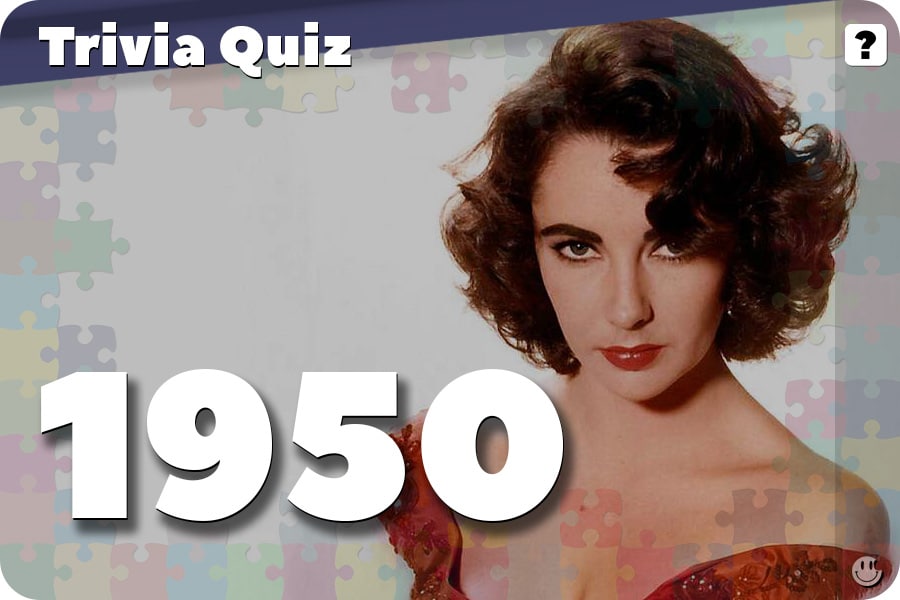
    40. On May 6, 1950, 18-year-old Elizabeth Taylor got married for the first time. She eventually married 8 times. Who was her first husband?

    41. What team won the FIFA World Cup in 1950?

    42. To make the US Postal Service more cost-effective, U.S. Postmaster General Jesse M. Donaldson limited the carriers to an eight-hour day, and what other major change?

    43. Who won the 1950 World Series?

    44. Bank robber and murderer Thomas James Holden is the first person on this famous list. What list?

    45. What company used the slogan: “You’re in Good Hands”?

    46. What company used the slogan: “The Champagne of Bottle Beer”?

    47. The third Christmas song reached the Billboard # 1 chart position. Name that song.

    48. Although initially published in only seven newspapers, this comic strip became one of the most popular.
    Hint: “Good Grief”

    49. Who was the Time Magazine Man of the Year in 1950?

    50. Who was the founder of Scientology?

    Trivia Team Bonus Questions:

    1. What was the name of L. Ron Hubbard’s book introducing Scientology? They call it ‘Book One”.

    2. What Horse won the Kentucky Derby in 1950?

    3. This comedy film series about an animal, starring Donald O’Connor, Patricia Medina, and the voice of Chill Wills, went on to seven films by 1956. Name the primary character of those films.

    4. Who were the 1950 NFL Champions?

    5. This accused communist spy, once a United States official, was convicted on two counts of perjury.

    6. Who was the American Vice-President in 1950?

    7. They call it ‘the world’s longest-running radio soap opera,’ and it began airing on the BBC on May 29, 1950. Name that radio programme.

    8. This naturally mummified corpse of a man living in the 4th century BC was found in a Denmark bog. The body was so well preserved they thought he was a recent murder victim. What have we named that man?

    9. Who were the 1950 NBA Champions?

    10. In East Germany, this group acted as the secret police until 1990.

    The Answers:

    50 Trivia Answers for 1950 History

    1. This comic strip character is best described as a lazy American soldier and continued after his creator, Mort Walker’s death in 2018. Name that apathetic soldier.
    Beetle Bailey

    2. How many people lived in the United States in 1950?
    The population was an estimated 150,697,361 people.

    3. How many people lived in the World in 1950?
    The estimated world population in 1950 was 2,525,149,000 people.

    4. Who won the Stanley Cup in 1950?
    In 1950, The Detroit Red Wings won over the New York Rangers (4 games to 3)

    5. What was the Biggest Number One Song of 1950?
    The Tennessee Waltz by Patti Page (very close second place was Goodnight Irene by The Weavers)

    6. Who was the President of the United States in 1950?
    Harry S. Truman (April 12, 1945 – January 20, 1953)

    7. Name the first racehorse in history to earn one million dollars.
    Citation

    8. According to the US Census, what was the average family income in 1950?
    $3,300

    9. To the nearest quarter, what was the average movie theater ticket price in 1950?
    50 cents

    10. On January 17, 1950, some people called it “the crime of the century” when $2.77 million was stolen in Boston Massachusettes. What is the more famous name of the theft?
    The Great Brinks Robbery

    11. What was the highest-grossing film of 1950?
    King Solomon’s Mines

    12. Sometimes called F1, this is the highest class of international single-seater auto racing. What do most people call it today?
    Formula One (Racing)

    13. The first animated TV series debuted in the United States on August 1, 1950. The show was named after the lead character. Name that cartoon.
    Crusader Rabbit

    14. What was the Bestselling Fiction Book in 1950?
    The Cardinal by Henry Morton Robinson

    15. How much did a Loaf of Bread cost in 1950?
    14 cents

    16. How much did a Gallon of Milk cost in 1950?
    82 cents

    17. In his encyclical Humani Generis, Pope Pius XII declared WHAT a serious hypothesis that does not contradict essential Catholic teachings.
    The Theory of Evolution

    18. At 22, this Hollywood starlet announced her retirement from the film industry. Who was she?
    Shirley Temple

    19. The first charge card (credit card) was used in New York. What was the name of the charge card company?
    Diner’s Club

    20. In 1950, what was the average life expectancy in the United States?
    Men – 65.6 years, Women – 71.1 years.

    21. This studio in Rockefeller Plaza was one of the largest radio studios in the world before it was converted to television in 1950. It has hosted Saturday Night since 1975. Name that NBC studio.
    Studio 8H

    22. Name the recording company started by Sam Phillips at 706 Union Avenue in Memphis, Tennessee…
    Sun Studio (originally called Memphis Recording Service)

    23. Which artist never recorded at Sun Studios: Elvis Presley, Johnny Cash, Buddy Holly, or Jerry Lee Lewis?
    Buddy Holly (September 7, 1936 – February 3, 1959)

    24. Based on a story from Charles Perrault, Disney released its 12th animated film. Name that film.
    Cinderella

    25. Disney also released its first live-action film in 1950, based on Robert Lewis Stevenson’s novel of the same name. What is the title of the film?
    Treasure Island

    26. Name the Nat King Cole song about a famous painting that was number one on the Billboard charts for eight weeks.
    Mona Lisa

    27. The Hank McCune Show on NBC was the first program to use this technology to “sweeten” the television broadcast. Name that technology.
    The Laugh Track

    28. How much did a gallon of gas cost in 1950?
    $0.27 per gallon

    29. Thomas J. Pickard and Louis Freeh were born on January 6, 1950. They also both held a high-profile job in Washington, DC. What position did they both hold?
    They were both directors of the FBI; Louis Freeh (1993 to 2001). Thomas J. Pickard was Acting FBI Director from June 25 to September 4, 2001.

    30. Which celebrity was NOT born in 1950: John Candy, Kareem Abdul-Jabbar, Tom Petty, or Nora Roberts?
    Kareem Abdul-Jabbar (born April 16, 1947)

    31. This movie star singing cowboy and his horse, Champion, had his own TV on CBS from 1950 to 1956. Name that cowboy.
    Gene Autry

    32. What was the first-named tropical cyclone in the Atlantic hurricane database and the first of six major hurricanes in the 1950 Atlantic hurricane season?
    Hurricane Abel. Before naming, they were numbered.

    33. What automobile company used the slogan: “Grace…Space…Pace”?
    Jaguar

    34. What term was first used in English by Edward Hunter in 1950 to describe how the communist Chinese government appeared to make people cooperate with them?
    Brainwashing

    35. New York City was the most populated area in the world, with over 12 million people in the metropolitan area. What was the second most populated city in the world in 1950?
    London, England.

    36. Name the United States government-funded organization that began broadcasting news, information, and analysis to Eastern European countries.
    Radio Free Europe

    37. Who was the Pope in 1950?
    Pope Pius XII, March 2, 1939 – October 9, 1958

    38. Featuring the song There’s No Business Like Show Business, this Broadway Technicolor musical comedy debuted on movie screens on July 17, 1950. Name it.
    Annie Get Your Gun

    39. How much did a dozen eggs cost in 1950?
    60 cents

    40. On May 6, 1950, 18-year-old Elizabeth Taylor got married for the first time. She eventually married eight times. Who was her first husband?
    Conrad Hilton, Jr.

    41. What team won the FIFA World Cup in 1950?
    Uruguay

    42. To make the US Postal Service more cost-effective, U.S. Postmaster General Jesse M. Donaldson limited the carriers to an eight-hour day, and what other major change?
    He stopped twice-a-day deliveries.

    43. Who won the 1950 World Series?
    In 1950, The New York Yankees won, beating the Philadelphia Phillies (4 games to 0)

    44. Bank robber and murderer Thomas James Holden is the first person on this famous list. What list?
    The FBI’s Ten Most Wanted

    45. What company used the slogan: “You’re in Good Hands”?
    Allstate

    46. What company used the slogan: “The Champagne of Bottle Beer”?
    Miller Beer

    47. The third Christmas song reached the Billboard # 1 chart position. Name that song.
    Rudolph The Red-Nosed Reindeer (by Gene Autry)

    48. Although initially published in only seven newspapers, this comic strip became one of the most popular.
    Hint: “Good Grief”
    Peanuts

    49. Who was the Time Magazine Man of the Year in 1950?
    The American Fighting-man

    50. Who was the founder of Scientology?
    L. Ron Hubbard

    Trivia Team Bonus Questions:

    1. What was the name of L. Ron Hubbard’s book introducing Scientology? They call it ‘Book One”.
    Dianetics: The Modern Science of Mental Health

    2. What Horse won the Kentucky Derby in 1950?
    Middleground

    3. This comedy film series about an animal, starring Donald O’Connor, Patricia Medina, and the voice of Chill Wills, went on to seven films by 1956. Name the primary character of those films.
    Francis the Talking Mule

    4. Who were the 1950 NFL Champions?
    Cleveland Browns

    5. This accused communist spy, once a United States official, was convicted on two counts of perjury.
    Alger Hiss (November 11, 1904 – November 15, 1996). He and his family proclaimed his innocence.

    6. Who was the American Vice-President in 1950?
    Alben W. Barkley (January 20, 1949 – January 20, 1953)

    7. They call it ‘the world’s longest-running radio soap opera,’ and it began airing on the BBC on May 29, 1950. Name that radio programme.
    The Archers

    8. This naturally mummified corpse of a man living in the 4th century BC was found in a Denmark bog. The body was so well preserved they thought he was a recent murder victim. What have we named that man?
    The Tollund Man

    9. Who were the 1950 NBA Champions?
    For the 1949-50 Season, Champion Minneapolis Lakers won 4 games to 2 over the Syracuse Nationals

    10. In East Germany, this group acted as the secret police until 1990.
    The Stasi (Ministerium fur Staatssicherhetsdienst)
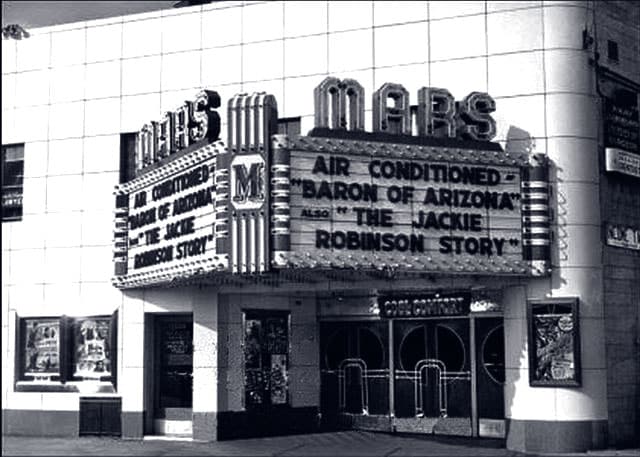
  • The Mars Theater on Conant Street, Detroit

    The Mars Theater on Conant Street, Detroit

    The Mars Theater on Conant Street, Detroit, opened in 1947 and closed in 1958. The Mars was the closest neighborhood theater throughout the 50’s. The seats in the Mars theater were luxurious and covered in equally luxurious cranberry velvet. You could sleep very comfortably in those seats.

    Cartoon Saturdays were a noisy affair that attracted all the neighborhood kids. I fondly remember walking to the Mars theater with my buddies to see the movie, “The Blob”, starring Steve McQueen. I used to go there each Saturday, in the fifties and see two features and a bunch of cartoons and a newsreel for about 15 cents.

    Yes, for fifteen cents, you got all that plus you could stay in the theater as long as you liked. It was common that if you walked in in the middle of the movie, you stayed to watch what you had missed.

    This was the fare on Saturdays. It was a great venue for us who lived in the ghetto on Minnesota street and in the neighboring Conant Gardens. The beauty of it was that we kids could walk the three quarter mile trip by ourselves, stay in the theater watching the same movie twice, and then walk the same three quarter mile trip home in the dark of night. Street lights on Conant Street were sparse and many properties were still undeveloped. There were a lot of empty lots. So, after watching a particularly scary movie, we’d leap frog from one street light to another, going on an all out run through areas of total darkness. I was sure that I could outrun any demon leaping from the shadows. Years later, I’d make my mark doing 100 yard and 200 yard dashes in high school.

    Serials like Tarzan, Commander Cody, Superman, The Blackhawks, and Captain Marvel were always the best followed by science fiction horror films like “It Came From Outer Space”, “The Thing from Another World”, and “Invasion of the Body Snatchers” were the scariest. Although films like “The Undead” and “The Brain Eaters”, could cause nightmares.

    The Mars also showed older comedy movies like “Abbot and Costello”, “Laurel and Hardy”, “The Three Stooges”, the “Little Rascals”, and “Our Gang” comedies.

    “It Came from Outer Space” was the first 3D movie I saw at the Mars. They handed us the little paper glasses with a red lens on one side and a green on the other. The 3D effect was enough for us to duck under our seats when there was an explosion causing rocks to seemingly fly from the screen, or when the monster stuck his hand out to grab you.

    Our favorite cartoons were “Mr. Magoo”, “Mighty Mouse”, “Heckle and Jeckle”, Tom and Jerry, the Roadrunner and Coyote, “Sylvester and Tweety”, and Foghorn Leghorn and Henery Hawk. It should be noted that several of these have been banned by the politically correct, humorless, imbecilic crowd for one insane reason or another.

    In the early days, patriotism was still in the air and the Mars continued to show newsreels about the war in Europe and the Pacific, sometimes alternation with Victory at Sea segments.

    Popcorn at the Mars came in a good size box for around ten cents, extra butter was always optional, and candy bars were only a nickel. So I could get a full day of entertainment from the one dollar my mom would give as my weekly allowance. There were ushers at the Mars, usually some pimply face high school kid that would use his flashlight to guide you in the dark if the movie was already showing and highlight you with that same flashlight if you got too noisy. Then, one day, a kid choked on a popcorn husk and died. At least that’s what our parents told us. Probably just a fib to cut down on our popcorn money.

    Wednesdays were usually the free gift nights where housewives could pick up a dinner plate or such with each admission. The ploy was to keep them coming back to finally get an entire service for eight or something. It was always high quality stuff, much better than many in our neighborhood could afford.

    It was also common for one or two of the guys to pay the admission and grab seats near the theater emergency exits to let the rest of the gang in during the intermissions. As we got older, our interests weren’t so much on watching movies as it was about getting together with other kids you never saw except in school. But too many kids under one roof and bored with the movies often evolved into prankish behaviors. One prankish behavior was when we discovered how loud a common glass marble sounded hitting the back of a movie seat. We’d all sit there like perfect little angels when the usher came down the aisle with his flashlight.

    The neighborhood changed however and so did the Mars theater. We were told to not go to the restroom alone and sometimes on those wonderful Saturday afternoons, there’d be more adult men in the theater than kids.

  • The Number One Hits Of 1950

    The Number One Hits Of 1950

    The Number One Hits Of 1950:

    November 26, 1949 – January 6, 1950:
    Frankie Laine – Mule Train
    January 7, 1950 – January 13, 1950:
    Gene Autry – Rudolph, The Red-nosed Reindeer
    January 14, 1950 – February 10, 1950:
    The Andrews Sisters – I Can Dream, Can’t I
    February 11, 1950 – February 17, 1950:
    Ames Brothers – Rag Mop
    February 18, 1950 – March 17, 1950:
    Red Foley – Chattanoogie Shoe Shine Boy
    March 18, 1950 – April 14, 1950:
    Teresa Brewer – Music! Music! Music!
    April 15, 1950 – April 28, 1950:
    Eileen Barton – If I Knew You Were Comin’ I’d’ve Baked a Cake
    April 29, 1950 – July 14, 1950:
    Anton Karas – The Third Man Theme
    July 15, 1950 – August 18, 1950:
    Nat King Cole – Mona Lisa (Nat King Cole song)
    August 19, 1950 – November 17, 1950:
    Gordon Jenkins and The Weavers – Goodnight Irene
    November 18, 1950 – December 1, 1950:
    Sammy Kaye – Harbor Lights
    December 2, 1950 – December 29, 1950:
    Phil Harris – The Thing
    December 30, 1950 – March 2, 1951:
    Patti Page – The Tennessee Waltz

    (Data is compiled from various charts including Billboard’s “Pop,” “Airplay,” “R&B” and “Singles” Charts. “Hot 100” is the primary chart used starting October, 1958)

    Take our 1950 Quiz!
  • 1950 Fun Facts, Trivia & History

    1950 Fun Facts, Trivia & History

    1950 History, Facts and Trivia

    Quick Facts from 1950

    • World Changing Event: Pope Pius XII confirmed there was no conflict between Christianity and the theory of evolution, and the Church officially supported the idea of theistic evolution.
    • The immortal cancer cells collected from patient Henrietta Lacks months before her 1950 death are still alive and being used today for research.
    • Influential Songs include Goodnight, Irene by The Weavers with Gordon Jenkins, Daddy’s Little Girl by The Mills Brothers, and Here Comes Peter Cottontail by Gene Autry.
    • The Movies to Watch include Father of the Bride, Harvey, All About Eve, Sunset Boulevard, Rio Grande, The Asphalt Jungle, and Cinderella.
    • The Most Famous Person in America was probably John Wayne.
    • Notable books include The Lion, the Witch and the Wardrobe by C.S. Lewis and Kon-Tiki: Across the Pacific in a Raft by Thor Heyerdahl.
    • Minimum Wage in 1950: 75 cents per hour
      Stromberg-Carlson TV: $279.95
    • Did You Know? Since 1950, acceptance of an Academy Award statuette requires that neither winners nor their heirs may sell the statuettes without first offering to sell them back to the Academy for $1. The Academy keeps the statuette if a winner refuses to agree to this stipulation.
    • The Funny Guy was Milton Berle
      The Funniest TV Duo: Sid Caesar and Imogene Coca
    • FBI’s “10 Most Wanted Fugitives” program began.
    • The US Army rank of 5 Star General is still considered an active rank, although no one has attained that rank since 1950 when Omar Bradley held it.
    • Take our 1950 Quiz!

    1950 History Rundown:

    • January 21 – Alger Hiss Convicted of Perjury: Alger Hiss, a former U.S. State Department official, was convicted of perjury for denying his involvement in a Soviet spy ring.
    • January 31 – Truman Orders Hydrogen Bomb Development: President Harry S. Truman directed the U.S. to develop a hydrogen bomb in response to the Soviet Union’s atomic capabilities.
    • February 9 – McCarthy Alleges Communist Infiltration: Senator Joseph McCarthy claimed that the U.S. State Department was harboring Communists, marking the start of the Red Scare.
    • February 14 – Sino-Soviet Treaty Signed: China and the Soviet Union signed a mutual defense treaty, strengthening their alliance during the Cold War.
    • March 1 – Klaus Fuchs Convicted of Espionage: Physicist Klaus Fuchs was convicted in London for passing atomic secrets to the Soviet Union.
    • March 8 – Volkswagen Type 2 Production Began: The first Volkswagen Type 2, known as the Microbus, rolled off the assembly line in Germany, becoming an iconic vehicle.
    • April 27 – South Africa Passes Group Areas Act: The apartheid-era law was enacted, segregating communities by race and restricting land ownership.
    • June 25 – Korean War Begins: North Korean forces invaded South Korea, initiating a conflict that drew in international forces.
    • June 27 – U.S. Commits Troops to Korea: President Truman ordered U.S. military forces to assist South Korea in repelling the North Korean invasion.
    • July 16 – Uruguay Wins FIFA World Cup: Uruguay defeated Brazil 2-1 in the World Cup final, held in Rio de Janeiro’s Maracanã Stadium.
    • August 5 – Florence Chadwick Swims English Channel: American swimmer Florence Chadwick became the second woman to swim the English Channel, completing the crossing in 13 hours and 20 minutes.
    • September 4 – Beetle Bailey Comic Strip Debuts: The comic strip “Beetle Bailey,” created by Mort Walker, was first published, introducing readers to the antics of a lazy U.S. Army private.
    • September 15 – Battle of Inchon: UN forces, led by General Douglas MacArthur, launched a successful amphibious assault at Inchon, turning the tide in the Korean War.
    • October 2 – Peanuts Comic Strip Launched: Charles M. Schulz’s “Peanuts” comic strip debuted, introducing the world to characters like Charlie Brown and Snoopy.
    • October 19 – China Enters Korean War: Chinese forces crossed the Yalu River into Korea, joining the conflict in support of North Korea.
    • November 1 – Assassination Attempt on President Truman: Puerto Rican nationalists attempted to assassinate President Truman at Blair House in Washington, D.C.; Truman was unharmed.
    • November 24 – Guys and Dolls Premiered on Broadway: The musical “Guys and Dolls” opened on Broadway, becoming a major hit and winning multiple Tony Awards.
    • December 2 – Battle of Chosin Reservoir: A brutal 17-day battle in freezing temperatures during the Korean War, where UN forces faced a massive Chinese offensive.
    • December 11 – Hungnam Evacuation Begins: UN forces began a massive evacuation of troops and civilians from Hungnam, North Korea, during the Korean War.
    • December 31 – First 12 Hours of Sebring Race Held: The inaugural 12 Hours of Sebring endurance race took place in Florida, becoming a premier event in motorsport.

    Top Ten Baby Names of 1950

    Linda, Mary, Patricia, Barbara, Susan, Nancy, Deborah, Sandra, Carol, Kathleen
    James, Robert, John, Michael, David, William, Richard, Thomas, Charles, Gary

    US Statistics, 1950

    US Life Expectancy: (1950) Males, 65.6 Females, 71.1
    Federal spending: 
    $42.56 billion
    Federal debt $256.9 billion
    Consumer Price Index: $24.1
    Unemployment: 5.9%
    A Gallon of Gas: 18 cents
    Cost of a first-class stamp: $0.03

    Fashion Icons and Sex Symbols

    Lauren Bacall, Martine Carol, Doris Day, Ava Gardner, Rita Hayworth, Eartha Kitt, Marilyn Monroe, Jane Russell, Elizabeth Taylor, Lana Turner

    Sex Symbols and Hollywood Hunks

    Humphrey Bogart, Montgomery Clift, Gregory Peck

    Oscars: 22nd Academy Awards

    The 22nd Academy Awards took place on March 23, 1950, at the RKO Pantages Theatre in Hollywood. Paul Douglas served as the host for the evening. The film All the King’s Men dominated the ceremony, winning Best Picture, Best Actor for Broderick Crawford, and Best Supporting Actress for Mercedes McCambridge. Olivia de Havilland took home the Best Actress award for The Heiress. An interesting trivia nugget is that this was the first year that all five Best Picture nominees were in color. Also, this was the final year that the Best Sound category was open to original musicals only.

    Emmy Awards: 2nd Primetime Emmy Awards

    The second Primetime Emmy Awards were held on January 27, 1950, at the Ambassador Hotel in Los Angeles. Bill Welsh served as host. The ceremony broadened its scope by recognizing achievements in various genres, such as drama and comedy, but still primarily focused on local Los Angeles programming. One of the significant winners was The Life of Riley, starring Jackie Gleason, which won for Best New Program. Alan Young won the Most Outstanding Personality category, making him the first actor to receive a Primetime Emmy for acting.

    For the Oscars, the eligibility period was January 1, 1949, to December 31, 1949. The Emmys still centered mainly around Los Angeles area programming without a strict eligibility window.

    “The Quotes:”

    “Most human beings have an almost infinite capacity for taking things for granted.”
    – Aldous Huxley

    “Fasten your seat belts. It’s going to be a bumpy night.”
    – Betty Davis, in All About Eve

    “All right, Mr. DeMille, I’m ready for my close-up.”
    “I am big! It’s the pictures that got small.”
    – Gloria Swanson, in Sunset Boulevard

    Willie Sutton robbed Manufacturers Bank of $64,000 in NYC. Urban legend says that when asked why he robbed banks, he said “Because that’s where the money is.”

    Time Magazine’s Man of the Year

    The American Fighting-Man (Korean War Troops)

    Miss America

    none

    Firsts

    James Dean made his first appearance in a Pepsi commercial. #pepsibounce

    Minute Rice appeared on the shelves for the first time.

    A payment was first made by the prototype Diners Club Card at Majors Cabin Grill restaurant in New York City (the first use of a charge card). Cards became available for others on May 13, 1950.

    The First TV remote control, Lazy Bones by Zenith, was sold.

    Marion Donovan invented disposable diapers.

    Darlington Raceway in South Carolina was the site of the inaugural Southern 500, the first 500-mile NASCAR race.

    The first metal lunchbox featuring Hopalong Cassidy was produced by Aladdin (the company, NOT the 1001 Arabian Nights hero).

    Corn Pops debuted in 1950 as ‘Corn Pops’. The name changed twice in 1951 to ‘Sugar Corn Pops’ then ‘Sugar Pops’. In 1978, it changed back to ‘Sugar Corn Pops’, then finally back to the original ‘Corn Pops’ in 1984. In 2006, it became ‘Pops’ and then back to ‘Corn Pops’ a few months later.

    Green plastic garbage bags, made from polyethylene, were invented by Harry Wasylyk.

    Bell Laboratories created a Telephone Answering Machine.

    John Hopps invented the world’s first cardiac pacemaker. It was larger than life and had to be used outside the body of the first recipient.

    Mort Walker created the comic strip Beetle Bailey.

    Racing pioneer C.J. Hart was credited with creating the first commercial drag racing strip on the runway of the Orange County Airport in Santa Ana, California on June 19.

    If I Ran the Zoo by Dr. Seuss, published in 1950, is the first recorded instance of the word “nerd.”

    1950 Pop Culture Facts & History

    The transistor was patented (#US 2,524,035) by William Shockley for Bell Labs.

    Kathryn Johnston became the first girl to play Little League baseball in 1950 when she tucked her hair under her hat, renamed herself “Tubby”, and joined the Kings Dairy team, posing as a boy. When she told her coach she was a girl, he said “That’s O.K., you’re a darned good player.”

    Earl Lloyd became the first African-American to play a game in the NBA.

    The Barrier played at the Broadhurst Theatre (Nov 02, 1950 – Nov 04, 1950) for 4 performances. It is a race-based drama about a single day in the 1950s in rural Georgia.

    7UP originally contained lithium citrate, a mood-stabilizing drug, until 1950.

    An articulate man (and snazzy dresser), Mr. Sutton later said he never said it, although the statement was true. “Why did I rob banks? Because I enjoyed it. I loved it. I was more alive inside a bank, robbing it, than at any other time. I enjoyed everything about it so much that one or two weeks later, I’d be out looking for the next job. But to me, the money was the chips, that’s all.”

    An estimated 50% of all American films made before 1950 and over 90% of films made before 1929 are lost forever.

    Mother Teresa founded Missionaries of Charity in Calcutta, India.

    Smokey Bear was a real bear who was rescued from a forest fire and later became a living mascot for wildfire prevention.

    Groundbreaking Your Show of Shows with Sid Caesar & Imogene Coca premiered on NBC.

    Radio’s Grand Ole Opry was broadcast on TV for 1st time

    On February 15, Walt Disney released Cinderella.

    Peter Pan opened at the Imperial Theater NYC for 320 performances.

    Your Hit Parade premiered on NBC (later CBS).

    Arthur Murray Party premiered on ABC TV (later DuMont, CBS, then NBC)

    Crusader Rabbit, the first animated TV series, debuted.

    The first printing of C.S. Lewis’ The Lion, the Witch, and the Wardrobe was released in London.

    I Robot,  a collection of sci-fi short stories by Isaac Asimov, was published.

    Ranch Dressing originated from The Hidden Valley Dude Ranch in 1950 in Santa Barbara, California.

    The Myxoma Virus (a type of poxvirus) was deliberately released into the rabbit population in Australia as a means of population control, causing the death of over 500 million rabbits.

    The US Navy sprayed San Francisco with “harmless” bacteria to simulate a biological attack. The not-so-harmless bacteria caused a spike in a rare UTI, killing one man. There were many unusually high reports of increased pneumonia and urinary tract infections. A lawsuit against the government was rejected because the government-held legal immunity.

    The Tollund Man, a mummified body from the 4th Century, was found in Denmark.

    The modern-day “pirate accent” we know comes from Robert Newton’s portrayal of Long John Silver in the 1950 Disney adaptation of Treasure Island. Before that, there was no universal “pirate accent.” #arrrrh

    The Great Brink’s Robbery: Eleven thieves stole over $2 million from the Brink’s armored car company headquarters in Boston, Massachusetts. The thieves were all caught, and Only $58,000 was recovered.

    After the Empire State Building opened in New York City in 1931, much of its office space went unrented. It was nicknamed the “Empty State Building” by New Yorkers and didn’t become profitable until 1950.

    The first Volkswagen Type 2 (aka the Microbus) rolls off the assembly line in Wolfsburg, Germany.

    The 1950 toy lab set “Gilbert U-238 Atomic Energy Laboratory” contained uranium ore, polonium, a Geiger counter, and a cloud chamber.

    L. Ron Hubbard published Dianetics: The Modern Science of Mental Health.

    In South Africa, the Group Areas Act was passed, formally segregating races.

    The United Nations Relief and Works Agency for Palestine Refugees in the Near East (UNRWA) began operations.

    Cold War

    January 12 – American Secretary of State Dean Acheson delivered his ‘Perimeter Speech,’ outlining the boundary of US security guarantees.

    January 21 – Communist spy Alger Hiss was convicted on two counts of perjury.

    January 30, 1950 – President Harry S. Truman ordered the development of the hydrogen bomb in response to the detonation of the Soviet Union’s first atomic bomb

    February 8, 1950 -The Stasi was founded in East Germany and acted as secret police until 1990.

    February 9 – In his speech to the Republican Women’s Club at the McClure Hotel in Wheeling, West Virginia, Senator Joseph McCarthy accused the United States Department of State of being filled with 205 Communists.

    February 14 – The Soviet Union and the People’s Republic of China signed a mutual defense treaty.

    March 1 – Klaus Fuchs was convicted in London of spying against both Britain and the United States for the Soviet Union by giving to the latter top-secret atomic bomb data.

    June 17, 1950 – Julius Rosenberg was arrested on suspicion of espionage, based on David Greenglass’s confession. On August 11, 1950, Ethel Rosenberg was arrested.

    July 4, 1950 – The first broadcast by Radio Free Europe.

    September 8 – The Defense Production Act was enacted into law in the United States.

    Korean & Vietnam Wars:
    January 1 Ho Chi Minh started the offensive against French troops in Indo-China.

    On KoKoMay 21, Vietnamese troops of Ho Chi-Minh attacked Cambodia.

    June 25, 1950 – The Korean War began its three-year conflict when troops of North Korea, backed with Soviet weaponry, invaded South Korea. The United States sent support to South Korea 2 days later.

    June 27, 1950 – Thirty-five military advisors were sent to South Vietnam to give military and economic aid to the anti-Communist government.

    Jun 28 – The North Koreans captured Seoul.

    Private Kenneth Shadrick was the first U.S. casualty of the Korean War on July 5, 1950.

    July 7 – The UN Security Council established the United Nations Command to combat North Korean forces

    July 8, 1950 -General Douglas MacArthur was named commander-in-chief of UN forces in Korea

    November 26, 1950 – United Nations forces retreated south toward the 38th parallel when Chinese Communist forces opened a counteroffensive in the Korean War.

    December 19 – Tibet’s Dalai Lama fled the Chinese invasion.

    Crime

    March 9: Willie Sutton robbed Manufacturers Bank of $64,000 in NYC. Urban legend says that when asked why he robbed banks, he said, “Because that’s where the money is.”
    (not really, but the quote is often attributed to him)

    1950 FBI’s “10 Most Wanted Fugitives”:
    #1. Thomas James Holden
    #2. Morley Vernon Kong
    #3. William Nesbit
    #4. Henry Randolph Mitchell
    #5. Omar August Pinson
    #6. Lee Emory Downs
    #7. Orba Elmer Jackson
    #8. Glen Roy Wright
    #9. Henry Harland Shelton
    #10. Morris Guralnick
    Willie Sutton was number 11.

    Statistics

    The average worker in the US today would only have to work 11 hours per week to be as productive as the 40 Hours per week worker in 1950.

    The Habit

    Watching ‘Your Show of Shows’ on television.

    1st Appearances & 1950’s Most Popular Christmas Gifts, toys, and presents

    Little People and the Safety School Bus, Wooly Willy, official Magic-8 Ball, Silly Putty

    Silly Putty was introduced as a toy on March 6, 1950, by Peter Hodgson. But it was invented in 1943 by James Wright, who was working for General Electric while trying to make synthetic rubber for the War Effort – it was in the middle of World War II. Earl Warrick also claimed to have invented it at about the same time.

    Silly Putty sold pretty quickly. Kids found uses for it. Mostly making things, then squishing them. Plus, you could copy your favorite comics. In the early 1960s, they started selling internationally, and they even took one into Space in Apollo 8. In 1977, Silly Putty became part of ‘Big Crayon’ when Crayola bought it. Silly Putty entered The National Toy Hall of Fame’s Third class in 2001, along with Tonka Trucks. Silly Putty is still a popular stocking stuffer today.

    Nobel Prize Winners

    Physics – Cecil Frank Powell
    Chemistry – Otto Paul Hermann Diels, Kurt Alder
    Medicine – Edward Calvin Kendall, Tadeusz Reichstein, Philip Showalter Hench
    Literature – Earl (Bertrand Arthur William) Russell
    Peace – Ralph Bunche

    Popular and Best-selling Books From 1950

    Across the River and Into the Trees by Ernest Hemingway
    The Adventurer by Mika Waltari
    The Cardinal by Henry Morton Robinson
    The Chronicles of Narnia: The Lion, the Witch and the Wardrobe by C.S. Lewis
    The Disenchanted by Budd Schulberg
    The Egyptian – Mika Waltari
    Floodtide by Frank Yerby
    Joy Street by Frances Parkinson Keyes
    Jubilee Trail by Gwen Bristow
    The Parasites by Daphne du Maurier
    Star Money by Kathleen Winsor
    The Wall by John Hersey

    Best Picture Oscar

    All The King’s Men (presented in 1950)

    Broadway Show

    Guys and Dolls (Musical) Opened on November 24, 1950, and closed: on November 28, 1953

    1950 Most Popular TV Shows

    1. Texaco Star Theatre (NBC)
    2. Fireside Theatre (NBC)
    3. Philco TV Playhouse (NBC)
    4. Your Show of Shows (NBC)
    5. The Colgate Comedy Hour (NBC)
    6. Gillette Cavalcade of Sports (NBC)
    7. The Lone Ranger (ABC)
    8. Arthur Godfrey’s Talent Scouts (CBS)
    9. Hopalong Cassidy (NBC)
    10. Mama (NBC)

    1950 United States Census

    Total US Population: 151,325,798
    1. New York, New York – 7,891,957
    2. Chicago, Illinois – 3,620,962
    3. Philadelphia, Pennsylvania – 2,071,605
    4. Los Angeles, California – 1,970,358
    5. Detroit, Michigan – 1,849,568
    6. Baltimore, Maryland – 949,708
    7. Cleveland, Ohio – 914,808
    8. St. Louis, Missouri – 856,796
    9. Washington, District of Columbia – 802,178
    10. Boston, Massachusetts – 801,444

    Sports

    World Series Champions: New York Yankees
    NFL Champions: Cleveland Browns
    NBA Champions: Minneapolis Lakers
    Stanley Cup Champs: Detroit Red Wings
    U.S. Open Golf Ben Hogan
    U.S. Tennis: (Men/Ladies) Arthur Larsen/Margaret Osborne DuPont
    Wimbledon (Men/Women): Budge Patty/Louis Brough
    NCAA Football Champions: Oklahoma
    NCAA Basketball Champions: CCNY
    Kentucky Derby: Middleground

    More 1950 Facts & History Resources:

    BabyBoomers.com (1950)
    Most Popular Baby Names (BabyCenter.com)
    Popular and Notable Books (popculture.us)
    Broadway Shows that Opened in 1950X
    1950 Calendar, courtesy of Time and Date.com
    Fact Monster
    Fifties Web (1950)
    1950s, Infoplease.com World History
    1950 in Movies (according to IMDB)
    Retrowaste Vintage Culture
    1950 Television
    1950s Slang
    1950 US Census Fast Facts
    Wikipedia 1950

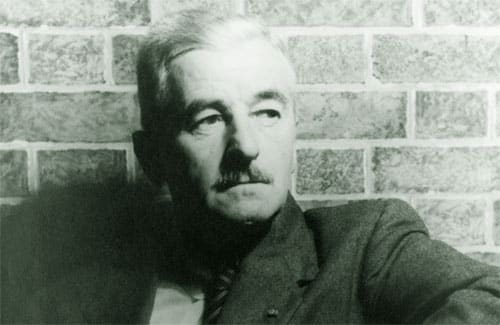
  • Nobel Prize Acceptance Speech by William Faulkner

    Nobel Prize Acceptance Speech by William Faulkner

    Nobel Prize Acceptance Speech
    by William Faulkner on December 10, 1950, in Stockholm, Sweden


    I feel that this award was not made to me as a man, but to my work-a life’s work in the agony and sweat of the human spirit, not for glory and least of all for profit, but to create out of the materials of the human spirit something which did not exist before. So this award is only mine in trust. It will not be difficult to find a dedication for the money part of it commensurate with the purpose and significance of its origin. But I would like to do the same with the acclaim too, by using this moment as a pinnacle from which I might be listened to by the young men and women already dedicated to the same anguish and travail, among whom is already that one who will some day stand where I am standing.

    Our tragedy today is a general and universal physical fear so long sustained by now that we can even bear it. There are no longer problems of the spirit. There is only one question: When will I be blown up? Because of this, the young man or woman writing today has forgotten the problems of the human heart in conflict with itself which alone can make good writing because only that is worth writing about, worth the agony and the sweat. He must learn them again. He must teach himself that the basest of all things is to be afraid: and, teaching himself that, forget it forever, leaving no room in his workshop for anything but the old verities and truths of the heart, the universal truths lacking which any story is ephemeral and doomed-love and honor and pity and pride and compassion and sacrifice. Until he does so, he labors under a curse. He writes not of love but of lust, of defeats in which nobody loses anything of value, and victories without hope and worst of all, without pity or compassion. His griefs grieve on no universal bones, leaving no scars. He writes not of the heart but of the glands.

    Until he learns these things, he will write as though he stood among and watched the end of man. I decline to accept the end of man. It is easy enough to say that man is immortal because he will endure: that when the last ding-dong of doom has clanged and faded from the last worthless rock hanging tideless in the last red and dying evening, that even then there will still be one more sound: that of his puny inexhaustible voice, still talking. I refuse to accept this. I believe that man will not merely endure: he will prevail. He is immortal, not because he alone among creatures has an inexhaustible voice, but because he has a soul, a spirit capable of compassion and sacrifice and endurance. The poet’s, the writer’s, duty is to write about these things. It is his privilege to help man endure by lifting his heart, by reminding him of the courage and honor and hope and pride and compassion and pity and sacrifice which have been the glory of his past. The poet’s voice need not merely be the record of man, it can be one of the props, the pillars to help him endure and prevail.

  • 1950 Music: Popular Music, Songs and Artists

    1950 Music: Popular Music, Songs and Artists

    1950 Popular Music, Songs and Artists

    Bing and Gary Crosby

    Play a Simple Melody
    Written by Irving Berlin, Play a Simple Melody was featured in the movie There’s No Business Like Show Business. The song is actually two melodies in one: a simple, old-fashioned tune juxtaposed with a more complex jazz melody. Initially sung separately, the two melodies eventually overlap, creating a harmonious blend. Gary Crosby, who performed the song with his father Bing Crosby, was one of Bing’s four sons.

    Doris Day

    Bewitched, Bothered, and Bewildered
    This classic originated in the 1940 Rodgers and Hart musical Pal Joey, which launched Gene Kelly’s Broadway career. Thanks to its enduring appeal, the song charted a decade later in 1950. Over the years, it has been recorded by many legendary artists, including Frank Sinatra, Ella Fitzgerald, and Barbra Streisand.

    The Mills Brothers

    Daddy’s Little Girl
    Daddy’s Little Girl is a timeless tearjerker often used for the father-daughter dance at weddings. Bobby Burke and Horace Gerlach wrote the song and became a sentimental favorite in the mid-20th century, evoking emotions across generations.

    Nat King Cole

    Mona Lisa
    Composed by Ray Evans and Jay Livingston, Mona Lisa was featured in the 1950 film Captain Carey, U.S.A. and won the Academy Award for Best Original Song. Nat King Cole’s smooth, heartfelt rendition made the song a classic, comparing a woman’s enigmatic nature to the famous painting by Leonardo da Vinci, which resides in the Louvre Museum in Paris.

    Perry Como

    A Bushel and a Peck
    This cheerful tune originates from the Broadway musical Guys and Dolls (1950), based on stories by Damon Runyon. In the musical, the song is performed by Miss Adelaide as part of her nightclub act. Perry Como’s recording brought the playful number to a wider audience, cementing its popularity.

    Gene Autry

    Here Comes Peter Cottontail
    After his success with Rudolph the Red-Nosed Reindeer, Gene Autry released Here Comes Peter Cottontail in 1950, written by Steve Nelson and Jack Rollins. The song, celebrating Easter traditions, peaked at No. 5 on the Billboard charts. It later inspired the 1971 Easter television special Here Comes Peter Cottontail, which tells how Peter became the Easter Bunny.

    Eileen Barton

    If I Knew You Were Coming, I’d Have Baked a Cake
    Written by Al Hoffman, Bob Merrill, and Clem Watts, this novelty hit was recorded by Eileen Barton in January 1950. Its popularity overwhelmed its initial record label, National Records, which partnered with Mercury Records to meet demand. The song was also recorded as a duet by Bing Crosby and Bob Hope, as well as by Ethel Merman and Ray Bolger.

    Teresa Brewer

    Music! Music! Music!
    Written by Stephen Weiss and Bernie Baum, Music! Music! Music! became a million-seller for Teresa Brewer in 1949. Petula Clark also recorded the song that year, achieving popularity in Australia. In the 1970s, Melanie Safka revived the tune as The Nickel Song, adding a modern twist.

    Anton Karas

    The Third Man Theme
    Composed by Anton Karas in 1949 for the film The Third Man, this instrumental piece topped the Billboard charts for 11 weeks. Its distinctive use of the zither, a rarely heard instrument, contributed to its unique sound and enduring popularity.

    Take our 1950 Quiz!


    Top Artists and Songs of 1950

      Andrews Sisters
    I Can Dream, Can’t I?
    I Wanna Be Loved
      Anton Karas
    Third Man Theme
      Art Lund
    Mona Lisa
      Bill Snyder
    Bewitched (Bothered and Bewildered)
      Billy Eckstine
    My Foolish Heart
      Bing and Gary Crosby
    Play A Simple Melody
    Sam’s Song (The Happy Tune)
      Bing Crosby
    Chattanoogie Shoe-Shine Boy
    Four Winds and the Seven Seas
    Harbor Lights
      Dinah Shore
    My Heart Cries For You
      Doris Day
    Bewitched (Bothered and Bewildered)
    Hoop-Dee-Doo
      Eileen Barton
    If I Knew You Were Comin’ I’d Have Baked A Cake
      Eve Young
    One Silver Dollar
      Fats Domino
    The Fat Man
      Frank Allison
    Peter Cottontail
      Frank Sinatra
    Goodnight Irene
      Frankie Laine
    Cry of the Wild Goose
    Music Maestro Please
      Freddy Martin
    Music! Music! Music! (Put Another Nickle In)
      Gene Autry
    Peter Cottontail
      Gene Krupa
    Bonaparte’s Retreat
      Gordon Jenkins and the Weavers
    Goodnight, Irene
      Gordon Jenkins
    Bewitched (Bothered and Bewildered)
    My Foolish Heart
    Tzena Tzena
      Guy Lombardo
    Enjoy Yourself (It’s Later Than You Think)
    Harbor Lights
    Tennessee Waltz
    Third Man Theme
      Guy Mitchell
    My Heart Cries For You
    The Roving Kind
      Hank Snow
    I’m Movin On
      Hoagy Carmichael
    The Old Piano Roll Blues
      Ivory Joe Hunter
    I Need You So
      Jerry Murad’s Harminicats
    Bewitched (Bothered and Bewildered)
      Jimmy Wakely
    Peter Cottontail
      Joe ‘Fingers’ Carr
    Sam’s Song
      Joe Liggins and his Honeydrippers
    Pink Champagne
      Jo Stafford
    Goodnight, Irene
    Tennessee Waltz
      Johnnie Lee Wills
    Rag Mop
      Johnny Otis
    Double Crossing Blues
      Larry Green and his Orchestra
    Bewitched (Bothered and Bewildered)
      Lefty Frizzell
    If You’ve Got The Money (I’ve Got The Time)
      Les Paul and Mary Ford
    Tennessee Waltz
      Lionel Hampton
    Rag Mop
      Little Esther
    Double Crossing Blues
      Louis Jordan and his Tympany Five
    Blue Light Boogie
      Louis Prima and Keely Smith
    Oh Babe
      Mel Torme
    Bewitched (Bothered and Bewildered)
      Mervin Shiner
    Peter Cottontail
      Mills Brothers
    Daddy’s Little Girl
    Nevertheless (I’m In Love With You)
      Mindy Carson
    My Foolish Heart
      Mitch Miller
    Tzena Tzena
      Muddy Waters
    Rollin’ Stone
      Nat ‘King’ Cole
    Mona Lisa
      Patti Page
    All My Love
    The Tennesse Waltz
      Percy Faith
    All My Love
      Percy Mayfield
    Please Send Me Someone To Love
      Perez Prado
    Mambo Number 5
      Perry Como and The Fontane Sisters
    Hoop-Dee-Doo
    You’re Just In Love
      Perry Como
    A Bushel and A Peck
    Patricia
    You’re Just In Love
      Phil Harris
    The Thing
      Professor Longhair
    Crazy Baldhead
      Ralph Flanagan
    Rag Mop
      Ray Anthony
    Count Every Star
    Harbor Lights
    Sentimental Me
      Ray Bolger
    Dearie
      Red Foley
    Chattanoogie Shoe Shine Boy
      Roy Brown and his Mighty-Mighty Men
    Hard Luck Blues
      Russ Morgan
    Sentimental Me
      Ruth Brown
    Teardrops From My Eyes
      Sammy Kaye
    Harbor Lights
    Hollywood Square Dance
    I’ve Got A Lovely Bunch of Coconuts
    It Isn’t Fair
      Teresa Brewer
    Music! Music! Music!
      The Ames Brothers
    Can Anyone Explain (No No No!)
    Rag Mop
    Undecided
    Sentimental Me
      The Robins
    Double Crossing Blues
      The Starlighters
    Rag Mop
      Tony Martin and Fred Warren
    I Said My Pajamas (And Put On My Pray’rs)
      Tony Martin
    There’s No Tomorrow
      Vic Damone
    My Heart Cries For You
      Victor Young
    Mona Lisa
      Yves Montand
    Les Feuilles Mortes
  • Gilbert U-238 Atomic Energy Laboratory

    Gilbert U-238 Atomic Energy Laboratory

    Dangerous Toys: The Atomic Energy Lab

    The Atomic Energy Lab was released by the A.C. Gilbert Company in 1950. The kit’s intention was to allow children to create and watch nuclear and chemical reactions using radioactive material.

    The lab contained a cloud chamber that allowed the viewer to watch alpha particles traveling at 12,000 miles per second (19,000,000 m/s), a spinthariscope that showed the results of radioactive disintegration on a fluorescent screen, and an electroscope that measured the radioactivity of different substances that were in the set.

    This toy has been called “the world’s most dangerous toy” because of the radioactive material included in the set. Gilbert claimed that none of the materials could conceivably prove dangerous. However, the instructions cautioned that “users should not take ore samples out of their jars, for they tend to flake and crumble and you would run the risk of having radioactive ore spread out in your laboratory. This would raise the level of your background count.”

    Product Description:

    “Produces awe-inspiring sights! Enables you to actually SEE the paths of electrons and alpha particles traveling at speeds of more than 10,000 miles per SECOND! Electrons racing at fantastic velocities produce delicate, intricate paths of electrical condensation – beautiful to watch. Viewing Cloud Chamber action is closest man has come to watching the Atom! Assembly kit (Chamber can be put together in a few minutes) includes Dri-Electric Power Pack, Deionizer, Compression Bulb, Glass Viewing Chamber, Tubings, Power Leads, Stand, and Legs.”
    – Gilbert U-238 Atomic Energy Laboratory

    Fredric Durrette served one tour in Vietnam, retired as E8 in the navy submarine service after 23 years. Major hobbies are collecting old stuff from the 20s and restoring old racing bicycles. Worked as a commercial photographer at JL Hudsons in Detroit and continue photography as a hobby. Love Sade, sixties soul, seventies rock, and all jazz. Attended Woodstock in 69!
    http://snakesafe.jalbum.net/

  • 1950 Oscars 22nd Academy Awards

    1950 Oscars 22nd Academy Awards

    1950 Oscars 22nd Academy Awards

    Winners Announced: March 23, 1950
    Held at: RKO Pantages Theatre, Hollywood, California
    Host: Paul Douglas
    Eligibility Year: 1949
    • Winners Announced: March 23, 1950
    • Venue: RKO Pantages Theatre, Hollywood, California
    • Host: Paul Douglas
    • Eligibility Year: Films released in 1949

    Major Wins:

    • All the King’s Men scooped up Best Picture.
    • Best Actor went to Broderick Crawford for his performance in All the King’s Men.
    • Olivia de Havilland took home Best Actress for her role in The Heiress.

    Directing & Screenplay:

    • Joseph L. Mankiewicz received the Best Director Oscar for A Letter to Three Wives.
    • Mankiewicz also clinched Best Adapted Screenplay for the same film.

    Additional Info:

    • Dean Jagger got Best Supporting Actor for Twelve O’Clock High.
    • Mercedes McCambridge snagged Best Supporting Actress for her role in All the King’s Men.
    • The Heiress earned eight nominations, winning 4.
    • All the Kings Men earned seven nominations, winning 3
    • Twelve O’Clock High earned four nominations, winning 2.

    Trivia:

    • This was the first year the Academy recognized Costume Design as a separate category.
    • It was a Mankiewicz family affair; Herman J. Mankiewicz, Joseph’s brother, was also nominated for co-writing The Third Man.
    • This was also the year when the Academy stopped giving out miniature Oscars to child actors. They introduced a new Juvenile Award but it didn’t last long and was eventually discontinued.
    • Take our 1950 Quiz!

    1950 Oscar Nominees and Winners

    Best Motion Picture:
    All the King’s Men – Robert Rossen for Columbia Pictures (WINNER)
    Battleground – Dore Schary for Metro-Goldwyn-Mayer
    The Heiress – William Wyler for Paramount Pictures
    A Letter to Three Wives – Sol C. Siegel for 20th Century Fox
    Twelve O’Clock High – Darryl F. Zanuck for 20th Century Fox
    Best Director:
    Joseph L. Mankiewicz – A Letter to Three Wives (WINNER)
    Robert Rossen – All the King’s Men
    William A. Wellman – Battleground
    Carol Reed – The Fallen Idol
    William Wyler – The Heiress
    Best Actor:
    Broderick Crawford – All the King’s Men as Willie Stark (WINNER)
    Kirk Douglas – Champion as Midge Kelly
    Gregory Peck – Twelve O’Clock High as Brigadier General Frank Savage
    Richard Todd – The Hasty Heart as Cpl. Lachlan “Lachie” MacLachlan
    John Wayne – Sands of Iwo Jima as Sgt. John M. Stryker
    Best Actress:
    Olivia de Havilland – The Heiress as Catherine Sloper (WINNER)
    Jeanne Crain – Pinky as Patricia “Pinky” Johnson
    Susan Hayward – My Foolish Heart as Eloise Winters
    Deborah Kerr – Edward, My Son as Evelyn Boult
    Loretta Young – Come to the Stable as Sister Margaret
    Best Supporting Actor:
    Dean Jagger – Twelve O’Clock High as Major Harvey Stovall (WINNER)
    John Ireland – All the King’s Men as Jack Burden
    Arthur Kennedy – Champion as Connie
    Ralph Richardson – The Heiress as Dr. Austin Sloper
    James Whitmore – Battleground as Sgt. Kinnie
    Best Supporting Actress:
    Mercedes McCambridge – All the King’s Men as Sadie Burke (WINNER)
    Ethel Barrymore – Pinky as Miss Em
    Celeste Holm – Come to the Stable as Sister Scholastica
    Elsa Lanchester – Come to the Stable as Amelia Potts
    Ethel Waters – Pinky as Dicey Johnson
    Best Screenplay:
    A Letter to Three Wives – Joseph L. Mankiewicz from Letter to Five Wives by John Klempner (WINNER)
    All the King’s Men – Robert Rossen from All the King’s Men by Robert Penn Warren
    Bicycle Thieves – Cesare Zavattini from The Bicycle Thief by Luigi Bartolini
    Champion – Carl Foreman from “Champion” by Ring Lardner
    The Fallen Idol – Graham Greene from “The Basement Room” by Graham Greene
    Best Story and Screenplay:
    Battleground – Robert Pirosh (WINNER)
    Jolson Sings Again – Sidney Buchman
    Paisan – Alfred Hayes, Federico Fellini, Sergio Amidei, Marcello Pagliero, and Roberto Rossellini
    Passport to Pimlico – T. E. B. Clarke
    The Quiet One – Helen Levitt, Janice Loeb, and Sidney Meyers
    Best Motion Picture Story:
    The Stratton Story – Douglas Morrow (WINNER)
    Come to the Stable – Clare Boothe Luce
    It Happens Every Spring – Shirley W. Smith and Valentine Davies
    Sands of Iwo Jima – Harry Brown
    White Heat – Virginia Kellogg
    Best Animated Short Film:
    For Scent-imental Reasons (WINNER)
    Canary Row
    Hatch Up Your Troubles
    The Magic Fluke
    Toy Tinkers
    Best Documentary Feature:
    Daybreak in Udi (WINNER)
    Kenji Comes Home
    Best Documentary Short Subject:
    A Chance to Live (WINNER)
    So Much for So Little
    1848
    The Rising Tide
    Best Live Action Short Subject, One-Reel:
    Aquatic House Party – Jack Eaton (WINNER)
    Roller Derby Girl – Justin Herman
    So You Think You’re Not Guilty – Gordon Hollingshead
    Spills and Chills – Walton C. Ament
    Water Trix – Pete Smith
    Best Live Action Short Subject, Two-Reel:
    Van Gogh – Gaston Diehl and Robert Hessens (WINNER)
    The Boy and the Eagle – William Lasky
    Chase of Death – Irving Allen
    The Grass Is Always Greener – Gordon Hollingshead
    Snow Carnival – Gordon Hollingshead
    Best Scoring of a Dramatic or Comedy Picture:
    The Heiress – Aaron Copland (WINNER)
    Beyond the Forest – Max Steiner
    Champion – Dimitri Tiomkin
    Best Scoring of a Musical Picture:
    On the Town – Roger Edens and Lennie Hayton (WINNER)
    Jolson Sings Again – Morris Stoloff and George Duning
    Look for the Silver Lining – Ray Heindorf
    Best Original Song:
    “Baby, It’s Cold Outside” from Neptune’s Daughter – Music and Lyrics by Frank Loesser (WINNER)
    “It’s a Great Feeling” from It’s a Great Feeling – Music by Jule Styne; Lyrics by Sammy Cahn
    “Lavender Blue” from So Dear to My Heart – Music by Eliot Daniel; Lyrics by Larry Morey
    “My Foolish Heart” from My Foolish Heart – Music by Victor Young; Lyrics by Ned Washington
    “Through a Long and Sleepless Night” from Come to the Stable – Music by Alfred Newman; Lyrics by Mack Gordon
    Best Sound Recording:
    Twelve O’Clock High – Thomas T. Moulton (WINNER)
    Once More, My Darling – Leslie I. Carey
    Sands of Iwo Jima – Daniel J. Bloomberg
    Best Art Direction – Set Decoration, Black-and-White:
    The Heiress – Art Direction: John Meehan and Harry Horner; Set Decoration: Emile Kuri (WINNER)
    Come to the Stable – Art Direction: Lyle R. Wheeler and Joseph C. Wright; Set Decoration: Thomas Little and Paul S. Fox
    Madame Bovary – Art Direction: Cedric Gibbons and Jack Martin Smith; Set Decoration: Edwin B. Willis and Richard Pefferle
    Best Art Direction – Set Decoration, Color:
    Little Women – Art Direction: Cedric Gibbons and Paul Groesse; Set Decoration: Edwin B. Willis and Jack D. Moore (WINNER)
    Adventures of Don Juan – Art Direction: Edward Carrere; Set Decoration: Lyle Reifsnider
    Saraband for Dead Lovers – Art Direction and Set Direction: Jim Morahan, William Kellner and Michael Relph
    Best Cinematography, Black-and-White:
    Battleground – Paul C. Vogel (WINNER)
    Champion – Franz Planer
    Come to the Stable – Joseph LaShelle
    The Heiress – Leo Tover
    Prince of Foxes – Leon Shamroy
    Best Cinematography, Color:
    She Wore a Yellow Ribbon – Winton C. Hoch (WINNER)
    The Barkleys of Broadway – Harry Stradling
    Jolson Sings Again – William Snyder
    Little Women – Robert Planck and Charles Schoenbaum
    Sand – Charles G. Clarke
    Best Costume Design, Black-and-White:
    The Heiress – Edith Head and Gile Steele (WINNER)
    Prince of Foxes – Vittorio Nino Novarese
    Best Costume Design, Color:
    Adventures of Don Juan – Leah Rhodes, Travilla and Marjorie Best (WINNER)
    Mother Is a Freshman – Kay Nelson
    Best Film Editing:
    Champion – Harry W. Gerstad (WINNER)
    All the King’s Men – Robert Parrish and Al Clark
    Battleground – John Dunning
    Sands of Iwo Jima – Richard L. Van Enger
    The Window – Frederic Knudtson
    Best Special Effects:
    Mighty Joe Young – Arko Production; RKO Radio (WINNER)
    Tulsa – Walter Wagner; Eagle Lion

    Academy Honorary Awards:
    Fred Astaire “for his unique artistry and his contributions to the technique of musical pictures.”

    Cecil B. DeMille “distinguished motion picture pioneer for 37 years of brilliant showmanship.”

    Jean Hersholt “in recognition of his service to the Academy during four terms as president.”

    Best Foreign Language Film:
    The Bicycle Thief (Italy)
    Academy Juvenile Award:
    Bobby Driscoll
    Oscar® and Academy Awards® and Oscar® design mark are the trademarks and service marks and the Oscar© statuette the copyrighted property, of the Academy of Motion Picture Arts and Sciences. Pop Culture Madness is neither endorsed by nor affiliated with the Academy of Motion Picture Arts and Sciences.


  • Founding of the European Broadcasting Union

    Founding of the European Broadcasting Union

    European Broadcasting Union

    The European Broadcasting Union (EBU) is an alliance of public-service media entities established to promote cooperation and collaboration among broadcasters across Europe. Founded on February 12, 1950, the EBU aimed to facilitate the exchange of news, sports, and cultural programming and develop technical broadcasting standards. Today, the EBU has grown to include members from over 50 countries, not only from Europe but also from other parts of the world.

    Details: 

    • The founding of the EBU took place in Torquay, England, on February 12, 1950, when representatives from 23 broadcasting organizations from 18 European countries gathered to sign the EBU’s constitution. The EBU’s initial focus was improving communication and fostering a sense of unity among European nations in the aftermath of World War II.
    • The EBU was instrumental in establishing the Eurovision Network, which facilitated the exchange of television programs between European countries.
    • The EBU is responsible for organizing the annual Eurovision Song Contest, which debuted in 1956, and has become one of the world’s most popular and enduring television events.
    • The EBU has significantly developed technical broadcasting standards, such as the Phase Alternating Line (PAL) system for analog television.

    Effects on Pop Culture: The EBU has had a notable impact on popular culture, particularly through its organization of the Eurovision Song Contest, which has:

    • Introduced the world to numerous musical artists and acts, including ABBA, Céline Dion, and Julio Iglesias, who achieved international fame after their Eurovision appearances.
    • Created a platform for cultural exchange and expression, with participating countries showcasing their unique music styles, languages, and traditions.
    • Spawned a dedicated fan base and inspired various spin-off events, such as the Junior Eurovision Song Contest and the Eurovision Choir competition.

    The EBU’s contributions to technical broadcasting standards have also helped shape the evolution of television and radio, enabling the seamless exchange of content between countries and fostering a sense of shared European identity.

    Prominent People and Countries Involved:

    • Marcel Bezençon: A Swiss engineer and one of the founding members of the EBU, Bezençon was the organization’s first president and a driving force behind the creation of the Eurovision Song Contest.
    • United Kingdom: The UK played a central role in founding the EBU, hosting the initial conference in Torquay and becoming one of the organization’s founding members.
    • European countries: The EBU’s membership encompasses the majority of European nations, whose broadcasting organizations collaborate on various projects, events, and initiatives to promote unity and cultural exchange.

    The founding of the European Broadcasting Union in 1950 marked a significant milestone in European media and broadcasting history. The organization has played a crucial role in fostering cooperation and collaboration among European countries, promoting cultural exchange, and shaping the development of broadcasting standards. The EBU’s most famous contribution to popular culture is the Eurovision Song Contest, which has entertained millions and introduced the world to diverse musical talent for over six decades.