1953 Trivia: How Much Do You Know About This Landmark Year?
1953 was a year that left its mark on history, pop culture, and innovation—and now it’s your turn to see how much you know! This trivia-packed page is here to challenge and delight, uncovering fascinating stories and events that defined the year. Whether you’re a trivia pro or just curious, there’s no shortage of surprises.
Do you know which beloved toy hit store shelves for the first time in 1953? What major event captivated television audiences across the globe? Can you name the blockbuster film that ruled the box office or the TV star who took home their first Emmy? These questions—and many more—will put your knowledge to the test.
1953 wasn’t just about big headlines; it was also a time of cultural shifts, iconic debuts, and sports, science, and entertainment milestones. From political power plays to technological breakthroughs, this year shaped the modern era. If you’re gearing up for trivia night or just love discovering history through quirky and fun facts, this is the perfect place to dive in.
So grab your thinking cap, and see how much you know about 1953! Will you conquer these questions, or will 1953 keep its secrets? There’s only one way to find out: start exploring now!
1. A very influential country music star died at 29 in his car on January 1, 1953. Name him.
2. What was the Biggest Number One Song of 1953?
3. What was the highest-grossing film of 1953?
4. In 1953, what was the average life expectancy in the United States?
5. Released in 1953, this was Disney’s 14th animated film. Name that movie.
6. This vehicle was produced by Chevrolet from 1953 through 2019…
7. What was the average household income in 1953?
8. How many people lived in the United States in 1953?
9. How many people lived in the World in 1953?
10. What was the Bestselling Fiction Book in 1953?
11. To the nearest quarter, what was the average movie theater ticket price in 1953?
12. How much did a Loaf of Bread cost in 1953?
13. Founded in 1953, what does UNICEF stand for?
14. What was the first color, wide-release 3D movie?
15. Who was the President of the United States in 1953?
16. This processed food spread by Kraft began to be sold nationwide in 1953. Name that food product!
17. Ray Bradbury titled his 1953 dystopian novel, Fahrenheit 451, based on what?
18. Name the Howard Hawks’ musical film starring Marilyn Monroe and Jane Russell, released by 20th Century Fox.
19. Who won the Stanley Cup in 1953?
20. What was the Top-Rated TV Show in the 1952/1953 season?
21. Who was crowned queen of the United Kingdom at Westminster Abbey on June 2, 1953?
22. The United States Federal Communications Commission (FCC) approved the upgrade using the “NTSC standard.” Just about every American household has at least one.
HINT: The first ones sold for about $1,175. Name that product.
23. This air traffic control sign was given to a specific aircraft in 1953 to protect America’s Commander-in-Chief…
24. What is the air traffic control sign for the vice president’s plane?
25. This 1953 film, Starring Marlon Brando as Johnny Strabler, is considered by many to be the first “outlaw biker movie.” Name that film.
26. For decades, this publication, which got nationwide distribution in 1953, had one of the largest circulations in America. Name that magazine.
27. Why did all radios manufactured in the US between 1953 and 1963 have a white triangle on the dial at 640 AM?
28. Pre-dating Godzilla, Ray Bradbury wrote a short story about a giant, fire-breathing lizard, which was made into what 1953 film?
29. Name the couple who were convicted in 1951 of selling American atomic secrets to the Soviet Union and executed in 1953.
30. True or False? The first radio operator to pick up news of Stalin’s death was future rock pioneer Johnny Cash, who was serving with the US Air Force in Germany in 1953
31. What product was sold featuring a very young blonde girl and a sneaky Cocker Spaniel puppy?
32. The term originated in 1953, defining someone who is both a friend and a rival…
33. Arthur Compton was a physicist and winner of the Nobel Prize in physics in 1927. He was chancellor at Washington University in St. Louis, Missouri. He also invented what traffic-slowing device in 1953?
34. Authorities at the Natural History Museum, London, announce that what famous skull, allegedly an early human discovered in 1912, was a hoax in studying evolution?
35. The discovery of human sleep patterns was first published by researchers Eugene Aserinsky and Nathaniel Kleitman.
36. Sidney Rosenthal created it, which consisted of a glass tube of ink with a felt wick. What did he call it?
37. This sports toy was named after what the inventor’s son called a “strike out.”
38. Who won the 1953 World Series?
39. Which actor was NOT born in 1953: Bill Pullman, Kim Basinger, Lynda Carter, or John Malkovich?
40. Where is (and what is) the line between North and South Korea?
41. Sir Edmund Hillary and Tenzing Norgay were the first men to accomplish what?
42. How much did a gallon of gas cost in 1953?
43. This 1953 invention, in a can, is good for lubricating and loosening joints and hinges and removing dirt and residue.
44. This organization uses a 12-step model developed for people with varied substance use disorders…
45. Who was the Pope in 1953?
46. Who was Chief Justice of the United States Supreme Court by President Dwight D. Eisenhower on October 5th, 1953?
47. Name the Soviet leader who died of a stroke on March 5, 1953.
48. Ian Fleming published his first James Bond novel in the United Kingdom; what was the book’s name?
49. What company used the slogan: “Plop, Plop, Fizz, Fizz, Oh What a Relief It Is”?
50. What was the Internal Revenue Service (IRS) called before 1953?
51. Who was the Time Magazine Man of the Year in 1953?
52. This magazine, for adults, sold almost 55,000 copies of its first issue at 50 cents each.
Trivia Team Bonus Questions:
1. Who was the first Playboy centerfold?
2. The Cincinnati Reds temporarily requested the team name to (what?) to avoid any association with communism in 1953.
3. Who was the American Vice-President in 1953?
4. British physicist Francis Crick and American biologist James Watson made what biological discovery in 1953?
5. It calls itself “the world’s southernmost city.” Name that city.
6. Who were the 1953 NBA Champions?
7. Who were the 1953 NFL Champions?
8. What was the first commercial computer to use random-access memory?
9. What Horse won the Kentucky Derby in 1953?
10. Transsexual Christine Jorgensen returned to New York after successful sex reassignment surgery from what country?
The Answers:
53 Trivia Answers for 1953 History
1. A very influential country music star died at 29 in his car on January 1, 1953. Name him.
Hank Williams (September 17, 1923 – January 1, 1953)
2. What was the Biggest Number One Song of 1953? Voya Con Dios (May God Be With You) by Les Paul and Mary Ford
3. What was the highest-grossing film of 1953? The Robe (2nd place: From Here to Eternity)
4. In 1953, what was the average life expectancy in the United States?
Men – 66.0 years, Women – 72.0 years.
5. Released in 1953, this was Disney’s 14th animated film. Name that movie. Peter Pan
6. This vehicle was produced by Chevrolet from 1953 through 2019…
Chevrolet Corvette
7. What was the average household income in 1953?
$3,900.
8. How many people lived in the United States in 1953?
The population was an estimated 160,184,192 people.
9. How many people lived in the World in 1953?
The estimated world population in 1953 was 2,665,865,392 people.
10. What was the Bestselling Fiction Book in 1953? The Robe by Lloyd C. Douglas
11. To the nearest quarter, what was the average movie theater ticket price in 1953?
50 cents
12. How much did a Loaf of Bread cost in 1953?
16 cents
13. Founded in 1953, what does UNICEF stand for?
United Nations International Children’s Emergency Fund (UNICEF)
14. What was the first color, wide-release 3D movie? The House of Wax, starring Vincent Price
15. Who was the President of the United States in 1953?
Harry S. Truman (April 12, 1945 – January 20, 1953) and Dwight D. Eisenhower (January 20, 1953 – January 20, 1961)
16. This processed food spread by Kraft began to be sold nationwide in 1953. Name that food product!
Cheez Whiz
17. Ray Bradbury titled his 1953 dystopian novel, Fahrenheit 451, based on what?
“Fahrenheit 451 – the temperature at which book paper catches fire and burns…”
18. Name the Howard Hawks’ musical film starring Marilyn Monroe and Jane Russell, released by 20th Century Fox. Gentlemen Prefer Blondes
19. Who won the Stanley Cup in 1953?
In 1953, The Montreal Canadiens won over the Boston Bruins (4 games to 1)
20. What was the Top-Rated TV Show in the 1952/1953 season? I Love Lucy (CBS)
21. Who was crowned queen of the United Kingdom at Westminster Abbey on June 2, 1953?
Elizabeth II
22. The United States Federal Communications Commission (FCC) approved the upgrade using the “NTSC standard.” Just about every American household has at least one.
HINT: The first ones sold for about $1,175. Name that product.
Color television
23. This air traffic control sign was given to a specific aircraft in 1953 to protect America’s Commander-in-Chief…
Air Force One
24. What is the air traffic control sign for the vice president’s plane?
Air Force Two
25. This 1953 film, Starring Marlon Brando as Johnny Strabler, is considered by many to be the first “outlaw biker movie.” Name that film. The Wild One
26. For decades, this publication, which got nationwide distribution in 1953, had one of the largest circulations in America. Name that magazine. TV Guide
27. Why did all radios manufactured in the US between 1953 and 1963 have a white triangle on the dial at 640 AM?
This indicates where Civil Defense information would be broadcast due to the Cold War.
28. Pre-dating Godzilla, Ray Bradbury wrote a short story about a giant, fire-breathing lizard, which was made into what 1953 film? The Beast from 20,000 Fathoms
29. Name the couple who were convicted in 1951 of selling American atomic secrets to the Soviet Union and executed in 1953.
Ethel and Julius Rosenberg
30. True or False? The first radio operator to pick up news of Stalin’s death was future rock pioneer Johnny Cash, who was serving with the US Air Force in Germany in 1953
True
31. What product was sold featuring a very young blonde girl and a sneaky Cocker Spaniel puppy?
Coppertone sunscreen
32. The term originated in 1953, defining someone who is both a friend and a rival…
Frenemy
33. Arthur Compton was a physicist and winner of the Nobel Prize in physics in 1927. He was chancellor at Washington University in St. Louis, Missouri. He also invented what traffic-slowing device in 1953?
The Speed Bump
34. Authorities at the Natural History Museum, London, announce that what famous skull, allegedly an early human discovered in 1912, was a hoax in studying evolution?
Piltdown Man
35. The discovery of human sleep patterns was first published by researchers Eugene Aserinsky and Nathaniel Kleitman.
REM sleep
36. Sidney Rosenthal created it, which consisted of a glass tube of ink with a felt wick. What did he call it?
Magic Marker
37. This sports toy was named after what the inventor’s son called a “strike out.”
Wiffleball (Inventor David N. Mullany’s son called it a “whiff.”)
38. Who won the 1953 World Series?
In 1953, The New York Yankees won, beating the Brooklyn Dodgers (4 games to 2)
39. Which actor was NOT born in 1953: Bill Pullman, Kim Basinger, Lynda Carter, or John Malkovich?
Lynda Carter (born July 24, 1951)
40. Where is (and what is) the line between North and South Korea?
The 38th parallel. (The 38th parallel north is a circle of latitude 38 degrees north of the Earth’s equatorial plane.)
41. Sir Edmund Hillary and Tenzing Norgay were the first men to accomplish what?
They were the first men to reach the summit of Mount Everest.
42. How much did a gallon of gas cost in 1953?
$0.29 per gallon
43. This 1953 invention, in a can, is good for lubricating and loosening joints and hinges and removing dirt and residue.
WD-40 (it was for commercial use only until 1958)
44. This organization uses a 12-step model developed for people with varied substance use disorders…
Narcotics Anonymous
45. Who was the Pope in 1953?
Pope Pius XII, March 2, 1939 – October 9, 1958
46. Who was Chief Justice of the United States Supreme Court by President Dwight D. Eisenhower on October 5th, 1953?
Earl Warren
47. Name the Soviet leader who died of a stroke on March 5, 1953.
Joseph Stalin (18 December 18, 1878 – March 5, 1953)
48. Ian Fleming published his first James Bond novel in the United Kingdom; what was the book’s name? Casino Royale
49. What company used the slogan: “Plop, Plop, Fizz, Fizz, Oh What a Relief It Is”?
Alka Seltzer
50. What was the Internal Revenue Service (IRS) called before 1953?
The Bureau of Internal Revenue
51. Who was the Time Magazine Man of the Year in 1953?
Konrad Adenauer
52. This magazine, for adults, sold almost 55,000 copies of its first issue at 50 cents each.
Playboy
Trivia Team Bonus Questions:
1. Who was the first Playboy centerfold?
Marilyn Monroe (the photograph was not taken specifically for the magazine)
2. The Cincinnati Reds temporarily requested the team name to (what?) to avoid any association with communism in 1953.
The Redlegs
3. Who was the American Vice-President in 1953?
Alben W. Barkley (January 20, 1949 – January 20, 1953) and Richard Nixon (January 20, 1953 – January 20, 1961)
4. British physicist Francis Crick and American biologist James Watson made what biological discovery in 1953?
The double-helix structure of human DNA
5. It calls itself “the world’s southernmost city.” Name that city.
Puerto Williams, in Chile.
6. Who were the 1953 NBA Champions?
For the 1952-53 Season, Champion Minneapolis Lakers won 4 games to 1 over the New York Knicks
7. Who were the 1953 NFL Champions?
Detroit Lions
8. What was the first commercial computer to use random-access memory?
UNIVAC (1103)
9. What Horse won the Kentucky Derby in 1953?
Dark Star
10. Transsexual Christine Jorgensen returned to New York after successful sex reassignment surgery from what country?
Denmark
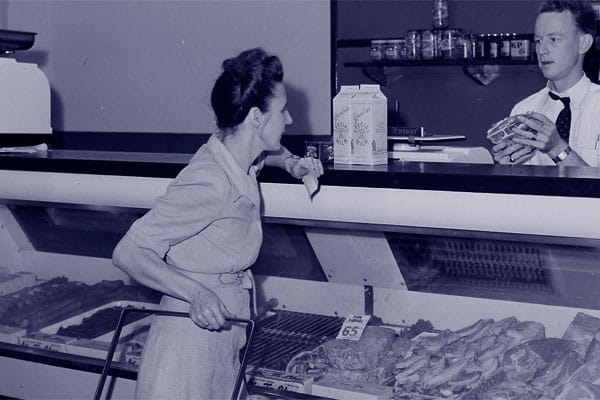
Back in the 1950s Detroit, before Walmart Super Stores, big chain supermarkets and packaged meat, you got your meat from a butcher shop. The butcher would actually cut the meat exactly how you wanted and weigh it right in front of you. If you wanted your porkchops thin, that’s how you got them. Want a special cut of beef, just ask the butcher.
Because the butcher shop was usually a neighborhood store, they knew the neighborhood families and would often be generous with weighing the scales, sometimes even letting poorer families get meat on a pay when you can basis. The butcher shop was also a gathering place for the ladies to exchange recipes and gossip.
Our particular neighborhood butcher was on Conant Avenue, a few blocks from our home, and was owned and operated by a kindly old Polish gentleman who had migrated here to escape the war in Europe. He knew his customers by name and even us kids when we shopped for our parents. His English was fair, but the European accent gave it a foreign flair. I also remember that he kept a candy dish near the register for us kids when we were sent by our parents to pick up an order.
Now, my mom fell on hard times while she was between housekeeping jobs and it was getting hard to put meat on the table. So, mom started buying beef liver and kidneys to serve with our homegrown vegetables. Well, the old butcher thought we were getting the kidneys to feed our cat, so he practically gave them to us without charging. This went on for several months until, my mom began asking only for the kidneys.
Then, one day during a conversation, my mom let out that the kidneys weren’t for the cat and that we were actually eating them ourselves. The old guy was shocked. But then he realized that we were probably one of his poorest customers. After that, he would always throw a couple of pork chops or steaks into the package with the free kidneys.
Fredric Durrette served one tour in Vietnam, retired as E8 in the navy submarine service after 23 years. Major hobbies are collecting old stuff from the 20s and restoring old racing bicycles. Worked as a commercial photographer at JL Hudsons in Detroit and continue photography as a hobby. Love Sade, sixties soul, seventies rock, and all jazz. Attended Woodstock in 69! http://snakesafe.jalbum.net/
Development of the Polio Vaccine by Dr. Jonas Salk
Polio, also known as poliomyelitis, is a highly infectious viral disease that primarily affects children and can lead to paralysis or death. In the early 20th century, polio epidemics were common worldwide, causing widespread fear and prompting an urgent search for a vaccine. Dr. Jonas Salk, an American medical researcher, and virologist, led the team that developed the first effective polio vaccine, which was announced on April 12, 1955. This groundbreaking achievement greatly reduced the incidence of polio and is considered a major milestone in the history of medicine.
Dr. Jonas Salk began working on the polio vaccine in 1947 at the University of Pittsburgh. He focused on creating an inactivated (killed) virus vaccine that would provide immunity without causing the disease. Salk’s team grew large quantities of the poliovirus and then inactivated them using formaldehyde. The inactivated viruses were used to develop the vaccine, tested on animals and eventually on human subjects, including Salk and his family.
Details:
In 1954, a large-scale clinical trial involving nearly two million children, known as the “Polio Pioneers,” was conducted to test the vaccine’s safety and effectiveness. The trial was a success, and on April 12, 1955, the vaccine was declared safe and effective, marking a turning point in the fight against polio.
Dr. Jonas Salk chose not to patent the polio vaccine, stating that it belonged to the public. As a result, the vaccine was made widely available at a low cost.
Salk became an international celebrity after the success of the polio vaccine, receiving numerous awards and honors for his work, including a Presidential Citation from President Dwight D. Eisenhower.
In 1963, Dr. Albert Sabin developed an oral polio vaccine using a live attenuated virus, which eventually replaced Salk’s inactivated virus vaccine in many parts of the world due to its ease of administration and lower cost.
Effects on Pop Culture: The development of the polio vaccine by Dr. Jonas Salk had several notable effects on popular culture, including:
Salk’s achievement made him a household name, and his status as a medical hero was celebrated in various forms of media, including television, radio, and print.
The success of the polio vaccine contributed to a sense of optimism and confidence in scientific progress, which was reflected in popular culture during the post-World War II era.
The polio vaccine’s development and distribution provided a model for large-scale public health campaigns and helped shape how vaccines are perceived and discussed in popular culture.
Prominent People and Countries Involved:
Dr. Jonas Salk: As the lead researcher behind the polio vaccine development, Salk played a pivotal role in this historic medical breakthrough.
United States: The polio vaccine development took place primarily in the US, with funding and support from organizations such as the National Foundation for Infantile Paralysis (now known as the March of Dimes).
In summary, the development of the polio vaccine by Dr. Jonas Salk in the 1950s marked a major milestone in the history of medicine and public health. The vaccine’s success greatly reduced the incidence of polio, saving countless lives and alleviating the fear of this devastating disease. Salk’s achievement significantly impacted popular culture, contributing to a sense of optimism in scientific progress and shaping the way vaccines are perceived and discussed in society.
December 27, 1952 – January 9, 1953:
Jimmy Boyd – I Saw Mommy Kissing Santa Claus
January 10, 1953 – February 13, 1953:
Perry Como – Don’t Let the Stars Get in Your Eyes
February 14, 1953 – March 20, 1953:
Teresa Brewer – Till I Waltz Again With You
March 21, 1953 – May 15, 1953:
Patti Page – The Doggie In The Window
May 16, 1953 – July 24, 1953:
Percy Faith – The Song From Moulin Rouge (Where Is Your Heart)
July 25, 1953 – August 7, 1953:
Eddie Fisher – I’m Walking Behind You
August 8, 1953 – October 9, 1953:
Les Paul and Mary Ford – Vaya Con Dios (May God Be With You)
October 10, 1953 – November 20, 1953:
Stan Freberg – St. George And The Dragonet
November 21, 1953 – January 1, 1954:
Tony Bennett – Rags To Riches
(Data is compiled from various charts including Billboard’s “Pop,” “Airplay,” “R&B” and “Singles” Charts. “Hot 100” is the primary chart used starting October, 1958)
Color television technology had been developing for several years before the first commercially available color television set was introduced. RCA (Radio Corporation of America) was a major player in the development of television technology and played a significant role in creating and popularizing color television.
Details:
On December 30, 1953, RCA introduced the CT-100, the first commercially available color television set in the United States. The CT-100 was a 15-inch screen TV, priced at $1,000 (equivalent to about $10,000 today, adjusted for inflation). Initially, limited color broadcasts were available, with the first nationwide color broadcast occurring on January 1, 1954, during the Tournament of Roses Parade.
The CT-100 was nicknamed “The Merrill” after RCA executive George H. C. Merrill.
Only around 5,000 units of the CT-100 were produced, making it a rare collector’s item today.
Color television sets were initially very expensive, and it took several years to become more affordable for the average consumer. By the mid-1960s, color TVs became more widespread in American households.
Effects on Pop Culture: The introduction of color television profoundly impacted popular culture, changing how people consumed media and experienced entertainment. Some effects on pop culture include:
An increased emphasis on visual storytelling and color in television programming leads to more vibrant and engaging content.
The rise of iconic TV shows in the 1960s and 1970s, such as “Star Trek,” “The Brady Bunch,” and “Sesame Street,” utilized color television technology to create memorable and visually striking television experiences.
The popularization of color television commercials enabled advertisers to create more visually appealing and persuasive ads, further shaping consumer culture.
Prominent People and Countries Involved:
David Sarnoff: As the president of RCA, Sarnoff played a crucial role in developing and marketing the first color television sets. He was a visionary leader in the field of electronic communication and helped shape the modern television industry.
George H. C. Merrill: An RCA executive who was instrumental in developing and promoting the CT-100 color television set.
The United States: The U.S. played a significant role in developing and popularizing color television technology, with RCA leading the charge. The introduction of color TV in the United States paved the way for its adoption in other countries around the world.
In conclusion, the introduction of the first color television by RCA marked a turning point in the history of television and popular culture. The development and popularization of color TV transformed the way people experienced entertainment and advertising, making television a more immersive and visually engaging medium. The United States, particularly RCA, played a significant role in bringing color television technology to the masses, influencing television programming and consumer culture for decades.
World-Changing Event: The structure of DNA was discovered at the Cavendish Laboratory at the University of Cambridge.
The First Big Bubblegum Pop Song? (How Much is That) Doggie in the Window by Patti Page
The Movies to Watch include From Here to Eternity, Houdini, The Robe, Stalag 17, The Caddy, House of Wax, The Wild One, It Came from Outer Space, and War of the Worlds.
The Most Famous Person in America was probably Gary Cooper.
Notable books include Fahrenheit 451 by Ray Bradbury, From Here to Eternity by James Jones, and Casino Royale by Ian Fleming.
Price of Packard Clipper automobile in 1953: $2,679.00
Arthur Miller’s play The Crucible premiered.
The Funny Comedy Team were: Dean Martin and Jerry Lewis
The Funniest TV Duo: Sid Caesar and Imogene Coca
The Funny Late Show Host: Steve Allen
The Funny Guy was Milton Berle
The Funny TV Lady: Lucille Ball
Atomic Espionage: Julius and Ethel Rosenberg were both found guilty of secret information about the atomic bomb to the Soviet Union and executed in 1953, becoming the first civilians to be executed for espionage in the United States.
MKUltra: The super-secret CIA program reputedly began in 1953 and ended in 1967.
Ray Bradbury wrote the first draft of Fahrenheit 451 on a coin-operated typewriter in the basement of the UCLA library. It charged 10¢ for 30 minutes, and he spent $9.80 on the machine.
Here are some significant events that took place in 1953
Queen Elizabeth II was coronated in Westminster Abbey on June 2, 1953.
The Korean War ended with the signing of the Korean Armistice Agreement on July 27, 1953.
Julius and Ethel Rosenberg were executed on June 19, 1953, after being found guilty of conspiracy to commit espionage for the Soviet Union.
The first issue of Playboy magazine was published in December 1953, featuring Marilyn Monroe as the cover model.
DNA structure was first described by James Watson and Francis Crick, who published their findings in the scientific journal Nature in April 1953. This discovery was later recognized as one of the most important scientific discoveries of the 20th century.
Top Ten Baby Names of 1953
Mary, Linda, Deborah, Patricia, Susan, Robert, James, Michael, John, David
Fashion Icons and Sex Symbols
Marilyn Monroe, Ava Gardner, Rita Hayworth, Audrey Hepburn, Doris Day, Lana Turner
Sex Symbols and Hollywood Hunks
Marlon Brando, Montgomery Clift
Oscars: 25th Academy Awards
The silver anniversary of the Oscars, also known as the 25th Academy Awards, was a spectacle held on March 19, 1953, at the RKO Pantages Theatre in Hollywood and the NBC International Theatre in New York City. This year was significant for being the first Oscars telecast, which was broadcast in black and white. Bob Hope served as host in Hollywood, while Conrad Nagel took on the role in New York. The Greatest Show on Earth secured Best Picture in a controversial win that still fuels debate among film aficionados. Gary Cooper took home Best Actor for his role in High Noon, and Shirley Booth was awarded Best Actress for her performance in Come Back, Little Sheba.
Emmy Awards: 5th Primetime Emmy Awards
For TV enthusiasts, the 5th Primetime Emmy Awards were celebrated on February 5, 1953, at the Statler Hotel in Los Angeles. Art Linkletter was the evening’s host. I Love Lucy still rode high, bagging the Best Situation Comedy award. A young and not-yet-famous James Dean was nominated for Best Actor, although the trophy ultimately went to Thomas Mitchell for The Doctor. The Best Actress accolade went to Helen Hayes for Schlitz Playhouse of Stars.
The Oscars had an eligibility period that ran from January 1, 1952, to December 31, 1952. The Emmy Awards, still in their infancy, were focused primarily on programming from the Los Angeles area.
“The Quotes:”
“The physician can bury his mistakes, but the architect can only advise his client to plant vines – so they should go as far as possible from home to build their first buildings.”
– Frank Lloyd Wright
“You’ll wonder where the yellow went when you brush your teeth with Pepsodent.”
Pepsodent toothpaste
“Shane. Shane. Come back!”
– Brandon De Wilde, in Shane
“Sometimes you feel like a nut, sometimes you don’t.”
– Peter Paul Mounds/Almond Joy
Time Magazine’s Man of the Year
Konrad Adenauer
Miss America
Neva Langley (Macon, GA)
Miss USA
Myrna Hansen (Illinois)
The Scandals
Piltdown Man, an archaeological find from 1912, was exposed as a forgery, consisting of the lower jawbone of an orangutan combined with the skull of a fully developed, modern man. The theory of Evolution took several steps back with this scandal.
Country Pop Star Death
Hank Williams (drugs and alcohol poisoning)
US Politics
January 20, 1953 (Tuesday): First inauguration of Dwight D. Eisenhower
1953 Pop Culture Facts & History
The first modern use of the word word ‘Frenemy” was first used in the 1953 article titled Howz about calling the Russians Your Frienemies? by gossip columnist Walter Winchell in the Nevada State Journal.
The Coppertone Girl was introduced to the American public. It is probably the most popular ‘butt crack’ of all time.
RCA invented the first musical synthesizer.
Officially, Ohio is listed as the 17th state in the US, but it is technically number 47. Congress forgot to vote on the formal resolution to admit Ohio to the Union but finally did on August 7, 1953.
Kenneth H. Rowe (born No Kum-Sok), a North Korean fighter pilot, defected to South Korea with his MiG-15 and was rewarded $100,000 from the United States.
Swanson had 260 tons of leftover turkey from Thanksgiving and didn’t know how to get rid of it. They asked their workers for ideas, and one man thought they should package it in individual trays with sides and freeze it. Thus, the TV Dinner was born.
Colgate-Palmolive-Peet became Colgate-Palmolive. We are not sure why, but we think that the Peet brothers suffered the same fate as Alvah Curtis Roebuck, of Sears and Roebuck fame.
Playwright and Nobel laureate Eugene O’Neill was born on October 16, 1888, in a hotel at Times Square; he also died on November 27, 1953, in another hotel in Boston. His last words were, “I knew it. I knew it. Born in a hotel room and died in a hotel room.”
The Cincinnati Reds baseball team was renamed the “Redlegs” this year through 1958 to avoid being associated with The Red Scare and communism.
Radios manufactured in the US between 1953 and 1963 had a white triangle on the dial at 640 AM to indicate where Civil Defense information would be broadcast.
Rolling Stone Keith Richards was a choirboy at the Queen’s 1953 Coronation.
Coca-Cola attempted to persuade the US Treasury to mint a 7.5-cent coin; a can of Coke had been a nickel since 1886 and needed to be raised due to inflation, but they felt a dime was too much.
Ore-Ida offered ‘Tater Tots’ in grocery stores. There were just pressed leftovers from their french fry line.
A Pennsylvania town named Mauch Chunk managed to get the remains of an early 20th-century athlete and bought the rights to his name. They renamed the town ‘Jim Thorpe,’ a tourist attraction in PA.
The first issue of Playboy, published in December 1953, featured Marilyn Monroe from her 1949 nude calendar shoot and sold over 50,000 copies.
Isaac Asimov wrote a short story, Sally, that claimed the first self-driving cars would be released around 2015.
In 1951, Ray Bradbury wrote a short story about a giant, fire-breathing lizard, which was made into the 1953 film The Beast from 20,000 Fathoms. This film inspired Ishirō Honda, a Japanese producer, to make Godzilla in 1954.
Biologists James D. Watson and Francis Crick published “Molecular Structure of Nucleic Acids: A Structure for Deoxyribose Nucleic Acid.” With little more than a drawing and some accompanying text, Watson and Crick discovered the structure of DNA.
Arthur Holly Compton (the Nobel Prize-winning chancellor of Washington University) was irritated by how fast people drove through the campus. To combat this, he designed the modern speed bump.
Doomsday Clock
Two minutes to midnight, according to the Bulletin of Atomic Scientists.
1953: After much debate, the United States decides to pursue the hydrogen bomb, a weapon far more powerful than any atomic bomb. In October 1952, the United States tests its first thermonuclear device, obliterating a Pacific Ocean islet in the process; nine months later, the Soviets test an H-bomb of their own. “The hands of the Clock of Doom have moved again,” the Bulletin announces. “Only a few more swings of the pendulum, and, from Moscow to Chicago, atomic explosions will strike midnight for Western civilization.”
1st Appearances & 1953’s Most Popular Christmas gifts, toys, and presents:
Scrabble, Mrs. Potato Head, Wiffle Ball invented, Matchbox (U.K.)
Nobel Prize Winners
Physics – Frits (Frederik) Zernike
Chemistry – Hermann Staudinger
Medicine – Hans Adolf Krebs, Fritz Albert Lipmann
Literature – Sir Winston Leonard Spencer Churchill
Peace – George Catlett Marshall
Best Film Oscar Winner
1952’s The Greatest Show On Earth
The Biggest Films of 1953
1. Peter Pan (Disney)
2. The Robe (Pop Culture Classic)
3. From Here to Eternity (Pop Culture Classic)
4. How to Marry a Millionaire
5. Shane
6. Gentlemen Prefer Blondes
7. Hondo
8. House of Wax (Pop Culture Classic)
9. The War of the Worlds (Pop Culture Classic)
10. The Beast from 20,000. Fathoms
11. Niagara
12. Abbott and Costello Meet Dr. Jekyll and Mr. Hyde
13. Stalag 17
14. Roman Holiday
15. Kiss Me, Kate
16. Charade
17. Salome
18. The Wild One (Pop Culture Classic)
19. Houdini
20. The Caddy
21. Devil’s Canyon
22. I Love Lucy
23. The Eddie Cantor Story
24. Scared Stiff
25. I Confess
26. It Came From Outer Space
27. Take The High Ground
28. Julius Caesar
29. Robot Monster
30. Glen or Glenda
*Movies beyond the Top Five are based on (a somewhat subjective) ranking based on how much they had a long-lasting effect on Pop Culture.
Broadway Show
The Teahouse of the August Moon (Play) Opened on October 15, 1953, and Closed on March 24, 1956
Popular and Best-selling Books From 1953
Battle Cry by Leon M. Uris Beyond This Place by A. J. Cronin Casino Royale by Ian Fleming The Chronicles of Narnia: The Silver Chair by C.S. Lewis The Crucible by Arthur Miller. Desirée by Annemarie Selinko Fahrenheit 451 by Ray Bradbury, From Here to Eternity by James Jones The High and the Mighty by Ernest K. Gann Lord Vanity by Samuel Shellabarger The Robe by Lloyd C. Douglas The Silver Chalice by Thomas B. Costain Time and Time Again by James Hilton The Unconquered by Ben Ames Williams
1953 Most Popular TV Shows
1. I Love Lucy (CBS)
2. Dragnet (NBC)
3. Arthur Godfrey’s Talent Scouts (CBS)
4. You Bet Your Life (NBC)
5. The Milton Berle Show (NBC)
6. Arthur Godfrey and his Friends (CBS)
7. Ford Theatre (NBC)
8. The Jackie Gleason Show (CBS)
9. Fireside Theatre (NBC)
10. The Colgate Comedy Hour (NBC)
1953 Billboard Number One Songs
December 27, 1952 – January 9, 1953: I Saw Mommy Kissing Santa Claus – Jimmy Boyd
January 10 – February 13: Don’t Let The Stars Get In Your Eyes – Perry Como
February 14 – March 20: Till I Waltz Again With You – Teresa Brewer
March 21 – May 15: The Doggie In The Window – Patti Page
May 16 – July 24: Song From Moulin Rouge – Percy Faith & his Orchestra
July 25 – August 7: I’m Walking Behind You – Eddie Fisher
August 8 – October 9: Vaya Con Dios – Les Paul & Mary Ford
October 10 – November 6: St. George And The Dragonet – Stan Freberg
November 7 – November 20: Vaya Con Dios – Les Paul & Mary Ford
November 21, 1953 – January 1, 1954: Rags To Riches – Tony Bennett
Sports
World Series Champions: New York Yankees
NFL Champions: Detroit Lions
NBA Champions: Minneapolis Lakers
Stanley Cup Champs: Montreal Canadiens
U.S. Open Golf Dick Mayer
U.S. Tennis: (Men/Ladies) Tony Trabert/Maureen Connolly
Wimbledon (Men/Women): Vic Seixas/Maureen Connolly
NCAA Football Champions: Maryland
NCAA Basketball Champions: Indiana
Kentucky Derby: Dark Star
Playboy Magazine, founded by Hugh Hefner, was a groundbreaking men’s magazine that combined articles on various topics, including lifestyle, politics, and culture, with photographs of nude or semi-nude women. At its peak, the magazine influenced popular culture, and Hefner became a well-known figure in the entertainment industry.
Details:
Hugh Hefner published the first issue of Playboy Magazine in December 1953. The debut issue featured a nude photograph of Marilyn Monroe, which Hefner had purchased to use as the magazine’s first centerfold. The issue sold over 50,000 copies and established Playboy as a major player in the magazine industry.
Hefner initially planned to name the magazine “Stag Party,” but changed the name to “Playboy” after a trademark dispute with an existing magazine called “Stag.”
The iconic Playboy logo, featuring a rabbit wearing a tuxedo bow tie, was designed by Art Paul for the magazine’s second issue.
Hefner created the first issue of Playboy using a $1,000 loan from his mother and $8,000 from other investors.
Effects on Pop Culture: Playboy Magazine significantly impacted popular culture, particularly during the 1960s and 1970s. Some of its effects on pop culture include:
Challenging societal norms and taboos surrounding sexuality and nudity, making discussions about sex more mainstream.
Providing a platform for renowned writers, including Ray Bradbury, Margaret Atwood, and Norman Mailer, who contributed fiction and non-fiction pieces to the magazine.
The “Playboy lifestyle” concept emphasized sophistication, luxury, and sexual freedom and was embodied by the Playboy Mansion and Hefner’s own lifestyle.
Launching the careers of numerous “Playboy Playmates,” who became well-known models and actresses, such as Pamela Anderson and Jenny McCarthy.
Prominent People and Countries Involved:
Hugh Hefner: The founder and editor-in-chief of Playboy Magazine, who played a crucial role in shaping its content and image. Hefner became a symbol of sexual freedom and the Playboy lifestyle, hosting lavish parties at his Playboy Mansion.
Marilyn Monroe: The Hollywood icon was featured in the first issue of Playboy as the magazine’s inaugural centerfold, helping to establish the magazine’s reputation and boost sales.
The United States: Playboy Magazine was launched in the United States and quickly influenced American popular culture. The magazine’s impact extended to other countries as it gained international popularity.
In conclusion, the launch of Playboy Magazine by Hugh Hefner in December 1953 marked a turning point in popular culture, challenging societal norms surrounding sexuality and introducing the concept of the “Playboy lifestyle.” The magazine played a significant role in shaping popular culture in the United States and beyond, featuring prominent writers, celebrities, and models, and influencing discussions about sex and relationships for decades to come.
The Publication of Ray Bradbury’s “Fahrenheit 451”
“Fahrenheit 451” is a dystopian novel by American author Ray Bradbury, published on October 19, 1953. The story is set in a future society where the state banned and burned books to suppress dissenting ideas and critical thought. The novel explores themes of censorship, conformity, and the impact of mass media on society.
Details:
“Fahrenheit 451” follows the story of Guy Montag, a fireman who burns books. In this dystopian society, the government employs firemen to destroy books and the houses of those who possess them, as books are considered the source of unhappiness and dissent. Montag’s journey begins when he meets a free-spirited young woman named Clarisse, who opens his eyes to the importance of books and the value of individual thought. Montag eventually rebels against the system, joining a group of outcasts who seek to preserve knowledge and literature.
The title “Fahrenheit 451” refers to the temperature at which paper supposedly ignites (451 degrees Fahrenheit or 233 degrees Celsius), symbolizing the novel’s central theme of book burning.
The novel was initially published as a shorter novella, titled “The Fireman,” in Galaxy Science Fiction magazine in 1951 before being expanded into a full-length novel.
Ray Bradbury claimed to have written the first draft of “Fahrenheit 451” in just nine days, using a typewriter he rented at the UCLA library.
Effects on Pop Culture: “Fahrenheit 451” has significantly impacted popular culture, influencing various forms of media and becoming a staple in discussions about censorship and the importance of free thought. Some examples include:
The novel has been adapted into multiple forms, including a 1966 film directed by François Truffaut, a 1984 stage play by Ray Bradbury, and a 2018 HBO film directed by Ramin Bahrani.
“Fahrenheit 451” is often taught in schools and has become a classic of American literature, frequently appearing on lists of must-read books.
The novel has inspired several songs and musical works, such as “Fahrenheit 451” by Hawkwind and “The Sound of Silence” by Simon & Garfunkel.
The book-burning theme in “Fahrenheit 451” has been referenced and explored in various other works of fiction, such as the film “Equilibrium” (2002) and the novel “The Book Thief” (2005).
Prominent People and Countries Involved:
Ray Bradbury: An American author known for his contributions to science fiction, fantasy, and horror, Bradbury wrote “Fahrenheit 451” as a response to the political climate of the time, particularly the fear of censorship and the loss of individuality.
United States: As the country of both the author and the novel’s setting, the United States serves as a backdrop for the story’s exploration of themes like censorship, mass media influence, and the power of literature.
Overall, Ray Bradbury’s “Fahrenheit 451” is a significant work of literature that has impacted popular culture and discussions surrounding censorship and free thought. Since its publication in 1953, the novel has inspired various adaptations and has been widely recognized for its powerful commentary on the importance of preserving knowledge and the dangers of conformity.
Rapid Eye Movement (REM) sleep is a phase of the sleep cycle characterized by rapid eye movements, increased brain activity, and vivid dreams. The discovery of REM sleep in the early 1950s by researchers Eugene Aserinsky and Nathaniel Kleitman at the University of Chicago significantly advanced our understanding of sleep and its various stages. This discovery led to further research on the relationship between sleep, dreaming, and brain function.
Details:
Eugene Aserinsky, a graduate student under Nathaniel Kleitman’s supervision, conducted a series of experiments to study eye movements during sleep using electroencephalogram (EEG) and electrooculogram (EOG) recordings. He observed periods of rapid eye movement and increased brain activity that coincided with the occurrence of dreams. Aserinsky and Kleitman’s findings were published in the journal Science in 1953, introducing the concept of REM sleep to the scientific community.
REM sleep was discovered almost accidentally, as Aserinsky initially set out to study the relationship between eye movements and brain function, not sleep.
Nathaniel Kleitman, sometimes referred to as the “father of modern sleep research,” also played a significant role in establishing the 24-hour circadian rhythm of humans.
Aserinsky and Kleitman’s discovery of REM sleep paved the way for future sleep research, including identifying non-REM (NREM) sleep stages.
Effects on Pop Culture: While the discovery of REM sleep might not have directly impacted popular culture, it has certainly contributed to a greater understanding of sleep and dreaming, which are common themes in various forms of art and entertainment. Some examples include:
The scientific study of dreams has inspired movies, such as “Inception” (2010) and “Waking Life” (2001), which explore the complexities of the dreaming mind.
The concept of lucid dreaming, or the ability to control one’s dreams, has gained popularity recently, with numerous books, websites, and workshops devoted to the subject. Lucid dreaming often occurs during REM sleep.
The understanding of sleep stages, including REM sleep, has influenced discussions around sleep disorders and the importance of quality sleep for overall health and well-being.
Prominent People and Countries Involved:
Eugene Aserinsky: A graduate student at the University of Chicago, Aserinsky was the first to observe and record rapid eye movement during sleep, leading to the discovery of REM sleep.
Nathaniel Kleitman: A prominent sleep researcher and mentor to Aserinsky, Kleitman co-authored the groundbreaking study on REM sleep and played a pivotal role in advancing sleep research.
United States: The discovery of REM sleep took place at the University of Chicago, marking a significant contribution to the field of sleep research by American scientists.
In summary, the discovery of REM sleep in 1953 by Eugene Aserinsky and Nathaniel Kleitman at the University of Chicago marked a crucial advancement in our understanding of sleep and its various stages. Their research has had a lasting impact on sleep studies, inspiring further investigation into the relationships between sleep, dreaming, and brain function. While the influence on popular culture may be limited, the increased understanding of sleep and dreaming has informed various artistic and scientific discussions.
Nikita Khrushchev Becomes Leader of the Soviet Union
Nikita Khrushchev, a prominent Soviet politician, and statesman, emerged as the leader of the Soviet Union after the death of Joseph Stalin in 1953. Khrushchev’s leadership marked a period of de-Stalinization, which sought to reform some of the harsh policies implemented under Stalin’s rule and a new direction in foreign policy during the early years of the Cold War.
Details:
Nikita Khrushchev (April 15, 1894 – September 11, 1971) was appointed First Secretary of the Central Committee of the Communist Party of the Soviet Union on September 7, 1953, following a power struggle in the wake of Stalin’s death. On March 27, 1958, Khrushchev was elected Premier of the Soviet Union, consolidating his leadership. Khrushchev’s time in power was marked by several key events and policies.
The “Secret Speech” (1956): Khrushchev denounced Stalin’s policies and cult of personality in a speech to the 20th Congress of the Communist Party, initiating a period of de-Stalinization and political reform in the Soviet Union.
The Suez Crisis (1956): Khrushchev supported Egypt during the Suez Crisis, which strained relations between the Soviet Union and Western powers.
The Hungarian Revolution (1956): Khrushchev ordered Soviet troops to suppress the anti-communist revolution in Hungary, resulting in thousands of deaths and international condemnation.
The Cuban Missile Crisis (1962): The Soviet Union’s decision to place nuclear missiles in Cuba led to a tense 13-day standoff with the United States, which ultimately ended with the removal of the missiles and a temporary easing of Cold War tensions.
Khrushchev was known for his often colorful and blunt rhetoric, famously banging his shoe on a table during a United Nations General Assembly session in 1960.
As part of his agricultural policies, Khrushchev launched the “Virgin Lands Campaign,” which sought to cultivate vast areas of previously unused land in the Soviet Union, with mixed results.
Effects on Pop Culture: Khrushchev’s time as leader of the Soviet Union significantly impacted popular culture, both within the Soviet Union and internationally. Some examples include:
The film “Dr. Strangelove” (1964), directed by Stanley Kubrick, satirized Cold War tensions and the threat of nuclear war during the Khrushchev era.
Khrushchev’s famous “kitchen debate” with U.S. Vice President Richard Nixon in 1959 showcased the competition between the Soviet Union and the United States in various aspects of life, including technology and consumer goods.
Khrushchev’s policies, such as de-Stalinization and the Virgin Lands Campaign, influenced Soviet literature and cinema during his time in power, with works reflecting the changing political and social climate.
Prominent People and Countries Involved:
Nikita Khrushchev: The leader of the Soviet Union during a crucial period of the Cold War, Khrushchev implemented domestic and foreign policies that shaped the course of Soviet history.
The Soviet Union: Under Khrushchev’s leadership, the Soviet Union underwent significant political and social changes and tense confrontations with Western powers.
The United States: The U.S. was a key adversary of the Soviet Union during the Khrushchev era, with events like the Cuban Missile Crisis highlighting the escalating tensions between the two superpowers during the Cold War.
Nikita Khrushchev’s leadership of the Soviet Union marked a significant period in global history and popular culture. His policies, such as de-Stalinization, and key events during his tenure, like the Cuban Missile Crisis, had far-reaching effects on both the Soviet Union and the world. Khrushchev’s actions and rhetoric also left a lasting impact on popular culture, with films, literature, and other artistic expressions reflecting the political and social climate of the time.
“Roman Holiday” is a romantic comedy film directed by William Wyler, starring Audrey Hepburn and Gregory Peck. The film marked Audrey Hepburn’s first major role, launching her to stardom and establishing her as a Hollywood icon. Set in Rome, Italy, the film tells the story of a European princess who escapes her royal duties for a day of adventure with an American reporter. “Roman Holiday” is known for its charming performances, beautiful cinematography, and heartwarming story.
Details:
“Roman Holiday” was released in the United States on August 27, 1953. The screenplay was written by Dalton Trumbo, John Dighton, and Ian McLellan Hunter. However, due to Trumbo’s blacklisting during the Hollywood Red Scare, he did not receive credit for his work on the film until 1991. The film was shot on location in Rome, Italy, using the city’s picturesque settings as a backdrop for the story.
Audrey Hepburn was relatively unknown before being cast in “Roman Holiday.” She was initially offered a smaller role, but director William Wyler insisted on casting her as the lead after seeing her screen test.
Audrey Hepburn won the Academy Award for Best Actress for her role as Princess Ann in “Roman Holiday,” making it her first and only Oscar win.
The film’s famous scene, in which Hepburn’s character receives a haircut at a Roman barber shop, was actually inspired by Hepburn’s own experience of impulsively cutting her hair short.
“Roman Holiday” was the first American film to be entirely shot on location in Italy.
Effects on Pop Culture: “Roman Holiday” has had a lasting impact on popular culture in various ways, including:
Audrey Hepburn’s performance in the film solidified her status as a Hollywood icon and fashion inspiration, influencing generations of actresses and fans.
The film’s romantic portrayal of Rome contributed to the city’s enduring appeal as a popular tourist destination and a backdrop for countless films and television shows.
“Roman Holiday” has been referenced and parodied in numerous films and television episodes, including “The Simpsons,” “The Princess Diaries,” and “Gossip Girl.”
The film’s success helped pave the way for other romantic comedies set in picturesque European locations, such as “An Affair to Remember” (1957), “Three Coins in the Fountain” (1954), and “To Catch a Thief” (1955).
Prominent People and Countries Involved:
Audrey Hepburn: The film’s lead actress, Hepburn’s performance in “Roman Holiday” propelled her to stardom and made her a lasting symbol of grace, elegance, and charm.
Gregory Peck: As the male lead, Peck’s portrayal of the American reporter, Joe Bradley, was instrumental in the film’s success and further solidified his status as a Hollywood leading man.
William Wyler: The director of “Roman Holiday,” Wyler was known for his meticulous filmmaking style and insistence on shooting on location in Rome.
Italy: The film’s picturesque setting in Rome played a significant role in its enduring appeal, showcasing the city’s historic sites and charming streets to audiences worldwide.
“Roman Holiday” is a beloved romantic comedy that introduced the world to Audrey Hepburn’s captivating charm and talent. Released in 1953, the film has left a lasting impact on popular culture, influencing fashion, film, and tourism. Its timeless story, set against the enchanting backdrop of Rome, has captured the hearts of audiences for decades.
The Korean War Armistice Agreement was signed on July 27, 1953, after three years of fighting between North Korea and South Korea. The war began on June 25, 1950, when North Korean forces invaded South Korea, and the conflict quickly drew in international support, with the United States and its allies backing South Korea and China supporting North Korea.
Representatives from the United Nations Command, North Korea, and China negotiated the armistice agreement. It was signed in Panmunjom, a village in the demilitarized zone (DMZ) between the two Koreas. The agreement called for a ceasefire and the creation of a demilitarized zone to buffer the two Koreas.
The armistice did not formally end the war, as no peace treaty was ever signed. Still, it effectively ended the fighting and ceased hostilities that have lasted until now. The agreement also established the Korean Demilitarized Zone (DMZ), a 4 km-wide buffer zone that spans the entire Korean Peninsula and is the most heavily fortified border in the world.
The effects of the Korean War Armistice Agreement on pop culture have been significant, with numerous books, movies, and TV shows depicting the conflict and its aftermath. Some prominent works include the book “The Korean War” by Max Hastings, the movie “MAS*H” (which was also adapted into a popular TV show), and the TV series “Mister Sunshine.”
Prominent people involved in the Korean War Armistice Agreement include the chief negotiators, Lieutenant General William K. Harrison Jr. of the United States and General Nam Il of North Korea, and the Chinese commander, General Peng Dehuai. Countries involved in the agreement include the United States, China, North Korea, South Korea, and the United Nations Command.
In conclusion, the Korean War Armistice Agreement was signed on July 27, 1953, after three years of fighting between North Korea and South Korea. It established a ceasefire and created a demilitarized zone, effectively ending the fighting, although no peace treaty was ever signed. The agreement has had significant effects on pop culture, with numerous books, movies, and TV shows depicting the conflict and its aftermath, and prominent people and countries involved in the negotiations include Lieutenant General William K. Harrison Jr., General Nam Il, General Peng Dehuai, the United States, China, North Korea, South Korea, and the United Nations Command.
That’s Amore
This song is widely associated with Dean Martin and is often considered his signature tune. Written in 1953 by Harry Warren and Jack Brooks, it debuted as part of the soundtrack for the Jerry Lewis and Dean Martin comedy film The Caddy. It was nominated for an Academy Award for Best Original Song in 1953 but lost to Doris Day’s Secret Love. The song experienced a resurgence in popularity when it was featured in the 1987 film Moonstruck, starring Cher and Nicolas Cage.
Eddie Fisher
Oh! My Pa-Pa
The original version of this song, O Mein Papa, was composed for the Swiss musical Der Schwarze Hecht in 1939, not a German musical. It gained popularity in the UK as an instrumental before being translated into English. Eddie Fisher’s emotional rendition became a hit, reaching No. 1 on the Billboard charts in 1954.
Frank Sinatra
I’ve Got the World on a String
This song, written by Harold Arlen and Ted Koehler in 1932, was introduced at The Cotton Club Parade. While initially performed by Bing Crosby and Cab Calloway, Frank Sinatra’s 1953 recording brought the song renewed attention, peaking at No. 14 on the Billboard charts. It has since become a Sinatra classic, showcasing his charismatic phrasing and vocal style.
Joni James
Your Cheatin’ Heart
Written and recorded by Hank Williams in 1952, this country classic was not released until after his death in January 1953. Joni James’s pop rendition introduced the song to a broader audience, cementing its place as one of the greatest country songs of all time.
Kay Starr
Side by Side
Originally written by Harry M. Woods and Gus Kahn in 1927, this song became a standard of American music. Kay Starr’s 1953 recording helped propel the song into the mainstream, solidifying its enduring legacy.
Patti Page
(How Much Is) That Doggie in the Window?
Composed by Bob Merrill and Ingrid Reuterskiöld in 1952, this whimsical tune became a chart-topping hit in 1953 with Patti Page’s playful rendition. The song reached No. 1 on the Billboard charts and is noted as the first No. 1 hit with a question in the title.
Tony Bennett
Stranger in Paradise
This song, part of the 1953 Broadway musical Kismet, was written by Robert Wright and George Forrest, with its melody based on Alexander Borodin’s Gliding Dance of the Maidens from the Polovtsian Dances. While Vic Damone and Ann Blyth performed the song in the 1955 film adaptation of Kismet, Tony Bennett’s version became a definitive hit, popularizing the song outside the context of the musical.
Rags to Riches
Written by Richard Adler and Jerry Ross, Rags to Riches reached No. 1 on the Billboard charts in 1953. The song later gained comedic fame as Carmine Ragusa’s serenade in Laverne & Shirley. Elvis Presley performed the song impromptu during his 1976 Pittsburgh concert, showing its enduring appeal.
Frankie Laine
I Believe
This inspirational song, written by Ervin Drake, Irvin Graham, Jimmy Shirl, and Al Stillman in 1953, was commissioned by Jane Froman for her television show to inspire hope during challenging times. Frankie Laine’s recording became a massive hit and holds the UK record for the longest stay at No. 1—18 weeks. The song has since been covered by numerous artists, including The Lettermen, and is often regarded as a hymn for its uplifting message.
Top Artists and Songs of 1953
Ames Brothers
You You You, The Man With The Banjo
Art Lund
Crying In The Chapel
Bill Haley and his Comets
Crazy Man Crazy
Darrell Glenn
Crying In The Chapel
Dean Martin
That’s Amore
Don Cornell
Heart of My Heart
Doris Day
Mister Tap Toe
Drifters
Money Honey
Eddie Calvert
Oh Mein Papa
Eddie Fisher
Downhearted
Ella Fitzgerald
Crying In The Chapel
Fats Domino
Roe Mary
Faye Adams
Shake a Hand
Four Aces
The gang that Sang ‘Heart of My Heart’
Frank Chacksfield Orchestra
Limelight
Frank Sinatra
I’ve Got The World On a String, South of the Border, From Here To Eternity
Frankie Laine
I Believe, Where The Winds Blow, Answer Me Lord Above, Blowing Wind
Guy Mitchell
She Wears Red Feathers
Hank Williams
Your Cheatin’ Heart, Kaw-Liga
Jimmy Boyd and Frankie Laine
Tell Me A Story
Johnny Ace
The Clock
Johnny Ray
Somebody Stole My gal
Joni James
Your Cheatin’ Heart, Have You Heard?
June Valli
Crying In The Chapel
Kay Starr
Side By Side, Changing Partners
Lawrence Welk
Oh Happy Day
Les Baxter
Ruby, Gigi/I Love Paris, April in Portugal
Les Paul and Mary Ford
Bye Bye Blues, Vaya Con Dios, Johnny (Is The Boy For Me)
Mantovani
Where Is Your Heart (From Moulin Rouge), Swedish Rhapsody
Nat ‘King’ Cole
Pretend, Blue Gardenia, can’t I
Patti Page
Changing Partners, Doggie In The Window
Percy Faith
Song From Moulin Rouge (Where Is Your Heart)
Perry Como
Don’t Let The Stars Get In Your Eyes, You Alone, No Other Love, Say Your Mine Again
Ray Anthony & His Orchestra
Dragnet
Red Buttons
The Ho Ho Song
Rex Allen
Crying In The Chapel
Richard Hayman
Ruby
Ruth Brown
(Mama) He Treats Your Daughter Mean
Stan Freberg
St. George and the Dragonette
Teresa Brewer Richochet (Rick-O-Shay), Till I Waltz Again With You
Julius and Ethel Rosenberg were American citizens convicted of conspiracy to commit espionage for the Soviet Union, specifically relating to passing information about the atomic bomb. Their trial and execution took place during the early years of the Cold War when anti-communist sentiment was high in the United States.
Julius and Ethel Rosenberg were arrested in 1950, and their trial began on March 6, 1951. The prosecution’s case relied heavily on the testimony of Ethel’s brother, David Greenglass, who had worked as a machinist at the Los Alamos National Laboratory during the development of the atomic bomb. Greenglass testified that Julius had recruited him to pass information to the Soviet Union and that Ethel had typed up the notes. On March 29, 1951, the Rosenbergs were convicted of conspiracy to commit espionage, and on April 5, they were sentenced to death.
They were executed on June 19, 1953.
The Rosenbergs were the first American civilians executed for espionage during peacetime.
Their two sons, Michael and Robert Meeropol were orphaned after their parents’ execution and were later adopted by Abel and Anne Meeropol.
Abel Meeropol, their adoptive father, composed the anti-lynching song “Strange Fruit,” famously performed by Billie Holiday.
Effects on Pop Culture: The trial and execution of the Rosenbergs became a symbol of anti-communist fervor in the United States during the 1950s. Their case has been depicted in various books, plays, and films, including:
E.L. Doctorow’s novel “The Book of Daniel” (1971), is a fictional account of the lives of Rosenberg’s sons.
The play “Angels in America” (1991) by Tony Kushner references the Rosenberg case and features Ethel’s ghost as a character.
The film “Daniel” (1983) was directed by Sidney Lumet and based on Doctorow’s novel.
Prominent People and Countries Involved:
David Greenglass: Ethel’s brother, whose testimony was crucial in the conviction of the Rosenbergs. He later admitted to lying about some aspects of his testimony, particularly regarding Ethel’s involvement, to protect his wife, Ruth Greenglass.
Roy Cohn: A young prosecutor on the Rosenberg case who later became a prominent lawyer and political figure, eventually serving as an advisor to Senator Joseph McCarthy during the “Red Scare” period.
The United States: The Rosenberg trial and execution took place during the early years of the Cold War, and their case symbolized anti-communist sentiment in the country.
The Soviet Union: While the Rosenbergs were accused of passing information to the Soviet Union, the extent of the information they provided and its impact on the development of the Soviet atomic bomb program remains a subject of debate among historians.
The execution of Julius and Ethel Rosenberg marked a significant moment in Cold War history. It served as a symbol of the anti-communist sentiment that gripped the United States during the 1950s. The trial and its aftermath have had a lasting impact on popular culture, with various works of fiction and non-fiction exploring the consequences of the case and the broader context of the Cold War.
The Coronation of Queen Elizabeth II was a ceremony held on June 2, 1953, at Westminster Abbey in London, England. Elizabeth ascended to the throne following the death of her father, King George VI, on February 6, 1952. The ceremony was attended by thousands of guests, including heads of state, diplomats, and other dignitaries from around the world.
The coronation ceremony itself was a lavish affair, with Elizabeth wearing a stunning white gown designed by Norman Hartnell and a diamond-studded crown known as the St. Edward’s Crown. The ceremony also included the anointing of the queen with holy oil and the presentation of various symbols of royalty, including the Sceptre, the Orb, and the Royal Ring of Saphire.
Trivial facts surrounding the Coronation of Queen Elizabeth II include that the ceremony was the first to be televised, with an estimated 27 million viewers tuning in to watch the event. The ceremony was also the first to be held in Westminster Abbey since the coronation of King George VI in 1937.
The effects of the Coronation of Queen Elizabeth II on pop culture have been significant, with the event sparking a renewed interest in the monarchy and increasing the popularity of the Queen. The ceremony also served as a symbol of Britain’s post-war recovery and helped to boost national morale.
Prominent people involved in the Coronation of Queen Elizabeth II include the Archbishop of Canterbury, who conducted the ceremony, and the Duke of Edinburgh, who accompanied the Queen during the procession to and from Westminster Abbey. Countries involved in the ceremony include the United Kingdom and various Commonwealth nations, with representatives from across the globe attending the event.
In conclusion, the Coronation of Queen Elizabeth II was a lavish ceremony held on June 2, 1953, at Westminster Abbey in London, England. Elizabeth ascended to the throne following the death of her father, King George VI, on February 6, 1952. The ceremony was the first to be televised and included the anointing of the queen with holy oil and the presentation of various symbols of royalty. Trivial facts surrounding the event include that it was the first coronation ceremony to be held in Westminster Abbey since 1937, and the effects of the ceremony on pop culture have been significant. Prominent people involved in the Coronation of Queen Elizabeth II include the Archbishop of Canterbury and the Duke of Edinburgh, and countries involved include the United Kingdom and various Commonwealth nations.
First Ascent of Mount Everest by Sir Edmund Hillary and Tenzing Norgay
The first ascent of Mount Everest was made on May 29, 1953, by Sir Edmund Hillary of New Zealand and Tenzing Norgay, a Sherpa of Nepal. Mount Everest is the highest mountain in the world, with an elevation of 29,029 feet (8,848 meters).
Hillary and Norgay began their ascent from the South Col, a base camp on the mountain’s southern side. They climbed for several days, battling harsh weather conditions and dangerous terrain, before finally reaching the summit.
Details surrounding the first ascent of Mount Everest include that Hillary and Norgay carried several scientific instruments to the summit, including a camera and a barometer. They also left behind a small cross on the summit, which has since become a famous landmark for climbers.
The effects of the first ascent of Mount Everest on pop culture have been significant, with Hillary and Norgay becoming famous overnight and inspiring generations of climbers and adventurers. The ascent was also seen as a symbol of national pride for both New Zealand and Nepal.
Prominent people involved in the first ascent of Mount Everest include Sir Edmund Hillary and Tenzing Norgay, as well as several other climbers who attempted to reach the summit before them. Countries involved in the first ascent include New Zealand, Nepal, and the United Kingdom.
In conclusion, the first ascent of Mount Everest was made on May 29, 1953, by Sir Edmund Hillary of New Zealand and Tenzing Norgay, a Sherpa of Nepal. The ascent was a significant achievement in mountaineering and inspired generations of climbers and adventurers. Trivial facts surrounding the ascent include the scientific instruments carried by Hillary and Norgay and the small cross left behind on the summit. The ascent significantly impacted pop culture, and prominent people involved included Hillary and Norgay. Countries involved include New Zealand, Nepal, and the United Kingdom.
First Successful Open-heart Surgery by Dr. John Gibbon
Open-heart surgery, a medical procedure that involves operating directly on the heart while it is exposed, was a groundbreaking development in cardiothoracic surgery. Dr. John H. Gibbon, an American surgeon, successfully performed the first open-heart surgery using a heart-lung machine on May 6, 1953. This milestone marked a significant advancement in cardiac care, paving the way for more complex heart procedures and saving countless lives.
Details:
Dr. John H. Gibbon was inspired to develop a heart-lung machine after witnessing a patient’s death due to a blood clot in the heart. He believed that a device capable of temporarily taking over the functions of the heart and lungs during surgery would allow surgeons to operate on the heart without risking the patient’s life. After years of research and experimentation, Dr. Gibbon developed a prototype of the heart-lung machine, known as the Gibbon-Mayo pump.
On May 6, 1953, Dr. Gibbon performed the first successful open-heart surgery using his heart-lung machine at Thomas Jefferson University Hospital in Philadelphia. The patient was an 18-year-old woman named Cecelia Bavolek, who suffered from an atrial septal defect (a hole in the wall separating the heart’s upper chambers). The surgery was successful, and Bavolek’s heart was repaired without complications.
Dr. Gibbon’s research on the heart-lung machine began in the 1930s and took almost two decades to come to fruition.
Dr. Gibbon’s wife, Mary, a fellow physician, played a crucial role in developing the heart-lung machine by assisting him in his research and providing valuable support.
Although Dr. Gibbon’s machine was groundbreaking, it was large, cumbersome, and expensive. Later versions of the heart-lung machine would become more efficient, compact, and cost-effective.
Effects on Pop Culture: While the first successful open-heart surgery using a heart-lung machine may not have directly impacted popular culture, it has undoubtedly influenced the way medical procedures and advancements are portrayed in various forms of media. Some examples include:
The success of open-heart surgery and other medical breakthroughs has contributed to the popularity of medical dramas on television, such as “Grey’s Anatomy,” “ER,” and “House.”
Stories of miraculous recoveries and life-saving surgeries, often inspired by real-life events like Dr. Gibbon’s pioneering work, are frequently featured in films, books, and other forms of storytelling.
The depiction of groundbreaking medical procedures in media can influence public perception and understanding of healthcare and the importance of medical research.
Prominent People and Countries Involved:
Dr. John H. Gibbon: An American surgeon who developed the heart-lung machine and performed the first successful open-heart surgery using the device.
Cecelia Bavolek: The patient who underwent the first successful open-heart surgery using the heart-lung machine, paving the way for countless other patients to receive life-saving treatment.
United States: As the country where Dr. Gibbon developed the heart-lung machine and performed the first successful open-heart surgery, the United States played a significant role in this medical milestone.
In summary, the first successful open-heart surgery using a heart-lung machine, performed by Dr. John Gibbon in 1953, marked a significant advancement in cardiothoracic surgery. This groundbreaking procedure demonstrated the potential for life-saving heart surgeries and contributed to developing more advanced cardiac care techniques. Although its direct impact on popular culture may be limited, the story of this medical breakthrough has undoubtedly inspired countless films, books, and television shows that celebrate the power of medical innovation and its impact on people’s lives. Dr. Gibbon’s pioneering work, along with the support of his wife, Mary, and the bravery of patient Cecelia Bavolek, has left a lasting legacy in cardiac surgery, ultimately saving and improving the lives of countless individuals worldwide.
First James Bond Novel, “Casino Royale” by Ian Fleming
“Casino Royale” is the first novel in the James Bond series by British author Ian Fleming. The book introduced the world to the iconic character of James Bond, a British Secret Service agent known for his suave demeanor, daring adventures, and affinity for gadgets, cars, and romance. The James Bond series would become a cultural phenomenon, spanning numerous novels, films, and adaptations, with a lasting impact on popular culture.
Details:
Ian Fleming, a former naval intelligence officer, drew on his own experiences and interests to create the character of James Bond. “Casino Royale” was published on April 13, 1953, by Jonathan Cape in the United Kingdom. The story follows Bond as he is sent to the fictional French coastal resort of Royale-les-Eaux to bankrupt a high-stakes card player and Soviet agent, Le Chiffre, in a baccarat game. The novel features the first appearance of iconic characters like M, the head of the British Secret Service, and Miss Moneypenny, M’s secretary.
Ian Fleming wrote “Casino Royale” while on vacation at his Goldeneye estate in Jamaica.
The character of James Bond was named after an American ornithologist, also named James Bond, whose book on Caribbean birds Fleming owned.
Casino Royale’s main antagonist, Le Chiffre, means “The Number” or “The Cipher” in French, reflecting his role as a Soviet agent.
The novel was initially met with mixed reviews but sold well, prompting Fleming to write a new Bond novel every year until his death in 1964.
Effects on Pop Culture: The James Bond series has had a significant impact on popular culture in various ways, including:
The success of “Casino Royale” and subsequent novels led to the creation of a long-running and successful film franchise, beginning with “Dr. No” in 1962, making Bond one of the most recognizable characters in the world.
The James Bond films have popularized many catchphrases, such as “Bond, James Bond,” “shaken, not stirred,” and “license to kill.”
The Bond series has influenced the action-adventure and spy genres in literature, film, and television, inspiring numerous imitations and parodies.
James Bond’s affinity for luxury cars, gadgets, and clothing has impacted fashion trends and marketing strategies, with many products associated with the Bond brand.
Prominent People and Countries Involved:
Ian Fleming: The British author who created the character of James Bond and wrote the first novel, “Casino Royale.”
United Kingdom: The birthplace of both Ian Fleming and the James Bond character, the UK has played a significant role in developing and popularizing the series.
Sean Connery: The first actor to portray James Bond on the big screen, Connery’s portrayal in the film “Dr. No” (1962) set the standard for the character and cemented Bond’s place in popular culture.
In summary, the publication of “Casino Royale” by Ian Fleming in 1953 marked the beginning of the immensely popular James Bond series. The novel introduced the world to the suave and sophisticated British Secret Service agent, whose adventures would capture the imagination of millions of readers and viewers around the globe. The impact of the James Bond series on popular culture is immense, influencing literature, film, fashion, and more.
Creation of the US Department of Health, Education, and Welfare
The United States Department of Health, Education, and Welfare (HEW) was a cabinet-level department of the federal government responsible for overseeing the administration and implementation of various health, education, and social welfare programs. Established on April 11, 1953, under President Dwight D. Eisenhower, the HEW aimed to consolidate various agencies dealing with these sectors, streamlining the government’s efforts to address public health, education, and social needs.
Details:
The Department of Health, Education, and Welfare was created by the Reorganization Plan No. 1 of 1953, signed by President Eisenhower. The plan combined the existing Federal Security Agency with several other health, education, and social services agencies. The department’s mission was to improve the American people’s lives by fostering better health, educational opportunities, and social conditions.
The Department of Health, Education, and Welfare was renamed the Department of Health and Human Services (HHS) in 1979 after the Department of Education was separated from it, becoming a standalone cabinet-level agency.
The Social Security Administration, initially part of the HEW, became an independent agency in 1995.
The HEW was the first federal department to have an African-American woman, Patricia Roberts Harris, as its secretary. She was appointed by President Jimmy Carter in 1977.
Effects on Pop Culture: While the Department of Health, Education, and Welfare may not have had a direct impact on popular culture, it played a significant role in shaping public policy and influencing the lives of millions of Americans through its various programs and initiatives. Some of its indirect contributions to popular culture include:
Promoting public health campaigns that have become ingrained in American culture, such as anti-smoking and anti-drug initiatives and efforts to improve nutrition and exercise habits.
Supporting arts and culture through grants and other forms of financial assistance, thereby helping to foster the growth of various cultural movements and institutions.
Implementing policies and regulations that have influenced how health, education, and social issues are portrayed and discussed in media, such as film, television, and literature.
Prominent People and Countries Involved:
President Dwight D. Eisenhower: As the president who established the Department of Health, Education, and Welfare, Eisenhower played a pivotal role in its creation and development.
Oveta Culp Hobby: Appointed as the first Secretary of Health, Education, and Welfare by President Eisenhower, Hobby was the first woman to hold a cabinet position under a Republican president and oversaw the department’s early years.
United States: As the country where the HEW was established and operated, the United States was the primary beneficiary of the department’s efforts to improve public health, education, and social welfare.
The creation of the US Department of Health, Education, and Welfare in 1953 marked a significant step in consolidating the federal government’s efforts to address public health, education, and social welfare issues. Over the years, the department has played a crucial role in shaping public policy and has indirectly influenced popular culture through its various programs and initiatives.
Venue: RKO Pantages Theatre, Hollywood, California and NBC International Theatre, New York City, New York
Hosts: Conrad Nagel (emcee), Bob Hope (Hollywood), Fredric March (New York City)
Eligibility Year: Films released in 1952
Major Wins:
The Greatest Show on Earth won Best Picture, a controversial pick still debated by film buffs.
Gary Cooper earned Best Actor for High Noon.
Shirley Booth claimed Best Actress for Come Back, Little Sheba.
Directing & Screenplay:
John Ford snatched Best Director for The Quiet Man.
The Bad and the Beautiful got Best Story and Screenplay.
Additional Info:
Anthony Quinn won Best Supporting Actor for Viva Zapata!.
Gloria Grahame won Best Supporting Actress for The Bad and the Beautiful.
Trivia:
Ronald Reagan Announcer for the 25th Academy Awards.
John Ford’s fourth win for Best Director set a record for the most wins in that category.
The Bad and the Beautiful won five awards, the most wins ever for a film not nominated for Best Picture.
It was the first Academy Awards ceremony to be televised, on NBC.
The Greatest Show on Earth is considered one of the weakest Best Picture winners, according to critics.
High Noon won four Academy Awards but missed out on Best Picture and Best Director.
1953 Oscar Nominees and Winners
Best Motion Picture:
The Greatest Show on Earth – Cecil B. DeMille for Paramount Pictures (WINNER)
High Noon – Stanley Kramer for United Artists
Ivanhoe – Pandro S. Berman for Metro-Goldwyn-Mayer
Moulin Rouge – John Huston for United Artists
The Quiet Man – John Ford and Merian C. Cooper for Republic Pictures
Best Director:
John Ford – The Quiet Man (WINNER)
Joseph L. Mankiewicz – Five Fingers
Cecil B. DeMille – The Greatest Show on Earth
Fred Zinnemann – High Noon
John Huston – Moulin Rouge
Best Actor:
Gary Cooper – High Noon as Marshall Will Kane (WINNER)
Marlon Brando – Viva Zapata! as Emiliano Zapata
Kirk Douglas – The Bad and the Beautiful as Jonathan Shields
José Ferrer – Moulin Rouge as Henri de Toulouse-Lautrec/Comte Alphonse de Toulouse-Lautrec
Alec Guinness – The Lavender Hill Mob as Henry “Dutch” Holland
Best Actress:
Shirley Booth – Come Back, Little Sheba as Lola Delaney (WINNER)
Joan Crawford – Sudden Fear as Myra Hudson
Bette Davis – The Star as Margaret “Maggie” Elliot
Julie Harris – The Member of the Wedding as Frankie Addams
Susan Hayward – With a Song in My Heart as Jane Froman
Best Supporting Actor:
Anthony Quinn – Viva Zapata! as Eufemio Zapata (WINNER)
Richard Burton – My Cousin Rachel as Philip Ashley
Arthur Hunnicutt – The Big Sky as Zeb Calloway
Victor McLaglen – The Quiet Man as Squire “Red” Will Danaher
Jack Palance – Sudden Fear as Lester Blaine
Best Supporting Actress:
Gloria Grahame – The Bad and the Beautiful as Rosemary Bartlow (WINNER)
Jean Hagen – Singin’ in the Rain as Lina Lamont
Colette Marchand – Moulin Rouge as Marie Charlet
Terry Moore – Come Back, Little Sheba as Marie Burkholder
Thelma Ritter – With a Song in My Heart as Clancy
Best Story and Screenplay:
The Bad and the Beautiful – Charles Schnee from “Tribute to a Badman” by George Bradshaw (WINNER)
Five Fingers – Michael Wilson from Operation Cicero by Ludwig Carl Moyzisch
High Noon – Carl Foreman from “The Tin Star” by John W. Cunningham
The Man in the White Suit – Roger MacDougall, John Dighton and Alexander Mackendrick from The Man in the White Suit by Roger MacDougall
The Quiet Man – Frank S. Nugent from “Green Rushes” by Maurice Walsh
Best Screenplay:
The Lavender Hill Mob – T. E. B. Clarke (WINNER)
The Atomic City – Sydney Boehm
Breaking the Sound Barrier – Terence Rattigan
Pat and Mike – Ruth Gordon and Garson Kanin
Viva Zapata! – John Steinbeck
Best Story:
The Greatest Show on Earth – Fredric M. Frank, Theodore St. John and Frank Cavett (WINNER)
My Son John – Leo McCarey
The Narrow Margin – Martin Goldsmith and Jack Leonard
The Pride of St. Louis – Guy Trosper
The Sniper – Edna Anhalt and Edward Anhalt
Best Short Subject – Cartoons:
Johann Mouse (WINNER)
Little Johnny Jet
Madeline
Pink and Blue Blues
The Romance of Transportation in Canada
Best Documentary Feature:
The Sea Around Us (WINNER)
The Hoaxters
Navajo
Best Documentary Short Subject:
Neighbours (WINNER)
Devil Take Us
The Garden Spider
Man Alive!
Best Live Action Short Subject, One-Reel:
Light in the Window (WINNER)
Athletes of the Saddle
Desert Killer
Neighbours
Royal Scotland
Best Live Action Short Subject, Two-Reel:
Water Birds (WINNER)
Bridge of Time
Devil Take Us
Thar She Blows!
Best Scoring of a Dramatic or Comedy Picture:
High Noon – Dimitri Tiomkin (WINNER)
Ivanhoe – Miklós Rózsa
The Miracle of Our Lady of Fatima – Max Steiner
The Thief – Herschel Burke Gilbert
Viva Zapata! – Alex North
Best Scoring of a Musical Picture:
With a Song in My Heart – Alfred Newman (WINNER)
Hans Christian Andersen – Walter Scharf
The Jazz Singer – Ray Heindorf and Max Steiner
The Medium – Gian Carlo Menotti
Singin’ in the Rain – Lennie Hayton
Best Song:
“The Ballad of High Noon (“Do Not Forsake Me, O My Darlin’”)” from High Noon – Music by Dimitri Tiomkin; Lyrics by Ned Washington (WINNER)
“Am I in Love?” from Son of Paleface – Music and Lyrics by Jack Brooks
“Because You’re Mine” from Because You’re Mine – Music by Nicholas Brodszky; Lyrics by Sammy Cahn
“Thumbelina” from Hans Christian Andersen – Music and Lyrics by Frank Loesser
“Zing a Little Zong” from Just for You – Music by Harry Warren; Lyrics by Leo Robin
Best Sound Recording:
Breaking the Sound Barrier – London Films Sound Department (WINNER)
The Card – Pinewood Studios Sound Department
Hans Christian Andersen – Gordon E. Sawyer
The Quiet Man – Daniel J. Bloomberg
With a Song in My Heart – Thomas T. Moulton
Best Art Direction, Black-and-White:
The Bad and the Beautiful – Art Direction: Cedric Gibbons and Edward Carfagno; Set Decoration: Edwin B. Willis and F. Keogh Gleason (WINNER)
Carrie – Art Direction: Hal Pereira and Roland Anderson; Set Decoration: Emile Kuri
My Cousin Rachel – Art Direction: Lyle R. Wheeler and John DeCuir; Set Decoration: Walter M. Scott
Rashomon – Art Direction: So Matsuyama; Set Decoration: H. Matsumoto
Viva Zapata! – Art Direction: Lyle R. Wheeler and Leland Fuller; Set Decoration: Thomas Little and Claude Carpenter
Best Art Direction, Color:
Moulin Rouge – Art Direction: Paul Sheriff; Set Decoration: Marcel Vertès (WINNER)
Hans Christian Andersen – Art Direction: Richard Day and Antoni Clavé; Set Decoration: Howard Bristol
The Merry Widow – Art Direction: Cedric Gibbons and Paul Groesse; Set Decoration: Edwin B. Willis and Arthur Krams
The Quiet Man – Art Direction: Frank Hotaling; Set Decoration: John McCarthy Jr. and Charles Thompson
The Snows of Kilimanjaro – Art Direction: Lyle R. Wheeler and John DeCuir; Set Decoration: Thomas Little and Paul S. Fox
Best Cinematography, Black-and-White:
The Bad and the Beautiful – Robert Surtees (WINNER)
The Big Sky – Russell Harlan
My Cousin Rachel – Joseph LaShelle
Navajo – Virgil Miller
Sudden Fear – Charles Lang
Best Cinematography, Color:
The Quiet Man – Winton C. Hoch and Archie Stout (WINNER)
Hans Christian Andersen – Harry Stradling
Ivanhoe – F. A. Young
Million Dollar Mermaid – George Folsey
The Snows of Kilimanjaro – Leon Shamroy
Best Costume Design, Black-and-White:
The Bad and the Beautiful – Helen Rose (WINNER)
Affair in Trinidad – Jean Louis
Carrie – Edith Head
My Cousin Rachel – Charles LeMaire and Dorothy Jeakins
Sudden Fear – Sheila O’Brien
Best Costume Design, Color:
Moulin Rouge – Marcel Vertès (WINNER)
The Greatest Show on Earth – Edith Head, Dorothy Jeakins and Miles White
Hans Christian Andersen – Antoni Clavé, Mary Wills and Barbara Karinska
The Merry Widow – Helen Rose and Gile Steele (posthumous nomination)
With a Song in My Heart – Charles LeMaire
Best Film Editing:
High Noon – Elmo Williams and Harry W. Gerstad (WINNER)
Come Back, Little Sheba – Warren Low
Flat Top – William Austin
The Greatest Show on Earth – Anne Bauchens
Moulin Rouge – Ralph Kemplen
Academy Honorary Awards:
George Alfred Mitchell “for the design and development of the camera which bears his name and for his continued and dominant presence in the field of cinematography.”
Joseph M. Schenck “for long and distinguished service to the motion picture industry.”
Merian C. Cooper “for his many innovations and contributions to the art of motion pictures.”
Harold Lloyd “master comedian and good citizen.”
Bob Hope “for his contribution to the laughter of the world, his service to the motion picture industry, and his devotion to the American premise.”
Plymouth Adventure for Best Special Effects.
Best Foreign Language Film:
Forbidden Games (France)
Irving G. Thalberg Memorial Award:
Cecil B. DeMille
Joseph Stalin, born Ioseb Besarionis Jughashvili, born December 6, 1878, was the leader of the Soviet Union from the mid-1920s until his death in 1953. He played a prominent role in the early years of the Soviet state and was a key figure during World War II, leading the USSR to victory against Nazi Germany. Despite his contributions to the war effort, Stalin’s rule was marked by widespread repression, mass incarceration, and executions.
Details:
On March 1, 1953, Stalin was found unconscious in his dacha (a country house) outside Moscow. He had suffered a massive stroke, and despite receiving medical attention, he died on March 5, 1953, at 74. It is widely believed that Stalin’s death was due to natural causes, although there has been some speculation over the years about possible foul play. Regardless of the cause, his death marked the end of an era for the Soviet Union and the beginning of a power struggle among his successors.
Stalin’s body was embalmed and placed on public display alongside Vladimir Lenin’s body in the Lenin Mausoleum in Red Square, Moscow. However, in 1961, during de-Stalinization, Stalin’s body was removed from the Mausoleum and buried near the Kremlin Wall.
Stalin was nominated for the Nobel Peace Prize twice, in 1945 and 1948, but never won the award.
Effects on Pop Culture: Stalin’s death and the subsequent power struggle within the Soviet Union inspired various works of fiction, such as the 1956 novel “The Thaw” by Ilya Ehrenburg and the 2017 film “The Death of Stalin” directed by Armando Iannucci. These works generally portray the intrigue and chaos that ensued in the USSR after Stalin’s death. Furthermore, the figure of Stalin remains a subject of fascination in both popular culture and academia, with numerous biographies and historical studies examining his life and rule.
Prominent People and Countries Involved:
Lavrentiy Beria: As the head of the secret police (NKVD) under Stalin, Beria was involved in the Great Purge and was responsible for numerous atrocities. After Stalin’s death, he was initially part of the ruling troika but was arrested and executed in December 1953.
Nikita Khrushchev: Khrushchev emerged as the leader of the Soviet Union after a power struggle with other high-ranking officials. He initiated the process of de-Stalinization, criticizing Stalin’s policies and practices during a secret speech in 1956 at the 20th Congress of the Communist Party of the Soviet Union.
Georgy Malenkov: Another key figure in the power struggle, Malenkov briefly served as the Premier of the Soviet Union from 1953 to 1955 before being replaced by Khrushchev.
The United States: The death of Stalin contributed to a brief thaw in Cold War tensions between the USSR and the US. However, the power struggle within the Soviet Union and Khrushchev’s rise to power soon renewed the rivalry between the two superpowers.
The death of Joseph Stalin marked the end of an era for the Soviet Union, leading to a power struggle, a brief thaw in the Cold War, and changes in domestic and foreign policies. Stalin’s death and the subsequent events have had a lasting impact on history and pop culture, with various works of fiction and non-fiction exploring the consequences of his rule and the turmoil that followed his death.
The discovery of the structure of deoxyribonucleic acid (DNA) by James Watson and Francis Crick was a groundbreaking achievement that laid the foundation for modern molecular biology and genetics. Their discovery of the double helix structure of DNA provided a critical insight into the mechanisms of heredity and revolutionized our understanding of life at the molecular level.
Details:
On February 28, 1953, James Watson and Francis Crick deduced the correct structure of DNA while working at the Cavendish Laboratory in Cambridge, England. They were building upon the work of other scientists, including Rosalind Franklin, Maurice Wilkins, Linus Pauling, and Erwin Chargaff. Franklin’s X-ray diffraction images of DNA fibers and Chargaff’s rules on base-pairing were crucial in guiding Watson and Crick to the correct structure.
Watson and Crick’s discovery was first announced at a pub in Cambridge called The Eagle, where they reportedly proclaimed, “We have discovered the secret of life!”
The duo’s groundbreaking work was published in the scientific journal Nature on April 25, 1953, in a concise article titled “Molecular Structure of Nucleic Acids: A Structure for Deoxyribose Nucleic Acid.”
In 1962, Watson, Crick, and Maurice Wilkins were awarded the Nobel Prize in Physiology or Medicine for their work on the structure of DNA, while Rosalind Franklin, who had died in 1958, was not recognized with the prize due to Nobel rules prohibiting posthumous awards.
Effects on Pop Culture: The discovery of the structure of DNA has had a profound impact on popular culture, as it has influenced various aspects of society, including literature, film, and art. Some examples include:
The novel “The Double Helix” (1968) by James Watson, which recounts the story of the discovery from his perspective, has become a classic of popular science literature.
Films such as “Gattaca” (1997) and “Jurassic Park” (1993) explore the ethical implications of genetic engineering and manipulation, which were made possible by the understanding of DNA structure.
The iconic double helix structure, including sculptures, jewelry, and graphic design elements, have inspired various works of art and design.
Prominent People and Countries Involved:
James Watson: An American molecular biologist who, along with Francis Crick, determined the double helix structure of DNA.
Francis Crick: A British molecular biologist who, in collaboration with James Watson, discovered the structure of DNA.
Rosalind Franklin: A British biophysicist whose X-ray diffraction images of DNA fibers played a critical role in discovering the DNA structure, although her contributions were not fully recognized during her lifetime.
Maurice Wilkins: A British biophysicist who worked on X-ray crystallography of DNA and shared the 1962 Nobel Prize with Watson and Crick.
The United Kingdom and the United States: The collaborative efforts between scientists from these two countries, working at institutions such as the Cavendish Laboratory and King’s College London, ultimately led to the discovery of the structure of DNA.
In conclusion, Watson and Crick’s discovery of DNA structure in 1953 marked a turning point in the history of science, paving the way for advances in molecular biology and genetics. The discovery has had a lasting impact on popular culture, inspiring a range of creative works and raising ethical questions about the manipulation of genetic information. The combined efforts of scientists from the United Kingdom and the United States, including the critical contributions of Rosalind Franklin, Maurice Wilkins, and others, were instrumental in unveiling the double helix structure of DNA and revolutionizing our understanding of the molecular basis of life. This groundbreaking discovery has continued to shape scientific research, medicine, and biotechnology and influence popular culture in various ways for decades.
Dwight D. Eisenhower served as the 34th President of the United States from January 20, 1953, to January 20, 1961. He was a five-star general in the United States Army and played a crucial role in Allied victories in Europe during World War II.
Eisenhower faced several significant challenges during his presidency, including the Cold War, the Korean War, and the Civil Rights Movement. He was also responsible for overseeing a number of important domestic initiatives, including the creation of the Interstate Highway System and the establishment of NASA.
Trivial facts surrounding Eisenhower’s presidency include that he was the first president to be inaugurated on January 20th, following the passage of the 20th Amendment to the Constitution. He was also the first president to travel by helicopter while in office and was an avid golfer, playing over 800 rounds during his presidency.
The effects of Eisenhower’s presidency on pop culture have been significant, with his image often appearing in movies, TV shows, and other media. He is also known for his famous farewell address in which he warned against the dangers of the military-industrial complex.
Prominent people involved in Eisenhower’s presidency include Vice President Richard Nixon, who served alongside him for both terms, and Secretary of State John Foster Dulles, who played a key role in shaping American foreign policy during the Cold War. Countries involved in Eisenhower’s presidency include the Soviet Union, China, and various other nations involved in the Cold War.
In conclusion, Dwight D. Eisenhower served as the 34th President of the United States from January 20, 1953, to January 20, 1961. He faced many significant challenges during his presidency, including the Cold War and the Civil Rights Movement. Trivial facts surrounding Eisenhower’s presidency include his inauguration on January 20th and his love for golf. The effects of his presidency on pop culture have been significant, and prominent people involved in his administration include Vice President Richard Nixon and Secretary of State John Foster Dulles. Countries involved in his presidency include the Soviet Union and China.