web analytics

Tag: 1961

  • 1961 Top Ten Music Charts

    1961 Top Ten Music Charts

    1961’s Biggest Artists and Songs

    Theme From ‘A Summer Place’ – Percy Faith (Grammy for 1960’s Record of the Year, presented in 1961)
    New Artists in the Pop Charts Included:
    Mary Wells, Aretha Franklin, Tony Orlando, The Marvelettes, Glen Campbell, Gene Pitney, Johnny Maestro, Dave Brubeck Quartet
    Take our 1961 Quiz!

    1961’s Retro Top 10 Hits

    1. Runaway – Del Shannon
    2. Mother-In-Law – Ernie K Doe
    3. Raindrops – Dee Clark
    4. Daddy’s Home – Shep and the Limelights
    5. Hurt – Timi Yuri
    6. Yellow Bird – Arthur Lyman Group
    7. I Love How You Love Me – The Paris Sisters
    8. Let There Be Drums – Sandy Nelson
    9. Norman – Sue Thompson
    10. My True Story – The Jive Five

    1961’s ‘One Hit Wonders’

    1. The Lion Sleeps Tonight – The Tokens
    2. Heart and Soul – The Cleftones
    3. Please Love Me Forever – Cathy Jean and the Roommates
    4. Who Put The Bomp (In The Bomp, Bomp, Bomp) – Barry Mann
    5. (Ghost) Riders I The Sky – The Ramrods
    6. Those Oldies But Goodies (Remind Me of You) – Little Caesar and the Romans
    7. A Little Bit of Soap – The Jarmels
    8. Foot Stompin’ – The Flares
    9. Does Your Chewing Gum Lose Its Flavor (On The Bedpost Over Night) -Lonnie Donegan
    10. When Will We Get Married – The Dreamlovers

    1961’s Dance Top 10 Hit List

    1. Tossin’ and Turnin’ – Bobby Lewis
    2. Pretty Little Angel Eyes – Curtis Lee
    3. The Bristol Stomp – The Dovells
    4. Blue Moon – The Marcels
    5. Runaround Sue – Dion
    6. Rama Lama Ding Dong – The Edsels
    7. Hushable – The Mystics
    8. I Like It Like That – Chris Kenner
    9. Take Good Care of My Baby – Bobby Vee
    10. Runaway – Del Shannon

    1961’s Doo-Wop Song Top 10 Hit List

    1. Blue Moon – Marcels
    2. The Lion Sleeps Tonight – The Tokens
    3. There’s a Moon Out Tonight – The Capris
    4. Daddy’s Home – Shep and the Limelights
    5. Heart And Soul – Cleftones
    6. Pretty Little Angel Eyes – Curtis Lee
    7. Tell Me Why – Dion and the Belmonts
    8. Barbara Ann – Regents
    9. My True Story – The Jive Five
    10. I’m So Young – The Students

    More Doo-Wop Song Hits:

    When We Get Married – The Dreamlovers
    In My Heart – Timetones
    Lover’s Island – The Blue Jays
    Tonight (Could Be The Night) – Velvets
    I Really Love You – Stereos
    Smoky Places – Corsairs
    Rip Van Winkle – Devotions
    To Be Loved (Forever) – The Paragons

    PCM’s 1961 Top 10 Hit List

    1. At Last – Etta James
    2. Crazy – Patsy Cline
    3. Let’s Twist Again – Chubby Checker
    4. Bristol Stomp – The Dovells
    5. Please Mr. Postman – The Marvelettes
    6. Hit The Road Jack – Ray Charles
    7. Stand By Me – Ben E. King
    8. Runaround Sue – Dion
    9. The Lion Sleeps Tonight – The Tokens
    10. Tossin and Turnin’ – Bobby Lewis
  • Pop Culture Trivia Quiz: What Happened In 1961?

    Pop Culture Trivia Quiz: What Happened In 1961?

    Pop Culture Trivia Quiz: What Happened In 1961?

    61 Trivia Questions for 1961 History

    (answers)

    1. Barbie’s boyfriend first appeared in 1961. What is his name?

    2. What was the Biggest Number One Song of 1961?

    3. What was the highest-grossing film of 1961?

    4.  This 1961 was based on a 1957 World War II-set novel by Alistair MacLean. Name that film.

    5. In 1961, what was the average life expectancy in the United States?

    6. Who worked as co-writers with Rob Petrie on The Dick Van Dyke Show?

    7. What was John F. Kennedy’s position before he was inaugurated as President of the United States?

    8. How many people lived in the United States in 1961?

    9. How many people lived in the World in 1961?

    10. What was the Bestselling Fiction Book in 1961?

    11. To the nearest quarter, what was the average movie theater ticket price in 1961?

    12. How much did a Loaf of Bread cost in 1961?

    13. How much was a Dozen Eggs in 1961?

    14. How much was a pound of bacon in 1961?

    15. Who was the President of the United States in 1961?

    16. This man was the original bass guitarist for The Beatles, but he left the band in 1961 to concentrate on his art. Name this musician/artist.

    17. Can you name the 17th Disney animated film? It was released in 1961.

    18. Her concert appearance at Carnegie Hall on April 23, 1961, was a considerable highlight, called by some people “the greatest night in show business history”. It won 4 Grammys. Name that singer.

    19. Who won the Stanley Cup in 1961?

    20. Before they signed on with Motown Records, what was the name of the singing group we call The Supremes?

    21. What amendment to the United States Constitution extended the right to vote in presidential elections to citizens residing in the District of Columbia (Washington, DC)?

    22. Regarded by some as the greatest male ballet dancer of his generation, this ballet dancer and choreographer from the USSR defected to the West in 1961. Name him.

    23. Elizabeth Taylor won her first Academy Award for Best Actress for her performance in what film?

    24. Can you name Chubby Checkers’ second #1 hit?

    25. This typewriter used a “typeball,” a sphere with the characters on it, to replace the “typebars” used for decades. It became the most popular typewriter for the next twenty years. What was it called?

    26. What candy company used the slogan: “Wotalotigot!”? (What a lot I got)

    27. After he signed the band in 1961, who became The Beatles’ manager?

    28. On the Rocky and Bullwinkle Show, two time travelers use a “way-back” machine. Name those characters.

    29. Brian, Dennis and Carl Wilson, Mike Love, and Al Jardine were best known as The Beach Boys. What did they call themselves before that?

    30. What was the Top-Rated TV Show in the 1960/1961 season?

    31. This Disney film featured two sisters, Sharon McKendrick and Susan Evers, who met at a summer camp for girls.

    32. The Parent Trap’s Sharon McKendrick and Susan Evers were twins, played by the same actress. Name the actress.

    33. Who was the voice of the nearsighted cartoon character Mr. Magoo?

    34. Which European Country had the largest population in 1961: France, East Germany, West Germany, Italy, or the United Kingdom?

    35. Can you name the first chimp sent into space? He returned safely after lifting off in a Mercury-Redstone rocket on January 31, 1961.

    36. On April 12, riding the USSR’s Vostok 1, can you name the first human in space?

    37. On May 5, 1951, the first American launched into space. Name him.

    38. Who said, “Gee, Mrs. Cleaver?” usually after he did something wrong.

    39. What long-running sports program debuted on April 29, 1961, on (ABC)?

    40. Milwaukee Braves players Eddie Mathews, Hank Aaron, Joe Adcock, and Frank Thomas achieved what MLB record on June 8, 1961?

    41. What company used the slogan “betcha can’t eat just one”?

    42. How much did a gallon of gas cost in 1961?

    43. President John F. Kennedy signed Executive Order #10924, which helped American volunteers provide international social and economic development assistance. What do we call that organization?

    44. Can you name the first nuclear-powered aircraft carrier?

    45. Only two US Presidents have hit hole-in-one, although not while in office. Name one of them.

    46. This fictional group, which included Ben Grimm, Reed Richards, Susan Storm, and Johnny Storm, was published by Marvel Comics. Name that team.

    47. The American League added two expansion teams for the 1961 baseball season. Name them.

    48. In 1961, American writer Fritz Leiber coined a short and simple descriptive phrase for the subgenre of fantasy characterized by adventuring sword-wielding heroes like Conan the Barbarian. Name the term.

    49. Which celebrity was NOT born in 1961: Robert Downey Jr., Eddie Murphy, Christopher Meloni, or Julia Louis-Dreyfus?

    50. Catchphrase: Who said, “The thrill of victory, the agony of defeat”?

    51. This Disney black-and-white science-fiction film was released on March 16, 1961.

    52. Who won the 1961 World Series?

    53. Name the unsuccessful invasion of Cuba that took place over April 17-20, 1961.

    54. From 1961 through 1973, the Lutheran Church in America produced a claymation television show. Name that show.

    55. Who was the Time Magazine Man of the Year in 1961?

    56. A palomino horse named “Bamboo Harvester” got the starring role in a television show that lasted for 143 black and white episodes from 1961 through 1966. Name that show.

    57. FCC chairman Newton N. Minow described commercial television programming with a phrase still sometimes used today: name nickname for television.

    58. He is the indisputable leader of the gang. He’s the boss, he’s a VIP, he’s a championship. He’s the most tip-top. Who is he?

    59. What did Top Cat’s friends call him?

    60. Yogi Bear got his cartoon show in 1961 – The Yogi Bear Show, but his first appearance was on another cartoon show. Name it.

    61. In what year did the Broadway version of West Side Story Debut?

    Trivia Team Bonus Questions:

    1. Natalie Wood, as Maria, did not sing on the West Side Story soundtrack. Who provided the singing voice for Maria?

    2. On October 30, 1961, The Soviet Union detonated a 58-megaton yield hydrogen bomb. There are two generally well-known facts about that bomb. Name one of those facts.

    3. Who were the 1961 NBA Champions?

    4. Who was the American Vice-President in 1961?

    5. Name the group, founded in 1961, now a large non-governmental organization focused on human rights.

    6. What Horse won the Kentucky Derby in 1961?

    7. What was the name of Dudley Do-Right’s horse?

    8. Who were the 1961 NFL Champions?

    9. Who was the Pope in 1961?

    10. What was the name of the fictional television show that Rob Petrie, played by Dick Van Dyke, on the Dick Van Dyke Show?

    The Answers:

    61 Trivia Answers for 1961 History

    1. Barbie’s boyfriend first appeared in 1961. What is his name?
    Ken (Carson)

    2. What was the Biggest Number One Song of 1961?
    Tossin’ and Turnin’ by Bobby Lewis

    3. What was the highest-grossing film of 1961?
    West Side Story

    4.  This 1961 was based on a 1957 World War II-set novel by Alistair MacLean. Name that film.
    The Guns of Navarone. It was the second-highest-grossing film of the year.

    5. In 1961, what was the average life expectancy in the United States?
    Men – 67.0 years, Women – 73.6 years.

    6. Who worked as co-writers with Rob Petrie on The Dick Van Dyke Show?
    Buddy Sorrell (Morey Amsterdam) and Sally Rogers (Rose Marie)

    7. What was John F. Kennedy’s position before he was inaugurated as President of the United States?
    United States Senator for Massachusetts.

    8. How many people lived in the United States in 1961?
    The population was an estimated 183,691,481 people.

    9. How many people lived in the World in 1961?
    The estimated world population in 1961 was 3,082,830,266 people.

    10. What was the Bestselling Fiction Book in 1961?
    The Agony and the Ecstasy by Irving Stone

    11. To the nearest quarter, what was the average movie theater ticket price in 1961?
    75 cents

    12. How much did a Loaf of Bread cost in 1961?
    21 cents

    13. How much was a Dozen Eggs in 1961?
    57 cents

    14. How much was a pound of bacon in 1961?
    71 cents

    15. Who was the President of the United States in 1961?
    Dwight D. Eisenhower (January 20, 1953 – January 20, 1961) and John F. Kennedy (January 20, 1961 – November 22, 1963)

    16. This man was the original bass guitarist for The Beatles, but he left the band in 1961 to concentrate on his art. Name this musician/artist.
    Stu Sutcliffe ( June 23, 1940 – April 10, 1962)

    17. Can you name the 17th Disney animated film? It was released in 1961.
    One Hundred and One Dalmatians

    18. Her concert appearance at Carnegie Hall on April 23, 1961, was a considerable highlight, called by some people “the greatest night in show business history”. It won 4 Grammys. Name that singer.
    Judy Garland

    19. Who won the Stanley Cup in 1961?
    In 1961, The Chicago Blackhawks won over the Detroit Red Wings (4 games to 2)

    20. Before they signed on with Motown Records, what was the name of the singing group we call The Supremes?
    The Primettes

    21. What amendment to the United States Constitution extended the right to vote in presidential elections to citizens residing in the District of Columbia (Washington, DC)?
    The 23rd Amendment to the United States Constitution.

    22. Regarded by some as the greatest male ballet dancer of his generation, this ballet dancer and choreographer from the USSR defected to the West in 1961. Name him.
    Rudolf Nureyev (March 17, 1938 – January 6, 1993)

    23. Elizabeth Taylor won her first Academy Award for Best Actress for her performance in what film?
    Butterfield 8

    24. Can you name Chubby Checkers’ second #1 hit?
    Pony Time (3 weeks at number one in early 1961)

    25. This typewriter used a “typeball,” a sphere with the characters on it, to replace the “typebars” that had been used for decades. It became the most popular typewriter for the next twenty years. What was it called?
    IBM Selectric typewriter

    26. What candy company used the slogan: “Wotalotigot!”? (What a lot I got)
    Smarties, 1961

    27. After he signed the band in 1961, who became The Beatles’ manager?
    Brian Epstein

    28. On the Rocky and Bullwinkle Show, two time travelers use a “way-back” machine. Name those characters.
    Mr. Peabody and Sherman

    29. Brian, Dennis and Carl Wilson, Mike Love, and Al Jardine were best known as The Beach Boys. What did they call themselves before that?
    The Pendletones

    30. What was the Top-Rated TV Show in the 1960/1961 season?
    Gunsmoke (CBS)

    31. This Disney film featured two sisters, Sharon McKendrick and Susan Evers, who met at a summer camp for girls.
    The Parent Trap

    32. The Parent Trap’s Sharon McKendrick and Susan Evers were twins, played by the same actress. Name the actress.
    Halley Mills (Maureen O’Hara and Brian Keith played her parents)

    33. Who was the voice of the nearsighted cartoon character Mr. Magoo?
    Jim Backus

    34. Which European Country had the largest population in 1961: France, East Germany, West Germany, Italy, or the United Kingdom?
    #1. West Germany (~54 million), then the United Kingdom (~53 million), Italy (~51 million), France (~47 million), East Germany (~17 million)

    35. Can you name the first chimp sent into space? He returned safely after lifting off in a Mercury-Redstone rocket on January 31, 1961.
    Ham the Chimp (aka Ham the Astrochimp)

    36. On April 12, riding the USSR’s Vostok 1, can you name the first human in space?
    Soviet cosmonaut Yuri Gagarin (March 9, 1934 – March 27, 1968)

    37. On May 5, 1951, the first American launched into space. Name him.
    Alan Shepard (November 18, 1923 – July 21, 1998)

    38. Who said, “Gee, Mrs. Cleaver?”, usually after he did something wrong.
    Eddie Haskell on Leave it to Beaver (1957-1963)

    39. What long-running sports program debuted on April 29, 1961, on (ABC)?
    The Wide World of Sports

    40. Milwaukee Braves players Eddie Mathews, Hank Aaron, Joe Adcock, and Frank Thomas achieved what MLB record on June 8, 1961?
    They were the first team in Major League Baseball history to hit four consecutive home runs in one inning. The Cincinnati Reds won the game, 10-8.

    41. What company used the slogan “betcha can’t eat just one”?
    Lay’s Potato Chips

    42. How much did a gallon of gas cost in 1961?
    $0.31 per gallon

    43. President John F. Kennedy signed Executive Order #10924, which helped American volunteers provide international social and economic development assistance. What do we call that organization?
    The Peace Corps

    44. Can you name the first nuclear-powered aircraft carrier?
    USS Enterprise (CVN-65)

    45. Only two US Presidents have hit hole-in-one, although not while in office. Name one of them.
    Richard Nixon (in 1961) and Gerald Ford (in 1977)

    46. This fictional group, which included Ben Grimm, Reed Richards, Susan Storm, and Johnny Storm, was published by Marvel Comics. Name that team.
    The Fantastic Four

    47. The American League added two expansion teams for the 1961 baseball season. Name them.
    The Minnesota Twin. and the Los Angeles Angels.

    48. In 1961, American writer Fritz Leiber coined a short and simple descriptive phrase for the subgenre of fantasy characterized by adventuring sword-wielding heroes like Conan the Barbarian. Name the term.
    “Sword and Sorcery”

    49. Which celebrity was NOT born in 1961: Robert Downey Jr., Eddie Murphy, Christopher Meloni, or Julia Louis-Dreyfus?
    Robert Downey Jr. (born April 4, 1965)

    50. Catchphrase: Who said, “The thrill of victory, the agony of defeat”?
    Jim McKay on (ABC’s) Wide World of Sports

    51. This Disney black-and-white science-fiction film was released on March 16, 1961.
    The Absent-Minded Professor

    52. Who won the 1961 World Series?
    In 1961, The New York Yankees won, beating the Cincinnati Reds (4 games to 1)

    53. Name the unsuccessful invasion of Cuba that took place over April 17-20, 1961.
    The Bay of Pigs Invasion

    54. From 1961 through 1973, the Lutheran Church in America produced a claymation television show. Name that show.
    Davey and Goliath

    55. Who was the Time Magazine Man of the Year in 1961?
    John F. Kennedy

    56. A palomino horse named “Bamboo Harvester” got the starring role in a television show that lasted for 143 black and white episodes from 1961 through 1966. Name that show.
    Mister Ed

    57. FCC chairman Newton N. Minow described commercial television programming with a phrase still sometimes used today: name nickname for television.
    A “vast wasteland”.

    58. He is the indisputable leader of the gang. He’s the boss, he’s a VIP, he’s a championship. He’s the most tip-top. Who is he?
    Top Cat (a Hanna Barbara cartoon character)

    59. What did Top Cat’s friends call him?
    T.C.

    60. Yogi Bear got his cartoon show in 1961 – The Yogi Bear Show, but his first appearance was on another cartoon show. Name it.
    Yoko debuted in 1958 as a supporting character in The Huckleberry Hound Show.

    61. In what year did the Broadway version of West Side Story Debut?
    1957

    Trivia Team Bonus Questions:

    1. Natalie Wood, as Maria, did not sing on the West Side Story soundtrack. Who provided the singing voice for Maria?
    Marni Nixon

    2. On October 30, 1961, The Soviet Union detonated a 58-megaton yield hydrogen bomb. There are two generally well-known facts about that bomb. Name one of those facts.
    1. Its name was Tsar Bomba.
    2. It was the largest ever man-made explosion.

    3. Who were the 1961 NBA Champions?
    For the 1960-61 Season, Champion Boston Celtics won 4 games to 1 over the St. Louis Hawks

    4. Who was the American Vice-President in 1961?
    Richard Nixon (January 20, 1953 – January 20, 1961) and Lyndon B. Johnson (January 20, 1961 – November 22, 1963)

    5. Name the group, founded in 1961, now a large non-governmental organization focused on human rights.
    Amnesty International

    6. What Horse won the Kentucky Derby in 1961?
    Carry Back

    7. What was the name of Dudley Do-Right’s horse?
    Horse

    8. Who were the 1961 NFL Champions?
    Green Bay Packers

    9. Who was the Pope in 1961?
    Pope John XXIII, from October 28, 1958 – June 3, 1963

    10. What was the name of the fictional television show that Rob Petrie, played by Dick Van Dyke, on the Dick Van Dyke Show?
    The Alan Brady Show

     

  • 25 Biggest Songs of the 1960s

    25 Biggest Songs of the 1960s

    Top 25 Songs of the 1960s

    The Twist by Chubby Checker is in a class by itself
    1. Hey Jude – The Beatles
    2. The Theme From ” A Summer Place” – Percy Faith
    3. Tossin’ and Turnin’ – Bobby Lewis
    4. I Want To Hold Your Hand – The Beatles
    5. I’m A Believer – The Monkees
    6. I Heard It Through The Grapevine – Marvin Gaye
    7. Aquarius/ Let The Sunshine In – The 5th Dimension
    8. Are You Lonesome To-night? – Elvis Presley
    9. In The Year 2525 – Zager & Evans
    10. It’s Now or Never – Elvis Presley
    11. I Can’t Stop Loving You – Ray Charles
    12. Love Is Blue – Paul Mauriat
    13. Big Girls Don’t Cry – The 4 Seasons
    14. Big Bad John – Jimmy Dean
    15. Sugar Shack – Jimmy Gilmer & The Fireballs
    16. Honey – Bobby Goldsboro
    17. To Sir With Love – Lulu
    18. Cathy’s Clown – The Everly Brothers
    19. People Got To Be Free – The Rascals
    20. Get Back – The Beatles
    21. The Ballad Of The Green Berets – SSgt. Barry Sadler
    22. Sherry – The 4 Seasons
    23. Can’t Buy Me Love – The Beatles
    24. Sugar, Sugar – The Archies
    25. (Sittin’ On) The Dock Of The Bay – Otis Redding
    Take our 1960 Quiz!
    Take our 1961 Quiz!
    Take our 1962 Quiz!
    Take our 1963 Quiz!
    Take our 1964 Quiz!
    Take our 1965 Quiz!
    Take our 1966 Quiz!
    Take our 1967 Quiz!
    Take our 1968 Quiz!
    Take our 1969 Quiz!
  • Top 100+ Oldies 1959-1963

    Top 100+ Oldies 1959-1963

    Top Oldies – 1959-1963/1964

    Oldies: Pre-Beatles The post-50s-pre-Beatles brought an amazing and often under-estimated, even forgotten, selection of quality popular music. This Era of Pop Music brought us the Girl Groups, Phil Spectre, and the post-do-wop sound of rock and roll. After this era, the Beatles changed music again.

    The Top Instrumentals 1959-1963/4

    1. Yakety Sax – Boots Randolph
    2. Miserlou – Dick Dale
    3. The Stripper – Davis Rose
    4. Take Five – Dave Brubeck Quartet
    5. Wipe Out – The Surfaris
    6. Green Onions – Booker T and the MG’s
    7. Desafinado – Stan Getz and Charlie Byrd
    8. Raw-Hide – Link Wray
    9. Bunny Hop – The Applejacks
    10. Alley Cat – Bent Fabric and His Piano

    The Top Oldies With Words 1959-1963/4

    1. Mack The Knife – Bobby Darin
    2. At Last – Etta James
    3. The Twist – Chubby Checker
    4. Crazy – Patsy Cline
    5. Stand By Me – Ben E. King
    6. The Lion Sleeps Tonight – The Tokens
    7. Under The Boardwalk – The Drifters
    8. Runaround Sue – Dion
    9. Surfin’ USA – Beach Boys
    10. What’d I Say – Ray Charles
    11. Breaking Up Is Hard To Do – Neil Sedaka
    12. It’s Just A Matter Of Time – Brooke Benton
    13. Heat Wave – Martha Reeves and the Vandellas
    14. Happy Birthday Sweet Sixteen – Neil Sedaka
    15. Sleep Walk – Santo and Johnny
    16. Surfin’ Safari – Beach Boys
    17. La Bamba – Ritchie Valens
    18. Big Girls Don’t Cry – The 4 Seasons
    19. Chapel Of Love – Dixie Cups
    20. Pretty Little Angel Eyes – Curtis Lee
    21. Louie Louie – The Kingsmen
    22. Volare – Bobby Rydell
    23. Beyond The Sea – Bobby Darin
    24. Bristol Stomp – The Dovells
    25. I Only Have Eyes For You – The Flamingos
    26. Do You Love Me – The Contours
    27. Wild One – Bobby Rydell
    28. Be My Baby – The Ronettes
    29. Lonely Teardrops – Jackie Wilson
    30. Daddy’s Home – Sheb and the Limelites
    31. A Teenager In Love – Dion & the Belmonts
    32. South Street – The Orlons
    33. The Loco-Motion – Little Eva
    34. My Boyfriend’s Back – The Angels
    35. Save The Last Dance For Me – The Drifters
    36. Sherry – The 4 Seasons
    37. Harbor Lights – The Platters
    38. Hey! Baby – Bruce Channel
    39. Leader of the Pack – Shangri-Las
    40. Kansas City – Wilbert Harrison
    41. Up On The Roof – The Drifters
    42. Some Kind of Wonderful – The Drifters
    43. I Fall To Pieces – Patsy Cline
    44. Back In The U.S.A. – Chuck Berry
    45. Mickey’s Monkey – The Miracles
    46. Only Sixteen – Sam Cooke
    47. You Can’t Sit Down – Dovells
    48. There’s a Moon Out Tonight – The Capris
    49. Our Day Will Come – Ruby and the Romantics
    50. Come Softly Yo Me – Fleetwoods
    51. Misty – Johnny Mathis
    52. Johnny Angel – Shelly Fabres
    53. Sealed With A Kiss – Brian Hyland
    54. Let’s Twist Again – Chubby Checker
    55. Pride and Joy – Marvin Gaye
    56. Party Lights – Claudine Clark
    57. Put Your Head On My Shoulder – Paul Anka
    58. Monkey Time – Major Vance
    59. The Wah Watusi – The Orlons
    60. Denise – Randy and the Rainbows
    61. Georgia On My Mind – Ray Charles
    62. On Broadway – The Drifters
    63. Wonderful World – Sam Cooke
    64. Hey Paula – Paul and Paula
    65. Dedicated To The One I Love – The Shirelles
    66. I Adore Him – The Angels
    67. Lovers Who Wander – Dion
    68. Surfer Girl – Beach Boys
    69. (Night Time Is) The Right Time – Ray Charles
    70. Then He Kissed Me – The Crystals
    71. Hello Mary Lou – Ricky Nelson
    72. Wildwood Days – Bobby Rydell
    73. When Will I Be Loved – The Every Brothers
    74. One Fine Day – The Chiffons
    75. This Magic Moment – The Drifters
    76. Remember (Walkin’ In The Sand) – The Shangri-Las
    77. Are You Lonesome To-Night? – Elvis Presley
    78. Don’t Hang Up – The Orlons
    79. Personality – Lloyd Price
    80. Having A Party – Sam Cooke
    81. He’s A Rebel – The Crystals
    82. (The Best Part Of) Breakin’ Up – The Ronettes
    83. Hushabye – The Mystics
    84. 409 – Beach Boys
    85. Will You Love Me Tomorrow – The Shirelles
    86. Dream Baby – Roy Orbison
    87. It Doesn’t Matter Anymore – Buddy Holly
    88. Baby Its You – The Shirelles
    89. Tossin’ and Turnin’ – Bobby Lewis
    90. The End of the World – Skeeter Davis
    91. Hit The Road Jack – Ray Charles
    92. Last Kiss – J. Frank Wilson and the Cavaliers
    93. Who Put The Bomp – Barry Mann
    94. Busted – Ray Charles
    95. There Goes My Baby – The Drifters
    96. Surfin – The Beach Boys
    97. Swingin’ School – Bobby Rydell
    98. 1-2-3 – Len Barry
    99. Charlie Brown – The Coasters
    100. Shout! Shout! Knock Yourself Out – Ernie Mareska
    101. Spanish Harlem – Ben E. King
    102. Baby It’s Cold Outside – Ray Charles and Betty Carter
    103. Runaway – Del Shannon
    104. Let’s Stomp – Bbby Comstock
    105. Sweet Nothins – Brenda Lee
    106. Dead Man’s Curve – Jan & Dean
    107. Sea Cruise – Frankie Ford
    108. Be True To Your School – Beach Boys
    109. Where Or When – Dion and the Belmonts
    110. Chains – The Cookies
    111. Money – Barrett Strong
    112. Bongo Stomp – Little Joey and the Flips
    113. Shimmy Shimmy Ko-Ko-Bop – Little Anthony and the Imperials
    114. Palisades Park – Fredie Cannon
    115. Bongo Rock – Preston Epps
    116. Beechwood 4-5789 – The Marvelettes
    117. Baby, I Love You – Ronettes
    118. Town Without Pity – Gene Pitney
    119. Cupid – Sam Cooke
    120. (Down At) Papa Joes – The Dixiebelles
    121. Everybody Loves To Cha Cha Cha – Sam Cooke
    122. Papa-Oom-Mow-Mow – The Rivingtons
    123. Poison Ivy – The Coasters
    124. Remember Then – The Earls
    125. Along Came Jones – The Coasters
    Take our 1959 Quiz!
    Take our 1960 Quiz!
    Take our 1961 Quiz!
    Take our 1962 Quiz!
    Take our 1963 Quiz!
    Take our 1964 Quiz!
  • The Number One Hits Of 1961

    The Number One Hits Of 1961

    The Number One Hits Of 1961

    November 28, 1960 – January 8, 1961:
    Elvis Presley – Are You Lonesome Tonight?
    January 9, 1961 – January 29, 1961:
    Bert Kaempfert – Wonderland by Night
    January 30, 1961 – February 12, 1961:
    The Shirelles – Will You Love Me Tomorrow
    February 13, 1961 – February 26, 1961:
    Lawrence Welk – Calcutta
    February 27, 1961 – March 19, 1961:
    Chubby Checker – Pony Time
    March 20, 1961 – April 2, 1961:
    Elvis Presley – Surrender
    April 3, 1961 – April 23, 1961:
    The Marcels – Blue Moon
    April 24, 1961 – May 21, 1961:
    Del Shannon – Runaway
    May 22, 1961 – May 28, 1961:
    Ernie K-Doe – Mother-in-Law
    May 29, 1961 – June 4, 1961:
    Ricky Nelson – Travelin’ Man
    June 5, 1961 – June 18, 1961:
    Roy Orbison – Running Scared
    June 19, 1961 – June 25, 1961:
    Pat Boone – Moody River
    June 26, 1961 – July 9, 1961:
    Gary U.S. Bonds – Quarter to Three
    July 10, 1961 – August 27, 1961:
    Bobby Lewis – Tossin’ and Turnin’
    August 28, 1961 – September 3, 1961:
    Joe Dowell – Wooden Heart (Muss I Denn)
    September 4, 1961 – September 17, 1961:
    The Highwaymen – Michael
    September 18, 1961 – October 8, 1961:
    Bobby Vee – Take Good Care of My Baby
    October 9, 1961 – October 22, 1961:
    Ray Charles – Hit the Road Jack
    October 23, 1961 – November 5, 1961:
    Dion – Runaround Sue
    November 6, 1961 – December 10, 1961:
    Jimmy Dean – Big Bad John
    December 11, 1961 – December 17, 1961:
    The Marvelettes – Please Mr. Postman
    December 18, 1961 – January 12, 1962:
    The Tokens – The Lion Sleeps Tonight

    (Data is compiled from various charts including Billboard’s “Pop,” “Airplay,” “R&B” and “Singles” Charts. “Hot 100” is the primary chart used starting October, 1958)

    Take our 1961 Quiz!
  • 1961 Trivia, History and Fun Facts

    1961 Trivia, History and Fun Facts

    1961 Trivia, History, and Fun Facts

    Quick Facts from 1961

    • World Changing Event: USSR’s Yuri Gagarin became the first man in space, giving them the lead in the Space Race.
    • Another World-Changing Event: Alan Shepard became the first American in space, catching up to the USSR in the Space Race.
    • The Top Song was Tossin’ and Turnin’ by Bobby Lewis.
    • The Movies to Watch include 101 Dalmnations, King of Kings, Babes in Toyland, Blue Hawaii, West Side Story, and The Parent Trap.
    • The Most Famous Person in America was probably Audrey Hepburn.
    • Notable books include Catch-22 by Joseph Heller and The Winter of Our Discontent by John Steinbeck.
    • Minimum Wage in 1961: $1.15 per hour
      “Chatty Cathy” talking doll: $10.98-$18.00 each
    • The Slip’N Slide water game was introduced in 1961.
    • The Funny Guy was Dick Gregory
      The Other Funny Guy was Ernie Kovacs
      The Funny Duo was Mike Nichols and Elaine May
    • The Politically incorrect Funny Guy was Lenny Bruce
    • The Tragedy: The entire US Figure skating team died in a plane crash, traveling to the World Figure Skating Championships in Prague, Czechoslovakia.
    • Take our 1961 Quiz!

    Top Ten Baby Names of 1961

    Mary, Lisa, Susan, Linda, Karen, Michael, David, John, James, Robert

    Fashion Icons and Sex Symbols

    Carroll Baker, Brigitte Bardot, Claudia Cardinale, Doris Day, Angie Dickinson, Annette Funicello, Audrey Hepburn, Jayne Mansfield, Gina Lollobrigida, Sophia Loren, Marilyn Monroe, Julie Newmar, Kim Novak, Leslie Parrish, Stella Stevens, Elizabeth Taylor, Tina Turner, Mamie Van Doren, Natalie Wood

    Sex Symbols and Hollywood Hunks

    Elvis Presley, Gregory Peck

    Oscars: 33rd Academy Awards (1961)

    The 33rd Academy Awards took place on April 17, 1961, at the Santa Monica Civic Auditorium, with Bob Hope serving as host. West Side Story emerged as the big winner, collecting 10 Oscars, including Best Picture and Best Director for Robert Wise and Jerome Robbins. Intriguingly, this ceremony marked the first time a directing award was shared between two individuals.

    Grammy Awards: 1961 Grammys (3rd Annual Grammy Awards)

    The 3rd Annual Grammy Awards, also referred to as the 1961 Grammys, unfolded on April 12. Henry Mancini had a night to remember, winning both Album of the Year for The Music from Peter Gunn and Song of the Year for “Moon River.” Meanwhile, Bob Newhart clinched the Best New Artist award, a category that had been introduced only a year earlier.

    Emmy Awards: 13th Primetime Emmy Awards (1961)

    The Emmy Awards held its 13th Primetime ceremony on May 16, 1961. Hosted by Dick Powell, The Jack Benny Show snagged the Emmy for Outstanding Comedy Series. Rod Serling, the mind behind The Twilight Zone, received an Emmy for Outstanding Writing Achievement in Drama.

    “The Quotes”

    “Sorry, Charlie. Starkist wants tuna that tastes good, not tuna with good taste”
    – Starkist tuna

    “Yabba Dabba Do”
    – Fred Flintstone

    “Ask not what your country can do for you – ask what you can do for your country.
    – President John F. Kennedy

    “For those who think young”
    – Pepsi

    “Hertz puts you in the driver’s seat”
    – Hertz

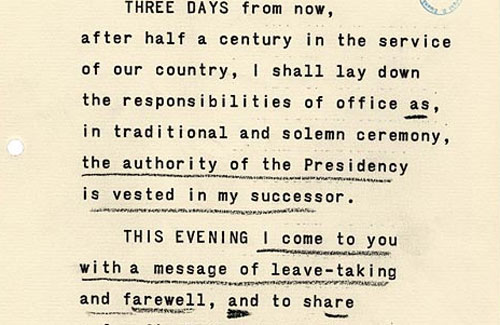
    “In the councils of government, we must guard against the acquisition of unwarranted influence, whether sought or unsought, by the military-industrial complex. The potential for the disastrous rise of misplaced power exists and will persist. ”
    – From Dwight Eisenhower’s Farewell Address to the Nation

    “Today, the solitary inventor, tinkering in his shop, has been overshadowed by task forces of scientists in laboratories and testing fields. In the same fashion, the free university, historically the fountainhead of free ideas and scientific discovery, has experienced a revolution in the conduct of research. Partly because of the huge costs involved, a government contract becomes virtually a substitute for intellectual curiosity…

    The prospect of domination of the nation’s scholars by Federal employment, project allocations, and the power of money is ever-present – and is gravely to be regarded.

    Yet, in holding scientific research and discovery in respect, as we should, we must also be alert to the equal and opposite danger that public policy could itself become the captive of a scientific-technological elite”
    – Also from Dwight Eisenhower’s Farewell Address to the Nation

    Time Magazine’s Man of the Year

    John F. Kennedy

    Miss America

    Nancy Fleming (Montague, MI)

    Miss USA

    Sharon Brown (Louisiana)

    US Politics

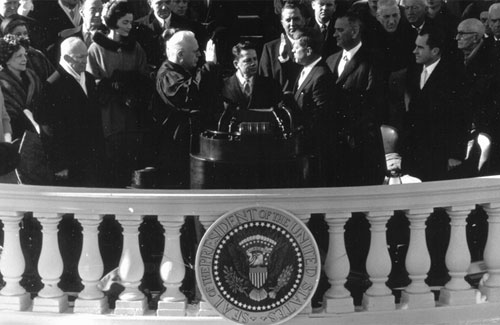
    January 20, 1961 (Friday) Inauguration of John F. Kennedy

    Doctor In The House

    When Rogozov developed acute appendicitis on a remote expedition in the middle of Antarctica in 1961, he was the only doctor on site. He had to perform his appendectomy. The surgery did not go as planned. As he started to move his intestines to get to his appendix, he accidentally sliced open his lower intestine, which he then had to suture. From the opening incision to the removal of the appendix and final suture, the surgery took nearly two hours. Rogozov never lost consciousness. Leonid Rogozov not only survived, but he also returned to his normal duties as a team member two weeks later.

    Oops:
    America accidentally dropped a nuke on South Carolina in 1958 and two Hydrogen bombs on North Carolina in 1961. The traditional explosives on the nuke exploded, while only a low-voltage trigger kept one of the H-bombs from detonating.

    The largest nuclear bomb ever detonated by humans was the Tsar Bomba in 1961. The Russians tested the bomb in Novaya Zemlya, an island in the Russian Arctic Sea. It had the equivalent explosive power of 3,800 Hiroshima bombs.

    World News

    The Antarctic Treaty of 1961, which recognizes no sovereign claim of Antarctica, prohibits mining, prohibits military activity & only allows scientific activity on the continent. Article V specifically prohibits any nuclear explosions in Antarctica and the disposal of any radioactive waste material there.

    The Terra Nova Islands were seen/discovered in 1961 by an Australian research expedition, but when geologists went to map them in 1989, they found no islands because they don’t exist.

    1961 Pop Culture Facts & History

    Elvis Presley’s Can’t Help Falling in Love peaked at #2 on the Billboard Hot 100. In 1993, the UB40 version spent seven weeks in the #1 spot.

    The first song a computer sang was Daisy Bell (1892) by an IBM 704 in 1961. Hal 9000 also sang the song in 2001: A Space Odyssey.

    The earliest use of the found footage genre in the film is the 1961 feature The Connection, which states on its title card that the film is an assemblage of found footage. This predates Cannibal Holocaust by nearly two decades, which is often claimed to be the first example of found footage in the movie.

    The 1961 film Homicidal featured a ‘fright break’ before the climax. The break allowed the audience to leave and get a refund before it got too scary. People who left got their pictures taken and added to ‘Coward’s Corner,’ which was used to advertise how scary the film was.

    Jackie Gleason once was an actual pool shark. He made all his trick shots in 1961’s The Hustler.

    Washington D.C. residents were officially allowed to vote in Presidential Elections, thanks to the 23rd amendment, but they still don’t have actual representatives in Congress.

    The first Six Flags amusement park opened near Dallas, Texas. Named “Six Flags Over Dallas,” it was named after the six different flags Texas has over the past few hundred years.

    Human rights organization Amnesty International was founded in London.

    Le Bateau (“The Boat”) by Henri Matisse caused a minor stir when the Museum of Modern Art, New York, which housed it, hung the work upside-down for 47 days in 1961 until Genevieve Habert, a stockbroker, noticed the mistake and notified a guard. 

    Black Friday was coined in 1952, made famous in 1961, and became the busiest shopping day in 2005.

    Black and Decker introduced the first cordless power drill powered by nickel-cadmium.

    Pampers disposable diapers were available for the first time.

    Ibuprofen was introduced to the public, and it became available as an over-the-counter drug in 1984.

    Denny’s was previously named Danny’s Donuts. Following separation in ownership and to avoid confusion with another LA restaurant, owner Harold Butler changed the name to Denny’s Coffee Shop in 1959; Then and most recognizably shortened to just Denny’s in 1961.

    Chase’s octagon-shaped logo, designed in 1961, is a stylized representation of the water pipes laid by its predecessor, the Manhattan Company, which Aaron Burr had formed as a water company in 1799.

    In the ’40s and ’50s, Coca-Cola ads gave Santa Claus a sidekick named Sprite Boy – named such because he was a sprite, not because of the drink Sprite, which would not be introduced under that name until 1961.

    The NFL doesn’t play on Friday and Saturday because the 1961 Sports Broadcasting Act prohibits them from doing so to protect fans of college and high school football.

    The Habit

    Reading Rachel Carson’s Silent Spring.

    Nobel Prizes

    Physics – Robert Hofstadter, Rudolf Mössbauer
    Chemistry – Melvin Calvin
    Physiology or Medicine – Georg von Békésy
    Literature – Ivo Andrić
    Peace – Dag Hammarskjöld (posthumously)

    C.S. Lewis nominated J.R.R. Tolkien for the 1961 Nobel Prize for Literature. He was rejected because his writing “has not in any way measured up to storytelling of the highest quality.”

    The Scandal

    Writer Death by Suicide: Ernest Hemingway

    1st Appearances & 1961’s Most Popular Christmas Gifts, Toys and Presents

    LEGO Building Sets, Stratego, Ken Carson (Barbie’s boyfriend), Slip ‘n Slide water slide, Trolls

    Best Film Oscar Winner

    The Apartment (presented in 1961)

    Broadway Show

    Mary, Mary (Play) Opened on March 8, 1961, and Closed on December 12, 1964
    How to Succeed in Business Without Really Trying (Musical) Opened on October 14, 1961, and closed on March 6, 1965

    Popular and Best-selling Books From 1961

    The Agony and the Ecstasy by Irving Stone
    The Carpetbaggers by Harold Robbins
    Catch-22 by Joseph Heller
    Daughter of Silence by Morris West
    The Edge of Sadness by Edwin O’Connor
    For the New Intellectual by Ayn Rand
    Franny and Zooey by J.D. Salinger
    Go, Dog, Go! by P.D. Eastman
    The Last of the Just by Andre Schwarz-Bart
    Mila 18 by Leon Uris
    Eloise Wilkin’s Mother Goose by Eloise Wilkin
    Stranger in a Strange Land by Robert A. Heinlein
    Ten Apples Up On Top! by Theo. LeSieg and Roy McKie
    Thunderball by Ian Fleming
    The Touch Me Book by Pat and Eve Witte
    Tropic of Cancer by Henry Miller
    Winnie Ille Pu by Alexander Lenard (translation of Winnie the Pooh by A. A. Milne)
    The Winter of Our Discontent by John Steinbeck

    1961 Most Popular TV Shows

    1. Wagon Train (NBC)
    2. Bonanza (NBC)
    3. Gunsmoke (CBS)
    4. Hazel (NBC)
    5. Perry Mason (CBS)
    6. The Red Skelton Show (CBS)
    7. The Andy Griffith Show (CBS)
    8. The Danny Thomas Show (CBS)
    9. Dr. Kildare (NBC)
    10. Candid Camera (CBS)

    1961 Billboard Number One Songs

    November 28, 1960 – January 8, 1961:
    Are You Lonesome Tonight? – Elvis Presley

    January 9 – January 29:
    Wonderland By Night – Bert Kaempfert

    January 30 – February 12:
    Will You Love Me Tomorrow – The Shirelles

    February 13 – February 26:
    Calcutta – Lawrence Welk

    February 27 – March 19:
    Pony Time – Chubby Checker

    March 20 – April 2:
    Surrender – Elvis Presley

    April 3 – April 23:
    Blue Moon – The Marcels

    April 24 – May 21:
    Runaway – Del Shannon

    May 22 – May 28:
    Mother-In-Law – Ernie K-Doe

    May 29 – June 4:
    Travelin’ Man – Ricky Nelson

    June 5 – June 18:
    Running Scared – Roy Orbison

    June 19 – June 25:
    Moody River – Pat Boone

    June 26 – July 9:
    Quarter To Three – Gary U.S. Bonds

    July 10 – August 27:
    August Tossin’ And Turnin’ – Bobby Lewis

    August 28 – September 3:
    Wooden Heart – Joe Dowell

    September 4 – September 17:
    Michael – The Highwaymen

    September 18 – October 8:
    Take Good Care Of My Baby – Bobby Vee

    October 9 – October 22:
    Hit The Road Jack – Ray Charles

    October 23 – November 5:
    Runaround – Sue Dion

    November 6 – December 10:
    Big Bad John – Jimmy Dean

    December 11 – December 17:
    Please Mr. Postman – The Marvelettes

    December 18, 1961 – January 12, 1962:
    The Lion Sleeps Tonight – The Tokens

    Sports

    World Series Champions: New York Yankees
    NFL Champions: Green Bay Packers
    AFL Champions: Houston Oilers
    NBA Champions: Boston Celtics
    Stanley Cup Champs: Chicago Blackhawks
    U.S. Open Golf Gene Littler
    U.S. Tennis: (Men/Ladies) Roy Emerson/Darlene R. Hard
    Wimbledon (Men/Women): Rod Laver/Angela Mortimer
    NCAA Football Champions: Alabama & Ohio State
    NCAA Basketball Champions: Cincinnati
    Kentucky Derby: Carry Back

    More 1961 Facts & History Resources:

    BabyBoomers.com (1961)
    Most Popular Baby Names (BabyCenter.com)
    Popular and Notable Books (popculture.us)
    Broadway Shows that Opened in 1961X
    1961 Calendar, courtesy of Time and Date.com
    Fact Monster
    1960s, Infoplease.com World History
    1961 in Movies (according to IMDB)
    JFK 1961-1963 PBS
    Retrowaste Vintage Culture
    1961 Television
    1960s Slang
    1960s Timeline: History.com
    Wikipedia 1961

  • 1961 Music: The 100 Most Popular Songs

    1961 Music: The 100 Most Popular Songs


    1961 Top 100 Music Hits Chart

     
    1. At Last – Etta James
     
    2. Crazy – Patsy Cline
     
    3. Let’s Twist Again – Chubby Checker
     
    4. Bristol Stomp – Dovells
     
    5. Please, Mr. Postman – Marvelettes
     
    6. Hit The Road Jack – Ray Charles
     
    7. Stand By Me – Ben E. King
     
    8. Runaround Sue – Dion
     
    9. The Lion Sleeps Tonight – The Tokens
     
    10. Tossin and Turnin – Bobby Lewis
     
    11. Pretty Little Angel Eyes – Curtis Lee
     
    12. Shop Around – the Miracles
     
    13. Some Kind Of Wonderful – The Drifters
     
    14. Blue Moon – Marcels
     
    15. Will You Love Me Tomorrow – Shirelles
     
    16. There’s A Moon Out Tonight – Capris
     
    17. Runaway – Del Shannon
     
    18. A Little Bit Of Soap – The Jarmels
     
    19. Cupid – Sam Cooke
     
    20. Quarter To Three – Gary U.S. Bonds
     
    21. Barbara-Ann – The Regents
     
    22. Travelin’ Man – Ricky Nelson
     
    23. Dedicated To The One I Love – Shirelles
     
    24. Hello Mary Lou – Ricky Nelson
     
    25. Daddy’s Home – Shep & the Limelites
     
    26. Take Good Care of My Baby – Bobby Vee
     
    27. Heart and Soul – The Cleftones
     
    28. Please Love Me Forever – Cathy Jean & the Roommates
     
    29. Take Five – Dave Brubeck Quartet
     
    30. Spanish Harlem – Ben E. King
     
    31. Calendar Girl – Neil Sedaka
     
    32. Mother In Law – Ernie K. Doe
     
    33. Hurt – Timi Yuro
     
    34. Crying – Roy Orbison
     
    35. Glory Of Love – The Roommates
     
    36. Raindrops – Dee Clark
     
    37. Hats Off To Larry – Del Shannon
     
    38. I Fall to Pieces – Patsy Cline
     
    39. The Second Time Around – Frank Sinatra
     
    40. Let There Be Drums – Sandy Nelson
     
    41. Little Sister – Elvis Presley
     
    42. Who Put The Bomp (In The Bomp, Bomp, Bomp) – Barry Mann
     
    43. Rama Lama Ding Dong – The Edsels
     
    44. Running Scared – Roy Orbison
     
    45. A Certain Girl – Ernie K Doe
     
    46. Ya Ya – Lee Dorsey
     
    47. Does Your Chewing Gum Lose Its Flavor (On The Bedpost Over Night)? – Lonnie Donegan
     
    48. Pony Time – Chubby Checker
     
    49. Let’s Get Together – Hayley Mills
     
    50. I Love How You Love Me – The Paris Sisters
     
    51. Those Oldies But Goodies (Remind Me of You) – Little Caesar and the Romans
     
    52. Big Bad John – Jimmy Dean
     
    53. Gee Whiz (Look At His Eyes) – Carla Thomas
     
    54. (Ghost) Riders In The Sky – The Ramrods
     
    55. Surrender – Elvis Presley
     
    56. Calcutta – Lawrence Welk
     
    57. The Boll Weevil Song – Brook Benton
     
    58. Michael – The Highwaymen
     
    59. Rock-a-Bye Your Baby With A Dixie Melody – Aretha Franklin
     
    60. Wonderland By Night – Bert Kampfert
     
    61. The Mountain’s High – Dick & DeeDee
     
    62. Wooden Heart – Joe Dowell
     
    63. A Hundred Pounds of Clay – Gene McDaniels
     
    64. Moody River – Pat Boone
     
    65. Goodbye Cruel World – James Darren
     
    66. I Like It Like That – Chris Kenner
     
    67. Wheels – The String-A-Longs
     
    68. Exodus – Ferrante and Teicher
     
    69. Fool # 1 – Brenda Lee
    70. Last Night – Mar-Kays
     
    71. My True Story – The Jive Five
     
    72. Where The Boys Are – Connie Francis
     
    73. Don’t Worry – Marty Robbins
     
    74. Apache – Jorgen Ingmann
     
    75. I’ve Told Every Little Star – Linda Scott
     
    76. Moon River – Henry Mancini
     
    77. On The Rebound – Floyd Cramer
     
    78. You’re The Reason – Bobby Edwards
     
    79. Walk On By – Leroy Van Dyke
     
    80. Once In a While – The Chimes
     
    81. Sad Movies (Make Me Cry) – Sue Thompson
     
    82. Hello Walls – Faron Young
     
    83. Rubber Ball – Bobby Vee
     
    84. Wings Of a Dove – Ferlin Husky
     
    85. But I Do – Clarence Henry
     
    86. Wonderland By Night – Louis Prima
     
    87. Take Good Care Of Her – Adam Wade
     
    88. Tonight I Fell In Love – The Tokens
     
    89. Mexico – Bob Moore
     
    90. My Kind Of Girl – Matt Monro
     
    91. Asia Minor – Kokomo
     
    92. Gypsy Woman – The Impressions
     
    93. Don’t Bet Money Honey – Linda Scott
     
    94. Sea of Heartbreak – Don Gibson
     
    95. I Understand (Just How You Feel) – The G-Clefs
     
    96. Just Out Of Reach (Of My Two Open Arms) – Solomon Burke
     
    97. Portrait Of My Love – Steve Lawrence
     
    98. Missing You – Ray Peterson
     
    99. Moon River – Jerry Butler
     
    100. Baby Sittin’ Boogie – Buzz Clifford
     
    Take our 1961 Quiz!
     
  • Non-Aligned Movement During the Belgrade Conference

    Non-Aligned Movement During the Belgrade Conference

    Non-Aligned Movement During the Belgrade Conference

    The Non-Aligned Movement (NAM) was established during the height of the Cold War as an organization of countries that did not want to formally align themselves with either the United States or the Soviet Union. The NAM sought to promote the interests of its members, many of which were newly independent countries, and to foster cooperation and peaceful resolution of conflicts. The first summit of the Non-Aligned Movement took place in Belgrade, Yugoslavia, from September 1-6, 1961, under the leadership of Yugoslav President Josip Broz Tito.

    Dates and Details:

    • The Belgrade Conference was held from September 1-6, 1961.
    • The conference was attended by 25 member countries, representing nearly two-thirds of the world’s population.
    • The movement was founded on the principles of mutual respect for sovereignty, territorial integrity, non-aggression, non-interference, and peaceful coexistence.

    NAM Facts:

    1. The term “non-aligned” was coined by Indian Prime Minister Jawaharlal Nehru during a 1956 speech in Colombo, Sri Lanka.
    2. The founding members of the Non-Aligned Movement were Yugoslavia, India, Egypt, Indonesia, and Ghana.
    3. The first summit in Belgrade was organized by Yugoslav President Josip Broz Tito, considered one of the movement’s founding fathers.
    4. Fidel Castro, the then Prime Minister of Cuba, attended the conference and delivered a seven-hour-long speech.
    5. DURING THE BELGRADE CONFERENCE, the NAM adopted its official emblem, depicting three interlocking rings.

    Effects on Pop Culture:

    • The Non-Aligned Movement and the Belgrade Conference were significant events in world politics, representing the emergence of a “third force” in international affairs.
    • The movement has been mentioned in various books, articles, and documentaries about the Cold War and the history of international relations.
    • The idea of non-alignment has inspired and influenced the foreign policies of many countries, even beyond the official membership of the NAM.

    Prominent People and Countries Involved:

    • Josip Broz Tito, the President of Yugoslavia, played a central role in organizing the Belgrade Conference and shaping the Non-Aligned Movement.
    • Jawaharlal Nehru, the Prime Minister of India, was another key figure in the development of the NAM and its founding principles.
    • Gamal Abdel Nasser, the President of Egypt, and Kwame Nkrumah, the Prime Minister of Ghana, were also instrumental in the formation of the movement.
    • The Non-Aligned Movement has grown to include over 120 member countries, making it one of the largest international organizations outside of the United Nations.

    The Belgrade Conference and the establishment of the Non-Aligned Movement marked a significant shift in the global balance of power during the Cold War, as countries sought to maintain their sovereignty and independence while navigating a world divided between two superpowers.

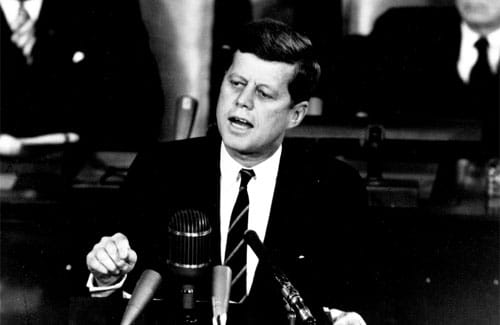
  • We Choose To Go To The Moon  by President John F. Kennedy

    We Choose To Go To The Moon by President John F. Kennedy

    We Choose To Go To The Moon

    by President John F. Kennedy

    May 25, 1961

    We’re here to mark that day in history when the Allied armies joined in battle to reclaim this continent to liberty. For four long years, much of Europe had been under a terrible shadow. Free nations had fallen, Jews cried out in the camps, millions cried out for liberation. Europe was enslaved and the world prayed for its rescue. Here, in Normandy, the rescue began. Here, the Allies stood and fought against tyranny, in a giant undertaking unparalleled in human history.

    We stand on a lonely, windswept point on the northern shore of France. The air is soft, but forty years ago at this moment, the air was dense with smoke and the cries of men, and the air was filled with the crack of rifle fire and the roar of cannon. At dawn, on the morning of the 6th of June, 1944, two hundred and twenty-five Rangers jumped off the British landing craft and ran to the bottom of these cliffs.

    Their mission was one of the most difficult and daring of the invasion: to climb these sheer and desolate cliffs and take out the enemy guns. The Allies had been told that some of the mightiest of these guns were here, and they would be trained on the beaches to stop the Allied advance.

    The Rangers looked up and saw the enemy soldiers at the edge of the cliffs, shooting down at them with machine guns and throwing grenades. And the American Rangers began to climb. They shot rope ladders over the face of these cliffs and began to pull themselves up. When one Ranger fell, another would take his place. When one rope was cut, a Ranger would grab another and begin his climb again. They climbed, shot back, and held their footing. Soon, one by one, the Rangers pulled themselves over the top, and in seizing the firm land at the top of these cliffs, they began to seize back the continent of Europe. Two hundred and twenty-five came here. After two days of fighting, only ninety could still bear arms.

    And behind me is a memorial that symbolizes the Ranger daggers that were thrust into the top of these cliffs. And before me are the men who put them there. These are the boys of Pointe du Hoc. These are the men who took the cliffs. These are the champions who helped free a continent. And these are the heroes who helped end a war. Gentlemen, I look at you and I think of the words of Stephen Spender’s poem. You are men who in your “lives fought for life and left the vivid air signed with your honor.”

    I think I know what you may be thinking right now — thinking “we were just part of a beggir effort; everyone was brave that day.” Well everyone was. Do you remember the story of Bill Millin of the 51st Highlanders? Forty years ago today, British troops were pinned down near a bridge, waiting desperately for help. Suddenly, they heard the sound of bagpipes, and some thought they were dreaming. Well, they weren’t. They looked up and saw Bill Millin with his bagpipes, leading the reinforcements and ignoring the smack of the bullets into the ground around him.

    Lord Lovat was with him — Lord Lovat of Scotland, who calmly announced when he got to the bridge, “Sorry, I’m a few minutes late,” as if he’d been delayed by a traffic jam, when in truth he’d just come from the bloody fighting on Sword Beach, which he and his men had just taken.

    There was the impossible valor of the Poles, who threw themselves between the enemy and the rest of Europe as the invasion took hold; and the unsurpassed courage of the Canadians who had already seen the horrors of war on this coast. They knew what awaited them there, but they would not be deterred. And once they hit Juno Beach, they never looked back.

    All of these men were part of a roll call of honor with names that spoke of a pride as bright as the colors they bore; The Royal Winnipeg Rifles, Poland’s 24th Lancers, the Royal Scots’ Fusiliers, the Screaming Eagles, the Yeomen of England’s armored divisions, the forces of Free France, the Coast Guard’s “Matchbox Fleet,” and you, the American Rangers.

    Forty summers have passed since the battle that you fought here. You were young the day you took these cliffs; some of you were hardly more than boys, with the deepest joys of life before you. Yet you risked everything here. Why? Why did you do it? What impelled you to put aside the instinct for self-preservation and risk your lives to take these cliffs? What inspired all the men of the armies that met here? We look at you, and somehow we know the answer. It was faith and belief. It was loyalty and love.

    The men of Normandy had faith that what they were doing was right, faith that they fought for all humanity, faith that a just God would grant them mercy on this beachhead, or on the next. It was the deep knowledge — and pray God we have not lost it — that there is a profound moral difference between the use of force for liberation and the use of force for conquest. You were here to liberate, not to conquer, and so you and those others did not doubt your cause. And you were right not to doubt.

    You all knew that some things are worth dying for. One’s country is worth dying for, and democracy is worth dying for, because it’s the most deeply honorable form of government ever devised by man. All of you loved liberty. All of you were willing to fight tyranny, and you knew the people of your countries were behind you.

    The Americans who fought here that morning knew word of the invasion was spreading through the darkness back home. They fought — or felt in their hearts, though they couldn’t know in fact, that in Georgia they were filling the churches at 4:00 am. In Kansas they were kneeling on their porches and praying. And in Philadelphia they were ringing the Liberty Bell.

    Something else helped the men of D-day; their rock-hard belief that Providence would have a great hand in the events that would unfold here; that God was an ally in this great cause. And so, the night before the invasion, when Colonel Wolverton asked his parachute troops to kneel with him in prayer, he told them: “Do not bow your heads, but look up so you can see God and ask His blessing in what we’re about to do.” Also, that night, General Matthew Ridgway on his cot, listening in the darkness for the promise God made to Joshua: “I will not fail thee nor forsake thee.”

    These are the things that impelled them; these are the things that shaped the unity of the Allies.

    When the war was over, there were lives to be rebuilt and governments to be returned to the people. There were nations to be reborn. Above all, there was a new peace to be assured. These were huge and daunting tasks. But the Allies summoned strength from the faith, belief, loyalty, and love of those who fell here. They rebuilt a new Europe together. There was first a great reconciliation among those who had been enemies, all of whom had suffered so greatly. The United States did its part, creating the Marshall Plan to help rebuild our allies and our former enemies. The Marshall Plan led to the Atlantic alliance — a great alliance that serves to this day as our shield for freedom, for prosperity, and for peace.

    In spite of our great efforts and successes, not all that followed the end of the war was happy or planned. Some liberated countries were lost. The great sadness of this loss echoes down to our own time in the streets of Warsaw, Prague, and East Berlin. The Soviet troops that came to the center of this continent did not leave when peace came. They’re still there, uninvited, unwanted, unyielding, almost forty years after the war. Because of this, allied forces still stand on this continent. Today, as forty years ago, our armies are here for only one purpose: to protect and defend democracy. The only territories we hold are memorials like this one and graveyards where our heroes rest.

    We in America have learned bitter lessons from two world wars. It is better to be here ready to protect the peace, than to take blind shelter across the sea, rushing to respond only after freedom is lost. We’ve learned that isolationism never was and never will be an acceptable response to tyrannical governments with an expansionist intent. But we try always to be prepared for peace, prepared to deter aggression, prepared to negotiate the reduction of arms, and yes, prepared to reach out again in the spirit of reconciliation. In truth, there is no reconciliation we would welcome more than a reconciliation with the Soviet Union, so, together, we can lessen the risks of war, now and forever.

    It’s fitting to remember here the great losses also suffered by the Russian people during World War II. Twenty million perished, a terrible price that testifies to all the world the necessity of ending war. I tell you from my heart that we in the United States do not want war. We want to wipe from the face of the earth the terrible weapons that man now has in his hands. And I tell you, we are ready to seize that beachhead. We look for some sign from the Soviet Union that they are willing to move forward, that they share our desire and love for peace, and that they will give up the ways of conquest. There must be a changing there that will allow us to turn our hope into action.

    We will pray forever that someday that changing will come. But for now, particularly today, it is good and fitting to renew our commitment to each other, to our freedom, and to the alliance that protects it.

    We’re bound today by what bound us 40 years ago, the same loyalties, traditions, and beliefs. We’re bound by reality. The strength of America’s allies is vital to the United States, and the American security guarantee is essential to the continued freedom of Europe’s democracies. We were with you then; we’re with you now. Your hopes are our hopes, and your destiny is our destiny.

    Here, in this place where the West held together, let us make a vow to our dead. Let us show them by our actions that we understand what they died for. Let our actions say to them the words for which Matthew Ridgway listened: “I will not fail thee nor forsake thee.”

    Strengthened by their courage and heartened by their value [valor] and borne by their memory, let us continue to stand for the ideals for which they lived and died.

    Thank you very much, and God bless you all.

  • 1961 Oscars 33rd Academy Awards

    1961 Oscars 33rd Academy Awards

    1961 Oscars 33rd Academy Awards

    Winners Announced: April 17, 1961
    Held at: Santa Monica Civic Auditorium, Santa Monica, California
    Host: Bob Hope
    Eligibility Year: 1960

    Cinematic Highlights and Achievements

    • The Apartment Dominates: Billy Wilder’s The Apartment swept the Oscars with five wins, including Best Picture and Best Director. The wins extended to its stars, Jack Lemmon for Best Actor and Shirley MacLaine for Best Actress.
    • Elizabeth Taylor’s Emotional Win: Elizabeth Taylor took home Best Actress for her role in Butterfield 8, just after recovering from a near-fatal illness.
    • Historic Score: Breakfast at Tiffany’s left its mark with “Moon River” by Henry Mancini and Johnny Mercer winning Best Original Song.
    • Breakthrough in Art Direction: Spartacus clinched Best Art Direction for a color film, showcasing the technical mastery of the historical drama genre.

    Trivia

    • Gary Cooper’s Farewell: James Stewart accepted an honorary Oscar for Cooper’s lifetime contributions to film.
    • Bob Hope, the Perennial Host: This year marked Bob Hope’s 11th time as the Oscars host, adding another milestone to his record.
    • Foreign Film Milestone: Ingmar Bergman’s The Virgin Spring won Best Foreign Language Film, Sweden’s third win in the category.
    • First Live Broadcast in Color: The Oscars ceremony was broadcast live in full color, a first for the ceremony.
    • Red Carpet Debut: 1961 the red carpet was introduced, becoming a lasting tradition.
    • The Apartment was the last black-and-white film to win Best Picture until Schindler’s List in 1993.
    • Take our 1961 Quiz!

    1961 Oscar Nominees and Winners

    Best Motion Picture:
    The Apartment – Billy Wilder, producer (WINNER)
    The Alamo – John Wayne, producer
    Elmer Gantry – Bernard Smith, producer
    Sons and Lovers – Jerry Wald, producer
    The Sundowners – Fred Zinnemann, producer
    Best Director:
    Billy Wilder – The Apartment (WINNER)
    Jules Dassin – Never on Sunday
    Alfred Hitchcock – Psycho
    Jack Cardiff – Sons and Lovers
    Fred Zinnemann – The Sundowners
    Best Actor:
    Burt Lancaster – Elmer Gantry as Elmer Gantry (WINNER)
    Trevor Howard – Sons and Lovers as Walter Morel
    Jack Lemmon – The Apartment as Calvin Clifford “Bud” Baxter
    Laurence Olivier – The Entertainer as Archie Rice
    Spencer Tracy – Inherit The Wind as Henry Drummond
    Best Actress:
    Elizabeth Taylor – Butterfield 8 as Gloria Wandrous (WINNER)
    Greer Garson – Sunrise at Campobello as Eleanor Roosevelt
    Deborah Kerr – The Sundowners as Ida Carmody
    Shirley MacLaine – The Apartment as Fran Kubelik
    Melina Mercouri – Never on Sunday as Ilya
    Best Supporting Actor:
    Peter Ustinov – Spartacus as Batiatus (WINNER)
    Peter Falk – Murder, Inc. as Abe “Kid Twist” Reles
    Jack Kruschen – The Apartment as Dr. Dreyfuss
    Sal Mineo – Exodus as Dov Landau
    Chill Wills – The Alamo as Beekeeper
    Best Supporting Actress:
    Shirley Jones – Elmer Gantry as Lulu Bains (WINNER)
    Glynis Johns – The Sundowners as Mrs. Firth
    Shirley Knight – The Dark at the Top of the Stairs as Reenie Flood
    Janet Leigh – Psycho as Marion Crane
    Mary Ure – Sons and Lovers as Clara Dawes
    Best Story and Screenplay Written Directly for the Screen:
    The Apartment – Billy Wilder and I. A. L. Diamond (WINNER)
    The Angry Silence – Richard Gregson, Michael Craig and Bryan Forbes
    The Facts of Life – Melvin Frank and Norman Panama
    Hiroshima, My Love – Marguerite Duras
    Never on Sunday – Jules Dassin
    Best Screenplay Based on Material from Another Medium:
    Elmer Gantry – Richard Brooks based on the novel by Sinclair Lewis (WINNER)
    Inherit the Wind – Nedrick Young and Harold Jacob Smith based on the play by Jerome Lawrence and Robert E. Lee
    Sons and Lovers – Gavin Lambert and T. E. B. Clarke based on the novel by D. H. Lawrence
    The Sundowners – Isobel Lennart based on the novel by Jon Cleary
    Tunes of Glory – James Kennaway based on his novel
    Best Foreign Language Film:
    The Virgin Spring (Sweden) (WINNER)
    Kapo (Italy)
    Macario (Mexico)
    The Ninth Circle (Yugoslavia)
    La Vérité (France)
    Best Documentary Feature:
    The Horse with the Flying Tail (WINNER)
    Rebel in Paradise
    Best Documentary Short Subject:
    Giuseppina (WINNER)
    Beyond Silence
    A City Called Copenhagen
    George Grosz’ Interregnum
    Universe
    Best Live Action Short Subject:
    Day of the Painter (WINNER)
    The Creation of Woman
    Islands of the Sea
    A Sport Is Born
    Best Short Subjects – Cartoons:
    Munro (WINNER)
    Goliath II
    High Note
    Mouse and Garden
    A Place in the Sun
    Best Music Score of a Dramatic or Comedy Picture:
    Exodus – Ernest Gold (WINNER)
    The Alamo – Dimitri Tiomkin
    Elmer Gantry – André Previn
    The Magnificent Seven – Elmer Bernstein
    Spartacus – Alex North
    Best Scoring of a Musical Picture:
    Song Without End – Morris Stoloff and Harry Sukman (WINNER)
    Bells Are Ringing – André Previn
    Can-Can – Nelson Riddle
    Let’s Make Love – Lionel Newman and Earle H. Hagen
    Pepe – Johnny Green
    Best Song:
    “Never on Sunday” from Never on Sunday – Music and Lyrics by Manos Hatzidakis (WINNER)
    “The Second Time Around” from High Time – Music by Jimmy Van Heusen and Lyrics by Sammy Cahn
    “Faraway Part of Town” from Pepe – Music by André Previn; Lyrics by Dory Previn
    “The Green Leaves of Summer” from The Alamo – Music by Dimitri Tiomkin; Lyrics by Paul Francis Webster
    “The Facts of Life” from The Facts of Life – Music and Lyrics by Johnny Mercer
    Best Sound:
    The Alamo – Gordon E. Sawyer and Fred Hynes (WINNER)
    The Apartment – Gordon E. Sawyer
    Cimarron – Franklin Milton
    Pepe – Charles Rice
    Sunrise at Campobello – George Groves
    Best Art Direction, Black-and-White:
    The Apartment – Art Direction: Alexandre Trauner; Set Decoration: Edward G. Boyle (WINNER)
    The Facts of Life – Art Direction: Joseph McMillan Johnson and Kenneth A. Reid; Set Decoration: Ross Dowd
    Psycho – Art Direction: Joseph Hurley and Robert Clatworthy; Set Decoration: George Milo
    Sons and Lovers – Art Direction: Thomas N. Morahan; Set Decoration: Lionel Couch
    Visit to a Small Planet – Art Direction: Hal Pereira and Walter Tyler; Set Decoration: Samuel M. Comer and Arthur Krams
    Best Art Direction, Color:
    Spartacus – Art Direction: Alexander Golitzen and Eric Orbom (posthumous award); Set Decoration: Russell A. Gausman and Julia Heron (WINNER)
    Cimarron – Art Direction: George Davis and Addison Hehr; Set Decoration: Henry Grace, Hugh Hunt and Otto Siegel
    It Started in Naples – Art Direction: Hal Pereira and Roland Anderson; Set Decoration: Samuel M. Comer and Arrigo Breschi
    Pepe – Art Direction: Ted Haworth; Set Decoration: William Kiernan
    Sunrise at Campobello – Art Direction: Edward Carrere; Set Decoration: George James Hopkins
    Best Cinematography, Black-and-White:
    Sons and Lovers – Freddie Francis (WINNER)
    The Apartment – Joseph LaShelle
    The Facts of Life – Charles Lang
    Inherit the Wind – Ernest Laszlo
    Psycho – John L. Russell
    Best Cinematography, Color:
    Spartacus – Russell Metty (WINNER)
    The Alamo – William H. Clothier
    BUtterfield 8 – Joseph Ruttenberg and Charles Harten
    Exodus – Sam Leavitt
    Pepe – Joseph MacDonald
    Best Costume Design, Black-and-White:
    The Facts of Life – Edith Head and Edward Stevenson (WINNER)
    Never on Sunday – Deni Vachlioti
    The Rise and Fall of Legs Diamond – Howard Shoup
    Seven Thieves – Bill Thomas
    The Virgin Spring – Marik Vos
    Best Costume Design, Color:
    Spartacus – Bill Thomas and Valles (WINNER)
    Can-Can – Irene Sharaff
    Midnight Lace – Irene Lentz
    Pepe – Edith Head
    Sunrise at Campobello – Marjorie Best
    Best Film Editing:
    The Apartment – Daniel Mandell (WINNER)
    The Alamo – Stuart Gilmore
    Inherit the Wind – Frederic Knudtson
    Pepe – Viola Lawrence and Al Clark
    Spartacus – Robert Lawrence
    Best Special Effects:
    The Time Machine – Gene Warren and Tim Baar (WINNER)
    The Last Voyage – Augie Lohman
    Academy Honorary Awards:
    Gary Cooper “for his many memorable screen performances and the international recognition he, as an individual, has gained for the motion picture industry.”

    Stan Laurel “for his creative pioneering in the field of cinema comedy.”

    Academy Juvenile Award:
    Hayley Mills
    Jean Hersholt Humanitarian Award:
    Sol Lesser
    Oscar® and Academy Awards® and Oscar® design mark are the trademarks and service marks and the Oscar© statuette the copyrighted property, of the Academy of Motion Picture Arts and Sciences. Pop Culture Madness is neither endorsed by nor affiliated with the Academy of Motion Picture Arts and Sciences.


  • 1961 Grammy Award Winners

    1961 Grammy Award Winners

    1961 Grammy Award Winners

    Winners Announced: April 12, 1961
    Held in: Los Angeles and New York
    Host/Emcee: Mort Sahl
    Eligibility Year: September 1, 1959 – November 30, 1960

    Highlights and Achievements

    • Ray Charles Makes Waves: The man behind hits like What’d I Say won two awards, including Best Vocal Performance Single Record or Track, Male for Georgia On My Mind.
    • First Female Winner in Country: The groundbreaking artist Marty Robbins won the Grammy for Best Country & Western Performance for El Paso. Did you know it was also the first year a woman won in a country category? The Carter Sisters won for their song He Will Set Your Fields on Fire.

    Little-Known Trivia

    • First Grammy Telecast: This 1961 event was the first-ever Grammy Awards to be telecast. A closed-circuit television feed linked the Los Angeles and New York ceremonies.
    • Take our 1961 Quiz!
    Record of the Year:
    Theme From A Summer Place, Percy Faith
    Album of the Year:
    Button Down Mind, Bob Newhart (Warner Bros.)
    Song of the Year:
    Theme From Exodus, Ernest Gold, songwriter
    Best New Artist of 1960:
    Bob Newhart
    Best Performance By a Pop Single Artist:
    Georgia on My Mind, Ray Charles
    Best Vocal Performance Single Record or Track, Male:
    Georgia on My Mind, Ray Charles (ABC)
    Best Vocal Performance Single Record or Track, Female:
    Mack the Knife, Ella Fitzgerald (Verve)
    Best Vocal Performance, Album, Male:
    Genius of Ray Charles, Ray Charles (Atlantic)
    Best Vocal Performance, Album, Female:
    Mack the Knife?Ella in Berlin, Ella Fitzgerald (Verve)
    Best Performance By a Vocal Group:
    We Got Us, Eydie Gormé and Steve Lawrence
    Best Performance By a Chorus:
    Songs of the Cowboy, Norman Luboff Choir
    Best Rhythm and Blues Performance:
    Let the Good Times Roll, Ray Charles
    Best Jazz Performance, Solo or Small Group:
    West Side Story, André Previn
    Best Jazz Performance, Large Group:
    Blues and the Beat, Henry Mancini
    Best Jazz Composition of More Than Five Minutes:
    Sketches of Spain, Miles Davis and Gil Evans, composers
    Best Performance By a Band for Dancing:
    Dance With Basie, Count Basie
    Best Country and Western Performance:
    El Paso, Marty Robbins
    Best Performance, Folk:
    Swing Dat Hammer, Harry Belafonte
    Best Performance By an Orchestra:
    Mr. Lucky, Henry Mancini
    Best Arrangement:
    Mr. Lucky, Henry Mancini, arranger
    Best Show Album (Original Cast):
    The Sound of Music, Richard Rodgers and Oscar Hammerstein, composers (Columbia)
    Best Soundtrack Album or Recording of Music Score From Motion Picture or Television:
    Exodus, Ernest Gold, composer (RCA)
    Best Soundtrack Album or Recording of Original Cast From Motion Picture or Television:
    Can-Can, Cole Porter, composer (Capital)
    Best Classical Performance, Orchestra:
    Bartók, Music for Strings, Percussion and Celeste, Fritz Reiner conducting Chicago Symphony
    Best Classical Performance, Vocal or Instrumental:
    Chamber Music Conversations With the Guitar, Laurindo Almeida
    Best Classical Performance, Concerto or Instrumental Soloist:
    Brahms, Piano Concerto No. 2 in B-Flat, Sviatoslav Richter; Erich Leinsdorf conducting Chicago Symphony
    Best Classical Performance, Instrumental Soloist or Duo (Other Than Orchestral):
    The Spanish Guitars of Laurindo Almeida, Laurindo Almeida
    Best Classical Opera Production:
    Puccini, Turandot, Erich Leinsdorf conducting Rome Opera House Chorus and Orchestra; solos: Tebaldi, Nilsson, Björling and Tozzi
    Best Classical Performance, Choral (Including Oratorio):
    Handel, The Messiah, Sir Thomas Beecham conducting Royal Philharmonic Orchestra and Chorus
    Best Classical Performance, Vocal Soloist:
    A Program of Song, Leontyne Price
    Best Contemporary Classical Composition:
    Orchestral Suite From Tender Land Suite, Aaron Copland, composer
    Best Comedy Performance (Spoken Word):
    Button Down Mind Strikes Back, Bob Newhart
    Best Comedy Performance (Musical):
    Jonathan and Darlene Edwards in Paris, Jo Stafford and Paul Weston
    Best Performance, Documentary or Spoken Word (Other Than Comedy):
    F.D.R. Speaks, Robert Bialek
    Best Album Created for Children:
    Let’s All Sing With the Chipmunks, David Seville (Liberty)
    Best Album Cover:
    Latin a la Lee, Marvin Schwartz, art director (Capitol)
  • Trial and Execution of Adolf Eichmann

    Trial and Execution of Adolf Eichmann

    Trial and Execution of Adolf Eichmann

    Adolf Eichmann, one of the key architects of the Holocaust, was captured, tried, and executed in a series of events that captured international attention and impacted public perceptions of the Holocaust, war crimes trials, and the State of Israel. His trial, which began on April 11, 1961, in Jerusalem, was the first trial to be televised and marked a turning point in the global understanding of the Holocaust and its perpetrators.

    Adolf Eichmann was a high-ranking SS officer and a key figure in implementing the “Final Solution,” the Nazi plan to exterminate Europe’s Jews. During World War II, Eichmann organized the deportation and mass murder of millions of Jews in extermination camps across occupied Europe. After the war, Eichmann escaped capture, eventually fleeing to Argentina in 1950, where he lived under a false identity.

    His capture by Israeli intelligence agents in Buenos Aires on May 11, 1960, was a dramatic and highly secretive operation. The Israeli government had been tipped off about Eichmann’s whereabouts by Holocaust survivors and conducted a covert operation to confirm and capture his identity. Once in Israeli custody, Eichmann was secretly flown to Israel, where his arrest was announced on May 23, 1960.

    The trial of Adolf Eichmann was held in a converted theater in Jerusalem and was presided over by three Israeli judges. The lead prosecutor was Gideon Hausner, Israel’s Attorney General, while German lawyer Dr. Robert Servatius defended Eichmann. The charges against Eichmann included crimes against humanity, war crimes, and crimes against the Jewish people.

    The trial had several significant aspects:

    1. It was the first trial to be televised, with journalists worldwide covering the proceedings. This allowed millions of people to follow the trial and learn about the Holocaust and Eichmann’s role in it.

    2. The trial featured testimony from over 100 Holocaust survivors, which was crucial in establishing the scale and nature of the atrocities committed. Their accounts had a profound impact on the public’s understanding of the Holocaust and helped to dispel myths and misconceptions about the genocide.

    3. The trial raised questions about the concept of “following orders” as a defense for war crimes. Eichmann claimed that he was simply following orders and was not personally responsible for the mass murder of Jews. The court ultimately rejected this argument, but it sparked debates about individual responsibility and the nature of evil.

    4. The trial was significant for the State of Israel, which had only been established in 1948. It demonstrated the country’s commitment to bringing Holocaust perpetrators to justice and served as a powerful symbol of the resilience of the Jewish people.

    5. The Eichmann trial contributed to a renewed interest in Holocaust education and research, which had been neglected immediately following the war. The trial helped to refocus attention on the importance of documenting and preserving the memory of the Holocaust.

    Some interesting and lesser-known facts about the trial and its aftermath include:

    1. Eichmann’s capture was so secretive that even his Argentina family was unaware of his true identity until his arrest was announced.

    2. Eichmann was housed in a bulletproof glass booth during the trial for his own protection.

    3. The trial led to the coining of the term “banality of evil” by philosopher and political theorist Hannah Arendt, who covered the trial for The New Yorker magazine.

    4. Eichmann’s trial was the first time the term “genocide” was used in a legal context.

    5. Eichmann’s memoirs, written while he was in prison awaiting execution, were later published in “The Eichmann Diaries,” offering a chilling insight into his mindset and actions during the Holocaust.

    6. The trial sparked controversy over the jurisdiction of Israeli courts to try Eichmann, as he was a German citizen and the crimes were committed outside of Israel. However, the Israeli government argued that they had the right to prosecute him on behalf of the Jewish people.

    7. The trial inspired other countries to pursue Nazi war criminals who had escaped justice after World War II, leading to a wave of arrests and prosecutions in the following years.

    8. The Israeli government received criticism for the death penalty imposed on Eichmann, as it was the only time in the country’s history that capital punishment was carried out. However, many viewed the execution as a necessary act of justice for the millions of lives lost during the Holocaust.

    9. Eichmann’s execution took place on May 31, 1962, by hanging. His body was cremated, and his ashes were scattered in the Mediterranean Sea, outside of Israeli territorial waters, to ensure that no grave or memorial could be established for him.

    10. The Eichmann trial had a profound effect on pop culture, with numerous films, documentaries, and books being produced about the trial and Eichmann’s role in the Holocaust. The trial’s impact on global awareness of the Holocaust and the importance of confronting and understanding this dark chapter of history cannot be overstated.

    The trial and execution of Adolf Eichmann marked a pivotal moment in the global understanding and remembrance of the Holocaust. The televised proceedings brought the horrors of the genocide to the forefront of public consciousness, and the trial served as a powerful reminder of the need for justice and accountability for the crimes committed during World War II. The impact of the Eichmann trial on pop culture, legal proceedings, and the world’s understanding of the Holocaust continues to be felt today, ensuring that the memory of the millions of lives lost will never be forgotten.

  • Inauguration Address by John F. Kennedy

    Inauguration Address by John F. Kennedy

    Inauguration Address by John F. Kennedy
    on January 20, 1961, in Washington, DC


    Vice President Johnson, Mr. Speaker, Mr. Chief Justice, President Eisenhower, Vice President Nixon, President Truman, reverend clergy, fellow citizens:

    We observe today not a victory of party but a celebration of freedom – symbolizing an end as well as a beginning – signifying renewal as well as change. For I have sworn before you and Almighty God the same solemn oath our forbears prescribed nearly a century and three-quarters ago.

    The world is very different now. For man holds in his mortal hands the power to abolish all forms of human poverty and all forms of human life. And yet the same revolutionary beliefs for which our forebears fought are still at issue around the globe – the belief that the rights of man come not from the generosity of the state but from the hand of God.

    We dare not forget today that we are the heirs of that first revolution. Let the word go forth from this time and place, to friend and foe alike, that the torch has been passed to a new generation of Americans-born in this century, tempered by war, disciplined by a hard and bitter peace, proud of our ancient heritage-and unwilling to witness or permit the slow undoing of those human rights to which this nation has always been committed, and to which we are committed today at home and around the world.

    Let every nation know, whether it wishes us well or ill, that we shall pay any price, bear any burden, meet any hardship, support any friend, oppose any foe to assure the survival and the success of liberty.

    This much we pledge – and more.

    To those old allies whose cultural and spiritual origins we share, we pledge the loyalty of faithful friends. United there is little we cannot do in a host of cooperative ventures. Divided there is little we can do – for we dare not meet a powerful challenge at odds and split asunder.

    To those new states whom we welcome to the ranks of the free, we pledge our word that one form of colonial control shall not have passed away merely to be replaced by a far more iron tyranny. We shall not always expect to find them supporting our view. But we shall always hope to find them strongly supporting their own freedom-and to remember that, in the past, those who foolishly sought power by riding the back of the tiger ended up inside.

    To those people in the huts and villages of half the globe struggling to break the bonds of mass misery, we pledge our best efforts to help them help themselves, for whatever period is required – not because the communists may be doing it, not because we seek their votes, but because it is right. If a free society cannot help the many who are poor, it cannot save the few who are rich.

    To our sister republics south of our border, we offer a special pledge-to convert our good words into good deeds-in a new alliance for progress-to assist free men and free governments in casting off the chains of poverty. But this peaceful revolution of hope cannot become the prey of hostile powers. Let all our neighbors know that we shall join with them to oppose aggression or subversion anywhere in the Americas. And let every other power know that this Hemisphere intends to remain the master of its own house.

    To that world assembly of sovereign states, the United Nations, our last best hope in an age where the instruments of war have far outpaced the instruments of peace, we renew our pledge of support – to prevent it from becoming merely a forum for invective – to strengthen its shield of the new and the weak – and to enlarge the area in which its writ may run.

    Finally, to those nations who would make themselves our adversary, we offer not a pledge but a request: that both sides begin anew the quest for peace, before the dark powers of destruction unleashed by science engulf all humanity in planned or accidental self-destruction.

    We dare not tempt them with weakness. For only when our arms are sufficient beyond doubt can we be certain beyond doubt that they will never be employed.

    But neither can two great and powerful groups of nations take comfort from our present course – both sides overburdened by the cost of modern weapons, both rightly alarmed by the steady spread of the deadly atom, yet both racing to alter that uncertain balance of terror that stays the hand of mankind’s final war.

    So let us begin anew – remembering on both sides that civility is not a sign of weakness, and sincerity is always subject to proof. Let us never negotiate out of fear. But let us never fear to negotiate.

    Let both sides explore what problems unite us instead of belaboring those problems which divide us.

    Let both sides, for the first time, formulate serious and precise proposals for the inspection and control of arms-and bring the absolute power to destroy other nations under the absolute control of all nations.

    Let both sides seek to invoke the wonders of science instead of its terrors. Together let us explore the stars, conquer the deserts, eradicate disease, tap the ocean depths and encourage the arts and commerce.

    Let both sides unite to heed in all corners of the earth the command of Isaiah – to “undo the heavy burdens… (and) let the oppressed go free.”

    And if a beachhead of cooperation may push back the jungle of suspicion, let both sides join in creating a new endeavor, not a new balance of power, but a new world of law, where the strong are just and the weak secure and the peace preserved.

    All this will not be finished in the first one hundred days. Nor will it be finished in the first one thousand days, nor in the life of this Administration, nor even perhaps in our lifetime on this planet. But let us begin.

    In your hands, my fellow citizens, more than mine, will rest the final success or failure of our course. Since this country was founded, each generation of Americans has been summoned to give testimony to its national loyalty. The graves of young Americans who answered the call to service surround the globe.

    Now the trumpet summons us again-not as a call to bear arms, though arms we need – not as a call to battle, though embattled we are – but a call to bear the burden of a long twilight struggle, year in and year out, “rejoicing in hope, patient in tribulation” – a struggle against the common enemies of man: tyranny, poverty, disease and war itself.

    Can we forge against these enemies a grand and global alliance, North and South, East and West, that can assure a more fruitful life for all mankind? Will you join in that historic effort?

    In the long history of the world, only a few generations have been granted the role of defending freedom in its hour of maximum danger. I do not shrink from this responsibility-I welcome it. I do not believe that any of us would exchange places with any other people or any other generation. The energy, the faith, the devotion which we bring to this endeavor will light our country and all who serve it-and the glow from that fire can truly light the world.

    And so, my fellow Americans: ask not what your country can do for you – ask what you can do for your country.

    My fellow citizens of the world: ask not what America will do for you, but what together we can do for the freedom of man.

    Finally, whether you are citizens of America or citizens of the world, ask of us here the same high standards of strength and sacrifice which we ask of you. With a good conscience our only sure reward, with history the final judge of our deeds, let us go forth to lead the land we love, asking His blessing and His help, but knowing that here on earth God’s work must truly be our own.

  • Dwight D. Eisenhower’s Farewell Address

    Dwight D. Eisenhower’s Farewell Address

    Dwight D. Eisenhower’s Farewell Address
    Given on January 17, 1961, in Washington, D.C.


    My fellow Americans:
    Three days from now, after half a century in the service of our country, I shall lay down the responsibilities of office as, in traditional and solemn ceremony, the authority of the Presidency is vested in my successor.

    This evening I come to you with a message of leave-taking and farewell, and to share a few final thoughts with you, my countrymen.

    Like every other citizen, I wish the new President, and all who will labor with him, Godspeed. I pray that the coming years will be blessed with peace and prosperity for all.

    Our people expect their President and the Congress to find essential agreement on issues of great moment, the wise resolution of which will better shape the future of the Nation.

    My own relations with the Congress, which began on a remote and tenuous basis when, long ago, a member of the Senate appointed me to West Point, have since ranged to the intimate during the war and immediate post-war period, and, finally, to the mutually interdependent during these past eight years.

    In this final relationship, the Congress and the Administration have, on most vital issues, cooperated well, to serve the national good rather than mere partisanship, and so have assured that the business of the Nation should go forward. So, my official relationship with the Congress ends in a feeling, on my part, of gratitude that we have been able to do so much together.

    II

    We now stand ten years past the midpoint of a century that has witnessed four major wars among great nations. Three of these involved our own country. Despite these holocausts America is today the strongest, the most influential and most productive nation in the world. Understandably proud of this pre-eminence, we yet realize that America’s leadership and prestige depend, not merely upon our unmatched material progress, riches and military strength, but on how we use our power in the interests of world peace and human betterment.

    III

    Throughout America’s adventure in free government, our basic purposes have been to keep the peace; to foster progress in human achievement, and to enhance liberty, dignity and integrity among people and among nations. To strive for less would be unworthy of a free and religious people. Any failure traceable to arrogance, or our lack of comprehension or readiness to sacrifice would inflict upon us grievous hurt both at home and abroad.

    Progress toward these noble goals is persistently threatened by the conflict now engulfing the world. It commands our whole attention, absorbs our very beings. We face a hostile ideology-global in scope, atheistic in character, ruthless in purpose, and insidious in method. Unhappily the danger it poses promises to be of indefinite duration. To meet it successfully, there is called for, not so much the emotional and transitory sacrifices of crisis, but rather those which enable us to carry forward steadily, surely, and without complaint the burdens of a prolonged and complex struggle-with liberty at stake. Only thus shall we remain, despite every provocation, on our charted course toward permanent peace and human betterment.

    Crises there will continue to be. In meeting them, whether foreign or domestic, great or small,there is a recurring temptation to feel that some spectacular and costly action could become the miraculous solution to all current difficulties. A huge increase in newer elements of our defense; development of unrealistic programs to cure every ill in agriculture; a dramatic expansion in basic and applied research-these and many other possibilities, each possibly promising in itself, may be suggested as the only way to the road we which to travel.

    But each proposal must be weighed in the light of a broader consideration: the need to maintain balance in and among national programs-balance between the private and the public economy, balance between cost and hoped for advantage-balance between the clearly necessary and the comfortably desirable; balance between our essential requirements as a nation and the duties imposed by the nation upon the individual; balance between action of the moment and the national welfare of the future. Good judgment seeks balance and progress; lack of it eventually finds imbalance and frustration.

    The record of many decades stands as proof that our people and their government have, in the main, understood these truths and have responded to them well, in the face of stress and threat. But threats, new in kind or degree, constantly arise. I mention two only.

    IV

    A vital element in keeping the peace is our military establishment. Our arms must be mighty, ready for instant action, so that no potential aggressor may be tempted to risk his own destruction.

    Our military organization today bears little relation to that known by any of my predecessors in peace time, or indeed by the fighting men of World War II or Korea.

    Until the latest of our world conflicts, the United States had no armaments industry. American makers of plowshares could, with time and as required, make swords as well. But now we can no longer risk emergency improvisation of national defense; we have been compelled to create a permanent armaments industry of vast proportions. Added to this, three and a half million men and women are directly engaged in the defense establishment. We annually spend on military security more than the net income of all United State corporations.

    This conjunction of an immense military establishment and a large arms industry is new in the American experience. The total influence-economic, political, even spiritual-is felt in every city, every state house, every office of the Federal government. We recognize the imperative need for this development. Yet we must not fail to comprehend its grave implications. Our toil, resources and livelihood are all involved; so is the very structure of our society.

    In the councils of government, we must guard against the acquisition of unwarranted influence, whether sought or unsought, by the military-industrial complex. The potential for the disastrous rise of misplaced power exists and will persist.

    We must never let the weight of this combination endanger our liberties or democratic processes. We should take nothing for granted only an alert and knowledgeable citizenry can compel the proper meshing of huge industrial and military machinery of defense with our peaceful methods and goals, so that security and liberty may prosper together.

    Akin to, and largely responsible for the sweeping changes in our industrial-military posture, has been the technological revolution during recent decades.

    In this revolution, research has become central; it also becomes more formalized, complex, and costly. A steadily increasing share is conducted for, by, or at the direction of, the Federal government.

    Today, the solitary inventor, tinkering in his shop, has been over shadowed by task forces of scientists in laboratories and testing fields. In the same fashion, the free university, historically the fountainhead of free ideas and scientific discovery, has experienced a revolution in the conduct of research. Partly because of the huge costs involved, a government contract becomes virtually a substitute for intellectual curiosity. For every old blackboard there are now hundreds of new electronic computers.

    The prospect of domination of the nation’s scholars by Federal employment, project allocations, and the power of money is ever present and is gravely to be regarded.

    Yet, in holding scientific research and discovery in respect, as we should, we must also be alert to the equal and opposite danger that public policy could itself become the captive of a scientific-technological elite.

    It is the task of statesmanship to mold, to balance, and to integrate these and other forces, new and old, within the principles of our democratic system-ever aiming toward the supreme goals of our free society.

    V

    Another factor in maintaining balance involves the element of time. As we peer into society’s future, we-you and I, and our government-must avoid the impulse to live only for today, plundering, for our own ease and convenience, the precious resources of tomorrow. We cannot mortgage the material assets of our grandchildren without risking the loss also of their political and spiritual heritage. We want democracy to survive for all generations to come, not to become the insolvent phantom of tomorrow.

    VI

    Down the long lane of the history yet to be written America knows that this world of ours, ever growing smaller, must avoid becoming a community of dreadful fear and hate, and be, instead, a proud confederation of mutual trust and respect.

    Such a confederation must be one of equals. The weakest must come to the conference table with the same confidence as do we, protected as we are by our moral, economic, and military strength. That table, though scarred by many past frustrations, cannot be abandoned for the certain agony of the battlefield.

    Disarmament, with mutual honor and confidence, is a continuing imperative. Together we must learn how to compose difference, not with arms, but with intellect and decent purpose. Because this need is so sharp and apparent I confess that I lay down my official responsibilities in this field with a definite sense of disappointment. As one who has witnessed the horror and the lingering sadness of war-as one who knows that another war could utterly destroy this civilization which has been so slowly and painfully built over thousands of years-I wish I could say tonight that a lasting peace is in sight.

    Happily, I can say that war has been avoided. Steady progress toward our ultimate goal has been made. But, so much remains to be done. As a private citizen, I shall never cease to do what little I can to help the world advance along that road.

    VII

    So-in this my last good night to you as your President-I thank you for the many opportunities you have given me for public service in war and peace. I trust that in that service you find somethings worthy; as for the rest of it, I know you will find ways to improve performance in the future.

    You and I-my fellow citizens-need to be strong in our faith that all nations, under God, will reach the goal of peace with justice. May we be ever unswerving in devotion to principle, confident but humble with power, diligent in pursuit of the Nation’s great goals.

    To all the peoples of the world, I once more give expression to America’s prayerful and continuing inspiration:

    We pray that peoples of all faiths, all races, all nations, may have their great human needs satisfied; that those now denied opportunity shall come to enjoy it to the full; that all who yearn for freedom may experience its spiritual blessings; that those who have freedom will understand, also, its heavy responsibilities; that all who are insensitive to the needs of others will learn charity; that the scourges of poverty, disease and ignorance will be made to disappear from the earth, and that, in the goodness of time, all peoples will come to live together in a peace guaranteed by the binding force of mutual respect and love.