Hootie and the Blowfish (1995 Best New Artist Grammy Winner, presented
on 1996)Alanis Morissette (Grammy for Album of the Year)Kiss From
A Rose – Seal (Grammy for Record of the Year)
New Artists in the Pop Charts Included: Donna Lewis, Ginuwine, Los Del Rio, Everclear, Busta Rhymes, 112, Dru Hill, Sublime, No Doubt, Jay-Z, K-Ci and JoJo, The Verve Pipe, Rage Against the machine, Republica, Faith Hill, and Ricky Martin.
1996’s Retro Top 10 Hits
1. Macarena – Los Del Rio
2. Don’t Speak – No Doubt
3. Missing – Everything But The Girl
4. I Believe I Can Fly – R Kelly
5. Wonderwall – Oasis
6. I Love You Always Forever – Donna Lewis
7. Who Will Save Your Soul – Jewel
8. Ready To Go – Republica
9. Grease Megamix – John Travolta and Olivia Newton-John
10. Champagne Supernova – Oasis
1996’s ‘One Hit Wonders’
1. Breakfast At Tiffany’s – Big Blue Something
2. Closer To Free – BoDeans
3. Counting Blue Cars – Dishwalla
4. One of Us – Joan Osborne
5. Flood – Jars of Clay
6. Whoever You Are – Geggy Tah
7. Ooh Aah Just A Little Bit – Gina G
8. Pepper – Butthole Surfers
9. Insensitive – Jann Arden
10. Mouth – Merril Bainbridge
1996’s Dance Top 10 Hit List
1. Macarena – Los Del Rio
2. Be My Lover – La Bouche
3. Set U Free – Planet Soul
4. Maria – Ricky Martin
5. Tonight is the Night – Le Click
6. C’Mon ‘N’ Ride It (The Train) – Quad City DJ’s
7. Stayin’ Alive – N-Trance
8. Sweet Dreams – La Bouche
9. That Girl – Maxi Priest Featuring Shaggy
10. You’re The One – SWV
1996’s Hip Hop Music Top Ten
1. California Love – 2Pac with Dr. Dre and Roger Troutman
2. Killing Me Softly – Fugees
3. How Do U Want It – 2Pac featuring KC and Jojo
4. Loungin – LL Cool J
5. Tha Crossroads – Bone Thugs-N-Harmony
6. 1,2,3,4 (Sumpin’ New) – Coolio
7. Doin’ It – LL Cool J with LeShaun Williams
8. I Like – Montell Jordan and Slick Rick
9. Who Hah! Got You All In Check/Everything Remains Raw – Busta Rhymes
10. Pony – Ginuwine
More 1996 Hip Hop
11. Cold Rock A Party – MC Lyte
12. No Diggity – BLACKStreet
1996’s Bubblegum Pop Music Top Ten
1. Macarena – Los Del Rio
2. I Love You Always Forever – Donna Lewis
3. No Diggity – Blackstreet
4. C’Mon N’ Ride It (The Train) – Quad City DJ’s
5. I Believe I Can Fly – R. Kelly
6. Just A Girl – No Doubt
7. Sittin’ Up In My Room – Brandy
8. Maria – Ricky Martin
9. Pony- Ginuwine
10. Counting Blue Cars – Dishwalla
1996’s Pop Rock Top 10 Hit List
1. Don’t Speak – No Doubt
2. Head Over Feet – Alanis Morissette
3. Name – Goo Goo Dolls
4. Breakfast At Tiffany’s – Deep Blue Something
5. Just A Girl – No Doubt
6. Follow You Down – Gin Blossoms
7. Who Will Save Your Soul – Jewel
8. Til I Hear It From You – Gin Blossoms
9. Everything Falls Apart – Dog’s Eye View
10. I Go Blind – Hootie And The Blowfish
1996’s Alternative Top 10 Hit List
1. Wonderwall – Oasis
2. Standing Outside A Broken Phone Booth With Money In My Hand
– Primitive Radio Gods
3. 1979 – Smashing Pumpkins
4. Counting Blue Cars – Dishwalla
5. Closer To Free – BoDeans
6. The Distance – Cake
7. Natural One – Folk Implosion
8. Hook – Blues Traveler
9. Pepper – Butthole Surfers
10. Peaches – Presidents Of The United States Of America
December 2, 1995 – March 22, 1996:
One Sweet Day – Mariah Carey and Boyz II Men
March 23 – May 3:
Because You Loved Me – Celine Dion
May 4 – May 17:
Always Be My Baby – Mariah Carey
May 18 – July 12:
Tha Crossroads – Bone Thugs N Harmony
July 13 – July 26:
How Do U Want It – 2Pac featuring K-Ci and JoJo
July 27 – August 2:
You’re Makin’ Me High – Toni Braxton
August 3 – November 8:
Macarena (bayside boys remix) -Los Del Rio
November 9 – December 6:
No Diggity – Blackstreet featuring Dr. Dre
December 7, 1996 – February 21, 1997:
Un-Break My Heart – Toni Braxton
(Data is compiled from various charts including Billboard’s “Pop,” “Rock,” “Airplay,” “R&B/Dance” and “Singles” Charts. The “Hot 100” is the primary chart used for this list.)
World Changing Event: Dolly the cloned sheep was born on 5 July 1996.
She was named after the busty singer Dolly Parton because her DNA came from a mammary gland cell.
The Top Song was Don’t Speak by No Doubt
The Movies to Watch include Jerry Maguire, The English Patient, Michael and Mars Attacks!
The Most Famous Person in America was probably Lance Armstrong
Notable books include: It Takes a Village by Hillary Clinton and Kingdom Come by Mark Waid and Alex Ross
Minimum Wage in 1996: $4.75 per hour
Compaq Presario Computer: $1,999.99
Red Bull energy drink entered the US Market.
The Funny Guy was: Adam Sandler
The Funny Girl was: Kathleen Madigan
The Crazy Conspiracy: Tupac Shakur was not really shot and killed in the BMW driven by fellow rapper Suge Knight.
Top Ten Baby Names of 1996: Emily, Jessica, Ashley, Sarah, Samantha, Michael, Matthew, Jacob, Chris, Topher, Joshua
Fashion Icons and Sex Symbols:
Claudia Schiffer
Leading Men and Hollywood Hunks:
Tupac Shakur, George Clooney, Tom Cruise
“The Quotes” “You had me at ‘hello’”
– Renée Zellweger, Jerry Maguire
“Show me the Money!”
– Cuba Gooding, Jr., in Jerry Maguire
Time Magazine’s Man of the Year:
David Ho
Miss America:
Shawntel Smith (Muldrow, OK)
Miss USA:
Ali Landry (Louisiana)
FYI: The Amber Alert was named after Amber Hagerman, a 9-year-old girl abducted and murdered in Arlington, Texas in 1996.
The Scandal:
The United States campaign finance controversy was an alleged effort by the People’s Republic of China to influence domestic American politics during the Clinton administration and also involved the fund-raising practices of the administration itself.
Theodore Kaczynski, the Unabomber was captured. He had killed d injured 23 people in his 17-year spree. He was turned in by his brother, David, who recognized the writing style and the content his brother was talking about.
Beauty Pageant Princess Murder: JonBenet Ramsey was found killed in her basement, and the killer was never found.
The Mystery: 6-year-old girl JonBenét Ramsey was murdered in her home. The case is still unsolved and no arrests have been made. An unusually lengthy ransom note claiming to have the girl kidnapped and demanding $118,000 for her return was found at her home, despite her corpse also being there.
Rap Star Murder:
Tupac Shakur killed in a drive-by shooting in Las Vegas.
Actress Overdose Death:
Margaux Hemingway, age 42, from a deliberate overdose of phenobarbital.
World News: Sparta and Athens signed a peace pack officially ending the Peloponnesian War that was fought over 2,500 years ago.
US News:
From 1897 until 1996 the federal government had a board of tea testers whose job was to make sure that imported tea was good enough to be sold in the US.
Prior to 1996, there was no requirement to present an ID to board a plane. The policy was put into place to show the government was “doing something” about the crash of TWA Flight 800.
Pop Culture Facts & History:
In 1996, a man broke into a New Zealand radio station, held the manager hostage, and his demand was for the station to play Rainbow Connection by Kermit the frog.
Ethernet inventor Robert Metcalfe predicted that the internet would collapse in 1996, promising to eat his words if not. In 1997, he took a printed copy of his column that predicted the collapse, put it in a blender with some liquid and then consumed the pulpy mass.
Jim Carrey was the first actor to make $20,000,000 to star in a single film, The Cable Guy.
After the release of the 1996 film Scream, which involved an anonymous killer calling and murdering his victims, Caller ID usage tripled in the United States.
Oprah started her famous book club.
In 1996 the remains of the “Queen Anne’s Revenge” Blackbeard’s pirate ship, were discovered off the coast of North Carolina.
Meg and Jack White of the White stripes publicly portrayed themselves as siblings despite the fact that they weren’t related and had married in 1996 prior to the band’s formation.
While creating the first Tomb Raider video game in 1996, a developer increasing Lara Croft’s breast size by 50% accidentally enlarged them by 150%. Others approved of the change before he fixed the mistake, and the marketing campaign emphasized Lara’s exaggerated body. It became a #1 hit.
The made-up word from a 1996 Simpsons episode “embiggen” was officially added to the Merriam Webster Dictionary in early March of 2018. #cromulent
The Waving Inflatable Arm Flailing Tube Man was created for the 1996 Olympics in Atlanta.
There is a light on top of the Capitol Records building in Los Angeles that spells out the word Hollywood in Morse code. It started blinking Hollywood in 1956 and has only stopped once in June of 1996 on Capitol Records 50th Anniversary where it blinked “Capitol 50”.
Lottie Williams is the only person to have been hit by re-entering space debris. She was walking through a park in Tulsa Oklahoma in Jan 1997 at 3:30 am and felt a tapping on her shoulder. It was a piece of the fuel tank of a Delta II rocket launched in 1996. She was unhurt.
The first person to stream their life on the internet was a 19-year-old woman, Jennifer Ringley on the Jennicam broadcasted her life from her college dorm room 24/7. At its peak, she got 7 million hits per day, a significant proportion of the internet at the time.
On April 1, 1996, Taco Bell spent $300k on ads claiming that they purchased the Liberty Bell and named it Taco Liberty Bell, and earned millions of dollars in free publicity.
Mary Tyler Moore offered a restaurant $1,000 to sell her a 65-year-old lobster so she could return it to the wild. Rush Limbaugh then offered $2,000 to eat the lobster. The restaurant denied both offers and kept the lobster as a mascot.
It wasn’t until 1996 that minivans had sliding doors on both sides of the second row. Before then minivans did not have a sliding door on the driver’s side.
Febreze fabric refresher began test-marketing in 1996. By 1998, it was sold nation-wide.
SNL’s Dana Carvey had a show that only aired 7 episodes in 1996, and had a writing team including Steve Carell, Bob Odenkirk, Louis CK, Stephen Colbert, and Charlie Kaufman.
Dave Chappelle was in a spin-off from Home Improvement, called “Buddies”. It premiered on March 5, 1996, and was canceled on April 3, 1996, after just five episodes.
Neither the Spice Girls themselves or their management came up with the Scary, Sporty, Baby, Ginger, Posh aliases. They were devised by Top of the Pops magazine in 1996 and later adopted by the group.
In 1996, Travelocity opened online. Early on, it was primarily traveling agents who booked flights on American Airlines.
The future King of Jordan, Abdullah bin al-Hussein (then prince), made a cameo in an episode of Star Trek: Voyager in 1996.
Animal Hero: Binti, a gorilla at the Brookfield Illinois Zoo, grabbed a 3-year-old who had fallen in the cage, protected him from the other apes, and delivered him to zoo personnel at the gate.
Marvel Comics filed for bankruptcy in 1996.
Marvel Comics writer Mark Gruenwald, upon his death in 1996, by request had his ashes mixed in with the printing ink for the collected edition of his series Squadron Supreme. Most first printings of the book probably contain some of his remains.
The world record for keeping the original 1996/1997 Tamagotchi alive is Age 89 days.
In 1996 the boxing career of former heavyweight boxing champion Tommy Morrison ended when he tested positive for HIV. However, in 2007 two nationally renowned HIV experts retained by the NY Times concluded that the 1996 result had been a false positive.
Cost of a Super Bowl ad in 1996: $1,085,000
The Habits:
Doing the Macarena
Playing with Tickle Me Elmo
Reading Angela’s Ashes by Frank McCourt
1st Appearances & 1996’s Most Popular Christmas Gifts, Toys and Presents:
Tickle Me Elmo, Toy Story toys, Pokemon, Beanie Babies catch on, although they had been around since 1993. The McDonalds mini-beanie-babies giveaway fueled the madness.
Popular and Best-selling Books From 1996: A Game of Thrones by George R.R. Martin Airframe by Michael Crichton Bridget Jones’s Diary by Helen Fielding Cause of Death by Patricia Cornwell The Christmas Box by Richard Paul Evans CivilWarLand in Bad Decline by George Saunders The Deep End of the Ocean by Jacquelyn Mitchard Desperation by Stephen King Executive Orders by Tom Clancy Falling Up by Shel Silverstein Fight Club by Chuck Palahniuk The Green Mile by Stephen King The Horse Whisperer by Nicholas Evans How Stella Got Her Groove Back by Terry McMillan Infinite Jest by David Foster Wallace Intensity by Dean Koontz It Takes a Village by Hillary Clinton Kingdom Come by Mark Waid and Alex Ross Malice by Danielle Steel Moonlight Becomes You by Mary Higgins Clark Primary Colors by Anonymous (Joe Klein) The Regulators by Richard Bachman (Stephen King) The Runaway Jury by John Grisham Servant of the Bones by Anne Rice Silent Honor by Danielle Steel The Tenth Insight by James Redfield
East End Show: The Complete Works of William Shakespeare (Abridged) (Play) Opened on March 7, 1996, and closed on April 3, 2005
Broadway Shows: Bring in ‘da Noise, Bring in ‘da Funk (Dance Musical) Opened on April 25, 1996, and closed on January 10, 1999 Rent (Musical) Opened on April 29, 1996, and closed on September 7, 2008 Chicago (Musical) Opened on November 14, 1996 (revival)
Best Film Oscar Winner: Braveheart (presented in 1996)
1996 Entries to the National Film Registry: The Awful Truth (released in 1937) Broken Blossoms (released in 1919) The Deer Hunter (released in 1978) Destry Rides Again (released in 1939) Flash Gordon Serial (released in 1936) The Forgotten Frontier (released in 1931) Frank Film (released in 1973) The Graduate (released in 1967) The Heiress (released in 1949) The Jazz Singer (released in 1927) The Life and Times of Rosie the Riveter (released in 1980) M*A*S*H (released in 1970) Mildred Pierce (released in 1945) The Outlaw Josey Wales (released in 1976) The Producers (released in 1968) Pull My Daisy (released in 1959) Road to Morocco (released in 1942) She Done Him Wrong (released in 1933) Shock Corridor (released in 1963) Show Boat (released in 1936) The Thief of Bagdad (released in 1924) To Be or Not to Be (released in 1942) Topaz (released in 1943/1945) Verbena tragica (released in 1939) Woodstock (released in 1970)
The Big Movies: (according to boxofficemojo)
1. Independence Day
2. Twister
3. Mission: Impossible
4. Jerry Maguire
5. Ransom
6. 101 Dalmations
7. The Rock
8. The Nutty Professor
9. The Birdcage
10. A Time To Kill
1996 Most Popular TV Shows:
1. E.R. (NBC)
2. Seinfeld (NBC)
3. Suddenly Susan (NBC)
4. Friends (NBC)
5. The Naked Truth (NBC)
6. Fired Up (NBC)
7. The Single Guy (NBC)
8. Home Improvement (ABC)
9. Touched By An Angel (CBS)
10. 60 Minutes (CBS)
1996 Billboard Number One Songs: December 2, 1995 – March 22, 1996: One Sweet Day – Mariah Carey and Boyz II Men
March 23 – May 3: Because You Loved Me – Celine Dion
May 4 – May 17: Always Be My Baby – Mariah Carey
May 18 – July 12: Tha Crossroads – Bone Thugs N Harmony
July 13 – July 26: How Do U Want It – 2Pac featuring K-Ci and JoJo
July 27 – August 2: You’re Makin’ Me High – Toni Braxton
August 3 – November 9: Macarena (Bayside Boys Remix) -Los Del Rio
November 9 – December 6: No Diggity – Blackstreet featuring Dr. Dre
December 7, 1996 – February 21, 1997: Un-Break My Heart – Toni Braxton
Sports:
World Series Champions: New York Yankees
Super Bowl XXX Champions: Dallas Cowboys
NBA Champions: Chicago Bulls
Stanley Cup Champs: Colorado Avalanche
U.S. Open Golf Steve Jones
U.S. Tennis: (Men/Ladies) Pete Sampras/Steffi Graf
Wimbledon (Men/Women): Richard Krajiceck/Steffi Graf
NCAA Football Champions: Florida
NCAA Basketball Champions: Kentucky
Kentucky Derby: Grindstone
Sports Highlights:
Cal Ripkin broke Lou Gehrig’s consecutive MLB game record when he played game number 2,131
1. Who was People Magazine’s 100 Most Beautiful People cover star in 1996?
2. Pinky and the Brain first appeared as a recurring segment on what other cartoon?
3. Can you name Walt Disney Pictures’ 34th feature film?
HINT: It was animated
4. Name the famous wrestler who “turned heel” for the first time in 15 years and announced the formation of the New World Order with Kevin Nash and Scott Hall.
5. These toys caused retail riots for Christmas shoppers in 1996. What were they?
6. Who illustrated the original Little Bear books that inspired the show?
7. What handheld digital toy, first released in Japan in 1996, let users care for a needy pixelated creature and became a global ’90s obsession?
8. Bob Dole was the Republican nominee for President in 1996. Who was his running mate?
9. Who was the Reform Party candidate in 1996?
10. How many episodes were produced for the 1987–1996 Teenage Mutant Ninja Turtles animated series?
11. The “Deep Blue” computer won one, drew two, and lost three games of chess against a chess master in 1996. Who beat “Big Blue” in the tournament?
12. This popular fifth-generation gaming console primarily competed with Sony’s PlayStation and the Sega Saturn when released in 1996. Name it.
13. Name the celebrity born in 1996:
Sydney Sweeney, Dove Cameron, Justin Bieber, or Rebecca Black?
14. Who is the cartoon character ‘Usagi Tsukino’ (Serena Tsukino in the English dub) better known as?
15. New York City’s public schools closed for the first time in 18 years on January 7, 1996. Why?
16. EchoStar launched a Direct Broadcast Satellite service. Name it.
17. Name the very famous golfer who made his professional PGA Tour debut at the 1996 Greater Milwaukee Open.
18. What year was designated the International Year for the Eradication of Poverty?
19. TV Trivia – What was Dick Solomon’s human cover job when he first arrived on Earth?
20. There was an apartment switch in season 3 of Friends. Who switched?
21. Name the author of the Arthur books and TV series.
22. What is the species of the title character, Arthur Read, and how old is he in the show?
23. This character made her debut in “Archie’s Madhouse” comic book, issue #22. She got her first TV show in 1996. Name that character.
24. This product, introduced in 1996, can store up to 4.7 GB of data. Name the product.
25. What catchphrase is Michelangelo famous for?
26. Name the kid’s TV Show that, in a 1996 episode, has a creature marching out of a video store after a typewriter manifests it? Goosebumps
27. TV Trivia. What unique shape is Arnold’s head known for?
28. What was the name of Nickelodeon’s first feature film?
39. Competitors for this service, established in 1996, include Apple Maps and Google Maps. Name that service.
30. Which huge ’90s musical group made a guest appearance in Season 4 of Hangin’ with Mr. Cooper?
31. Who was the first host on The Daily Show?
32. Name the character played by Tom Cruise in the Mission Impossible movie series.
33. What fictional corporation is responsible for creating the T-Virus?
34. Launched in 1996, this Japanese product is estimated to be the world’s highest-grossing media franchise today. Name it.
35. Translated to English, what are Pokémon?
36. On Frasier, what is the name of Niles Crane’s wife, whom we never see?
37. Often called Bugs Bunny’s girlfriend, this character first appeared in the 1996 film Space Jam. What is her name?
38. TV Trivia. What drink is Kel (from Kenan & Kel)obsessed with?
39. Children’s TV Question: What does Blue leave behind to help solve each episode’s puzzle?s
40. Who was the biggest musical artist of 1996?
41. Name the classic cartoon production company that created Pinky and the Brain.
42. What real-life public figure (actor & filmmaker) was reportedly the inspiration for the Brain’s voice?
43. What is the collective name for the main setting where most of the story of Game of Thrones unfolds?
44. What was the popular line of graphing calculators produced by Texas Instruments before the TI-84 Plus?
45. On The Simpsons episode “You Only Move Twice,” who is Homer’s boss at Globex Corporation?
46. Name the popular Broadway Musical loosely based on the 1896 opera La bohème.
47. Chris Isaak and Brooke Shields make guest appearances on a post-Super Bowl episode of this very popular NBC show. Name that show.
48. Movie Trivia. Who said ‘You had me at hello’?
49. Played by Kurt Russell, name the character who served as the protagonist of the film Escape from L.A.
50. Who won the World Series in 1996?
51. What TV network aired the World Series in 1996?
52. Name the digital person who represented Ask.com.
53. The “Unabomber” was arrested at his Montana cabin. What was his name?
54. What is the first rule of Fight Club?
60. Who was the President in 1996?
61. Who was People Magazine’s Sexiest Man Alive in 1996?
62. Who won the inaugural 1996 World Cup of Hockey (WCH), by defeating Canada?
63. Who is NOT a Pokémon character?
Charizard, Steelix, Ignatz, Eevee, or Dwebble?
64. Who said, “A noble spirit embiggens the smallest man.”
65. Who were the NBA Champions in 1996?
66. TV Catchphrase: Who said “Holy crap!”?
67. Starring Paul McGann as the Eighth Doctor, the 1996 TV Movie was the last television appearance by The Doctor until 2005. What network aired the Doctor Who film?
68. In what city did Sportacus live?
HINT: It is in Iceland
69. What song popularized the term “Zig-a-zig-ahhh?
70. Name the Simpson’s character devoted to in the 1970s.
71. Name the Awards show co-hosted by Whitney Houston and Rosie O’Donnel in 1996.
72. This video game character was genetically enhanced by the series’ main antagonist, Doctor Neo Cortex. Name that video game character.
73. Name the character played by Neve Campbell in the Scream film franchise.
74. Who was the original human host of Blue’s Clues from 1996 until his departure in 2002?
75. Who was the Pope in 1996?
76. What can summon Pegasus for Super transformations in Sailor Moon?
77. Who were the Stanley Cup Champions in 1996?
78. What was the name of the fictional town Arnold lived in in Hey, Arnold!?
79. What U.S. city primarily inspired the urban setting of Hey Arnold!’s fictional town?
80. What team won the Super Bowl in 1996?
81. Name the first NFL franchise to win 3 Super Bowls in a span of 4 seasons.
82. This CBS program featured the only time that Mr. Fred Rogers portrayed a fictional character on television. Name that western drama.
83. What show did Xena originally appear in before getting her own series?
84. Who was the primary villain of Sailor Moon SuperS?
85. Who is the official spokestoon for the National Crime Prevention Council?
86. This CBS program ran through 262 episodes and four films. Name that program.
HINT: The final episode was titled “Death By Demographics.”
87. Portable Network Graphics is a raster-graphics file format that supports lossless data compression. What is it commonly known as?
88. Name the rapper who was critically wounded in a drive-by shooting while cruising the Las Vegas Strip on September 7, 1996.
89. Name the actor who played Deputy Mayor Mike Flaherty on Spin City.
90. Who was the Vice-President in 1996?
91. What iconic quote from Dexter is often repeated and became a meme: “You are stupid, and you make me…” – what?
92. Born in Skopje, Ottoman Empire, this woman received an honorary U.S. citizenship in 1996. Name that nun.
93. Name the first mammal to be successfully cloned from an adult cell, born at the Roslin Institute in Midlothian, Scotland, UK.
94. What is Kramer’s business idea in “The Muffin Tops” on Seinfeld?
95. Please complete this cartoon phrase: “Same thing we do every night, Pinky…”
96. What kind of creature is Earthworm Jim before he gets his super suit?
Bonus Team Trivia Questions
1. Which gaming console first featured the original Earthworm Jim video game in 1994, just before the show aired in 1995?
2. Can you name the element (#112) that was discovered in 1996?
3. In the “I, Whoops, There It Is,” of The Fresh Prince of Bel-Air, who hosts the blooper reel episode?
4. These two brothers were found guilty of first-degree murder for the shotgun killing of their parents in California. Name them.
5. CBS affiliate WRAL-TV in Raleigh, North Carolina, was awarded a special broadcast license in 1996. What was it for?
HINT: We still use this today.
6. What is the name of the sentient island that the X-Men encounter in X-Men: The Animated Series?
7. The Mandalay Bay resort, on the Las Vegas Strip, replaced what former landmark hotel and casino?
8. Played by Joe Rogan, who is the station’s nerdy and lovable handyman introduced in Season 2 of NewsRadio?
9. On Friends, what is Phoebe Buffay’s father’s name?
10. In “The Bizarro Jerry” episode, who does Elaine meet who is the opposite of Jerry Seinfeld?
The Answers:
96 Trivia Answers for 1996 History
1. Who was People Magazine’s 100 Most Beautiful People cover star in 1996?
Mel Gibson
2. Pinky and the Brain first appeared as a recurring segment on what other cartoon? The Animaniacs
3. Can you name Walt Disney Pictures’ 34th feature film?
HINT: It was animated The Hunchback of Notre Dame
4. Name the famous wrestler who “turned heel” for the first time in 15 years and announced the formation of the New World Order with Kevin Nash and Scott Hall.
Hulk Hogan
5. These toys caused retail riots for Christmas shoppers in 1996. What were they?
Tickle me Elmo
6. Who illustrated the original Little Bear books that inspired the show?
Maurice Sendak
7. What handheld digital toy, first released in Japan in 1996, let users care for a needy pixelated creature and became a global ’90s obsession?
Tamagotchi virtual pets
8. Bob Dole was the Republican nominee for President in 1996. Who was his running mate?
Jack Kemp
9. Who was the Reform Party candidate in 1996?
Ross Perot
10. How many episodes were produced for the 1987–1996 Teenage Mutant Ninja Turtles animated series?
193 episodes
11. The “Deep Blue” computer won one, drew two, and lost three games of chess against a chess master in 1996. Who beat “Big Blue” in the tournament?
Garry Kasparov
12. This popular fifth-generation gaming console primarily competed with Sony’s PlayStation and the Sega Saturn when released in 1996. Name it.
Nintendo 64
13. Name the celebrity born in 1996:
Sydney Sweeney, Dove Cameron, Justin Bieber, or Rebecca Black?
Dove Cameron was born on January 15, 1996
14. Who is the cartoon character ‘Usagi Tsukino’ (Serena Tsukino in the English dub) better known as?
Sailor Moon
15. New York City’s public schools closed for the first time in 18 years on January 7, 1996. Why?
A blizzard with over 24 inches of snow hit the Northeastern USA.
16. EchoStar launched a Direct Broadcast Satellite service. Name it.
DISH Network
17. Name the very famous golfer who made his professional PGA Tour debut at the 1996 Greater Milwaukee Open.
Tiger Woods
18. What year was designated the International Year for the Eradication of Poverty?
1996
19. TV Trivia – What was Dick Solomon’s human cover job when he first arrived on Earth?
A physics professor at Pendleton State University. (played by John Lithgow, on Third Rock From The Sun)
20. There was an apartment switch in season 3 of Friends. Who switched?
Chandler and Joey temporarily switch apartments with Monica and Rachel
21. Name the author of the Arthur books and TV series.
Marc Brown
22. What is the species of the title character Arthur Read, and how old is he in the show?
Arthur is an 8‑year‑old aardvark.
23. This character made her debut in “Archie’s Madhouse” comic book, issue #22. She got her first TV show in 1996. Name that character.
Sabrina (The Teenage Witch)
24. This product, introduced in 1996, can store up to 4.7 GB of data. Name the product.
DVD
25. What catchphrase is Michelangelo famous for?
“Cowabunga!”
26. Name the kid’s TV Show that, in a 1996 episode, has a creature marching out of a video store after a typewriter manifests it?
HINT: “The Blob That Ate Everyone” Goosebumps
27. TV Trivia. What unique shape is Arnold’s head known for?
A football
28. What was the name of Nickelodeon’s first feature film? Harriet The Spy
39. Competitors for this service, established in 1996, include Apple Maps and Google Maps. Name that service.
MapQuest
30. Which huge ’90s musical group made a guest appearance in Season 4 of Hangin’ with Mr. Cooper?
Boyz II Men
31. Who was the first host on The Daily Show?
Craig Kilborn
32. Name the character played by Tom Cruise in the Mission Impossible movie series.
Ethan Hunt (Ethan Matthew Hunt)
33. What fictional corporation is responsible for creating the T-Virus?
The Umbrella Corporation
34. Launched in 1996, this Japanese product is estimated to be the world’s highest-grossing media franchise today. Name it.
Pokémon
35. Translated to English, what are Pokémon?
Pocket Monsters
36. On Frasier, what is the name of Niles Crane’s wife, whom we never see?
Maris
37. Often called Bugs Bunny’s girlfriend, this character first appeared in the 1996 film Space Jam. What is her name?
Lola Bunny
38. TV Trivia. What drink is Kel (from Kenan & Kel)obsessed with?
Orange soda
39. Children’s TV Question: What does Blue leave behind to help solve each episode’s puzzle?
Pawprint clues
40. Who was the biggest musical artist of 1996?
No Doubt
41. Name the classic cartoon production company that created Pinky and the Brain.
Warner Bros. Animation (Bonus: in association with Steven Spielberg’s Amblin Entertainment)
42. What real-life public figure (actor & filmmaker) was reportedly the inspiration for the Brain’s voice?
Orson Welles
43. What is the collective name for the main setting where most of the story of Game of Thrones unfolds?
Westeros
44. What was the popular line of graphing calculators produced by Texas Instruments before the TI-84 Plus?
TI-83 (TI-83 Plus)
45. On The Simpsons episode “You Only Move Twice,” who is Homer’s boss at Globex Corporation?
Hank Scorpio
46. Name the popular Broadway Musical loosely based on the 1896 opera La bohème. Rent
47. Chris Isaak and Brooke Shields make guest appearances on a post-Super Bowl episode of this very popular NBC show. Name that show. Friends
48. Movie Trivia. Who said ‘You had me at hello’?
Renée Zellweger’s character, Dorothy Boyd, in Jerry Maguire
49. Played by Kurt Russell, name the character who served as the protagonist of the film Escape from L.A.
Snake Plissken
50. Who won the World Series in 1996?
New York Yankees
51. What TV network aired the World Series in 1996?
Fox
52. Name the digital person who represented Ask.com.
Jeeves
53. The “Unabomber” was arrested at his Montana cabin. What was his name?
Theodore (Ted) Kaczynski
54. What is the first rule of Fight Club?
You do not talk about Fight Club
60. Who was the President in 1996?
Bill Clinton (January 20, 1993 – January 20, 2001)
61. Who was People Magazine’s Sexiest Man Alive in 1996?
Denzel Washington
62. Who won the inaugural 1996 World Cup of Hockey (WCH), by defeating Canada?
The United States
63. Who is NOT a Pokémon character?
Charizard, Steelix, Ignatz, Eevee, or Dwebble?
Ignatz
64. Who said, “A noble spirit embiggens the smallest man.”
Jebediah Springfield (on The Simpsons)
65. Who were the NBA Champions in 1996?
Chicago Bulls
66. TV Catchphrase: Who said “Holy crap!”?
Frank Barone on Everybody Loves Raymond
67. Starring Paul McGann as the Eighth Doctor, the 1996 TV Movie was the last television appearance by The Doctor until 2005. What network aired the Doctor Who film?
Fox
68. In what city did Sportacus live?
HINT: It is in Iceland
LazyTown
69. What song popularized the term “Zig-a-zig-ahhh? Wannabe by the Spice Girls
70. Name the Simpson’s character devoted to in the 1970s.
Disco Stu
71. Name the Awards show co-hosted by Whitney Houston and Rosie O’Donnel in 1996.
The 1996 Kids’ Choice Awards, on Nickelodeon
72. This video game character was genetically enhanced by the series’ main antagonist, Doctor Neo Cortex. Name that video game character.
Crash Bandicoot
73. Name the character played by Neve Campbell in the Scream film franchise.
Sidney Prescott
74. Who was the original human host of Blue’s Clues from 1996 until his departure in 2002?
Steve Burns.
75. Who was the Pope in 1996?
John Paul II (October 16, 1978 – April 2, 2005)
76. What can summon Pegasus for Super transformations in Sailor Moon?
The Crystal Carillon
77. Who were the Stanley Cup Champions in 1996?
Colorado Avalanche
78. What was the name of the fictional town Arnold lived in in Hey, Arnold!?
Hillwood
79. What U.S. city primarily inspired the urban setting of Hey Arnold!’s fictional town?
Seattle, Washington (also: Brooklyn, NY and Portland, OR)
80. What team won the Super Bowl in 1996?
Dallas Cowboys
81. Name the first NFL franchise to win 3 Super Bowls in a span of 4 seasons.
The Dallas Cowboys
82. This CBS program featured the only time that Mr. Fred Rogers portrayed a fictional character on television. Name that western drama. Dr. Quinn, Medicine Woman
83. What show did Xena originally appear in before getting her own series? Hercules: The Legendary Journeys (1995)
84. Who was the primary villain of Sailor Moon SuperS?
Queen Nehelenia
85. Who is the official spokestoon for the National Crime Prevention Council?
McGruff The Crime Dog
86. This CBS program ran through 262 episodes and four films. Name that program.
HINT: The final episode was titled “Death By Demographics.” Murder, She Wrote
87. Portable Network Graphics is a raster-graphics file format that supports lossless data compression. What is it commonly known as?
PNG (Ping)
88. Name the rapper who was critically wounded in a drive-by shooting while cruising the Las Vegas Strip on September 7, 1996.
Tupac Shakur
89. Name the actor who played Deputy Mayor Mike Flaherty on Spin City.
Michael J. Fox
90. Who was the Vice-President in 1996?
Al Gore (January 20, 1993 – January 20, 2001)
91. What iconic quote from Dexter is often repeated and became a meme: “You are stupid, and you make me…” – what?
“Very angry!”
92. Born in Skopje, Ottoman Empire, this woman received an honorary U.S. citizenship in 1996. Name that nun.
Mother Teresa (Mary Teresa Bojaxhiu)
93. Name the first mammal to be successfully cloned from an adult cell, born at the Roslin Institute in Midlothian, Scotland, UK.
Dolly the Sheep
94. What is Kramer’s business idea in “The Muffin Tops” on Seinfeld?
Selling only the tops of muffins.
95. Please complete this cartoon phrase: “Same thing we do every night, Pinky…”
(try) to take over the world!
96. What kind of creature is Earthworm Jim before he gets his super suit?
A regular earthworm.
Bonus Team Trivia Answers
1. Which gaming console first featured the original Earthworm Jim video game in 1994, just before the show aired in 1995?
Sega Genesis. (It was also released for SNES shortly after.)
2. Can you name the element (#112) that was discovered in 1996?
Copernicium
3. In the “I, Whoops, There It Is,” of The Fresh Prince of Bel-Air, who hosts the blooper reel episode?
Dick Clark
4. These two brothers were found guilty of first-degree murder for the shotgun killing of their parents in California. Name them.
Lyle and Erik Menendez (The Menendez Brothers)
5. CBS affiliate WRAL-TV in Raleigh, North Carolina, was awarded a special broadcast license in 1996. What was it for?
HINT: We still use this today.
It received the first “experimental” high-definition television license in the United States.
6. What is the name of the sentient island that the X-Men encounter in X-Men: The Animated Series?
Krakoa
7. The Mandalay Bay resort, on the Las Vegas Strip, replaced what former landmark hotel and casino?
The Hacienda
8. Played by Joe Rogan, who is the station’s nerdy and lovable handyman introduced in Season 2 of NewsRadio?
Joe Garrelli
9. On Friends, what is Phoebe Buffay’s father’s name?
Frank Buffay, Jr.
10. In “The Bizarro Jerry” episode, who does Elaine meet who is the opposite of Jerry Seinfeld?
Kevin, Jerry’s kind and polite counterpart
Held at: Dorothy Chandler Pavilion, Los Angeles, California
Host: Whoopi Goldberg
Eligibility Year: 1995
Trivia
Braveheart’s Roar: Mel Gibson’s Braveheart was the evening’s big winner, capturing Best Picture and Best Director.
Nicholas’ Nick of Time: Nicholas Cage won Best Actor for his role in Leaving Las Vegas, marking a high point in his eclectic career.
A Sense and Sensibility: Emma Thompson, already an Oscar winner, scored another nomination for her adapted screenplay for Sense and Sensibility.
A Toy’s Tale: Toy Story was acknowledged with a Special Achievement Award, highlighting the growing impact of computer animation in cinema.
Supporting Surprises: Mira Sorvino won Best Supporting Actress for Mighty Aphrodite, while Kevin Spacey took Best Supporting Actor for The Usual Suspects.
Comedy to Oscars: Whoopi Goldberg, known for her comedic roles and stand-up, was one of the few African American women to have hosted the Oscars, a feather in her already impressive cap.
Se7en and the Snub: Despite its commercial and critical success, Se7en failed to secure a Best Picture nomination.
1996 Oscar Nominees and Winners
Best Picture:
Braveheart – Mel Gibson, Bruce Davey and Alan Ladd Jr., producers (WINNER)
Apollo 13 – Brian Grazer, producer
Babe – George Miller, Doug Mitchell and Bill Miller, producers
Il Postino: The Postman – Mario Cecchi Gori (posthumous nomination), Vittorio Cecchi Gori and Gaetano Daniele, producers
Sense and Sensibility – Lindsay Doran, producer
Best Director:
Mel Gibson – Braveheart (WINNER)
Chris Noonan – Babe
Tim Robbins – Dead Man Walking
Mike Figgis – Leaving Las Vegas
Michael Radford – Il Postino: The Postman
Best Actor:
Nicolas Cage – Leaving Las Vegas as Ben Sanderson (WINNER)
Richard Dreyfuss – Mr. Holland’s Opus as Glenn Holland
Anthony Hopkins – Nixon as Richard Nixon
Sean Penn – Dead Man Walking as Matthew Poncelet
Massimo Troisi – Il Postino: The Postman as Mario Ruoppolo (posthumous nomination)
Best Actress:
Susan Sarandon – Dead Man Walking as Helen Prejean (WINNER)
Elisabeth Shue – Leaving Las Vegas as Sera
Sharon Stone – Casino as Ginger McKenna
Meryl Streep – The Bridges of Madison County as Francesca Johnson
Emma Thompson – Sense and Sensibility as Elinor Dashwood
Best Supporting Actor:
Kevin Spacey – The Usual Suspects as Roger “Verbal” Kint (WINNER)
James Cromwell – Babe as Farmer Arthur Hoggett
Ed Harris – Apollo 13 as Gene Kranz
Brad Pitt – 12 Monkeys as Jeffrey Goines
Tim Roth – Rob Roy as Archibald Cunningham
Best Supporting Actress:
Mira Sorvino – Mighty Aphrodite as Linda Ash (WINNER)
Joan Allen – Nixon as Pat Nixon
Kathleen Quinlan – Apollo 13 as Marilyn Gerlach Lovell
Mare Winningham – Georgia as Georgia Flood
Kate Winslet – Sense and Sensibility as Marianne Dashwood
Best Screenplay Written Directly for the Screen:
The Usual Suspects – Christopher McQuarrie (WINNER)
Braveheart – Randall Wallace
Mighty Aphrodite – Woody Allen
Nixon – Oliver Stone, Christopher Wilkinson and Stephen J. Rivele
Toy Story – Joss Whedon, Andrew Stanton, Joel Cohen, Alec Sokolow, John Lasseter, Pete Docter and Joe Ranft
Best Screenplay Based on Material Previously Produced or Published:
Sense and Sensibility – Emma Thompson adapted from the novel by Jane Austen (WINNER)
Apollo 13 – Al Reinert and William Broyles Jr. based on the book Lost Moon by Jim Lovell and Jeffrey Kluger
Babe – George Miller and Chris Noonan based on the book The Sheep-Pig by Dick King-Smith
Leaving Las Vegas – Mike Figgis based on the novel by John O’Brien
Il Postino: The Postman – Michael Radford, Anna Pavignano, Furio Scarpelli, Giacomo Scarpelli and Massimo Troisi (posthumous nomination) based on the novel Ardiente Paciencia by Antonio Skármeta
Best Foreign Language Film:
Antonia’s Line (The Netherlands) in Dutch – Marleen Gorris, director (WINNER)
All Things Fair (Sweden) in Swedish – Bo Widerberg, director
Dust of Life (Algeria) in French – Rachid Bouchareb, director
O Quatrilho (Brazil) in Portuguese and Italian – Fábio Barreto, director
The Star Maker (Italy) in Italian – Giuseppe Tornatore, director
Best Documentary Feature:
Anne Frank Remembered – Jon Blair (WINNER)
The Battle Over Citizen Kane – Thomas Lennon and Michael Epstein
Fiddlefest—Roberta Tzavaras and Her East Harlem Violin Program – Allan Miller and Walter Scheuer
Hank Aaron: Chasing the Dream – Mike Tollin and Fredric Golding
Troublesome Creek: A Midwestern – Jeanne Jordan and Steven Ascher
Best Documentary Short Subject:
One Survivor Remembers – Kary Antholis (WINNER)
Jim Dine: A Self-Portrait on the Walls – Nancy Dine and Richard Stilwell
The Living Sea – Greg MacGillivray and Alec Lorimore
Never Give Up: The 20th Century Odyssey of Herbert Zipper – Terry Sanders and Freida Lee Mock
The Shadow of Hate – Charles Guggenheim
Best Live Action Short Film:
Lieberman in Love – Christine Lahti and Jana Sue Memel (WINNER)
Brooms – Luke Cresswell and Steve McNicholas
Duke of Groove – Griffin Dunne and Thom Colwell
Little Surprises – Jeff Goldblum and Tikki Goldberg
Tuesday Morning Ride – Dianne Houston and Joy Ryan
Best Animated Short Film:
A Close Shave – Nick Park (WINNER)
The Chicken from Outer Space – John R. Dilworth
The End – Chris Landreth and Robin Barger
Gagarin – Alexiy Kharitidi
Runaway Brain – Chris Bailey
Best Original Dramatic Score:
Il Postino: The Postman – Luis Bacalov (WINNER)
Apollo 13 – James Horner
Braveheart – James Horner
Nixon – John Williams
Sense and Sensibility – Patrick Doyle
Best Original Musical or Comedy Score:
Pocahontas – Music by Alan Menken; Lyrics by Stephen Schwartz; Orchestral score by Alan Menken (WINNER)
The American President – Marc Shaiman
Sabrina – John Williams
Toy Story – Randy Newman
Unstrung Heroes – Thomas Newman
Best Original Song:
“Colors of the Wind” from Pocahontas – Music by Alan Menken; Lyrics by Stephen Schwartz (WINNER)
“Dead Man Walkin’” from Dead Man Walking – Music and Lyrics by Bruce Springsteen
“Have You Ever Really Loved a Woman” from Don Juan DeMarco – Music and Lyrics by Michael Kamen, Bryan Adams and Robert John Lange
“Moonlight” from Sabrina – Music by John Williams; Lyrics by Alan and Marilyn Bergman
“You’ve Got a Friend in Me” from Toy Story – Music and Lyrics by Randy Newman
Best Sound Effects Editing:
Braveheart – Lon Bender and Per Hallberg (WINNER)
Batman Forever – John Leveque and Bruce Stambler
Crimson Tide – George Watters II
Best Sound:
Apollo 13 – Rick Dior, Steve Pederson, Scott Millan and David MacMillan (WINNER)
Batman Forever – Donald O. Mitchell, Frank A. Montaño, Michael Herbick and Petur Hliddal
Braveheart – Andy Nelson, Scott Millan, Anna Behlmer and Brian Simmons
Crimson Tide – Kevin O’Connell, Rick Kline, Gregory H. Watkins and William B. Kaplan
Waterworld – Steve Maslow, Gregg Landaker and Keith A. Wester
Best Art Direction:
Restoration – Art Direction and Set Decoration: Eugenio Zanetti (WINNER)
Apollo 13 – Art Direction: Michael Corenblith; Set Decoration: Merideth Boswell
Babe – Art Direction: Roger Ford; Set Decoration: Kerrie Brown
A Little Princess – Art Direction: Bo Welch; Set Decoration: Cheryl Carasik
Richard III – Art Direction and Set Decoration: Tony Burrough
Best Cinematography:
Braveheart – John Toll (WINNER)
Batman Forever – Stephen Goldblatt
A Little Princess – Emmanuel Lubezki
Sense and Sensibility – Michael Coulter
Shanghai Triad – Lü Yue
Best Makeup:
Braveheart – Peter Frampton, Paul Pattison and Lois Burwell (WINNER)
My Family, Mi Familia – Ken Diaz and Mark Sanchez
Roommates – Greg Cannom, Bob Laden and Colleen Callaghan
Best Costume Design:
Restoration – James Acheson (WINNER)
12 Monkeys – Julie Weiss
Braveheart – Charles Knode
Richard III – Shuna Harwood
Sense and Sensibility – Jenny Beavan and John Bright
Best Film Editing:
Apollo 13 – Mike Hill and Daniel P. Hanley (WINNER)
Babe – Marcus D’Arcy and Jay Friedkin
Braveheart – Steven Rosenblum
Crimson Tide – Chris Lebenzon
Seven – Richard Francis-Bruce
Best Visual Effects:
Babe – Scott E. Anderson, Charles Gibson, Neal Scanlan and John Cox (WINNER)
Apollo 13 – Robert Legato, Michael Kanfer, Leslie Ekker and Matt Sweeney
Academy Honorary Awards:
Chuck Jones
Kirk Douglas
Special Achievement Award:
John Lasseter for Toy Story
Held at: Shrine Auditorium, Los Angeles, California
Host: Ellen DeGeneres
Eligibility Year: October 1, 1994 – September 30, 1995
Trivia
Alanis Unplugged: Alanis Morissette’s Jagged Little Pill snagged Album of the Year, marking her as a force in the music industry.
Hootie’s Big Catch: Hootie & the Blowfish won Best New Artist, propelling them into stardom.
King of Pop’s Return: Michael Jackson’s Scream, his duet with sister Janet, was one of the most expensive music videos ever made and was nominated, although it didn’t win.
Country Under Spotlight: Shania Twain’s The Woman in Me won Best Country Album, indicating the growing influence of country music in mainstream media.
Seal of Approval: Seal’s Kiss from a Rose won both Record of the Year and Song of the Year, boosting his career substantially.
Soundtrack Success: Disney’s Pocahontas took home the award for Best Song Written Specifically for a Motion Picture or for Television, continuing the trend of animated films performing well at the Grammys.
Comic Relief: The host, Ellen DeGeneres, was primarily known for her work in television and stand-up comedy, making her a unique but entertaining choice for the music-focused event.
1996 Grammy Winners
Album of the Year:
Jagged Little Pill, Alanis Morissette (Maverick/Reprise)
Song of the Year:
Kiss From a Rose – Seal, songwriter
Best New Artist:
Hootie and the Blowfish
Best Pop Vocal Performance, Male:
Kiss From a Rose – Seal
Best Pop Vocal Performance, Female:
No More `I Love You’s – Annie Lennox
Best Pop Performance By a Duo or Group With Vocal:
Let Her Cry – Hootie and the Blowfish
Best Traditional Pop Vocal Performance:
Duets II – Frank Sinatra
Best Pop Instrumental Performance:
Mariachi Suite – Los Lobos
Best Pop Vocal Collaboration:
Have I Told You Lately That I Love You? – The Chieftains with Van Morrison
Best Pop Album:
Turbulent Indigo, Joni Mitchell (Reprise)
Best Rock Album:
Jagged Little Pill, Alanis Morissette (Maverick/Reprise)
Best Rock Gospel Album:
Lesson of Love, Ashley Cleveland (Reunion)
Best Rock Song:
You Oughta Know – Glen Ballard and Alanis Morissette, songwriters
Best Rock Vocal Performance, Male:
You Don’t Know How It Feels – Tom Petty
Best Rock Vocal Performance, Female:
You Oughta Know – Alanis Morissette
Best Rock Performance By a Duo or Group With Vocal:
Run-Around – Blues Traveler
Best Rock Instrumental Performance:
Jessica – The Allman Brothers Band
Best Hard Rock Performance:
Spin the Black Circle – Pearl Jam
Best Metal Performance:
Happiness Is Slavery – Nine Inch Nails
Best Alternative Music Performance:
MTV Unplugged in New York, Nirvana (DGC)
Best Rhythm and Blues Album:
CrazySexyCool, TLC (LaFace Records)
Best Rhythm and Blues Song:
For Your Love – Stevie Wonder, songwriter
Best Rhythm and Blues Vocal Performance, Male:
For Your Love – Stevie Wonder
Best Rhythm and Blues Vocal Performance, Female:
I Apologize – Anita Baker
Best Rhythm and Blues Performance By a Duo or Group With Vocal:
Creep – TLC
Best Rap Album:
Poverty’s Paradise, Naughty by Nature (Tommy Boy)
Best Rap Solo Performance:
Gangsta’s Paradise – Coolio
Best Rap Performance By a Duo or Group:
I’ll Be There for You /You’re All I Need to Get By – Method Man/Mary J. Blige
Best Jazz Vocal Performance:
An Evening With Lena Horne – Lena Horne
Best Jazz Instrumental Solo:
Impressions – Michael Brecker
Best Jazz Instrumental Performance, Individual or Group:
Infinity – McCoy Tyner Trio featuring Michael Brecker
Best Contemporary Jazz Performance:
We Live Here – Pat Metheny Group
Best Large Jazz Ensemble Performance:
All Blues – GRP All-Star Big Band and Tom Scott
Best Latin Jazz Performance:
Antônio Brasileiro – Antônio Carlos Jobim
Best Country Album:
The Woman in Me, Shania Twain (Mercury Nashville)
Best Country Song:
Go Rest High on That Mountain – Vince Gill, songwriter
Best Country Vocal Performance, Male:
Go Rest High on That Mountain – Vince Gill
Best Country Vocal Performance, Female:
Baby, Now That I’ve Found You – Alison Krauss
Best Country Performance By a Duo or Group With Vocal:
Here Comes the Rain – The Mavericks
Best Country Vocal Collaboration:
Somewhere in the Vicinity of the Heart – Shenandoah with Alison Krauss
Best Country Instrumental Performance:
Hightower – Asleep at the Wheel featuring Bela Fleck and Johnny Gimble
Best Bluegrass Album:
Unleashed, The Nashville Bluegrass Band (Sugar Hill)
Best Traditional Soul Gospel Album:
Shirley Caesar Live He Will Come, Shirley Caesar (Word)
Best Contemporary Soul Gospel Album:
Alone in His Presence, CeCe Winans (Sparrow Communications Group)
Best Pop/Contemporary Gospel Album:
I’ll Lead You Home, Michael W. Smith (Reunion)
Best Rock Gospel Album:
Lesson of Love, Ashley Cleveland (Reunion)
Best Southern Gospel, Country Gospel or Bluegrass Gospel Album:
Amazing Grace – A Country Salute to Gospel, various artists (Sparrow Communications Group)
Best Gospel Album By a Choir or Chorus:
Praise Him… Live!, The Brooklyn Tabernacle Choir (Warner Alliance)
Best Latin Pop Performance:
Amor – Jon Secada
Best Tropical Latin Performance:
Abriendo Puertas – Gloria Estefan
Best Mexican-American Performance:
Flaco Jimenez – Flaco Jimenez
Best Traditional Blues Album:
Chill Out, John Lee Hooker (Point-Blank)
Best Contemporary Blues Album:
Slippin’ In, Buddy Guy (Silvertone)
Best Traditional Folk Album:
South Coast, Ramblin’ Jack Elliott (Red House)
Best Contemporary Folk Album:
Wrecking Ball, Emmylou Harris (Asylum/Elektra)
Best Reggae Album:
Boombastic, Shaggy (Virgin)
Best New Age Album:
Forest, George Winston
Best World Music Album:
Bohème, Deep Forest (Windham Hill)
Best Polka Album:
I Love to Polka, Jimmy Sturr (Rounder)
Best Instrumental Arrangement:
Lament – Robert Farnon, arranger
Best Instrumental Arrangement With Accompanying Vocal(s):
I Get a Kick out of You – Rob McConnell, arranger
Best Instrumental Composition:
A View From the Side – Bill Holman
Best Musical Show Album:
Smokey Joe’s Cafe – The Songs of Leiber and Stoller, Jerry Leiber, lyricist; Mike Stoller, composer (Atlantic Theater)
Best Instrumental Composition Written for a Motion Picture or for Television:
Crimson Tide – Hans Zimmer, composer
Best Song Written Specifically for a Motion Picture or for Television:
Colors of the Wind (From Pocahontas), Alan Menken and Stephen Schwartz, songwriters
Best Classical Contemporary Composition:
Messiaen: Concert a Quatre – Olivier Messiaen, composer
Best Classical Album:
Debussy: La Mer; Nocturnes; Jeux, etc. Pierre Boulez conducting the Cleveland Orchestra (Deutsche Grammophon)
Best Chamber Music Performance:
Brahms/Beethoven/Mozart: Clarinet Trios, Emanuel Ax, piano; Yo-Yo Ma, cello; Richard Stoltzman, clarinet
Best Classical Performance, Instrumental Soloist(s) (With Orchestra):
The American Album (Works of Bernstein, Barber, Foss), Itzhak Perlman, violin (EMI Classics)
Best Classical Performance, Instrumental Soloist(s) (Without Orchestra):
Schubert: Piano Sonatas (B-Flat Major and A Major), Radu Lupu, piano (London Records)
Best Orchestral Performance:
Debussy: La Mer, Nocturnes; Jeux, etc., Pierre Boulez conducting the Cleveland Orchestra (Deutsche Grammophon)
Best Opera Recording:
Berlioz: Les Troyens, Charles Dutoit conducting the Orchestre Symphonie de Montreal
Best Performance of a Choral Work:
Brahms: Ein Deutsches Requiem, Herbert Blomstedt conducting San Francisco Symphony, San Francisco Symphony Chorus and various artists
Best Classical Vocal Performance:
The Echoing Air – The Music of Henry Purcell (If Music Be the Food of Love; Sweeter Than Roses, etc.), Sylvia McNair, soprano
Best Spoken Comedy Album:
Crank Calls, Jonathan Winters (Audio Select)
Best Spoken Word or Non-Musical Album:
Phenomenal Woman, Maya Angelou (Random House Audio Books)
Best Musical Album for Children:
Sleepy Time Lullabys, Barbara Bailey Hutchison (Jaba)
Best Spoken Word Album for Children:
Prokofiev: Peter and the Wolf, Patrick Stewart (Erato)
Best Recording Package:
Turbulent Indigo, Robbie Cavolina and Joni Mitchell, art directors (Reprise)
Best Recording Package – Boxed:
Civilization Phaze III, Frank Zappa and Gail Zappa, art directors (Barking Pumpkin)
Best Album Notes:
The Complete Stax/Volt Soul Singles, Volume 3: 1972 – 1975, Rob Bowman, album notes writer (Stax)
Best Historical Album:
The Heifetz Collection (RCA Victor Gold Seal)
Best Music Video, Short Form:
Scream – Michael Jackson and Janet Jackson
Best Music Video, Long Form:
Secret World Live – Peter Gabriel
Best Engineered Album (Non-Classical):
Wildflowers, Dave Bianco, Richard Dodd, Stephen McLaughlin and Jim Scott, engineers (Warner Bros.)
Best Classical Engineered Recording:
Bartók: Concerto for Orchestra/Kossuth: Symphonic Poem, Michael Mailes and Jonathan Stokes, engineers (London Records)
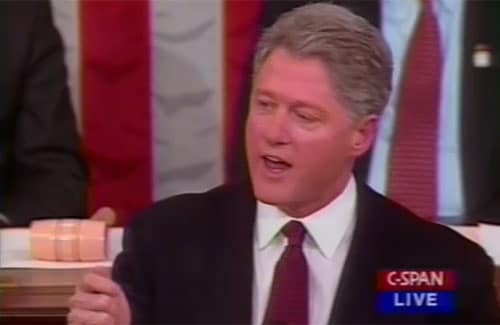
by President William Jefferson Clinton, on January 23, 1996
Mr. Speaker, Mr. Vice President, members of the 104th Congress, distinguished guests, my fellow Americans all across our land:
Let me begin tonight by saying to our men and women in uniform around the world, and especially those helping peace take root in Bosnia and to their families, I thank you. America is very, very proud of you.
My duty tonight is to report on the state of the Union- not the state of our government, but of our American community; and to set forth our responsibilities, in the words of our Founders, to form a more perfect union.
The state of the Union is strong. Our economy is the healthiest it has been in three decades. We have the lowest combined rates of unemployment and inflation in 27 years. We have created nearly 8 million new jobs, over a million of them in basic industries, like construction and automobiles. America is selling more cars than Japan for the first time since the 1970s. And for three years in a row, we have had a record number of new businesses started in our country.
Our leadership in the world is also strong, bringing hope for new peace. And perhaps most important, we are gaining ground in restoring our fundamental values. The crime rate, the welfare and food stamp rolls, the poverty rate and the teen pregnancy rate are all down. And as they go down, prospects for America’s future go up.
We live in an age of possibility. A hundred years ago we moved from farm to factory. Now we move to an age of technology, information, and global competition. These changes have opened vast new opportunities for our people, but they have also presented them with stiff challenges. While more Americans are living better, too many of our fellow citizens are working harder just to keep up, and they are rightly concerned about the security of their families.
We must answer here three fundamental questions: First, how do we make the American Dream of opportunity for all a reality for all Americans who are willing to work for it? Second, how do we preserve our old and enduring values as we move into the future? And, third, how do we meet these challenges together, as one America?
We know big government does not have all the answers. We know there’s not a program for every problem. We have worked to give the American people a smaller, less bureaucratic government in Washington. And we have to give the American people one that lives within its means.
The era of big government is over. But we cannot go back to the time when our citizens were left to fend for themselves. Instead, we must go forward as one America, one nation working together to meet the challenges we face together. Self-reliance and teamwork are not opposing virtues; we must have both.
I believe our new, smaller government must work in an old-fashioned American way, together with all of our citizens through state and local governments, in the workplace, in religious, charitable and civic associations. Our goal must be to enable all our people to make the most of their own lives- with stronger families, more educational opportunity, economic security, safer streets, a cleaner environment in a safer world.
To improve the state of our Union, we must ask more of ourselves, we must expect more of each other, and we must face our challenges together.
Here, in this place, our responsibility begins with balancing the budget in a way that is fair to all Americans. There is now broad bipartisan agreement that permanent deficit spending must come to an end.
I compliment the Republican leadership and the membership for the energy and determination you have brought to this task of balancing the budget. And I thank the Democrats for passing the largest deficit reduction plan in history in 1993, which has already cut the deficit nearly in half in three years.
Since 1993, we have all begun to see the benefits of deficit reduction. Lower interest rates have made it easier for businesses to borrow and to invest and to create new jobs. Lower interest rates have brought down the cost of home mortgages, car payments and credit card rates to ordinary citizens. Now, it is time to finish the job and balance the budget.
Though differences remain among us which are significant, the combined total of the proposed savings that are common to both plans is more than enough, using the numbers from your Congressional Budget Office to balance the budget in seven years and to provide a modest tax cut.
These cuts are real. They will require sacrifice from everyone. But these cuts do not undermine our fundamental obligations to our parents, our children, and our future, by endangering Medicare, or Medicaid, or education, or the environment, or by raising taxes on working families.
I have said before, and let me say again, many good ideas have come out of our negotiations. I have learned a lot about the way both Republicans and Democrats view the debate before us. I have learned a lot about the good ideas that we could all embrace.
We ought to resolve our remaining differences. I am willing to work to resolve them. I am ready to meet tomorrow. But I ask you to consider that we should at least enact these savings that both plans have in common and give the American people their balanced budget, a tax cut, lower interest rates, and a brighter future. We should do that now, and make permanent deficits yesterday’s legacy.
Now it is time for us to look also to the challenges of today and tomorrow, beyond the burdens of yesterday. The challenges are significant. But America was built on challenges, not promises. And when we work together to meet them, we never fail. That is the key to a more perfect Union. Our individual dreams must be realized by our common efforts.
Tonight I want to speak to you about the challenges we all face as a people.
Our first challenge is to cherish our children and strengthen America’s families. Family is the foundation of American life. If we have stronger families, we will have a stronger America.
Before I go on, I would like to take just a moment to thank my own family, and to thank the person who has taught me more than anyone else over 25 years about the importance of families and children- a wonderful wife, a magnificent mother and a great First Lady. Thank you, Hillary.
All strong families begin with taking more responsibility for our children. I have heard Mrs. Gore say that it’s hard to be a parent today, but it’s even harder to be a child. So all of us, not just as parents, but all of us in our other roles- our media, our schools, our teachers, our communities, our churches and synagogues, our businesses, our governments- all of us have a responsibility to help our children to make it and to make the most of their lives and their God-given capacities.
To the media, I say you should create movies and CDs and television shows you’d want your own children and grandchildren to enjoy.
I call on Congress to pass the requirement for a V-chip in TV sets so that parents can screen out programs they believe are inappropriate for their children. When parents control what their young children see, that is not censorship; that is enabling parents to assume more personal responsibility for their children’s upbringing. And I urge them to do it. The V-chip requirement is part of the important telecommunications bill now pending in this Congress. It has bipartisan support, and I urge you to pass it now.
To make the V-chip work, I challenge the broadcast industry to do what movies have done- to identify your programming in ways that help parents to protect their children. And I invite the leaders of major media corporations in the entertainment industry to come to the White House next month to work with us in a positive way on concrete ways to improve what our children see on television. I am ready to work with you.
I say to those who make and market cigarettes: every year a million children take up smoking, even though it is against the law. Three hundred thousand of them will have their lives shortened as a result. Our administration has taken steps to stop the massive marketing campaigns that appeal to our children. We are simply saying: Market your products to adults, if you wish, but draw the line on children.
I say to those who are on welfare, and especially to those who have been trapped on welfare for a long time: For too long our welfare system has undermined the values of family and work, instead of supporting them. The Congress and I are near agreement on sweeping welfare reform. We agree on time limits, tough work requirements, and the toughest possible child support enforcement. But I believe we must also provide child care so that mothers who are required to go to work can do so without worrying about what is happening to their children.
I challenge this Congress to send me a bipartisan welfare reform bill that will really move people from welfare to work and do the right thing by our children. I will sign it immediately.
Let us be candid about this difficult problem. Passing a law, even the best possible law, is only a first step. The next step is to make it work. I challenge people on welfare to make the most of this opportunity for independence. I challenge American businesses to give people on welfare the chance to move into the work force. I applaud the work of religious groups and others who care for the poor. More than anyone else in our society, they know the true difficulty of the task before us, and they are in a position to help. Every one of us should join them. That is the only way we can make real welfare reform a reality in the lives of the American people.
To strengthen the family we must do everything we can to keep the teen pregnancy rate going down. I am gratified, as I’m sure all Americans are, that it has dropped for two years in a row. But we all know it is still far too high.
Tonight I am pleased to announce that a group of prominent Americans is responding to that challenge by forming an organization that will support grass-roots community efforts all across our country in a national campaign against teen pregnancy. And I challenge all of us and every American to join their efforts.
I call on American men and women in families to give greater respect to one another. We must end the deadly scourge of domestic violence in our country. And I challenge America’s families to work harder to stay together. For families who stay together not only do better economically, their children do better as well.
In particular, I challenge the fathers of this country to love and care for their children. If your family has separated, you must pay your child support. We’re doing more than ever to make sure you do, and we’re going to do more, but let’s all admit something about that, too: A check will not substitute for a parent’s love and guidance. And only you — only you can make the decision to help raise your children. No matter who you are, how low or high your station in life, it is the most basic human duty of every American to do that job to the best of his or her ability.
Our second challenge is to provide Americans with the educational opportunities we will all need for this new century. In our schools, every classroom in America must be connected to the information superhighway, with computers and good software, and well-trained teachers. We are working with the telecommunications industry, educators and parents to connect 20 percent of California’s classrooms by this spring, and every classroom and every library in the entire United States by the year 2000. I ask Congress to support this education technology initiative so that we can make sure this national partnership succeeds.
Every diploma ought to mean something. I challenge every community, every school and every state to adopt national standards of excellence; to measure whether schools are meeting those standards; to cut bureaucratic red tape so that schools and teachers have more flexibility for grass-roots reform; and to hold them accountable for results. That’s what our Goals 2000 initiative is all about.
I challenge every state to give all parents the right to choose which public school their children will attend; and to let teachers form new schools with a charter they can keep only if they do a good job.
I challenge all our schools to teach character education, to teach good values and good citizenship. And if it means that teenagers will stop killing each other over designer jackets, then our public schools should be able to require their students to wear school uniforms.
I challenge our parents to become their children’s first teachers. Turn off the TV. See that the homework is done. And visit your children’s classroom. No program, no teacher, no one else can do that for you.
My fellow Americans, higher education is more important today than ever before. We’ve created a new student loan program that’s made it easier to borrow and repay those loans, and we have dramatically cut the student loan default rate. That’s something we should all be proud of, because it was unconscionably high just a few years ago. Through AmeriCorps, our national service program, this year 25,000 young people will earn college money by serving their local communities to improve the lives of their friends and neighbors. These initiatives are right for America and we should keep them going.
And we should also work hard to open the doors of college even wider. I challenge Congress to expand work-study and help one million young Americans work their way through college by the year 2000; to provide a $1000 merit scholarship for the top five percent of graduates in every high school in the United States; to expand Pell Grant scholarships for deserving and needy students; and to make up to $10,000 a year of college tuition tax deductible. It’s a good idea for America.
Our third challenge is to help every American who is willing to work for it, achieve economic security in this new age. People who work hard still need support to get ahead in the new economy. They need education and training for a lifetime. They need more support for families raising children. They need retirement security. They need access to health care. More and more Americans are finding that the education of their childhood simply doesn’t last a lifetime.
So I challenge Congress to consolidate 70 overlapping, antiquated job-training programs into a simple voucher worth $2,600 for unemployed or underemployed workers to use as they please for community college tuition or other training. This is a G.I. Bill for America’s workers we should all be able to agree on.
More and more Americans are working hard without a raise. Congress sets the minimum wage. Within a year, the minimum wage will fall to a 40-year low in purchasing power. Four dollars and 25 cents an hour is no longer a living wage, but millions of Americans and their children are trying to live on it. I challenge you to raise their minimum wage.
In 1993, Congress cut the taxes of 15 million hard-pressed working families to make sure that no parents who work full-time would have to raise their children in poverty, and to encourage people to move from welfare to work. This expanded earned income tax credit is now worth about $1,800 a year to a family of four living on $20,000. The budget bill I vetoed would have reversed this achievement and raised taxes on nearly 8 million of these people. We should not do that.
I also agree that the people who are helped under this initiative are not all those in our country who are working hard to do a good job raising their children and at work. I agree that we need a tax credit for working families with children. That’s one of the things most of us in this Chamber, I hope, can agree on. I know it is strongly supported by the Republican majority. And it should be part of any final budget agreement.
I want to challenge every business that can possibly afford it to provide pensions for your employees. And I challenge Congress to pass a proposal recommended by the White House Conference on Small Business that would make it easier for small businesses and farmers to establish their own pension plans. That is something we should all agree on.
We should also protect existing pension plans. Two years ago, with bipartisan support that was almost unanimous on both sides of the aisle, we moved to protect the pensions of 8 million working people and to stabilize the pensions of 32 million more. Congress should not now let companies endanger those workers’ pension funds. I know the proposal to liberalize the ability of employers to take money out of pension funds for other purposes would raise money for the treasury. But I believe it is false economy. I vetoed that proposal last year, and I would have to do so again.
Finally, if our working families are going to succeed in the new economy, they must be able to buy health insurance policies that they do not lose when they change jobs or when someone in their family gets sick. Over the past two years, over one million Americans in working families have lost their health insurance. We have to do more to make health care available to every American. And Congress should start by passing the bipartisan bill sponsored by Senator Kennedy and Senator Kassebaum that would require insurance companies to stop dropping people when they switch jobs, and stop denying coverage for preexisting conditions. Let’s all do that.
And even as we enact savings in these programs, we must have a common commitment to preserve the basic protections of Medicare and Medicaid — not just to the poor, but to people in working families, including children, people with disabilities, people with AIDS, and senior citizens in nursing homes.
In the past three years, we’ve saved $15 billion just by fighting health care fraud and abuse. We have all agreed to save much more. We have all agreed to stabilize the Medicare Trust Fund. But we must not abandon our fundamental obligations to the people who need Medicare and Medicaid. America cannot become stronger if they become weaker.
The G.I. Bill for workers, tax relief for education and child rearing, pension availability and protection, access to health care, preservation of Medicare and Medicaid- these things, along with the Family and Medical Leave Act passed in 1993 — these things will help responsible, hard-working American families to make the most of their own lives.
But employers and employees must do their part, as well, as they are doing in so many of our finest companies — working together, putting the long-term prosperity ahead of the short-term gain. As workers increase their hours and their productivity, employers should make sure they get the skills they need and share the benefits of the good years, as well as the burdens of the bad ones. When companies and workers work as a team they do better, and so does America.
Our fourth great challenge is to take our streets back from crime and gangs and drugs. At last we have begun to find a way to reduce crime, forming community partnerships with local police forces to catch criminals and prevent crime. This strategy, called community policing, is clearly working. Violent crime is coming down all across America. In New York City murders are down 25 percent; in St. Louis, 18 percent; in Seattle, 32 percent. But we still have a long way to go before our streets are safe and our people are free from fear.
The Crime Bill of 1994 is critical to the success of community policing. It provides funds for 100,000 new police in communities of all sizes. We’re already a third of the way there. And I challenge the Congress to finish the job. Let us stick with a strategy that’s working and keep the crime rate coming down.
Community policing also requires bonds of trust between citizens and police. I ask all Americans to respect and support our law enforcement officers. And to our police, I say, our children need you as role models and heroes. Don’t let them down.
The Brady Bill has already stopped 44,000 people with criminal records from buying guns. The assault weapons ban is keeping 19 kinds of assault weapons out of the hands of violent gangs. I challenge the Congress to keep those laws on the books.
Our next step in the fight against crime is to take on gangs the way we once took on the mob. I’m directing the FBI and other investigative agencies to target gangs that involve juveniles in violent crime, and to seek authority to prosecute as adults teenagers who maim and kill like adults.
And I challenge local housing authorities and tenant associations: Criminal gang members and drug dealers are destroying the lives of decent tenants. From now on, the rule for residents who commit crime and peddle drugs should be one strike and you’re out.
I challenge every state to match federal policy to assure that serious violent criminals serve at least 85 percent of their sentence.
More police and punishment are important, but they’re not enough. We have got to keep more of our young people out of trouble, with prevention strategies not dictated by Washington, but developed in communities. I challenge all of our communities, all of our adults, to give our children futures to say yes to. And I challenge Congress not to abandon the Crime Bill’s support of these grass-roots prevention efforts.
Finally, to reduce crime and violence we have to reduce the drug problem. The challenge begins in our homes, with parents talking to their children openly and firmly. It embraces our churches and synagogues, our youth groups and our schools.
I challenge Congress not to cut our support for drug-free schools. People like the D.A.R.E. officers are making a real impression on grade schoolchildren that will give them the strength to say no when the time comes.
Meanwhile, we continue our efforts to cut the flow of drugs into America. For the last two years, one man in particular has been on the front lines of that effort. Tonight I am nominating him- a hero of the Persian Gulf War and the Commander in Chief of the United States Military Southern Command- General Barry McCaffrey, as America’s new Drug Czar.
General McCaffrey has earned three Purple Hearts and two Silver Stars fighting for this country. Tonight I ask that he lead our nation’s battle against drugs at home and abroad. To succeed, he needs a force far larger than he has ever commanded before. He needs all of us. Every one of us has a role to play on this team.
Thank you, General McCaffrey, for agreeing to serve your country one more time.
Our fifth challenge: to leave our environment safe and clean for the next generation. Because of a generation of bipartisan effort we do have cleaner water and air, lead levels in children’s blood has been cut by 70 percent, toxic emissions from factories cut in half. Lake Erie was dead, and now it’s a thriving resource. But 10 million children under 12 still live within four miles of a toxic waste dump. A third of us breathe air that endangers our health. And in too many communities, the water is not safe to drink. We still have much to do.
Yet Congress has voted to cut environmental enforcement by 25 percent. That means more toxic chemicals in our water, more smog in our air, more pesticides in our food. Lobbyists for polluters have been allowed to write their own loopholes into bills to weaken laws that protect the health and safety of our children. Some say that the taxpayer should pick up the tab for toxic waste and let polluters who can afford to fix it off the hook. I challenge Congress to reexamine those policies and to reverse them.
This issue has not been a partisan issue. The most significant environmental gains in the last 30 years were made under a Democratic Congress and President Richard Nixon. We can work together. We have to believe some basic things. Do you believe we can expand the economy without hurting the environment? I do. Do you believe we can create more jobs over the long run by cleaning the environment up? I know we can. That should be our commitment.
We must challenge businesses and communities to take more initiative in protecting the environment, and we have to make it easier for them to do it. To businesses this administration is saying: If you can find a cheaper, more efficient way than government regulations require to meet tough pollution standards, do it — as long as you do it right. To communities we say: We must strengthen community right-to-know laws requiring polluters to disclose their emissions, but you have to use the information to work with business to cut pollution. People do have a right to know that their air and their water are safe.
Our sixth challenge is to maintain America’s leadership in the fight for freedom and peace throughout the world. Because of American leadership, more people than ever before live free and at peace. And Americans have known 50 years of prosperity and security.
We owe thanks especially to our veterans of World War II. I would like to say to Senator Bob Dole and to all others in this Chamber who fought in World War II, and to all others on both sides of the aisle who have fought bravely in all our conflicts since: I salute your service, and so do the American people.
All over the world, even after the Cold War, people still look to us and trust us to help them seek the blessings of peace and freedom. But as the Cold War fades into memory, voices of isolation say America should retreat from its responsibilities. I say they are wrong.
The threats we face today as Americans respect no nation’s borders. Think of them: terrorism, the spread of weapons of mass destruction, organized crime, drug trafficking, ethnic and religious hatred, aggression by rogue states, environmental degradation. If we fail to address these threats today, we will suffer the consequences in all our tomorrows.
Of course, we can’t be everywhere. Of course, we can’t do everything. But where our interests and our values are at stake, and where we can make a difference, America must lead. We must not be isolationist.
We must not be the world’s policeman. But we can and should be the world’s very best peacemaker. By keeping our military strong, by using diplomacy where we can and force where we must, by working with others to share the risk and the cost of our efforts, America is making a difference for people here and around the world. For the first time since the dawn of the nuclear age, there is not a single Russian missile pointed at America’s children.
North Korea has now frozen its dangerous nuclear weapons program. In Haiti, the dictators are gone, democracy has a new day, the flow of desperate refugees to our shores has subsided. Through tougher trade deals for America — over 80 of them — we have opened markets abroad, and now exports are at an all-time high, growing faster than imports and creating good American jobs.
We stood with those taking risks for peace: In Northern Ireland, where Catholic and Protestant children now tell their parents, violence must never return. In the Middle East, where Arabs and Jews who once seemed destined to fight forever now share knowledge and resources, and even dreams.
And we stood up for peace in Bosnia. Remember the skeletal prisoners, the mass graves, the campaign to rape and torture, the endless lines of refugees, the threat of a spreading war. All these threats, all these horrors have now begun to give way to the promise of peace. Now, our troops and a strong NATO, together with our new partners from Central Europe and elsewhere, are helping that peace to take hold.
As all of you know, I was just there with a bipartisan congressional group, and I was so proud not only of what our troops were doing, but of the pride they evidenced in what they were doing. They knew what America’s mission in this world is, and they were proud to be carrying it out.
Through these efforts, we have enhanced the security of the American people. But make no mistake about it:important challenges remain.
The START II Treaty with Russia will cut our nuclear stockpiles by another 25 percent. I urge the Senate to ratify it — now. We must end the race to create new nuclear weapons by signing a truly comprehensive nuclear test ban treaty — this year.
As we remember what happened in the Japanese subway, we can outlaw poison gas forever if the Senate ratifies the Chemical Weapons Convention — this year. We can intensify the fight against terrorists and organized criminals at home and abroad if Congress passes the anti-terrorism legislation I proposed after the Oklahoma City bombing- now. We can help more people move from hatred to hope all across the world in our own interest if Congress gives us the means to remain the world’s leader for peace.
My fellow Americans, the six challenges I have just discussed are for all of us. Our seventh challenge is really America’s challenge to those of us in this hallowed hall tonight: to reinvent our government and make our democracy work for them.
Last year this Congress applied to itself the laws it applies to everyone else. This Congress banned gifts and meals from lobbyists. This Congress forced lobbyists to disclose who pays them and what legislation they are trying to pass or kill. This Congress did that, and I applaud you for it.
Now I challenge Congress to go further- to curb special interest influence in politics by passing the first truly bipartisan campaign reform bill in a generation. You, Republicans and Democrats alike, can show the American people that we can limit spending and open the airwaves to all candidates.
I also appeal to Congress to pass the line-item veto you promised the American people.
Our administration is working hard to give the American people a government that works better and costs less. Thanks to the work of Vice President Gore, we are eliminating 16,000 pages of unnecessary rules and regulations, shifting more decision-making out of Washington, back to states and local communities.
As we move into the era of balanced budgets and smaller government, we must work in new ways to enable people to make the most of their own lives. We are helping America’s communities, not with more bureaucracy, but with more opportunities. Through our successful Empowerment Zones and Community Development Banks, we are helping people to find jobs, to start businesses. And with tax incentives for companies that clean up abandoned industrial property, we can bring jobs back to places that desperately, desperately need them.
But there are some areas that the federal government should not leave and should address and address strongly. One of these areas is the problem of illegal immigration. After years of neglect, this administration has taken a strong stand to stiffen the protection of our borders. We are increasing border controls by 50 percent. We are increasing inspections to prevent the hiring of illegal immigrants. And tonight, I announce I will sign an executive order to deny federal contracts to businesses that hire illegal immigrants.
Let me be very clear about this: We are still a nation of immigrants; we should be proud of it. We should honor every legal immigrant here, working hard to become a new citizen. But we are also a nation of laws.
I want to say a special word now to those who work for our federal government. Today our federal government is 200,000 employees smaller than it was the day I took office as President.
Our federal government today is the smallest it has been in 30 years, and it’s getting smaller every day. Most of our fellow Americans probably don’t know that. And there is a good reason: The remaining federal work force is composed of Americans who are now working harder and working smarter than ever before, to make sure the quality of our services does not decline.
I’d like to give you one example. His name is Richard Dean. He is a 49 year-old Vietnam veteran who’s worked for the Social Security Administration for 22 years now. Last year he was hard at work in the Federal Building in Oklahoma City when the blast killed 169 people and brought the rubble down all around him. He reentered that building four times. He saved the lives of three women. He’s here with us this evening, and I want to recognize Richard and applaud both his public service and his extraordinary personal heroism.
But Richard Dean’s story doesn’t end there. This last November, he was forced out of his office when the government shut down. And the second time the government shut down he continued helping Social Security recipients, but he was working without pay.
On behalf of Richard Dean and his family, and all the other people who are out there working every day doing a good job for the American people, I challenge all of you in this Chamber: Never, ever shut the federal government down again.
On behalf of all Americans, especially those who need their Social Security payments at the beginning of March, I also challenge the Congress to preserve the full faith and credit of the United States- to honor the obligations of this great nation as we have for 220 years; to rise above partisanship and pass a straightforward extension of the debt limit and show people America keeps its word.
I know that this evening I have asked a lot of Congress, and even more from America. But I am confident: When Americans work together in their homes, their schools, their churches, their synagogues, their civic groups, their workplace, they can meet any challenge.
I say again, the era of big government is over. But we can’t go back to the era of fending for yourself. We have to go forward to the era of working together as a community, as a team, as one America, with all of us reaching across these lines that divide us- the division, the discrimination, the rancor- we have to reach across it to find common ground. We have got to work together if we want America to work.
I want you to meet two more people tonight who do just that. Lucius Wright is a teacher in the Jackson, Mississippi, public school system. A Vietnam veteran, he has created groups to help inner-city children turn away from gangs and build futures they can believe in. Sergeant Jennifer Rodgers is a police officer in Oklahoma City. Like Richard Dean, she helped to pull her fellow citizens out of the rubble and deal with that awful tragedy. She reminds us that in their response to that atrocity the people of Oklahoma City lifted all of us with their basic sense of decency and community.
Lucius Wright and Jennifer Rodgers are special Americans. And I have the honor to announce tonight that they are the very first of several thousand Americans who will be chosen to carry the Olympic torch on its long journey from Los Angeles to the centennial of the modern Olympics in Atlanta this summer- not because they are star athletes, but because they are star citizens, community heroes meeting America’s challenges. They are our real champions.
Now, each of us must hold high the torch of citizenship in our own lives. None of us can finish the race alone. We can only achieve our destiny together — one hand, one generation, one American connecting to another.
There have always been things we could do together -dreams we could make real- which we could never have done on our own. We Americans have forged our identity, our very union, from every point of view and every point on the planet, every different opinion. But we must be bound together by a faith more powerful than any doctrine that divides us — by our belief in progress, our love of liberty, and our relentless search for common ground.
America has always sought and always risen to every challenge. Who would say that, having come so far together, we will not go forward from here? Who would say that this age of possibility is not for all Americans?
Our country is and always has been a great and good nation. But the best is yet to come, if we all do our part.
Thank you, God bless you and God bless the United States of America. Thank you.