web analytics

Tag: 1940s

  • Pop Culture Trivia Quiz: What Happened In 1949?

    Pop Culture Trivia Quiz: What Happened In 1949?

    Pop Culture Trivia Quiz: What Happened In 1949?

    49 Trivia Questions for 1949 History

    (answers)

    1. Who was the President of the United States in 1949?

    2. What was the Biggest Number One Song of 1949?

    3. To the nearest quarter, what was the average movie theater ticket price in 1949?

    4. Who was the author of 1984, which came out in 1949?

    5. In 1949, a mysterious person began an annual tradition of leaving three roses in a distinctive arrangement and a bottle of cognac at what famous writer’s grave?

    6. What was the highest-grossing film of 1949

    7. How much did a Loaf of Bread cost in 1949?

    8. How much did a Gallon of Milk cost in 1949?

    9. White Christmas by Bing Crosby was the first Christmas song to reach the number one position on the Billboard Music Charts. What was the second one?

    10. How many people lived in the United States in 1949?

    11. The Warner Brothers cartoon Fast and Furry-ous introduced what two iconic characters?

    12. What was the Coyote’s full name?

    13. Who won the Stanley Cup in 1949?

    14. In 1949, what was the average life expectancy in the United States?

    15. Making his TV debut on LA’s KTTV, he was called “The World’s Most Famous Clown.”… who was he?

    16. This automobile, introduced by Oldsmobile in 1949, has been called the ‘first muscle car.’ Name that car.

    17. What was the Bestselling Fiction Book in 1949?

    18. This baseball star’s $90,000 contract made him seem like the highest-paid star of the 1949 season. Name that Yankee.

    19. A few weeks later, another baseball star received an even higher contract for the season, almost $100,000. Name that Boston Baseball Hitter.

    20. This 1949 film, based on a 2 volume novel, starred June Allyson, Margaret O’Brien, Elizabeth Taylor, Janet Leigh, and Peter Lawford.

    21. Starring Laurence Olivier, this film won four Academy Awards in 1949, including Best Picture. It was the first non-Hollywood production to win the award. Name that film.

    22. Founded in 1949, the North Atlantic Alliance is better known by what name?

    23. Who was named the Major League Baseball Most Valuable Player Award winner for the National League?

    24. First presented in 1949, what was the Volkswagen Type 2 vehicle?

    25. Who won the 1949 World Series?

    26. On February 7, 1949, This Arthur Miller tragedy opened at the Morosco Theatre in New York City and ran for 742 performances.

    27. Which celebrity was NOT born in 1949: Elton John, Billy Joel, Hank Williams Jr, or Lionel Richie?

    28. English Astronomer Fred Hoyle did not agree with a particular theory of how the universe began, but he gave it the nickname we use today. Name that theory.

    29. The first television western aired on NBC in the United States. Name that cowboy.

    30. Who was the Time Magazine Man of the Year in 1949?

    31. On May 9, 1949, Rainier III became Prince of Monaco. A few years later, he married a Hollywood star. Name his wife.

    32. The first telethon took place in April 1949, raising over $1,000,000 from the Damon Runyan Memorial Fund. over 16 hours. Name the TV star who hosted the event.

    33. Airing from June 1949 to April 1955, this was the first American live-action Science Fiction television show.

    34. Opened in Rochester, New York, what is the George Eastman Museum dedicated to?

    35. Who were the 1949 NFL Champions?

    36. This Major League Baseball player reached base safely for the 84th consecutive game, a record. Name that player.

    37. This musical comedy was the last film starring the Marx Brothers. What was the name of the movie

    38. The title of this 1949 Abbot and Costello film mentions the other co-star by name. What is the film’s title?

    39. This 1949 film, directed by Raoul Walsh and starring James Cagney, is considered by many to be the best gangster movie of all time. Name that film.

    40. How much did an average Volkswagen Beetle cost in 1949?

    41. How much did a gallon of gas cost in 1949?

    42. This reality/documentary show started as a newspaper comic strip feature in 1918, originally called Champs and Chumps. It has been revived several times. Name that show!

    43. This American soldier, actor, and songwriter was one of World War II’s most decorated combat soldiers. His book is titled To Hell and Back. Name this American hero.

    44. How much did a dozen eggs cost in 1949?

    45. It only lasted a month on NBC, but TC historians call this program “the first daytime soap opera.” Can you name that program?

    46. Staring as a 1929 radio dramedy, this came back as a television show on CBS and was one of the very first sitcoms. Name that show.

    47. RCA Victor introduced a 7-inch product that changed music for the next 70 years. What was it?

    48. Before 1949, Jordan had a different name. What was the old name of the country?

    49. The biggest hit from this 1949 musical is “Some Enchanted Evening”. What is the name of the musical?

    Trivia Team Bonus Questions:

    1. Who were the composers of South Pacific?

    2. Who was the American Vice-President in 1949?

    3. What did the fictional Book, Film, and Television Cowboy Hopalong Cassidy like to drink?

    4. Who were the 1949 NBA Champions?

    5. On March 21, 1949, WTVJ signed on the air as the first television station in what state?

    6. The unfortunate death of 3-year-old Kathy Fiscus was one of the first ongoing pop culture stories. What happened to her?

    7. What Horse won the Kentucky Derby in 1949?

    8. America’s National Security Agency (NSA) was founded in 1952, but the agency it replaced was formed in 1949. Name the prior agency.

    9. What two leagues merged in 1949 to form the National Basketball Association (NBA)?

    10. Who was the Pope in 1949?

    The Answers:

    49 Trivia Answers for 1949 History

    1. Who was the President of the United States in 1949?
    Harry S. Truman (April 12, 1945 – January 20, 1953)

    2. What was the Biggest Number One Song of 1949?
    Riders In The Sky (A Cowboy Legend) by Vaughn Monroe

    3. To the nearest quarter, what was the average movie theater ticket price in 1949?
    50 cents

    4. Who was the author of 1984, which came out in 1949?
    George Orwell

    5. In 1949, a mysterious person began an annual tradition of leaving three roses in a distinctive arrangement and a bottle of cognac at what famous writer’s grave?
    Edgar Allen Poe (January 19, 1809 – October 7, 1849)

    6. What was the highest-grossing film of 1949?
    Samson and Delilah

    7. How much did a Loaf of Bread cost in 1949?
    14 cents

    8. How much did a Gallon of Milk cost in 1949?
    84 cents

    9. White Christmas by Bing Crosby was the first Christmas song to reach the number one position on the Billboard Music Charts. What was the second one?
    All I Want For Christmas (Is My Two Front Teeth) by Spike Jones

    10. How many people lived in the United States in 1949?
    The population was an estimated 149,188,130 people.

    11. The Warner Brothers cartoon Fast and Furry-ous introduced what two iconic characters?
    The Road Runner and the Coyote

    12. What was the Coyote’s full name?
    Wile E. Coyote

    13. Who won the Stanley Cup in 1949?
    In 1949, The Toronto Maple Leafs won over the Detroit Red Wings (4 games to 0)

    14. In 1949, what was the average life expectancy in the United States?
    Men – 65.2 years, Women – 70.7 years.

    15. Making his TV debut on LA’s KTTV, he was called “The World’s Most Famous Clown.”… who was he?
    Bozo The Clown

    16. This automobile, introduced by Oldsmobile in 1949, has been called the ‘first muscle car.’ Name that car.
    Oldsmobile 88 (Rocket 88)

    17. What was the Bestselling Fiction Book in 1949?
    The Egyptian by Mika Waltari

    18. This baseball star’s $90,000 contract made him seem like the highest-paid star of the 1949 season. Name that Yankee.
    Joe DiMaggio

    19. A few weeks later, another baseball star received an even higher contract for the season, almost $100,000. Name that Boston Baseball Hitter.
    Ted Williams

    20. This 1949 film, based on a 2 volume novel, starred June Allyson, Margaret O’Brien, Elizabeth Taylor, Janet Leigh, and Peter Lawford.
    Little Women

    21. Starring Laurence Olivier, this film won four Academy Awards in 1949, including Best Picture. It was the first non-Hollywood production to win the award. Name that film.
    Hamlet

    22. Founded in 1949, the North Atlantic Alliance is better known by what name?
    NATO (North Atlantic Treaty Organization)

    23. Who was named the Major League Baseball Most Valuable Player Award winner for the National League?
    Jackie Robison (Ted Williams won for the American League)

    24. First presented in 1949, what was the Volkswagen Type 2 vehicle?
    Microbus (small bus)

    25. Who won the 1949 World Series?
    In 1949, The New York Yankees won, beating the Brooklyn Dodgers (4 games to 1)

    26. On February 7, 1949, This Arthur Miller tragedy opened at the Morosco Theatre in New York City and ran for 742 performances.
    Death of a Salesman

    27. Which celebrity was NOT born in 1949: Elton John, Billy Joel, Hank Williams Jr, or Lionel Richie?
    Elton John (born March 25, 1947)

    28. English Astronomer Fred Hoyle did not agree with a particular theory of how the universe began, but he gave it the nickname we use today. Name that theory.
    The Big Bang

    29. The first television western aired on NBC in the United States. Name that cowboy.
    Hopalong Cassidy

    30. Who was the Time Magazine Man of the Year in 1949?
    Winston Churchill

    31. On May 9, 1949, Rainier III became Prince of Monaco. A few years later, he married a Hollywood star. Name his wife.
    Grace Kelly (November 12, 1929 – September 14, 1982)

    32. The first telethon took place in April 1949, raising over $1,000,000 from the Damon Runyan Memorial Fund. over 16 hours. Name the TV star who hosted the event.
    Milton Berle

    33. Airing from June 1949 to April 1955, this was the first American live-action Science Fiction television show.
    Captain Video and His Video Rangers

    34. Opened in Rochester, New York, what is the George Eastman Museum dedicated to?
    Photography

    35. Who were the 1949 NFL Champions?
    Philadelphia Eagles

    36. This Major League Baseball player reached base safely for the 84th consecutive game, a record. Name that player.
    Ted Williams

    37. This musical comedy was the last film starring the Marx Brothers. What was the name of the movie?
    Love Happy

    38. The title of this 1949 Abbot and Costello film mentions the other co-star by name. What is the film’s title?
    Abbott and Costello Meet the Killer, Boris Karloff

    39. This 1949 film, directed by Raoul Walsh and starring James Cagney, is considered by many to be the best gangster movie of all time. Name that film.
    White Heat

    40. How much did an average Volkswagen Beetle cost in 1949?
    $1280

    41. How much did a gallon of gas cost in 1949?
    $0.27 per gallon

    42. This reality/documentary show started as a newspaper comic strip feature in 1918, originally called Champs and Chumps. It has been revived several times. Name that show!
    Ripley’s Believe It or Not!

    43. This American soldier, actor, and songwriter was one of World War II’s most decorated combat soldiers. His book is titled To Hell and Back. Name this American hero.
    Audie Murphy

    44. How much did a dozen eggs cost in 1949?
    70 cents

    45. It only lasted a month on NBC, but TC historians call this program “the first daytime soap opera”. can you name that program?
    These Are My Children

    46. Staring as a 1929 radio dramedy, this came back as a television show on CBS and was one of the very first sitcoms. Name that show.
    The Goldbergs

    47. RCA Victor introduced a 7-inch product that changed music for the next 70 years. What was it?
    The 45 RPM Record.

    48. The country of Jordan had a different name before 1949. What was the old name of the country?
    Transjordan

    49. The biggest hit from this 1949 musical is “Some Enchanted Evening”. What is the name of the musical?
    South Pacific

    Trivia Team Bonus Questions:

    1. Who were the composers of South Pacific?
    Richard Rodgers (music), Oscar Hammerstein II (lyrics)

    2. Who was the American Vice-President in 1949?
    Alben W. Barkley (January 20, 1949 – January 20, 1953)
    The office of vice president was vacant from April 12, 1945 – January 20, 1949

    3. What did the fictional Book, Film, and Television Cowboy Hopalong Cassidy like to drink?
    Sarsaparilla.

    4. Who were the 1949 NBA Champions?
    For the 1948-49 Season, Champion Minneapolis Lakers won 4 games to 2 over the Washington Capitals

    5. On March 21, 1949, WTVJ signed on the air as the first television station in what state?
    Florida

    6. The unfortunate death of 3-year-old Kathy Fiscus was one of the first ongoing pop culture stories. What happened to her?
    She fell down a well. (in San Marino, California.)

    7. What Horse won the Kentucky Derby in 1949?
    Ponder

    8. America’s National Security Agency (NSA) was founded in 1952, but the agency it replaced was formed in 1949. Name the prior agency.
    Armed Forces Security Agency (AFSA)

    9. What two leagues merged in 1949 to form the National Basketball Association (NBA)?
    Basketball Association of America and the National Basketball League

    10. Who was the Pope in 1949?
    Pope Pius XII, March 2, 1939 – October 9, 1958

  • Pop Culture Trivia Quiz: What Happened In 1948?

    Pop Culture Trivia Quiz: What Happened In 1948?

    Pop Culture Trivia Quiz: What Happened In 1948?

    48 Trivia Questions for 1948 History

    (answers)
    1. Who was the President of the United States in 1948?

    2. What was the name of the American initiative passed in 1948 for foreign aid to Western Europe?

    3. What was the highest-grossing film of 1948?

    4. What was the highest-grossing musical film of 1948?

    5. How much did a Loaf of Bread cost in 1948?

    6. How much did a Gallon of Milk cost in 1948?

    7. What was the Bestselling Fiction Book in 1948?

    8. What was the Biggest Number One Song of 1948?

    9. What is the civilian auxiliary of the United States Air Force called?

    10. This song, about an unusual plant, was written in 1927 but became a Number One Hit for Art Mooney in 1948. Name that song

    11. The Soviet Union controlled Eastern Berlin, Germany, and interfered with travel between both parts of the city. What was this restriction called?

    12. What was the response from the United States and the Allies to the Berlin Blockade?

    13. This television variety was best known as The Ed Sullivan Show, but it had another title for the first seven years. Name that old TV show.

    14. Who won the Stanley Cup in 1948?

    15. In 1948, what was the average life expectancy in the United States?

    16. By the end of the 1948 Major League Baseball season, only one stadium did not have lights installed for night games, although they did get them 40 years later. Name that baseball stadium.

    17. How many people lived in the United States in 1948?

    18. This stadium was renamed Mile High Stadium in 1968, but what was it called when it was built in 1948?

    19. what was the average movie theater ticket price in 1948 to the nearest dime?

    20. This show moved from radio to television in 1958, and gave Milton Berle the nickname of “Mister Television”

    21. Who was the Republican nominee for President in 1948?

    22. After the 1948 election, what newspaper erroneously declared “Dewey Defeats Truman”?

    23. On November 14, 1948, Buckingham Palace released a statement: “Her Royal Highness the Princess Elizabeth Duchess of Edinburgh was safely delivered of a Prince at 9:14 o’clock this evening. Her Royal Highness and the infant Prince are both well.” Who was the prince they were talking about?

    24. Which celebrity was NOT born in 1948: Dan Aykroyd, Samuel L. Jackson, Ozzy Osbourne, Jackson Browne, or Christa McAuliffe?

    25. What company used the slogan: “A Diamond is Forever”?

    26. This household product, invented by Ed Lowe, for indoor pets, is a $2 Billion a year industry.

    27. First produced in 1948, now they are the longest-running pickup brand in the world. What are “they”?

    28. How much did a dozen eggs cost in 1948?

    29. This show has been on and off the air since 1948, capturing ordinary people being confronted with unusual situations.
    HINT: Smile!

    30. This Oscar-winning film had the same title as a Top Ten song by Bertie Higgins in 1981…

    31. This musical, written by Bella and Samuel Spewack with music and lyrics by Cole Porter, is based on Shakespeare’s Taming of the Shrew. Name that Broadway show.

    32. Who won the 1948 World Series?

    33. What American city banned pinball machines and other “gaming devices” until 1976?

    34. This Chicago television station, a superstation on cable decades late, first went on the air on April 5, 1948.

    35. Who was the Time Magazine Man of the Year in 1948?

    36. What restaurant had the first drive-thru window?

    37. To look sleeker and futuristic, Cadillac added what to its 1948 cars?

    38. This company originally produced utilitarian four-wheel drive, off-road vehicles but now focuses on luxury SUVs. Name this English company.

    39. What two newspapers merged to form the Chicago Sun-Times?

    40. The 1948 Summer Olympics were held in London, United Kingdom. How many medals did the US win?

    41. The 1948 Winter Olympics were held in St. Moritz, Switzerland. How many medals did the US win?

    42. This Western film gave us the line – “Badges? We ain’t got no badges! We don’t need no badges! I don’t have to show you any stinking badges!”

    43. How much did a gallon of gas cost in 1948?

    44. Rudolf and Adolf Dassler both opened shoe companies in Bavaria, Germany. What are the names of the two companies the brothers founded?

    45. What is the common name for the (new in 1948) microgroove product?

    46. Founded in 1948, this United Nations organization is responsible for international public health. Name that organization.

    47. Who won the US Triple Crown of Thoroughbred Racing in 1948?

    48. This racing company began in 1948 and is headquartered in Daytona, Florida. Name that company.

    Trivia Team Bonus Questions:

    1. What do the letters in NASCAR mean?

    2. What did the United Kingdom name its new comprehensive health care system in 1948?

    3. The first Tony Award for Best Play was presented. Name the winning play.

    4. Who was the Pope in 1948?

    5. Air National Guard pilot Thomas F. Mantell died in the crash of his F-51 Mustang fighter plane while doing what?

    6. Who were the 1948 NFL Champions?

    7. Margaret Chase Smith was elected as a United States Senator, representing Maine. She holds a first-time distinction for serving in Congress; what is that honor?

    8. Who were the 1948 NBA Champions?

    9. In 1948, the Soviet Union began to jam what radio broadcasts?

    10. Who was the American Vice-President in 1948?

    The Answers:

    48 Trivia Answers for 1948 History

    1. Who was the President of the United States in 1948?
    Harry S. Truman (April 12, 1945 – January 20, 1953)

    2. What was the name of the American initiative passed in 1948 for foreign aid to Western Europe?
    The Marshall Plan

    3. What was the highest-grossing film of 1948?
    Red River (The Paleface was a very close #2)

    4. What was the highest-grossing musical film of 1948?
    Easter Parade

    5. How much did a Loaf of Bread cost in 1948?
    14 cents

    6. How much did a Gallon of Milk cost in 1948?
    87 cents

    7. What was the Bestselling Fiction Book in 1948?
    The Big Fisherman by Lloyd C. Douglas

    8. What was the Biggest Number One Song of 1948?
    Buttons and Bows by Dinah Shore

    9. What is the civilian auxiliary of the United States Air Force called?
    Civil Air Patrol

    10. This song, about an unusual plant, was written in 1927 but became a Number One Hit for Art Mooney in 1948. Name that song.
    I’m Looking Over a Four-Leaf Clover

    11. The Soviet Union controlled Eastern Berlin, Germany, and interfered with travel between both parts of the city. What was this restriction called?
    The Berlin Blockade

    12. What was the response from the United States and the Allies to the Berlin Blockade?
    The Berlin Airlift

    13. This television variety was best known as The Ed Sullivan Show, but it had another title for the first seven years. Name that old TV show.
    Toast of the Town

    14. Who won the Stanley Cup in 1948?
    In 1948, The Toronto Maple Leafs won over the Detroit Red Wings (4 games to 0)

    15. In 1948, what was the average life expectancy in the United States?
    Men – 64.6 years, Women – 69.9 years.

    16. By the end of the 1948 Major League Baseball season, only one stadium did not have lights installed for night games, although they did get them 40 years later. Name that baseball stadium.
    Wrigley Field.

    17. How many people lived in the United States in 1948?
    The population was an estimated 146,631,302 people.

    18. This stadium was renamed Mile High Stadium in 1968, but what was it called when it was built in 1948?
    Bears Stadium (For the Denver Bears minor league baseball team)

    19. what was the average movie theater ticket price in 1948 to the nearest dime?
    40 cents

    20. This show moved from radio to television in 1958, and gave Milton Berle the nickname of “Mister Television”
    Texaco Star Theater

    21. Who was the Republican nominee for President in 1948?
    Thomas E. Dewey

    22. After the 1948 election, what newspaper erroneously declared “Dewey Defeats Truman”?
    The Chicago Tribune

    23. On November 14, 1948, Buckingham Palace released a statement: “Her Royal Highness the Princess Elizabeth Duchess of Edinburgh was safely delivered of a Prince at 9:14 o’clock this evening. Her Royal Highness and the infant Prince are both well.” Who was the prince they were talking about?
    Prince Charles

    24. Which celebrity was NOT born in 1948: Dan Aykroyd, Samuel L. Jackson, Ozzy Osbourne, Jackson Browne, or Christa McAuliffe?
    Dan Aykroyd (born July 1, 1952)

    25. What company used the slogan: “A Diamond is Forever”?
    DeBeers

    26. This household product, invented by Ed Lowe, for indoor pets, is a $2 Billion a year industry.
    The Litter Box

    27. First produced in 1948, now they are the longest-running pickup brand in the world. What are “they”?
    Ford F-Series Pickup Trucks

    28. How much did a dozen eggs cost in 1948?
    72 cents

    29. This show has been on and off the air since 1948, capturing ordinary people being confronted with unusual situations.
    HINT: Smile!
    Candid Camera

    30. This Oscar-winning film had the same title as a Top Ten song by Bertie Higgins in 1981…
    Key Largo

    31. This musical, written by Bella and Samuel Spewack with music and lyrics by Cole Porter, is based on Shakespeare’s Taming of the Shrew. Name that Broadway show.
    Kiss Me, Kate

    32. Who won the 1948 World Series?
    In 1948, The Cleveland Indians won, beating the Boston Braves (4 games to 2)

    33. What American city banned pinball machines and other “gaming devices” until 1976?
    New York City

    34. This Chicago television station, a superstation on cable decades late, first went on the air on April 5, 1948.
    WGN (tagline “Chicago’s very own”)

    35. Who was the Time Magazine Man of the Year in 1948?
    Harry S. Truman

    36. What restaurant had the first drive-thru window?
    In-n-Out Burger in Baldwin Park, California.

    37. To look sleeker and futuristic, Cadillac added what to its 1948 cars?
    Tailfins

    38. This company originally produced utilitarian four-wheel drive, off-road vehicles but now focuses on luxury SUVs. Name this English company.
    Land Rover

    39. What two newspapers merged to form the Chicago Sun-Times?
    The Chicago Sun and Chicago Daily Times

    40. Held in London, United Kingdom, how many medals did the US win in the 1948 Summer Olympics?
    84.
    38 Gold, 27 Silver, 19 Bronze.

    41. Held in St. Moritz, Switzerland, how many medals did the US win in the 1948 Winter Olympics?
    9.
    3 Gold, 4 Silver, 2 Bronze.

    42. This Western film gave us the line – “Badges? We ain’t got no badges! We don’t need no badges! I don’t have to show you any stinking badges!”
    The Treasure of the Sierra Madre

    43. How much did a gallon of gas cost in 1948?
    $0.26 per gallon

    44. Rudolf and Adolf Dassler both opened shoe companies in Bavaria, Germany. What are the names of the two companies the brothers founded?
    Puma and Adidas (They divided the company they had started in 1924)

    45. What is the common name for the (new in 1948) microgroove product?
    Long Playing Record album

    46. Founded in 1948, this United Nations organization is responsible for international public health. Name that organization.
    World Health Organization (WHO)

    47. Who won the US Triple Crown of Thoroughbred Racing in 1948?
    Citation

    48. This racing company began in 1948 and is headquartered in Daytona, Florida. Name that company.
    NASCAR

    Trivia Team Bonus Questions:

    1. What do the letters in NASCAR mean?
    National Association for Stock Car Auto Racing

    2. What did the United Kingdom name its new comprehensive health care system in 1948?
    The National Health Service

    3. The first Tony Award for Best Play was presented. Name the winning play.
    Mister Roberts

    4. Who was the Pope in 1948?
    Pope Pius XII, March 2, 1939 – October 9, 1958

    5. Air National Guard pilot Thomas F. Mantell died in the crash of his F-51 Mustang fighter plane while doing what?
    He was sent by Godman Army Airfield at Fort Knox, Kentucky, to pursue an unidentified flying object (UFO).

    6. Who were the 1948 NFL Champions?
    Philadelphia Eagles

    7. Margaret Chase Smith was elected as a United States Senator, representing Maine. She holds a first-time distinction for serving in Congress; what is that honor?
    She was the first woman to serve in the US House Of Representatives and the United States Senate.

    8. Who were the 1948 NBA Champions?
    For the 1947-48 Season, Champion Baltimore Bullets (1st) won 4 games to 2 over the Philadelphia Warriors

    9. In 1948, the Soviet Union began to jam what radio broadcasts?
    Voice of America broadcasts

    10. Who was the American Vice-President in 1948?
    The office of vice president was vacant from April 12, 1945 – January 20, 1949

  • Pop Culture Trivia Quiz: What Happened In 1946?

    Pop Culture Trivia Quiz: What Happened In 1946?

    Pop Culture Trivia Quiz: What Happened In 1946?

    1946 Trivia: Dive Into the Post-War Era of Innovation and Culture!

    1946 was a transformative year as the world began rebuilding after the Second World War. This year marked the start of a cultural, technological, and economic boom that would define the post-war era. From groundbreaking inventions to timeless classics in entertainment, 1946 was a year full of significant milestones. Test your knowledge with trivia about the year that helped shape the modern world!

    Do you know 1946? Answer questions like Which classic Christmas film debuted that year but only became a hit decades later? What beloved toy brand began its journey? Who was the U.S. President during this pivotal year? Which iconic fashion item became a staple for generations to come?

    Here’s some bonus trivia to get you started:

    • It’s a Wonderful Life, now one of the most iconic holiday films ever was released, but it initially underperformed at the box office.
    • The first Cannes Film Festival was held in France, celebrating international cinema.
    • The Bikini swimsuit debuted in Paris, sparking controversy and a fashion revolution.
    • Tupperware was introduced to the market, changing the way people stored food.
    • The NBA (National Basketball Association) was officially founded in sports, redefining professional basketball.

    1946 also marked significant advancements in technology and geopolitics: The United Nations held its first session, aiming to foster peace and cooperation worldwide. In the tech world, ENIAC (Electronic Numerical Integrator and Computer), the world’s first general-purpose computer, was completed, signaling the dawn of the computer age.

    Whether you’re brushing up on trivia for a challenge or revisiting the rich history of the 1940s, this page is packed with fascinating moments highlighting why 1946 was a cornerstone year for the modern era.

    Are you ready to explore the milestones, inventions, and entertainment that made 1946 unforgettable? Test your knowledge now and relive a year that bridged the past and the future!

    46 Trivia Questions for 1946 History

    (answers)

    1. What was the Biggest Number One Song of 1946?

    2. At Club 500 in Atlantic City, New Jersey, this comedy duo performed their first show as a comedy team. Name them.

    3. This woman was the first American saint to be canonized. Name that American Saint.

    4. What was the Bestselling Fiction Book in 1946?

    5. In 1946, what was the average life expectancy in the United States?

    6. What was the highest-grossing film of 1946?

    7. This club, exclusive to very smart people, opened on October 1, 1946. Name that club.

    8. Starring Bing Crosby, Bob Hope, and Dorothy Lamour, with Alaska as the destination, name the Fourth “Road To…” film.

    9. Who was the President of the United States in 1946?

    10. Who was the American Vice-President in 1946?

    11. Who won the Stanley Cup in 1946?

    12. The “2-way wrist radio” was introduced in what popular comic strip?

    13. How much did a Loaf of Bread cost in 1946?

    14. How many people lived in the United States in 1946?

    15. This television network rivaled NBC and CBS when it started broadcasting, but they ended up operating in 1956. Name that almost-forgotten TV network.

    16. Now called ‘Holiday World’ in a town called Santa Clause in Indiana, this was America’s First Theme Park. (Not just amusement park). What was it called when it opened in 1946?

    17. Which celebrity was NOT born in 1946: Diane Keaton, Naomi Judd, Joy Behar, Dolly Parton, or Susan Lucci?

    18. In September 1946, this film festival debuted in France.

    19. This NHL player started his career in 1946 and played into 1980, with 1,767 games. Name that National Hockey League legend.

    20. In 1946, who first mentioned the “Iron Curtain” at Westminster College in Fulton, Missouri?

    21. This 1946 Disney film, a mix of live-action and animation, won an Academy Award for Best Song. Name that film.

    22. The name of this vehicle means ‘wasp’ in Italian. What is the vehicle?

    23. UNICEF was founded in 1946. What is the full name of the organization?

    24. This secret US Government program brought more than 1,600 German scientists, engineers, and technicians from Germany to the United States. Name that secret program.

    25. Who won the US Triple Crown of Thoroughbred Racing in 1946?

    26. This future rock star was born as Farrokh Bulsara in Stone Town, Zanzibar. Name that rock star.

    27. A young actress decided to use a stage name, Marilyn Monroe, instead of her given name. What was this actress’s real name?

    28. In this area, the United Kingdom granted what we now call Jordan its independence. What was it called then?

    29. Who won the 1946 World Series?

    30. Eventually selling over 50 million copies, what was the name of the book about raising small children by pediatrician Benjamin Spock?

    31. The Nat King Cole Trio recorded a song about a road for the first time, making that road one of the most famous in America. Name that road.

    32. Who was the Time Magazine Man of the Year in 1946?

    33. This South Pacific area, part of the Marshall Islands, became a testing area for American atomic bombs…

    34. Marguerite Perey discovered Actinium K, also known as ‘francium’; what is francium’s Atomic Number?

    35. This flight demonstration team was formed by the US Navy in 1946. Name that squadron.

    36. This very large professional wrestler was born on May 19, 1946, in Grenoble, France.

    37. This musical, starring Ethel Merman, premiered on Broadway at the Imperial Theatr

    38. Originally founded to help support people affected by World War II, this organization still offers aid packages to those in need. Name that organization.

    39. How much did a gallon of gas cost in 1946?

    40. This American fast food company started as ‘Dwarf Grill’ in 1946, changed its name to ‘Dwarf House’, and changed its name again in 1967. What is that company?

    41. Tokyo Telecommunications Engineering was founded in 1942 with about 20 employees. What is the name of that company today?

    42. what was the average movie theater ticket price in 1946 to the nearest dime?

    43. The Roosevelt dime was released in 1946. What was the dime used from 1916 through 1945?

    44. Although seldom seen today, this product was first produced in 1946 and was a major part of the plot in the 1983 film Trading Places.

    45. Directed by Howard Hughes, this film made Jane Russell a Hollywood sex symbol.

    46. This film, starring James Stewart, Donna Reed, and Lionel Barrymore, opened in December 1946

    Trivia Team Bonus Questions:

    1. Who directed It’s a Wonderful Life?

    2. What Horse won the Kentucky Derby in 1946?

    3. This early film noir based on the 1934 novel of the same name by James M. Cain features Lana Turner and John Garfield. Name

    4. Although the United Nations eventually settled in New York City, what was their  American first choice town?

    5. What was the name of American foreign policy’s primary purpose to contain Soviet geopolitical expansion during the Cold War?

    6. What was the first official Formula One Race?

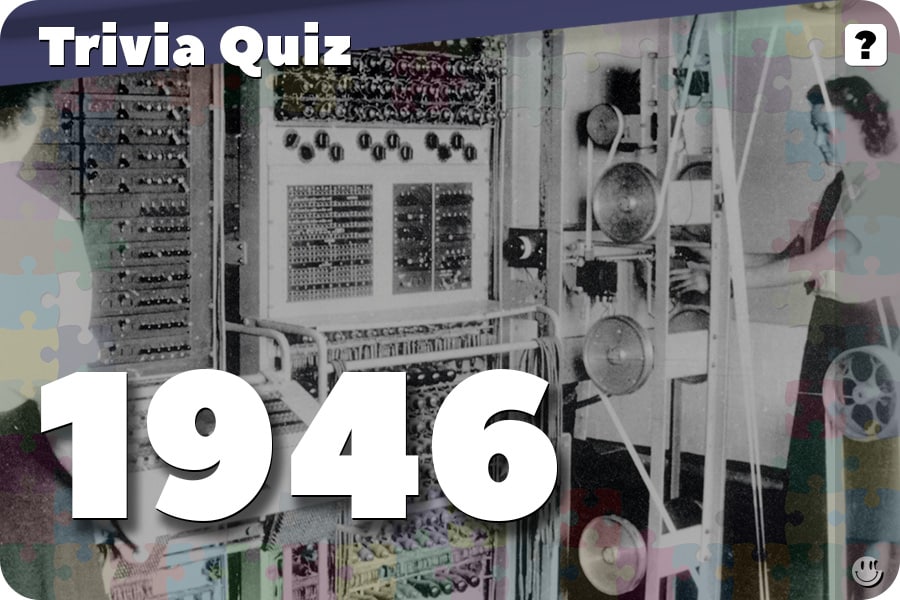
    7. Weighing 60,0000 pounds, what was the computer’s name unveiled at the University of Pennsylvania in February 1946?

    8. Who were the 1946 NFL Champions?

    9. This space project bounced radar waves off the Moon, proving that communication between Earth and outer space is possible. Name that US government project.

    10. Who was the Pope in 1946?

    The Answers:

    46 Trivia Answers for 1946 History

    1. What was the Biggest Number One Song of 1946?
    The Gypsy by The Ink Spots

    2. At Club 500 in Atlantic City, New Jersey, this comedy duo performed their first show as a comedy team. Name them.
    Dean Martin and Jerry Lewis

    3. This woman was the first American saint to be canonized. Name that American Saint.
    Mother Cabrini (Mother Frances Xavier Cabrini)

    4. What was the Bestselling Fiction Book in 1946?
    The King’s General by Daphne du Maurier

    5. In 1946, what was the average life expectancy in the United States?
    Men – 64.4 years, Women – 69.4 years.

    6. What was the highest-grossing film of 1946?
    The Best Years of Our Lives

    7. This club, exclusive to very smart people, opened on October 1, 1946. Name that club.
    Mensa

    8. Starring Bing Crosby, Bob Hope, Dorothy Lamour, with Alaska as the destination, name the Fourth “Road To…” film.
    Road to Utopia

    9. Who was the President of the United States in 1946?
    Harry S. Truman (April 12, 1945 – January 20, 1953)

    10. Who was the American Vice-President in 1946?
    The office of vice president was vacant from April 12, 1945 – January 20, 1949

    11. Who won the Stanley Cup in 1946?
    In 1946, The Montreal Canadiens won over the Boston Bruins (4 games to 1)

    12. The “2-way wrist radio” was introduced in what popular comic strip?
    Dick Tracy

    13. How much did a Loaf of Bread cost in 1946?
    10 cents

    14. How many people lived in the United States in 1946?
    The population was an estimated 141,388,566 people.

    15. This television network rivaled NBC and CBS when it started broadcasting, but they ended up operating in 1956. Name that almost-forgotten TV network.
    The DuMont Television Network

    16. Now called ‘Holiday World’ in a town called Santa Clause in Indiana, this was America’s First Theme Park. (Not just amusement park). What was it called when it opened in 1946?
    Santa Claus Land

    17. Which celebrity was NOT born in 1946: Diane Keaton, Naomi Judd, Joy Behar, Dolly Parton, or Susan Lucci?
    Joy Behar (born October 7, 1942)

    18. In September 1946, this film festival debuted in France.
    The Cannes Film Festival

    19. This NHL player started his career in 1946 and played into 1980, with 1,767 games. Name that National Hockey League legend.
    Gordie Howe

    20. In 1946, who first mentioned the “Iron Curtain” at Westminster College in Fulton, Missouri?
    Winston Churchill

    21. This 1946 Disney film, a mix of live-action and animation, won an Academy Award for Best Song. Name that film.
    Song of the South (Song: Zip-a-Dee-Doo-Dah)

    22. The name of this vehicle means ‘wasp’ in Italian. What is the vehicle?
    Vespa (scooter).

    23. UNICEF was founded in 1946. What is the full name of the organization?
    United Nations Children’s Emergency Fund

    24. This secret US Government program brought more than 1,600 German scientists, engineers, and technicians from Germany to the United States. Name that secret program.
    Project Paperclip

    25. Who won the US Triple Crown of Thoroughbred Racing in 1946?
    Assault

    26. This future rock star was born as Farrokh Bulsara in Stone Town, Zanzibar. Name that rock star.
    Freddie Mercury (September 5, 1946 – November 24, 1991)

    27. A young actress decided to use a stage name, Marilyn Monroe, instead of her given name. What was this actress’s real name?
    Norma Jean Baker

    28. In this area, the United Kingdom granted what we now call Jordan its independence. What was it called then?
    Transjordan

    29. Who won the 1946 World Series?
    In 1946, The St. Louis Cardinals won, beating the Boston Red Sox (4 games to 3)

    30. Eventually selling over 50 million copies, what was the name of the book about raising small children by pediatrician Benjamin Spock?
    The Common Sense Book of Baby and Child Care

    31. The Nat King Cole Trio recorded a song about a road for the first time, making that road one of the most famous in America. Name that road.
    (Get Your Kicks On) Route 66

    32. Who was the Time Magazine Man of the Year in 1946?
    James F. Byrnes

    33. This South Pacific area, part of the Marshall Islands, became a testing area for American atomic bombs…
    Bikini Atoll

    34. Marguerite Perey discovered Actinium K, also known as ‘francium’; what is francium’s Atomic Number?
    87

    35. This flight demonstration team was formed by the US Navy in 1946. Name that squadron.
    The Blue Angels

    36. This very large professional wrestler was born on May 19, 1946, in Grenoble, France.
    Andre the Giant (died on January 27, 1993))

    37. This musical, starring Ethel Merman, premiered on Broadway at the Imperial Theatre
    Annie Get Your Gun

    38. Originally founded to help support people affected by World War II, this organization still offers aid packages to those in need. Name that organization.
    CARE (Cooperative for Assistance and Relief Everywhere, originally the Cooperative for American Remittances to Europe)

    39. How much did a gallon of gas cost in 1946?
    $0.21 per gallon

    40. This American fast food company started as ‘Dwarf Grill’ in 1946, changed its name to ‘Dwarf House’, and changed its name again in 1967. What is that company?
    Chick-fil-A

    41. Tokyo Telecommunications Engineering was founded in 1942 with about 20 employees. What is the name of that company today?
    SONY

    42. what was the average movie theater ticket price in 1946 to the nearest dime?
    40 cents

    43. The Roosevelt dime was released in 1946. What was the dime used from 1916 through 1945?
    The Mercury Dime

    44. Although seldom seen today, this product was first produced in 1946 and was a major part of the plot in the 1983 film Trading Places.
    Frozen concentrated orange juice

    45. Directed by Howard Hughes, this film made Jane Russell a Hollywood sex symbol.
    The Outlaw

    46. This film, starring James Stewart, Donna Reed, and Lionel Barrymore, opened in December 1946.
    It’s a Wonderful Life

    Trivia Team Bonus Questions:

    1. Who directed It’s a Wonderful Life?
    Frank Capra

    2. What Horse won the Kentucky Derby in 1946?
    Assault

    3. This early film noir based on the 1934 novel of the same name by James M. Cain features Lana Turner and John Garfield. Name
    The Postman Always Rings Twice

    4. Although the United Nations eventually settled in New York City, what was their  American first choice town?
    Greenwich, Connecticut

    5. What was the name of American foreign policy’s primary purpose to contain Soviet geopolitical expansion during the Cold War?
    The Truman Doctrine

    6. What was the first official Formula One Race?
    1946 Turin Grand Prix

    7. Weighing 60,0000 pounds, what was the computer’s name unveiled at the University of Pennsylvania in February 1946?
    ENIAC (Electronic Numerical Integrator and Computer)

    8. Who were the 1946 NFL Champions?
    Chicago Bears

    9. This space project bounced radar waves off the Moon, proving that communication between Earth and outer space is possible. Name that US government project.
    Project Diana. Some say that it started The Space Age.

    10. Who was the Pope in 1946?
    Pope Pius XII, March 2, 1939 – October 9, 1958


  • Pop Culture Trivia Quiz: What Happened In 1940?

    Pop Culture Trivia Quiz: What Happened In 1940?

    Pop Culture Trivia Quiz: What Happened In 1940?

    40 Trivia Questions for 1940 History

    (answers)

    1. Who was the first African-American to win an Academy Award (Best Supporting Actress)

    2. This man hosted the 1940 Oscars and went on to host it 19 times. Who was he?

    3. What is the name of the 1940 American comedy-western film featuring Mae West and W.C. Fields

    4. What was the highest-grossing film of 1940

    5. How much did a Loaf of Bread cost in 1940?

    6. How much did a Gallon of Milk cost in 1940?

    7. What was the Bestselling Fiction Book in 1940

    8. What was the Biggest Number One Song of 1940?

    9. Who was the Republican Presidential Nominee in 1940?

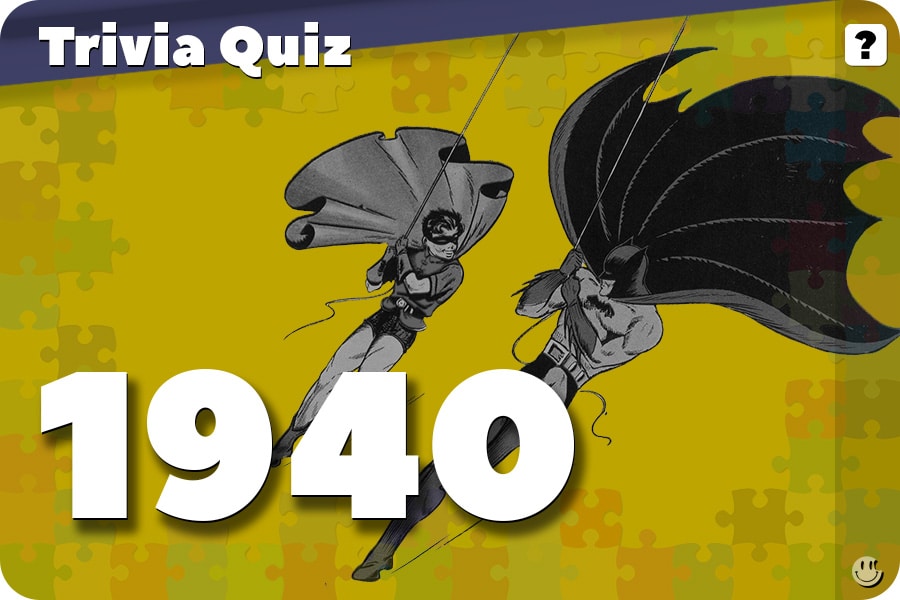
    10. This masked hero sidekick debuted in April 1940…

    11. This comic book villain debuted in the fourth issue of this Superhero comic book, and he has the same initials as her girlfriend. Name that villain.

    12. She made her American film debut in Down Argentine Way and was known for wearing hats made of fruit. Who was she?

    13. Which celebrity was NOT born in 1940: Julian Bond, Jack Nicklaus, Richard Pryor, Danny Trejo, or Al Pacino?

    14. Who won the Stanley Cup in 1940?

    15. Name the best-selling female fiction author of all time.

    16. Released in late 1939, what was Agatha Christie’s best-selling book

    17. How many people lived in the United States in 1940?

    18. How many people lived in the World in 1940?

    19. On May 10, 1940, Winston Churchill became the United Kingdom’s Prime Minister. Who held the position before Mr. Churchill?

    20. Who was the President of the United States in 1940?

    21. What comedy group filmed the first Hollywood parody of Adolf Hitler and the Nazis?
    The Three Stooges (in You Nazty Spy!)

    22. Nine months later, Charlie Chaplin also wrote, directed, and starred in his parody of Nazi Germany. Name that film

    23. This comic book character was seen punching Adolph Hitler in the face on the cover of his first issue before the United States entered World War 2

    24. Two brothers, Richard and Maurice, opened this fast food in San Bernadino, California, in 1940…

    25. What World War II event occurred between 26 May and 4 June 1940?

    26. What annual South Dakota Rally began in 1940?

    27. Bing Crosby, Bob Hope, and Dorothy Lamour starred in 7 “Road To…” films. Name the first one

    28. How much did a dozen eggs cost in 1940?

    29. In 1940, what was the average life expectancy in the United States?

    30. What is the United States’ first long-distance controlled-access highway?

    31. What cartoon duo made their debut in Puss Gets the Boot?

    32. The spring of 1940 introduced American women to this type of hosiery…

    33. This 1940 gameshow debuted on NBC radio but was periodically shown on television from 1950 through 1988..

    34. How much did a gallon of gas cost in 1940?

    35. Who was the Time Magazine Man of the Year in 1940?

    36. Who won the 1940 World Series?

    37. Now considered a classic, this Disney Film took a decade to become profitable.

    38. This 1940 Disney film won the Academy Awards for Best Original Song and Best Original Score…

    39. Who made Pinocchio a ‘real boy’?

    40. Before Bugs Bunny was officially named, this hat-wearing cohort was named first. Name that toon.

    Trivia Team Bonus Questions:

    1. What was Elmer Fudd’s prior nickname for several cartoons from 1937 through 1940?

    2. Who was the Pope in 1940?

    3. This cartoon bird debuted in 1940’s Knock Knock, but wasn’t named until 1941. Who is he?

    4. Who were the 1940 NFL Champions?

    5. In Lascaux, France, some 17,000-year-old evidence of human handiwork was found. What were they?

    6. Who was the American Vice-President in 1940?

    7. A time capsule at Oglethorpe University, Georgia, was sealed shut and projected to open in 8113 CE. What was it named?

    8. Who said, “I have nothing to offer you but blood, toil, tears, and sweat.”?

    9. What Horse won the Kentucky Derby in 1940?

    10. The cartoon duo Tom and Jerry debuted with other names; what were their original names?

    The Answers:

    40 Trivia Answers for 1940 History

    1. Who was the first African-American to win an Academy Award (Best Supporting Actress)
    Hattie McDaniel, for Gone With The Wind.

    2. This man hosted the 1940 Oscars and went on to host it 19 times. Who was he?
    Bob Hope

    3. What is the name of the 1940 American comedy-western film featuring Mae West and W.C. Fields?
    My Little Chickadee

    4. What was the highest-grossing film of 1940?
    Boom Town

    5. How much did a Loaf of Bread cost in 1940?
    8 cents

    6. How much did a Gallon of Milk cost in 1940?
    51 cents

    7. What was the Bestselling Fiction Book in 1940?
    How Green Was My Valley by Richard Llewellyn

    8. What was the Biggest Number One Song of 1940?
    (tie) Frenesi by Artie Shaw, OR In The Mood by Glenn Miller, OR I’ll Never Smile Again by Tommy Dorsey

    9. Who was the Republican Presidential Nominee in 1940?
    Wendell Willkie

    10. This masked hero sidekick debuted in April 1940…
    Robin the Boy Wonder, in Detective Comics #38.

    11. This comic book villain debuted in the fourth issue of this Superhero comic book, and he has the same initials as her girlfriend. Name that villain.
    Lex Luthor (1st appearance in Superman #4)

    12. She made her American film debut in Down Argentine Way and was known for wearing hats made of fruit. Who was she?
    Carmen Miranda (February 9, 1909 – August 5, 1955)

    13. Which celebrity was NOT born in 1940: Julian Bond, Jack Nicklaus, Richard Pryor, Danny Trejo, or Al Pacino?
    Danny Trejo (born May 16, 1944)

    14. Who won the Stanley Cup in 1940?
    In 1940, The New York Rangers won over the Toronto Maple Leafs (4 games to 2)

    15. Name the best-selling female fiction author of all time.
    Agatha Christie

    16. Released in late 1939, what was Agatha Christie’s best-selling book?
    And Then There Were None

    17. How many people lived in the United States in 1940?
    The population was an estimated 131,669,275 people.

    18. How many people lived in the World in 1940?
    The estimated world population in 1940 was 2,300,000,000 people.

    19. On May 10, 1940, Winston Churchill became the United Kingdom’s Prime Minister. Who held the position before Mr. Churchill?
    Neville Chamberlain

    20. Who was the President of the United States in 1940?
    Franklin D. Roosevelt (March 4, 1933 – April 12, 1945)

    21. What comedy group filmed the first Hollywood parody of Adolf Hitler and the Nazis?
    The Three Stooges (in You Nazty Spy!)

    22. Nine months later, Charlie Chaplin also wrote, directed and starred in his parody of Nazi Germany. Name that film.
    The Great Dictator

    23. This comic book character was seen punching Adolph Hitler in the face on the cover of his first issue before the United States entered World War 2.
    Captain America

    24. Two brothers, Richard and Maurice, opened this fast food in San Bernadino, California in 1940…
    McDonald’s. Ray Kroc bought it from them in 1955.

    25. What World War II event occurred between 26 May and 4 June 1940?
    The Dunkirk Evacuation (code-named Operation Dynamo, aka the Miracle of Dunkirk)

    26. What annual South Dakota Rally began in 1940?
    Sturgis Motorcycle Rally

    27. Bing Crosby, Bob Hope, and Dorothy Lamour starred in 7 “Road To…” films. Name the first one.
    Road to Singapore

    28. How much did a dozen eggs cost in 1940?
    33 cents

    29. In 1940, what was the average life expectancy in the United States?
    Men – 60.8 years, Women – 65.2 years.

    30. What is the United States’ first long-distance controlled-access highway?
    The Pennsylvania Turnpike

    31. What cartoon duo made their debut in Puss Gets the Boot?
    Tom & Jerry (although not officially named until 1941).

    32. The spring of 1940 introduced American women to this type of hosiery…
    Nylon stockings

    33. This 1940 gameshow debuted on NBC radio but was periodically shown on television from 1950 through 1988…
    Truth or Consequences

    34. How much did a gallon of gas cost in 1940?
    $0.18 per gallon

    35. Who was the Time Magazine Man of the Year in 1940?
    Winston Churchill

    36. Who won the 1940 World Series?
    In 1940, The Cincinnati Reds won, beating the Detroit Tigers (4 games to 3)

    37. Now considered a classic, this Disney Film took a decade to become profitable.
    Fantasia

    38. This 1940 Disney film won the Academy Awards for Best Original Song and Best Original Score…
    Pinocchio

    39. Who made Pinocchio a ‘real boy’?
    The Blue Fairy (aka Fairy with Turquoise Hair)

    40. Before Bugs Bunny was officially named, this hat-wearing cohort was named first. Name that toon.
    Elmer Fudd

    Trivia Team Bonus Questions:

    1. What was Elmer Fudd’s prior nickname for several cartoons from 1937 through 1940?
    Egghead

    2. Who was the Pope in 1940?
    Pope Pius XII, March 2, 1939 – October 9, 1958

    3. This cartoon bird debuted in 1940’s Knock Knock, but wasn’t named until 1941. Who is he?
    Woody Woodpecker

    4. Who were the 1940 NFL Champions?
    Chicago Bears

    5. In Lascaux, France, some 17,000-year-old evidence of human handiwork was found. What were they?
    The Lascaux cave paintings

    6. Who was the American Vice-President in 1940?
    John Garner (March 4, 1933 – January 20, 1941)

    7. A time capsule at Oglethorpe University, Georgia, was sealed shut and projected to open in 8113 CE. What was it named?
    The Crypt of Civilization

    8. Who said, “I have nothing to offer you but blood, toil, tears, and sweat.”?
    Winston Churchill

    9. What Horse won the Kentucky Derby in 1940?
    Gallahadion

    10. The cartoon duo Tom and Jerry debuted with other names; what were their original names?
    Jasper and Jinx


  • Pop Culture Trivia Quiz:  What Happened In 1942?

    Pop Culture Trivia Quiz: What Happened In 1942?

    Pop Culture Trivia Quiz: What Happened In 1942?

    42 Trivia Questions for 1942 History

    (answers)

    1. What was Muhammed Ali’s name when he was born in Louisville, Kentucky, on January 17, 1942?

    2. How many people lived in the United States in 1942?

    3. This 1942 film was based on an unproduced stage play, Everybody Comes to Rick’s. Name that film

    4. Who won the Stanley Cup in 1942?

    5. What was the Biggest Number One Song of 1942?

    6. What was the Biggest Song of 1942 that was NOT White Christmas?

    7. Over 1,400 AA shells are fired at an unidentified object, or objects, in the skies over Los Angeles overnight on February 25, 1942. It may have been nothing at all. What was this event (or non-event) called?

    8. Who was the President of the United States in 1942?

    9. What was the average movie theater ticket price in 1942 to the nearest dime?

    10. 1942 Catchphrase: Who said, “Here’s looking at you, kid”?

    11. What was the highest-grossing film of 1942

    12. The sports-drama film The Pride of the Yankees, starring Gary Cooper, was about what baseball legend?

    13. Born in 1942, this singer/songwriter co-wrote hits like Touch of Grey, Alabama Getaway, and Uncle John’s Band. Name that rock star.

    14. What was the Bestselling Fiction Book in 1942?

    15. How much did a Loaf of Bread cost in 1942?

    16. How much did a Gallon of Milk cost in 1942?

    17. The comic character Archie Andrews first appeared in Pep Comics, and he had a very old car (a jalopy). What type of car did Archie drive in 1942?

    18. This “Road to…” movie, starring Bing Crosby, Bob Hope, and Dorothy Lamour, involved going into the African continent. What is the name of this 1942 film?

    19. This hydroelectric power dam began operating in Washington state in 1942…

    20. In 1942, what was the average life expectancy in the United States?

    21. This 1942 film introduced the classic song White Christmas.

    22. Based on a 1923 book by Austrian author and hunter Felix Salten, the adaptation was a big hit for Disney Studios. Name that film.

    23. After an Allied victory, who said, “Now this is not the end. It is not even the beginning of the end. But it is, perhaps, the end of the beginning.”?

    24. The Little Golden Books book series includes the best-selling hardcover book for children of all time, with over 15 million copies sold. Name that children’s book.

    25. Launched in Philadelphia, this was the only US battleship that provided gunfire support during the Vietnam War.

    26. Founded in 1942, what was the women’s branch of the United States Navy Reserve better known as? It is an acronym.

    27. How old was movie star Clark Gable, who entered an Army recruiting station in Los Angeles and enlisted as a private?

    28. How much did a gallon of gas cost in 1942?

    29. This comic book villain was once an upstanding District Attorney, Harvey Dent. He became an enemy of Batman in Detective Comics number 66. Who is this coin-flipping bad guy?

    30. Although later a long-running comic strip by Walt Kelly, this character debuted in Animal Comics issue #1

    31. Who won the 1942 World Series?

    32. Yankee Doodle Dandy is an American biographical musical film about who? He is known as “The Man Who Owned Broadway”

    33. Born in 1942, this Rolling Stone member was also a member of the ’27 Club’ – who was he?

    34. We knew him as Mighty Mouse when he was there to save the day in 1944. But what was his name when he first appeared in 1942’s Mouse of Tomorrow?

    35. On her 13th birthday, June 12, 1942. This young woman began writing in her diary. Who was she?

    36. The German A-4 rocket was better known as what?

    37. Who was the Time Magazine Man of the Year in 1942?

    38. Which celebrity was NOT born in 1942: Peter Tork, Aretha Franklin, Roger Daltrey, Leon Russel, or Stephen Hawking?

    39. How much did a dozen eggs cost in 1942?

    40. What was the name of the research and development undertaken during World War II that produced the first nuclear weapons for the United States?

    41. This Hollywood star was granted a US patent (#2,292,387) for a frequency-hopping system for radio-controlled torpedoes. It’s also the basis for Wi-Fi. Name that actress.

    42. This American broadcast has been going on since 1942. Some people consider it American propaganda. What is it?

    Trivia Team Bonus Questions:

    1. In what language was the first Voice of America broadcast?

    2. What was the magazine’s name produced exclusively for members serving in the US military through World War II?

    3. What Horse won the Kentucky Derby in 1942?

    4. This author wrote a book released in 1942 about a series of letters to a nephew named Wormwood. Name the author and book.

    5. In Boston, Massachusettes, this was the deadliest nightclub fire in history, claiming a total of 492 lives. What was the name of that fire?

    6. Who was the Pope in 1942?

    7. The United States Coast Guard Women’s Reserve is known as the SPARS. S.P.A.R.S. What does that acronym stand for?

    8. This Hollywood star died in a plane crash while returning from a war bond tour. She was Clark Gable’s wife. Who was she?

    9. Who was the American Vice-President in 1942?

    10. Who were the 1942 NFL Champions?

    The Answers:

    42 Trivia Answers for 1942 History

    1. What was Muhammed Ali’s name when he was born in Louisville, Kentucky, on January 17, 1942?
    Cassius Clay (Cassius Marcellus Clay Jr., died June 3, 2016)

    2. How many people lived in the United States in 1942?
    The population was an estimated 134,859,553 people.

    3. This 1942 film was based on an unproduced stage play, Everybody Comes to Rick’s. Name that film.
    Casablanca

    4. Who won the Stanley Cup in 1942?
    In 1942, The Toronto Maple Leafs won over the Detroit Red Wings (4 games to 3)

    5. What was the Biggest Number One Song of 1942?
    White Christmas by Bing Crosby

    6. What was the Biggest Song of 1942 that was NOT White Christmas?
    Moonlight Cocktail by Glenn Miller

    7. Over 1,400 AA shells are fired at an unidentified object, or objects, in the skies over Los Angeles overnight on February 25, 1942. It may have been nothing at all. What was this event (or non-event) called?
    The Battle of Los Angeles.

    8. Who was the President of the United States in 1942?
    Franklin D. Roosevelt (March 4, 1933 – April 12, 1945)

    9. What was the average movie theater ticket price in 1942 to the nearest dime?
    30 cents

    10. 1942 Catchphrase: Who said, “Here’s looking at you, kid”?
    Rick Blaine on Casablanca

    11. What was the highest-grossing film of 1942?
    Mrs. Miniver

    12. The sports-drama film The Pride of the Yankees, starring Gary Cooper, was about what baseball legend?
    Lou Gehrig

    13. Born in 1942, this singer/songwriter co-wrote hits like Touch of Grey, Alabama Getaway, and Uncle John’s Band. Name that rock star.
    Jerry Garcia (August 1, 1942 – August 9, 1995)

    14. What was the Bestselling Fiction Book in 1942?
    The Song of Bernadette by Franz Werfel

    15. How much did a Loaf of Bread cost in 1942?
    8 cents

    16. How much did a Gallon of Milk cost in 1942?
    60 cents

    17. The comic character Archie Andrews first appeared in Pep Comics, and he had a very old car (a jalopy). What type of car did Archie drive in 1942?
    He owned a 1916 Ford Model T jalopy called “Betsy.” Some later comics said it was a Ford Model A.

    18. This “Road to…” movie, starring Bing Crosby, Bob Hope, and Dorothy Lamour, involved going into the African continent. What is the name of this 1942 film?
    Road to Morocco

    19. This hydroelectric power dam began operating in Washington state in 1942…
    The Grand Coulee Dam

    20. In 1942, what was the average life expectancy in the United States?
    Men – 64.7 years, Women – 67.9 years.

    21. This 1942 film introduced the classic song White Christmas.
    Holiday Inn, starring Bing Crosby and Fred Astaire.

    22. Based on a 1923 book by Austrian author and hunter Felix Salten, the adaptation was a big hit for Disney Studios. Name that film.
    Bambi

    23. After an Allied victory, who said, “Now this is not the end. It is not even the beginning of the end. But it is, perhaps, the end of the beginning.”?
    Winston Churchill

    24. The Little Golden Books book series includes the best-selling hardcover book for children of all time, with over 15 million copies sold. Name that children’s book.
    The Poky Little Puppy, written by Janette Sebring Lowrey and illustrated by Gustaf Tenggren.

    25. Launched in Philadelphia, this was the only US battleship that provided gunfire support during the Vietnam War.
    The USS New Jersey (BB-62)

    26. Founded in 1942, what was the women’s branch of the United States Navy Reserve better known as? It is an acronym.
    WAVES (Women Accepted for Volunteer Emergency Service)

    27. How old was movie star Clark Gable, who entered an Army recruiting station in Los Angeles and enlisted as a private?
    41 years old. During World War II, he spent two years as an aerial cameraman and bomber gunner in Europe.

    28. How much did a gallon of gas cost in 1942?
    $0.20 per gallon

    29. This comic book villain was once an upstanding District Attorney, Harvey Dent. He became an enemy of Batman in Detective Comics number 66. Who is this coin-flipping bad guy?
    Two-Face

    30. Although later a long-running comic strip by Walt Kelly, this character debuted in Animal Comics issue #1
    Pogo the Possum

    31. Who won the 1942 World Series?
    In 1942, The St. Louis Cardinals won, beating the New York Yankees (4 games to 1)

    32. Yankee Doodle Dandy is an American biographical musical film about who? He is known as “The Man Who Owned Broadway”
    George M. Cohen

    33. Born in 1942, this Rolling Stone member was also a member of the ’27 Club’ – who was he?
    Brian Jones ( February 28, 1942 – July 3, 1969). The 27 Club is any celebrity who died at the age of 27.

    34. We knew him as Mighty Mouse when he was there to save the day in 1944. But what was his name when he first appeared in 1942’s Mouse of Tomorrow?
    Super Mouse

    35. On her 13th birthday, June 12, 1942. This young woman began writing in her diary. Who was she?
    Anne Frank

    36. The German A-4 rocket was better known as what?
    The V-2

    37. Who was the Time Magazine Man of the Year in 1942?
    Joseph Stalin

    38. Which celebrity was NOT born in 1942: Peter Tork, Aretha Franklin, Roger Daltrey, Leon Russel, or Stephen Hawking?
    Roger Daltrey (born March 1, 1944)

    39. How much did a dozen eggs cost in 1942?
    48 cents

    40. What was the name of the research and development undertaken during World War II that produced the first nuclear weapons for the United States?
    The Manhattan Project

    41. This Hollywood star was granted a US patent (#2,292,387) for a frequency-hopping system for radio-controlled torpedoes. It’s also the basis for Wi-Fi. Name that actress.
    Hedy Lamarr

    42. This American broadcast has been going on since 1942. Some people consider it American propaganda. What is it?
    Voice of America (VOA)

    Trivia Team Bonus Questions:

    1. In what language was the first Voice of America broadcast?
    German

    2. What was the magazine’s name produced exclusively for members serving in the US military through World War II?
    Yank, the Army Weekly

    3. What Horse won the Kentucky Derby in 1942?
    Shut Out

    4. This author wrote a book released in 1942 about a series of letters to a nephew named Wormwood. Name the author and book.
    The Screwtape Letters by C.S. Lewis

    5. In Boston, Massachusettes, this was the deadliest nightclub fire in history, claiming a total of 492 lives. What was the name of that fire?
    The Cocoanut Grove Fire

    6. Who was the Pope in 1942?
    Pope Pius XII, March 2, 1939 – October 9, 1958

    7. The United States Coast Guard Women’s Reserve is known as the SPARS. S.P.A.R.S. What does that acronym stand for?
    “Semper Paratus, Always Ready!”

    8. This Hollywood star died in a plane crash while returning from a war bond tour. She was Clark Gable’s wife. Who was she?
    Carol Lombard (October 6, 1908 – January 16, 1942)

    9. Who was the American Vice-President in 1942?
    Henry A. Wallace (January 20, 1941 – January 20, 1945)

    10. Who were the 1942 NFL Champions?
    Washington Redskins

     
  • Pop Culture Trivia Quiz: What Happened In 1941?

    Pop Culture Trivia Quiz: What Happened In 1941?

    Pop Culture Trivia Quiz: What Happened In 1941?

    41 Trivia Questions for 1941 History

    (answers)

    1. Who was the President of the United States in 1941?

    2. What was the Biggest Number One Song of 1941?

    3. To the nearest dime, what was the average movie theater ticket price in 1941?

    4. On July 1, 1941, what two television networks began broadcasting in New York City?

    5. What was the date that US President Franklin Roosevelt said, “which will live in infamy the United States of America was suddenly and deliberately attacked by naval and air forces of the Empire of Japan.”

    6. What did Germany and Italy do on December 11, 1941?

    7. Was this quasi-biographical film based on real-life newspapermen William Randolph Hearst and Joseph Pulitzer? Name this film.

    8. How much did a Gallon of Milk cost in 1941?

    9. How much did a Loaf of Bread cost in 1941?

    10. How many people lived in the United States in 1941?

    11. What was the highest-grossing film of 1941?

    12. What practice did the 13th Academy Awards start after a fiasco the prior year with the Los Angeles Times newspaper?

    13. Who won the Stanley Cup in 1941?

    14. In 1941, what was the average life expectancy in the United States?

    15. Who was the subject of a popular World War 2 pinup featuring the actress wearing a nightgown?

    16. True or False? Joseph Stalin decreed that every Soviet soldier should receive 100 grams (about 3.5 ounces) of vodka daily.

    17. What was the Bestselling Fiction Book in 1941

    18. What was the title of the second “Road To…” film, starring Bing Crosby, Bob Hope, and Dorothy Lamour?

    19. Amyotrophic lateral sclerosis (ALS) is also referred to as an MLB legend’s disease. Name that New York Yankee.

    20. Who won the 1941 World Series?

    21. Red Sox MLB player Ted Williams set an all-time baseball batting record on the last day of the 1941 season. What record did he set?

    22. What were the four freedoms mentioned in Franklin Roosevelt’s Four Freedoms speech?

    23. The first American television station outside New York aired in Philadelphia, Pennsylvania. Name that station.

    24. Who won the US Triple Crown of Thoroughbred Racing in 1941?

    25. Throughout 1941 and 1945, the United States built over 2,700 of this class of cargo ship. Name that class of ships.

    26. Who was the Time Magazine Man of the Year in 1941?

    27. What was the name of Franklin D. Roosevelt’s presidential yacht from 1936 until he died in 1945?

    28. Which celebrity was NOT born in 1941: Judy Blume, Joan Baez, David Ruffin, or Neil Diamond?

    29. This baseball player is the all-time MLB player with the most hits, games played, and at-bats. Born in 1941, who is he?

    30. What was Pete Rose’s nickname?

    31. A New York Yankee, Joe DiMaggio, began a record-breaking streak on May 15, 1941, that continued until July 16th. What record does he hold for that period?

    32. This group began entertaining the United States Armed Services on February 4, 1941. What is its name?

    33. This superhero, first appearing in Police Comics #1, was among the first to be a wise-cracking super-crimefighter.

    34. How much did a gallon of gas cost in 1941?

    35. This radio program started in Helena, Arkansas, and is the longest-running daily American radio broadcast in history. What is it?

    36. What Marx Brothers film featured Grouch Marx as Wolf J. Flywheel?

    37. How much did a dozen eggs cost in 1941?

    38. Plutonium was chemically identified in 1941. What is plutonium’s Atomic Number?

    39. What Andrews Sisters hit was revived by Bette Midler in 1973?

    40. Based on Dashiell Hammett’s 1930 book, this 1941 film noir starred Humphrey Bogart and Mary Aster.

    41. What 1941 film was remade as Heaven Can Wait in 1978, starring Warren Beatty, Buck Henry, and Julie Christie?

    Trivia Team Bonus Questions:

    1. What was Virginia Woolf’s final novel, published shortly after her death?

    2. This comic book publisher’s first issue was an adaptation of The Three Musketeers, and they published more stories through 1969. Name that long-running comic book company.

    3. Who was the American Vice-President in 1941?

    4. Who were the 1941 NFL Champions?

    5. Six-year-old Elaine Esposito began a world medical record on August 6, 1941. What record did she hold?

    6. What is the National Hockey League record for shots on goal in a single game?

    7. Cheerios was released by General Mills by another name in 1941. What were they called?

    8. What was the name of the Cartoon where Bugs Bunny was first named?

    9. Who was the Pope in 1941?

    10. On January 13, 1941, All persons born in what nearby American territory were declared U.S. citizens by birth, through U.S. federal law?

    The Answers:

    41 Trivia Answers for 1941 History

    1. Who was the President of the United States in 1941?
    Franklin D. Roosevelt (March 4, 1933 – April 12, 1945)

    2. What was the Biggest Number One Song of 1941?
    Amapola (Pretty Little Poppy) by Jimmy Dorsey

    3. To the nearest dime, what was the average movie theater ticket price in 1941?
    30 cents

    4. On July 1, 1941, what two television networks began broadcasting in New York City?
    CBS and NBC.

    5. What was the date that US President Franklin Roosevelt said, “which will live in infamy the United States of America was suddenly and deliberately attacked by naval and air forces of the Empire of Japan.”
    December 7, 1941

    6. What did Germany and Italy do on December 11, 1941?
    They both declared war on The United States.

    7. Was this quasi-biographical film based on real-life newspapermen William Randolph Hearst and Joseph Pulitzer? Name this film.
    Citizen Kane

    8. How much did a Gallon of Milk cost in 1941?
    54 cents

    9. How much did a Loaf of Bread cost in 1941?
    8 cents

    10. How many people lived in the United States in 1941?
    The population was an estimated 133,402,471 people.

    11. What was the highest-grossing film of 1941?
    Sergeant York

    12. What practice did the 13th Academy Awards start after a fiasco the prior year with the Los Angeles Times newspaper?
    They placed the winners’ names in envelopes. In 1940, the L.A. Times published a list of winners before they were announced.

    13. Who won the Stanley Cup in 1941?
    In 1941, The Boston Bruins won over the Detroit Red Wings (4 games to 0)

    14. In 1941, what was the average life expectancy in the United States?
    Men – 63.1 years, Women – 66.8 years.

    15. Who was the subject of a popular World War 2 pinup featuring the actress wearing a nightgown?
    Rita Hayworth

    16. True or False? Joseph Stalin decreed that every Soviet soldier should receive 100 grams (about 3.5 ounces) of vodka per day.
    True

    17. What was the Bestselling Fiction Book in 1941?
    The Keys of the Kingdom by A.J. Cronin

    18. What was the title of the second “Road To…” film, starring Bing Crosby, Bob Hope, and Dorothy Lamour?
    Road to Zanzibar

    19. Amyotrophic lateral sclerosis (ALS) is also referred to as an MLB legend’s disease. Name that New York Yankee.
    Lou Gehrig’s disease (June 19, 1903 – June 2, 1941)

    20. Who won the 1941 World Series?
    In 1941, The New York Yankees won, beating the Brooklyn Dodgers (4 games to 1)

    21. Red Sox MLB player Ted Williams set an all-time baseball batting record o the last day of the 1941 season. What record did he set?
    He the season with a batting average of .4057 (rounded up to 406)

    22. What were the four freedoms mentioned in Franklin Roosevelt’s Four Freedoms speech?
    Freedom of speech, freedom of worship, freedom from want and freedom from fear.

    23. The first American television station outside New York aired in Philadelphia, Pennsylvania. Name that station.
    KYW-TV (WPTZ at the time, an NBC affiliate)

    24. Who won the US Triple Crown of Thoroughbred Racing in 1941?
    Whirlaway

    25. Throughout 1941 and 1945, the United States built over 2,700 of this class of cargo ship. Name that class of ships.
    Liberty Ships

    26. Who was the Time Magazine Man of the Year in 1941?
    Franklin D. Roosevelt

    27. What was the name of Franklin D. Roosevelt’s presidential yacht from 1936 until he died in 1945?
    USS Potomac (AG-25)

    28. Which celebrity was NOT born in 1941: Judy Blume, Joan Baez, David Ruffin, or Neil Diamond?
    Judy Blume (born February 12, 1938)

    29. This baseball player is the all-time MLB player with the most hits, games played, and at-bats. Born in 1941, who is he?
    Pete Rose (born April 14, 1941)

    30. What was Pete Rose’s nickname?
    Charlie Hustle

    31. A New York Yankee, Joe DiMaggio, began a record-breaking streak on May 15, 1941, that continued until July 16th. What record does he hold for that period?
    A 56-game hitting streak. (the record still stands)

    32. This group began entertaining the United States Armed Services on February 4, 1941. What is its name?
    USO (United Service Organizations)

    33. This superhero, first appearing in Police Comics #1, was among the first to be a wise-cracking super-crimefighter.
    Plastic Man

    34. How much did a gallon of gas cost in 1941?
    $0.19 per gallon

    35. This radio program started in Helena, Arkansas, and is the longest-running daily American radio broadcast in history. What is it?
    King Biscuit Time, a blues radio show

    36. What Marx Brothers film featured Grouch Marx as Wolf J. Flywheel?
    The Big Store

    37. How much did a dozen eggs cost in 1941?
    40 cents

    38. Plutonium was chemically identified in 1941. What is plutonium’s Atomic Number?
    Plutonium’s atomic number is 94.

    39. What Andrews Sisters hit was revived by Bette Midler in 1973?
    Boogie Woogie Bugle Boy

    40. Based on Dashiell Hammett’s 1930 book, this 1941 film noir starred Humphrey Bogart and Mary Aster.
    The Maltese Falcon

    41. What 1941 film was remade as Heaven Can Wait in 1978, starring Warren Beatty, Buck Henry, and Julie Christie?
    Her Comes Mr. Jordan

    Trivia Team Bonus Questions:

    1. What was Virginia Woolf’s final novel, published shortly after her death?
    Between the Acts

    2. This comic book publisher’s first issue was an adaptation of The Three Musketeers, and they published more stories through 1969. Name that long-running comic book company.
    Classic Comics

    3. Who was the American Vice-President in 1941?
    John Garner (March 4, 1933 – January 20, 1941) and Henry A. Wallace (January 20, 1941 – January 20, 1945)

    4. Who were the 1941 NFL Champions?
    Chicago Bears

    5. Six-year-old Elaine Esposito began a world medical record on August 6, 1941. What record did she hold?
    The longest person in a coma – 37 years. She was anesthetized for an appendectomy and never woke up; she died in 1978.

    6. What is the National Hockey League record for shots on goal in a single game?
    The Boston Bruins took 83 shots on goal during a 3-2 win over the Chicago Black Hawks on March 4, 1941.
    This led to another NHL record in that game – Black Hawk goaltender Sam LoPresti had 80 saves.

    7. Cheerios was released by General Mills by another name in 1941. What were they called?
    CheeriOats. They were renamed Cheerios in 1945.

    8. What was the name of the Cartoon where Bugs Bunny was first named?
    Elmer’s Pet Rabbit

    9. Who was the Pope in 1941?
    Pope Pius XII, March 2, 1939 – October 9, 1958

    10. On January 13, 1941, All persons born in what nearby American territory were declared U.S. citizens by birth, through U.S. federal law?
    Puerto Rico


  • Pop Culture Trivia Quiz: What Happened In 1943?

    Pop Culture Trivia Quiz: What Happened In 1943?

    Pop Culture Trivia Quiz: What Happened In 1943?

    43 Trivia Questions for 1943 History

    (answers)

    1. This was the first major crossover release starring two monster characters from established films. Name the characters or film.
    Frankenstein Meets the Wolfman

    2. During World War II, the National Football League merged the Philadelphia Eagles and the Pittsburgh Steelers into a single franchise. What was the name of that football team?
    The Steagles (also Phil-Pitt)

    3. This Broadway show opened on March 31, 1943, and ran through 1948—it became the longest-running musical play at that time. Name that show.
    Oklahoma!

    4. In 1943, what was the average life expectancy in the United States?
    Men – 62.4 years, Women – 64.4 years.

    5. Who was the President of the United States in 1943?
    Franklin D. Roosevelt (March 4, 1933 – April 12, 1945)

    6. This company was founded in 1943 by a 17-year-old Swedish carpenter named Ingvar Kamprad. Name his company.
    IKEA

    7. She was a song in 1942 and became a poster in 1943. Who was she?
    Rosie the Riveter.

    8. what was the average movie theater ticket price in 1943 to the nearest dime?
    30 cents

    9. NBC had two radio networks: the Blue Network and the Red Network. The Red Network was sold and became what radio, and later television, network?
    ABC (American Broadcasting Company)

    10. Born in 1943, this author wrote the second-best-selling book series, After Harry Potter. Name the author and his book series.
    Goosebumps by R.L. Stine

    11. What was the Bestselling Fiction Book in 1943?
    The Robe by Lloyd C. Douglas

    12. Lassie’s first movie was released in October of 1943. What was it called?
    Lassie Come Home

    13. What was the Biggest Number One Song of 1943?
    I’ve Heard That Song Before by Harry James

    14. What was the highest-grossing film of 1943?
    This is the Army

    15. How many people lived in the United States in 1943?
    The population was an estimated 136,739,353 people.

    16. Name the Italian leader arrested on July 25, 1943…
    Benito Mussolini

    17. The third Dracula film was released through Universal Pictures and starred Lon Chaney Jr as Count Alucard. Name that horror sequel
    Son of Dracula

    18. Mexican-American youths and some members of the American military have a bit of a tussle in early June in East Los Angeles. What was that fight called?
    The Zoot Suit Riots

    19. Introduced in 1943, Kryptonite can injure Superman. Was it first introduced in his comic books, cartoons, or radio show?
    The Adventures of Superman radio show. It gave a reason for him not to appear while his actor took a vacation.

    20. Who won the Stanley Cup in 1943?
    In 1943, The Detroit Red Wings won over the Boston Bruins (4 games to 0)

    21. Who won the US Triple Crown of Thoroughbred Racing in 1943?
    Count Fleet

    22. Ignacio Anaya created this snack in Mexico, near the Texas border.
    Nachos

    23. This metal toy was introduced at a Gimbels department store and inducted into the Toy Hall of Fame in 2000. Later, it had its own commercial jingle.
    The Slinky

    24. This US Navy mystery involved the USS Eldridge, the Philadelphia Navy Shipyard, invisibility, and teleportation. Although probably a hoax, what is the name of the incident?
    The Philadelphia Experiment

    25. What is the all-time best-selling book originally written in French?
    The Little Prince (by Antoine de Saint-Exupéry)

    26. How much did a gallon of gas cost in 1943?
    $0.21 per gallon

    27. This caped comic book hero appeared in both newspaper comic strips and a 15-part movie serial in 1943. Name that crimefighter.
    Batman (and Robin)

    28. It’s one of America’s most collectible coins and less than a few dozen were produced in 1943. Name that coin.
    1943 Copper Penny (Most were made of steel)

    29. Featuring Howard Roark, his 1943 novel by Ayn Rand was her first bestseller.
    The Fountainhead

    30. This building was built in Washington, DC, between 1939 and 1943 in honor of an American president. Name that building.
    Jefferson Memorial

    31. Along with Emile Gagnan, who invented the Aqua-lung?
    Jacques Cousteau

    32. How much did a dozen eggs cost in 1943?
    57 cents

    33. Named after a trombone-like instrument, this was designed as an anti-tank weapon. Name that weapon.
    Bazooka

    34. Which celebrity was NOT born in 1943: John Denver, Keith Richards, Jim Morrison, Marvin Gaye Toni Basil?
    Marvin Gaye (April 2, 1939 – April 1, 1984)

    35. Who was the Time Magazine Man of the Year in 1943?
    George Marshall

    36. In the Warner Brothers cartoon Falling Hare, it didn’t happen very often, but who gets the best of Bugs Bunny?
    A Gremlin.

    37. Who was NOT at the WWII: Casablanca Conference: Winston Churchill, Joseph Stalin, Charles de Gaulle, or Franklin D. Roosevelt?
    Joseph Stalin (he was focused on the Battle of Stalingrad)

    38. What is the world’s largest office building?
    The Pentagon (completed in 1943)

    39. After this scientist died on January 7, 1943, the Federal Bureau of Investigation took all of his notes. Name that scientist.
    Nikola Tesla (July 10, 1856 – January 7, 1943)

    40. The city of Spearfish had a temperature fluctuation one morning of 49 degrees, from minus 4 to 45 degrees on January 22, 1943, within 2 minutes! In what state is Spearfish located? Hint: Rapid City had a similar rise that same day.
    South Dakota

    41. Who won the 1943 World Series?
    In 1943, The New York Yankees won, beating the St. Louis Cardinals (4 games to 1)

    42. What was the boat’s name under the command of future President John F. Kennedy’s boat?
    PT-109

    43. Born in 1943, this man co-founded Atari and Chuck-E-Cheese. Name him.
    Nolan Bushnell

    Trivia Team Bonus Questions:

    1. Minister George Fox and Clark Poling, Roman Catholic priest John Washington, and Rabbi Alexander Goode all gave up their life jackets for servicemen and died at sea. What is the nickname for these men?
    The Four Chaplains

    2. What was the codename for World War II’s Battle of Normandy?
    Operation Overlord.

    3. Who were the 1943 NFL Champions?
    Chicago Bears

    4. In 1943, Mexican farmer Dionisio Pulido noticed a bump in his yard, which grew to 400 feet tall within a week. What was that bump in his yard?
    A Volcano.

    5. Who was the American Vice-President in 1943?
    Henry A. Wallace (January 20, 1941 – January 20, 1945)

    6. What government agency worked with Hollywood in censoring and propaganda during World War II?
    (United States) Office of War Information

    7. Name the star, an actor and singer, whose 20-room Hollywood mansion was destroyed by a fire while his family was taking down the Christmas tree.Bing Crosby

    8. Who was the Pope in 1943?
    Pope Pius XII, March 2, 1939 – October 9, 1958

    9. Born this year, this actress was killed by the “Manson family” in 1969. Name that actress.
    Sharon Tate

    10. What Horse won the Kentucky Derby in 1943?
    Count Fleet

    The Answers:

    43 Trivia Answers for 1943 History

    1. This was the first major crossover release starring two monster characters from established films. Name the characters or film.
    Frankenstein Meets the Wolfman

    2. During World War II, the National Football League merged the Philadelphia Eagles and the Pittsburgh Steelers into a single franchise. What was the name of that football team?
    The Steagles (also Phil-Pitt)

    3. This Broadway show opened on March 31, 1943, and ran through 1948—it became the longest-running musical play at that time. Name that show.
    Oklahoma!

    4. In 1943, what was the average life expectancy in the United States?
    Men – 62.4 years, Women – 64.4 years.

    5. Who was the President of the United States in 1943?
    Franklin D. Roosevelt (March 4, 1933 – April 12, 1945)

    6. This company was founded in 1943 by a 17-year-old Swedish carpenter named Ingvar Kamprad. Name his company.
    IKEA

    7. She was a song in 1942 and became a poster in 1943. Who was she?
    Rosie the Riveter.

    8. what was the average movie theater ticket price in 1943 to the nearest dime?
    30 cents

    9. NBC had two radio networks: the Blue Network and the Red Network. The Red Network was sold and became what radio, and later television, network?
    ABC (American Broadcasting Company)

    10. Born in 1943, this author wrote the second-best-selling book series, After Harry Potter. Name the author and his book series.
    Goosebumps by R.L. Stine

    11. What was the Bestselling Fiction Book in 1943?
    The Robe by Lloyd C. Douglas

    12. Lassie’s first movie was released in October of 1943. What was it called?
    Lassie Come Home

    13. What was the Biggest Number One Song of 1943?
    I’ve Heard That Song Before by Harry James

    14. What was the highest-grossing film of 1943?
    This is the Army

    15. How many people lived in the United States in 1943?
    The population was an estimated 136,739,353 people.

    16. Name the Italian leader arrested on July 25, 1943…
    Benito Mussolini

    17. The third Dracula film was released through Universal Pictures and starred Lon Chaney Jr as Count Alucard. Name that horror sequel
    Son of Dracula

    18. Mexican-American youths and some members of the American military have a bit of a tussle in early June in East Los Angeles. What was that fight called?
    The Zoot Suit Riots

    19. Introduced in 1943, Kryptonite can injure Superman. Was it first introduced in his comic books, cartoons, or radio show?
    The Adventures of Superman radio show. It gave a reason for him not to appear while his actor took a vacation.

    20. Who won the Stanley Cup in 1943?
    In 1943, The Detroit Red Wings won over the Boston Bruins (4 games to 0)

    21. Who won the US Triple Crown of Thoroughbred Racing in 1943?
    Count Fleet

    22. Ignacio Anaya created this snack in Mexico, near the Texas border.
    Nachos

    23. This metal toy was introduced at a Gimbels department store and inducted into the Toy Hall of Fame in 2000. Later, it had its own commercial jingle.
    The Slinky

    24. This US Navy mystery involved the USS Eldridge, the Philadelphia Navy Shipyard, invisibility, and teleportation. Although probably a hoax, what is the name of the incident?
    The Philadelphia Experiment

    25. What is the all-time best-selling book originally written in French?
    The Little Prince (by Antoine de Saint-Exupéry)

    26. How much did a gallon of gas cost in 1943?
    $0.21 per gallon

    27. This caped comic book hero appeared in both newspaper comic strips and a 15-part movie serial in 1943. Name that crimefighter.
    Batman (and Robin)

    28. It’s one of America’s most collectible coins and less than a few dozen were produced in 1943. Name that coin.
    1943 Copper Penny (Most were made of steel)

    29. Featuring Howard Roark, his 1943 novel by Ayn Rand was her first bestseller.
    The Fountainhead

    30. This building was built in Washington, DC, between 1939 and 1943 in honor of an American president. Name that building.
    Jefferson Memorial

    31. Along with Emile Gagnan, who invented the Aqua-lung?
    Jacques Cousteau

    32. How much did a dozen eggs cost in 1943?
    57 cents

    33. Named after a trombone-like instrument, this was designed as an anti-tank weapon. Name that weapon.
    Bazooka

    34. Which celebrity was NOT born in 1943: John Denver, Keith Richards, Jim Morrison, Marvin Gaye Toni Basil?
    Marvin Gaye (April 2, 1939 – April 1, 1984)

    35. Who was the Time Magazine Man of the Year in 1943?
    George Marshall

    36. In the Warner Brothers cartoon Falling Hare, it didn’t happen very often, but who gets the best of Bugs Bunny?
    A Gremlin.

    37. Who was NOT at the WWII: Casablanca Conference: Winston Churchill, Joseph Stalin, Charles de Gaulle, or Franklin D. Roosevelt?
    Joseph Stalin (he was focused on the Battle of Stalingrad)

    38. What is the world’s largest office building?
    The Pentagon (completed in 1943)

    39. After this scientist died on January 7, 1943, the Federal Bureau of Investigation took all of his notes. Name that scientist.
    Nikola Tesla (July 10, 1856 – January 7, 1943)

    40. The city of Spearfish had a temperature fluctuation one morning of 49 degrees, from minus 4 to 45 degrees on January 22, 1943, within 2 minutes! In what state is Spearfish located? Hint: Rapid City had a similar rise that same day.
    South Dakota

    41. Who won the 1943 World Series?
    In 1943, The New York Yankees won, beating the St. Louis Cardinals (4 games to 1)

    42. What was the boat’s name under the command of future President John F. Kennedy’s boat?
    PT-109

    43. Born in 1943, this man co-founded Atari and Chuck-E-Cheese. Name him.
    Nolan Bushnell

    Trivia Team Bonus Questions:

    1. Minister George Fox and Clark Poling, Roman Catholic priest John Washington, and Rabbi Alexander Goode all gave up their life jackets for servicemen and died at sea. What is the nickname for these men?
    The Four Chaplains

    2. What was the codename for World War II’s Battle of Normandy?
    Operation Overlord.

    3. Who were the 1943 NFL Champions?
    Chicago Bears

    4. In 1943, Mexican farmer Dionisio Pulido noticed a bump in his yard, which grew to 400 feet tall within a week. What was that bump in his yard?
    A Volcano.

    5. Who was the American Vice-President in 1943?
    Henry A. Wallace (January 20, 1941 – January 20, 1945)

    6. What government agency worked with Hollywood in censoring and propaganda during World War II?
    (United States) Office of War Information

    7. Name the star, an actor and singer, whose 20-room Hollywood mansion was destroyed by a fire while his family was taking down the Christmas tree.Bing Crosby

    8. Who was the Pope in 1943?
    Pope Pius XII, March 2, 1939 – October 9, 1958

    9. Born this year, this actress was killed by the “Manson family” in 1969. Name that actress.
    Sharon Tate

    10. What Horse won the Kentucky Derby in 1943?
    Count Fleet

     
  • Novelty and Comedy Songs in Pop

    Novelty and Comedy Songs in Pop

    Novelty & Comedy Songs

    Novelty songs are different from most popular songs in that they usually have an invisible expiration date like 1999 or Pac-Man Fever with the exception of Christmas Songs and to a lesser extent, Halloween Songs. Pac-Man Fever really mattered in the early 1980s, but it has long since lost its purpose. Sometimes you can’t tell the difference between a novelty song and an odd pop song written on purpose. Songs like 1999 by Prince, Angie Baby by Helen Reddy, 1985 by Bowling For Soup and Who Let The Dogs Out by the Baha Men come to mind.

    Songs like Lindbergh (The Eagle of the U.S.A.) and Lucky Lindy (both 1927) celebrated Charles Lindbergh’s historic non-stop flight across the Atlantic Ocean. Even Lorne Green (TV’s Bonanza’s Ben Cartwright) tried to financially horn in on the Beatles’ coming, with his tribute to Ringo, in 1964. Of course, not all novelty tunes were about the world around them. Some were very experimental. Richard “Dickie” Goodman took short riffs (now called ‘samples’) from then-current pop songs to answer by his intrepid, fast-talking reporter/announcer. His Mr. Jaws was a hit in 1975 and The Flying Saucer soared in 1956. Some novelty tunes are new interpretations of the classics, like Richard Cheese’s Baby Got Back, and Jessica’s Simpson’s remake of These Boots Are Made For Walking.

    Youtube videos changed the game, and the most successful are targeted towards a younger audience.

    Top Novelty Songs Given To Us By Youtube

    1. Baby Shark – Pinkfong

    2. Crazy Frog – Axel F

    3. Gummy Bear

    4. Gangnam Style – Psy

    5. The Duck Song – Song by Bryant Oden and video by Forrest Whaley

    6. It’s Raining Tacos – Parry Gripp

    7. Hamster Dance – Hampton the Hamster

    8. The Fox (What Does The Fox Say?) – Ylvis

    9. Everything is Awesome – Tegan and Sara

    10. Chocolate Rain

    2000s Comedy & Novelty Songs

    1. White and Nerdy – Weird Al Yankovic
    2. She-Bang – William Hung
    3. The Hardest Part of Breaking Up (Is Getting Back Your Stuff) – 2ge+her
    4. Aaron’s Party – Aaron Carter
    5. Because I Got High – Afroman
    6. Tribute – Tenacious D 
    7. My Humps – Black-Eyed Peas
    8. Chicken Noodle Soup – Young B and Webstar 
    9. Baby Got Back – Richard Cheese
    10. Osama – Yo’ Mama – Ray Stevens

    90s Comedy/ Novelty Songs

    1. Amish Paradise – Weird Al Yankovic
    2. The Humpty Dance – Digital Underground
    3. The Thanksgiving Song – Adam Sandler
    4. Smells Like Nirvana – Weird Al Yankovic
    5. This Is Ponderous – 2nu
    6. Deep, Deep Trouble – The Simpsons
    7. Meet The Flintstones – The B.C. 52’s
    8. Three Little Pigs – Green Jelly
    9. Redneck Games – Jeff Foxworthy & Alan Jackson
    10.  Turtle Power – Partners In Kryme

    80s Comedy/ Novelty Songs

    Noone in the world of novelty has had the enormous success of Weird Al Yankovic. He has mocked many of the stars of the 1980s through today, including Michael Jackson, Nirvana, Eminem, Limp Biskit, Chamillionaire and others. His first breakout near-hit was Another One Rides the Bus, recorded in a bathroom for “just the right echo effect”.
    1. Fat – Weird Al Yankovic
    2. Curly Shuffle – The Jump In The Saddle Band
    3. Shaddap You Face – Joe Dolce
    4. Always Look On The Bright Side Of Life – Monty Python (Eric Idol)*
    * From 1979’s Life of Brian
5. Because I’m a Blonde – Julie Brown
6. Take Off – Bob & Doug McKenzie with Eddie Lee
7. Eat It – Weird Al Yankovic
8. You Look Marvelous – Billy Crystal
9.Meet The Flintstones – Bruce Springstone
10. Make My Day – T.G. Sheppard with Clint Eastwood

70s Comedy/ Novelty Songs

The Streak had its day in 1974, but by April of that year, the shortcomings of this fad, running naked through public events, were evident, as noted by film star David Niven. Practically everybody bought a C.B. radio when they heard Convoy in 1976. Of course, some Novelty tunes are timeless like Junk Food Junkie by Larry Groce and Take This Job and Shove It by Johnny Paycheck.
1. Disco Duck – Rick Dees
2. King Tut – Steve Martin
3. My Balogna – Weird Al Yankovic
4. Mr. Jaws – Dickie Goodman
5. Earache My Eye – Cheech and Chong
6. Shaving Cream – Benny Bell
7. The Topical Song – The Barron Knights
8. Junk Food Junkie – Larry Groce
9. Do You Think I’m Disco – Steve Dahl
10. Dead Skink – Loudon Wainwright III

60s Weirdest/ un-P.C. Songs

1. Maxwell’s Silver Hammer – The Beatles
2. In-A-Gadda-Da-Vida – Iron Butterfly
3. A Boy Named Sue – Johnny Cash
4. Star-Spangled Banner – Jimi Hendrix
5. If You Wanna Be Happy – Jimmy Soul
6. Surfin’ Bird – The Trashmen
7. Fire – The Crazy World of Arthur Brown
8. Tip-Toe Through the Tulips With Me – Tiny Tim
9. I Want My Baby Back – Jimmy Cross
10. My Pal Foot Foot – The Shaggs

60s Comedy/ Novelty Songs

1. They’re Coming To Take Me Away, Ha-Haaa! – Napoleon XIV
2. Itsy Bitsy Teenie Weenie Yellow Polka Dot Bikini – Brian Hyland
3. On Top Of Spaghetti – Tom Glazer
4. Short Shorts – Royal Teens
5. Beep Beep – Playmates
6. Tip Toe Through The Tulips – Tiny Tim
7. Does Your Chewing Gum Lose Its Flavor – Lonnie Donegan
8. Hello Muddah, Hello Faddah – Allen Sherman
9. Leader Of The Laundromat – the Detergents
10. Tie Me Kangaroo Down Sport – Rolf Harris

50s Comedy/ Novelty Songs

Ross Bagdasarian, better known as David Seville, used the process of speeding up his voice to create the Halloween hit, Witch Doctor. He further refined the technique to create Alvin, Simon and Theodore, the Chipmunks. With them, he created another holiday classic The Chipmonk Song (Christmas Don’t Be Late). Mad with power, he built this one-trick novelty bit into a mini-empire with a prime-time animated TV show.
1. Purple People Eater – Sheb Wolley
2. Banana Boat (Day-O) – Stan Freberg
3. Alvin’s Harmonica – The Chipmunks
4. Stranded In The Jungle – The Cadets (or The Jayhawks)
5. The Naughty Lady Of Shady Lane – The Ames Brothers
6. The Flying Saucer – Buchanan & Goodman
7. The Thing – Phil Harris
8. What It Was, Was Football – Andy Griffith
9. Uh! Oh! – The Nutty Squirrels
10. Nuttin For Christmas – cracked the top 40 in 1955 by Art Mooney & Barry Gordon, Joe Ward, Ricky Zahnd, The Fontane Sisters and Stan Freberg in 1955.

Pre-50s Comedy/ Novelty Songs

The earliest novelty song we could find was recorded in the days before CD, Cassette Tapes, even vinyl records. The Laughing Song followed up with The Whistling Coon ware recorded by ex-slave George Washington Johnson in 1891 on a cylinder. His Laughing Song was probably the highest-selling recording of the 19th century. The first-ever actually-recorded song that we have proof of was Thomas Edison singing Mary Had A Little Lamb.

In Der Fuehrer’s Face and (There’ll Be A) Hot Time in the Town of Berlin (When the Yanks Go Marching In) meant a lot to freedom-loving American people in the 1940s.

A Chicken Ain’t Nothin But a Bird – Cab Calloway
Animal Crackers In My Soup – Shirley Temple
Bake Dat Chicken Pie – Arthur Collins and Byron Harlan
Boogie Woogie Bugle Boy – Andrews Sisters
Brother, Can You Spare A Dime? – Bing Crosby
Casey At The Bat – DeWolf Hopper
Cigarettes, Whiskey and Wild Women – Red Engle
Come Take a Trip On My Air-ship – Billy Murray
Daddy Won’t Buy Me A Bow-wow – Dan Quinn
Daisy Bell (Bicycle Built for Two) – various
Dem Golden Slippers – Silas Leachman
Der Fuehrer’s Face – Spike Jones
Girlfriend of the Whirling Dervish – Johnny Payne
Grandfather’s Clock – Burl Ives
I Scream You Scream We All Scream For Ice Cream – Fred Waring’s Pennsylvanians
I’ll Lend You Everything I Got, Except My Wife – Bert Williams
I’m Against It – Groucho Marx
I’m Popeye, The Sailor Man – Billy Costello
Indian Love Call – Slim Whitman
Inka Dinka Doo – Jimmy Durante
Courtroom Catastrophe – Amos and Andy
Istanbul (Not Constantinople) – The Four Lads
K-K-K-Katy (The Stammering Song) – Billy Murray
Last Shot Got Him (Great Bloo-is Song) – Eddie Morton
Let’s Misbehave – Ben Bernie
Mairzy Doates – Merry Macs
Makin’ Whoopee – Eddie Cantor
Minnie The Moocher – Cab Calloway
My Own Grandpa – Lonzo and Oscar
Oh Death, Where Is Thy Sing? – Bert Williams
Shaving Cream – Benny Bell
Shoo-Fly Pie and Apple Pan Dowty – Dinah Shore
Shortnin’ Bread – The Andrews Sisters
Take Me Out To The Ball Game – Billy Murray and the Haydn Quartet
The Alphabet Song – The Three Stooges
The Laughing Sing – George Washington Johnson
The Naughty Lady Of Shady Lane – The Ames Brothers
The Spaniard That Blighted My Life – Al Jolson
Three Little Fishes – Kay Kyser
Tubby the Tuba – Danny Kaye
When You Ain’t Got No More Money, Well, You Needn’t Come Around – Billy Golden
Who’s Afraid Of The Big Bad Wolf – various
Would You Rather Be a Colonel With an Eagle On Your Shoulder Or A Private With a Chicken On Your Knee? – Arthur Fields
Yes! We Have No Bananas – Ben Selvin
You Oughta Be in Pictures – Little Jack Little
  • Pop Culture Trivia Quiz: What Happened In 1947?

    Pop Culture Trivia Quiz: What Happened In 1947?

    Pop Culture Trivia Quiz: What Happened In 1947?

    47 Trivia Questions for 1947 History

    (answers)

    1. What was the highest-grossing film of 1947?

    2. This film, starring Maureen O’Hara, John Payne, and  Natalie Wood, won 3 Academy Awards.

    3. In 1947, what was the average life expectancy in the United States?

    4. This player broke the modern color barrier in major league baseball when he stepped onto Ebbets Field in Brooklyn to play for the Brooklyn Dodgers. Name the player AND his number.

    5. Which celebrity was NOT born in 1947: Art Garfunkel, Kevin Kline, Michael McKean, Richard Dreyfuss, or Albert Brooks?

    6. what was the average movie theater ticket price in 1947 to the nearest dime?

    7. What was the Biggest Number One Song of 1947?

    8. How much did a Loaf of Bread cost in 1947?

    9. How much did a pound of bacon cost in 1947?

    10. What was the first television station west of the Mississippi River?

    11. The most famous diary in the world was first published in the Netherlands in 1947. Name that book.

    12. Who won the Stanley Cup in 1947?

    13. How many people lived in the United States in 1947?

    14. What quiz show, hosted by Groucho Marx, premiered on ABC Radio, and later on television?

    15. This Disney Character first appeared in Dell Comics Four Color #178.
    Hint: He is very wealthy.

    16. Hurley Smith was granted a US patent (#2417786) for this clothing accessory, best known to be worn by white-collar workers and nerds.

    17. Tennessee Williams’s play A Streetcar Named Desire, starring Jessica Tandy, premiered at the Ethel Barrymore Theatre on Broadway. Who played Stanley Kowalski in the stage show?

    18. Who was the President of the United States in 1947?

    19. Starring Bing Crosby, Bob Hope, and Dorothy Lamour, the fifth “Road To…” film was released. Name that road movie

    20. Bob Hope and Dorothy Lamour co-starred in a 1947 romantic comedy in which Bing Crosby only made a cameo appearance. Name that film.

    21. On December 27, 1947, NBC produced a cowboy and puppet-hosted TV show that ran until 1960. Based on the name of this children’s television show, what time is it?

    22. The Bulletin of the Atomic Scientists has maintained this symbol since 1947, representing the likelihood of a man-made global catastrophe.

    23. What was the Bestselling Fiction Book in 1947?

    24. Which of the Axis powers was the first to regain its sovereignty with the withdrawal of Allied Troops in 1947?

    25. Who won the Major League Baseball Rookie of the Year Award in 1947?

    26. Some would say that this American Thoroughbred champion racehorse was the greatest of all time, but he died in 1947 at the age of 30. Name that horse.

    27. How much did a gallon of gas cost in 1947?

    28. Born in 1947, Donald Brian Roeser, better known as Buck Dharma, was one of the founding members of what American rock group just a few decades later?
    Hint One: Biggest hit was Burnin’ For You
    Hint Two: It needs more cowbell

    29. This good-looking gentleman was one of the original outlandish wrestling stars and first appeared on television in 1947.

    30. Name the small American town best known as the location of an Alien Spaceship crash in 1947.

    31. In 1947, Edwin Land demonstrated his invention to the Optical Society of America. What was his invention?

    32. Starting in Chicago, this children’s show, featuring a woman and two puppets, went nationwide on NBC. Name that show.

    33. Who was the American Vice-President in 1947?

    34. In 1947, a moth was discovered stuck in a relay in the Harvard Mark II electromechanical computer. This was, literally, the first what?

    35. Purchased in Germany, John C. Hennessy, Jr. brought what vehicle, the first in America, to the United States?

    36. This popular children’s book, the second of several Margaret Wise Brown with illustrations by Clement Hurd, was published.

    37. This 1947 comedy, starring Danny Kaye and Virginia Mayo, was remade in 2013 with Ben Stiller in the lead role.

    38. Who won the 1947 World Series?

    39. True or False? Several years after Captain America, comic book storytellers Joe Simon and Jack Kirby created the first Romance comic book, Young Romance.

    40. United States Air Force test pilot Captain Chuck Yeager flew a rocket plane faster than the speed of sound. What was the name of the aircraft?

    41. This theater-based annual award ceremony was first held in the Grand Ballroom of the Waldorf Astoria Hotel in New York City.

    42. Who was the Time Magazine Man of the Year in 1947?

    43. Still popular today, this weekly news magazine began to be published in Hamburg, Germany

    44. These ancient texts were found on the northern shore of a large salt lake in the Middle East’s West Bank.

    45. This television news/interview program debuted on November 6, 1947, on NBC.

    46. An aspiring actress named Elizabeth Short was murdered in Los Angeles. What nickname did the press give her murder?

    47. This A-List pianist, singer-songwriter, and composer was born on March 24, 1947, in Pinner, Middlesex, England.

    Trivia Team Bonus Questions:

    1. What is Elton John’s Real name?

    2. The United States Navy Office of Naval Research used these simple but effective devices for high-altitude atmospheric research in the late 1940s and 1950s.

    3. What Horse won the Kentucky Derby in 1947?

    4. It was #1 on the charts for six weeks in 1947, and it was Tex Williams and his band’s only Top Ten hit.
    HINT: The surgeon general would disapprove.

    5. Who were the 1947 NFL Champions?

    6. Who was the Pope in 1947?

    7. What was the first pinball machine to include flippers?

    8. Evelyn McHale, 23, was an American bookkeeper whose sudden death was photographed and dubbed “the most beautiful suicide”. At what famous New York City location did she die?

    9. Who were the 1947 NBA Champions?

    10. Debuting on NBC, this was the first televised game show for children…

    The Answers:

    47 Trivia Answers for 1947 History

    1. What was the highest-grossing film of 1947?
    Welcome Stranger

    2. This film, starring Maureen O’Hara, John Payne, and  Natalie Wood, won 3 Academy Awards.
    Miracle on 34th Street

    3. In 1947, what was the average life expectancy in the United States?
    Men – 64.4 years, Women – 69.7 years.

    4. This player broke the modern color barrier in major league baseball when he stepped onto Ebbets Field in Brooklyn to play for the Brooklyn Dodgers. Name the player AND his number.
    Jackie Robinson #42.

    5. Which celebrity was NOT born in 1947: Art Garfunkel, Kevin Kline, Michael McKean, Richard Dreyfuss, or Albert Brooks?
    Art Garfunkel (born November 5, 1941)

    6. what was the average movie theater ticket price in 1947 to the nearest dime?
    40 cents

    7. What was the Biggest Number One Song of 1947?
    Near You – Francis Craig

    8. How much did a Loaf of Bread cost in 1947?
    13 cents

    9. How much did a pound of bacon cost in 1947?
    78 cents

    10. What was the first television station west of the Mississippi River?
    KTLA in Los Angeles.

    11. The most famous diary in the world was first published in the Netherlands in 1947. Name that book.
    The Diary of a Young Girl by Anne Frank

    12. Who won the Stanley Cup in 1947?
    In 1947, The Toronto Maple Leafs won over the Montreal Canadiens (4 games to 2)

    13. How many people lived in the United States in 1947?
    The population was an estimated 144,126,071 people.

    14. What quiz show, hosted by Groucho Marx, premiered on ABC Radio, and later on television?
    You Bet Your Life

    15. This Disney Character first appeared in Dell Comics Four Color #178.
    Hint: He is very wealthy.
    Scrooge McDuck

    16. Hurley Smith was granted a US patent (#2417786) for this clothing accessory, which is best known to be worn by white-collar workers and nerds.
    The Pocket Protector.

    17. Tennessee Williams’s play A Streetcar Named Desire, starring Jessica Tandy, premiered at the Ethel Barrymore Theatre on Broadway. Who played Stanley Kowalski in the stage show?
    Marlon Brando

    18. Who was the President of the United States in 1947?
    Harry S. Truman (April 12, 1945 – January 20, 1953)

    19. Starring Bing Crosby, Bob Hope, and Dorothy Lamour, the fifth “Road To…” film was released. Name that road movie.
    Road To Rio

    20. Bob Hope and Dorothy Lamour co-starred in a 1947 romantic comedy in which Bing Crosby only made a cameo appearance. Name that film.
    My Favorite Brunette

    21. On December 27, 1947, NBC produced a cowboy and puppet-hosted TV show that ran until 1960. Based on the name of this children’s television show, what time is it?
    It’s Howdy Doody Time

    22. The Bulletin of the Atomic Scientists has maintained this symbol since 1947, representing the likelihood of a man-made global catastrophe.
    Doomsday Clock

    23. What was the Bestselling Fiction Book in 1947?
    The Miracle of the Bells by Russell Janney

    24. Which of the Axis powers was the first to regain its sovereignty with the withdrawal of Allied Troops in 1947?
    Italy

    25. Who won the Major League Baseball Rookie of the Year Award in 1947?
    Jackie Robinson

    26. Some would say that this American Thoroughbred champion racehorse was the greatest of all time, but he died in 1947 at the age of 30. Name that horse.
    Man ‘o War

    27. How much did a gallon of gas cost in 1947?
    $0.23 per gallon

    28. Born in 1947, Donald Brian Roeser, better known as Buck Dharma, was one of the founding members of what American rock group just a few decades later?
    Hint One: Biggest hit was Burnin’ For You
    Hint Two: It needs more cowbell
    Blue Öyster Cult

    29. This good-looking gentleman was one of the original outlandish wrestling stars and first appeared on television in 1947.
    Gorgeous George

    30. Name the small American town best known as the location of an Alien Spaceship crash in 1947.
    Roswell, New Mexico.

    31. In 1947, Edwin Land demonstrated his invention to the Optical Society of America. What was his invention?
    The first “instant camera” – his Polaroid Land Camera.

    32. Starting in Chicago, this children’s show, featuring a woman and two puppets, went nationwide on NBC. Name that show.
    Kukla, Fran, and Ollie.

    33. Who was the American Vice-President in 1947?
    The office of vice president was vacant from April 12, 1945 – January 20, 1949

    34. In 1947, a moth was discovered stuck in a relay in the Harvard Mark II electromechanical computer. This was, literally, the first what?
    Computer Bug

    35. Purchased in Germany, John C. Hennessy, Jr. brought what vehicle, the first in America, to the United States?
    His Volkswagen Beetle

    36. This popular children’s book, the second of several Margaret Wise Brown with illustrations by Clement Hurd, was published.
    Goodnight Moon

    37. This 1947 comedy, starring Danny Kaye and Virginia Mayo, was remade in 2013 with Ben Stiller in the lead role.
    The Secret Life of Walter Mitty

    38. Who won the 1947 World Series?
    In 1947, The New York Yankees won, beating the Brooklyn Dodgers (4 games to 3)

    39. True or False? Several years after Captain America, comic book storytellers Joe Simon and Jack Kirby created the first Romance comic book, Young Romance.
    True. It eventually ran for 208 issues.

    40. United States Air Force test pilot Captain Chuck Yeager flew a rocket plane faster than the speed of sound. What was the name of the aircraft?
    Bell X-1 (nicknamed ‘Glamorous Glennis’)

    41. This theater-based annual award ceremony was first held in the Grand Ballroom of the Waldorf Astoria Hotel in New York City.
    The Tony Awards

    42. Who was the Time Magazine Man of the Year in 1947?
    George Marshall

    43. Still popular today, this weekly news magazine began to be published in Hamburg, Germany.
    Der Spiegel

    44. These ancient texts were found on the northern shore of a large salt lake in the Middle East’s West Bank.
    Dead Sea Scrolls

    45. This television news/interview program debuted on November 6, 1947, on NBC.
    Meet the Press

    46. An aspiring actress named Elizabeth Short was murdered in Los Angeles. What nickname did the press give her murder?
    The Black Dahlia. It is still unsolved.

    47. This A-List pianist, singer-songwriter, and composer was born on March 24, 1947, in Pinner, Middlesex, England.
    Elton John

    Trivia Team Bonus Questions:

    1. What is Elton John’s Real name?
    Reginald Dwight

    2. The United States Navy Office of Naval Research used these simple but effective devices for high-altitude atmospheric research in the late 1940s and 1950s.
    Skyhook balloons.

    3. What Horse won the Kentucky Derby in 1947?
    Jet Pilot

    4. It was #1 on the charts for six weeks in 1947, and it was the only Top Ten Hit for Tex Williams and his band.
    HINT: The surgeon general would disapprove.
    Smoke! Smoke! Smoke! (That Cigarette)

    5. Who were the 1947 NFL Champions?
    Chicago Cardinals

    6. Who was the Pope in 1947?
    Pope Pius XII, March 2, 1939 – October 9, 1958

    7. What was the first pinball machine to include flippers?
    The Humpty Dumpty pinball machine by Gottlieb.

    8. Evelyn McHale, 23, was an American bookkeeper whose sudden death was photographed and dubbed “the most beautiful suicide”. At what famous New York City location did she die?
    She committed suicide by jumping off the Empire State Building.

    9. Who were the 1947 NBA Champions?
    For the 1946-47 Season, Champion Philadelphia Warriors won 4 games to 1 over the Chicago Stags

    10. Debuting on NBC, this was the first televised game show for children…
    Juvenile Jury


  • The Top 100 Comedy Films

    The Top 100 Comedy Films

    Top 100 Movie Comedies

    1.
    Airplane! (Directed by Jim Abrahams, David Zucker, and Jerry Zucker, 1980)
    2.
    Some Like It Hot (Directed by Billy Wilder, 1959)
    3.
    Groundhog Day (Directed by Harold Ramis, 1993)
    4.
    This Is Spinal Tap (Directed by Rob Reiner, 1984)
    5.
    Monty Python and the Holy Grail (Directed by Terry Gilliam and Terry Jones, 1975)
    6.
    Anchorman: The Legend of Ron Burgundy (Directed by Adam McKay, 2004)
    7.
    Best in Show (Directed by Christopher Guest, 2000)
    8.
    Shaun of the Dead (Directed by Edgar Wright, 2004)
    9.
    Duck Soup (Directed by Leo McCarey, 1933)
    10.
    Life of Brian (Directed by Terry Jones, 1979)
    11.
    Young Frankenstein (Directed by Mel Brooks, 1974)
    12.
    When Harry Met Sally… (Directed by Rob Reiner, 1989)
    13.
    The Naked Gun: From the Files of Police Squad! (Directed by David Zucker, 1988)
    14.
    It’s A Mad, Mad, Mad World (Directed by Stanley Kramer, 1963)
    15.
    Borat (Directed by Larry Charles, 2006)
    16.
    In the Loop (Directed by Armando Iannucci, 2009)
    17.
    The General (Directed by Clyde Bruckman and Buster Keaton, 1926)
    18.
    The Big Lebowski (Directed by Joel and Ethan Coen, 1998)
    19.
    Blazing Saddles (Directed by Mel Brooks, 1974)
    20.
    It Happened One Night (Directed by Frank Capra, 1934)
    21.
    Raising Arizona (Directed by Joel and Ethan Coen, 1987)
    22.
    The Philadelphia Story (Directed by George Cukor, 1940)
    23.
    Bridesmaids (Directed by Paul Feig, 2011)
    24.
    Animal House (Directed by John Landis, 1978)
    25.
    Team America: World Police (Directed by Trey Parker, 2004)
    26.
    Step Brothers (Directed by Adam McKay, 2008)
    27.
    The 40-Year-Old Virgin (Directed by Judd Apatow, 2005)
    28.
    Dr. Strangelove (Directed by Stanley Kubrick, 1964)
    29.
    Annie Hall (Directed by Woody Allen, 1977)
    30.
    Modern Times (Directed by Charlie Chaplin, 1936)
    31.
    His Girl Friday (Directed by Howard Hawks, 1940)
    32.
    Bringing Up Baby (Directed by Howard Hawks, 1938)
    33.
    City Lights (Directed by Charlie Chaplin, 1931)
    34.
    The Apartment (Directed by Billy Wilder, 1960)
    35.
    The Producers (Directed by Mel Brooks, 1967)
    36.
    Mean Girls (Directed by Mark Waters, 2004)
    37.
    Trading Places (Directed by John Landis, 1983)
    38.
    The Princess Bride (Directed by Rob Reiner, 1987)
    39.
    Ghostbusters (Directed by Ivan Reitman, 1984)
    40.
    The Jerk (Directed by Carl Reiner, 1979)
    41.
    Rat Race (Directed by Jerry Zucker, 2001)
    42.
    In Bruges (Directed by Martin McDonagh, 2008)
    43.
    Superbad (Directed by Greg Mottola, 2007)
    44.
    Napoleon Dynamite (Directed by Jared Hess, 2004)
    45.
    School of Rock (Directed by Richard Linklater, 2003)
    46.
    The Great Dictator (Directed by Charlie Chaplin, 1940)
    47.
    Tootsie (Directed by Sydney Pollack, 1982)
    48.
    Clueless (Directed by Amy Heckerling, 1995)
    49.
    A Fish Called Wanda (Directed by Charles Crichton and John Cleese, 1988)
    50.
    Singin’ in the Rain (Directed by Stanley Donen and Gene Kelly, 1952)
    51.
    Sullivan’s Travels (Directed by Preston Sturges, 1941)
    52.
    M*A*S*H* (Directed by Robert Altman, 1970)
    53.
    The Blues Brothers (Directed by John Landis, 1980)
    54.
    Harold and Maude (Directed by Hal Ashby, 1971)
    55.
    Arsenic and Old Lace (Directed by Frank Capra, 1944)
    56.
    Hot Fuzz (Directed by Edgar Wright, 2007)
    57.
    Office Space (Directed by Mike Judge, 1999)
    58.
    There’s Something About Mary (Directed by Bobby and Peter Farrelly, 1998)
    59.
    Safety Last! (Directed by Fred C Newmeyer and Sam Taylor, 1923)
    60.
    South Park: Beggir, Longer & Uncut (Directed by Trey Parker, 1999)
    61.
    The Royal Tenenbaums (Directed by Wes Anderson, 2001)
    62.
    Harold and Kumar Go To White Castle (Directed by Danny Leiner, 2004)
    63.
    Ferris Bueller’s Day Off (Directed by John Hughes, 1986)
    64.
    The Grand Budapest Hotel (Directed by Wes Anderson, 2014)
    65.
    Sideways (Directed by Alexander Payne, 2004)
    66.
    Four Weddings and A Funeral (Directed by Mike Newell, 1994)
    67.
    Wet Hot American Summer (Directed by David Wain, 2001)
    68.
    Sherlock Jr. (Directed by Buster Keaton, 1924)
    69.
    The Lady Eve (Directed by Preston Sturges, 1941)
    70.
    Broadcast News (Directed by James L Brooks, 1987)
    71.
    What We Do in the Shadows (Directed by Jemaine Clement and Taika Waititi, 2014)
    72.
    Caddyshack (Directed by Harold Ramis, 1980)
    73.
    Top Secret! (Directed by Jim Abrahams, David Zucker, and Jerry Zucker, 1984)
    74.
    Zoolander (Directed by Ben Stiller, 2001)
    75.
    What’s Up, Doc? (Directed by Peter Bogdanovich, 1972)
    76.
    Planes, Trains and Automobile (Directed by John Hughes, 1987)
    77.
    Burn After Reading (Directed by Coen brothers, 2008)
    78.
    Idiocracy (Directed by Mike Judge, 2006)
    79.
    Galaxy Quest (Directed by Dean Parisot, 1999)
    80.
    Happy Gilmore (Directed by Dennis Dugan, 1996)
    81.
    Legally Blonde (Directed by Robert Luketic, 2001)
    82.
    Kung Fu Hustle (Directed by 2005, Stephen Chow)
    83.
    Lost in Translation (Directed by Sofia Coppola, 2003)
    84.
    The Odd Couple (Directed by Gene Saks, 1968)
    85.
    Trainwreck (Directed by Judd Apatow, 2015)
    86.
    O Brother, Where Art Thou? (Directed by Coen brothers, 2000)
    87.
    Tropic Thunder (Directed by Ben Stiller, 2008)
    88.
    Coming To America (Directed by John Landis, 1988)
    89.
    Rushmore (Directed by Wes Anderson, 1998)
    90.
    The LEGO Movie (Directed by Phil Lord and Christopher Miller, 2014)
    91.
    Elf (Directed by Jon Favreau, 2003)
    92.
    Ghost World (Directed by Terry Zwigoff, 2001)
    93.
    Pee-Wee’s Big Adventure (Directed by Tim Burton, 1985)
    94.
    Bad Santa (Directed by Terry Zwigoff, 2003)
    95.
    The Gold Rush (Directed by Charlie Chaplin, 1925)
    96.
    The Death of Stalin (Directed by Armando Iannucci, 2017)
    97.
    Dirty Rotten Scoundrels (Directed by Frank Oz, 1988)
    98.
    Four Lions (Directed by Christopher Morris, 2010)
    99.
    Dumb and Dumber (Directed by Peter Farrelly, 1994)
    100.
    Withnail and I (Directed by Bruce Robinson, 1987)
  • Hotel Pennsylvania

    Hotel Pennsylvania

    The Hotel Pennsylvania

    It went through four name changes but it also started as The Hotel Pennsylvania when it opened at 401 Seventh Avenue (15 Penn Plaza) in Manhattan, across the street from Pennsylvania Station and Madison Square Garden in New York City, right across the street from the Pennsylvania Station and was designed to be the main hotel for visitors who took the train to New York. When it opened on January 25, 1919, and for a long time it was the largest hotel in the world. It was bought and renamed the Hotel Statler on January 1, 1949, and the hotel became The Statler Hilton in 1958. In 1991, it was renamed the Hotel Pennsylvania

    • Animated films Hotel Transylvania I, II, III, IV  – AND a Bugs Bunny Cartoon spoofed the Transylvania Hotel idea.
    • Ellsworth Statler first owned the hotel, he is the basis for one of the two cranky old Muppets who sit in a theatre balcony – Statler and Waldorf.
    • The TV Show Mad Men made several references to the hotel, which was still called the Hilton-Statler in the 60s.
    • There was Scandal Too- it was the location of the famous– foul/play murder in 1953 of Frank Olson, he was a CIA agent, who was deliberately given LSD without his knowledge. The CIA confessed to that in 1975.
    • On January 21, 1972, the first Star Trek Convention occurred in New York, at the Statler-Hilton Hotel. Because the Star Trek Future idea outlasted the show, it created a real community. Star Wars and the MCU are beggir now, but today there are dozens of conventions centered around TV Shows, Horror Conventions, with hundreds of thousands, possibly millions,  of visitors among them. I don’t think any of that would have happened if a few thousand fans didn’t show up in New York that first weekend in January 1972.

    Pennsylvania Hotel’s Musical Connection

    Starting with the Phone Number- Before Tommy Tutone came out with 867-5309 in (#4 in 1982), the Hotel’s Number- Pennsylvania 6- 5000 (212-736-5000,) came out as a song by Glenn Miller. Tommy made up 867-5309, but Pennsylvania 6, 5000 was and is the real number for the Hotel. They claim that it is the longest continually used number in New York City, which would make it one of the longest-used 7 digit phone numbers anywhere. We’re talking 100 years old at this point.

    Glenn Miller was the Top Artist of the day. He had 20 Top Ten Hits between 1939 and 1943- he had 120 Top 30 Hits, all in under 5 years. Nobody has matched that success in such a short time, including chart-toppers like The Beatles, Drake, or Taylor Swift. Pennsylvania Six 5000 was one of his Signature Songs, he performed at the hotel more than any other artist.

    In the Early Days of Radio, the 30s, and 40s, live entertainment was based in New York, and Live Broadcasts on NBC had a lot of bands and orchestras that were broadcast from a restaurant/showroom that was part of the Hotel called The Cafe Rouge. Benny Goodman, Duke Ellington, Count Basie, Doris Day, and of course Glenn Miller played there. In the forties, it was the hottest nightclub in New York.

    The Annual Westminster Dog Show is across the street at Madison Square Garden, so a lot of the contestants and their owners stayed there,
    The New York City Landmarks Preservation Commission denied several requests to get it listed as a Historic Landmark.
    It’s just a walk from the train station, and it was last renovated in 2008- they planned on renovation again, but the building was just too old to renovate. They closed it on April 1, 2020, and it was demolished in 2022.


  • 69 Old Time Sexy Songs and Sexy Music

    69 Old Time Sexy Songs and Sexy Music

    Sexy Songs From Yesteryear

    Music has been the source of sexual discovery for a very long time. In different eras, the style of the music that was considered erotic or sexy changed. A few decades can make the difference between an amorous connection or a silly novelty song. Here is a mix from many from the half-century before this one.

    Old Time Double Entendre, Sexy & Seduction Songs, Film Scores, with a little hot Rock and Roll.

    1.
     
    The Stripper – David Rose
    2.
     
    Let’s Spend The Night Together – The Rolling
    Stones
    3.
     
    Fever – Peggy Lee
    4.
     
    Ebb Tide – The Righteous Brothers
    5.
     
    Sixty Minute Man – The Dominoes
    6.
     
    Lay Lady Lay – Bob Dylan
    7.
     
    Makin’ Whoopee! – Eddie Cantor, 1928
    8.
     
    Please Please Me – The Beatles
    9.
     
    Let’s Misbehave – Ben Bernie
    10.
     
    I Want a Little Sugar in My Bowl – Nina Simone
    11.
     
    Je T’Aime… Moi Non Plus – Jane Birkin and
    Serge Gainsbourg
    12.
     
    Whole Lotta Love – Led Zeppelin
    13.
     
    I Just Want to Make Love to You – Etta James
    14.
     
    Nights in White Satin – Moody Blues
    15.
     
    Yes Sir, That’s My Baby – various, 1925
    16.
     
    Just A Gigolo – Louis Prima & Keely Smith
    17.
     
    The Look of Love – Dusty Springfield
    18.
     
    I Get Ideas – Tony Martin, 1950
    19.
     
    The House of the Rising Sun – The Animals
    20.
     
    Handy Man – Jimmy Jones
    21.
     
    One Night – Elvis Presley
    22.
     
    Boléro – Maurice Ravel, 1928
    23.
     
    In The Midnight Hour – Wilson Pickett
    24.
     
    Why Don’t We Do It In The Road – The Beatles
    25.
     
    Love Is Strange – Mickey & Sylvia
    26.
     
    Boom Boom – John Lee Hooker
    27.
     
    You Got To Give Me Some – Bessie Smith
    28.
     
    A Guy What Takes His Time – Mae West
    29.
     
    Girl, You’ll Be A Woman Soon – Gary Puckett
    & The Union Gap
    30.
     
    Carolina in the Morning – various, 1923
    31.
     
    I Love Ya Then I Need Ya – Eartha Kitt
    32.
     
    Fever – Elvis Presley
    33.
     
    The Orgy (From The Conan The Barbarian Soundtrack)
    – Basil Poledouris’, 1980
    34.
     
    Walkin’ the Dog – Rufus Thomas
    35.
     
    I Need A Little Sugar In My Bowl – Bessie Smith
    36.
     
    I Never Loved a Man (The Way I Love You) – Aretha
    Franklin
    37.
     
    I Want To Be Bad – Helen Kane
    38.
     
    Harlen Nocturn – The Viscounts
    39.
     
    Too Hot Too Handle – Jayne Mansfield
    40.
     
    Hard To Handle – Otis Redding
    41.
     
    Night Train – The Viscounts
    42.
     
    Lover Man – Billie Holiday
    43.
     
    Bacchanale from Daphnis et Chloé (Daphnis
    and Chloe)
    – Maurice Ravel
    44.
     
    What’s New Pussycat? – Tom Jones
    45.
     
    Good Golly Miss Molly – Little Richard
    46.
     
    Shave ‘Em Dry – Lucille Bogan
    47.
     
    I’m Your Hoochie Coochie Man – Muddy Waters
    48.
     
    Bacchanale from Samson et Dalila (Samson and Delilah)
    – Charles-Camille Saint-Saëns, 1877
    49.
     
    Squeeze Box – The Who
    50.
     
    Buffalo Gals – various
    51.
     
    If It Don’t Fit (Don’t Force It) – Los Enemigos
    52.
     
    Sonata Erotica – Erwin Schulhoff
    53.
     
    Foxey Lady – Jimi Hendrix
    54.
     
    Dance of the Seven Veils (Salomé) – Richard
    Strauss, various, based on the biblical era story of Salome
    and John the Baptist
    55.
     
    Gotta Gimme Whatcha Got – Julia Lee
    56.
     
    Comin’ Thro’ the Rye – Robert Burns
    57.
     
    Tom Cat – Muddy Waters
    58.
     
    Keep On Churnin’ – Wynonie Harris
    59.
     
    These Arms of Mine – Otis Redding
    60.
     
    Strip Polka – The Andrews Sisters
    61.
     
    A Man For Every Day Of The Week – Sippie Wallace
    62.
     
    Come Again, Sweet Love Doth Now Invite – John
    Dowland, late 1500s
    63.
     
    Love Man – Otis Redding
    64.
     
    Whatever Lola Wants – Carmen McRae
    65.
     
    Sam The Hot Dog Man – Lil Johnson
    66.
     
    Opening of Der Rosenkavalier – Richard Strauss,
    1911
    67.
     
    Rock Me – Sister Rosetta Thorpe
    68.
     
    The Heat Is On – Jo Ann Greer
    69.
     
    I’m a King Bee – Slim Harpo
  • 1949 Trivia, History and Fun Facts

    1949 Trivia, History and Fun Facts

    1949 Trivia, History and Fun Facts

    Quick Facts from 1949

    • World Changing Event: On April 4, 1949, The North Atlantic Treaty was signed, making the United States closer to our European allies.
    • Influential Songs include Some Enchanted Evening from the musical South Pacific and the now-controversial Baby It’s Cold Outside by various duos.
    • The Movies to Watch include Mighty Joe Young, She Wore a Yellow Ribbon, White Heat, Twelve O’Clock High, Samson and Delilah, The Third Man, Adam’s Rib, and A Letter to Three Wives.
    • The Most Famous Person in America was probably Bob Hope
    • Notable books include: 1984 by George Orwell
    • Price of 1 pound of bacon in 1949: 49 cents
    • US Life Expectancy: Males: 65.2 years, Females: 70.7 years
    • The Funny Duo was: Abbott and Costello
      The Funny Guy was Milton Berle
    • The First: The first science fiction television series was Captain Video and His Video Rangers, airing from 1949 to 1955.

    Top Ten Baby Names of 1949

    Linda, Mary, Patricia, Barbara, Susan, James, Robert, John, William, Michael

    Fashion Icons and Sex Symbols

    Lauren Bacall, Ingrid Bergman, Martine Carol, Ava Gardner, Rita Hayworth, Hedy Lamarr, Marilyn Monroe, Jane Russell, Lana Turner

    Oscars: 21st Academy Awards

    The 21st Academy Awards ceremony took place on March 24, 1949, and returned to the Academy Award Theater in Hollywood, breaking from the larger Shrine Auditorium of the previous year. Robert Montgomery was the host for the evening. The film Hamlet made history by becoming the first non-American film to win the Best Picture award. Laurence Olivier starred in and directed Hamlet, earning him the Best Actor award. The Best Actress trophy went to Jane Wyman for her role in Johnny Belinda. This ceremony is particularly notable because it was the first time the Best Foreign Language Film category was introduced, although it was only a special honorary award then.

    Emmy Awards: 1st Primetime Emmy Awards

    The first Primetime Emmy Awards were held on January 25, 1949, at the Hollywood Athletic Club. Walter O’Keefe hosted the event. Unlike today’s expansive categories, the first Emmy Awards had only six. The Most Outstanding Television Personality award went to ventriloquist Shirley Dinsdale for her work on Judy Splinters. Meanwhile, the “Station Award” for the best overall programming was given to KTLA, a local station in Los Angeles. The first Emmy Awards were focused primarily on Los Angeles programming and were less of a national event compared to what they’ve become today.

    Both ceremonies marked significant moments in their respective histories: the Oscars for adding a new category and the Emmys for their very inception. The eligibility period for the Oscars was from January 1, 1948, to December 31, 1948, while the Emmy Awards primarily focused on Los Angeles-area programming without a specific eligibility window.

    “The Quotes”

    “Meep Meep”
    – The Road-runner

    “Made it, Ma! Top of the world!”
    – James Cagney, in White Heat

    “What a dump.”
    – Bette Davis, in Beyond the Forest

    Time Magazine’s Man of the Year

    Winston Churchill

    Miss America

    Jacque Mercer (Litchfield, AZ)

    The Biggest Pop Artists of 1949 include

    The Andrews Sisters, Buddy Clark, Perry Como, Bing Crosby, Vic Damone, Gordon Jenkins and His Orchestra, Dick Haymes, Eddy Howard, Sammy Kaye, Frankie Laine, Peggy Lee, Guy Lombardo and His Royal Canadians, Tony Martin, Art Mooney, Russ Morgan, Vaughn Monroe, Gordon MacRae, Tony Martin, Art Mooney, Dinah Shore, Frank Sinatra, Jo Stafford, Kay Starr, Mel Torme, Jimmy Wakely, Margaret Whiting

    US Politics

    January 20, 1949 (Thursday): Second inauguration of Harry S. Truman

    1949 Pop Culture Facts & History

    Charles Lubin’s small chain of ‘Community Bake Shops’ became the Kitchens of Sara Lee, named after his daughter.

    Fast and Furry-ous (cartoon) was released, with the debut of Wile E. Coyote and the Road Runner. It was directed by Chuck Jones (credited as Charles M. Jones).

    The first “network” television broadcast, as The Dumont Network’s KDKA-TV in Pittsburgh, Pennsylvania, went on the air, connecting the East Coast and mid-west programming.

    The minimum wage jumped from 40 to 75 cents on October 26.

    Airplane Celebrity Death: Buddy Clark

    The first credit card, Diners Club, was issued in 1949 and made of cardboard. Co-founder Frank McNamara was dining with clients and realized he had forgotten his wallet (his wife paid the tab).

    The Basketball Association of America and the National Basketball League merged to form the National Basketball Association (NBA).

    The Ladies Pro Golf Association of America was formed in New York.

    The first Volkswagon (Type 1) car to arrive in the United States, a 1948 model, was brought to New York by Dutch businessman Ben Pon. There was little interest, and only two were sold that year.

    On March 2, the B-50 Superfortress Lucky Lady II, under Captain James Gallagher, landed in Fort Worth, Texas, after completing the first non-stop around-the-world airplane flight, refueling four times in flight.

    Dragnet premiered on NBC radio; later, it was a TV series.

    At Wimbledon, “Gorgeous Gussie” Moran wore a skirt that exposed her knees, causing Wimbledon officials to complain that she was “bringing vulgarity and sin into tennis”.

    The first automatic street light went on in New Milford, CT.

    The “Hollywood” sign by Mulholland Drive used to say “Hollywoodland” when it was constructed in 1923, up until 1949.

    The first Emmy Awards were presented at the Hollywood Athletic Club.

    Jockey Bill Shoemaker won his 1st race in Albany, California.

    Grady the Cow, a 1,200-pound cow, got stuck inside a silo on a farm in Yukon, Oklahoma, and captured national media attention. After a few days, Grady was freed and lived until 1961.

    On January 19, The cognac-bearing Poe Toaster first appeared at the grave of Edgar Allan Poe.

    On January 11, Los Angeles received its first recorded snowfall.

    António Egas Moniz was awarded the 1949 Nobel Prize for Medicine for perfecting the lobotomy.

    Red Byron won the first NASCAR Sprint Cup.

    The Prohibition of Mixed Marriages Act, Act No 55, prohibiting marriage or any sexual relationship between White people and people of other races, was passed in South Africa.

    The 45 RPM record was introduced. DJ’s got a pressing of Texarkana Baby/Bouquet Of Roses by Eddy Arnold, The Tennessee Plowboy, And His Guitar. The first large commercial release was You’re Adorable by Perry Como. There were several samples produced before them.

    Siam renamed itself Thailand.

    By a vote of 37-12, Israel became the 59th member of the United Nations.

    Between 1949 and 1952, The White House was completely gutted, leaving only the outer walls around a shell. The mansion was rebuilt using concrete and steel beams instead of its original wooden joists.

    The Antiquarian Booksellers Association of America was incorporated in New York.

    George Orwell’s dystopian novel Nineteen Eighty-Four was published in London.

    Arthur Miller’s tragedy Death of a Salesman opened at the Morosco Theatre in New York City for 742 performances.

    The Tragedy

    Kathy Fiscus, 3½ years old, died from falling down an abandoned well in San Marino, California.

    Doomsday Clock

    Three minutes to midnight, according to the Bulletin of Atomic Scientists.
    1949: The Soviet Union denies it, but in the fall, President Harry Truman tells the American public that the Soviets tested their first nuclear device, officially starting the arms race. “We do not advise Americans that doomsday is near and that they can expect atomic bombs to start falling on their heads a month or year from now,” the Bulletin explains. “But we think they have reason to be deeply alarmed and to be prepared for grave decisions.”

    Television Debuts

    On January 10, The Goldbergs premiered on CBS
    On January 12Arthur Godfrey & His Friends premiered on CBS TV
    On January 31, Daytime soap opera These Are My Children premiered on NBC in Chicago
    On June 24Hopalong Cassidy became the first network western on NBC.
    On June 27, Captain Video & His Video Rangers” debuted on DUMONT-TV.

    The Habits

    Men started wearing argyle socks, thanks to Brooks Brothers.

    Watching Arthur Miller’s Death of a Salesman on Broadway

    1st Appearances & 1949’s Most Popular Christmas Gifts, Toys and Presents

    Silly Putty, Candy Land, Kewpie dolls, Cootie*, Clue** (1948 in the U.K.), Bouncing Putty, Wind-up Clacking “Talking Teeth”

    Nobel Prize Winners

    Physics – Yukawa Hideki
    Chemistry – William Francis Giauque
    Medicine – Walter Rudolf Hess and António Caetano de Abreu Freire Egas Moniz
    Literature – William Faulkner
    Peace – John Boyd Orr

    Popular and Best-selling Books From 1949

    A Rage to Live by John O’Hara
    The Big Fisherman by Lloyd C. Douglas
    Cutlass Empire by Van Wyck Mason
    Death of a Salesman by Arthur Miller
    Dinner at Antoine’s by Frances Parkinson Keyes
    The Egyptian by Mika Waltari
    Father of the Bride by Edward Streeter
    High Towers by Thomas B. Costain
    Mary by Sholem Asch
    1984 by George Orwell
    Point of No Return by John P. Marquand
    Pride’s Castle by Frank Yerby

    Best Film Oscar Winner

    Hamlet (presented in 1949)

    Sports Highlights

    World Series Champions: New York Yankees
    NFL Champions: Philadelphia Eagles
    NBA Champions: Minneapolis Lakers
    Stanley Cup Champs: Toronto Maple Leafs
    U.S. Open Golf Cary Middlecoff
    U.S. Tennis: (Men/Ladies) Richard A. Gonzales/Margaret Osborne DuPont
    Wimbledon (Men/Women): Ted Schroeder/Louis Brough
    NCAA Football Champions: Notre Dame
    NCAA Basketball Champions: Kentucky
    Kentucky Derby: Ponder

    More 1949 Facts & History Resources:

    Most Popular Baby Names (BabyCenter.com)
    Popular and Notable Books (popculture.us)
    Broadway Shows that Opened in 1949
    1949 Calendar, courtesy of Time and Date.com
    Fact Monster
    Forties Nostalgia
    1940s, Infoplease.com World History
    1949 in Movies (according to IMDB)
    Retrowaste Vintage Culture
    1940s Slang
    1949 Television
    Wikipedia 1949
    NATO History

  • Popular and Best-selling Books From The 1940s

    Popular and Best-selling Books From The 1940s

    Popular and Best-selling Books From 1940:

    The Family by Nina Fedorova
    For Whom the Bell Tolls by Ernest Hemingway
    The Grapes of Wrath by John Steinbeck
    Horton Hatches the Egg by Dr. Seuss
    How Green Was My Valley by Richard Llewellyn
    Kitty Foyle by Christopher Morley
    Mrs. Miniver by Jan Struther
    The Nazarene by Sholem Asch
    Night in Bombay by Louis Bromfield
    Oliver Wiswell by Kenneth Roberts
    Pat the Bunny by Dorothy Kunhardt
    Stars on the Sea by F. van Wyck Mason
    Take our 1940 Quiz!

    Popular and Best-selling Books From 1941:

    Curious George by H.A. and Margret Ray
    For Whom the Bell Tolls by Ernest Hemingway
    H. M. Pulham, Esquire by John P. Marquand
    The Keys of the Kingdom by A. J. Cronin
    Oliver Wiswell by Kenneth Roberts
    Make Way for Ducklings by Robert McCloskey
    Mr. and Mrs. Cugat by Isabel Scott Rorick
    Random Harvest by James Hilton
    Saratoga Trunk by Edna Ferber
    The Sun Is My Undoing by Marguerite Steen
    This Above All by Eric Knight
    Windswept by Mary Ellen Chase
    Take our 1941 Quiz!

    Popular and Best-selling Books From 1942:

    And Now Tomorrow by Rachel Field
    Dragon Seed by Pearl S. Buck
    Drivin’ Woman by Elizabeth Pickett
    Frenchman’s Creek by Daphne du Maurier
    The Keys of the Kingdom by A. J. Cronin
    Kings Row by Henry Bellamann
    The Moon Is Down by John Steinbeck
    The Poky Little Puppy by Janette Sebring Lowrey
    The Robe by Lloyd C. Douglas
    The Screwtape Letters by C.S. Lewis
    The Song of Bernadette by Franz Werfel
    The Stranger by Albert Camus
    The Sun Is My Undoing by Marguerite Steen
    Windswept by Mary Ellen Chase
    Take our 1942 Quiz!

    Popular and Best-selling Books From 1943:

    A Tree Grows in Brooklyn by Betty Smith
    The Apostle by Sholem Asch
    The Forest and the Fort by Hervey Allen
    The Fountainhead – Ayn Rand
    The Human Comedy by William Saroyan
    Hungry Hill by Daphne du Maurier
    The Little Prince by Antoine de Saint-Exupéry
    Mrs. Parkington by Louis Bromfield
    The Robe by Lloyd C. Douglas
    So Little Time by John P. Marquand
    The Song of Bernadette by Franz Werfel
    The Valley of Decision by Marcia Davenport
    Take our 1943 Quiz!

    Popular and Best-selling Books From 1944:

    A Bell for Adano by John Hersey
    A Tree Grows in Brooklyn by Betty Smith
    The Apostle by Sholem Asch
    Forever Amber by Kathleen Winsor
    The Glass Menagerie by Tennessee Williams
    Green Dolphin Street by Elizabeth Goudge
    The Green Years by A.J. Cronin
    Leave Her to Heaven by Ben Ames Williams
    The Razor’s Edge by W. Somerset Maugham
    The Robe by Lloyd C. Douglas
    Strange Fruit by Lillian Smith
    The Tall Book of Nursery Tales by Feodor Rojankovsky
    Take our 1944 Quiz!

    Popular and Best-selling Books From 1945:

    A Lion Is in the Streets by Adria Locke Langley
    A Street in Bronzeville by Gwendolyn Brooks
    The Black Rose by Thomas B. Costain
    Captain from Castile by Samuel Shellabarger
    Cass Timberlane by Sinclair Lewis
    Earth and High Heaven by Gwethalyn Graham
    Forever Amber by Kathleen Winsor
    The Green Years by A.J. Cronin
    Immortal Wife by Irving Stone
    The Robe by Lloyd C. Douglas
    Tootle by Gertrude Crampton
    So Well Remembered by James Hilton
    The White Tower by James Ramsey Ullman

    Popular and Best-selling Books From 1946:

    Arch of Triumph by Erich Maria Remarque
    B.F.’s Daughter by John P. Marquand
    The Black Rose by Thomas B. Costain
    The Common Sense Book of Baby and Child Care by Dr. Benjamin Spock
    East River by Sholen Asch
    The Foxes of Harrow by Frank Yerby
    The Hucksters by Frederic Wakeman, Sr.
    The Iceman Cometh by Eugene O’Neill
    The King’s General by Daphne du Maurier
    The Littlest Angel by Charles Tazewell
    The Miracle of the Bells by Russell Janney
    The River Road by Frances Parkinson Keyes
    This Side of Innocence by Taylor Caldwell
    The Snake Pit by Mary Jane Ward
    Take our 1946 Quiz!

    Popular and Best-selling Books From 1947:

    A Streetcar Named Desire by Tennessee Williams
    B.F.’s Daughter by John P. Marquand
    The Diary of a Young Girl (aka The Diary of Anne Frank) by Anne Frank
    East Side, West Side by Marcia Davenport
    Gentleman’s Agreement by Laura Z. Hobson
    Goodnight Moon by Margaret Wise Brown
    House Divided by Ben Ames Williams
    Kingsblood Royal by Sinclair Lewis
    Lydia Bailey by Kenneth Roberts
    The Miracle of the Bells by Russell Janney
    The Moneyman by Thomas B. Costain
    Prince of Foxes by Samuel Shellabarger
    The Vixens by Frank Yerby
    The Wayward Bus by John Steinbeck
    Take our 1947 Quiz!

    Popular and Best-selling Books From 1948:

    The Big Fisherman by Lloyd C. Douglas
    The Bishop’s Mantle by Agnes Sligh Turnbull
    Cry, the Beloved Country by Alan Paton
    Dinner at Antoine’s by Frances Parkinson Keyes
    Eagle in the Sky by Van Wyck Mason
    East Side, West Side by Marcia Davenport
    The Golden Hawk by Frank Yerby
    House Divided by Ben Ames Williams
    The Ides of March by Thornton Wilder
    The Naked and the Dead by Norman Mailer
    Pilgrim’s Inn by Elizabeth Goudge
    Raintree County by Ross Lockridge, Jr.
    Saggy Baggy Elephant by Kathryn and Byron Jackson
    Sexual Behavior in the Human Male by Alfred C. Kinsey
    Shannon’s Way by A. J. Cronin
    Tomorrow Will Be Better by Betty Smith
    The Young Lions by Irwin Shaw
    Take our 1948 Quiz!

    Popular and Best-selling Books From 1949:

    A Rage to Live by John O’Hara
    The Big Fisherman by Lloyd C. Douglas
    Cutlass Empire by Van Wyck Mason
    Death of a Salesman by Arthur Miller
    Dinner at Antoine’s by Frances Parkinson Keyes
    The Egyptian by Mika Waltari
    Father of the Bride by Edward Streeter
    High Towers by Thomas B. Costain
    Mary by Sholem Asch
    1984 by George Orwell
    Point of No Return by John P. Marquand
    Pride’s Castle by Frank Yerby
    Take our 1949 Quiz!

  • 1949 Music: Popular Music, Songs and Artists

    1949 Music: Popular Music, Songs and Artists

    1949 Popular Music, Songs and Artists

    Ezio Pinza

    Some Enchanted Evening
    Rodgers and Hammerstein’s South Pacific (1949) remains one of their most celebrated musicals, combining entertainment with a strong social commentary on prejudice. Based on James Michener’s Tales of the South Pacific (1947), the show won multiple Tony Awards during its Broadway run. It follows two couples: Nurse Nellie Forbush and French planter Emile de Becque, and Lt. Cable with Tonkinese girl Liat. Both relationships face cultural and racial barriers, and while Nellie and Emile reconcile, Lt. Cable dies on a dangerous mission.

    Some Enchanted Evening, performed by Ezio Pinza, captures Emile’s romantic longing upon meeting Nellie. Other memorable songs include I’m Gonna Wash That Man Right Out of My Hair and Happy Talk. The show also gained notoriety for its song You’ve Got to Be Carefully Taught, which criticizes learned prejudice. The Ku Klux Klan threatened Rodgers and Hammerstein over the song, but they refused to remove it.

    Bing Crosby

    Galway Bay
    Written by Dr. Arthur Colahan in 1947, Galway Bay became a hit for Bing Crosby, who revised some of the lyrics. The song resonated deeply with Irish immigrants worldwide and is often used during St. Patrick’s Day Masses. It captures the yearning for a homeland, with Galway Bay—a real bay in Ireland—serving as a poignant symbol.

    Dinah Shore and Buddy Clark

    Baby, It’s Cold Outside
    Written by Frank Loesser, Baby, It’s Cold Outside was originally performed by Loesser and his wife at a private party before being featured in the 1949 film Neptune’s Daughter. The song won the Academy Award for Best Original Song that year. The playful duet depicts a man persuading a woman to stay indoors due to the weather. Numerous artists have since recorded it and even received a modern twist when performed by Kurt and Blaine in the 2010 Christmas episode of Glee.

    Bing Crosby

    Dear Hearts and Gentle People
    Composed in 1949 by Sammy Fain with lyrics by Bob Hilliard, Dear Hearts and Gentle People was inspired by a scrap of paper found on Stephen Foster’s body in 1864. The phrase “Dear friends and gentle hearts” served as the song’s foundation, and Bing Crosby’s warm recording became a popular hit.

    Dinah Shore

    Lavender Blue
    Originally a 17th-century English nursery rhyme, Lavender Blue became a hit in 1949, with Dinah Shore popularizing the tune. Burl Ives performed the song in the Disney film So Dear to My Heart (1949), winning an Academy Award for his rendition.

    Eddie “Piano” Miller

    Around Her Neck She Wore a Yellow Ribbon
    A yellow ribbon has symbolized waiting for a loved one’s return since ancient Rome. The modern song She Wore a Yellow Ribbon was adapted in 1907 as a military marching tune. In 1949, it was used as the title song for the John Wayne film She Wore a Yellow Ribbon, with altered lyrics. The yellow ribbon remains a symbol of homecoming, as seen during the 1980 Iranian hostage crisis.

    Frankie Laine

    Mule Train
    Written by Johnny Lange, Hy Heath, Doc Tommy Scott, and Fred Glickman, Mule Train is a Wild West-themed song about a cowboy delivering mail and packages. Introduced by Frankie Laine, it was later recorded by Burl Ives, who added whip-cracking sound effects. The song became a Western music classic.

    Top Artists and Songs of 1949

    Al Morgan
    Jealous Heart
    Andrews Sisters and Danny Kaye
    Put ’em in a Box Tie ’em With a Ribbon
    Andrews Sisters
    I Can Dream Can’t I?
    Art Mooney
    Hop-Scotch Polka
    Bing Crosby
    Dear Hearts and Gentle People
    Faraway Places
    Galway Bay
    Mule Train
    Riders in the Sky
    Some Enchanted Evening
    Blue Barron Orchestra
    Cruising Down the River
    Buddy Clark
    A Dreamer’s Holiday
    It’s A Big, Wide, Wonderful World
    You’re Breakin’ My Heart
    Delmore Brothers
    Blues Stay Away From Me
    Dick Haymes
    Dear Hearts and Gentle People
    Maybe Its Because
    The Old Master Painter
    Dinah Shore and Buddy Clark
    Baby, It’s Cold Outside
    Dinah Shore
    Dear Hearts and Gentle People
    Lavender Blue
    Doris Day
    Again
    Canadian Capers
    Eddie ‘Piano’ Miller
    She Wore a Yellow Ribbon
    Eddy Arnold
    Don’t Rob Another Man’s Castle
    I’m Throwing Rice (At The Girl I Love)
    Edith Piaf
    La Vie En Rose
    Elton Britt
    Riders in the Sky
    Ernest Tubb
    Slippin’ Around
    Evelyn Night
    A Little Bird Told Me
    Ezio Pinza
    Some Enchanted Evening
    Frank Sinatra
    Some Enchanted Evening
    Frankie Laine
    Mule Train
    That Lucky Old Sun (Just Rolls Around Heaven All day)
    Freddy Martin
    I’ve Got A Lovely Bunch of Coconuts
    Gordon Jenkins
    Again
    Don’t Cry Joe (Let Her Go)
    Guy Lombardo
    Hop-Scotch Polka
    Hank Willaims
    I’m So Lonesome I Could Cry
    Lovesick Blues
    Ink Spots
    You’re Breakin’ My Heart
    Jack Teter Trio
    Johnson Rag
    Jimmy Witherspoon
    Ain’t Nobody’s Business
    Jo Stafford and Gordon MacRae
    ‘A’ You’re Adorable
    My Darling My Darling
    Joe Loss Orchestra
    A Little Bird Told Me
    Far Away Places
    Say Something Sweet To Your Sweetheart
    Larry Darnell
    For You My Love
    Larry Green
    It’s a Big, Wide Wonderful World
    Les Brown
    I’ve Got My Love To Keep Me Warm
    Louis Jordan and his Tympany Five
    Beans and Corn Bread
    Saturday Night Fish Fry
    Margaret Whiting and Jimmy Wakely
    Slippin’ Around
    Margaret Whiting and Johnny Mercer
    Baby, It’s Cold Outside
    Margaret Whiting
    Far Away Places
    Mel Torme
    Careless Hands
    Patty Andrews and Bob Crosby
    The Pussy Cat Song (Nyot Nyow!)
    Paul Williams and His Hucklebuckers
    The Huckle-Buck
    Perry Como
    A Dreamer’s Holiday
    Forever and Ever
    Some Enchanted Evening
    Perry Como and The Fontane Sisters
    ‘A’ You’re Adorable
    A Dreamer’s Holiday
    I Don’t See Me In Your Eyes Anymore
    Ray Anthony
    Harbor Lights
    Richard Hayes
    The Old Master Painter
    Russ Morgan
    Cruising Down The River
    Forever and Ever
    Sammy Kaye
    Four Winds and the Seven Seas
    Powder Your Face With Sunshine
    Room Full of Roses
    Sticks McGhee
    Drinkin’ Wine Spo-Dee-O-Dee
    Ted Heath Orchestra
    Harlem Nocturne
    Toni Arden
    I Can Dream, Can’t I
    Vaughn Monroe
    Mule Train
    Riders in the Sky
    Someday (You’ll Want Me to Want You)
    Vic Damone
    Again
    My Bolero
    You’re Breakin’ My Heart
    Wayne Raney
    Why Don’t You Haul Off and Love Me?
  • 1949 Oscars 21st Academy Awards

    1949 Oscars 21st Academy Awards

    1949 Oscars 21st Academy Awards

    • Winners Announced: March 24, 1949
    • Venue: The Academy Theater, Hollywood, California, USA
    • Host: Robert Montgomery
    • Eligibility Year: Films released in 1948

    Major Wins:

    • Best Picture went to Hamlet, starring Laurence Olivier.
    • Olivier also won Best Actor for his role in the same movie.
    • Jane Wyman bagged Best Actress for her performance in Johnny Belinda.

    Directing & Screenplay:

    • Laurence Olivier, who was the man of the night, directed Hamlet, but the Best Director nod went to John Huston for The Treasure of the Sierra Madre.
    • The screenplay Oscars were divided, with The Treasure of the Sierra Madre taking Adapted and A Letter to Three Wives winning Original.

    Additional Info:

    • Walter Huston won Best Supporting Actor for The Treasure of the Sierra Madre, a film directed by his son, John Huston.
    • Claire Trevor got Best Supporting Actress for her role in Key Largo.

    Trivia:

    • This was the first time a non-Hollywood film, Hamlet, won Best Picture.
    • Hamlet was the first time an individual (Laurence Olivier) directed himself in an Oscar-winning performance.
    • Johnny Belinda earned 12 Oscar nominations, winning 1.
    • The event was also notable as the first Oscars to be emceed by someone other than an Academy president.
    • The Oscars this year had a substantial number of nominations for films adapted from plays, which was a sign of Hollywood’s increasing reliance on tried-and-true source material.

    1949 Oscar Nominees and Winners

    Best Motion Picture:
    Hamlet – Laurence Olivier for Universal Studios and General Film Distributors, Ltd. (WINNER)
    Johnny Belinda – Jerry Wald for Warner Bros.
    The Red Shoes – Michael Powell and Emeric Pressburger for Eagle-Lion Films and General Film Distributors, Ltd.
    The Snake Pit – Anatole Litvak and Robert Bassler for 20th Century Fox
    The Treasure of the Sierra Madre – Henry Blanke for Warner Bros.
    Best Director:
    John Huston – The Treasure of the Sierra Madre (WINNER)
    Laurence Olivier – Hamlet
    Jean Negulesco – Johnny Belinda
    Fred Zinnemann – The Search
    Anatole Litvak – The Snake Pit
    Best Actor:
    Laurence Olivier – Hamlet as Hamlet (WINNER)
    Lew Ayres – Johnny Belinda as Dr. Robert Richardson
    Montgomery Clift – The Search as Ralph “Steve” Stevenson
    Dan Dailey – When My Baby Smiles at Me as “Skid” Johnson
    Clifton Webb – Sitting Pretty as Lynn Belvedere
    Best Actress:
    Jane Wyman – Johnny Belinda as Belinda MacDonald (WINNER)
    Ingrid Bergman – Joan of Arc as Jeanne d’Arc
    Olivia de Havilland – The Snake Pit as Virginia Stuart Cunningham
    Irene Dunne – I Remember Mama as Marta “Mama” Hanson
    Barbara Stanwyck – Sorry, Wrong Number as Leona Stevenson
    Best Supporting Actor:
    Walter Huston – The Treasure of the Sierra Madre as Howard (WINNER)
    Charles Bickford – Johnny Belinda as Black MacDonald
    José Ferrer – Joan of Arc as The Dauphin, later Charles VII of France
    Oscar Homolka – I Remember Mama as Uncle Chris Halvorsen
    Cecil Kellaway – The Luck of the Irish as Horace
    Best Supporting Actress:
    Claire Trevor – Key Largo as Gaye Dawn (WINNER)
    Barbara Bel Geddes – I Remember Mama as Katrin Hanson
    Ellen Corby – I Remember Mama as Aunt Trina
    Agnes Moorehead – Johnny Belinda as Aggie MacDonald
    Jean Simmons – Hamlet as Ophelia
    Best Motion Picture Story:
    The Search – Richard Schweizer and David Wechsler (WINNER)
    Louisiana Story – Robert Flaherty and Frances Flaherty
    The Naked City – Malvin Wald
    Red River – Borden Chase
    The Red Shoes – Emeric Pressburger
    Best Screenplay:
    The Treasure of the Sierra Madre – John Huston from The Treasure of the Sierra Madre by B. Traven (WINNER)
    A Foreign Affair – Charles Brackett, Billy Wilder, and Richard L. Breen from a story by David Shaw
    Johnny Belinda – Irma von Cube and Allen Vincent from Johnny Belinda by Elmer Blaney Harris
    The Search – Richard Schweizer and David Wechsler
    The Snake Pit – Frank Partos and Millen Brand from The Snake Pit by Mary Jane Ward
    Best Documentary Feature:
    The Secret Land – Orville O. Dull (WINNER)
    The Quiet One – Janice Loeb
    Best Documentary Short Subject:
    Toward Independence (WINNER)
    Heart to Heart
    Operation Vittles
    Best Live Action Short Subject, One-Reel:
    Symphony of a City – Edmund H. Reek (WINNER)
    Annie Was a Wonder – Herbert Moulton
    Cinderella Horse – Gordon Hollingshead
    So You Want to Be on the Radio – Gordon Hollingshead
    You Can’t Win – Pete Smith
    Best Live Action Short Subject, Two-Reel:
    Seal Island – Walt Disney (WINNER)
    Calgary Stampede – Gordon Hollingshead
    Going to Blazes – Herbert Morgan
    Samba-Mania – Harry Grey
    Snow Capers – Thomas Head
    Best Short Subject – Cartoons:
    The Little Orphan – Fred Quimby (WINNER)
    Mickey and the Seal – Walt Disney
    Mouse Wreckers – Edward Selzer
    Robin Hoodlum – United Productions of America
    Tea for Two Hundred – Walt Disney
    Best Scoring of a Dramatic or Comedy Picture:
    The Red Shoes – Brian Easdale (WINNER)
    Hamlet – William Walton
    Joan of Arc – Hugo Friedhofer
    Johnny Belinda – Max Steiner
    The Snake Pit – Alfred Newman
    Best Scoring of a Musical Picture:
    Easter Parade – Johnny Green and Roger Edens (WINNER)
    The Emperor Waltz – Victor Young
    The Pirate – Lennie Hayton
    Romance on the High Seas – Ray Heindorf
    When My Baby Smiles at Me – Alfred Newman
    Best Original Song:
    “Buttons and Bows” from The Paleface – Music and Lyrics by Jay Livingston and Ray Evans (WINNER)
    “For Every Man There is a Woman” from Casbah – Music by Harold Arlen; Lyrics by Leo Robin
    “It’s Magic” from Romance on the High Seas – Music by Jule Styne; Lyrics by Sammy Cahn
    “This is the Moment” from That Lady in Ermine – Music by Frederick Hollander; Lyrics by Leo Robin
    “The Woody Woodpecker Song” from Wet Blanket Policy – Music and Lyrics by Ramey Idriss and George Tibbles
    Best Sound Recording:
    The Snake Pit – Thomas T. Moulton (WINNER)
    Johnny Belinda – Nathan Levinson
    Moonrise – Daniel J. Bloomberg
    Best Art Direction – Set Decoration, Black-and-White:
    Hamlet – Art Direction: Roger K. Furse; Set Decoration: Carmen Dillon (WINNER)
    Johnny Belinda – Art Direction: Robert M. Haas; Set Decoration: William O. Wallace
    Best Art Direction – Set Decoration, Color:
    The Red Shoes – Art Direction: Hein Heckroth; Set Decoration: Arthur Lawson (WINNER)
    Joan of Arc – Art Direction: Richard Day; Set Decoration: Casey Roberts and Joseph Kish
    Best Cinematography, Black-and-White:
    The Naked City – William Daniels (WINNER)
    A Foreign Affair – Charles Lang
    I Remember Mama – Nicholas Musuraca
    Johnny Belinda – Ted D. McCord
    Portrait of Jennie – Joseph August
    Best Cinematography, Color:
    Joan of Arc – Joseph Valentine, William V. Skall, and Winton C. Hoch (WINNER)
    Green Grass of Wyoming – Charles G. Clarke
    The Loves of Carmen – William Snyder
    The Three Musketeers – Robert Planck
    Best Costume Design, Black-and-White:
    Hamlet – Roger K. Furse (WINNER)
    B.F.’s Daughter – Irene Lentz
    Best Costume Design, Color:
    Joan of Arc – Dorothy Jeakins and Barbara Karinska (WINNER)
    The Emperor Waltz – Edith Head and Gile Steele
    Best Film Editing:
    The Naked City – Paul Weatherwax (WINNER)
    Joan of Arc – Frank Sullivan
    Johnny Belinda – David Weisbart
    Red River – Christian Nyby
    The Red Shoes – Reginald Mills
    Best Special Effects:
    Portrait of Jennie – Paul Eagler, Joseph McMillan Johnson, Russell Shearman and Clarence Slifer; Special Audible Effects: Charles L. Freeman and James G. Stewart (WINNER)
    Deep Waters – Ralph Hammeras, Fred Sersen and Edward Snyder; Special Audible Effects: Roger Heman Sr.
    Academy Honorary Awards:
    Sid Grauman “master showman, who raised the standard of exhibition of motion pictures.”
    Adolph Zukor “a man who has been called the father of the feature film in America, for his services to the industry over a period of forty years.”
    Walter Wanger “for distinguished service to the industry in adding to its moral stature in the world community by his production of the picture Joan of Arc.”
    Best Foreign Language Film:
    Monsieur Vincent (France)
    Academy Juvenile Award:
    Ivan Jandl
    Irving G. Thalberg Memorial Award:
    Jerry Wald
    Oscar® and Academy Awards® and Oscar® design mark are the trademarks and service marks and the Oscar© statuette the copyrighted property, of the Academy of Motion Picture Arts and Sciences. Pop Culture Madness is neither endorsed by nor affiliated with the Academy of Motion Picture Arts and Sciences.


  • 1948 Fun Facts, Trivia and Information

    1948 Fun Facts, Trivia and Information

    1948 Fun Facts, Trivia and Information

    Quick Facts from 1948

    • World-Changing Event: Scientists at Bell Labs invented the transistor.
    • Popular Songs include Buttons and Bows by Dinah Shore, I’ve Got My Love To Keep Me Warm by Les Brown, and It’s Magic by Doris Day.
    • The Movies to Watch include The Treasure of the Sierra Madre, Easter Parade, Key Largo, Rope, Abbott and Costello Meet Frankenstein, The Paleface I Remember Mama and The Boy with Green Hair.
    • The Most Famous Person in America was probably Bing Crosby
    • Notable books include The Naked and the Dead by Norman Mailer and Sexual Behavior in the Human Male by Alfred C. Kinsey
    • Price of 2 pounds of Charcoal briquettes in 1948: 39 cents
      A telephone call from Morristown, NJ-San Francisco, CA, 3 minutes: $2.50 + tax
    • The Funny Duo was: Abbott and Costello
      The Funny Guy was Jack Benny
    • The World’s Smallest Park Dedicated: Mill Ends Park is a tiny urban park located in the median strip of SW Naito Parkway, approaching the esplanade along the Willamette River near SW Taylor Street in downtown Portland, Oregon, United States. The park has a total area of 452 sq inches.

    Top Ten Baby Names of 1948

    Linda, Mary, Barbara, Patricia, Susan, James, Robert, John, William, David

    Fashion Icons and Sex Symbols

    Ava Gardner, Rita Hayworth, Lauren Bacall, Lana Turner, Betty Grable

    Entertainment History: The Oscars

    The 20th Academy Awards ceremony was held on March 20, 1948, at the Shrine Auditorium in Los Angeles. Bob Hope served as the host of the evening. Gentleman’s Agreement, a film that dealt with anti-Semitism in America, took home the Best Picture award, and Elia Kazan received the Best Director Oscar for the same film. Meanwhile, Ronald Colman snagged the Best Actor statue for his role in A Double Life, and Loretta Young won Best Actress for The Farmer’s Daughter. Interestingly, this ceremony marked the first time the international press covered the Oscars. The eligibility period for the 20th Academy Awards spanned from December 1, 1946, to December 31, 1947. This was the first ceremony to be held at the Shrine Auditorium, which would later go on to host numerous other Academy Awards events.

    “The Quotes:”
    “Tonight, we have a really big show (pronounced shoe).”
    – Ed Sullivan

    “Badges? We ain’t got no badges! We don’t need no badges! I don’t have to show you any stinking badges!”
    – Alfonso Bedoya, as Gold Hat, in ‘Treasure of the Sierra Madre’

    “A diamond is forever”
    – DeBeers

    Time Magazine’s Man of the Year

    Harry S. Truman

    Miss America

    BeBe Shopp (Hopkins, MN)

    The Biggest Pop Artists of 1948 include

    The Andrews Sisters, Tex Beneke, Frankie Carle, and His Orchestra, Buddy Clark, Nat ‘King’ Cole, Perry Como, Bing Crosby, Vic Damone, Ella Fitzgerald, Dick Haymes, Eddy Howard, Red Ingle, and the Natural Seven, Spike Jones and His City Slickers, Sammy Kaye, Stan Kenton, and His Orchestra, Evelyn Knight, Frankie Laine, Peggy Lee, Art Lund, Gordon MacRae, Vaughn Monroe, Art Mooney, Frank Sinatra, Jo Stafford, The Three Suns, Jimmy Wakely, Margaret Whiting

    The Scandal

    Actor Rex Harrison’s mistress, Carole Landis, committed suicide. His career survived, and his marriage to Lilli Palmer survived until 1957.

    The Kindness

    Since 1948, The Arlington Ladies at Arlington National Cemetery has attended every funeral to support and comfort families or to be the only one who attends to ensure no one is ever buried alone.

    Dewey Did Not Defeat Truman

    The presidential election of 1948 was a close one – the two candidates, Harry Truman and Thomas E. Dewey, were neck and neck in the polls. On November 3rd, just days before the general election on November 4th, it became clear that both sides had an equal number of states secured as their own. With only five percent of votes left to be counted, Truman suddenly pulled ahead with 49.6% of the vote while Dewey fell back to 48%.

    The next day, Americans woke up to headlines such as “Dewey Defeats Truman” (New York Times) or “How Wrong Can They Be?” (Chicago Daily Tribune). The day after the election, Truman won an upset victory over Dewey by winning 303 electoral votes to 189 for his opponent. After holding up a newspaper that had already printed “Dewey Defeats Truman”, he told reporters: “That’s one of the happiest moments of my life.”

    1948 Pop Culture Facts & History

    Due to Mahatma Gandhi’s (October 2, 1869 – January 30, 1948) assassination, the Nobel Committee refused to give the Nobel Peace Prize that year because there was “no suitable living candidate.” The Prize cannot be given to deceased candidates. That kept Gandhi’s place on the list silently but respectfully left open.

    “Highway Gothic” is a standard set of fonts specifically designed in 1948 to maximize legibility at a distance and high speed and are used on highway signs worldwide.

    Lithium (lithium citrate) was used in the 7 UP beverage until 1948.

    It is estimated that Bing Crosby’s recordings filled more than half of the radio time allocated to recorded music in 1948.

    Almost all chickens eaten today come from the winner of the 1948 ‘Chicken of Tomorrow‘ Contest, whose genetics now dominate poultry farms worldwide.

    Swiss engineer George de Mestral took his dog on a hike this year. When he got home, he noticed there were many burrs on the dog. He examined one under the microscope. He noticed that the burrs had small hooks that enabled them to cling to the soft fur. De Mestral patented Velcro in 1955.

    London was the first city to have ever hosted the Olympics thrice: 1908, 1948, and 2012.

    The shortest movie review ever was for the film Isn’t It Romantic? By Leonard Maltin, it read simply “No.”

    The reason sprinkles are called Jimmies in New England is that in 1948, Dr. Farber founded The Jimmy Fund, and an ice cream shop named Brigham’s would charge an extra penny for chocolate sprinkles on a cone, which went to The Jimmy Fund.

    Cheetos were first created this year.

    Under the Smith–Mundt Act of 1948, Voice of America was forbidden to broadcast directly to American citizens until July 2013. The legislation intended to protect the American public from propaganda actions by its government.

    Eliza Moore (1843 – January 21, 1948) was the last known black slave of the US.

    Jimmy “The Greek” Snyder bet $10,000 at 17–1 odds on Harry Truman to defeat Thomas Dewey in the ’48 election because Dewey had a mustache and “American women didn’t trust men with a mustache.”

    The Ford F-series truck was introduced.

    Muddy Waters’ 1948 hit Rollin’ Stone inspired a 1960s band a few decades later.
    (Hint: It was NOT “The Beatles”, “The Who,” “The Kinks,” or “Cream.”)

    Bernard Silver and Norman Woodland invented bar codes.

    The Crazy Horse Memorial in the Black Hills of South Dakota has been under construction since 1948 and is “far from completion”.

    McCulloch chainsaws were introduced.

    The Habit

    Hiding behind their newspapers and magazines, many people were reading the Kinsey Report on Sexuality on the Human Male.

    1st Appearances & 1948’s Most Popular Christmas Gifts, Toys and Presents

    Scrabble, Slinky Jr.

    Nobel Prize Winners

    Physics – Patrick Maynard Stuart Blackett
    Chemistry – Arne Tiselius
    Medicine – Paul Hermann Müller
    Literature – T. S. Eliot
    Peace – not awarded (planned for Gandhi, but he passed away)

    Popular and Best-selling Books From 1948

    The Big Fisherman by Lloyd C. Douglas
    The Bishop’s Mantle by Agnes Sligh Turnbull
    Cry, the Beloved Country by Alan Paton
    Dinner at Antoine’s by Frances Parkinson Keyes
    Eagle in the Sky by Van Wyck Mason
    East Side, West Side by Marcia Davenport
    The Golden Hawk by Frank Yerby
    House Divided by Ben Ames Williams
    The Ides of March by Thornton Wilder
    The Naked and the Dead by Norman Mailer
    Pilgrim’s Inn by Elizabeth Goudge
    Raintree County by Ross Lockridge, Jr.
    Saggy Baggy Elephant by Kathryn and Byron Jackson
    Sexual Behavior in the Human Male by Alfred C. Kinsey
    Shannon’s Way by A. J. Cronin
    Tomorrow Will Be Better by Betty Smith
    The Young Lions by Irwin Shaw

    Broadway Shows

    Mister Roberts (Play) Opened on February 18, 1948, and closed on January 6, 1951
    Kiss Me, Kate (Musical) Opened on December 30, 1948, and closed on July 28, 1951

    Best Film Oscar Winner

    Gentleman’s Agreement (presented in 1948)

    Sports

    World Series Champions: Cleveland Indians
    NFL Champions: Philadelphia Eagles
    NBA Champions: Baltimore Bullets
    Stanley Cup Champs: Toronto Maple Leafs
    U.S. Open Golf Ben Hogan
    U.S. Tennis: (Men/Ladies) Richard A. Gonzales/Margaret Osborne DuPont
    Wimbledon (Men/Women): Bob Falkenburg/Louis Brough
    NCAA Football Champions: Michigan
    NCAA Basketball Champions: Kentucky
    Kentucky Derby: Citation (Triple Crown Winner: Kentucky Derby, Preakness Stakes, and Belmont Stakes)

    More 1948 Facts & History Resources:

    Most Popular Baby Names (BabyCenter.com)
    Popular and Notable Books (popculture.us)
    Broadway Shows that Opened in 1948
    1948 Calendar, courtesy of Time and Date.com
    Fact Monster
    Forties Nostalgia
    1940s, Infoplease.com World History
    1948 in Movies (according to IMDB)
    Retrowaste Vintage Culture
    1940s Slang

    1948 Television
    1940 US Census Fast Facts
    Wikipedia 1948
    Arab-Isreali War of 1948

  • 1948 Music: Popular Music, Songs and Artists

    1948 Music: Popular Music, Songs and Artists

    1948 Popular Music, Songs and Artists

    Russ Morgan

    I’m Looking Over a Four-Leaf Clover
    Written by Mort Dixon (lyrics) and Harry M. Woods (music) in 1927, I’m Looking Over a Four Leaf Clover initially charted as a jazz hit. It made a popular resurgence in 1948, with Russ Morgan’s recording becoming a favorite. The song is closely associated with St. Patrick’s Day celebrations and is a staple at Philadelphia’s Mummers Parade, often performed by their famous string bands.

    Benny Goodman

    On a Slow Boat to China
    This romantic tune, written by Frank Loesser in 1947, was first recorded by Kay Kyser. On a Slow Boat to China became a jazz and pop standard, covered by artists like Rosemary Clooney, Ella Fitzgerald, and later Bette Midler. Its slow, swaying rhythm made it a favorite among vocalists and big bands.

    Kay Kyser

    The Woody Woodpecker Song
    The iconic laugh of Woody Woodpecker, a popular cartoon character from the 1940s through the 1960s inspired the Woody Woodpecker Song. Written by George Tibbles and Ramey Idriss, it was recorded by Kay Kyser in 1948 and became a novelty hit. The song was also recorded by Danny Kaye and others, celebrating the animated character’s enduring charm.

    Spike Jones

    The William Tell Overture
    The William Tell Overture, composed by Gioachino Rossini in 1829, was the opening piece for his opera William Tell, his final and most ambitious work. The overture gained modern recognition for its use as the theme for The Lone Ranger radio and TV series. Spike Jones created a parody version that blended humor with the overture’s energetic finale, showcasing his comedic genius. Franz Liszt also famously transcribed it for piano, cementing its status in both classical and popular music.

    Doris Day

    It’s Magic
    Written by Jule Styne and Sammy Cahn, It’s Magic was featured in Doris Day’s debut film Romance on the High Seas (1948). The song was published in 1947 but didn’t gain traction until its release in the film. Doris Day’s heartfelt performance helped make It’s Magic a hit, earning her widespread acclaim.

    Top Artists and Songs of 1948

    Al Jolson
    When You Were Sweet Sixteen
    Al Trace
    You Call Everybody Darlin’
    Amos Milburn
    Chicken Shak Boogie
    Andrews Sisters
    Toolie Oolie Doolie (The Yodel Polka)
    Andrews Sisters with Carmen Miranda
    Cuanto La Gusta
    Anne Vincent
    You Call Everybody Darlin’
    Arbee Stidham
    My Heart Belongs To You
    Art Mooney
    Baby Face
    I’m Looking Over a Four Leaf Clover
    Arthur Smith
    Boomerang
    Guitar Boogie
    Benny Goodman
    On A Slow Boat to China
    Bing Crosby
    How Is The Hour (Maori Farewell Song)
    Blue Lu barker
    A Little Bird Told Me
    Bob Hope
    Buttons and Bows
    Brother Bones and His Shadows
    Sweet Georgia Brown
    Bull Moose Jackson and His Buffalo Bearcats
    I Can’t Go On Without You
    Carmen Cavallaro Orchestra
    Chopin’s Polonaise
    Dick Haymes and The Andrews Sisters
    Teresa
    Dick Haymes
    Little White Lies
    Dinah Shore
    Buttons and Bows
    Doris Day and Buddy Clark
    Love Somebody
    My Darling My Darling
    Doris Day
    Confess
    It’s Magic
    Eddy Arnold
    A Heart Full of Love (For A Handful of Kisses)
    Anytime
    Bouquet of Roses
    Just A Little Lovin’ Will Go A Long Way
    Texarkana Baby
    Ella Fitzgerald
    My Happiness
    Evelyn Knight
    Powder Your Face With Sunshine
    Francis Craig
    I Beg Your Pardon
    Frank Sinatra
    Nature Boy
    Frankie Carle Orchestra with Marjorie Hughes
    Beg You Pardon
    Frankie Yankovic
    Just Because
    Freddy Martin
    Sabre Dance Boogie
    The Dickie-bird Song
    Gene Autry
    Buttons and Bows
    Gordon Jenkins
    Hair of Gold Eyes of Blue
    Maybe You’ll Be There
    Gracie Fields
    How Is The Hour (Maori Farewell Song)
    Hal Singer
    Cornbread
    Jimmy Wakely
    I Love You So Much It Hurts
    One Has My Name (The Other Has My Heart)
    John Lee Hooker
    Boogie Chillun
    Jon & Sondra Steele
    My Happiness
    Kay Kyser
    On A Slow Boat To China
    The Woody Woodpecker Song
    Ken Griffin
    You Can’t Be True Dear
    Les Brown
    I’ve Got My Love To Keep Me Warm (This was probably the last ‘Big Band’ Hit)
    Louis Jordan and His Tympany five
    Run Joe
    Margaret Whiting
    A Tree In A Meadow
    Memphis Slim and his House Rockers
    Messin’ Round
    Muddy Waters
    Feel Like Going Home
    I Can’t Be Satisfied
    Nat ‘King’ Cole
    Nature Boy
    Nellie Lutcher
    Fine Brown Frame
    Paula Watson
    A Little Bird Told Me
    Pee Wee Crayton and his Guitar
    Blues After Hours
    Pee Wee Hunt
    Twelfth Street Rag
    Pee Wee King
    Tennessee Waltz
    Peggy Lee
    Manana (Is Soon Enough For Me)
    Perry Como
    Because
    Ramblin Rose
    Red Foley
    Tennessee Saturday Night
    Red Miller Trio
    Bewildered
    Russ Morgan
    I’m Looking Over a Four Leaf CloverSo Tired
    Sammy Kaye
    Lavender Blue
    Sonny Thompson with the Sharps and the Flats
    Long Gone
    Spike Jones
    William Tell Overture
    Tex Beneke
    St Louis Blues March
    The Ink Spots
    Say Something Sweet To Your Sweetheart
    You Were Only Fooling (While I Was Falling in Love)
    The Orioles
    It’s Too Soon To Know
    The Pied Pipers
    My Happiness
    Tommy Dorsey
    Until
    Vera Lynn
    You Can’t Be True Dear
    Wynonie Harris
    Good Rockin’ Tonight
  • 1947 History, Fun Facts and Trivia

    1947 History, Fun Facts and Trivia

    1947 History, Fun Facts and Trivia

    Quick Facts from 1947

    Top Ten Baby Names of 1947

    Linda, Mary, Patricia, Barbara, Sandra, James, Robert, John, William, Richard

    Fashion Icons and Sex Symbols

    Ava Gardner, Gene Tierney, Dorothy Dandridge, Rita Hayworth, Lauren Bacall, Lana Turner, Betty Grable

    Entertainment History: The Oscar

    The 19th Academy Awards took place on March 13, 1947, at the Shrine Auditorium in Los Angeles. The host for the evening was Jack Benny. The Best Years of Our Lives, a film about servicemen trying to adjust to civilian life after World War II, was the big winner, scooping up seven Oscars, including Best Picture, Best Director for William Wyler, and Best Actor for Fredric March. Harold Russell, a non-professional actor who lost both hands during WWII, received two Oscars for the same role in the film—a Best Supporting Actor award and a special Oscar for “bringing hope and courage to his fellow veterans.” For music lovers, Song of the South won for Best Original Song with Zip-a-Dee-Doo-Dah. The eligibility for these awards covered films released between December 1, 1945, and December 31, 1946. Trivia alert: This was the first year the Academy Awards were televised—though only to audiences in and around Los Angeles.

    “The Quote”

    “I have always depended on the kindness of strangers” from A Streetcar Named Desire.

    Time Magazine’s Man of the Year

    George Marshall

    Miss America

    Barbara Walker (Memphis, TN)

    The Biggest Pop Artists of 1947 include

    The Andrews Sisters, Count Basie and His Orchestra, Tex Beneke, Les Brown and His Orchestra, Frankie Carle and His Orchestra, Buddy Clark, Nat ‘King’ Cole, Perry Como, Bing Crosby, Vic Damone, Arthur Godfrey, Harmonicats, Phil Harris, Dick Haymes, Woody Herman and His Orchestra, Eddy Howard, Red Ingle and the Natural Seven, Harry James and His Orchestra, Louis Jordan, Sammy Kaye, Stan Kenton and His Orchestra, Frankie Laine, Peggy Lee, Guy Lombardo, and His Royal Canadians, Johnny Mercer, Vaughn Monroe, Pied Pipers, Alvino Rey, and His Orchestra, Dinah Shore, Frank Sinatra, Jo Stafford, The Three Suns, Martha Tilton, Ted Weems, and His Orchestra, Margaret Whiting, Tex Williams

    Jackie Robinson

    Jackie Robinson was the first African American player to play in Major League Baseball and broke the color barrier in a sport that had been segregated for more than 50 years.

    Robinson was born Jackie Roosevelt Robinson on January 31, 1919, in Cairo, Georgia. Jackie’s father left his family when Jackie was only two years old, and Jackie grew up with a mother whose parents were both former slaves.

    Jackie had one brother who died at age three from spinal meningitis. His older sister Daisy took care of Jackie and his younger brother Mack. Jackie Robinson attended the University of California, Los Angeles, on a football scholarship but was drafted into the army in 1942. Jackie served in the military for two years before being discharged in 1944.

    Jackie started playing baseball while serving in the army, and after being discharged, he played for the Negro League’s Kansas City Monarchs. Jackie was signed by the Brooklyn Dodgers in 1945 and played for their minor league team, the Montreal Royals. Jackie made his debut with the Brooklyn Dodgers on April 15, 1947. Jackie Robinson was a six-time all-star and won Rookie of the Year in 1947. He also won the National League MVP award in 1949. Jackie Robinson retired from baseball in 1957 and died on October 24, 1972.

    He is remembered as a civil rights pioneer who helped break the color barrier in Major League Baseball. Jackie’s number 42 was retired by Commissioner Bud Selig in 1997 to honor Jackie’s legacy and his contributions to baseball and civil rights. Jackie Robinson was a great role model for kids and adults and will always be remembered as one of the most influential figures in sports history.

    The Disaster

    In 1947, the SS Grandcamp docked and loaded with over 7,000 tons of ammonium nitrate, exploded in the Port of Texas City, killing 581 and injuring over 5,000. The explosion was equivalent to 3.2 kilotons of TNT, making it one of the largest non-nuclear explosions in history.

    1947 Pop Culture Facts & History

    Thor Heyerdahl undertook his Kon-Tiki expedition in 1947, in which he sailed 8,000 km (5,000 mi) across the Pacific Ocean in a hand-built raft from South America to the Tuamotu Islands to prove the Ancients could have accomplished this too.

    The first animals in space were fruit flies, launched in a V-2 rocket by the United States in 1947. The fruit flies were recovered alive.

    The United States’ “constitutionally mandated presidential address” changed names.  From 1790 through  1946, it “was formally known as the Annual Message.” Since 1947, we call it “the State of the Union Address”.

    Major League Baseball allowed black players, starting with Jackie Robinson.

    Wataru Misaka was the first person of Asian descent to be drafted into the NBA (known as BAA at the time).

    Princeton was the last Ivy League college to admit a black student in 1947. That was 90 years after Yale admitted its first black student in 1857.

    The Superman radio show did a series called “Clan of the Fiery Cross,” in which they exposed many of the KKK’s most guarded secrets. Membership dwindled in the months after the show.

    Meet the Press is the longest-running TV show in history. It began broadcasting in November 1947.

    Before The Flintstones, the first couple shown in a bed was from a sitcom called Mary Kay and Johnny (1947).

    Every California license plate since 1947 has been made in the infamous Folsom State Prison, where inmates produce 45,000-50,000 plates daily.

    The two-term limit for the U.S. Presidency only came into effect in 1947, following Franklin D. Roosevelt’s four election wins. Before then, it was only a tradition to serve two terms, following the unofficial precedent set by George Washington.

    The British used 6800 tons of surplus WW2 explosives to destroy military infrastructure on the tiny island of Heligoland. The loss of the island was considered acceptable. The explosion resulted in one of the largest single non-nuclear detonations recorded.

    The first course in entrepreneurship was offered at the Harvard Business School in 1947 by Myles Mace.

    1980s sitcom Mr. Belvedere was based on a 1947 novel that became a 1948 movie called Sitting Pretty. The movie spawned two sequels and earned the actor who played Mr. Belvedere an Academy Award nomination.

    When Linda McCartney was four years old, her lawyer’s father asked a client (Jack Lawrence) to write a song named after her. Linda was recorded by Ray Noble and Buddy Clark and hit #1 in May 1947. The song was re-recorded in 1963, reaching #28 on Billboard,  by Jan and Dean.

    Prince Philip was not allowed to invite his three sisters to his wedding to Princess (now Queen) Elizabeth in 1947 because they were all married to German noblemen, which would have been considered inappropriate in postwar Britain. When Queen Elizabeth II married Prince Philip in 1947, their wedding cake was 9 feet tall, and she had to save up post-war clothing ration coupons to pay for her wedding dress.
    Fun Fact: Queen Elizabeth II and her husband, Prince Philip, started dating when he was 18 and she was 13.

    Suicide: Evelyn McHale’s note read, “He is much better off without me … I wouldn’t make a good wife for anybody,” then she jumped to her death from atop the Empire State Building, landing on a United Nations vehicle. Visual artist Andy Warhol later used the photo in one of his paintings entitled Suicide.

    Chung Ju-Yung, the founder of Hyundai, originally wanted to become a school teacher, but his family’s dire financial situation made him unable to get higher education. Instead, he ran away from his family to Seoul, where he started the Hyundai construction company in 1947.

    The Air Force, the Department of Defense, The Joint Chiefs of Staff, the National Security Council, and the CIA were all founded by The National Security Act of 1947, two weeks after the Roswell Incident.

    A UFO may have crash-landed in Roswell, New Mexico. The United States Air Force and military have denied this ever happened but have released several hole-filled stories about whatever did happen there*.

    *Unrelated? Project Mogul was a US Air Force secret project to detect nuclear tests acoustically with microphones mounted on high-altitude balloons. When one such balloon crashed in Roswell, NM, in 1947, they covered it up by saying it was a weather balloon.

    On July 10, 1947, Idaho Senator Glen Taylor said: “I almost wish the flying saucers would turn out to be spaceships from another planet because the possibility of hostility would unify the people of the earth as nothing else could.”

    A British South American Airways flight usually flew over the Andes Mountains, about 4 minutes from landing, but it sent a Morse Code message ‘STENDEC’ three consecutive times, then vanished; the wreckage was found in 1998 on  Mount Tupungato. To this day, what ‘STENDEC’ meant is a mystery.

    The Transistor was invented by John Bardeen, Walter Brattain, and William Shockley. It was later presented to the world in 1948.

    The Howdy Doody Show appeared on NBC and ran until 1960. Host Buffalo Bob Smith was from Buffalo, New York. Howdy Doody had/has a freckle for every state in the United States. (that would be 50 today) The Howdy Doody Show was the first television show targeted towards children.

    After the murder of Elizabeth Short (better known as the Black Dahlia), reporters from the Los Angeles Examiner called her mother, telling her that her daughter had won a beauty contest; once they pried enough personal information for their story, they informed her that her daughter had been murdered.

    Bing Crosby’s recording of White Christmas was so popular that he had to re-record it in 1947 using the same musicians and backup singers in the 1942 original master because it had become damaged due to its frequent use. There was no digital recording in the 1940s.

    Chuck Yeager became the first person to fly faster than the speed of sound, piloting a Bell XS-1.

    Meredith Baxter Birney and Michael Gross, who played the parents on Family Ties, were born on the same day, June 21, 1947.

    The first Cannes Film Festival was held in Cannes, France.

    The term “bug” for a software malfunction was traced back to a moth stuck in the system at Harvard. The term had been used for errors in products before that as well.

    The Christmas tree in London’s Trafalgar Square has been given by the country of Norway every year since 1947. It is a token of appreciation for the friendship of the British people during World War II.

    Mikhail Kalashnikov presented his invention, the Avtomat Kalashnikova Obrazets 1947, better known as the AK-47.

    The first person to be blacklisted from the film industry was a man named Dalton Trumbo because of his link to Communism in 1947.

    After World War II, Americans craving a front yard and home of their own began moving out of the crowded cities and into the suburbs. The first and most famous suburb, Levittown, opened in New York this year and was named after Levitt and Sons, the construction firm that built the suburb. Scientists theorize suburbanization caused Americans to become dependent on automobiles, an increase in air pollution, dependence on foreign oil, and a rising obesity rate.

    The ZIKA virus was discovered in the Zika forest of Uganda in 1947.

    Doomsday Clock

    Seven minutes to midnight, according to the Bulletin of Atomic Scientists.
    1947: As the Bulletin evolves from a newsletter into a magazine, the Clock appears on the cover for the first time. It symbolizes the urgency of the nuclear dangers that the magazine’s founders–and the broader scientific community–are trying to convey to the public and political leaders around the world.

    1st Appearances & 1947’s Most Popular Christmas Gifts, Toys and Presents

    Steel Pogo Sticks, John Deere Die-Cast Tractor, Lionel Trains Milk Car, Tonka Trucks

    The Igloo portable cooler was introduced.

    Edward Lowe invented Kitty Litter®.

    Wham-O introduced its first product – a slingshot. The company name came from the sound of a slingshot hitting a target.

    Nobel Prize Winners

    Physics – Edward Victor Appleton
    Chemistry – Sir Robert Robinson
    Medicine – Carl Ferdinand Cori, Gerty Cori, Bernardo Houssay
    Literature – André Gide
    Peace – The Friends Service Council (UK) and The American Friends Service Committee (USA), on behalf of the Religious Society of Friends

    Popular and Best-selling Books From 1947

    A Streetcar Named Desire by Tennessee Williams
    B.F.’s Daughter by John P. Marquand
    The Diary of a Young Girl (aka The Diary of Anne Frank) by Anne Frank
    East Side, West Side by Marcia Davenport
    Gentleman’s Agreement by Laura Z. Hobson
    Goodnight Moon by Margaret Wise Brown
    House Divided by Ben Ames Williams
    Kingsblood Royal by Sinclair Lewis
    Lydia Bailey by Kenneth Roberts
    The Miracle of the Bells by Russell Janney
    The Moneyman by Thomas B. Costain
    Prince of Foxes by Samuel Shellabarger
    The Vixens by Frank Yerby
    The Wayward Bus by John Steinbeck

    Best Film Oscar Winner

    The Best Years of Our Lives (presented in 1947)

    Sports

    World Series Champions: New York Yankees
    NFL Champions: Chicago Cardinals
    NBA Champions: Philadelphia Warriors
    Stanley Cup Champs: Toronto Maple Leafs
    U.S. Open Golf Lew Worsham
    U.S. Tennis: (Men/Ladies) Jack Kramer/Pauline Betz
    Wimbledon (Men/Women): Jack Kramer/Margaret Osbourne
    NCAA Football Champions: Notre Dame
    NCAA Basketball Champions: Holy Cross
    Kentucky Derby: Jet Pilot

    More 1947 Facts & History Resources:

    Most Popular Baby Names (BabyCenter.com)
    Popular and Notable Books (popculture.us)
    Broadway Shows that Opened in 1947
    1947 Calendar, courtesy of Time and Date.com
    Fact Monster
    Forties Nostalgia
    1940s, Infoplease.com World History
    1947 in Movies (according to IMDB)
    Retrowaste Vintage Culture
    1940s Slang
    Wikipedia 1947
    National Security Act of 1947
    The Truman Doctrine

  • 1947 Music: Popular Music, Songs and Artists

    1947 Music: Popular Music, Songs and Artists

    1947 Popular Music, Songs and Artists

    Woody Guthrie

    This Land Is Your Land
    Woody Guthrie wrote This Land Is Your Land in 1940 as a response to Irving Berlin’s God Bless America. Initially titled God Bless America for Me, the song carried Guthrie’s socialist ideals and criticism of inequality. It wasn’t officially published until 1945 in a small mimeographed booklet. By the 1960s, it was a staple in American school music programs. In 2002, the song was added to the Library of Congress’s National Recording Registry, cementing its status as an enduring American folk classic.

    Dinah Shore

    The Anniversary Song
    Originally composed as Waves of the Danube by Iosif Ivanovici in 1880, the melody gained new life when Al Jolson and Saul Chaplin added English lyrics in 1946. Popularized by Dinah Shore, the song became a romantic hit, often played at weddings. Despite frequent confusion, it is not related to The Anniversary Waltz.

    Frank Sinatra

    Always
    Written by Irving Berlin in 1925 as a gift to his wife, Always is a timeless romantic ballad about undying love. Berlin gave all the royalties to his wife as part of the gift. Frank Sinatra’s 1947 recording returned the song to the public eye, making it a hit for a new generation.

    Dick Haymes

    How Are Things in Glocca Morra
    This wistful ballad comes from the Broadway musical Finian’s Rainbow (1947). The song expresses Sharon’s longing for her Irish homeland and became a standout piece from the show. Finian’s Rainbow tells the whimsical story of an Irishman and his daughter trying to bury stolen leprechaun gold near Fort Knox, only to be pursued by the leprechaun himself.

    Bing Crosby

    The Whiffenpoof Song
    This Yale University anthem, written in 1909 by Tod Galloway and Meade Minnigerode, was popularized by Rudy Vallée in the 1920s. Bing Crosby’s 1947 rendition brought the acapella classic to wider audiences. It has since become a cultural touchstone, appearing in films and television shows.

    Bing Crosby and The Andrews Sisters

    There’s No Business Like Show Business
    This Irving Berlin composition became the anthem for entertainers everywhere, first performed by Ethel Merman in Annie Get Your Gun (1946). Bing Crosby and The Andrews Sisters recorded a popular version in 1947, extending its reach beyond the stage. The song later served as the title for a 1954 movie musical starring Ethel Merman, Marilyn Monroe, and Donald O’Connor.

    Billie Holiday

    Easy Living
    Written in 1937 by Ralph Rainger and Leo Robin, Easy Living became a jazz standard through Billie Holiday’s emotional 1947 recording. The song captures themes of love and devotion, showcasing Holiday’s unparalleled ability to infuse her performances with deep feelings.

    Peggy Lee

    Golden Earrings
    Written by Jay Livingston, Ray Evans, and Victor Young for the 1947 film Golden Earrings, this haunting tune was performed by Peggy Lee and became a top-charting hit. The mysterious and romantic melody captured audiences, solidifying Lee’s star power.

    Vaughn Monroe

    Ballerina
    Written by Carl Sigman and Sidney Keith Russell, Ballerina became a major hit for Vaughn Monroe in 1947. Its poignant lyrics tell the story of a ballerina who dances her way to stardom but loses herself along the way. Monroe’s baritone delivery made the song a classic.

    Dinah Shore

    You Do
    Written by Mack Gordon and Josef Myrow for the 1947 film Mother Wore Tights, You Do was performed by Dinah Shore and became a chart-topping hit. The song’s sentimental lyrics and Shore’s warm delivery made it a favorite in post-war America.

    Top Artists and Songs 1947

    Al Jolson
    Anniversary Song
    Andrews Sisters and Danny Kaye
    Civilization (Bongo, Bongo, Bongo)
    Andrews Sisters
    Near You
    Art Lund
    Mam’selle
    Arthur Godfrey
    Too Fat Polka (I Don’t Want Her You can Have Her She’s Too Fat For Me)
    Benny Goodman
    A Gal in Calico
    Betty Hutton
    I Wish I Didn’t Love You So
    Bill Wills and his Texas Playboys
    Sugar Moon
    Bill Monroe
    Blue Moon of Kentucky
    Bing Crosby and the Andrews Sisters
    There’s No Business Like Show Business!
    Bing Crosby
    Anniversary Song
    The Wiffenpoof Song
    Blue Barron
    You Were Only Fooling
    Buddy Clark
    I’ll Dance At Your Wedding
    Peg O’ My Heart
    Claude Thornhill and his Orchestra
    A Sunday Kind of Love
    Count Basie
    Open the Door, Richard!
    Dick Farney
    Copacabana
    I Wish I Didn’t Love You So
    Marina
    Dick Haymes
    How Are Things In Glocca Morra
    I Wish I Didn’t Love You So
    Mam’selle
    Dinah Shore
    Anniversary Song
    (I Love You) For Sentimental Reasons
    Dizzy Gillespie
    Manteca
    Dorothy Shay
    Feudin’ and Fightin’
    Dusty Fletcher
    Open the Door, Richard
    Eddie Arnold
    I’ll Hold You In My Heart (Till I Can Hold You In My Arms)
    I Wonder, I Wonder, I Wonder
    Eddie Vinson
    Old Maid Boogie
    Francis Craig Orchestra
    Near You
    Frank Sinatra
    Always
    Mam’selle
    Time After Time
    Frankie Laine
    That’s My Desire
    Freddy Martin
    Managua, Nicaragua
    Guy Lombardo
    Anniversary Song
    Managua, Nicaragua
    Hank Williams
    Move It On Over
    Hoagy Carmichael
    Huggin And Chalkin
    Jack McVea and his Band
    Open The Door, Richard!
    James Baskett
    Zip-A-Dee-Doo-Dah
    Jerry Murad’s Harmonicats
    Peg O’ My Heart
    Jo Stafford
    Serenade Of The Bells
    Julia Lee and Her Boy Friends
    38. (Opportunity Knocks But Once) Snatch and Grab It
    Lester Young
    Jumpin’ With Symphony
    Louis Jordan and his Tympany Five
    Ain’t Nobody Here But Us Chickens
    Boogie Woogie Blue Plate
    Open The Door, Richard!
    Texas and Pacific
    Louis Prima
    Civilization (Bongo, Bongo, Bongo)
    Mahalia Jackson
    Move On Up A Little Higher
    Margaret Whiting
    Guilty
    Merle Travis
    So Round, So Firm, So Fully packed
    Nat ‘King’ Cole
    There! I’ve Said It Again
    Paul Weston
    Linda
    Peggy Lee
    Golden Earrings
    Perry Como
    Ch-Baba Chi-Baba )My Bambino Goes To Sleep)
    I Wonder Who’s Kissing Her Now
    When You Were Sweet Sixteen
    Ray Noble
    Linda
    Red Foley
    New Pretty Blonde (Jole Blon)
    Red Ingle and The Natural Seven
    Temptation (Tim-Tayshun)
    Sammy Kaye
    Serenade of the Bells
    That’s My Desire
    Savannah Churchill and The Sentimentalists
    I Wanna Be Loved (But Only By You)
    T-Bone Walker Quintet
    Stormy Monday
    Ted Weems
    Heartaches
    Tex Williams and the Western Caravan
    Smoke! Smoke! Smoke! (That Cigarette)
    The Charioteers
    Open The Door, Richard!
    The Mills Brothers
    Across The Alley From The Alamo
    The Three Flames
    Open The Door, Richard!
    The Three Suns
    Peg O My Heart
    Vaughn Monroe
    Ballerina
    I Wish I Didn’t Love You So
    Woody Guthrie
    This Land Is Your Land
    Wynonie Harris
    There’s Good Rockin Tonight
  • 1947 Oscars 19th Academy Awards

    1947 Oscars 19th Academy Awards

    1947 Oscars 19th Academy Awards

    • Winners Announced: March 13, 1947
    • Venue: Shrine Auditorium, Los Angeles, California
    • Host: Jack Benny
    • Eligibility Year: Films released in 1946

    Major Wins:

    • The Best Years of Our Lives scooped up the Best Picture award.
    • Fredric March garnered Best Actor for the same film, while Olivia de Havilland was named Best Actress for To Each His Own.

    Directing & Screenplay:

    • William Wyler took home the Best Director trophy for The Best Years of Our Lives.
    • The Best Original Screenplay went to The Seventh Veil.

    Additional Info:

    • Harold Russell, a non-professional actor, won Best Supporting Actor for The Best Years of Our Lives and also received an Honorary Oscar for bringing hope and courage to fellow veterans.
    • Anne Baxter clinched Best Supporting Actress for The Razor’s Edge.
    • This was the first time since the 2nd Academy Awards that every category had at most 5 nominations.
    • The “Academy Award of Merit” is what the Oscar statue is officially called.
    • Homer Parrish won a special award and Best Supporting actor, making him the first actor to win 2 Oscars for the same performance.

    1947 Oscar Nominees and Winners

    Best Motion Picture:
    The Best Years of Our Lives – Samuel Goldwyn for RKO Radio Pictures (WINNER)
    Henry V – Laurence Olivier for United Artists
    It’s a Wonderful Life – Frank Capra for RKO Radio Pictures
    The Razor’s Edge – Darryl F. Zanuck for 20th Century Fox
    The Yearling – Sidney Franklin for Metro-Goldwyn-Mayer
    Best Director:
    William Wyler – The Best Years of Our Lives (WINNER)
    David Lean – Brief Encounter
    Frank Capra – It’s a Wonderful Life
    Robert Siodmak – The Killers
    Clarence Brown – The Yearling
    Best Actor:
    Fredric March – The Best Years of Our Lives as Platoon Sergeant Al Stephenson (WINNER)
    Laurence Olivier – Henry V as King Henry V of England
    Larry Parks – The Jolson Story as Al Jolson
    Gregory Peck – The Yearling as Ezra “Penny” Baxter
    James Stewart – It’s a Wonderful Life as George Bailey
    Best Actress:
    Olivia de Havilland – To Each His Own as Miss Josephine “Jody” Norris (WINNER)
    Celia Johnson – Brief Encounter as Laura Jesson
    Jennifer Jones – Duel in the Sun as Pearl Chavez
    Rosalind Russell – Sister Kenny as Elizabeth Kenny
    Jane Wyman – The Yearling as Ora Baxter
    Best Supporting Actor:
    Harold Russell – The Best Years of Our Lives as Petty Officer 2nd Class Homer Parrish (WINNER)
    Charles Coburn – The Green Years as Alexander Gow
    William Demarest – The Jolson Story as Steve Martin
    Claude Rains – Notorious as Alexander Sebastian
    Clifton Webb – The Razor’s Edge as Elliott Templeton
    Best Supporting Actress:
    Anne Baxter – The Razor’s Edge as Sophie MacDonald (WINNER)
    Ethel Barrymore – The Spiral Staircase as Mrs Warren
    Lillian Gish – Duel in the Sun as Laura Belle McCanles
    Flora Robson – Saratoga Trunk as Angelique Buiton
    Gale Sondergaard – Anna and the King of Siam as Lady Thiang
    Best Original Screenplay:
    The Seventh Veil – Muriel Box and Sydney Box (WINNER)
    The Blue Dahlia – Raymond Chandler
    Children of Paradise – Jacques Prévert
    Notorious – Ben Hecht
    Road to Utopia – Norman Panama and Melvin Frank
    Best Screenplay:
    The Best Years of Our Lives – Robert E. Sherwood from Glory For Me by MacKinlay Kantor (WINNER)
    Anna and the King of Siam – Sally Benson and Talbot Jennings from Anna and the King of Siam by Margaret Landon
    Brief Encounter – Anthony Havelock-Allan, David Lean and Ronald Neame from Still Life by Noël Coward
    The Killers – Anthony Veiller from “The Killers” by Ernest Hemingway
    Rome, Open City – Sergio Amidei and Federico Fellini[2] from a story by Sergio Amidei and Alberto Consiglio
    Best Motion Picture Story:
    Vacation From Marriage – Clemence Dane (WINNER)
    The Dark Mirror – Vladimir Pozner
    The Strange Love of Martha Ivers – Jack Patrick
    The Stranger – Victor Trivas
    To Each His Own – Charles Brackett
    Best Documentary Short Subject:
    Seeds of Destiny (WINNER)
    Atomic Power
    Life at the Zoo
    Paramount News Issue #37
    Traffic with the Devil
    Best Short Subject – Cartoons:
    The Cat Concerto – Fred Quimby (WINNER)
    John Henry and the Inky Poo – George Pal
    Musical Moments from Chopin – Walter Lantz
    Squatter’s Rights – Walt Disney
    Walky Talky Hawky – Edward Selzer
    Best Live Action Short Subject, One-Reel:
    Facing Your Danger – Gordon Hollingshead (WINNER)
    Dive-Hi Champs – Jack Eaton
    Golden Horses – Edmund Reek
    Smart as a Fox – Gordon Hollingshead
    Sure Cures – Pete Smith
    Best Live Action Short Subject, Two-Reel:
    A Boy and His Dog – Gordon Hollingshead (WINNER)
    College Queen – George B. Templeton
    Hiss and Yell – Jules White
    The Luckiest Guy in the World – Jerry Bresler
    Best Scoring of a Dramatic or Comedy Picture:
    The Best Years of Our Lives – Hugo Friedhofer (WINNER)
    Anna and the King of Siam – Bernard Herrmann
    Henry V – William Walton
    Humoresque – Franz Waxman
    The Killers – Miklós Rózsa
    Best Scoring of a Musical Picture:
    The Jolson Story – Morris Stoloff (WINNER)
    Blue Skies – Robert Emmett Dolan
    Centennial Summer – Alfred Newman
    The Harvey Girls – Lennie Hayton
    Night and Day – Ray Heindorf and Max Steiner
    Best Original Song:
    “On the Atchison, Topeka and the Santa Fe” from The Harvey Girls – Music by Harry Warren; Lyrics by Johnny Mercer (WINNER)
    “All Through the Day” from Centennial Summer – Music by Jerome Kern (posthumous nomination); Lyrics by Oscar Hammerstein II
    “I Can’t Begin to Tell You” from The Dolly Sisters – Music by James V. Monaco (posthumous nomination); Lyrics by Mack Gordon
    “Ole Buttermilk Sky” from Canyon Passage – Music by Hoagy Carmichael; Lyrics by Jack Brooks
    “You Keep Coming Back Like a Song” from Blue Skies – Music and Lyrics by Irving Berlin
    Best Sound Recording:
    The Jolson Story – John P. Livadary (WINNER)
    The Best Years of Our Lives – Gordon E. Sawyer
    It’s a Wonderful Life – John O. Aalberg
    Best Art Direction – Interior Decoration, Black-and-White:
    Anna and the King of Siam – Art Direction: Lyle R. Wheeler and William S. Darling; Interior Decoration: Thomas Little and Frank E. Hughes (WINNER)
    Kitty – Art Direction: Hans Dreier and Walter Tyler; Interior Decoration: Samuel M. Comer and Ray Moyer
    The Razor’s Edge – Art Direction: Richard Day and Nathan H. Juran; Interior Decoration: Thomas Little and Paul S. Fox
    Best Art Direction – Interior Decoration, Color:
    The Yearling – Art Direction: Cedric Gibbons and Paul Groesse; Interior Decoration: Edwin B. Willis
    Caesar and Cleopatra – Art Direction and Interior Decoration: John Bryan
    Henry V – Art Direction and Interior Decoration: Paul Sheriff and Carmen Dillon
    Best Cinematography, Black-and-White:
    Anna and the King of Siam – Arthur Miller (WINNER)
    The Green Years – George J. Folsey
    Best Cinematography, Color:
    The Yearling – Charles Rosher, Leonard Smith and Arthur Arling (WINNER)
    The Jolson Story – Joseph Walker
    Best Film Editing:
    The Best Years of Our Lives – Daniel Mandell (WINNER)
    It’s a Wonderful Life – William Hornbeck
    The Jolson Story – William Lyon
    The Killers – Arthur Hilton
    The Yearling – Harold F. Kress
    Best Special Effects:
    Blithe Spirit – Tom Howard (WINNER)
    A Stolen Life – William C. McGann; Special Audible Effects: Nathan Levinson
    Academy Honorary Awards:
    Laurence Olivier “for his outstanding achievement as actor, producer and director in bringing Henry V to the screen.”
    Harold Russell “for bringing hope and courage to his fellow veterans through his appearance in The Best Years of Our Lives”
    Ernst Lubitsch “for his distinguished contributions to the art of the motion picture.”
    Irving G. Thalberg Memorial Award:
    Samuel Goldwyn
    Academy Juvenile Award:
    Claude Jarman Jr.
    Oscar® and Academy Awards® and Oscar® design mark are the trademarks and service marks and the Oscar© statuette the copyrighted property, of the Academy of Motion Picture Arts and Sciences. Pop Culture Madness is neither endorsed by nor affiliated with the Academy of Motion Picture Arts and Sciences.


  • 1946 Trivia, Information, History and Fun Facts

    1946 Trivia, Information, History and Fun Facts

    1946 Trivia, Information, History and Fun Facts

    Quick Facts from 1946

    • World Changing Event: ‘ENIAC’ became the world’s first computer as we know it today.
    • Influential Songs include The Christmas Song by Nat ‘King’ Cole. Also, Zip a Dee Do Dah by various artists.
    • The Movies to Watch include Duel in the Sun, It’s A Wonderful Life, Angel on My Shoulder, Notorious, The Best Years of Our Lives, and A Night in Casablanca.
    • The Most Famous Person in America was probably Bing Crosby.
    • Notable books include The Common Sense Book of Baby and Child Care by Dr. Benjamin Spock.
    • US Life Expectancy: Males: 64.4 years, Females: 69.4 years
    • Price to enter a teen dance/mixer in 1946: 25 cents
    • The Funny Trio Was Bob Hope, Bing Crosby, and Dorothy Lamour
    • The Movie Flop?It’s a Wonderful Life was considered a box office failure upon release in 1946. A clerical error placed the film in the public domain in 1974, causing many local TV networks to play it for free, popularizing it as a Christmas Classic.

    1946 History Rundown:

    • January 10First United Nations General Assembly Convened: The inaugural session of the UN General Assembly took place in London, with representatives from 51 nations.
    • January 17 – First UN Security Council Meeting Held: The United Nations Security Council held its first session in London, addressing global security issues.
    • February 14 – Bank of England Nationalized: The UK government took control of the Bank of England, transitioning it from private to public ownership.
    • March 5 – Winston Churchill Delivered ‘Iron Curtain’ Speech: In Fulton, Missouri, Churchill warned of the Soviet Union’s expanding influence in Eastern Europe, coining the term “Iron Curtain.”
    • March 9 – Burnden Park Disaster Occurred: A human crush at Bolton Wanderers’ football stadium in England resulted in 33 deaths and hundreds of injuries.
    • April 1 – Aleutian Islands Earthquake Struck: An 8.6 magnitude earthquake in Alaska generated a Pacific-wide tsunami, causing significant damage in Hawaii.
    • April 18 – League of Nations Officially Dissolved: The League of Nations disbanded, transferring its responsibilities to the newly formed United Nations.
    • May 16 – ‘Annie Get Your Gun’ Premiered on Broadway: The musical, featuring songs like “There’s No Business Like Show Business,” opened in New York City.
    • June 6 – Basketball Association of America (BAA) Established: The BAA, a precursor to the NBA, was formed in New York City.
    • July 4 – Philippines Gained Independence: The United States granted independence to the Philippines after nearly 50 years of American rule.
    • July 25 – First Underwater Atomic Bomb Test Conducted: As part of Operation Crossroads, the U.S. detonated an atomic bomb underwater at Bikini Atoll.
    • August 1 – Atomic Energy Act Enacted in the U.S.: The act established the Atomic Energy Commission, ending wartime nuclear collaboration between the U.S. and the UK.
    • August 15 – Mass Riots in Kolkata (Calcutta) Began: Known as Direct Action Day, violent clashes between Hindus and Muslims resulted in significant casualties.
    • September 24First Cannes Film Festival Held: The inaugural festival showcased films from 21 countries, promoting international cinema.
    • October 1 – Nuremberg Trials Concluded: Major Nazi war criminals were sentenced, with 12 receiving the death penalty.
    • October 16 – Hungarian Republic Proclaimed: Hungary declared itself a republic, transitioning from a monarchy to a parliamentary system.
    • November 5 – UNESCO Founded: The United Nations Educational, Scientific and Cultural Organization was established to promote global collaboration.
    • November 10First U.S. Secretary of Defense Appointed: James Forrestal became the inaugural Secretary of Defense, overseeing the newly unified military departments.
    • November 23French Naval Bombardment of Haiphong Occurred: The attack in Vietnam escalated tensions, leading to the First Indochina War.
    • December 2 – The Best Years of Our Lives Released: The film, depicting post-war adjustments of veterans, premiered and later won multiple Academy Awards.
    • December 11 – UNICEF Established: The United Nations International Children’s Emergency Fund was created to relieve children affected by World War II.
    • December 19 – First Indochina War Began: Conflict erupted between French forces and the Viet Minh in Vietnam.
    • December 20It’s a Wonderful Life Premiered: Frank Capra’s now-classic Christmas film debuted in New York City.
    • December 31 – President Truman Officially Ended WWII Hostilities: A proclamation was signed, formally concluding U.S. involvement in World War II.
    • Baby Boom Began: A significant increase in birth rates was observed in the U.S. and other countries, marking the start of the Baby Boomer generation.

    Top Ten Baby Names of 1946

    Mary, Linda, Patricia, Barbara, Carol, James, Robert, John, William, Richard

    Fashion Icons and Sex Symbols

    Lana Turner, Ava Gardner, Gene Tierney, Rita Hayworth, Lauren Bacall, Lana Turner, Betty Grable

    Entertainment History: The Oscars

    The 18th Academy Awards unfolded on March 7, 1946, at the Grauman’s Chinese Theatre in Hollywood. Jimmy Stewart, fresh from his military service in World War II, served as the host. The Lost Weekend was the night’s major winner, claiming four Oscars, including Best Picture and Best Director for Billy Wilder. This film was groundbreaking for its unflinching look at alcoholism, a topic Hollywood typically shied away from. Joan Crawford won Best Actress for her role in Mildred Pierce, solidifying her comeback in Hollywood. She accepted her award in bed due to illness, making for an unforgettable photo op. Interestingly, the documentary categories were introduced this year, reflecting the genre’s significance during wartime. The eligibility period ran from January 1 to December 31, 1945. Miklós Rózsa won for Best Original Score for Spellbound, a psychological thriller that also featured a dream sequence designed by Salvador Dalí.

    “The Quote”

    “The unleashed power of the atom has changed everything save our modes of thinking, and we thus drift toward unparalleled catastrophe” – Albert Einstein

    Time Magazine’s Man of the Year

    James F. Byrnes

    Miss America

    Marilyn Buferd (Los Angeles, CA)

    The Biggest Pop Artists of 1946 include

    The Andrews Sisters, Count Basie and His Orchestra, Tex Beneke, Connee Boswell, Les Brown and His Orchestra, Frankie Carle and His Orchestra, Hoagy Carmichael, Nat ‘King’ Cole, Perry Como, Bing Crosby, Tommy Dorsey and His Orchestra, Helen Forrest, Arthur Godfrey, Dick Haymes, Phil Harris, Woody Herman, and His Orchestra, Eddy Howard, The Ink Spots, Harry James and His Orchestra, Louis Jordan, Sammy Kaye, Stan Kenton, and His Orchestra, Peggy Lee, Guy Lombardo, and His Royal Canadians, Tony Martin, Johnny Mercer, Vaughn Monroe, Pied Pipers, Dinah Shore, Frank Sinatra, Jo Stafford, Margaret Whiting

    1946 Pop Culture Facts & History

    Jacques Heim and Louis Reard designed the first bikini for public consumption, named after the Bikini Atoll in the Marshall Islands.

    Mother Francis Xavier Cabrini became the first American Saint.

    April 8th is Draw A Bird Day. It is observed to honor a 10-year-old girl who was killed when hit by a car in 1946. The Cozy Dog Drive-In is now a restaurant at 2935 South Sixth Street in Springfield, Illinois.

    Ed Waldmire Jr. invented The Cozy Dog, the first corn dog on a stick in 1946. He had wanted to name his creation the “Crusty Cur,” but his wife convinced him that people wouldn’t want to eat something described as “crusty.”

    The Adventures of Superman radio show revealed the ‘secret’ codes and rituals of the KKK, making it a laughingstock and drying up Klan membership within weeks.

    The Misfits’ famous skull mascot is originally from a 1946 film serial titled The Crimson Ghost—the titular character plots to steal a device that can short out any electronic. The Crimson Ghost has also been featured in an Iron Maiden music video.

    The BBC broadcast its first multi-episode television show, a crime drama called Telecrime, in 1938. After five episodes, the show went on a seven-year hiatus due to WWII and resumed in 146,  when the remaining 12 episodes were broadcast.

    7-Eleven changed its name from Tote’m to empathizing with the company’s new extended hours, from 7 a.m. to 11 p.m., seven days a week.

    The fastest typing speed on an IBM electric typewriter is 216 words per minute, achieved by Stella Pajunas-Garnand. The average typist reaches 50 to 80 words per minute.

    A tidal wave hit Hawaii on April 1. Many ignored the tidal warnings, thinking them an April Fools Prank. The disaster killed 159 people and caused $26 million in damages.

    The United States tried to purchase Greenland from Denmark for $100 million.

    Song of the South is a 1946 Disney film that has never been released on video in the United States due to controversial racial overtones.

    Tom and Jerry’s episode where Tom performed Liszt’s Hungarian Rhapsody No. 2  won the Oscar for Best Animated Short Film in 1946.

    Fidelity Investments was founded in Boston, Massachusettes.

    United Business Company, basically an accounting firm, was founded by Henry and Richard Bloch. The company was renamed H & R Block in 1955 and specialized in taxes for businesses nationwide.

    Walt Disney himself voiced Mickey Mouse from his premiere in 1928 until 1946, when Jimmy MacDonald took over.

    The highest I.Q. ever recorded was 228 by Marilyn Vos Savant, an American writer born on August 11, 1946. She solved the Monty Hall Problem.

    The modern concept of a diamond engagement ring is largely due to a marketing campaign from the De Beers company from 1946… possibly the most successful ad campaign of all time.

    When Louis Rèard introduced the bikini in France, no respectable models were willing to wear the revealing swimwear, so Rèard had to hire a stripper, Micheline Bernardini, to model it.

    Spook Busters is a 1946 comedy film about a group of recent graduates (The Bowery Boys) who set up a company to exterminate ghosts in New York. Sound familiar?

    During the production of the noir classic The Big Sleep, neither the director nor the screenwriters knew if a character was supposed to have committed suicide or been murdered, so they contacted the book’s author, Raymond Chandler, and he didn’t know either.

    After losing both hands, WWII Veteran Howard Russell was cast in the film The Best Years of Our Lives. For his portrayal of an injured veteran coming home from war, he went on to win the Oscar for Best Supporting Actor.

    The Los Angeles Rams signed Kenny Washington, the first African-American player in the NFL.

    Sept 1, 1946, The first Formula One race took place in Turin, Italy, and was won by Achille Varzi.

    The Habit

    Reading Baby and Child Care by Dr. Benjamin Spock

    1st Appearances & 1946’s Most Popular Christmas Gifts, Toys and Presents

    Magic 8 Ball (Syco Seer), Lionel Trains with ‘steam,’ Streater Steam Shovel truck

    Nobel Prize Winners

    Physics – Percy Williams Bridgman
    Chemistry – James B. Sumner, John Howard Northrop, Wendell Meredith Stanley
    Physiology or Medicine – Hermann Joseph Muller
    Literature – Hermann Hesse
    Peace – Emily Greene Balch, John Mott

    Popular and Best-selling Books From 1946

    Arch of Triumph by Erich Maria Remarque
    B.F.’s Daughter by John P. Marquand
    The Black Rose by Thomas B. Costain
    The Common Sense Book of Baby and Child Care by Dr. Benjamin Spock
    East River by Sholem Asch
    The Foxes of Harrow by Frank Yerby
    The Hucksters by Frederic Wakeman, Sr.
    The Iceman Cometh by Eugene O’Neill
    The King’s General by Daphne du Maurier
    The Littlest Angel by Charles Tazewell
    The Miracle of the Bells by Russell Janney
    The River Road by Frances Parkinson Keyes
    This Side of Innocence by Taylor Caldwell
    The Snake Pit by Mary Jane Ward

    Best Film Oscar Winner

    The Lost Weekend (presented in 1946)

    Broadway Shows

    Born Yesterday (Play) Opened on February 4, 1946, and closed on December 31, 1949
    Annie Get Your Gun (Musical) Opened on May 16, 1946, and Closed on February 12, 1949

    Sports

    World Series Champions: St. Louis Cardinals
    NFL Champions: Chicago Bears
    Stanley Cup Champs: Montreal Canadiens
    U.S. Open Golf Lloyd Mangrum
    U.S. Tennis: (Men/Ladies) Jack Kramer/Pauline Betz
    Wimbledon (Men/Women): Yvon Petra/Pauline Betz
    NCAA Football Champions: Notre Dame
    NCAA Basketball Champions: Oklahoma A&M
    Kentucky Derby: Assault (Triple Crown Winner: Kentucky Derby, Preakness Stakes, and Belmont Stakes)
    World Cup (Soccer): not held

    More 1946 Facts & History Resources:

    Most Popular Baby Names (BabyCenter.com)
    Popular and Notable Books (popculture.us)
    Broadway Shows that Opened in 1946
    1946 Calendar, courtesy of Time and Date.com
    Fact Monster
    Forties Nostalgia
    1940s, Infoplease.com World History
    1946 in Movies (according to IMDB)
    Retrowaste Vintage Culture
    1940s Slang
    Wikipedia 1946
    The Cold War

  • 1946 Music: Popular Music, Songs and Artists

    1946 Music: Popular Music, Songs and Artists

    1946 Popular Music, Songs and Artists

    Perry Como

    They Say It’s Wonderful
    This romantic ballad is one of the standout songs from Irving Berlin’s Annie Get Your Gun (1946). Sung by Frank Butler as he expresses his newfound love for Annie Oakley, the song captures the magical feeling of falling in love. Perry Como’s warm baritone made his recording a favorite, solidifying it as an American standard.

    Les Brown

    I’ve Got the Sun in the Morning
    Another hit from Annie Get Your Gun, I’ve Got the Sun in the Morning, is sung by Annie as she reflects on the simple joys of life. Les Brown’s lively big band version became a popular hit in 1946, showcasing the song’s infectious optimism.

    Freddy Martin

    Doin’ What Comes Naturally
    This tongue-in-cheek number from Annie Get Your Gun humorously contrasts the sophisticated ways of the world with the more practical, natural skills of Annie and her backwoods family. Freddy Martin’s recording brought a jazzy, upbeat take to this playful tune, making it a standout on the charts.

    Bing Crosby and The Jesters

    McNamara’s Band
    Written in 1945 by O’Connor and Stanford, McNamara’s Band tells the humorous tale of a small Irish band. Bing Crosby’s 1947 version with The Jesters added charm and wit, making it a perennial favorite among Irish Americans, particularly around St. Patrick’s Day.

    Dixie Hummingbirds

    Amazing Grace
    One of the most performed hymns in history, Amazing Grace was written by John Newton in 1773. Once a slave trader, Newton experienced a spiritual awakening that led him to renounce his past and write the hymn as part of a sermon. The Dixie Hummingbirds’ gospel rendition added soulful harmonies, ensuring the song’s legacy in American music and beyond.

    Eddie Howard

    I Love You for Sentimental Reasons
    This tender love song, written by William Best in 1945, became an enduring classic. Eddie Howard’s version brought the song to mainstream audiences, and its timeless appeal led to covers by artists like Nat King Cole, Linda Ronstadt, and Dean Martin.

    Judy Garland

    On the Atchison, Topeka and the Santa Fe
    This lively tune from the 1946 MGM musical The Harvey Girls captures the excitement of westward expansion. Written by Harry Warren and Johnny Mercer, it won the Academy Award for Best Original Song. Judy Garland led the vibrant production number as the women of the Harvey House arrived to take up their posts in the Wild West.

    Nat King Cole

    (Get Your Kicks on) Route 66
    Written by Bobby Troup in 1946, Route 66 became an instant classic with Nat King Cole’s smooth rendition. Inspired by Troup’s cross-country journey on the historic highway, the song namechecks iconic stops along the way. Numerous artists, including The Rolling Stones and Natalie Cole have covered it.

    Johnny Mercer

    Zip-a-Dee-Doo-Dah
    Featured in Disney’s Song of the South (1946), this upbeat tune won the Academy Award for Best Original Song. Written by Allie Wrubel and Ray Gilbert, it became a signature Disney song, performed by James Baskett as Uncle Remus. Despite the film’s controversy, Zip-a-Dee-Doo-Dah remains a beloved part of Disney’s musical legacy.

    Vaughn Monroe

    Let It Snow! Let It Snow! Let It Snow!
    Written by Sammy Cahn and Jule Styne in 1945, this festive song about staying cozy during a snowstorm became a winter standard. Vaughn Monroe’s version topped the charts in 1946 and remains one of the most popular renditions.

    Frank Sinatra

    Five Minutes More
    Composed by Sammy Cahn and Jule Styne in 1946, Five Minutes More became a huge hit for Frank Sinatra. Its lighthearted lyrics, about wanting a little extra time with a loved one, made it a post-war favorite.

    Bing Crosby and The Andrews Sisters

    South America, Take It Away
    This lively Latin-inspired tune was written by Harold Rome in 1946. Bing Crosby and The Andrews Sisters’ playful rendition, complete with catchy rhythms and witty lyrics, became a hit, reflecting the era’s fascination with South American culture.

    Top Artists and Songs of 1946

    Al Dexter and His Troopers
    Guitar Polka
    Arthur ‘Big Boy’ Crudup
    That’s Alright Mama
    Benny Goodman
    Symphony
    Betty Hutton
    Doctor, Lawyer, Indian Chief
    Bing Crosby and The Jesters
    McNamara’s band
    Sioux City One
    Bing Crosby and the Andrews Sisters
    South America, Take It Away
    Bing Crosby
    Symphony
    They Say It’s Wonderful
    You Keep Coming Back Like A Song
    Bob Wills and his Texas Playboys
    New Spanish Two-Step
    Carroll Gibbons
    Chickery Chick
    Charlie Parker
    Ornithology
    Count Basie
    Blue Skies
    Dinah Shore
    Laughing On The Outside
    The Gypsy
    You Keep Coming Back Like A Song
    Dixie Hummingbirds
    Amazing Grace
    Dizzy Gillespie
    Night In Tunisia
    Eddie Howard
    (I Love You) For Sentimental Reasons
    To Each His Own
    Edith Piaf
    Les Trois Cloches
    Ella Fitzgerald and Louis Jordan
    Stone Cold Dead in the Market (He Had It Coming)
    Frank Sinatra
    Day By Day
    Five Minutes More
    Oh! What It Seemed To Be
    The Coffee Song
    The House I Live In
    They Say It’s Wonderful
    Frankie Carle
    Oh! What It Seemed To Be
    Rumors Are Flying
    Freddy Martin
    Bumble Boogie
    Doin’ What Comes naturally
    Symphony
    To Each His Own
    Harry James
    I Can’t Begin To Tell You
    Hoagy Carmichael and Cass Daley
    Ole Buttermilk Sky
    Hoagy Carmichael
    Huggin’ and Chalkin’
    Johnny Mercer
    Personality
    Zip-A-Dee-Doo-Dah
    Kay Kyser
    Ole Buttermilk Sky
    The Old Lamplighter
    Les Brown with Doris Day
    The Whole World Is Singing My Song
    Les Brown
    I Got The Sun In The Morning
    You Won’t Be Satisfied (Until You Break My Heart)
    Lionel Hampton
    Hey! Ba-Ba-Re-Bop
    Hamp’s Walkin’ Boogie
    Louis Jordan and his Tympany Five
    Buzz Me
    Choo Choo Ch’Boogie
    Let The Good Times Roll
    Merle Travis
    Divorce Me COD
    Nat ‘King’ Cole
    (I Love you) For Sentimental Reasons
    (Get Your Kicks) On Route 66
    Perry Como
    I’m Always Chasing Rainbows
    Prisoner of Love
    Surrender
    They Say It’s Wonderful
    Sammy Kaye
    I’m A Big Girl Now
    Laughing on the Outside (Crying on the Inside)
    The Old Lamplighter
    Sarah Vaughn
    If You Could See Me Now
    Spike Jones
    Hawaiian War Chant (Ta-Hu-Wa-Hu-Wai)
    Stan Kenton
    Shoo-Fly Pie and Apple Pan Dowdy
    The Ink Spots
    Prisoner of Love
    The Gypsy
    To Each His Own
    The Modernaires and Paula Kelly
    To Each His Own
    Thelonious Monk
    Round About Midnight
    Tony Martin
    Rumors Are Flying
    To Each His Own
    Xavier Cugat
    South America Take It Away
  • Bing Crosby, Bob Hope, Dorothy Lamour Road Films

    Bing Crosby, Bob Hope, Dorothy Lamour Road Films

    Road Films With Bob Hope, Bing Crosby, and Dorothy Lamour

    The Road to Singapore (1940)

    US Release Date: March 14, 1940
    Starring: Bing Crosby, Bob Hope, Dorothy Lamour\
    Plot: Best friends Josh (Bing Crosby) and Ace (Bob Hope) flee their impending marriages and sail to the exotic port of Singapore. There, they meet Mima (Dorothy Lamour), a captivating dancer, and both vie for her affections, sparking a series of comedic rivalries and adventures.

    The Road to Zanzibar (1941)
    US Release Date: April 11, 1941
    Starring: Bing Crosby, Bob Hope, Dorothy Lamour
    Plot: After escaping from a circus con, Josh and Ace embark on a wild African adventure. They cross paths with diamond smugglers and a princess in need of a husband, leading to a chaotic scramble through the jungle filled with humor and danger.

    The Road to Morocco (1942)

    US Release Date: October 5, 1942
    Starring: Bing Crosby, Bob Hope, Dorothy Lamour
    Plot: Shipwreck survivors Josh and Ace wash up on the shores of Morocco, where they stumble into a plot involving a beautiful princess and a scheming sheik. The duo’s hilarious misadventures include romantic entanglements and mistaken identities.

    The Road to Utopia (1946)

    US Release Date: March 27, 1946
    Starring: Bing Crosby, Bob Hope, Dorothy Lamour
    Plot: Seeking gold in Alaska, Josh and Ace impersonate dangerous criminals to claim a fortune. Their plans are complicated when they encounter a crooked saloon owner and a charming singer, leading to a treasure hunt filled with comic mishaps.

    The Road to Rio (1947)

    US Release Date: December 25, 1947
    Starring: Bing Crosby, Bob Hope, Dorothy Lamour
    Plot: After accidentally boarding a ship to Brazil, Josh and Ace find themselves entangled in a plot to steal a priceless diamond. Their journey is fraught with zany schemes and pursuits by international criminals, all set against the backdrop of Rio’s vibrant culture.

    The Road to Bali (1952)

    US Release Date: November 19, 1952
    Starring: Bing Crosby, Bob Hope, Dorothy Lamour
    Plot: Shipwrecked on a lush tropical island, Josh and Ace compete for the love of a beautiful native woman while dealing with the perils of a mad scientist and a legendary giant squid. The duo’s comic rivalry is tested in this exotic paradise.

    The Road to Hong Kong (1962)

    US Release Date: May 22, 1962
    Starring: Bing Crosby, Bob Hope, and Joan Collins, with an extended cameo featuring Dorothy Lamour
    Plot: In the series’ final film, Josh and Ace find themselves involved in a mistaken top-secret espionage plot. With the help of a mysterious spy (Joan Collins) and their old flame (Dorothy Lamour), they embark on a globe-trotting adventure that takes them from Hong Kong to the Himalayas, filled with classic antics and comedic confusion.

    Brief Biographies of Bob Hope, Bing Crosby, and Dorothy Lamour

    Bob Hope

    • Personality: Known for his quick wit and impeccable comedic timing, Bob Hope was one of the most beloved entertainers of the 20th century. His on-stage persona was that of a wise-cracking everyman, often poking fun at himself, which endeared him to audiences worldwide. Hope was also famous for his tireless support of American troops, performing in numerous USO shows over the decades.
    • Involvement in Road Films: Hope played a central role in the “Road” film series, often portraying characters that were lovable yet bumbling sidekicks to Bing Crosby’s slightly more composed figures. His humorous and light-hearted approach perfectly counterbalanced Crosby’s smooth demeanor, creating a dynamic and entertaining duo.

    Bing Crosby

    • Personality: Bing Crosby was known for his smooth baritone voice and laid-back, easygoing charm. He exuded a warm, approachable on-screen presence that made him a favorite in American homes. Off-camera, Crosby was a passionate golfer and a significant figure in the development of recorded media technology.
    • Involvement in Road Films: Crosby often played the “straight man” to Bob Hope’s comedic antics in the “Road” movies. His character usually initiated the duo’s various escapades and romantic entanglements. Crosby’s smooth singing voice was a highlight in many films, contributing to several memorable musical sequences.

    Dorothy Lamour

    • Personality: Dorothy Lamour was known for her exotic beauty and versatility as an actress. She often played the romantic interest or the damsel in distress with a touch of intelligence and moxie. Her warm demeanor and talent for comedy and drama made her a valuable and memorable part of any cast.
    • Involvement in Road Films: Lamour was famously dubbed the “Road” series’ leading lady, appearing in all but one of the films. She often played the role of a smart, resourceful woman who competed with and romanced Hope and Crosby’s characters. Lamour’s performances added charm and a romantic flair to the series, and her presence was integral to the trio’s chemistry.

    25 Bits of Trivia About the “Road Films”

    1. Improvised Genius: Much of Bob Hope’s and Bing Crosby’s dialogue was ad-libbed, contributing to the films’ spontaneous and humorous atmosphere.

    2. Recurring Leading Lady: Dorothy Lamour starred in all but the last of the original “Road” films, often wearing a sarong, which became her trademark look.

    3. Musical Highlights: Each film featured at least one song that became a hit, including classics like “Moonlight Becomes You” and “Road to Morocco.”

    4. Cameo Appearances: The series is known for its cameo appearances by well-known era stars, including Dean Martin, Jerry Lewis, and even Frank Sinatra.

    5. The Formula: The “Road” films followed a successful formula where Hope and Crosby would play two adventurers who end up in exotic locales, compete for Lamour’s affections, and sing songs.

    6. Breaking the Fourth Wall: Bob Hope and Bing Crosby frequently broke the fourth wall, directly addressing the audience, which was innovative for its time.

    7. Last-Minute Title: The Road to Hong Kong was initially titled The Road to the Moon but was changed due to the space race context of the time.

    8. Not the End: The Road to Hong Kong was intended to be followed by The Road to the Fountain of Youth, but it was never made due to Crosby’s death in 1977.

    9. Technicolor Triumph: The Road to Singapore, the first in the series, was one of the early films to use Technicolor, helping to popularize the technology.

    10. Critical Acclaim: While known for their comedic elements, the films were also critically acclaimed and received several award nominations.

    11. Parody Element: The films often parodied other popular genres and films of the time, including adventure epics and film noir.

    12. Animal Antics: Animals frequently played significant roles in the films, including an orangutan in The Road to Bali.

    13. Economic Impact: The series was extremely profitable, consistently earning more than double their production costs.

    14. Script Changes: Scripts were often rewritten on set to accommodate new jokes or plot ideas, particularly those improvised by Hope and Crosby.

    15. Innovative Marketing: The films were among the first to use extensive cross-promotion, often featuring in radio shows and comic strips.

    16. Film References: The series often referenced other films Hope, Crosby, and Lamour were filming at the time, poking fun at Hollywood itself.

    17. Impact on Pop Culture: Phrases from the films, such as “pat it and mark it with a ‘B’,” became catchphrases that entered popular vocabulary.

    18. Global Appeal: Despite their American sense of humor, the films enjoyed international success, helping to globalize Hollywood cinema.

    19. Directorial Shifts: The films had various directors; however, Hal Walker directed several, setting much of the stylistic tone.

    20. Unscripted Songs: Many of the songs were written impromptu on set and integrated into the films’ plots.

    21. Costume Influence: Dorothy Lamour’s sarong became so popular that it sparked a fashion trend in the 1940s.

    22. Legacy: The series influenced later buddy comedies, establishing a genre template of combining humor with exotic adventure.

    23. Adaptations: There were numerous adaptations of the series in other media, including radio plays and a comic book series.

    24. Ratings Success: The films were consistently among the top box office draws of their years of release.

    25. Enduring Popularity: The “Road” films remain popular today, frequently screened at film festivals and on classic movie channels.

  • 1946 Oscars 18th Academy Awards

    1946 Oscars 18th Academy Awards

    1946 Oscars 18th Academy Awards

    • Winners Announced: March 7, 1946
    • Venue: Grauman’s Chinese Theater, Hollywood, California
    • Hosts: Jimmy Stewart and Bob Hope
    • Eligibility Year: Films released in 1945

    Major Wins:

    • The Lost Weekend claimed Best Picture, and its lead, Ray Milland, won Best Actor
    • Joan Crawford took home Best Actress for her role in Mildred Pierce

    Directing & Screenplay:

    • Billy Wilder didn’t just win for directing The Lost Weekend; he also shared the Best Screenplay win with Charles Brackett
    • The adapted screenplay award went to The Lost Weekend as well

    Additional Info:

    • The year 1946 marked the introduction of the Best Supporting Actor and Actress categories, won by James Dunn for A Tree Grows in Brooklyn and Anne Revere for National Velvet
    • This was the first year that the awards were broadcast on the radio coast-to-coast
    • Bing Crosby was the first actor to be nominated twice for playing the same character in two films, Father Chuck O’Malley.
    • This was the first year every film nominated for Best Picture won at least one Oscar.
    • The Bells of St. Marys had 8 Nominations and won 1 Oscar.
    • The Lost Weekend had seven nominations and won 4 Oscars.
    • National Velvet had five nominations and won 2.

    1946 Oscar Nominees and Winners

    Best Motion Picture:
    The Lost Weekend – Charles Brackett for Paramount Pictures (WINNER)
    Anchors Aweigh – Joe Pasternak for Metro-Goldwyn-Mayer
    The Bells of St. Mary’s – Leo McCarey for RKO Radio Pictures
    Mildred Pierce – Jerry Wald for Warner Bros.
    Spellbound – David O. Selznick for United Artists
    Best Director:
    Billy Wilder – The Lost Weekend (WINNER)
    Leo McCarey – The Bells of St. Mary’s
    Clarence Brown – National Velvet
    Jean Renoir – The Southerner
    Alfred Hitchcock – Spellbound
    Best Actor:
    Ray Milland – The Lost Weekend as Don Birnam (WINNER)
    Bing Crosby – The Bells of St. Mary’s as Father Chuck O’Malley
    Gene Kelly – Anchors Aweigh as Joseph “Joe” Brady
    Gregory Peck – The Keys of the Kingdom as Father Francis Chisholm
    Cornel Wilde – A Song to Remember as Frédéric Chopin
    Best Actress:
    Joan Crawford – Mildred Pierce as Mildred Pierce Beragon (WINNER)
    Ingrid Bergman – The Bells of St. Mary’s as Sister Mary Benedict
    Greer Garson – The Valley of Decision as Mary Rafferty
    Jennifer Jones – Love Letters as Singleton/Victoria Morland
    Gene Tierney – Leave Her to Heaven as Ellen Berent Harland
    Best Supporting Actor:
    James Dunn – A Tree Grows in Brooklyn as Johnny Nolan (WINNER)
    Michael Chekhov – Spellbound as Dr Alexander “Alex” Brulov
    John Dall – The Corn Is Green as Morgan Evans
    Robert Mitchum – The Story of G.I. Joe as Lt/Cpt. Bill Walker
    J. Carrol Naish – A Medal for Benny as Charley Martin
    Best Supporting Actress:
    Anne Revere – National Velvet as Mrs Araminty Brown (WINNER)
    Eve Arden – Mildred Pierce as Ida Corwin
    Ann Blyth – Mildred Pierce as Veda Pierce Forrester
    Angela Lansbury – The Picture of Dorian Gray as Sibyl Vane
    Joan Lorring – The Corn Is Green as Bessie Watty
    Best Original Screenplay:
    Marie-Louise – Richard Schweizer (WINNER)
    Dillinger – Philip Yordan
    Music for Millions – Myles Connolly
    Salty O’Rourke – Milton Holmes
    What Next, Corporal Hargrove? – Harry Kurnitz
    Best Screenplay:
    The Lost Weekend – Charles Brackett and Billy Wilder from The Lost Weekend by Charles R. Jackson (WINNER)
    Mildred Pierce – Ranald MacDougall from Mildred Pierce by James M. Cain
    Pride of the Marines – Albert Maltz from Al Schmid, Marine by Roger Butterfield
    The Story of G.I. Joe – Leopold Atlas, Guy Endore and Philip Stevenson from Brave Men and Here Is Your War by Ernie Pyle
    A Tree Grows in Brooklyn – Frank Davis and Tess Slesinger (posthumous nomination) from A Tree Grows in Brooklyn by Betty Smith
    Best Motion Picture Story:
    The House on 92nd Street – Charles G. Booth (WINNER)
    The Affairs of Susan – László Görög and Thomas Monroe
    A Medal for Benny – John Steinbeck and Jack Wagner
    Objective, Burma! – Alvah Bessie
    A Song to Remember – Ernst Marischka
    Best Short Subject – Cartoons:
    Quiet Please! (WINNER)
    Donald’s Crime
    Jasper and the Beanstalk
    Life with Feathers
    Mighty Mouse in Gypsy Life
    The Poet and Peasant
    Rippling Romance
    Best Documentary Feature:
    The True Glory (WINNER)
    The Last Bomb
    Best Documentary Short Subject:
    Hitler Lives (WINNER)
    Library of Congress
    To the Shores of Iwo Jima
    Best Live Action Short Subject, One-Reel:
    Stairway to Light – Herbert Moulton and Jerry Bresler (WINNER)
    Along the Rainbow Trail – Edmund Reek
    Screen Snapshots’ 25th Anniversary – Ralph Staub
    Story of a Dog – Gordon Hollingshead
    White Rhapsody – Grantland Rice
    Your National Gallery – Joseph O’Brien (posthumous nomination) and Thomas Mead
    Best Live Action Short Subject, Two-Reel:
    Star in the Night – Gordon Hollingshead (WINNER)
    A Gun in His Hand – Chester Franklin
    The Jury Goes Round ‘N’ Round – Jules White
    The Little Witch – George Templeton
    Best Scoring of a Dramatic or Comedy Picture:
    Spellbound – Miklós Rózsa (WINNER)
    The Bells of St. Mary’s – Robert Emmett Dolan
    Brewster’s Millions – Lou Forbes
    Captain Kidd – Werner Janssen
    The Enchanted Cottage – Roy Webb
    Flame of Barbary Coast – Dale Butts and Morton Scott
    G. I. Honeymoon – Edward J. Kay
    Guest in the House – Werner Janssen
    Guest Wife – Daniele Amfitheatrof
    The Keys of the Kingdom – Alfred Newman
    The Lost Weekend – Miklós Rózsa
    Love Letters – Victor Young
    The Man Who Walked Alone – Karl Hajos
    Objective, Burma! – Franz Waxman
    Paris Underground – Alexandre Tansman
    A Song to Remember – Miklós Rózsa and Morris Stoloff
    The Southerner – Werner Janssen
    The Story of G.I. Joe – Louis Applebaum and Ann Ronell
    This Love of Ours – H. J. Salter
    The Valley of Decision – Herbert Stothart
    The Woman in the Window – Hugo Friedhofer and Arthur Lange
    Best Scoring of a Musical Picture:
    Anchors Aweigh – Georgie Stoll (WINNER)
    Belle of the Yukon – Arthur Lange
    Can’t Help Singing – Jerome Kern (posthumous nomination) and H. J. Salter
    Hitchhike to Happiness – Morton Scott
    Incendiary Blonde – Robert Emmett Dolan
    Rhapsody in Blue – Ray Heindorf and Max Steiner
    State Fair – Charles Henderson and Alfred Newman
    Sunbonnet Sue – Edward J. Kay
    The Three Caballeros – Edward H. Plumb, Paul J. Smith and Charles Wolcott
    Tonight and Every Night – Marlin Skiles and Morris Stoloff
    Why Girls Leave Home – Walter Greene
    Wonder Man – Lou Forbes and Ray Heindorf
    Best Original Song:
    “It Might as Well Be Spring” from State Fair – Music by Richard Rodgers; Lyrics by Oscar Hammerstein II (WINNER)
    “Accentuate the Positive” from Here Come the Waves – Music by Harold Arlen; Lyrics by Johnny Mercer
    “Anywhere” from Tonight and Every Night – Music by Jule Styne; Lyrics by Sammy Cahn
    “Aren’t You Glad You’re You” from The Bells of St. Mary’s – Music by James Van Heusen; Lyrics by Johnny Burke
    “The Cat and the Canary” from Why Girls Leave Home – Music by Jay Livingston; Lyrics by Ray Evans
    “Endlessly” from Earl Carroll Vanities – Music by Walter Kent; Lyrics by Kim Gannon
    “I Fall in Love Too Easily” from Anchors Aweigh – Music by Jule Styne; Lyrics by Sammy Cahn
    “I’ll Buy That Dream” from Sing Your Way Home – Music by Allie Wrubel; Lyrics by Herb Magidson
    “Linda” from The Story of G.I. Joe – Music and Lyrics by Ann Ronell
    “Love Letters” from Love Letters – Music by Victor Young; Lyrics by Edward Heyman
    “More and More” from Can’t Help Singing – Music by Jerome Kern (posthumous nomination); Lyrics by E. Y. Harburg
    “Sleighride in July” from Belle of the Yukon – Music by James Van Heusen; Lyrics by Johnny Burke
    “So in Love” from Wonder Man – Music by David Rose; Lyrics by Leo Robin
    “Some Sunday Morning” from San Antonio – Music by Ray Heindorf and M. K. Jerome; Lyrics by Ted Koehler
    Best Sound Recording:
    The Bells of St. Mary’s – Stephen Dunn (WINNER)
    Flame of Barbary Coast – Daniel J. Bloomberg
    Lady on a Train – Bernard B. Brown
    Leave Her to Heaven – Thomas T. Moulton
    Rhapsody in Blue – Nathan Levinson
    A Song to Remember – John P. Livadary
    The Southerner – Jack Whitney
    They Were Expendable – Douglas Shearer
    The Three Caballeros – C. O. Slyfield
    Three Is a Family – W. V. Wolfe
    The Unseen – Loren L. Ryder
    Wonder Man – Gordon E. Sawyer
    Best Art Direction – Interior Decoration, Black-and-White:
    Blood on the Sun – Art Direction: Wiard Ihnen; Interior Decoration: A. Roland Fields (WINNER)
    Experiment Perilous – Art Direction: Albert S. D’Agostino and Jack Okey; Interior Decoration: Darrell Silvera and Claude E. Carpenter
    The Keys of the Kingdom – Art Direction: James Basevi and William S. Darling; Interior Decoration: Thomas Little and Frank E. Hughes
    Love Letters – Art Decoration: Hans Dreier and Roland Anderson; Interior Decoration: Samuel M. Comer and Ray Moyer
    The Picture of Dorian Gray – Art Direction: Cedric Gibbons and Hans Peters; Interior Decoration: Edwin B. Willis, John Bonar and Hugh Hunt
    Best Art Direction – Interior Decoration, Color:
    Frenchman’s Creek – Art Direction: Hans Dreier and Ernst Fegté; Interior Decoration: Samuel M. Comer (WINNER)
    Leave Her to Heaven – Art Direction: Lyle R. Wheeler and Maurice Ransford; Interior Decoration: Thomas Little
    National Velvet – Art Direction: Cedric Gibbons and Urie McCleary; Interior Decoration: Edwin B. Willis and Mildred Griffiths
    San Antonio – Art Direction: Ted Smith; Interior Decoration: Jack McConaghy
    A Thousand and One Nights – Art Direction: Stephen Goosson and Rudolph Sternad; Interior Decoration: Frank Tuttle
    Best Cinematography, Black-and-White:
    The Picture of Dorian Gray – Harry Stradling (WINNER)
    The Keys of the Kingdom – Arthur C. Miller
    The Lost Weekend – John F. Seitz
    Mildred Pierce – Ernest Haller
    Spellbound – George Barnes
    Best Cinematography, Color:
    Leave Her to Heaven – Leon Shamroy (WINNER)
    Anchors Aweigh – Robert Planck and Charles P. Boyle
    National Velvet – Leonard Smith
    A Song to Remember – Tony Gaudio and Allen M. Davey (posthumous nomination)
    The Spanish Main – George Barnes
    Best Film Editing:
    National Velvet – Robert J. Kern (WINNER)
    The Bells of St. Mary’s – Harry Marker
    The Lost Weekend – Doane Harrison
    Objective, Burma! – George Amy
    A Song to Remember – Charles Nelson
    Best Special Effects:
    Wonder Man – Photographic Effects: John P. Fulton; Sound Effects: Arthur Johns (WINNER)
    Captain Eddie – Photographic Effects: Fred Sersen and Sol Halperin; Sound Effects: Roger Heman Sr. and Harry M. Leonard
    Spellbound – Photographic Effects: Jack Cosgrove
    They Were Expendable – Photographic Effects: A. Arnold Gillespie, Donald Jahraus and R. A. MacDonald; Sound Effects: Michael Steinore
    A Thousand and One Nights – Photographic Effects: Lawrence W. Butler; Sound Effects: Ray Bomba
    Academy Honorary Awards:
    Walter Wanger “for his six years service as President of the Academy of Motion Picture Arts and Sciences.”
    The House I Live In tolerance short subject; produced by Frank Ross and Mervyn LeRoy; directed by Mervyn LeRoy; screenplay by Albert Maltz; song “The House I Live In”, music by Earl Robinson, lyrics by Lewis Allan; starring Frank Sinatra; released by RKO Radio.
    Republic Studio, Daniel J. Bloomberg and the Republic Sound Department “for the building of an outstanding musical scoring auditorium which provides optimum recording conditions and combines all elements of acoustic and engineering design.
    Academy Juvenile Award:
    Peggy Ann Garner
    Oscar® and Academy Awards® and Oscar® design mark are the trademarks and service marks and the Oscar© statuette the copyrighted property, of the Academy of Motion Picture Arts and Sciences. Pop Culture Madness is neither endorsed by nor affiliated with the Academy of Motion Picture Arts and Sciences.


  • 1945 Trivia, History and Fun Facts

    1945 Trivia, History and Fun Facts

    1945 Trivia, History, and Fun Facts

    Quick Facts from 1945

    • World Changing Events: The atomic bombings of Hiroshima and Nagasaki on August 6 and 9.
      Horrors of the Nazi Holocaust and concentration camps were exposed.
    • Popular Songs include: There I’ve Said It Again by Vaughn Monroe and Pop Standards I’m Beginning To See The Light and Ac-cent-tchu-ate the Positive
    • The Movies to Watch include The Lost Weekend, Spellbound, They Were Expendable, State Fair, Back to Bataan, Anchors Aweigh, The Picture of Dorian Gray and And Then There Were None
    • The Most Famous Person in America was probably Bob Hope
    • US Life Expectancy: Males: 63.6 years, Females: 67.9 years
    • Price of 1 pound of Ritz Crackers in 1945: 21 cents
    • 1 ounce of gold value: $37.25
    • The 1945 Food and Nutrition Board Paper often quoted that “humans require roughly 2.5 liters (8 glasses) per day,” which is only 1/2 of the complete statement. The other half was, “We get most of the fluid we need from food and other beverages.”
    • The Conversation: The term ‘cold war’ was coined by George Orwell in an October 1945 essay about the atomic bomb.

    Top Ten Baby Names of 1945

    Mary, Linda, Barbara, Patricia, Carol, James, Robert, John, William, Richard

    WW2 News

    Pulitzer Prize-winning war correspondent Ernie Pyle was killed by Japanese machine-gun fire on the island of Ie Shima off the coast of Okinawa. Extremely popular, especially with the average GI, whose life and death he reported on (American infantrymen braved enemy fire to recover Pyle’s body), Pyle had been at the London Blitz of 1941 and saw action in North Africa, Italy, France, and the Pacific. A monument exists to him to this day on Ie Shima, describing him simply as “a buddy.” Burgess Meredith portrayed him in the 1945 film The Story of GI Joe.

    US Marines raised the flag on Iwo Jima on February 23rd. There are six Flag Raisers in the famous Iwo Jima photo—four in the front line and two in the back. The front four are (left to right) Ira Hayes, Franklin Sousley, John Bradley, and Harlon Block. The back two are Michael Strank (behind Sousley) and Rene Gagnon (behind Bradley). It is one of the most famous photographs of all time, taken by Joe Rosenthal.

    August 14th was V-J Day (Victory over Japan day). Japan surrendered unconditionally to end WW II

    August 22nd – The Vietnam conflict began as Ho Chi Minh led a successful coup. 

    Fashion Icons and Sex Symbols

    Gene Tierney, Rita Hayworth, Lauren Bacall, Lana Turner, Betty Grable

    Entertainment History: The Oscars

    The 17th Academy Awards occurred on March 15, 1945, at Grauman’s Chinese Theatre in Hollywood. Bob Hope was the host, making it his fifth time leading the ceremony. The film Going My Way was the star of the evening, snagging seven awards, including Best Picture, Best Director for Leo McCarey, and Best Actor for Bing Crosby. The musical comedy-drama dominated despite stiff competition from Double Indemnity, which had seven nominations but didn’t win in any category. The ceremony was noteworthy for recognizing foreign films; Roberto Rossellini’s Rome, Open City won a special award for its significance. The eligibility year for this ceremony stretched from January 1 to December 31, 1944. Did you know that Barry Fitzgerald was nominated for Best Actor and Best Supporting Actor for the same role in Going My Way? He won in the supporting category, and this oddity led the Academy to change its rules to prevent such double nominations.

    “The Quotes”

    “Happiness is not achieved by the conscious pursuit of happiness; it is generally the by-product of other activities”
    – Aldous Huxley

    “Who’s on First?”
    – Bud Abbott, in ‘The Naughty Nineties’

    “I’m Chiquita Banana, and I’ve come to say – bananas have to ripen in a certain way…”
    – Chiquita Bananas

    “An iron curtain is drawn down upon their front. We do not know what is going on behind.”
    – Winston Churchill, to Harry S. Truman, regarding the Democracies and the Russian-controlled Communist bloc.

    Time Magazine’s Man of the Year

    Harry S. Truman

    Miss America

    Bess Myerson (New York, NY)

    The Biggest Pop Artists of 1945 include

    The Andrews Sisters, Les Brown and His Orchestra, Frankie Carle and His Orchestra, Perry Como, Xavier Cugat, and His Waldorf-Astoria Orchestra, Bing Crosby, Jimmy Dorsey, and His Orchestra, Tommy Dorsey and His Orchestra, Helen Forrest, Benny Goodman and His Orchestra, Dick Haymes, Woody Herman, and His Orchestra, Betty Hutton, Harry James and His Orchestra, Louis Jordan, Sammy Kaye, Stan Kenton and His Orchestra, Gene Krupa and His Orchestra, Guy Lombardo and His Royal Canadians, Johnny Mercer, Freddy Martin, and His Orchestra, The Merry Macs, Vaughn Monroe, Pied Pipers, Dinah Shore, Frank Sinatra, Kate Smith, Charlie Spivak, and His Orchestra, Jo Stafford, Martha Tilton

    The Terrible

    On July 28th, a U.S. B-25 bomber accidentally hit the Empire State Building in New York. 14 people were killed.

    US Politics

    January 20, 1945 (Saturday): Fourth inauguration of Franklin D. Roosevelt
    April 12, 1945 (Thursday) First inauguration of Harry S. Truman, in the Cabinet Room

    WW2 News

    Pulitzer Prize-winning war correspondent Ernie Pyle was killed by Japanese machine-gun fire on the island of Ie Shima off the coast of Okinawa. Extremely popular, especially with the average GI, whose life and death he reported on (American infantrymen braved enemy fire to recover Pyle’s body), Pyle had been at the London Blitz of 1941 and saw action in North Africa, Italy, France, and the Pacific. A monument exists to him to this day on Ie Shima, describing him simply as “a buddy.” Burgess Meredith portrayed him in the 1945 film The Story of GI Joe.

    US Marines raised the flag on Iwo Jima on February 23rd. There are six Flag Raisers in the famous Iwo Jima photo—four in the front line and two in the back. The front four are (left to right) Ira Hayes, Franklin Sousley, John Bradley, and Harlon Block. The back two are Michael Strank (behind Sousley) and Rene Gagnon (behind Bradley). It is one of the most famous photographs of all time, taken by Joe Rosenthal.

    August 14th was V-J Day (Victory over Japan Day). Japan surrendered unconditionally to end WW II.

    August 22nd – The Vietnam conflict began as Ho Chi Minh led a successful coup. The world keeps turning.

    1945 Pop Culture Facts & History

    Pepe LePew debuted in Warner Bros cartoon Odor-able Kitty on January 5th.

    Slinky is from a Swedish word meaning ‘stealthy, sleek and sinuous.’ Each slinky has about 67 feet of steel and was first invented by Richard James while working for the military in his home. He dropped a spring and it ‘slinkied’ off a tabletop and some books. In 1960, he founded (James Industries) and became an evangelical missionary in Bolivia.

    October 5th – Meet the Press premiered on the radio.

    FDR founded the National Foundation for Infantile Paralysis in 1938 to find a cure for polio and believed that if everyone gave only a dime, polio would be eradicated. Because of this motto, after he died in 1945, FDR’s face was put on the dime, and his organization was renamed “The March of Dimes.”

    Since 1945,  all British tanks have come equipped with tea-making facilities.

    Three Musketeers came in three pieces: one chocolate, strawberry, and vanilla. Hence the name. This changed in 1945 because WWII caused the strawberry and vanilla flavors to be too expensive.

    In November, 1st issue of Ebony magazine was published by John H Johnson.

    An airplane crashed into the Empire State Building, injuring elevator operator Betty Oliver. When rescuers attempted to lower her on an elevator, the cable snapped, plunging her 75 stories down. She survived the fall and still holds the record for the longest survived elevator fall.

    The last president to have a net worth under a million dollars was Harry Truman.

    Abbott and Costello’s film The Naughty Nineties was released, featuring the longest version of their “Who’s on First” routine.

    Percy Spencer was working in a lab testing magnetrons, the high-powered vacuum tubes inside radars that produced microwaves, when he noticed a peanut butter candy bar in his pocket had begun to melt, the basic concept behind microwave ovens, which he later invented.

    America minted 500,000 Purple Hearts in anticipation of invading Japan. About 120,000 remain for future Purple Heart recipients.

    July 16th – The first (and secret) test detonation of an atomic bomb took place at Trinity Site, Alamogordo, New Mexico. Kodak accidentally discovered the U.S. was testing atomic bombs after customers complained of “foggy” film.

    Before the first nuclear bomb detonation in July of 1945,  isotopes such as strontium-90 and cesium-137 simply did not exist in nature.” Pieces of art and bottles of wine created before then can be tested for cesium. If they contain traces of cesium, they would almost certainly be fake. Steel made after that date is not usable for much scientific research.

    Tsutomu Yamaguchi is the only man on record to survive both nuclear bombs in Japan. He was in Hiroshima on business during the first bombing and returned home to Nagasaki with burns to his upper body. He died in 2010.

    March 15, 1945 – Billboard published its 1st album chart (King Cole Trio was #1)

    Frank Sinatra canceled a $10,000 (a lot of money in 1945) gig and traveled to Gary, Indiana, to convince white high school students striking against integration to return to school. Sinatra called it “the most shameful incident in the history of American education.”

    The Number One Hits Of 1945

    December 23 – February 9, 1945
    Bing Crosby and The Andrews Sisters – Don’t Fence Me In

    February 10, 1945 – Feb 16, 1945
    Bing Crosby & The Andrews Sisters – Don’t Fence Me In (tie)
    The Andrews Sisters – Rum and Coca-Cola (tie)

    Feb 17, 1945 – April 6, 1946
    The Andrews Sisters – Rum and Coca-Cola

    April 7, 1945 – May 25, 1945
    Les Brown and His Orchestra – My Dreams Are Getting Better All the Time

    May 26, 1945 – July 27, 1945
    Les Brown and His Orchestra – Sentimental Journey

    July 28, 1945 – September 14, 1945
    Johnny Mercer and The Pied Pipers – On the Atchison, Topeka and the Santa Fe

    September 15, 1945 – November 16, 1945
    Perry Como – Till the End of Time

    November 17, 1945 – November 23, 1945
    Perry Como – Till the End of Time (tie)
    Sammy Kaye – Chickery Chick (tie)

    November 24, 1945 – December 7, 1945
    Harry James and His Orchestra – It’s Been a Long, Long Time

    December 8, 1945 – December 14, 1945
    Bing Crosby with The Les Paul Trio – It’s Been a Long, Long Time

    December 15, 1945 – December 21, 1945
    Sammy Kaye and His Orchestra – Chickery Chick

    December 22, 1945 – December 28, 1945
    Harry James and His Orchestra – It’s Been a Long, Long Time

    December 29, 1945 – January 4, 1946
    Sammy Kaye and His Orchestra – Chickery Chick

    The Habit

    Reading Dr. Benjamin Spock’s Baby and Child Care was necessary for young parents.

    Nobel Prize Winners

    Physics – Wolfgang Pauli
    Chemistry – Artturi Ilmari Virtanen
    Physiology or Medicine – Sir Alexander Fleming, Ernst Boris Chain, Sir Howard Florey
    Literature – Gabriela Mistral
    Peace – Cordell Hull

    Popular and Best-selling Books From 1945

    A Lion Is in the Streets by Adria Locke Langley
    A Street in Bronzeville by Gwendolyn Brooks
    The Black Rose by Thomas B. Costain
    Captain from Castile by Samuel Shellabarger
    Cass Timberlane by Sinclair Lewis
    Earth and High Heaven by Gwethalyn Graham
    Forever Amber by Kathleen Winsor
    The Green Years by A.J. Cronin
    Immortal Wife by Irving Stone
    The Robe by Lloyd C. Douglas
    Tootle by Gertrude Crampton
    So Well Remembered by James Hilton
    The White Tower by James Ramsey Ullman

    1st Appearances & 1945’s Most Popular Christmas Gifts, Toys and Presents

    Slinky

    Best Film Oscar Winner

    Going My Way (presented in 1945)

    Sports

    World Series Champions: Detroit Tigers
    NFL Champions: Cleveland Rams
    Stanley Cup Champs: Toronto Maple Leafs
    U.S. Open Golf Not played due to WWII
    U.S. Tennis: (Men/Ladies) Sgt. Frank Parker/Sarah Palfrey Cooke
    Wimbledon (Men/Women): not held
    NCAA Football Champions: Army
    NCAA Basketball Champions: Oklahoma A&M
    Kentucky Derby: Hoop Jr

    More 1945 Facts & History Resources:

    Most Popular Baby Names (BabyCenter.com)
    Popular and Notable Books (popculture.us)
    Broadway Shows that Opened in 1945
    1945 Calendar, courtesy of Time and Date.com
    Fact Monster
    Forties Nostalgia
    1940s, Infoplease.com World History
    1945 in Movies (according to IMDB)
    Retrowaste Vintage Culture
    1940s Slang
    Wikipedia 1945
    Atomic Bombing of Hiroshima and Nagasaki


  • 1945 Music: Popular Music, Songs and Artists

    1945 Music: Popular Music, Songs and Artists

    1945 Popular Music, Songs and Artists

    Perry Como

    If I Loved You
    One of the most beloved songs from Carousel (1945), If I Loved You is a duet between Billy Bigelow and Julie Jordan, where they shyly explore their feelings for each other. Perry Como’s smooth rendition brought the song beyond Broadway to mainstream popularity. The conversational structure of the song made it a unique and poignant expression of unspoken love, cementing it as a Broadway standard.

    Billy Bigelow

    Soliloquy
    Billy Bigelow sings this powerful seven-minute song as he contemplates his impending fatherhood. Starting with excitement over having a son and transitioning to fear about raising a daughter, Soliloquy explores Billy’s hopes, dreams, and insecurities. Rodgers and Hammerstein originally wrote it to fill time during a scene change, but it became a standout moment in the musical. In the 1956 film adaptation, Gordon MacRae performed the song against the backdrop of Maine’s coastline, further emphasizing Billy’s introspection.

    Frank Sinatra

    You’ll Never Walk Alone
    A timeless anthem of comfort and resilience, You’ll Never Walk Alone is sung by Nettie Fowler to Julie Jordan after Billy’s death, assuring her that she will find strength in her darkest moments. Frank Sinatra’s iconic recording brought the song into broader cultural awareness. The song has since been adopted by Christian hymnals and sports fans worldwide, notably becoming the anthem for Liverpool Football Club.

    Dick Haymes

    It Might as Well Be Spring
    From Rodgers and Hammerstein’s State Fair (1945), It Might as Well Be Spring captures Margy Frake’s yearning for something more in life. Dick Haymes’s heartfelt rendition earned the song an Academy Award for Best Original Song. Its reflective, wistful lyrics make it a standout from this family-friendly musical.

    Bing Crosby and The Andrews Sisters

    Ac-Cent-Tchu-Ate the Positive
    Written by Harold Arlen and Johnny Mercer in 1944, this upbeat tune blends humor and optimism with biblical references to Noah and Jonah. Bing Crosby and The Andrews Sisters turned it into a chart-topping hit, encouraging audiences to focus on the positive even during tough times. Its infectious rhythm and memorable lyrics have kept it popular for decades.

    The Andrews Sisters

    Rum and Coca-Cola
    Lord Invader and Lionel Belasco wrote this calypso-inspired tune and became a major hit for The Andrews Sisters in 1945. Despite copyright controversies, the song spent ten weeks at the top of the Billboard charts. Its playful lyrics and catchy melody made it an enduring favorite, albeit with some criticism for its subtle nods to cultural issues in the Caribbean.

    Harry James

    It’s Been a Long, Long Time
    This romantic ballad, written by Jule Styne with lyrics by Sammy Cahn, captures the joy of lovers reuniting after World War II. Harry James’s version, featuring vocals by Kitty Kallen, topped the charts in 1945. Bing Crosby and Les Paul’s duet also became a hit, with its emotional delivery resonating deeply with post-war audiences.

    Les Brown and Doris Day

    Sentimental Journey
    Released in 1945, this song was written by Les Brown and Ben Homer with lyrics by Arthur Green. Doris Day’s vocals turned Sentimental Journey into an instant classic, becoming a favorite among soldiers returning home after the war. Its nostalgic tone and uplifting melody kept it on the charts for 23 weeks.

    Vaughn Monroe

    There I’ve Said It Again
    Written by Redd Evans and David Mann, this romantic ballad became a hit for Vaughn Monroe in 1945. The song saw a resurgence in 1963 when Bobby Vinton’s version reached No. 1 on the Billboard Hot 100, marking a transition in music history. It was the last chart-topper of the pre-Beatles era, paving the way for the modern rock revolution with I Want to Hold Your Hand.

    Judy Garland

    On the Atchison, Topeka and the Santa Fe
    This lively tune from The Harvey Girls (1946), written by Harry Warren and Johnny Mercer, showcases the excitement of westward expansion. Judy Garland led the vibrant production number, which won the Academy Award for Best Original Song. The film, which also starred Ray Bolger and Angela Lansbury, celebrated the women who worked at Harvey House Restaurants across the American railroad.

    Top Artists and Songs of 1945

    Andrews Sisters
    Rum and Coca-Cola
    The Blonde Sailer
    Benny Goodman
    Gotta Be This Or that
    Big Maceo Merriweather
    Chicago Breakdown
    Billie Holiday
    Lover Man (Oh Where Can You Be?)
    Billy Butterfield
    My Ideal
    Bing Crosby and Les Paul
    It’s Been a Long Ling Time
    Bing Crosby and Carmen Cavallaro
    I Can’t Begin To Tell You
    Bing Crosby and The Andrews Sisters
    Ac-Cent-tchu-ate the Positive
    Along the Navajo Trail
    Bing Crosby
    A Friend of Yours
    Amor, Amor
    I Can’t Begin To Tell You
    On The Atchison, Topeka and the Sante Fe
    You Belong To My Heart
    Carmen Cavallaro
    Chopin’s Polonaise
    Charlie Parker
    Billie’s Bounce
    Coleman Hawkins
    Rifftide
    Cootie Williams
    Somebody’s Gotta Go
    Dick Haymes
    It Might As well Be Spring
    Laura
    Love Letters
    The More I See You
    Till The End of Time
    Dick Thomas
    Sioux City Sue
    Dizzy Gillespie
    Groovin High
    Salt Peanuts
    Duke Ellington
    I’m Beginning To See The Light
    Eddie Heywood
    Begin The Beguine
    Ella Fitzgerald and the Ink Spots
    I’m Beginning To See The Light
    Erskine Hawkins
    Tippin’ In
    Frank Sinatra
    A Friend of Yours
    Dream (When You’re Feeling Blue
    I Dream of You
    Nancy With The Laughing face
    Saturday Night (Is The Loneliest Night)
    Try A Little Tenderness
    You’ll Never Walk Alone
    Frankie Carle Orchestra (With Paul Allen)
    A Little On The Lonely Side
    Betty Grable
    I Can’t Begin To Tell You
    Guy Lombardo
    Bell Bottom Trousers
    Harry James
    I’ll Buy That Dream
    I’m Beginning To See The Light
    It’s Been A Long, Long Time
    Helen Forrest and Dick Haymes
    I’ll Buy That Dream
    Jo Stafford
    Symphony
    That’s For Me
    Joe Liggins
    The Honeydripper (parts 1 & 2)
    Johnny Mercer and Jo Stafford
    Candy
    Johnny Mercer
    Ac-cent-tchu-ate the Positive
    On the Atchison, Topeka and the Santa Fe
    Judy Garland
    On the Atchison, Topeka and the Santa Fe
    Les Brown and Doris Day
    Sentimental Journey
    Les Brown
    My Dreams Are Getting Better All The Time
    Louis Jordan and his Tympany Five
    Caledonia
    Louis Prima
    Angelina
    Bell Bottom Trousers
    Lucky Millinder
    Who Threw The Whiskey In The Well
    Peggy Lee
    Waiting For The Train To Come In
    Pied Pipers
    Dream
    Perry Como
    (Did You Ever Get) That Feeling In The Moonlight
    Dig You Later (A-Hubba Hubba Hubba)
    I’m Gonna Love That Gal
    If I Loved You
    Till The End of Time
    Phil Moore Four
    My Dreams Are Getting Better All The Time
    Roosevelt Sykes
    I Wonder
    Russ Morgan
    There Goes That Song Again
    Sammy Kaye
    Chickery Chick
    Spike Jones
    Cocktails For Two
    Stan Kenton
    Tampico
    Tex Ritter
    You Two-Timed Once Too Often
    You Will Have To pay
    The Mills Brothers
    I Wish
    Tommy Dorsey
    Opus One
    Tony Pastor and his Orchestra
    Bell Bottom Blues
    Vaughn Monroe
    There! I’ve said It Again
    Woody Herman
    Caledonia
    Laura
  • 1945 Oscars 17th Academy Awards

    1945 Oscars 17th Academy Awards

    1945 Oscars 17th Academy Awards

    • The 17th Academy Awards unfolded on March 15, 1945
    • Venue: Grauman’s Chinese Theater in Hollywood, California
    • Hosts: John Cromwell and the return of Bob Hope
    • Eligibility Year: Films of 1944

    Major Wins:

    • Going My Way dominated by winning Best Picture
    • Bing Crosby snagged Best Actor for the same film
    • Ingrid Bergman was honored as Best Actress for Gaslight

    Directing & Screenplay:

    • Going My Way also won Leo McCarey the Best Director award
    • The film also scored Best Original Story for Frank Butler and Frank Cavett

    Additional Info:

    • Going My Way received a total of 10 nominations and secured 7 wins
    • This was Ingrid Bergman’s first Oscar win; she would go on to win two more
    • Bob Hope served as one of the hosts, continuing his long association with the Academy Awards
    • This was the first and only time an individual was nominated for Best Actor and Best Supporting Actor for playing the same role in the same film; Barry Fitzgerald for the character of Father Fitzgibbon in Going My Way. He won for Best Supporting Actor.
    • Wilson and Going My Way earned ten nominations each; Wilson won 5, and Going My Way won 7.
    • Gaslight had seven nominations and won 2 Oscars

    1945 Oscar Nominees and Winners

    Best Motion Picture:
    Going My Way – Leo McCarey for Paramount (WINNER)
    Double Indemnity – Joseph Sistrom for Paramount
    Gaslight – Arthur Hornblow Jr. for Metro-Goldwyn-Mayer
    Since You Went Away – David O. Selznick for United Artists
    Wilson – Darryl F. Zanuck for 20th Century Fox
    Best Director:
    Leo McCarey – Going My Way (WINNER)
    Billy Wilder – Double Indemnity
    Otto Preminger – Laura
    Alfred Hitchcock – Lifeboat
    Henry King – Wilson
    Best Actor:
    Bing Crosby – Going My Way as Father Chuck O’Malley (WINNER)
    Charles Boyer – Gaslight as Gregory Anton/Sergius Bauer
    Barry Fitzgerald – Going My Way as Father Fitzgibbon
    Cary Grant – None but the Lonely Heart as Ernie Mott
    Alexander Knox – Wilson as Woodrow Wilson
    Best Actress:
    Ingrid Bergman – Gaslight as Paula Alquist Anton (WINNER)
    Claudette Colbert – Since You Went Away as Mrs Anne Hilton
    Bette Davis – Mr. Skeffington as Frances Beatrice “Fanny” Trellis Skeffington
    Greer Garson – Mrs. Parkington as Susie Parkington
    Barbara Stanwyck – Double Indemnity as Phyllis Dietrichson
    Best Supporting Actor:
    Barry Fitzgerald – Going My Way as Father Fitzgibbon (WINNER)
    Hume Cronyn – The Seventh Cross as Paul Roeder
    Claude Rains – Mr. Skeffington as Job Skeffington
    Clifton Webb – Laura as Waldo Lydecker
    Monty Woolley – Since You Went Away as Colonel William G. Smollett
    Best Supporting Actress:
    Ethel Barrymore – None But the Lonely Heart as Ma Mott (WINNER)
    Jennifer Jones – Since You Went Away as Jane Deborah Hilton
    Angela Lansbury – Gaslight as Nancy Oliver
    Aline MacMahon – Dragon Seed as Ling Tan’s Wife
    Agnes Moorehead – Mrs. Parkington as Baroness Aspasia Conti
    Best Original Screenplay:
    Wilson – Lamar Trotti (WINNER)
    Hail the Conquering Hero – Preston Sturges
    The Miracle of Morgan’s Creek – Preston Sturges
    Two Girls and a Sailor – Richard Connell and Gladys Lehman
    Wing and a Prayer – Jerome Cady
    Best Screenplay:
    Going My Way – Frank Butler and Frank Cavett, based on a story by Leo McCarey (WINNER)
    Double Indemnity – Raymond Chandler and Billy Wilder, based on Double Indemnity in Three of a Kind by James M. Cain
    Gaslight – John L. Balderston, Walter Reisch, and John Van Druten, based on Angel Street by Patrick Hamilton
    Laura – Jay Dratler, Samuel Hoffenstein, and Elizabeth Reinhardt, based on the novel by Vera Caspary
    Meet Me in St. Louis – Irving Brecher and Fred F. Finklehoffe, based on the novel by Sally Benson
    Best Original Motion Picture Story:
    Going My Way – Leo McCarey (WINNER)
    A Guy Named Joe – David Boehm and Chandler Sprague
    Lifeboat – John Steinbeck
    None Shall Escape – Alfred Neumann and Joseph Than
    The Sullivans – Edward Doherty and Jules Schermer
    Best Short Subjects – Cartoons:
    Mouse Trouble – Fred Quimby (WINNER)
    And to Think I Saw It on Mulberry Street – George Pal
    Dog, Cat and Canary – Raymond Katz
    Fish Fry – Walter Lantz
    How to Play Football – Walt Disney
    My Boy, Johnny – Paul Terry
    Swooner Crooner – Edward Selzer
    Best Documentary Feature:
    The Fighting Lady – United States Navy (WINNER)
    Resisting Enemy Interrogation – United States Army Air Force
    Best Documentary Short Subject:
    With the Marines at Tarawa – United States Marine Corps (WINNER)
    Hymn of the Nations – United States Office of War Information, Overseas Motion Picture Bureau
    New Americans – RKO Radio
    Best Live Action Short Subject, One-Reel:
    Who’s Who in Animal Land – Jerry Fairbanks (WINNER)
    Blue Grass Gentlemen – Edmund Reek
    Jammin’ the Blues – Gordon Hollingshead
    Movie Pests – Pete Smith
    Screen Snapshots’ 50th Anniversary of Motion Pictures – Ralph Staub
    Best Live Action Short Subject, Two-Reel:
    I Won’t Play – Gordon Hollingshead (WINNER)
    Bombalera – Louis Harris
    Main Street Today – Jerry Bresler
    Best Scoring of a Dramatic or Comedy Picture:
    Since You Went Away – Max Steiner (WINNER)
    Address Unknown – Morris Stoloff and Ernst Toch
    The Adventures of Mark Twain – Max Steiner
    The Bridge of San Luis Rey – Dimitri Tiomkin
    Casanova Brown – Arthur Lange
    Christmas Holiday – H. J. Salter
    Double Indemnity – Miklós Rózsa
    The Fighting Seabees – Walter Scharf and Roy Webb
    The Hairy Ape – Edward Paul and Michel Michelet
    It Happened Tomorrow – Robert Stolz
    Jack London – Frederic Efrem Rich
    Kismet – Herbert Stothart
    None but the Lonely Heart – Hanns Eisler and C. Bakaleinikoff
    The Princess and the Pirate – David Rose
    Summer Storm – Karl Hajos
    Three Russian Girls – W. Franke Harling
    Up in Mabel’s Room – Edward Paul
    Voice in the Wind – Michel Michelet
    Wilson – Alfred Newman
    The Woman of the Town – Miklós Rózsa
    Best Scoring of a Musical Picture:
    Cover Girl – Morris Stoloff and Carmen Dragon (WINNER)
    Brazil – Walter Scharf
    Higher and Higher – C. Bakaleinikoff
    Hollywood Canteen – Ray Heindorf
    Irish Eyes Are Smiling – Alfred Newman
    Knickerbocker Holiday – Werner R. Heymann and Kurt Weill
    Lady in the Dark – Robert Emmett Dolan
    Lady, Let’s Dance – Edward Kay
    Meet Me in St. Louis – Georgie Stoll
    The Merry Monahans – H. J. Salter
    Minstrel Man – Ferde Grofé and Leo Erdody
    Sensations of 1945 – Mahlon Merrick
    Song of the Open Road – Charles Previn
    Up in Arms – Ray Heindorf and Louis Forbes
    Best Song:
    “Swinging on a Star” from Going My Way – Music by James Van Heusen; Lyrics by Johnny Burke (WINNER)
    “I Couldn’t Sleep a Wink Last Night” from Higher and Higher – Music by Jimmy McHugh; Lyrics by Harold Adamson
    “I’ll Walk Alone” from Follow the Boys – Music by Jule Styne; Lyrics by Sammy Cahn
    “I’m Making Believe” from Sweet and Lowdown – Music by James V. Monaco; Lyrics by Mack Gordon
    “Long Ago and Far Away” from Cover Girl – Music by Jerome Kern; Lyrics by Ira Gershwin
    “Now I Know” from Up in Arms – Music by Harold Arlen; Lyrics by Ted Koehler
    “Remember Me to Carolina” from Minstrel Man – Music by Harry Revel; Lyrics by Paul Webster
    “Rio de Janeiro” from Brazil – Music by Ary Barroso; Lyrics by Ned Washington
    “Silver Shadows and Golden Dreams” from Lady, Let’s Dance – Music by Lew Pollack; Lyrics by Charles Newman
    “Sweet Dreams Sweetheart” from Hollywood Canteen – Music by Maurice K. Jerome; Lyrics by Ted Koehler
    “Too Much in Love” from Song of the Open Road – Music by Walter Kent; Lyrics by Kim Gannon
    “The Trolley Song” from Meet Me in St. Louis – Music and Lyrics by Ralph Blane and Hugh Martin
    Best Sound Recording:
    Wilson – Edmund H. Hansen (WINNER)
    Brazil – Daniel J. Bloomberg
    Casanova Brown – Thomas T. Moulton
    Cover Girl – John P. Livadary
    Double Indemnity – Loren L. Ryder
    His Butler’s Sister – Bernard B. Brown
    Hollywood Canteen – Nathan Levinson
    It Happened Tomorrow – Jack Whitney
    Kismet – Douglas Shearer
    Music in Manhattan – Stephen Dunn
    Voice in the Wind – W. M. Dalgleish
    Best Art Direction, Black-and-White:
    Gaslight – Art Direction: Cedric Gibbons and William Ferrari; Interior Decoration: Paul Huldschinsky and Edwin B. Willis (WINNER)
    Address Unknown – Art Direction: Lionel Banks and Walter Holscher; Interior Decoration: Joseph Kish
    The Adventures of Mark Twain – Art Direction: John Hughes; Interior Decoration: Fred M. MacLean
    Casanova Brown – Art Direction: Perry Ferguson; Interior Decoration: Julia Heron
    Laura – Art Direction: Lyle R. Wheeler and Leland Fuller; Interior Decoration: Thomas Little
    No Time for Love – Art Direction: Hans Dreier and Robert Usher; Interior Decoration: Samuel M. Comer
    Since You Went Away – Art Direction: Mark-Lee Kirk; Interior Decoration: Victor A. Gangelin
    Step Lively – Art Direction: Albert S. D’Agostino and Carroll Clark; Interior Decoration: Darrell Silvera and Claude Carpenter
    Song of the Open Road – N/A (nomination withdrawn)
    Best Art Direction, Color:
    Wilson – Art Direction: Wiard Ihnen; Interior Decoration: Thomas Little (WINNER)
    The Climax – Art Direction: John B. Goodman and Alexander Golitzen; Interior Decoration: Russell A. Gausman and Ira S. Webb
    Cover Girl – Art Direction: Lionel Banks and Cary Odell; Interior Decoration: Fay Babcock
    The Desert Song – Art Direction: Charles Novi; Interior Decoration: Jack McConaghy
    Kismet – Art Direction: Cedric Gibbons and Daniel B. Cathcart; Interior Decoration: Edwin B. Willis and Richard Pefferle
    Lady in the Dark – Art Direction: Hans Dreier and Raoul Pene Du Bois; Interior Decoration: Ray Moyer
    The Princess and the Pirate – Art Direction: Ernst Fegté; Interior Decoration: Howard Bristol
    Best Cinematography, Black-and-White:
    Laura – Joseph LaShelle (WINNER)
    Double Indemnity – John F. Seitz
    Dragon Seed – Sidney Wagner
    Gaslight – Joseph Ruttenberg
    Going My Way – Lionel Lindon
    Lifeboat – Glen MacWilliams
    Since You Went Away – Stanley Cortez and Lee Garmes
    Thirty Seconds Over Tokyo – Robert L. Surtees and Harold Rosson
    The Uninvited – Charles Lang
    The White Cliffs of Dover – George J. Folsey
    Best Cinematography, Color:
    Wilson – Leon Shamroy (WINNER)
    Cover Girl – Rudolph Maté and Allen M. Davey
    Home in Indiana – Edward Cronjager
    Kismet – Charles Rosher
    Lady in the Dark – Ray Rennahan
    Meet Me in St. Louis – George J. Folsey
    Best Film Editing:
    Wilson – Barbara McLean (WINNER)
    Going My Way – Leroy Stone
    Janie – Owen Marks
    None but the Lonely Heart – Roland Gross
    Since You Went Away – Hal C. Kern and James E. Newcom
    Best Special Effects:
    Thirty Seconds Over Tokyo – Photographic Effects A. Arnold Gillespie, Donald Jahraus and Warren Newcombe; Sound Effects: Douglas Shearer
    The Adventures of Mark Twain – Photographic Effects: Paul Detlefsen and John Crouse; Sound Effects: Nathan Levinson
    Days of Glory – Photographic Effects Vernon L. Walker; Sound Effects: James G. Stewart and Roy Granville
    Secret Command – Photographic Effects: David Allen, Ray Cory and Robert Wright; Sound Effects: Russell Malmgren and Harry Kusnick
    Since You Went Away – Photographic Effects: Jack Cosgrove; Sound Effects: Arthur Johns
    The Story of Dr. Wassell – Photographic Effects: Farciot Edouart and Gordon Jennings; Sound Effects: George Dutton
    Wilson – Photographic Effects: Fred Sersen; Sound Effects: Roger Heman Sr.
    Academy Honorary Award:
    Bob Hope “for his many services to the Academy.”
    Academy Juvenile Award:
    Margaret O’Brien
    Irving G. Thalberg Memorial Award:
    Darryl F. Zanuck
    Oscar® and Academy Awards® and Oscar® design mark are the trademarks and service marks and the Oscar© statuette the copyrighted property, of the Academy of Motion Picture Arts and Sciences. Pop Culture Madness is neither endorsed by nor affiliated with the Academy of Motion Picture Arts and Sciences.
  • 1944 Pop Culture History, Facts and Trivia

    1944 Pop Culture History, Facts and Trivia

    1944 History, Facts and Trivia

    Quick Facts from 1944

    • World Changing Event: D-Day took place on June 6, 1944, in Normandy, France, with the Allied invasion of Nazi-occupied Europe.
    • Another World-Changing Event: The Bretton Woods Conference ended with agreements signed to set up the International Bank for Reconstruction and Development, the General Agreement on Tariffs and Trade, and the International Monetary Fund (IMF).
    • Popular Songs include: You Always Hurt The One You Love by The Mills Brothers, Don’t Fence Me In by Bing Crosby and The Andrew Sisters, and It Had to Be You by Helen Forest and Dick Haymes.
    • The Movies to Watch include Meet Me in St. Louis, To Have and Have Not, National Velvet, Gaslight, Arsenic and Old Lace, Laura, Hollywood Canteen and Double Indemnity
    • The Most Famous Person in America was probably Bing Crosby
    • Notable books include The Glass Menagerie by Tennessee Williams and Strange Fruit by Lillian Smith
    • The price of 1 pound of Velveeta Cheese in 1944 42 cents
    • The Adventures of Ozzie and Harriet radio show debuted.
    • The Machine: IBM announced the first program-controlled calculator, the Automatic Sequence Controlled Calculator (The Harvard Mark I).

    Top Ten Baby Names of 1944

    Mary, Barbara, Linda, Patricia, Carol, James, Robert, John, William, Richard

    US Life Expectancy

    1944 Males: 63.6 years, Females: 66.8 years

    The Stars

    Lauren Bacall, Ingrid Bergman, Betty Grable, Rita Hayworth, Lena Horne, Veronica Lake, Carole Landis, Alexis Smith, Jane Russell, Gene Tierney, Lana Turner

    Entertainment History: The Oscars

    The 16th Academy Awards were held on March 2, 1944, at Grauman’s Chinese Theatre in Los Angeles. Bob Hope served as the host for the fourth time. Casablanca dominated the evening, winning Best Picture, Best Director for Michael Curtiz, and Best Adapted Screenplay. Humphrey Bogart was nominated for Best Actor for his iconic role but lost to Paul Lukas for Watch on the Rhine. The film The Song of Bernadette received the most nominations, with 12 but only won four awards, including Best Actress for Jennifer Jones. The eligibility period for this ceremony was the calendar year of 1943. One interesting trivia note: Harold Russell, a non-professional actor who lost both hands in a training accident during World War II, won two Oscars for his role in The Best Years of Our Lives—Best Supporting Actor and a special award “for bringing hope and courage to his fellow veterans.”

    Miss America

    Venus Ramey (Washington, DC)

    Time Magazine’s Man of the Year

    Dwight D. Eisenhower

    Firsts, Inventions, and Wonders

    The first issue of Human Events Magazine was published in Washington, D.C.

    The United Negro College Fund was incorporated.

    The New York Times didn’t mention the word ‘pizza until’ 1944, 40 years after the first pizzeria came to New York City.

    The original stage version of The Glass Menagerie by Tennessee Williams premiered in Chicago.

    Florence Foster Jenkins gave a recital in Carnegie Hall.

    1944 Pop Culture Facts & History

    In 1944, Mary Babnik Brown became the first woman to have her hair used in crosshairs for military aircraft bombsights. The hair had to fit strict criteria such as being blonde, over 22 inches long and never been treated with chemicals or hot irons.

    Hitler gave orders to destroy Paris on the eve of the Allied liberation in 1944, but the Nazi German General Dietrich von Choltitz (in command) deliberately ignored the order. Frenchman Pierre Taittinger probably talked him out of giving the order.

    The 1944 Summer Olympics, scheduled for London (together with the February Winter Olympics scheduled for Cortina d’Ampezzo in Italy), were suspended due to WWII.

    Baseball Legend Jackie Robinson was once ordered to move to the back of a bus while in uniform. Robinson refused and received a court-martial. An army court found that Robinson was completely within his rights and fully acquitted the future baseball star.

    Big Band composer/musician Glenn Miller went missing in action over the English Channel in 1944, and no trace of him has ever been found.

    In 1944, Russia captured an American B-29 bomber. Stalin demanded exact clones be made for the Russian air force. A small hole was found on the left wing of the captured aircraft due to a manufacturing mistake. All Russian TU-4 bombers included an unnecessary hole in the left wing. #copycat

    The term ‘Gaslighting’ comes from a 1938 play and a 1944 movie called Gas Light.

    Hans Asperger published his paper on Asperger syndrome. He later said, “It seems that for success in science and art, a dash of autism is essential. The necessary ingredient may be an ability to turn away from the everyday world, to rethink a subject with originality so as to create in new untrodden ways.”

    The US and the USSR’s only direct military confrontation happened in October 1944 over the Serbian town of Niš, Serbia. Both governments consider it a top secret, and the exact number of casualties is unknown.

    The cause of Celiac (Coeliac) Disease, gluten intolerance, was discovered during the Dutch famine of 1944 when wheat was scarce.

    A crossword puzzle was printed in The Daily Telegraph with some answers containing D-Day operation “code names,” which sent MI-5 into a panic, thinking their invasion plans had been discovered. The code words included Utah, Neptune, Omaha, Mulberry, and Overlord.

    The New York Dodgers, Giants, and Yankees played a “tri-cornered game,” which consisted of all three teams competing against each other and rotating between fielding, batting, and resting.

    The Disasters

    Over 100 children died among the 167 deaths in The Hartford Circus Fire, one of the worst fire disasters in the history of the United States.

    Cleveland East Ohio Gas Explosion: An above-ground natural gas storage tank began to leak. The gas eventually made its way into the sewers of Cleveland and ignited, blowing manhole covers miles away and shooting flames up through the plumbing of homes. 130 people were killed.

    Popular Quotes

    “You know how to whistle, don’t you, Steve? You just put your lips together and blow.”
    – Lauren Bacall, in To Have and To Have Not

    “Only you can prevent forest fires.”
    – United States Forest Service

    Broadway Show

    Harvey (Play) Opened on November 1, 1944, and closed on January 15, 1949

    Nobel Prize Winners

    Physics – Isidor Isaac Rabi
    Chemistry – Otto Hahn*
    Medicine – Joseph Erlanger, Herbert Spencer Gasser
    Literature – Johannes V. Jensen
    Peace – International Committee of the Red Cross
    *Even though Lise Meitner co-discovered nuclear fission of uranium, she did not receive the 1944 Nobel Prize in Chemistry for that discovery. Only her associate, Otto Hahn, did. In the 1990s, the decision was called ‘unjust’ by many scientists, and she has had several posthumous awards since then, including naming chemical element 109 meitnerium after her in 1992.

    Popular and Best-selling Books From 1944

    A Bell for Adano by John Hersey
    A Tree Grows in Brooklyn by Betty Smith
    The Apostle by Sholem Asch
    Forever Amber by Kathleen Winsor
    The Glass Menagerie by Tennessee Williams
    Green Dolphin Street by Elizabeth Goudge
    The Green Years by A.J. Cronin
    Leave Her to Heaven by Ben Ames Williams
    The Razor’s Edge by W. Somerset Maugham
    The Robe by Lloyd C. Douglas
    Strange Fruit by Lillian Smith
    The Tall Book of Nursery Tales by Feodor Rojankovsky

    Sports

    World Series Champions: St. Louis Cardinals
    NFL Champs: Green Bay Packers
    Stanley Cup Champs: Montreal Canadians
    U.S. Open Golf: Not played due to WWII
    U.S. Tennis (Men/Ladies): Sgt. Frank Parker/Pauline Betz
    Wimbledon (Men/Women): not held
    NCAA Football Champions: Army
    NCAA Basketball Champions: Utah
    Kentucky Derby Winner: Pensive
    Boston Marathon Winner: Gérard Côté Time: 2:31:50

    More 1944 Facts & History Resources:

    Most Popular Baby Names (BabyCenter.com)
    Popular and Notable Books (popculture.us)
    Broadway Shows that Opened in 1944
    1944 Calendar, courtesy of Time and Date.com
    Fact Monster
    Forties Nostalgia
    1940s, Infoplease.com World History
    1944 in Movies (according to IMDB)
    Retrowaste Vintage Culture
    1940s Slang
    Wikipedia 1944
    D-Day June 6, 1944

  • 1944 Music: Popular Music, Songs and Artists

    1944 Music: Popular Music, Songs and Artists

    1944 Popular Music, Songs and Artists

    Bing Crosby
    Would You Like To Swing On A Star
    Too – Ra – Loo- Ra – Loo – Ra

    Going My Way is a 1944 movie starring Bing Crosby and Barry Fitzgerald. The story revolves around a young Priest, played by Bing Crosby, who comes secretly, to the aid of an older priest who is about to lose his parish. The older Priest, Father Fitzgibbon, was played by Barry Fitzgerald.” Would You Like To Swing On A Star”, and “Too – Ra – Loo – Ra – Loo – Ra”, were both parts of this motion picture. The film was not a musical as much as a film that involved music.

    Would You Like To Swing On A Star, became the key to getting money to save the parish. The song has an interesting history. Jimmy Van Heusen, a songwriter working on the film was at Crosby’s house for dinner one evening. One of Crosby’s sons complained of not wanting to go to school the next day. Crosby looked at his son and said to him, “If you don’t go to school, you might grow up to be a mule. Do you wanna do that?” The rebuke became the inspiration for an Academy Award-winning song.

    Too – Ra – Loo – Ra – Loo – Ra was actually written in 1914 by composer James Royce Shannon who lived from 1881 to 1946. The film used the song to sing the old priest, Father Fitzgibbon, to sleep after he had been caught in a bad storm. Though the song was written in 1914 the composer would live to see his song become a popular hit in 1944.

    Judy Garland
    The Trolley Song
    Contrary to the way modern songs become hits, many of the hits of the 1920s, 30, and 40s, came from two major sources first, The Broadway Stage, and second The Movie Musical. And nobody made movie musicals like MGM studios. In 1944 a musical would be released starring Judy Garland and directed by Vincent Minnelli. The movie? Meet Me In St. Louis.

    Meet Me In St Louis told the story of the Smith family, over one year. The movie starts in the summer and ends in the spring, with the opening of the St Louis World’s Fair. In the summer section, one of the daughters, Esther, played by Judy Garland, and a group of her friends are going to the fairgrounds to see what preparations are being made. And they are going by trolley. Garland sings a song that told the story of a young woman who meets the love of her life on a trolley. This would become one of the biggest hits of Garland’s career only outdone by Over The Rainbow.

    Another significant point about Meet in St Louis is that one other song would become popular and take on a life of its own being recorded repeatedly by many artists. The song is, Have Yourself A Merry Little Christmas.” Another point from the personal life of Garland is this was where she met Vincent Minnelli, the two would marry and would produce Liza Minnelli. Meet Me In St Louis is considered by many movie scholars as one of the greatest films of all time.

    Bing Crosby and The Andrews Sisters
    Don’t Fence Me In
    Cole Porter wrote the music for the song. The lyrics were adapted from a text by a poet and engineer with the Department of Highways, Robert (Bob) Fletcher, in Helena, Montana, in 1934. Porter bought Fletcher’s material for $250.00. The song was to be used in a movie musical to be produced by 20th Century Fox that ended up being shelved. 10 years later the song was resurrected for Roy Rodgers in the film, Hollywood Canteen. The first time America got introduced to the song was on Kate Smith’s radio program. The song hit full stride later in 1944 when Bing Crosby and The Andrews entered a recording studio and, having never heard the song before, recorded it in thirty minutes. This song version would top the charts from 1944 to 1945 for eight weeks.

    The Mills Brothers
    You Always Hurt The One You Love
    With words by Allan Roberts and music by Doris Fisher, the song would become a standard to be recorded again and again over the years. When The Mills Brothers recorded it in 1944, it became a top seller. The song would stay on the pop charts for twenty weeks peaking at number one.

    Helen Forrest and Dick Haymes
    It Had To Be You
    It Had To Be You, was written by Isham Jones with lyrics by Gus Khan in 1924. It would take 15 years to be heard. The song was used in the 1939 film, The Roaring Twenties. In 1944 When Helen Forrest Recorded the song as duet with Dick Haymes the song would hit Billboard Magazine’s bestsellers list on 09/14/44 and remain on the chart for five weeks, peaking at number 4. The song would be used many times over the years. Of special interest is to note that Dooley Wilson sang it in the 1945 film, Casablanca.

    Merry Macs
    Mairzy Doats
    The song has its basis in an English Nursery Rhyme that was reworked into the song by Milton Drake, Al Hoffman and Jerry Livingston in 1943. It took a year for the song to be published as no company wanted to publish a silly song, which could be considered a bit surprising as, Would You Like To Swing On A Star, was doing well for Bing Crosby. Eventually, the song would find a publisher and become a number one hit for The Merry Macs in March of 1944. This song was also popular with the soldiers in WWII where the lyrics were used as passwords.

    The King Cole Trio
    Straighten Up and Fly Right
    This song was written by Nat King Cole and Irving Mills in 1943. It became a hit in 1944 and the most popular song the group produced. The single topped the pop charts at number nine. The song was recorded by artists such as The Andrews Sisters, Linda Ronstadt, and Lyle Lovett.

    Take our 1944 Quiz!

    Top Artists and Songs of 1944

    Al Dexter and His Troopers
    Rosalita (Come Out Tonight), Too Late To Worry, Too Blue To Cry
    Andrews Sisters
    Shoo-Shoo Baby
    Benny Carter
    I’m Lost
    Bing Crosby and the Andrews Sisters
    Don’t Fence Me In, Victory Polka, A Hot Time In The Town Of Berlin, Is You Is Or Is You Ain’t (My baby)
    Bing Crosby
    Swinging on a Star, I Love You, I’ll Be Seeing You, San Fernando Valley, Too-Ra-Loo-Ra-Loo-Ral, It Could Happen to You, Poinciana (Song Of The Tree), Amor
    Charlie Barnet
    Skyliner
    Duke Ellington
    Do Nothin’ Till You Hear From Me, Main Stem, Black Brown and Beige
    Ernest Tubb
    Soldier’s Last Letter
    Frank Sinatra
    A Lovely Way To Spend An Evening, I Couldn’t Sleep a wink last Night
    Glen Gray
    My Heart Tells Me, My Shing Hour
    Guy Lombardo
    Its Love Love Love, Speak Low (When you Speak, Love)
    Harry James and Dick Haymes
    I’ll Get By (As Long As I Have You)
    Harry James
    Cherry, Estrellita
    Helen Forrest and Dick Haymes
    Long Ago And Far Away, It Had To Be You, Together
    I’ll Walk Alone
    Dinah Shore
    Ink Spots with Ella Fitzgerald
    Cow-Cow Boogie (Cuma-Ti-Yi-Yi-Ay), Into Each Life Some Rain Must Fall, I’m Making Believe
    Ink Spots
    A Lovely Way To Spend An Evening, I’ll Get By (As Long As I Have You)
    Jimmy Dorsey
    Besame Mucho, Star Eyes
    Jo Stafford
    It Could Happen to You
    Joe Loss Orchestra
    No Other Love, You’ll Never Know
    Judy Garland
    Trolley Song
    King Cole Trio
    Straighten Up And Fly Right
    King Sisters
    It’s Love-Love-Love
    Lawrence Welk
    Don’t You Sweetheart Me
    Les Brown
    Twilight Time
    Lester Young
    Just You Just Me
    Lionel Hampton
    Hamp’s Boogie Woogie
    Louis Jordan and his Tympany Five
    G.I. Jive
    Louis Jordan
    Ration Blues
    Marlene Dietrich
    Lili Marlene
    Mary Martin
    I’ll Walk Alone
    Merry Macs
    Mairzy Doats
    Mills Brothers
    You Always Hurt The One You Love, Till Then
    Red Foley
    Smoke on the Water
    Russ Morgan
    Dance With A Dolly (With A Hole In Her Stocking)
    Stan Kenton
    Artistry In Rhythm And Her Tears Flowed Like Wine
    Tex Ritter
    I’m Wasting My Tears On You
    Vera Lynn
    You’ll Never Know
    Woody Herman
    Do Nothin’ Till You Hear From Me
    Xavier Cugat
    Babalu, Amor