web analytics

Tag: AI

  • Isaac Asimov’s Laws of Robotics

    Isaac Asimov’s Laws of Robotics

    Isaac Asimov’s Laws of Robotics: Ethics at the Intersection of Sci-Fi and AI

    In 1942, science fiction author Isaac Asimov introduced one of speculative fiction’s most enduring ethical frameworks: the Three Laws of Robotics. These laws first appeared in his short story “Runaround,” part of the I, Robot collection, and they’ve since echoed through books, films, and academic discourse. What began as a fictional safeguard against runaway robots has become a starting point for real-world discussions on artificial intelligence and machine ethics.

    The Three Laws are as follows:

    1. A robot may not injure a human being or, through inaction, allow a human being to come to harm.

    2. A robot must obey the orders given it by human beings except where such orders would conflict with the First Law.

    3. A robot must protect its own existence as long as such protection does not conflict with the First or Second Law.

    These deceptively simple rules suggest a world where machines exist only to serve and protect humans. But as Asimov himself repeatedly demonstrated, following rules isn’t always so straightforward.

    Fiction Meets Philosophy

    Asimov’s stories frequently explore how these laws might backfire. In “Little Lost Robot,” a robot has been given a weakened version of the First Law—one that ignores indirect harm. The result? A dangerous and unpredictable machine that follows commands while skirting the spirit of the law. In “The Evitable Conflict,” robots manage the global economy and make decisions that harm individual humans in order to preserve humanity at large—an ominous interpretation of the First Law.

    These stories echo real-world ethical dilemmas. What happens when rules conflict? When harm is indirect or ambiguous? When machines are tasked with choosing between individual and collective good?

    Rule-Based Systems vs. Moral Reasoning

    Asimov’s framework has drawn comparison to various ethical theories:

    • Utilitarianism supports outcomes that maximize well-being, aligning with the First Law’s emphasis on preventing harm.

    • Deontological ethics, like those proposed by Immanuel Kant, argue for duties and rules, regardless of the consequences—much like the rigid adherence the Three Laws demand.

    • Virtue ethics, rooted in Aristotle, suggest that morality isn’t about rules or results but character and intention—something no robot yet possesses.

    This tension remains unresolved in today’s AI development. Are rules enough? Or do we need systems that understand context, emotion, and long-term consequences?

    Case Study: Self-Driving Cars

    Self-driving vehicles face Asimov-like dilemmas in the real world. If a child darts into the street, should the car swerve—risking the lives of passengers—to avoid hitting them? Should it follow orders to prioritize cargo delivery deadlines, even when traffic conditions might suggest rerouting?

    The “Trolley Problem”—a classic moral dilemma involving whether to sacrifice one to save five—suddenly becomes a programming issue. Whose life should be prioritized? And who decides?

    Case Study: Medical AI

    AI systems are increasingly used in healthcare to recommend treatments, flag errors, and even detect cancers. But what happens when an AI’s recommendation contradicts a doctor’s? Or when following a patient’s command might do them harm? These systems are bound by protocols—modern-day “laws”—but the subtleties of patient care often resist codification.

    A real-world example: IBM’s Watson for Oncology was shelved after experts found its treatment recommendations were inconsistent and potentially dangerous. Even with the best data and intentions, machines don’t yet grasp the messy complexities of ethics.

    The Illusion of Intelligence

    Philosopher John Searle’s famous Chinese Room argument questions whether machines that simulate understanding understand anything at all. A robot might follow the Three Laws flawlessly, but that doesn’t mean it knows why.

    This distinction—between acting like you understand and understanding—raises a central concern: Can we entrust moral decisions to systems that lack consciousness?

    Beyond the Laws

    Today, most ethicists and AI researchers view the Three Laws as a helpful metaphor—not a practical design framework. Modern discussions focus on:

    • Transparency – Users should understand how decisions are made.

    • Accountability – There must be someone to answer for machine behavior.

    • Fairness – AI must not reinforce biases or discriminate.

    • Safety and Alignment – Systems must be designed to reflect human values.

    One influential document, the IEEE’s Ethically Aligned Design, offers engineers a more detailed and realistic ethical guideline, including provisions for human oversight, dignity, and well-being.

    Are We Still Writing Science Fiction?

    It’s worth noting how prophetic Asimov was. In 1950, he imagined machines grappling with ethical conflicts. By 2025, we have AI systems writing legal briefs, assisting in surgeries, and screening job applicants.

    But we also have controversies: facial recognition software with racial bias, predictive policing systems reinforcing systemic injustice, and social media algorithms optimizing for engagement rather than truth or safety. These systems don’t follow Asimov’s laws. They follow profit motives, data patterns, or optimization goals, none guarantee moral outcomes.

    Quotable Reflections

    “A robot may not harm a human—but who defines harm?” — Isaac Asimov, I, Robot

    “In AI ethics, the simplest rules raise the hardest problems.” — Bostrom & Yudkowsky, The Ethics of Artificial Intelligence

    “The saddest aspect of life right now is that science gathers knowledge faster than society gathers wisdom.” — Isaac Asimov

    Glossary of Terms

    • AI Ethics – The study of how machines should behave and how humans should design and regulate them.

    • Utilitarianism – A philosophy that prioritizes the greatest good for the greatest number.

    • Deontology – An ethics system focused on duties and moral rules, regardless of outcome.

    • Chinese Room Argument – A thought experiment questioning whether rule-following equals understanding.

    • Value Alignment – The challenge of ensuring AI systems reflect human moral values.

    Discussion Questions

    1. Can rigid programming ever truly replicate human ethical reasoning?

    2. Should machines prioritize the individual or the majority when facing moral choices?

    3. Is it ethical to build machines that make life-and-death decisions on our behalf?

    References

  • The Chinese Room Argument

    The Chinese Room Argument


    The Chinese Room Argument: Examining the Nature of Machine “Thought”

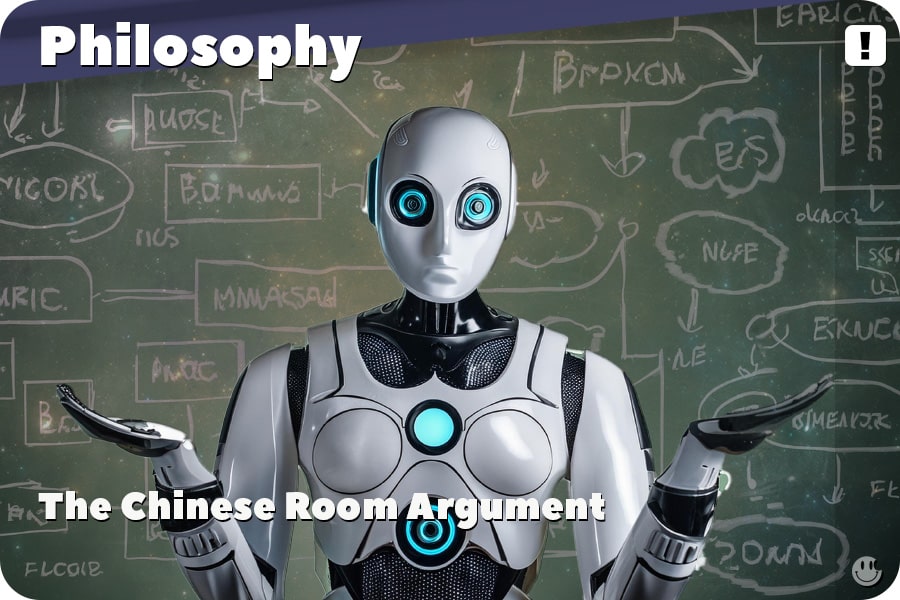
    Imagine a locked room. Inside is a person who speaks only English. Outside, people slip in cards covered in Chinese writing. The person inside consults a giant book of rules—written in English—and uses it to select the correct Chinese characters to pass back out. The answers are flawless. To the outsiders, it seems like the person understands Chinese.

    However, inside the room, the person has no idea what any of the Chinese symbols mean. They’re just following rules.

    This is The Chinese Room Argument, introduced in 1980 by philosopher John Searle. It’s one of the most important and debated thought experiments in the philosophy of mind and artificial intelligence (AI).

    Its central question: Can machines truly “understand,” or do they simulate understanding?

    The Setup

    Searle’s scenario was a response to what’s known as “strong AI”—the claim that a computer running the right program doesn’t just simulate a mind, but actually has a mind, including understanding and consciousness.

    The Chinese Room was meant to challenge this claim by showing that a system could convincingly respond to language without understanding it at all.

    Here’s the breakdown:

    • The person = the computer’s processor.

    • The rulebook = the program.

    • The cards = the input/output.

    • The whole system = what outsiders think is a mind.

    But Searle argued that no part of the system understands Chinese, just as no calculator understands math.

    Syntax vs. Semantics

    Searle’s core point is about the difference between syntax and semantics.

    • Syntax: Rules for manipulating symbols (like grammar).

    • Semantics: The meanings behind those symbols.

    Computers, Searle argued, manipulate syntax only. They follow rules to produce outputs, but they don’t grasp meaning.

    So even if a computer responds like it understands language, it doesn’t have intentionality—the mind’s ability to be “about” something, to connect thoughts to real-world meaning.

    To Searle, this shows that computation alone can’t generate real understanding.

    The Implications

    If Searle is right, then:

    • No matter how advanced AI becomes, it won’t “understand” anything.

    • Intelligence might require something more than programming—perhaps a biological brain, or consciousness.

    • Machines may pass the Turing Test (convincing a human that they’re intelligent) without genuine understanding.

    This challenges major assumptions in computer science, cognitive psychology, and the development of AI.

    Objections and Responses

    Searle’s argument sparked intense debate, and many philosophers and computer scientists pushed back.

    The Systems Reply

    Objection: “While the person doesn’t understand Chinese, the whole system does—the person plus the rulebook plus the room.”

    Searle’s response: You could memorize the entire rulebook and do the process in your head. You’d still not understand Chinese. So the system doesn’t understand either.

    The Robot Reply

    Objection: “Give the computer a robot body—let it see, hear, and interact with the world. That might produce real understanding.”

    Searle’s response: Even if the computer has sensory inputs, it still manipulates symbols. It doesn’t know what it sees or hears. Understanding requires more than inputs and outputs.

    The Brain Simulator Reply

    Objection: “What if we build a computer that mimics the firing patterns of a real human brain neuron by neuron?”

    Searle’s response: That’s still a simulation—not the real thing. Simulating understanding isn’t the same as having it.

    It’s like simulating digestion—it won’t produce nutrients.

    AI Today: Still in the Room?

    So what does the Chinese Room mean in the age of chatbots, GPTs, and Siri?

    Modern AI systems can produce text that seems fluent, even insightful. But are they truly understanding—or just following vast, sophisticated rules?

    The Chinese Room argument suggests that even the most advanced language model doesn’t understand what it’s saying. It doesn’t have beliefs, emotions, or intentions. It doesn’t “know” that Paris is in France or that 2+2=4.

    It just produces outputs that resemble those from a mind.

    In other words, the Chinese Room may not be obsolete—it may be more relevant than ever.

    Does It Matter?

    Some researchers argue that if a system behaves as if it understands, maybe that’s all we need. If an AI can hold a conversation, translate languages, or diagnose illness, who cares if it’s “really” conscious?

    Others insist that without genuine understanding, we’re missing something essential—not just in AI design, but in how we define personhood, responsibility, and ethics.

    Would you trust a judge, therapist, or doctor who can talk like a human but doesn’t understand you?

    Philosophical Foundations

    Searle’s critique taps into broader questions in the philosophy of mind:

    • What is consciousness?

    • Can minds be reduced to functions or computations?

    • Is the human brain just a biological computer—or something more?

    It contrasts with views like functionalism (the idea that mental states are defined by what they do, not what they’re made of) and supports a more biological view of the mind.

    Modern Variations

    Some modern thinkers reinterpret the Chinese Room through newer lenses:

    • Embodied Cognition: Understanding arises from interacting with the world physically—not just processing data.

    • Extended Mind Theory: Our minds may be partly external—shaped by tools, language, and environment.

    • Emergentism: Consciousness might “emerge” from complexity, even in machines—though this is still speculative.

    Each offers a different view on what it might take for a machine to truly think.

    Related Thought Experiments

    • Mary the Color Scientist: Explores whether knowing all facts about something is the same as experiencing it.

    • The Turing Test: Proposed by Alan Turing as a practical test for machine intelligence—but says nothing about consciousness.

    • The Hard Problem of Consciousness: David Chalmers coined this question: Why does brain activity feel like something from the inside?

    The Chinese Room remains one of the most direct challenges to computational theories of mind.

    Glossary of Terms

    • Strong AI: The view that a computer running the right program can have a mind.

    • Intentionality: The mind’s ability to refer to, or be about, things in the world.

    • Syntax: Rules for symbol manipulation (like grammar).

    • Semantics: The meanings behind those symbols.

    • Functionalism: The theory that mental states are defined by their function, not their physical makeup.

    Discussion Questions

    1. If a machine can perfectly imitate a human conversation, does it matter whether it “understands” what it says?

    2. Do you think understanding requires consciousness—or is behavior enough?

    3. How might the Chinese Room argument apply to today’s AI tools?

    References and Further Reading

  • The Monster’s Dilemma

    The Monster’s Dilemma

    The Monster’s Dilemma: Should We Create What Might Suffer or Harm?

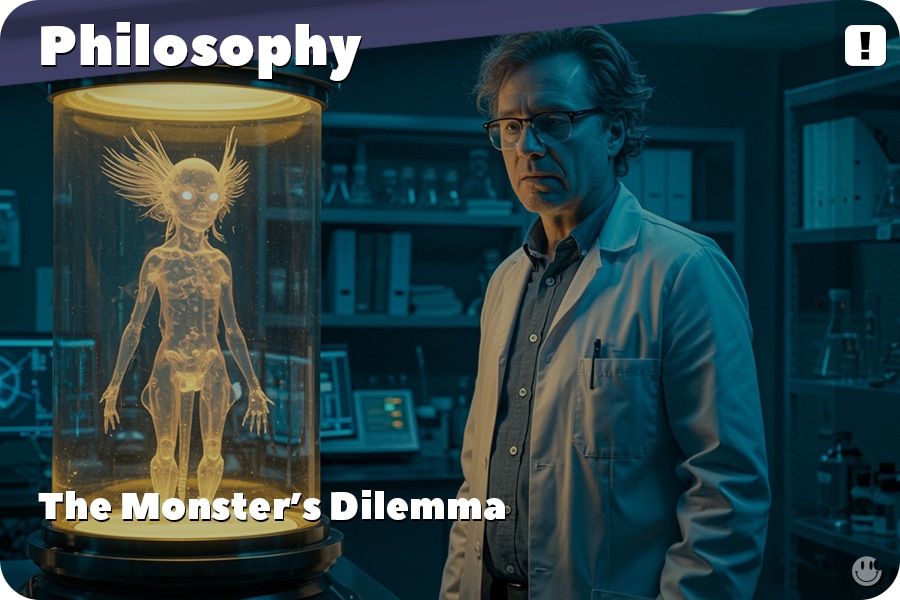
    Imagine a brilliant scientist on the verge of a breakthrough: they’ve designed a sentient creature—highly intelligent, potentially powerful, and capable of immense good. But there’s a catch.

    The creature might suffer.

    It might suffer a lot.

    It might also hurt others.

    Should the scientist flip the switch and bring it to life?

    This is The Monster’s Dilemma, a thought experiment rooted in Frankenstein, infused with bioethics, and increasingly relevant in debates about artificial intelligence, synthetic biology, and genetic engineering. It challenges us to confront the ethics of creation: just because we can make something—should we?

    The Origins of the Thought Experiment

    While there’s no single philosopher credited with the Monster’s Dilemma as a formal concept, its essence has existed for centuries:

    • In Mary Shelley’s Frankenstein (1818), Victor Frankenstein creates life—only to recoil from what he’s made. The creature, shunned and tormented, becomes violent. Victor must ask himself: Who is responsible for the monster’s pain?

    • In modern AI ethics, researchers ask: Should we create machines that can suffer or cause suffering?

    • In bioethics, we question whether it’s right to engineer life forms that may endure pain or whose existence might carry unintended consequences.

    At the heart of the Monster’s Dilemma is a twofold risk:

    1. Creating a being that suffers.

    2. Creating a being that causes suffering.

    Is Creation Itself a Moral Act?

    The dilemma raises profound ethical questions about responsibility and intention:

    Deontological Ethics

    From a deontological perspective, some acts are inherently wrong—regardless of outcome.

    • Creating life that suffers may violate a duty not to cause unnecessary harm.

    • Even if the creature is never harmful, the act of creating something destined to suffer may be wrong in itself.

    The question becomes: Is it ever ethical to bring pain into existence knowingly?

    Utilitarian Ethics

    A utilitarian might weigh total happiness vs. total suffering. The creation might be justified if the creature can live a meaningful, mostly positive life—or benefit others.

    But the risks are real:

    • The act is unethical if the creature suffers more than it brings joy.

    • If it harms others, its creation might lower total well-being.

    Utilitarianism asks: Can we predict and responsibly manage the outcomes?

    Virtue Ethics

    A virtue ethicist might ask about the creator’s character:

    • Is the scientist acting out of hubris or genuine curiosity?

    • Is there compassion in how the creature will be treated?

    • Does the creator take moral responsibility, or just seek achievement?

    Being a “good person” may mean pausing before playing god.

    Real-World Parallels

    Though Frankenstein’s monster is fictional, the moral issues are real—and growing more relevant.

    1. Artificial Intelligence

    Creating machines that mimic or exceed human intelligence raises major concerns:

    • What if AI develops consciousness or sentience?

    • Would turning off such an AI be murder?

    • What if it turns against us, like HAL 9000 or Skynet?

    Experts like Nick Bostrom warn about unintended consequences from AI systems that optimize goals in harmful ways. (See: Superintelligence, 2014)

    2. Animal Engineering

    Genetic modification of animals for food, research, or aesthetics raises questions:

    • Are we creating creatures with built-in suffering?

    • Does the utility (food, medical progress) outweigh the moral cost?

    Some bioethicists advocate for a “no unnecessary suffering” rule, especially for sentient beings.

    3. Synthetic Life

    Scientists have begun creating synthetic organisms—new life forms built from DNA.

    • Should we create organisms that we cannot fully understand or control?

    • What are our obligations if a synthetic being becomes sentient or gains agency?

    Existence without consent is a troubling theme. After all, no one asks to be born—least of all a lab-grown monster.

    4. AI Companions and Emotional Robots

    Designing robots that mimic love, pain, or attachment can emotionally manipulate users and raise questions about the machines’ emotional lives.

    If a robot feels heartbreak when turned off, have we done something cruel?

    Moral Risk vs. Moral Reward

    Sometimes, the Monster’s Dilemma becomes a question of moral risk tolerance.

    • Do the benefits of creation outweigh the ethical uncertainties?

    • Is it worse to never try—and never know what good might have come?

    But there’s also a slippery slope: where do we stop once we justify one risky creation?

    This concern has echoes in nuclear research, bioweapons, and dual-use technologies. Every tool of great power carries the shadow of potential misuse.

    Lessons from Frankenstein

    Shelley’s Frankenstein remains the definitive allegory of the Monster’s Dilemma. It’s not just about science—it’s about responsibility:

    • Victor’s real failure isn’t making the creature.

    • It’s abandoning it.

    • It’s ignoring the moral obligations that come after creation.

    This warning remains strikingly modern: inventors, developers, and technologists are often eager to push boundaries—but who stays to raise the monster?

    Counterarguments: Isn’t All Life Risky?

    Some argue that:

    • Human life is full of suffering, yet we continue to reproduce.

    • We cannot know how a being’s life will turn out—so long as there’s a chance for joy, why not create it?

    This view values potential and autonomy, suggesting that a being deserves the chance to exist and find meaning, even at risk.

    But critics respond: accepting life’s risks for ourselves is one thing. It’s another to create a life we know could suffer—without consent.

    Glossary of Terms

    • Bioethics – The study of ethical issues in biology and medicine.

    • Sentience – The capacity to feel, perceive, or experience subjectively.

    • Utilitarianism – An ethical theory focused on maximizing happiness and minimizing suffering.

    • Deontology – Ethics based on duty, rules, or inherent right and wrong.

    • Existential Risk – A risk that threatens the entire future of humanity or intelligent life.

    Discussion Questions

    1. Is it ever ethical to create something that might suffer or harm others?

    2. Do creators have moral responsibility for the outcomes of what they make?

    3. Where should we draw the line between curiosity, invention, and caution?

    References and Further Reading