Benjamin Franklin’s Letter to William Strahan
July 5, 1775
Mr. Strahan
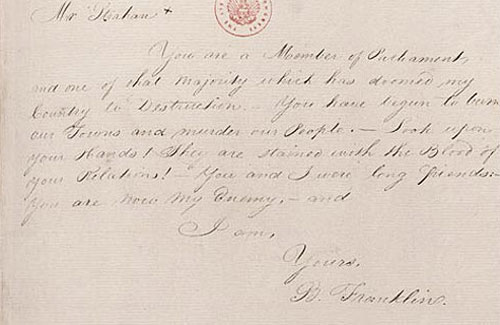
You are a Member of Parliament, and one of that Majority which has doomed my Country to Destruction. You have begun to burn our Towns and murder our People. — Look upon your hands! They are stained with the Blood of your Relations! — You and I were long Friends:— You are now my Enemy, — and
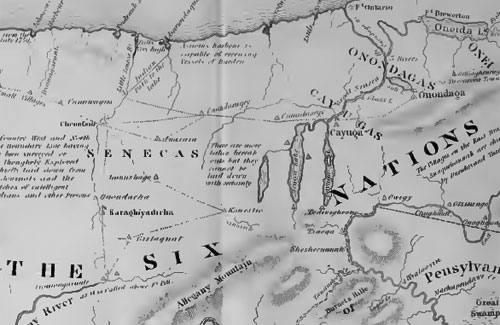
Canasatego and the CollegeAnother passage from the letter I wrote Peter Collinson on May 9, 1753. This contains a story I told more than once. I have added to it the official minutes of the same transaction, which I printed, which are rather different.
_____________________________
The little value Indians set on what we prize so highly under the name of learning appears from a pleasant passage that happened some years since at a treaty between one of our colonies and the Six Nations. When everything had been settled to the satisfaction of both sides, and nothing remained but a mutual exchange of civilities, the English commissioners told the Indians, they had in their country a college for the instruction of youth who were there taught various languages, arts, and sciences; that there was a particular foundation in favor of the Indians to defray the expense of the education of any of their sons who should desire to take the benefit of it. And now if the Indians would accept of the offer, the English would take half a dozen of their brightest lads and bring them up in the best manner.
The Indians after consulting on the proposal replied that it was remembered some of their youths had formerly been educated in that college, but it had been observed that for a long time after they returned to their friends, they were absolutely good for nothing, being neither acquainted with the true methods of killing deer, catching beaver, or surprising an enemy. The proposition however, they looked on as a mark of the kindness and good will of the English to the Indian nations, which merited a grateful return; and therefore if the English gentlemen would send a dozen or two of their children to Onondago, the great Council would take care of their education, bring them up in really what was the best manner, and make men of them.
____________________
A TREATY, Held at the town of Lancaster, in Pennsylvania, by … the lieutenant governor of the province [George Thomas], and … the commissioners for the provinces Virginia and Maryland, with the Indians of the Six Nations, in June, 1744. … Printed and sold by B. Franklin, at the new printing office, near the market. MDCCXLIV.
A commissioner from Virginia:
Our friend, [the interpreter] Conrad Weiser, when he is old, will go into the other world, as our fathers have done; our children will then want such a friend to go between them and your children, to reconcile any differences that may happen to arise between them, that, like him, may have the ears and tongues of our children and yours.
The way to have such a friend, is for you to send three or four of your boys to Virginia, where we have a fine house for them to live in, and a man on purpose to teach the children of you, our friends, the religion, language, and customs of the white people. To this place [i.e. the Brafferton School at the College of William and Mary] we kindly invite you to send some of your children, and we promise you they shall have the fame care taken of them, and be instructed in the same manner as our own children, and returned to you again when you please.
Canasatego, speaking for the Six Nations:
You told us … you had a great house provided for the education of youth, and that there were feveral white people and Indians’ children there to learn languages, and to write and read, and invited us to fend some of our children amongst you, &c.
We must let you know we love our children too well to fend them so great a way, and the Indians are not inclined to give their children learning. We allow it to be good, and we thank you for your invitation, but our customs differing from yours, you will be so good as to excuse us.
[Later the same day, Canasatego made the following remarks, and though they do not regard the subject at hand, I thought them worthy of your notice.]
We have one thing further to say, and that is we heartily recommend union and a good agreement between you our brethren. Never disagree, but preserve a strict friendship for one another, and thereby you as well as we will become the stronger.
Our wise forefathers established union and amity between the Five Nations; this has made us formidable, this has given us great weight and authority with our neighboring nations.
We are a powerful confederacy, and, by your observing the same methods our wise forefathers have taken, you will acquire fresh strength and power; therefore, whatever befalls you, never fall out with one another.
Another passage from the letter I wrote to Peter Collinson on May 9, 1753. Not a passage I am now, decades later, very proud of. At the time, I sincerely feared that the great number of Germans pouring into Pennsylvania might very well betray the country to the French, and lead to the overthrow of British government there, not to mention English institutions.
Here I say hard things about the Germans that I later came to think unjust, calling them ignorant and stupid. In another place, I asked, “Why should the Palatine boors be suffered to swarm into our settlements, and by herding together establish their languages and manners to the exclusion of ours? Why should Pennsylvania, founded by the English, become a colony of aliens, who will shortly be so numerous as to Germanize us instead of our Anglifying them, and will never adopt our language or customs, any more than they can acquire our complexion?” I went so far as to declare my preference for white people, which I did not regard the Germans to be. These sentiments being published, cost me my place in the general assembly of Pennsylvania after the next election.
Now, many years later, what do we find? We ourselves have taken Pennsylvania out of the British empire, and leagued ourselves with the French to do it! The children of those swarming German immigrants have learned English for the most part, and become good Americans. Many served after all in our War of Independence, or at least did our cause no harm.
In my own defense I will point to the last paragraph of the following passage, so that you might understand that I was never so hostile to the Germans as I sometimes appeared in those days.
_______________________________
I am perfectly of your mind, that measures of great temper are necessary with the Germans, and am not without apprehensions, that through their indiscretion or ours, or both, great disorders and inconveniences may one day arise among us.
Those who come hither are generally of the most ignorant, stupid sort of their own nation, and as ignorance is often attended with credulity when knavery would mislead it, and with suspicion when honesty would set it right; and as few of the English understand the German language, and so cannot address them either from the press or pulpit, ’tis almost impossible to remove any prejudices they once entertain. Their own clergy have very little influence over the people; who seem to take an uncommon pleasure in abusing and discharging the minister on every trivial occasion. Not being used to liberty, they know not how to make a modest use of it; and as Kolben says of the young Hottentots, that they are not esteemed men till they have shown their manhood by beating their mothers, so these seem to think themselves not free, till they can feel their liberty in abusing and insulting their teachers. Thus they are under no restraint of ecclesiastical government.
They behave, however, submissively enough at present to the civil government, which I wish they may continue to do; for I remember when they modestly declined intermeddling in our elections, but now they come in droves, and carry all before them, except in one or two counties.
Few of their children in the country learn English; they import many books from Germany; and of the six printing houses in the province, two are entirely German, two half German half English, and but two entirely English. They have one German newspaper, and one half German. Advertisements intended to be general are now printed in Dutch [i.e. Deutsch, German] and English; the signs in our streets have inscriptions in both languages, and in some places only German. They begin of late to make all their bonds and other legal writings in their own language, which (though I think it ought not to be) are allowed good in our courts, where the German business so encreases that there is continual need of interpreters; and I suppose in a few years they will be also necessary in the assembly, to tell one half of our legislators what the other half say.
In short, unless the stream of their importation could be turned from this to other colonies, as you very judiciously propose, they will soon so outnumber us, that all the advantages we have will not [in my opinion] be able to preserve our language, and even our government will become precarious. The French who watch all advantages, are now [themselves] making a German settlement back of us in the Illinois country, and by means of those Germans they may in time come to an understanding with ours, and indeed in the last war our Germans showed a general disposition that seems to bode us no good; for when the English who were not Quakers, alarmed by the danger arising from the defenseless state of our country entered unanimously into an association within this government and the lower counties, raised, armed, and disciplined [near] 10,000 men, the Germans, except a very few in proportion to their numbers, refused to engage in it, giving out one among another, and even in print, that if they were quiet the French, should they take the country, would not molest them; at the same time abusing the Philadelphians for fitting out privateers against the enemy; and representing the trouble, hazard, and expense of defending the Province, as a greater inconvenience than any that might be expected from a change of government.
Yet I am not for refusing entirely to admit them into our colonies. All that seems to be necessary is, to distribute them more equally, mix them with the English, establish English schools where they are now too thick settled, and take some care to prevent the practice lately fallen into by some of the ship owners, of sweeping the German goals [i.e. jails] to make up the number of their passengers. I say I am not against the admission of Germans in general, for they have their virtues, their industry and frugality is exemplary; they are excellent husbandmen and contribute greatly to the improvement of a country.
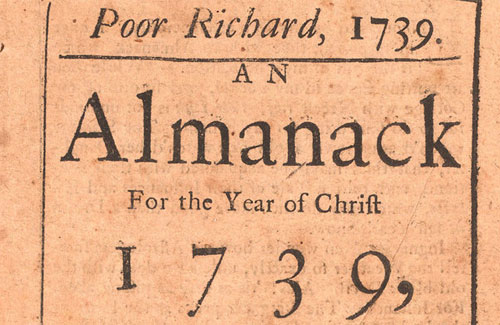
The following is a little piece I put together for my 1739 almanac. I took some passages from Francois Rabelais, added a good deal of my own observation or invention, and recalculated for America. I jested a bit here with the manner of speaking I heard in different places, and other things. I was not yet 26 years of age when I composed this, and ’twas written to be read by low and high alike. If you find its humor not to your liking, pray forgive my youthful self.
________________________________
A TRUE PROGNOSTICATION FOR 1739.
Courteous Readers,
Having considered the infinite abuses arising from the false prognostications published among you, made under the shadow of a pot of drink, or so, I have here calculated one of the most sure and unerring that ever was seen in black and white, as hereafter you’ll find. For doubtless it is a heinous, foul, and crying sin, to deceive the poor gaping world, greedy of the knowledge of futurity, as we Americans all are.
Take notice by the by, that having been at a great deal of pains in the calculation, if you don’t believe every syllable, jot, and tittle of it, you do me a great deal of wrong; for which either here or elsewhere, you may chance to be clawed off with a vengeance. A good cowskin, crabtree, or bull’s pizzle [i.e. whip, stick, or (ahem) rawhide] may be plentifully bestowed on your outward man. You may snuff up your noses as much as you please, ’tis all one for that.
Well however, come, snite [wipe] your noses my little children; and you old doting Father Greybeards, pull out your best eyes, on with your barnacles [spectacles], and carefully observe every scruple of what I’m going to tell you.
Of the Golden Number.
The Golden Number, non est inventus [legal phrase, “not found’]. I cannot find it this year by any calculation I have made. I must content myself with a number of copper. No matter, go on.
Of the Eclipses this Year.
There are so many invisible eclipses this year, that I fear, not unjustly, our pockets will suffer inanition, be full empty, and our feeling at a loss. During the first visible eclipse Saturn is retrograde; for which reason the crabs will go sidelong, and the ropemakers backward. The belly will wag before, and the arse shall sit down first. Mercury will have his share in these affairs, and so confound the speech of people, that when a Pennsylvanian would say PANTHER, he shall say PAINTER. When a New Yorker thinks to say THIS he shall say DISS and the people in New England and Cape May will not be able to say COW for their lives, but will be forced to say KEOW by a certain involuntary twist in the root of their tongues. No Connecticut Man nor Marylander will be able to open his mouth this year, but SIR shall be the first or last syllable he pronounces, and sometimes both. Brutes shall speak in may places, and there will be above seven and twenty irregular verbs made this year, if grammar don’t interpose. Who can help these misfortunes!
Of the Diseases this Year.
This year the stone-blind shall see but very little; the deaf shall hear but poorly; and the dumb shan’t speak very plain. And it’s much, if my Dame Bridget talks at all this year. Whole flocks, herds and droves of sheep, swine and oxen, cocks and hens, ducks and drakes, geese and ganders shall go to pot; but the mortality will not be altogether so great among cats, dogs, and horses. As for old age, ’twill be incurable this year, because of the years past. And towards the fall some people will be seized with an unaccountable inclination to roast and eat their own ears. Should this be called madness, doctors? I think not. — But the worst disease of all will be a certain most horrid, dreadful, malignant, catching, perverse and odious malady, almost epidemical, insomuch that many shall run mad upon it; I quake for very fear when I think on it; for I assure you very few will escape this disease; which is called by the learned Albumazar, LACKO’MONY.
Of the Fruits of the Earth.
I find that this will be a plentiful year of all manner of good things, to those who have enough; but the orange trees in Greenland will go near to fare the worse for the cold. As for oats, they’ll be a great help to horses. I dare say there won’t be much more bacon than swine. Mercury somewhat threatens our parsley beds, yet parsley will be to be had for money. Hemp will grow faster than the children of this age, and some will find there’s but too much on it. As for corn, fruit, cider, and turnips, there never was such plenty as will be now; if poor folks may have their wish.
Of the Condition of some Countries.
I foresee an universal drought this Year through all the northern colonies. Hence there will be dry rice in Carolina, dry tobacco in Virginia and Maryland, dry bread in Pennsylvania and New York; and, in New England, dry fish and dry doctrine. Dry throats there will be everywhere; but then how pleasant it will be to drink cool cider! Though some will tell you nothing is more contrary to thirst. I believe it; and indeed, Contraria contrariis curantur [opposites cure opposites].
 Benjamin Franklin’s Letter to William Strahan