Abraham Lincoln’s letter to Lydia Bixby, who lost 5 sons in the Civil War
November 21, 1864
Dear Madam,—I have been shown in the files of the War Department a statement of the Adjutant General of Massachusetts, that you are the mother of five sons who have died gloriously on the field of battle.
I feel how weak and fruitless must be any words of mine which should attempt to beguile you from the grief of a loss so overwhelming. But I cannot refrain from tendering to you the consolation that may be found in the thanks of the Republic they died to save.
I pray that our Heavenly Father may assuage the anguish of your bereavement, and leave you only the cherished memory of the loved and lost, and the solemn pride that must be yours, to have laid so costly a sacrifice upon the altar of Freedom.
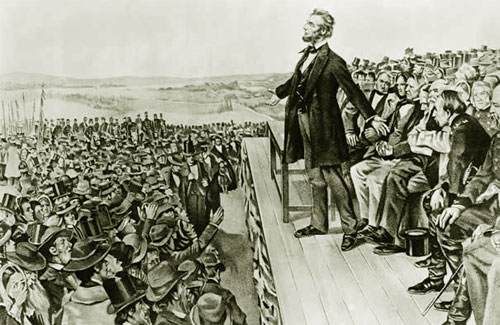
by Abraham Lincoln, on November 19, 1863, at Gettysburg, Pennsylvania
Four score and seven years ago our fathers brought forth on this continent, a new nation, conceived in liberty, and dedicated to the proposition that all men are created equal.
Now we are engaged in a great civil war, testing whether that nation, or any nation so conceived and so dedicated, can long endure. We are met on a great battlefield of that war. We have come to dedicate a portion of that field, as a final resting place for those who here gave their lives that that nation might live. It is altogether fitting and proper that we should do this.
But in a larger sense, we cannot dedicate – we cannot consecrate – we cannot hallow – this ground. The brave men, living and dead, who struggled here, have consecrated it, far above our poor power to add or detract. The world will little note, nor long remember, what we say here, but it can never forget what they did here. It is for us the living, rather, to be dedicated here to the unfinished work which they who fought here have thus far so nobly advanced. It is rather for us to be here dedicated to the great task remaining before us – that from these honored dead we take increased devotion to that cause for which they gave the last full measure of devotion – that we here highly resolve that these dead shall not have died in vain – that this nation, under God, shall have a new birth of freedom – and that government of the people, by the people, for the people, shall not perish from the earth.
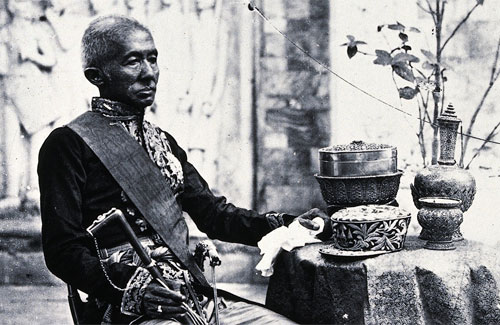
Abraham Lincoln’s Letter to the King of Siam, declining the offer of Elephants to help with the civil war.
February 3, 1862
Abraham Lincoln,
President of the United States of America.
To His Majesty Somdetch Phra Paramendr Maha Mongut,
King of Siam,
Great and Good Friend:
I have received Your Majesty’s two letters of the date of February 14th., 1861.
I have also received in good condition the royal gifts which accompanied those letters, -namely, a sword of costly materials and exquisite workmanship; a photographic likeness of Your Majesty and of Your Majesty’s beloved daughter; and also two elephants’ tusks of length and magnitude such as indicate that they could have belonged only to an animal which was a native of Siam.
Your Majesty’s letters show an understanding that our laws forbid the President from receiving these rich presents as personal treasures. They are therefore accepted in accordance with Your Majesty’s desire as tokens of your good will and friendship for the American People. Congress being now in session at this capital, I have had great pleasure in making known to them this manifestation of Your Majesty’s munificence and kind consideration.
Under their directions the gifts will be placed among the archives of the Government, where they will remain perpetually as tokens of mutual esteem and pacific dispositions more honorable to both nations than any trophies of conquest could be.
I appreciate most highly Your Majesty’s tender of good offices in forwarding to this Government a stock from which a supply of elephants might be raised on our own soil. This Government would not hesitate to avail itself of so generous an offer if the object were one which could be made practically useful in the present condition of the United States.
Our political jurisdiction, however, does not reach a latitude so low as to favor the multiplication of the elephant, and steam on land, as well as on water, has been our best and most efficient agent of transportation in internal commerce.
I shall have occasion at no distant day to transmit to Your Majesty some token of indication of the high sense which this Government entertains of Your Majesty’s friendship.
Meantime, wishing for Your Majesty a long and happy life, and for the generous and emulous People of Siam the highest possible prosperity, I commend both to the blessing of Almighty God.
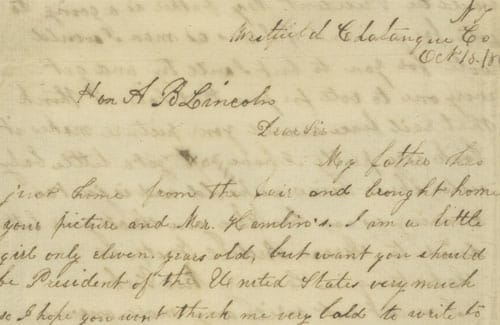
11 year-old Grace Bedell’s letter to Abraham Lincoln, advising him to grow a beard
October 18, 1860
Dear Sir
My father has just home from the fair and brought home your picture and Mr. Hamlin’s. I am a little girl only eleven years old, but want you should be President of the United States very much so I hope you wont think me very bold to write to such a great man as you are. Have you any little girls about as large as I am if so give them my love and tell her to write to me if you cannot answer this letter. I have got 4 brothers and part of them will vote for you any way and if you let your whiskers grow I will try and get the rest of them to vote for you you would look a great deal better for your face is so thin. All the ladies like whiskers and they would tease their husbands to vote for you and then you would be President. My father is going to vote for you and if I was a man I would vote for you too but I will try and get every one to vote for you that I can. I think that rail fence around your picture makes it look very pretty. I have got a little baby sister she is nine weeks old and is just as cunning as can be. When you direct your letter direct to Grace Bedell Westfield Chatauque County New York. I must not write any more answer this letter right off Good bye. Grace Bedell
________________________________
Abraham Lincolns’ Response to Grace Bedell
Miss. Grace Bedell
My dear little Miss.
Your very agreeable letter of the 15th is received.
I regret the necessity of saying I have no daughters. I have three sons — one seventeen, one nine, and one seven, years of age. They, with their mother, constitute my whole family.
As to the whiskers, having never worn any, do you not think people would call it a piece of silly affection if I were to begin it now?
Sarah Lougue’s letter to her runaway slave Jermain Wesley Logan (Jarm Logue)
His response is included below.
February 20th, 1860.
To JARM:-
I now take my pen to write you a few lines, to let you know how well we all are. I am a cripple, but I am still able to get about. The rest of the family are all well. Cherry is as well as Common. I write you these lines to let you the situation we are in—partly in consequence of your running away and stealing Old Rock, our fine mare. Though we got the mare back, she was never worth much after you took her; and as I now stand in need of some funds, I have determined to sell you; and I have had an offer for you, but did not see fit to take it. If you will send me one thousand dollars and pay for the old mare, I will give up all claim I have to you. Write to me as soon as you get these lines, and let me know if you will accept my proposition. In consequence of your running away, we had to sell Abe and Ann and twelve acres of land; and I want you to send me the money that I may be able to redeem the land that you was the cause of our selling, and on receipt of the above named sum of money, I will send you your bill of sale. If you do not comply with my request, I will sell you to some one else, and you may rest assured that the time is not far distant when things will be changed with you. Write to me as soon as you get these lines. Direct your letter to Bigbyville, Maury County, Tennessee. You had better comply with my request.
I understand that you are a preacher. As the Southern people are so bad, you had better come and preach to your old acquaintances. I would like to know if you read your Bible? If so can you tell what will become of the thief if he does not repent? and, if the the blind lead the blind, what will the consequence be? I deem it unnecessary to say much more at present. A word to the wise is sufficient. You know where the liar has his part. You know that we reared you as we reared our own children; that you was never abused, and that shortly before you ran away, when your master asked if you would like to be sold, you said you would not leave him to go with anybody.
Sarah Logue.
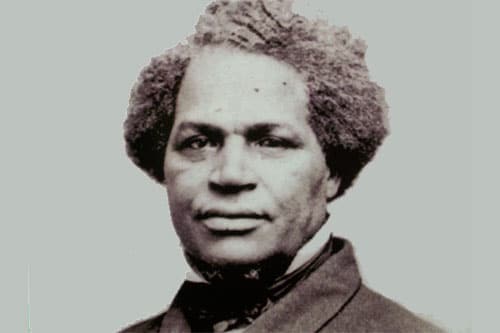
Jermain Wesley Logan’s response to Sarah Logue
March 28, 1860.
MRS. SARAH LOGUE-
Yours of the 20th of February is duly received, and I thank you for it. It is a long time since I heard from my poor old mother, and I am glad to know she is yet alive, and, as you say, “as well as common.” What that means I don’t know. I wish you had said more about her.
You are a woman; but had you a woman’s heart you could never have insulted a brother by telling him you sold his only remaining brother and sister, because he put himself beyond your power to convert him into money.
You sold my brother and sister, ABE and ANN, and 12 acres of land, you say, because I ran away. Now you have the unutterable meanness to ask me to return and be your miserable chattel, or in lieu thereof send you $1000 to enable you to redeem the land, but not to redeem my poor brother and sister! If I were to send you money it would be to get my brother and sister, and not that you should get land. You say you are a cripple, and doubtless you say it to stir my pity, for you know I was susceptible in that direction. I do pity you from the bottom of my heart. Nevertheless I am indignant beyond the power of words to express, that you should be so sunken and cruel as to tear the hearts I love so much all in pieces; that you should be willing to impale and crucify us out of all compassion for your poor foot or leg. Wretched woman! Be it known to you that I value my freedom, to say nothing of my mother, brothers and sisters, more than your whole body; more, indeed, than my own life; more than all the lives of all the slaveholders and tyrants under Heaven.
You say you have offers to buy me, and that you shall sell me if I do not send you $1000, and in the same breath and almost in the same sentence, you say, “you know we raised you as we did our own children.” Woman, did you raise your own children for the market? Did you raise them for the whipping-post? Did you raise them to be driven off in a coffle in chains? Where are my poor bleeding brothers and sisters? Can you tell? Who was it that sent them off into sugar and cotton fields, to be kicked, and cuffed, and whipped, and to groan and die; and where no kin can hear their groans, or attend and sympathize at their dying bed, or follow in their funeral? Wretched woman! Do you say you did not do it? Then I reply, your husband did, and you approved the deed- and the very letter you sent me shows that your heart approves it all. Shame on you.
But, by the way, where is your husband? You don’t speak of him. I infer, therefore, that he is dead; that he has gone to his great account, with all his sins against my poor family upon his head. Poor man! gone to meet the spirits of my poor, outraged and murdered people, in a world where Liberty and Justice are MASTERS.
But you say I am a thief, because I took the old mare along with me. Have you got to learn that I had a better right to the old mare, as you call her, than MANNASSETH LOGUE had to me? Is it a greater sin for me to steal his horse, than it was for him to rob my mother’s cradle and steal me? If he and you infer that I forfeit all my rights to you, shall not I infer that you forfeit all your rights to me? Have you got to learn that human rights are mutual and reciprocal, and if you take my liberty and life, you forfeit your own liberty and life? Before God and High Heaven, is there a law for one man which is not a law for every other man?
If you or any other speculator on my body and rights, wish to know how I regard my rights, they need but come here and lay their hands on me to enslave me. Did you think to terrify me by presenting the alternative to give my money to you, or give my body to Slavery? Then let me say to you, that I meet the proposition with unutterable scorn and contempt. The proposition is an outrage and an insult. I will not budge one hair’s breadth. I will not breathe a shorter breath, even to save me from your persecutions. I stand among a free people, who, I thank God, sympathize with my rights, and the rights of mankind; and if your emissaries and venders come here to re-enslave me, and escape the unshrinking vigor of my own right arm, I trust my strong and brave friends, in this City and State, will be my rescuers and avengers.
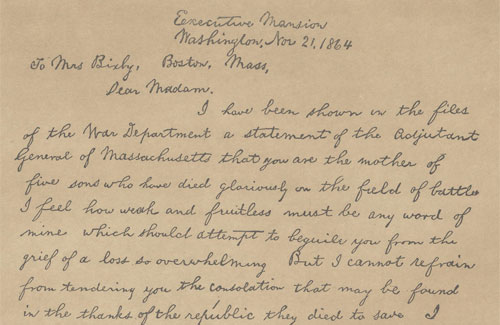 Abraham Lincoln’s letter to Lydia Bixby, who lost 5 sons in the Civil War