web analytics

Tag: Cold War

  • November 30 in Pop Culture History

    November 30 in Pop Culture History

    November 30 History, Trivia, and Fun Facts

    November 30 History Highlights

    • 1803 – In New Orleans, Spanish representatives officially transferred the Louisiana Territory to France. Just a few weeks later, France transferred the same land to the United States in the Louisiana Purchase
    • 1872 – The first-ever international football match takes place at Hamilton Crescent, Glasgow, between Scotland and England. Four thousand people watched the scoreless game.
    • 1982 – Michael Jackson’s sixth solo studio album, Thriller, was released worldwide.
    • 1998 – Exxon and Mobil signed a $73.7 billion agreement to merge, thus creating ExxonMobil, the world’s largest company at that time.
    • If you were born on November 30th,
      You were likely conceived the week of… March 8th (same year)

    The Sylacauga (Hodges) Meteorite

    36-year-old Elizabeth (Liz) Hodges was lounging, half-asleep in her home on November 30, 1954. The people in the town saw an orange smoking streak go through the sky, sonic booming, breaking up, and a 9-pound hot rock landed in her house. The townsfolk thought it was a Russian Missile. This was at the height of the Cold War. The US Air Force got involved, and took the meteorite from Liz, to study.

    A Neighbor found a piece on his property but sold it right away, HE got enough money for a new car. The Air Force promised Liz that they’d give it back to her, as long as it wasn’t Russian.

    Nobody had ever been hit by a meteorite before, so THIS was probably the rarest Space Rock ever, given that hit a human being, so she thought she’d at least make some money from it. But…

    As Liz and her lawyer were starting to take offers, and a few months later, the Air Force was going to give it back, and her Landlord, a Mr. Biidie Guy, said that the meteorite was HIS property, since it landed in his house.
    This stopped all the bidding, and it went to court.

    They settled out of court, and LIZ gave Birdie $500, about $5K today, to win unrestricted rights to the Stone from Space, but by that time, it was a year later, and nobody wanted to buy it. Liz Hodges ended up Donating the meteorite to the Alabama Museum of Natural History, about two years later.

    November 30 is…

    Cities For Life Day
    Computer Security Day
    National Mousse Day
    National Stay At Home Because You’re Well Day
    November 30 Birthday Quotes

    “A sound heart is a safer guide than an ill-trained conscience.”
    – Mark Twain

    “It is a good thing for an uneducated man to read books of quotations. Bartlett’s Familiar Quotations is an admirable work, and I studied it intently. The quotations when engraved upon the memory give you good thoughts. They also make you anxious to read the authors and look for more.”
    – Winston Churchill

    “When a great genius appears in the world the dunces are all in confederacy against him.”
    – Jonathan Swift

    “You measure a democracy by the freedom it gives its dissidents, not the freedom it gives its assimilated conformists.”
    – Abbie Hoffman

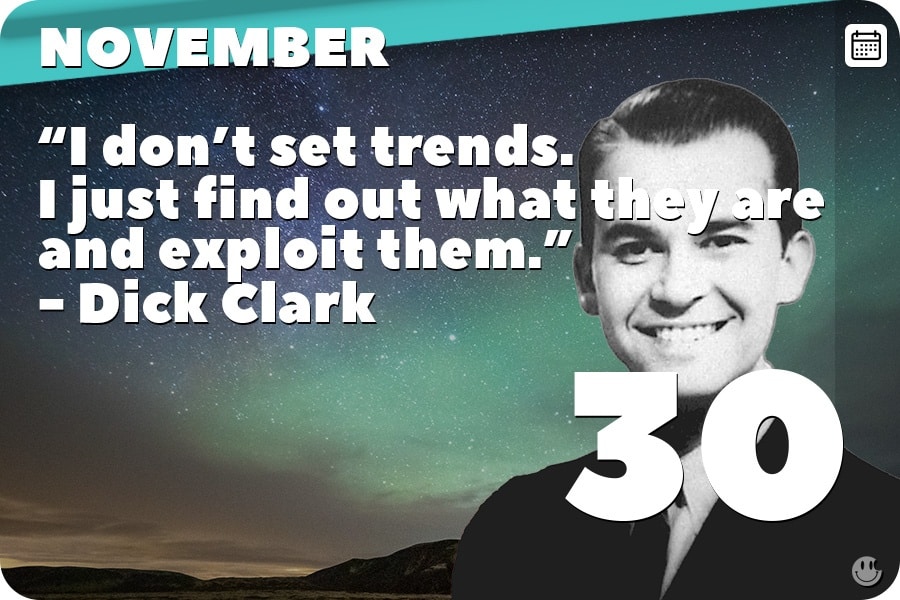
    “I don’t set trends. I just find out what they are and exploit them.”
    – Dick Clark

    “Music is the soundtrack of your life.”
    – Dick Clark

    “Hello. My name is Iñigo Montoya. You killed my father. Prepare to die.”
    – Mandy Patinkin, as Inigo Montoya, in The Princess Bride

    “If you want to stay young-looking, pick your parents very carefully.”
    – Dick Clark

    November 30 Birthdays

    1667 – Jonathan Swift, Irish satirist, and essayist (died in 1745)
    1835 – Mark Twain, American novelist, humorist, and critic (died in 1910)
    1872 – John McCrae, Canadian physician, soldier, and poet (In Flanders Fields, died in 1918)
    1874 – Winston Churchill, English colonel, journalist, and politician, Prime Minister of the United Kingdom (Nobel Prize laureate, died in 1965)
    1918 – Efrem Zimbalist, Jr., American actor (died in 2014)
    1920 – Virginia Mayo, American actress (died in 2005)
    1924 – Allan Sherman, American actor, comedian, singer, producer, and screenwriter (died in 1973)
    1926 – Richard Crenna, American actor, director, and producer (died in 2003)
    1927 – Robert Guillaume, American actor and singer (died in 2017)
    1929 – Dick Clark, American TV host, and producer (founded Dick Clark Productions, died in 2012)
    1930 – G. Gordon Liddy, American lawyer, radio host
    1936 – Abbie Hoffman, American activist and author (co-founded the Youth International Party, died in 1989)
    1937 – Ridley Scott, English director, and producer (Alien, Blade Runner)
    1942 – Eugene Krabs, restaurateur (The Krusty Krab)
    1951 – Daniel Petrie, Jr., American director, producer, and screenwriter
    1952 – Mandy Patinkin, American actor, and singer
    1953 – June Pointer, American singer (Pointer Sisters, d. 2006)
    1955 – Kevin Conroy, American actor (animated Batman)
    1955 – Billy Idol, English Singer/Songwriter (White Wedding, Mony Mony)
    1958 – Stacey Q, American pop Singer/Songwriter, dancer, and actress
    1959 – Cherie Currie, American Singer/Songwriter, musician, and actress (The Runaways)
    1960 – Mandy Patinkin, American actor
    1962 – Bo Jackson, American football and baseball player
    1968 – Des’ree, English Singer/Songwriter
    1975 – Mindy McCready, American Singer/Songwriter (died in 2013)
    1977 – Steve Aoki, American DJ, and producer (founded Dim Mak Records)
    1978 – Clay Aiken, American singer (American Idol)
    1982 – Elisha Cuthbert, Canadian actress
    1985 – Kaley Cuoco, American actress (Big Bang Theory)
    1985 – Chrissy Teigen, American model

    November 30 History

    3340 BC – Earliest believed record of an eclipse, in Ireland.

    1609 – Galileo Galilei realized that the moon was a landscape, not a flat surface on a circle in the sky.

    1858 – The Mason Jar was invented and patented (#22,186) by Philadelphia tinsmith John Landis Mason.

    1872 – First international soccer game was played. Final score: Scotland-England 0-0 (in Glasgow)

    1875 – A patent (#170,460) was issued for a “Biscuit Cutter” to Alexander P. Ashbourne.

    1886 – The first commercially successful U.S. alternating current power plant was opened at Buffalo, NY by George Westinghouse.

    1897 – A patent (#594,501) for a “Device for Rolling Cigarettes” was issued to American inventor J.A. Sweeting.

    1931 – The Joy of Cooking by Irma Rombauer was published.

    1936 – London’s Crystal Palace was destroyed by fire.

    1940 – Lucille Ball married Desi Arnaz in Greenwich, Connecticut.

    1954 – First proven meteorite known to strike a woman/person (Liz Hodges, in Sylacauga, Alabama). It took a year of pleading with the air force, but she was allowed to keep the 9-pound meteorite.

    1956 – CBS became the first network to broadcast from videotape. It was a rebroadcast to the West Coast of the 15-minute Douglas Edwards and the News program. It was recorded on 2-inch tape with an Ampex Mark IV machine.

    1968 – #1 Hit November 30, 1968 – December 13, 1968: Diana Ross & the Supremes – Love Child

    1971 – TV movie Brian’s Song, aired for the first time on ABC

    1979 – Pink Floyd released The Wall double album. “If you don’t eat your meat, you can’t have any pudding, how can you have any pudding if you don’t eat your meat!”

    1982 – Michael Jackson’s second solo album, Thriller, possibly the biggest-selling album in history, was released worldwide.

    1985 – #1 Hit November 30, 1985 – December 6, 1985: Phil Collins and Marilyn Martin – Separate Lives

    1991 – #1 Hit November 30, 1991 – December 6, 1991: P.M. Dawn – Set Adrift On Memory Bliss

    1992 – Guns N’ Roses performed their hit song November Rain in Bogotá, Colombia. When they started to play it, a soft rain fell over the city and stopped right after they finished the song.

    1993 – The Brady Bill, requiring a five-day waiting period for handgun purchases and background checks of prospective buyers, was signed into law.

    1994 – Italian cruise ship MS Achille Lauro caught fire off Somalia, with 3 people dead, and most of the nearly 1,000 passengers and crew escaping in lifeboats. It sank on December 2nd.

    2004 – Longtime Jeopardy! champion Ken Jennings of Salt Lake City, finally lost, leaving him with $2,520,700 – television’s biggest game show winnings.

    2009 – CERN (European Organization for Nuclear Research) started. “CERN’s Large Hadron Collider has today become the world’s highest-energy particle accelerator, having accelerated its twin beams of protons to an energy of 1.18 TeV in the early hours of the morning.” CERN is experimenting with things like “The Big Bang” but hopefully on a smaller scale.

    #1 Hit November 30, 2019 – December 13, 2019: Post Malone – Circles

    Today’s Random Trivia and Shower Thoughts

    US President #34 Dwight Eisenhower (1953-1961) He initiated the use of Air Force One.

    Despite Star Wars being set a “long time ago in a galaxy far far away” they have insanely advanced technology, yet they don’t have glasses.

    The Capital of Cameroon is Yaounde

    After the Library of Congress was burned by the British in 1814, Thomas Jefferson offered his entire personal library as a replacement – more than doubling the previous size of the library to 6,487 volumes

    TV Quotes… “Well, isn’t that special?” (Dana Carvey as the Church Lady) on Saturday Night Live.

    The Scooby Gang includes Scooby-doo Fred “Freddie” Jones, Daphne Blake, Velma Dinkley, and Norville “Shaggy” Rogers.

    I just got done with my performance review and it’s pretty clear that my boss is clueless to the difference between a “debacle” and a “fiasco”.

    A group of Antelope is called a Herd.

    “I’m not even supposed to be here. I’m just ‘Crewman Number Six.’ I’m expendable. I’m the guy in the episode who dies to prove how serious the situation is. I’ve gotta get outta here.” – Guy Fleegman

    From Russia with Love was the last film JFK saw at the White House, on November 20, 1963, before going to Dallas.

    Roulette Odds: 0,00,1,2,3 combination: Payoff: 6:1 True Odds: 13.16%

    The Bohemian Rhapsody lyric “Scaramouche, will you do the Fandango”, it refers to a clown character from 17th-century theatre being asked to do a Spanish dance, which has a lively triple meter rhythm like a waltz.
    More Pop Culture History Resources

  • 1989 Trivia, Fun Facts and  History

    1989 Trivia, Fun Facts and History


    1989 Trivia, Fun Facts and  History

    Quick Facts from 1989:

    • World Changing Events: The Berlin Wall between East and West Germany fell, representing the beginning of the end of the Soviet Union on November 9th.
      China’s Tiananmen Square protests of 1989 included the death of hundreds, possibly thousands of pro-democracy students by the Chinese government.
    • The Top Song was Another Day In Paradise by Phil Collins
    • The Movies to Watch include Driving Miss Daisy, Field of Dreams, The Little Mermaid, Parenthood, Steel Magnolias, and When Harry Met Sally.
    • The Most Famous Fictional Person in America was probably Batman.
    • Notable books include The 7 Habits of Highly Effective People by Stephen R. Covey, The Pillars of the Earth by Ken Follett, and V for Vendetta by Alan Moore and David Lloyd.
    • Price of Pepsi 12 pack/12 oz cans in 1989: $2.99
      Sony Walkman: $79.00
    • The Funny Late Night Host: Johnny Carson
      The Funny Lady: Roseanne Barr
    • The Man-Made Disaster: Oil tanker Exxon Valdez ran aground in Prince William Sound, Alaska, spilling 750,000 barrels of crude oil.

    A Look At 1989’s Top News Stories

    1. The Tiananmen Square massacre in Beijing on June 4, 1989, which saw the Chinese government use military force to crush pro-democracy protests, was one of the year’s biggest news events.
    2. The fall of the Berlin Wall on November 9, 1989, marked the end of the Cold War and the beginning of a new era of European history.
    3. The Loma Prieta earthquake in California on October 17, 1989, which killed 63 people and caused widespread damage, was one of the biggest natural disasters of the year.
    4. The Romanian Revolution of 1989, which saw the overthrow of dictator Nicolae Ceaușescu, was one of the most significant events of the year in Eastern Europe.
    5. The Velvet Revolution in Czechoslovakia, which saw the peaceful overthrow of the communist government and the establishment of a democratic government, was another major event in Eastern Europe.
    6. The United States invasion of Panama on December 20, 1989, was a military action authorized by US President George H.W. Bush, in which U.S. troops were used to overthrow the government of Manuel Noriega.
    7. The Exxon Valdez oil spill in Alaska on March 24, 1989, one of the worst oil spills in American history, caused significant environmental damage.
    8. The collapse of the Soviet-backed government in Afghanistan marked the end of the Soviet-Afghan War and the beginning of a period of civil war and instability in the country. The withdrawal of Soviet troops from Afghanistan on February 15, 1989, marked the end of the Soviet-Afghan War and the beginning of a new era in the country’s history. It also marked the end of the Cold War, the withdrawal of Soviet troops from Eastern Europe, the collapse of communist governments, and the reunification of Germany.

    The Year of the Snake

    The year of the snake is one of the 12 years in the Chinese zodiac cycle. The snake is the sixth animal in the cycle.
    The years of the snake include: 1929, 1941, 1953, 1965, 1977, 1989, 2001, 2013, 2025, 2037, 2049, and 2061,The year of the snake is associated with wisdom, intelligence, and grace. People born in the year of the snake are considered wise, deep thinkers, and have a good sense of humor. They are also said to be discreet, elegant, and good at keeping secrets. They are also good at managing money and are often successful in business. They can be quite mysterious, and people often have trouble figuring out their thoughts. They are also known to be independent and quite stubborn when they want to be. They are also known to be quite charming and can be quite persuasive when they want to be.

    Top Ten Baby Names of 1989:

    Jessica, Ashley, Brittany, Amanda, Sarah, Michael, Chris, Topher, Matthew, Joshua, David

    Fashion Icons and Sex Symbols:

    Elle Macpherson

    Leading Men and Hollywood Hunks:

    Johnny Depp, John Travolta

    “The Quotes”

    “If you build it, he will come.”
    Ray Liotta (voice of Shoeless Joe Jackson) in Field of Dreams

    “It keeps going, and going, and going…”
    – Energizer Batteries

    “This is your brain. This is your brain on drugs. Any questions?”
    – Partnership for a Drug-Free America

    “Fahrvergnügen”
    – Volkswagen

    “Cotton. The fabric of our lives.”
    – Cotton Incorporated

    “I’m Batman”
    – Michael Keaton, in Batman

    “Eat My Shorts”
    – Bart Simpson, The Simpsons

    “I’ll have what she’s having.”
    – Estelle Reiner, in When Harry Met Sally…

    “Carpe diem. Seize the day, boys. Make your lives extraordinary.”
    – Robin Williams, in Dead Poets Society

    Time Magazine’s Man of the Year:

    Mikhail Gorbachev

    Miss America:

    Gretchen Carlson (Anoka, MN)

    Miss USA:

    Gretchen Polhemus (Texas)

    The Scandals & Mysteries:

    Allegations that Major League Baseball star Pete Rose gambled on the Game became public.

    The Exxon Valdez oil spill in which the tanker hit Prince William Sound’s Bligh Reef and spilled an estimated 11 to 30 million gallons of oil on March 24. The captain, Joseph Hazelwood, was drinking at the time.

    Billy Ripken’s 1989 Fleer baseball card has the words “F*ckFace” written on the bat due to a prank from teammates.

    Salmon Rushdie published The Satanic Verses – with heresy in the book, Ayatollah Khomeini ordered a ‘fatwa’ on him – a command ordering followers of the Muslim faith to kill him. The fatwah was lifted in 1998.

    The Exxon Valdez vessel, which caused the worst oil spill (at that time) in U.S. history in 1989, continued to operate under various names before eventually being dismantled in India in 2012, 23 years after the disaster in Alaska.

    Russian psychic E. Frenkel was run over by a train while attempting to stop it with his psychic-biological power after successfully stopping a car and streetcar.

    No one knows what happened to “Tank Man,” who stood in front of government tanks at Tiananmen Square in China.

    In an episode of Ducktales (Yuppy Ducks), there is a scene where Donald Duck is in a doctor’s office where an eye chart in the background reads “Ask about Illuminati”.

    Celebrity Murders:

    Rebecca Schaeffer, star of TV’s My Sister Sam, was killed by a stalker who got her address from California’s Department of Motor Vehicles. Private information is no longer available from them.

    Joy Adamson, the author of Born Free, was murdered in 1980 by a former employee and is buried next to Elsa the Lioness in Meru National Park in Kenya. Her husband was murdered by poachers in 1989.

    US Politics:

    January 20, 1989 (Friday) Inauguration of George H. W. Bush

    Boris Yeltsin Visited An American Supermarket

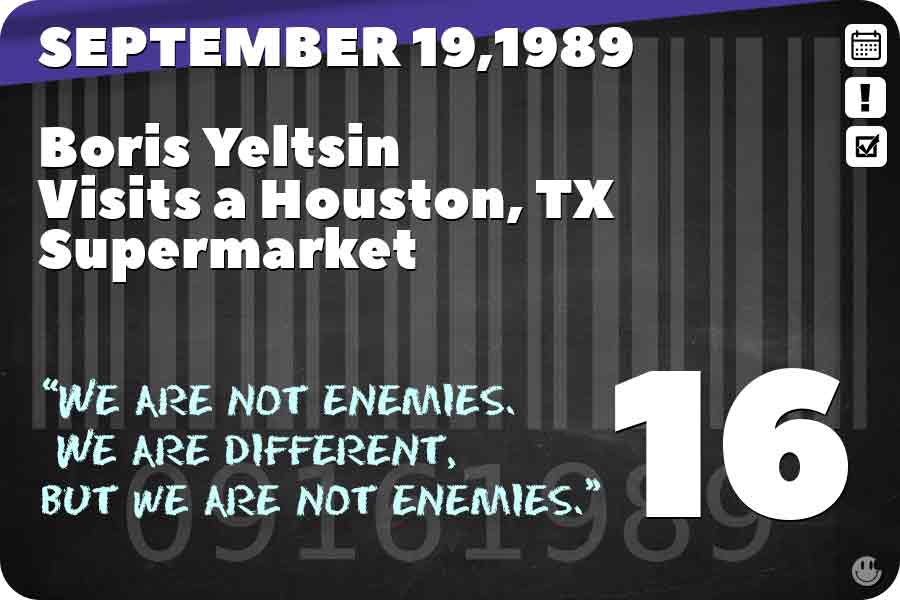
    On September 16th, 1989, Boris Yeltsin, then newly elected to the new Soviet parliament and the Supreme Soviet, had just visited Johnson Space Center in Clear Lake, Texas, and invited himself to visit a regular American Supermarket. The store manager, Paul Yirga, only had 15 15-minute warnings and no pre-planned security. As he roamed the aisles of Randall’s, nodding his head in amazement, Yeltsin told his fellow Russians in his entourage that if their people, who often must wait in line for most goods, saw the conditions of U.S. supermarkets,” there would be a revolution.”

    It’s hard to believe that just 29 years ago, the collapse of communism was spurred by Yeltsin’s visit to an American grocery store. The shelves were stocked with so much food that he was in disbelief. While communist Russia was experiencing shortages and long lines for essential goods, America had abundant everything.

    This event perfectly exemplifies the saying, “A picture is worth a thousand words.” The images of Yeltsin in the grocery store were shared across the Soviet Union and caused an outcry. People couldn’t believe they were living in poverty when others had so much. This was one of the factors that led to the collapse of communism.

    It’s amazing to think about how a trip to the grocery store can change the course of history. Yeltsin’s visit was a wake-up call for the Soviet Union and led to more freedom and democracy for its people. 

    Yeltsin didn’t leave empty-handed, as he was given a small bag of goodies to enjoy on the rest of his trip. About a year after the Russian leader left office, a Yeltsin biographer later wrote that he was sad on the plane ride to Yeltsin’s next destination, Miami. He couldn’t stop thinking about the plentiful food at the grocery store and what his countrymen had to subsist on in Russia. Yeltsin’s visit to America changed his perspective and made him realize communism wasn’t working for the people. It was this realization that eventually led to the collapse of communism in Russia.

    World News:

    Operation Yellowbird was carried out by various Western intelligence services to help dissidents from the 1989 Tiananmen Square protests escape China through Hong Kong. Over 400 people were reportedly successfully evacuated, including 7 of the 21 major leaders of the protests.

    Emperor Hirohito (April 29, 1901 – January 7, 1989) ), the Emperor of WWII Japan, was the only “Axis Power” leader not to have died during the war; he died in 1989.

    In 1989, Queen Elizabeth II was the wealthiest person in the UK. In 2015, she fell out of the top 300.

    3% of Americans had passports in 1989.

    Alcohol News:

    Beer was banned in Iceland until March 1, 1989, which is now celebrated annually as Beer Day. Iceland outlawed all forms of alcohol in 1915, but within 20 years had unbanned all alcoholic beverages except for beer.

    Pop Culture Facts & History:

    The same Hershey’s Kisses Holiday Commercial has aired every season since 1989.

    One of the most expensive wine bottles that were never to have been drunk was a 1787 Margaux from Thomas Jefferson’s Collection. The owner brought it to a restaurant, and a waiter knocked it over. Insurance paid out $225,000 for it in 1989.

    The word with the most meanings in English is the verb ‘set’, with 430 meanings listed in the Second Edition of the Oxford English Dictionary, published in 1989. The word commands the longest entry in the dictionary at 60,000 words (326,000 characters).

    Lexus was introduced in the US market in 1989.

    The Energizer Bunny was introduced to an unsuspecting public, replacing gymnast Mary Lou Retton as the energetic spokesperson.

    Jules Verne’s shelved 1863 novel Paris in the Twentieth Century predicted gas-powered cars, fax machines, electric street lighting, maglev trains, the record industry, and the internet. His publisher deemed it pessimistic and lackluster. It was discovered in 1989 and finally published in 1994.

    Charging Bull, the famous statue on Wall Street was installed secretly and illegally outside the New York Stock Exchange in 1989 following the 1987 stock market crash. NYPD seized and impounded the sculpture but re-installed it two blocks south of the Exchange after a public outcry.

    The most generations alive in a single family  is seven. Augusta Bunge, aged 109 years, followed by her daughter, aged 89; her granddaughter, 70; her great-granddaughter, 52; her great-great-granddaughter, 33; her great-great-great-granddaughter, 15; and her great-great-great-great-grandson born in 1989.

    Buddy, the golden retriever that played the original Air Bud, is the same dog that played Comet on Full House. In 1989, his owner originally found him as a stray in the Sierra Nevada. He took Buddy in and trained him to play basketball, baseball, football, soccer, and hockey.

    In 1989, only 50% of the US had 911 service.

    On September 15, 1989, NASA published a comprehensive report on house plants that are best for cleaning indoor air pollution.

    All arcade games imported into North America from 1989 to 2000 had the following FBI slogan included in their attract mode: “Winners Don’t Use Drugs”.

    The first Reebok Pump shoes were released on November 24, 1989.

    Cost of a Super Bowl ad in 1989: $675,000

    The Habit:

    Game Boy

    1st Appearances & 1989’s Most Popular Christmas Gifts, Toys and Presents:

    Tetris, Sega Genesis, Polly Pockets, Nintendo Game Boy, Trolls*
    *Trolls appeared first in Europe in 1956. The first wave of Trolls was popularized in the United States in 1963.

    Popular and Best-selling Books From 1989:

    A Prayer for Owen Meany by John Irving
    California Gold by John Jakes
    Caribbean by James A. Michener
    Clear and Present Danger by Tom Clancy
    Daddy by Danielle Steel
    The Dark Half by Stephen King
    Geek Love by Katherine Dunn
    The Joy Luck Club by Amy Tan
    Midnight by Dean Koontz
    The Mummy, or Ramses the Damned by Anne Rice
    The Pillars of the Earth by Ken Follett
    Polar Star by Martin Cruz Smith
    The Remains of the Day by Kazuo Ishiguro
    The Russia House by John le Carre
    The Sands of Time by Sidney Shelton
    The Satanic Verses by Salman Rushdie
    The Seven Habits of Highly Effective People by Stephen R. Covey
    Star by Danielle Steel
    V for Vendetta by Alan Moore and David Lloyd
    While My Pretty One Sleeps by Mary Higgins Clark

    East End Shows:

    The Woman in Black (Play) Opened on June 7, 1989
    Miss Saigon (Musical) Opened on September 20, 1989, and closed on October 30, 1999
    Buddy – The Buddy Holly Story (Musical) Opened on October 12, 1989, and closed on March 3, 2002

    Broadway Show:

    Grand Hotel (Musical) Opened on November 12, 1989, and closed on April 25, 1992

    Best Film Oscar Winner:

    Rain Man (presented in 1989)

    1989 Entries to The National Film Registry:

    The Best Years of Our Lives (released in 1946)
    Casablanca (released in 1942)
    Citizen Kane (released in 1941)
    The Crowd (released in 1928)
    Dr. Strangelove (released in 1964)
    The General (released in 1927)
    Gone With the Wind (released in 1939)
    The Grapes of Wrath (released in 1940)
    High Noon (released in 1952)
    Intolerance (released in 1916)
    The Learning Tree (released in 1969)
    The Maltese Falcon (released in 1941)
    Modern Times (released in 1936)
    Mr. Smith Goes to Washington (released in 1939)
    Nanook of the North (released in 1922)
    On the Waterfront (released in 1954)
    The Searchers (released in 1956)
    Singin’ in the Rain (released in 1952)
    Snow White and the Seven Dwarfs (released in 1937)
    Some Like It Hot (released in 1959)
    Star Wars (released in 1977)
    Sunrise (released in 1927)
    Sunset Boulevard (released in 1950)
    Vertigo (released in 1958)
    The Wizard of Oz (released in 1939)

    The Big Movies: (according to boxofficemojo)

    1. Batman
    2. Indiana Jones and the Last Crusade
    3. Lethal Weapon 2
    4. Look Who’s Talking
    5. Honey, I Shrunk The Kids
    6. Back To The Future Part II
    7. Ghostbusters II
    8. Driving Miss Daisy
    9. Parenthood
    10. Dead Poets Society

    1989 Most Popular TV Shows:

    1. The Cosby Show (NBC)
    2. Roseanne (ABC)
    3. Cheers (NBC)
    4. A Different World (NBC)
    5. America’s Funniest Home Videos (ABC)
    6. The Golden Girls (NBC)
    7. 60 Minutes (CBS)
    8. The Wonder Years (ABC)
    9. Empty Nest (NBC)
    10. Monday Night Football (ABC)

    1989 Billboard Number One Songs:

    December 24, 1988- January 13, 1989:
    Every Rose Has Its Thorn – Poison

    January 14 – January 20:
    My Prerogative – Bobby Brown

    January 21 – February 3:
    Two Hearts – Phil Collins

    February 4 – February 10:
    When I’m With You – Sheriff

    February 11 – March 3:
    Straight Up – Paula Abdul

    March 4 – March 24:
    Lost In Your Eyes – Debbie Gibson

    March 25 – March 31:
    The Living Years – Mike & The Mechanics

    April 1 – April 7:
    Eternal Flame – The Bangles

    April 8 – April 14:
    The Look – Roxette

    April 15 – April 21:
    She Drives Me Crazy – Fine Young Cannibals

    April 22 – May 12:
    Like a Prayer – Madonna

    May 13 – May 19:
    I’ll Be There for You – Bon Jovi

    May 20 – June 2:
    Forever Your Girl – Paula Abdul

    June 3 – June 9:
    Rock On – Michael Damian

    June 10 – June 16:
    Wind Beneath My Wings – Bette Midler

    June 17- June 23:
    I’ll Be Loving You (Forever) – New Kids On The Block

    June 24 – June 30:
    Satisfied – Richard Marx

    July 1 – July 7:
    Baby Don’t Forget My Number – Milli Vanilli

    July 8 – July 14:
    Good Thing – Fine Young Cannibals

    July 15 – July 21:
    If You Don’t Know Me By Now – Simply Red

    July 22 – August 4:
    Toy Soldiers – Martika

    August 5 – August 11:
    Batdance – Prince

    August 12 – September 1:
    Right Here Waiting – Richard Marx

    September 2 – September 8:
    Cold-Hearted – Paula Abdul

    September 9 – September 15:
    Hangin’ Tough – New Kids On The Block

    September 16 – September 22:
    Don’t Wanna Lose You – Gloria Estefan

    September 23 – October 6:
    Girl, I’m Gonna Miss You – Milli Vanilli

    October 7 – November 3:
    Miss You Much – Janet Jackson

    November 4 – November 10:
    Listen to Your Heart – Roxette

    November 11 – November 24:
    When I See You Smile – Bad English

    November 25 – December 9:
    Blame It On The Rain – Milli Vanilli

    December 9 – December 22:
    We Didn’t Start The Fire – Billy Joel

    December 23, 1989 – January 13, 1990:
    Another Day In Paradise – Phil Collins

    Sports:

    World Series Champions: Oakland Athletics
    Super Bowl XXIII Champions: San Francisco 49ers
    NBA Champions: Detroit Pistons
    Stanley Cup Champs: Calgary Flames
    U.S. Open Golf Curtis Strange
    U.S. Tennis: (Men/Ladies) Boris Becker/Steffi Graf
    Wimbledon (Men/Women): Boris Becker/Steffi Graf
    NCAA Football Champions: Miami
    NCAA Basketball Champions: Michigan
    Kentucky Derby: Sunday Silence

    More 1989 Facts and History Resources:

    Most Popular Baby Names (BabyCenter.com)
    Popular and Notable Books (popculture.us)
    Broadway Shows that Opened in 1989X
    1989 Calendar, courtesy of Time and Date.com
    Exxon Valdez Oil Spill
    Fact Monster
    1980s, Infoplease.com World History
    1989 in Movies (according to IMDB)
    1989 Top Movies (according to BoxOfficeMojo)
    Retrowaste Vintage Culture
    The 80s(History.com)
    |80s and 90s Classic NES Games (1985-1994)
    1980s Slang
    1980s Timeline (Security and Exchange Commision)
    Wikipedia 1989

  • Boris Yeltsin’s Visit To a Texas Supermarket in 1989

    Boris Yeltsin’s Visit To a Texas Supermarket in 1989

    Boris Yeltsin’s Eye-Opening Visit To a Texas Supermarket in 1989

    Boris Yeltsin, during his visit to the United States in 1989 as the Chairman of the Presidium of the Supreme Soviet of the Russian SFSR. On September 16, 1989, visited a supermarket in Houston, Texas. 

    The main reason for this visit was to see firsthand the abundance and variety of consumer goods available in the United States and to learn about American-style retailing and distribution methods, as he was trying to implement market reform in Russia.

    The visit was considered a symbol of the new openness and democracy in the Soviet Union and Yeltsin’s desire to modernize the Soviet economy and improve the standard of living of the Russian people. This visit is also considered as a turning point in the history of US-Russia relations as it shows the willingness of the Soviet leader to learn from the West and to reform the Soviet economy.

    Economic “Eye-Opener”

    He reportedly said that the visit was “an eye-opener” for him, and that the abundance and variety of consumer goods available in the United States struck him. He also said that the supermarket’s efficient system of stocking and selling goods, and its use of barcode scanners and computerized inventory systems, was something the Soviet Union could learn from.

    In particular, Yeltsin said that the visit made him realize that the Soviet Union needed to change the way it approached economic issues and that a market-oriented approach was necessary to improve the standard of living of the Soviet people. 

    “I saw with my own eyes that the people in the United States are living better than we are. They have more goods, more food, more everything. We must change that.”

    Yeltsin also spoke about the importance of the visit in terms of US-Russia relations: “I want to tell the American people that I saw with my own eyes the kind of life they have, and I want to say that we are not enemies. We are not enemies. We are different, but we are not enemies.”

    These statements were widely reported in the Soviet media and helped to raise public awareness and support for the economic reforms that Yeltsin was proposing. His visit to the supermarket was seen as a turning point in the history of the Soviet Union, as it marked the beginning of a new era of openness and engagement with the West, helping bring an end to The Cold War (March 12, 1947 – December 26, 1991)

    After his visit to the supermarket in Houston, Texas, Boris Yeltsin returned to the Soviet Union and continued to push for market reform and economic modernization. He advocated for introducing market-oriented policies and creating a market economy in the Soviet Union, which was in stark contrast to the central planning and state control that had characterized the Soviet economy for decades.

    Yeltsin’s visit to the United States, specifically the supermarket, symbolized the changes he was trying to implement in the Soviet Union. The abundance of consumer goods and the efficiency of the American-style retail system was in stark contrast to the shortages and inefficiencies of the Soviet economy. His visit was widely covered in the Soviet media and helped to raise public awareness and support for the economic reforms he was proposing.

    Yeltsin’s efforts to implement market reform were met with resistance from the Soviet establishment, and the economic reform process was slow and difficult. However, Yeltsin’s visit to the United States was seen as a turning point in the history of the Soviet Union, as it marked the beginning of a new era of openness and engagement with the West.

    In 1991, Yeltsin became the first president of the Russian Federation, and his government continued to implement market-oriented economic policies, which led to a significant transformation of the Russian economy. However, the transition to a market economy was challenging, and it took several years for the Russian economy to stabilize.

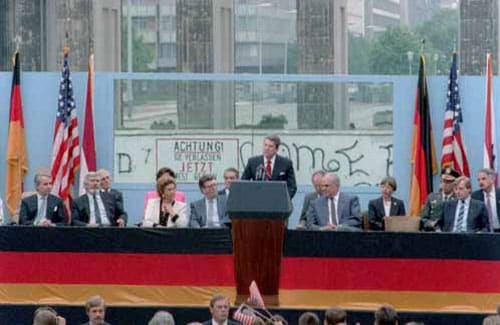
  • Remarks at the Brandenburg Gate by Ronald Reagan

    Remarks at the Brandenburg Gate by Ronald Reagan

    “Remarks at the Brandenburg Gate”
    by Ronald Reagan, on June 12, 1987, in Berlin


    Chancellor Kohl, Governing Mayor Diepgen, ladies and gentlemen: Twenty four years ago, President John F. Kennedy visited Berlin, and speaking to the people of this city and the world at the city hall. Well since then two other presidents have come, each in his turn to Berlin. And today, I, myself, make my second visit to your city.

    We come to Berlin, we American Presidents, because it’s our duty to speak in this place of freedom. But I must confess, we’re drawn here by other things as well; by the feeling of history in this city- more than 500 years older than our own nation; by the beauty of the Grunewald and the Tiergarten; most of all, by your courage and determination. Perhaps the composer, Paul Linke, understood something about American Presidents. You see, like so many Presidents before me, I come here today because wherever I go, whatever I do: Ich hab noch einen Koffer in Berlin. [I still have a suitcase in Berlin.]

    Our gathering today is being broadcast throughout Western Europe and North America. I understand that it is being seen and heard as well in the East. To those listening throughout Eastern Europe, I extend my warmest greetings and the good will of the American people. To those listening in East Berlin, a special word: Although I cannot be with you, I address my remarks to you just as surely as to those standing here before me. For I join you, as I join your fellow countrymen in the West, in this firm, this unalterable belief: Es gibt nur ein Berlin. [There is only one Berlin.]

    Behind me stands a wall that encircles the free sectors of this city, part of a vast system of barriers that divides the entire continent of Europe. From the Baltic South, those barriers cut across Germany in a gash of barbed wire, concrete, dog runs, and guard towers. Farther south, there may be no visible, no obvious wall. But there remain armed guards and checkpoints all the same- still a restriction on the right to travel, still an instrument to impose upon ordinary men and women the will of a totalitarian state.

    Yet, it is here in Berlin where the wall emerges most clearly; here, cutting across your city, where the news photo and the television screen have imprinted this brutal division of a continent upon the mind of the world.

    Standing before the Brandenburg Gate, every man is a German separated from his fellow men.

    Every man is a Berliner, forced to look upon a scar.

    President Von Weizsäcker has said, “The German question is open as long as the Brandenburg Gate is closed.” Well today- today I say: As long as this gate is closed, as long as this scar of a wall is permitted to stand, it is not the German question alone that remains open, but the question of freedom for all mankind.

    Yet, I do not come here to lament. For I find in Berlin a message of hope, even in the shadow of this wall, a message of triumph.

    In this season of spring in 1945, the people of Berlin emerged from their air-raid shelters to find devastation. Thousands of miles away, the people of the United States reached out to help. And in 1947 Secretary of State- as you’ve been told- George Marshall announced the creation of what would become known as the Marshall Plan. Speaking precisely 40 years ago this month, he said: “Our policy is directed not against any country or doctrine, but against hunger, poverty, desperation, and chaos.”

    In the Reichstag a few moments ago, I saw a display commemorating this 40th anniversary of the Marshall Plan. I was struck by a sign- the sign on a burnt-out, gutted structure that was being rebuilt. I understand that Berliners of my own generation can remember seeing signs like it dotted throughout the western sectors of the city. The sign read simply: “The Marshall Plan is helping here to strengthen the free world.” A strong, free world in the West- that dream became real. Japan rose from ruin to become an economic giant. Italy, France, Belgium- virtually every nation in Western Europe saw political and economic rebirth; the European Community was founded.

    In West Germany and here in Berlin, there took place an economic miracle, the Wirtschaftswunder [Miracle on the Rhine]. Adenauer, Erhard, Reuter, and other leaders understood the practical importance of liberty- that just as truth can flourish only when the journalist is given freedom of speech, so prosperity can come about only when the farmer and businessman enjoy economic freedom. The German leaders- the German leaders reduced tariffs, expanded free trade, lowered taxes. From 1950 to 1960 alone, the standard of living in West Germany and Berlin doubled.

    Where four decades ago there was rubble, today in West Berlin there is the greatest industrial output of any city in Germany: busy office blocks, fine homes and apartments, proud avenues, and the spreading lawns of parkland. Where a city’s culture seemed to have been destroyed, today there are two great universities, orchestras and an opera, countless theaters, and museums. Where there was want, today there’s abundance- food, clothing, automobiles- the wonderful goods of the Kudamm.1 From devastation, from utter ruin, you Berliners have, in freedom, rebuilt a city that once again ranks as one of the greatest on earth. Now the Soviets may have had other plans. But my friends, there were a few things the Soviets didn’t count on: Berliner Herz, Berliner Humor, ja, und Berliner Schnauze. [Berliner heart, Berliner humor, yes, and a Berliner Schnauze.2]

    In the 1950s- In the 1950s Khrushchev predicted: “We will bury you.”

    But in the West today, we see a free world that has achieved a level of prosperity and well-being unprecedented in all human history. In the Communist world, we see failure, technological backwardness, declining standards of health, even want of the most basic kind- too little food. Even today, the Soviet Union still cannot feed itself. After these four decades, then, there stands before the entire world one great and inescapable conclusion: Freedom leads to prosperity. Freedom replaces the ancient hatreds among nations with comity and peace. Freedom is the victor.

    And now- now the Soviets themselves may, in a limited way, be coming to understand the importance of freedom. We hear much from Moscow about a new policy of reform and openness. Some political prisoners have been released. Certain foreign news broadcasts are no longer being jammed. Some economic enterprises have been permitted to operate with greater freedom from state control.

    Are these the beginnings of profound changes in the Soviet state? Or are they token gestures intended to raise false hopes in the West, or to strengthen the Soviet system without changing it? We welcome change and openness; for we believe that freedom and security go together, that the advance of human liberty- the advance of human liberty can only strengthen the cause of world peace.

    There is one sign the Soviets can make that would be unmistakable, that would advance dramatically the cause of freedom and peace.

    General Secretary Gorbachev, if you seek peace, if you seek prosperity for the Soviet Union and Eastern Europe, if you seek liberalization: Come here to this gate.

    Mr. Gorbachev, open this gate.

    Mr. Gorbachev- Mr. Gorbachev, tear down this wall!

    I understand the fear of war and the pain of division that afflict this continent, and I pledge to you my country’s efforts to help overcome these burdens. To be sure, we in the West must resist Soviet expansion. So, we must maintain defenses of unassailable strength. Yet we seek peace; so we must strive to reduce arms on both sides.

    Beginning 10 years ago, the Soviets challenged the Western alliance with a grave new threat, hundreds of new and more deadly SS-20 nuclear missiles capable of striking every capital in Europe. The Western alliance responded by committing itself to a counter-deployment (unless the Soviets agreed to negotiate a better solution)- namely, the elimination of such weapons on both sides. For many months, the Soviets refused to bargain in earnestness. As the alliance, in turn, prepared to go forward with its counter-deployment, there were difficult days, days of protests like those during my 1982 visit to this city; and the Soviets later walked away from the table.

    But through it all, the alliance held firm. And I invite those who protested then- I invite those who protest today- to mark this fact: Because we remained strong, the Soviets came back to the table. Because we remained strong, today we have within reach the possibility, not merely of limiting the growth of arms, but of eliminating, for the first time, an entire class of nuclear weapons from the face of the earth.

    As I speak, NATO ministers are meeting in Iceland to review the progress of our proposals for eliminating these weapons. At the talks in Geneva, we have also proposed deep cuts in strategic offensive weapons. And the Western allies have likewise made far-reaching proposals to reduce the danger of conventional war and to place a total ban on chemical weapons.

    While we pursue these arms reductions, I pledge to you that we will maintain the capacity to deter Soviet aggression at any level at which it might occur. And in cooperation with many of our allies, the United States is pursuing the Strategic Defense Initiative- research to base deterrence not on the threat of offensive retaliation, but on defenses that truly defend; on systems, in short, that will not target populations, but shield them. By these means we seek to increase the safety of Europe and all the world. But we must remember a crucial fact: East and West do not mistrust each other because we are armed; we are armed because we mistrust each other. And our differences are not about weapons but about liberty. When President Kennedy spoke at the City Hall those 24 years ago, freedom was encircled; Berlin was under siege. And today, despite all the pressures upon this city, Berlin stands secure in its liberty. And freedom itself is transforming the globe.

    In the Philippines, in South and Central America, democracy has been given a rebirth. Throughout the Pacific, free markets are working miracle after miracle of economic growth. In the industrialized nations, a technological revolution is taking place, a revolution marked by rapid, dramatic advances in computers and telecommunications.

    In Europe, only one nation and those it controls refuse to join the community of freedom. Yet in this age of redoubled economic growth, of information and innovation, the Soviet Union faces a choice: It must make fundamental changes, or it will become obsolete.

    Today, thus, represents a moment of hope. We in the West stand ready to cooperate with the East to promote true openness, to break down barriers that separate people, to create a safer, freer world. And surely there is no better place than Berlin, the meeting place of East and West, to make a start.

    Free people of Berlin: Today, as in the past, the United States stands for the strict observance and full implementation of all parts of the Four Power Agreement of 1971. Let us use this occasion, the 750th anniversary of this city, to usher in a new era, to seek a still fuller, richer life for the Berlin of the future. Together, let us maintain and develop the ties between the Federal Republic and the Western sectors of Berlin, which is permitted by the 1971 agreement.

    And I invite Mr. Gorbachev: Let us work to bring the Eastern and Western parts of the city closer together, so that all the inhabitants of all Berlin can enjoy the benefits that come with life in one of the great cities of the world.

    To open Berlin still further to all Europe, East and West, let us expand the vital air access to this city, finding ways of making commercial air service to Berlin more convenient, more comfortable, and more economical. We look to the day when West Berlin can become one of the chief aviation hubs in all central Europe.

    With- With our French- With our French and British partners, the United States is prepared to help bring international meetings to Berlin. It would be only fitting for Berlin to serve as the site of United Nations meetings, or world conferences on human rights and arms control, or other issues that call for international cooperation.

    There is no better way to establish hope for the future than to enlighten young minds, and we would be honored to sponsor summer youth exchanges, cultural events, and other programs for young Berliners from the East. Our French and British friends, I’m certain, will do the same. And it’s my hope that an authority can be found in East Berlin to sponsor visits from young people of the Western sectors.

    One final proposal, one close to my heart: Sport represents a source of enjoyment and ennoblement, and you may have noted that the Republic of Korea- South Korea- has offered to permit certain events of the 1988 Olympics to take place in the North. International sports competitions of all kinds could take place in both parts of this city. And what better way to demonstrate to the world the openness of this city than to offer in some future year to hold the Olympic games here in Berlin, East and West.

    In these four decades, as I have said, you Berliners have built a great city. You’ve done so in spite of threats- the Soviet attempts to impose the East-mark, the blockade. Today the city thrives in spite of the challenges implicit in the very presence of this wall. What keeps you here? Certainly there’s a great deal to be said for your fortitude, for your defiant courage.

    But I believe there’s something deeper, something that involves Berlin’s whole look and feel and way of life- not mere sentiment. No one could live long in Berlin without being completely disabused of illusions. Something, instead, that has seen the difficulties of life in Berlin but chose to accept them, that continues to build this good and proud city in contrast to a surrounding totalitarian presence, that refuses to release human energies or aspirations, something that speaks with a powerful voice of affirmation, that says “yes” to this city, yes to the future, yes to freedom. In a word, I would submit that what keeps you in Berlin- is “love.”

    Love both profound and abiding.

    Perhaps this gets to the root of the matter, to the most fundamental distinction of all between East and West. The totalitarian world produces backwardness because it does such violence to the spirit, thwarting the human impulse to create, to enjoy, to worship. The totalitarian world finds even symbols of love and of worship an affront.

    Years ago, before the East Germans began rebuilding their churches, they erected a secular structure: the television tower at Alexander Platz. Virtually ever since, the authorities have been working to correct what they view as the tower’s one major flaw: treating the glass sphere at the top with paints and chemicals of every kind. Yet even today when the sun strikes that sphere, that sphere that towers over all Berlin, the light makes the sign of the cross. There in Berlin, like the city itself, symbols of love, symbols of worship, cannot be suppressed.

    As I looked out a moment ago from the Reichstag, that embodiment of German unity, I noticed words crudely spray-painted upon the wall, perhaps by a young Berliner (quote):

    “This wall will fall. Beliefs become reality.”

    Yes, across Europe, this wall will fall, for it cannot withstand faith; it cannot withstand truth. The wall cannot withstand freedom.

    And I would like, before I close, to say one word. I have read, and I have been questioned since I’ve been here about certain demonstrations against my coming. And I would like to say just one thing, and to those who demonstrate so. I wonder if they have ever asked themselves that if they should have the kind of government they apparently seek, no one would ever be able to do what they’re doing again.

    Thank you and God bless you all. Thank you.

  • Deployment of Pershing II Missiles in West Germany

    Deployment of Pershing II Missiles in West Germany

    The Deployment of Pershing II Missiles in West Germany: Cold War Tensions

    The 1983 deployment of Pershing II missiles in West Germany was a critical event during the Cold War, as it increased tensions between the United States and the Soviet Union, and sparked widespread protests in Europe due to concerns about escalating the arms race and the potential for nuclear conflict.

    The first Pershing II missiles were deployed in West Germany beginning in late November 1983 and completed in late 1985 with 108 launchers. Initial Operational Status (IOS) was achieved on December 15, 1983, when A Battery, 1st Battalion, 41st Field Artillery Regiment rotated onto operational status with the Pershing II at its site in Mutlangen.

    In the late 1970s, NATO became increasingly concerned about the Soviet Union’s deployment of SS-20 intermediate-range ballistic missiles (IRBMs) in Eastern Europe, which were capable of striking targets throughout Western Europe with little warning. In response, NATO adopted the “dual-track” decision in 1979, which called for the deployment of new U.S. intermediate-range nuclear forces (INF) in Europe, specifically the Pershing II IRBMs and ground-launched cruise missiles (GLCMs), while also pursuing arms control negotiations with the Soviet Union.

    The Pershing II was a mobile, solid-fueled missile with a range of approximately 1,800 kilometers (1,100 miles), capable of carrying a nuclear warhead. Its increased accuracy and short flight time made it a formidable weapon, as it could potentially destroy heavily fortified targets, such as Soviet missile silos and command centers.

    Despite ongoing arms control negotiations and widespread public opposition to the deployment, the first Pershing II missiles arrived in West Germany in November 1983. The deployment was met with massive protests throughout Europe, with hundreds of thousands of people taking to the streets to voice their concerns about the increased risk of nuclear war.

    The deployment of the Pershing II missiles in West Germany also had significant implications for U.S.-Soviet relations, contributing to a further deterioration of the already tense relationship between the two superpowers. The Soviet Union responded to the deployment by breaking off INF negotiations and deploying additional SS-20 missiles in Eastern Europe.

    The Pershing II missiles remained in West Germany until the signing of the Intermediate-Range Nuclear Forces (INF) Treaty in 1987, which resulted in the elimination of all U.S. and Soviet IRBMs, including the Pershing II and SS-20 missiles. The treaty marked a significant milestone in arms control and helped to reduce tensions between the United States and the Soviet Union during the final years of the Cold War.

  • The Able Archer 83 Exercise: NATO’s War Simulation and Soviet Reaction

    The Able Archer 83 Exercise: NATO’s War Simulation and Soviet Reaction

    The Able Archer 83 Exercise: NATO’s War Simulation and Soviet Reaction

    The Able Archer 83 Exercise was a NATO military simulation in November 1983, which heightened Cold War tensions and brought the United States and the Soviet Union closer to a nuclear confrontation due to misinterpretation and fear of a potential preemptive strike.

    Able Archer 83 was a routine annual command post-exercise conducted by NATO forces across Western Europe. The exercise, which took place from November 2 to November 11, 1983, simulated a period of escalating conflict between NATO and the Warsaw Pact, culminating in a coordinated nuclear release scenario. The simulation aimed to test and improve NATO’s nuclear release procedures, communication, and decision-making processes.

    However, the context of the exercise was anything but routine. In the early 1980s, the Cold War had entered a particularly tense phase, characterized by the deployment of intermediate-range nuclear missiles in Europe, the downing of Korean Air Flight 007 by the Soviet Union, and heated rhetoric between the United States and the Soviet Union. This tense atmosphere fueled Soviet paranoia and distrust of NATO’s intentions.

    During the Able Archer 83 exercise, the Soviet leadership, led by General Secretary Yuri Andropov, misinterpreted the simulation as a cover for an actual NATO nuclear attack on the Soviet Union. As a result, the Soviet Union placed its military forces on high alert, ready to launch a retaliatory strike if necessary.

    The situation was further exacerbated by a series of intelligence failures and miscommunications on both sides. The United States, unaware of the Soviet Union’s heightened state of alert, continued the exercise as planned. At the same time, the Soviet Union mobilized its forces, including nuclear-armed bombers and ballistic missile submarines, in anticipation of a potential attack.

    Fortunately, Able Archer 83 ended without incident, and tensions gradually subsided. The close call exposed the dangerous potential for misinterpretation and miscalculation during the Cold War, prompting both sides to reassess their intelligence-gathering methods and communication channels.

    The Able Archer 83 Exercise remains a significant event in Cold War history, illustrating the fragility of peace in the face of escalating tensions and the critical importance of effective communication and understanding between rival powers.

  • 1979 History, Facts and Trivia

    1979 History, Facts and Trivia

    1979 History, Facts and Trivia

    Quick Facts from 1979

    • World-Changing Event: Khomeini’s Iranian Revolution over Mohammad Reza Shah Pahlavi.
    • The Other World-Changing Event: The Introduction of the Sony Walkman.
    • The Top Song was My Sharona by The Knack.
    • The Movies to Watch include Alien, Rocky 2, The Muppet Movie, Apocalypse Now and Star Trek: The Motion Picture, and The Life of Brian.
    • The Most Famous Person in America was probably Pope John Paul II.
    • Notable books include Flowers in the Attic by V. C. Andrews and The Hitchhiker’s Guide to the Galaxy by Douglas Adams.
    • US Life Expectancy: Males: 70.0 years, Females: 77.8 years
    • Minimum Wage in 1979: $2.90 per hour
      Composition book, 100 pages: 69 cents
    • The Funny Late Night Host: Johnny Carson
    • Girl Power: Fully independent in 1979, Saint Lucia is the only country in the world named after a woman

    Top Ten Baby Names of 1979

    Jennifer, Melissa, Amanda, Jessica, Amy, Michael, Chris, Topher, Jason, David, James

    Fashion Icons and Sex Symbols

    Loni Anderson, Susan Anton, Barbara Bach, Catherine Bach, Kim Basinger, Valerie Bertinelli, Jacqueline Bisset, Christie Brinkley, Lynda Carter, Bo Derek, Farrah Fawcett, Erin Gray, Shelly Hack, Debbie Harry, Marilu Henner, Lauren Hutton, Kate Jackson, Cheryl Ladd, Olivia Newton-John, Stevie Nicks, Dolly Parton, Bernadette Peters, Victoria Principal, Diana Ross, Jane Seymour, Brooke Shields, Jacquelyn Smith, Suzanne Somers, Donna Summer, Cheryl Tiegs, Charlene Tilton, Mary Woronov

    Leading Men and Hollywood Heartthrobs

    Gregg Allman, David Cassidy, Patrick Duffy, Sam Elliott, Harrison Ford, Andy Gibb, Mark Hamill, Julio Iglesias, Kris Kristofferson, Lee Majors, Jack Nicholson, Ryan O’Neal, Burt Reynolds, Richard Roundtree, Davide Lee Roth, Sylvester Stallone, Rod Stewart, John Travolta

    “The Quotes”

    “I love the smell of napalm in the morning.”
    – Robert Duvall in ‘Apocalypse Now’

    “Have a Coke and smile.”
    -Coca-Cola

    “Quality is job one.”
    – Ford

    “Nothing comes between me and my Calvins.”
    – Brooke Shields, for Calvin Klein

    “Reach out and touch someone.”
    – AT&T

    Time Magazine’s Man of the Year:
    Ayatollah Khomeini

    Miss America

    Kylene Barker (Roanoke, VA)

    Miss USA

    Mary Therese Friel (New York)

    The Bad News

    Ford’s Pinto automobile design allowed its fuel tank to be easily damaged during a rear-end collision, sometimes resulting in deadly fires and explosions. Ford first noticed it in 1971 tests.

    The Three Mile Island Unit 2 reactor, near Middletown, Pa., partially melted down on March 28, 1979. This was the most serious accident in U.S. commercial nuclear power plant operating history, although its minor radioactive releases had no detectable health effects on plant workers or the public. Its aftermath brought about sweeping changes involving emergency response planning, reactor operator training, human factors engineering, radiation protection, and many other areas of nuclear power plant operations. A combination of equipment malfunctions, design-related problems, and worker errors led to TMI-2’s partial meltdown and very small off-site releases of radioactivity.

    52 Americans are taken hostage in Tehran, Iran, for 444 days. Four days later, ABC’s Nightline premiered, centering on the crisis.

    NASA’s Skylab fell to Earth, landing mainly in the Indian Ocean.

    Rock and Roll Death: Sid Vicious (heroin overdose)

    Eleven people were crushed to death outside of Cincinnati Riverfront Coliseum before a concert by The Who.

    Cleveland School Shooting

    The Cleveland School Shooting in San Diego, CA, is remembered as one of the deadliest school shootings in United States history. On January 29, 1979, 16-year-old Brenda Spencer opened fire on the Cleveland Elementary School from her house across the street with a rifle, killing two people and injuring eight others. She said she did it because “I don’t like Mondays.”

    In response to this shooting, schools have looked for ways to protect their students better; one such measure has been to install metal detectors at school entrances, though this can be costly and time-consuming. Schools have also turned to other measures, such as improved surveillance tracking systems to protect their students from potential threats better.

    1979 Pop Culture Facts & History

    A song called ‘Ready ‘n’ Steady’ by ‘D.A’ appeared on several charts peaking at #102, but it is very, very hard to find.

    Eight “Sea Shepherd” activists were arrested in 1979 for violating the Seal Protection Act, for spraying a thousand seal pups with permanent red dye, which made their pelts useless for hunters.

    Scrappy-Doo was first added to the cast of Scooby-Doo in 1979.

    Hurricanes were traditionally named only after women. After feminist groups protested over the implied slur that women alone were tempestuous and unpredictable, men’s names were also used for such weather phenomena beginning in 1979.

    Australia Fined NASA $400 for littering after debris from the spacecraft “Skylab” landed in the Shire of Esperance, Western Australia. NASA never paid. Thirty years later, California DJ Scott Barley raised funds from his listeners and paid NASA’s bill. Scott got a key to the city for his efforts.

    The Guardian Angels were formed in New York City as an unarmed organization of young crime fighters.

    The eradication of the smallpox virus was certified.

    Black and Decker released the now-famous cordless mini-vacuum, The Dustbuster.

    1979 -The film The China Syndrome, a movie about a nuclear meltdown caused by a faulty sensor reading and a stuck-open pressure release valve, was released only 12 days before the 3 Mile Island Meltdown on March 28, 1979, caused by a faulty sensor reading and a stuck open pressure release valve.

    Rhodesia became Zimbabwe

    The highest Nielsen rating (24.1) for any basketball game in the US, college or pro, is still the 1979 NCAA Championship between Michigan State, with Magic Johnson, and Indiana State, with Larry Bird. The highest-rated and most-watched NBA Final game was Game 6 of the 1998 NBA Finals which averaged a 22.3 rating.

    Chrysler received a $1.5 Billion government loan guarantee from the United States government.

    Chip Shearin had to play bass, and Bryan Horton had to play the drums for 15 minutes straight on the 1979 song “Rapper’s Delight” by The Sugarhill Gang because it was the days before samplers and drum machines.

    Tens of thousands of rock fans gathered at Disco Demolition Night was an ill-fated baseball promotion on July 12, 1979, at Comiskey Park in Chicago, Illinois. On The Day That Disco Died, the field was ruined, and The Chicago White Sox had to forfeit the second game (of the doubleheader) to the Detroit Tigers.

    Pope John Paul II visited the United States.

    Elvita Adams jumped from the 86th floor of the Empire State Building in an attempted suicide, only to be blown back onto the 85th floor by a gust of wind. Her only injury was a broken hip.

    A (still) unknown group of people paid for the erection of the Georgia Guidestones, six granite slabs that instruct the survivors of an apocalyptic scenario on rebuilding a better world. The builder was told that it was planned for 20 years; it was completed in 1980.

    The Surf Ballroom in Clear Lake, Iowa, is the venue where Buddy Holly, Ritchie Valens, and The Big Bopper gave their final performances on February 2, 1959. Each February, since 1979, the venue hosts a Winter Dance Party (the name of Holly’s last tour) in honor of the three stars.

    Pushing the Envelope is a reference to a World War 2 flight envelope. WWII pilots used it to describe upper and lower conditions where the pilot could fly. To push those conditions, increased capabilities and technology. The phrase was brought into the mainstream in 1979 by Tom Wolfe’s book, The Right Stuff.

    Cost of a Super Bowl ad in 1979: $185,000

    RIP

    In January 1979, 16-year-old Brenda Ann Spencer was arrested after killing a principal and a custodian at an elementary school in California. When asked why she did it, she replied, “I just don’t like Mondays.” She also injured eight children and a police officer.

    On January 25, 1979, Robert Williams became the first known human being killed by a robot. He was an American factory worker at the Ford Motor Company Flat Rock Casting Plant in Michigan. He was struck from behind and crushed by a one-ton cart moved by a robot arm, killing him instantly.

    The Who Concert Disaster: Eleven fans were crushed to death during a crowd surge for unreserved seats before The Who rock concert at the Riverfront Coliseum in Cincinnati, Ohio.

    When Australia abolished its inheritance tax in 1979, an unusually high number of parents died in the week immediately after the abolition went into effect, suggesting that many of their heirs were doing everything to keep them alive just long enough for the inheritance tax to expire.

    The Mount Erebus Disaster: A plane crash in Antarctica (Air New Zealand Flight 901) in which 237 tourists and 20 crew were killed on a sightseeing flight due to an error in flight planning and a phenomenon known as “sector whiteout” in which there is no contrast between the sky and the ground.

    Cold War

    In the late 1980s, FBI agent Robert Hanssen was tasked by his superiors to find a mole within the agency after the FBI’s moles in the KGB were caught. In reality, he was the mole, working with the KGB since 1979.

    NORAD experienced a computer glitch that alerted technicians of a widespread Russian nuclear attack on North America. The U.S. air defense program ordered the president’s “doomsday plane” to take off and warned launch control to prepare for a retaliatory attack.

    Nobel Prize Winners

    Physics – Sheldon Lee Glashow, Abdus Salam, Steven Weinberg
    Chemistry – Herbert C. Brown, Georg Wittig
    Medicine – Allan M. Cormack, Godfrey N. Hounsfield
    Literature – Odysseas Elytis
    Peace – Mother Teresa
    Economics – Theodore Schultz, Arthur Lewis

    The Habit

    Jogging while listening to tapes on your Sony Walkman and wearing a Lacoste preppy shirt with the famous alligator on the left side and designer jeans.

    1st Appearances & 1979’s Most Popular Christmas Gifts, Toys and Presents

    Walkman cassette/radio

    More Firsts

    Modern Sudoku was created by an American architect named Howard Garns in 1979, using the name “Number Place”. It became more popular in 1986 by the Japanese puzzle company Nikoli, under “Sudoku,” meaning “single number.”

    ESPN (Entertainment and Sports Programming Network) began broadcasting on September 7.

    April 1st – Nickelodeon TV cable network began.

    Victoria’s Secret stores opened in 1979. It went national in 1982 after being acquired by Limited Brands.

    The McDonald’s Happy Meal first went on sale in 1979.

    Debuting on PBS as a one-time, 13-part series, This Old House was one of the earliest home improvement shows and is arguably the most well-known.

    The first use of the phrase “May the Fourth Be With You” was by a Danish political party that placed a congratulatory advertisement in The London Evening News when Margaret Thatcher took office as Prime Minister on May 4th, 1979, “May the Fourth Be with You, Maggie. Congratulations.”

    Etan Patz was the 1st missing child to have their picture on a milk carton in 1979, and the murderer wasn’t caught till 2012.

    Best Film Oscar Winner

    The Deer Hunter (presented in 1979)

    Broadway Shows

    They’re Playing Our Song (Musical) Opened on February 11, 1979, and closed on September 6, 1981
    Evita (Musical) Opened on September 25, 1979, and closed on June 26, 1983
    Sugar Babies (Review) Opened on October 8, 1979, and closed on August 28, 1982

    Popular and Best-selling Books From 1979

    1985 by John Hackett
    A Wizard of Earthsea by Ursula K. Le Guin
    The Bloody Chamber by Angela Carter
    Chesapeake by James Michener
    The Dead Zone by Stephen King
    The Establishment by Howard Fast
    The Executioner’s Song by Norman Mailer
    Flowers in the Attic by V.C. Andrews
    Good as Gold by Joseph Heller
    The Hitchhiker’s Guide to the Galaxy by Douglas Adams
    Jailbird by Kurt Vonnegut
    Kane and Abel by Jeffrey Archer
    Kindred by Octavia Butler
    The Last Enchantment by Mary Stewart
    The Matarese Circle by Robert Ludlum
    Memories of Another Day by Harold Robbins
    Oh Say Can You Say? by Dr. Seuss
    Overload by Arthur Hailey
    Smiley’s People by John le Carré
    Sophie’s Choice by William Styron
    Triple by Ken Follett
    War and Remembrance by Herman Wouk
    The White Album by Joan Didion

    1979 Most Popular TV Shows

    1. 60 Minutes (CBS)
    2. Three’s Company (ABC)
    3. That’s Incredible! (ABC)
    4. Alice (CBS)
    5. M*A*S*H (CBS)
    6. Dallas (CBS)
    7. Flo (CBS)
    8. The Jeffersons (CBS)
    9. The Dukes of Hazzard (CBS)
    10. One Day at a Time (CBS)

    1979 Billboard Number One Songs

    January 6 – January 19:
    Too Much Heaven – Bee Gees

    January 20 – February 9:
    Le Freak – Chic

    February 10 – March 9:
    Do Ya Think I’m Sexy? – Rod Stewart

    March 10 – March 23:
    I Will Survive – Gloria Gaynor

    March 24 – April 6:
    Tragedy – Bee Gees

    April 7 – April 13:
    I Will Survive – Gloria Gaynor

    April 14 – April 20:
    What A Fool Believes – The Doobie Brothers

    April 21 – April 27:
    Knock on Wood – Amii Stewart

    April 28 – May 4:
    Heart of Glass – Blondie

    May 5 – June 30:
    Reunited – Peaches & Herb

    June 2 – June 8:
    Hot Stuff – Donna Summer

    June 9 – June 15:
    Love You Inside Out – Bee Gees

    June 16 – July 29:
    Hot Stuff – Donna Summer

    June 30 – July 13:
    Ring My Bell – Anita Ward

    July 14 – August 17:
    Bad Girls – Donna Summer

    August 18 – August 24:
    Good Times – Chic

    August 25 – October 5:
    My Sharona – The Knack

    October 6 – October 12:
    Sad Eyes – Robert John

    October 13 – October 19:
    Don’t Stop ‘Til You Get Enough – Michael Jackson

    October 20 – November 2:
    Rise – Herb Alpert

    November 3 – November 9:
    Pop Muzik – M

    November 10 – November 16:
    Heartache Tonight – The Eagles

    November 17 – November 23:
    Still – The Commodores

    November 24 – December 7:
    No More Tears (Enough Is Enough) – Barbra Streisand & Donna Summer

    December 8 – December 21:
    Babe – Styx

    December 22, 1979 – January 4, 1980:
    Escape (The Pina Colada Song) – Rupert Holmes

    Sports

    World Series Champions: Pittsburgh Pirates
    Super Bowl XIII Champions: Pittsburgh Steelers
    NBA Champions: Seattle SuperSonics
    Stanley Cup Champs: Montreal Canadiens
    U.S. Open Golf Hale Irwin
    U.S. Tennis: (Men/Ladies) John McEnroe/Tracy Austin
    Wimbledon (Men/Women): Bjorn Borg/Martina Navratilova
    NCAA Football Champions: Alabama
    NCAA Basketball Champions: Michigan State
    Kentucky Derby: Spectacular Bid


  • 1969 History, Facts and Trivia

    1969 History, Facts and Trivia

    1969 History, Facts and Trivia

    Quick Facts from 1969

    • World Changing Event: Neil A. Armstrong, Command Module pilot Michael Collins, and Lunar Module pilot Edwin “Buzz” E. Aldrin landed in the Sea of Tranquility on The Moon on July 20, 1969.
    • Other World-Changing Events: The Arpanet (the first internet) was created.
    • The Top Song was Aquarius/Let The Sunshine In by The 5th Dimension.
    • The Movies to Watch include Once Upon a Time in the West, Butch Cassidy and the Sundance Kid, The Love Bug, and Paint Your Wagon.
    • The Most Famous Person in America was probably Steve McQueen.
    • Notable books include The Very Hungry Caterpillar by Eric Carle, The Godfather by Mario Puzo, and My Friends the Wild Chimpanzees by Jane Goodall.
    • Price of an Aladdin Lunch Box, with Thermos in 1969: 99 cents
      Wendy’s Frosty: 35 cents
      Hasbro Lite Brite: $5.66
    • The Funny Late Night Host: Johnny Carson
      The Funny Guy was Don Rickles
      The Funny Lady was Phyllis Diller
    • The Crazy Conspiracy: The Moon Landing was faked, filmed in a studio in Arizona by famed director Stanley Kubrick.
    • Take our 1969 Quiz!

    Top Ten Baby Names of 1969

    Lisa, Michelle, Jennifer, Kimberly, Melissa, Michael, David, James, John, Robert

    Fashion Icons and Sex Symbols

    Jamee Becker, Dyan Cannon, Veronica Carlson, Julie Christie, Catherine Deneuve, Barbara Eden, Barbara Feldon, Jane Fonda, Goldie Hawn, Peggy Lipton, Ann-Margret, Elizabeth Montgomery, Caroline Munro, Ingrid Pitt, Diana Rigg, Elke Sommer, Tina Turner, Twiggy, Raquel Welch, Natalie Wood

    Leading Men, Sex Symbols and Hollywood Hunks

    Jim Morrison, Paul Newman, Robert Redford

    “The Quotes”

    “That’s one small step for man, one giant leap for mankind.”
    – Neil Armstrong, upon stepping on the moon.

    “I’m walking here! I’m walking here!”
    – Dustin Hoffman, in Midnight Cowboy

    Time Magazine’s People of the Year

    Middle Americans

    Miss America

    Judith Ford (Belvidere, IL)

    Miss USA

    Wendy Dascomb (Virginia)

    The Scandals and War

    Senator Ted Kennedy was involved in the drunk driving ‘Chappaquiddick’ incident ending with the death of Mary Jo Kopechne.

    On Christmas Day, 1969, Francisco Macias Nguema executed 150 people with soldiers dressed as Santa Clause in the former Spanish colony of Equatorial Guinea, while Those Were the Days, My Friend by Mary Hopkin played in the background.

    El Salvador and Honduras had a brief war with each other after tension arose in a 1970 FIFA World Cup qualifier. This war became later known as the “Soccer War”. It was more complicated than that, but over 3,000 people died.

    The Manson “Family” committed a series of murders under the influence of Charles Manson’s Helter Skelter philosophy. One of the victims was Sharon Tate and her unborn child.

    Unsolved Mysteries

    Jim Sullivan recorded an album called U.F.O., which featured strange lyrics about leaving his family and being abducted by aliens. Sullivan disappeared six years later without a trace, the only piece of evidence being his abandoned car found on a desert road.

    Penn State student Betsy Aardsma was doing research in the campus library when she was stabbed in the chest. Because the wound was so small and the fact that she was wearing a red dress, paramedics thought that she had a seizure before she died. The case is still unsolved.

    On April 24, Paul McCartney announced that he was not dead, contrary to rumors.

    1969 Firsts

    Scooby-Doo aired its first episode on CBS.

    Monty Python’s Flying Circus first aired on BBC One.

    Sesame Street premiered on the NET (Later PBS) network.

    In 1963, Hall of Fame pitcher Gaylord Perry remarked, “They’ll put a man on the moon before I hit a home run.” On July 20, 1969, a few hours after Neil Armstrong set foot on the moon, Perry hit his first and only home run.

    Hee Haw premiered on CBS (1969 to 1971), later in syndication (1971 to 1993), and on TNN (1996 to 1997).

    Chemical Bank installed the first automatic teller machine in the United States in Rockville Centre, New York.

    Led Zeppelin, the first Led Zeppelin album, was released in the United States.

    Dave Thomas, in Columbus, Ohio, founded Wendy’s Hamburgers.

    The Godfather by Mario Puzo was released.

    Soft drink Capri Suns first went on sale.

    Woodstock

    On August 15, 1969, The Woodstock Music & Art Fair opened in upstate New York. Tickets were $18 in advance and $24 at the gate, and there was sufficient sound for the 500,000 attendees, but only about 1/2 paid for a ticket. It had 32 acts over three days, and there were two births and a few minor incidents, but overall, it was 3 Days of Love, Peace, and MNusic. You can usually find tickets on eBay for under $100.

    The Summer of 69 by Bryan Adams (1984)

    US Politics

    January 20, 1969 (Monday): First inauguration of Richard Nixon

    1969 Pop Culture Facts & History

    In 1969, Neiman Marcus listed a $10,000 kitchen computer in its Christmas Catalog, which came with a cookbook, apron, and a 2-week programming course. None were sold.

    Bambi Meets Godzilla is a two-minute short film by Marv Newland that features (spoiler alert) Bambi getting stepped on by Godzilla. It was later admitted into the Academy Film Archive in 2009.

    In 1963, San Francisco Giants manager Alvin Dark joked, “They’ll put a man on the moon before (Giants pitcher) Gaylord Perry hits a home run.” On July 20, 1969, less than an hour after Neil Armstrong’s historic moonwalk, Perry hit his first career homer.

    Grace Slick of Jefferson Airplane was invited to the White House for a tea party in 1969 and planned to spike President Nixon’s tea with 600 micrograms of LSD. The plan was thwarted by White House security.

    Jimi Hendrix insisted on being the final performer at the 1969 Woodstock and was scheduled to perform on Sunday at midnight. He didn’t take the stage until 9 AM Monday and played for 2 hours to a relatively small audience. Some considered Jimi’s version of The Star-Spangled Banner at Woodstock controversial and disrespectful on August 16, 1969.

    The Beatles originally planned to have an album titled Everest. However, the band didn’t want to travel to Mount Everest for the album cover photo shoot. This lead album title changed to Abbey Road, which was the street right outside their studio.

    The Domino Pizza Logo has three dots because of how many stores they opened. In 2018, they had over 14,000 stores worldwide.

    About 300 1969 Dodge Chargers were destroyed during the filming of The Dukes of Hazzard (1979-1985) television series, averaging two Chargers per episode.

    About 90% of American Schoolchildren walked to school in 1969.

    On May 1, 1969, Fred Rogers appeared before the U.S. Senate Commerce Committee requesting funds to help support the growth of  National Public Television.

    Frank Zappa’s album Hot Rats was one of the first albums to use a 16-track recorder and among the first to record drums on multiple tracks, giving stereo drums, all of which helped achieve outstanding technical quality.

    Georges Perec wrote a novel called La Disparition, which completely lacked the letter ‘e.’ It has since been translated into a dozen languages maintaining this limitation, including an English version entitled A Void.

    Robert Crumb’s R-rated Fritz The Cat was the comic strip that all the tuned-in folks read.

    Illinois representative Charlotte Reid (R) was the first woman to wear pants to Congress. Women were officially forbidden to wear pants on the floor until 1993.

    David Paul Gregg patented the optical or laserdisc, although he came up with the idea in 1958.

    When Cubans hijacked Candid Camera host Allen Funt’s airplane, the passengers believed they were on a hidden camera TV show. He could not change their minds.

    The Iron Horse Ranch and Vineyards opened in Sebastopol, California.

    Near Bethel, New York, the first mega-concert, the Woodstock Music Festival, occurred on August 15-18. Claims of up to one million people came; it was more likely half that number, but still an incredible amount of people!

    The Beatles gave their last public performance of several tracks on the roof of Apple Records, in London.

    Donald and Doris Fisher opened their clothing store, The Gap, in San Francisco.

    The new North Face Sierra Parka was destined to be the clothing of choice for outdoors people. The company was named after the north-facing mountains of North America.

    American Astronaut Neil Armstrong set foot on the moon on June 20th. There was no comment from Mr. Gorsky.

    Cost of a Super Bowl ad in 1968: $55,000

    Frank Sinatra recorded his signature song, My Way, nearly three decades after he began his singing career.

    The American side of Niagara Falls was “shut off” briefly.

    In 1969, James Brown released five different songs about popcorn – The Popcorn, Mother Popcorn, Lowdown Popcorn, and Let a Man Come In and Do the Popcorn (parts 1 & 2)

    The 1969 3-D adult film The Stewardesses was the most profitable 3-D film ever released until James Cameron’s Avatar beat it in 2009.

    24 journalists came together to write the worst novel they could have, Naked Came The Stranger, to make fun of the US’s vulgar and declining literary culture. The book became a bestseller.

    You have probably heard this drumbeat, The Amen Break:

    Nobel Prize Winners

    Physics – Murray Gell-Mann
    Chemistry – Derek Harold Richard Barton, Odd Hassel
    Medicine – Max Delbrück, Alfred Hershey, Salvador Luria
    Literature – Samuel Beckett
    Peace – International Labour Organization
    Economics – Ragnar Frisch, Jan Tinbergen

    RIP

    Rolling Stones guitarist Brian Jones purchased an old house that belonged to A.A. Milne (author of the Winnie the Pooh books). The 100-acre wood was based on the estate. Brian Jones died in the pool in 1969. #27club

    An American teenager known as ‘Robert R.’ died in St. Louis, Missouri, of a baffling medical condition. In 1984, he was identified as the earliest confirmed HIV/AIDS fatality in North America.

    During the Production of the 1969 Film Shark!, Stuntman Jose Marco was attacked and killed by a Shark they thought was sedated. The Studio distributing the Film (Excelsior Pictures) used this to advertise it.

    Cold War

    The EC-121 shootdown incident occurred when North Korean jets shot down an American reconnaissance plane in international airspace killing 30 American citizens. America never retaliated.

    Doomsday Clock

    Ten minutes to midnight, according to the Bulletin of Atomic Scientists.
    1969: Nearly all of the world’s nations come together to sign the Nuclear Non-Proliferation Treaty. The deal is simple–the nuclear-weapon states vow to help the treaty’s non-nuclear weapon signatories develop nuclear power if they promise to forego producing nuclear weapons. The nuclear weapon states also pledge to abolish their own arsenals when political conditions allow for it. Although Israel, India, and Pakistan refuse to sign the treaty, the Bulletin is cautiously optimistic: “The great powers have made the first step. They must proceed without delay to the next one–the dismantling, gradually, of their own oversized military establishments.”

    1st Appearances & 1969’s Most Popular Christmas Gifts, Toys and Presents

    Tog’l, Upsy Downsys, Silly String, Astrolite, Toss Across, Big Wheels, Nerf Ball

    Best Film Oscar Winner

    Oliver! (presented in 1969)

    Broadway Shows

    1776 (Musical) Opened on March 16, 1969, and closed on February 13, 1972
     Oh! Calcutta! (Review) Opened on June 17, 1969, and closed on August 12, 1972
    Butterflies Are Free (Play) Opened on October 21, 1969, and closed on July 2, 1972

    Popular and Best-selling Books From 1969

    Ada or Ardor: A Family Chronicle by Vladimir Nabokov
    The Andromeda Strain by Michael Crichton
    Dune Messiah by Frank Herbert
    The Edible Woman, The Left Hand of Darkness by Ursula K. Le Guin
    My Friends the Wild Chimpanzees by Jane Goodall
    The Godfather by Mario Puzo
    The House on the Strand by Daphne du Maurier
    I Know Why the Caged Bird Sings by Maya Angelou
    The Inheritors by Harold Robbins
    The Love Machine by Jacqueline Susann
    My Book About Me (by Me, Myself) by Dr. Seuss
    Naked Came the Stranger by Penelope Ashe
    The Promise by Chaim Potok
    The Portnoy’s Complaint by Philip Roth
    Pretenders by Gwen Davi
    The Romantic Manifesto by Ayn Rand
    The Salzburg Connection by Helen MacInnes
    The Seven Minutes by Irving Wallace
    Slaughterhouse-Five by Kurt Vonnegut
    The Very Hungry Caterpillar by Eric Carle

    1969 Most Popular TV Shows

    1. Rowan and Martin’s Laugh-In (NBC)
    2. Gunsmoke (CBS)
    3. Bonanza (NBC)
    4. Mayberry R.F.D. (CBS)
    5. Family Affair (CBS)
    6. Here’s Lucy (CBS)
    7. The Red Skelton Hour (CBS)
    8. Marcus Welby, M.D. (ABC)
    9. Walt Disney’s Wonderful World of Color (ABC)
    10. The Doris Day Show (CBS)

    1969 Billboard Number One Songs

    December 14, 1968 – January 31, 1969:
    I Heard It Through The Grapevine – Marvin Gaye

    February 1 – February 14:
    Crimson And Clover – Tommy James & the Shondells

    February 15 – March 14:
    Everyday People – Sly & The Family Stone

    March 15 – April 11:
    Dizzy – Tommy Roe

    April 12 – May 23:
    Aquarius/Let The Sunshine In (The Flesh Failures) – The 5th Dimension

    May 24 – June 27:
    Get Back – The Beatles with Billy Preston

    June 28 – July 11:
    Love Theme From Romeo & Juliet – Henry Mancini

    July 12 – August 22:
    In The Year 2525 (Exordium & Terminus) – Zager & Evans

    August 23 – September 19:
    Honky Tonk Women – The Rolling Stones

    September 20 – October 17:
    Sugar, Sugar – The Archies

    October 18 – October 31:
    I Can’t Get Next to You – The Temptations

    November 1 – November 7:
    Suspicious Minds – Elvis Presley

    November 8 – November 28:
    Wedding Bell Blues – The 5th Dimension

    November 29 – December 5:
    Come Together – The Beatles

    December 6 – December 19:
    Na Na Hey Hey (Kiss Him Goodbye) – Steam

    December 20 – December 26:
    Leaving On A Jet Plane – Peter, Paul & Mary

    December 27, 1969 – January 2, 1970:
    Someday We’ll Be Together – Diana Ross & The Supremes

    Sports

    World Series Champions: New York Mets
    Super Bowl III Champions: New York Jets
    NBA Champions: Boston Celtics
    Stanley Cup Champs: Montreal Canadians
    U.S. Open Golf Orville Moody
    U.S. Tennis: (Men/Ladies) Rod Laver/Margaret Smith Court
    Wimbledon (Men/Women): Rod Laver/Ann Jones
    NCAA Football Champions: Texas
    NCAA Basketball Champions: UCLA
    Kentucky Derby: Majestic Prince

    Leonard Tose bought the Philadelphia Eagles for $16,500,000, a record-high amount for a sports team at the time.

  • 1968 History, Facts and Trivia

    1968 History, Facts and Trivia

    1968 History, Facts and Trivia

    Quick Facts from 1968

    • World Changing Events: Martin Luther King Jr. was assassinated in Memphis during the garbage workers’ strike, and Robert Kennedy was assassinated in Los Angeles during his presidential campaign.
    • The Top Song was Hey Jude by The Beatles
    • Influential Songs include Born to be Wild and Magic Carpet Ride by Steppenwolf, You Keep Me Hangin’ On by Vanilla Fudge, and Tuesday Afternoon (Forever Afternoon) by The Moody Blues.
    • The Movies to Watch include Funny Girl, 2001: A Space Odyssey, Bandolero!, Night of the Living Dead, Planet of the Apes, Chitty Chitty Bang Bang, The Odd Couple, The Love Bug, and Yours Mine and Ours.
    • The Most Famous Person in America was probably Paul Newman.
    • Notable books include: The Naked Ape by Desmond Morris and Do Androids Dream of Electric Sheep? by Philip K. Dick and Chariots of the Gods? Unsolved Mysteries of the Past by Erich von Daniken.
    • Price of a postage stamp in 1968: 6 cents
      Chevrolet Impala sport coupe: $3,468.00
      Panasonic Tape Recorder: $29.95
    • The Funny Guy was: Woody Allen
    • The Other Funny Guy was Bill Cosby
      The Funny Lady was Carol Burnett
    • The Conversation: Saigon police chief Nguyen Ngoc Loan executes Viet Cong officer Nguyen Van Lém with a pistol shot to the head. The execution was captured by photographer Eddie Adams and helped many people question the Vietnam War.
    • Take our 1968 Quiz!

    Top Ten Baby Names of 1968

    Lisa, Michelle, Kimberly, Jennifer, Melissa, Michael, David, John, James, Robert

    Fashion Icons and Sex Symbols

    Ewa Aulin, Honor Blackman, Veronica Carlson, Julie Christie, Yvonne Craig, Catherine Deneuve, Barbara Eden, Barbara Feldon, Jane Fonda, Goldie Hawn, Peggy Lipton, Virna Lisi, Ann-Margret, Elizabeth Montgomery, Caroline Munro, Turia Mau, Julie Newmar, Ingrid Pitt, Diana Rigg, Elke Sommer, Stella Stevens, Sharmila Tagore, Twiggy, Raquel Welch, Barbara Windsor

    Sex Symbols, Hollywood Hunks and Leading Men

    Warren Beatty, Clint Eastwood, Peter Fonda, Marvin Gaye, Robert Goulet, Jimi Hendrix, Englebert Humperdink, Mick Jagger, Tom Jones, John Lennon, Paul McCartney, Steve McQueen, Roger Moore, Jim Morrison, Joe Namath, Paul Newman, Leonard Nimoy, Robert Redford, Omar Sharif, William Shatner

    “The Quotes”

    “Book ’em, Dano”
    – Jack Lord in Hawaii 5-0

    “You’ve come a long way, baby.”
    – Virginia Slims Cigarettes

    “I became operational at the H.A.L. plant in Urbana, Illinois, on the 12th of January 1992. My instructor was Mr. Langley, and he taught me to sing a song. If you’d like to hear it I can sing it for you.”
    -Hal 5000, in 2001: A Space Odyssey

    “Open the pod bay doors, HAL.”
    – Keir Dullea, in 2001: A Space Odyssey

    “Ring around the collar”
    – Wisk Laundry Detergent

    “They’re coming to get you, Barbara.”
    – Johnny, in Night Of The Living Dead

    “Hello, gorgeous.”
    – Barbra Streisand as Fanny Brice, in Funny Girl

    “Get your stinking paws off me, you damned dirty ape!”
    – Charlton Heston, in Planet of the Apes

    “Daisy, Daisy, give me your answer do
    I’m half crazy, all for the love of you
    It won’t be a stylish marriage
    I can’t afford the carriage
    But you look sweet upon the street
    On a bicycle built for two.”
    – Hal 9000

    The Quote for the 21st Century

    Philip K. Dick, the author of the science fiction novel Do Androids Dream of Electric Sheep?, said, “There will come a time when it isn’t ‘They’re spying on me through my phone’ anymore. Eventually, it will be, ‘My phone is spying on me.’”

    Time Magazine’s Man of the Year

    Apollo 8 Astronauts (William Anders, Frank Borman, and Jim Lovell)

    Miss America

    Debra Barnes (Pittsburgh, KS)

    Miss USA

    Dorothy Anstett (Washington)

    The Assassinations

    April 4 – James Earl Ray assassinated Reverend Martin Luther King.
    June 5 – Sirhan Bishara Sirhan assassinated Senator Robert F. Kennedy (D, NY).

    The Scandals

    The Heidi Game AFL Championship Game: With the Jets leading 32-29 with only 65 seconds left, the Raiders quickly scored 14 points to win, 43-32. Meanwhile, millions of American television viewers could not see Oakland’s comeback. The NBC television network cut off the live broadcast for a pre-scheduled airing of Heidi, a new made-for-TV version of the classic children’s story.

    Since there were no real Movie Ratings set up in October 1968, Night of the Living Dead was released at a Saturday Matinee.

    Philadelphia Eagles Fans booed Santa Claus and threw snowballs at him. The real Santa could not attend, so Eagles management approached a fan to do the job…

    Lin Zhao’s parents learned their daughter was executed in 1968 only after a Chinese Communist Party official asked them to pay the five-cent fee for the bullet used to kill her.

    The Doors’ Jim Morrison, at a Miami concert, drunkenly screeched, “There are no rules!” and exposed his privates.

    Pop Culture Facts & History:
    The Harlem Globetrotters were from Chicago, IL. Founded in 1926, it wasn’t until 1968 that they played in Harlem, NY.

    Best known for developing microprocessors today, Intel was founded.

    A college football game between Harvard and Yale ended in a 29-29 tie, but the next day, the Harvard Crimson ran the headline “Harvard Beats Yale 29-29”. Since Yale had been so heavily favored, Harvard viewed the tie as a de facto victory.

    Aretha Franklin won the first ‘Best Female R&B Vocal Performance’ Grammy Award in 1968 and won the same Grammy Award for the following seven consecutive years (1968-1975).

    21-year-old Chemical Bank employee Francine Gottfried was called “Wallstreet’s Sweater Girl” and was known for catching people’s eye (mostly men) on her walk to work each morning for a few weeks in September 1968.

    The film Grand Budapest Hotel was shot at 1.37, 1.85, and 2.35:1 ratio, matching the film ratio of the referred time, to inform the viewer where he is in the timeline, which alternates between the 1930s, 1968, and 1985.

    The Candy Desk, a tradition of the US Senate since 1968, whereby a senator who sits at a desk near a busy entrance keeps a drawer full of candy for members of the body.

    Singer Presents… Elvis (aka The ’68 Comeback Special) aired on NBC.

    Snoopy is NASA’s official safety mascot. Every astronaut since 1968 has been given a silver Snoopy pin to bring into space. After returning, the astronauts present the pin as a special recognition to a civilian team member who helped keep them safe.

    John Lennon, after taking a large amount of LSD, called an emergency meeting of The Beatles to inform them that he was Jesus Christ reincarnated.

    Some people were upset that Memorial Day was changed in 1968 to be the last Monday of May rather than the 30th, saying: “Changing the date merely to create three-day weekends has undermined the very meaning of the day.”

    Andy Warhol was fortunate to survive an assassination attempt by Valerie Solanas in 1968. He had been declared dead in the emergency room and had nine damaged organs, and he never fully recovered- he had trouble eating and swallowing for the rest of his life and wore a girdle to hold in his bowels.

    Robert P. McCulloch bought the (New) London Bridge for $2.5 million, had it dismantled in England, and shipped it to Lake Havasu, AZ, as a tourist attraction for his new retirement real estate development.

    Voter turnout for US Presidential Elections has been below 60% since 1968, until 2020. The highest voter turnout for a US presidential election was in 1876, with 81.8% of males over 21 voting. Republican Governor Rutherford B. Hayes of Ohio won despite Democratic Governor Samuel J. Tilden of New York earning most of the popular vote.

    In what was the most-watched television broadcast at the time, the crew of Apollo 8 read in turn from the Book of Genesis as they orbited the moon. The founder of American Atheists responded by suing the United States government, alleging violations of the First Amendment.

    Cost of a Super Bowl ad in 1968: $54,000

    The Sequel:
    1988 Christmas (?), Film Die Hard is a sequel to Frank Sinatra’s 1968 movie The Detective.

    Civil Rights

    Harriet Glickman wrote to Charles Shulz, creator of Peanuts, about the racial strife gripping the United States following the assassination of Martin Luther King Jr. Their correspondence convinced him to create the character of Franklin.

    In 1968, Major League Baseball delayed its opening day for three days to honor the assassination of Martin Luther King, Jr.

    Shirley Chisholm became the first black woman elected to the United States Congress when she was chosen to represent New York’s 12th district. When Chisholm became the first black candidate to seek her party’s nomination for President of the United States in 1972, her campaign slogan was “Unbought and Unbossed.”

    Tommie Smith and John Carlos, the two African-American athletes who gave the Black Power salute at the 1968 Olympics, were also shoeless (socks only) during the protest. This was to represent black poverty. Peter Norman, the third man in the iconic black power salute photo from the 1968 Olympics, was treated as an outcast when he returned to Australia. He wasn’t given a formal apology until six years after his death. Both Smith and Carlos were pallbearers at Norman’s funeral.

    The last 3rd Party Candidate to win a state in the US presidential election was George Wallace (August 25, 1919 – September 13, 1998), who ran on a pro-segregation platform in 1968.

    Hundreds of anti-lynching bills were introduced from 1882 to 1968. The Senate would not pass them. In 2005, the Senate formally apologized for stopping these bills.

    In addition to profanity and depictions of sex in film, the Hays Code of 1930 to 1968 also forbade depictions of interracial relationships.

    The Censored Eleven Cartoons

    11 Looney Tunes and Merrie Melodies cartoons were deemed too politically incorrect to air, and United Artists withheld them from syndication. They have not been seen on regular television since Hittin’ the Trail for Hallelujah Land (1931), Sunday Go to Meetin’ Time (1936), Clean Pastures (1937), Uncle Tom’s Bungalow (1937), Jungle Jitters (1938), The Isle of Pingo Pongo (1938), All This and Rabbit Stew (1941), Coal Black and de Sebben Dwarfs (1943), Tin Pan Alley Cats (1943), Angel Puss (1944), Goldilocks and the Jivin’ Bears (1944).

    Vietnam War

    On April 23, 1968, students protesting the Vietnam War took over Columbia Univ. in NYC, occupying buildings for a week.

    African-American Dan Bullock altered his birth certificate so that he could join the Marines in 1968. Six months later he became the youngest service member to die in combat in Vietnam. He was 15.

    My Lai Massacre: a company of American soldiers killed over 500 civilians of My Lai on March 16, 1968. The incident was covered up for over a year and only one man was convicted, William Calley, of the 14 charged. Given a life sentence of house arrest in 1971, he was paroled in 1974.

    Vietcong AP Photojournalist Eddie Adams took a photograph of an officer shooting a handcuffed prisoner in the head at point-blank range and earned a Pulitzer Prize in 1969. Although it changed the viewpoint of the war in many American’s eyes, the victim was, in fact, a Vietcong ‘revenge squad’ leader, having killed dozens of (unarmed) civilians that very same day.

    Cold War

    The United States lost an H-Bomb (serial number 78252) in a crash off the Thule, Greenland US Airbase.

    The USS Pueblo (AGER-2), an American vessel was captured by North Korea. The crew was abused, and to show the world, they gave the middle finger in propaganda photographs, claiming it was a “Hawaiian good luck sign”.

    The USS Scorpion (SSN-589), a nuclear submarine that sank in deep water in 1968 is still resting at the bottom of the sea a few hundred miles southwest of the Azores, Portugal. Its nuclear reactor and nuclear weapons have never been recovered.

    Sea Mystery

    There were four mysterious submarine disappearances. The USS Scorpion, the Israeli submarine INS Dakar, the French submarine Minerve, and the Soviet submarine K-129 all went down.

    The Champion

    In the 1968 Olympics, Kenyan Kipchoge Hezekiah Keino was late for the 1500m final because he was stuck in traffic. He ran 2 miles to make it to the event on time and still won the gold. He was also suffering from Gallstones.

    The Mother Of All Demos

    The computer mouse, video conferencing, teleconferencing, hypertext, word processing, hypermedia, object addressing and dynamic file linking, bootstrapping, and a collaborative real-time editor were all demonstrated for the first time.

    Doomsday Clock

    Seven minutes to midnight, according to the Bulletin of Atomic Scientists.
    1968: Regional wars rage. U.S. involvement in Vietnam intensified, India and Pakistan battle in 1965, and Israel and its Arab neighbors renew hostilities in 1967. Worse yet, France and China develop nuclear weapons to assert themselves as global players. “There is little reason to feel sanguine about the future of our society on the world scale,” the Bulletin laments. “There is a mass revulsion against war, yes; but no sign of conscious intellectual leadership in a rebellion against the deadly heritage of international anarchy.”

    Nobel Prize Winners

    Physics – Luis Walter Alvarez
    Chemistry – Lars Onsager
    Physiology or Medicine – Robert W. Holley, Har Gobind Khorana, Marshall W. Nirenberg
    Literature – Yasunari Kawabata
    Peace – René Cassin

    1st Appearances & 1968’s Most Popular Christmas Gifts, Toys and Presents

    Don’t Break The Ice, Hot Wheels, Battling Tops, Silly Putty*, Whirlee Twirlee
    * Silly Putty originally came out in 1950 but gained new popularity when it was announced that the Apollo astronauts brought some to the moon (stress relief, they said).

    More Firsts

    Nikolai Konstantinov made the first computer animation. “Kitty” was created with BESM-4. It’s a silhouette of a cat.

    The earliest computer animation was started in 1967 by Charles Csuri of a hummingbird.

    Hot Wheels were introduced in 1968.

    Roy Jacuzzi invented the first self-contained, fully integrated whirlpool bath and named it the Jacuzzi®.

    Mister Rogers’ Neighborhood debuted on NET (now PBS)

    The Gateway Arch in St. Louis, Missouri, was dedicated.

    Semiconductor company Intel was founded.

    On February 16, 1968, Alabama Senator Rankin Fite made the first 911 call in the United States in Haleyville, Alabama. It was a test, not a real emergency.

    Best Film Oscar Winner

    In the Heat of the Night (presented in 1968)

    Broadway Shows

    Plaza Suite (Play) Opened on February 14, 1968, and closed on October 3, 1970
    Hair (Musical) Opened on April 29, 1968, and closed on July 1, 1972
    Promises, Promises (Musical) Opened on December 1, 1968, and closed on January 1, 1972

    Popular and Best-selling Books From 1968

    A Small Town in Germany by John le Carre
    Airport by Arthur Hailey
    Richard Scarry’s Best Storybook Ever by Richard Scarry
    Richard Scarry’s Cars and Trucks and Things That Go by Richard Scarry
    Chariots of the Gods? Unsolved Mysteries of the Past by Erich von Daniken
    Christy by Catherine Marshall
    The Confessions of Nat Turner by William Styron
    Couples by John Updike
    Do Androids Dream of Electric Sheep? by Philip K. Dick
    The Double Helix by James D. Watson
    The First Circle by Aleksandr Solzhenitsyn
    MASH: A Novel About Three Army Doctors by Richard Hooker
    Myra Breckinridge by Gore Vidal
    The Naked Ape by Desmond Morris
    The Pigman by Paul Zindel
    Preserve and Protect by Allen Drury
    The Salzburg Connection by Helen MacInnes
    Slouching Towards Bethlehem by Joan Didion
    Linda Goodman’s Sun Signs by Linda Goodman
    Testimony of Two Men by Taylor Caldwell
    The Tower of Babel by Morris L. West
    Vanished by Fletcher Knebel

    1968 Most Popular TV Shows

    1. Rowan and Martin’s Laugh-In (NBC)
    2. Gomer Pyle U.S.M.C. (CBS)
    3. Bonanza (NBC)
    4. Mayberry R.F.D. (CBS)
    5. Family Affair (CBS)
    6. Gunsmoke (CBS)
    7. Julia (NBC)
    8. The Dean Martin Show (NBC)
    9. Here’s Lucy (CBS)
    10. The Beverly Hillbillies (CBS)

    1968 Billboard Number One Songs

    December 30, 1967 – January 19, 1968:
    Hello Goodbye – The Beatles

    January 20 – February 2:
    Judy In Disguise (With Glasses) – John Fred & His Playboy Band

    February 3 – February 9:
    Green Tambourine – The Lemon Pipers

    February 10 – March 15:
    Love Is Blue – Paul Mauriat

    March 16 – April 12:
    (Sittin’ On) the Dock of the Bay – Otis Redding

    April 13 – May 17:
    Honey – Bobby Goldsboro

    May 18 – May 31:
    Tighten Up – Archie Bell & the Drells

    June 1 – June 21:
    Mrs. Robinson – Simon & Garfunkel

    June 22 – July 19:
    This Guy’s In Love With You – Herb Alpert

    July 20 – August 2:
    Grazing In The Grass – Hugh Masekela

    August 3 – August 16:
    Hello, I Love You – The Doors

    August 17 – September 20:
    People Got To Be Free – The Rascals

    September 21 – September 27:
    Harper Valley P.T.A – Jeannie C. Riley

    September 28 – November 29:
    Hey Jude – The Beatles

    November 30 – December 13:
    Love Child – Diana Ross & The Supremes

    December 14, 1968 – January 31, 1969:
    I Heard It Through The Grapevine – Marvin Gaye

    Sports

    World Series Champions: Detroit Tigers
    Super Bowl II Champions: Green Bay Packers
    NBA Champions: Boston Celtics
    Stanley Cup Champs: Montreal Canadiens
    U.S. Open Golf Lee Trevino
    U.S. Tennis: (Men/Ladies) Arthur Ashe/Virginia Wade
    Wimbledon (Men/Women): Rod Laver/Billie Jean King
    NCAA Football Champions: Ohio State
    NCAA Basketball Champions: UCLA
    Kentucky Derby: Forward pass

    More 1968 Facts & History Resources:

    Most Popular Baby Names (BabyCenter.com)
    Popular and Notable Books (popculture.us)
    Broadway Shows that Opened in 1968X
    1968 Calendar, courtesy of Time and Date.com
    Fact Monster
    1968 Flu Pandemic
    History.com: 1968
    1960s, Infoplease.com World History
    1968 in Movies (according to IMDB)
    Retrowaste Vintage Culture
    1968 Television
    1960s Slang
    Wikipedia 1968
    YourDictionary.com 1968

  • 1960 Trivia, History and Fun Facts

    1960 Trivia, History and Fun Facts

    1960 Trivia, History, and Fun Facts

    Quick Facts from 1960

    • World-Changing Event: The Birth Control Pill was approved on May 9, 1960.
    • The Top Song was The Theme From “A Summer Place” by Percy Faith
    • The Movies to Watch included Spartacus, Oceans’ Eleven, Please Don’t Eat The Daisies, Psycho, Exodus and Swiss Family Robinson
    • The Most Famous Person in America was probably Doris Day
    • Notable books include To Kill a Mockingbird by Harper Lee and Are You My Mother? by P.D. Eastman
    • Price of a loaf of bread in 1960: 21 cents
      8 oz Kraft Cheez Whiz: 35 cents
    • US Life Expectancy: Males: 66.6 years, Females: 73.1 years
    • The Funny Duo were: Mike Nichols and Elaine May
    • The Funny Guys were Bob Newhart and Jonathan Winters
    • The Bossa Nova was the ‘new’ dance for the early 1960s.
    • The Conversation: Who won the Kennedy/Nixon Debates?
      Radio listeners said Nixon did… TV viewers gave the win to Kennedy.
    • Take our 1960 Quiz!

    1960 History Rundown:

    • January 1 – Cameroon Achieved Independence: Cameroon gained independence from France and the United Kingdom, becoming a sovereign nation.
    • February 1 – Greensboro Sit-ins Began: Four African American students initiated sit-ins at a segregated Woolworth’s lunch counter in Greensboro, North Carolina, sparking a nationwide civil rights movement.
    • February 13 – France Conducted First Nuclear Test: France became the fourth nuclear power by detonating its first atomic bomb, “Gerboise Bleue,” in the Algerian Sahara desert.
    • March 21 – Sharpeville Massacre Occurred: In Sharpeville, South Africa, police opened fire on a crowd protesting apartheid pass laws, killing 69 people and injuring 180.
    • April 21 – Brasília Inaugurated as Brazil’s Capital: Brazil officially inaugurated Brasília as its new capital, relocating the government from Rio de Janeiro to promote inland development.
    • May 1 – U-2 Incident Heightened Cold War Tensions: An American U-2 spy plane piloted by Francis Gary Powers was shot down over the Soviet Union, leading to a diplomatic crisis.
    • May 9 – U.S. Approved Birth Control Pill: The U.S. Food and Drug Administration approved the first oral contraceptive pill, revolutionizing family planning.
    • May 16 – First Laser Operated Successfully: Physicist Theodore Maiman operated the first functional laser at Hughes Research Laboratories in California, marking a significant technological advancement.
    • May 22 – Great Chilean Earthquake Devastated Region: The most powerful earthquake ever recorded, with a magnitude of 9.5, struck Valdivia, Chile, causing widespread destruction and triggering tsunamis.
    • June 23 – First Contraceptive Pill Available for Purchase: The first contraceptive pill was made available for purchase in the United States, providing women with more control over reproduction.
    • July 1 – Somalia Gained Independence: British and Italian Somaliland territories united to form the independent Republic of Somalia.
    • August 1 – Dahomey (Benin) Achieved Independence: Dahomey, now known as Benin, gained independence from France, becoming a sovereign nation.
    • August 16 – Cyprus Became Independent: Cyprus gained independence from the United Kingdom, establishing itself as the Republic of Cyprus.
    • September 14 – OPEC Established: Iran, Iraq, Kuwait, Saudi Arabia, and Venezuela formed the Organization of the Petroleum Exporting Countries to coordinate oil policies.
    • September 26 – First Televised U.S. Presidential Debate Held: John F. Kennedy and Richard Nixon participated in the first televised presidential debate, influencing public perception through visual media.
    • October 12 – Inejiro Asanuma Assassinated on Live Television: Japanese socialist politician Inejiro Asanuma was fatally stabbed during a televised debate, shocking the nation.
    • November 8 – John F. Kennedy Elected U.S. President: John F. Kennedy defeated Richard Nixon in a closely contested election, becoming the 35th President of the United States.
    • December 9 – First Episode of Coronation Street Aired: The British television soap opera Coronation Street premiered, becoming the world’s longest-running TV soap opera.
    • “Year of Africa” Saw Multiple Nations Gain Independence: Seventeen African countries gained independence from colonial powers, marking a significant shift in the continent’s political landscape.
    • Sino-Soviet Split Began: Ideological differences between China and the Soviet Union led to a gradual estrangement, impacting global communist movements.

    US Statistics

    US GDP (1998 dollars): $526.6 billion
    Federal spending: $92.19 billion
    Federal debt $290.5 billion
    Unemployment: 5.5%
    Gallon of Gas: 25 cents
    Cost of a first-class stamp: $0.04

    Top Ten Baby Names of 1960

    Mary, Susan, Linda, Karen, Donna,  Lisa, Patricia, Debra, Cynthia, Deborah
    David, Michael, James, John, Robert, Mark, William, Richard, Thomas, Steven

    Fashion Icons and Sex Symbols

    Carroll Baker, Brigitte Bardot, Claudia Cardinale, Doris Day, Angie Dickinson, Anita Ekberg, Annette Funicello, Audrey Hepburn, Gina Lollobrigida, Sophia Loren, Marilyn Monroe, Julie Newmar, Kim Novak, Leslie Parrish, Stella Stevens, Elizabeth Taylor, Tina Turner, Mamie Van Doren

    Sex Symbols and Hollywood Hunks

    Paul Newman, Robert Goulet, Elvis Presley

    Oscars: 32nd Academy Awards (1960)

    The Oscars on April 4, 1960, were hosted by Bob Hope at the RKO Pantages Theatre. The night belonged to Ben-Hur, which swept 11 Oscars, a record that stood until 1997. Charlton Heston received the Best Actor award for his role in the film, while Simone Signoret won Best Actress for Room at the Top.

    Grammy Awards: 2nd Annual Grammy Awards (1960)

    The 2nd Annual Grammy Awards were held on November 29, 1960. Bobby Darin made a splash by winning Record of the Year and Best New Artist for his hit “Mack the Knife.” The event saw the introduction of the Best Jazz Performance and Best Comedy Performance categories, adding more diversity to the awards.

    Emmy Awards: 12th Primetime Emmy Awards (1960)

    Hosted at the NBC Studios in Burbank on June 20, 1960, the Emmy Awards had Robert Stack winning Best Actor for The Untouchables and Jane Wyatt snagging Best Actress for Father Knows Best. Playhouse 90 secured the Best Dramatic Series with a continuing story, while Art Carney Special received the Best Comedy award.

    “The Quotes”

    “Smile! You’re on Candid Camera!”
    – Candid Camera

    “A boy’s best friend is his mother.”
    – Anthony Perkins, as Norman Bates in Psycho

    Time Magazine’s Men of the Year

    United States Scientists, Represented by George Beadle, Charles Draper, John Enders, Donald A. Glaser, Joshua Lederberg, Willard Libby, Linus Pauling, Edward Purcell, Isidor Rabi, Emilio Segrè, William Shockley, Edward Teller, Charles Townes, James Van Allen, and Robert Woodward

    Miss America

    Lynda Mead (Natchez, MS)

    Miss USA

    Linda Bement (Utah)

    The Scandals

    Chuck Berry (age 34) got in legal trouble when he took a 14-year-old girl from Arizona to Missouri to work at his Bandstand club.

    Comedic actress and producer Lucille Ball filed for divorce from her husband, Desi Arnaz, after 19 years of marriage.

    JFK was elected President of the United States reportedly with much help from the votes of dead Americans in Cook County, Illinois, and in Texas.

    The Space Mystery

    Russian and American Air Defense units saw the mysterious BLACK KNIGHT Satellite. At 15 tons, it was bigger than any country could have sent then. It ‘disappeared’ after about three weeks but has been spottily reported for decades; it is possible that Nikola Tesla heard radio broadcasts from it as early as 1899.

    Some internet sources say it has been orbiting for around 13,000 years. NASA and other space agencies have been silent about the craft, although they do allow the occasional picture.
    Take our 1960 Quiz!

    1960 Pop Culture Facts & History

    August 1, 1960 – The Twist by Chubby Checker was released. On August 6, Chubby Checker (Ernest Evans) performed his version of The Twist, written by Hank Ballard, on The Dick Clark Show. It reached number one on The Billboard chart for the first time on September 19, 1960.

    USAF Captain Joseph Kittinger set three records on August 16th – the highest parachute jump (102,800 feet), the longest parachute free-fall (4 minutes 36 seconds), and the first person to exceed the speed of sound without an aircraft or space vehicle (714 mph during free fall).

    Morely Cigarettes are a fake brand of cigarettes used across mass media since April 5, 1961, first used on an episode of The Naked City.

    The largest polar bear on record, reportedly weighing 2,209 pounds, was a male shot at Kotzebue Sound in northwestern Alaska in 1960. When mounted, he stood 11 feet, 1 inch tall on its hind legs.

    Motown, founded by Berry Gordy Jr., was incorporated as Motown Record Corporation.

    On July 20, 1960, The world’s first-ever female head of government in the modern era was elected in Ceylon (now Sri Lanka), Sirimavo Bandaranaike as Prime Minister.

    The first CERN particle accelerator became operational in Geneva, Switzerland.

    The PLATO computer system, introduced at the University of Illinois in 1960, invented forums, message boards, chat rooms, instant messaging, remote screen sharing, and multiplayer video games years before the internet existed.

    Standard showtimes for films were not expected until 1960. Previously, most films would just play on a loop, and people could enter anytime. Thriller Psycho was one of the first films set to viewing times.

    On September 30, 1960,  The Flintstones premiered at 8:30 PM on ABC.

    Joanne Woodward received one of the first stars on the Hollywood Walk of Fame.

    The AFL began placing players’ names on the back of their jerseys. Major League Baseball’s Chicago White Sox started the practice earlier that year. NOB – Names On Back. The New York Yankees have traditionally never worn the names.

    KISS is an acronym for “Keep it simple, stupid,” as a design principle noted by the US Navy in 1960.

    When Eisenhower planned to visit Japan in 1960, the government called on Yakuza bosses to lend an army of their men as security guards. The visit was later canceled.

    Amos ‘n’ Andy, an American radio sitcom set in Harlem with black characters, ran from 1928 through 1960, was created, written, and voiced by two white actors.

    February and Late August through September, CBS broadcast the 1960 Winter Olympics and Summer Olympics exclusively for $60,000.

    The record for the fastest propeller passenger aircraft (541.45 MPH) was set on 24 March 1960 by the Russian Tupolev Tu-114.

    The X-15 jet has held the record for the world’s fastest plane since 1960 (2,196 MPH), 1961 (4,093 MPH), 19612 (4,104 MPH), and 1967 (4,534 MPH).

    Mariana Trench: Only three people ever went into The Mariana Trench. Don Walsh and Jacques Piccard, two scientists aboard the Trieste on January 4, 1960, and film director James Cameron in 2012.

    Starting on February 24, the first submerged circumnavigation of Earth was completed by USS submarine Triton on April 25th (Operation Sandblast, 60 days, 21 hours).

    December 31, 1960: The last day on which the farthing, a coin first minted in England in the 13th century, was legal tender in the United Kingdom. The value at that point was less than a penny.

    Paleoanthropologist Louis Leakey discovered 1.4 million-year-old Homo erectus (Olduvai Hominid 9) in Olduvai Gorge, Tanzania.

    There are three dots on every Domino’s Pizza box because when founder Tom Monaghan started his chain, he planned on adding a dot with each new store. Looking back, 8,000+ stores later, stopping with the three dots was a good idea, forming a simple domino.

    The term paparazzi originated with Italian director Federico Fellini’s La Dolce Vita. One of the minor characters in the film is a photographer named Paparazzo. Fellini took Paparazzo’s name from the Italian word for a noisy mosquito.

    Snoopy’s Doghouse

    Snoopy’s doghouse is always shown from the side so as never to reveal the interior, leaving what’s inside to the reader’s imagination. On May 8, 1960, the inside of the doghouse can be seen, but it seems empty.  It is apparently not empty.

    Civil Rights

    February 1, 1960 – In Greensboro, North Carolina, four black students from North Carolina Agricultural and Technical State University began a sit-in at a segregated Woolworth’s lunch counter. Although they were refused service, they were allowed to stay at the counter.

    July 25, 1960 – The same Woolworth Company’s lunch counter in Greensboro, North Carolina, served a meal to its first black customer.

    May 6 – United States President Dwight D. Eisenhower signed the Civil Rights Act of 1960 into law.

    In 1960, Republican Frank R. Beckwith was the first African American to run as a candidate for President of the United States in a major-party primary

    Cold War

    In 1960, the President of France told the President of the United States, John F. Kennedy, “I do not know what Khrushchev is going to do, nor what is going to happen, but whatever he does… I want you to know that I am with you to the end.”

    May 1 – Several Soviet surface-to-air missiles shot down an American Lockheed U-2 spy plane. Its pilot, Francis Gary Powers of the Central Intelligence Agency, is captured.

    July 1 – A Soviet Air Force MiG-19 fighter plane flying north of Murmansk, Russia, over the Barents Sea, shot down a six-man RB-47 Stratojet US Air Force reconnaissance plane. Four of the Air Force officers were killed, and the two survivors were held prisoner in the Soviet Union.

    October 12 – Soviet Premier Nikita Khrushchev pounds his shoe on a table at a meeting of the United Nations General Assembly, protesting the discussion of the Soviet Union’s policies toward Eastern Europe.

    Doomsday Clock

    Seven minutes to midnight, according to the Bulletin of Atomic Scientists.
    1960: “Political actions belie the tough talk of “massive retaliation.” For the first time, the United States and Soviet Union appear eager to avoid direct confrontation in regional conflicts such as the 1956 Egyptian-Israeli dispute. Joint projects that build trust and constructive dialogue between third parties also quell diplomatic hostilities. Scientists initiate many of these measures, helping establish the International Geophysical Year, a series of coordinated, worldwide scientific observations, and the Pugwash Conferences, which allow Soviet and American scientists to interact.”

    The Habit

    Reading To Kill a Mockingbird by Harper Lee.
    OR watching Alfred Hitchcock’s Psycho in theaters.

    1st Appearances & 1960’s Most Popular Christmas Gifts, Toys and Presents

    Green Eggs and Ham, by Dr. Seuss, Game of Life*, Etch-A-Sketch, Barbie, Chatty Cathy, Mattel’s Lie Detector Game, Mr. Machine, Play-Doh Fun Factory

    Best Film Oscar Winner

    Ben-Hur (presented in 1960)

    Popular and Best-selling Books From 1960

    Dr. Seuss’s ABC by Dr. Seuss
    Advise and Consent by Allen Drury
    Are You My Mother? by P.D. Eastman
    The Chapman Report by Irving Wallace
    The Constant Image by Marcia Davenport
    For Your Eyes Only by Ian Fleming
    Green Eggs and Ham by Dr. Seuss
    Hawaii by James A. Michener
    To Kill a Mockingbird by Harper Lee
    The Leopard by Giuseppe Tomasi di Lampedusa
    The Listener by Taylor Caldwell
    Love Is a Special Way of Feeling by Joan Walsh Anglund
    The Lovely Ambition by Mary Ellen Chase
    One Fish, Two Fish, Red Fish, Blue Fish by Dr. Seuss
    Ourselves to Know by John O’Hara
    Put Me in the Zoo by Robert Lopshire
    Sermons and Soda-Water by John O’Hara
    The Sneetches and Other Stories by Dr. Seuss
    Trustee from the Toolroom by Nevil Shute

    1960 Most Popular TV Shows

    1. Gunsmoke (CBS)
    2. Wagon Train (NBC)
    3. Have Gun Will Travel (CBS)
    4. The Andy Griffith Show (CBS)
    5. The Real McCoys (ABC)
    6. Rawhide (CBS)
    7. Candid Camera (CBS)
    8. The Untouchables (ABC)
    9. The Jack Benny Show (CBS)
    10. Dennis The Menace (CBS)

    1960 Billboard Number One Songs

    December 28, 1959 – January 3, 1960:
    Why – Frankie Avalon

    January 4, 1960 – January 17:
    El Paso – Marty Robbins

    January 18 – February 7:
    Running Bear – Johnny Preston

    February 8 – February 21:
    Teen Angel – Mark Dinning

    February 22 – April 24:
    The Theme From A Summer Place – Percy Faith & his Orchestra

    April 25 – May 22:
    Stuck On You – Elvis Presley

    May 23 – June 26:
    Cathy’s Clown – The Everly Brothers

    June 27 – June 10:
    Everybody’s Somebody’s Fool – Connie Francis

    July 11 – July 17:
    Alley-Oop – Hollywood Argyles

    July 18 – August 7:
    I’m Sorry – Brenda Lee

    August 8 – August 17:
    Itsy Bitsy Teenie Weenie Yellow Polkadot Bikini – Brian Hyland

    August 15 – September 18:
    It’s Now Or Never – Elvis Presley

    September 19 – September 25:
    The Twist – Chubby Checker

    September 26 – October 9:
    My Heart Has A Mind Of Its Own – Connie Francis

    October 10 – October 16:
    Mr. Custer – Larry Verne

    October 17 – October 23:
    Save The Last Dance For Me – The Drifters

    October 24 – November 13:
    I Want To Be Wanted – Brenda Lee

    November 14 – November 20:
    Georgia On My Mind – Ray Charles

    November 21 – November 27:
    Stay – Maurice Williams & The Zodiacs

    November 28, 1960 – January 8, 1961:
    Are You Lonesome Tonight? – Elvis Presley

    1960 United States Census

    Total US Population: 179,323,175
    1. New York, New York – 7,781,984
    2. Chicago, Illinois – 3,550,404
    3. Los Angeles, California – 2,479,015
    4. Philadelphia, Pennsylvania – 2,002,512
    5. Detroit, Michigan – 1,670,144
    6. Baltimore, Maryland – 939,024
    7. Houston, Texas – 938,219
    8. Cleveland, Ohio – 876,050
    9. Washington, District of Columbia – 783,956
    10. St. Louis, Missouri – 750,026

    Sports Highlights

    Wilt Chamberlain scored 58 points, the most ever by an NBA rookie, as Philadelphia Warriors beat Detroit Pistons, 127-117 in Bethlehem, PA.

    In 1960, the National Basketball Association player Wilt Chamberlain got 55 rebounds in a game versus the Boston Celtics.

    Wilma Rudolph (June 23, 1940 – November 12, 1994) had polio as an infant and was unable to walk properly until she was 11. For several years, her family had to massage her legs four times a day, and she had to wear a metal brace. In 1960, she became the first American woman to win three gold medals in an Olympic event.

    October 29 – In Louisville, Kentucky, Cassius Clay (Muhammad Ali) won his first professional boxing match over Tunney Hunsaker.

    On September 9, 1960,  The first regular-season game in the American Football League took place at Boston’s Nickerson Field. The Denver Broncos defeated the Boston Patriots, 13–10.

    On September 10, 1960, during the Summer Olympics in Rome, Ethiopian runner Abele Bikila became the first Sub-Saharan African to win a gold medal. He ran barefoot.

    Sports

    World Series Champions: Pittsburgh Pirates
    NFL Champions: Philadelphia Eagles
    AFL Champions: Houston Oilers
    NBA Champions: Boston Celtics
    Stanley Cup Champs: Montreal Canadians
    U.S. Open Golf Arnold Palmer
    U.S. Tennis: (Men/Ladies) Neale Fraser/Darlene R. Hard
    Wimbledon (Men/Women): Neale Fraser/Maria Bueno
    NCAA Football Champions: Minnesota & Mississippi
    NCAA Basketball Champions: Ohio State
    Kentucky Derby: Venetian Way

    More 1960 Facts & History Resources:

    BabyBoomers.com (1960)
    Most Popular Baby Names (BabyCenter.com)
    Popular and Notable Books (popculture.us)
    Broadway Shows that Opened in 1960X
    1960 Calendar, courtesy of Time and Date.com
    Fact Monster
    1960s, Infoplease.com World History
    1960 in Movies (according to IMDB)
    Retrowaste Vintage Culture
    1960 Television
    1960s Slang
    1960s Timeline: PBS
    1960 US Census Fast Facts
    Wikipedia 1960


  • 1950 Fun Facts, Trivia & History

    1950 Fun Facts, Trivia & History

    1950 History, Facts and Trivia

    Quick Facts from 1950

    • World Changing Event: Pope Pius XII confirmed there was no conflict between Christianity and the theory of evolution, and the Church officially supported the idea of theistic evolution.
    • The immortal cancer cells collected from patient Henrietta Lacks months before her 1950 death are still alive and being used today for research.
    • Influential Songs include Goodnight, Irene by The Weavers with Gordon Jenkins, Daddy’s Little Girl by The Mills Brothers, and Here Comes Peter Cottontail by Gene Autry.
    • The Movies to Watch include Father of the Bride, Harvey, All About Eve, Sunset Boulevard, Rio Grande, The Asphalt Jungle, and Cinderella.
    • The Most Famous Person in America was probably John Wayne.
    • Notable books include The Lion, the Witch and the Wardrobe by C.S. Lewis and Kon-Tiki: Across the Pacific in a Raft by Thor Heyerdahl.
    • Minimum Wage in 1950: 75 cents per hour
      Stromberg-Carlson TV: $279.95
    • Did You Know? Since 1950, acceptance of an Academy Award statuette requires that neither winners nor their heirs may sell the statuettes without first offering to sell them back to the Academy for $1. The Academy keeps the statuette if a winner refuses to agree to this stipulation.
    • The Funny Guy was Milton Berle
      The Funniest TV Duo: Sid Caesar and Imogene Coca
    • FBI’s “10 Most Wanted Fugitives” program began.
    • The US Army rank of 5 Star General is still considered an active rank, although no one has attained that rank since 1950 when Omar Bradley held it.
    • Take our 1950 Quiz!

    1950 History Rundown:

    • January 21 – Alger Hiss Convicted of Perjury: Alger Hiss, a former U.S. State Department official, was convicted of perjury for denying his involvement in a Soviet spy ring.
    • January 31 – Truman Orders Hydrogen Bomb Development: President Harry S. Truman directed the U.S. to develop a hydrogen bomb in response to the Soviet Union’s atomic capabilities.
    • February 9 – McCarthy Alleges Communist Infiltration: Senator Joseph McCarthy claimed that the U.S. State Department was harboring Communists, marking the start of the Red Scare.
    • February 14 – Sino-Soviet Treaty Signed: China and the Soviet Union signed a mutual defense treaty, strengthening their alliance during the Cold War.
    • March 1 – Klaus Fuchs Convicted of Espionage: Physicist Klaus Fuchs was convicted in London for passing atomic secrets to the Soviet Union.
    • March 8 – Volkswagen Type 2 Production Began: The first Volkswagen Type 2, known as the Microbus, rolled off the assembly line in Germany, becoming an iconic vehicle.
    • April 27 – South Africa Passes Group Areas Act: The apartheid-era law was enacted, segregating communities by race and restricting land ownership.
    • June 25 – Korean War Begins: North Korean forces invaded South Korea, initiating a conflict that drew in international forces.
    • June 27 – U.S. Commits Troops to Korea: President Truman ordered U.S. military forces to assist South Korea in repelling the North Korean invasion.
    • July 16 – Uruguay Wins FIFA World Cup: Uruguay defeated Brazil 2-1 in the World Cup final, held in Rio de Janeiro’s Maracanã Stadium.
    • August 5 – Florence Chadwick Swims English Channel: American swimmer Florence Chadwick became the second woman to swim the English Channel, completing the crossing in 13 hours and 20 minutes.
    • September 4 – Beetle Bailey Comic Strip Debuts: The comic strip “Beetle Bailey,” created by Mort Walker, was first published, introducing readers to the antics of a lazy U.S. Army private.
    • September 15 – Battle of Inchon: UN forces, led by General Douglas MacArthur, launched a successful amphibious assault at Inchon, turning the tide in the Korean War.
    • October 2 – Peanuts Comic Strip Launched: Charles M. Schulz’s “Peanuts” comic strip debuted, introducing the world to characters like Charlie Brown and Snoopy.
    • October 19 – China Enters Korean War: Chinese forces crossed the Yalu River into Korea, joining the conflict in support of North Korea.
    • November 1 – Assassination Attempt on President Truman: Puerto Rican nationalists attempted to assassinate President Truman at Blair House in Washington, D.C.; Truman was unharmed.
    • November 24 – Guys and Dolls Premiered on Broadway: The musical “Guys and Dolls” opened on Broadway, becoming a major hit and winning multiple Tony Awards.
    • December 2 – Battle of Chosin Reservoir: A brutal 17-day battle in freezing temperatures during the Korean War, where UN forces faced a massive Chinese offensive.
    • December 11 – Hungnam Evacuation Begins: UN forces began a massive evacuation of troops and civilians from Hungnam, North Korea, during the Korean War.
    • December 31 – First 12 Hours of Sebring Race Held: The inaugural 12 Hours of Sebring endurance race took place in Florida, becoming a premier event in motorsport.

    Top Ten Baby Names of 1950

    Linda, Mary, Patricia, Barbara, Susan, Nancy, Deborah, Sandra, Carol, Kathleen
    James, Robert, John, Michael, David, William, Richard, Thomas, Charles, Gary

    US Statistics, 1950

    US Life Expectancy: (1950) Males, 65.6 Females, 71.1
    Federal spending: 
    $42.56 billion
    Federal debt $256.9 billion
    Consumer Price Index: $24.1
    Unemployment: 5.9%
    A Gallon of Gas: 18 cents
    Cost of a first-class stamp: $0.03

    Fashion Icons and Sex Symbols

    Lauren Bacall, Martine Carol, Doris Day, Ava Gardner, Rita Hayworth, Eartha Kitt, Marilyn Monroe, Jane Russell, Elizabeth Taylor, Lana Turner

    Sex Symbols and Hollywood Hunks

    Humphrey Bogart, Montgomery Clift, Gregory Peck

    Oscars: 22nd Academy Awards

    The 22nd Academy Awards took place on March 23, 1950, at the RKO Pantages Theatre in Hollywood. Paul Douglas served as the host for the evening. The film All the King’s Men dominated the ceremony, winning Best Picture, Best Actor for Broderick Crawford, and Best Supporting Actress for Mercedes McCambridge. Olivia de Havilland took home the Best Actress award for The Heiress. An interesting trivia nugget is that this was the first year that all five Best Picture nominees were in color. Also, this was the final year that the Best Sound category was open to original musicals only.

    Emmy Awards: 2nd Primetime Emmy Awards

    The second Primetime Emmy Awards were held on January 27, 1950, at the Ambassador Hotel in Los Angeles. Bill Welsh served as host. The ceremony broadened its scope by recognizing achievements in various genres, such as drama and comedy, but still primarily focused on local Los Angeles programming. One of the significant winners was The Life of Riley, starring Jackie Gleason, which won for Best New Program. Alan Young won the Most Outstanding Personality category, making him the first actor to receive a Primetime Emmy for acting.

    For the Oscars, the eligibility period was January 1, 1949, to December 31, 1949. The Emmys still centered mainly around Los Angeles area programming without a strict eligibility window.

    “The Quotes:”

    “Most human beings have an almost infinite capacity for taking things for granted.”
    – Aldous Huxley

    “Fasten your seat belts. It’s going to be a bumpy night.”
    – Betty Davis, in All About Eve

    “All right, Mr. DeMille, I’m ready for my close-up.”
    “I am big! It’s the pictures that got small.”
    – Gloria Swanson, in Sunset Boulevard

    Willie Sutton robbed Manufacturers Bank of $64,000 in NYC. Urban legend says that when asked why he robbed banks, he said “Because that’s where the money is.”

    Time Magazine’s Man of the Year

    The American Fighting-Man (Korean War Troops)

    Miss America

    none

    Firsts

    James Dean made his first appearance in a Pepsi commercial. #pepsibounce

    Minute Rice appeared on the shelves for the first time.

    A payment was first made by the prototype Diners Club Card at Majors Cabin Grill restaurant in New York City (the first use of a charge card). Cards became available for others on May 13, 1950.

    The First TV remote control, Lazy Bones by Zenith, was sold.

    Marion Donovan invented disposable diapers.

    Darlington Raceway in South Carolina was the site of the inaugural Southern 500, the first 500-mile NASCAR race.

    The first metal lunchbox featuring Hopalong Cassidy was produced by Aladdin (the company, NOT the 1001 Arabian Nights hero).

    Corn Pops debuted in 1950 as ‘Corn Pops’. The name changed twice in 1951 to ‘Sugar Corn Pops’ then ‘Sugar Pops’. In 1978, it changed back to ‘Sugar Corn Pops’, then finally back to the original ‘Corn Pops’ in 1984. In 2006, it became ‘Pops’ and then back to ‘Corn Pops’ a few months later.

    Green plastic garbage bags, made from polyethylene, were invented by Harry Wasylyk.

    Bell Laboratories created a Telephone Answering Machine.

    John Hopps invented the world’s first cardiac pacemaker. It was larger than life and had to be used outside the body of the first recipient.

    Mort Walker created the comic strip Beetle Bailey.

    Racing pioneer C.J. Hart was credited with creating the first commercial drag racing strip on the runway of the Orange County Airport in Santa Ana, California on June 19.

    If I Ran the Zoo by Dr. Seuss, published in 1950, is the first recorded instance of the word “nerd.”

    1950 Pop Culture Facts & History

    The transistor was patented (#US 2,524,035) by William Shockley for Bell Labs.

    Kathryn Johnston became the first girl to play Little League baseball in 1950 when she tucked her hair under her hat, renamed herself “Tubby”, and joined the Kings Dairy team, posing as a boy. When she told her coach she was a girl, he said “That’s O.K., you’re a darned good player.”

    Earl Lloyd became the first African-American to play a game in the NBA.

    The Barrier played at the Broadhurst Theatre (Nov 02, 1950 – Nov 04, 1950) for 4 performances. It is a race-based drama about a single day in the 1950s in rural Georgia.

    7UP originally contained lithium citrate, a mood-stabilizing drug, until 1950.

    An articulate man (and snazzy dresser), Mr. Sutton later said he never said it, although the statement was true. “Why did I rob banks? Because I enjoyed it. I loved it. I was more alive inside a bank, robbing it, than at any other time. I enjoyed everything about it so much that one or two weeks later, I’d be out looking for the next job. But to me, the money was the chips, that’s all.”

    An estimated 50% of all American films made before 1950 and over 90% of films made before 1929 are lost forever.

    Mother Teresa founded Missionaries of Charity in Calcutta, India.

    Smokey Bear was a real bear who was rescued from a forest fire and later became a living mascot for wildfire prevention.

    Groundbreaking Your Show of Shows with Sid Caesar & Imogene Coca premiered on NBC.

    Radio’s Grand Ole Opry was broadcast on TV for 1st time

    On February 15, Walt Disney released Cinderella.

    Peter Pan opened at the Imperial Theater NYC for 320 performances.

    Your Hit Parade premiered on NBC (later CBS).

    Arthur Murray Party premiered on ABC TV (later DuMont, CBS, then NBC)

    Crusader Rabbit, the first animated TV series, debuted.

    The first printing of C.S. Lewis’ The Lion, the Witch, and the Wardrobe was released in London.

    I Robot,  a collection of sci-fi short stories by Isaac Asimov, was published.

    Ranch Dressing originated from The Hidden Valley Dude Ranch in 1950 in Santa Barbara, California.

    The Myxoma Virus (a type of poxvirus) was deliberately released into the rabbit population in Australia as a means of population control, causing the death of over 500 million rabbits.

    The US Navy sprayed San Francisco with “harmless” bacteria to simulate a biological attack. The not-so-harmless bacteria caused a spike in a rare UTI, killing one man. There were many unusually high reports of increased pneumonia and urinary tract infections. A lawsuit against the government was rejected because the government-held legal immunity.

    The Tollund Man, a mummified body from the 4th Century, was found in Denmark.

    The modern-day “pirate accent” we know comes from Robert Newton’s portrayal of Long John Silver in the 1950 Disney adaptation of Treasure Island. Before that, there was no universal “pirate accent.” #arrrrh

    The Great Brink’s Robbery: Eleven thieves stole over $2 million from the Brink’s armored car company headquarters in Boston, Massachusetts. The thieves were all caught, and Only $58,000 was recovered.

    After the Empire State Building opened in New York City in 1931, much of its office space went unrented. It was nicknamed the “Empty State Building” by New Yorkers and didn’t become profitable until 1950.

    The first Volkswagen Type 2 (aka the Microbus) rolls off the assembly line in Wolfsburg, Germany.

    The 1950 toy lab set “Gilbert U-238 Atomic Energy Laboratory” contained uranium ore, polonium, a Geiger counter, and a cloud chamber.

    L. Ron Hubbard published Dianetics: The Modern Science of Mental Health.

    In South Africa, the Group Areas Act was passed, formally segregating races.

    The United Nations Relief and Works Agency for Palestine Refugees in the Near East (UNRWA) began operations.

    Cold War

    January 12 – American Secretary of State Dean Acheson delivered his ‘Perimeter Speech,’ outlining the boundary of US security guarantees.

    January 21 – Communist spy Alger Hiss was convicted on two counts of perjury.

    January 30, 1950 – President Harry S. Truman ordered the development of the hydrogen bomb in response to the detonation of the Soviet Union’s first atomic bomb

    February 8, 1950 -The Stasi was founded in East Germany and acted as secret police until 1990.

    February 9 – In his speech to the Republican Women’s Club at the McClure Hotel in Wheeling, West Virginia, Senator Joseph McCarthy accused the United States Department of State of being filled with 205 Communists.

    February 14 – The Soviet Union and the People’s Republic of China signed a mutual defense treaty.

    March 1 – Klaus Fuchs was convicted in London of spying against both Britain and the United States for the Soviet Union by giving to the latter top-secret atomic bomb data.

    June 17, 1950 – Julius Rosenberg was arrested on suspicion of espionage, based on David Greenglass’s confession. On August 11, 1950, Ethel Rosenberg was arrested.

    July 4, 1950 – The first broadcast by Radio Free Europe.

    September 8 – The Defense Production Act was enacted into law in the United States.

    Korean & Vietnam Wars:
    January 1 Ho Chi Minh started the offensive against French troops in Indo-China.

    On KoKoMay 21, Vietnamese troops of Ho Chi-Minh attacked Cambodia.

    June 25, 1950 – The Korean War began its three-year conflict when troops of North Korea, backed with Soviet weaponry, invaded South Korea. The United States sent support to South Korea 2 days later.

    June 27, 1950 – Thirty-five military advisors were sent to South Vietnam to give military and economic aid to the anti-Communist government.

    Jun 28 – The North Koreans captured Seoul.

    Private Kenneth Shadrick was the first U.S. casualty of the Korean War on July 5, 1950.

    July 7 – The UN Security Council established the United Nations Command to combat North Korean forces

    July 8, 1950 -General Douglas MacArthur was named commander-in-chief of UN forces in Korea

    November 26, 1950 – United Nations forces retreated south toward the 38th parallel when Chinese Communist forces opened a counteroffensive in the Korean War.

    December 19 – Tibet’s Dalai Lama fled the Chinese invasion.

    Crime

    March 9: Willie Sutton robbed Manufacturers Bank of $64,000 in NYC. Urban legend says that when asked why he robbed banks, he said, “Because that’s where the money is.”
    (not really, but the quote is often attributed to him)

    1950 FBI’s “10 Most Wanted Fugitives”:
    #1. Thomas James Holden
    #2. Morley Vernon Kong
    #3. William Nesbit
    #4. Henry Randolph Mitchell
    #5. Omar August Pinson
    #6. Lee Emory Downs
    #7. Orba Elmer Jackson
    #8. Glen Roy Wright
    #9. Henry Harland Shelton
    #10. Morris Guralnick
    Willie Sutton was number 11.

    Statistics

    The average worker in the US today would only have to work 11 hours per week to be as productive as the 40 Hours per week worker in 1950.

    The Habit

    Watching ‘Your Show of Shows’ on television.

    1st Appearances & 1950’s Most Popular Christmas Gifts, toys, and presents

    Little People and the Safety School Bus, Wooly Willy, official Magic-8 Ball, Silly Putty

    Silly Putty was introduced as a toy on March 6, 1950, by Peter Hodgson. But it was invented in 1943 by James Wright, who was working for General Electric while trying to make synthetic rubber for the War Effort – it was in the middle of World War II. Earl Warrick also claimed to have invented it at about the same time.

    Silly Putty sold pretty quickly. Kids found uses for it. Mostly making things, then squishing them. Plus, you could copy your favorite comics. In the early 1960s, they started selling internationally, and they even took one into Space in Apollo 8. In 1977, Silly Putty became part of ‘Big Crayon’ when Crayola bought it. Silly Putty entered The National Toy Hall of Fame’s Third class in 2001, along with Tonka Trucks. Silly Putty is still a popular stocking stuffer today.

    Nobel Prize Winners

    Physics – Cecil Frank Powell
    Chemistry – Otto Paul Hermann Diels, Kurt Alder
    Medicine – Edward Calvin Kendall, Tadeusz Reichstein, Philip Showalter Hench
    Literature – Earl (Bertrand Arthur William) Russell
    Peace – Ralph Bunche

    Popular and Best-selling Books From 1950

    Across the River and Into the Trees by Ernest Hemingway
    The Adventurer by Mika Waltari
    The Cardinal by Henry Morton Robinson
    The Chronicles of Narnia: The Lion, the Witch and the Wardrobe by C.S. Lewis
    The Disenchanted by Budd Schulberg
    The Egyptian – Mika Waltari
    Floodtide by Frank Yerby
    Joy Street by Frances Parkinson Keyes
    Jubilee Trail by Gwen Bristow
    The Parasites by Daphne du Maurier
    Star Money by Kathleen Winsor
    The Wall by John Hersey

    Best Picture Oscar

    All The King’s Men (presented in 1950)

    Broadway Show

    Guys and Dolls (Musical) Opened on November 24, 1950, and closed: on November 28, 1953

    1950 Most Popular TV Shows

    1. Texaco Star Theatre (NBC)
    2. Fireside Theatre (NBC)
    3. Philco TV Playhouse (NBC)
    4. Your Show of Shows (NBC)
    5. The Colgate Comedy Hour (NBC)
    6. Gillette Cavalcade of Sports (NBC)
    7. The Lone Ranger (ABC)
    8. Arthur Godfrey’s Talent Scouts (CBS)
    9. Hopalong Cassidy (NBC)
    10. Mama (NBC)

    1950 United States Census

    Total US Population: 151,325,798
    1. New York, New York – 7,891,957
    2. Chicago, Illinois – 3,620,962
    3. Philadelphia, Pennsylvania – 2,071,605
    4. Los Angeles, California – 1,970,358
    5. Detroit, Michigan – 1,849,568
    6. Baltimore, Maryland – 949,708
    7. Cleveland, Ohio – 914,808
    8. St. Louis, Missouri – 856,796
    9. Washington, District of Columbia – 802,178
    10. Boston, Massachusetts – 801,444

    Sports

    World Series Champions: New York Yankees
    NFL Champions: Cleveland Browns
    NBA Champions: Minneapolis Lakers
    Stanley Cup Champs: Detroit Red Wings
    U.S. Open Golf Ben Hogan
    U.S. Tennis: (Men/Ladies) Arthur Larsen/Margaret Osborne DuPont
    Wimbledon (Men/Women): Budge Patty/Louis Brough
    NCAA Football Champions: Oklahoma
    NCAA Basketball Champions: CCNY
    Kentucky Derby: Middleground

    More 1950 Facts & History Resources:

    BabyBoomers.com (1950)
    Most Popular Baby Names (BabyCenter.com)
    Popular and Notable Books (popculture.us)
    Broadway Shows that Opened in 1950X
    1950 Calendar, courtesy of Time and Date.com
    Fact Monster
    Fifties Web (1950)
    1950s, Infoplease.com World History
    1950 in Movies (according to IMDB)
    Retrowaste Vintage Culture
    1950 Television
    1950s Slang
    1950 US Census Fast Facts
    Wikipedia 1950