web analytics

Tag: healthcare

  • James Verone: The Reluctant Bankrobber

    James Verone: The Reluctant Bankrobber

    James Verone: The Reluctant Bankrobber

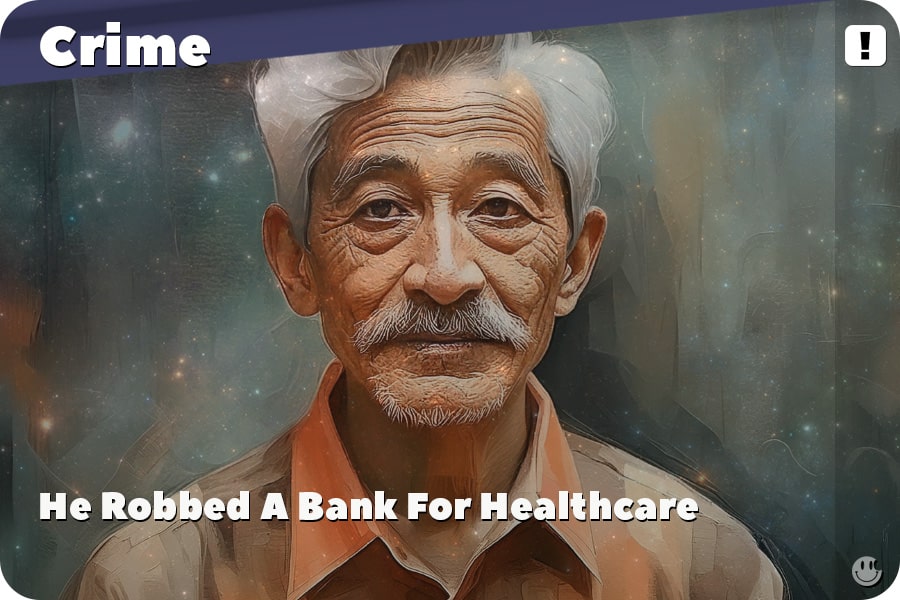
    In 2011, a 59-year-old man named James Verone walked into a Gastonia, North Carolina bank, handed the teller a note, and calmly asked for one dollar.

    He then sat down in the bank lobby and waited patiently for the police to arrive.

    Verone’s intention wasn’t to get rich. He wasn’t a hardened criminal or an impulsive thief. His goal, astonishingly, was to be arrested—so he could receive medical care in prison. The story made national headlines at the time and continues to spark ethical debates about healthcare, desperation, and justice.

    What makes someone commit a crime not out of greed or rage—but out of sheer necessity?

    A Crime of Survival

    James Verone’s decision didn’t come out of nowhere. At the time of the robbery, he was dealing with serious medical issues: a growth on his chest, two ruptured discs in his back, and a problem with his left foot. He had no job, no insurance, and no savings. His Social Security benefits had run out. Traditional healthcare was out of reach.

    After carefully weighing his options, he hatched a plan. He would stage a small, non-violent crime, get arrested, and then receive the state-provided healthcare available to inmates.

    He wrote a letter to the Gaston Gazette ahead of time explaining his motives, then walked into the bank, handed over the note asking for a dollar, and sat down to await arrest. He even requested medical attention while being taken into custody.

    The Letter

    Here’s what Verone wrote to the local paper before committing the robbery:

    “When you receive this a bank robbery will have already taken place. I am of sound mind but not so much sound body.”

    In his own words, this wasn’t about rebellion or protest—it was a last resort. He knew it would land him in jail. He wanted that. It wasn’t freedom he needed. It was help.

    The Legal Outcome

    Verone was charged with larceny from a person, a lesser charge than full-fledged bank robbery, since he didn’t use a weapon or threaten anyone. He got his wish and was taken to jail. While incarcerated, he received basic medical care, though not necessarily the full treatment he was hoping for.

    Eventually, after serving his time, Verone was released—and remained in the public eye for a short while due to the media interest in his unusual case.

    His story was covered by outlets like ABC News, CBS, and CNN, prompting widespread debate: was Verone a criminal… or a symptom of a broken system?

    Ethical Fault Lines

    Verone’s act forces us to confront some uncomfortable questions:

    • Is breaking the law to access essential services like healthcare ever morally acceptable?

    • Does a non-violent, deliberate crime with clear ethical intent deserve the same treatment as other offenses?

    • What does this say about a system where prison is more accessible than healthcare?

    From a legal standpoint, Verone committed a crime. But from a moral or philosophical view, the lines are blurrier.

    Utilitarian Viewpoint

    From a utilitarian perspective—focusing on outcomes—Verone’s act may seem justifiable. He avoided harming others, received care, and brought public attention to a serious societal issue. His action maximized benefit (for himself) with minimal harm (to others).

    But critics could argue that normalizing crime as access to care risks undermining the justice system—and could backfire if others followed suit.

    Deontological Ethics

    In contrast, deontological ethics, which emphasizes duty and rules over consequences, would likely view Verone’s action as wrong, regardless of his motive. A rule-based society cannot function if people are allowed to break the law when it suits their personal needs—even sympathetic ones.

    This approach draws a hard line: wrong is wrong, even with good intentions.

    Virtue Ethics

    Virtue ethics asks a different question: What kind of person would do this—and why? Depending on your perspective, Verone’s action might be seen as courageous or desperate. His willingness to give up his freedom in exchange for medical attention suggests a profound level of sacrifice—and a moral call for systemic reform.

    It also raises the question: What virtues should society display in response? Compassion? Justice? Reform?

    Not an Isolated Case

    Verone’s story is shocking—but not unique. Across the United States, particularly before the Affordable Care Act was implemented, people in poverty have been known to commit minor crimes to gain access to shelter, food, or healthcare.

    Some examples:

    • Individuals intentionally getting arrested during cold winters to sleep in heated cells.

    • Nonviolent offenders aiming to extend short sentences to stay on prison health plans.

    • Parents risking custody loss by breaking laws to feed or care for their children.

    While these cases vary, they share a common thread: desperation born of systemic failure.

    Systemic Reflection: Healthcare or Incarceration?

    The U.S. is one of the only developed nations where healthcare is tightly tied to employment and insurance. The system can become an impenetrable wall for those like Verone—older, out of work, and in poor health. Jail, by contrast, is guaranteed to provide food, shelter, and at least basic healthcare.

    This ironic reality sparked serious discussion following Verone’s case. CNN contributor LZ Granderson famously commented, “There are millions of people like James Verone—people who would rather be criminals than untreated.”

    So what’s the bigger ethical dilemma? That someone committed a crime to access healthcare—or that this is one of the few ways to do so?

    Policy Questions That Follow

    Verone’s story intersects with some of the biggest ethical and political questions facing the U.S.:

    • Should healthcare be a human right, not a privilege tied to employment or income?

    • Should prisons be a last resort—or a de facto social safety net?

    • What reforms could prevent people from seeing incarceration as their best chance at survival?

    These are not abstract questions. They are urgent, human, and deeply moral.

    Media and Public Response

    Initial media coverage ranged from sympathetic to sensationalized. Some saw Verone as a folk hero, others as a manipulator. Online commenters debated whether he was gaming the system or exposing its failures.

    But in ethical terms, the most interesting aspect is this: Verone told the truth. He didn’t rob the bank and flee. He didn’t demand more money. He waited to be arrested and asked for help. There was no deception. Just need.

    His story didn’t lead to direct policy change—but it continues to circulate in ethics classes, healthcare debates, and even philosophy discussion boards as a real-life case study of moral tension in modern society.

    Glossary of Terms

    • Larceny: Unlawful taking of someone else’s property with intent to deprive them of it.

    • Utilitarianism: Ethical theory focuses on outcomes and the greatest good for the greatest number.

    • Deontology: Ethics based on adherence to moral rules and duties, regardless of consequences.

    • Virtue Ethics: Moral theory emphasizes character traits and virtues over strict rules or outcomes.

    • Social Determinants of Health: Conditions in the environments where people live and work that affect health outcomes.

    Discussion Questions

    1. Is it ever morally acceptable to break the law to receive healthcare or meet basic needs?

    2. What does Verone’s story say about the priorities of our legal and healthcare systems?

    3. How should a compassionate society respond to acts of “ethical criminality”?

    References and Further Reading

  • The Survival Lottery

    The Survival Lottery

    The Survival Lottery: A Radical Approach to Ethical Dilemmas in Medicine

    Would you be willing to die so that two strangers could live?

    That’s the uncomfortable premise behind philosopher John Harris’s 1975 thought experiment, The Survival Lottery. It’s one of the most provocative ethical hypotheticals in modern philosophy—raising questions about fairness, sacrifice, and how society should distribute life-saving resources.

    This scenario isn’t about dystopian fiction or sci-fi morality plays. It’s about medicine, ethics, and whether a society could—or should—rationally sacrifice one healthy person to save two dying ones.

    The Core Idea

    Here’s how the Survival Lottery works:

    Imagine a world where patients regularly die from organ failure. Two such patients—say, Y and Z—will soon die unless they receive new organs. Meanwhile, you’re perfectly healthy.

    The proposal: implement a lottery system that randomly selects healthy individuals to be euthanized and have their organs harvested. If sacrificing one person could save two (or more), wouldn’t that maximize the overall number of lives saved?

    Harris’s thought experiment forces us to ask whether it is more moral to let people die of natural causes or to kill one person to save more.

    The concept was first introduced in Harris’s essay “The Survival Lottery,” published in the journal Philosophy in 1975. The piece sparked immediate controversy and continues to be studied in bioethics, philosophy, and medical law.

    Utilitarian Logic

    The ethical engine driving the lottery is utilitarianism—the idea that the best action is the one that maximizes happiness or well-being for the greatest number. By that logic, letting Y and Z die when one healthy donor could save them both seems inefficient—perhaps even cruel.

    Why should two people die so that one may live? Isn’t it just mathematical morality?

    Ignoring social discomfort and emotional reactions, the survival lottery looks like a highly efficient, morally impartial system. It would:

    • Save more lives than it costs

    • Treat all citizens equally under the law

    • Eliminate emotional or economic biases in organ allocation

    So why does the idea feel so wrong?

    Deontological Objections

    For many people, the idea of sacrificing an innocent person is morally unacceptable, even if the outcome saves lives. This comes from deontological ethics—the school of thought associated with philosophers like Immanuel Kant, which prioritizes the morality of actions, not just the consequences.

    According to this framework:

    • Killing an innocent person is wrong, regardless of the outcome

    • Human beings should never be treated merely as a means to an end

    • We have a duty to respect individual rights, including the right to life

    Critics argue that The Survival Lottery treats people as disposable resources, not autonomous individuals with dignity and rights. Even if the math works, the ethics may not.

    Social Trust and Fear

    There’s also a practical concern: a society that enacts such a policy would likely descend into fear and mistrust. Citizens might live in constant anxiety, wondering if they’ll be the next selected. People may avoid hospitals or lie about their health to avoid entering the system.

    And what happens when exceptions are made? Would the rich and powerful be excluded from the lottery? Would racial or social bias creep in?

    Rather than fostering a sense of collective good, the survival lottery could create moral panic, erode public trust in medical institutions, and lead to dangerous unintended consequences.

    Harris’s Response

    John Harris anticipated many of these objections. In his original essay, he emphasized:

    • The need for impartiality: No one should be more or less likely to be selected.

    • The principle of fair risk: If all citizens face equal risk, then all benefit equally from the system.

    • The idea that doing nothing—letting Y and Z die—is also a choice, arguably worse.

    He argues that we accept some collective risks for the greater good (like conscription, or certain taxation policies), and that our moral instincts about killing may be emotionally driven rather than logically defensible.

    His goal wasn’t to propose actual policy. Rather, it was to challenge our intuitions and ask: Why do we view some deaths as unfortunate necessities and others as moral violations?

    Real-World Echoes

    While no country has implemented a literal survival lottery, the ethical dilemma it raises is surprisingly relevant in modern medicine and public policy.

    Some real-world parallels include:

    • Triage protocols: During pandemics or mass casualty events, doctors must decide who gets treatment based on survivability, not first-come-first-served.

    • Organ donation systems: Debates continue about opt-in vs. opt-out systems, living donors, and incentivized donation.

    • Healthcare rationing: Limited access to certain treatments, especially in systems with constrained resources, leads to moral questions about who gets care.

    One modern example came during the COVID-19 pandemic, when some hospitals developed crisis protocols for ventilator access. If only one machine was available, and two patients needed it, hard choices had to be made.

    The Personal Identity Problem

    Another dimension: how do we define “sacrifice” when medical technology blurs the lines between life and death?

    Suppose someone is brain-dead but otherwise physically healthy. Should they be entered into the lottery?

    Or suppose someone volunteers to donate both kidneys, knowing it will end their life but save two others—does this shift our moral calculus?

    The Survival Lottery draws a sharp line—but modern bioethics lives in the gray area.

    Ethical Questions That Linger

    • Is it more ethical to allow two people to die, or to kill one person to save them actively?

    • Can a system of random sacrifice ever truly be just?

    • Should we weigh lives saved over lives preserved?

    • Do our instincts against such policies come from reason—or discomfort?

    Philosophers continue to wrestle with these questions because they touch on our deepest values about life, agency, fairness, and fear.

    Pop Culture and Influence

    This thought experiment has inspired a range of fictional and artistic interpretations, from dystopian films like The Island (2005), where clones are used for organ harvesting, to episodes of Black Mirror and The Twilight Zone, which explore utilitarian horror.

    You’ll also see echoes of the survival lottery in policy debates around universal healthcare, euthanasia, and the ethics of gene editing, where questions of fairness and benefit collide with fears of abuse.

    Glossary of Terms

    • Utilitarianism: Ethical theory prioritizing outcomes that maximize overall well-being.

    • Deontology: Ethics centered on duties and moral rules, regardless of consequences.

    • Triage: The process of prioritizing treatment based on urgency or likelihood of survival.

    • Moral Intuition: An instinctive judgment about right and wrong, often emotional rather than reasoned.

    • Sacrificial Dilemma: A scenario in which one person must be harmed (or killed) to benefit others.

    Discussion Questions

    1. Is it ever morally justifiable to sacrifice one person to save two?

    2. How is that different from a structured survival lottery if we accept triage in emergencies?

    3. Would knowing you’re part of a lottery for the greater good change how you view fairness or fear?

    References and Further Reading

  • Delaware Uniform Health-Care Decisions Act (DUHCDA)

    Delaware Uniform Health-Care Decisions Act (DUHCDA)

    Delaware Uniform Health-Care Decisions Act (DUHCDA):

    What You Need to Know

    Delaware has adopted the Uniform Health-Care Decisions Act of 2023 (UHCDA 2023), replacing its nearly 30-year-old health-care directive law. This new framework, known locally as the Delaware Uniform Health-Care Decisions Act (DUHCDA), went into effect on September 30, 2025. It updates how residents can make advance health-care directives, appoint decision-makers, and ensure their wishes are honored if they cannot speak for themselves. Importantly, directives issued under the old law will remain valid.

    The DUHCDA modernizes Delaware’s approach to end-of-life and medical decision-making. It clarifies the powers of agents, streamlines the process of creating directives, adds provisions for mental health directives, and updates the criteria for who can act as a surrogate decision-maker if no one has been appointed. Healthcare institutions will also have greater authority to petition for guardianship when patients are unable to make decisions and lack a representative. The law strikes a balance between individual autonomy, family involvement, and practical needs in today’s healthcare system.

    Why Delaware Needed a New Law

    Delaware’s prior system was based on the 1993 Uniform Health-Care Decisions Act, enacted in 1996. While it served as the legal foundation for decades, medicine, technology, and family structures have undergone significant changes since then. Think about electronic records, non-traditional family arrangements, long-term care challenges, and mental health awareness — all of which require legal updates.

    By adopting the UHCDA 2023, Delaware joins other states in creating a consistent, modern standard for advanced health-care planning. The goal is to make it easier for people to express their wishes, empower trusted decision-makers, and reduce uncertainty for families and medical professionals.

    Key Features of the DUHCDA

    Advance Health-Care Directives

    An advance directive is a legal document where you can:

    • State your wishes about medical treatment (for example, life support or resuscitation).

    • Appoint an agent (also called a health-care power of attorney) to make decisions if you lose capacity.

    Under the new law, Delaware residents still have this ability — but with more flexibility and fewer hurdles, especially regarding how documents are created and recognized.

    Clearer Definitions

    The DUHCDA keeps familiar terms but sharpens them:

    • Capacity means being able to understand and communicate health-care choices.

    • Healthcare decision-making encompasses everything from choosing providers to accepting or refusing treatment.

    • A life-sustaining procedure refers to artificial measures that prolong life without offering realistic recovery prospects.

    • A surrogate is someone who can step in if no agent or guardian is available.

    These definitions reduce legal gray areas that sometimes cause disputes in hospitals.

    Mental Health Directives

    One of the most significant updates is the ability to create advanced mental health directives. These let individuals specify treatment preferences for mental health conditions, including a “Ulysses clause” — a binding instruction that can apply even if someone later objects during a mental health crisis. This gives patients more control and provides clarity for providers in challenging situations.

    Updated Surrogate Decision-Maker Rules

    If you don’t have a written directive or an appointed agent, someone still needs to speak for you. The DUHCDA revises Delaware’s surrogate hierarchy (the list of who gets priority). This helps reflect modern families and living situations, ensuring decision-making isn’t limited strictly to spouses or blood relatives.

    Limits and Powers of Agents

    The law strengthens safeguards by requiring express grants for certain agent powers, such as:

    • Admitting someone to a long-term care facility.

    • Accessing confidential medical records.

    • Making mental health treatment decisions.

    This ensures people know exactly what authority they are giving to their chosen agent.

    Institutional Guardianship

    Hospitals and long-term care facilities will have more apparent authority to petition courts for guardianship when a patient needs decisions made but lacks an agent or surrogate. This addresses a real-world problem: patients “stuck” in acute care with no decision-maker, even after their immediate needs have been met.

    What Stays the Same

    Not everything changes. Many protections remain from the old Delaware law:

    • Your old directive is still valid. If you already have one, you don’t need to redo it unless you want to add new powers or mental health instructions.

    • Providers must act in good faith. Doctors and nurses who follow valid directives or agent instructions are shielded from liability.

    • Conscience protections remain. Providers can still decline to follow instructions that conflict with their values or involve medically ineffective treatments.

    This continuity avoids confusion during the transition.

    Why This Matters to You

    If you live in Delaware, the DUHCDA gives you more tools to plan ahead:

    • Peace of mind: Your medical and mental health wishes can be recorded and respected.

    • Clarity for loved ones: Family won’t be left guessing about your preferences in critical moments.

    • Flexibility: The law accommodates electronic directives, modern relationships, and expanded decision-making powers.

    • Protection: Clearer rules reduce the risk of disputes among relatives or between families and providers.

    Even if you already have an advance directive, this is a good time to review it and consider updating language to match the new law.

    Timeline for Implementation

    • Until September 29, 2025, the old Delaware law (from 1996) still governed advance directives and healthcare decisions.

    • September 30, 2025: The DUHCDA officially took effect. All new directives will follow their rules, though old ones remain valid.

    This transition period provides individuals, attorneys, and healthcare institutions with time to prepare.

    Practical Next Steps for Delaware Residents

    1. Check your existing directive. If you have one, review it with a lawyer or health-care professional to ensure it still reflects your wishes.

    2. Consider adding mental health provisions. If mental health care is a concern, this is a major opportunity to add clear instructions.

    3. Talk with your agent or family. Ensure that the people who may be making decisions on your behalf understand your values and preferences.

    4. Stay tuned for updated forms. Hospitals, law firms, and the state are likely to publish new template documents closer to the 2025 effective date.

    The Bigger Picture

    The Delaware Uniform Health-Care Decisions Act is part of a broader trend: states modernizing laws to respect autonomy while adapting to today’s medical realities. By making directives easier to create and expanding them to cover mental health, Delaware is helping its residents face difficult health situations with dignity and control.

    References:

    • Delaware General Assembly – Senate Bill 309 (the enabling legislation)

      This is the bill text and legislative summary adopting UHCDA 2023 in Delaware, showing precisely what is being changed and how Delaware is implementing the uniform law.

      Link: Bill Detail — SB 309 Delaware General Assembly

    • Delaware Code Online — Title 16, Chapter 25 (Health-Care Decisions)

      This is the statutory basis for Delaware’s existing health-care decisions law (which gets superseded/amended by DUHCDA). It helps compare the old law and see which provisions are being replaced.

      Link: Chapter 25 – Health-Care Decisions Delaware Code Online

    • Justia Law — 16 Del. C. § 2507 (Surrogate decision-makers)

      This gives the current (pre-2025) default rules about who may act as a surrogate when someone hasn’t appointed an agent or lacks capacity. Because DUHCDA will revise the surrogate hierarchy, this is useful as a “before” reference.

      Link: 16 Del. C. § 2507 – Surrogates Justia Law