web analytics

Tag: Law Breaking

  • Heinz’s Dilemma

    Heinz’s Dilemma

    Heinz’s Dilemma: Stealing Medicine to Save a Life

    In a small town, a man named Heinz faces an unbearable choice: his wife is gravely ill, and a pharmacist has developed a drug that could save her life. The problem? The medicine costs ten times more than it took to make—and Heinz can’t afford it.

    He begs, borrows, and pleads. The pharmacist refuses to lower the price or let Heinz pay later. With time running out, Heinz breaks into the pharmacy and steals the drug.

    Was Heinz wrong to steal the medicine?

    Or was he morally justified in doing whatever it took to save his wife’s life?

    This is Heinz’s Dilemma, a foundational moral scenario introduced by psychologist Lawrence Kohlberg in the 1950s. It’s used not to judge right or wrong, but to explore how people reason about ethics—and what that says about moral development.

    The Setup

    The original version, simplified for students and researchers, goes something like this:

    “A woman was near death from a rare cancer. One drug might save her, discovered by a local chemist. He was charging $2,000, ten times what it cost to make. Heinz tried everything to raise the money but came up short. He asked the chemist to sell it cheaper or let him pay later, but the man refused. So Heinz broke in and stole the drug.”

    Kohlberg posed this dilemma not to find the right answer, but to understand the reasoning behind people’s decisions.

    The Levels of Moral Reasoning

    Kohlberg believed people move through three stages of moral development, each with two sub-levels:

    1. Pre-Conventional Morality

    • Obedience and punishment: “Heinz shouldn’t steal because he’ll get caught.”

    • Self-interest: “Heinz should steal because he’ll be happier if his wife survives.”

    2. Conventional Morality

    • Interpersonal accord: “Heinz should steal because a good husband puts his wife first.”

    • Law and order: “Heinz shouldn’t steal because it’s against the law.”

    3. Post-Conventional Morality

    • Social contract: “Heinz should steal because the right to life is more important than property.”

    • Universal ethical principles: “Heinz must act based on justice, even if it means breaking the law.”

    The action might be the same (stealing the drug), but the justification reveals a person’s moral depth.

    Is Stealing Ever Justified?

    Let’s unpack some major ethical frameworks using Heinz’s dilemma.

    Utilitarianism

    A utilitarian would ask: Which choice creates the greatest good for the greatest number?

    • Saving a life has more utility than preserving property.

    • The pharmacist loses some money, but a human life is preserved.

    From this perspective, Heinz’s theft is morally justified—even obligated.

    Deontology

    A deontologist (like Immanuel Kant) would argue that morality is based on duties and universal rules, not outcomes.

    • Stealing is always wrong, regardless of intention.

    • If everyone stole when they had a good reason, trust and law would break down.

    Therefore, Heinz’s action violates a moral duty—even if his motive is love.

    Virtue Ethics

    This approach asks: What does a virtuous person do in this situation?

    Heinz is showing courage, compassion, and loyalty. But is he also showing justice and respect for others’ rights?

    A virtue ethicist might sympathize with Heinz but also ask: why is the pharmacist so unmoved by suffering?

    Ethics, in this view, is relational—it depends on the kind of person you are becoming, not just the rule you follow.

    What About the Pharmacist?

    While Heinz gets the spotlight, the pharmacist’s behavior raises its own ethical questions.

    • Should life-saving medicine be priced for profit?

    • Does the right to private property outweigh the right to life?

    • Is refusing payment or delayed compensation morally defensible?

    Some argue the pharmacist has a social obligation to make medicine accessible. Others defend his property rights and autonomy—after all, he created the drug.

    This side of the dilemma mirrors real-world debates over health care pricing, insulin access, and the patenting of life-saving drugs.

    Real-World Parallels

    Heinz’s story isn’t just a classroom thought experiment—it echoes real moral challenges.

    1. Healthcare Inequality

    Globally, millions face choices like Heinz’s every day. Lack of access to affordable treatment forces families to:

    • Delay care

    • Ration medication

    • Go into debt

    • Or resort to illegal actions

    In this light, the dilemma becomes a systemic indictment, not just a personal one.

    2. Medical Bankruptcy

    Medical debt is one of the leading causes of bankruptcy in countries without universal healthcare. When life and livelihood are on the line, moral boundaries blur.

    3. Insulin and EpiPen Prices

    Recent public outcry over the rising costs of insulin and allergy medication mirrors the pharmacist’s refusal to lower prices. These stories raise tough questions about profit, ethics, and public health.

    The Law vs. Justice

    This dilemma also highlights the difference between legal and moral actions.

    • Laws are rules enforced by governments.

    • Morals are principles about right and wrong.

    They often overlap—but not always. History is full of civil disobedience: people breaking laws to uphold moral ideals (think Rosa Parks or Gandhi).

    So the question becomes: When is it okay to break the law to do the right thing?

    Cultural Differences

    Interestingly, studies show that culture affects moral reasoning.

    • People may prioritize family or social harmony in collectivist societies (like Japan or India).

    • People might emphasize personal rights or legal structures in individualist societies (like the U.S.).

    This means moral dilemmas don’t have universal answers, but they do reveal universal questions.

    Glossary of Terms

    • Utilitarianism – A moral theory that emphasizes consequences and maximizing overall well-being.

    • Deontology – An ethical approach based on following rules or duties regardless of the outcomes.

    • Virtue Ethics – A theory focusing on moral character rather than rules or results.

    • Civil Disobedience – Breaking a law to uphold a moral principle.

    • Moral Development – The process through which people evolve in their ability to reason about ethics.

    Discussion Questions

    1. Was Heinz morally justified in stealing the drug? Why or why not?

    2. Should the pharmacist have lowered the price or offered a payment plan?

    3. Can breaking the law ever be the most ethical choice?

    References and Further Reading

  • The Honest Thief: Can Stealing Ever Be Moral?

    The Honest Thief: Can Stealing Ever Be Moral?

    The Honest Thief: Can Stealing Ever Be Moral?

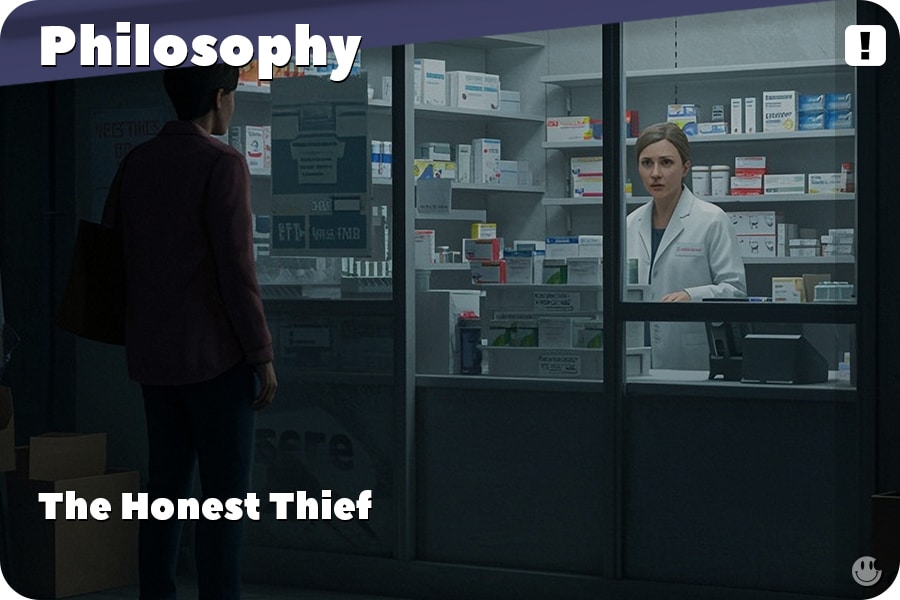
    You walk past a pharmacy. Inside, on the shelf, sits a medication that could save your child’s life. You can’t afford it. Insurance denied the claim. The government won’t help. The pharmacist, while sympathetic, can’t give it away.

    So you wait until no one’s looking… and take it.

    Are you a criminal—or a parent doing what anyone would?

    This is The Honest Thief, a classic ethical dilemma in everything from courtrooms to literature. It forces us to confront the uneasy relationship between law and morality and asks: Is it ever right to do the wrong thing?

    A Familiar Story

    The “honest thief” shows up in:

    • Religious texts – including the thief crucified beside Jesus in Christian scripture, who repents and is forgiven.

    • Literature – like Jean Valjean in Victor Hugo’s Les Misérables, who steals bread to feed his family and spends a lifetime making amends.

    • Real-life – think of people who shoplift food during economic crises or steal fuel to get to work.

    Each version tests our sense of compassion, justice, and principle.

    Why This Dilemma Matters

    Unlike cold ethical puzzles, this one comes wrapped in emotion. It’s about people we can empathize with—those caught between moral duty and legal constraint.

    • Should they be punished for breaking the law?

    • Or praised for doing what’s right in context?

    Ethical Frameworks

    1. Utilitarianism: The Ends Matter

    A utilitarian looks at outcomes. If stealing:

    • Saves a life

    • Prevents suffering

    • Results in greater good than harm

    …then it’s arguably justified.

    Stealing a $50 inhaler to prevent a child’s asthma attack? If the harm to the store is minor and the benefit to the child is immense, the act may be morally acceptable—even praiseworthy.

    2. Deontology: Rules Must Be Followed

    Deontologists argue that right and wrong depend on the act itself, not the outcome. Stealing is wrong, full stop.

    Even if the motive is noble, violating a moral law—like respect for property—corrupts one’s integrity. One version of this view comes from Immanuel Kant, who stressed acting from duty, not outcome.

    Kant might ask:

    • What if everyone stole when they needed something?

    • Would society collapse under moral exceptions?

    In this view, intention is not enough to excuse the act.

    3. Virtue Ethics: It’s About Character

    Virtue ethicists consider the kind of person you’re trying to be.

    • Are you greedy? No.

    • Are you selfish? No.

    • Are you desperate but acting with humility, remorse, and a plan to repay? Maybe.

    The honest thief might be seen as morally complex: flawed, but courageous. A person of compassion and resolve, even in the face of laws.

    Law vs. Justice

    The law often draws hard lines:

    • Theft is illegal, regardless of reason.

    • Judges may have limited discretion.

    • Public sympathy doesn’t always matter in the courtroom.

    But justice? That’s fuzzier.

    Jury Nullification

    Sometimes, juries acquit defendants despite clear guilt, because they believe the law itself—or its application—is unjust. In real-world “honest thief” cases, this happens more often than you might think.

    Case example:

    • In 2011, a man in the UK stole food because his benefits were delayed. The court issued no punishment, citing the situation’s context.

    Civil Disobedience

    When laws are unjust, some argue they should be broken intentionally. This includes:

    • Feeding the homeless where banned

    • Stealing life-saving medicine when it’s unaffordable

    • Breaking into buildings to shelter the unhoused during storms

    The honest thief often operates in this gray zone of protest and survival.

    When Is It Not Justifiable?

    Not every thief is honest. Some situations don’t meet the moral threshold:

    • Stealing luxury goods

    • Causing harm to others

    • Acting from entitlement, not necessity

    Context is key. Stealing a loaf of bread when starving? Ethically debatable. Stealing a TV during a riot? Less so.

    Psychological Factors

    Moral Licensing

    People sometimes justify wrongdoing by claiming they’re “doing it for a good cause.” But psychology warns this can become a slippery slope—where one good deed (or motive) is used to rationalize harmful behavior.

    Empathy and Bias

    We judge “honest thieves” differently based on identity:

    • A struggling mother? Sympathetic.

    • A homeless person with mental illness? Often judged harshly.

    • A suit-wearing executive embezzling “to pay off medical debt”? Harder to defend.

    Bias plays a role in how we assign moral value—even in identical acts.

    Real-World Applications

    1. Healthcare Theft

    People who can’t afford insulin or cancer medication sometimes turn to theft—or illegal online sources. These acts challenge policymakers to confront:

    • Is theft the problem—or the system?

    • Should we punish acts of desperation—or prevent the desperation?

    2. Food Insecurity

    In food deserts and poverty zones, shoplifting is often about survival. Some stores quietly let the theft go if it is small, while others press charges to deter future incidents.

    3. Emergency Scenarios

    Think natural disasters, where looting blurs into survival. During Hurricane Katrina, people took baby formula and diapers from wrecked stores. Were they stealing—or rescuing resources?

    The Burden of Remorse

    The honest thief isn’t just defined by action—it’s also about accountability. Do they:

    • Make restitution?

    • Apologize?

    • Feel conflicted?

    Moral weight increases when someone owns their actions and seeks to repair the harm. Some donate, repay, or even turn themselves in later.

    As a society, we might ask: Should we make space for redemption—not just punishment?

    Glossary of Terms

    • Civil Disobedience – The intentional violation of laws for moral or political reasons.

    • Utilitarianism – An ethics theory focused on outcomes and the greater good.

    • Deontology – Ethics based on adherence to moral rules, regardless of outcomes.

    • Virtue Ethics – A framework that emphasizes moral character over rule-following or consequences.

    • Moral Licensing – A psychological effect where past good behavior is used to justify future bad actions.

    Discussion Questions

    1. Is it ever morally acceptable to steal? If so, under what circumstances?

    2. Should legal systems show flexibility in cases of “honest theft”?

    3. Does motive matter more than action—or should we uphold the rules equally for everyone?

    References and Further Reading

  • Samuel L. Clemen’s Notice for his Next Burglar

    Samuel L. Clemen’s Notice for his Next Burglar

    Samuel L. Clemen’s notice for his next burglar
    September 9, 1908

    NOTICE.

    To the next Burglar.

    There is nothing but plated ware in this house, now and henceforth. You will find it in that brass thing in the dining-room over in the corner by the basket of kittens. If you want the basket, put the kittens in the brass thing. Do not make a noise-  it disturbs the family. You will find rubbers in the front hall, by that thing which has the umbrellas in it, chiffonier, I think they call it, or pergola, or something like that.

    Please close the door when you go away!

    Very truly yours,

    S.L. Clemens

  • Letters from Jack The Ripper, 1888

    Letters from Jack The Ripper, 1888

    Letters from Jack The Ripper, 1888
    Jack The Ripper ‘Dear Boss’ letter
    September 27, 1888

    Dear Boss,
    I keep on hearing the police have caught me but they wont fix me just yet. I have laughed when they look so clever and talk about being on the right track. That joke about Leather Apron gave me real fits. I am down on whores and I shant quit ripping them till I do get buckled. Grand work the last job was. I gave the lady no time to squeal. How can they catch me now. I love my work and want to start again. You will soon hear of me with my funny little games. I saved some of the proper red stuff in a ginger beer bottle over the last job to write with but it went thick like glue and I cant use it. Red ink is fit enough I hope ha. ha. The next job I do I shall clip the ladys ears off and send to the police officers just for jolly wouldn’t you. Keep this letter back till I do a bit more work, then give it out straight. My knife’s so nice and sharp I want to get to work right away if I get a chance. Good Luck.

    Yours truly
    Jack the Ripper

    Dont mind me giving the trade name

    PS Wasnt good enough to post this before I got all the red ink off my hands curse it No luck yet. They say I’m a doctor now. ha ha
    _________________________
    Jack The Ripper ‘Saucy Jack’ postcard
    October 1, 1888

    I was not codding dear old Boss when I gave you the tip, you’ll hear about Saucy Jacky’s work tomorrow double event this time number one squealed a bit couldn’t finish straight off. ha not the time to get ears for police. thanks for keeping last letter back till I got to work again.

    Jack the Ripper
    _________________________
    Jack The Ripper ‘From Hell’ Letter
    October 16, 1888

    From hell.
    Mr Lusk,
    Sor
    I send you half the Kidne I took from one woman and prasarved it for you tother piece I fried and ate it was very nise. I may send you the bloody knif that took it out if you only wate a whil longer

    signed
    Catch me when you can Mishter Lusk
    __________________________
    Jack The Ripper possible fake letters
    October 6, 1888

    You though your-self very clever I reckon when you informed the police. But you made a mistake if you though I dident see you. Now I known you know me and I see your little game, and I mean to finish you and send your ears to your wife if you show this to the police or help them if you do I will finish you. It no use your trying to get out of my way. Because I have you when you dont expect it and I keep my word as you soon see and rip you up. Yours truly Jack the Ripper.

    PS You see I know your address

    1888
    Beware I shall be at work on the 1st and 2nd inst. in the Minories at 12 midnight and I give the authorities a good chance but there is never a policeman near when I am at work. Yours Jack the Ripper.

    1988
    What fools the police are. I even give them the name of the street where I am living. Prince William Street.

    1888

    The Juwes are the men That Will not be Blamed for nothing
    _________________________
    Jack The Ripper (to Dr. Thomas Openshaw)
    October 29, 1888

    Old boss you was rite it was the left kidny i was goin to hoperate agin close to you ospitle just as i was going to dror mi nife along of er bloomin throte them cusses of coppers spoilt the game but i guess i wil be on the jobn soon and will send you another bit of innerds

    Jack the Ripper

    O have you seen the devle with his mikerscope and scalpul a-lookin at a kidney with a slide cocked up.

    More Jack The Ripper Information here