I am Tarzan of the Apes. I want you. I am yours. You are mine. We live here together always in my house. I will bring you the best of fruits, the tenderest deer, the finest meats that roam the jungle. I will hunt for you. I am the greatest of the jungle fighters. I will fight for you. I am the mightiest of the jungle fighters. You are Jane Porter, I saw it in your letter. When you see this you will know that it is for you and that Tarzan of the Apes loves you.
Samuel L. Clemen’s notice for his next burglar
September 9, 1908
NOTICE.
To the next Burglar.
There is nothing but plated ware in this house, now and henceforth. You will find it in that brass thing in the dining-room over in the corner by the basket of kittens. If you want the basket, put the kittens in the brass thing. Do not make a noise- it disturbs the family. You will find rubbers in the front hall, by that thing which has the umbrellas in it, chiffonier, I think they call it, or pergola, or something like that.
Asa Don Dickinson’s Letter to Mark Twain regarding taking the Tom Sawyer and Huck Finn books out of a children’s library
November 19, 1905
DEAR SIR:
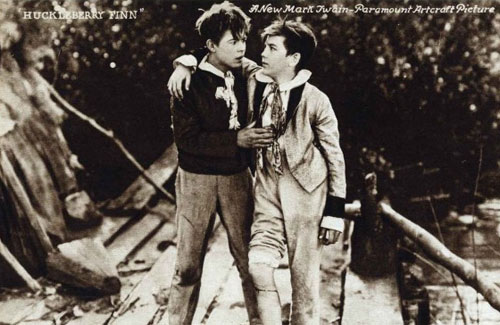
I happened to be present the other day at a meeting of the children’s librarians of the Brooklyn Public Library. In the course of the meeting it was stated that copies of “Tom Sawyer” and “Huckleberry Finn” were to be found in some of the children’s rooms of the system. The Sup’t of the Children’s Dep’t- a conscientious and enthusiastic young woman- was greatly shocked to hear this, and at once ordered that they be transferred to the adults’ department. Upon this I shamefacedly confessed to having read “Huckleberry Finn” aloud to my defenseless blind people, without regard to their age, color, or previous condition of servitude. I also reminded them of Brander Matthews’s opinion of the book, and stated the fact that I knew it almost at heart, having got more pleasure from it than from any book I have ever read, and reading is the greatest pleasure I have in life. My warm defense elicited some further discussion and criticism, from which I gathered that the prevailing opinion of Huck was that he was a deceitful boy who said “sweat” when he should have said “perspiration.” The upshot of the matter was that there is to be further consideration of these books at a meeting early in January which I am especially invited to attend. Seeing you the other night at the performance of “Peter Pan” the thought came to me that you (who know Huck as well as I- you can’t know him better or love him more—) might be willing to give me a word or two to say in witness of his good character though he “warn’t no more quality than a mud cat.”
I would ask as a favor that you regard this communication as confidential, whether you find time to reply to it or not; for I am loath for obvious reasons to bring the institution from which I draw my salary into ridicule, contempt or reproach.
Yours very respectfully,
Asa Don Dickinson.
(In charge Department for the Blind and Sheepshead Bay Branch, Brooklyn Public Library.)
_______________________
Mark Twain’s Reply…
November 21, 1905
DEAR SIR:
I am greatly troubled by what you say. I wrote Tom Sawyer and Huck Finn for adults exclusively, and it always distresses me when I find that boys and girls have been allowed access to them. The mind that becomes soiled in youth can never again be washed clean; I know this by my own experience, and to this day I cherish an unappeasable bitterness against the unfaithful guardians of my young life, who not only permitted but compelled me to read an unexpurgated Bible through before I was 15 years old. None can do that and ever draw a clean sweet breath again this side of the grave. Ask that young lady- she will tell you so.
Most honestly do I wish I could say a softening word or two in defence of Huck’s character, since you wish it, but really in my opinion it is no better than those of Solomon, David, Satan, and the rest of the sacred brotherhood.
If there is an unexpurgated Bible in the Children’s Department, won’t you please help that young woman remove Huck and Tom from that questionable companionship?
Sincerely yours,
Signed, S. L. Clemens
I shall not show your letter to anyone- it is safe with me.
George Bernard Shaw’s Review of a woman at a Don Giovanni performance to the London Times
July 3, 1905
Sir,
The Opera management of Covent Garden regulates the dress of its male patrons. When is it going to do the same to the women?
On Saturday night I went to the Opera. I wore the costume imposed on me by the regulations of the house. I fully recognize the advantage of those regulations. Evening dress is cheap, simple, durable, prevents rivalry and extravagance on the part of male leaders of fashion, annihilates class distinctions and gives men who are poor and doubtful of their social position (that is, the great majority of men) a sense of security and satisfaction that no clothes of their own choosing could confer, besides saving a whole sex the trouble of considering what they should wear on state occasions. The objections to it are as dust in the balance in the eyes of the ordinary Briton. These objections are that it is colourless; that it involves a whitening process that makes the shirt troublesome, slightly uncomfortable, and seriously unclean; that it acts as a passport for undesirable persons; that it fails to guarantee sobriety, cleanliness, and order on the part of the wearer; and that it reduces to a formula a very vital human habit which should be the subject of constant experiment and active private enterprise. All such objections are thoroughly un-English. They appeal only to an eccentric few, and may be left out of account with the fantastic objections of men like Ruskin, Tennyson, Carlyle, and Morris to tall hats.
But I submit that what is sauce for the gander is sauce for the goose. Every argument that applies to the regulation of the man’s dress applies equally to the regulation of the woman’s. Now let me describe what actually happened to me at the Opera. Not only was I in evening dress by compulsion, but I voluntarily added many graces of conduct as to which the management made no stipulation whatever. I was in my seat in time for the first chord of the overture. I did not chatter during the music nor raise my voice when the Opera was too loud for normal conversation. I did not get up and go out when the statue music began. My language was fairly moderate considering the number and nature of the improvements on Mozart volunteered by Signor Caruso, and the respectful ignorance of dramatic points of the score exhibited by the conductor and stage manager- if there is such a functionary at Covent Garden. In short, my behavior was exemplary.
At 9 o’clock (the Opera began at 8) a lady came in and sat down very conspicuously in my line of sight. She remained there until the beginning of the last act. I do not complain of her coming late and going early; on the contrary, I wish she had come later and gone earlier. For this lady, who had very black hair, had stuck over her right ear the pitiable corpse of a large white bird, which looked exactly if someone had killed it by stamping on the beast, and then nailed it to the lady’s temple, which was presumably of sufficient solidity to bear the operation. I am not, I hope, a morbidly squeamish person; but the spectacle sickened me. I presume that if I had presented myself at the doors with a dead snake round my neck, a collection of black beetles pinned to my shirtfront, and a grouse in my hair, I should have been refused admission. Why, then is a woman to be allowed to commit such a public outrage? Had the lady been refused admission, as she should have been, she would have soundly rated the tradesman who imposed the disgusting headdress on her under the false pretence that ‘the best people’ wear such things, and withdrawn her custom from him; and thus the root of the evil would be struck at; for your fashionable woman generally allows herself to be dressed according to the taste of a person who she would not let sit down in her presence. I once, in Drury Lane Theatre, sat behind a matinee hat decorated with the two wings of a seagull, artificially reddened at the joints so as to produce the illusion of being freshly plucked from a live bird. But even that lady stopped short of a whole seagull. Both ladies were evidently regarded by their neighbors as ridiculous and vulgar; but that is hardly enough when the offence is one which produces a sensation of physical sickness in persons of normal human sensibility.
I suggest to the Covent Garden authorities that, if they feel bound to protect their subscribers against the dangers of my shocking them with a blue tie, they are at least equally bound to protect me against the danger of a woman shocking me with a dead bird.
Every time a writer tells the truth about a manuscript (or book), to a friend-author, he loses that friend, or sees that friendship dim and fade away to a ghost of what it was formerly.
Every time a writer tells the truth about a manuscript (or book), to a stranger-author, he makes an enemy.
If the writer loves his friend and fears to lose him, he lies to his friend.
But what’s the good of straining himself to lie to strangers?
And, with like insistence, what’s the good of making enemies anyway?
Furthermore, a known writer is overwhelmed by requests from strangers to read their work and pass judgment upon it. This is properly the work of a literary bureau. A writer is not a literary bureau. If he is foolish enough to become a literary bureau, he will cease to be a writer. He won’t have time to write.
Also, as a charitable literary bureau, he will receive no pay. Wherefore he will soon go bankrupt and himself live upon the charity of friends (if he has not already made them all his enemies by telling them the truth), while he will behold his wife and children went their melancholy way to the poorhouse.
Sympathy for the struggling unknown is all very well. It is beautiful—but there are so many struggling unknowns, something like several millions of them. And sympathy can be worked too hard. Sympathy begins at home. The writer would far rather allow the multitudinous unknowns to remain unknown than to allow his near and dear ones to occupy pauper pallets and potter’s fields.
Samuel L. Clemens’ letter to Helen Keller over plagiarism accusations
March 17, 1903
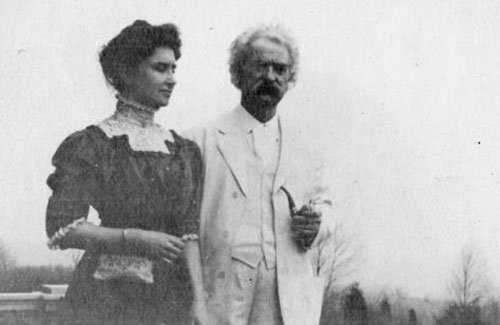
Dear Helen,—
I must steal half a moment from my work to say how glad I am to have your book, and how highly I value it, both for its own sake and as a remembrance of an affectionate friendship which has subsisted between us for nine years without a break, and without a single act of violence that I can call to mind. I suppose there is nothing like it in heaven; and not likely to be, until we get there and show off. I often think of it with longing, and how they’ll say, “There they come- sit down in front!” I am practicing with a tin halo. You do the same. I was at Henry Roger’s last night, and of course we talked of you. He is not at all well;- you will not like to hear that; but like you and me, he is just as lovely as ever.
I am charmed with your book- enchanted. You are a wonderful creature, the most wonderful in the world—you and your other half together—Miss Sullivan, I mean, for it took the pair of you to make a complete and perfect whole. How she stands out in her letters! her brilliancy, penetration, originality, wisdom, character, and the fine literary competencies of her pen- they are all there.
Oh, dear me, how unspeakably funny and owlishly idiotic and grotesque was that “plagiarism” farce! As if there was much of anything in any human utterance, oral or written, except plagiarism! The kernel, the soul—let us go further and say the substance, the bulk, the actual and valuable material of all human utterances—is plagiarism. For substantially all ideas are second-hand, consciously and unconsciously drawn from a million outside sources, and daily use by the garnerer with a pride and satisfaction born of the superstition that he originated them; whereas there is not a rag of originality about them anywhere except the little discoloration they get from his mental and moral calibre and his temperament, and which is revealed in characteristics of phrasing. When a great orator makes a great speech you are listening to ten centuries and ten thousand men- but we call it his speech, and really some exceedingly small portion of it is his. But not enough to signify. It is merely a Waterloo. It is Wellington’s battle, in some degree, and we call it his; but there are others that contributed. It takes a thousand men to invent a telegraph, or a steam engine, or a phonograph, or a telephone or any other important thing- and the last man gets the credit and we forget the others. He added his little mite- that is all he did. These object lessons should teach us that ninety-nine parts of all things that proceed from the intellect are plagiarisms, pure and simple; and the lesson ought to make us modest. But nothing can do that.
Then why don’t we unwittingly reproduce the phrasing of a story, as well as the story itself? It can hardly happen- to the extent of fifty words except in the case of a child; its memory-tablet is not lumbered with impressions, and the actual language can have graving-room there, and preserve the language a year or two, but a grown person’s memory-tablet is a palimpsest, with hardly a bare space upon which to engrave a phrase. It must be a very rare thing that a whole page gets so sharply printed on a man’s mind, by a single reading, that it will stay long enough to turn up some time or other to be mistaken by him for his own. No doubt we are constantly littering our literature with disconnected sentences borrowed from books at some unremembered time and now imagined to be our own, but that is about the most we can do. In 1866 I read Dr. Holmes’s poems, in the Sandwich Islands. A year and a half later I stole his dedication, without knowing it, and used it to dedicate my “Innocents Abroad” with. Then years afterward I was talking with Dr. Holmes about it. He was not an ignorant ass—no, not he; he was not a collection of decayed human turnips, like your “Plagiarism Court;” and so when I said, “I know now where I stole it, but whom did you steal it from,” he said, “I don’t remember; I only know I stole it from somebody, because I have never originated anything altogether myself, nor met anyone who had.”
To think of those solemn donkeys breaking a little child’s heart with their ignorant rubbish about plagiarism! I couldn’t sleep for blaspheming about it last night. Why, their whole lives, their whole histories, all their learning, all their thoughts, all their opinions were one solid rock of plagiarism, and they didn’t know it and never suspected it. A gang of dull and hoary pirates piously setting themselves the task of disciplining and purifying a kitten that they think they’ve caught filching a chop! Oh, dam-
But you finish it, dear, I am running short of vocabulary today.
Bram Stoker’s Letter to Walt Whitman
February 14, 1876
My dear Mr. Whitman.
I hope you will not consider this letter from an utter stranger a liberty. Indeed, I hardly feel a stranger to you, nor is this the first letter that I have written to you. My friend Edward Dowden has told me often that you like new acquaintances or I should rather say friends. And as an old friend I send you an enclosure which may interest you. Four years ago I wrote the enclosed draft of a letter which I intended to copy out and send to you- it has lain in my desk since then- when I heard that you were addressed as Mr. Whitman. It speaks for itself and needs no comment. It is as truly what I wanted to say as that light is light.
The four years which have elapsed have made me love your work fourfold, and I can truly say that I have ever spoken as your friend. You know what hostile criticism your work sometimes evokes here, and I wage a perpetual war with many friends on your behalf. But I am glad to say that I have been the means of making your work known to many who were scoffers at first. The years which have passed have not been uneventful to me, and I have felt and thought and suffered much in them, and I can truly say that from you I have had much pleasure and much consolation- and I do believe that your open earnest speech has not been thrown away on me or that my life and thought fail to be marked with its impress. I write this openly because I feel that with you one must be open. We have just had tonight a hot debate on your genius at the Fortnightly Club in which I had the privilege of putting forward my views- I think with success.
Do not think me cheeky for writing this. I only hope we may sometime meet and I shall be able perhaps to say what I cannot write. Dowden promised to get me a copy of your new edition and I hope that for any other work which you may have you will let me always be an early subscriber. I am sorry that you’re not strong. Many of us are hoping to see you in Ireland. We had arranged to have a meeting for you. I do not know if you like getting letters. If you do I shall only be too happy to send you news of how thought goes among the men I know. With truest wishes for your health and happiness believe me,
Your letters have been most welcome to me- welcome to me as Person and as Author- I don’t know which most- You did well to write me so unconventionally, so fresh, so manly, and so affectionately, too. I too hope (though it is not probable) that we shall one day meet each other. Meantime I send you my friendship and thanks.
Edward Dowden’s letter containing among others your subscription for a copy of my new edition has just been received. I shall send the books very soon by express in a package to his address. I have just written E. D.
My physique is entirely shattered- doubtless permanently, from paralysis and other ailments. But I am up and dressed, and get out every day a little. Live here quite lonesome, but hearty, and good spirits.
Charles Lamb’s letter to Bernard Barton, regarding his cold
January 9th, 1824
Dear B.B.-
Do you know what it is to succumb under an insurmountable day-mare,- “a whoreson lethargy,” Falstaff calls it, -an indisposition to do anything, or to be anything, -a total deadness and distaste,-a suspension of vitality, -an indifference to locality,- a numb, soporifical, good-for-nothingness, -an ossification all over,- an oyster-like insensibility to the passing events, -a mind-stupor,- a brawny defiance to the needles of a thrusting-in conscience. Did you ever have a very bad cold, with a total irresolution to submit to water-gruel processes? This has been for many weeks my lot, and my excuse; my fingers drag heavily over this paper, and to my thinking it is three-and-twenty furlongs from here to the end of this demi-sheet.
I have not a thing to say; nothing is of more importance than another; I am flatter than a denial or a pancake; emptier than Judge Parke’s wig when the head is in it; duller than a country stage when the actors are off it; a cipher, an o! I acknowledge life at all, only by an occasional convulsional cough, and a permanent phlegmatic pain in the chest. I am weary of the world; life is weary of me. My day is gone into twilight, and I don’t think it worth the expense of candles. My wick hath a thief in it, but I can’t muster courage to snuff it.
I inhale suffocation; I can’t distinguish veal from mutton; nothing interests me. ‘Tis twelve o’clock, and Thurtell is just now coming out upon the New Drop, Jack Ketch alertly tucking up his greasy sleeves to do the last office of mortality, yet cannot I elicit a groan or a moral reflection. If you told me the world will be at an end to-morrow, I should just say, “Will it?” I have not volition enough left to dot my i’s, much less to comb my eyebrows; my eyes are set in my head; my brains are gone out to see a poor relation in Moorfields, and they did not say when they’d come back again; my skull is a Grub-street attic to let- not so much as a joint-stool or a crack’d jordan left in it; my hand writes, not I, from habit, as chickens run about a little, when their heads are off. O for a vigorous fit of gout, cholic, toothache, -an earwig in my auditory, a fly in my visual organs; pain is life- the sharper, the more evidence of life; but this apathy, this death!
Did you ever have an obstinate cold, a six or seven weeks’ unintermitting chill and suspension of hope, fear, conscience, and everything? Yet do I try all I can to cure it; I try wine, and spirits, and smoking, and snuff in unsparing quantities, but they all only seem to make me worse, instead of better. I sleep in a damp room, but it does me no good; I come home late o’nights, but do not find any visible amendment! Who shall deliver me from the body of this death?
It is just fifteen minutes after twelve; Thurtell is by this time a good way on his journey, baiting at Scorpion perhaps; Ketch is bargaining for his cast coat and waistcoat; and the Jew demurs at first at three half-crowns, but on consideration that he may get somewhat by showing ’em in the town, finally closes.
 Tarzan’s Love Letter to Jane