web analytics

Tag: Morality

  • The Fat Man and the Impending Doom

    The Fat Man and the Impending Doom

    The Fat Man and the Impending Doom: A Heavier Take on the Trolley Problem

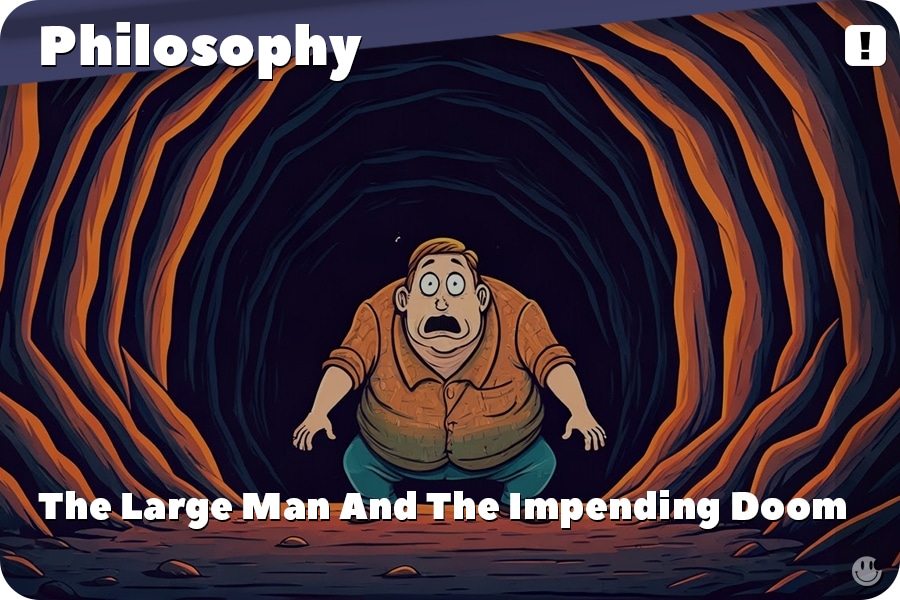
    You’re standing on a footbridge overlooking train tracks. Below you, a runaway trolley speeds toward five unsuspecting people tied to the tracks. There’s no time to warn them. But next to you is a very large man—he’s big enough that if pushed off the bridge, his body would stop the trolley, saving the five. He would die, but they would live.

    Do you push the man?

    This is the Fat Man variant of the Trolley Problem, one of ethics’ most famous thought experiments. First proposed by philosopher Judith Jarvis Thomson in the 1980s, it takes the original trolley dilemma and ratchets up the discomfort. It forces us to ask: Is it ever morally acceptable to sacrifice one person to save many actively?

    The Original Trolley Problem

    Before diving into the footbridge, let’s revisit the original dilemma:

    A trolley is headed toward five people tied to the tracks. You can pull a lever to divert the trolley to another track, where it will kill just one person. Do you pull the lever?

    Most people say yes—it feels like a tragic but rational trade: five lives for one.

    But the Fat Man variation tweaks just one detail—and suddenly, most people say no.

    Why the Change in Judgment?

    Both scenarios involve sacrificing one person to save five. So why do people feel differently?

    The key difference lies in direct action versus indirect action.

    • In the original, you pull a lever. The death is a byproduct.

    • In the Fat Man case, you physically push someone. The death is instrumental.

    This distinction activates different ethical instincts.

    Deontological Ethics (Duty-Based)

    Deontologists argue that some actions are inherently wrong, regardless of the outcomes.

    • Killing an innocent person, especially by personal force, violates a moral duty.

    • It treats the fat man as a means to an end, not as an end in himself.

    From this view, pushing the man is murder, even if the outcome saves more lives.

    Utilitarian Ethics (Outcome-Based)

    Utilitarians care about maximizing well-being. Five lives are more valuable than one. The math is the same in both cases.

    But even many utilitarians feel discomfort here, especially if intentions and consequences blur. It raises the slippery question: Can we justify any harm if it brings greater good?

    Virtue Ethics

    Virtue ethicists focus on the kind of person you are, not just what you do.

    • Would a virtuous person push the man?

    • Is courage or compassion expressed by action—or restraint?

    Virtue ethics encourages reflection on moral character, not just decision-making outcomes.

    Moral Intuition and Emotion

    Studies in psychology show that people react more negatively to the Fat Man scenario because it triggers emotional reasoning:

    • Physical contact (pushing a person) feels more violent.

    • You’re personally involved, not just operating a switch.

    • The action is intentional and premeditated.

    Neuroscience supports this. Personal moral dilemmas activate brain areas linked to emotion (like the amygdala), while impersonal dilemmas engage reasoning centers (like the dorsolateral prefrontal cortex).

    This suggests that morality is not just logical—it’s deeply emotional.

    Cultural and Legal Considerations

    Different cultures approach this dilemma in distinct ways:

    • In some collectivist cultures, sacrificing one to save many may be more acceptable.

    • In individualist societies, personal rights and bodily autonomy are more sacred.

    Legally, pushing the man would likely be seen as premeditated homicide. The law doesn’t typically weigh moral outcomes—it protects rights and punishes intentional harm.

    Real-World Parallels

    Though unlikely to face this exact scenario, similar ethical dilemmas exist:

    1. Medical Triage

    Doctors in overwhelmed hospitals must decide who gets care when resources are limited. Choosing who lives and dies echoes trolley-style logic.

    2. Drone Warfare

    Operators may choose to kill one known target to prevent a future attack. But civilian casualties complicate the ethical equation.

    3. Self-Driving Cars

    Should an autonomous vehicle swerve to avoid five pedestrians if it means killing the passenger? Designers are now encoding moral decisions into machines.

    These aren’t theoretical anymore—they’re real decisions with lives in the balance.

    Critics and Modifications

    Some philosophers challenge the Fat Man scenario entirely:

    • It’s unrealistic: people don’t stop trolleys with their bodies.

    • It’s emotionally manipulative, designed to elicit a certain reaction.

    • It assumes perfect knowledge: we know the outcomes with certainty.

    Others embrace it as a useful test case. It doesn’t need to be realistic—it’s a moral mirror that reveals what principles we value most.

    A Thought Experiment… or a Trap?

    Some ethicists argue the Fat Man problem distorts morality by presenting a no-win binary. Real life offers nuance, negotiation, and compromise.

    Still, it forces us to wrestle with hard questions:

    • Are we more responsible for what we do, or what we allow?

    • Does proximity change moral responsibility?

    • Can one life ever be worth less than five?

    Glossary of Terms

    • Deontology – Ethical theory that emphasizes duties and rules.

    • Utilitarianism – Moral philosophy focused on maximizing overall good.

    • Virtue Ethics – An approach to ethics that emphasizes character and moral virtues.

    • Trolley Problem – A thought experiment exploring the ethics of sacrificing one life to save many.

    • Moral Intuition – Immediate gut reactions to moral dilemmas, often shaped by emotion.

    Discussion Questions

    1. Why does pushing the man feel more morally wrong than pulling a lever?

    2. Should we always prioritize the greater good, even if it involves direct harm?

    3. How do emotions shape our ethical judgments—should we trust them?

    References and Further Reading

    • Thomson, Judith Jarvis. “The Trolley Problem.” Yale Law Journal, 1985.

    • Foot, Philippa. “The Problem of Abortion and the Doctrine of the Double Effect,” Oxford Review, 1967.

    • Stanford Encyclopedia of Philosophy – The Trolley Problem

    • Psychology Today – “Why We Hate the Fat Man Scenario”
  • Heinz’s Dilemma

    Heinz’s Dilemma

    Heinz’s Dilemma: Stealing Medicine to Save a Life

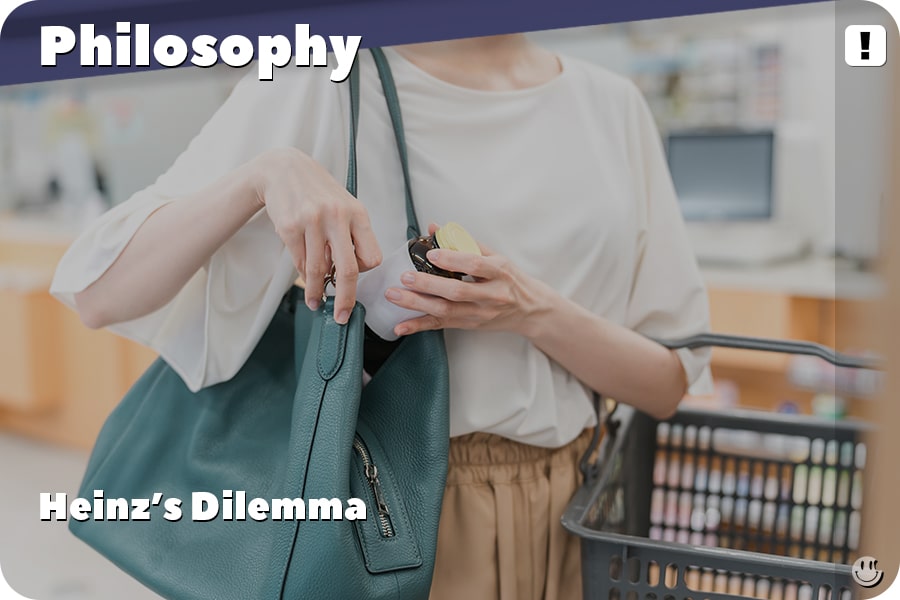
    In a small town, a man named Heinz faces an unbearable choice: his wife is gravely ill, and a pharmacist has developed a drug that could save her life. The problem? The medicine costs ten times more than it took to make—and Heinz can’t afford it.

    He begs, borrows, and pleads. The pharmacist refuses to lower the price or let Heinz pay later. With time running out, Heinz breaks into the pharmacy and steals the drug.

    Was Heinz wrong to steal the medicine?

    Or was he morally justified in doing whatever it took to save his wife’s life?

    This is Heinz’s Dilemma, a foundational moral scenario introduced by psychologist Lawrence Kohlberg in the 1950s. It’s used not to judge right or wrong, but to explore how people reason about ethics—and what that says about moral development.

    The Setup

    The original version, simplified for students and researchers, goes something like this:

    “A woman was near death from a rare cancer. One drug might save her, discovered by a local chemist. He was charging $2,000, ten times what it cost to make. Heinz tried everything to raise the money but came up short. He asked the chemist to sell it cheaper or let him pay later, but the man refused. So Heinz broke in and stole the drug.”

    Kohlberg posed this dilemma not to find the right answer, but to understand the reasoning behind people’s decisions.

    The Levels of Moral Reasoning

    Kohlberg believed people move through three stages of moral development, each with two sub-levels:

    1. Pre-Conventional Morality

    • Obedience and punishment: “Heinz shouldn’t steal because he’ll get caught.”

    • Self-interest: “Heinz should steal because he’ll be happier if his wife survives.”

    2. Conventional Morality

    • Interpersonal accord: “Heinz should steal because a good husband puts his wife first.”

    • Law and order: “Heinz shouldn’t steal because it’s against the law.”

    3. Post-Conventional Morality

    • Social contract: “Heinz should steal because the right to life is more important than property.”

    • Universal ethical principles: “Heinz must act based on justice, even if it means breaking the law.”

    The action might be the same (stealing the drug), but the justification reveals a person’s moral depth.

    Is Stealing Ever Justified?

    Let’s unpack some major ethical frameworks using Heinz’s dilemma.

    Utilitarianism

    A utilitarian would ask: Which choice creates the greatest good for the greatest number?

    • Saving a life has more utility than preserving property.

    • The pharmacist loses some money, but a human life is preserved.

    From this perspective, Heinz’s theft is morally justified—even obligated.

    Deontology

    A deontologist (like Immanuel Kant) would argue that morality is based on duties and universal rules, not outcomes.

    • Stealing is always wrong, regardless of intention.

    • If everyone stole when they had a good reason, trust and law would break down.

    Therefore, Heinz’s action violates a moral duty—even if his motive is love.

    Virtue Ethics

    This approach asks: What does a virtuous person do in this situation?

    Heinz is showing courage, compassion, and loyalty. But is he also showing justice and respect for others’ rights?

    A virtue ethicist might sympathize with Heinz but also ask: why is the pharmacist so unmoved by suffering?

    Ethics, in this view, is relational—it depends on the kind of person you are becoming, not just the rule you follow.

    What About the Pharmacist?

    While Heinz gets the spotlight, the pharmacist’s behavior raises its own ethical questions.

    • Should life-saving medicine be priced for profit?

    • Does the right to private property outweigh the right to life?

    • Is refusing payment or delayed compensation morally defensible?

    Some argue the pharmacist has a social obligation to make medicine accessible. Others defend his property rights and autonomy—after all, he created the drug.

    This side of the dilemma mirrors real-world debates over health care pricing, insulin access, and the patenting of life-saving drugs.

    Real-World Parallels

    Heinz’s story isn’t just a classroom thought experiment—it echoes real moral challenges.

    1. Healthcare Inequality

    Globally, millions face choices like Heinz’s every day. Lack of access to affordable treatment forces families to:

    • Delay care

    • Ration medication

    • Go into debt

    • Or resort to illegal actions

    In this light, the dilemma becomes a systemic indictment, not just a personal one.

    2. Medical Bankruptcy

    Medical debt is one of the leading causes of bankruptcy in countries without universal healthcare. When life and livelihood are on the line, moral boundaries blur.

    3. Insulin and EpiPen Prices

    Recent public outcry over the rising costs of insulin and allergy medication mirrors the pharmacist’s refusal to lower prices. These stories raise tough questions about profit, ethics, and public health.

    The Law vs. Justice

    This dilemma also highlights the difference between legal and moral actions.

    • Laws are rules enforced by governments.

    • Morals are principles about right and wrong.

    They often overlap—but not always. History is full of civil disobedience: people breaking laws to uphold moral ideals (think Rosa Parks or Gandhi).

    So the question becomes: When is it okay to break the law to do the right thing?

    Cultural Differences

    Interestingly, studies show that culture affects moral reasoning.

    • People may prioritize family or social harmony in collectivist societies (like Japan or India).

    • People might emphasize personal rights or legal structures in individualist societies (like the U.S.).

    This means moral dilemmas don’t have universal answers, but they do reveal universal questions.

    Glossary of Terms

    • Utilitarianism – A moral theory that emphasizes consequences and maximizing overall well-being.

    • Deontology – An ethical approach based on following rules or duties regardless of the outcomes.

    • Virtue Ethics – A theory focusing on moral character rather than rules or results.

    • Civil Disobedience – Breaking a law to uphold a moral principle.

    • Moral Development – The process through which people evolve in their ability to reason about ethics.

    Discussion Questions

    1. Was Heinz morally justified in stealing the drug? Why or why not?

    2. Should the pharmacist have lowered the price or offered a payment plan?

    3. Can breaking the law ever be the most ethical choice?

    References and Further Reading

  • The Ring of Gyges

    The Ring of Gyges

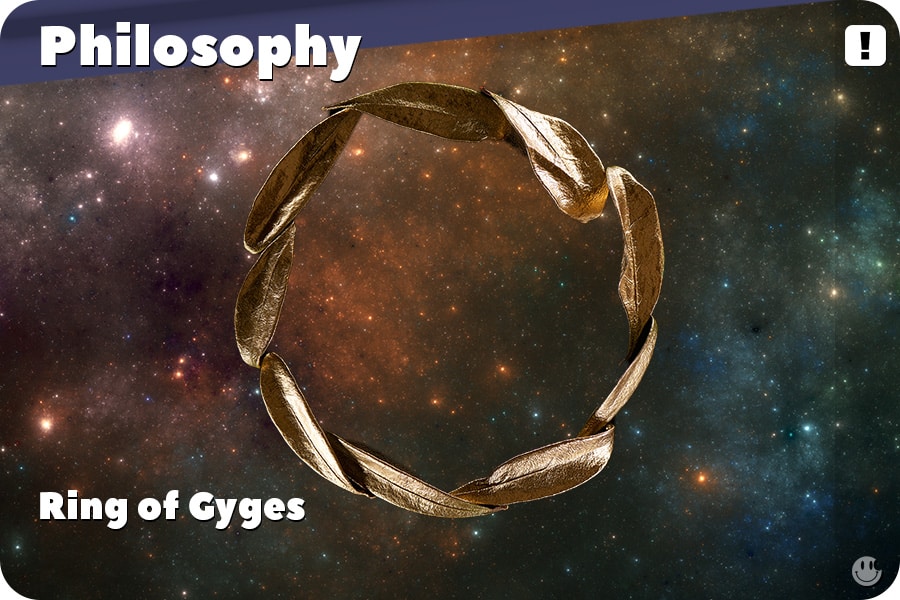
    The Ring of Gyges: Exploring Morality and Invisibility

    What would you do if you could never be caught?

    That’s the challenge posed by The Ring of Gyges, a thought experiment introduced by Plato in The Republic (Book II). It’s not just a magic story. It’s a deep dive into the nature of morality, justice, and human character—a tale that’s as relevant today as it was in ancient Greece.

    The scenario is simple but unsettling: Would you still act morally if no one could see your actions? And if not, what does that say about the real source of our ethics?

    The Story

    Plato tells the story through Glaucon, who challenges Socrates by recounting the myth of Gyges, a shepherd in the service of the king of Lydia.

    One day, after an earthquake, Gyges discovers a cave containing a bronze horse with a dead giant inside. On the corpse’s finger is a mysterious ring. Gyges takes it and soon discovers that he becomes invisible when he turns the ring inward.

    With his newfound power, Gyges seduces the queen, murders the king, and seizes the throne.

    No one holds him accountable. No one knows what he’s done. And that’s the point.

    According to Glaucon, anyone—no matter how just—would act the same if they had such power.

    Glaucon’s Challenge

    Glaucon uses the story to argue that people are only just because of social consequences. We don’t want to be punished. We want approval. But take away those consequences—through a ring of invisibility—and our true selfish nature will emerge.

    He says that justice is a social contract, a mutual agreement among people who fear the consequences of wrongdoing. Strip away that fear, and morality collapses.

    Or does it?

    This is the question Socrates—and Plato—aim to explore throughout the rest of The Republic.

    The Real Ethical Dilemma

    The Ring of Gyges isn’t about fantasy. It’s about temptation. Plato’s challenge is timeless:

    • If you could act without consequences…

    • If you could steal, lie, or cheat with impunity…

    • If you could harm without being caught…

    …would you still choose to be good?

    And if the answer is no, does that mean justice is just a performance?

    Socrates’ Rebuttal

    Socrates doesn’t deny that the ring could corrupt. But he argues that injustice damages the soul of the one who commits it. Even if a person gains power or pleasure through wrongdoing, they suffer internally—through disordered desires, anxiety, or spiritual disharmony.

    In Plato’s vision, justice is not just about external rules. It’s about inner harmony. A just person is aligned with reason, controls their impulses, and lives with peace of mind.

    In this view, morality is its own reward—even if no one is watching.

    Modern Parallels

    The Ring of Gyges has found echoes in countless modern scenarios:

    1. Online Anonymity

    On the internet, many people behave worse under the mask of anonymity—trolling, doxxing, or spreading misinformation. Without accountability, the ring goes digital.

    2. Whistleblowers vs. Corrupt Officials

    When people think they’re untouchable—politicians, executives, even religious leaders—they sometimes act as if the rules don’t apply. Invisibility comes in many forms: legal power, social privilege, or institutional cover.

    3. Surveillance and Ethics

    Debates about government surveillance often raise this question in reverse: If people behave better when they know they’re being watched, is mass surveillance justified?

    Would you prefer a society where people do the right thing because it’s right, or because they’re afraid of being seen?

    The Psychology of Hidden Actions

    Research in psychology supports Plato’s concern. Studies show that **people are more likely to cheat or lie when:

    • They feel anonymous

    • They perceive low risk of detection

    • They think “everyone else is doing it”

    Conversely, people are more ethical when:

    • They reflect on their values

    • They feel watched or accountable

    • They see others acting ethically

    In short, character and context both matter. The ring doesn’t create evil but reveals what’s already there.

    Related Thought Experiments

    • The Trolley Problem: Focuses on moral decision-making with visible consequences. The Ring of Gyges flips that script—what happens when no consequences exist?

    • The Experience Machine: Explores whether pleasure is enough, or if authenticity matters too.

    • Plato’s Allegory of the Cave: Also in The Republic, it contrasts illusion and enlightenment—another journey from shadow to truth.

    These stories all test what it means to live a good life.

    Pop Culture References

    The Ring of Gyges has inspired many fictional works:

    • The One Ring in Tolkien’s Lord of the Rings: Grants invisibility—and slowly corrupts the bearer.

    • H.G. Wells’ The Invisible Man: A scientist turns invisible and descends into madness and crime.

    • Harry Potter’s Invisibility Cloak: Used for both noble and mischievous ends.

    The trope of “power without consequence” is a storytelling staple—and a moral test.

    What Would You Do?

    Here’s the twist: Most people believe they would still act morally. But when tested, the line between who we are and what we do when no one’s watching often blurs.

    The Ring of Gyges forces us to ask:

    • Is morality real, or is it performance?

    • Do we act justly out of principle or out of fear?

    • Who are we when no one is looking?

    It’s easy to say, “I would never,”—but the point is to ask, “What would keep me from doing wrong?”

    Glossary of Terms

    • Justice: Fairness or moral rightness; in Plato’s philosophy, inner harmony between reason, spirit, and desire.

    • Ethics: The study of right and wrong behavior.

    • Social Contract: The idea that society is based on mutual agreements for the common good.

    • Anonymity: The condition of being unknown or unidentifiable—often linked to moral disengagement.

    • Moral Character: The traits or habits that reflect how a person consistently chooses right from wrong.

    Discussion Questions

    1. Would you act differently if you knew no one would ever find out?

    2. What keeps you from doing something wrong: consequences, conscience, or community?

    3. Is morality still meaningful when no one else is affected or aware?

    References and Further Reading