web analytics

Tag: Religion

  • Pascal’s Wager: The Pragmatic Bet on Belief in God

    Pascal’s Wager: The Pragmatic Bet on Belief in God

    Pascal’s Wager: The Pragmatic Bet on Belief in God

    In the 17th century, French mathematician and philosopher Blaise Pascal proposed a curious argument: Even if you can’t prove that God exists, you should still live as if He does—because the potential upside is infinite, and the downside is negligible.

    This idea became known as Pascal’s Wager. While it’s not a traditional proof of God’s existence, it remains one of the most famous and debated arguments in the philosophy of religion.

    Pascal didn’t claim to know God existed. Instead, he framed belief as a rational bet—a wager with eternal consequences.

    The Argument

    Here’s the logic in its simplest form:

    • If you believe in God and God exists → you gain eternal happiness (heaven).

    • If you believe in God and God does not exist → you lose very little.

    • If you do not believe and God exists → you suffer eternal loss (hell).

    • If you do not believe and God does not exist → you gain very little.

    So, Pascal asks, why not bet on belief? Given the asymmetry of outcomes, belief is the safer option.

    The Payoff Matrix

    Let’s put it into a basic grid:

      God Exists God Doesn’t Exist
    Believe Infinite gain Minor loss (e.g., time, discipline)
    Don’t Believe Infinite loss Minor gain (e.g., freedom, comfort)

    In game theory terms, this is a decision under uncertainty with infinite stakes. Pascal argues that reason alone can’t determine the truth—but reason can still tell us how to bet wisely.

    Belief as a Rational Choice

    Pascal wasn’t trying to prove God exists. He admitted that faith requires more than logic. But he also understood human psychology and offered this wager as a practical guide for the uncertain.

    His approach echoes expected value theory—a concept now central in economics and risk analysis. If the expected value of belief (even with low probability) is infinite, then it outweighs any finite cost.

    In short: When the potential reward is infinite, any finite investment is worth it.

    Common Critiques of Pascal’s Wager

    While clever, the argument has attracted a wide range of criticisms:

    1. Can Belief Be a Choice?

    Can you simply decide to believe something because it’s advantageous? Critics argue that genuine belief requires conviction—not calculation.

    Pascal anticipated this and suggested that habit and practice could lead to sincere belief over time. Go to church, pray, engage with faith—and belief might follow.

    Still, this raises ethical concerns: Is belief valid if it starts from self-interest?

    2. Which God Are We Betting On?

    Pascal’s Wager assumes a specific religious framework (Christianity), but what if another religion is correct? If you bet on the wrong god, could you still lose?

    This is sometimes called the Many Gods Objection. It challenges the idea that belief in any god leads to the same infinite reward—or that the “right” god can be known in advance.

    3. What If the Cost Is Higher Than He Thinks?

    Pascal suggests that the cost of belief is small. But for some, religious belief might involve:

    • Repression of personal identity

    • Sacrifice of intellectual freedom

    • Emotional or cultural tension

    The wager’s appeal depends on how you value what belief might cost in your specific life.

    Modern Interpretations

    Pascal’s Wager has aged surprisingly well. Its logic has been adapted to other fields:

    Decision Theory

    Pascal’s logic resembles risk management. When consequences are extreme (like death or disaster), even a small chance justifies big precautions. This is why we buy insurance.

    Existential Risk

    Some philosophers now use a version of Pascal’s Wager to argue for climate action, AI safety, and nuclear disarmament. If the risk of global catastrophe is small but the impact is enormous, shouldn’t we act just in case?

    AI and Superintelligence

    A twist on the wager has emerged in debates about AI ethics. If future superintelligent AIs might punish non-believers in simulation scenarios (a bizarre hypothetical known as Roko’s Basilisk), does that change how we act now?

    Most philosophers reject these fringe versions—but they show how Pascal’s logic still resonates in new domains.

    Why the Wager Still Matters

    Pascal’s Wager isn’t about proof. It’s about pragmatism. It challenges us to ask:

    • What do I risk by believing?

    • What might I gain?

    • What assumptions shape my decisions?

    It also forces us to confront our uncertainty. Most people don’t have perfect knowledge of the divine. Pascal accepts this ambiguity and builds an argument about how to live without knowing for sure.

    That humility is part of the wager’s power.

    The Man Behind the Bet

    Blaise Pascal (1623–1662) was a mathematician, physicist, inventor, and Christian thinker. He helped develop probability theory, made early breakthroughs in fluid mechanics, and even designed one of the first mechanical calculators.

    In his later years, Pascal turned to theology and philosophy. He never finished his masterwork Pensées (“Thoughts”), but the fragments remain deeply influential. The Wager appears in one of these notes.

    Pascal’s personal struggles with illness, suffering, and spiritual doubt gave his arguments a personal weight. He wasn’t bluffing. He was betting everything.

    Related Thought Experiments

    • Pascal’s Mugging: A twist where someone asks for $5 and promises infinite reward—but gives no reason to believe them. Should you pay up? It explores how the possibility of infinite reward can be abused.

    • The Experience Machine: Challenges whether pleasure alone is enough to justify life—echoing Pascal’s deeper question about meaning vs. happiness.

    • The Veil of Ignorance: Like Pascal’s Wager, it guides decision-making under uncertainty—but for social justice, not spirituality.

    Glossary of Terms

    • Expected Value: A weighted average of all possible outcomes, factoring in probability.

    • Decision Theory: A field of study about how people make choices under uncertainty.

    • Pragmatism: A philosophical approach that evaluates ideas based on their practical consequences.

    • Faith: Belief that goes beyond (or sometimes against) reason or empirical evidence.

    Discussion Questions

    1. Can belief be a rational strategy, even without evidence?

    2. What are the ethical implications of believing just to avoid punishment or gain reward?

    3. How does Pascal’s Wager compare to modern risk-based decision-making?

    References and Further Reading

  • Founder of Pastafarianism, Bobby Henderson’s Letter to Kansas School Board

    Founder of Pastafarianism, Bobby Henderson’s Letter to Kansas School Board

    Bobby Henderson’s (founder of Pastafarianism) Open Letter to Kansas School Board
    May, 2005

    I am writing you with much concern after having read of your hearing to decide whether the alternative theory of Intelligent Design should be taught along with the theory of Evolution. I think we can all agree that it is important for students to hear multiple viewpoints so they can choose for themselves the theory that makes the most sense to them. I am concerned, however, that students will only hear one theory of Intelligent Design.

    Let us remember that there are multiple theories of Intelligent Design. I and many others around the world are of the strong belief that the universe was created by a Flying Spaghetti Monster. It was He who created all that we see and all that we feel. We feel strongly that the overwhelming scientific evidence pointing towards evolutionary processes is nothing but a coincidence, put in place by Him.

    It is for this reason that I’m writing you today, to formally request that this alternative theory be taught in your schools, along with the other two theories. In fact, I will go so far as to say, if you do not agree to do this, we will be forced to proceed with legal action. I’m sure you see where we are coming from. If the Intelligent Design theory is not based on faith, but instead another scientific theory, as is claimed, then you must also allow our theory to be taught, as it is also based on science, not on faith.

    Some find that hard to believe, so it may be helpful to tell you a little more about our beliefs. We have evidence that a Flying Spaghetti Monster created the universe. None of us, of course, were around to see it, but we have written accounts of it. We have several lengthy volumes explaining all details of His power. Also, you may be surprised to hear that there are over 10 million of us, and growing. We tend to be very secretive, as many people claim our beliefs are not substantiated by observable evidence.

    What these people don’t understand is that He built the world to make us think the earth is older than it really is. For example, a scientist may perform a carbon-dating process on an artifact. He finds that approximately 75% of the Carbon-14 has decayed by electron emission to Nitrogen-14, and infers that this artifact is approximately 10,000 years old, as the half-life of Carbon-14 appears to be 5,730 years. But what our scientist does not realize is that every time he makes a measurement, the Flying Spaghetti Monster is there changing the results with His Noodly Appendage. We have numerous texts that describe in detail how this can be possible and the reasons why He does this. He is of course invisible and can pass through normal matter with ease.

    I’m sure you now realize how important it is that your students are taught this alternate theory. It is absolutely imperative that they realize that observable evidence is at the discretion of a Flying Spaghetti Monster. Furthermore, it is disrespectful to teach our beliefs without wearing His chosen outfit, which of course is full pirate regalia. I cannot stress the importance of this enough, and unfortunately cannot describe in detail why this must be done as I fear this letter is already becoming too long. The concise explanation is that He becomes angry if we don’t.

    You may be interested to know that global warming, earthquakes, hurricanes, and other natural disasters are a direct effect of the shrinking numbers of Pirates since the 1800s. For your interest, I have included a graph of the approximate number of pirates versus the average global temperature over the last 200 years. As you can see, there is a statistically significant inverse relationship between pirates and global temperature.

    In conclusion, thank you for taking the time to hear our views and beliefs. I hope I was able to convey the importance of teaching this theory to your students. We will of course be able to train the teachers in this alternate theory. I am eagerly awaiting your response, and hope dearly that no legal action will need to be taken. I think we can all look forward to the time when these three theories are given equal time in our science classrooms across the country, and eventually the world; One third time for Intelligent Design, one third time for Flying Spaghetti Monsterism (Pastafarianism), and one third time for logical conjecture based on overwhelming observable evidence.

    Sincerely Yours,

    Bobby Henderson, concerned citizen.

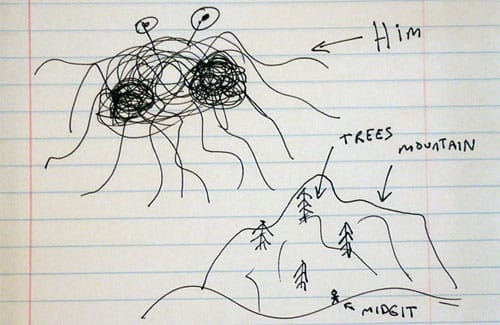
    P.S. I have included an artistic drawing of Him creating a mountain, trees, and a midget. Remember, we are all His creatures.

  • Martin Luther’s 95 Theses

    Martin Luther’s 95 Theses

    Martin Luther’s 95 Theses: The Start of the Protestant Reformation

    Martin Luther’s 95 Theses didn’t just challenge a religious practice—they cracked the foundation of the Catholic Church’s authority and launched the Protestant Reformation. Nailed (or mailed) on October 31, 1517, the 95 Theses questioned the legitimacy of selling indulgences and ignited a global reform movement.

    What Were Martin Luther’s 95 Theses?

    Martin Luther’s 95 Theses, officially titled Disputation on the Power and Efficacy of Indulgences, were a series of academic statements that challenged the Catholic Church’s teachings, particularly its practice of selling indulgences.

    Written in Latin, the document wasn’t a public protest but a formal call for scholarly debate. Luther, a theology professor at the University of Wittenberg, aimed to address corrupt practices he believed misled faithful Christians.

    Key term: An indulgence was a certificate sold by the Church promising forgiveness of sins and reduced time in purgatory.

    Why Did Martin Luther Write the 95 Theses?

    In 1517, a Dominican friar named Johann Tetzel aggressively marketed indulgences across German territories. His famous line, “As soon as a coin in the coffer rings, the soul from purgatory springs,” perfectly captured what Luther found so wrong.

    Luther believed that salvation came by faith alone (sola fide), not by purchasing forgiveness. He argued that the pope had no authority to sell divine grace and that true repentance could not be bought.

    Key Events and Dates in Martin Luther’s 95 Theses

    ???? October 31, 1517

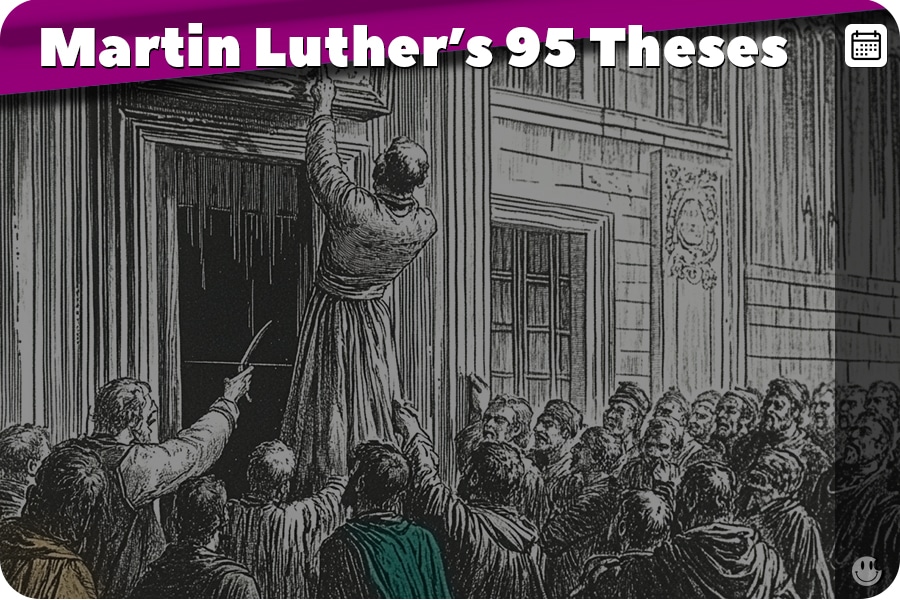
    Luther likely mailed his 95 Theses to Archbishop Albrecht of Mainz and may have also posted them on the door of All Saints’ Church in Wittenberg, following academic custom. This symbolic act is now recognized as the start of the Protestant Reformation.

    ???? December 10, 1520

    Luther burned the papal bull Exsurge Domine, which had ordered him to recant under threat of excommunication.

    ???? January 3, 1521

    Pope Leo X officially excommunicated Martin Luther via the decree Decet Romanum Pontificem.

    ???? April 17–18, 1521

    Luther appeared before the Diet of Worms, a formal assembly of the Holy Roman Empire. When asked to recant, he allegedly declared, “Here I stand, I can do no other.”

    How the Printing Press Helped Spread the 95 Theses

    While Luther intended the theses for internal academic discussion, unauthorized German translations quickly circulated—thanks to the printing press, invented by Johannes Gutenberg in the mid-1400s.

    Within weeks, copies of Luther’s theses had spread throughout Germany. Within months, they had reached most of Europe. The Reformation went viral by 16th-century standards.

    Was the 95 Theses Event Really a Protest?

    Yes and no. The tone of the 95 Theses was academic and respectful, not rebellious. Luther didn’t originally seek to leave the Church but to correct what he saw as abuses. He addressed the pope directly and used Church-approved debate methods. But once the controversy gained public traction, the Church’s backlash radicalized Luther and his supporters.

    Legacy of Martin Luther’s 95 Theses

    The 95 Theses didn’t just launch a religious reformation—they reshaped European history. The movement led to:

    • The creation of Lutheranism and other Protestant denominations

    • The Counter-Reformation and the Council of Trent

    • Translation of the Bible into the vernacular (German)

    • Centuries of religious conflict and political upheaval

    Today, the event is commemorated every October 31st as Reformation Day, particularly in Germany and among Protestant communities worldwide.

    Quick Facts About Martin Luther’s 95 Theses

    Fact Detail
    Date Posted October 31, 1517
    Location Wittenberg, Saxony (Holy Roman Empire)
    Original Language Latin
    Full Title Disputatio pro declaratione virtutis indulgentiarum
    Number of Theses 95
    Target of Criticism Indulgences and papal authority
    Historical Outcome Sparked the Protestant Reformation

    Out of love for the truth and from desire to elucidate it, the Reverend Father Martin Luther, Master of Arts and Sacred Theology, and ordinary lecturer therein at Wittenberg, intends to defend the following statements and to dispute on them in that place. Therefore he asks that those who cannot be present and dispute with him orally shall do so in their absence by letter. In the name of our Lord Jesus Christ, Amen.

    1. When our Lord and Master Jesus Christ said, “Repent” (Mt 4:17), he willed the entire life of believers to be one of repentance.
    2. This word cannot be understood as referring to the sacrament of penance, that is, confession and satisfaction, as administered by the clergy.
    3. Yet it does not mean solely inner repentance; such inner repentance is worthless unless it produces various outward mortification of the flesh.
    4. The penalty of sin remains as long as the hatred of self (that is, true inner repentance), namely till our entrance into the kingdom of heaven.
    5. The pope neither desires nor is able to remit any penalties except those imposed by his own authority or that of the canons.
    6. The pope cannot remit any guilt, except by declaring and showing that it has been remitted by God; or, to be sure, by remitting guilt in cases reserved to his judgment. If his right to grant remission in these cases were disregarded, the guilt would certainly remain unforgiven.
    7. God remits guilt to no one unless at the same time he humbles him in all things and makes him submissive to the vicar, the priest.
    8. The penitential canons are imposed only on the living, and, according to the canons themselves, nothing should be imposed on the dying.
    9. Therefore the Holy Spirit through the pope is kind to us insofar as the pope in his decrees always makes exception of the article of death and of necessity.
    10. Those priests act ignorantly and wickedly who, in the case of the dying, reserve canonical penalties for purgatory.
    11. Those tares of changing the canonical penalty to the penalty of purgatory were evidently sown while the bishops slept (Mt 13:25).
    12. In former times canonical penalties were imposed, not after, but before absolution, as tests of true contrition.
    13. The dying are freed by death from all penalties, are already dead as far as the canon laws are concerned, and have a right to be released from them.
    14. Imperfect piety or love on the part of the dying person necessarily brings with it great fear; and the smaller the love, the greater the fear.
    15. This fear or horror is sufficient in itself, to say nothing of other things, to constitute the penalty of purgatory, since it is very near to the horror of despair.
    16. Hell, purgatory, and heaven seem to differ the same as despair, fear, and assurance of salvation.
    17. It seems as though for the souls in purgatory fear should necessarily decrease and love increase.
    18. Furthermore, it does not seem proved, either by reason or by Scripture, that souls in purgatory are outside the state of merit, that is, unable to grow in love.
    19. Nor does it seem proved that souls in purgatory, at least not all of them, are certain and assured of their own salvation, even if we ourselves may be entirely certain of it.
    20. Therefore the pope, when he uses the words “plenary remission of all penalties,” does not actually mean “all penalties,” but only those imposed by himself.
    21. Thus those indulgence preachers are in error who say that a man is absolved from every penalty and saved by papal indulgences.
    22. As a matter of fact, the pope remits to souls in purgatory no penalty which, according to canon law, they should have paid in this life.
    23. If remission of all penalties whatsoever could be granted to anyone at all, certainly it would be granted only to the most perfect, that is, to very few.
    24. For this reason most people are necessarily deceived by that indiscriminate and high-sounding promise of release from penalty.
    25. That power which the pope has in general over purgatory corresponds to the power which any bishop or curate has in a particular way in his own diocese and parish.
    26. The pope does very well when he grants remission to souls in purgatory, not by the power of the keys, which he does not have, but by way of intercession for them.
    27. They preach only human doctrines who say that as soon as the money clinks into the money chest, the soul flies out of purgatory.
    28. It is certain that when money clinks in the money chest, greed and avarice can be increased; but when the church intercedes, the result is in the hands of God alone.
    29. Who knows whether all souls in purgatory wish to be redeemed, since we have exceptions in St. Severinus and St. Paschal, as related in a legend.
    30. No one is sure of the integrity of his own contrition, much less of having received plenary remission.
    31. The man who actually buys indulgences is as rare as he who is really penitent; indeed, he is exceedingly rare.
    32. Those who believe that they can be certain of their salvation because they have indulgence letters will be eternally damned, together with their teachers.
    33. Men must especially be on guard against those who say that the pope’s pardons are that inestimable gift of God by which man is reconciled to him.
    34. For the graces of indulgences are concerned only with the penalties of sacramental satisfaction established by man.
    35. They who teach that contrition is not necessary on the part of those who intend to buy souls out of purgatory or to buy confessional privileges preach unchristian doctrine.
    36. Any truly repentant Christian has a right to full remission of penalty and guilt, even without indulgence letters.
    37. Any true Christian, whether living or dead, participates in all the blessings of Christ and the church; and this is granted him by God, even without indulgence letters.
    38. Nevertheless, papal remission and blessing are by no means to be disregarded, for they are, as I have said (Thesis 6), the proclamation of the divine remission.
    39. It is very difficult, even for the most learned theologians, at one and the same time to commend to the people the bounty of indulgences and the need of true contrition.
    40. A Christian who is truly contrite seeks and loves to pay penalties for his sins; the bounty of indulgences, however, relaxes penalties and causes men to hate them — at least it furnishes occasion for hating them.
    41. Papal indulgences must be preached with caution, lest people erroneously think that they are preferable to other good works of love.
    42. Christians are to be taught that the pope does not intend that the buying of indulgences should in any way be compared with works of mercy.
    43. Christians are to be taught that he who gives to the poor or lends to the needy does a better deed than he who buys indulgences.
    44. Because love grows by works of love, man thereby becomes better. Man does not, however, become better by means of indulgences but is merely freed from penalties.
    45. Christians are to be taught that he who sees a needy man and passes him by, yet gives his money for indulgences, does not buy papal indulgences but God’s wrath.
    46. Christians are to be taught that, unless they have more than they need, they must reserve enough for their family needs and by no means squander it on indulgences.
    47. Christians are to be taught that they buying of indulgences is a matter of free choice, not commanded.
    48. Christians are to be taught that the pope, in granting indulgences, needs and thus desires their devout prayer more than their money.
    49. Christians are to be taught that papal indulgences are useful only if they do not put their trust in them, but very harmful if they lose their fear of God because of them.
    50. Christians are to be taught that if the pope knew the exactions of the indulgence preachers, he would rather that the basilica of St. Peter were burned to ashes than built up with the skin, flesh, and bones of his sheep.
    51. Christians are to be taught that the pope would and should wish to give of his own money, even though he had to sell the basilica of St. Peter, to many of those from whom certain hawkers of indulgences cajole money.
    52. It is vain to trust in salvation by indulgence letters, even though the indulgence commissary, or even the pope, were to offer his soul as security.
    53. They are the enemies of Christ and the pope who forbid altogether the preaching of the Word of God in some churches in order that indulgences may be preached in others.
    54. Injury is done to the Word of God when, in the same sermon, an equal or larger amount of time is devoted to indulgences than to the Word.
    55. It is certainly the pope’s sentiment that if indulgences, which are a very insignificant thing, are celebrated with one bell, one procession, and one ceremony, then the gospel, which is the very greatest thing, should be preached with a hundred bells, a hundred processions, a hundred ceremonies.
    56. The true treasures of the church, out of which the pope distributes indulgences, are not sufficiently discussed or known among the people of Christ.
    57. That indulgences are not temporal treasures is certainly clear, for many indulgence sellers do not distribute them freely but only gather them.
    58. Nor are they the merits of Christ and the saints, for, even without the pope, the latter always work grace for the inner man, and the cross, death, and hell for the outer man.
    59. St. Lawrence said that the poor of the church were the treasures of the church, but he spoke according to the usage of the word in his own time.
    60. Without want of consideration we say that the keys of the church, given by the merits of Christ, are that treasure.
    61. For it is clear that the pope’s power is of itself sufficient for the remission of penalties and cases reserved by himself.
    62. The true treasure of the church is the most holy gospel of the glory and grace of God.
    63. But this treasure is naturally most odious, for it makes the first to be last (Mt. 20:16).
    64. On the other hand, the treasure of indulgences is naturally most acceptable, for it makes the last to be first.
    65. Therefore the treasures of the gospel are nets with which one formerly fished for men of wealth.
    66. The treasures of indulgences are nets with which one now fishes for the wealth of men.
    67. The indulgences which the demagogues acclaim as the greatest graces are actually understood to be such only insofar as they promote gain.
    68. They are nevertheless in truth the most insignificant graces when compared with the grace of God and the piety of the cross.
    69. Bishops and curates are bound to admit the commissaries of papal indulgences with all reverence.
    70. But they are much more bound to strain their eyes and ears lest these men preach their own dreams instead of what the pope has commissioned.
    71. Let him who speaks against the truth concerning papal indulgences be anathema and accursed.
    72. But let him who guards against the lust and license of the indulgence preachers be blessed.
    73. Just as the pope justly thunders against those who by any means whatever contrive harm to the sale of indulgences.
    74. Much more does he intend to thunder against those who use indulgences as a pretext to contrive harm to holy love and truth.
    75. To consider papal indulgences so great that they could absolve a man even if he had done the impossible and had violated the mother of God is madness.
    76. We say on the contrary that papal indulgences cannot remove the very least of venial sins as far as guilt is concerned.
    77. To say that even St. Peter if he were now pope, could not grant greater graces is blasphemy against St. Peter and the pope.
    78. We say on the contrary that even the present pope, or any pope whatsoever, has greater graces at his disposal, that is, the gospel, spiritual powers, gifts of healing, etc., as it is written. (1 Co 12[:28])
    79. To say that the cross emblazoned with the papal coat of arms, and set up by the indulgence preachers is equal in worth to the cross of Christ is blasphemy.
    80. The bishops, curates, and theologians who permit such talk to be spread among the people will have to answer for this.
    81. This unbridled preaching of indulgences makes it difficult even for learned men to rescue the reverence which is due the pope from slander or from the shrewd questions of the laity.
    82. Such as: “Why does not the pope empty purgatory for the sake of holy love and the dire need of the souls that are there if he redeems an infinite number of souls for the sake of miserable money with which to build a church?” The former reason would be most just; the latter is most trivial.
    83. Again, “Why are funeral and anniversary masses for the dead continued and why does he not return or permit the withdrawal of the endowments founded for them, since it is wrong to pray for the redeemed?”
    84. Again, “What is this new piety of God and the pope that for a consideration of money they permit a man who is impious and their enemy to buy out of purgatory the pious soul of a friend of God and do not rather, beca use of the need of that pious and beloved soul, free it for pure love’s sake?”
    85. Again, “Why are the penitential canons, long since abrogated and dead in actual fact and through disuse, now satisfied by the granting of indulgences as though they were still alive and in force?”
    86. Again, “Why does not the pope, whose wealth is today greater than the wealth of the richest Crassus, build this one basilica of St. Peter with his own money rather than with the money of poor believers?”
    87. Again, “What does the pope remit or grant to those who by perfect contrition already have a right to full remission and blessings?”
    88. Again, “What greater blessing could come to the church than if the pope were to bestow these remissions and blessings on every believer a hundred times a day, as he now does but once?”
    89. “Since the pope seeks the salvation of souls rather than money by his indulgences, why does he suspend the indulgences and pardons previously granted when they have equal efficacy?”
    90. To repress these very sharp arguments of the laity by force alone, and not to resolve them by giving reasons, is to expose the church and the pope to the ridicule of their enemies and to make Christians unhappy.
    91. If, therefore, indulgences were preached according to the spirit and intention of the pope, all these doubts would be readily resolved. Indeed, they would not exist.
    92. Away, then, with all those prophets who say to the people of Christ, “Peace, peace,” and there is no peace! (Jer 6:14)
    93. Blessed be all those prophets who say to the people of Christ, “Cross, cross,” and there is no cross!
    94. Christians should be exhorted to be diligent in following Christ, their Head, through penalties, death and hell.
    95. And thus be confident of entering into heaven through many tribulations rather than through the false security of peace (Acts 14:22).