web analytics

Tag: WWII

  • 2000 History, Facts and Trivia

    2000 History, Facts and Trivia

    2000 History, Facts and Trivia

    Quick Facts from 2000:

    • World Changing Event: HotorNot.com was founded. It was the first major participation site on the internet.
    • The Top Song was Independent Woman by Destiny’s Child
    • Influential Songs include: Goodbye Earl by The Dixie Chicks, Stan by Eminem, and Graduation by Vitamin C
    • The Movies to Watch include Cast Away, Erin Brockovich, Remember the Titans, Unbreakable, O Brother, Where Art Thou?, The Emperor’s New Groove and The Perfect Storm
    • People Magazine’s Sexiest Man Alive: Brad Pitt
    • Notable books include Harry Potter and the Goblet of Fire by J.K. Rowling and Tuesdays with Morrie by Mitch Albom.
    • Price of Russet Potatoes, 5 pounds in 2000: 79 cents
      Dell Dimension computer, 64 MB, with the monitor: $899.00
      Samsung MP3 player: $399.00
      Sony PlayStation: $299.00
    • The Funny Guy was: Lewis Black
    • According to a poll in 2000, the Japanese believe that their best invention of the 20th century was instant noodles.
    • Athletes in the Olympic Village reportedly used 70,000 condoms at the 2000 Games and 100,000 at the 2008 Games. About 450,000 were provided in 2016.
    • The Unexpected Paycheck: A prisoner named James Carter was leading the men in a song called Po’ Lazarus. While chopping logs, it was recorded by Alan Lomax and Shirley Collins. In 2000, it was used in O Brother, Where Art Thou?, which won a Grammy. Carter was tracked down and given thousands in royalties.
    • The Conversation: “So, why were we so worried about Y2K again…?”

    Year 2000 History Roundup:

    • January 1 – New Millennium Celebrations: Global festivities marked the beginning of the 21st century and the new millennium, despite debates about the official start year.
    • January 10 – AOL and Time Warner Announced Merger: America Online announced a $162 billion deal to purchase Time Warner, marking the largest corporate merger at that time.
    • January 14 – Dow Jones Industrial Average Peak: The Dow Jones closed at 11,722.98, reflecting the peak of the Dot-com bubble.
    • February 13 – Final ‘Peanuts’ Comic Strip Published: The last original “Peanuts” comic strip was published.
    • February 17 – Microsoft Released Windows 2000: Microsoft launched Windows 2000, introducing new features for business and professional computing.
    • March 10 – NASDAQ Composite Index Peak: The NASDAQ reached an all-time high of 5,048.62, signaling the zenith of the Dot-com bubble.
    • March 26 – Vladimir Putin Elected President of Russia: Vladimir Putin won the Russian presidential election, beginning his first term as president.
    • April 22 – Elián González Reunited with Father: After a federal raid on his Miami relatives’ home, six-year-old Cuban boy Elián González was reunited with his father, ending an international custody dispute.
    • May 5ILOVEYOU Computer Virus Spread: The ILOVEYOU virus, originating from the Philippines, infected millions of computers worldwide, causing extensive damage.
    • May 11 – India’s Population Reached 1 Billion: India’s population officially reached 1 billion, marked by the birth of a baby girl named Astha.
    • June 26 – Human Genome Project Draft Completed: A preliminary draft of the human genome was completed, marking a significant milestone in genetics.
    • July 2 – Vicente Fox Elected President of Mexico: Vicente Fox won the Mexican presidential election, ending 71 years of Institutional Revolutionary Party (PRI) rule.
    • July 25 – Concorde Crash in Paris: Air France Flight 4590, a Concorde aircraft, crashed shortly after takeoff in Paris, killing all 109 people on board and four on the ground.
    • August 12 – Russian Submarine Kursk Sank: The Russian submarine Kursk sank in the Barents Sea during a naval exercise, resulting in the deaths of all 118 crew members.
    • September 6–8 – UN Millennium Summit Held: World leaders gathered at the United Nations Headquarters in New York City for the Millennium Summit to discuss global issues and set development goals.
    • September 15–October 1 – Sydney Hosted Summer Olympics: The 2000 Summer Olympics were held in Sydney, Australia, featuring 10,651 athletes from 199 nations.
    • October 12USS Cole Bombing: The USS Cole, a U.S. Navy destroyer, was attacked by suicide bombers in Aden, Yemen, resulting in the deaths of 17 sailors.
    • November 7Contested U.S. Presidential Election: The U.S. presidential election between George W. Bush and Al Gore resulted in a prolonged legal battle over Florida’s vote count.
    • December 12Bush v. Gore Supreme Court Decision: The U.S. Supreme Court halted the Florida recount, effectively awarding the presidency to George W. Bush.
    • December 15 – Chernobyl Nuclear Power Plant Closed: The Chernobyl Nuclear Power Plant was officially shut down, ending operations 14 years after the catastrophic 1986 disaster.
    • December 24 – Christmas Eve Church Bombings in Indonesia: A series of bombings targeted churches across Indonesia, resulting in 18 deaths and numerous injuries.
    • December 25 – Luoyang Christmas Fire in China: A devastating fire at a shopping center in Luoyang, China, killed 309 people during Christmas celebrations.
    • December 31 – End of the 20th Century: The 20th and 2nd millennium concluded, leading to global reflections on the past 1000 years.
    • Dot-Com Bubble Burst: The collapse of numerous internet-based companies led to a significant stock market downturn, marking the end of the Dot-com bubble.

    Top Ten Baby Names of 2000:

    Emily, Hannah, Madison, Ashley, Sarah, Jacob, Michael, Matthew, Joshua, Chris, Topher

    Fashion Icons and Sex Symbols:

    Gisele Bündchen, Jessica Biel, Claudia Schiffer, Britney Spears, Heidi Klum, Estella Warren, Shannon Elizabeth, Christina Aguilera, Jessica Alba, Piper Perabo

    The Hot Guys:

    Brad Pitt, George Clooney, Bon Jovi, Mel Gibson, Ricky Martin, Mark Wahlberg, Casper Casper Van Dien, Jessie L. Martin, Tyrese, Derek Jeter, Johnny Depp, Russell Crowe, Ben Affleck, Tom Cruise, Alex Rodriguez, and Prince William.

    “The Quote:”

    “I have nipples, Greg. Could you milk me?”
    – Robert De Nero in Meet The Parents

    Time Magazine’s Man of the Year:

    George W. Bush

    Time Magazine’s Person of the Century:

    Albert Einstein

    Miss America:

    Heather French (Maysville, KY)

    Miss USA:

    Lynnette Cole (Tennessee)

    The Scandals:

    The Mexican government opened fire on peaceful protestors in October 1968. An estimated 300-400 civilians were killed and an additional 1,345 were arrested. In 2000, official government documents were released that showed the government employed agents dressed as protestors to provoke the officers into the shooting.

    Jenifer Lopez’s Versace Grammy Dress.

    Meg Ryan left hubby Dennis Quaid for what turned out to be a fling with Russell Crowe.

    The police found cocaine and valium in Robert Downey Jr.’s Merv Griffin Hotel room.

    In November 2000, Japan passed its first anti-stalking law after Shiori Ino, a 21-year-old student, was murdered by her stalker the previous year. She had been turned away multiple times by the police.

    Hip Hop Obesity Death:

    Big Pun

    Beloved Mad Magazine Cartoonist Death:

    Don Martin

    Pop Culture Facts & History:

    2000 was the first year Martin Luther King Jr. Day was officially observed in all 50 states.

    In October 2000, Heinz introduced colored ketchup products called EZ Squirt, which eventually included green (2000), purple (2001), mystery (pink, orange, or teal, 2002), and blue (2003). In 2006, the products were discontinued.

    There have been two wooden looping roller coasters in history, one built in 1895 (Flip Flap Railway at Paul Boyton’s Sea Lion Park on Coney Island in Brooklyn, New York, closed 1902) and the other in 2000 (Son of Beast at Kings Island in Mason, Ohio, closed 2009).

    November 2, 2000 was the last time humans were simultaneously on earth. Ever since then, the ISS has been occupied continuously.

    Coca-Cola settled at a trial, where they were accused of discrimination in pay, promotions and performance evaluations towards African-American employees. They agreed to a $192 million settlement in corporate racial discrimination, the largest settlement ever.

    In 2000, author J.K. Rowling gave her father the first edition of Harry Potter and the Goblet of Fire for Father’s Day and signed it: “Lots of love from your firstborn.” Three years later, he sold it for £27,500.

    For centuries, there was a secret wing at the Naples National Archaeological Museum, where all the erotic art found in Pompeii was locked away. The cabinet remained closed for over a hundred years, with the doorway even bricked up at one point, and was only fully opened to the public in 2000.

    NASA spacecraft ‘Deep Impact’ is lost in space, as NASA lost communication with it due to a similar problem to the Y2K bug. It was lost less than a second after January 1st, 2000 – most likely because the time tracker onboard had overflowed.

    In 2000, an American-British consortium offered $250 million to each of the group’s four members to reunite, but they turned down the offer.

    Danish citizen, Stig Severinsen, held his breath for over twenty minutes while submerged in a tank filled with sharks.

    A Brazilian electronics company, Gradiente, is legally allowed to call their phone ‘iPhone’ because they trademarked the word in 2000, 7 years before Apple’s iPhone. They share the name with Apple, although they are different products.

    Air travel was practically unaffected on January 1, 2000, even though there was a fair amount of panic about the Y2K bug.

    The country of Tuvalu could not join the United Nations until 2000, because it did not have the $100,000 fee to join. Tuvalu began selling its domain name of .tv to companies to make most of that country’s money.

    The lowest PGA score of 63 played by Jose Maria Olazabal.

    Spain’s Paralympic basketball team was ordered to return their gold medals won in Sydney after nearly all of their players were found to have no disability at all.

    Two Egyptologists found that a 2,700-year-old 27-inch statue of King Taharqa was unknowingly being used as a bike rack by staff in the basement of a Southampton museum. It had been ignored for a century.

    Angelina Jolie and Billy Bob Thornton got married on May 5, 2000.

    Brad Pitt and Jennifer Aniston were married on July 29, 2000

    After nearly two weeks of planning, Pop Culture Madness.com went online on January 8, 2000.

    The highest-grossing stop-motion animated film is Chicken Run (2000, $106,834,564), beating out The Nightmare Before Christmas.

    Strictly speaking, the “20th Century” didn’t end until December 31, 2000.

    Ten members of the Spanish Paralympic basketball team were ordered to hand back their 2000 Sydney Games gold medals after it was revealed that they had no intellectual disability.

    A 2000 study of the Library of Congress suggested that the amount of uncompressed textual data represented by the 26 million books then in the collection was 10 terabytes.

    In the year 2000, about 37 percent of Earth’s land area was agricultural land.

    All arcade games imported into North America from 1989 to 2000 had the following FBI slogan included into their attract mode: “Winners Don’t Use Drugs”.

    In post-war America, (1950s and 1960s) Americans were told that by the year 2000 the normal work week would be 20-30 hours, and people would be committing suicide from boredom.

    Millennials are not people born after the 2000s as a lot of people seem to think. Actually it ranges from people born from 1980 until 2000!

    In 2000 a mining company in Mexico discovered a cave filled with giant crystals under the Sierra de Naica Mountain.

    The Chernobyl Nuclear Power Plant had four reactors and only one was impacted by the 1986 meltdown; the others continued producing power for several years and one (Reactor No. 3) produced power until it was decommissioned in 2000.

    405 is a three-minute film released in June 2000 had a budget of $300. It was the first “viral video”. $140 was to pay two tickets for walking on the highway shoulder while filming. It was issued to them by California Highway Patrol Officer Dana Anderson, who is listed in the “Special Thanks” section of the credits. The video created by Bruce Branit and Jeremy Hunt.

    Based on the 2000 Census, only 6.6% of the Hawaiian population comprised native Hawaiians.

    In July 2000, Turner Classic Movies aired The Wizard of Oz with the option of listening to Pink Floyd’s The Dark Side of the Moon on a separate audio feed.

    Andre Geim won the (parody prize) Ig Nobel Prize in 2000 for his work on using magnetism to levitate a frog. 10 years later, his experiments regarding graphene won him the 2010 Nobel Prize in Physics. This makes him the only recipient of the Ig Nobel and Nobel Prizes.

    Only one Major League Baseball player has worn the number 69 for over a year- Bronson Arroyo, who wore it from 2000-2002 with the Pittsburgh Pirates.

    A naked man, Richard Hatch, won $1,000,000 in the first season of CBS’s Survivor.

    Cost of a Super Bowl ad in 2000: $2,200,000

    German Chancellor Gerhard Schroeder was supposed to turn the Holocaust memorial flame in Yad Vashem up. However, he turned the burner knob the wrong way and accidentally extinguished the flame.

    Richard Klinkhamer’s wife “disappeared” in 1991. He then wrote a book on seven ways to kill your spouse. In 2000, the new owners of his former home found the skeletal remains of his wife, and in 2001 he was sentenced to 7 years in prison. He was released in 2003 for good behavior.

    A study of 2000 high-performing CEOs found more non-college graduates (8%) than Ivy League graduates (7%).

    Sholom Weiss was sentenced to 845 years in Feb 2000 in Florida, for fraud and racketeering but was reduced to 835 years on FULL payment of restitution, $125,016,656.

    Between the years 1900 and 2000, the increase in world population was three times greater than during the entire previous history of humanity—an increase from 1.5 to 6.1 billion in just 100 years.

    World War II News

    András Toma was a Hungarian soldier taken prisoner by the Red Army in 1945, then discovered living in a Russian psychiatric hospital in 2000. He was the last prisoner of war from the Second World War to be repatriated.

    2000 Toys inducted to the National Toy Hall of Fame:

    Bicycle, Jacks, Jump Rope, Mr. Potato Head, Slinky

    1st Appearances & 2000’s Most Popular Christmas Gifts, Toys and Presents:

    Who wants to be a Millionaire Board Game, Barbie, Addams Family gift set

    Best Film Oscar Winner:

    American Beauty (presented in 2000)

    2000 Entries to The National Film Registry:

    Apocalypse Now (released in 1979)
    Dracula (released in 1931)
    The Fall of the House of Usher (released in 1928)
    Five Easy Pieces (released in 1970)
    Goodfellas (released in 1990)
    Koyaanisqatsi (released in 1983)
    The Land Beyond the Sunset (released in 1912)
    Let’s All Go to the Lobby (released in 1957)
    The Life of Emile Zola (released in 1937)
    Little Caesar (released in 1930)
    The Living Desert (released in 1953)
    Love Finds Andy Hardy (released in 1938)
    Multiple SIDosis (released in 1970)
    Network (released in 1976)
    Peter Pan (released in 1924)
    Porky in Wackyland (released in 1938)
    President McKinley Inauguration Footage (released in 1901)
    Regeneration (released in 1915)
    Salomé (released in 1923)
    Shaft (released in 1971)
    Sherman’s March (released in 1986)
    A Star Is Born (released in 1954)
    The Tall T (released in 1957)
    Why We Fight (released in 1943/1945)
    Will Success Spoil Rock Hunter? (released in 1957)
    Abbott and Costello Meet Frankenstein (released in 1948)

    The Big Movies: (according to boxofficemojo)

    1. How The Grinch Stole Christmas
    2. Cast Away
    3. Mission Impossible II
    4. Gladiator
    5. What Women Want
    6. The Perfect Storm
    7. Meet The Parents
    8. X-Men
    9. Scary Movie
    10. What Lies Beneath

    Broadway Show:

    Contact (Dance Musical) Opened on March 30, 2000 and closed on September 1, 2002

    2000’s Most Popular TV Shows:

    1. Survivor: The Australian Outback (CBS)
    2. ER (NBC)
    3. Who Wants to Be a Millionaire (ABC)
    4. Friends (NBC)
    5. Everybody Loves Raymond (CBS)
    6. NFL Monday Night Football (ABC)
    7. The Practice (ABC)
    8. CSI (CBS)
    9. Law & Order (NBC)
    10. Will & Grace (NBC)

    2000 Billboard Number One Songs:

    October 23, 1999- January 14, 2000:
    Smooth – Santana Featuring Rob Thomas

    January 15 – January 28:
    What A Girl Wants – Christina Aguilera

    January 29 – February 18:
    I Knew I Loved You – Savage Garden

    February 19 – February 25:
    Thank God I Found You – Mariah Carey featuring Joe and 98 Degrees

    February 26 – March 3:
    I Knew I Loved You – Savage Garden

    March 4 – March 17:
    Amazed – Lonestar

    March 18 – April 7:
    Say My Name – Destiny’s Child

    April 8 – June 16:
    Maria Maria – Santana featuring Wyclef Jean and The Product G&B

    June 17 – July 23:
    Try Again – Aaliyah

    June 24 – July 14:
    Be With You – Enrique Iglesias

    July 15July 21:
    Everything You Want – Vertical Horizon

    July 22 – July 28:
    Bent – Matchbox Twenty

    July 29 – August 11:
    It’s Gonna Be Me – *NSYNC

    August 12 – August 25:
    Incomplete – Sisqó

    August 26 – September 15:
    Doesn’t Really Matter – Janet Jackson

    September 16October 13:
    Music – Madonna

    October 14 – November 10:
    Come on Over (All I Want Is You) – Christina Aguilera

    November 11 – November 17:
    With Arms Wide Open – Creed

    November 18, 2000 – February 2, 2001:
    Independent Women – Destiny’s Child

    2000 United States Census:

    Total US Population: 281,421,906
    1. New York, New York – 8,008,278
    2. Los Angeles, California – 3,694,820
    3. Chicago, Illinois – 2,896,016
    4. Houston, Texas – 1,953,631
    5. Philadelphia, Pennsylvania – 1,517,550
    6. Phoenix, Arizona – 1,321,045
    7. San Diego, California – 1,223,400
    8. Dallas, Texas – 1,188,580
    9. San Antonio, Texas – 1,144,646
    10. Detroit, Michigan – 951,270

    Sports:

    World Series Champions: New York Yankees
    Super Bowl XXXIV Champions: St. Louis Rams
    NBA Champions: Los Angeles Lakers
    Stanley Cup Champs: New Jersey Devils
    U.S. Open Golf Tiger Woods
    U.S. Tennis: (Men/Ladies) Marat Safin/Venus Williams
    Wimbledon (Men/Women): Pete Sampras/Venus Williams
    NCAA Football Champions: Oklahoma
    NCAA Basketball Champions: Michigan State
    Kentucky Derby: Fusaichi Pegasus
  • 1945 Trivia, History and Fun Facts

    1945 Trivia, History and Fun Facts

    1945 Trivia, History, and Fun Facts

    Quick Facts from 1945

    • World Changing Events: The atomic bombings of Hiroshima and Nagasaki on August 6 and 9.
      Horrors of the Nazi Holocaust and concentration camps were exposed.
    • Popular Songs include: There I’ve Said It Again by Vaughn Monroe and Pop Standards I’m Beginning To See The Light and Ac-cent-tchu-ate the Positive
    • The Movies to Watch include The Lost Weekend, Spellbound, They Were Expendable, State Fair, Back to Bataan, Anchors Aweigh, The Picture of Dorian Gray and And Then There Were None
    • The Most Famous Person in America was probably Bob Hope
    • US Life Expectancy: Males: 63.6 years, Females: 67.9 years
    • Price of 1 pound of Ritz Crackers in 1945: 21 cents
    • 1 ounce of gold value: $37.25
    • The 1945 Food and Nutrition Board Paper often quoted that “humans require roughly 2.5 liters (8 glasses) per day,” which is only 1/2 of the complete statement. The other half was, “We get most of the fluid we need from food and other beverages.”
    • The Conversation: The term ‘cold war’ was coined by George Orwell in an October 1945 essay about the atomic bomb.

    Top Ten Baby Names of 1945

    Mary, Linda, Barbara, Patricia, Carol, James, Robert, John, William, Richard

    WW2 News

    Pulitzer Prize-winning war correspondent Ernie Pyle was killed by Japanese machine-gun fire on the island of Ie Shima off the coast of Okinawa. Extremely popular, especially with the average GI, whose life and death he reported on (American infantrymen braved enemy fire to recover Pyle’s body), Pyle had been at the London Blitz of 1941 and saw action in North Africa, Italy, France, and the Pacific. A monument exists to him to this day on Ie Shima, describing him simply as “a buddy.” Burgess Meredith portrayed him in the 1945 film The Story of GI Joe.

    US Marines raised the flag on Iwo Jima on February 23rd. There are six Flag Raisers in the famous Iwo Jima photo—four in the front line and two in the back. The front four are (left to right) Ira Hayes, Franklin Sousley, John Bradley, and Harlon Block. The back two are Michael Strank (behind Sousley) and Rene Gagnon (behind Bradley). It is one of the most famous photographs of all time, taken by Joe Rosenthal.

    August 14th was V-J Day (Victory over Japan day). Japan surrendered unconditionally to end WW II

    August 22nd – The Vietnam conflict began as Ho Chi Minh led a successful coup. 

    Fashion Icons and Sex Symbols

    Gene Tierney, Rita Hayworth, Lauren Bacall, Lana Turner, Betty Grable

    Entertainment History: The Oscars

    The 17th Academy Awards occurred on March 15, 1945, at Grauman’s Chinese Theatre in Hollywood. Bob Hope was the host, making it his fifth time leading the ceremony. The film Going My Way was the star of the evening, snagging seven awards, including Best Picture, Best Director for Leo McCarey, and Best Actor for Bing Crosby. The musical comedy-drama dominated despite stiff competition from Double Indemnity, which had seven nominations but didn’t win in any category. The ceremony was noteworthy for recognizing foreign films; Roberto Rossellini’s Rome, Open City won a special award for its significance. The eligibility year for this ceremony stretched from January 1 to December 31, 1944. Did you know that Barry Fitzgerald was nominated for Best Actor and Best Supporting Actor for the same role in Going My Way? He won in the supporting category, and this oddity led the Academy to change its rules to prevent such double nominations.

    “The Quotes”

    “Happiness is not achieved by the conscious pursuit of happiness; it is generally the by-product of other activities”
    – Aldous Huxley

    “Who’s on First?”
    – Bud Abbott, in ‘The Naughty Nineties’

    “I’m Chiquita Banana, and I’ve come to say – bananas have to ripen in a certain way…”
    – Chiquita Bananas

    “An iron curtain is drawn down upon their front. We do not know what is going on behind.”
    – Winston Churchill, to Harry S. Truman, regarding the Democracies and the Russian-controlled Communist bloc.

    Time Magazine’s Man of the Year

    Harry S. Truman

    Miss America

    Bess Myerson (New York, NY)

    The Biggest Pop Artists of 1945 include

    The Andrews Sisters, Les Brown and His Orchestra, Frankie Carle and His Orchestra, Perry Como, Xavier Cugat, and His Waldorf-Astoria Orchestra, Bing Crosby, Jimmy Dorsey, and His Orchestra, Tommy Dorsey and His Orchestra, Helen Forrest, Benny Goodman and His Orchestra, Dick Haymes, Woody Herman, and His Orchestra, Betty Hutton, Harry James and His Orchestra, Louis Jordan, Sammy Kaye, Stan Kenton and His Orchestra, Gene Krupa and His Orchestra, Guy Lombardo and His Royal Canadians, Johnny Mercer, Freddy Martin, and His Orchestra, The Merry Macs, Vaughn Monroe, Pied Pipers, Dinah Shore, Frank Sinatra, Kate Smith, Charlie Spivak, and His Orchestra, Jo Stafford, Martha Tilton

    The Terrible

    On July 28th, a U.S. B-25 bomber accidentally hit the Empire State Building in New York. 14 people were killed.

    US Politics

    January 20, 1945 (Saturday): Fourth inauguration of Franklin D. Roosevelt
    April 12, 1945 (Thursday) First inauguration of Harry S. Truman, in the Cabinet Room

    WW2 News

    Pulitzer Prize-winning war correspondent Ernie Pyle was killed by Japanese machine-gun fire on the island of Ie Shima off the coast of Okinawa. Extremely popular, especially with the average GI, whose life and death he reported on (American infantrymen braved enemy fire to recover Pyle’s body), Pyle had been at the London Blitz of 1941 and saw action in North Africa, Italy, France, and the Pacific. A monument exists to him to this day on Ie Shima, describing him simply as “a buddy.” Burgess Meredith portrayed him in the 1945 film The Story of GI Joe.

    US Marines raised the flag on Iwo Jima on February 23rd. There are six Flag Raisers in the famous Iwo Jima photo—four in the front line and two in the back. The front four are (left to right) Ira Hayes, Franklin Sousley, John Bradley, and Harlon Block. The back two are Michael Strank (behind Sousley) and Rene Gagnon (behind Bradley). It is one of the most famous photographs of all time, taken by Joe Rosenthal.

    August 14th was V-J Day (Victory over Japan Day). Japan surrendered unconditionally to end WW II.

    August 22nd – The Vietnam conflict began as Ho Chi Minh led a successful coup. The world keeps turning.

    1945 Pop Culture Facts & History

    Pepe LePew debuted in Warner Bros cartoon Odor-able Kitty on January 5th.

    Slinky is from a Swedish word meaning ‘stealthy, sleek and sinuous.’ Each slinky has about 67 feet of steel and was first invented by Richard James while working for the military in his home. He dropped a spring and it ‘slinkied’ off a tabletop and some books. In 1960, he founded (James Industries) and became an evangelical missionary in Bolivia.

    October 5th – Meet the Press premiered on the radio.

    FDR founded the National Foundation for Infantile Paralysis in 1938 to find a cure for polio and believed that if everyone gave only a dime, polio would be eradicated. Because of this motto, after he died in 1945, FDR’s face was put on the dime, and his organization was renamed “The March of Dimes.”

    Since 1945,  all British tanks have come equipped with tea-making facilities.

    Three Musketeers came in three pieces: one chocolate, strawberry, and vanilla. Hence the name. This changed in 1945 because WWII caused the strawberry and vanilla flavors to be too expensive.

    In November, 1st issue of Ebony magazine was published by John H Johnson.

    An airplane crashed into the Empire State Building, injuring elevator operator Betty Oliver. When rescuers attempted to lower her on an elevator, the cable snapped, plunging her 75 stories down. She survived the fall and still holds the record for the longest survived elevator fall.

    The last president to have a net worth under a million dollars was Harry Truman.

    Abbott and Costello’s film The Naughty Nineties was released, featuring the longest version of their “Who’s on First” routine.

    Percy Spencer was working in a lab testing magnetrons, the high-powered vacuum tubes inside radars that produced microwaves, when he noticed a peanut butter candy bar in his pocket had begun to melt, the basic concept behind microwave ovens, which he later invented.

    America minted 500,000 Purple Hearts in anticipation of invading Japan. About 120,000 remain for future Purple Heart recipients.

    July 16th – The first (and secret) test detonation of an atomic bomb took place at Trinity Site, Alamogordo, New Mexico. Kodak accidentally discovered the U.S. was testing atomic bombs after customers complained of “foggy” film.

    Before the first nuclear bomb detonation in July of 1945,  isotopes such as strontium-90 and cesium-137 simply did not exist in nature.” Pieces of art and bottles of wine created before then can be tested for cesium. If they contain traces of cesium, they would almost certainly be fake. Steel made after that date is not usable for much scientific research.

    Tsutomu Yamaguchi is the only man on record to survive both nuclear bombs in Japan. He was in Hiroshima on business during the first bombing and returned home to Nagasaki with burns to his upper body. He died in 2010.

    March 15, 1945 – Billboard published its 1st album chart (King Cole Trio was #1)

    Frank Sinatra canceled a $10,000 (a lot of money in 1945) gig and traveled to Gary, Indiana, to convince white high school students striking against integration to return to school. Sinatra called it “the most shameful incident in the history of American education.”

    The Number One Hits Of 1945

    December 23 – February 9, 1945
    Bing Crosby and The Andrews Sisters – Don’t Fence Me In

    February 10, 1945 – Feb 16, 1945
    Bing Crosby & The Andrews Sisters – Don’t Fence Me In (tie)
    The Andrews Sisters – Rum and Coca-Cola (tie)

    Feb 17, 1945 – April 6, 1946
    The Andrews Sisters – Rum and Coca-Cola

    April 7, 1945 – May 25, 1945
    Les Brown and His Orchestra – My Dreams Are Getting Better All the Time

    May 26, 1945 – July 27, 1945
    Les Brown and His Orchestra – Sentimental Journey

    July 28, 1945 – September 14, 1945
    Johnny Mercer and The Pied Pipers – On the Atchison, Topeka and the Santa Fe

    September 15, 1945 – November 16, 1945
    Perry Como – Till the End of Time

    November 17, 1945 – November 23, 1945
    Perry Como – Till the End of Time (tie)
    Sammy Kaye – Chickery Chick (tie)

    November 24, 1945 – December 7, 1945
    Harry James and His Orchestra – It’s Been a Long, Long Time

    December 8, 1945 – December 14, 1945
    Bing Crosby with The Les Paul Trio – It’s Been a Long, Long Time

    December 15, 1945 – December 21, 1945
    Sammy Kaye and His Orchestra – Chickery Chick

    December 22, 1945 – December 28, 1945
    Harry James and His Orchestra – It’s Been a Long, Long Time

    December 29, 1945 – January 4, 1946
    Sammy Kaye and His Orchestra – Chickery Chick

    The Habit

    Reading Dr. Benjamin Spock’s Baby and Child Care was necessary for young parents.

    Nobel Prize Winners

    Physics – Wolfgang Pauli
    Chemistry – Artturi Ilmari Virtanen
    Physiology or Medicine – Sir Alexander Fleming, Ernst Boris Chain, Sir Howard Florey
    Literature – Gabriela Mistral
    Peace – Cordell Hull

    Popular and Best-selling Books From 1945

    A Lion Is in the Streets by Adria Locke Langley
    A Street in Bronzeville by Gwendolyn Brooks
    The Black Rose by Thomas B. Costain
    Captain from Castile by Samuel Shellabarger
    Cass Timberlane by Sinclair Lewis
    Earth and High Heaven by Gwethalyn Graham
    Forever Amber by Kathleen Winsor
    The Green Years by A.J. Cronin
    Immortal Wife by Irving Stone
    The Robe by Lloyd C. Douglas
    Tootle by Gertrude Crampton
    So Well Remembered by James Hilton
    The White Tower by James Ramsey Ullman

    1st Appearances & 1945’s Most Popular Christmas Gifts, Toys and Presents

    Slinky

    Best Film Oscar Winner

    Going My Way (presented in 1945)

    Sports

    World Series Champions: Detroit Tigers
    NFL Champions: Cleveland Rams
    Stanley Cup Champs: Toronto Maple Leafs
    U.S. Open Golf Not played due to WWII
    U.S. Tennis: (Men/Ladies) Sgt. Frank Parker/Sarah Palfrey Cooke
    Wimbledon (Men/Women): not held
    NCAA Football Champions: Army
    NCAA Basketball Champions: Oklahoma A&M
    Kentucky Derby: Hoop Jr

    More 1945 Facts & History Resources:

    Most Popular Baby Names (BabyCenter.com)
    Popular and Notable Books (popculture.us)
    Broadway Shows that Opened in 1945
    1945 Calendar, courtesy of Time and Date.com
    Fact Monster
    Forties Nostalgia
    1940s, Infoplease.com World History
    1945 in Movies (according to IMDB)
    Retrowaste Vintage Culture
    1940s Slang
    Wikipedia 1945
    Atomic Bombing of Hiroshima and Nagasaki


  • Emperor Hirohito’s Jewel Voice Broadcast

    Emperor Hirohito’s Jewel Voice Broadcast

    The Jewel Voice Broadcast

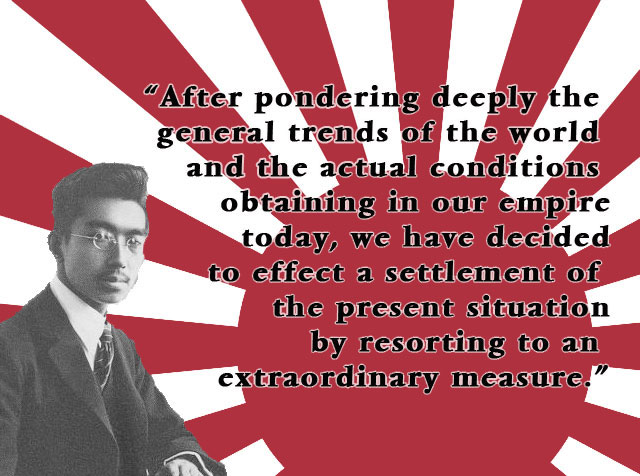
    The Jewel Voice Broadcast was the radio broadcast in which Japanese Emperor Hirohito read out the Imperial Rescript on the Termination of the Greater East Asia War, announcing to the Japanese people that the Japanese Government had accepted the Potsdam Declaration demanding the unconditional surrender of the Japanese military to the Allied Forces at the end of World War II. Most Japanese citizens had never heard his voice before.

    This speech was broadcast at noon Japan Standard Time on August 15, 1945.

    To our good and loyal subjects: After pondering deeply the general trends of the world and the actual conditions obtaining in our empire today, we have decided to effect a settlement of the present situation by resorting to an extraordinary measure.

    We have ordered our Government to communicate to the Governments of the United States, Great Britain, China, and the Soviet Union that our empire accepts the provisions of their joint declaration.

    To strive for the common prosperity and happiness of all nations as well as the security and well-being of our subjects is the solemn obligation which has been handed down by our imperial ancestors and which we lay close to the heart.

    Indeed, we declared war on America and Britain out of our sincere desire to ensure Japan’s self-preservation and the stabilization of East Asia, it being far from our thought either to infringe upon the sovereignty of other nations or to embark upon territorial aggrandizement.

    But now the war has lasted for nearly four years. Despite the best that has been done by everyone–the gallant fighting of our military and naval forces, the diligence and assiduity of out servants of the State and the devoted service of our 100,000,000 people–the war situation has developed not necessarily to Japan’s advantage, while the general trends of the world have all turned against her interest.

    Moreover, the enemy has begun to employ a new and most cruel bomb, the power of which to do damage is, indeed, incalculable, taking the toll of many innocent lives. Should we continue to fight, it would not only result in an ultimate collapse and obliteration of the Japanese nation but also it would lead to the total extinction of human civilization.

    Such being the case, how are we to save the millions of our subjects, nor to atone ourselves before the hallowed spirits of our imperial ancestors? This is the reason why we have ordered the acceptance of the provisions of the joint declaration of the powers.

    We cannot but express the deepest sense of regret to our allied nations of East Asia, who have consistently cooperated with the Empire toward the emancipation of East Asia.

    The thought of those officers and men as well as others who have fallen in the fields of battle, those who died at their posts of duty, or those who met death [otherwise] and all their bereaved families, pains our heart night and day.

    The welfare of the wounded and the war sufferers and of those who lost their homes and livelihood is the object of our profound solicitude. The hardships and sufferings to which our nation is to be subjected hereafter will be certainly great.

    We are keenly aware of the inmost feelings of all of you, our subjects. However, it is according to the dictates of time and fate that we have resolved to pave the way for a grand peace for all the generations to come by enduring the [unavoidable] and suffering what is unsufferable. Having been able to save *** and maintain the structure of the Imperial State, we are always with you, our good and loyal subjects, relying upon your sincerity and integrity.

    Beware most strictly of any outbursts of emotion that may engender needless complications, of any fraternal contention and strife that may create confusion, lead you astray and cause you to lose the confidence of the world.

    Let the entire nation continue as one family from generation to generation, ever firm in its faith of the imperishableness of its divine land, and mindful of its heavy burden of responsibilities, and the long road before it. Unite your total strength to be devoted to the construction for the future. Cultivate the ways of rectitude, the nobility of spirit, and work with resolution so that you may enhance the innate glory of the Imperial State and keep pace with the progress of the world.

  • Capture of Italian Dictator Benito Mussolini

    Capture of Italian Dictator Benito Mussolini

    The Capture of Italian Dictator Benito Mussolini

    Benito Mussolini, the founder of Italian Fascism and dictator of Italy from 1922 to 1943, played a significant role in the events leading up to World War II. As an ally of Adolf Hitler, Mussolini led Italy into the war on the side of the Axis powers. However, Italy’s performance in the war was poor, and by 1943, the Allies had begun their invasion of Italy. On July 25, 1943, Mussolini was arrested on the orders of King Victor Emmanuel III, and the Italian government began negotiating an armistice with the Allies.

    After his arrest, Mussolini was moved to various locations to prevent his rescue by German forces. However, on September 12, 1943, he was freed during a daring raid by German paratroopers led by Otto Skorzeny. Mussolini established the Italian Social Republic, a German puppet state, in northern Italy. As the Allies continued their advance through Italy, the situation for Mussolini’s regime became increasingly dire.

    On April 25, 1945, as the Allies closed in on Milan, Mussolini attempted to escape to Switzerland with his mistress, Clara Petacci, and other high-ranking Fascist officials. However, they were captured by Italian partisans near the village of Dongo on April 27, 1945. Mussolini was initially disguised as a German soldier, but his identity was quickly discovered.

    Effects on Pop Culture:

    • The capture and subsequent execution of Mussolini marked the end of Fascist rule in Italy and served as a warning to other dictators.
    • The events surrounding Mussolini’s capture and execution have been portrayed in various films, documentaries, and books, highlighting their historical significance.
    • The fall of Mussolini and the end of World War II led to a reexamination of the role of fascism and totalitarianism in society, which has been a theme in various works of literature, art, and film.

    Prominent People and Countries Involved:

    • Benito Mussolini: Italian dictator and founder of Italian Fascism, who led Italy during World War II until his capture and execution.
    • Italy: The country Mussolini ruled as a dictator and where his capture took place.
    • Otto Skorzeny: A German SS officer who led the raid that freed Mussolini from captivity in 1943.
    • The Italian Partisans: Members of the Italian resistance movement who captured Mussolini and his entourage near the village of Dongo.

    The capture of Italian dictator Benito Mussolini on April 27, 1945, marked a turning point in Italy’s role in World War II. As the founder of Italian Fascism, Mussolini’s fall from power and subsequent execution had significant effects on popular culture, reexamining totalitarianism’s role in society and inspiring various works of literature, art, and film. The events surrounding his capture have been portrayed in numerous historical accounts, showcasing their importance in the broader narrative of World War II.

  • Colossus Computer for Code-breaking

    Colossus Computer for Code-breaking

    Colossus Computer for Code-breaking

    The Colossus computer was the world’s first programmable digital computer, designed and built during World War II by British engineer Tommy Flowers and his team at the Government Code and Cypher School at Bletchley Park. The purpose of the Colossus was to break encrypted messages sent by the German military, specifically the high-level Lorenz cipher, which was more complex than the famous Enigma code.

    The development of the Colossus computer began in 1943 in response to the need for a faster and more efficient way to break the Lorenz cipher. The first operational Colossus, Colossus Mark 1, was completed in December 1943 and installed at Bletchley Park in January 1944.

    The Colossus used over 2,000 vacuum tubes (valves) and had limited programmable features, making it the first programmable digital computer. By analyzing encrypted messages and performing complex statistical analysis at high speeds, the Colossus significantly reduced the time needed to break the Lorenz cipher, which was critical to the Allied war effort.

    A total of ten Colossus computers were built, and their code-breaking efforts remained a closely guarded secret until the 1970s. After the war, the Colossus machines were dismantled, and their existence was kept secret for several decades.

    Effects on Pop Culture:

    • The story of the Colossus computer and the codebreakers at Bletchley Park has been the subject of several books, documentaries, and films, including the 2014 movie “The Imitation Game,” which focused primarily on Alan Turing and the breaking of the Enigma code.
    • The Colossus has also been featured in various television series and documentaries about the history of computing and World War II, such as the BBC series “Code-Breakers: Bletchley Park’s Lost Heroes.”
    • The rebuilding of a Colossus computer in the 1990s by a team led by engineer Tony Sale sparked renewed interest in the machine and its historical significance, leading to its display at The National Museum of Computing in Bletchley Park.

    Prominent People and Countries Involved:

    • United Kingdom: The British government was responsible for developing and using the Colossus computer during World War II, with the work taking place at Bletchley Park.
    • Tommy Flowers: A British engineer who led the team that designed and built the Colossus computer.
    • Bill Tutte: A British mathematician who worked at Bletchley Park and played a crucial role in understanding and breaking the Lorenz cipher, leading to the development of the Colossus.

    The Colossus computer was the world’s first programmable digital computer, designed and built by British engineer Tommy Flowers and his team at Bletchley Park during World War II. The Colossus played a significant role in breaking the German Lorenz cipher, contributing to the Allied war effort. The story of the Colossus and its code-breaking efforts has been featured in films, books, and documentaries, and a rebuilt Colossus is now on display at The National Museum of Computing in Bletchley Park.

  • 1943 History, Facts and Trivia

    1943 History, Facts and Trivia

    1943 History, Facts and Trivia

    Quick Facts from 1943:

    • World Changing Event: Nachos were invented circa 1943 by Ignacio “Nacho” Anaya in Piedras Negras, Coahuila, Mexico.
    • Influential Songs include: Paper Doll by The Mills Brothers
    • The Movies to Watch include The Ox-Bow Incident, Cabin in the Sky, For Whom the Bell Tolls, A Guy Named Joe, Lassie Come Home, This is the Army, Shadow of a Doubt, and The Song of Bernadette
    • The Most Famous Person in America was probably Betty Grable
    • Notable books include A Tree Grows in Brooklyn by Betty Smith
    • Price of 12 Quart sized Mason Jars in 1943: 98 cents
    • The Football Team(s): Due to a player shortage caused by WWII, The Pittsburgh Steelers and The Philadelphia Eagles merged and were known as the Steagles.
    • The Mystery: The USS Eldridge, docked at the Philadelphia Naval Yard, reportedly disappeared for a few minutes in a ‘transporter experiment,’ after which crew members reportedly suffered from sporadic invisibility, madness, and spontaneous combustion. The 1984 film, The Philadelphia Experiment was very loosely based on this report.
    • On August 13, 1943, J. Edgar Hoover received a letter alleging that the popularity of Frank Sinatra was being used to prepare the masses to accept a new “Hitler.” The FBI kept surveillance over Sinatra for the next 40 years.

    Significant 1943 History:

    • January: The Battle of Stalingrad ended, with Soviet forces successfully driving German troops out of the city. This was a significant turning point in the war and dealt a heavy blow to German morale.
    • February: General Dwight D. Eisenhower was selected to command the Allied armies in Europe.
    • March: Rodgers and Hammerstein’s Oklahoma! opened on Broadway, heralding a new era in “integrated” stage musicals.
    • April: The Jefferson Memorial in Washington, DC, was dedicated on the 200th anniversary of Thomas Jefferson’s birthday.
    • May: The United States Army contracted with the University of Pennsylvania’s Moore School to develop the computer ENIAC.
    • June: The first game of the All-American Girls Professional Baseball League was played.
    • July: The Allies launched Operation Husky, the invasion of Sicily. This operation marked the first major Allied offensive against the Axis powers in Europe and was a prelude to the eventual invasion of mainland Italy.
    • August: The Allies bombed the Ploesti oil fields in Romania, a significant fuel source for the German war effort.
    • September: The Allies invaded Italy, with British and American forces landing on the southern coast. Italian dictator Benito Mussolini was overthrown and arrested.
    • October: The Battle of Kursk, the largest tank battle in history, occurred in the Soviet Union. The Soviet Red Army successfully repelled a German offensive, further turning the tide of the war on the Eastern front.
    • November: The Tehran Conference took place, with leaders of the Soviet Union, the United States, and the United Kingdom meeting to discuss strategy for the war.
    • December: The Battle of Berlin began; it was the last and one of the bloodiest battles of the Second World War in Europe.

    Top Ten Baby Names of 1943

    Mary, Barbara, Patricia, Linda, Carol, James, Robert, John, William, Richard

    US Life Expectancy

    1943 Males: 62.4 years, Females: 64.4 years

    The Stars

    Ingrid Bergman, Betty Grable, Rita Hayworth, Lena Horne, Veronica Lake, Hedy Lamarr, Carole Landis, Brenda Marshall, Jane Russell, Alexis Smith, Gene Tierney, Lana Turner

    Entertainment History: The Oscars

    The 15th Academy Awards occurred on March 4, 1943, at the Ambassador Hotel in Los Angeles. The ceremony was hosted by Bob Hope, marking his third time as the master of ceremonies. The film Mrs. Miniver was the star of the night, winning six Oscars, including Best Picture, Best Director for William Wyler, and Best Actress for Greer Garson. Her acceptance speech, clocking in at around five and a half minutes, became legendary for its length. James Cagney won Best Actor for his energetic portrayal of George M. Cohan in Yankee Doodle Dandy. The eligibility year for these awards was from January 1 to December 31, 1942. This was the first year the Best Animated Short category was introduced, with the award going to Der Fuehrer’s Face, a Walt Disney cartoon featuring Donald Duck in a satirical jab at Nazi Germany.

    Miss America

    Jean Bartel (Los Angeles, CA)

    Time Magazine’s Man of the Year

    George Marshall

    Firsts, Inventions, and Wonders

    Jacques-Yves Cousteau and Émile Gagnan invented the first commercially successful open circuit type of scuba diving equipment, the Aqua-lung.

    A Mexican farmer, Dionisio Pulido, had a volcano (Volcán de Parícutin) start forming in his cornfield. By the early 1950s, it was over 400 meters tall. Before being evacuated and leaving his home for the last time, he left a sign that read, “This volcano is owned and operated by Dionisio Pulido.” In 1997, CNN included Parícutin in its list of the Seven Natural Wonders of the World.

    Pizza Uno first created the first Deep-Dish Pizza in 1943.

    Bea Arthur (Dorothy from The Golden Girls) was a US Marine from 1943 to 1945 with an honorably discharged rank of staff sergeant.

    Vicodin and Lortab were first produced in Germany.

    1943 ‘Wartime’ Pennies and Nickels

    ‘Wartime nickels’ aka ‘war nickels’ were minted from 1943 to 1945. The temporary composition was 56% copper, 35% silver, and 9% manganese. Minted in 1938, the original design of the Jefferson nickel was created by Felix Schlag.

    1943 Silver Pennies – Like nickel, copper was needed for the war effort. 1943 steel pennies were made with low-grade steel and coated with zinc. They had previously been made with a 95 percent copper-based bronze. The Mint switched back to creating copper pennies in 1944.
    An estimated 40 copper pennies were created by accident in 1943 and have become some of the most valuable and sought-after coins by collectors.

    World War II News

    In Russia, the Battle of Stalingrad came to an end with the surrender of the German 6th Army.

    Stalin’s son, Yakov Dzhugashvili, was captured by the Germans during World War 2. The Germans proposed a prisoner exchange: Stalin’s son for a German Field Marshall. Stalin’s response to this request was, ”I will not trade a Marshall for a Lieutenant.” His son died in 1943.

    US General Dwight D. Eisenhower became the supreme Allied commander.

    On November 5th, four bombs were dropped on the neutral Vatican City. The aircraft responsible was never identified.

    The Pentagon, considered to be the world’s largest office building, was completed.

    During a press conference in June 1943, Congressman Andrew May noted that Japanese depth charges detonated too soon to be effective. After the press releases, the Japanese changed depth-charge tactics, killing 800 US submariners.

    The Four Chaplains of the U.S. Army were among those who drowned when their ship, Dorchester, was struck by a German torpedo in the North Atlantic.

    The Gloster Meteor, the first Allied jet fighter, was introduced.

    In the United States, rationing included gasoline, canned food, meat, shoes,  cheese, butter, and cooking oils.

    Due to wartime blackouts, a no-lit New Year’s Eve Ball was held at One Times Square in 1942 and 1943.

    The RMS Queen Mary carried 16,683 American troops from New York to Great Britain, the (still) standing record for the most passengers ever transported on one vessel.

    Future American President John F. Kennedy’s command, the PT-109, was sunk by a Japanese destroyer, the Amagiri. Kennedy was awarded the Purple Heart for injuries he sustained in the collision.

    The Rescue

    Brazilian fishermen rescued Chinese steward Poon Lim after being adrift for 130 days.

    Pop Culture History

    Duke Ellington played at New York City’s Carnegie Hall for the first time.

    The Conical Bra was made famous by Jane Russell.

    January 22, 1943, the temperature in Spearfish, South Dakota, changed from -4°F to 45°F in just two minutes, setting a world record. This was caused by a Chinook wind, which eventually increased the temperature to 54°F before dying down, dropping the temperature back to -4°F.

    Sliced bread was banned temporarily in the United States in 1943 for wartime conservation.

    The Governor-General of Canada declared Princess Juliana of the Netherlands’ hospital room extraterritorial so that her child born would still be in the line of succession.

    Because so many players joined the WWII military service, the Pittsburgh Steelers and Philadelphia Eagles combined to become the Steagles during the 1943 season.

    Disney made an animated short with Donald Duck titled Der Fuehrer’s Face to mock Hitler and the Nazis.

    David Niven was the only British star in Hollywood to enlist during World War 2. When suspicious American guards asked during the Battle of the Bulge who had won the World Series in 1943, he answered, “Haven’t the foggiest idea … but I did co-star with Ginger Rogers in Bachelor Mother!”

    Due to a player shortage caused by WWII, The Pittsburgh Steelers and The Philadelphia Eagles merged and were known as the Steagles.

    On July 1st, the U.S. government started the payroll withholding tax.

    Kryptonite, the only substance that can hurt or even kill Superman, was created as a plot device to allow his radio voice actor (1943) to take some time off, not from the comic books.

    The first person ever diagnosed with autism was Mississippi resident Donald Triplett in 1943.

    The Zoot Suit Riots erupted between military personnel and Mexican-American youths in East Los Angeles in early June.

    Philip Morris ran an ad acknowledging Smoker’s cough in 1943. They claimed it was caused by smoking brands other than Philip Morris.

    Oklahoma! was the first great American Musical. It was the first musical play that genuinely added a full story to the production. Older musicals primarily had a loose plot revolving around songs and often major dance and stage productions. The show began on March 31, 1943, and ran for 2,212 performances through its initial run, ending in 1948. It has had many revivals as well.

    Packard Motors promoted three blacks to work next to whites on the assembly line, causing 25,000 workers to walk off the job.

    Chinese immigrants were officially banned from the United States for 61 years (1882 to 1943).

    Mohandas Gandhi held a hunger strike from February 10 until March 3,  to protest his imprisonment.

    Norman Rockwell’s Rosie the Riveter first appeared on the cover of The Saturday Evening Post.

    The Biggest Films of 1943

    1. This is the Army
    2. For Whom the Bell Tolls
    3. The Song of Bernadette
    4. Stage Door Canteen
    5. Star-Spangled Rhythm
    6. Casablanca (Pop Culture Classic)
    7. Cabin in the Sky (Pop Culture Classic)
    8. The Outlaw
    9. Frankenstein Meets the Wolf Man (Pop Culture Classic)
    10. Lassie Come Home (Pop Culture Classic)
    11. The Ox-Bow Incident
    12. To The Shores of Tripoli
    13. Girl Crazy
    14. Watch on the Rhine
    15. A Guy Named Joe
    16. Thousands Cheer
    17. Jitterbugs
    18. Batman (Columbia Pictures serial)
    19. Cry ‘Havoc’
    20. I Walked with a Zombie
    *Movies beyond the Top Five are based on (a somewhat subjective) ranking based on how much they had a long-lasting effect on Pop Culture.

    The Disasters

    An explosion at Smith Mine #3 in Bearcreek, Montana, United States, killed 74 coal miners.

    Gulf Hotel fire: A fire at the Gulf Hotel in Houston, Texas, killed 55 people.

    Popular Quote

    “Grown-ups never understand anything for themselves, and it is tiresome for children to be always and forever explaining things to them.”
    – The Little Prince

    Unpopular Quote:
    Thomas Watson, chairman of IBM, said in 1943, “I think there is a world market for maybe five computers.”

    Broadway Shows

    The Voice of the Turtle (Play) Opened on December 8, 1943, and closed on January 3, 1948
    Oklahoma! (Musical) Opened on March 31, 1943, and closed on May 29, 1948

    Nobel Prizes

    Physics – Otto Stern
    Chemistry – George de Hevesy
    Physiology or Medicine – Carl Peter Henrik Dam, Edward Adelbert Doisy
    Literature – not awarded
    Peace – not awarded

    Popular and Best-selling Books From 1943

    A Tree Grows in Brooklyn by Betty Smith
    The Apostle by Sholem Asch
    The Forest and the Fort by Hervey Allen
    The Fountainhead – Ayn Rand
    The Human Comedy by William Saroyan
    Hungry Hill by Daphne du Maurier
    The Little Prince by Antoine de Saint-Exupéry
    Mrs. Parkington by Louis Bromfield
    The Robe by Lloyd C. Douglas
    So Little Time by John P. Marquand
    The Song of Bernadette by Franz Werfel
    The Valley of Decision by Marcia Davenport

    Sports

    World Series Champions: New York Yankees
    NFL Champs: Chicago Bears
    Stanley Cup Champs: Detroit Red Wings
    U.S. Open Golf: Not played due to WWII
    U.S. Tennis (Men/Ladies): Lt. Joseph R. Hunt/Pauline Betz
    Wimbledon (Men/Women): not held
    NCAA Football Champions: Notre Dame
    NCAA Basketball Champions: Wyoming
    Kentucky Derby Winner: Pensive
    Boston Marathon Winner: Gérard Côté Time: 2:28:25

    More 1943 Facts & History Resources:

    Most Popular Baby Names (BabyCenter.com)
    Popular and Notable Books (popculture.us)
    Broadway Shows that Opened in 1943
    1943 Calendar, courtesy of Time and Date.com
    Fact Monster
    Forties Nostalgia
    1940s, Infoplease.com World History
    1943 in Movies (according to IMDB)
    Retrowaste Vintage Culture
    1940s Slang
    Wikipedia 1943
    WW II Timeline: 1943

  • Tehran Conference Between the Allies’ “Big Three” Leaders

    Tehran Conference Between the Allies’ “Big Three” Leaders

    Tehran Conference Between the Allies’ “Big Three” Leaders

    The Tehran Conference, also known as the Eureka Conference, was a critical meeting held during World War II between the “Big Three” Allied leaders: British Prime Minister Winston Churchill, U.S. President Franklin D. Roosevelt, and Soviet Premier Joseph Stalin November 28December 1, 1943. The conference occurred in Tehran, Iran, from November 28 to December 1, 1943. This was the first time the three leaders met in person to discuss war strategy and post-war plans, ultimately shaping the course of the conflict and the future of Europe.

    The Tehran Conference focused on coordinating military strategy and discussing the opening of a second front against Nazi Germany. The major decisions made during the conference included:

    Details:

    • The commitment to launch Operation Overlord (the invasion of German-occupied Western Europe) in June 1944, led by U.S. General Dwight D. Eisenhower.
    • A promise from the Soviet Union to enter the war against Japan once Germany was defeated.
    • The recognition of Iran’s independence and the importance of providing economic assistance to the country.
    • Discussions on post-war arrangements, including the division of Germany, the creation of a United Nations organization, and Soviet influence in Eastern Europe.
    • The Tehran Conference was held at the Soviet Embassy, with each leader staying in a separate residence for security reasons.
    • The nickname “Eureka” was derived from a comment made by Churchill, who reportedly exclaimed, “Eureka!” when the decision was made to launch Operation Overlord.
    • During the conference, the “Big Three” leaders were the target of a Nazi assassination plot known as Operation Long Jump, but the plot was foiled by Soviet intelligence.

    Effects on Pop Culture: The Tehran Conference significantly impacted popular culture by shaping the narrative of World War II and its aftermath. Some of the ways it influenced pop culture include:

    • The conference has been depicted in numerous films, documentaries, and books, highlighting the importance of the meeting in shaping the course of the war and post-war Europe.
    • The term “Big Three” became synonymous with the leaders of the major Allied powers, with the trio often depicted in various forms of media as symbols of wartime cooperation and unity.
    • The Tehran Conference has been referenced in alternate history stories and conspiracy theories, exploring different outcomes if the conference had made different decisions or if the Nazi assassination plot had succeeded.

    Prominent People and Countries Involved:

    • Winston Churchill: As the British Prime Minister, Churchill played a vital role in the Tehran Conference and the broader Allied war effort.
    • Franklin D. Roosevelt: The U.S. President’s leadership during the conference and commitment to opening a second front against Germany helped shape the war’s course.
    • Joseph Stalin: The Soviet Premier’s participation in the conference and pledge to join the war against Japan were critical to developing Allied strategy.
    • Iran: As the host country, Iran’s strategic location and significance were recognized during the conference, with discussions on the nation’s independence and future economic assistance.

    The Tehran Conference between the “Big Three” Allied leaders during World War II was a pivotal event that shaped the course of the war and the future of Europe. The conference’s major decisions, such as the commitment to Operation Overlord and the Soviet Union’s promise to enter the war against Japan, played crucial roles in the eventual defeat of Nazi Germany. The Tehran Conference has had a lasting impact on popular culture, with its narrative and significance explored through various forms of media.

  • The Cairo Conference

    The Cairo Conference

    The Cairo Conference

    The Cairo Conference was a series of meetings held during World War II between leaders of the Allied powers, aimed at discussing military strategy and coordinating efforts against the Axis powers. The conference took place in Cairo, Egypt, from November 22 to 26, 1943, and involved representatives from the United States, the United Kingdom, and the Republic of China. The Soviet Union was not present at the conference, as they were not at war with Japan then.

    The main participants in the Cairo Conference were U.S. President Franklin D. Roosevelt, British Prime Minister Winston Churchill, and Chinese Generalissimo Chiang Kai-shek. The leaders discussed various strategic issues, such as the progress of the war against Germany, the planned invasion of France, and future operations in the Pacific theater against Japan.

    One of the key outcomes of the conference was the Cairo Declaration, which outlined the Allies’ goals concerning the Asia-Pacific region. The declaration stated that Japan must be stripped of all territories acquired since 1894 and that Korea should become independent after the war. Additionally, the Allies agreed to continue supporting China in their struggle against Japanese aggression.

    Details:

    • The conference took place at the residence of the American ambassador to Egypt, Alexander Kirk, located in the Cairo suburb of Mena House.
    • The Cairo Conference was held concurrently with the Tehran Conference, where Roosevelt and Churchill met with Soviet leader Joseph Stalin to discuss European military strategy.

    Effects on Pop Culture:

    • The Cairo Conference is not as well-known in popular culture as other wartime conferences, such as Yalta or Tehran. However, it is occasionally referenced in historical works and documentaries about World War II.
    • The conference has been depicted in a few films and television series focused on the broader events of World War II. Still, it typically does not receive significant attention in these productions.

    Prominent People and Countries Involved:

    • United States: President Franklin D. Roosevelt represented the United States at the conference, playing a crucial role in shaping Allied strategy in the Asia-Pacific region.
    • United Kingdom: British Prime Minister Winston Churchill participated in the discussions, working closely with Roosevelt and Chiang Kai-shek to coordinate military efforts against the Axis powers.
    • Republic of China: Generalissimo Chiang Kai-shek represented China, a key ally in the fight against Japan.

    In summary, the Cairo Conference was an important series of meetings held during World War II between leaders of the Allied powers aimed at coordinating military strategy against the Axis powers. The conference resulted in the Cairo Declaration, which outlined the Allies’ goals in the Asia-Pacific region, including the eventual independence of Korea and the return of territories seized by Japan. Although the Cairo Conference is not widely referenced in popular culture, it significantly shaped the war’s course.

  • United Nations Relief and Rehabilitation Administration (UNRRA)

    United Nations Relief and Rehabilitation Administration (UNRRA)

    United Nations Relief and Rehabilitation Administration (UNRRA)

    The United Nations Relief and Rehabilitation Administration (UNRRA) was an international agency established during World War II to provide relief and assistance to war-affected countries. The Allies created the organization to help rebuild and provide humanitarian aid to countries devastated by the war, including food, clothing, medical supplies, and other necessities. UNRRA played a crucial role in post-war recovery efforts and laid the groundwork for future international humanitarian and development organizations.

    Details: UNRRA was officially founded on November 9, 1943, following an agreement between 44 Allied nations at the White House. The organization focused on providing immediate relief to war-torn countries, supporting refugees and displaced persons, and facilitating the repatriation of prisoners of war. UNRRA was instrumental in rebuilding infrastructure, supporting agriculture, and providing vocational training to help people rebuild their lives.

    At its peak, UNRRA employed over 25,000 people worldwide and operated in more than 25 countries. The organization’s operations were funded by member countries, with the United States, the United Kingdom, and the Soviet Union being the largest contributors.

    UNRRA’s work began to wind down in 1947, with most of its responsibilities transferred to other organizations, such as the International Refugee Organization (IRO) and the World Health Organization (WHO). The UNRRA officially ceased operations in 1948.

    Effects on Pop Culture: While UNRRA may not have directly impacted pop culture, it laid the foundation for future international humanitarian and development organizations, such as the United Nations High Commissioner for Refugees (UNHCR) and the United Nations Children’s Fund (UNICEF). These organizations have been depicted in various films, books, and documentaries, highlighting their work in providing aid and support to those affected by conflict, disasters, and other crises.

    Prominent People and Countries Involved:

    • United States: As one of the main contributors to UNRRA, the U.S. played a significant role in the organization’s establishment and operations. President Franklin D. Roosevelt was instrumental in promoting UNRRA’s creation.
    • United Kingdom: The UK was another major contributor to UNRRA, supporting its efforts to provide relief to war-affected countries and playing a key role in its administration.
    • Soviet Union: As a major power in the Allied coalition and one of the main contributors to UNRRA, the Soviet Union was involved in the organization’s operations and administration.

    In summary, the United Nations Relief and Rehabilitation Administration (UNRRA) was an international agency established in 1943 by 44 Allied nations to provide relief and assistance to countries affected by World War II. UNRRA played a vital role in post-war recovery efforts, helping millions of people rebuild their lives and laying the groundwork for future international humanitarian and development organizations. While the organization may not have directly impacted pop culture, its legacy continues to influence the work of modern humanitarian agencies.

  • The Philadelphia Experiment: Alleged Naval Invisibility Test

    The Philadelphia Experiment: Alleged Naval Invisibility Test

    The Philadelphia Experiment

    The Philadelphia Experiment is an alleged military experiment said to have taken place during World War II. According to conspiracy theories, the United States Navy attempted to create an invisible ship to radar and the human eye using electromagnetic fields. The experiment supposedly occurred at the Philadelphia Naval Shipyard and involved the USS Eldridge, a Cannon-class destroyer escort. Despite numerous claims and stories, there is no substantial evidence to support the existence of this experiment, and the U.S. Navy has consistently denied its occurrence.

    Details: 

    • The story of the Philadelphia Experiment gained traction in the 1950s when Carl M. Allen, using the pseudonym Carlos Allende, sent a series of letters to Morris K. Jessup, an author who had written about UFOs. Allen claimed he had witnessed the USS Eldridge disappearing and reappearing during the alleged experiment in 1943. According to the story, the crew members on board the ship experienced severe side effects, such as disorientation, nausea, and in some cases, being fused to the ship’s hull.
    • The story of the Philadelphia Experiment has been largely discredited by experts and researchers, who argue that the science behind the alleged invisibility technology is implausible.
    • The Office of Naval Research investigated the claims made by Carlos Allende and found no evidence to support the existence of the Philadelphia Experiment.

    Effects on Pop Culture: Despite the lack of evidence and official denials, the Philadelphia Experiment has become popular in conspiracy theories and science fiction. It has been referenced in various forms of media, including:

    • The 1984 science fiction film “The Philadelphia Experiment,” directed by Stewart Raffill, tells a fictionalized story of two sailors transported to the 1980s after being caught in the experiment.
    • Numerous novels, television shows, and documentaries have explored or mentioned the Philadelphia Experiment, often in the context of secret government projects or time travel.

    Prominent People and Countries Involved:

    • United States: As the alleged location of the Philadelphia Experiment, the United States plays a central role in the conspiracy theory.
    • U.S. Navy: The Navy has consistently denied any involvement in the alleged experiment and has emphasized that the claims made in the story are scientifically implausible.

    Ihe Philadelphia Experiment is an alleged military experiment that supposedly took place during World War II, involving the creation of an invisible ship using electromagnetic fields. Despite being widely discredited by experts and denied by the U.S. Navy, the story has become popular in conspiracy theories and science fiction, inspiring numerous films, novels, and television shows.

  • Operation Gomorrah

    Operation Gomorrah

    Operation Gomorrah: Allied Bombing Campaign Against Hamburg, Germany

    During World War II, Operation Gomorrah was an eight-day air raid campaign by the British Royal Air Force (RAF) and the United States Army Air Forces (USAAF). The operation targeted Hamburg, Germany’s second-largest city, and aimed to cripple the city’s industrial capacity, infrastructure, and morale. Hamburg was a strategically important location, with its port facilities, shipyards, and U-boat construction facilities, making it a prime target for the Allied forces.

    Details: 

    • Operation Gomorrah began on July 24, 1943, with the RAF launching the first of several nighttime bombing raids. The USAAF followed up with daytime raids, creating a continuous assault on the city. In total, approximately 9,000 tons of explosives were dropped on Hamburg over the course of the operation.
    • The bombing campaign created a firestorm, a deadly combination of fire and wind that engulfed the city. The firestorm incinerated large parts of Hamburg, causing widespread destruction and 34,000 to 42,600 civilian casualties. The operation also displaced approximately one million people, as many fled the city to escape the devastation.
    • Took place over July 24, 1943 – August 3, 1943
    • The operation was named “Gomorrah” after the biblical city was destroyed by fire and brimstone in the Old Testament, reflecting the intensity of the bombing campaign.
    • Operation Gomorrah marked the first use of “Window,” a radar countermeasure involving releasing thousands of small, reflective strips of aluminum foil to confuse enemy radar systems.
    • The bombing raids were so intense that they created a rare weather phenomenon known as a “bomb cloud,” a mix of smoke, dust, and debris from the bombing.

    Effects on Pop Culture:

    • Operation Gomorrah has been featured in various books, documentaries, and films depicting World War II events, including the 1983 German miniseries “Das Feuerzeug” and the 1993 British film “The Fire-Raiser.”
    • The operation is also referenced in the 2018 novel “Munich” by Robert Harris, which is set during the early years of World War II.

    Prominent People and Countries Involved:

    • United Kingdom: The British Royal Air Force played a significant role in carrying out nighttime bombing raids during Operation Gomorrah.
    • United States: The United States Army Air Forces conducted daytime bombing raids as part of the operation, contributing to the destruction of Hamburg.
    • Germany: As the target of Operation Gomorrah, Hamburg suffered immense destruction and civilian casualties, severely impacting the city’s industrial capacity.

    In summary, Operation Gomorrah was an intense eight-day air raid campaign by the British RAF and the USAAF against the German city of Hamburg in 1943. The operation caused widespread destruction, resulting in tens of thousands of civilian casualties and displaced approximately one million people. The events of Operation Gomorrah have been featured in various forms of popular culture, serving as a reminder of the devastating impact of aerial bombing campaigns during World War II.

  • Forced Deportation of Jews from the Warsaw Ghetto

    Forced Deportation of Jews from the Warsaw Ghetto

    Forced Deportation of Jews from the Warsaw Ghetto

    The Nazis established the Warsaw Ghetto in October 1940 in the occupied Polish capital of Warsaw. It was the largest ghetto in Nazi-occupied Europe, housing over 400,000 Jews in extremely cramped and unsanitary conditions. The forced deportation of Jews from the Warsaw Ghetto, known as the Grossaktion Warsaw, began on July 22, 1942, as part of the Nazis’ “Final Solution” – their plan to systematically exterminate the Jewish population.

    Facts:

    • During the Grossaktion Warsaw, the Nazis, under the command of SS-Brigadeführer Jürgen Stroop, deported approximately 254,000-300,000 Jews from the Warsaw Ghetto to the Treblinka extermination camp. The deportations occurred daily, with thousands of Jews being rounded up, forced onto trains, and sent to their deaths.
    • The Nazis used the euphemism “Resettlement to the East” to describe the deportations, which were, in fact, a systematic process of sending Jews to extermination camps.
    • Jewish leaders in the Warsaw Ghetto, such as Adam Czerniaków, the head of the Judenrat (Jewish Council), were initially unaware of the true purpose of the deportations. When Czerniaków realized the fate that awaited his people, he committed suicide on July 23, 1942.
    • The deportations were temporarily halted on Yom Kippur (September 21, 1942) but resumed shortly after.

    Effects on Pop Culture:

    • The forced deportation of Jews from the Warsaw Ghetto has been depicted in numerous films, books, and documentaries, including “The Pianist” (2002), a film directed by Roman Polanski and based on the autobiography of Polish-Jewish pianist Władysław Szpilman.
    • The events in the Warsaw Ghetto have also been chronicled in works such as “Mila 18” (1961), a novel by Leon Uris, and “The Wall” (1950), a novel by John Hersey, both of which are based on the broader context of the Jewish resistance during the Holocaust.

    Prominent People and Countries Involved:

    • Nazi Germany: Under Adolf Hitler’s rule, Nazi Germany orchestrated the Holocaust, which led to the systematic extermination of approximately six million Jews, including those deported from the Warsaw Ghetto.
    • Poland: As the country where the Warsaw Ghetto was located, Poland was directly affected by the forced deportations and the Holocaust. It’s estimated that around 3 million Polish Jews were killed during the Holocaust.
    • Jewish Resistance: Some Jews in the Warsaw Ghetto, such as Mordechai Anielewicz, were involved in organizing resistance against the Nazis. This resistance culminated in the Warsaw Ghetto Uprising in 1943, ultimately suppressed by the Nazis.

    In summary, the forced deportation of Jews from the Warsaw Ghetto, also known as the Grossaktion Warsaw, was a horrific event from July to September 1942. Over 250,000 Jews were forcibly deported to the Treblinka extermination camp as part of the Nazis’ “Final Solution.” The tragic events in the Warsaw Ghetto have been depicted in various forms of popular culture, including films, novels, and documentaries, and continue to serve as a somber reminder of the atrocities committed during the Holocaust.

  • Battle of Kursk: Largest Tank Battle in History

    Battle of Kursk: Largest Tank Battle in History

    Battle of Kursk

    The Battle of Kursk was a significant engagement between the Axis powers, led by Nazi Germany, and the Soviet Union during World War II. As the German army attempted to regain the initiative on the Eastern Front after a series of defeats, they planned a large-scale offensive named Operation Citadel. The goal was to encircle and destroy Soviet forces in the Kursk salient. In response, the Soviet Union fortified the area heavily and prepared for the anticipated attack.

    Details: The battle began on July 5, 1943, when German forces launched their offensive. Soviet defenses, however, were well-prepared, and they managed to absorb the brunt of the attack. The most famous portion of the battle, the Battle of Prokhorovka, took place on July 12. It involved hundreds of tanks from both sides, making it the largest tank battle in history.

    The Germans could not make any significant progress, and by July 13, they began to withdraw their forces. The Soviets launched a series of counteroffensives on July 12, continuing until August 23, pushing the Germans back and regaining territory.

    Effects on Pop Culture:

    • The Battle of Kursk has been featured in numerous books, films, and documentaries, focusing on the massive scale and intensity of the engagement.
    • The battle is a popular subject for military historians and has been studied extensively, influencing the understanding of armored warfare tactics.
    • The Battle of Kursk is a prominent topic in video games featuring World War II, allowing players to experience the historical event in an interactive setting.

    Prominent People and Countries Involved:

    • Nazi Germany: The primary Axis power that launched Operation Citadel, attempting to regain the initiative on the Eastern Front.
    • Soviet Union: The country that successfully defended the Kursk salient and launched counteroffensives against the German forces.
    • Adolf Hitler: The dictator of Nazi Germany who ordered the Kursk offensive.
    • Erich von Manstein: A German field marshal who planned and led Operation Citadel.
    • Georgy Zhukov: A Soviet military commander who played a significant role in organizing and coordinating the defense of the Kursk salient and subsequent counteroffensives.

    From July 5 to August 23, 1943, the Battle of Kursk was the largest tank battle in history and a pivotal engagement during World War II. The battle saw Nazi Germany attempt to regain the initiative on the Eastern Front, only to be repelled by the well-prepared defenses of the Soviet Union. The Battle of Kursk has left a lasting impact on popular culture, being featured in various forms of media. It has influenced the understanding of armored warfare tactics in modern military history.

  • The Holocaust: Warsaw Ghetto Uprising

    The Holocaust: Warsaw Ghetto Uprising

    Warsaw Ghetto Uprising

    The Warsaw Ghetto Uprising was the largest Jewish insurrection during the Holocaust, aimed at resisting the Nazis’ efforts to deport the remaining inhabitants of the Warsaw Ghetto to extermination camps. The uprising occurred in the context of the broader Holocaust, during which approximately 6 million Jews were systematically murdered by the Nazis and their collaborators. The Warsaw Ghetto Uprising, despite its tragic outcome, became a symbol of Jewish resistance and courage in the face of horrific persecution.

    The Warsaw Ghetto was established in 1940, confining over 400,000 Jews in a small, impoverished city area. By the time of the uprising in 1943, most of the ghetto’s inhabitants had already been deported to extermination camps, leaving about 60,000 people behind. When the Nazis began a second wave of deportations in January 1943, Jewish resistance organizations within the ghetto decided to fight back.

    The uprising began on April 19, 1943, through May 16, 1943, when German troops entered the ghetto to carry out further deportations. Jewish fighters, including members of the Jewish Combat Organization (ŻOB) and the Jewish Military Union (ŻZW), launched a coordinated armed resistance using homemade weapons and a limited supply of firearms smuggled into the ghetto.

    Details:

    • The Warsaw Ghetto Uprising lasted nearly a month, much longer than the Nazis had anticipated.
    • Marek Edelman, one of the leaders of the ŻOB and a key participant in the uprising, later became a prominent cardiologist and human rights activist.
    • The fighting tactics employed by the Jewish resistance included hit-and-run attacks, underground bunkers construction, and homemade explosives.

    Effects on Pop Culture: The Warsaw Ghetto Uprising has significantly impacted popular culture, inspiring various forms of artistic expression and serving as a symbol of courage and resistance. Some examples include:

    • The uprising has been the subject of numerous films, such as “Uprising” (2001) and “The Pianist” (2002), as well as documentaries like “Who Will Write Our History” (2018).
    • The event has been referenced in literature, both in historical accounts and works of fiction, such as John Hersey’s “The Wall” (1950) and Leon Uris’s “Mila 18” (1961).
    • The Warsaw Ghetto Uprising has inspired various songs, poems, and works of visual art that pay tribute to the bravery of the Jewish fighters and commemorate their struggle.

    Prominent People and Countries Involved:

    • Mordechai Anielewicz: As the Jewish Combat Organization (ŻOB) leader, Anielewicz played a key role in organizing and leading the uprising.
    • Marek Edelman: A prominent member of the ŻOB and one of the few surviving leaders of the uprising, Edelman became a notable human rights activist.
    • Nazi Germany: As the perpetrators of the Holocaust and the force responsible for creating the Warsaw Ghetto, Nazi Germany was the primary antagonist of the uprising.
    • Poland: The Warsaw Ghetto Uprising took place in the country’s capital, and the event is an important part of Polish history and the broader story of World War II.

    The Warsaw Ghetto Uprising was a significant act of Jewish resistance during the Holocaust. Although the uprising ultimately ended in tragedy, with the vast majority of the ghetto’s remaining inhabitants killed or deported, it has become a powerful symbol of courage and resilience in the face of persecution.

  • Assassination of Admiral Isoroku Yamamoto

    Assassination of Admiral Isoroku Yamamoto

    The Assassination of Admiral Isoroku Yamamoto

    Admiral Isoroku Yamamoto was a Japanese naval officer and the commander-in-chief of the Combined Fleet during World War II. He was responsible for planning and executing the surprise attack on Pearl Harbor on December 7, 1941, which led to the United States’ entry into the war. Yamamoto was widely respected for his strategic acumen, and his death was a significant blow to the Japanese war effort.

    On April 14, 1943, U.S. intelligence intercepted and decrypted a message detailing Yamamoto’s planned inspection tour of Japanese bases in the Solomon Islands. In response, the U.S. launched Operation Vengeance, a mission to intercept and shoot down Yamamoto’s plane.

    On April 18, 1943, Yamamoto boarded a Mitsubishi G4M bomber, accompanied by six Mitsubishi A6M Zero fighters, for his inspection tour. A squadron of 18 U.S. P-38 Lightning fighters, led by Major John Mitchell and including Lieutenant Rex T. Barber, was dispatched to intercept the Japanese aircraft.

    The American squadron successfully located and attacked Yamamoto’s plane over Bougainville Island. Lt. Barber is credited with firing the shots that downed Yamamoto’s aircraft, which crashed into the jungle, killing Yamamoto and all other passengers on board.

    Effects on Pop Culture:

    • The assassination of Admiral Isoroku Yamamoto has been the subject of several films and documentaries, such as the 1970 Japanese film “Rengo kantai shirei chokan: Yamamoto Isoroku” (Admiral Yamamoto) and the 2011 Japanese film “Isoroku” (The Admiral).
    • Yamamoto’s life and death have also been portrayed in various books, including “Yamamoto Isoroku: Nihon no gunkan” (Yamamoto Isoroku: The Japanese Battleship) by Zenji Orita and “Yamamoto Isoroku: Nihon no umi” (Yamamoto Isoroku: The Japanese Sea) by Hiroyuki Agawa.

    Prominent People and Countries Involved:

    • Admiral Isoroku Yamamoto: As the commander-in-chief of the Combined Fleet, Yamamoto played a crucial role in Japan’s naval strategy during World War II. His death weakened Japan’s military leadership and morale.
    • United States: The U.S. intelligence community’s decryption of Yamamoto’s itinerary allowed them to plan and execute Operation Vengeance, leading to Yamamoto’s assassination.
    • Lieutenant Rex T. Barber: A U.S. fighter pilot, Barber is credited with firing the shots that downed Yamamoto’s plane, resulting in the admiral’s death.

    The assassination of Admiral Isoroku Yamamoto took place on April 18, 1943, when U.S. forces intercepted and shot down his plane over Bougainville Island. Yamamoto’s death dealt a significant blow to the Japanese war effort, as he was a highly respected strategist and commander. The event has been depicted in several films and books, reflecting its significance in World War II history.

  • Casablanca Conference Between Winston Churchill and Franklin D. Roosevelt

    Casablanca Conference Between Winston Churchill and Franklin D. Roosevelt

    Casablanca Conference

    The Casablanca Conference was a pivotal meeting between British Prime Minister Winston Churchill and U.S. President Franklin D. Roosevelt during World War II. Held in Casablanca, Morocco, the conference focused on the strategic direction of the war effort and set the course for the subsequent Allied military actions. This meeting marked the first time the leaders of the United States and the United Kingdom came together on African soil during the war.

    The Casablanca Conference was a critical gathering where Churchill and Roosevelt, along with their military advisors, discussed several key issues, including the coordination of their respective military strategies, the decision to focus on the invasion of Italy before launching an invasion of France, and the continuation of the strategic bombing campaign against Germany. One of the most significant outcomes of the conference was the announcement of the policy of “unconditional surrender” as the only acceptable term for the Axis powers. This decision aimed to dispel any notion of a negotiated peace and ensure the enemy’s total defeat.

    Details:

    • Took Place January 14January 24, 1943
    • Soviet leader Joseph Stalin was invited to the conference but declined to attend, citing the ongoing Battle of Stalingrad as his reason.
    • The conference took place at the Anfa Hotel in Casablanca, which was chosen for its remote location and the ability to maintain secrecy.
    • The “unconditional surrender” policy was announced at a joint press conference by Roosevelt and Churchill on January 24, 1943.

    Effects on Pop Culture: The Casablanca Conference had a lasting impact on popular culture, partly because of the iconic nature of the meeting between Churchill and Roosevelt. Some examples include:

    • The conference has been portrayed in various films and television programs, often focusing on the drama and intrigue surrounding the high-level discussions.
    • Although not directly related to the conference, the 1942 film “Casablanca,” starring Humphrey Bogart and Ingrid Bergman, is often associated with it because of the shared location and time period. The film’s release shortly before the conference further cemented the connection in the public imagination.
    • The conference has been referenced in literature, particularly in historical accounts and biographies of the leaders involved, as well as in works of fiction set during World War II.

    Prominent People and Countries Involved:

    • Winston Churchill: As the British Prime Minister, Churchill played a crucial role in shaping the course of the war and was instrumental in setting the policy of “unconditional surrender” during the conference.
    • Franklin D. Roosevelt: The U.S. President was heavily involved in the strategic discussions at the Casablanca Conference and was a key advocate for the policy of “unconditional surrender.”
    • The United States and the United Kingdom: As the two major Allied powers, the United States and the United Kingdom significantly influenced the strategic direction of the war effort, and the decisions made at the Casablanca Conference would shape their future actions.

    In summary, the Casablanca Conference was a critical meeting between Winston Churchill and Franklin D. Roosevelt, which set the strategic direction of the war effort and established the policy of “unconditional surrender” for the Axis powers. The conference has had a lasting impact on popular culture, inspiring film, television, and literature and symbolizing the close cooperation between the United States and the United Kingdom during World War II.

  • 1942 History, Facts and Trivia

    1942 History, Facts and Trivia

    1942 History, Facts and Trivia

    Quick Facts from 1942

    • World Changing Event: The Manhattan Project began secret work on the atomic bomb, and Enrico Fermi triggered the first atomic chain reaction.
    • Influential Songs include: Deep In The Heart of Texas by Alvino Rey or Bing Crosby or Horace Heidt or Merry Macs, and Blues In The Night (My Mama Done Told Me) by Dinah Shore or, Woody Herman or, Jimmie Lunceford or Cab Calloway or, Artie Shaw.
    • The Movies to Watch include Bambi, Casablanca, Woman of the Year, Mrs. Miniver, Random Harvest, For Me and My Gal, Holiday Inn, Road to Morocco, and Yankee Doodle Dandy.
    • The Most Famous Person in America was probably Gary Cooper.
    • Douglas Albert Munro (October 11, 1919 – September 27, 1942) was the only US Coast Guard to receive the Medal of Honor. While covering ground troops with his boat, Munro was fatally wounded. His last words were, “Did they get off?” referring to the soldiers he’d saved. He was 22 years old.
    • Notable books include The Screwtape Letters by C.S. Lewis and The Poky Little Puppy by Janette Sebring Lowrey.
    • US Life Expectancy: Males: 64.7 years, Females: 67.9 years
    • Silly Putty was created.
    • Price of 12 oz. Pepsi in 1942: 5 cents
    • The Funny Trio was Bob Hope, Bing Crosby, and Dorothy Lamour

    Here are some significant WW2 events that occurred in 1942

    • January: Japanese forces invaded Burma and captured Rangoon.
    • February: President Franklin D. Roosevelt signed an executive order authorizing the internment of Japanese Americans.
    • May: The Battle of the Coral Sea occurred, marking the first time two opposing aircraft carriers engaged each other.
    • June: The Battle of Midway took place, resulting in a decisive victory for the United States over Japan.
    • November: The Allies launched Operation Torch landings in French North Africa.
    • December: The Battle of Stalingrad began, marking the start of a turning point in the European Theater of World War II.

    1942 was a significant year for World War II, with several major military engagements. It was also a time of great social upheaval, with the internment of Japanese Americans and other controversial events occurring in the United States.

    Top Ten Baby Names of 1942

    Mary, Barbara, Patricia, Linda, Carol, James, Robert, John, William, Richard

    US Life Expectancy

    1942 Males: 64.7 years, Females: 67.9 years

    The Stars

    Ingrid Bergman, Betty Grable, Rita Hayworth, Katharine Hepburn, Lena Horne, Veronica Lake, Hedy Lamarr, Carole Landis, Brenda Marshall, Alexis Smith, Gene Tierney, Lana Turner

    Entertainment History: The Oscars

    The 14th Academy Awards were held on February 26, 1942, at the Biltmore Hotel in Los Angeles. The master of ceremonies for the evening was none other than Bob Hope. The big winner was How Green Was My Valley, which walked away with Best Picture, beating out other esteemed films like Citizen Kane and The Maltese Falcon. John Ford received the Best Director award for the film, which also snagged Best Supporting Actor for Donald Crisp. Gary Cooper won Best Actor for his role in Sergeant York, and Joan Fontaine took home Best Actress for her performance in Suspicion. The eligibility year for the awards spanned from October 1940 to December 1941.

    Miss America

    Jo-Carroll Dennison (Tyler, TX)

    Time Magazine’s Man of the Year

    Joseph Stalin

    Firsts, Inventions, and Wonders

    Train Kept A-Rollin was recorded by Freddie Slack in 1942, Tiny Bradshaw in 1951, Johnny Burnette in 1956, the Yardbirds in 1965, Led Zeppelin in 1968, and Aerosmith in 1974.

    The Voice of America began broadcasting.

    C.S. Lewis’s The Screwtape Letters was first published in book format in England.

    World War II News

    Produced in 1942 and released on January 1, 1943, the only Donald Duck film to win an Oscar was a Disney propaganda called Der Fuehrer’s Face.

    In the spring of 1942, German U-boats patrolled the east coast of the United States, sinking fuel tankers and cargo ships, often within sight of shore, and in less than seven months, destroyed 22 percent of the tanker fleet and sank 233 ships, killing 5,000 people, mostly civilians.

    Nazi U-boat U-166 was sunk 100 miles off the coast of Louisiana the day after attacking a US Naval Patrol in the Gulf of Mexico. Between 1942 and 1943, more than 20 German U-boats operated in the Gulf of Mexico. They attacked tankers transporting oil from ports in Texas and Louisiana and successfully sank 56 vessels.

    Invented in 1942 by Julius Fieser, a Harvard organic chemist, napalm was the ideal incendiary weapon: cheap, stable, and sticky—a burning gel that stuck to roofs, furniture, and skin. It killed more Japanese than both Atomic Bombs combined.

    Between 1941 and 1945, the USA built almost 6,000 ships. The average time to build a ship went from 240 days in early 1942 to only 56 days at the end of the year.

    Hawaii had its own money during WW2 with a “Hawaii stamp” on it, so if the Japanese took over the island, America could say that the money was no good.

    In January 1942, Lytle S. Adams, a dentist, proposed strapping tiny incendiary bombs to bats, to bomb Japanese cities to the White House. “Think of thousands of fires breaking out simultaneously over a circle of forty miles in diameter for every bomb dropped. Japan could have been devastated, yet with a small loss of life.”

    From May 1942 to August 1945, the US had a nationwide speed limit of 35 miles per hour called The “Victory Speed Limit”.

    Stop That Tank! is a 22-minute 1942 instructional film created during World War II by Walt Disney Productions to demonstrate the proper use and handling of the Mk.1 Boys Anti-Tank Rifle.

    The last time Congress declared war was in 1942 (against Bulgaria, Hungary, and Romania). The Executive branch declared the Korean War.

    The 1942 Battle Of The Coral Sea was the first naval battle in history in which the opposing ships never saw each other, the engagement being entirely one of opposing airstrikes from carrier-borne aircraft.

    Calvin Graham was 12 years old and enlisted in the Navy in 1942. During WW2, he was awarded The Bronze Star, Purple Heart, and other medals. They were taken away because he was underage. President Jimmy Carter Approved all the medals except his Purple Heart to be reinstated. His Purple Heart was reinstated in 1994.

    During World War II, penicillin was scarce, so it was expected to collect urine from patients to recycle penicillin.

    In 1942, Japanese troops landed and occupied the Aleutian Islands of Attu and Kiska. They were driven out entirely a year later, between May and August 1943, by American and Canadian forces. This was American soil’s first significant foreign occupation since the War of 1812.

    In 1942, a Finnish sound engineer secretly recorded 11 minutes of a candid conversation between Adolf Hitler and Finnish Defence Chief Gustaf Mannerheim before being caught by the SS. It is the only known recording of Hitler’s normal speaking voice. (11 min, English translation)

    Dr. Harry Coover accidentally invented Super Glue during World War II. In 1942, he searched for materials for making clear plastic gun sights to be used by Allied soldiers in the war against the Axis.

    Lyudmila Pavlichenko, a female Soviet sniper with 309 credited kills, toured the US in 1942 to gain support for a second front in Nazi-occupied Europe. Of course, the press was more interested in her appearance and if she wore make-up on the front lines.

    “If Day” was a simulated Nazi German invasion and occupation of the Canadian city of Winnipeg, Manitoba, and surrounding areas on February 19, 1942.

    Tea was so crucial for morale in the British army that 1942, the UK bought the entire world’s crop of tea.

    The Savoia Cavalleria Charge at Izbushensky, many consider history’s last significant cavalry charge. It took place on August 24, 1942. 700 Italian cavalrymen took on and drove back over 2,500 soviet foot soldiers armed with machine guns and mortars.

    Twelve-year-old Calvin Leon Graham (April 3, 1930 – November 6, 1992) was the youngest U.S. serviceman to serve and fight during World War II. After the attack on Pearl Harbor, he enlisted in the United States NAVY at the age of 12 on August 15, 1942.

    The original painting of “Washington Crossing the Delaware” was destroyed by a British bombing raid in 1942. It was in Breman, Germany at the time.

    The deadliest battle in history was the Battle of Stalingrad from 1942-1943. Lasting several months, the clash between Russian and German forces ended 1,971,000 lives, making it 23 times deadlier than the next deadliest, the Battle of Leipzig in 1813.

    In 1942, ihe Japanese, led by General Imamura, fed 200 American POWs to the sharks off Java Island in what became known as the “Pig Basket Atrocities”.

    The “The Death Match” was a 1942 soccer match between Nazi soldiers and Ukrainian prisoners of war. It was the inspiration behind the movie The Longest Yard.

    Pop Culture Facts & History

    The idea that the federal government can regulate almost any business was established in a 1942 Supreme Court case, Wickard v. Filburn. Since a farmer could theoretically sell products over state lines, the US government had the authority to control what he could grow.

    On Mexico’s  Mother’s Day in 1942, the government announced that all Mexican women could reclaim their pawned sewing machines from the National Pawnshop at no cost.

    The US government made a short film in 1942 called “Hemp for Victory,” which discussed the many virtues of hemp and its products.

    The Marines rejected actor Audie Murphy for being too short and the Navy for being too skinny. The Army accepted him but did not want to send him into combat because he looked so young. He received every military award for valor available from the Army.

    Hollywood actress Carole Lombard visited her hometown (Indiana) in 1942 and, in one night, raised $2 million in war bonds (about $35 million today). She died in a plane crash on her return home due in part to a lack of airport lighting turned off to conceal American airstrips from the Japanese.

    Camp David was converted to a presidential retreat by Franklin D. Roosevelt and renamed “Shangri-La” (for the fictional Himalayan paradise). Camp David received its present name from Dwight D. Eisenhower, in honor of his father and grandson, both named David.

    DDT was first used as a pesticide.

    The University of Chicago produced the first nuclear chain reaction using uranium isotope U-235.

    Before the 20th century, people mainly reported dreaming in color. But in 1942, 70% of college sophomores “rarely/never” had color dreams. By 2001, that rate had dropped to 17%. The change is thought to be because of the influence of black and white media in the mid-1900s.

    Due to wartime blackouts, there was no lit New Year’s Eve Ball at One Times Square in 1942 and 1943.

    President Gerald Ford worked as a male model in his late 20s and was featured on the cover of Cosmopolitan in 1942 wearing his Navy Uniform.

    On March 18, Franklin D. Roosevelt signed Executive Order 9102, creating the War Relocation Authority (WRA), which caused the internment of Americans of Japanese and, to a lesser extent, German and Italian descent, many of them legal citizens.

    Pinball machines were banned in NYC from 1942 to 1976 as lawmakers considered them luck-based, similar to gambling, and were ‘stealing’ money from kids.

    Bing Crosby’s recording of White Christmas was so popular that he had to re-record it in 1947 using the same musicians and backup singers in the 1942 original master because it had become damaged due to its frequent use. There was no digital recording in the 1940s.

    The Battle of Los Angeles: In February 1942, unknown objects were reportedly seen over Los Angeles. A nearby artillery brigade fired over 1400 rounds into the skies over the city in response.

    On August 16, 1942, a military blimp left San Francisco Bay on a routine submarine-spotting mission. A few hours later, the airship wandered back over land and crashed with nobody aboard. Life rafts and other gear had not been touched. To this day, the two-man crew has never been found.

    Hoagy Carmichael’s 1942 song I’m a Cranky Old Yank in a Clanky Old Tank on the Streets of Yokohama with My Honolulu Mama Doin’ Those Beat-o, Beat-o Flat-On-My-Seat-o, Hirohito Blues arguably holds the world record for the longest song title.

    Bambi and Bambi II hold the record for the longest gap between movie sequels, the first being released in 1942 and the second being released 64 years later in 2006.

    On June 12, 1942, Anne Frank received an autograph book from her father for her 13th birthday. That book became her diary.

    Dr. Alf Alving, working for the US Army’s Office of Scientific Research and Development, tested some 441 convicts from Statesville Penitentiary with Malaria drugs without their knowledge.

    Poon Kim holds the record for surviving adrift in a life raft at 133 days in 1942-43. When told no one had ever survived longer on a raft at sea, he replied, “I hope no one will ever have to break that record.”

    Jack Kerouac, the author of the book On the Road, enlisted in the US Navy in 1942 but served only eight days of active duty before being dismissed after doctors diagnosed him with dementia and a schizoid personality.

    Stephen Hawking was born on January 8, 1942, exactly 300 years after the death of Galileo on January 8, 1642.

    Three Musketeers Bars originally had three smaller chocolate bars. Chocolate, strawberry, and vanilla variety. In 1942, the strawberry and vanilla flavors were cut due to increased production costs due to sugar rationing.

    The 1942 Rose Bowl was played in Durham, NC, due to fears of the Japanese attack on the west coast of the US.

    The Disasters

    The Cocoanut Grove Fire on November 28, 1942, killed nearly 500 people in a mad panic to escape the fire people when they were crushed against the inward opening doors and could not pull them open. It changed the fire, door, and safety laws in the United States forever. In 1942, over 300 skeletons were found around Roopkund, an obscure high-altitude lake in India. The skeletons were the remains of a 9th-century AD party killed by a freak hail storm.

    When USS Juneau was sunk in November 1942, all five brothers of the Sullivan family from Waterloo, Iowa, were killed. Soon after, the U.S. War Department adopted the Sole Survivor Policy.

    The Biggest Films of 1942

    1. Bambi (Pop Culture Classic)
    2. Casablanca (Pop Culture Classic)
    3. Yankee Doodle Dandy (Pop Culture Classic)
    4. Mrs. Miniver
    5. Woman of the Year (Pop Culture Classic)
    6. Once Upon a Honeymoon
    7. Tales of Manhattan
    8. For Me and My Gal
    9. Holiday Inn
    10. Road to Morocco (Pop Culture Classic)
    11. Cat People
    12. My Favorite Blonde
    13. Jungle Book
    14. Pride of the Yankees (Pop Culture Classic)
    15. The Magnificent Ambersons
    16. Saboteur
    17. I Married A Witch
    18. The Talk of the Town
    19. To Be or Not to Be
    20. Rio Rita
    21. Gentleman Jim
    22. Arabian Nights
    23. Reap The Wild Wind
    24. The Young Mr. Pitt
    25. Sons of the Pioneers
    *Movies beyond the Top Ten are based on (a somewhat subjective) ranking based on how much they had a long-lasting effect on Pop Culture.

    Popular Quotes

    “Here’s looking at you, kid.”
    “Of all the gin joints in the world, she had to walk into mine.”
    “Louis, I think this is the beginning of a beautiful friendship.”
    “We’ll always have Paris.”
    – Humphrey Bogart in Casablanca

    “Play it, Sam. Play ‘As Time Goes By.’”
    -Ingrid Bergman, in Casablanca

    “Round up the usual suspects.”
    – Claude Rains, in Casablanca

    Nobel Prizes

    Physics – not awarded
    Chemistry – not awarded
    Medicine – not awarded
    Literature – not awarded
    Peace – not awarded
    *No Nobel prizes were awarded from 1940-1942, due to World War II. When Norway was occupied, the members of the Nobel Committee fled into exile.

    The Number One Hits Of 1942

    December 27, 1941 – January 6, 1942
    Glenn Miller and His Orchestra with Tex Beneke and the Four Modernaires – Chattanooga Choo Choo

    February 7, 1942 – February 13, 1942
    Glenn Miller and His Orchestra – A String of Pearls

    February 14, 1942 – February 20, 1942
    Woody Herman and His Orchestra with Woody Herman – Blues in the Night (My Mama Done Tol’ Me)

    February 21, 1942 – February 27, 1942
    Glenn Miller and His Orchestra – A String of Pearls

    February 28, 1942 – May 8, 1942
    Glenn Miller and His Orchestra with Ray Eberle and the Modernaires – Moonlight Cocktail

    May 9, 1942 – June 19, 1942
    Jimmy Dorsey and His Orchestra with Bob Eberly and Helen O’Connell – Tangerine

    June 20, 1942 – July 17, 1942
    Harry James and His Orchestra – Sleepy Lagoon

    July 18, 1942 – September 11, 1942
    Kay Kyser and His Orchestra with Harry Babbitt, Julie Conway, and the Group – Jingle Jangle Jingle

    September 12, 1942 – October 30, 1942
    Glenn Miller and His Orchestra with Tex Beneke, Marion Hutton, and the Modernaires – (I’ve Got a Gal In) Kalamazoo

    October 31, 1942 – January 15, 1943
    Bing Crosby with the Ken Darby Singers and John Scott Trotter and His Orchestra – White Christmas

    Popular and Best-selling Books From 1942

    And Now Tomorrow by Rachel Field
    Dragon Seed by Pearl S. Buck
    Drivin’ Woman by Elizabeth Pickett
    Frenchman’s Creek by Daphne du Maurier
    The Keys of the Kingdom by A. J. Cronin
    Kings Row by Henry Bellamann
    The Moon Is Down by John Steinbeck
    The Poky Little Puppy by Janette Sebring Lowrey
    The Robe by Lloyd C. Douglas
    The Screwtape Letters by C.S. Lewis
    The Song of Bernadette by Franz Werfel
    The Stranger by Albert Camus
    The Sun Is My Undoing by Marguerite Steen
    Windswept by Mary Ellen Chase

    Sports

    World Series Champions: St. Louis Cardinals
    NFL Champs: Washington Redskins
    Stanley Cup Champs: Toronto Maple Leafs
    U.S. Open Golf: Not played due to WWII
    U.S. Tennis (Men/Ladies): Fredrick Schroeder, Jr./Pauline Betz
    Wimbledon (Men/Women): not held
    NCAA Football Champions: Ohio State
    NCAA Basketball Champions: Stanford
    Kentucky Derby Winner: Shut Out
    FIFA World Cup (Soccer): not held
    Boston Marathon Winner: Joe Smith Time: 2:26:51

    More 1942 Facts & History Resources:

    Most Popular Baby Names (BabyCenter.com)
    Popular and Notable Books (popculture.us)
    Broadway Shows that Opened in 1942
    XXXX Calendar, courtesy of Time and Date.com
    Fact Monster
    Forties Nostalgia
    1940s History
    1940s, Infoplease.com World History
    1942 in Movies (according to IMDB)
    Retrowaste Vintage Culture
    1940s Slang
    Wikipedia 1942
    WW II Timeline (US Dept. of Defense)


  • The Battle of Stalingrad

    The Battle of Stalingrad

    The Battle of Stalingrad

    The Battle of Stalingrad was a major confrontation between Nazi Germany and its allies against the Soviet Union during World War II. Stalingrad, now called Volgograd, was a strategically important city on the banks of the Volga River. The battle was one of the largest and deadliest in history, with millions of soldiers and civilians involved. It is often regarded as a turning point in the war, as the Red Army’s victory marked the beginning of a series of Soviet offensives against the German invaders.

    The battle began with German air raids and a ground offensive led by the German Sixth Army under General Friedrich Paulus, which pushed into the city. The Soviet defenders, commanded by General Vasily Chuikov, fiercely resisted the German advance, leading to brutal urban warfare with both sides suffering heavy casualties.

    As winter set in, the Soviet Union launched Operation Uranus, a counteroffensive that encircled and trapped the German Sixth Army within Stalingrad. The German forces, facing severe supply shortages and extreme cold, eventually surrendered on February 2, 1943.

    Effects on Pop Culture:

    • The Battle of Stalingrad has been featured in numerous films, books, and documentaries, reflecting its significance in World War II history. Some notable examples include the films “Enemy at the Gates” (2001), “Stalingrad” (1993), and “Stalingrad” (2013).
    • The battle has also inspired various novels, such as “Life and Fate” by Vasily Grossman, “Stalingrad” by Theodor Plievier, and “War of the Rats” by David L. Robbins.

    Prominent People and Countries Involved:

    • Nazi Germany: Under Adolf Hitler’s leadership, the German Sixth Army, led by General Friedrich Paulus, attempted to capture Stalingrad but was ultimately defeated and captured by the Soviet forces.
    • Soviet Union: Defending their territory, the Soviet Red Army, commanded by General Vasily Chuikov, successfully resisted the German invasion and emerged victorious, marking a turning point in the Eastern Front.
    • Other Axis countries: Germany’s allies, such as Italy, Romania, and Hungary, were also involved in the battle, providing support and troops for the German forces.

    The Battle of Stalingrad was a critical confrontation during World War II between Nazi Germany and the Soviet Union that lasted from August 23, 1942, to February 2, 1943. The battle resulted in a significant victory for the Soviet Union, marking a turning point in the war. The events of the Battle of Stalingrad have been depicted in numerous films, books, and documentaries, serving as a reminder of the intense and brutal nature of the conflict.

  • The Messerschmitt Me 262

    The Messerschmitt Me 262

    The Messerschmitt Me 262

    The Messerschmitt Me 262, the Schwalbe (Swallow), was the world’s first operational jet-powered fighter aircraft. Developed by the German Luftwaffe during World War II, the Me 262 was a significant technological advancement in aviation, representing a new era of jet propulsion.

    Details:

    • The first flight was on April 18, 1941 (with a piston engine), and on July 18, 1942 (with jet engines)
    • The Messerschmitt Me 262 was the first Jet-powered Aircraft
    • The development of the Me 262 began in 1938 when the Reich Air Ministry requested a new fighter aircraft design with jet propulsion. The first prototype, the Me 262 V1, made its maiden flight with a piston engine on April 18, 1941, and later with jet engines on July 18, 1942.
    • The Me 262 had a top speed of around 540 mph (870 km/h), significantly faster than any piston-engined aircraft. Its armament included four 30mm MK 108 cannons and, in some versions, air-to-air missiles. Despite its advanced design, the Me 262 was introduced late in the war, and its impact on the overall outcome was limited.

    The Me 262 became operational in April 1944, but production and logistical problems and the deteriorating war situation delayed its widespread deployment. The aircraft saw limited action, but when it did, it proved an effective interceptor and fighter bomber.

    After the war, the Me 262 and its technology influenced the development of jet aircraft in other countries, including the United States and the Soviet Union, which captured and studied German jet aircraft technology.

    Effects on Pop Culture:

    • The Me 262 has been featured in various films, documentaries, and television series related to World War II, including “Battle of Britain” (1969) and “The War” (2007).
    • The aircraft has also appeared in numerous books, such as “Messerschmitt Me 262: Arrow to the Future” by Walter J. Boyne, and in aviation magazines.
    • The Me 262 remains a popular subject for scale model aircraft builders and aviation enthusiasts.

    Prominent People and Countries Involved:

    • Germany: The Me 262 was developed and produced by the German Luftwaffe during World War II, representing the cutting-edge of aviation technology at the time.
    • Willy Messerschmitt: German aircraft designer and manufacturer who played a key role in developing the Me 262.
    • United States and Soviet Union: Both countries captured and studied Me 262 aircraft after the war, using the technology to advance their own jet aircraft development.

    In summary, the Messerschmitt Me 262 was the world’s first operational jet-powered fighter aircraft developed by Germany during World War II. It had a limited impact on the war due to production and logistical issues but influenced post-war jet aircraft development in other countries. The Me 262 has been featured in films, documentaries, and books, and remains a popular subject for aviation enthusiasts.

  • The Manhattan Project: The Race to Develop the Atomic Bomb

    The Manhattan Project: The Race to Develop the Atomic Bomb

    The Manhattan Project: The Race to Create An Atomic Bomb

    The Manhattan Project was a top-secret research and development program initiated by the United States during World War II. The project aimed to develop the first atomic bomb, a weapon of unprecedented power, in response to the possibility that Nazi Germany was pursuing similar technology. The project involved collaboration between the United States, the United Kingdom, and Canada, with scientists, engineers, and military personnel working together at various sites across the countries.

    The Manhattan Project began in earnest in May 1942 under the direction of physicist J. Robert Oppenheimer and U.S. Army General Leslie Groves. Key research facilities were established at Los Alamos, New Mexico; Oak Ridge, Tennessee; and Hanford, Washington. The project successfully developed two types of atomic bombs: one using uranium-235 (the “Little Boy” bomb) and the other using plutonium-239 (the “Fat Man” bomb). It was disbanded on August 15, 1947.

    The first atomic bomb was tested at the Trinity Site in New Mexico on July 16, 1945. Following the successful test, two atomic bombs were dropped on the Japanese cities of Hiroshima on August 6, 1945, and Nagasaki on August 9, 1945, leading to Japan’s surrender and the end of World War II.

    Effects on Pop Culture:

    • The Manhattan Project and the subsequent bombings of Hiroshima and Nagasaki have been the subject of numerous films, books, and documentaries examining the moral and ethical implications of using such a devastating weapon.
    • The atomic bomb and its immense destructive power have become symbols of the potential horrors of war and have been referenced in various forms of media, often as a metaphor for the dangers of unchecked technological advancements.
    • The atomic age, ushered in by the Manhattan Project, has influenced popular culture, with atomic-themed design, art, and architecture emerging in the post-war era.
    • The events surrounding the Manhattan Project have been explored in several stage productions, such as the play “Copenhagen” by Michael Frayn and the opera “Doctor Atomic” by John Adams and Peter Sellars.

    Prominent People and Countries Involved:

    • United States: The country primarily responsible for initiating and leading the Manhattan Project.
    • The United Kingdom and Canada: Key allies collaborating with the United States on the project.
    • J. Robert Oppenheimer: The physicist who served as the director of the Los Alamos laboratory and oversaw the development of the atomic bombs.
    • General Leslie Groves: The U.S. Army officer who led the overall management of the Manhattan Project.

    The Manhattan Project was a top-secret program undertaken by the United States, with the collaboration of the United Kingdom and Canada, to develop the first atomic bomb during World War II. The successful development of these bombs led to their use against the Japanese cities of Hiroshima and Nagasaki, contributing to the war’s end. The Manhattan Project has had a significant impact on popular culture, with numerous films, books, and documentaries exploring the moral and ethical implications of using such a devastating weapon and the atomic age influencing various aspects of design, art, and architecture.

  • London Economic Conference

    London Economic Conference

    London Economic Conference

    The London Economic Conference was an international gathering of representatives from 66 nations in London in 1933. The primary goal of the conference was to address the ongoing global economic crisis during the Great Depression and to stabilize international currency exchange rates. Unfortunately, the conference failed to achieve its objectives and was considered a major disappointment.

    • The conference was organized by the League of Nations and held at the Geological Museum in London.
    • The initial focus of the conference was on currency stabilization, with the intention of establishing a fixed exchange rate system to promote international trade and economic recovery.
    • US President Franklin D. Roosevelt initially supported the conference, sending a delegation led by Secretary of State Cordell Hull.
    • However, Roosevelt changed his position due to concerns that fixed exchange rates would undermine his domestic economic recovery program, known as the New Deal.
    • On July 3, 1933, Roosevelt sent a telegram to the conference, known as the “bombshell message,” which effectively undermined the conference’s objectives by rejecting any fixed exchange rate system.
    • The conference discussed other economic issues, such as trade barriers and war debts but ultimately failed to reach significant agreements.
    • The conference’s failure further damaged international relations and contributed to the rise of economic nationalism, which some historians argue contributed to the outbreak of World War II.
    • The London Economic Conference is often seen as a turning point in the decline of the League of Nations, which was unable to address the global economic crisis. effectively
    • The conference’s failure highlighted the need for a more effective international economic framework, which later led to the creation of institutions like the International Monetary Fund (IMF) and the World Bank after World War II.

    In summary, the London Economic Conference was an international gathering in 1933 to address the global economic crisis during the Great Depression. The conference’s failure to reach significant agreements, particularly on currency stabilization, further damaged international relations and contributed to the rise of economic nationalism. The shortcomings of the conference underscored the need for more effective international economic cooperation, leading to the establishment of global financial institutions in the post-war era.