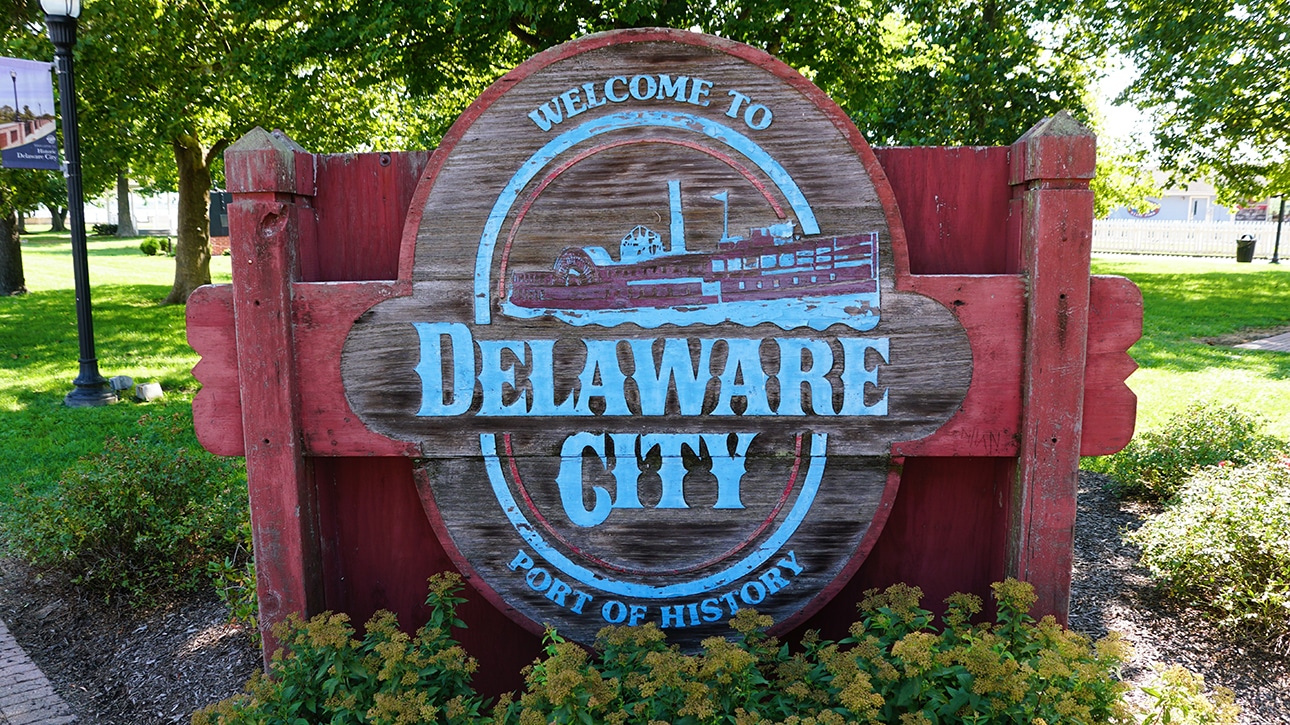
Delaware City Historic District
Tucked along the banks of the Delaware River at the eastern end of the Chesapeake & Delaware Canal, the Delaware City Historic District is one of Delaware’s most intact 19th-century waterfront communities. Brick sidewalks, Federal and Victorian homes, and sweeping river views create the feeling of a preserved maritime village rather than a modern town.
It’s small. It’s walkable. And it’s loaded with history.
Canal Town Origins (1820s–1850s)
Delaware City’s story began with the construction of the Chesapeake & Delaware Canal, which opened in 1829. The canal dramatically shortened shipping routes between the Chesapeake Bay and Delaware River, eliminating the need to sail around the Delmarva Peninsula.
Recognizing the economic opportunity, town founder William Corbit laid out Delaware City in the 1820s as a port community to serve canal traffic. Warehouses, inns, taverns, and ship chandlers quickly followed.
The town became a hub for:
- River commerce
- Canal workers
- Packet boats and cargo vessels
- Ship repair
- Hospitality for travelers moving between Philadelphia and Baltimore
The canal didn’t just create a shortcut — it created a town.
Civil War Era & Fort Delaware Connection
During the Civil War, Delaware City played a critical support role for Fort Delaware on nearby Pea Patch Island. Supplies, guards, and logistics passed through the town as the fort operated as a Union prison camp for Confederate soldiers.
Many soldiers, workers, and officials traveled between the town and the island by boat, tying Delaware City directly to one of the region’s most significant Civil War sites.
Today, visitors can still take the seasonal ferry from Delaware City to Fort Delaware State Park, making the historic district the gateway to that story.
Architectural Character
The Delaware City Historic District was listed on the National Register of Historic Places in 1983. The district contains more than 200 contributing structures, primarily dating from the mid-19th to early-20th centuries.
Architectural styles include:
- Federal
- Greek Revival
- Italianate
- Victorian
- Colonial Revival
Many homes feature narrow facades typical of canal-era towns, deep front porches, and decorative cornices. The layout reflects its original commercial grid, with Washington Street serving as the main corridor.
Unlike some towns that “recreated” history, Delaware City largely preserved its original fabric.
The C&D Canal & Modern Engineering
The original 1829 canal passed directly through town. In the 1920s, the U.S. Army Corps of Engineers widened and deepened the canal to accommodate larger ships, reshaping portions of the town’s relationship to the water.
Today, the C&D Canal Trail runs nearby, connecting Delaware City westward for miles along a paved multi-use path. The canal remains one of the busiest commercial waterways in the United States.
Watching massive cargo ships glide past a 19th-century river town is a surreal blend of eras.
Maritime & Industrial Influence
Delaware City’s economy has historically revolved around:
- Shipping
- Canal operations
- Fishing
- Boatbuilding
- Trade and hospitality
The nearby Delaware City Refinery (constructed in the 20th century) later became an economic anchor, adding an industrial chapter to the town’s long relationship with the river.
Even so, the historic district itself maintains its small-town maritime character.
Community Landmarks
Key sites within or adjacent to the historic district include:
- Battery Park – A riverfront green space with panoramic views of the Delaware River.
- Historic inns and taverns dating back to the canal-era travel.
- The Delaware City Hotel was originally built in 1828 (rebuilt after a fire).
- The ferry landing at Fort Delaware.
Battery Park in particular offers one of the best riverfront vistas in the state, especially at sunset.
Events & Atmosphere
Delaware City frequently hosts:
- Canal Day festivals
- Historic reenactments
- Seasonal markets
- Riverfront events
Its scale makes it uniquely walkable. You can cover most of the historic district in under an hour — though you’ll likely want to linger longer.
It feels less like a tourist stop and more like stepping into a preserved moment of early American commerce.
Why It Matters
The Delaware City Historic District tells a layered story:
- Early American infrastructure innovation (the C&D Canal)
- Civil War logistics and imprisonment
- 19th-century maritime trade
- 20th-century industrial expansion
- Ongoing river commerce
- Few towns illustrate more clearly how transportation technology shapes communities.
- In a state built on crossroads and waterways, Delaware City may be one of the clearest examples of how geography drives history.