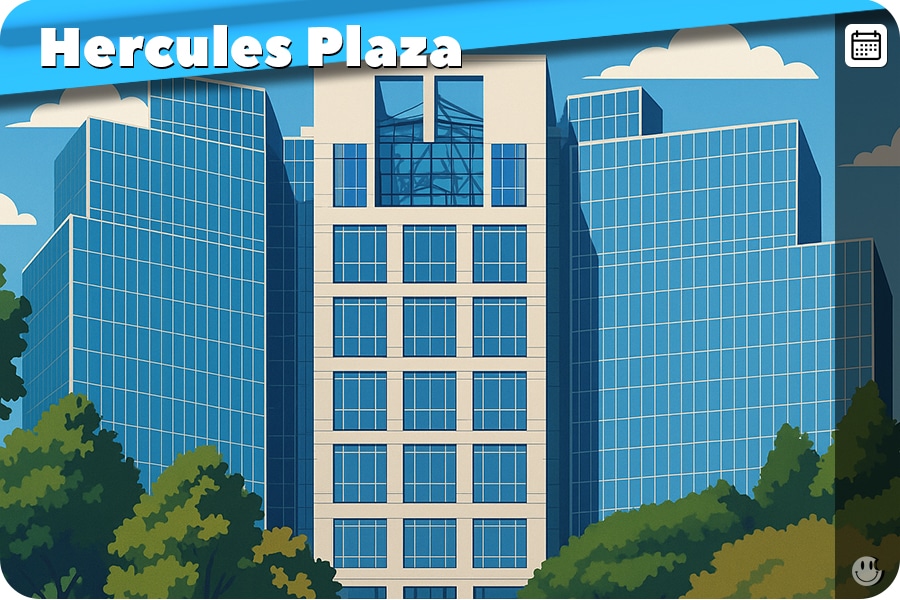
Hercules Plaza
Located in downtown Wilmington near Rodney Square, Hercules Plaza is a modern office complex built on land once occupied by one of Delaware’s most influential corporations: Hercules Incorporated. Although it currently functions primarily as a commercial office center, the site reflects Wilmington’s deep industrial and corporate history.
Origins: From Explosives to Corporate Headquarters
The story begins with Hercules Powder Company, founded in 1912 after a federal antitrust ruling broke up DuPont’s explosives business. Hercules became a major manufacturer of explosives and later diversified into chemicals and specialty materials.
For much of the 20th century, Hercules Incorporated was a central corporate presence in Wilmington. The company constructed a headquarters complex in the late 20th century that helped redefine the downtown skyline.
The modern Hercules Plaza buildings rose during Wilmington’s push to strengthen its identity as a financial and corporate center, particularly during the 1970s–1990s expansion of Delaware’s banking industry.
The Hercules Building
The most prominent structure in the complex, often referred to as the Hercules Building, became one of Wilmington’s taller office towers. With reflective glass and modernist lines, it marked a departure from the earlier Georgian Revival architecture seen around nearby Rodney Square.
The plaza itself created an open public space between the towers — a nod to late-20th-century urban design principles that emphasized light, openness, and pedestrian flow.
Corporate Evolution
In 2008, Hercules Incorporated was acquired by Ashland Inc., ending the company’s independent existence. While the name remains associated with the plaza, the site transitioned from a single-company headquarters to multi-tenant corporate office space.
Today, the complex houses law firms, financial institutions, and professional services, fitting given Wilmington’s prominence in corporate law and incorporation services.
Downtown Context
Hercules Plaza sits within walking distance of:
- Rodney Square
- The historic Hotel du Pont
- Wilmington’s financial district
- The Grand Opera House
- Brandywine Park
Its location places it at the intersection of Wilmington’s industrial legacy and its modern legal and financial identity.
While not a traditional tourist landmark, Hercules Plaza represents:
- Delaware’s early 20th-century chemical industry
- The legacy of antitrust reform
- Wilmington’s evolution into a financial capital
- Late 20th-century urban redevelopment
It reflects the shift from manufacturing dominance to corporate services — a broader economic transition that shaped Delaware’s modern profile.