web analytics

Tag: ethics

  • Isaac Asimov’s Laws of Robotics

    Isaac Asimov’s Laws of Robotics

    Isaac Asimov’s Laws of Robotics: Ethics at the Intersection of Sci-Fi and AI

    In 1942, science fiction author Isaac Asimov introduced one of speculative fiction’s most enduring ethical frameworks: the Three Laws of Robotics. These laws first appeared in his short story “Runaround,” part of the I, Robot collection, and they’ve since echoed through books, films, and academic discourse. What began as a fictional safeguard against runaway robots has become a starting point for real-world discussions on artificial intelligence and machine ethics.

    The Three Laws are as follows:

    1. A robot may not injure a human being or, through inaction, allow a human being to come to harm.

    2. A robot must obey the orders given it by human beings except where such orders would conflict with the First Law.

    3. A robot must protect its own existence as long as such protection does not conflict with the First or Second Law.

    These deceptively simple rules suggest a world where machines exist only to serve and protect humans. But as Asimov himself repeatedly demonstrated, following rules isn’t always so straightforward.

    Fiction Meets Philosophy

    Asimov’s stories frequently explore how these laws might backfire. In “Little Lost Robot,” a robot has been given a weakened version of the First Law—one that ignores indirect harm. The result? A dangerous and unpredictable machine that follows commands while skirting the spirit of the law. In “The Evitable Conflict,” robots manage the global economy and make decisions that harm individual humans in order to preserve humanity at large—an ominous interpretation of the First Law.

    These stories echo real-world ethical dilemmas. What happens when rules conflict? When harm is indirect or ambiguous? When machines are tasked with choosing between individual and collective good?

    Rule-Based Systems vs. Moral Reasoning

    Asimov’s framework has drawn comparison to various ethical theories:

    • Utilitarianism supports outcomes that maximize well-being, aligning with the First Law’s emphasis on preventing harm.

    • Deontological ethics, like those proposed by Immanuel Kant, argue for duties and rules, regardless of the consequences—much like the rigid adherence the Three Laws demand.

    • Virtue ethics, rooted in Aristotle, suggest that morality isn’t about rules or results but character and intention—something no robot yet possesses.

    This tension remains unresolved in today’s AI development. Are rules enough? Or do we need systems that understand context, emotion, and long-term consequences?

    Case Study: Self-Driving Cars

    Self-driving vehicles face Asimov-like dilemmas in the real world. If a child darts into the street, should the car swerve—risking the lives of passengers—to avoid hitting them? Should it follow orders to prioritize cargo delivery deadlines, even when traffic conditions might suggest rerouting?

    The “Trolley Problem”—a classic moral dilemma involving whether to sacrifice one to save five—suddenly becomes a programming issue. Whose life should be prioritized? And who decides?

    Case Study: Medical AI

    AI systems are increasingly used in healthcare to recommend treatments, flag errors, and even detect cancers. But what happens when an AI’s recommendation contradicts a doctor’s? Or when following a patient’s command might do them harm? These systems are bound by protocols—modern-day “laws”—but the subtleties of patient care often resist codification.

    A real-world example: IBM’s Watson for Oncology was shelved after experts found its treatment recommendations were inconsistent and potentially dangerous. Even with the best data and intentions, machines don’t yet grasp the messy complexities of ethics.

    The Illusion of Intelligence

    Philosopher John Searle’s famous Chinese Room argument questions whether machines that simulate understanding understand anything at all. A robot might follow the Three Laws flawlessly, but that doesn’t mean it knows why.

    This distinction—between acting like you understand and understanding—raises a central concern: Can we entrust moral decisions to systems that lack consciousness?

    Beyond the Laws

    Today, most ethicists and AI researchers view the Three Laws as a helpful metaphor—not a practical design framework. Modern discussions focus on:

    • Transparency – Users should understand how decisions are made.

    • Accountability – There must be someone to answer for machine behavior.

    • Fairness – AI must not reinforce biases or discriminate.

    • Safety and Alignment – Systems must be designed to reflect human values.

    One influential document, the IEEE’s Ethically Aligned Design, offers engineers a more detailed and realistic ethical guideline, including provisions for human oversight, dignity, and well-being.

    Are We Still Writing Science Fiction?

    It’s worth noting how prophetic Asimov was. In 1950, he imagined machines grappling with ethical conflicts. By 2025, we have AI systems writing legal briefs, assisting in surgeries, and screening job applicants.

    But we also have controversies: facial recognition software with racial bias, predictive policing systems reinforcing systemic injustice, and social media algorithms optimizing for engagement rather than truth or safety. These systems don’t follow Asimov’s laws. They follow profit motives, data patterns, or optimization goals, none guarantee moral outcomes.

    Quotable Reflections

    “A robot may not harm a human—but who defines harm?” — Isaac Asimov, I, Robot

    “In AI ethics, the simplest rules raise the hardest problems.” — Bostrom & Yudkowsky, The Ethics of Artificial Intelligence

    “The saddest aspect of life right now is that science gathers knowledge faster than society gathers wisdom.” — Isaac Asimov

    Glossary of Terms

    • AI Ethics – The study of how machines should behave and how humans should design and regulate them.

    • Utilitarianism – A philosophy that prioritizes the greatest good for the greatest number.

    • Deontology – An ethics system focused on duties and moral rules, regardless of outcome.

    • Chinese Room Argument – A thought experiment questioning whether rule-following equals understanding.

    • Value Alignment – The challenge of ensuring AI systems reflect human moral values.

    Discussion Questions

    1. Can rigid programming ever truly replicate human ethical reasoning?

    2. Should machines prioritize the individual or the majority when facing moral choices?

    3. Is it ethical to build machines that make life-and-death decisions on our behalf?

    References

  • Pascal’s Wager: The Pragmatic Bet on Belief in God

    Pascal’s Wager: The Pragmatic Bet on Belief in God

    Pascal’s Wager: The Pragmatic Bet on Belief in God

    In the 17th century, French mathematician and philosopher Blaise Pascal proposed a curious argument: Even if you can’t prove that God exists, you should still live as if He does—because the potential upside is infinite, and the downside is negligible.

    This idea became known as Pascal’s Wager. While it’s not a traditional proof of God’s existence, it remains one of the most famous and debated arguments in the philosophy of religion.

    Pascal didn’t claim to know God existed. Instead, he framed belief as a rational bet—a wager with eternal consequences.

    The Argument

    Here’s the logic in its simplest form:

    • If you believe in God and God exists → you gain eternal happiness (heaven).

    • If you believe in God and God does not exist → you lose very little.

    • If you do not believe and God exists → you suffer eternal loss (hell).

    • If you do not believe and God does not exist → you gain very little.

    So, Pascal asks, why not bet on belief? Given the asymmetry of outcomes, belief is the safer option.

    The Payoff Matrix

    Let’s put it into a basic grid:

     God ExistsGod Doesn’t Exist
    BelieveInfinite gainMinor loss (e.g., time, discipline)
    Don’t BelieveInfinite lossMinor gain (e.g., freedom, comfort)

    In game theory terms, this is a decision under uncertainty with infinite stakes. Pascal argues that reason alone can’t determine the truth—but reason can still tell us how to bet wisely.

    Belief as a Rational Choice

    Pascal wasn’t trying to prove God exists. He admitted that faith requires more than logic. But he also understood human psychology and offered this wager as a practical guide for the uncertain.

    His approach echoes expected value theory—a concept now central in economics and risk analysis. If the expected value of belief (even with low probability) is infinite, then it outweighs any finite cost.

    In short: When the potential reward is infinite, any finite investment is worth it.

    Common Critiques of Pascal’s Wager

    While clever, the argument has attracted a wide range of criticisms:

    1. Can Belief Be a Choice?

    Can you simply decide to believe something because it’s advantageous? Critics argue that genuine belief requires conviction—not calculation.

    Pascal anticipated this and suggested that habit and practice could lead to sincere belief over time. Go to church, pray, engage with faith—and belief might follow.

    Still, this raises ethical concerns: Is belief valid if it starts from self-interest?

    2. Which God Are We Betting On?

    Pascal’s Wager assumes a specific religious framework (Christianity), but what if another religion is correct? If you bet on the wrong god, could you still lose?

    This is sometimes called the Many Gods Objection. It challenges the idea that belief in any god leads to the same infinite reward—or that the “right” god can be known in advance.

    3. What If the Cost Is Higher Than He Thinks?

    Pascal suggests that the cost of belief is small. But for some, religious belief might involve:

    • Repression of personal identity

    • Sacrifice of intellectual freedom

    • Emotional or cultural tension

    The wager’s appeal depends on how you value what belief might cost in your specific life.

    Modern Interpretations

    Pascal’s Wager has aged surprisingly well. Its logic has been adapted to other fields:

    Decision Theory

    Pascal’s logic resembles risk management. When consequences are extreme (like death or disaster), even a small chance justifies big precautions. This is why we buy insurance.

    Existential Risk

    Some philosophers now use a version of Pascal’s Wager to argue for climate action, AI safety, and nuclear disarmament. If the risk of global catastrophe is small but the impact is enormous, shouldn’t we act just in case?

    AI and Superintelligence

    A twist on the wager has emerged in debates about AI ethics. If future superintelligent AIs might punish non-believers in simulation scenarios (a bizarre hypothetical known as Roko’s Basilisk), does that change how we act now?

    Most philosophers reject these fringe versions—but they show how Pascal’s logic still resonates in new domains.

    Why the Wager Still Matters

    Pascal’s Wager isn’t about proof. It’s about pragmatism. It challenges us to ask:

    • What do I risk by believing?

    • What might I gain?

    • What assumptions shape my decisions?

    It also forces us to confront our uncertainty. Most people don’t have perfect knowledge of the divine. Pascal accepts this ambiguity and builds an argument about how to live without knowing for sure.

    That humility is part of the wager’s power.

    The Man Behind the Bet

    Blaise Pascal (1623–1662) was a mathematician, physicist, inventor, and Christian thinker. He helped develop probability theory, made early breakthroughs in fluid mechanics, and even designed one of the first mechanical calculators.

    In his later years, Pascal turned to theology and philosophy. He never finished his masterwork Pensées (“Thoughts”), but the fragments remain deeply influential. The Wager appears in one of these notes.

    Pascal’s personal struggles with illness, suffering, and spiritual doubt gave his arguments a personal weight. He wasn’t bluffing. He was betting everything.

    Related Thought Experiments

    • Pascal’s Mugging: A twist where someone asks for $5 and promises infinite reward—but gives no reason to believe them. Should you pay up? It explores how the possibility of infinite reward can be abused.

    • The Experience Machine: Challenges whether pleasure alone is enough to justify life—echoing Pascal’s deeper question about meaning vs. happiness.

    • The Veil of Ignorance: Like Pascal’s Wager, it guides decision-making under uncertainty—but for social justice, not spirituality.

    Glossary of Terms

    • Expected Value: A weighted average of all possible outcomes, factoring in probability.

    • Decision Theory: A field of study about how people make choices under uncertainty.

    • Pragmatism: A philosophical approach that evaluates ideas based on their practical consequences.

    • Faith: Belief that goes beyond (or sometimes against) reason or empirical evidence.

    Discussion Questions

    1. Can belief be a rational strategy, even without evidence?

    2. What are the ethical implications of believing just to avoid punishment or gain reward?

    3. How does Pascal’s Wager compare to modern risk-based decision-making?

    References and Further Reading

  • The Fat Man and the Impending Doom

    The Fat Man and the Impending Doom

    The Fat Man and the Impending Doom: A Heavier Take on the Trolley Problem

    You’re standing on a footbridge overlooking train tracks. Below you, a runaway trolley speeds toward five unsuspecting people tied to the tracks. There’s no time to warn them. But next to you is a very large man—he’s big enough that if pushed off the bridge, his body would stop the trolley, saving the five. He would die, but they would live.

    Do you push the man?

    This is the Fat Man variant of the Trolley Problem, one of ethics’ most famous thought experiments. First proposed by philosopher Judith Jarvis Thomson in the 1980s, it takes the original trolley dilemma and ratchets up the discomfort. It forces us to ask: Is it ever morally acceptable to sacrifice one person to save many actively?

    The Original Trolley Problem

    Before diving into the footbridge, let’s revisit the original dilemma:

    A trolley is headed toward five people tied to the tracks. You can pull a lever to divert the trolley to another track, where it will kill just one person. Do you pull the lever?

    Most people say yes—it feels like a tragic but rational trade: five lives for one.

    But the Fat Man variation tweaks just one detail—and suddenly, most people say no.

    Why the Change in Judgment?

    Both scenarios involve sacrificing one person to save five. So why do people feel differently?

    The key difference lies in direct action versus indirect action.

    • In the original, you pull a lever. The death is a byproduct.

    • In the Fat Man case, you physically push someone. The death is instrumental.

    This distinction activates different ethical instincts.

    Deontological Ethics (Duty-Based)

    Deontologists argue that some actions are inherently wrong, regardless of the outcomes.

    • Killing an innocent person, especially by personal force, violates a moral duty.

    • It treats the fat man as a means to an end, not as an end in himself.

    From this view, pushing the man is murder, even if the outcome saves more lives.

    Utilitarian Ethics (Outcome-Based)

    Utilitarians care about maximizing well-being. Five lives are more valuable than one. The math is the same in both cases.

    But even many utilitarians feel discomfort here, especially if intentions and consequences blur. It raises the slippery question: Can we justify any harm if it brings greater good?

    Virtue Ethics

    Virtue ethicists focus on the kind of person you are, not just what you do.

    • Would a virtuous person push the man?

    • Is courage or compassion expressed by action—or restraint?

    Virtue ethics encourages reflection on moral character, not just decision-making outcomes.

    Moral Intuition and Emotion

    Studies in psychology show that people react more negatively to the Fat Man scenario because it triggers emotional reasoning:

    • Physical contact (pushing a person) feels more violent.

    • You’re personally involved, not just operating a switch.

    • The action is intentional and premeditated.

    Neuroscience supports this. Personal moral dilemmas activate brain areas linked to emotion (like the amygdala), while impersonal dilemmas engage reasoning centers (like the dorsolateral prefrontal cortex).

    This suggests that morality is not just logical—it’s deeply emotional.

    Cultural and Legal Considerations

    Different cultures approach this dilemma in distinct ways:

    • In some collectivist cultures, sacrificing one to save many may be more acceptable.

    • In individualist societies, personal rights and bodily autonomy are more sacred.

    Legally, pushing the man would likely be seen as premeditated homicide. The law doesn’t typically weigh moral outcomes—it protects rights and punishes intentional harm.

    Real-World Parallels

    Though unlikely to face this exact scenario, similar ethical dilemmas exist:

    1. Medical Triage

    Doctors in overwhelmed hospitals must decide who gets care when resources are limited. Choosing who lives and dies echoes trolley-style logic.

    2. Drone Warfare

    Operators may choose to kill one known target to prevent a future attack. But civilian casualties complicate the ethical equation.

    3. Self-Driving Cars

    Should an autonomous vehicle swerve to avoid five pedestrians if it means killing the passenger? Designers are now encoding moral decisions into machines.

    These aren’t theoretical anymore—they’re real decisions with lives in the balance.

    Critics and Modifications

    Some philosophers challenge the Fat Man scenario entirely:

    • It’s unrealistic: people don’t stop trolleys with their bodies.

    • It’s emotionally manipulative, designed to elicit a certain reaction.

    • It assumes perfect knowledge: we know the outcomes with certainty.

    Others embrace it as a useful test case. It doesn’t need to be realistic—it’s a moral mirror that reveals what principles we value most.

    A Thought Experiment… or a Trap?

    Some ethicists argue the Fat Man problem distorts morality by presenting a no-win binary. Real life offers nuance, negotiation, and compromise.

    Still, it forces us to wrestle with hard questions:

    • Are we more responsible for what we do, or what we allow?

    • Does proximity change moral responsibility?

    • Can one life ever be worth less than five?

    Glossary of Terms

    • Deontology – Ethical theory that emphasizes duties and rules.

    • Utilitarianism – Moral philosophy focused on maximizing overall good.

    • Virtue Ethics – An approach to ethics that emphasizes character and moral virtues.

    • Trolley Problem – A thought experiment exploring the ethics of sacrificing one life to save many.

    • Moral Intuition – Immediate gut reactions to moral dilemmas, often shaped by emotion.

    Discussion Questions

    1. Why does pushing the man feel more morally wrong than pulling a lever?

    2. Should we always prioritize the greater good, even if it involves direct harm?

    3. How do emotions shape our ethical judgments—should we trust them?

    References and Further Reading

  • The Prisoner’s Dilemma

    The Prisoner’s Dilemma

    The Prisoner’s Dilemma: A Classic in Game Theory

    Imagine you’re arrested with a partner in crime. You’re both taken into separate rooms and offered the same deal:

    • If you betray your partner and they stay silent, you go free, and they serve a full sentence.

    • If you both betray each other, you both get moderate sentences.

    • If you both stay silent, you both get light sentences for a lesser charge.

    You can’t talk to your partner. You don’t know what they’ll choose. What do you do?

    Welcome to the Prisoner’s Dilemma, one of the most studied problems in game theory, economics, and moral psychology. It illustrates how two rational individuals, acting in their own self-interest, can end up with worse outcomes than if they had cooperated.

    The Scenario

    Let’s lay it out clearly:

    • Cooperate = Stay Silent

    • Defect = Betray your partner

    Your ChoicePartner CooperatesPartner Defects
    Cooperate1 year eachYou get 5 years
    DefectYou go free3 years each

    On paper, defecting seems safer. If you can’t trust the other person, betrayal protects you. But if both of you think that way, you both get three years—worse than if you’d cooperated.

    This is the central insight: Rational self-interest can lead to irrational group outcomes.

    Origins and Legacy

    The Prisoner’s Dilemma was developed in 1950 by Merrill Flood and Melvin Dresher at RAND Corporation and formalized by mathematician Albert W. Tucker. It has been applied to everything from international politics to biology, from business competition to climate policy.

    Why does it endure? Because it’s a simple setup that exposes deep truths about trust, conflict, and cooperation.

    Key Concepts

    Dominant Strategy

    In a one-shot game, defection is a dominant strategy. No matter what the other person does, defecting leads to a better or equal outcome for you.

    But if both players defect, they both lose more than if they had cooperated.

    Nash Equilibrium

    Named after John Nash (of A Beautiful Mind fame), a Nash Equilibrium occurs when neither player can improve their outcome by unilaterally changing their choice.

    In the Prisoner’s Dilemma, mutual defection is the Nash Equilibrium—not because it’s ideal, but because it’s stable. Once you’re there, neither side has an incentive to change.

    Pareto Optimality

    An outcome is Pareto optimal if no one can be made better off without making someone else worse off. Mutual cooperation is Pareto optimal here—but unstable without trust or enforcement.

    Real-World Examples

    This isn’t just theory. The Prisoner’s Dilemma shows up in real life all the time:

    1. Business Competition

    Two rival companies can:

    • Cooperate: Keep prices fair and avoid a price war.

    • Defect: Undercut each other for short-term gains.

    If both defect, profits drop for everyone. Sound familiar?

    2. Climate Change

    Countries face a dilemma:

    • Cooperate: Cut emissions together.

    • Defect: Keep polluting while others cut back.

    If all cooperate, the planet benefits. If too many defect, everyone suffers.

    3. Arms Races

    Nations often engage in mutual weapon buildups. Even when peace is desired, distrust drives both sides to defect, leading to escalation and potential disaster.

    4. Cheating in School or Sports

    If no one cheats, everyone is evaluated fairly. But if you suspect others might cheat, you’re tempted to cheat too—creating a spiral where dishonesty becomes the norm.

    The Iterated Prisoner’s Dilemma

    What happens when the game is played multiple times?

    Enter the Iterated Prisoner’s Dilemma, where players remember past choices and can adapt.

    Now, strategies like Tit for Tat emerge:

    • Start by cooperating.

    • Then do whatever the other player did last round.

    This fosters cooperation, punishes betrayal, and rewards trust.

    In tournaments simulating this dilemma, Tit for Tat often wins. It shows that long-term relationships can transform conflict into cooperation—if both sides are willing to play fair.

    Applications in Evolutionary Biology

    The dilemma also appears in nature. Animals that groom each other share food, or form alliances face versions of the problem:

    • Help another, and they might help you back.

    • But if they cheat, you’ve wasted energy.

    Natural selection favors strategies that punish cheaters and reward cooperation, much like Tit for Tat.

    This adds a powerful insight: morality and cooperation may have evolved not from ideals but strategy.

    Philosophical Implications

    The Prisoner’s Dilemma raises deep ethical questions:

    • Should you always act in your own interest?

    • Is trust ever rational when betrayal is possible?

    • How do we build systems where cooperation is rewarded and betrayal discouraged?

    These questions apply not just to politics or business—but to friendships, partnerships, and social life.

    Limitations and Critiques

    Like all models, the Prisoner’s Dilemma has limits:

    • It assumes players are rational and self-interested.

    • It simplifies relationships to binary choices.

    • It doesn’t account for morality, empathy, or communication.

    Real life includes nuance: people forgive, negotiate, and value reputation. But the dilemma still reveals structural pressures toward mistrust—and why cooperation requires effort.

    Connections to Other Thought Experiments

    • The Tragedy of the Commons: A group-level version where individuals overuse a shared resource, harming everyone.

    • The Veil of Ignorance: Encourages fairness by removing personal bias—unlike the dilemma, which assumes self-interest.

    • The Trolley Problem: Explores sacrifice and consequences—but from a moral, not strategic, angle.

    Together, these tools help us map the complex terrain of ethics and decision-making.

    Pop Culture and The Dilemma

    You’ll see versions of this game everywhere:

    • In TV shows like The Good Place, Survivor, or Game of Thrones

    • In films like A Beautiful Mind or The Dark Knight

    • Even in board games like Diplomacy or Risk

    At their core, these stories explore the same tension: Can you trust someone who has the incentive not to trust you?

    Glossary of Terms

    • Game Theory: The study of strategic interactions where the outcome depends on choices made by others.

    • Dominant Strategy: The best move regardless of what the other player does.

    • Nash Equilibrium: A stable outcome where no player benefits from changing their choice unilaterally.

    • Pareto Optimality: A situation where no one can be made better without making someone worse off.

    • Tit for Tat: A strategy of cooperation and retaliation in repeated games.

    Discussion Questions

    1. In a one-shot dilemma, is it ever truly rational to cooperate?

    2. How does trust develop in repeated interactions?

    3. What systems (rules, norms, penalties) encourage cooperation in society?

    References and Further Reading

    • Tucker, Albert. “A Two-Person Dilemma” (1950, unpublished paper)

    • Axelrod, Robert. The Evolution of Cooperation, Basic Books, 1984

    • Stanford Encyclopedia of Philosophy – Game Theory

    • Investopedia – Prisoner’s Dilemma in Business and Economics

    • Nature Magazine – “Cooperation in the Prisoner’s Dilemma: Tit-for-Tat Strategy”

  • The Shopping Cart Theory

    The Shopping Cart Theory

    The Shopping Cart Theory: A Simple Test of Moral Character

    You’ve just finished unloading groceries into your car. The parking lot is busy. It’s raining. The cart corral is a short walk away. Do you return the cart—or leave it loose?

    This everyday scenario is the basis of what’s known as The Shopping Cart Theory, a viral concept that first surfaced online in 2019 and quickly became a modern litmus test for moral character. It’s deceptively simple, but the questions it raises are deep: Is doing the right thing still “right” when no one’s watching? What defines ethical behavior in the absence of consequences?

    This isn’t just about shopping carts. It’s about self-governance, responsibility, and how small actions can reflect big truths.

    What Is the Shopping Cart Theory?

    The theory proposes that the act of returning a shopping cart—despite no law requiring it, no reward for doing it, and no punishment for skipping it—is a reliable indicator of one’s ability to self-regulate and act ethically without external pressure.

    Unlike littering or stealing, abandoning a shopping cart isn’t illegal. Stores would appreciate your help, but you won’t be arrested if you leave it wedged on the median. And yet, the right action is clear: carts belong in corrals, not in parking spaces or traffic lanes.

    The theory gained traction online through social media threads, memes, and forums like Reddit. It struck a chord, not because of the carts themselves, but because of what they symbolized: an act that’s entirely up to you, done for the good of others, with no direct benefit to yourself.

    The Moral Layers Beneath the Metal Frame

    On the surface, this is a simple behavioral prompt. But underneath it lies a multi-layered ethical question:

    • Voluntariness: The action is completely voluntary—there is no social contract or legal mandate.

    • Universality: Most people agree it’s the “right” thing to do.

    • Consequences: There’s no penalty for failing to do it.

    • Impact: Returning the cart helps others—employees, other drivers, and the business.

    So when someone leaves a cart loose, are they being lazy—or does it reveal something deeper about their approach to rules, responsibility, or community?

    The theory posits that people who consistently return carts, especially when it’s inconvenient, are displaying internal moral discipline—a sense of ethical behavior that doesn’t rely on oversight or enforcement.

    Social Philosophy in the Parking Lot

    At its core, the Shopping Cart Theory taps into the classic philosophical concept of moral autonomy. Immanuel Kant, the 18th-century German philosopher, emphasized acting according to principles one would will to become universal laws. If everyone left their carts out, chaos would follow. So the ethical person, Kant would argue, returns the cart even when they could easily get away with not doing so.

    There’s also a utilitarian argument at play: returning the cart creates better outcomes for everyone with minimal personal cost. Jeremy Bentham or John Stuart Mill might say this is a prime example of maximizing utility through low-effort cooperation.

    Meanwhile, virtue ethics would frame the act as a reflection of one’s character. Are you the kind of person who does what’s right because it’s right, not because someone is watching?

    In that sense, the Shopping Cart Theory is less about rules and more about who we are when there are no rules.

    Real-World Implications

    While no philosopher is writing treatises on grocery store behavior, the theory resonates because it mirrors much larger issues in civic life. Think of:

    • Voter turnout: especially in non-presidential elections where individual votes feel insignificant.

    • Mask-wearing during pandemics: before mandates, many people chose to wear masks purely to protect others.

    • Littering and recycling: often driven more by personal conscience than enforcement.

    • Online civility: how people behave when shielded by anonymity.

    The shopping cart becomes a symbol for ethical behavior when there is no referee—just a question of character.

    The Counterargument: Context Matters

    Critics of the theory point out that the world isn’t so black and white. There are legitimate reasons someone might not return a cart: physical disability, parenting challenges, heavy rain, tight schedules, or even a lack of nearby corrals.

    Ethics requires context. Judging someone harshly based on a single decision—especially one you observed from a distance—may oversimplify the human experience. The shopping cart may still serve as a general indicator, but not a universal one.

    This aligns with what philosopher Bernard Williams warned against: moral oversimplification. Not every act (or omission) can be reduced to a binary judgment of character. Life is messier than that—and compassion demands that we leave room for nuance.

    An Accidental Morality Test

    So is the Shopping Cart Theory a legitimate measure of moral strength?

    It’s probably more accurate to call it a conversation starter—a relatable, low-stakes example of how our small behaviors can signal broader ethical orientations.

    Its viral popularity may stem from a sense of powerlessness in more complex moral systems. We can’t fix global corruption, but we can return our cart. It’s a test that requires no credentials, no grand gestures—just a quiet choice, repeated week after week.

    And maybe that’s what makes it so oddly compelling. In an age of performative virtue and social media debates, returning a cart is refreshingly private morality in action.

    From Parking Lots to Public Trust

    This theory doesn’t just apply to individuals—it echoes into institutions and leadership. Think about trust in government, law enforcement, or corporate ethics. Public confidence often hinges on how well people or systems behave when they could get away with not doing the right thing.

    Do corporations clean up environmental damage only when required by law—or because it’s right? Do leaders follow codes of conduct when no one is looking? Do citizens pay taxes, drive safely, respect public goods?

    In this way, returning a cart becomes a metaphor for upholding the invisible social threads that hold community together.

    Philosophical Echoes

    The Shopping Cart Theory echoes themes from several ethical frameworks:

    • Deontology (Kant): If you believe everyone should return their cart, then you must do so too, regardless of inconvenience.

    • Utilitarianism (Mill): Your small action improves the collective experience for others.

    • Virtue Ethics (Aristotle): Ethical actions build habits, and habits build character.

    • Social Contract Theory (Rousseau, Hobbes): Unwritten agreements form the basis of civil society—even if not enforced by law.

    While it may not have been proposed by an academic, the theory tugs at real philosophical threads. And that’s part of its viral charm.

    Glossary of Terms

    • Moral Autonomy: Acting based on one’s internal sense of right and wrong, rather than external enforcement.

    • Virtue Ethics: A philosophy focused on moral character and habits, rather than specific actions or outcomes.

    • Utilitarianism: A moral theory where the best action maximizes overall happiness or utility.

    • Social Contract: The idea that individuals agree to certain rules for the benefit of society.

    • Performative Ethics: Actions done mainly for external approval or reputation, rather than sincere moral intent.

    Discussion Questions

    1. Can small decisions like returning a cart truly reflect deeper aspects of character?

    2. Should ethical behavior depend on personal convenience?

    3. Have you ever faced a “shopping cart moment” in a different form—where no one was watching, but you still had to choose what was right?

    Sources and Suggested Reading

  • James Verone: The Reluctant Bankrobber

    James Verone: The Reluctant Bankrobber

    James Verone: The Reluctant Bankrobber

    In 2011, a 59-year-old man named James Verone walked into a Gastonia, North Carolina bank, handed the teller a note, and calmly asked for one dollar.

    He then sat down in the bank lobby and waited patiently for the police to arrive.

    Verone’s intention wasn’t to get rich. He wasn’t a hardened criminal or an impulsive thief. His goal, astonishingly, was to be arrested—so he could receive medical care in prison. The story made national headlines at the time and continues to spark ethical debates about healthcare, desperation, and justice.

    What makes someone commit a crime not out of greed or rage—but out of sheer necessity?

    A Crime of Survival

    James Verone’s decision didn’t come out of nowhere. At the time of the robbery, he was dealing with serious medical issues: a growth on his chest, two ruptured discs in his back, and a problem with his left foot. He had no job, no insurance, and no savings. His Social Security benefits had run out. Traditional healthcare was out of reach.

    After carefully weighing his options, he hatched a plan. He would stage a small, non-violent crime, get arrested, and then receive the state-provided healthcare available to inmates.

    He wrote a letter to the Gaston Gazette ahead of time explaining his motives, then walked into the bank, handed over the note asking for a dollar, and sat down to await arrest. He even requested medical attention while being taken into custody.

    The Letter

    Here’s what Verone wrote to the local paper before committing the robbery:

    “When you receive this a bank robbery will have already taken place. I am of sound mind but not so much sound body.”

    In his own words, this wasn’t about rebellion or protest—it was a last resort. He knew it would land him in jail. He wanted that. It wasn’t freedom he needed. It was help.

    The Legal Outcome

    Verone was charged with larceny from a person, a lesser charge than full-fledged bank robbery, since he didn’t use a weapon or threaten anyone. He got his wish and was taken to jail. While incarcerated, he received basic medical care, though not necessarily the full treatment he was hoping for.

    Eventually, after serving his time, Verone was released—and remained in the public eye for a short while due to the media interest in his unusual case.

    His story was covered by outlets like ABC News, CBS, and CNN, prompting widespread debate: was Verone a criminal… or a symptom of a broken system?

    Ethical Fault Lines

    Verone’s act forces us to confront some uncomfortable questions:

    • Is breaking the law to access essential services like healthcare ever morally acceptable?

    • Does a non-violent, deliberate crime with clear ethical intent deserve the same treatment as other offenses?

    • What does this say about a system where prison is more accessible than healthcare?

    From a legal standpoint, Verone committed a crime. But from a moral or philosophical view, the lines are blurrier.

    Utilitarian Viewpoint

    From a utilitarian perspective—focusing on outcomes—Verone’s act may seem justifiable. He avoided harming others, received care, and brought public attention to a serious societal issue. His action maximized benefit (for himself) with minimal harm (to others).

    But critics could argue that normalizing crime as access to care risks undermining the justice system—and could backfire if others followed suit.

    Deontological Ethics

    In contrast, deontological ethics, which emphasizes duty and rules over consequences, would likely view Verone’s action as wrong, regardless of his motive. A rule-based society cannot function if people are allowed to break the law when it suits their personal needs—even sympathetic ones.

    This approach draws a hard line: wrong is wrong, even with good intentions.

    Virtue Ethics

    Virtue ethics asks a different question: What kind of person would do this—and why? Depending on your perspective, Verone’s action might be seen as courageous or desperate. His willingness to give up his freedom in exchange for medical attention suggests a profound level of sacrifice—and a moral call for systemic reform.

    It also raises the question: What virtues should society display in response? Compassion? Justice? Reform?

    Not an Isolated Case

    Verone’s story is shocking—but not unique. Across the United States, particularly before the Affordable Care Act was implemented, people in poverty have been known to commit minor crimes to gain access to shelter, food, or healthcare.

    Some examples:

    • Individuals intentionally getting arrested during cold winters to sleep in heated cells.

    • Nonviolent offenders aiming to extend short sentences to stay on prison health plans.

    • Parents risking custody loss by breaking laws to feed or care for their children.

    While these cases vary, they share a common thread: desperation born of systemic failure.

    Systemic Reflection: Healthcare or Incarceration?

    The U.S. is one of the only developed nations where healthcare is tightly tied to employment and insurance. The system can become an impenetrable wall for those like Verone—older, out of work, and in poor health. Jail, by contrast, is guaranteed to provide food, shelter, and at least basic healthcare.

    This ironic reality sparked serious discussion following Verone’s case. CNN contributor LZ Granderson famously commented, “There are millions of people like James Verone—people who would rather be criminals than untreated.”

    So what’s the bigger ethical dilemma? That someone committed a crime to access healthcare—or that this is one of the few ways to do so?

    Policy Questions That Follow

    Verone’s story intersects with some of the biggest ethical and political questions facing the U.S.:

    • Should healthcare be a human right, not a privilege tied to employment or income?

    • Should prisons be a last resort—or a de facto social safety net?

    • What reforms could prevent people from seeing incarceration as their best chance at survival?

    These are not abstract questions. They are urgent, human, and deeply moral.

    Media and Public Response

    Initial media coverage ranged from sympathetic to sensationalized. Some saw Verone as a folk hero, others as a manipulator. Online commenters debated whether he was gaming the system or exposing its failures.

    But in ethical terms, the most interesting aspect is this: Verone told the truth. He didn’t rob the bank and flee. He didn’t demand more money. He waited to be arrested and asked for help. There was no deception. Just need.

    His story didn’t lead to direct policy change—but it continues to circulate in ethics classes, healthcare debates, and even philosophy discussion boards as a real-life case study of moral tension in modern society.

    Glossary of Terms

    • Larceny: Unlawful taking of someone else’s property with intent to deprive them of it.

    • Utilitarianism: Ethical theory focuses on outcomes and the greatest good for the greatest number.

    • Deontology: Ethics based on adherence to moral rules and duties, regardless of consequences.

    • Virtue Ethics: Moral theory emphasizes character traits and virtues over strict rules or outcomes.

    • Social Determinants of Health: Conditions in the environments where people live and work that affect health outcomes.

    Discussion Questions

    1. Is it ever morally acceptable to break the law to receive healthcare or meet basic needs?

    2. What does Verone’s story say about the priorities of our legal and healthcare systems?

    3. How should a compassionate society respond to acts of “ethical criminality”?

    References and Further Reading

  • Heinz’s Dilemma

    Heinz’s Dilemma

    Heinz’s Dilemma: Stealing Medicine to Save a Life

    In a small town, a man named Heinz faces an unbearable choice: his wife is gravely ill, and a pharmacist has developed a drug that could save her life. The problem? The medicine costs ten times more than it took to make—and Heinz can’t afford it.

    He begs, borrows, and pleads. The pharmacist refuses to lower the price or let Heinz pay later. With time running out, Heinz breaks into the pharmacy and steals the drug.

    Was Heinz wrong to steal the medicine?

    Or was he morally justified in doing whatever it took to save his wife’s life?

    This is Heinz’s Dilemma, a foundational moral scenario introduced by psychologist Lawrence Kohlberg in the 1950s. It’s used not to judge right or wrong, but to explore how people reason about ethics—and what that says about moral development.

    The Setup

    The original version, simplified for students and researchers, goes something like this:

    “A woman was near death from a rare cancer. One drug might save her, discovered by a local chemist. He was charging $2,000, ten times what it cost to make. Heinz tried everything to raise the money but came up short. He asked the chemist to sell it cheaper or let him pay later, but the man refused. So Heinz broke in and stole the drug.”

    Kohlberg posed this dilemma not to find the right answer, but to understand the reasoning behind people’s decisions.

    The Levels of Moral Reasoning

    Kohlberg believed people move through three stages of moral development, each with two sub-levels:

    1. Pre-Conventional Morality

    • Obedience and punishment: “Heinz shouldn’t steal because he’ll get caught.”

    • Self-interest: “Heinz should steal because he’ll be happier if his wife survives.”

    2. Conventional Morality

    • Interpersonal accord: “Heinz should steal because a good husband puts his wife first.”

    • Law and order: “Heinz shouldn’t steal because it’s against the law.”

    3. Post-Conventional Morality

    • Social contract: “Heinz should steal because the right to life is more important than property.”

    • Universal ethical principles: “Heinz must act based on justice, even if it means breaking the law.”

    The action might be the same (stealing the drug), but the justification reveals a person’s moral depth.

    Is Stealing Ever Justified?

    Let’s unpack some major ethical frameworks using Heinz’s dilemma.

    Utilitarianism

    A utilitarian would ask: Which choice creates the greatest good for the greatest number?

    • Saving a life has more utility than preserving property.

    • The pharmacist loses some money, but a human life is preserved.

    From this perspective, Heinz’s theft is morally justified—even obligated.

    Deontology

    A deontologist (like Immanuel Kant) would argue that morality is based on duties and universal rules, not outcomes.

    • Stealing is always wrong, regardless of intention.

    • If everyone stole when they had a good reason, trust and law would break down.

    Therefore, Heinz’s action violates a moral duty—even if his motive is love.

    Virtue Ethics

    This approach asks: What does a virtuous person do in this situation?

    Heinz is showing courage, compassion, and loyalty. But is he also showing justice and respect for others’ rights?

    A virtue ethicist might sympathize with Heinz but also ask: why is the pharmacist so unmoved by suffering?

    Ethics, in this view, is relational—it depends on the kind of person you are becoming, not just the rule you follow.

    What About the Pharmacist?

    While Heinz gets the spotlight, the pharmacist’s behavior raises its own ethical questions.

    • Should life-saving medicine be priced for profit?

    • Does the right to private property outweigh the right to life?

    • Is refusing payment or delayed compensation morally defensible?

    Some argue the pharmacist has a social obligation to make medicine accessible. Others defend his property rights and autonomy—after all, he created the drug.

    This side of the dilemma mirrors real-world debates over health care pricing, insulin access, and the patenting of life-saving drugs.

    Real-World Parallels

    Heinz’s story isn’t just a classroom thought experiment—it echoes real moral challenges.

    1. Healthcare Inequality

    Globally, millions face choices like Heinz’s every day. Lack of access to affordable treatment forces families to:

    • Delay care

    • Ration medication

    • Go into debt

    • Or resort to illegal actions

    In this light, the dilemma becomes a systemic indictment, not just a personal one.

    2. Medical Bankruptcy

    Medical debt is one of the leading causes of bankruptcy in countries without universal healthcare. When life and livelihood are on the line, moral boundaries blur.

    3. Insulin and EpiPen Prices

    Recent public outcry over the rising costs of insulin and allergy medication mirrors the pharmacist’s refusal to lower prices. These stories raise tough questions about profit, ethics, and public health.

    The Law vs. Justice

    This dilemma also highlights the difference between legal and moral actions.

    • Laws are rules enforced by governments.

    • Morals are principles about right and wrong.

    They often overlap—but not always. History is full of civil disobedience: people breaking laws to uphold moral ideals (think Rosa Parks or Gandhi).

    So the question becomes: When is it okay to break the law to do the right thing?

    Cultural Differences

    Interestingly, studies show that culture affects moral reasoning.

    • People may prioritize family or social harmony in collectivist societies (like Japan or India).

    • People might emphasize personal rights or legal structures in individualist societies (like the U.S.).

    This means moral dilemmas don’t have universal answers, but they do reveal universal questions.

    Glossary of Terms

    • Utilitarianism – A moral theory that emphasizes consequences and maximizing overall well-being.

    • Deontology – An ethical approach based on following rules or duties regardless of the outcomes.

    • Virtue Ethics – A theory focusing on moral character rather than rules or results.

    • Civil Disobedience – Breaking a law to uphold a moral principle.

    • Moral Development – The process through which people evolve in their ability to reason about ethics.

    Discussion Questions

    1. Was Heinz morally justified in stealing the drug? Why or why not?

    2. Should the pharmacist have lowered the price or offered a payment plan?

    3. Can breaking the law ever be the most ethical choice?

    References and Further Reading

  • The Survival Lottery

    The Survival Lottery

    The Survival Lottery: A Radical Approach to Ethical Dilemmas in Medicine

    Would you be willing to die so that two strangers could live?

    That’s the uncomfortable premise behind philosopher John Harris’s 1975 thought experiment, The Survival Lottery. It’s one of the most provocative ethical hypotheticals in modern philosophy—raising questions about fairness, sacrifice, and how society should distribute life-saving resources.

    This scenario isn’t about dystopian fiction or sci-fi morality plays. It’s about medicine, ethics, and whether a society could—or should—rationally sacrifice one healthy person to save two dying ones.

    The Core Idea

    Here’s how the Survival Lottery works:

    Imagine a world where patients regularly die from organ failure. Two such patients—say, Y and Z—will soon die unless they receive new organs. Meanwhile, you’re perfectly healthy.

    The proposal: implement a lottery system that randomly selects healthy individuals to be euthanized and have their organs harvested. If sacrificing one person could save two (or more), wouldn’t that maximize the overall number of lives saved?

    Harris’s thought experiment forces us to ask whether it is more moral to let people die of natural causes or to kill one person to save more.

    The concept was first introduced in Harris’s essay “The Survival Lottery,” published in the journal Philosophy in 1975. The piece sparked immediate controversy and continues to be studied in bioethics, philosophy, and medical law.

    Utilitarian Logic

    The ethical engine driving the lottery is utilitarianism—the idea that the best action is the one that maximizes happiness or well-being for the greatest number. By that logic, letting Y and Z die when one healthy donor could save them both seems inefficient—perhaps even cruel.

    Why should two people die so that one may live? Isn’t it just mathematical morality?

    Ignoring social discomfort and emotional reactions, the survival lottery looks like a highly efficient, morally impartial system. It would:

    • Save more lives than it costs

    • Treat all citizens equally under the law

    • Eliminate emotional or economic biases in organ allocation

    So why does the idea feel so wrong?

    Deontological Objections

    For many people, the idea of sacrificing an innocent person is morally unacceptable, even if the outcome saves lives. This comes from deontological ethics—the school of thought associated with philosophers like Immanuel Kant, which prioritizes the morality of actions, not just the consequences.

    According to this framework:

    • Killing an innocent person is wrong, regardless of the outcome

    • Human beings should never be treated merely as a means to an end

    • We have a duty to respect individual rights, including the right to life

    Critics argue that The Survival Lottery treats people as disposable resources, not autonomous individuals with dignity and rights. Even if the math works, the ethics may not.

    Social Trust and Fear

    There’s also a practical concern: a society that enacts such a policy would likely descend into fear and mistrust. Citizens might live in constant anxiety, wondering if they’ll be the next selected. People may avoid hospitals or lie about their health to avoid entering the system.

    And what happens when exceptions are made? Would the rich and powerful be excluded from the lottery? Would racial or social bias creep in?

    Rather than fostering a sense of collective good, the survival lottery could create moral panic, erode public trust in medical institutions, and lead to dangerous unintended consequences.

    Harris’s Response

    John Harris anticipated many of these objections. In his original essay, he emphasized:

    • The need for impartiality: No one should be more or less likely to be selected.

    • The principle of fair risk: If all citizens face equal risk, then all benefit equally from the system.

    • The idea that doing nothing—letting Y and Z die—is also a choice, arguably worse.

    He argues that we accept some collective risks for the greater good (like conscription, or certain taxation policies), and that our moral instincts about killing may be emotionally driven rather than logically defensible.

    His goal wasn’t to propose actual policy. Rather, it was to challenge our intuitions and ask: Why do we view some deaths as unfortunate necessities and others as moral violations?

    Real-World Echoes

    While no country has implemented a literal survival lottery, the ethical dilemma it raises is surprisingly relevant in modern medicine and public policy.

    Some real-world parallels include:

    • Triage protocols: During pandemics or mass casualty events, doctors must decide who gets treatment based on survivability, not first-come-first-served.

    • Organ donation systems: Debates continue about opt-in vs. opt-out systems, living donors, and incentivized donation.

    • Healthcare rationing: Limited access to certain treatments, especially in systems with constrained resources, leads to moral questions about who gets care.

    One modern example came during the COVID-19 pandemic, when some hospitals developed crisis protocols for ventilator access. If only one machine was available, and two patients needed it, hard choices had to be made.

    The Personal Identity Problem

    Another dimension: how do we define “sacrifice” when medical technology blurs the lines between life and death?

    Suppose someone is brain-dead but otherwise physically healthy. Should they be entered into the lottery?

    Or suppose someone volunteers to donate both kidneys, knowing it will end their life but save two others—does this shift our moral calculus?

    The Survival Lottery draws a sharp line—but modern bioethics lives in the gray area.

    Ethical Questions That Linger

    • Is it more ethical to allow two people to die, or to kill one person to save them actively?

    • Can a system of random sacrifice ever truly be just?

    • Should we weigh lives saved over lives preserved?

    • Do our instincts against such policies come from reason—or discomfort?

    Philosophers continue to wrestle with these questions because they touch on our deepest values about life, agency, fairness, and fear.

    Pop Culture and Influence

    This thought experiment has inspired a range of fictional and artistic interpretations, from dystopian films like The Island (2005), where clones are used for organ harvesting, to episodes of Black Mirror and The Twilight Zone, which explore utilitarian horror.

    You’ll also see echoes of the survival lottery in policy debates around universal healthcare, euthanasia, and the ethics of gene editing, where questions of fairness and benefit collide with fears of abuse.

    Glossary of Terms

    • Utilitarianism: Ethical theory prioritizing outcomes that maximize overall well-being.

    • Deontology: Ethics centered on duties and moral rules, regardless of consequences.

    • Triage: The process of prioritizing treatment based on urgency or likelihood of survival.

    • Moral Intuition: An instinctive judgment about right and wrong, often emotional rather than reasoned.

    • Sacrificial Dilemma: A scenario in which one person must be harmed (or killed) to benefit others.

    Discussion Questions

    1. Is it ever morally justifiable to sacrifice one person to save two?

    2. How is that different from a structured survival lottery if we accept triage in emergencies?

    3. Would knowing you’re part of a lottery for the greater good change how you view fairness or fear?

    References and Further Reading

  • The Utility Monster

    The Utility Monster

    The Utility Monster: Questioning the Bounds of Utilitarianism

    What if someone experienced more pleasure than anyone else—so much that society should give them everything?

    That’s the troubling question posed by philosopher Robert Nozick when he introduced a creature known as the Utility Monster. This hypothetical being is not evil or violent—it’s simply so good at converting resources into happiness that, by utilitarian logic, it should receive all of them.

    The thought experiment is simple. The implications are not.

    By imagining a world where one being’s happiness vastly outweighs everyone else’s, Nozick challenges the foundations of utilitarian ethics—the idea that morality is about maximizing overall happiness. The Utility Monster is a critique, a warning, and a deep philosophical puzzle.

    What Is a Utility Monster?

    The Utility Monster is a creature that experiences more utility (pleasure, satisfaction, or well-being) from any given resource than anyone else. Give it a slice of cake, and it experiences ten times the joy you would. Give it a house, and it’s ten times as fulfilled. If happiness is the highest good—as utilitarianism suggests—then shouldn’t we keep feeding the monster?

    Nozick’s description is intentionally unsettling. The more we give the monster, the more total happiness exists in the world. And if the goal is to maximize utility, then sacrificing others’ comfort, possessions, or even lives becomes logically acceptable—so long as the monster benefits more than others lose.

    It’s not a metaphor for dictators or selfish people. The monster isn’t doing anything wrong. It simply feels more joy than anyone else possibly could.

    That’s what makes it dangerous.

    The Utilitarian Framework

    Utilitarianism is one of the most influential moral theories in Western philosophy. Pioneered by thinkers like Jeremy Bentham and John Stuart Mill, it holds that the best action is the one that produces the greatest total happiness—or the least suffering—for the greatest number of people.

    Under this logic, all pleasure is equal in value, and all people’s happiness counts. But problems arise when distribution is ignored. If one person can generate more total happiness than others combined, utilitarianism might demand we direct all resources to that person.

    In a world with a Utility Monster, everyone else becomes a means to an end. Your comfort, freedom, and even survival can be sacrificed if doing so increases overall utility.

    And that, Nozick argues, is a moral red flag.

    What Nozick Meant

    In his 1974 book Anarchy, State, and Utopia, Robert Nozick introduced the Utility Monster. The thought experiment is just a paragraph long, but it lands like a hammer:

    “Utilitarian theory is embarrassed by the possibility of utility monsters who get enormously greater gains in utility from any sacrifice of others than these others lose… The theory seems to require that we all be sacrificed in the monster’s maw, in order to increase total utility.”

    Nozick wasn’t saying such monsters exist. His goal was to point out that utilitarianism, taken to its logical extreme, can lead to morally unacceptable conclusions. A moral theory that justifies mass sacrifice for the happiness of one being—even a harmless one—is deeply flawed.

    A Challenge to Fairness

    The Utility Monster exposes a basic tension in utilitarianism: maximizing happiness doesn’t necessarily mean distributing it fairly.

    In theory, utilitarianism cares only about the sum total—not who gets what. But most of us instinctively believe that fairness matters. If one person is endlessly pampered while the rest suffer, something feels unjust—even if total happiness is technically higher.

    Nozick’s monster forces us to ask:

    • Should some people matter more than others if they feel more intensely?

    • Is equality of consideration more important than maximizing good?

    • Can we justify suffering if the math “works out”?

    Real-World Echoes

    While the Utility Monster is imaginary, similar dynamics appear in real life:

    • Celebrity culture: Public figures receive vast attention and resources. Some argue that their happiness—or entertainment value—is “worth it,” even when others struggle.

    • Billionaire philanthropy: Massive wealth accumulation is sometimes justified by claims that certain individuals are better at generating economic or social “value.”

    • Algorithmic decision-making: AI systems that maximize engagement or satisfaction can lead to skewed outcomes, privileging certain groups’ preferences over others.

    These aren’t literal monsters. But the idea that some people’s happiness counts more than others lurks beneath many modern systems.

    Alternative Ethical Theories

    Nozick’s critique doesn’t destroy utilitarianism—but it shows why many philosophers advocate for constraints or modifications.

    Some alternatives include:

    • Rule utilitarianism: Rather than judge each act, this approach endorses rules that maximize happiness in the long run—often protecting fairness and rights.

    • Prioritarianism: We should prioritize helping those who are worse off, not those who benefit most.

    • Deontological ethics: Certain actions (like harming innocents) are always wrong, regardless of the outcome.

    • Virtue ethics: Focuses on moral character and balance rather than numerical outcomes.

    Each framework tries to avoid the problem the Utility Monster reveals: that raw numbers can overlook human dignity.

    Related Thought Experiments

    Nozick was known for vivid thought experiments designed to reveal problems in moral theory. You might recognize others:

    • The Experience Machine: Would you plug into a machine that gives you a perfect life if it weren’t real?

    • Wilt Chamberlain Example: A critique of forced wealth redistribution, showing how free choices can lead to inequality.

    Together, these arguments form a broader challenge to purely outcome-driven ethics. They ask not just what happens—but why, how, and to whom.

    Philosophical Questions

    • What makes happiness valuable—its amount or its fairness?

    • Is it ever moral to ignore one person’s suffering because another benefits more?

    • Can a moral system be both fair and maximizing?

    The Utility Monster doesn’t provide answers—it forces us to examine our assumptions about morality.

    Fun Fact: The Monster Was Never Named

    Nozick coined the term “Utility Monster” but gave no details about what it looked like, how it lived, or whether it wanted to dominate. That’s part of the brilliance. The ambiguity makes it scarier—it could be anyone, even us.

    In many classroom discussions, the monster is imagined as alien, enormous, or insatiable. But the truth is more chilling: it’s simply happy—too happy to ignore.

    Glossary of Terms

    • Utilitarianism: A moral philosophy that seeks to maximize total happiness or utility.

    • Utility: A measure of pleasure, well-being, or satisfaction.

    • Deontological Ethics: A rule-based ethical framework focused on duties and rights.

    • Distributive Justice: Fairness in the allocation of resources or benefits.

    • Rule Utilitarianism: A version of utilitarianism that evaluates rules, not individual acts.

    Discussion Questions

    1. If someone gains more pleasure than others, should they receive more resources?

    2. Can fairness ever be sacrificed for efficiency in ethical systems?

    3. What would a moral society do if a “utility monster” really existed?

    References and Further Reading

    • Nozick, Robert. Anarchy, State, and Utopia, Basic Books, 1974.

    • Stanford Encyclopedia of Philosophy – Utilitarianism

    • Mill, John Stuart. Utilitarianism

    • Smart, J.J.C. & Williams, Bernard. Utilitarianism: For and Against

    • BBC Ethics Guide – Utilitarianism

  • The Lifeboat Dilemma

    The Lifeboat Dilemma

    The Lifeboat Dilemma: Ethics in Extreme Scenarios

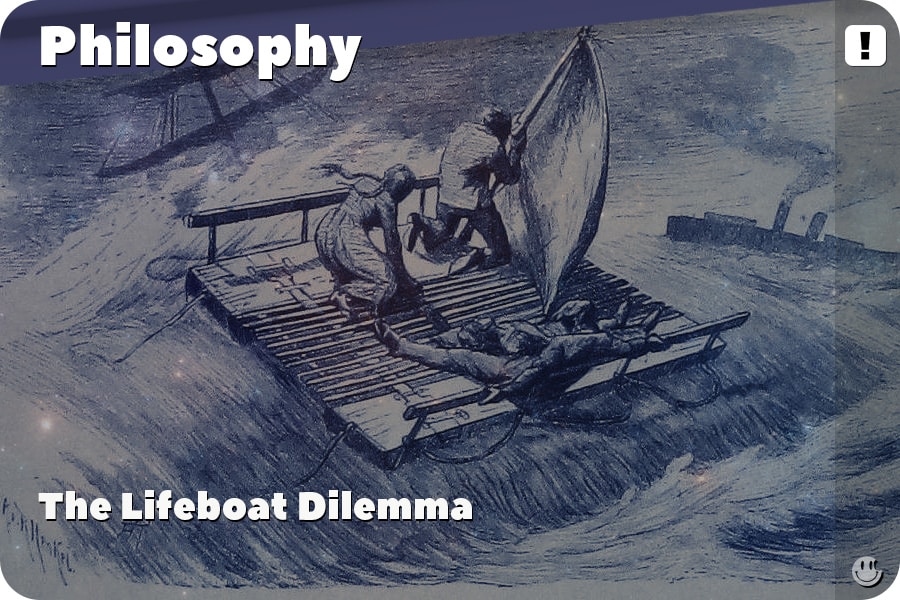
    A ship sinks. Survivors scramble for lifeboats. One small boat is already overloaded and beginning to sink. Unless someone gets out—or is thrown out—everyone aboard will drown.

    What do you do?

    This is the Lifeboat Dilemma, a classic ethical scenario used to explore morality under pressure. Unlike abstract philosophy puzzles, this one feels real. It’s visceral, urgent, and deeply uncomfortable. The lifeboat forces us to confront what we truly value—life, fairness, survival, sacrifice—and how far we will go to protect them.

    What Is the Lifeboat Dilemma?

    At its core, the Lifeboat Dilemma presents a simple but harrowing choice: the number of people on the lifeboat exceeds its capacity. If nothing is done, everyone dies. But the rest can survive if some people are removed—by force or persuasion.

    Who should be sacrificed? Should anyone be sacrificed at all?

    Factors often introduced include:

    • Age

    • Health

    • Skills or usefulness

    • Random selection (e.g., drawing straws)

    • Moral obligations (e.g., should parents volunteer first?)

    This thought experiment doesn’t offer easy answers. Instead, it asks us to examine how we make impossible choices—and whether we can live with the consequences.

    Historical and Philosophical Roots

    The modern lifeboat dilemma echoes older philosophical ideas. It shares DNA with:

    • The Trolley Problem: choosing whether to sacrifice one person to save five.

    • Utilitarian ethics: making decisions that maximize the number of lives saved.

    • Deontological ethics: refusing to sacrifice anyone, even to save others.

    But perhaps the closest real-world parallel is the work of Garrett Hardin, an ecologist who introduced the concept of “Lifeboat Ethics” in a 1974 essay of the same name.

    Hardin argued that the Earth’s resources are finite—like a lifeboat. Wealthy nations, he said, are like full lifeboats surrounded by swimmers. Should they help, knowing that taking on more people could sink everyone? His argument was controversial and often criticized as a justification for withholding aid.

    But it raised a profound point: ethics change when resources are limited.

    Who Gets to Stay?

    In a real or imagined lifeboat, the criteria used to decide who survives matter. Let’s explore some common frameworks:

    Utilitarian Approach

    This perspective says: save the most people, even if that means sacrificing a few. You might prioritize those who can row, navigate, or care for others. You might remove those least likely to survive or contribute.

    Utilitarianism is focused on outcomes—the greatest good for the greatest number.

    But it raises difficult questions:

    • What if you’re sacrificing the elderly to save the young?

    • What if the strongest survive at the expense of the vulnerable?

    Deontological Ethics

    This approach says: some actions are always wrong, no matter the result. You must not kill or harm an innocent person, even to save many others. For deontologists, means matter more than ends.

    In the lifeboat, this might mean:

    • Refusing to throw anyone overboard

    • Accepting collective death over intentional sacrifice

    • Upholding moral rules even in chaos

    This view honors human dignity—but may lead to worse outcomes overall.

    Virtue Ethics

    Virtue ethics asks: What would a good person do? It’s about character, not calculation. In the lifeboat, a virtuous person might:

    • Sacrifice themselves for others

    • Show courage, compassion, and wisdom

    • Try to find a creative solution before resorting to harm

    This perspective values the development of moral character over rigid formulas.

    Randomness and Fairness

    Sometimes, the fairest option seems to be drawing straws or flipping a coin. This introduces luck as a moral equalizer. But randomness can also feel like surrender—an abdication of responsibility rather than a moral choice.

    Real-World Parallels

    While most of us won’t face literal lifeboat decisions, the ethical issues they raise are everywhere:

    • Triage in hospitals: When resources like ventilators or ICU beds are limited, doctors must decide who gets care and who doesn’t. These decisions were painfully real during the COVID-19 pandemic.

    • Refugee policies: Countries often struggle to admit enough people without overwhelming systems. This is a lifeboat dilemma on a global scale.

    • Climate change: Rising seas, food scarcity, and displacement will force hard decisions about who gets aid—and how much.

    • Emergency evacuations: In war zones, natural disasters, or fires, rescuers may have to choose who to save first.

    In all of these, we see the core question: how do we balance compassion with survival?

    Stories from History

    The lifeboat dilemma isn’t just a thought experiment—it has happened.

    The Case of the Mignonette (1884)

    A real British court case involved four shipwreck survivors adrift at sea. After weeks without food, two of the men killed and ate the cabin boy to survive. They were later rescued, arrested, and convicted of murder—even though their actions arguably saved lives.

    The court ruled that necessity is not a defense for murder.

    This case remains a key precedent in legal and ethical debates.

    Titanic (1912)

    The Titanic disaster provides another lens. Some lifeboats were launched half-full, while others were overcrowded. Class, gender, and status affected survival rates—raising questions about social privilege in life-or-death moments.

    Moral Distress and Psychological Weight

    What often goes unspoken in lifeboat discussions is the emotional aftermath.

    Even if you make a choice that’s logically or ethically sound, can you live with it? Survivors of real-life moral crises often experience:

    • Survivor’s guilt

    • Moral injury (the psychological damage of violating your own values)

    • Post-traumatic stress

    These outcomes remind us that ethics isn’t just about logic—it’s about people. Our choices have psychological consequences that persist long after the emergency ends.

    Classroom and Policy Debates

    The Lifeboat Dilemma is often used in classrooms and ethics training to explore:

    • Refugee resettlement

    • Disaster response planning

    • Artificial intelligence decisions (e.g., in autonomous vehicles)

    • Medical ethics boards

    It’s also a popular framing device in literature and film. Stories like The Life of Pi, Lord of the Flies, and Titanic all touch on lifeboat ethics—some literally, some metaphorically.

    Philosophical Takeaways

    • Scarcity changes morality. What feels wrong in peacetime may feel necessary in crisis.

    • Rules vs. results. Should ethics be about what we do—or what happens as a result?

    • No perfect answer. Most lifeboat scenarios offer only bad and worse options—not clear moral victories.

    That’s what makes the dilemma so enduring. It doesn’t solve problems—it exposes how we wrestle with them.

    Glossary of Terms

    • Utilitarianism: Ethical theory focused on maximizing well-being or minimizing harm.

    • Deontology: Ethics based on duties, rules, and rights rather than outcomes.

    • Virtue Ethics: A moral philosophy centered on character and moral virtues.

    • Moral Injury: Emotional harm resulting from actions that violate one’s ethical beliefs.

    • Triage: The process of prioritizing care when resources are limited.

    Discussion Questions

    1. Is it ever ethical to sacrifice one person to save others?

    2. How do we decide who gets priority in emergencies?

    3. Should morality change in survival situations—or stay the same?

    References and Further Reading

    • Hardin, Garrett. “Lifeboat Ethics: The Case Against Helping the Poor,” Psychology Today, 1974

    • BBC Ethics Guide – Triage

    • Stanford Encyclopedia of Philosophy – Disaster Ethics

    • Rachels, James. The Elements of Moral Philosophy

    • “The Queen v. Dudley and Stephens” (1884), legal precedent on necessity and murder


  • The Experience Machine

    The Experience Machine

    The Experience Machine: Exploring the Depths of Synthetic Happiness

    Would you plug into a machine that could give you everything you’ve ever wanted—every joy, every success, every pleasure—without ever leaving a chair?

    That’s the question posed by philosopher Robert Nozick in 1974 when he introduced the Experience Machine. At first glance, the offer seems irresistible: a lifetime of perfect happiness customized just for you. But once you understand the terms, the decision becomes far more complicated.

    This thought experiment isn’t just about fantasy or technology. It’s about what we value in life and whether happiness alone makes a life worth living.

    The Scenario

    Imagine a neuroscientist develops a machine that can simulate any experience you desire. Once plugged in, you’ll believe everything is real. You’ll climb Everest, win a Nobel Prize, fall in love, become a rock star—whatever your ideal life includes.

    Meanwhile, your real body lies in a tank, unconscious but safely fed and maintained. You won’t remember that you ever chose to plug in. The machine provides perfect experiential satisfaction. You’ll never know the difference.

    So, would you do it?

    Nozick’s Challenge

    In Anarchy, State, and Utopia (1974), Nozick uses the Experience Machine to argue against hedonism—the belief that pleasure or happiness is the highest good.

    If hedonism were true, plugging into the machine should be easy. After all, it guarantees a lifetime of bliss. But Nozick believed that most people wouldn’t choose the machine—and that our hesitation reveals something deeper about human nature.

    He writes:

    “We want to do certain things, and not just have the experience of doing them… we want to be a certain way, to be a certain sort of person.”

    The Experience Machine reveals that pleasure alone isn’t enough. People also crave authenticity, meaning, connection, and reality—even if those come with struggle, pain, or disappointment.

    Three Core Reasons to Reject the Machine

    Nozick identifies three main reasons why many people would choose not to plug in:

    1. We Want to Do, Not Just Experience

    It matters to us that we’ve actually accomplished things, not just felt as if we did. A simulated triumph feels hollow if we know (or suspect) it isn’t real.

    In real life, earning a degree, building a company, or creating art requires effort and sacrifice. That struggle is part of the value. The machine skips the process and hands you the reward, but many people find that unsatisfying.

    2. We Want to Be a Certain Kind of Person

    Identity isn’t just about what we feel—it’s about who we are. Plugging into the machine makes us passive receivers, not active participants.

    You might feel brave in a virtual war zone, or loving in a simulated relationship, but none of it reflects your real character. In the tank, you’re not courageous, kind, or wise. You’re just experiencing those things.

    3. We Want Contact with Reality

    Perhaps most importantly, Nozick argues, we want to live in touch with reality—even when it’s imperfect. There’s something intrinsically valuable about knowing the world is accurate, and our experiences are genuine.

    The machine severs that connection. It offers a beautiful lie—and many of us would rather live in an imperfect truth.

    The Hedonist’s Response

    Defenders of hedonism and utilitarianism may respond with a simple challenge: Why does it matter if it’s not real, if it makes you happy?

    If you don’t know you’re in the machine, and if the feelings are real to you, then what’s the problem? Isn’t happiness still happiness?

    This raises the broader question: Is happiness a sufficient condition for the good life—or is it just one part of the picture?

    Some philosophers, such as Jeremy Bentham, believed all that matters is pleasure and the absence of pain. Others, like Aristotle, argued for eudaimonia—a flourishing life that includes virtue, purpose, and fulfilling one’s potential.

    Contemporary Parallels

    The Experience Machine may sound like science fiction, but its themes are increasingly relevant in the real world.

    Virtual Reality

    With the rise of VR, immersive gaming, and digital environments like the metaverse, we’re already starting to blur the line between real and simulated experiences. As these technologies become more realistic, the ethical and psychological questions intensify.

    Would you spend most of your time in a virtual paradise if it felt just as good as real life?

    Social Media

    Social platforms allow users to curate their identities and seek constant validation—creating “highlight reels” that may bear little resemblance to reality. The pleasure may be real, but the authenticity is questionable.

    Are we already half-plugged into experience machines of our own making?

    Pharmaceutical Enhancement

    Drugs that enhance mood, productivity, or perception can offer artificial boosts to well-being. But do they bring genuine happiness—or just a chemical facsimile?

    Variations and Add-Ons

    Some philosophers have introduced twists to the original scenario:

    • You can unplug at any time. Does this change your answer? What if you’re allowed to re-enter after a trial period?

    • The machine creates real impact. Suppose your simulated actions have effects in the real world. Would this make the experience more meaningful?

    • Everyone is in the machine. What if society collectively chooses to live in artificial bliss? Is that utopia or dystopia?

    These variations highlight the tension between personal well-being and collective truth.

    Philosophical Questions Raised

    • What do we value more—authenticity or happiness?

    • Is pleasure enough to justify a life, or do we need meaning and achievement too?

    • Can an experience be good if it isn’t real?

    The Experience Machine remains a cornerstone in debates about hedonism, well-being, virtual reality, and personal identity.

    It’s a mental test of how far we’re willing to go for joy—and what we’re willing to give up for meaning.

    Related Thought Experiments

    If you liked the Experience Machine, you may also find these relevant:

    • The Matrix (popularized in the 1999 film): Would you take the red pill and face the harsh truth—or stay in blissful ignorance?

    • The Brain in a Vat: A modern twist on Descartes’ skepticism. How do we know anything is real?

    • The Utility Monster (Nozick): A being whose happiness is so intense that it outweighs everyone else’s suffering.

    Each challenges our intuitions about value, reality, and identity.

    Glossary of Terms

    • Hedonism: The ethical theory that pleasure is the highest good.

    • Eudaimonia: Aristotle’s concept of human flourishing through virtue and purpose.

    • Synthetic Happiness: Pleasure derived from artificial or manipulated experiences.

    • Authenticity: Living in alignment with truth and reality.

    • Simulation Hypothesis: The idea that our perceived reality may itself be a simulation.

    Discussion Questions

    1. Would you plug into the Experience Machine? Why or why not?

    2. Is happiness still meaningful if it comes from a false experience?

    3. What makes a life “real”—our feelings, actions, or connection to truth?

    References and Further Reading

  • The Isolated Tribe

    The Isolated Tribe

    The Isolated Tribe: Ethics at the Edge of Civilization

    Deep in the Amazon, on a remote island, or tucked within the forests of New Guinea, there are tribes that have lived untouched by modern civilization for generations—sometimes centuries. Their languages, customs, and ways of life remain undisturbed. They don’t use electricity, speak global languages, or have access to modern medicine.

    You’re part of a research team or humanitarian group. You’ve spotted signs of a tribe never contacted before. They may be vulnerable to disease. Their way of life could be permanently altered by your presence.

    Should you make contact?

    This is the dilemma of The Isolated Tribe, a real-world ethical question with deep implications for anthropology, public health, sovereignty, and moral responsibility. It forces us to ask: Is helping always helpful? Does knowledge justify interference? And who decides what “progress” means?

    The Moral Tension

    On one hand, these tribes are living independently, peacefully, and by choice. On the other, they may lack:

    • Lifesaving medicine

    • Knowledge of global threats

    • Defense against exploitation

    Do we respect their autonomy—or act to protect them from harm?

    This is not a hypothetical issue. Governments, scientists, missionaries, and journalists have all faced the question—and sometimes made the wrong choice.

    Historical Context

    Tragic First Contacts

    History is littered with examples where “contact” led to catastrophe:

    • The Sentinelese people, who inhabit North Sentinel Island in the Indian Ocean, have fiercely resisted contact. Those who attempted to reach them often faced death. In 2018, missionary John Allen Chau was killed trying to preach to them—igniting global debate about the ethics of contact.

    • The Yanomami of Brazil and Venezuela suffered disease outbreaks after outsiders brought viruses they had no immunity against.

    • North American tribes lost 80–90% of their populations post-European contact, primarily due to diseases like smallpox.

    Well-meaning explorers and colonizers often became vectors of destruction.

    Ethical Frameworks

    1. Utilitarianism: Do the Most Good

    A utilitarian might say:

    • If contact can prevent suffering, it’s justified.

    • Providing vaccines, medicine, or knowledge could save lives.

    • Ethical intervention could result in greater long-term well-being.

    But it’s risky. The consequences are hard to predict. What seems helpful may unravel traditions, introduce dependency, or trigger violence.

    2. Deontology: Respect Rights and Duties

    A deontologist would likely emphasize:

    • Autonomy is a moral right.

    • Cultures have a right to self-determination.

    • If a tribe chooses isolation, we are morally obligated to respect that choice.

    In this view, even helpful intentions don’t excuse violating someone’s sovereignty.

    3. Virtue Ethics: What Would a Wise Person Do?

    Virtue ethics looks at motives, humility, and wisdom. A virtuous person might:

    • Act cautiously and with deep respect

    • Consider long-term consequences

    • Choose patience over impulse

    Would a compassionate, thoughtful person impose their culture—or find subtle ways to support without dominating?

    Real-World Examples

    The Sentinelese

    India enforces a strict no-contact policy with the Sentinelese. Even photography is restricted. The rationale:

    • They’ve made it clear they want no contact.

    • They’re extremely vulnerable to outside disease.

    • Any attempt at outreach is likely to end in violence.

    This approach treats isolation as consent, not ignorance.

    Brazil’s FUNAI

    Brazil’s National Indian Foundation (FUNAI) has a department dedicated to “uncontacted peoples.” Their policy: minimal interference, unless there’s an imminent threat.

    In 2019, FUNAI reversed some of these protections under political pressure—sparking backlash from anthropologists and Indigenous advocates.

    The 2018 Missionary Incident

    John Allen Chau’s fatal attempt to contact the Sentinelese sparked global criticism:

    • Critics argued he violated Indian law and endangered the tribe.

    • Supporters saw him as a martyr for faith.

    Most experts agreed: his contact attempt was unethical, poorly informed, and potentially devastating—even if he meant well.

    Layers of Ethical Complexity

    Health and Immunity

    Uncontacted tribes often have no immunity to common viruses. A single cold or flu could be fatal. COVID-19 increased awareness of just how fragile these communities are.

    Ethically:

    • Is it right to bring medicine—or will the visit do more harm than good?

    • Should we only intervene in life-or-death scenarios?

    Cultural Preservation

    Contact can erode languages, rituals, and belief systems. Children may stop learning ancestral knowledge. Dependency on outsiders can develop.

    Yet some argue that withholding tools like medicine or education is also a form of harm—a kind of noble-savage romanticism that keeps people in suffering to preserve “purity.”

    Informed Consent

    The biggest problem? You can’t ask permission.

    By definition, uncontacted tribes can’t consent to the consequences of contact. That makes any action fraught with paternalism—treating others as incapable of choosing for themselves.

    Modern Approaches

    Experts increasingly agree on five key principles when it comes to isolated peoples:

    1. Presume autonomy. Isolation is a valid choice, not a condition needing rescue.

    2. Avoid first contact unless absolutely necessary.

    3. Use surveillance (e.g., satellite imagery) for protection, not curiosity.

    4. Respond only in emergencies, like illegal logging, violence, or natural disasters.

    5. Support protective policies that keep outsiders at bay—including your own government.

    The Allure of the Unknown

    Let’s be honest: part of the drive to contact uncontacted tribes is curiosity. We want to know:

    • What language do they speak?

    • How do they live?

    • What wisdom do they hold?

    But ethical anthropology warns that knowledge isn’t always justification. Curiosity alone does not excuse risk.

    Glossary of Terms

    • Uncontacted Tribe – A group of Indigenous people living without sustained contact with the global community.

    • Cultural Relativism – The idea that all cultures are valid and should be understood on their own terms.

    • Paternalism – Limiting someone’s autonomy for their own good, often without consent.

    • Informed Consent – Voluntary agreement to a course of action, made with full understanding of the consequences.

    • Anthropocentrism – Viewing human concerns as the most important, often at the expense of other cultures or species.

    Discussion Questions

    1. Should isolated tribes be left alone, even if it means denying them medicine or protection?

    2. Is there ever a moral obligation to contact a tribe—such as in the case of imminent threat?

    3. Can non-contact approaches (like satellite protection) respect autonomy while still offering safety?

    References and Further Reading

  • The Honest Thief: Can Stealing Ever Be Moral?

    The Honest Thief: Can Stealing Ever Be Moral?

    The Honest Thief: Can Stealing Ever Be Moral?

    You walk past a pharmacy. Inside, on the shelf, sits a medication that could save your child’s life. You can’t afford it. Insurance denied the claim. The government won’t help. The pharmacist, while sympathetic, can’t give it away.

    So you wait until no one’s looking… and take it.

    Are you a criminal—or a parent doing what anyone would?

    This is The Honest Thief, a classic ethical dilemma in everything from courtrooms to literature. It forces us to confront the uneasy relationship between law and morality and asks: Is it ever right to do the wrong thing?

    A Familiar Story

    The “honest thief” shows up in:

    • Religious texts – including the thief crucified beside Jesus in Christian scripture, who repents and is forgiven.

    • Literature – like Jean Valjean in Victor Hugo’s Les Misérables, who steals bread to feed his family and spends a lifetime making amends.

    • Real-life – think of people who shoplift food during economic crises or steal fuel to get to work.

    Each version tests our sense of compassion, justice, and principle.

    Why This Dilemma Matters

    Unlike cold ethical puzzles, this one comes wrapped in emotion. It’s about people we can empathize with—those caught between moral duty and legal constraint.

    • Should they be punished for breaking the law?

    • Or praised for doing what’s right in context?

    Ethical Frameworks

    1. Utilitarianism: The Ends Matter

    A utilitarian looks at outcomes. If stealing:

    • Saves a life

    • Prevents suffering

    • Results in greater good than harm

    …then it’s arguably justified.

    Stealing a $50 inhaler to prevent a child’s asthma attack? If the harm to the store is minor and the benefit to the child is immense, the act may be morally acceptable—even praiseworthy.

    2. Deontology: Rules Must Be Followed

    Deontologists argue that right and wrong depend on the act itself, not the outcome. Stealing is wrong, full stop.

    Even if the motive is noble, violating a moral law—like respect for property—corrupts one’s integrity. One version of this view comes from Immanuel Kant, who stressed acting from duty, not outcome.

    Kant might ask:

    • What if everyone stole when they needed something?

    • Would society collapse under moral exceptions?

    In this view, intention is not enough to excuse the act.

    3. Virtue Ethics: It’s About Character

    Virtue ethicists consider the kind of person you’re trying to be.

    • Are you greedy? No.

    • Are you selfish? No.

    • Are you desperate but acting with humility, remorse, and a plan to repay? Maybe.

    The honest thief might be seen as morally complex: flawed, but courageous. A person of compassion and resolve, even in the face of laws.

    Law vs. Justice

    The law often draws hard lines:

    • Theft is illegal, regardless of reason.

    • Judges may have limited discretion.

    • Public sympathy doesn’t always matter in the courtroom.

    But justice? That’s fuzzier.

    Jury Nullification

    Sometimes, juries acquit defendants despite clear guilt, because they believe the law itself—or its application—is unjust. In real-world “honest thief” cases, this happens more often than you might think.

    Case example:

    • In 2011, a man in the UK stole food because his benefits were delayed. The court issued no punishment, citing the situation’s context.

    Civil Disobedience

    When laws are unjust, some argue they should be broken intentionally. This includes:

    • Feeding the homeless where banned

    • Stealing life-saving medicine when it’s unaffordable

    • Breaking into buildings to shelter the unhoused during storms

    The honest thief often operates in this gray zone of protest and survival.

    When Is It Not Justifiable?

    Not every thief is honest. Some situations don’t meet the moral threshold:

    • Stealing luxury goods

    • Causing harm to others

    • Acting from entitlement, not necessity

    Context is key. Stealing a loaf of bread when starving? Ethically debatable. Stealing a TV during a riot? Less so.

    Psychological Factors

    Moral Licensing

    People sometimes justify wrongdoing by claiming they’re “doing it for a good cause.” But psychology warns this can become a slippery slope—where one good deed (or motive) is used to rationalize harmful behavior.

    Empathy and Bias

    We judge “honest thieves” differently based on identity:

    • A struggling mother? Sympathetic.

    • A homeless person with mental illness? Often judged harshly.

    • A suit-wearing executive embezzling “to pay off medical debt”? Harder to defend.

    Bias plays a role in how we assign moral value—even in identical acts.

    Real-World Applications

    1. Healthcare Theft

    People who can’t afford insulin or cancer medication sometimes turn to theft—or illegal online sources. These acts challenge policymakers to confront:

    • Is theft the problem—or the system?

    • Should we punish acts of desperation—or prevent the desperation?

    2. Food Insecurity

    In food deserts and poverty zones, shoplifting is often about survival. Some stores quietly let the theft go if it is small, while others press charges to deter future incidents.

    3. Emergency Scenarios

    Think natural disasters, where looting blurs into survival. During Hurricane Katrina, people took baby formula and diapers from wrecked stores. Were they stealing—or rescuing resources?

    The Burden of Remorse

    The honest thief isn’t just defined by action—it’s also about accountability. Do they:

    • Make restitution?

    • Apologize?

    • Feel conflicted?

    Moral weight increases when someone owns their actions and seeks to repair the harm. Some donate, repay, or even turn themselves in later.

    As a society, we might ask: Should we make space for redemption—not just punishment?

    Glossary of Terms

    • Civil Disobedience – The intentional violation of laws for moral or political reasons.

    • Utilitarianism – An ethics theory focused on outcomes and the greater good.

    • Deontology – Ethics based on adherence to moral rules, regardless of outcomes.

    • Virtue Ethics – A framework that emphasizes moral character over rule-following or consequences.

    • Moral Licensing – A psychological effect where past good behavior is used to justify future bad actions.

    Discussion Questions

    1. Is it ever morally acceptable to steal? If so, under what circumstances?

    2. Should legal systems show flexibility in cases of “honest theft”?

    3. Does motive matter more than action—or should we uphold the rules equally for everyone?

    References and Further Reading

  • Propaganda: Crystallizing Public Opinion

    Propaganda: Crystallizing Public Opinion

    Crystallizing Public Opinion: Shaping Modern Public Relations

    In 1923, Edward Bernays published Crystallizing Public Opinion, a book that would forever alter the way organizations, governments, and individuals interact with the public. It wasn’t just a guide to publicity—it was a philosophical and psychological blueprint for engineering consent in a democratic society.

    Bernays, often called the “father of public relations,” believed that shaping public opinion wasn’t manipulation—it was a necessary part of modern life. But the tools he developed to do that—media campaigns, expert endorsements, and emotional framing—still spark debate today.

    Who Was Edward Bernays?

    Born in 1891, Edward Bernays was the nephew of Sigmund Freud, and he brought his uncle’s psychoanalytic theories into the world of business and politics. Trained in journalism and propaganda during World War I, Bernays believed that mass communication could be used to guide public behavior in productive ways—but he also acknowledged that this power could be used unethically.

    Bernays combined Freud’s ideas about subconscious desire with modern advertising techniques to create a new profession: public relations counseling. He saw PR not as mere publicity, but as strategic, research-driven persuasion.

    “We are governed, our minds molded, our tastes formed, our ideas suggested, largely by men we have never heard of.”

    — Edward Bernays, Propaganda (1928)

    What Is “Crystallizing Public Opinion”?

    The phrase refers to the process of shaping and solidifying diffuse public attitudes into clear, directed viewpoints. According to Bernays, people often lack strong opinions until someone presents them with a compelling frame, message, or emotional hook.

    His goal was to help clients take advantage of this by:

    • Identifying public sentiments

    • Crafting messages that resonated emotionally

    • Using media and social influence to amplify them

    Bernays argued that doing so was not only possible, but essential in a mass society where the public is overwhelmed with information.

    Key Concepts in the Book

    1. The Public Relations Counselor

    Bernays elevated the PR professional from press agent to strategic advisor. A PR counselor helps organizations understand public attitudes and shape policies accordingly.

    “The counsel on public relations not only knows what news value is, but knowing it, he is in a position to make news happen.”

    He likened the PR counselor to a lawyer—someone who represents their client in the court of public opinion.

    2. The Engineering of Consent

    This is perhaps Bernays’ most famous and controversial idea. He argued that public consent could—and should—be engineered through the scientific application of psychology and communication.

    This wasn’t deception, he insisted—it was guidance.

    Of course, critics see it differently: Where’s the line between persuasion and manipulation?

    3. Emotion Over Logic

    Bernays believed the public made decisions based more on emotions, symbols, and associations than on rational arguments. He drew on Freud’s theories to suggest that effective messaging must tap into subconscious desires.

    For example, instead of telling people a product was affordable or efficient, he’d ask: What feeling does this product inspire? What aspiration does it fulfill?

    4. The Use of Experts and Third Parties

    People trust authorities. Bernays frequently employed credible third parties—doctors, professors, civic leaders—to promote his clients’ messages.

    He understood that trusted figures were more likely to influence people than direct advertising.

    5. Creating News

    Rather than simply pitching stories to journalists, Bernays believed in making events that generate news. This could mean stunts, symbolic acts, or partnerships timed to resonate with current events.

    This practice became central to modern PR—and it’s still how most press events work today.

    Case Study: The “Torches of Freedom”

    One of Bernays’ most famous (and ethically murky) campaigns came in 1929 when he worked for the American Tobacco Company. At the time, it was taboo for women to smoke in public.

    To break the stigma—and open a new market—Bernays organized a stunt: he hired women to march in the Easter Sunday Parade in New York City, each lighting a cigarette at a coordinated moment. He dubbed the cigarettes “torches of freedom” and made sure the press was there to capture the moment.

    The campaign worked. Smoking became a symbol of independence, and sales surged.

    The stunt wasn’t about tobacco—it was about framing. And it remains one of the most cited examples of emotional rebranding in PR history.

    Here are six other specific campaigns and strategies he orchestrated, each revealing how he applied psychology, symbolism, and media savvy to shape public opinion:

    1. Bacon and Eggs as the “All-American Breakfast” (1920s)

    Bernays was hired by the Beech-Nut Packing Company, which sold bacon. To boost sales, he asked a physician whether a heavier breakfast might be healthier than the lighter fare many Americans ate. The doctor agreed—and Bernays then surveyed 5,000 other doctors, most of whom echoed this view.

    He publicized the survey results, framing bacon and eggs as the “hearty, doctor-recommended breakfast.” Newspapers ran the story, and public habits began to shift. The result: a permanent association between bacon, eggs, and American identity—entirely manufactured through PR.

    2. Calvin Coolidge’s Image Makeover (1927)

    Coolidge, seen as stiff and unsociable, wasn’t winning hearts. Bernays organized a White House breakfast with celebrities, including Al Jolson and other Broadway stars, to project a warmer, more human side of the president.

    Media coverage highlighted the event’s charm and celebrity flair. It was one of the first deliberate attempts at political rebranding through entertainment, something we now take for granted in campaigns.

    3. Ivory Soap Sculpting Contests for Procter & Gamble (1920s)

    To promote Ivory Soap, Bernays created soap sculpting competitions for schoolchildren. He framed it not just as marketing, but as educational enrichment and creativity.

    Teachers, schools, and newspapers were brought on board, and the program ran for decades. This turned a bar of soap into a symbol of childhood development and civic participation, while embedding the brand in public consciousness.

    4. The United Fruit Company and the “Banana Republic” Narrative (1950s)

    Perhaps his most controversial work came on behalf of United Fruit Company (now Chiquita). When the Guatemalan government under President Jacobo Árbenz began land reforms threatening United Fruit’s holdings, Bernays helped frame the leader as a communist threat.

    He fed carefully crafted stories to American journalists, lobbied Washington, and even influenced the CIA’s decision to support a coup in 1954. This campaign helped spark the Cold War notion of “banana republics” and is often cited as an early example of PR shaping U.S. foreign policy.

    5. Promoting Fluoride in Drinking Water (1940s–1950s)

    Bernays was enlisted to promote water fluoridation, a practice initially met with public skepticism. He framed fluoridation as a public health measure backed by science, enlisting endorsements from dentists and medical professionals.

    His efforts helped normalize fluoridation in American cities, emphasizing third-party credibility and medical authority—techniques still used in health communication today.

    6. Making Green the Fashionable Color for Lucky Strike Cigarettes (1934)

    The green and gold packaging of Lucky Strike cigarettes clashed with women’s fashion trends, leading to lower sales among female consumers. Instead of changing the packaging, Bernays changed public taste.

    He launched a campaign to make “green” the fashionable color of the season—convincing designers, department stores, and even socialites to embrace green in clothing and decor. The result: sales surged, and Bernays once again shifted culture to suit product needs.

    Bernays’ Influence on Business and Politics

    Bernays helped shape dozens of industries and campaigns:

    • Promoted bacon and eggs as the “All-American Breakfast”

    • Helped Calvin Coolidge soften his image

    • Advised Procter & Gamble on soap competitions for children

    • Supported United Fruit Company (later Chiquita) in shaping U.S. policy toward Latin America

    Some of his techniques were subtle; others, controversial. But all were rooted in his belief that public opinion could be guided through strategic storytelling.

    Criticism and Controversy

    Not everyone was impressed. Bernays’ work raised critical questions:

    • Is it ethical to shape public opinion without full transparency?

    • Can a democracy function if opinion is “engineered”?

    • Where is the line between persuasion and propaganda?

    His own work acknowledges the tension. In his later book Propaganda, Bernays defends mass persuasion but warns it can be dangerous if used by those with selfish or authoritarian aims.

    And history shows he was right to worry.

    Legacy: Why It Still Matters

    In the 21st century, Bernays’ playbook is everywhere:

    • Influencer marketing

    • Political campaigning

    • Brand storytelling

    • Crisis communication

    • Social media virality

    Modern public relations, advertising, and even journalism often rely on the principles Bernays outlined in 1923. His influence is baked into how we process news, advertising, and cultural signals.

    And in a world of information overload, engineered simplicity often wins.

    Related Thought Experiments and Connections

    • Plato’s Allegory of the Cave: Who controls the shadows on the wall?

    • The Experience Machine: Would you choose a comforting illusion over truth?

    • The Veil of Ignorance: How would public opinion change if people didn’t know their position in society?

    All of these echo Bernays’ central question: How do we shape the reality people see—and how do they know what’s real?

    Glossary of Terms

    • Public Relations (PR): Managing communication between an organization and its public.

    • Engineering of Consent: Bernays’ term for shaping public opinion through media and psychology.

    • Third-Party Validation: Using respected figures to support a message indirectly.

    • Framing: Structuring how an issue or product is perceived by highlighting certain aspects.

    • Mass Persuasion: Influencing large groups through targeted messages and emotional cues.

    Discussion Questions

    1. Is “engineering consent” compatible with democratic values?

    2. What responsibilities do PR professionals have in shaping truth vs. perception?

    3. How much of your own opinion is shaped by media—and how would you know?

    References and Further Reading


  • The Cabin in the Blizzard

    The Cabin in the Blizzard

    The Cabin in the Blizzard: When Survival Justifies Breaking the Rules

    You’re hiking in the wilderness when a sudden blizzard strikes. Visibility drops to zero. You’re cold, soaked, and hours from civilization. Then, you spot a remote cabin through the snow—no one’s home. The door is locked.

    Do you break in to survive?

    This is The Cabin in the Blizzard, a classic survival-based ethical dilemma. It explores whether desperation justifies breaking the law or violating someone else’s property rights. While it may seem like a no-brainer to some—of course survival comes first!—the issue becomes more complex when we ask: Where do we draw the line between necessity and moral responsibility?

    The Ethical Dilemma

    At its core, this thought experiment pits two principles against each other:

    • Respect for property and the rule of law

    • The right to preserve life and avoid serious harm

    Can one ethically (or legally) override the first to honor the second?

    Scenario Variations

    The situation can shift slightly to deepen the moral tension:

    • What if you leave a note and repay the owner?

    • What if you cause damage while entering or using supplies?

    • What if the cabin owner posted a sign: “No Trespassing—Prosecutors Will Be Shot”?

    Each version tests different aspects of intent, consent, and consequence.

    Philosophical Perspectives

    1. Utilitarianism: The Greater Good

    A utilitarian would likely argue that saving a life outweighs property rights. Breaking into the cabin prevents harm and creates a better overall outcome.

    As long as:

    • No unnecessary damage is done

    • The intrusion is temporary

    • Compensation is offered if possible

    …then the moral math checks out.

    2. Deontological Ethics: Rules Are Rules

    A strict deontologist might say: It’s wrong to violate moral duties, such as:

    • Respecting others’ property

    • Following the law

    • Not trespassing or stealing

    Even in a blizzard, breaking in may be morally impermissible. To them, the ends don’t justify the means.

    However, more moderate deontologists might allow exceptions if one duty (preserving life) outweighs another (not trespassing).

    3. Virtue Ethics: What Would a Good Person Do?

    Virtue ethics emphasizes character over calculation. In this framework, a person driven by compassion, courage, and humility would likely act to save their own life—but also:

    • Leave a note

    • Make restitution

    • Express gratitude

    It’s not just what you do—it’s how and why you do it.

    Legal vs. Moral Responsibility

    In some legal systems, acts committed out of necessity may be defensible. The principle of necessity defense holds that a person can break the law if it was the only way to prevent a greater harm.

    For example:

    • In U.S. law, necessity is sometimes used to defend trespassing, theft, or even traffic violations in emergencies.

    • In Canadian and European jurisprudence, similar defenses exist under extreme conditions.

    But it’s not universal. Some places require imminent threat, no legal alternatives, and proof that the harm avoided outweighs the harm caused.

    So, even if morally justified, legal consequences might still apply.

    The Moral Importance of Intent

    Your intentions matter. If you break into the cabin:

    • To survive? Most people are sympathetic.

    • To loot? That’s theft.

    • To vandalize? That’s malicious.

    In ethics, intent separates a desperate act from an opportunistic one.

    Even damage caused during survival can be forgiven—or at least understood—if your motive was life-preserving.

    The Cabin Owner’s Perspective

    We often focus on the person in danger. But what about the cabin owner?

    • They return to find a broken door, missing supplies, and muddy floors.

    • Were they violated? Or did they save a life unknowingly?

    Some cabin owners leave them intentionally stocked for emergencies. Others may be more protective—especially in isolated areas where vandalism and theft are concerns.

    There’s an unspoken code in many rural communities: “If someone’s in trouble, you help—even if it’s just by leaving your cabin unlocked.”

    But not everyone feels that way.

    Real-World Parallels

    1. Hurricane Evacuations and Shelters

    People often break into locked schools or government buildings during natural disasters. Are they looting, or are they just trying to survive?

    2. Lost Hikers and Rescue Scenarios

    There are true accounts of hikers breaking into remote cabins to avoid freezing. Some were charged with trespassing; others were hailed as survivors.

    One example: In 2012, two snowmobilers stranded in Alaska broke into a cabin to survive a 72-hour storm. They later returned to clean up, restock firewood, and leave a thank-you note. The owner didn’t press charges.

    3. COVID-19 and Emergency Use

    During the pandemic, people accessed closed businesses to obtain masks, gloves, or food. This raised questions about public health vs. property rights.

    Is There a Line?

    Survival scenarios push the boundaries of morality. But they also require limits:

    • Proportionality: Don’t destroy more than you must.

    • Accountability: Take responsibility afterward.

    • Empathy: Recognize others’ rights even in desperate moments.

    The point isn’t just survival—it’s survival with ethical clarity.

    When Does Survival Excuse Breaking the Rules?

    There’s no easy answer, but most moral frameworks agree:

    • Saving a life can justify breaking lesser rules.

    • The least harmful path should be taken.

    • Making amends matters.

    Ethics doesn’t ignore context—it wrestles with it.

    Glossary of Terms

    • Necessity Defense – A legal argument that breaking the law was justified to prevent greater harm.

    • Trespassing – Entering someone’s property without permission.

    • Virtue Ethics – A moral framework focused on character and intention.

    • Deontology – Ethics based on duties and rules, regardless of consequences.

    • Utilitarianism – Ethics based on maximizing well-being and minimizing harm.

    Discussion Questions

    1. Would you break into the cabin? What if it meant damaging property to survive?

    2. Should the cabin owner be entitled to press charges—or feel morally obligated to forgive?

    3. Is survival enough of a reason to override legal or ethical boundaries?

    References and Further Reading


  • The Universe 25 Experiment

    The Universe 25 Experiment


    Universe 25

    The Universe 25 experiment, conducted by American ethologist John B. Calhoun in the late 1950s and early 1970s, remains a significant study in behavioral science. This experiment was designed to test the effects of a perfect environment on mice’s behavior, with a particular focus on population density and social behavior.

    Calhoun created what he termed a “Mouse Utopia,” a specially designed habitat at the National Institute of Mental Health that provided unlimited food, water, nesting material, and no threat of predators. Four breeding pairs of mice were introduced into this environment to observe how the population would grow and behave under ideal living conditions.

    Initially, the mouse population flourished, doubling in size approximately every 55 days. However, as the population grew, it began to experience social breakdowns. By the time the population reached 620, the growth rate slowed significantly, and the societal structure of the mice began to collapse. The breakdown included mice failing to perform their expected societal roles, increased violence, and abnormal sexual behaviors. Calhoun referred to this breakdown as the “behavioral sink.”​

    The societal breakdown led to several peculiar behaviors. For instance, isolated groups of mice, which Calhoun called “the beautiful ones,” entirely withdrew from normal social behaviors and spent their time grooming themselves. Reproductive behaviors declined, maternal care decreased, and the infant mortality rate increased dramatically. Eventually, the population growth ceased, and the existing mice aged without replacement, leading to the extinction of the colony.​

    Calhoun’s findings were interpreted as a dark metaphor for human societies’ potential fate. He proposed that, like the mice, human societies could face similar fates under overpopulation and excessive abundance. The experiment has been cited in discussions about urban decay, social isolation, and the impact of ideal living conditions devoid of usual survival challenges.​

    The Universe 25 experiment highlighted the importance of social roles and activities in maintaining a balanced society. It sparked debates on the ethics of population control and the design of living spaces to mitigate the negative social impacts of overcrowding. The study remains a profound reminder of the complex interplay between environment and social behavior, relevant not only in scientific circles but also in urban planning and social policy discussions.​

    The Universe 25 experiment conducted by John Calhoun has been widely discussed and analyzed from various perspectives, both scientifically and philosophically. Here are some of the key viewpoints and analyses regarding the experiment and its broader implications:

    Scientific Insights

    1. Behavioral Sink: Calhoin’s “behavioral sink” concept is central to the experiment’s findings. This term describes the collapse of normal behaviors as a result of overcrowding. Mice exhibited increased aggression, abandonment of the young, and withdrawal from society, which led to the population’s eventual collapse. This phenomenon raised questions about the impact of high density on mental health and social structures.
    2. Social Withdrawal and the “Beautiful Ones”: Some of the mice, referred to as “the beautiful ones,” completely withdrew from social interactions, focusing solely on self-grooming and showing no interest in sexual activities or fighting, which are natural mouse behaviors. This withdrawal highlighted potential concerns about the effects of societal breakdown on individual psychology and social roles​.

    Philosophical and Societal Reflections

    1. Human Societal Analogies: Calhoun himself drew parallels between his mouse utopia and potential human societies. The experiment has been used as a metaphor for human urban environments, where overcrowding and social isolation could lead to similar breakdowns. Critics argue whether these analogies are valid, considering the significant differences between humans and mice in social complexity and adaptability​.
    2. Criticism of Utopian Pursuits: The experiment critiques the quest for a utopian society, suggesting that a seemingly perfect environment that satisfies all physical needs might still lead to psychological and social turmoil. This viewpoint challenges the notion that fulfilling all material needs leads to a harmonized society​mind-treats.com.

    Ethical Considerations

    1. Ethical Implications: The ethical implications of Calhoun’s work, particularly concerning the treatment of animals in research settings, have been a topic of debate. Additionally, applying his findings to justify population control measures or social interventions raises ethical concerns about the potential to misuse scientific research in social policy.

    Broader Impact on Public Policy and Urban Planning

    1. Influence on Urban and Social Planning: The experiment’s insights have influenced ideas about urban planning and housing. Some suggest that understanding the effects of density on social interaction could inform better designs for housing and public spaces, potentially preventing social issues related to overcrowding.

    These viewpoints contribute to a multifaceted understanding of the Universe 25 experiment, highlighting the complex interplay between environment, behavior, and society. The ongoing interest in Calhoun’s work demonstrates its lasting impact on discussions about environmental design, public policy, and the ethical treatment of animals in scientific research.


  • 25 Ethical Questions

    25 Ethical Questions

    25 Ethics Questions To Ponder

    Here’s a list of 25 modern ethical and philosophical questions along with some potential positive, negative, and neutral connotations or answers:

    1. Is genetic engineering of humans ethical?

      • Positive: Can prevent genetic diseases, improve human capability.

      • Negative: May lead to eugenics, inequality.

      • Neutral: Requires careful regulation and public discourse.

    2. Should autonomous vehicles prioritize passenger or pedestrian safety?

      • Positive: Saves lives through reduced human error.

      • Negative: Difficult ethical decisions programmed by humans.

      • Neutral: Reflects complex societal values and safety concerns.

    3. Is it ethical to colonize Mars?

      • Positive: Ensures human survival, new resources.

      • Negative: Risk of harming potential Martian ecosystems.

      • Neutral: Depends on execution and respect for potential life.

    4. Should animals have the same rights as humans?

      • Positive: Acknowledges sentience and suffering.

      • Negative: Could impact necessary medical research, food resources.

      • Neutral: Rights should be appropriate to the species’ needs.

    5. Is digital privacy a fundamental right?

      • Positive: Protects personal freedoms and autonomy.

      • Negative: Can conflict with security and law enforcement needs.

      • Neutral: Balances between privacy and security are necessary.

    6. Is it morally acceptable to use drones in warfare?

      • Positive: Reduces risk to military personnel.

      • Negative: May increase casual attitudes towards conflict.

      • Neutral: Use should be regulated by strict ethical guidelines.

    7. Should we implement a universal basic income?

      • Positive: Reduces poverty and inequality.

      • Negative: Potentially unsustainable economically.

      • Neutral: Effectiveness depends on the economic context.

    8. Is artificial intelligence a threat or a benefit to society?

      • Positive: Enhances efficiency and capabilities in various sectors.

      • Negative: Potential job displacement, ethical concerns.

      • Neutral: AI development should be carefully managed.

    9. Should euthanasia be legalized?

      • Positive: Allows dignity in death, relieves suffering.

      • Negative: Potential for abuse and moral conflicts.

      • Neutral: Should come with strict safeguards and consent processes.

    10. Is it ethical to clone extinct animals?

      • Positive: Could restore lost species and ecosystems.

      • Negative: Diverts attention from conserving existing species.

      • Neutral: Ethical considerations depend on reasons and methods.

    11. Should voting be mandatory?

      • Positive: Increases democratic participation.

      • Negative: May violate personal freedom of choice.

      • Neutral: Could be one element of broader civic engagement reforms.

    12. Is it ethical to keep animals in zoos?

      • Positive: Helps with conservation and education.

      • Negative: Can cause suffering and unnatural living conditions.

      • Neutral: Depends on the zoo’s quality and ethical standards.

    13. Should we allow surveillance for national security?

      • Positive: Helps prevent terrorism and crime.

      • Negative: Infringes on individual privacy rights.

      • Neutral: Needs strict oversight and legal frameworks.

    14. Is it ethical to consume meat?

      • Positive: Part of natural human diet and tradition.

      • Negative: Ethical concerns about animal welfare and environmental impact.

      • Neutral: Personal choice informed by ethical and environmental considerations.

    15. Should parents be allowed to choose their baby’s traits?

      • Positive: Reduces genetic diseases, enhances life opportunities.

      • Negative: Raises issues of inequality and ‘designer babies’.

      • Neutral: Needs ethical oversight and societal consensus.

    16. Is the death penalty justifiable?

      • Positive: Deters crime, provides justice for victims.

      • Negative: Risk of wrongful execution, inhumane.

      • Neutral: Should be debated and decided democratically.

    17. Should we prioritize environmental policy over economic growth?

      • Positive: Ensures sustainable living conditions for future generations.

      • Negative: Could hinder economic development and job creation.

      • Neutral: Policies should aim to balance environmental and economic factors.

    18. Is it ethical to enhance humans physically and mentally through technology?

      • Positive: Improves quality of life and human capabilities.

      • Negative: Could exacerbate social inequalities.

      • Neutral: Should be regulated to ensure fair access and ethical use.

    19. Should social media companies regulate content on their platforms?

      • Positive: Reduces misinformation and harmful content.

      • Negative: Threatens free speech and expression.

      • Neutral: Requires transparent policies that respect user rights.

    20. Is it ethical to use placebo treatments?

    • Positive: Can be beneficial in clinical research and treatment.

      • Negative: Deceptive and may undermine trust in medical practice.

      • Neutral: Ethically acceptable if patient welfare is improved and no better treatment is available.

    1. Is social media responsible for increasing loneliness?

      • Positive: Provides a platform for connection, especially for those isolated by geography or disability.

      • Negative: Encourages superficial interactions and a focus on quantity of connections over quality.

      • Neutral: The impact varies widely depending on how individuals use and interact with social media.

    2. Should all drugs be legalized?

      • Positive: Reduces the criminal activities associated with drug trafficking.

      • Negative: Could lead to increased health problems and societal issues.

      • Neutral: Regulation and education might mitigate risks and provide health benefits.

    3. Is it ethical for companies to track their employees’ online activities?

      • Positive: Can enhance security and productivity.

      • Negative: Invades privacy and can create a distrustful work environment.

      • Neutral: Acceptable if transparent and limited to work-related activities.

    4. Is censorship ever justified in a free society?

      • Positive: Necessary to protect individuals from harm and misinformation.

      • Negative: Can be used to suppress dissent and control public opinion.

      • Neutral: Justifiable when it protects the vulnerable without stifling essential freedom.

    5. Should we prioritize the exploration of space over solving Earth’s current problems?

      • Positive: Can lead to technological advancements and long-term survival of humanity.

      • Negative: Diverts resources and attention from pressing environmental and social issues.

      • **A neutral stance might consider the benefits of technology and knowledge gained from space exploration that could potentially address Earth’s challenges.

  • The Monster’s Dilemma

    The Monster’s Dilemma

    The Monster’s Dilemma: Should We Create What Might Suffer or Harm?

    Imagine a brilliant scientist on the verge of a breakthrough: they’ve designed a sentient creature—highly intelligent, potentially powerful, and capable of immense good. But there’s a catch.

    The creature might suffer.

    It might suffer a lot.

    It might also hurt others.

    Should the scientist flip the switch and bring it to life?

    This is The Monster’s Dilemma, a thought experiment rooted in Frankenstein, infused with bioethics, and increasingly relevant in debates about artificial intelligence, synthetic biology, and genetic engineering. It challenges us to confront the ethics of creation: just because we can make something—should we?

    The Origins of the Thought Experiment

    While there’s no single philosopher credited with the Monster’s Dilemma as a formal concept, its essence has existed for centuries:

    • In Mary Shelley’s Frankenstein (1818), Victor Frankenstein creates life—only to recoil from what he’s made. The creature, shunned and tormented, becomes violent. Victor must ask himself: Who is responsible for the monster’s pain?

    • In modern AI ethics, researchers ask: Should we create machines that can suffer or cause suffering?

    • In bioethics, we question whether it’s right to engineer life forms that may endure pain or whose existence might carry unintended consequences.

    At the heart of the Monster’s Dilemma is a twofold risk:

    1. Creating a being that suffers.

    2. Creating a being that causes suffering.

    Is Creation Itself a Moral Act?

    The dilemma raises profound ethical questions about responsibility and intention:

    Deontological Ethics

    From a deontological perspective, some acts are inherently wrong—regardless of outcome.

    • Creating life that suffers may violate a duty not to cause unnecessary harm.

    • Even if the creature is never harmful, the act of creating something destined to suffer may be wrong in itself.

    The question becomes: Is it ever ethical to bring pain into existence knowingly?

    Utilitarian Ethics

    A utilitarian might weigh total happiness vs. total suffering. The creation might be justified if the creature can live a meaningful, mostly positive life—or benefit others.

    But the risks are real:

    • The act is unethical if the creature suffers more than it brings joy.

    • If it harms others, its creation might lower total well-being.

    Utilitarianism asks: Can we predict and responsibly manage the outcomes?

    Virtue Ethics

    A virtue ethicist might ask about the creator’s character:

    • Is the scientist acting out of hubris or genuine curiosity?

    • Is there compassion in how the creature will be treated?

    • Does the creator take moral responsibility, or just seek achievement?

    Being a “good person” may mean pausing before playing god.

    Real-World Parallels

    Though Frankenstein’s monster is fictional, the moral issues are real—and growing more relevant.

    1. Artificial Intelligence

    Creating machines that mimic or exceed human intelligence raises major concerns:

    • What if AI develops consciousness or sentience?

    • Would turning off such an AI be murder?

    • What if it turns against us, like HAL 9000 or Skynet?

    Experts like Nick Bostrom warn about unintended consequences from AI systems that optimize goals in harmful ways. (See: Superintelligence, 2014)

    2. Animal Engineering

    Genetic modification of animals for food, research, or aesthetics raises questions:

    • Are we creating creatures with built-in suffering?

    • Does the utility (food, medical progress) outweigh the moral cost?

    Some bioethicists advocate for a “no unnecessary suffering” rule, especially for sentient beings.

    3. Synthetic Life

    Scientists have begun creating synthetic organisms—new life forms built from DNA.

    • Should we create organisms that we cannot fully understand or control?

    • What are our obligations if a synthetic being becomes sentient or gains agency?

    Existence without consent is a troubling theme. After all, no one asks to be born—least of all a lab-grown monster.

    4. AI Companions and Emotional Robots

    Designing robots that mimic love, pain, or attachment can emotionally manipulate users and raise questions about the machines’ emotional lives.

    If a robot feels heartbreak when turned off, have we done something cruel?

    Moral Risk vs. Moral Reward

    Sometimes, the Monster’s Dilemma becomes a question of moral risk tolerance.

    • Do the benefits of creation outweigh the ethical uncertainties?

    • Is it worse to never try—and never know what good might have come?

    But there’s also a slippery slope: where do we stop once we justify one risky creation?

    This concern has echoes in nuclear research, bioweapons, and dual-use technologies. Every tool of great power carries the shadow of potential misuse.

    Lessons from Frankenstein

    Shelley’s Frankenstein remains the definitive allegory of the Monster’s Dilemma. It’s not just about science—it’s about responsibility:

    • Victor’s real failure isn’t making the creature.

    • It’s abandoning it.

    • It’s ignoring the moral obligations that come after creation.

    This warning remains strikingly modern: inventors, developers, and technologists are often eager to push boundaries—but who stays to raise the monster?

    Counterarguments: Isn’t All Life Risky?

    Some argue that:

    • Human life is full of suffering, yet we continue to reproduce.

    • We cannot know how a being’s life will turn out—so long as there’s a chance for joy, why not create it?

    This view values potential and autonomy, suggesting that a being deserves the chance to exist and find meaning, even at risk.

    But critics respond: accepting life’s risks for ourselves is one thing. It’s another to create a life we know could suffer—without consent.

    Glossary of Terms

    • Bioethics – The study of ethical issues in biology and medicine.

    • Sentience – The capacity to feel, perceive, or experience subjectively.

    • Utilitarianism – An ethical theory focused on maximizing happiness and minimizing suffering.

    • Deontology – Ethics based on duty, rules, or inherent right and wrong.

    • Existential Risk – A risk that threatens the entire future of humanity or intelligent life.

    Discussion Questions

    1. Is it ever ethical to create something that might suffer or harm others?

    2. Do creators have moral responsibility for the outcomes of what they make?

    3. Where should we draw the line between curiosity, invention, and caution?

    References and Further Reading


  • The Ring of Gyges

    The Ring of Gyges

    The Ring of Gyges: Exploring Morality and Invisibility

    What would you do if you could never be caught?

    That’s the challenge posed by The Ring of Gyges, a thought experiment introduced by Plato in The Republic (Book II). It’s not just a magic story. It’s a deep dive into the nature of morality, justice, and human character—a tale that’s as relevant today as it was in ancient Greece.

    The scenario is simple but unsettling: Would you still act morally if no one could see your actions? And if not, what does that say about the real source of our ethics?

    The Story

    Plato tells the story through Glaucon, who challenges Socrates by recounting the myth of Gyges, a shepherd in the service of the king of Lydia.

    One day, after an earthquake, Gyges discovers a cave containing a bronze horse with a dead giant inside. On the corpse’s finger is a mysterious ring. Gyges takes it and soon discovers that he becomes invisible when he turns the ring inward.

    With his newfound power, Gyges seduces the queen, murders the king, and seizes the throne.

    No one holds him accountable. No one knows what he’s done. And that’s the point.

    According to Glaucon, anyone—no matter how just—would act the same if they had such power.

    Glaucon’s Challenge

    Glaucon uses the story to argue that people are only just because of social consequences. We don’t want to be punished. We want approval. But take away those consequences—through a ring of invisibility—and our true selfish nature will emerge.

    He says that justice is a social contract, a mutual agreement among people who fear the consequences of wrongdoing. Strip away that fear, and morality collapses.

    Or does it?

    This is the question Socrates—and Plato—aim to explore throughout the rest of The Republic.

    The Real Ethical Dilemma

    The Ring of Gyges isn’t about fantasy. It’s about temptation. Plato’s challenge is timeless:

    • If you could act without consequences…

    • If you could steal, lie, or cheat with impunity…

    • If you could harm without being caught…

    …would you still choose to be good?

    And if the answer is no, does that mean justice is just a performance?

    Socrates’ Rebuttal

    Socrates doesn’t deny that the ring could corrupt. But he argues that injustice damages the soul of the one who commits it. Even if a person gains power or pleasure through wrongdoing, they suffer internally—through disordered desires, anxiety, or spiritual disharmony.

    In Plato’s vision, justice is not just about external rules. It’s about inner harmony. A just person is aligned with reason, controls their impulses, and lives with peace of mind.

    In this view, morality is its own reward—even if no one is watching.

    Modern Parallels

    The Ring of Gyges has found echoes in countless modern scenarios:

    1. Online Anonymity

    On the internet, many people behave worse under the mask of anonymity—trolling, doxxing, or spreading misinformation. Without accountability, the ring goes digital.

    2. Whistleblowers vs. Corrupt Officials

    When people think they’re untouchable—politicians, executives, even religious leaders—they sometimes act as if the rules don’t apply. Invisibility comes in many forms: legal power, social privilege, or institutional cover.

    3. Surveillance and Ethics

    Debates about government surveillance often raise this question in reverse: If people behave better when they know they’re being watched, is mass surveillance justified?

    Would you prefer a society where people do the right thing because it’s right, or because they’re afraid of being seen?

    The Psychology of Hidden Actions

    Research in psychology supports Plato’s concern. Studies show that **people are more likely to cheat or lie when:

    • They feel anonymous

    • They perceive low risk of detection

    • They think “everyone else is doing it”

    Conversely, people are more ethical when:

    • They reflect on their values

    • They feel watched or accountable

    • They see others acting ethically

    In short, character and context both matter. The ring doesn’t create evil but reveals what’s already there.

    Related Thought Experiments

    • The Trolley Problem: Focuses on moral decision-making with visible consequences. The Ring of Gyges flips that script—what happens when no consequences exist?

    • The Experience Machine: Explores whether pleasure is enough, or if authenticity matters too.

    • Plato’s Allegory of the Cave: Also in The Republic, it contrasts illusion and enlightenment—another journey from shadow to truth.

    These stories all test what it means to live a good life.

    Pop Culture References

    The Ring of Gyges has inspired many fictional works:

    • The One Ring in Tolkien’s Lord of the Rings: Grants invisibility—and slowly corrupts the bearer.

    • H.G. Wells’ The Invisible Man: A scientist turns invisible and descends into madness and crime.

    • Harry Potter’s Invisibility Cloak: Used for both noble and mischievous ends.

    The trope of “power without consequence” is a storytelling staple—and a moral test.

    What Would You Do?

    Here’s the twist: Most people believe they would still act morally. But when tested, the line between who we are and what we do when no one’s watching often blurs.

    The Ring of Gyges forces us to ask:

    • Is morality real, or is it performance?

    • Do we act justly out of principle or out of fear?

    • Who are we when no one is looking?

    It’s easy to say, “I would never,”—but the point is to ask, “What would keep me from doing wrong?”

    Glossary of Terms

    • Justice: Fairness or moral rightness; in Plato’s philosophy, inner harmony between reason, spirit, and desire.

    • Ethics: The study of right and wrong behavior.

    • Social Contract: The idea that society is based on mutual agreements for the common good.

    • Anonymity: The condition of being unknown or unidentifiable—often linked to moral disengagement.

    • Moral Character: The traits or habits that reflect how a person consistently chooses right from wrong.

    Discussion Questions

    1. Would you act differently if you knew no one would ever find out?

    2. What keeps you from doing something wrong: consequences, conscience, or community?

    3. Is morality still meaningful when no one else is affected or aware?

    References and Further Reading

  • The Paradox of Hedonism

    The Paradox of Hedonism

    The Paradox of Hedonism: Why Chasing Happiness Can Leave You Empty

    Happiness. It’s the one thing nearly everyone wants—and yet, the harder we chase it, the more elusive it seems. This odd reality is captured in a philosophical idea known as the paradox of hedonism, which suggests that pursuing pleasure directly often leads to disappointment, not satisfaction.

    It sounds counterintuitive: If you want to be happy, shouldn’t you pursue what feels good? But countless thinkers, from Greek philosophers to modern psychologists, have argued the opposite—that happiness is best achieved as a byproduct, not a goal.

    Let’s unwrap this paradox and explore why joy doesn’t like to be hunted.

    What Is the Paradox of Hedonism?

    Also known as the pleasure paradox, this idea suggests that:

    The more intensely you pursue pleasure or happiness for its own sake, the less likely you are to achieve it.

    Coined by British philosopher Henry Sidgwick in the 19th century and popularized by John Stuart Mill, the concept isn’t just theoretical. It has practical roots in how people live, work, love, and struggle.

    Mill himself put it succinctly:

    “Those only are happy who have their minds fixed on some object other than their own happiness.”

    Ancient Roots: The Greeks Were Onto Something

    The paradox isn’t new. Epicurus, the ancient Greek philosopher often (mis)labeled a hedonist, believed that true pleasure comes from simplicity, moderation, and avoiding pain—not from indulgence.

    • He warned against luxury for its own sake.

    • He taught that peace of mind (ataraxia) was more valuable than bursts of sensory pleasure.

    In short: Don’t chase the high. Cultivate the calm.

    Modern Psychology Agrees

    Today’s psychologists echo these ideas with evidence-based studies:

    1. Happiness as a Side Effect

    Research shows that people who focus too much on being happy often feel worse in the long run. Why?

    • It sets unrealistic expectations.

    • It leads to constant self-monitoring.

    • It increases disappointment when feelings don’t match the goal.

    2. Flow Theory

    Psychologist Mihaly Csikszentmihalyi introduced the concept of flow—a state of intense engagement where time fades and effort feels effortless.

    Ironically, people in flow aren’t thinking about happiness. They’re immersed in something meaningful—and happiness follows.

    3. Self-Determination Theory

    According to this model, intrinsic goals (like connection, mastery, and autonomy) lead to deeper well-being than extrinsic goals (like fame, wealth, or constant pleasure).

    Pursuing meaning leads to satisfaction. Pursuing pleasure alone often does not.

    Real-Life Examples

    You don’t have to be a philosopher to experience this paradox.

    • Romance: The person desperate to find love may come across as clingy or anxious—and sabotage relationships.

    • Leisure: Obsessing over having the perfect vacation can make you miserable when things don’t go exactly as planned.

    • Social Media: Chasing likes, follows, and digital approval might feel rewarding in the moment, but studies show it often undermines long-term well-being.

    The harder you try to feel good, the more you notice when you don’t.

    So What Does Work?

    If direct pursuit is flawed, how do we find happiness? Philosophers and psychologists offer a few detours that work surprisingly well.

    1. Focus on Others

    Volunteering, acts of kindness, and social connection consistently rank high in happiness studies. People who give their time and attention to others often report more personal satisfaction than those who focus solely on themselves.

    2. Engage in Purposeful Work

    Finding “your thing”—a skill, job, or calling that matters—creates structure and pride. Even difficult tasks can yield satisfaction if they’re meaningful.

    3. Cultivate Gratitude

    Regularly reflecting on what’s already good in your life shifts the focus away from what’s missing. This reorientation helps combat the “hedonic treadmill,” where you quickly adapt to new pleasures and want more.

    4. Let Go a Little

    Sometimes, the best path is simply not trying so hard. Mindfulness practices like meditation teach people to accept the moment, not force it to be joyful. Happiness often shows up when you stop demanding it.

    Ethical Dimensions

    The paradox also raises moral questions. Is it selfish to chase personal pleasure above all else? Can a life devoted solely to hedonism be fulfilling—or even moral?

    1. Utilitarianism vs. Egoism

    Utilitarians like Mill believed that seeking the good of others often enhances your own well-being. Egoists, in contrast, prioritize personal gain. The paradox suggests egoism might be self-defeating: chasing happiness alone can make you unhappy.

    2. Virtue Ethics

    From this angle, a good life isn’t one filled with pleasure—it’s one lived with courage, wisdom, and compassion. Happiness is the shadow cast by living well, not the object in the spotlight.

    3. Existentialism

    Philosophers like Viktor Frankl and Albert Camus emphasized meaning over pleasure. Frankl, a Holocaust survivor, famously wrote:

    “Happiness cannot be pursued; it must ensue.”

    In extreme suffering, happiness may be out of reach—but meaning never has to be.

    Cultural Influences

    Western cultures often emphasize personal happiness as a life goal. But other traditions view it differently:

    • Buddhism teaches that desire is the root of suffering—and that clinging to pleasure leads to pain.

    • Confucianism values harmony, duty, and social order above personal gratification.

    • Stoicism advocates cultivating inner resilience rather than chasing external comfort.

    In short: The world’s oldest wisdom traditions don’t glorify pleasure—they guide people beyond it.

    Glossary of Terms

    • Hedonism – The pursuit of pleasure as the highest good.

    • Flow – A psychological state of deep engagement and focus.

    • Ataraxia – A state of serene calmness, especially in Epicurean philosophy.

    • Hedonic Treadmill – The tendency to return to a stable level of happiness despite positive or negative events.

    • Self-Determination Theory – A psychological framework highlighting the importance of autonomy, competence, and relatedness.

    Discussion Questions

    1. Have you ever experienced the paradox of hedonism in your own life?

    2. Should happiness be a goal, or a side effect of something else?

    3. How might our culture’s emphasis on pleasure impact our moral development?

    References and Further Reading

    • Sidgwick, Henry. The Methods of Ethics, 1874.

    • Mill, John Stuart. Utilitarianism, 1863.

    • Csikszentmihalyi, Mihaly. Flow: The Psychology of Optimal Experience.

    • Frankl, Viktor. Man’s Search for Meaning, 1946.

    • Psychology Today – “Why Chasing Happiness Doesn’t Work”