web analytics

Author: Joe Hummel III

  • 1973 Number One Hits

    1973 Number One Hits

    1973 Billboard Number One Hits:

    December 16, 1972 – January 5, 1973:
    Me and Mrs. Jones – Billy Paul
    January 6 – January 26:
    You’re So Vain – Carly Simon
    January 27 – February 2:
    Superstition – Stevie Wonder
    February 3 – February 23:
    Crocodile Rock – Elton John
    February 24 – March 23:
    Killing Me Softly With His Song – Roberta Flack
    March 24 – April 6:
    Love Train – O’Jays
    April 7 – April 20:
    The Night the Lights Went Out in Georgia – Vicki Lawrence
    April 21 – May 18:
    Tie A Yellow Ribbon Round The Ole Oak Tree – Dawn Featuring Tony Orlando
    May 19 – May 25:
    You Are The Sunshine Of My Life – Stevie Wonder
    May 26 – June 1:
    Frankenstein – The Edgar Winter Group
    June 2 – June 29:
    My Love – Paul McCartney & Wings
    June 30 – July 6:
    Give Me Love (Give Me Peace On Earth) – George Harrison
    July 7 – July 20:
    Will It Go Round In Circles – Billy Preston
    July 21 – August 3:
    Bad, Bad Leroy Brown – Jim Croce
    August 4 – August 17:
    The Morning After – Maureen McGovern
    August 18- August 25:
    Touch Me in the Morning – Diana Ross
    August 25 – September 8:
    Brother Louie – Stories
    September 8 – September 14:
    Let’s Get It On – Marvin Gaye
    September 15 – September 28:
    Delta Dawn – Helen Reddy
    September 29 – October 5:
    We’re An American Band – Grand Funk
    October 6 – October 19:
    Half-Breed – Cher
    October 20 – October 26:
    Angie – The Rolling Stones
    October 27 – November 9:
    Midnight Train To Georgia – Gladys Knight & The Pips
    November 10 – November 23:
    Keep On Truckin’ (Part 1) – Eddie Kendricks
    November 24 – November 30:
    Photograph – Ringo Starr
    December 1 – December 14:
    Top Of The World – The Carpenters
    December 15 – December 28:
    The Most Beautiful Girl – Charlie Rich
    December 29, 1973 – January 14, 1974:
    Time In A Bottle – Jim Croce

    (Data is compiled from various charts including Billboard’s “Pop,” “Adult Contemporary,” “Airplay,” “R&B” and “Singles” Charts. “Hot 100” is the primary chart used starting October, 1958)

    Try our 1973 Quiz!
  • 1973 History, Facts and Trivia

    1973 History, Facts and Trivia

    1973 History, Facts and Trivia

    Quick Facts from 1973

    • Science in Space: Anita and Arabella, two female cross spiders, went into orbit in 1973 for the Skylab 3 space station as part of an experiment to see if spiders could spin webs in near-weightlessness. They can.
    • The Top Song was Tie a Yellow Ribbon Round the Ole Oak Tree by Tony Orlando and Dawn
    • Influential Songs include: Walk on the Wild Side by Lou Reed, Knockin’ On Heaven’s Door by Bob Dylan, Cover of “Rolling Stone” by Dr Hook & The Medicine Show and Sing by The Carpenters
    • The Movies to Watch include The Sting, Charlotte’s Web, Paper Moon, Don’t Be Afraid of the Dark, Godspell, Enter the Dragon, The Exorcist, High Plains Drifter, Jesus Christ Superstar, Soylent Green, The Way We Were, The Sting and American Graffiti
    • The Most Famous Person in America was probably Elvis Presley
    • Notable books include Fear of Flying by Erica Jong and The Princess Bride by William Goldman
    • $200,000 ($1,100,000 in today’s dollars) was stolen from Led Zeppelin’s tour’s safety deposit box between the band’s second and third concerts in New York. The crime remains unsolved.
    • Garlic knots were invented in 1973 in Ozone Park, Queens. Several pizzerias began making them within days of each other.
    • Jimmy Carter reported a UFO sighting, calling it the “darndest thing I’ve ever seen.”
    • Price of metal ice cube tray in 1973: 91 cents
      Raleigh Triumph bicycle: $97.95
    • The Funny Guys were Robert Klein and Albert Brooks
      The Funny Late Night Host: Johnny Carson
      The Funny Duo was Cheech and Chong
      The Funny Lady was Carol Burnett
    • The Music Question: Who was Carly Simon singing about in You’re So Vain?
    • The Crazy Conspiracy: Did physically fit 32-year-old action star Bruce Lee die of natural causes?
    • Try our 1973 Quiz!

    Significant news events that occurred in 1973

    • January: The Paris Peace Accords were signed, ending direct U.S. involvement in the Vietnam War.
    • February: The American Indian Movement occupied Wounded Knee, South Dakota.
    • March: The last U.S. combat troops left Vietnam.
    • April: The first handheld cellular phone call was made by Martin Cooper in New York City.
    • May: The United States withdrew all its troops from Vietnam by the end of August.
    • June: A patent for the first mobile phone was granted to Motorola.
    • July: The United States Drug Enforcement Administration (DEA) was founded.
    • August: The second film directed by George Lucas (after 1971’s THX1138), American Graffiti, was released.
    • September: A coup d’etat took place in Chile, leading to the overthrow of President Salvador Allende.
    • October: Spiro T. Agnew resigned as Vice President of the United States.
    • November: The U.S. Congress passed the War Powers Act over President Richard Nixon’s veto.
    • December: The American Psychiatric Association removed homosexuality from its Diagnostic and Statistical Manual of Mental Disorders.

    Top Ten Baby Names of 1973

    Jennifer, Amy, Michelle, Kimberly, Lisa, Michael, Chris, Topher, Jason, James, David

    The Hotties, Sex Symbols and Fashion Icons

    Adrienne Barbeau, Dyan Cannon, Veronica Carlson, Pam Grier, Dayle Haddon, Peggy Lipton, Maureen McCormick, Caroline Munro, Ingrid Pitt, Diana Ross, Maria Schneider, Barbra Streisand, Jane Seymour

    Hollywood Hunks, Leading Men and Sex Symbols

    Robert Redford, Paul Newman, Richard Roundtree, Marlon Brando

    “The Quotes”

    “My brain? But that’s my second favorite organ!”
    – Woody Allen, in Sleeper

    “Have it your way.”
    – Burger King

    “People have got to know whether or not their President is a crook. Well, I’m not a crook. I’ve earned everything I’ve got.”
    – President Richard Nixon

    “It’s people! Soylent Green is made of people!”
    – Charlton Heston, in Soylent Green

    “The uncola”
    – 7 Up

    “It ain’t over ’til it’s over” wasn’t a phrase until Yogi Berra coined it in 1973

    Time Magazine’s Man of the Year

    John Sirica

    Miss America

    Terry Meeuwsen (De Pere, WI)

    Miss USA

    Amanda Jones (Illinois)

    The Scandals

    Sacheen Littlefeather accepted the Best Actor Award for Marlon Brando in The Godfather. He didn’t accept the award in person because of the United State’s treatment of Native American Indians. She was an actress who later appeared in Playboy magazine.

    80% of Army personnel records of soldiers discharged from November 1, 1912, to January 1, 1960, were lost in a fire at the National Personnel Records Center (NPRC) in 1973.

    The 1973 Soap Box Derby winner, 14-year-old Jimmy Gronen, was stripped of his title after his car was found to have an electromagnet in the nose, which, when activated, pulled the car forward by attracting it to the steel paddle used to start the race.

    Airplane Celebrity Death

    Jim Croce

    Cult Movie Star Death

    Bruce Lee (brain edema, allergy, or mysterious kung fu maneuver)

    US Politics

    January 20, 1973 (Saturday): Second inauguration of Richard Nixon

    1973 Pop Culture Facts & History

    Pink Floyd’s Dark Side of the Moon album was on the Billboard charts for 741 consecutive weeks from 1973 to 1988, and in total, has charted for 917 weeks.

    Led Zeppelin bought their private jet, “The Starship,” for part of their 1973 US tour for $30,000. Drummer John Bonham once flew the band from New York to LA even though he didn’t have a pilot’s license.

    KISS played their first show in 1973 in Queens, New York, for an audience of fewer than ten people and was paid $50 for that evening.

    The Hampster Dance song (1998) is just a sped-up version of the song Whistle Stop from the animated Disney movie Robin Hood (1973).

    Magnetic resonance imaging (MRI) was invented.

    The public first used Air Bags in the Oldsmobile Toronado.

    In 1973, Johnny Carson made a joke about a toilet paper shortage, causing people to hoard enough to cause an actual nationwide shortage.

    Following Bruce Lee’s death in 1973, a series of “Brucesploitation” movies was released starring look-alike actors to capitalize on the late star’s fame. The actors had names such as Bruce Le, Bruce Lai, Brute Lee, and Bruce Lie.

    Only one man in history has ever turned down the Nobel Peace Prize: Vietnamese revolutionary, diplomat, and politician Le Duc Tho. For his role as Vietnam’s chief negotiator in the Paris Peace Accords in 1973, he was jointly awarded the prize alongside his American counterpart, Henry Kissinger.

    Floyd J. Thompson, a Colonel in the U.S. Army, was the longest-held American prisoner of war in U.S. history, spending nearly nine years in captivity in the jungle camps and mountains of South Vietnam and Laos and North Vietnam during the Vietnam War. He was held from 1964 till 1973.

    Burger Chef (opened in 1958 by Donald & Frank Thomas, who used McDonald’s as their inspiration) was the fast-food chain that pioneered the kids’ meal concept. First sold in 1973, their “Fun Meal” bundled burgers with a dessert and toy.

    Germany was excluded from the International Union of Pure and Applied Chemistry (IUPAC) upon its founding in 1919 due to its involvement in WW1. It was admitted in 1929 but kicked again during WW2. After the war, East and West Germany were readmitted to the IUPAC in 1973.

    Jimmy Carter claimed he saw a UFO in 1969. After he became the governor of Georgia, he was asked to file an official report of the sighting in 1973 by the International UFO Bureau in Oklahoma City. Carter described the object as bright white, changing to blue, red, and white again.

    Richard Nixon presented Leonid Brezhnev with a brand-new Lincoln Continental at Camp David as a gift. Brezhnev unexpectedly took Nixon on a joyride outside Camp David on public roads alone for half an hour without Secret Service detail or the nuclear briefcase.

    The White House forbade female staffers and employees from wearing pants instead of skirts until the Energy Crisis of 1973, when building temperatures were lowered, and pants were finally allowed.

    Until 1973, the full title for the King of Sweden was “King of the Swedes, the Goths, and the Vends.”

    On August 11th, 1973, in the Bronx, NYC, a bloc party was held called the “Back to School Jam” by Clive Campbell. Going by the stage name DJ Kool Herc, Campbell stretched and scratched popular disco break beats and funky drum solos into the genre of music we now know today as Hip Hop.

    Stanley Kubrick personally pulled A Clockwork Orange in 1973 due to a run of copycat crimes. It was re-released a year after his death, in 2000.

    Bob Fosse is the only person to have ever won an Oscar, an Emmy, and a Tony all in the same year (1973).

    A man tried to rob a bank in Kenora, Ontario, with dynamite strapped to his chest. A police sniper shot him, detonating the explosives and blowing him up. He has never been identified.

    Debra McKenna forgot a class ring gifted by her then-fiancé in a department store in Maine in 1973. A worker found it in 2020, with a metal detector, buried in a forest in Finland.

    An MIT computer in 1973 predicted society would collapse in 2040.

    NASA sent two spiders known as Arabella and Anita into space to see if they could spin a web without gravity. It took the spiders a couple of days to figure out, but they eventually made finer and more complex webs than their Earth counterparts.

    When 16-year-old John Paul Getty III was kidnapped in 1973, his billionaire grandfather refused to pay a $17 million ransom. After the kidnappers mailed Getty’s ear to a newspaper, his grandfather only agreed to pay $2.2 million because that was the maximum amount that was tax deductible.

    The word “factoid” was invented by Norman Mailer in his 1973 biography of Marylin Monroe. He defined it as things that are not necessarily true but are repeated so often people think they are.

    In addition to being blind, Stevie Wonder temporarily lost his sense of smell and taste after a car crash in 1973. He was also in a coma for ten days, waking when a friend sang his song, Higher Ground, to him.

    In 1973, a volcano erupted on the Icelandic island of Heimaey. Rather than fleeing to safety, the island’s residents sprayed the advancing lava flow with seawater to form a wall and direct the lava into the sea.

    On June 9th, 1973, Secretariat won the Triple Crown. In the Kentucky Derby, Secretariat broke from near the back of the pack to win the one and-1/4-mile race in a record 1 minute and 59 2/5th seconds. He was the first to run the Derby in less than two minutes, and his record still stands. When Secretariat died in 1989, his body was sent to the University of Kentucky for an autopsy. They found his heart weighed an astounding 22 pounds! The average weight of a mature Thoroughbred’s heart is a mere eight pounds.

    Two New York Yankees pitchers, Fritz Peterson and Mike Kekich, swapped wives and children; they announced the “change-up” at separate press conferences in 1973.

    Dave Winfield, a former baseball player and Hall of Famer, was not only drafted by the MLB’s San Diego Padres in 1973 but also by an NBA team and an NFL team.

    Basketball Hall of Famer Spencer Haywood was approached by Nike early in his career with an enticing offer: 100K or 10 % of Nike. He took the 100K. Today, the 10% is worth over 12.4 billion.

    As of 2022, the NFL’s New York Jets have never beaten the Philadelphia Eagles. The first time they played was in 1973.

    Cost of a Super Bowl ad in 1973: $88,000

    The 1973 Soap Box Derby winner, 14-year-old Jimmy Gronen, was stripped of his title after his car was found to have an electromagnet in the nose, which, when activated, pulled the car forward by attracting it to the steel paddle used to start the race.

    The Habit

    Pong (arcade)

    1st Appearances & 1973’s Most Popular Christmas Gifts, Toys and Presents

    Anti-Monopoly, Raleigh Chopper Bikes, Toy guns, Shrinky Dinks, Pente, Dungeons and Dragons

    Best Film Oscar Winner

    The Godfather (presented in 1973)

    Popular and Best-selling Books From 1973

    The Billion Dollar Sure Thing by Paul E. Erdman
    Breakfast of Champions by Kurt Vonnegut
    Burr by Gore Vidal
    Evening in Byzantium by Irwin Shaw
    Fear of Flying by Erica Jong
    The Friends by Rosa Guy
    Gravity’s Rainbow by Thomas Pynchon
    The Hollow Hills by Mary Stewart
    The Honorary Consul by Graham Greene
    Jonathan Livingston Seagull by Richard Bach
    The Matlock Paper by Robert Ludlum
    The Odessa File by Frederick Forsyth
    Once Is Not Enough by Jacqueline Susann
    The Princess Bride by William Goldman
    Sula by Toni Morrison
    Where the Red Fern Grows by Wilson Rawls

    1973 Most Popular TV Shows

    1. All in the Family (CBS)
    2. The Waltons (CBS)
    3. Sanford and Son (NBC)
    4. M*A*S*H (CBS)
    5. Hawaii Five-O (CBS)
    6. Maude (CBS)
    7. Kojak (CBS)
    8. The Sonny and Cher Comedy Hour (CBS)
    9. The Mary Tyler Moore Show (CBS)
    10. Cannon (CBS)

    1973 Billboard Number One Songs

    December 16, 1972 – January 5, 1973:
    Me and Mrs. Jones – Billy Paul

    January 6 – January 26:
    You’re So Vain – Carly Simon

    January 27 – February 2:
    Superstition – Stevie Wonder

    February 3 – February 23:
    Crocodile Rock – Elton John

    February 24 – March 23:
    Killing Me Softly With His Song – Roberta Flack

    March 24 – April 6:
    Love Train – O’Jays

    April 7 – April 20:
    The Night the Lights Went Out in Georgia – Vicki Lawrence

    April 21 – May 18:
    Tie A Yellow Ribbon Round The Ole Oak Tree – Dawn Featuring Tony Orlando

    May 19 – May 25:
    You Are The Sunshine Of My Life – Stevie Wonder

    May 26 – June 1:
    Frankenstein – The Edgar Winter Group

    June 2 – June 29:
    My Love – Paul McCartney & Wings

    June 30 – July 6:
    Give Me Love – (Give Me Peace On Earth) – George Harrison

    July 7 – July 20:
    Will It Go Round In Circles – Billy Preston

    July 21 – August 3:
    Bad, Bad Leroy Brown – Jim Croce

    August 4 – August 17:
    The Morning After – Maureen McGovern

    August 18- August 25:
    Touch Me in the Morning – Diana Ross

    August 25 – September 8:
    Brother Louie – Stories

    September 8 – September 14:
    Let’s Get It On – Marvin Gaye

    September 15 – September 28:
    Delta Dawn – Helen Reddy

    September 29 – October 5:
    We’re An American Band – Grand Funk

    October 6 – October 19:
    Half-Breed – Cher

    October 20October 26:
    Angie – The Rolling Stones

    October 27 – November 9:
    Midnight Train To Georgia – Gladys Knight & The Pips

    November 10 – November 23:
    Keep On Truckin’ – (Part 1) Eddie Kendricks

    November 24 – November 30:
    Photograph – Ringo Starr

    December 1 – December 14:
    Top Of The World – The Carpenters

    December 15 – December 28:
    The Most Beautiful Girl – Charlie Rich

    December 29, 1972 – January 11, 1974:
    Time In A Bottle – Jim Croce

    Sports

    World Series Champions: Oakland Athletics
    Super Bowl VII Champions: Miami Dolphins
    NBA Champions: New York Knicks
    Stanley Cup Champs: Montreal Canadiens
    U.S. Open Golf Johnny Miller
    U.S. Tennis: (Men/Ladies) John Newcombe/Margaret Smith Court
    Wimbledon (Men/Women): Jan Kodes/Billie Jean King
    NCAA Football Champions: Alabama & Notre Dame
    NCAA Basketball Champions: UCLA
    Kentucky Derby: Secretariat (Triple Crown Winner: Kentucky Derby, Preakness Stakes, and Belmont Stakes)

    More 1973 Facts & History Resources:

    Most Popular Baby Names (BabyCenter.com)
    Popular and Notable Books (popculture.us)
    Broadway Shows that Opened in 1973X
    1973 Calendar, courtesy of Time and Date.com
    Fact Monster
    1970s, Infoplease.com World History
    1973 in Movies (according to IMDB)
    Retrowaste Vintage Culture
    Rewind365: 1973
    Roe v. Wade
    1970s Slang
    Wikipedia 1973
    Yom Kippur War 1973


  • Endangered Species Act: Legislation for Wildlife Conservation

    Endangered Species Act: Legislation for Wildlife Conservation

    1973 Endangered Species Act

    The Endangered Species Act (ESA) is a landmark piece of U.S. legislation passed in 1973. It aims to protect and conserve threatened and endangered species and their habitats, playing a crucial role in wildlife conservation and environmental policy in the United States.

    President Richard Nixon signed the ESA into law on December 28, 1973, in response to growing public concern about the rapid decline of various plant and animal species due to human activities such as habitat destruction, pollution, and overexploitation. The act significantly expanded the earlier Endangered Species Preservation Act of 1966 and the Endangered Species Conservation Act of 1969.

    The ESA is administered by two federal agencies, the U.S. Fish and Wildlife Service (FWS) and the National Oceanic and Atmospheric Administration (NOAA). The legislation provides a framework for identifying, listing, and protecting endangered and threatened species and their critical habitats. The act also established a cooperative framework between federal, state, and local governments and private entities to work together on conservation efforts.

    Under the ESA, it is illegal to kill, harm, or otherwise “take” a listed species, and the law also prohibits the trade in endangered or threatened species. In addition, the act requires federal agencies to ensure that their actions do not jeopardize the continued existence of listed species or adversely modify their critical habitats. This provision has played a significant role in shaping land use and development policies across the United States.

    The ESA has been successful in preventing the extinction of numerous species, such as the bald eagle, the American alligator, and the gray wolf. However, the act has also been a source of controversy, with some critics arguing that it places undue burdens on private landowners and hinders economic development. Despite these debates, the Endangered Species Act remains a cornerstone of U.S. environmental policy and a key tool for wildlife conservation.

  • 1973 Music – The 100 Most Popular Songs

    1973 Music – The 100 Most Popular Songs

    1973’s Top 100 Pop Music Hits

    1. Let’s Get It On – Marvin Gaye
    2. I’ll Always Love My Mama – Intruders
    3. Love Train – O’Jays
    4. Money – Pink Floyd
    5. Ramblin Man – Allman Brothers Band
    6. Friends – Bette Midler
    7. Time In A Bottle – Jim Croce
    8. Touch Me In The Morning – Diana Ross
    9. Crocodile Rock – Elton John
    10. You Are The Sunshine Of My Life – Stevie Wonder
    11. I’m Gonna Love You Just A Little Bit More Baby – Barry White
    12. Feelin’ Stronger Every Day – Chicago
    13. Also Sprach Zarathustra (2001) – Deodato
    14. Drift Away – Dobie Gray
    15. Bad, Bad Leroy Brown – Jim Croce
    16. You Can’t Always Get What You Want – Rolling Stones
    17. Daniel – Elton John
    18. Do it Again – Steely Dan
    19. Superstition – Stevie Wonder
    20. Long Train Runnin’ – Doobie Brothers
    21. Just You ‘N’ Me – Chicago
    22. Superfly – Curtis Mayfield
    23. Little Willy – Sweet
    24. Frankenstein – Edgar Winter Group
    25. Higher Ground – Stevie Wonder
    26. Knockin’ On Heaven’s Door – Bob Dylan
    27. Dancing In The Moonlight – King Harvest
    28. I’m Just a Singer (In A Rock and Roll Band) – Moody Blues
    29. We’re An American Band – Grand Funk Railroad
    30. Don’t Let Me Be Lonely Tonight – James Taylor
    31. Saturday Night’s Alright For Fighting – Elton John
    32. Peaceful Easy Feeling – Eagles
    33. China Grove – Doobie Brothers
    34. Space Oddity – David Bowie
    35. Cisco Kid – War
    36. Tie a Yellow Ribbon ‘Round The Old Oak Tree – Dawn Featuring Tony Orlando
    37. D’Yer Maker – Led Zeppelin
    38. Stuck In The Middle With You – Stealer’s Wheel
    39. Ain’t No Woman (Like The One I Got) – Four Tops
    40. Hocus Pocus – Focus
    41. Dream On – Aerosmith
    42. Dueling Banjos – Eric Weissburg & Steve Mandell
    43. Your Mama Don’t Dance – Loggins & Messina
    44. Mind Games – John Lennon
    45. Midnight Train To Georgia – Gladys Knight & the Pips
    46. Goodbye Yellow Brick Road – Elton John
    47. Rocky Mountain Way – Joe Walsh
    48. Free Ride – Edgar Winter Group
    49. Hello Its Me – Todd Rundgren
    50. Superstition – Stevie Wonder
    51. Smoke On The Water – Deep Purple
    52. Walk On The Wild Side – Lou Reed
    53. Sugar Magnolia – Grateful Dead
    54. We May Never Pass This Way Again – Seals & Crofts
    55. Rocky Mountain High – John Denver
    56. I’ve Got So Much Love To Give – Barry White
    57. No More Mr. Nice Guy – Alice Cooper
    58. I Got Ants In My Pants – James Brown
    59. Behind Closed Doors – Charlie Rich
    60. Give It To Me – J. Geils Band
    61. Live and Let Die – Wings
    62. One Less Set Of Footsteps – Jim Croce
    63. Danny’s Song – Anne Murray
    64. Show Biz Kids – Steely Dan
    65. My Old School – Steely Dan
    66. Redneck Friend – Jackson Brown
    67. You’ll Never Get To Heaven (If You Break My Heart) – The Stylistics
    68. Tequila Sunrise – The Eagles
    69. Brother Louie – Stories
    70. Over The Hills And Far Away – Led Zeppelin
    71. Right Place, Wrong Time – Dr. John
    72. Reeling In The Years – Steely Dan
    73. Sail On Sailor – Beach Boys
    74. Could It Be I’m Falling In Love – The Spinners
    75. Break Up To Make Up – Stylistics
    76. Don’t Expect Me To Be Your Friend – Lobo
    77. Rockin’ Roll Baby – Stylistics
    78. Rockin Pneumonia and the Boogie Woogie Flu – Johnny Rivers
    79. Pillow Talk – Sylvia
    80. Young Love – Donny Osmond
    81. Jesus Is Just Alright – Doobie Brothers
    82. One Of A Kind (Love Affair) – Spinners
    83. Sing – Carpenters
    84. Boogie Woogie Bugle Boy – Bette Midler
    85. Kodachrome – Paul Simon
    86. The Twelfth of Never – Donnie Osmond
    87. Long Train Runnin’ – Doobie Brothers
    88. I Got A Name – Jim Croce
    89. Cover of “Rolling Stone” – Dr. Hook & The Medicine
    Show
    90. Living In The Past – Jethro Tull
    91. Twisting The Night away- Rod Stewart
    92. Cheaper To Keep Her – Johnny Taylor
    93. Uneasy Rider – Charlie Daniels
    94. Mama Weer All Crazee Now – Slade
    95. Daisy a Day – Jud Strunk
    96. Where Peaceful Waters Flow – Glady Knight and the Pips
    97. Rhapsody In Blue – Deodato
    98. The Right Thing To Do – Carly Simon
    99. Cum On Feel The Noize – Slade
    100. Been To Canaan – Carole King
    Try our 1973 Quiz!
  • The Exorcist: Release and Cultural Impact

    The Exorcist: Release and Cultural Impact

    The Exorcist (1973 Film)

    “The Exorcist,” a groundbreaking horror film directed by William Friedkin and based on the novel of the same name by William Peter Blatty, was released on December 26, 1973, and became a major cultural phenomenon, earning critical acclaim, box office success, and a lasting impact on the horror genre.

    The story of “The Exorcist” centers on the demonic possession of a 12-year-old girl named Regan, played by Linda Blair, and the attempts of two priests, portrayed by Jason Miller and Max von Sydow, to exorcise the demon from her. The film was adapted from Blatty’s novel, published in 1971 and inspired by a real-life exorcism case from the late 1940s.

    “The Exorcist” was notable for its graphic and disturbing imagery and innovative special effects, contributing to its intense and unsettling atmosphere. The film’s release was met with widespread public interest and controversy, as audiences were both fascinated and horrified by the subject matter. The film’s shocking content led to fainting, vomiting, and even reported cases of heart attacks in theaters.

    Despite the controversy, “The Exorcist” was a massive box office success, becoming one of the highest-grossing films of all time at that point, with a domestic gross of over $232 million. The film received ten Academy Award nominations, winning two for Best Adapted Screenplay (awarded to Blatty) and Best Sound. It was the first horror film to be nominated for Best Picture.

    The cultural impact of “The Exorcist” was profound, as it redefined the horror genre and sparked a wave of films dealing with themes of demonic possession and exorcism. The film’s success also led to a franchise, including sequels, prequels, and a television series. Today, “The Exorcist” is widely regarded as a classic and one of cinema’s most influential horror films, continuing to inspire and terrify new generations of viewers.

  • Princess Anne’s Wedding: Royal Wedding of Princess Anne and Captain Mark Phillips

    Princess Anne’s Wedding: Royal Wedding of Princess Anne and Captain Mark Phillips

    Royal Wedding of Princess Anne and Captain Mark Phillips

    Princess Anne’s wedding was the highly anticipated royal marriage between Princess Anne, the only daughter of Queen Elizabeth II and Prince Philip, and Captain Mark Phillips, a British Army officer, on November 14, 1973, at Westminster Abbey in London, England.

    Princess Anne, who was 23 years old at the time of her wedding, had met Captain Mark Phillips, then 25, at a party for horse enthusiasts in 1968. Both shared a passion for equestrian sports, and their relationship blossomed over the years. In May 1973, Buckingham Palace officially announced the couple’s engagement.

    The royal wedding was a grand affair, attracting considerable public interest and media attention, both in the United Kingdom and around the world. It was only the second time in the 20th century that a British monarch’s daughter had married, and the first such wedding to be widely televised. An estimated 500 million viewers tuned in to watch the ceremony.

    On the wedding day, Princess Anne wore a Tudor-style, high-necked wedding gown designed by Maureen Baker, featuring a fitted bodice and a full skirt with a 20-foot train. Captain Mark Phillips wore his military uniform. The ceremony was officiated by the Archbishop of Canterbury, Dr. Michael Ramsey, and was attended by numerous dignitaries and members of the royal family, including Queen Elizabeth II, Prince Philip, and Princess Anne’s siblings, Prince Charles, Prince Andrew, and Prince Edward.

    Following the ceremony, the newlyweds made the traditional appearance on the balcony of Buckingham Palace, where they waved to the cheering crowds and shared a public kiss. The couple then celebrated with a reception at the palace before departing for their honeymoon aboard the Royal Yacht Britannia, which took them on a cruise through the Caribbean.

    Princess Anne and Captain Mark Phillips had two children, Peter Phillips, born in 1977, and Zara Phillips, born in 1981. However, the couple’s marriage faced difficulties, and they separated in 1989 before officially divorcing in 1992. Princess Anne later married Timothy Laurence, a naval officer, while Captain Mark Phillips married Sandy Pflueger, an American equestrian.

  • Sydney Opera House: Official Opening in Australia

    Sydney Opera House: Official Opening in Australia

    Sydney Opera House

    The Sydney Opera House, an iconic architectural masterpiece and cultural landmark in Australia, was officially opened on October 20, 1973, after more than a decade of construction and design challenges.

    The idea for a dedicated performing arts venue in Sydney emerged in the late 1940s. In 1956, the New South Wales government, led by Premier Joseph Cahill, organized an international design competition for the new building. Danish architect Jørn Utzon’s innovative and striking design was selected from over 230 entries, featuring a series of sail-like shells that symbolized modern Australia.

    Construction of the Sydney Opera House began in 1959. Still, the project faced numerous technical challenges, delays, and cost overruns due to the complexity of Utzon’s design and the need for innovative engineering solutions. The project’s initial estimated cost of AUD 7 million ballooned to over AUD 100 million by the time it was completed. In 1966, following disputes with the New South Wales government and the resignation of Premier Cahill, Utzon resigned from the project, and his role was taken over by Australian architects Peter Hall, Lionel Todd, and David Littlemore, who completed the interior design.

    Despite the controversies and setbacks, Queen Elizabeth II officially opened the Sydney Opera House on October 20, 1973, in a ceremony attended by dignitaries and the public. Performances from the Australian Opera, the Sydney Symphony Orchestra, and other artists marked the opening.

    Today, the Sydney Opera House is recognized as one of the world’s most distinctive architectural achievements and is a UNESCO World Heritage Site. It hosts over 1,500 performances annually, including opera, ballet, theatre, and concerts. It attracts millions of visitors from around the globe, making it a symbol of Australia’s cultural and artistic identity.

  • 1973 Oil Crisis: OPEC Embargo and its Global Impact

    1973 Oil Crisis: OPEC Embargo and its Global Impact

    1973 Oil Crisis: OPEC Embargo

    The 1973 oil crisis was a global economic event that resulted from an oil embargo imposed by the Organization of the Petroleum Exporting Countries (OPEC), primarily targeting the United States and other Western nations, leading to widespread shortages, soaring prices, and significant political and economic consequences.

    The crisis began on October 17, 1973, when OPEC, led by Arab oil-producing countries, announced an embargo on oil exports to countries that supported Israel during the Yom Kippur War, a conflict between Israel and a coalition of Arab states led by Egypt and Syria. The United States, under President Richard Nixon, and its Western allies were the primary targets of the embargo due to their military and financial support for Israel.

    The embargo had an immediate impact on global oil supplies and prices. By the end of 1973, the price of oil had quadrupled, leading to widespread fuel shortages, long lines at gas stations, and rationing in many countries. The crisis exposed the dependence of Western economies on imported oil and revealed the enormous influence of OPEC, particularly Middle Eastern nations like Saudi Arabia, in shaping global energy markets.

    The oil crisis had far-reaching economic and political consequences. It treggired a recession in many industrialized nations, with high inflation, unemployment, and reduced economic growth. The crisis also prompted significant changes in energy policies and investments, with governments worldwide promoting energy efficiency, conservation, and the development of alternative energy sources.

    In the United States, the crisis led to establishing the Strategic Petroleum Reserve, adopting the National Maximum Speed Law (reducing highway speed limits), and the passing of legislation to increase fuel efficiency in vehicles. The crisis also intensified the debate over the United States’ support for Israel and its broader Middle East policy.

    The oil embargo was lifted in March 1974, following the conclusion of the Yom Kippur War and diplomatic negotiations. However, the experience of the 1973 oil crisis had a lasting impact on global energy politics, shaping international relations and energy policies for decades to come.

    The 1973 oil crisis, also known as the first oil shock, was a pivotal moment in modern history when a sudden spike in oil prices led to widespread economic turmoil and significant geopolitical consequences. It was treggired by the decision of Arab oil-producing countries, members of the Organization of the Petroleum Exporting Countries (OPEC), to impose an oil embargo on the United States and other Western countries in response to their support for Israel during the Yom Kippur War.

    Dates and details:

    • The Yom Kippur War began on October 6, 1973, when Egypt and Syria launched a surprise attack on Israel during the Jewish holiday of Yom Kippur.
    • In response to the United States’ support for Israel, Arab members of OPEC, led by Saudi Arabia, imposed an oil embargo on October 17, 1973. The embargo initially targeted the US, Canada, Japan, the Netherlands, and the United Kingdom.
    • By the end of the embargo in March 1974, the price of oil had risen from around $3 per barrel to nearly $12 per barrel, representing a 400% increase.
    • The crisis exposed the vulnerability of oil-dependent economies and led to significant changes in energy policies and investment in alternative energy sources worldwide.

    Facts:

    1. The 1973 oil crisis prompted the US government to establish the Strategic Petroleum Reserve in 1975 as a buffer against future oil shortages.
    2. The crisis also led to oil-importing countries’ creation of the International Energy Agency (IEA) in 1974 to coordinate energy policies and maintain stability in global energy markets.
    3. In response to the embargo, many countries imposed fuel rationing, resulting in long queues at gas stations.
    4. The crisis led to the widespread adoption of energy conservation measures, such as the 55 mph speed limit in the US and the promotion of carpooling.
    5. The oil crisis is sometimes credited with popularizing smaller, more fuel-efficient cars, particularly from Japanese automakers like Toyota and Honda.
    6. The crisis led to the cancellation of some major sporting events, such as the 1974 24 Hours of Le Mans, due to fuel shortages.
    7. The 1973 oil crisis was followed by a second oil shock in 1979, treggired by the Iranian Revolution and subsequent disruptions in global oil supplies.

    Effects on Pop Culture:

    • The 1973 oil crisis profoundly impacted popular culture, inspiring movies, TV shows, and books dealing with energy shortages and their consequences.
    • The crisis is often referenced in political satire and comedy, with characters and storylines highlighting the absurdities and challenges of the era.
    • The oil crisis is sometimes seen as a turning point in popular consciousness about environmental issues, as it highlights the limits of natural resources and the need for sustainable energy solutions.
    • The crisis sparked a renewed interest in alternative energy sources and technologies, which can be seen in the emergence of solar and wind power, electric vehicles, and energy-efficient appliances in subsequent decades.

    Prominent people and countries involved:

    • Arab members of OPEC, led by Saudi Arabia, were the primary drivers of the oil embargo, seeking to use their control over oil resources to gain political leverage.
    • The United States, under President Richard Nixon, played a central role in the crisis due to its support for Israel during the Yom Kippur War and its heavy dependence on imported oil.
    • Henry Kissinger, then-US Secretary of State, was a key figure in the crisis, as he played a crucial role in negotiating a ceasefire in the Yom Kippur War and worked to manage the diplomatic fallout from the oil embargo.
    • The oil crisis-affected countries around the world but particularly impacted Western countries that were heavily reliant on oil imports.
    Try our 1973 Quiz!
  • The Yom Kippur War

    The Yom Kippur War

    The Yom Kippur War

    The Yom Kippur War, also known as the October War or the Ramadan War, was a surprise military attack launched by a coalition of Arab states led by Egypt and Syria against Israel in 1973, to reclaim territories lost during the Six-Day War in 1967.

    The conflict began on October 6, 1973, coinciding with the Jewish holiday of Yom Kippur and the Muslim holy month of Ramadan. Egyptian President Anwar Sadat and Syrian President Hafez al-Assad orchestrated a coordinated assault on Israel, with Egypt attacking across the Suez Canal into the Israeli-occupied Sinai Peninsula and Syria launching an offensive in the Golan Heights. The element of surprise caught the Israeli Defense Forces (IDF) off-guard, and the Arab forces initially made significant gains.

    In the days following the initial attack, Israel, led by Prime Minister Golda Meir and Defense Minister Moshe Dayan, scrambled to mobilize its forces and mount a counteroffensive. The United States, under President Richard Nixon and Secretary of State Henry Kissinger, provided crucial military support to Israel. At the same time, the Soviet Union backed Egypt and Syria with arms and supplies.

    Despite early setbacks, the IDF managed to turn the tide of the war, pushing Egyptian forces back across the Suez Canal and advancing into Syrian territory. After 19 days of intense fighting, a ceasefire was brokered by the United Nations on October 25, 1973, effectively ending the war.

    The Yom Kippur War had far-reaching consequences for the region and beyond. It prompted a global energy crisis due to an oil embargo imposed by Arab oil-producing nations against countries supporting Israel. Furthermore, the war set the stage for the Camp David Accords in 1978, which led to the historic peace treaty between Egypt and Israel in 1979 and increased diplomatic efforts to resolve the Arab-Israeli conflict.

  • Chilean coup d’état: Overthrow of Salvador Allende

    Chilean coup d’état: Overthrow of Salvador Allende

    The 1973 Chilean coup d’état

    The Chilean coup d’état of 1973 was a military takeover that resulted in the overthrow of the democratically-elected socialist President Salvador Allende and the establishment of a dictatorship under General Augusto Pinochet.

    On September 11, 1973, the Chilean military, led by General Augusto Pinochet, staged a coup against the government of President Salvador Allende. Allende, a Marxist, had been elected in 1970 as the first socialist president of Chile, implementing policies that aimed to nationalize key industries, redistribute land, and address social inequalities. However, his policies led to economic difficulties, political polarization, and growing opposition from the middle and upper classes and the military.

    The coup was preceded by a period of unrest, including strikes, protests, and covert actions by the U.S. Central Intelligence Agency (CIA) aimed at destabilizing the Allende government. The United States, under President Richard Nixon and National Security Advisor Henry Kissinger, had expressed concerns about the spread of communism in Latin America and had provided financial support to opposition groups in Chile.

    On the day of the coup, Chilean military forces seized control of strategic locations, including government buildings, radio stations, and the presidential palace, La Moneda. Allende made his last radio broadcast to the Chilean people, declaring his loyalty to the constitution and refusing to surrender. He died later that day in La Moneda, reportedly by suicide.

    In the coup’s aftermath, General Pinochet consolidated power suspended the constitution and established a military dictatorship until 1990. Widespread human rights abuses, including the arrest, torture, and execution of thousands of political opponents and the forced exile of many others, marked the Pinochet regime. The coup d’état remains a dark and divisive chapter in Chilean history.

  • The Bahamas: Independence from the United Kingdom

    The Bahamas: Independence from the United Kingdom

    The Bahamas Gain Independence from the United Kingdom

    The Bahamas gained its independence from the United Kingdom on July 10, 1973, becoming a sovereign nation and a member of the British Commonwealth after a long political and constitutional development process.

    The modern history of The Bahamas began with its colonization by the British in the 17th century. Throughout the centuries, the islands experienced various degrees of self-governance, with the British gradually granting more autonomy to the local population. 1964 The Bahamas achieved internal self-government, with Sir Roland Symonette becoming the first Premier. However, foreign affairs, defense, and internal security remained under British control.

    In the 1960s and 1970s, a growing sense of nationalism emerged in The Bahamas, fueled by the growing influence of the Progressive Liberal Party (PLP), led by Sir Lynden Pindling. The PLP championed the cause of Bahamian independence and social reform. In 1967 the PLP won the general elections, and Pindling became the new Premier.

    After several years of negotiations and constitutional development, The Bahamas held a referendum on independence in 1972. Although the turnout was low and the results were not overwhelming, the momentum for independence grew. On July 10, 1973, The Bahamas formally gained its independence from the United Kingdom, with Pindling becoming the first Prime Minister of the newly independent nation.

    The Bahamas’ independence was marked by celebrations, flag-raising ceremonies, and the unveiling of a new national flag featuring the national colors of black, gold, and aquamarine. Since gaining independence, The Bahamas has become a popular tourist destination known for its stunning beaches, vibrant culture, and stable political environment. The country remains a member of the British Commonwealth, with Queen Elizabeth II as the head of state, represented by a Bahamian Governor-General.

  • US Drug Enforcement Administration – DEA

    US Drug Enforcement Administration – DEA

    DEA established: US Drug Enforcement Administration

    The US Drug Enforcement Administration (DEA) was established on July 1, 1973, as a federal agency responsible for enforcing the controlled substances laws and regulations of the United States and combating drug trafficking both domestically and internationally.

    The DEA was created by an executive order issued by President Richard Nixon, as part of his broader initiative to combat drug abuse and the illegal drug trade, which he had declared as “public enemy number one” in 1971. The agency was formed by merging several existing federal drug enforcement organizations, including the Bureau of Narcotics and Dangerous Drugs (BNDD), the Office of Drug Abuse Law Enforcement (ODALE), and elements of the US Customs Service and the Central Intelligence Agency (CIA).

    Upon its establishment, the DEA was placed under the jurisdiction of the Department of Justice and tasked with coordinating and consolidating all federal drug enforcement efforts, as well as conducting investigations, apprehending traffickers, and providing support to state and local law enforcement agencies. The agency’s mission also included international cooperation with foreign counterparts to disrupt and dismantle drug trafficking organizations operating across borders.

    Over the years, the DEA has played a significant role in the fight against drug trafficking and abuse in the United States and around the world. The agency has been involved in numerous high-profile operations and investigations, targeting major drug cartels, money laundering networks, and other criminal organizations involved in the illicit drug trade.

    The DEA has also faced criticism and controversy throughout its history, with some questioning the effectiveness of the “war on drugs” approach and arguing for alternative strategies such as harm reduction, drug treatment, and decriminalization. Despite these debates, the DEA remains a central component of the US government’s efforts to address the challenges posed by drug trafficking and abuse.

  • Secretariat: Triple Crown-winning Racehorse

    Secretariat: Triple Crown-winning Racehorse

    Secretariat: Triple Crown Winner

    Secretariat was an American Thoroughbred racehorse that achieved legendary status by winning the Triple Crown in 1973, setting records that still stand today and becoming one of history’s most famous and beloved racehorses.

    Secretariat was foaled on March 30, 1970, at Meadow Farm in Virginia and was owned by Penny Chenery, who took over the family’s thoroughbred racing and breeding operation after her father’s death. The chestnut colt was sired by Bold Ruler and out of the mare Somethingroyal, making him a product of a strong racing pedigree.

    Trained by Lucien Laurin and ridden by jockey Ron Turcotte, Secretariat began his racing career in 1972, showing immense promise from the start. He won the Eclipse Award for American Champion Two-Year-Old Male Horse that year, setting the stage for his remarkable three-year-old season in 1973.

    In 1973, Secretariat became the first horse to win the Triple Crown in 25 years, which consists of three prestigious races for three-year-old Thoroughbreds: the Kentucky Derby, the Preakness Stakes, and the Belmont Stakes. He won the Kentucky Derby on May 5, setting a new track record with a time of 1:59 2/5, which remains unbroken. On May 19, he claimed victory in the Preakness Stakes, and on June 9, he delivered a jaw-dropping performance in the Belmont Stakes, winning by an astonishing 31 lengths and setting a world record time of 2:24 for 1 1/2 miles on dirt, a record that still stands.

    Secretariat’s Triple Crown win captured the public’s imagination and solidified his status as a true racing icon. The media widely covered his accomplishments, and he appeared on Time, Newsweek, and Sports Illustrated covers. After his racing career, Secretariat was retired to stud at Claiborne Farm in Kentucky, where he sired several successful racehorses. He was euthanized on October 4, 1989, due to laminitis, a painful and debilitating hoof condition.

    Secretariat’s enduring legacy can still be felt in the horse racing world today, and his incredible achievements continue to inspire awe and admiration among fans and professionals alike.

  • The Americans: A Canadian’s Opinion By Gordon Sinclair

    The Americans: A Canadian’s Opinion By Gordon Sinclair

    The Americans: A Canadian’s Opinion By Gordon Sinclair

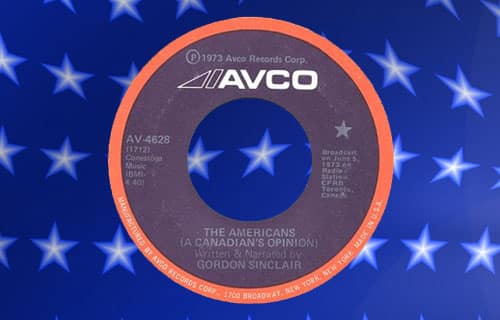
    Originally written for a regular broadcast on CFRB radio in Toronto on June 5, 1973.

    This Canadian thinks it is time to speak up for the Americans as most generous and possibly the least appreciated people on all the earth.

    Germany, Japan and, to a lesser extent, Britain and Italy were lifted out of the debris of war by the Americans who poured in billions of dollars and forgave other billions in debts. None of these countries is today paying even the interest on its remaining debts to the United States.

    When the franc was in danger of collapsing in 1956, it was the Americans who propped it up, and their reward was to be insulted and swindled on the streets of Paris. I was there. I saw it. When distant cities are hit by earthquakes, it is the United States that hurries in to help. This spring, 59 American communities were flattened by tornadoes. Nobody helped.

    The Marshall Plan and the Truman Policy pumped billions of dollars into discouraged countries. Now newspapers in those countries are writing about the decadent, warmongering Americans. I’d like to see just one of those countries that is gloating over the erosion of the United States Dollar build its own airplane. Does any other country in the world have a plane to equal the Boeing Jumbo Jet, the Lockheed Tristar, or the Douglas DC-10? If so, why don’t they fly them? Why do all the International lines except Russia fly American planes?

    Why does no other land on earth even consider putting a man or woman on the moon? You talk about Japanese technocracy, and you get radios. You talk about German technocracy, and you get automobiles. You talk about American technocracy, and you find men on the moon — not once, but several times — and safely home again.

    You talk about scandals, and the Americans put theirs right in the store window for everybody to look at. Even their draft-dodgers are not pursued and hounded. They are here on our streets, and most of them, unless they are breaking Canadian laws, are getting American dollars from ma and pa at home to spend here.

    When the railways of France, Germany and India were breaking down through age, it was the American who rebuilt them. When the Pennsylvania Railroad and the New York Central went broke, nobody loaned them an old caboose. Both are still broke.

    I can name you 5,000 times when the Americans raced to the help of other people in trouble. Can you name me even one time when someone else raced to the Americans in trouble? I don’t think there was outside help even during the San Francisco earthquake.

    Our neighbors have faced it alone, and I’m one Canadian who is damned tired of hearing them get kicked around. They will come out of this thing with their flag high. And when they do, they are entitled to thumb their nose at the lands that are gloating over their present troubles. I hope Canada is not one of those.

  • Skylab: America’s First Space Station

    Skylab: America’s First Space Station

    Skylab

    Skylab was America’s first space station, developed by NASA during the 1970s as a platform for scientific research and experimentation in a microgravity environment, marking a significant milestone in human space exploration.

    Launched on May 14, 1973, Skylab was a modified Saturn V rocket’s third stage that had been converted into an orbital workshop and living space for astronauts. It was designed to support a variety of scientific experiments, including solar observations, Earth resources studies, and the effects of prolonged weightlessness on the human body. Skylab was also intended to test the feasibility of long-duration human spaceflight, a crucial stepping stone toward future missions, such as those to the Moon and Mars.

    Three manned missions, known as Skylab 2, Skylab 3, and Skylab 4, took place between May 1973 and February 1974, with crews spending a total of 171 days aboard the space station. Prominent astronauts involved in these missions included Charles “Pete” Conrad, Alan Bean, Jack Lousma, Owen Garriott, and Gerald Carr. The astronauts conducted various experiments and maintenance tasks, setting records for the longest time humans had spent in space at that point.

    Skylab’s initial launch faced some challenges, including damage to its micrometeoroid shield and one of its solar panels. The Skylab 2 crew was tasked with repairing these issues, successfully deploying a parasol-like sunshade and freeing the jammed solar panel, which allowed the space station to become fully operational.

    Skylab’s operational life came to an end when the last crew departed in February 1974. The space station remained in orbit until July 11, 1979, when it re-entered Earth’s atmosphere and disintegrated, with some debris landing in the Indian Ocean and Western Australia.

    The Skylab program laid the groundwork for future space stations, such as the Russian Mir and the International Space Station (ISS), by providing valuable insights into the challenges and opportunities of long-duration human spaceflight. Its legacy continues to inform current and future space exploration efforts.

  • The Battle of the Sexes: Billie Jean King vs. Bobby Riggs Tennis Match

    The Battle of the Sexes: Billie Jean King vs. Bobby Riggs Tennis Match

    The Battle of the Sexes: Billie Jean King vs. Bobby Riggs

    The Battle of the Sexes was a highly publicized tennis match between Billie Jean King, a top female tennis player, and Bobby Riggs, a former men’s champion, that took place on September 20, 1973, at the Houston Astrodome in Texas, and became a symbol of the fight for gender equality in sports and society.

    Bobby Riggs, a former world number one tennis player and Wimbledon champion, had been a vocal critic of women’s tennis, claiming that even at age 55, he could defeat any female player. In 1973, Riggs challenged Billie Jean King, then 29 years old and one of the best female tennis players in the world, to a match that would test his claims.

    King initially declined Riggs’ challenge, but after Riggs defeated another top female player, Margaret Court, in a similar exhibition match dubbed the “Mother’s Day Massacre” on May 13, 1973, King agreed to face Riggs in a winner-takes-all match for $100,000.

    The Battle of the Sexes match attracted massive media attention and was watched by an estimated 90 million viewers worldwide, making it one of the most-watched tennis matches in history. Over 30,000 spectators attended the Houston Astrodome event, filled with a circus-like atmosphere and intense anticipation.

    During the match, Billie Jean King outplayed Bobby Riggs in straight sets, winning 6-4, 6-3, 6-3, and securing a significant victory for women’s tennis and the broader fight for gender equality. The match made King an international icon and helped to dispel the notion that female athletes were inherently inferior to their male counterparts.

    The Battle of the Sexes had a lasting impact on the perception of women’s sports. It contributed to the growth of women’s tennis, with King becoming a leading advocate for gender equality and equal pay in professional sports. The event has been the subject of several documentaries and a 2017 feature film, further cementing its place in sports history and the broader struggle for gender equality.

  • The Cod Wars: Fishing disputes between the UK and Iceland

    The Cod Wars: Fishing disputes between the UK and Iceland

    The Cod Wars

    The Cod Wars were a series of disputes between the United Kingdom and Iceland over fishing rights in the North Atlantic, which took place between 1958 and 1976, involving several confrontations at sea, diplomatic tensions, and economic repercussions for both countries.

    The root of the conflict lay in Iceland’s attempts to expand its exclusive fishing zone, primarily to protect its vital cod fishing industry from overfishing by foreign trawlers, including those from the United Kingdom. The disputes were marked by three main periods of confrontation: the First Cod War (1958-1961), the Second Cod War (1972-1973), and the Third Cod War (1975-1976).

    During the First Cod War, Iceland unilaterally extended its exclusive fishing zone from 4 to 12 nautical miles, which was met with strong opposition from the UK. British trawlers continued to fish in the disputed waters, leading to incidents of Icelandic Coast Guard vessels attempting to cut the fishing nets of the British trawlers. The conflict ended in 1961 with a temporary agreement, allowing British vessels to fish in certain areas within the 12-mile limit.

    The Second Cod War erupted in 1972 when Iceland further extended its fishing zone to 50 nautical miles. The UK again protested the move and sent naval vessels to protect its fishing fleet. The situation escalated, with both sides’ vessels ramming each other and even firing warning shots. The conflict was resolved in 1973 through a temporary agreement, which allowed British trawlers limited access to the disputed zone.

    The Third Cod War began in 1975 when Iceland expanded its fishing zone once more, this time to 200 nautical miles. The UK responded by sending naval vessels to protect its fishing fleet, leading to more aggressive confrontations at sea. In 1976, Iceland threatened to close a NATO base on its territory, which was strategically important during the Cold War. This prompted the intervention of the United States, which mediated a settlement between the two countries.

    The Cod Wars ultimately resulted in Iceland’s victory, as the UK agreed to recognize the 200-mile fishing zone and significantly reduce its fishing activities in the area. The disputes had a lasting impact on the fishing industry in both countries, with the British fishing industry facing a significant decline. At the same time, Iceland successfully preserved its vital cod stocks and solidified its control over its fishing resources.

  • The World Trade Center: Completion and Opening in New York City

    The World Trade Center: Completion and Opening in New York City

    The World Trade Center

    The World Trade Center, a complex of iconic buildings in New York City, was completed and opened in 1973. It became a symbol of global commerce and a prominent feature of the city’s skyline until its tragic destruction in 2001.

    The idea for the World Trade Center emerged in the late 1950s to promote international trade and revitalize Lower Manhattan. The project was developed by the Port Authority of New York and New Jersey, led by David Rockefeller, the chairman of Chase Manhattan Bank, and his brother, New York Governor Nelson Rockefeller. Renowned architect Minoru Yamasaki was selected to design the complex, including seven buildings, with the Twin Towers, 1 World Trade Center (North Tower), and 2 World Trade Center (South Tower), as its centerpiece.

    Construction of the World Trade Center began in 1966, with the excavation of the site, known as the “bathtub,” which required the removal of more than 1.2 million cubic yards of soil and rock. The innovative design of the Twin Towers featured a “tube-within-a-tube” structural system, which allowed for large, open floor plans and increased structural stability.

    The North Tower was completed and opened in December 1970, while the South Tower was finished and opened in January 1972. The complex’s official ribbon-cutting ceremony took place on April 4, 1973. At the time of their completion, the Twin Towers were the tallest buildings in the world, standing at 1,368 feet (North Tower) and 1,362 feet (South Tower), with each tower having 110 stories.

    The World Trade Center became a hub for international commerce, housing numerous offices, businesses, and organizations, an observation deck, and the Windows on the World restaurant. The complex was tragically destroyed in the terrorist attacks of September 11, 2001, which claimed the lives of nearly 3,000 people. In the years following the attacks, a new World Trade Center complex was constructed, including the One World Trade Center, which stands as a symbol of resilience and a tribute to those who lost their lives in the tragedy.

  • First Mobile Phone: Motorola’s DynaTAC 9000

    First Mobile Phone: Motorola’s DynaTAC 9000

    The First Mobile Phone: Motorola’s DynaTAC 9000

    The introduction of the mobile phone revolutionized personal communication, and Motorola’s DynaTAC 9000 was the first commercially available handheld cellular phone, which was unveiled in 1983 and became available to consumers in 1984.

    The DynaTAC 9000 was developed by Motorola, an American telecommunications company, under the leadership of engineer and inventor Dr. Martin Cooper. Cooper is often credited as the “father of the mobile phone” for his pioneering work in cellular technology. The development of the DynaTAC began in the early 1970s, to create a portable telephone that could operate on a cellular network.

    On April 3, 1973, Dr. Cooper made the first public mobile phone call using a prototype of the DynaTAC, marking a historic milestone in the development of cellular technology. He called on the streets of New York City to his rival, Dr. Joel S. Engel of Bell Labs, a research division of AT&T.

    It took another decade before the DynaTAC 9000 was ready for commercial release. The phone was officially unveiled in 1983 and became available in 1984, with a hefty price tag of around $3,995 (equivalent to nearly $10,000 today, when adjusted for inflation). The DynaTAC 9000 was large by today’s standards, measuring approximately 13 inches (33 cm) tall and weighing around 2 pounds (0.9 kg). Despite its size and cost, the phone was a status symbol and marked the beginning of the mobile phone revolution.

    The DynaTAC 9000 offered a talk time of around 30 minutes and required 10 hours to recharge. However, it provided users with the unprecedented ability to make and receive phone calls while on the move, laying the foundation for developing smaller, more affordable, and more advanced mobile phones in the following years.

    The introduction of the Motorola DynaTAC 9000 marked a turning point in telecommunications history, transforming how people communicated and paving the way for the widespread adoption of mobile phones and the eventual rise of smartphones that dominate today’s market.

  • Project Tiger: Wildlife Conservation Initiative in India

    Project Tiger: Wildlife Conservation Initiative in India

    Project Tiger in India

    Project Tiger is a wildlife conservation initiative launched by the Government of India on April 1, 1973, aimed at protecting the endangered Bengal tiger and its natural habitat, while also addressing the broader issues of biodiversity conservation and sustainable development.

    The project was launched under the leadership of then-Prime Minister Indira Gandhi, who recognized the need for urgent action to protect India’s dwindling tiger population. The Bengal tiger, India’s national animal, faced numerous threats, including habitat loss, human encroachment, and poaching for its fur and body parts, which were in high demand in the illegal wildlife trade.

    Project Tiger began with the establishment of nine tiger reserves across India, strategically chosen to represent a diverse range of ecosystems and encompass as many tiger populations as possible. These reserves, covering a total area of about 16,339 square miles, were designed to provide the tigers with a safe and protected environment where they could live and breed. The project employed a multi-pronged approach, focusing on habitat preservation, anti-poaching measures, and efforts to minimize human-tiger conflicts.

    In addition to the conservation of tigers, Project Tiger has had a broader impact on preserving ecosystems and biodiversity in India. The tiger reserves established under the project serve as vital habitats for numerous other species, including endangered animals like the Indian rhinoceros and the Asiatic lion, as well as countless plants, birds, and insects.

    Since its inception, Project Tiger has grown in scope and ambition, with the number of tiger reserves increasing to over 50 by the early 21st century. The project has had a measurable impact on tiger populations in India, with the numbers steadily increasing over the years. According to the 2018 tiger census, there were an estimated 2,967 tigers in India, up from just 1,411 in 2006.

    Despite ongoing challenges, such as poaching and habitat loss, Project Tiger has been largely successful in protecting the Bengal tiger and its habitat. The initiative serves as a model for wildlife conservation efforts in other countries and has played a significant role in raising awareness about preserving biodiversity and promoting sustainable development.

  • 1973 Oscars 45th Academy Awards

    1973 Oscars 45th Academy Awards

    1973 Oscars 45th Academy Awards

    • Winners Announced: March 3, 1973
    • Held at: Tennessee Theater, Nashville, Tennessee
    • Host: Andy Williams
    • Eligibility Year: October 16, 1971 – October 15, 1972

    Musical Highlights and Achievements

    • Sweep by “The Concert for Bangladesh”: The album, organized by George Harrison and Ravi Shankar, won Album of the Year and demonstrated the power of music to enact social change.
    • Robert Flack’s “First Time Ever I Saw Your Face”: This song won both Record of the Year and Song of the Year, catapulting Roberta Flack to stardom.
    • Prestigious Newcomer: America won Best New Artist.

    Engaging Trivia

    • Country Takeover: With the Grammys being held in Nashville for the first time, there was a noticeable focus on country music, including Charley Pride winning Best Country Vocal Performance.
    • Repeat Host: Andy Williams hosted the Grammys for several years, but the 1973 event was notable for its location change to Nashville, placing Williams in the heart of country music.
    • Youth Power: Michael Jackson got his first Grammy nomination at the age of 14 for Best Original Score Written for a Motion Picture or a Television Special.
    Try our 1973 Quiz!

    1973 Oscar Nominees and Winners

    Best Picture:
    The Godfather – Albert S. Ruddy, producer
    Cabaret – Cy Feuer, producer
    Deliverance – John Boorman, producer
    The Emigrants – Bengt Forslund, producer
    Sounder – Robert B. Radnitz, producer
    Best Director:
    Bob Fosse – Cabaret
    John Boorman – Deliverance
    Jan Troell – The Emigrants
    Francis Ford Coppola – The Godfather
    Joseph L. Mankiewicz – Sleuth
    Best Actor:
    Marlon Brando – The Godfather as Vito Corleone (declined)
    Michael Caine – Sleuth as Milo Tindle
    Laurence Olivier – Sleuth as Andrew Wyke
    Peter O’Toole – The Ruling Class as Jack Gurney
    Paul Winfield – Sounder as Nathan Lee Morgan
    Best Actress:
    Liza Minnelli – Cabaret as Sally Bowles
    Diana Ross – Lady Sings the Blues as Billie Holiday
    Maggie Smith – Travels with My Aunt as Augusta Bertram
    Cicely Tyson – Sounder as Rebecca Morgan
    Liv Ullmann – The Emigrants as Kristina Nilsson
    Best Supporting Actor:
    Joel Grey – Cabaret as the M.C.
    Eddie Albert – The Heartbreak Kid as Mr. Corcoran
    James Caan – The Godfather as Santino “Sonny” Corleone
    Robert Duvall – The Godfather as Tom Hagen
    Al Pacino – The Godfather as Michael Corleone
    Best Supporting Actress:
    Eileen Heckart – Butterflies Are Free as Mrs. Baker
    Jeannie Berlin – The Heartbreak Kid as Lila Kolodny
    Geraldine Page – Pete ‘n’ Tillie as Gertrude Wilson
    Susan Tyrrell – Fat City as Oma
    Shelley Winters – The Poseidon Adventure as Belle Rosen
    Best Screenplay Based on Factual Material or Material Not Previously Produced or Published:
    The Candidate – Jeremy Larner
    The Discreet Charm of the Bourgeoisie – Luis Buñuel and Jean-Claude Carrière
    Lady Sings the Blues – Chris Clark, Suzanne de Passe and Terence McCloy
    Murmur of the Heart – Louis Malle
    Young Winston – Carl Foreman
    Best Screenplay Based on Material from Another Medium:
    The Godfather – Francis Ford Coppola and Mario Puzo based on the novel by Puzo
    Cabaret – Jay Presson Allen based on the musical by Fred Ebb and John Kander and the book by Joe Masteroff
    The Emigrants – Bengt Forslund and Jan Troell based on the novels The Emigrants and Unto a Good Land by Vilhelm Moberg
    Pete ‘n’ Tillie – Julius J. Epstein based on the story Witch’s Milk by Peter De Vries
    Sounder – Lonne Elder III based on the novel by William H. Armstrong
    Best Documentary Feature:
    Marjoe – Sarah Kernochan and Howard Smith
    Ape and Super-Ape – Bert Haanstra
    Malcolm X – Arnold Perl (posthumous nomination) and Marvin Worth
    Manson – Robert Hendrickson and Laurence Merrick
    The Silent Revolution – Eckehard Munck
    Best Documentary Short Subject:
    This Tiny World – Charles Huguenot van der Linden and Martina Huguenot van der Linden
    Hundertwasser’s Rainy Day – Peter Schamoni
    K-Z – Giorgio Treves
    Selling Out – Tadeusz Jaworski
    The Tide of Traffic – Humphrey Swingler
    Best Live Action Short Subject:
    Norman Rockwell’s World… An American Dream – Richard Barclay
    Frog Story – Ray Gideon and Ron Satlof
    Solo – David Adams
    Best Animated Short Subject:
    A Christmas Carol – Richard Williams
    Kama Sutra Rides Again – Bob Godfrey
    Tup Tup – Nedeljko Dragic
    Best Foreign Language Film:
    The Discreet Charm of the Bourgeoisie (France) in French – Luis Buñuel
    The Dawns Here Are Quiet (USSR) in Russian – Stanislav Rostotsky
    I Love You Rosa (Israel) in Hebrew – Moshé Mizrahi
    My Dearest Senorita (Spain) in Spanish – Jaime de Armiñán
    The New Land (Sweden) in Swedish – Jan Troell
    Best Song Original for the Picture:
    “The Morning After” from The Poseidon Adventure – Music and Lyrics by Joel Hirschhorn and Al Kasha
    “Ben” from Ben – Music by Walter Scharf; Lyrics by Don Black
    “Come Follow, Follow Me” from The Little Ark – Music by Fred Karlin; Lyrics by Marsha Karlin
    “Marmalade, Molasses & Honey” from The Life and Times of Judge Roy Bean – Music by Maurice Jarre; Lyrics by Alan and Marilyn Bergman
    “Strange Are the Ways of Love” from The Stepmother – Music by Sammy Fain; Lyrics by Paul Francis Webster
    Best Original Dramatic Score:
    Limelight – Charlie Chaplin, Raymond Rasch and Larry Russell (posthumous awards)
    Images – John Williams
    Napoleon and Samantha – Buddy Baker
    The Poseidon Adventure – John Williams
    Sleuth – John Addison
    Best Scoring: Adaptation and Original Song Score:
    Cabaret – Adaptated by Ralph Burns
    Lady Sings the Blues – Adapted by Gil Askey
    Man of La Mancha – Adapted by Laurence Rosenthal
    Best Costume Design:
    Travels with My Aunt – Anthony Powell
    The Godfather – Anna Hill Johnstone
    Lady Sings the Blues – Ray Aghayan, Norma Koch and Bob Mackie
    The Poseidon Adventure – Paul Zastupnevich
    Young Winston – Anthony Mendleson
    Best Sound:
    Cabaret – David Hildyard and Robert Knudson
    Butterflies Are Free – Charles T. Knight and Arthur Piantadosi
    The Candidate – Gene Cantamessa and Richard Portman
    The Godfather – Bud Grenzbach, Christopher Newman and Richard Portman
    The Poseidon Adventure – Herman Lewis and Theodore Soderberg
    Best Art Direction:
    Cabaret – Art Direction: Hans Jürgen Kiebach and Rolf Zehetbauer; Set Decoration: Herbert Strabel
    Lady Sings the Blues – Art Direction: Carl Anderson; Set Decoration: Reg Allen
    The Poseidon Adventure – Art Direction: William Creber; Set Decoration: Raphaël Bretton
    Travels with My Aunt – Art Direction and Set Decoration: John Box, Robert W. Laing and Gil Parrondo
    Young Winston – Art Direction: Donald M. Ashton, Geoffrey Drake, John Graysmark and William Hutchinson; Set Decoration: Peter James
    Best Cinematography:
    Cabaret – Geoffrey Unsworth
    1776 – Harry Stradling Jr.
    Butterflies Are Free – Charles Lang
    The Poseidon Adventure – Harold E. Stine
    Travels with My Aunt – Douglas Slocombe
    Best Film Editing:
    Cabaret – David Bretherton
    Deliverance – Tom Priestley
    The Godfather – William H. Reynolds and Peter Zinner
    The Hot Rock – Fred W. Berger and Frank P. Keller
    The Poseidon Adventure – Harold F. Kress
    Special Achievement Award:
    L. B. Abbott and A. D. Flowers for the visual effects of The Poseidon Adventure
    Academy Honorary Award:
    Charles S. Boren
    Edward G. Robinson
    Oscar® and Academy Awards® and Oscar® design mark are the trademarks and service marks and the Oscar© statuette the copyrighted property, of the Academy of Motion Picture Arts and Sciences. Pop Culture Madness is neither endorsed by nor affiliated with the Academy of Motion Picture Arts and Sciences.
  • 1973 Grammy Award Winners

    1973 Grammy Award Winners

    1973 Grammy Award Winners

    • Winners Announced: March 3, 1973
    • Held at: Tennessee Theater, Nashville, Tennessee
    • Host: Andy Williams
    • Eligibility Year: October 16, 1971 – October 15, 1972

    Musical Highlights and Achievements

    • Sweep by “The Concert for Bangladesh”: The album, organized by George Harrison and Ravi Shankar, won Album of the Year and demonstrated the power of music to enact social change.
    • Robert Flack’s “First Time Ever I Saw Your Face”: This song won both Record of the Year and Song of the Year, catapulting Roberta Flack to stardom.
    • Prestigious Newcomer: America won Best New Artist

    Engaging Trivia

    • Country Takeover: With the Grammys being held in Nashville for the first time, there was a noticeable focus on country music, including Charley Pride winning Best Country Vocal Performance.
    • Repeat Host: Andy Williams hosted the Grammys for several years, but the 1973 event was notable for its location change to Nashville, placing Williams in the heart of country music.
    • Youth Power: Michael Jackson got his first Grammy nomination at 14 for Best Original Score Written for a Motion Picture or a Television Special.
    • Try our 1973 Quiz!

    1973 Grammy Winners

    Record of the Year:
    The First Time Ever I Saw Your Face – Roberta Flack
    Album of the Year:
    The Concert for Bangla Desh, George Harrison, Ravi Shanker, Bob Dylan, Leon Russell, Ringo Starr, Billy Preston, Eric Clapton and Klaus Voormann (Apple)
    Song of the Year:
    The First Time Ever I Saw Your Face – Ewan MacColl, songwriter
    Best New Artist of the Year:
    America
    Best Pop Vocal Performance, Male:
    Without You – Nilsson
    Best Pop Vocal Performance, Female:
    I Am Woman – Helen Reddy
    Best Pop Vocal Performance By a Duo, Group or Chorus:
    Where Is the Love – Roberta Flack and Donny Hathaway
    Best Pop Instrumental Performance By an Instrumental Performer:
    Outa-Space – Billy Preston
    Best Pop Instrumental Performance With Vocal:
    Coloring Black Moses, Isaac Hayes
    Best Rhythm and Blues Song:
    Papa Was a Rolling Stone – Barrett Strong and Norman Whitfield, songwriters
    Best Rhythm and Blues Vocal Performance, Male:
    Me and Mrs. Jones – Billy Paul
    Best Rhythm and Blues Vocal Performance, Female:
    Young, Gifted and Black, Aretha Franklin
    Best Rhythm and Blues Vocal Performance By a Duo, Group, or Chorus:
    Papa Was a Rolling Stone – Temptations
    Best Jazz Performance By a Soloist:
    Alone at Last – Gary Burton
    Best Jazz Performance By a Group:
    First Light – Freddie Hubbard
    Best Jazz Performance By a Big Band:
    Toga Brava Suite – Duke Ellington
    Best Country Vocal Performance, Female:
    Happiest Girl in the Whole USA – Donna Fargo
    Best Country Vocal Performance, Male:
    Charley Pride Sings Heart Songs, Charley Pride
    Best Country Vocal Performance By a Duo or Group:
    Class of ’57 – Statler Brothers
    Best Country Instrumental Performance:
    Charlie McCoy/The Real McCoy, Charlie McCoy
    Best Country Song:
    Kiss an Angel Good Mornin’ – Ben Peters, songwriter
    Best Gospel Performance:
    L-O-V-E, Blackwood Brothers
    Best Soul Gospel Performance:
    Amazing Grace – Aretha Franklin
    Best Inspirational Performance:
    He Touched Me, Elvis Presley
    Best Ethnic or Traditional Recording:
    The London Muddy Waters Session, Muddy Waters (Chess)
    Best Instrumental Arrangement:
    Theme From The French Connection – Don Ellis, arranger
    Best Arrangement Accompanying Vocalist:
    What Are You Doing the Rest of Your Life – Michel Legrand, arranger
    Best Instrumental Composition:
    Brian’s Song – Michel Legrand, composer
    Best Score From an Original Cast Show Album:
    Don’t Bother Me, I Can’t Cope, Micki Grant, composer (Polydor)
    Best Original Score Written for a Motion Picture or a Television Special:
    The Godfather, Nino Rota, composer
    Album of the Year, Classical:
    Mahler, Symphony No. 8 in E-Flat Major (Symphony of a Thousand), Sir Georg Solti conducting Chicago Symphony Orchestra, Vienna Boys Choir, Vienna State Opera Chorus, Vienna Singverein Chorus and Soloists (London)
    Best Classical Performance, Orchestra:
    Mahler, Symphony No. 7 in E Minor, Sir Georg Solti conducting Chicago Symphony Orchestra
    Best Chamber Music Performance:
    Julian and John, Julian Bream and John Williams
    Best Instrumental Soloist Performance, Classical:
    (With Orchestra) Brahms, Concerto No. 2, Artur Rubinstein
    Best Instrumental Soloist Performance, Classical (Without Orchestra):
    Horowitz Plays Chopin, Vladimir Horowitz
    Best Opera Recording:
    Berlioz, Benvenuto Cellini, Colin Davis conducting BBC Symphony and Chorus of Covent Garden (Philips)
    Best Choral Performance, Classical:
    Mahler, Symphony No. 8 in E-Flat Major (Symphony of a Thousand), Sir Georg Solti conducting Chicago Symphony Orchestra, Vienna Boys Choir, Vienna State Opera Chorus, Vienna Singverein Chorus and Soloists
    Best Vocal Soloist Performance, Classical:
    Brahms, Die Schöne Magelone, Dietrich Fischer-Dieskau
    Best Comedy Recording:
    FM and AM, George Carlin (Little David)
    Best Spoken Word Recording:
    Lenny, Original Cast (Blue Thumb)
    Best Recording for Children:
    The Electric Company, Lee Chamberlin, Bill Cosby and Rita Moreno (Warner Bros.)
    Best Album Cover:
    The Siegel Schwall Band, Acy Lehman, art director; Harvey Dinnerstein, artist (Wooden Nickel)
    Best Album Notes:
    Tom T. Hall’s Greatest Hits, Tom T. Hall, annotator (Mercury)
    Best Album Notes, Classical:
    Williams, Symphony No. 2, James Lyons, annotator (RCA)
     
     
  • Pink Floyd’s The Dark Side of the Moon: Release and Legacy

    Pink Floyd’s The Dark Side of the Moon: Release and Legacy

    Pink Floyd’s The Dark Side of the Moon

    “Pink Floyd’s The Dark Side of the Moon,” a groundbreaking and influential progressive rock album, was released on March 1, 1973, and has since become one of the best-selling and most critically acclaimed albums in music history.

    The album was created by the British rock band Pink Floyd, which at the time consisted of Roger Waters (bass and vocals), David Gilmour (guitar and vocals), Richard Wright (keyboards and vocals), and Nick Mason (drums). “The Dark Side of the Moon” was the band’s eighth studio album and marked a significant departure from their earlier psychedelic sound, as it delved into themes of life, death, mental health, and the human experience.

    Recorded at the famous Abbey Road Studios in London and produced by Pink Floyd and engineer Alan Parsons, the album is known for its innovative use of sound effects, multi-layered instrumentation, and sophisticated production techniques. Iconic tracks such as “Money,” “Time,” “Us and Them,” and “Brain Damage” are still celebrated today for their emotional resonance and technical brilliance.

    Upon its release, “The Dark Side of the Moon” was met with widespread critical acclaim and commercial success. The album topped the charts in multiple countries, including the United States and the United Kingdom, and has sold an estimated 45 million copies worldwide. It also holds the record for the longest time spent on the Billboard 200 chart, with over 900 weeks.

    The legacy of “The Dark Side of the Moon” is immense, as it has influenced countless musicians and bands across various genres and has been praised for its progressive and experimental approach to music-making. The album’s iconic cover art, designed by Storm Thorgerson and featuring a prism refracting light into a rainbow, symbolizes Pink Floyd and the progressive rock genre. In recognition of its enduring impact and cultural significance, “The Dark Side of the Moon” was inducted into the Grammy Hall of Fame in 1999 and selected for preservation in the United States National Recording Registry by the Library of Congress in 2013.

  • The Wounded Knee Incident: Native American activism

    The Wounded Knee Incident: Native American activism

    The 1973 Wounded Knee Incident

    The Wounded Knee Incident was a 71-day standoff between members of the American Indian Movement (AIM) and U.S. federal law enforcement that took place from February 27 to May 8, 1973, on the Pine Ridge Indian Reservation in South Dakota, highlighting Native American civil rights issues and government treatment of indigenous peoples.

    The American Indian Movement, founded in 1968 by Dennis Banks, Clyde Bellecourt, and George Mitchell, was a grassroots organization that aimed to address the grievances of Native Americans, including treaty rights, living conditions, and police harassment. In February 1973, AIM activists and a group of Oglala Lakota people occupied the town of Wounded Knee, the site of the 1890 Wounded Knee Massacre, to draw attention to their cause.

    The occupation began on February 27, 1973, when approximately 200 AIM activists and Oglala Lakota supporters seized the town and took 11 residents hostage. They demanded the removal of tribal president Richard Wilson, whom they accused of corruption and abuse of power. They called for a review of treaties between the U.S. government and Native American tribes.

    The situation quickly escalated as federal law enforcement agencies, including the FBI, U.S. Marshals, and the Bureau of Indian Affairs Police, surrounded the town and set up roadblocks. The standoff turned violent, with sporadic gunfire exchanges between the activists and law enforcement, resulting in the deaths of two Native American occupiers and injuries to several others, including a U.S. Marshal.

    Senator George McGovern, special envoy Kent Frizzell, and AIM leaders Russell Means and Dennis Banks led negotiations to end the standoff. On May 8, 1973, the occupation finally ended when the activists agreed to disarm and leave Wounded Knee, with the understanding that the U.S. government would address their concerns.

    Although the Wounded Knee Incident did not lead to immediate changes in government policy or the resolution of all grievances, it brought national attention to the plight of Native Americans and galvanized the movement for indigenous rights. The incident remains a significant event in the history of Native American activism. It serves as a reminder of the long-standing struggle for justice and self-determination among indigenous peoples in the United States.

  • The Paris Peace Accords

    The Paris Peace Accords

    The Paris Peace Accords

    The Vietnam War ceasefire and withdrawal of U.S. troops marked the end of direct American military involvement in the conflict between communist North Vietnam and non-communist South Vietnam, paving the way for the eventual reunification of Vietnam under communist rule.

    In 1973, after years of fighting in the Vietnam War, the United States, North Vietnam, South Vietnam, and the Viet Cong reached a ceasefire agreement known as the Paris Peace Accords, which led to the withdrawal of American troops from Vietnam.

    The Paris Peace Accords were signed on January 27, 1973, by representatives from the U.S., North Vietnam, South Vietnam, and the Provisional Revolutionary Government of the Republic of South Vietnam, representing the Viet Cong. During the negotiation process, key figures included U.S. National Security Advisor Henry Kissinger, North Vietnamese diplomat Le Duc Tho, South Vietnamese President Nguyen Van Thieu, and Viet Cong leader Nguyen Thi Binh.

    The accords aimed to end direct U.S. military involvement in Vietnam and establish a framework for a political settlement, including a ceasefire, the release of prisoners of war, and the eventual reunification of the country through peaceful means. The agreement also called for the withdrawal of all U.S. forces and military personnel and the dismantling of U.S. military bases in South Vietnam within 60 days.

    In accordance with the agreement, the last American combat troops left Vietnam on March 29, 1973. However, a small number of U.S. military advisors and Marines remained at the U.S. Embassy in Saigon to assist in the transition. The war, however, continued between North and South Vietnam, with the North ultimately emerging victorious when Saigon, the capital of South Vietnam, fell on April 30, 1975. This event marked the end of the Vietnam War and the beginning of the reunification process, with Vietnam becoming a unified, communist country.

  • Icelandic Eldfell Volcanic Eruption: Heimaey Island evacuation

    Icelandic Eldfell Volcanic Eruption: Heimaey Island evacuation

    Iceland’s Eldfell Volcano Eruption

    The eruption of the Eldfell volcano on Heimaey Island, Iceland, in 1973 led to the emergency evacuation of the island’s population and a months-long battle to save the island’s vital infrastructure and fishing industry.

    The eruption began suddenly on January 23, 1973, when a fissure opened up near the edge of the town of Vestmannaeyjar on Heimaey, the largest and only inhabited island of the Westman Islands archipelago. At the time, Heimaey was home to around 5,300 people, who relied heavily on the fishing industry for their livelihoods.

    As lava and ash from the eruption began to threaten the town and harbor, the island’s population was evacuated to the mainland swiftly and efficiently. The Icelandic government, the Red Cross, and the local fishing fleet worked together to transport residents off the island, with most being evacuated within 24 hours. Miraculously, only one person lost their life as a result of the eruption.

    Over the following months, Icelanders mounted an extraordinary effort to save the island’s harbor, which was at risk of being closed off by lava flows. They sprayed seawater on the advancing lava to cool and solidify it, preventing the closure of the harbor entrance and preserving the island’s critical fishing industry. The operation was successful, and the harbor remained open and functional.

    The eruption continued until July 3, 1973, dramatically altering the island, with almost one-fifth of the town buried under lava and ash. Many residents returned to Heimaey to rebuild their homes and lives, and the island’s population gradually recovered. Today, the eruption and its aftermath remain an important part of Icelandic history, and the site serves as a popular tourist attraction, showcasing the power of nature and the resilience of the human spirit.

  • Roe v. Wade: Landmark U.S. Supreme Court Decision on Abortion

    Roe v. Wade: Landmark U.S. Supreme Court Decision on Abortion

    Roe v. Wade: U.S. Supreme Court Decision on Abortion

    Roe v. Wade was a landmark 1973 U.S. Supreme Court decision that established a woman’s legal right to have an abortion, striking down many state restrictions and significantly changing the legal landscape surrounding reproductive rights in the United States.

    The case decided on January 22, 1973, centered on a Texas woman named Norma McCorvey, who used the pseudonym “Jane Roe” to protect her privacy. McCorvey sought to terminate her pregnancy but could not do so because Texas law only allowed abortion in cases where the mother’s life was in danger. She filed a lawsuit against Henry Wade, the district attorney of Dallas County, Texas, arguing that the state’s restrictive abortion laws violated her constitutional rights.

    The Supreme Court, in a 7-2 decision, ruled in favor of Roe. The majority opinion, written by Justice Harry Blackmun, held that the constitutional right to privacy, which was found to be “broad enough to encompass a woman’s decision whether or not to terminate her pregnancy,” was protected under the Due Process Clause of the Fourteenth Amendment. The Court established a trimester framework, which granted women the right to have an abortion during the first trimester of pregnancy without government interference while allowing states to regulate or restrict abortions in the later stages of pregnancy, with the state’s interest in protecting the health of the mother and the potential life of the fetus increasing as the pregnancy progressed.

    The Roe v. Wade decision profoundly impacted the debate surrounding abortion rights in the United States. It galvanized both pro-choice and pro-life activists, forming organizations like the National Abortion Rights Action League (now NARAL Pro-Choice America) and the National Right to Life Committee. The decision remains one of the most contentious and politically divisive issues in American politics, with ongoing debates over the extent of the right to abortion and the role of the government in regulating reproductive rights.

  • 1972 Number One Hits

    1972 Number One Hits

    1972 Billboard Number One Hits:

    December 25, 1971 – January 14, 1972:
    Brand New Key – Melanie
    January 15 – February 11:
    American Pie – Don McLean
    February 12 – February 18:
    Let’s Stay Together – Al Green
    February 19 – March 17:
    Without You – Nilsson
    March 18 – March 24:
    Heart of Gold – Neil Young
    March 25 – April 14:
    A Horse With No Name – America
    April 15 – May 26:
    The First Time I Ever Saw Your Face – Roberta Flack
    May 27 – June 2:
    Oh Girl – Chi-Lites
    June 3 – June 9:
    I’ll Take You There – The Staple Singers
    June 10 – June 30:
    The Candy Man – Sammy Davis, Jr.
    July 1 – July 7:
    Song Sung Blue – Neil Diamond
    July 8 – July 30:
    Lean on Me – Bill Withers
    July 29 – August 25:
    Alone Again (Naturally) – Gilbert O’ Sullivan
    August 26 – September 1:
    Brandy (You’re A Fine Girl) – Looking Glass
    September 2 – September 15:
    Alone Again (Naturally) – Gilbert O’Sullivan
    September 16 – September 22:
    Black and White – Three Dog Night
    September 23 – October 13:
    Baby, Don’t Get Hooked On Me – Mac Davis
    October 14 – October 20:
    Ben – Michael Jackson
    October 21 – November 3:
    My Ding-A-Ling – Chuck Berry
    November 4 – December 1:
    I Can See Clearly Now – Johnny Nash
    December 2 – December 8:
    Papa Was a Rollin’ Stone – The Temptations
    December 9 – December 15:
    I Am Woman – Helen Reddy
    December 16, 1972 – January 5, 1973:
    Me and Mrs. Jones – Billy Paul

    (Data is compiled from various charts including Billboard’s “Pop,” “Adult Contemporary,” “Airplay,” “R&B” and “Singles” Charts. “Hot 100” is the primary chart used starting October, 1958)

    Try our 1972 Quiz!
  • 1972 History, Facts and Trivia

    1972 History, Facts and Trivia

    1972 History, Facts and Trivia

    Quick Facts from 1972

    • World Changing Event: Intel invented the single-chip microprocessor.
    • The Top Song was The First Time Ever I Saw Your Face by Roberta Flack
    • The Movies to Watch include The Godfather, The Getaway, What’s Up Doc, and The Poseidon Adventure.
    • The Most Famous Person in America was probably President Richard Nixon.
    • Notable books include Jonathan Livingston Seagull by Richard Bach and Watership Down by Richard Adams.
    • Price of Peter Max sneakers in 1972: $4.44
      Q-Tips: 87 cents/125
    • US Life Expectancy: Males: 67.4 years, Females: 75.1 years
    • The Funny Guy was Martin Mull
      The Other Funny Guy was Don Rickles
      The Funny Girl was Lily Tomlin
      The other Other Funny Guy was George Carlin
    • Bloody Sunday: On January 30, British troops shot unarmed protesters in Northern Ireland, killing 13 civilians. Rock band U2’s Sunday Bloody Sunday memorialized the event.
    • Try our 1972 Quiz!

    Top Ten Baby Names of 1972

    Jennifer, Michelle, Lisa, Kimberly, Amy, Michael, Chris, Topher, James, David, John

    The Hotties, Sex Symbols, and Fashion Icons

    Adrienne Barbeau, Dyan Cannon, Veronica Carlson, Lynda Carter, Pam Grier, Peggy Lipton, Caroline Munro, Ingrid Pitt, Maria Schneider, Barbra Streisand, Shelia Roscoe, Diana Ross

    Sex Symbols, Hollywood Hunks, and Leading Men

    Richard Roundtree, Burt Reynolds, Marlon Brando, Elvis Presley

    “The Quotes”

    “Hey, Mikey! He likes it!”
    – Life cereal ad

    “A mind is a terrible thing to waste.”
    -United Negro College Fund

    ” It takes a tough man to make a tender chicken.”
    – Frank Perdue

    “I’m going to make him an offer he can’t refuse.”
    – Marlon Brando, in The Godfather

    “Nothing runs like a Deere.”
    – John Deere

    “Nobody doesn’t like Sara Lee.”
    – Sara Lee

    “In the fall of 1972, President Nixon announced that the rate of increase of inflation was decreasing. This was the first time a sitting president used the third derivative to advance his case for re-election.
    – Hugo Rossi (said in 1996)

    Time Magazine’s Men of the Year

    Richard Nixon and Henry Kissinger

    Miss America

    Laura Lea Schaefer (Bexley, OH)

    Miss USA

    Tanya Wilson (Hawaii)

    Wow

    Vesna Vulović holds the world record for surviving the highest fall without a parachute: 10,160 m (33,330 ft; 6.31 mi). She was the sole survivor after a briefcase bomb tore through the baggage compartment of JAT Flight 367 on January 26, 1972. 

    In 1972, Ted Bundy was appointed to the Seattle Crime Prevention Advisory Committee.

    The Deaths and Scandals

    The Iranian blizzard of 1972 was the deadliest in history. It dropped up to 26 feet of snow and killed over 4,000 people. Those who survived the minus 13 degrees Fahrenheit temperatures were trapped without water, food, heat, and medical aid for days. George Carlin was arrested in Milwaukee in 1972 for violating obscenity laws. His crime was delivering his “Seven Dirty Words” bit in public.

    On June 17, agents of the Richard Nixon (Republican) White House and the Nixon reelection campaign were arrested while breaking into the office of the Democratic National Committee (DNC), which at the time was located in Washington D.C.’s Watergate Complex.

    Jane Fonda visited North Vietnam, supporting the communist side of the war, earning the nickname “Hanoi Jane”.

    Scottish Musician Les Harvey of the band Stone the Crows was electrocuted in front of a live audience in 1972 when he touched an un-grounded microphone cable and his guitar at the same time.

    Bloody Sunday in Derry, Northern Ireland, 14 unarmed protestors and civilians were shot by British paratroopers. U2’s ‘Sunday Bloody Sunday’ was based on this event.

    The Watergate Break-in

    In June 1972, five men were arrested for breaking into Democratic National Committee (DNC) headquarters at the Watergate Complex in Washington D.C., an event seen as a catalyst for the eventual downfall of President Richard Nixon.

    The break-in happened during an election year and led to an investigation by journalists Bob Woodward and Carl Bernstein, who uncovered multiple cases of abuse of power by the Nixon administration, including a connection to the White House’s secret taping system, which was used to spy on political opponents.

    In 1974, President Richard Nixon became the first US president to resign from office and faced criminal charges for his role in Watergate. While the full extent of Nixon’s involvement is still debated today, it is clear that the Watergate Scandal marked one of the biggest presidential scandals in American history.

    SALT I – Anti-Ballistic Missile Treaty

    On May 27, 1972, United States President Richard Nixon signed the Anti-Ballistic Missile Treaty and Soviet Premier Leonid Brezhnev. The Anti-Ballistic Missile Treaty limited the US and USSR to 2 anti-ballistic missile complexes with 100 missiles each, and the number of intercontinental ballistic missiles and submarine-launched ballistic missiles was frozen at the then-existing levels. It was negotiated during Strategic Arms Limitation Talks (SALT) I in May of that same year. This treaty came about after both countries realized they could not win a nuclear war against one another due to their equivalent number of nuclear weapons. The treaty also served as a foundation for future arms control agreements. The Anti-Ballistic Missile Treaty was the first time a US president visited the Soviet Union since World War II. It marked an essential step in improving relations between the two countries.

    The Anti-Ballistic Missile Treaty is still in effect today despite being over 50 years old. Anti-ballistic missiles can be launched to intercept and destroy incoming ballistic missiles. Anti-ballistic missile systems have been developed by both the US and Russia to protect their countries from nuclear attacks. Still, they also make it possible for a country to launch an attack on another without fear of retaliation. Anti-ballistic missile systems such as the US’s Terminal High Altitude Area Defense (THAAD) and Russia’s A-235, also known as Nudol, have been developed, but there has not been a need to use them. Anti-ballistic missiles are deployed around major cities to protect them from incoming nuclear weapons and other ballistic missiles.

    The Anti-Ballistic Missile Treaty is an integral part of arms control and nuclear disarmament. It has prevented both the US and Russia from deploying more anti-ballistic missiles. The treaty also serves as a foundation for future arms control agreements. Anti-ballistic missile systems are becoming increasingly important as more countries develop ballistic missiles.

    Now You Know

    Walt Disney wasn’t cryogenically frozen. He was cremated, and his ashes were interred at the Forest Lawn Memorial Park in Glendale, California. The rumor that he wanted to be frozen was started in 1972 by the president of the California Cryogenics Society and has since been denied by Disney’s family.

    Pop Culture Facts & History

    Former teen idol Ricky Nelson was booed off stage at a rock ‘n roll reunion concert at Madison Square Garden in 1971. He took that horrible experience and wrote a song called Garden Party. It reached #6 on the US Top 100 in 1972.

    The word ‘spam’ used about e-communications (commonly emails) comes from a 1972 Monty Python sketch in which two customers are lowered into a restaurant, and everything on the menu contains spam. The connection is that you can’t escape unwanted spam no matter what you want.
    Doritos were introduced in 1964 as plain tortilla chips. Taco flavor was introduced in 1967, and nacho cheese in 1972.

    The ‘Battle of the Sexes’ was over once and for all when Billie Jean King beat Bobby Riggs in three straight tennis sets.

    Jerry Lewis wrote, directed, and starred in a movie (The Day The Clown Cried) about a Jewish man who dresses as a clown to lead children into gas chambers in the Holocaust; upon screening, Lewis had the film locked in a vault so nobody would see it, but he donated a copy to the Library of Congress, and it could be released in June 2024.

    The Great Daylight Fireball (US19720810) was an Earth-grazing fireball that passed within 35 miles of Earth’s surface on August 10, 1972. It entered Earth’s atmosphere at a speed of 9.3s per second in daylight over Utah, United States, and passed northwards, leaving the atmosphere over Alberta, Canada.

    On August 4, 1972, dozens of sea mines randomly exploded off the coast of Hon La, Vietnam for no apparent reason. In 2018, it was discovered that a huge Solar Storm had been the culprit, triggering magnetic sensors on the sea mines, which led to explosions.

    The famous baseball mascot “The San Diego Chicken” has been played by the same dude in all official appearances (aside from a short replacement period during a lawsuit) since its debut in 1972.

    DC Comics has owned the rights to the original Captain Marvel since 1972. However, trademark conflicts with Marvel have resulted in DC marketing the hero under the name “Shazam!”

    Ray Tomlinson invented internet-based email.

    The Mecha genre of science fiction was founded in Japan. The first depiction of Mecha Super Robots piloted by a user from within a cockpit was introduced in the manga and anime series Mazinger Z by Go Nagai in 1972.

    In 1972, Nolan Bushnell founded Atari with an investment of $250.

    The first commercial home video game console was the Magnavox Odyssey. It was released in 1972 and cost $100 (equivalent to about $611 in 2019)—an individual game price of $5.49.

    Time Warner launched HBO (Home Box Office).

    Chrysler brought electronic ignition to automobiles.

    A Canadian radio station, CBC, held a poll to find a national simile (like ‘As American as apple pie’). The winning response was “As Canadian as possible under the circumstances.”

    Fashion designer Diane von Furstenberg introduced her knit jersey dress style.

    Clothes had a lot less static cling in 1972, thanks to the introduction of Bounce dryer sheets.

    1972 was when Carnival Cruise Lines began sailing.

    In 1972, there were only 12 paramedic units in North America. The TV show Emergency! Starring Randolph Mantooth as Johnny Gage introduced people to pre-hospital care and CPR.

    While initial planning started in the 1920s, household dish cleaner ‘Dawn’ was released in 1972.

    In 1972, Agnetha Fältskog, Björn Ulvaeus, Benny Andersson, and Anni-Frid Lyngstad formed a pop music group in Sweden. They used their first initials to name their band… ABBA.

    Singer and guitarist Chuck Berry’s only number-one single was a live recording of a raunchy New Orleans tune called My Ding-a-Ling.

    The U.S. Men’s Basketball team was 63-0 in Olympic History going into the finals of the 1972 Munich Olympic finals. The loss, by one point to the Soviet team in one of the most controversial events in Olympic history. The U.S. team never accepted their silver medals in protest.

    Mark Spitz, a nine-time Olympic champion, jokingly told the Russian swim team coach in 1972 that his mustache increased his speed in the water, deflecting water away from his mouth. The following year, every Russian swimmer was sporting one.

    The Dallas Cowboys hired the NFL’s first professional cheerleading squad in 1972.

    Cost of a Super Bowl ad in 1972: $86,000

    The Biggest Films of 1972

    1. The Godfather (Pop Culture Classic)
    2. The Poseidon Adventure
    3. What’s Up, Doc?
    4. Deliverance
    5. Jeremiah Johnson
    6. Cabaret
    7. The Getaway
    8. Last Tango in Paris
    9. Lady Sings the Blues
    10. Everything You Always Wanted to Know About Sex
    11. The Valachi Papers
    12. Sounder
    13. The Life and Times of Judge Roy Bean
    14. Pete ‘n’ Tillie
    15. Frenzy
    16. The Candidate
    17. Shaft’s Big Score! (Blaxploitation)
    18. Conquest of the Planet of the Apes
    19. Butterflies Are Free (Pop Culture Classic)
    20. Frenzy
    21. Silent Running (Pop Culture Classic)
    22. Play It Again, Sam
    23. Solaris (Pop Culture Classic)
    24. Ben (Pop Culture Classic)
    25. The Magnificent Seven Ride
    26. The Concert for Bangladesh
    27. And Now For Something Completely Different
    28. The Heartbreak Kid
    29. Man of La Mancha
    30. Slaughterhouse-Five
    31. Snoopy, Come Home (animated)
    32. Fritz the Cat (adult cartoon)
    33. Sleuth
    34. Dracula A.D. 1972 (Pop Culture Classic)
    35. Blackula (Blaxploitation)
    36. The Last House on the Left
    37. 1776 (Musical)
    38. The Mechanic
    39. Panch Villa
    40. Sounder
    41. Dumbo (reissue from 1941)
    42. Joe Kidd
    43. Bluebeard
    44. The Cowboys
    45. Now You See Him, Now You Don’t (Disney)
    46. Across 110th Street
    47. Cool Breeze (Blaxploitation)
    48. Fuzz
    49. The Ruling Class
    50. Pink Flamingoes
    *Movies beyond the Top Ten are based on (a somewhat subjective) ranking based on how much they had a long-lasting effect on Pop Culture.

    Doomsday Clock

    Twelve minutes to midnight, according to the Bulletin of Atomic Scientists.
    1972: “The United States and Soviet Union attempt to curb the race for nuclear superiority by signing the Strategic Arms Limitation Treaty (SALT) and the Anti-Ballistic Missile (ABM) Treaty. The two treaties force a nuclear parity of sorts. SALT limits the number of ballistic missile launchers either country can possess, and the ABM Treaty stops an arms race in defensive weaponry from developing.”

    The Habits

    Pong (arcade), Hacky Sacks.
    Watching The Godfather in theaters.

    1st Appearances & 1972’s Most Popular Christmas Gifts, Toys and Presents

    Pong, Dawn dolls, Hacky Sack, Seance Game, Nerf Football

    Best Film Oscar Winner

    The French Connection (presented in 1972)
    Charlie Chaplin was given a 12-minute standing ovation at the Academy Awards gala in 1972, the longest in the Academy’s history.

    Popular and Best-selling Books From 1972

    August 1914 by Aleksandr Solzhenitsyn
    Captains and the Kings by Taylor Caldwell
    The Day of the Jackal by Frederick Forsyth
    Deathwatch by Robb White
    Invisible Cities by Italo Calvino
    Jonathan Livingston Seagull by Richard Bach
    The Joy of Sex by Alex Comfort
    My Name is Asher Lev by Chaim Potok
    The Odessa File by Frederick Forsyth
    Semi-Tough by Dan Jenkins
    Shane by Jack Schaeffer
    Two from Galilee by Marjorie Holmes
    Watership Down by Richard Adams
    Wheels by Arthur Hailey
    The Winds of War by Herman Wouk
    The Word by Irving Wallace

    East End Show:

    Jesus Christ Superstar (Musical) Opened on August 9, 1972, and closed on August 23, 1980

    Broadway Shows

    Grease (Musical) Opened on February 14, 1972, and closed on April 13, 1980
    Pippin (Musical) Opened on October 23, 1972, and closed on June 12, 1977

    1972 Most Popular TV Shows

    1. All in the Family (CBS)
    2. Sanford and Son (NBC)
    3. Hawaii Five-O (CBS)
    4. Maude (CBS)
    5. Bridget Loves Bernie (CBS)
    6. The Mary Tyler Moore Show (CBS)
    7. Gunsmoke (CBS)
    8. The Wonderful World of Disney (NBC)
    9. Ironside (NBC)
    10. Adam 12 (NBC)

    1972 Billboard Number One Songs

    December 25, 1971 – January 14, 1972:
    Brand New Key – Melanie

    January 15 – February 11:
    American Pie – Don McLean

    February 12 – February 18:
    Let’s Stay Together – Al Green

    February 19 – March 17:
    Without You – Nilsson

    March 18 – March 24:
    Heart of Gold – Neil Young

    March 25 – April 14:
    A Horse With No Name – America

    April 15 – May 26:
    The First Time I Ever Saw Your Face – Roberta Flack

    May 27 – June 2:
    Oh Girl – Chi-Lites

    June 3 – June 9:
    I’ll Take You There – The Staple Singers

    June 10 – June 30:
    The Candy Man – Sammy Davis, Jr.

    July 1 – July 7:
    Song Sung Blue – Neil Diamond

    July 8 – July 30:
    Lean on Me – Bill Withers

    July 29 – August 25:
    Alone Again (Naturally) – Gilbert O’ Sullivan

    August 26 – September 1:
    Brandy (You’re A Fine Girl) – Looking Glass

    September 2 – September 15:
    Alone Again (Naturally) – Gilbert O’Sullivan

    September 16 – September 22:
    Black and White – Three Dog Night

    September 23 – October 13:
    Baby, Don’t Get Hooked On Me – Mac Davis

    October 14 – October 20:
    Ben – Michael Jackson

    October 21 – November 3:
    My Ding-A-Ling – Chuck Berry

    November 4 – December 1:
    I Can See Clearly Now – Johnny Nash

    December 2 – December 8:
    Papa Was a Rollin’ Stone – The Temptations

    December 9 – December 15:
    I Am Woman – Helen Reddy

    December 16, 1972 – January 5, 1973:
    Me and Mrs. Jones – Billy Paul

    Sports

    World Series Champions: Oakland Athletics
    Super Bowl VI Champions: Dallas Cowboys
    NBA Champions: Los Angeles Lakers
    Stanley Cup Champs: Boston Bruins
    U.S. Open Golf Jack Nicklaus
    U.S. Tennis: (Men/Ladies) Ilie Nastase/Billie Jean King
    Wimbledon (Men/Women): Stan Smith/Billie Jean King
    NCAA Football Champions: USC
    NCAA Basketball Champions: UCLA
    Kentucky Derby: Riva Ridge

    Sports Highlight

    Sandy Koufax was inducted into the Baseball Hall of Fame, the youngest player ever elected, at age 36.

    More 1972 Facts & History Resources:

    Most Popular Baby Names (BabyCenter.com)
    Born in 1972 (OverTheHill.com)
    Popular and Notable Books (popculture.us)
    Broadway Shows that Opened in 1972X
    1972 Calendar, courtesy of Time and Date.com
    Fact Monster
    Facts.net 1972
    10 Facts And Historical Events
    1970s, Infoplease.com World History
    1972 in Movies (according to IMDB)
    Massacre at the 1972 Olympic Games
    Remembering 1972 (HuffPo)
    Retrowaste Vintage Culture
    1970s Slang
    Wikipedia 1972

  • 1972 Music – The 100 Most Popular Songs

    1972 Music – The 100 Most Popular Songs

    1972 Top 100 Popular Music Chart

    1. Rock and Roll part II – Gary Glitter
    2. American Pie – Don McLean
    3. Lean On Me – Bill Withers
    4. Rock and Roll – Led Zeppelin
    5. I’ll Take You There – Staple Singers
    6. Precious and Few – Climax
    7. Let’s Stay Together – Al Green
    8. Coconut – Nilsson
    9. School’s Out – Alice Cooper
    10. Me and Mrs. Jones – Billy Paul
    11. Layla – Derek and the Dominoes
    12. Goodbye To Love – Carpenters
    13. Burning Love – Elvis Presley
    14. The Candy Man – Sammy Davis, Jr.
    15. Operator – Jim Croce
    16. Horse With No Name – America
    17. Nights In White Satin – Moody Blues
    18. Anticipation – Carly Simon
    19. Saturday In The Park – Chicago
    20. Get On The Good Foot – James Brown
    21. Summer Breeze – Seals and Crofts
    22. Rockin’ Robin – Michael Jackson
    23. Listen To The Music – Doobie Brothers
    24. Take It Easy – Eagles
    25. Brandy – Looking Glass
    26. Diamonds Are Forever – Shirley Bassey
    27. My Ding-A-Ling – Chuck Berry
    28. I’ll Be Around – Spinners
    29. The First Time Ever I Saw Your Face – Roberta Flack
    30. Morning Has Broken – Cat Stevens
    31. Everybody Plays The Fool – The Main Ingredient
    32. Iron Man – Black Sabbath
    33. Alone Again (Naturally) – Gilbert O’Sullivan
    34. Baby Don’t Get Hooked On Me – Mac Davis
    35. Jackie Wilson Said – Van Morrison
    36. Tupelo Honey – Van Morrison
    37. If You Don’t Know Me By Now – Harold Melvin and the Bluenotes
    38. You Wear It Well – Rod Stewart
    39. I Am Woman – Helen Reddy
    40. I Can See Clearly Now – Johnny Nash
    41. Papa Was A Rolling Stone – Temptations
    42. Changes – David Bowie
    43. From The Beginning – Emerson, Lake and Palmer
    44. Immigration Man – Graham Nash & David Crosby
    45. Tiny Dancer – Elton John
    46. Melissa – Allman Brothers Band
    47. Honky Cat – Elton John
    48. Black Dog – Led Zeppelin
    49. Heart Of Gold – Neil Young
    50. Taxi – Harry Chapin
    51. Feeling Alright – Joe Cocker
    52. Down On Me – Janis Joplin
    53. Popcorn – Hot Butter
    54. City Of New Orleans – Arlo Guthrie
    55. Long Cool Woman (In A Black Dress) – Hollies
    56. Roundabout – Yes
    57. Bang A Gong (Get It On) – T. Rex
    58. Hold Your Head Up – Argent
    59. America – Yes
    60. Black and White – Three Dog Night
    61. Rock Me On The Water – Jackson Browne
    62. Looking For A Love – J. Geils Band
    63. You Don’t Mess Around With Jim – Jim Croce
    64. The Jean Genie – David Bowie
    65. Starman – David Bowie
    66. Easy Livin – Uriah Heap
    67. Rocket Man – Elton John
    68. Little Bitty Pretty One – Jackson Five
    69. I Just Want To Make Love To You – Foghat
    70. Hot ‘N’ Nasty – Humble Pie
    71. It Never Rains In Southern California – Albert Hammond
    72. I Saw The Light – Todd Rundgren
    73. Handbags and Gladrags – Rod Stewart
    74. Witchy Woman – Eagles
    75. Freddie’s Dead (Theme from Superfly) – Curtis Mayfield
    76. Rock and Roll Stew – Traffic
    77. Delta Dawn – Tanya Tucker
    78. America – Simon and Garfunkle
    79. I Don’t Need No Doctor – New Riders Of The Purple Sage
    80. Ben – Michael Jackson
    81. All The Young Dudes – Mott The Hoople
    82. I’d Like To Teach The World To Sing (In Perfect Harmony) – The
    New Seekers
    83. I’m Stone In Love With You – Stylistics
    84. Join Together – The Who
    85. The Guitar man – Bread
    86. Me and Julio Down By The Schoolyard – Paul Simon
    87. Honky Tonk part 1 – James Brown
    88. Without You – Nilsson
    89. Footstompin’ Music – Grand Funk Railroad
    90. Go All The Way – Raspberries
    91. Let It Rain – Eric Clapton
    92. Tumbling Dice – Rolling Stones
    93. Diary – Bread
    94. Girl – Davy Jones
    95. Crazy Mama – J.J. Cale
    96. Old Man – Neil Young
    97. For Emily, Whenever I May Find Her – Simon and Garfunkle
    98. Levon – Elton John
    99. Francene – ZZ Top
    100. Jesus Was A Capricorn – Kris Kristofferson
    Try our 1972 Quiz!