Mary, Helen, Anna, Margaret, Ruth, John, William, James, George, Charles
US Life Expectancy
(1902) Males: 49.8 years, Females: 53.4 years
Firsts, Inventions and Wonders
The Fuller Building (now called the Flatiron Building) at 175 Fifth Avenue in the borough of Manhattan, New York City, was completed.
The Texas Oil Company (Texaco) was formed.
(oops!) – The Greek symbol Caduceus (two snakes on a winged pole) was mistakenly used as the emblem for the US Medical Corps instead of the Rod of Asclepius (one snake climbing a pole), the true Greek symbol for medicine. We still use the wrong one.
J C Penney opened his first store in Kemmerer, Wyoming.
The American Automobile Association (AAA) was founded in Chicago.
Alfred Thayer Mahan (1840-1914) first invented the term ‘Middle East’ in the September 1902 issue of London’s monthly National Review.
Carnegie Institution for Science (CIS) was founded in Washington, DC, with a $10 Million grant from Andrew Carnegie.
Denmark became the first country to adopt fingerprinting to identify criminals.
The Electric Theatre, the first full-time movie theater in the United States, opened in Los Angeles, California.
The Most Popular Singers and Artists of 1902 include
Arthur Collins, Charles D’ Almaine, Joe Belmont, S.H. Dudley, Edward M. Favor, Byron G. Harlon, The Hayden Quartet, Mina Hickman, Silas Leachman, Jules Levy, Aldrich Libbey, Harry Macdonough, Jere Mahoney, The Metropolitan Orchestra, J.W. Meyers, Dan Quinn, William Redmond, John Philip Sousa’s Band, Len Spencer, Frank Stanley, Cal Stewart, Fred Van Epps, Bert Williams
Pop Culture Facts & History
A Trip to the Moon (Le Voyage Dans la Lune), directed by Georges Méliès, is recognized as the first Science Fiction film.
The Cecil Rhodes Scholarship fund was established.
Brooklyn, NY, toymaker Morris Michtom named his Teddy Bear doll after US President Teddy Roosevelt.
Paleontologist Barnum Brown discovered remains of a Tyrannosaurus Rex near the town of Jordan, Montana.
Michigan beat Stanford 49-0 in the Tournament East-West Football Game, which would later be known as the Rose Bowl Game
1902 was about the time Trains were used more than Horses for transportation.
Marie and Pierre Curie isolated the radioactive element radium chloride.
Grawlix, or obscenicons (like #@$%&!) as swear words in comics, were first seen in The Katzenjammer Kids in 1902.
The Horrible
The volcanic eruption of Mt. Pelée on the French-Caribbean island of Martinique on May 8, 1902, killed between 30 and 40 thousand people.
The Yacolt Burn is the collective name for dozens of September fires in Washington and Oregon, killing ~70 people.
A Mystery
Albert Einstein and his wife Mileva Maric had a daughter in 1902 named Lieserl before they were married. Her existence was only discovered in 1986. Einstein is believed to have never met her, and what happened to her is a mystery.
Nobel Prize Winners
Physics – Hendrik Antoon Lorentz and Pieter Zeeman
Chemistry – Hermann Emil Fischer
Medicine – Ronald Ross
Literature – Christian Matthias Theodor Mommsen
Peace – Élie Ducommun and Charles Albert Gobat
Popular and Best-selling Books From 1902
Fiction Bestsellers:
1. The Virginian by Owen Wister
2. Mrs. Wiggs of the Cabbage Patch by Alice Caldwell Hegan
3. Dorothy Vernon of Haddon Hall by Charles Major
4. The Mississippi Bubble by Emerson Hough
5. Audrey by Mary Johnston
6. The Right of Way by Gilbert Parker
7. The Hound of the Baskervilles by A. Conan Doyle
8. The Two Vanrevels by Booth Tarkington
9. The Blue Flower by Henry van Dyke
10. Sir Richard Calmady by Lucas Malet
Other Books of Note
The Tale of Peter Rabbit by Beatrix Potter Democracy and Social Ethics by Jane Addams Varieties of Religious Experience by William James Heart of Darkness by Joseph Conrad Human Nature and Social Order by C. H. Cooley The Virginian by Owen Wister The Immoralist by André Gide What is to be Done? by Vladimir Lenin The Wings of the Dove by Henry James Garden Cities of To-morrow by Ebenezer Howard
Sports
American League Baseball Champions: Philadelphia Athletics
National League Baseball Champions: Pittsburg Pirates
Challenge Cup Champs: Winnipeg Victorias/Montreal Hockey Club
U.S. Open Golf: Laurie Auchterlonie
U.S. Tennis (Men/Ladies): William Larned/Marion Jones
Wimbledon (Men/Women): Laurence Doherty/Muriel Robb
NCAA Football Champions: Michigan
Kentucky Derby Winner: Alan-a-Dale
Boston Marathon Winner: Sammy Mellor Time: 2:43:12
Guy Lombardo (born June 19, 1902 – died November 5, 1977) was a Canadian-American bandleader, violinist, and composer who became a popular music icon. His orchestra, Guy Lombardo and His Royal Canadians, was known for its “sweet” dance music style and was a fixture of American New Year’s Eve celebrations for decades.
Guy Lombardo was born to Italian-Canadian parents in London, Ontario, Canada.
He was the eldest of five siblings, who eventually joined his orchestra.
Lombardo began his music career as a violinist and formed his first band with his brothers in 1924.
He and his orchestra relocated to Cleveland, Ohio, in 1927 and later to New York City.
Guy Lombardo and His Royal Canadians gained nationwide fame through radio broadcasts and recordings.
The orchestra’s signature sound was characterized by a smooth, sweet, and melodious style that appealed to a wide audience.
Lombardo’s orchestra was known as “The Sweetest Music This Side of Heaven.”
They recorded more than 500 songs, including hits like “Auld Lang Syne,” “Boo Hoo,” and “Seems Like Old Times.”
Guy Lombardo and His Royal Canadians were the resident orchestra at the Roosevelt Hotel in New York City for 33 years.
Lombardo became synonymous with New Year’s Eve celebrations, performing live on radio and television broadcasts from 1929 until he died in 1977.
Millions across the United States and Canada watched his annual New Year’s Eve broadcasts.
Lombardo was also an accomplished speedboat racer, winning several championships during his lifetime.
In addition to being a bandleader, Lombardo appeared as a guest conductor for symphony orchestras and worked as a composer and arranger.
Lombardo’s orchestra featured notable vocalists such as Carmen Lombardo (his brother), Kenny Gardner, and Tony Craig.
Guy Lombardo and His Royal Canadians appeared in several films, including “Many Happy Returns” and “Stage Door Canteen.”
Lombardo received a star on the Hollywood Walk of Fame for his contributions to the music industry.
His band’s version of “Auld Lang Syne” remains a traditional choice for New Year’s Eve celebrations in North America.
Lombardo’s orchestra continued to perform after his death, led by his brother Victor and later by other musicians.
Guy Lombardo’s music has been featured in numerous films, television shows, and commercials, often as a nostalgic representation of a bygone era.
His contributions to popular music and enduring legacy as “Mr. New Year’s Eve” have made Guy Lombardo a cherished figure in the history of American entertainment.
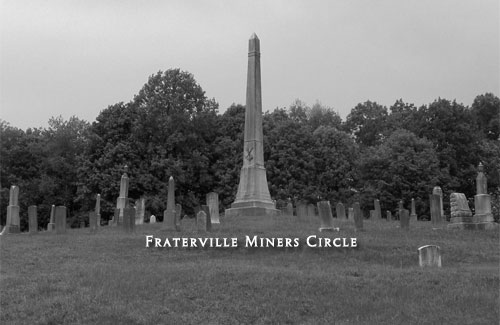
Fraterville, Tennessee Mine Disaster Victim Jacob Vowell’s farewell letter to his wife, Sarah Ellen Vowell
His son, Elbert died with him.
May 19, 1902
Ellen, darling, goodbye for us both. Elbert said the Lord has saved him. We are all praying for air to support us, but it is getting so bad without any air.
Ellen I want you to live right and come to heaven. Raise the children the best you can. Oh how I wish to be with you, goodbye. Bury me and Elbert in the same grave by little Eddie. Godbye Ellen, goodbye Lily, goodbye Jemmie, goodbye Horace. We are together. Is 25 minutes after two. There is a few of us alive yet.
Jake and Elbert
Oh God for one more breath. Ellen remember me as long as you live Goodbye darling.
Mary, Helen, Anna, Margaret, Ruth, John, William, James, George, Charles
US Life Expectancy
(1901) Males: 47.6 years, Females: 50.6 years
Firsts, Inventions and Wonders:
The United States Army Nurse Corps was established as a permanent part of the U.S. Army’s Medical Department, allowing women to join the US Army.
The Cadillac Motor Company was founded.
Founded in 1865, the US Secret Service was initially formed to combat (rampant) counterfeit currency. It wasn’t until 1901, after the assassination of President William McKinley, that their responsibilities broadened to presidential protection.
John Nordstrom opened his first retail store in 1901.
Aviation pioneer Gustave Whitehead flew a motor-powered aircraft in Connecticut. Many consider this the first manned, powered, controlled flight.
The College Board introduced its first standardized test, later becoming the Scholastic Assessment Test (SAT).
Nikola Tesla’s “Apparatus for the Utilization of Radiant Energy” was patented (#685,957).
The First Nobel Peace Prizes were awarded to Red Cross founder Jean Henri Dunant and peace activist Frederic Passy.
US Politics
March 4, 1901 (Monday): Second inauguration of William McKinley
September 14, 1901 (Saturday): First inauguration of Theodore Roosevelt
The Most Popular Singers and Artists of 1901 include
Joe Belmont, Arthur Collins, Emilio DeGogorza, Will Denny, S.H. Dudley, George J. Gaskin, The Georgia Minstrel Company, The Gilmore’s Band, Billy Golden, Byran G. Harlan, Mina Hickman, Silas Leachman, Harry Macdonough, J.W. Meyers, Vess Ossman, Dan Quinn, John Philip Sousa’s Band, Len Spencer, Cal Stewart
Pop Culture Facts & History
The world’s longest burning light bulb was turned on in 1901, at Fire Station No. 6 in Livermore, CA, and has been working, last we heard.
Sixty-nine coal miners at the Wellington Colliery Company, near Cumberland, British Columbia, were killed in an explosion.
Since Abraham Lincoln’s first burial in 1865, his coffin has been moved 17 times and opened six times. On the last time the coffin was opened (1901), reports say his face was still recognizable.
The last Passenger Pigeon in the wild was shot in 1901. The previous in captivity, Martha, died in the Cincinnati Zoo on September 1, 1914.
Things you taste are spread throughout your whole mouth, and the idea that you taste sweet or sour on different areas of the tongue is based on a misinterpretation of one experiment in 1901, Zur Psychophysik des Geschmackssinnes, by German scientist David P Hänig.
Charlotte Anne Moberly and Eleanor Jourdain claimed to have traveled back in time while in the Palace of Versailles, seeing 18th-century gardens and Marie Antoinette.
The first known person ever to go over Niagara Falls in a barrel and survive was Annie Taylor on October 24, 1901.
Teddy Roosevelt presented his “Controlling the Trusts” speech to Congress on December 3, 1901. In the speech, he asked Congress to curb the corporation’s power to “within reasonable limits.”
The Year 2038 Problem is that because of the way that many computer systems (32-bit) track time, they cannot go past January 19, 2038, and will instead go back to 1901.
The Horrible
Blanche Monnier (1849–1913) was held captive by her mother for over 24 years before she was rescued by police in 1901. Her mother disapproved of the man she wanted to marry in 1874.
The assassination of President William McKinley on September 6, 1901, at the Pan-American Exposition in Buffalo, NY.
The Quote
“The role of a newspaper, however, is not limited solely to the dissemination of ideas, to political education, and to the enlistment of political allies. A newspaper is not only a collective propagandist and a collective agitator, it is also a collective organizer.”
– Vladimir Lenin
Predictions for America in 2001
There will be no “C,” “B,” or “Q” in our alphabet.
There will be no more flies or mosquitoes.
Strawberries will be as large as Apples.
University Education will be free for everybody.
Trains will go 150 miles per hour.
Rats and Mice will be exterminated, and Horses will be nearly extinct.
Ready-cooked meals will be available by walk-in or car.
Nobel Prize Winners
Physics – Wilhelm Conrad Röntgen
Chemistry – Jacobus Henricus van ‘t Hoff
Medicine – Emil Adolf von Behring
Literature – Sully Prudhomme
Peace – Jean Henri Dunant and Frédéric Passy
Popular and Best-selling Books From 1901
Fiction Bestsellers
1. The Crisis by Winston Churchill
2. Alice of Old Vincennes by Maurice Thompson
3. The Helmet of Navarre by Bertha Runkle
4. The Right of Way by Gilbert Parker
5. Eben Holden by Irving Bacheller
6. The Visits of Elizabeth by Elinor Glyn
7. The Puppet Crown by Harold MacGrath
8. Richard Yea-and-Nay by Maurice Hewlett
9. Graustark by George Barr McCutcheon
10. D’ri and I by Irving Bacheller
Other Books of Note
The Octopus by Frank Norris Social Control by E. A. Ross Up from Slavery by Booker T. Washington Man and Superman by George Bernard Shaw New Epoch for Faith by George A. Gordon Kim by Rudyard Kipling
Sports
American League Baseball Champions: Chicago White Sox
National League Baseball Champions: Pittsburg Pirates
Challenge Cup Champs: Montreal Shamrocks
U.S. Open Golf: Willie Anderson
U.S. Tennis (Men/Ladies): William Larned/Elisabeth Moore
Wimbledon (Men/Women): Arthur Gore/Charlotte Sterry
NCAA Football Champions: Michigan
Kentucky Derby Winner: His Eminence
Boston Marathon Winner: John “Jack” Caffery Time: 2:29:23
Transatlantic Radio Transmission by Guglielmo Marconi
The first transatlantic radio transmission by Guglielmo Marconi is a significant milestone in the history of wireless communication. This achievement paved the way for modern radio, television, and telecommunications systems.
Details:
In 1895, Italian inventor Guglielmo Marconi successfully demonstrated the first wireless telegraphy.
On December 12, 1901, Marconi achieved the first transatlantic radio transmission between Poldhu, Cornwall, England, and Signal Hill, St. John’s, Newfoundland, Canada, a distance of about 2,200 miles (3,540 km).
The transmission sent by Marconi was Morse code for the letter “S” (three short dots).
Marconi initially struggled to find investors and support for his experiments, so he moved to England to continue his work.
Marconi’s early radio devices were referred to as “wireless telegraphs” because they could send Morse code signals without wires.
Marconi’s mother, Annie Jameson, was from a prominent Irish family that owned the Jameson Whiskey distillery.
Marconi shared the 1909 Nobel Prize in Physics with Karl Ferdinand Braun for their contributions to the development of wireless telegraphy.
In 1912, the Titanic disaster highlighted the importance of radio communication, as the ship could send distress signals via Marconi’s wireless telegraphy system.
Marconi’s invention was initially met with skepticism, as many scientists believed that radio waves could only travel in straight lines and would not follow Earth’s curvature.
Marconi’s early experiments involved using kites and balloons to elevate antennas for better signal reception.
Effects on Pop Culture:
The success of Marconi’s transatlantic transmission led to the widespread adoption of radio technology, impacting news, entertainment, and communication.
Radio broadcasting became a popular form of entertainment in the 1920s and 1930s, with families gathering around their radio sets to listen to music, news, and radio dramas.
The invention of the transistor in 1947 made portable radios more accessible, further integrating radio into everyday life.
Prominent People and Countries:
Guglielmo Marconi was crucial in developing and popularizing wireless telegraphy and radio communication.
England and Canada were the two countries directly involved in the first transatlantic radio transmission, with the signal sent from Cornwall, England, to St. John’s, Newfoundland, Canada.
Marconi’s achievements inspired a new generation of inventors, scientists, and engineers to further develop radio and telecommunications technology.
January 1 – Commonwealth of Australia Formed: Australia officially became a federation, uniting six colonies under one constitution.
February 5 – United States and Britain Sign Hay-Pauncefote Treaty: This agreement laid the groundwork for U.S. control over the construction of the Panama Canal.
February 27 – Labour Party Founded in the UK: The Labour Representation Committee (later the Labour Party) was established to represent working-class interests.
March 6 – German Empire Adopts Naval Expansion: The Second Naval Law passed, significantly increasing Germany’s naval fleet under Kaiser Wilhelm II.
May 18 – Second Boer War Intensifies: British troops lifted the siege of Mafeking in South Africa, marking a turning point in the war.
June 2 – Zeppelin LZ1 Makes Its Maiden Flight: The first successful flight of Count Zeppelin’s airship took place in Germany, revolutionizing aviation.
June 20 – Boxer Rebellion Peaks in China: The Siege of the International Legations in Beijing began, as anti-foreigner sentiment culminated in violent uprisings.
July 29 – King Umberto I of Italy Assassinated: Anarchist Gaetano Bresci killed the king in Monza, sparking political unrest in Italy.
August 14 – Allied Forces Capture Beijing: Eight-Nation Alliance troops entered Beijing, ending the Boxer Rebellion.
September 8 – Galveston Hurricane Strikes: The deadliest natural disaster in U.S. history devastated Galveston, Texas, killing an estimated 6,000-12,000 people.
September 17 – Commonwealth of Australia’s First Governor-General Appointed: Lord Hopetoun was sworn in, formalizing Australia’s new government.
October 19 – Max Planck Presents Quantum Theory: The German physicist introduced his groundbreaking work on quantum mechanics, changing the field of physics.
November 6 – William McKinley Re-Elected U.S. President: McKinley defeated William Jennings Bryan in a landslide victory.
November 30 – Oscar Wilde Dies: The famous Irish writer and playwright passed away in Paris at the age of 46.
December 14 – First Mercedes Automobile Produced: Daimler-Motoren-Gesellschaft unveiled the first Mercedes car, a milestone in automotive history.
December 25 – Hurricane in Western Australia: A tropical cyclone caused massive destruction in the town of Onslow, leaving hundreds homeless.
Kodak Brownie Camera Released: The affordable camera popularized amateur photography and brought it into the mainstream.
Discovery of Radium: Marie and Pierre Curie isolated radium, paving the way for advances in science and medicine.
Paris Exposition Universelle: This world’s fair showcased technological innovation, including the debut of escalators and talking films.
Rise of American Imperialism: Following the Spanish-American War, the U.S. annexed territories like Puerto Rico, Guam, and the Philippines, signaling its growing global influence.
Top Ten Baby Names of 1900
Mary, Helen, Anna, Margaret, Ruth, John, William, James, George, Charles
US Life Expectancy
Males: 46.3 years, Females: 48.3 years
Firsts, Inventions and Wonders
On January 18, author L. Frank Baum and illustrator W. W. Denslow joint copyrighted their new book- The Land of Oz. It was released as The Wonderful Wizard of Oz on May 12.
Veterans of Foreign Wars was founded on September 29, 1899
King Oscar II of Sweden approved the creation of the Nobel Foundation, funded by the 1895 Will of Alfred Nobel. The first Nobel Prize awards were made by the foundation in 1901.
The Eastman Kodak Company introduced the Brownie camera, priced at $1.00.
The founding brothers of Michelin Tires started the Michelin Guide in 1900 when they decided that a rating guide (Michelin Stars) for hotels and restaurants would compel the limited number of drivers to use up and buy more of their tires.
Nipper, the RCA Victor dog, was registered as a trademark and became one of the advertising icons of the 20th century. The dog belonged to Francis Barraud, whose painting His Master’s Voice showed the animal listening to a gramophone.
The International Ladies’ Garment Workers’ Union (ILGWU) was founded in New York.
Harvey Firestone established the Firestone Tire & Rubber Company as an automobile tire supply store in Akron, Ohio. He started making tires about three years later.
The Most Popular Singers and Artists of 1900
Albert Cambell, Arthur Collins, Edward M. Favor, George J. Gaskin, The Hayden Quartet, Harry Macdonough, Jere Mahoney, J.W. Meyers, Voss Ossman, Steve Porter, Dan Quinn, Len Spencer
Pop Culture Facts & History
Dwight F. Davis, President of the United States Lawn Tennis Association, announced the creation of a silver cup for whoever won the international tennis championship. It is now known as The Davis Cup.
Guglielmo Marconi was awarded a British patent (#7,777) for his wireless radio.
Robert Leroy Parker (aka Butch Cassidy), Harry Longabaugh (aka The Sundance Kid), and other members of “The Wild Bunch” staged their third train robbery, taking control of Union Pacific train No. 3 at Tipton, Wyoming, robbing the express car of $45,000 and successfully escaping.
The Paris World Exhibition (Exposition Universelle of 1900) World’s Fair occurred between April 14 and November 12.
The American League’s eight teams for the inaugural 1900 season were the Buffalo Bisons, Chicago White Sox, Cleveland Blues, Detroit Tigers, Indianapolis Indians, Kansas City Blues, Milwaukee Brewers, and the Minneapolis Millers.
The Union Cycliste Internationale (UCI), the controlling body for bicycling events around the world, was founded in Aigle, Switzerland.
Nikola Tesla received a patent (#645,576) for ‘wireless transmission of electrical power’ – the first in a series of patents for sending “industrially significant amounts of power” from one station to another without electrical wires.
The first book of stamps in the United States was placed on sale in American post offices in packs of 12,24 and 48 2-cent stamps.
Willis L. Moore, Chief of the US Weather Bureau, issued the first workplace smoking ban. “The smoking of cigarettes in the offices of the Weather Bureau is hereby prohibited. Officials in charge of stations will rigidly enforce this order, and will also include in their semiannual confidential reports information about those of their assistants who smoke cigarettes outside of office hours.”
The 1900 Census counted 76,295,220 people living in the United States and Territories.
John Luther “Casey” Jones was driving a passenger train from Memphis to Canton, Mississippi, when he encountered two stalled freight trains on the main track at Vaughn, Mississippi, ahead of his. Unable to avoid a collision, Casey Jones slowed the train enough that he was the only fatality in the accident.
The Patent (#646,375) was granted to William Abner Eddy for the ‘Eddy kite’ – the standard basic kite design we use today.
The Associated Press (AP) was incorporated as a New York corporation.
The vaudeville team of Joe and Myra Keaton was appearing at a matinee show at the Wonderland Theater in Wilmington, Delaware, and their 5-year-old son, Buster, joined the act. He later became one of the first silent film stars.
The largest banquet in history was held at the Tuileries Gardens when French President Émile Loubet treated the 22,695 mayors of all French cities.
A hurricane struck Galveston, Texas, causing the worst natural disaster in American history, with 8-12,000 people killed.
Popular and Best-selling Books From 1900
Fiction Bestsellers
1. To Have and To Hold by Mary Johnston
2. Red Pottage by Mary Cholmondeley
3. Unleavened Bread by Robert Grant
4. The Reign of Law by James Lane Allen
5. Eben Holden by Irving Bacheller
6. Janice Meredith by Paul Leicester Ford
7. The Redemption of David Corson by Charles Frederic Goss
8. Richard Carvel by Winston Churchill
9. When Knighthood Was in Flower by Charles Majo
10. Alice of Old Vincennes by Maurice Thompson
Other Books of Note
The World and the Individual by Josiah Royce An American Anthology by Clarence Stedman Sister Carrie by Theodore Dreiser The Interpretation of Dreams by Sigmund Freud The Wonderful Wizard of Oz by L. Frank Baum Lord Jim by Joseph Conrad The School and Society by John Dewey
1900 United States Census
Total US Population: 76,212,168
1. New York, New York – 3,437,202
2. Chicago, Illinois – 1,698,575
3. Philadelphia, Pennsylvania – 1,293,697
4. St. Louis, Missouri – 575,238
5. Boston, Massachusetts – 560,892
6. Baltimore, Maryland – 508,957
7. Cleveland, Ohio – 391,768
8. Buffalo, New York 352,387
9. San Francisco, California – 342,782
10. Cincinnati, Ohio – 325,902
Sports
National League Baseball Champions: Brooklyn Superbas
Challenge Cup Champs: Montreal Shamrocks
U.S. Open Golf: Harry Varden
U.S. Tennis (Men/Ladies): Malcolm Whitman/Myrtle McAteer
Wimbledon (Men/Women): Reginald Doherty/Blanche Hillyard
NCAA Football Champions: Yale
Kentucky Derby Winner: Lieutenant Gibson
Boston Marathon Winner: 1900 John “Jack” Caffery Time: 2:39:44
Tug of War was an Olympic event between 1900 and 1920.
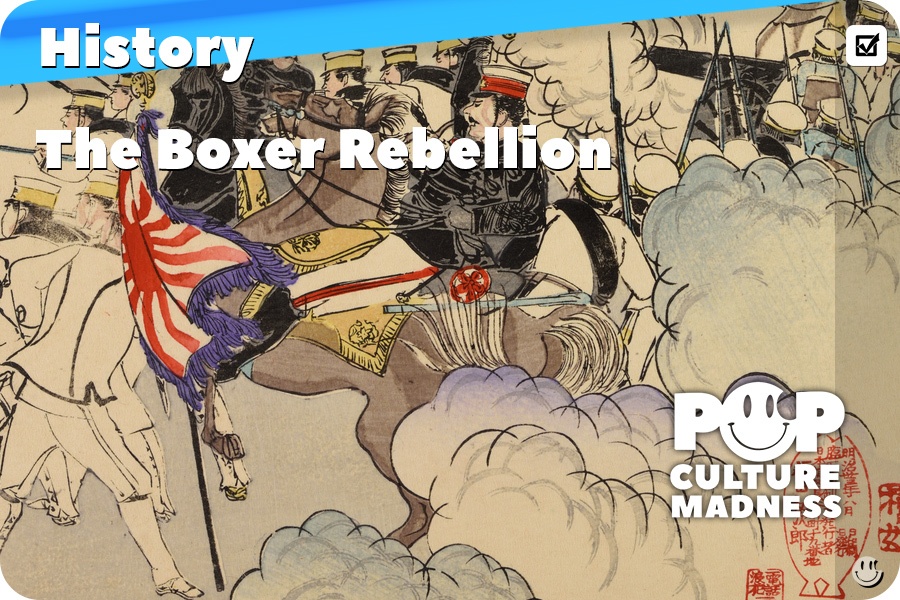
The Boxer Rebellion of 1900 is one of the most significant events in Chinese history. Also known as the “Boxer Uprising,” this event primarily occurred because of a secret Chinese society named “Society of the Righteous and Harmonious Fists.” The society was responsible for stirring an uprising in northern China due to the rising Japanese and Western influence in the area.
The members of the society were referred to as “Boxers” because they were physical fighters and took pride in their fitness and exercise routine. They eventually also killed local Christians and foreigners, along with destroying foreign property. In the three months leading to the uprising (June to August), the Boxers besieged Beijing’s foreign district until international troops intervened. Even though the rebellion ended in 1901, China paid over $300 million as compensation.
However, it’s important to understand all the events that led to a rebellion of this caliber. It all started towards the end of the 19th century when Japanese and Western powers had forcefully overtaken the country’s economic affairs. Earlier, in the mid19th century, the Opium and Sino-Japanese Wars had also brought China down to its knees due to a lack of trained military.
Interestingly, the money China paid to America in reparations was also eventually returned on the condition that they’ll use the money to create a university in the Chinese capital. However, things took a turn for the worse when the secret Society of Righteous and Harmonious Fists started attacking Christians and foreigners during the late 1890s.
The boxers were mainly peasants from the impoverished Shandong province, which had been in the grip of flooding and famine for years. Their living conditions were also part of the reason the group chose violence against foreigners in the country. The Chinese government giving commercial and territorial concessions to the Europeans might be a contributing factor.
By 1900, the movement had taken its hold on Beijing, where many Christian missionaries were killed and churches destroyed. The siege went on for weeks until Japan and some Western nations decided to intervene through their own forces. Many diplomats also suffered in the war as they survived in hunger to keep the boxers fighting.
According to some estimates, thousands of Chinese Christians and foreigners were killed during the siege. By the 14th of August, international troops from over eight countries came in to rescue the victims.
On September 7, 1901, the war finally ended as the Boxer Protocol was signed. As per the agreement, the members of the group, along with the government officials involved, were to be arrested and punished and foreign embassies were to have personal security in Beijing. As a consequence, China could not import arms for over two years, and during this time, the country paid millions in reparations.
Even though the Boxers weren’t entirely successful, they did manage to bring the ruling Qing dynasty down. As a result, China finally adopted a republic status in 1912.
The Russian Social Democratic Labour Party (RSDLP) was a revolutionary socialist political party in the Russian Empire active in the early 20th century. The party played a significant role in the Russian Revolution and eventually split into two factions: the Bolsheviks and the Mensheviks. The Bolshevik faction, led by Vladimir Lenin, went on to form the Communist Party of the Soviet Union.
Dates and Details:
The RSDLP was founded in Minsk, Belarus, in 1898 during a secret congress of Russian social democrats.
In 1903, the party split into two factions at its Second Congress held in London, England: the Bolsheviks (meaning “majority”) led by Vladimir Lenin, and the Mensheviks (meaning “minority”), led by Julius Martov.
RSDLP Facts:
The RSDLP sought to overthrow the Tsarist autocracy and establish a democratic socialist state in Russia.
The party’s program was heavily influenced by the theories of Karl Marx and Friedrich Engels, particularly the idea of class struggle and the dictatorship of the proletariat.
Lenin’s faction, the Bolsheviks, believed in a small, disciplined party of professional revolutionaries, while the Mensheviks advocated for a larger, more democratic party with mass membership.
The RSDLP was initially clandestine, operating underground due to the repressive political environment in the Russian Empire.
During the Russian Revolution of 1905, the RSDLP played a key role in organizing strikes, protests, and uprisings against the Tsarist regime.
In 1912, the RSDLP formally split into two separate parties: the Russian Social Democratic Labour Party (Bolsheviks) and the Russian Social Democratic Labour Party (Mensheviks).
The Bolshevik faction of the RSDLP eventually became the Communist Party of the Soviet Union, which ruled the Soviet Union until its collapse in 1991.
Effects on Pop Culture:
The RSDLP and its factions, particularly the Bolsheviks, have been portrayed in various movies, novels, and plays depicting the Russian Revolution and the rise of the Soviet Union.
The party’s history has also inspired numerous academic studies, biographies, and documentaries.
Prominent People and Countries:
Key figures in the RSDLP included Vladimir Lenin, Julius Martov, Leon Trotsky, and Joseph Stalin.
The RSDLP had a significant impact on Russia and the Russian Empire, as the Bolshevik faction ultimately led to the creation of the Soviet Union, which was a major global power throughout the 20th century.
The party and its split into Bolsheviks and Mensheviks have been the subject of much debate and analysis among historians, political scientists, and other scholars.
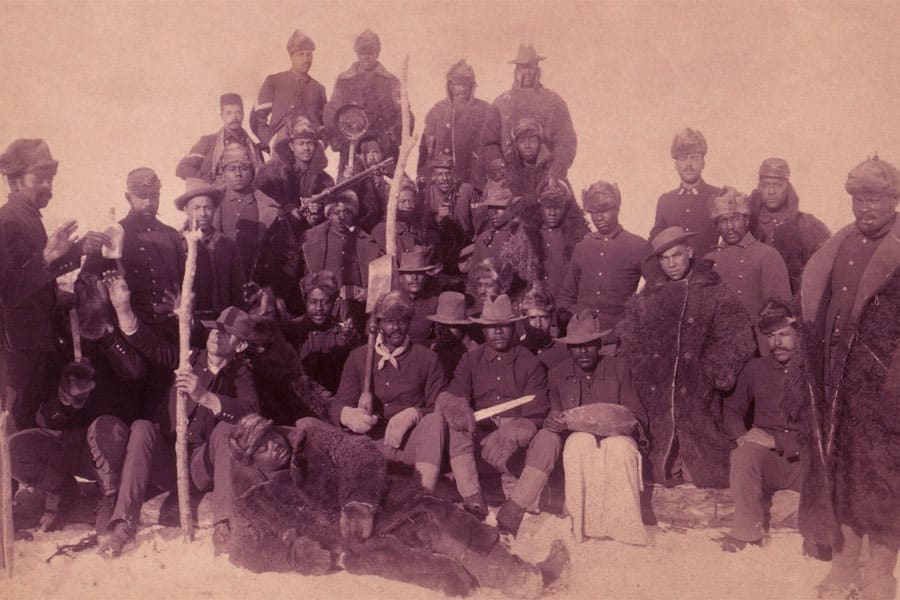
The U.S. Army ‘Buffalo Soldiers’ Took a 1,900-mile Bicycle Trek to St. Louis
The Buffalo Soldiers were originally the 10th Cavalry Regiment of the US Army, founded in 1864 in Buffalo, New York, USA, in response to the Civil War. While several African American regiments were part of the Union Army during the Civil War, including the 1st, 2nd, 3rd, 4th, 5th and 6th Colored Cavalry, the Buffalo Soldier was created by Congress in 1865.
Native American tribes who fought in the Indian Wars were nicknamed the Black Cavalry by the Indians of the American Indian Reservation, who had participated in a number of battles against the US Army during the Civil War, such as the Battle of Buffalo.
On June 14, 1897, Lt. James Moss led his bicycle corps from Fort Missoula, Montana, through a wagon trail and Indian path, arriving in St. Louis on July 16, 1897.
The 25th Infantry US Army soldiers cycled 1,900 miles from St. Louis to the Indian Reservation in the western United States in 1864, the year after the Battle of Buffalo. The 20 soldiers who took part in the trip were part of a racially segregated group known as the Buffalo Soldiers. The term referred to black soldiers serving west of Mississippi in regiments established by that regiment between 1866 and the end of the Civil War.
The trip was followed in newspapers across the country, and in 1897 there was a story about it in the summer. I was embedded as a newspaperman and visited all five states and followed the journey with newspapers from all over the country.
American soldiers reportedly had difficulty using their bikes during the war. They took the trek to test the use of bicycles before the practice became more common in the United States during World War I and the Civil War.
Lieutenant James Moss demonstrated the potential of bicycles by taking eight soldiers on a three-day training trip from Buffalo to Lake Erie and back. The training consisted of a 40-mile ride through an obstacle course, which included a nine-foot fence that the men had to overcome by leaning the bike against the fence, standing on its seat, climbing over it, and then moving it up and down. Moss began his first bike ride in the US Army at the age of 18.
Success encouraged him and he ventured out on his own in March 2009 on his first bike ride in the US Army.
Some local farmers gave wrong directions. had to scrape the mud he called “Black Gumbo” from tires with a butter knife.
Runaway, uncontrolled, unstoppable acceleration was the order of the day, and the bicycle convoy passed through farms and small towns at regular intervals. Men pushed their bikes through snow, rocks, and ruts, blocked streams, crossed mountain ranges, suffered from heat, cold, hunger and lack of sleep. They suffered the worst effects of drinking alkaline water and soon realized that the spoon brake on their bicycles could not cope with the eastern slopes of Helena, Montana. They experienced searing heat and a ride along the railway tracks that numbed their hands.
Occasionally, farmers would let the men stay on their land, give them something fresh to eat, or simply ask questions. When a civilian asked a man: “Where are you going today? “And he said,” I’m on my way home.
Although the trip was a success, the soldiers had to deal with harsh conditions in their five-country travels. In June, a snowstorm in the Rocky Mountains brought 11 inches of snow to riders. On the other side of the ice, soldiers from Nebraska hit a sweltering 110 degrees. An ice storm hampered progress, and some soldiers’ hands froze on the handlebars and ice stuck to chains.
Although the trip was considered a success, it was slowed down by the Spanish-American War, which began a year after her trip.
The Klondike Gold Rush was a period of intense gold mining activity in the Yukon Territory of northwestern Canada, following the discovery of gold in the Klondike region in 1896. The gold rush attracted tens of thousands of prospectors, leading to a rapid population boom in the region and the establishment of the city of Dawson. The Klondike Gold Rush had significant social and economic impacts on the region and has since become an enduring symbol of adventure, perseverance, and fortune-seeking.
Dates and Details:
Local miners George Carmack, Skookum Jim, and Dawson Charlie discovered gold in the Klondike region on August 16, 1896.
The Klondike Gold Rush began in earnest in 1897 when news of the discovery reached the United States, with the first wave of prospectors arriving in the region in the summer of that year.
The gold rush lasted until around 1899 when gold discoveries in Nome, Alaska, lured prospectors away from the Klondike.
Klondike Gold Rush Facts:
An estimated 100,000 people set off for the Klondike during the gold rush, but only around 30,000 to 40,000 made it to the goldfields.
The most famous routes to the Klondike goldfields were the Chilkoot Trail and the White Pass, which were incredibly difficult and treacherous.
Prospectors were required to bring a year’s food supply to the Klondike, as mandated by the Canadian government, which often amounted to over a ton of provisions per person.
Dawson City, the main settlement in the Klondike region, saw its population grow from around 500 in 1896 to more than 30,000 at the height of the gold rush in 1898.
The Klondike Gold Rush is responsible for the popular phrase “Klondike or bust,” which originated from a sign displayed by a prospector in the 1890s.
The Klondike Gold Rush is estimated to have produced about 12.5 million ounces (350,000 kilograms) of gold, worth more than $18 billion at today’s prices.
Effects on Pop Culture:
The Klondike Gold Rush has inspired numerous books, films, television shows, and other works of art, including Jack London’s “The Call of the Wild” and “White Fang,” and Charlie Chaplin’s silent film “The Gold Rush.”
The gold rush has become an enduring symbol of adventure and the pursuit of wealth, influencing the popular perception of the rugged, independent prospector.
Klondike Gold Rush-related tourism, including historical sites, museums, and tours, remains a significant industry in the Yukon Territory.
Prominent People and Countries:
George Carmack, Skookum Jim, and Dawson Charlie, the trio who discovered gold in the Klondike, played a crucial role in sparking the gold rush.
The Klondike Gold Rush primarily attracted prospectors from the United States and Canada, but people from other countries, including the United Kingdom, Australia, and Europe, also participated.
The gold rush significantly impacted the economy and infrastructure of Canada and the United States, as the influx of prospectors and gold led to increased investment and development in the region.
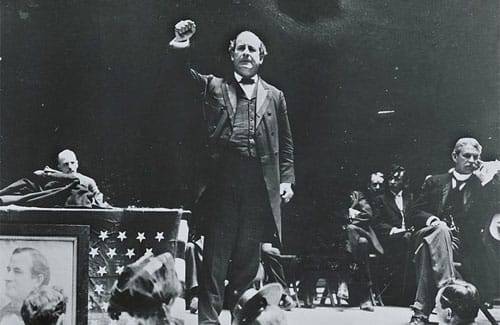
The Cross of Gold Speech
Delivered by William Jennings Bryan, at the Democratic National Convention, in Chicago on July 9, 1896.
I would be presumptuous, indeed, to present myself against the distinguished gentlemen to whom you have listened if this were but a measuring of ability; but this is not a contest among persons. The humblest citizen in all the land when clad in the armor of a righteous cause is stronger than all the whole hosts of error that they can bring. I come to speak to you in defense of a cause as holy as the cause of liberty—the cause of humanity. When this debate is concluded, a motion will be made to lay upon the table the resolution offered in commendation of the administration and also the resolution in condemnation of the administration. I shall object to bringing this question down to a level of persons. The individual is but an atom; he is born, he acts, he dies; but principles are eternal; and this has been a contest of principle.
Never before in the history of this country has there been witnessed such a contest as that through which we have passed. Never before in the history of American politics has a great issue been fought out as this issue has been by the voters themselves.
On the 4th of March, 1895, a few Democrats, most of them members of Congress, issued an address to the Democrats of the nation asserting that the money question was the paramount issue of the hour; asserting also the right of a majority of the Democratic Party to control the position of the party on this paramount issue; concluding with the request that all believers in free coinage of silver in the Democratic Party should organize and take charge of and control the policy of the Democratic Party. Three months later, at Memphis, an organization was perfected, and the silver Democrats went forth openly and boldly and courageously proclaiming their belief and declaring that if successful they would crystallize in a platform the declaration which they had made; and then began the conflict with a zeal approaching the zeal which inspired the crusaders who followed Peter the Hermit. Our silver Democrats went forth from victory unto victory, until they are assembled now, not to discuss, not to debate, but to enter up the judgment rendered by the plain people of this country.
But in this contest, brother has been arrayed against brother, and father against son. The warmest ties of love and acquaintance and association have been disregarded. Old leaders have been cast aside when they refused to give expression to the sentiments of those whom they would lead, and new leaders have sprung up to give direction to this cause of freedom. Thus has the contest been waged, and we have assembled here under as binding and solemn instructions as were ever fastened upon the representatives of a people.
We do not come as individuals. Why, as individuals we might have been glad to compliment the gentleman from New York [Senator Hill], but we knew that the people for whom we speak would never be willing to put him in a position where he could thwart the will of the Democratic Party. I say it was not a question of persons; it was a question of principle; and it is not with gladness, my friends, that we find ourselves brought into conflict with those who are now arrayed on the other side. The gentleman who just preceded me [Governor Russell] spoke of the old state of Massachusetts. Let me assure him that not one person in all this convention entertains the least hostility to the people of the state of Massachusetts.
But we stand here representing people who are the equals before the law of the largest cities in the state of Massachusetts. When you come before us and tell us that we shall disturb your business interests, we reply that you have disturbed our business interests by your action. We say to you that you have made too limited in its application the definition of a businessman. The man who is employed for wages is as much a businessman as his employer. The attorney in a country town is as much a businessman as the corporation counsel in a great metropolis. The merchant at the crossroads store is as much a businessman as the merchant of New York. The farmer who goes forth in the morning and toils all day, begins in the spring and toils all summer, and by the application of brain and muscle to the natural resources of this country creates wealth, is as much a businessman as the man who goes upon the Board of Trade and bets upon the price of grain. The miners who go 1,000 feet into the earth or climb 2,000 feet upon the cliffs and bring forth from their hiding places the precious metals to be poured in the channels of trade are as much businessmen as the few financial magnates who in a backroom corner the money of the world.
We come to speak for this broader class of businessmen. Ah. my friends, we say not one word against those who live upon the Atlantic Coast; but those hardy pioneers who braved all the dangers of the wilderness, who have made the desert to blossom as the rose—those pioneers away out there, rearing their children near to nature’s heart, where they can mingle their voices with the voices of the birds—out there where they have erected schoolhouses for the education of their children and churches where they praise their Creator, and the cemeteries where sleep the ashes of their dead—are as deserving of the consideration of this party as any people in this country.
It is for these that we speak. We do not come as aggressors. Our war is not a war of conquest. We are fighting in the defense of our homes, our families, and posterity. We have petitioned, and our petitions have been scorned. We have entreated, and our entreaties have been disregarded. We have begged, and they have mocked when our calamity came.
We beg no longer; we entreat no more; we petition no more. We defy them!
The gentleman from Wisconsin has said he fears a Robespierre. My friend, in this land of the free you need fear no tyrant who will spring up from among the people. What we need is an Andrew Jackson to stand as Jackson stood, against the encroachments of aggregated wealth.
They tell us that this platform was made to catch votes. We reply to them that changing conditions make new issues; that the principles upon which rest Democracy are as everlasting as the hills; but that they must be applied to new conditions as they arise. Conditions have arisen and we are attempting to meet those conditions. They tell us that the income tax ought not to be brought in here; that is not a new idea. They criticize us for our criticism of the Supreme Court of the United States. My friends, we have made no criticism. We have simply called attention to what you know. If you want criticisms, read the dissenting opinions of the Court. That will give you criticisms.
They say we passed an unconstitutional law. I deny it. The income tax was not unconstitutional when it was passed. It was not unconstitutional when it went before the Supreme Court for the first time. It did not become unconstitutional until one judge changed his mind; and we cannot be expected to know when a judge will change his mind.
The income tax is a just law. It simply intends to put the burdens of government justly upon the backs of the people. I am in favor of an income tax. When I find a man who is not willing to pay his share of the burden of the government which protects him, I find a man who is unworthy to enjoy the blessings of a government like ours.
He says that we are opposing the national bank currency. It is true. If you will read what Thomas Benton said, you will find that he said that in searching history he could find but one parallel to Andrew Jackson. That was Cicero, who destroyed the conspiracies of Cataline and saved Rome. He did for Rome what Jackson did when he destroyed the bank conspiracy and saved America.
We say in our platform that we believe that the right to coin money and issue money is a function of government. We believe it. We believe it is a part of sovereignty and can no more with safety be delegated to private individuals than can the power to make penal statutes or levy laws for taxation.
Mr. Jefferson, who was once regarded as good Democratic authority, seems to have a different opinion from the gentleman who has addressed us on the part of the minority. Those who are opposed to this proposition tell us that the issue of paper money is a function of the bank and that the government ought to go out of the banking business. I stand with Jefferson rather than with them, and tell them, as he did, that the issue of money is a function of the government and that the banks should go out of the governing business.
They complain about the plank which declares against the life tenure in office. They have tried to strain it to mean that which it does not mean. What we oppose in that plank is the life tenure that is being built up in Washington which establishes an office-holding class and excludes from participation in the benefits the humbler members of our society. . . .
Let me call attention to two or three great things. The gentleman from New York says that he will propose an amendment providing that this change in our law shall not affect contracts which, according to the present laws, are made payable in gold. But if he means to say that we cannot change our monetary system without protecting those who have loaned money before the change was made, I want to ask him where, in law or in morals, he can find authority for not protecting the debtors when the act of 1873 was passed when he now insists that we must protect the creditor. He says he also wants to amend this platform so as to provide that if we fail to maintain the parity within a year that we will then suspend the coinage of silver. We reply that when we advocate a thing which we believe will be successful we are not compelled to raise a doubt as to our own sincerity by trying to show what we will do if we are wrong.
I ask him, if he will apply his logic to us, why he does not apply it to himself. He says that he wants this country to try to secure an international agreement. Why doesn’t he tell us what he is going to do if they fail to secure an international agreement. There is more reason for him to do that than for us to expect to fail to maintain the parity. They have tried for thirty years—thirty years—to secure an international agreement, and those are waiting for it most patiently who don’t want it at all.
Now, my friends, let me come to the great paramount issue. If they ask us here why it is we say more on the money question than we say upon the tariff question, I reply that if protection has slain its thousands the gold standard has slain its tens of thousands. If they ask us why we did not embody all these things in our platform which we believe, we reply to them that when we have restored the money of the Constitution, all other necessary reforms will be possible, and that until that is done there is no reform that can be accomplished.
Why is it that within three months such a change has come over the sentiments of the country? Three months ago, when it was confidently asserted that those who believed in the gold standard would frame our platforms and nominate our candidates, even the advocates of the gold standard did not think that we could elect a President; but they had good reasons for the suspicion, because there is scarcely a state here today asking for the gold standard that is not within the absolute control of the Republican Party.
But note the change. Mr. McKinley was nominated at St. Louis upon a platform that declared for the maintenance of the gold standard until it should be changed into bimetallism by an international agreement. Mr. McKinley was the most popular man among the Republicans ; and everybody three months ago in the Republican Party prophesied his election. How is it today? Why, that man who used to boast that he looked like Napoleon, that man shudders today when he thinks that he was nominated on the anniversary of the Battle of Waterloo. Not only that, but as he listens he can hear with ever increasing distinctness the sound of the waves as they beat upon the lonely shores of St. Helena.
Why this change? Ah, my friends. is not the change evident to anyone who will look at the matter? It is because no private character, however pure, no personal popularity, however great, can protect from the avenging wrath of an indignant people the man who will either declare that he is in favor of fastening the gold standard upon this people, or who is willing to surrender the right of self-government and place legislative control in the hands of foreign potentates and powers. . . .
We go forth confident that we shall win. Why? Because upon the paramount issue in this campaign there is not a spot of ground upon which the enemy will dare to challenge battle. Why, if they tell us that the gold standard is a good thing, we point to their platform and tell them that their platform pledges the party to get rid of a gold standard and substitute bimetallism. If the gold standard is a good thing, why try to get rid of it? If the gold standard, and I might call your attention to the fact that some of the very people who are in this convention today and who tell you that we ought to declare in favor of international bimetallism and thereby declare that the gold standard is wrong and that the principles of bimetallism are better—these very people four months ago were open and avowed advocates of the gold standard and telling us that we could not legislate two metals together even with all the world.
I want to suggest this truth, that if the gold standard is a good thing we ought to declare in favor of its retention and not in favor of abandoning it; and if the gold standard is a bad thing, why should we wait until some other nations are willing to help us to let it go?
Here is the line of battle. We care not upon which issue they force the fight. We are prepared to meet them on either issue or on both. If they tell us that the gold standard is the standard of civilization, we reply to them that this, the most enlightened of all nations of the earth, has never declared for a gold standard, and both the parties this year are declaring against it. If the gold standard is the standard of civilization, why, my friends, should we not have it? So if they come to meet us on that, we can present the history of our nation. More than that, we can tell them this, that they will search the pages of history in vain to find a single instance in which the common people of any land ever declared themselves in favor of a gold standard. They can find where the holders of fixed investments have.
Mr. Carlisle said in 1878 that this was a struggle between the idle holders of idle capital and the struggling masses who produce the wealth and pay the taxes of the country; and my friends, it is simply a question that we shall decide upon which side shall the Democratic Party fight. Upon the side of the idle holders of idle capital, or upon the side of the struggling masses? That is the question that the party must answer first; and then it must be answered by each individual hereafter. The sympathies of the Democratic Party, as described by the platform, are on the side of the struggling masses, who have ever been the foundation of the Democratic Party.
There are two ideas of government. There are those who believe that if you just legislate to make the well-to-do prosperous, that their prosperity will leak through on those below. The Democratic idea has been that if you legislate to make the masses prosperous their prosperity will find its way up and through every class that rests upon it.
You come to us and tell us that the great cities are in favor of the gold standard. I tell you that the great cities rest upon these broad and fertile prairies. Burn down your cities and leave our farms, and your cities will spring up again as if by magic. But destroy our farms and the grass will grow in the streets of every city in the country.
My friends, we shall declare that this nation is able to legislate for its own people on every question without waiting for the aid or consent of any other nation on earth, and upon that issue we expect to carry every single state in the Union.
I shall not slander the fair state of Massachusetts nor the state of New York by saying that when citizens are confronted with the proposition, “Is this nation able to attend to its own business?”—I will not slander either one by saying that the people of those states will declare our helpless impotency as a nation to attend to our own business. It is the issue of 1776 over again. Our ancestors, when but 3 million, had the courage to declare their political independence of every other nation upon earth. Shall we, their descendants, when we have grown to 70 million, declare that we are less independent than our forefathers? No, my friends, it will never be the judgment of this people. Therefore, we care not upon what lines the battle is fought. If they say bimetallism is good but we cannot have it till some nation helps us, we reply that, instead of having a gold standard because England has, we shall restore bimetallism, and then let England have bimetallism because the United States have.
If they dare to come out in the open field and defend the gold standard as a good thing, we shall fight them to the uttermost, having behind us the producing masses of the nation and the world. Having behind us the commercial interests and the laboring interests and all the toiling masses, we shall answer their demands for a gold standard by saying to them, you shall not press down upon the brow of labor this crown of thorns. You shall not crucify mankind upon a cross of gold.
Death of Russian composer Pyotr Ilyich Tchaikovsky
Pyotr Ilyich Tchaikovsky, a renowned Russian composer of the Romantic era, left a lasting legacy in classical music. Known for his ballets, symphonies, operas, and chamber music, Tchaikovsky’s life and untimely death have been the subject of much speculation and intrigue.
Dates: Tchaikovsky was born on May 7, 1840, and died on November 6, 1893.
Details: Tchaikovsky’s death has been the subject of numerous theories and speculation. The official cause of his death was reported as cholera, contracted after drinking a glass of unboiled water during an epidemic in St. Petersburg. However, some scholars have suggested that his death may have resulted from suicide, possibly due to personal or professional pressures, or even as the outcome of a “court of honor” held by his former classmates to protect the reputation of the Russian nobility.
Trivial Facts: Tchaikovsky’s last work was Symphony No. 6, the “Pathétique.” This symphony was premiered just nine days before his death, and some have interpreted the piece as a musical reflection on the composer’s own life and impending death. There is also a rumor that Tchaikovsky’s last words were, “Ah, music, what a beautiful art! But what a wretched profession!”
Effects on Pop Culture: Tchaikovsky’s death sparked an outpouring of grief and tributes in Russia and internationally. His music continues to be celebrated and performed around the world, with pieces such as “The Nutcracker,” “Swan Lake,” and “1812 Overture” remaining popular and influential in the world of classical music and beyond. Tchaikovsky’s life and death have also inspired various films, novels, and plays that explore his complex personal life and the mystery surrounding his demise.
Prominent People: Tchaikovsky was part of a circle of influential Russian composers and musicians, including Modest Mussorgsky, Nikolai Rimsky-Korsakov, and Alexander Borodin, who were collectively known as “The Five” or “The Mighty Handful.” Tchaikovsky’s patroness, Nadezhda von Meck, played a significant role in his life, providing him with financial support and encouragement while maintaining an exclusively epistolary relationship.
Countries Involved: Tchaikovsky was a prominent figure in Russian culture, but his music and influence extended well beyond his homeland, gaining widespread recognition and appreciation in Europe, the United States, and other parts of the world.
Pyotr Ilyich Tchaikovsky, born in 1840, was a prominent Russian composer whose sudden death in 1893 has been a subject of speculation. Although officially attributed to cholera, alternative theories suggest suicide or forced death due to societal pressures. Tchaikovsky’s music has had a lasting impact on classical music and popular culture, with his works continuing to be performed and celebrated around the world.
One evening I was walking along a path, the city was on one side and the fjord below. I felt tired and ill. I stopped and looked out over the fjord – the sun was setting, and the clouds turning blood red. I sensed a scream passing through nature; it seemed to me that I heard the scream. I painted this picture, painted the clouds as actual blood. The color shrieked. This became The Scream.
I was walking along the road with two friends – the sun was setting – suddenly the sky turned blood red – I paused, feeling exhausted, and leaned on the fence – there was blood and tongues of fire above the blue-black fjord and the city – my friends walked on, and I stood there trembling with anxiety – and I sensed an infinite scream passing through nature
The Scream” is an iconic painting by the Norwegian artist Edvard Munch, known for its expressive style and emotional intensity. This famous work has had a lasting impact on both the art world and popular culture.
Dates: Munch created four versions of “The Scream” between 1893 and 1910. The first and most famous version was painted in 1893 using tempera and crayon on cardboard.
Details: “The Scream” depicts a figure with a distorted face and an open mouth, standing on a bridge with a red, swirling sky in the background. Munch described the painting as a “soul painting,” representing the “infinite scream of nature.” The painting is often associated with feelings of anxiety, despair, and existential dread.
Trivial Facts: One of the lesser-known facts about “The Scream” is that it was originally titled “Der Schrei der Natur” (The Scream of Nature) by Munch. Another interesting fact is that the background of the painting was likely inspired by the intense red sunsets caused by the 1883 eruption of the Krakatoa volcano.
Effects on Pop Culture: “The Scream” has had a significant impact on popular culture, with its image frequently appearing in various forms of media, such as movies, television, and advertisements. The painting has been parodied in cartoons like The Simpsons and has inspired various Halloween costumes and masks, including the mask featured in the “Scream” movie franchise. The artwork’s influence is also seen in the work of other artists, including expressionists and pop artists.
Prominent People: Edvard Munch, the painter of “The Scream,” is regarded as a pioneer of the Expressionist movement, which emerged in the early 20th century. Munch’s work has influenced many artists who came after him, such as Max Beckmann, Ernst Ludwig Kirchner, and other German Expressionists.
Countries Involved: The primary country associated with “The Scream” is Norway, where Edvard Munch was born and raised. However, the painting has gained international recognition and is housed in the National Gallery of Norway, making it an important cultural symbol in the global art community.
“The Scream” by Edvard Munch is a highly influential artwork that has left an indelible mark on the art world and popular culture. Created between 1893 and 1910, the painting’s intense emotional resonance led to its image becoming a symbol of anxiety and existential dread. Its presence in various forms of media and its influence on later artists are testaments to the lasting impact of this iconic painting.
The Palace Theatre is a West End theatre in the City of Westminster in London, England. Its rich history, remarkable architecture, and significant cultural impact make it an important landmark.
Opening: The Palace Theatre officially opened its doors on January 10, 1891, as the Royal English Opera House. It was designed by the prominent architect Thomas Edward Collcutt, who was known for his elaborate and ornate designs.
Change of Name: In 1892, the Palace Theatre of Varieties was renamed after the original opera venture failed. The theatre then focused on variety shows and musicals, which it continues to showcase today.
Ownership: Over the years, the theatre has changed hands several times. Notable owners include Richard D’Oyly Carte, the Gatti family, and Andrew Lloyd Webber’s Really Useful Group. The current owner is Nimax Theatres, who acquired it in 2005.
Prominent Productions: The Palace Theatre has hosted numerous high-profile productions, including “The Sound of Music” (1961), “Jesus Christ Superstar” (1972), “Les Misérables” (1985-2004), and “Harry Potter and the Cursed Child” (2016-present).
The theatre was originally designed with a sliding roof to improve ventilation, but the idea was later abandoned due to technical difficulties.
In 1983, the theatre underwent a major refurbishment and restoration project that restored many of the original decorative features.
The Palace Theatre’s current seating capacity is 1,400, making it one of the larger West End theatres.
Effects on Pop Culture: The Palace Theatre has been featured in various films, television shows, and books, such as “The Phantom of the Opera” (2004), in which the theatre’s exterior doubled as the Paris Opera House.
Prominent People and Countries: The Palace Theatre has attracted numerous famous actors, directors, and playwrights worldwide, including Laurence Olivier, Trevor Nunn, and Cameron Mackintosh. It has also hosted productions from countries like the United States, Canada, and France.
The Palace Theatre in London, England, is a historically significant and culturally influential institution in the theatre world. It has played host to many notable productions and artists, and its storied past continues to make it a beloved destination for theatre-goers worldwide.
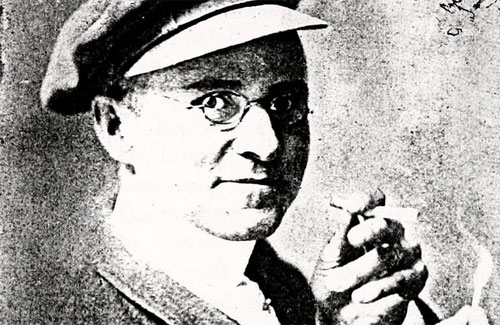
Paul Whiteman was a prominent American bandleader, composer, and orchestral director who played a significant role in popularizing jazz music during the 1920s and 1930s. Born on March 28, 1890, in Denver, Colorado, Whiteman grew up in a musical family. His father, Wilberforce J. Whiteman, was a music teacher and music supervisor for the Denver Public Schools.
Whiteman began studying the violin early on and eventually took up the viola. He played in the Denver Symphony Orchestra and later joined the San Francisco Symphony Orchestra. In 1918, Whiteman formed his dance band, which soon gained popularity for its unique fusion of classical music and jazz.
Whiteman’s big band became known as the “Paul Whiteman Orchestra” and was one of the most popular dance bands of the 1920s.
He earned the nickname “The King of Jazz” for popularizing jazz music.
Whiteman’s orchestra featured many talented musicians, including Bix Beiderbecke, Frankie Trumbauer, and Joe Venuti.
He is credited with helping to launch the careers of famous singers like Bing Crosby and Mildred Bailey.
Whiteman commissioned George Gershwin’s “Rhapsody in Blue,” a groundbreaking piece that blended jazz and classical music, and premiered it in 1924.
He co-wrote the popular song “Whispering,” which became a hit in 1920.
Whiteman was known for his innovative arrangements and orchestrations, often using symphonic instruments like violins and cellos alongside traditional jazz instruments.
He appeared in several films during the 1920s and 1930s, including “The King of Jazz” (1930) and “Strike Up the Band” (1940).
Whiteman hosted several radio shows throughout his career, including “The Paul Whiteman Hour” and “The Kraft Music Hall.”
His orchestra recorded more than 800 songs during its existence.
Whiteman was an early advocate for racial integration in music, working with African-American musicians like Louis Armstrong and James P. Johnson.
He was known for his large frame and imposing stage presence, standing at 6’2″ and weighing over 300 pounds.
Whiteman was married five times and had four children.
He authored an autobiography, “Music for the Millions,” in 1948.
Whiteman was an avid art collector and amassed an impressive collection of modern art.
His orchestra’s signature theme song was “My Blue Heaven.”
Whiteman’s career slowed down during the 1940s and 1950s, but he continued performing and recording music.
In 1959, Whiteman appeared on the television show “This Is Your Life,” which celebrated his life and accomplishments.
Paul Whiteman died on December 29, 1967, in Doylestown, Pennsylvania.
Whiteman’s impact on American music has been widely recognized, and he was posthumously inducted into the Big Band and Jazz Hall of Fame in 1993.
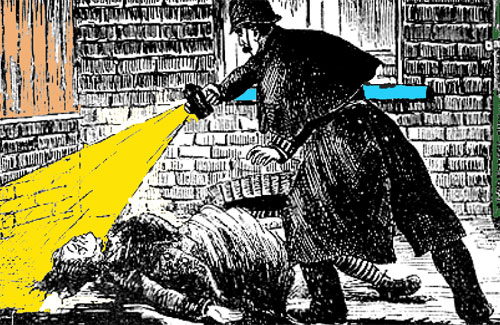
Letters from Jack The Ripper, 1888 Jack The Ripper ‘Dear Boss’ letter
September 27, 1888
Dear Boss,
I keep on hearing the police have caught me but they wont fix me just yet. I have laughed when they look so clever and talk about being on the right track. That joke about Leather Apron gave me real fits. I am down on whores and I shant quit ripping them till I do get buckled. Grand work the last job was. I gave the lady no time to squeal. How can they catch me now. I love my work and want to start again. You will soon hear of me with my funny little games. I saved some of the proper red stuff in a ginger beer bottle over the last job to write with but it went thick like glue and I cant use it. Red ink is fit enough I hope ha. ha. The next job I do I shall clip the ladys ears off and send to the police officers just for jolly wouldn’t you. Keep this letter back till I do a bit more work, then give it out straight. My knife’s so nice and sharp I want to get to work right away if I get a chance. Good Luck.
Yours truly
Jack the Ripper
Dont mind me giving the trade name
PS Wasnt good enough to post this before I got all the red ink off my hands curse it No luck yet. They say I’m a doctor now. ha ha
_________________________
Jack The Ripper ‘Saucy Jack’ postcard
October 1, 1888
I was not codding dear old Boss when I gave you the tip, you’ll hear about Saucy Jacky’s work tomorrow double event this time number one squealed a bit couldn’t finish straight off. ha not the time to get ears for police. thanks for keeping last letter back till I got to work again.
Jack the Ripper
_________________________
Jack The Ripper ‘From Hell’ Letter
October 16, 1888
From hell.
Mr Lusk,
Sor
I send you half the Kidne I took from one woman and prasarved it for you tother piece I fried and ate it was very nise. I may send you the bloody knif that took it out if you only wate a whil longer
signed
Catch me when you can Mishter Lusk
__________________________
Jack The Ripper possible fake letters
October 6, 1888
You though your-self very clever I reckon when you informed the police. But you made a mistake if you though I dident see you. Now I known you know me and I see your little game, and I mean to finish you and send your ears to your wife if you show this to the police or help them if you do I will finish you. It no use your trying to get out of my way. Because I have you when you dont expect it and I keep my word as you soon see and rip you up. Yours truly Jack the Ripper.
PS You see I know your address
1888
Beware I shall be at work on the 1st and 2nd inst. in the Minories at 12 midnight and I give the authorities a good chance but there is never a policeman near when I am at work. Yours Jack the Ripper.
1988
What fools the police are. I even give them the name of the street where I am living. Prince William Street.
1888
The Juwes are the men That Will not be Blamed for nothing
_________________________
Jack The Ripper (to Dr. Thomas Openshaw)
October 29, 1888
Old boss you was rite it was the left kidny i was goin to hoperate agin close to you ospitle just as i was going to dror mi nife along of er bloomin throte them cusses of coppers spoilt the game but i guess i wil be on the jobn soon and will send you another bit of innerds
Jack the Ripper
O have you seen the devle with his mikerscope and scalpul a-lookin at a kidney with a slide cocked up.
Al Jolson, born Asa Yoelson on May 26, 1886, in Srednik, Lithuania, was a famous American singer, comedian, and actor. Known as “The World’s Greatest Entertainer,” Jolson’s dynamic stage presence and powerful singing voice made him one of the most popular performers of his time. While Al Jolson was an iconic figure in the entertainment industry, it is essential to remember and acknowledge the racially insensitive aspects of his career, specifically his use of blackface, when discussing his contributions to American music and culture.
Jolson immigrated to the United States with his family as a young child, eventually settling in Washington, D.C.
He began his career in vaudeville and burlesque, performing in blackface as a minstrel show entertainer.
Jolson’s first Broadway appearance came in 1911 in the musical “La Belle Paree.”
He gained fame for his signature song, “Mammy,” which he first performed in the 1921 Broadway musical “Bombo.”
Jolson is best known for starring in the first-ever talking motion picture, “The Jazz Singer” (1927).
“The Jazz Singer” was a groundbreaking film that marked the transition from silent movies to sound films.
Jolson was the first to win the Best Actor award at the first-ever Academy Awards ceremony in 1929 for his role in “The Jazz Singer.”
His other popular songs include “Swanee,” “April Showers,” “Toot, Toot, Tootsie,” and “Rock-a-Bye Your Baby With a Dixie Melody.”
Jolson’s vocal style, characterized by its emotional intensity and conversational delivery, influenced future generations of singers, including Frank Sinatra and Judy Garland.
He was known for his energetic and charismatic stage performances, often running up and down the stage and interacting with the audience.
Jolson was the first performer to entertain American troops overseas during World War II.
He recorded over 200 songs throughout his career.
Jolson was married four times, most notably to actress Ruby Keeler.
His career experienced a resurgence in the late 1940s with the release of the biographical film “The Jolson Story” (1946).
Jolson’s life story was further depicted in the sequel, “Jolson Sings Again” (1949).
Jolson was among the first inductees into the Hollywood Walk of Fame in 1960.
Despite his success and popularity, Jolson’s legacy has been tainted by his use of blackface, a racist practice widely criticized in modern times.
In 2000, Jolson was posthumously awarded a Grammy Lifetime Achievement Award for his contributions to the music industry.
His life and career have been the subject of numerous books and documentaries.
Al Jolson passed away on October 23, 1950, at the age of 64
The Indian National Congress (INC) was founded in 1885 as a political party that played a crucial role in the Indian independence movement against British colonial rule. The INC was instrumental in mobilizing the Indian masses and shaping the country’s political landscape.
Dates: The INC was founded on December 28, 1885, by Indian and British individuals.
Details: The party was initially established as a platform for Indian professionals to discuss and address issues related to British colonial policies. Gradually, the INC’s scope expanded to include the broader goal of attaining self-government for India. Over the years, the INC transformed into a mass political movement, advocating for Indian independence from British rule.
Trivial Facts: The first meeting of the INC was held in Bombay (now Mumbai) and was attended by 72 delegates. A.O. Hume, a retired British civil servant, played a pivotal role in forming the party. The INC adopted the tricolor flag (now the Indian national flag) in 1931.
Effects on Pop Culture: The INC’s struggle for Indian independence inspired various art, literature, and cinema forms in India. The party’s leaders, such as Mahatma Gandhi and Jawaharlal Nehru, became iconic figures, and their ideas and actions continued to influence Indian society and popular culture. Bollywood films like “Gandhi” (1982) and “The Legend of Bhagat Singh” (2002) depict the lives of prominent INC leaders and their contributions to the independence movement.
Prominent People: Some of the most notable leaders of the INC include Mahatma Gandhi, who led the party in the nonviolent resistance against British rule; Jawaharlal Nehru, who became the first Prime Minister of independent India; and Vallabhbhai Patel, who played a crucial role in the integration of princely states into the Indian Union. Significant figures include Dadabhai Naoroji, Bal Gangadhar Tilak, Gopal Krishna Gokhale, Subhas Chandra Bose, and Sarojini Naidu.
Countries Involved: The INC was primarily active in British India, which included present-day India, Pakistan, and Bangladesh. The party’s efforts to gain independence from British rule had repercussions for the United Kingdom, ultimately leading to the end of British colonial rule in the Indian subcontinent.
In summary, the Indian National Congress was founded in 1885 and played a significant role in India’s struggle for independence from British colonial rule. The party’s leaders, such as Mahatma Gandhi and Jawaharlal Nehru, have become iconic figures in Indian history, and the INC’s activities have left a lasting impact on Indian society, politics, and popular culture.
The American Anti-Vivisection Society (AAVS) is an organization dedicated to ending the use of animals in research, testing, and education. It is one of the oldest animal rights organizations in the United States. It has played an important role in raising awareness and promoting legislative changes to protect animals from cruelty and suffering.
Dates and Details:
The AAVS was founded in Philadelphia, Pennsylvania on December 8, 1883.
Caroline Earle White, a prominent philanthropist and social reformer, established the organization along with other like-minded individuals.
The Society’s primary focus has been on ending the use of animals in research, particularly in vivisection, which involves the dissection of live animals.
AAVS Facts:
The AAVS was originally called the “American Anti-Vivisection and Animal Protection Society” before being renamed in 1887.
Caroline Earle White also co-founded the Women’s Pennsylvania Society for the Prevention of Cruelty to Animals (WPSPCA) in 1869.
The AAVS was instrumental in establishing the first federal law regulating animal research in the United States, the Laboratory Animal Welfare Act of 1966 (now known as the Animal Welfare Act).
The AAVS publishes a quarterly magazine called the “AV Magazine,” which covers topics related to animal rights, animal research, and alternatives to animal testing.
Over the years, the AAVS has provided funding for developing alternative research methods that do not involve animals, such as in vitro testing and computer modeling.
Effects on Pop Culture:
The AAVS has influenced public opinion on animal rights and vivisection, with its campaigns and publications raising awareness about the ethical implications of animal research.
The organization’s work has inspired other animal rights groups and activists to fight for similar causes.
The AAVS has been referenced in books, documentaries, and other media covering the animal rights movement and its history.
Prominent People and Countries Involved:
Caroline Earle White, the founder of the AAVS, was a significant figure in the American animal welfare movement in the late 19th and early 20th centuries.
Other notable members and supporters of the AAVS include Henry Bergh, the founder of the American Society for the Prevention of Cruelty to Animals (ASPCA); and Ralph Waldo Trine, a philosopher and author who served as the AAVS’s president from 1908 to 1914.
The AAVS has collaborated with various animal rights organizations in the United States and worldwide, such as the Humane Society of the United States and Cruelty-Free International, to advocate for animal protection and promote alternatives to animal testing.
Edgar Wilson ‘Bill’ Nye’s Postmaster resignation letter to US President Chester B. Arthur
October 1, 1883
To the President of the United States:
Sir.—
I beg leave at this time to officially tender my resignation as postmaster at this place, and in due form to deliver the great seal and the key to the front door of the office. The safe combination is set on the numbers 33, 66 and 99, though I do not remember at this moment which comes first, or how many times you revolve the knob, or which direction you should turn it at first in order to make it operate.
There is some mining stock in my private drawer in the safe, which I have not yet removed. This stock you may have, if you desire it. It is a luxury, but you may have it. I have decided to keep a horse instead of this mining stock. The horse may not be so pretty, but it will cost less to keep him.
You will find the postal cards that have not been used under the distributing table, and the coal down in the cellar. If the stove draws too hard, close the damper in the pipe and shut the general delivery window.
Looking over my stormy and eventful administration as postmaster here, I find abundant cause for thanksgiving. At the time I entered upon the duties of my office the department was not yet on a paying basis. It was not even self-sustaining. Since that time, with the active co-operation of the chief executive and the heads of the department, I have been able to make our postal system a paying one, and on top of that I am now able to reduce the tariff on average-sized letters from three cents to two. I might add that this is rather too too, but I will not say anything that might seem undignified in an official resignation which is to become a matter of history.
Through all the vicissitudes of a tempestuous term of office I have safely passed. I am able to turn over the office to-day in a highly improved condition, and to present a purified and renovated institution to my successor.
Acting under the advice of Gen. Hatton, a year ago, I removed the feather bed with which my predecessor, Deacon Hayford, had bolstered up his administration by stuffing the window, and substituted glass. Finding nothing in the book of instructions to postmasters which made the feather bed a part of my official duties, I filed it away in an obscure place and burned it in effigy, also in the gloaming. This act maddened my predecessor to such a degree, that he then and there became a candidate for justice of the peace on the Democratic ticket. The Democratic party was able, however, with what aid it secured from the Republicans, to plow the old man under to a great degree.
It was not long after I had taken my official oath before an era of unexampled prosperity opened for the American people. The price of beef rose to a remarkable altitude, and other vegetables commanded a good figure and a ready market. We then began to make active preparations for the introduction of the strawberry-roan two-cent stamps and the black-and-tan postal note. One reform has crowded upon the heels of another, until the country is to-day upon the foam-crested wave of permanent prosperity.
Mr. President, I cannot close this letter without thanking yourself and the heads of departments at Washington for your active, cheery and prompt cooperation in these matters. You can do as you see fit, of course, about incorporating this idea into your Thanksgiving proclamation, but rest assured it would not be ill-timed or inopportune. It is not alone a credit to myself, It reflects credit upon the administration also.
I need not say that I herewith transmit my resignation with great sorrow and genuine regret. We have toiled on together month after month, asking for no reward except the innate consciousness of rectitude and the salary as fixed by law. Now we are to separate. Here the roads seem to fork, as it were, and you and I, and the cabinet, must leave each other at this point.
You will find the key under the door-mat, and you had better turn the cat out at night when you close the office. If she does not go readily, you can make it clearer to her mind by throwing the cancelling stamp at her.
If Deacon Hayford does not pay up his box-rent, you might as well put his mail in the general delivery, and when Bob Head gets drunk and insists on a letter from one of his wives every day in the week, you can salute him through the box delivery with an old Queen Anne tomahawk, which you will find near the Etruscan water-pail. This will not in any manner surprise either of these parties.
Tears are unavailing. I once more become a private citizen, clothed only with the right to read such postal cards as may be addressed to me personally, and to curse the inefficiency of the postoffice department. I believe the voting class to be divided into two parties, viz: Those who are in the postal service, and those who are mad because they cannot receive a registered letter every fifteen minutes of each day, including Sunday.
Mr. President, as an official of this Government I now retire. My term of office would not expire until 1886. I must, therefore, beg pardon for my eccentricity in resigning. It will be best, perhaps, to keep the heart-breaking news from the ears of European powers until the dangers of a financial panic are fully past. Then hurl it broadcast with a sickening thud.
“Duties of American Citizenship”
by Theodore Roosevelt, on January 26, 1883
Of course, in one sense, the first essential for a man’s being a good citizen is his possession of the home virtues of which we think when we call a man by the emphatic adjective of manly. No man can be a good citizen who is not a good husband and a good father, who is not honest in his dealings with other men and women, faithful to his friends and fearless in the presence of his foes, who has not got a sound heart, a sound mind, and a sound body; exactly as no amount of attention to civil duties will save a nation if the domestic life is undermined, or there is lack of the rude military virtues which alone can assure a country’s position in the world.
In a free republic the ideal citizen must be one willing and able to take arms for the defense of the flag, exactly as the ideal citizen must be the father of many healthy children. A race must be strong and vigorous; it must be a race of good fighters and good breeders, else its wisdom will come to naught and its virtue be ineffective; and no sweetness and delicacy, no love for and appreciation of beauty in art or literature, no capacity for building up material prosperity can possibly atone for the lack of the great virile virtues.
But this is aside from my subject, for what I wish to talk of is the attitude of the American citizen in civic life. It ought to be axiomatic in this country that every man must devote a reasonable share of his time to doing his duty in the Political life of the community. No man has a right to shirk his political duties under whatever plea of pleasure or business; and while such shirking may be pardoned in those of small means it is entirely unpardonable in those among whom it is most common – in the people whose circumstances give them freedom in the struggle for life.
In so far as the community grows to think rightly, it will likewise grow to regard the young man of means who shirks his duty to the State in time of peace as being only one degree worse than the man who thus shirks it in time of war. A great many of our men in business, or of our young men who are bent on enjoying life (as they have a perfect right to do if only they do not sacrifice other things to enjoyment), rather plume themselves upon being good citizens if they even vote; yet voting is the very least of their duties, Nothing worth gaining is ever gained without effort.
You can no more have freedom without striving and suffering for it than you can win success as a banker or a lawyer without labor and effort, without self-denial in youth and the display of a ready and alert intelligence in middle age. The people who say that they have not time to attend to politics are simply saying that they are unfit to live in a free community. Their place is under a despotism; or if they are content to do nothing but vote, you can take despotism tempered by an occasional plebiscite, like that of the second Napoleon.
In one of Lowell’s magnificent stanzas about the Civil War he speaks of the fact which his countrymen were then learning, that freedom is not a gift that tarries long in the hands of cowards: nor yet does it tarry long in the hands of the sluggard and the idler, in the hands of the man so much absorbed in the pursuit of pleasure or in the pursuit of gain, or so much wrapped up in his own easy home life as to be unable to take his part in the rough struggle with his fellow men for political supremacy. If freedom is worth having, if the right of self-government is a valuable right, then the one and the other must be retained exactly as our forefathers acquired them, by labor, and especially by labor in organization, that is in combination with our fellows who have the same interests and the same principles.
We should not accept the excuse of the business man who attributed his failure to the fact that his social duties were so pleasant and engrossing that he had no time left for work in his office; nor would we pay much heed to his further statement that he did not like business anyhow because he thought the morals of the business community by no means what they should be, and saw that the great successes were most often won by men of the Jay Gould stamp. It is just the same way with politics. It makes one feel half angry and half amused, and wholly contemptuous, to find men of high business or social standing in the community saying that they really have not got time to go to ward meetings, to organize political clubs, and to take a personal share in all the important details of practical politics; men who further urge against their going the fact that they think the condition of political morality low, and are afraid that they may be required to do what is not right if they go into politics.
The first duty of an American citizen, then, is that he shall work in politics; his second duty is that he shall do that work in a practical manner; and his third is that it shall be done in accord with the highest principles of honor and justice. Of course, it is not possible to define rigidly just the way in which the work shall be made practical. Each man’s individual temper and convictions must be taken into account. To a certain extent his work must be done in accordance with his individual beliefs and theories of right and wrong. To a yet greater extent it must be done in combination with others, he yielding or modifying certain of his own theories and beliefs so as to enable him to stand on a common ground with his fellows, who have likewise yielded or modified certain of their theories and beliefs.
There is no need of dogmatizing about independence on the one hand or party allegiance on the other. There are occasions when it may be the highest duty of any man to act outside of parties and against the one with which he has himself been hitherto identified; and there may be many more occasions when his highest duty is to sacrifice some of his own cherished opinions for the sake of the success of the party which he on the whole believes to be right. I do not think that the average citizen, at least in one of our great cities, can very well manage to support his own party all the time on every issue, local and otherwise; at any rate if he can do so he has been more fortunately placed than I have been.
On the other hand, I am fully convinced that to do the best work people must be organized; and of course an organization is really a party, whether it be a great organization covering the whole nation and numbering its millions of adherents, or an association of citizens in a particular locality, banded together to win a certain specific victory, as, for instance, that of municipal reform. Somebody has said that a racing-yacht, like a good rifle, is a bundle of incompatibilities; that you must get the utmost possible sail power without sacrificing some other quality if you really do get the utmost sail power, that, in short you have got to make more or less of a compromise on each in order to acquire the dozen things needful; but, of course, in making this compromise you must be very careful for the sake of something unimportant not to sacrifice any of the great principles of successful naval architecture. Well, it is about so with a man’s political work. He has got to preserve his independence on the one hand; and on the other, unless he wishes to be a wholly ineffective crank, he has got to have some sense of party allegiance and party responsibility, and he has got to realize that in any given exigency it may be a matter of duty to sacrifice one quality, or it may be a matter of duty to sacrifice the other.
If it is difficult to lay down any fixed rules for party action in the abstract; it would, of course, be wholly impossible to lay them down for party action in the concrete, with reference to the organizations of the present day. I think that we ought to be broad-minded enough to recognize the fact that a good citizen, striving with fearlessness, honesty, and common sense to do his best for the nation, can render service to it in many different ways, and by connection with many different organizations. It is well for a man if he is able conscientiously to feel that his views on the great questions of the day, on such questions as the tariff, finance, immigration, the regulation of the liquor traffic, and others like them, are such as to put him in accord with the bulk of those of his fellow citizens who compose one of the greatest parties: but it is perfectly supposable that he may feel so strongly for or against certain principles held by one party, or certain principles held by the other, that he is unable to give his full adherence to either. In such a case I feel that he has no right to plead this lack of agreement with either party as an excuse for refraining from active political work prior to election. It will, of course, bar him from the primaries of the two leading parties, and preclude him from doing his share in organizing their management; but, unless he is very unfortunate, he can surely find a number of men who are in the same position as himself and who agree with him on some specific piece of political work, and they can turn in practically and effectively long before election to try to do this new piece of work in a practical manner.
One seemingly very necessary caution to utter is, that a man who goes into politics should not expect to reform everything right off, with a jump. I know many excellent young men who, when awakened to the fact that they have neglected their political duties, feel an immediate impulse to form themselves into an organization which shall forthwith purify politics everywhere, national, State, and city alike; and I know of a man who having gone round once to a primary, and having, of course, been unable to accomplish anything in a place where he knew no one and could not combine with anyone, returned saying it was quite useless for a good citizen to try to accomplish anything in such a manner. To these too hopeful or too easily discouraged people I always feel like reading Artemus Ward’s article upon the people of his town who came together in a meeting to resolve that the town should support the Union and the Civil War, but were unwilling to take any part in putting down the rebellion unless they could go as brigadier-generals.
After the battle of Bull Run there were a good many hundreds of thousands of young men in the North who felt it to be their duty to enter the Northern armies; but no one of them who possessed much intelligence expected to take high place at the outset, or anticipated that individual action would be of decisive importance in any given campaign. He went in as private or sergeant, lieutenant or captain, as the case might be, and did his duty in his company, in his regiment, after a while in his brigade. When Ball’s Bluff and Bull Run succeeded the utter failure of the Peninsular campaign, when the terrible defeat of Fredericksburg was followed by the scarcely less disastrous day at Chancellorsville he did not announce (if he had any pluck or manliness about him) that he considered it quite useless for any self-respecting citizen to enter the Army of the Potomac, because he really was not of much weight in its councils, and did not approve of its management; he simply gritted his teeth and went doggedly on with his duty, grieving over, but not disheartened at the innumerable shortcomings and follies committed by those who helped to guide the destinies of the army, recognizing also the bravery, the patience, intelligence, and resolution with which other men in high places offset the follies and shortcomings and persevering with equal mind through triumph and defeat until finally he saw the tide of failure turn at Gettysburg and the full flood of victory come with Appomattox.
I do wish that more of our good citizens would go into politics, and would do it in the same spirit with which their fathers went into the Federal armies. Begin with the little thing, and do not expect to accomplish anything without an effort. Of course, if you go to a primary just once, never having taken the trouble to know any of the other people who go there you will find yourself wholly out of place; but if you keep on attending and try to form associations with other men whom you meet at the political gatherings, or whom you can persuade to attend them, you will very soon find yourself a weight. In the same way, if a man feels that the politics of his city, for instance, are very corrupt and wants to reform them, it would be an excellent idea for him to begin with his district. If he Joins with other people, who think as he does, to form a club where abstract political virtue will be discussed he may do a great deal of good.
We need such clubs; but he must also get to know his own ward or his own district, put himself in communication with the decent people in that district, of whom we may rest assured there will be many, willing and able to do something practical for the procurance of better government Let him set to work to procure a better assemblyman or better alderman before he tries his hand at making a mayor, a governor, or a president. If he begins at the top he may make a brilliant temporary success, but the chances are a thousand to one that he will only be defeated eventually; and in no event will the good he does stand on the same broad and permanent foundation as if he had begun at the bottom. Of course, one or two of his efforts may be failures; but if he has the right stuff in him he will go ahead and do his duty irrespective of whether he meets with success or defeat. It is perfectly right to consider the question of failure while shaping one’s efforts to succeed in the struggle for the right; but there should be no consideration of it whatsoever when the question is as to whether one should or should not make a struggle for the right. When once a band of one hundred and fifty or two hundred honest, intelligent men, who mean business and know their business, is found in any district, whether in one of the regular organizations or outside, you can guarantee that the local politicians of that district will begin to treat it with a combination of fear, hatred, and respect, and that its influence will be felt; and that while sometimes men will be elected to office in direct defiance of its wishes, more often the successful candidates will feel that they have to pay some regard to its demands for public decency and honesty.
But in advising you to be practical and to work hard, I must not for one moment be understood as advising you to abandon one iota of your self-respect and devotion to principle. It is a bad sign for the country to see one class of our citizens sneer at practical politicians, and another at Sunday-school politics. No man can do both effective and decent work in public life unless he is a practical politician on the one hand, and a sturdy believer in Sunday-school politics on the other. He must always strive manfully for the best, and yet, like Abraham Lincoln, must often resign himself to accept the best possible. Of course when a man verges on to the higher ground of statesmanship, when he becomes a leader, he must very often consult with others and defer to their opinion, and must be continually settling in his mind how far he can go in just deference to the wishes and prejudices of others while yet adhering to his own moral standards: but I speak not so much of men of this stamp as I do of the ordinary citizen, who wants to do his duty as a member of the commonwealth in its civic life; and for this man I feel that the one quality which he ought always to hold most essential is that of disinterestedness. If he once begins to feel that he wants office himself, with a willingness to get it at the cost of his convictions, or to keep it when gotten, at the cost of his convictions, his usefulness is gone. Let him make up his mind to do his duty in politics without regard to holding office at all, and let him know that often the men in this country who have done the best work for our public life have not been the men in office.
If, on the other hand, he attains public position, let him not strive to plan out for himself a career. I do not think that any man should let himself regard his political career as a means of livelihood, or as his sole occupation in life; for if he does he immediately becomes most seriously handicapped. The moment that he begins to think how such and such an act will affect the voters in his district, or will affect some great political leader who will have an influence over his destiny, he is hampered and his hands are bound. Not only may it be his duty often to disregard the wishes of politicians, but it may be his clear duty at times to disregard the wishes of the people. The voice of the people is not always the voice of God; and when it happens to be the voice of the devil, then it is a man’s clear duty to defy its behests. Different political conditions breed different dangers. The demagogue is as unlovely a creature as the courtier, though one is fostered under republican and the other under monarchical institutions.
There is every reason why a man should have an honorable ambition to enter public life, and an honorable ambition to stay there when he is in; but he ought to make up his mind that he cares for it only as long as he can stay in it on his own terms, without sacrifice of his own principles; and if he does thus make up his mind he can really accomplish twice as much for the nation, and can reflect a hundredfold greater honor upon himself, in a short term of service, than can the man who grows gray in the public employment at the cost of sacrificing what he believes to be true and honest. And moreover, when a public servant has definitely made up his mind that he will pay no heed to his own future, but will do what he honestly deems best for the community, without regard to how his actions may affect his prospects, not only does he become infinitely more useful as a public servant, but he has a far better time. He is freed from the harassing care which is inevitably the portion of him who is trying to shape his sails to catch every gust of the wind of political favor.
But let me reiterate, that in being virtuous he must not become ineffective, and that he must not excuse himself for shirking his duties by any false plea that he cannot do his duties and retain his self-respect. This is nonsense, he can; and when he urges such a plea it is a mark of mere laziness and self-indulgence. And again, he should beware how he becomes a critic of the actions of others, rather than a doer of deeds himself; and in so far as he does act as a critic (and of course the critic has a great and necessary function) he must beware of indiscriminate censure even more than of indiscriminate praise. The screaming vulgarity of the foolish spread-eagle orator who is continually yelling defiance at Europe, praising everything American, good and bad, and resenting the introduction of any reform because it has previously been tried successfully abroad, is offensive and contemptible to the last degree; but after all it is scarcely as harmful as the peevish, fretful, sneering, and continual faultfinding of the refined, well-educated man, who is always attacking good and bad alike, who genuinely distrusts America, and in the true spirit of servile colonialism considers us inferior to the people across the water. It may be taken for granted that the man who is always sneering at our public life and our public men is a thoroughly bad citizen, and that what little influence he wields in the community is wielded for evil. The public speaker or the editorial writer who teaches men of education that their proper attitude toward American politics should be one of dislike or indifference is doing all he can to perpetuate and aggravate the very evils of which he is ostensibly complaining.
Exactly as it is generally the case that when a man bewails the decadence of our civilization he is himself physically, mentally, and morally a first-class type of the decadent, so it is usually the case that when a man is perpetually sneering at American politicians, whether worthy or unworthy, he himself is a poor citizen and a friend of the very forces of evil against which he professes to contend. Too often these men seem to care less for attacking bad men, than for ruining the characters of good men with whom they disagree on some pubic question; and while their influence against the bad is almost nil, they are sometimes able to weaken the hands of the good by withdrawing from them support to which they are entitled, and they thus count in the sum total of forces that work for evil. They answer to the political prohibitionist, who, in a close contest between a temperance man and a liquor seller diverts enough votes from the former to elect the liquor seller Occasionally it is necessary to beat a pretty good man, who is not quite good enough, even at the cost of electing a bad one— but it should be thoroughly recognized that this can be necessary only occasionally and indeed, I may say, only in very exceptional cases, and that as a rule where it is done the effect is thoroughly unwholesome in every way, and those taking part in it deserve the severest censure from all honest men.
Moreover, the very need of denouncing evil makes it all the more wicked to weaken the effect of such denunciations by denouncing also the good. It is the duty of all citizens, irrespective of party, to denounce, and, so far as may be, to punish crimes against the public on the part of politicians or officials. But exactly as the public man who commits a crime against the public is one of the worst of criminals, so, close on his heels in the race for iniquitous distinction, comes the man who falsely charges the public servant with outrageous wrongdoing; whether it is done with foul-mouthed and foolish directness in the vulgar and violent party organ, or with sarcasm, innuendo, and the half-truths that are worse than lies, in some professed organ of independence. Not only should criticism be honest, but it should be intelligent, in order to be effective. I recently read in a religious paper an article railing at the corruption of our public life, in which it stated incidentally that the lobby was recognized as all-powerful in Washington. This is untrue. There was a day when the lobby was very important at Washington, but its influence in Congress is now very small indeed; and from a pretty intimate acquaintance with several Congresses I am entirely satisfied that there is among the members a very small proportion indeed who are corruptible, in the sense that they will let their action be influenced by money or its equivalent. Congressmen are very often demagogues; they are very often blind partisans; they are often exceedingly short-sighted, narrow-minded, and bigoted; but they are not usually corrupt; and to accuse a narrow-minded demagogue of corruption when he is perfectly honest, is merely to set him more firmly in his evil course and to help him with his constituents, who recognize that the charge is entirely unjust, and in repelling it lose sight of the man’s real shortcomings.
I have known more than one State legislature, more than one board of aldermen against which the charge of corruption could perfectly legitimately be brought, but it cannot be brought against Congress. Moreover these sweeping charges really do very little good. When I was in the New York legislature, one of the things that I used to mind most was the fact that at the close of every session the papers that affect morality invariably said that particular legislature was the worst legislature since the days of Tweed. The statement was not true as a rule; and, in any event, to lump all the members, good and bad, in sweeping condemnation simply hurt the good and helped the bad. Criticism should be fearless, but I again reiterate that it should be honest and should be discriminating. When it is sweeping and unintelligent, and directed against good and bad alike, or against the good and bad qualities of any man alike, it is very harmful. It tends steadily to deteriorate the character of our public men; and it tends to produce a very unwholesome spirit among young men of education, and especially among the young men in our colleges.
Against nothing is fearless and specific criticism more urgently needed than against the “spoils system,” which is the degradation of American politics. And nothing is more effective in thwarting the purposes of the spoilsmen than the civil service reform. To be sure, practical politicians sneer at it. One of them even went so far as to say that civil-service reform is asking a man irrelevant questions. What more irrelevant question could there be than that of the practical politician who asks the aspirant for his political favor — “Whom did you vote for in the last election?” There is certainly nothing more interesting, from a humorous point of view, than the heads of departments urging changes to be made in their underlings, “on the score of increased efficiency” they say; when as the result of such a change the old incumbent often spends six months teaching the new incumbent how to do the work almost as well as he did himself! Occasionally the civil-service reform has been abused, but not often. Certainly the reform is needed when you contemplate the spectacle of a New York City treasurer who acknowledges his annual fees to be eighty-five thousand dollars, and who pays a deputy one thousand five hundred dollars to do his work—when you note the corruptions in the New York legislature, where one man says he has a horror of the Constitution because it prevents active benevolence, and another says that you should never allow the Constitution to come between friends! All these corruptions and vices are what every good American citizen must fight against.
Finally, the man who wishes to do his duty as a citizen in our country must be imbued through and through with the spirit of Americanism. I am not saying this as a matter of spread-eagle rhetoric: I am saying it quite soberly as a piece of matter-of-fact, common-sense advice, derived from my own experience of others. Of course, the question of Americanism has several sides. If a man is an educated man, he must show his Americanism by not getting misled into following out and trying to apply all the theories of the political thinkers of other countries, such as Germany and France, to our own entirely different conditions. He must not get a fad, for instance, about responsible government; and above all things he must not, merely because he is intelligent, or a college professor well read in political literature, try to discuss our institutions when he has had no practical knowledge of how they are worked. Again, if he is a wealthy man, a man of means and standing, he must really feel, not merely affect to feel, that no social differences obtain save such as a man can in some way himself make by his own actions. People sometimes ask me if there is not a prejudice against a man of wealth and education in ward politics. I do not think that there is, unless the man in turn shows that he regards the facts of his having wealth and education as giving him a claim to superiority aside from the merit he is able to prove himself to have in actual service.
Of course, if he feels that he ought to have a little better treatment than a carpenter, a plumber, or a butcher, who happens to stand beside him, he is going to be thrown out of the race very quickly, and probably quite roughly; and if he starts in to patronize and elaborately condescend to these men he will find that they resent this attitude even more. Do not let him think about the matter at all. Let him go into the political contest with no more thought of such matters than a college boy gives to the social standing of the members of his own and rival teams in a hotly contested football match. As soon as he begins to take an interest in politics (and he will speedily not only get interested for the sake of politics, but also take a good healthy interest in playing the game itself — an interest which is perfectly normal and praise-worthy, and to which only a prig would object), he will begin to work up the organization in the way that will be most effective, and he won’t care a rap about who is put to work with him, save in so far as he is a good fellow and an efficient worker.
There was one time that a number of men who think as we do here to-night (one of the number being myself) got hold of one of the assembly districts of New York, and ran it in really an ideal way, better than any other assembly district has ever been run before or since by either party. We did it by hard work and good organization; by working practically, and yet by being honest and square in motive and method: especially did we do it by all turning in as straight-out Americans without any regard to distinctions of race origin. Among the many men who did a great deal in organizing our victories was the son of a Presbyterian clergyman, the nephew of a Hebrew rabbi, and two well-known Catholic gentlemen. We also had a Columbia College professor (the stroke-oar of a university crew), a noted retail butcher, and the editor of a local German paper, various brokers, bankers, lawyers, bricklayers and a stone-mason who was particularly useful to us, although on questions of theoretic rather than applied politics he had a decidedly socialistic turn of mind.
Again, questions of race origin, like questions of creed, must not be considered: we wish to do good work, and we are all Americans, pure and simple. In the New York legislature, when it fell to my lot to choose a committee — which I always esteemed my most important duty at Albany — no less than three out of the four men I chose were of Irish birth or parentage; and three abler and more fearless and disinterested men never sat in a legislative body; while among my especial political and personal friends in that body was a gentleman from the southern tier of counties, who was, I incidentally found out, a German by birth, but who was just as straight United States as if his ancestors had come over here in the Mayflower or in Henry Hudson’s yacht. Of course, none of these men of Irish or German birth would have been worth their salt had they continued to act after coming here as Irishmen or Germans, or as anything but plain straight-out Americans. We have not any room here for a divided allegiance. A man has got to be an American and nothing else; and he has no business to be mixing us up with questions of foreign politics, British or Irish, German or French, and no business to try to perpetuate their language and customs in the land of complete religious toleration and equality. If, however, he does become honestly and in good faith an American, then he is entitled to stand precisely as all other Americans stand, and it is the height of un-Americanism to discriminate against him in any way because of creed or birthplace. No spirit can be more thoroughly alien to American institutions, than the spirit of the Know-Nothings.
In facing the future and in striving, each according to the measure of his individual capacity, to work out the salvation of our land, we should be neither timid pessimists nor foolish optimists. We should recognize the dangers that exist and that threaten us: we should neither overestimate them nor shrink from them, but steadily fronting them should set to work to overcome and beat them down. Grave perils are yet to be encountered in the stormy course of the Republic — perils from political corruption, perils from individual laziness, indolence and timidity, perils springing from the greed of the unscrupulous rich, and from the anarchic violence of the thriftless and turbulent poor. There is every reason why we should recognize them, but there is no reason why we should fear them or doubt our capacity to overcome them, if only each will, according to the measure of his ability, do his full duty, and endeavor so to live as to deserve the high praise of being called a good American citizen.
“Surrender Speech”
by Chief Joseph, on October 5, 1877, as he surrendered to General Howard, in The Montana Territory:
“I am tired of fighting. Our chiefs are killed. Looking Glass is dead. Toohoolhoolzote is dead. The old men are all dead. It is the young men who say, ‘Yes’ or ‘No.’ He who led the young men [Olikut] is dead. It is cold, and we have no blankets. The little children are freezing to death. My people, some of them, have run away to the hills, and have no blankets, no food. No one knows where they are — perhaps freezing to death. I want to have time to look for my children, and see how many of them I can find. Maybe I shall find them among the dead. Hear me, my chiefs! I am tired. My heart is sick and sad. From where the sun now stands I will fight no more forever.”
Bram Stoker’s Letter to Walt Whitman
February 14, 1876
My dear Mr. Whitman.
I hope you will not consider this letter from an utter stranger a liberty. Indeed, I hardly feel a stranger to you, nor is this the first letter that I have written to you. My friend Edward Dowden has told me often that you like new acquaintances or I should rather say friends. And as an old friend I send you an enclosure which may interest you. Four years ago I wrote the enclosed draft of a letter which I intended to copy out and send to you- it has lain in my desk since then- when I heard that you were addressed as Mr. Whitman. It speaks for itself and needs no comment. It is as truly what I wanted to say as that light is light.
The four years which have elapsed have made me love your work fourfold, and I can truly say that I have ever spoken as your friend. You know what hostile criticism your work sometimes evokes here, and I wage a perpetual war with many friends on your behalf. But I am glad to say that I have been the means of making your work known to many who were scoffers at first. The years which have passed have not been uneventful to me, and I have felt and thought and suffered much in them, and I can truly say that from you I have had much pleasure and much consolation- and I do believe that your open earnest speech has not been thrown away on me or that my life and thought fail to be marked with its impress. I write this openly because I feel that with you one must be open. We have just had tonight a hot debate on your genius at the Fortnightly Club in which I had the privilege of putting forward my views- I think with success.
Do not think me cheeky for writing this. I only hope we may sometime meet and I shall be able perhaps to say what I cannot write. Dowden promised to get me a copy of your new edition and I hope that for any other work which you may have you will let me always be an early subscriber. I am sorry that you’re not strong. Many of us are hoping to see you in Ireland. We had arranged to have a meeting for you. I do not know if you like getting letters. If you do I shall only be too happy to send you news of how thought goes among the men I know. With truest wishes for your health and happiness believe me,
Your letters have been most welcome to me- welcome to me as Person and as Author- I don’t know which most- You did well to write me so unconventionally, so fresh, so manly, and so affectionately, too. I too hope (though it is not probable) that we shall one day meet each other. Meantime I send you my friendship and thanks.
Edward Dowden’s letter containing among others your subscription for a copy of my new edition has just been received. I shall send the books very soon by express in a package to his address. I have just written E. D.
My physique is entirely shattered- doubtless permanently, from paralysis and other ailments. But I am up and dressed, and get out every day a little. Live here quite lonesome, but hearty, and good spirits.
Love Letter from Samuel L. Clemens to Olivia Clemens
November 27, 1875
Livy darling,
Six years have gone by since I made my first great success in life and won you, and thirty years have passed since Providence made preparation for that happy success by sending you into the world.
Every day we live together adds to the security of my confidence that we can never any more wish to be separated than that we can ever imagine a regret that we were ever joined. You are dearer to me to-day, my child, than you were upon the last anniversary of this birth-day; you were dearer then than you were a year before—you have grown more and more dear from the first of those anniversaries, and I do not doubt that this precious progression will continue on to the end.
Let us look forward to the coming anniversaries, with their age and their gray hairs without fear and without depression, trusting and believing that the love we bear each other will be sufficient to make them blessed.
So, with abounding affection for you and our babies, I hail this day that brings you matronly grace and dignity of three decades!
2nd Inaugural Address
by Abraham Lincoln, on March 4, 1865
“Fellow-Countrymen, at this second appearing to take the oath of the Presidential office there is less occasion for an extended address than there was at the first. Then a statement somewhat in detail of a course to be pursued seemed fitting and proper. Now, at the expiration of four years, during which public declarations have been constantly called forth on every point and phase of the great contest which still absorbs the attention and engrosses the energies of the nation, little that is new could be presented. The progress of our arms, upon which all else chiefly depends, is as well known to the public as to myself, and it is, I trust, reasonably satisfactory and encouraging to all. With high hope for the future, no prediction in regard to it is ventured.
On the occasion corresponding to this four years ago all thoughts were anxiously directed to an impending civil war. All dreaded it, all sought to avert it. While the inaugural address was being delivered from this place, devoted altogether to saving the Union without war, insurgent agents were in the city seeking to destroy it without war-seeking to dissolve the Union and divide effects by negotiation. Both parties deprecated war, but one of them would make war rather than let the nation survive, and the other would accept war rather than let it perish, and the war came.
One-eighth of the whole population were colored slaves, not distributed generally over the Union, but localized in the southern part of it. These slaves constituted a peculiar and powerful interest. All knew that this interest was somehow the cause of the war. To strengthen, perpetuate, and extend this interest was the object for which the insurgents would rend the Union even by war, while the Government claimed no right to do more than to restrict the territorial enlargement of it. Neither party expected for the war the magnitude or the duration which it has already attained. Neither anticipated that the cause of the conflict might cease with or even before the conflict itself should cease. Each looked for an easier triumph, and a result less fundamental and astounding. Both read the same Bible and pray to the same God, and each invokes His aid against the other. It may seem strange that any men should dare to ask a just God’s assistance in wringing their bread from the sweat of other men’s faces, but let us judge not, that we be not judged. The prayers of both could not be answered. That of neither has been answered fully.”
The Almighty has His own purposes.
“Woe unto the world because of offenses;for it must needs be that offenses come, but woe to that man by whom the offense cometh.” If we shall suppose that American slavery is one of those offenses which, in the providence of God, must needs come, but which, having continued through His appointed time, He now wills to remove, and that He gives to both North and South this terrible war as the woe due to those by whom the offense came, shall we discern therein any departure from those divine attributes which the believers in a living God always ascribe to Him? Fondly do we hope, fervently do we pray, that this mighty scourge of war may speedily pass away. Yet, if God wills that it continue until all the wealth piled by the bondsman’s two hundred and fifty years of unrequited toil shall be sunk, and until every drop of blood drawn with the lash shall be paid by another drawn with the sword, as was said three thousand years ago, so still it must be said “the judgments of the Lord are true and righteous altogether.
“With malice toward none, with charity for all, with firmness in the right as God gives us to see the right, let us strive on to finish the work we are in, to bind up the nation’s wounds, to care for him who shall have borne the battle and for his widow and his orphan, to do all which may achieve and cherish a just and lasting peace among ourselves and with all nations.”
Abraham Lincoln’s letter to Lydia Bixby, who lost 5 sons in the Civil War
November 21, 1864
Dear Madam,—I have been shown in the files of the War Department a statement of the Adjutant General of Massachusetts, that you are the mother of five sons who have died gloriously on the field of battle.
I feel how weak and fruitless must be any words of mine which should attempt to beguile you from the grief of a loss so overwhelming. But I cannot refrain from tendering to you the consolation that may be found in the thanks of the Republic they died to save.
I pray that our Heavenly Father may assuage the anguish of your bereavement, and leave you only the cherished memory of the loved and lost, and the solemn pride that must be yours, to have laid so costly a sacrifice upon the altar of Freedom.
by Abraham Lincoln, on November 19, 1863, at Gettysburg, Pennsylvania
Four score and seven years ago our fathers brought forth on this continent, a new nation, conceived in liberty, and dedicated to the proposition that all men are created equal.
Now we are engaged in a great civil war, testing whether that nation, or any nation so conceived and so dedicated, can long endure. We are met on a great battlefield of that war. We have come to dedicate a portion of that field, as a final resting place for those who here gave their lives that that nation might live. It is altogether fitting and proper that we should do this.
But in a larger sense, we cannot dedicate – we cannot consecrate – we cannot hallow – this ground. The brave men, living and dead, who struggled here, have consecrated it, far above our poor power to add or detract. The world will little note, nor long remember, what we say here, but it can never forget what they did here. It is for us the living, rather, to be dedicated here to the unfinished work which they who fought here have thus far so nobly advanced. It is rather for us to be here dedicated to the great task remaining before us – that from these honored dead we take increased devotion to that cause for which they gave the last full measure of devotion – that we here highly resolve that these dead shall not have died in vain – that this nation, under God, shall have a new birth of freedom – and that government of the people, by the people, for the people, shall not perish from the earth.
Abraham Lincoln’s Letter to the King of Siam, declining the offer of Elephants to help with the civil war.
February 3, 1862
Abraham Lincoln,
President of the United States of America.
To His Majesty Somdetch Phra Paramendr Maha Mongut,
King of Siam,
Great and Good Friend:
I have received Your Majesty’s two letters of the date of February 14th., 1861.
I have also received in good condition the royal gifts which accompanied those letters, -namely, a sword of costly materials and exquisite workmanship; a photographic likeness of Your Majesty and of Your Majesty’s beloved daughter; and also two elephants’ tusks of length and magnitude such as indicate that they could have belonged only to an animal which was a native of Siam.
Your Majesty’s letters show an understanding that our laws forbid the President from receiving these rich presents as personal treasures. They are therefore accepted in accordance with Your Majesty’s desire as tokens of your good will and friendship for the American People. Congress being now in session at this capital, I have had great pleasure in making known to them this manifestation of Your Majesty’s munificence and kind consideration.
Under their directions the gifts will be placed among the archives of the Government, where they will remain perpetually as tokens of mutual esteem and pacific dispositions more honorable to both nations than any trophies of conquest could be.
I appreciate most highly Your Majesty’s tender of good offices in forwarding to this Government a stock from which a supply of elephants might be raised on our own soil. This Government would not hesitate to avail itself of so generous an offer if the object were one which could be made practically useful in the present condition of the United States.
Our political jurisdiction, however, does not reach a latitude so low as to favor the multiplication of the elephant, and steam on land, as well as on water, has been our best and most efficient agent of transportation in internal commerce.
I shall have occasion at no distant day to transmit to Your Majesty some token of indication of the high sense which this Government entertains of Your Majesty’s friendship.
Meantime, wishing for Your Majesty a long and happy life, and for the generous and emulous People of Siam the highest possible prosperity, I commend both to the blessing of Almighty God.
11 year-old Grace Bedell’s letter to Abraham Lincoln, advising him to grow a beard
October 18, 1860
Dear Sir
My father has just home from the fair and brought home your picture and Mr. Hamlin’s. I am a little girl only eleven years old, but want you should be President of the United States very much so I hope you wont think me very bold to write to such a great man as you are. Have you any little girls about as large as I am if so give them my love and tell her to write to me if you cannot answer this letter. I have got 4 brothers and part of them will vote for you any way and if you let your whiskers grow I will try and get the rest of them to vote for you you would look a great deal better for your face is so thin. All the ladies like whiskers and they would tease their husbands to vote for you and then you would be President. My father is going to vote for you and if I was a man I would vote for you too but I will try and get every one to vote for you that I can. I think that rail fence around your picture makes it look very pretty. I have got a little baby sister she is nine weeks old and is just as cunning as can be. When you direct your letter direct to Grace Bedell Westfield Chatauque County New York. I must not write any more answer this letter right off Good bye. Grace Bedell
________________________________
Abraham Lincolns’ Response to Grace Bedell
Miss. Grace Bedell
My dear little Miss.
Your very agreeable letter of the 15th is received.
I regret the necessity of saying I have no daughters. I have three sons — one seventeen, one nine, and one seven, years of age. They, with their mother, constitute my whole family.
As to the whiskers, having never worn any, do you not think people would call it a piece of silly affection if I were to begin it now?