
Founding of the Federal Reserve System

The first crossword puzzle, an important milestone in puzzles and popular culture, was published by Arthur Wynne in the New York World newspaper.
The publication of the first crossword puzzle by Arthur Wynne in the New York World newspaper in 1913 marked the beginning of a popular pastime that continues to engage and entertain people globally. The crossword puzzle has become a cultural icon, influencing various forms of entertainment and inspiring countless other word puzzles and games.

The Ford Model T assembly line revolutionized automobile manufacturing and transformed how products were produced in the 20th century. The moving assembly line was introduced by the Ford Motor Company in 1913, which allowed for mass production and significantly lowered the cost of the Model T, making automobiles more accessible to the general public.
The Ford Model T assembly line revolutionized automobile production, making cars more affordable and accessible to the American public. This innovation transformed the automotive industry and had far-reaching effects on manufacturing processes, American society, and popular culture.

The Irish Volunteers was a military organization founded in Dublin, Ireland, in response to the growing demand for Irish independence from British rule. The organization played a significant role in Irish history, particularly during the Easter Rising of 1916, and eventually became a part of the Irish Republican Army (IRA).
In summary, the Irish Volunteers, founded in Dublin in 1913, was a military organization to secure Irish independence from British rule. The group played a significant role in the Easter Rising of 1916 and later became part of the Irish Republican Army (IRA). The Irish Volunteers’ actions and impact on Irish history have inspired numerous works of literature, film, and television, and the organization remains an important part of Irish nationalist history.
The publication of Marcel Proust’s “Swann’s Way,” the first volume of his magnum opus “In Search of Lost Time” (also known as “Remembrance of Things Past”), marked a turning point in literary history. Proust’s innovative narrative style, a profound exploration of memory, and detailed examination of society made it an influential work that continues to shape modern literature.
In summary, the publication of Marcel Proust’s “Swann’s Way” in 1913 introduced readers to a groundbreaking work that has had a lasting impact on the literary world. Proust’s exploration of memory, time, and society in “In Search of Lost Time” has influenced countless authors and continues to be a touchstone for modern literature.

Stainless steel, an alloy known for its corrosion-resistant properties, was discovered by English metallurgist Harry Brearley. The invention of stainless steel marked a significant advancement in metallurgy and had widespread implications in various industries.
Discovery: Harry Brearley made the groundbreaking discovery on August 13, 1913, while working at the Brown-Firth Research Laboratory in Sheffield, England. His research initially focused on finding more wear-resistant steel for gun barrels, but it led him to develop steel with exceptional corrosion resistance.
Composition: Stainless steel primarily comprises iron, chromium, and other elements like nickel and carbon. The key factor in its corrosion resistance is the presence of at least 10.5% chromium, which forms a thin, protective layer of chromium oxide on the steel’s surface.
Naming: The term “stainless steel” was coined by Ernest Stuart, the cutlery manager at a local steelworks. He named it after noticing that the steel did not stain or corrode like other steels.
Harry Brearley originally called his invention “rustless steel,” but the name didn’t catch on.
Sheffield, England, where stainless steel was discovered, has a long history of steel production and is often referred to as the “Steel City.”
Effects on Pop Culture: Stainless steel quickly became popular for various applications due to its durability, corrosion resistance, and aesthetic appeal. It has been used in architecture, automotive design, kitchen appliances, cutlery, and even fashion accessories like watches and jewelry. The widespread use of stainless steel has influenced design trends and symbolized modernity and functionality.
Prominent People and Countries Involved: Harry Brearley is the primary figure associated with the invention of stainless steel. His discovery took place in England, which played a significant role in the early development and production of the material. The United States, Germany, and other countries soon began producing stainless steel, contributing to its widespread adoption.
In summary, the discovery of stainless steel by Harry Brearley in 1913 revolutionized various industries due to its unique properties. It has become an integral part of modern design and manufacturing, influencing pop culture and how we live. The development of stainless steel is a testament to the ingenuity of metallurgists and their ongoing quest for better materials.

The Balkan Wars were a series of conflicts in the early 20th century in southeastern Europe involving the Balkan League countries (Serbia, Montenegro, Greece, and Bulgaria) and the weakening Ottoman Empire. The wars resulted in significant regional territorial changes and played a crucial role in shaping the political landscape leading up to World War I.
In summary, the Balkan Wars were a series of conflicts in the early 20th century that resulted in significant territorial changes in southeastern Europe. The wars involved the Balkan League countries and the Ottoman Empire and contributed to the rising tensions that eventually led to World War I. The Balkan Wars also inspired various works of literature, journalism, and art, reflecting the human cost of the conflicts and the complex geopolitical landscape of the era.
The first successful ascent of Mount McKinley, now known as Denali, the highest peak in North America, is a significant event in mountaineering history. Climbers Hudson Stuck, Harry Karstens, Walter Harper, and Robert Tatum achieved this remarkable feat, leaving an indelible mark on exploration and adventure.
In summary, the first successful ascent of Mount McKinley in 1913 by Hudson Stuck, Harry Karstens, Walter Harper, and Robert Tatum marked a significant milestone in mountaineering history. Their achievement inspired generations of climbers and adventurers, establishing Denali as a symbol of human determination and exploration.

The discovery of the radioactive isotope protactinium by Kasimir Fajans and Otto Hahn was a significant milestone in the field of radiochemistry, paving the way for a better understanding of radioactive decay and the eventual development of nuclear technology.
The discovery of the radioactive isotope protactinium by Kasimir Fajans and Otto Hahn in 1913 was an important development in the understanding of radioactive decay and the properties of radioactive elements. This discovery contributed to the growth of radiochemistry and nuclear research in the early 20th century, with lasting effects on science, technology, and society.

The Rockefeller Foundation, a prominent philanthropic organization, was established to promote the well-being of humanity through various initiatives worldwide. Significant contributions to science, public health, education, and the arts marked its inception.
In summary, the Rockefeller Foundation, established in 1913 by John D. Rockefeller, has had a far-reaching impact on various aspects of society and culture, from public health and science to the arts and humanities. The foundation’s work has spanned the globe, with its influence felt in many countries and across diverse fields.
The Suffragette “Cat and Mouse Act,” formally known as the Prisoners (Temporary Discharge for Ill Health) Act of 1913, was a controversial British law enacted in response to the hunger strikes of imprisoned suffragettes. The law enabled authorities to release hunger-striking suffragettes on health grounds and rearrest them once they had recovered, thus creating a cycle of release and re-arrest.
In summary, the “Cat and Mouse Act” was a controversial British law enacted in 1913 in response to the hunger strikes staged by imprisoned suffragettes. The law allowed authorities to release and rearrest hunger-striking suffragettes, creating a cycle that drew attention to the suffrage movement and fueled public debate. While the “Cat and Mouse Act” did not directly impact popular culture, the broader suffragette movement inspired various creative works that continue to be influential today.

The Woolworth Building, an iconic skyscraper in New York City, was once the tallest building in the world and is a significant part of the city’s architectural history.
In summary, the Woolworth Building, completed in 1913, was once the tallest building in the world and remains an iconic part of New York City’s architectural landscape. Commissioned by Frank W. Woolworth and designed by Cass Gilbert, the neo-Gothic skyscraper has played a significant role in pop culture and inspired similar structures worldwide.

The 17th Amendment to the United States Constitution played a significant role in the country’s political landscape by altering how U.S. senators were elected. It shifted the power of selecting senators from state legislatures to the general voting population, reinforcing the principles of democracy and direct representation.
The 17th Amendment to the U.S. Constitution ratified in 1913, changed how U.S. senators were elected by allowing citizens to vote directly for their representatives in the Senate. This amendment was a product of the Progressive Era and aimed to reduce corruption and strengthen democracy. The amendment was championed by progressive politicians and reformers, who sought to improve government transparency and responsiveness to the needs of the people.

The Armory Show, officially known as the International Exhibition of Modern Art, was a groundbreaking art exhibition in New York City in 1913. It introduced the American public to modern art, sparking debates and controversies and ultimately changing the course of American art history.
The Armory Show in 1913 was a groundbreaking art exhibition that introduced the American public to modern art and significantly influenced the course of American art history. The show challenged traditional artistic conventions, ignited controversies, and impacted popular culture and the art world.

The Sixteenth Amendment to the United States Constitution was a pivotal development in the nation’s taxation system. It granted Congress the power to levy and collect income taxes without apportionment among the states or regard for any census.
In summary, the Sixteenth Amendment, ratified in 1913, granted the US Congress the power to levy and collect income taxes, providing a stable and flexible revenue source. The amendment responded to a Supreme Court ruling that found direct taxes on income from property unconstitutional. Although not directly influencing pop culture, the Sixteenth Amendment has significantly impacted American society, politics, and government spending.

Introducing the Parcel Post system in the United States was a transformative event that revolutionized the shipping industry and impacted everyday life in America. It made the delivery of packages more affordable and accessible, leading to a boom in mail-order businesses and significantly changing the way Americans shopped and communicated.
In summary, the introduction of the Parcel Post system in the United States in 1913 revolutionized the shipping industry and impacted American society. It made package delivery more accessible and affordable, leading to the growth of mail-order businesses and transforming the way people shopped and communicated. The Parcel Post system became an essential part of American life and remains integral to the country’s postal system.

The British Board of Film Censors (BBFC), now known as the British Board of Film Classification, was established to regulate the content of films shown in the United Kingdom. The BBFC sought to ensure that films met certain moral standards, protecting audiences from potentially harmful or offensive material.
The British Board of Film Censors, established in 1913, aimed to regulate film content in the United Kingdom by issuing certificates for films that met their moral standards. The BBFC’s actions have impacted British cinema and popular culture and influenced other countries’ film rating systems. Key figures associated with the BBFC include T.P. O’Connor, Alistair Sim, and David Cooke.

Mary, Helen, Dorothy, Margaret, Ruth, John, William, James, Robert, Joseph
(1912) Males: 51.5 years, Females: 55.9 years
Paramount Pictures (the Famous Players Film Company) was founded in 1912, 23 days after the sinking of the Titanic. The first film was about the Titanic.
Sunshine made Hydrox Cookies in 1908, and Oreo copied them in 1912.
Juliette Gordon Low founded Girl Scouts of the United States of America (GSUSA).
Mrs. Luther Halsey Gulick officially founded the Camp Fire Girls organization. It was informally started in 1910.
Arthur Rose Eldred, a 17-year-old member of Troop 1 of Rockville Centre, Long Island, became the first Eagle Scout.
Tarzan of the Apes by Edgar Rice Burroughs was published.
Fenway Park opened in Boston.
The Beverly Hills Hotel opened.
Wilbur Scoville created the Scoville Organoleptic Test which has become standardized today as the Scoville Scale, which we use to measure the spiciness in chili peppers.
Roald Amundsen announced his discovery of the South Pole.
Memphis Blues, by W.C. Handy, was published. It is usually recognized as one of the first blues songs.
The Helen Hayes Theater opened at 240 West 44th Street, New York, NY.
Frederick Rodman Law was paid to Jump off the Brooklyn Bridge for A Leap of Love, starring Ethel Wright, becoming the first movie stuntman in 1912.
The 1912 Olympics was the last time that gold medals were solid gold. Since then, they’ve been silver with gold plating.
‘Discovered’ by Charles Dawson in 1912, The Piltdown Man became the most famous paleoanthropological hoax ever.
The American Quartet, Elsie Baker, Henry Burr, Albert Campbell, Enrico Caruso, Arthur Collins, The Columbia Stellar Quartet, Dolly Connolly, Alma Gluck, Byron G. Harlon, The Heidelberg Quartet, Louise Homer, Al Jolson, Ada Jones, Harry Lauder, Christie MacDonald, Harry Macdonough, Lucy Isabelle Marsh, John McCormack, Reed Miller, Billy Murray, Will Oakland, The Peerless Quartet, Prince’s Orchestra, Bob Roberts, William H. Thompson, Alan Turner, Walter Van Brunt, Victor Light Opera Company
J.P. Morgan of JPMorgan Chase Co. Banking and Milton Hershey of Hershey’s Chocolate were both in Europe and planned to travel back to the US on Titanic’s Maiden Voyage but made other plans.
The empire with the most extended longevity in history was the Chinese Empire. It began in 221 BC and ended in 1912 AD, 2133 years of existence over nine major family dynasties.
The Musketeers of Pig Alley is credited as the first gangster film.
Violet Jessop (October 2, 1887 – May 5, 1971) was a stewardess/nurse aboard the Oceanliner Olympic when it collided with a warship in 1911. She was aboard Titanic (1912) and the Britannic (1916) when they sank. She survived all three events.
The North Korean calendar is based on Kim Il-Sung’s birth year, 1912.
Alaska (Seward’s Folly) was bought from Russia in 1867 for $7.2 million. It became the organized Territory of Alaska in 1912. Before that, it was the District of Alaska. It became the 49th state in 1959.
In 1912’s Broadway play, Snow White and the Seven Dwarfs, they were Blick, Flick, Glick, Plick, Quee, Snick, and Whick.
The empire with the longest longevity in history was the Chinese Empire, beginning in 221 BC and ending in 1912 AD, 2133 years of existence. #9dynasties
Created in 1894, the Michelin Man’s real name is Bibendum, and the reason he’s white is because he was created before carbon was added as a preservative and a strengthener to the basic rubber material. Before 1912, tires were a gray-white or light and translucent-beige color.
The US Postal Service regularly delivered mail on Sundays until 1912.
A criminologist named Arthur MacDonald suggested making it a misdemeanor to call assassins publicly, stating, “This would lessen the hope for glory, renown or notoriety, which is a great incentive to such crimes.”
A 400+ pound meteor exploded over Holbrook, Arizona.
Under the provisions of the 1912 Scottish Protection of Animals Act, the Loch Ness monster is a protected species.
Franz Reichelt tried to demonstrate his parachute design by jumping off the first level (about 187 feet) of the Eiffel Tower. Police and friends tried to convince him to use a dummy instead, but he insisted on testing it himself. His prototype failed, and he fell to his death.
How would you do with an Eighth-Grade 1912 Kentucky School test?
The Pink Cherry Blossoms in Washington, DC, were a gift from Japan. In 1912, Japan sent more than 3,000 seeds to be planted near the Potomac River as a symbol of friendship between the two nations.
In the US Election of 1912, there were four candidates for President: William Taft (Republican), Theodore Roosevelt (Bull Moose Party), Eugene V. Debs (Socialist), and Woodrow Wilson (Democrat). Wilson won with 41.8% of the vote.
The first dramatic film of the Titanic sinking was released 29 days after the event in 1912. It was written by and stars Dorothy Gibson, an actual survivor.
Today’s Olympic Gold Medals are made of Silver. The last time the Olympic medals were made of solid gold was the 1912 Olympic Games in Stockholm, Sweden. Today’s gold medals are 92.5% silver.
Shizo Kanaguri, an Olympic marathon runner, quit, went home to Japan without telling officials, and was considered a missing person in Sweden for 50 years. In 1966, he was invited to complete the marathon. His net time: 54 years, eight months, six days, 5 hours, 32 minutes, and 20.379 seconds.
The oldest Olympic gold medallist, Oscar Swahn, was 64 and 258 days old when he won gold for Shooting in 1912.
When Native American athlete Jim Thorpe was awarded his two Olympic Gold Medals in 1912, the King of Sweden said, “You, sir, are the greatest athlete in the world,” to which Thorpe replied, “Thanks, King”. Jim was stripped of the medals won in the 1912 Olympics for receiving money for playing semi-pro baseball two years earlier. They were reinstated in 1983, 30 years after his death.
Physics – Nils Gustaf Dalén
Chemistry – Victor Grignard, Paul Sabatier
Medicine – Alexis Carrel
Literature – Gerhart Johann Robert Hauptmann
Peace – Elihu Root
1. The Harvester by Gene Stratton Porter
2. The Street Called Straight by Basil King
3. Their Yesterdays by Harold Bell Wright
4. The Melting of Molly by Maria Thompson Daviess
5. A Hoosier Chronicle by Meredith Nicholson
6. The Winning of Barbara Worth by Harold Bell Wright
7. The Just and the Unjust by Vaughan Kester
8. The Net by Rex Beach
9. Tante by Anne Douglas Sedgwick
10. Fran by J. Breckenridge Ellis
1. The Promised Land by Mary Antin
2. The Montessori Method by Maria Montessori
3. South America by James Bryce
4. A New Conscience and an Ancient Evil by Jane Addams
5. Three Plays by Eugene Brieux
6. Your United States by Arnold Bennett
7. Creative Evolution by Henri Bergson
8. How to Live on Twenty-Four Hours a Day by Arnold Bennett
9. Woman and Labor by Olive Schreiner
10. Mark Twain by Albert Bigelow Paine
The New History by James Harvey Robinson
The Montessori Method by Maria Montessori
The Promised Land by Mary Antin,
Ripostes by Ezra Pound\
Tarzan of the Apes by Edgar Rice Burroughs
Autobiography of an Ex-Colored Man by James Weldon Johnson
Elementary Forms of Religious Life by Emile Durkheim
World Series Champions: Boston Red Sox
Challenge Cup Champs: Quebec Bulldogs
U.S. Open Golf: John McDermott
U.S. Tennis (Men/Ladies): Maurice McLoughlin/Mary Browne
Wimbledon (Men/Women): Laurence Doherty/Ethel Larcombe
NCAA Football Champions: Harvard & Penn State
Kentucky Derby Winner: Worth
Boston Marathon Winner: Michael J. Ryan Time: 2:21:18
Most Popular Baby Names (BabyCenter.com)
Popular and Notable Books (popculture.us)
Broadway Shows that Opened in 1912
1912 Calendar, courtesy of Time and Date.com
Fact Monster
1912 in Movies (according to IMDB)
Wikipedia 1910

Tarzan’s Love Letter to Jane
1912
I am Tarzan of the Apes. I want you. I am yours. You are mine. We live here together always in my house. I will bring you the best of fruits, the tenderest deer, the finest meats that roam the jungle. I will hunt for you. I am the greatest of the jungle fighters. I will fight for you. I am the mightiest of the jungle fighters. You are Jane Porter, I saw it in your letter. When you see this you will know that it is for you and that Tarzan of the Apes loves you.

The 24-hour clock, also known as military time, is a timekeeping convention where the day is divided into 24 hours, running from midnight to midnight. It was popularized in the early 20th century by the International Time Bureau, and its adoption was driven by a need for standardized and unambiguous timekeeping in various fields, such as transportation, military, and scientific purposes.
The 24-hour clock is a timekeeping system that gained popularity in the early 20th century through the efforts of the International Time Bureau. It was adopted to avoid confusion and ambiguity in communication, particularly in the military, transportation, and scientific contexts. The 24-hour clock has impacted pop culture, often portrayed in movies and television series related to military and espionage themes, and is now widely used worldwide.

Mary, Helen, Margaret, Dorothy, Ruth, John, William, James, George, Robert
(1911) Males: 50.9 years, Females: 54.4 years
The Morton Salt Company began adding magnesium carbonate to its product, which stopped the salt from caking during damp or humid temperatures. Hence their tagline, “When it rains, it pours.”
The first use of a rear-view mirror was at the first Indy 500 in Ray Harroun’s car. #hewon
George Seldon, a patent lawyer, and possibly the first patent troll, was granted the patent (#549,160) to cars in 1895. He got a % of every sale in the US until 1911, when it was overturned, mainly through the efforts of Henry Ford. He never built a functioning automobile.
Crisco Shortening was introduced by Procter & Gamble.
The world’s first official airmail flight was piloted by Henri Pequet, who flew with 6,500 letters a distance of 13 km (8.1 mi) from Allahabad to Naini – the nearest station on the Bombay-Calcutta line in British India, on February 18, 1911
The Carnegie Corporation of New York was founded.
The first airplane to land on a ship occurred on January 18, 1911. Eugene Ely landed on the USS Pennsylvania in San Francisco Bay.
Samuel J. Battle became the first black police officer in New York City.
The American Quartet, Henry Burr, Albert Campbell, Enrico Caruso, Arthur Clough, Arthur Collins, Byron G. Harlan, Victor Herbert, and His Orchestra, Ada Jones, Fritz Kreisler, The Lyric Quartet, Harry Macdonough, Lucy Isabelle Marsh, John McCormack, Reed Miller, Eddie Morton, Billy Murray, Will Oakland, The Peerless Quartet, Prince’s Orchestra, Blanche Ring, Bob Roberts, Frank Stanley, That Girl Quartet, Sophie Tucker, Walter Van Brunt, Victor Light Opera Company, Reinald Werrenrath, Elizabeth Wheeler
“It is a safe rule to apply that when a mathematical or philosophical author writes with a misty profundity, he is talking nonsense.”
– Albert Whitehead, An Introduction to Mathematics
Vincenzo Peruggia, wanting to bring the Mona Lisa back to Italy after “Napoleon stole it,” just walked into the Louvre Museum, removed the painting, took it to a service staircase, removed the frame, put it under his smock, and walked out with it in plain sight. It sat in his apartment for two years. The theft helped make the Mona Lisa famous.
Richard III is a 1911 film adaptation of the Shakespeare play, became the oldest surviving American feature-length film when, in 1996, a former projectionist found and donated an intact copy to the AFI. The film was thought lost since the 1920s
Women in China with small feet were deemed beautiful. China’s foot-binding custom lasted over 1,000 years but was banned in 1911.
Pittsburgh was officially changed to “Pittsburg” from 1891-1911.
A series of books were published featuring a fictional boy inventor named Tom Swift. One of these books was 1911’s Tom Swift and His Electric Rifle. Many years later, this indirectly led to naming the TASER that police now carry – “Tom A. Swift Electric Rifle.”
Parks Canada was established on May 19, 1911, as the Dominion Parks Branch under the Department of the Interior, becoming the world’s first national park service.
The US House of Representatives has had 435 seats since 1911, when the population of the United States was 94 million. Today, the population is over 325 million.
Francis H. Holton filed a patent (#1000000) for a tubeless vehicle tire.
In 1911/1912, the United States endured one of the coldest winters on record. Niagra Falls was frozen solid enough for people to cross.
California was initially called The Grizzly Bear State. The bear on the California flag is modeled after “Monarch,” a Grizzly Bear that was held in captivity in California until he died in 1911.
The fastest temperature drop in recorded history occurred in South Dakota in 1911. The temperature fell by 49°F in 15 minutes.
Hugo Gernsback’s novel Ralph 124C 41+ successfully predicted the invention of television, videophones, airlines, solar energy in practical use, sound films, synthetic foods, artificial cloth, tape recorders, and spaceflight. It contained the first accurate description of radar.
On March 25, 1911, the Triangle Shirtwaist Factory in New York City burned, and 145 (mostly young girls) died. Doors were locked to prevent theft.
A colony of Adélie penguins was discovered to have homosexual and necrophilic behaviors by explorer George Murray Levick. It was at the time considered too indecent for publication. The findings were finally published in 2012.
Paul Geidel served the longest prison sentence in history: 68 years, 245 days, from 1911-1980, for the second-degree murder of a 73-year-old man when he was 17. He was granted parole after 63 years but voluntarily chose to serve the remainder of his sentence.
The first movie to show an actor’s penis on screen was the 1911 Italian film Dante’s Inferno.
In 1976, the mummified body of Elmer Mccurdy was found in a funhouse in California. McCurdy had died in a shootout in 1911, and his body had been used ever since as a sideshow attraction. His discoverers only realized it was a human body when his arm broke off, revealing bone and muscle.
United States v. Forty Barrels and Twenty Kegs of Coca-Cola was a 1911 federal court case in which religious fundamentalists argued that caffeine was causing sexual transgression.
Physics – Wilhelm Wien
Chemistry – Marie Sklodowska-Curie
Medicine – Allvar Gullstrand
Literature – Count Maurice Polidore Marie Bernhard Maeterlinck
Peace – Tobias Asser Alfred Hermann Fried
1. The Broad Highway, by Jeffrey Farnol
2. The Prodigal Judge by Vaughan Kester
3. The Winning of Barbara Worth by Harold Bell Wright
4. Queed by Henry Sydnor Harrison
5. The Harvester by Gene Stratton Porter
6. The Iron Woman by Margaret Deland
7. The Long Roll by Mary Johnston
8. Molly Make-Believe by Eleanor Abbott
9. The Rosary by Florence Barclay
10. The Common Law by Robert W. Chambers
Principles of Scientific Management by F.W. Taylor
The Mind of Primitive Man by Franz Boas
Zuleika Dobson by Max Beerbohm
World Series Champions: Philadelphia Athletics
Challenge Cup Champs: Ottawa Hockey Club
U.S. Open Golf: John McDermott
U.S. Tennis (Men/Ladies): William Larned/Hazel Hotchkiss Wightman
Wimbledon (Men/Women): Laurence Doherty/Dorothea Lambert Chambers
NCAA Football Champions: Princeton & Penn State
Kentucky Derby Winner: Meridian
Boston Marathon Winner: Clarence DeMar Time: 2:21:39
Most Popular Baby Names (BabyCenter.com)
Popular and Notable Books (popculture.us)
Broadway Shows that Opened in 1911
1911 Calendar, courtesy of Time and Date.com
Fact Monster
1911 in Movies (according to IMDB)
Wikipedia 1911

Mary, Helen, Margaret, Dorothy, Ruth, Anna, Elizabeth, Mildred, Marie, Alice
John, James, William, Robert, George, Joseph, Charles, Frank, Edward, Henry
(1910) Males: 48.4 years, Females: 51.8 years
Federal spending: $690 million
Unemployment: 5.9%
Cost of a first-class stamp: $0.02
Principia Mathematica, a three-volume work on the foundations of Mathematics, was released. This hefty work aimed to create a set of axioms that could, in theory, prove all mathematical truths. This included proving that 1+1=2.
Thomas Edison’s Frankenstein (1910) is the earliest known film version of Mary Shelley’s novel.
The word “Moron” was first coined in 1910 by psychologist Henry H. Goddard from the Ancient Greek word ‘moros,’ meaning “dull.”
William D. Boyce founded the Boy Scouts of America.
The first mid-air collision. On October 3, Frenchman René Thomas, flying the Antoinette IV monoplane, collided with British Army Captain Bertram Dickson in his Farman III biplane. No one was killed.
The first public radio broadcast was live performances of the Cavalleria Rusticana and Pagliacci operas from the Metropolitan Opera House in New York.
The first airship with passengers set afloat-Zeppelin on June 22, on The Deutschland.
Georges Claude invented Neon Lights, first publicly displayed at the Paris Motor (Auto) Show.
The Tango dance, a cultural blend of Cuban, Argentinian, and African rhythms, became famous worldwide.
President William Howard Taft began the tradition of throwing out balls on MLB’s opening day.
“ALFA” (later Alfa Romeo) was an acronym for “Anonima Lombarda Fabbrica Automobili,” founded in 1910.
Yellow Cab was founded
The American Quartet, Harry Anthony, Norah Bayes, Henry Burr, Arthur Clough, Arthur Collins, Ada Jones, Byron G. Harlan, The Hayden Quartet, Harry Lauder, Harry Macdonough, Lucy Isabelle Marsh, John McCormack, Eddie Morton, Billy Murray, Jack Norworth, Will Oakland, The Peerless Quartet, Arthur Pryor’s Band, Bob Roberts, Frank Stanley, Elise Stevenson, Sophie Tucker, Walter Van Brunt, Elizabeth Wheeler, Bert Williams
When Earth passed through the tail of Halley’s Comet during its 1910 approach, there was public fear that a gas discovered in the tail, cyanogen, would destroy all life on the planet, leading to people buying gas masks and “Anti-Comet Pills,” which were $1 each.
The Great January Comet of 1910, often called the Daylight Comet, appeared in January. It was brighter than Halley’s and unexpected.
Typhoid Mary (Mary Mallon) was released from her first periods of forced isolation and went on to cause several further outbreaks of typhoid in the New York area.
“Lakeview Gusher” was the name given to an out-of-control oil eruption from a drilled well in Kern County, California. It created the largest accidental oil spill in history, spewing for 544 consecutive days, and releasing 9 million barrels of crude oil.
During three days of shooting in December 1910, Adolf Toepperwein shot 72,491 out of 75,000 tossed wooden blocks.
In one hour, 10,000 people in Iowa constructed a 380-mile road in 1910.
The first movie ever shot in Hollywood was “In Old California” by DW Griffith in 1910. It was a historical melodrama about southern California in the 1800s when it was a part of Mexico.
The first film version of The Wizard of Oz was released in 1910
Alice Stebbins Wells was sworn in as the first policewoman in the United States by the Los Angeles Police Department.
The world record holder for the world’s oldest dog was Bluey, who lived from 1910 to 1939 and died at 29 years and five months.
In France, Raymonde de Laroche was awarded Pilot’s License #36 by the Federation Aeronautique Internationale, becoming the first woman authorized to fly an airplane.
Rayon, a man-made fabric blended from cotton, wood pulp, and other natural or synthetic fibers, was first commercially produced in America in Marcus Hook, Pennsylvania.
While attending the first American Air Meet, William Boeing asked every aviator for a ride, but no one obliged. William then went back to Seattle and founded Boeing Aircraft.
One hundred eighteen people died when three passenger trains were buried at Steven’s Pass, Washington, in the Cascade Range by the worst snow slide in US history.
On March 27, a Fire during a barn dance in Hungary killed 312 people.
In England, near Bolton, an explosion killed 360 coal miners: The Pretoria Pit Disaster.
A fire at a building in Newark, New Jersey, housing several factories, killed 24 women and girls employed by the Wolf Muslin Undergarment Company.
The Great Fire of 1910 (aka Idaho Big Burn or The Big Blowup) in the western US was the size of the state of Connecticut. It spanned from eastern Washington to western Montana, and 3 million acres were burned. Eighty-seven people were killed.
In England, an explosion at the Wellington Coal Mine near Manchester killed 137 people.
Valentine Tapley promised never to shave again if Abraham Lincoln was elected president. He died in 1910 with a 12-foot 6-inch long beard.
The Great Illusion by Norman Angell, a best-selling British book published in 1910, claimed future major wars were unlikely because they would unprofitably disrupt commerce and credit between nations.
The Population of Manhattan peaked in 1910, at 2,331,542. It is lower today.
Chemistry – Otto Wallach
Literature – Paul Heyse
Medicine – Albrecht Kossel
Peace – Permanent International Peace Bureau
Physics – Johannes Diderik van der Waals
1. The Rosary by Florence Barclay
2. A Modern Chronicle by Winston Churchill,
3. The Wild Olive by Basil King
4. Max by Katherine Cecil Thurston
5. The Kingdom of Slender Swords by Hallie Erminie Rives
6. Simon the Jester by William J. Locke
7. Lord Loveland Discovers America by C.N. and A.M. Williamson
8. The Window at the White Cat by Mary Roberts Rinehart
9. Molly Make-Believe by Eleanor Abbott
10. When a Man Marries by Mary Roberts Rinehart
Twenty Years at Hull-House by Jane Addams
Origins and Development of Psychoanalysis by Sigmund Freud
Howards End by E.M. Forster
How We Think by John Dewey
Total US Population: 92,228,496
1. New York, New York – 4,766,883
2. Chicago, Illinois – 2,185,283
3. Philadelphia, Pennsylvania – 1,549,008
4. St. Louis, Missouri – 687,029
5. Boston, Massachusetts – 670,585
6. Cleveland, Ohio – 560,663
7. Baltimore, Maryland – 558,485
8. Pittsburgh, Pennsylvania – 533,905
9. Detroit, Michigan – 465,766
10. Buffalo, New York – 423,715
World Series Champions: Philadelphia Athletics
Challenge Cup Champs: Ottawa Hockey Club/Montreal Wanderers
U.S. Open Golf: Alex Smith
U.S. Tennis (Men/Ladies): William Larned/Hazel Hotchkiss Wightman
Wimbledon (Men/Women): Anthony Wilding/Dorothea Lambert Chambers
NCAA Football Champions: Harvard & Pitt
Kentucky Derby Winner: Donau
Boston Marathon Winner: Fred Cameron Time: 2:28:52
Most Popular Baby Names (BabyCenter.com)
Popular and Notable Books (popculture.us)
Broadway Shows that Opened in 1910
1910 Calendar, courtesy of Time and Date.com
1910US Census Fast Facts
Fact Monster
1910 in Movies (according to IMDB)
Wikipedia 1910
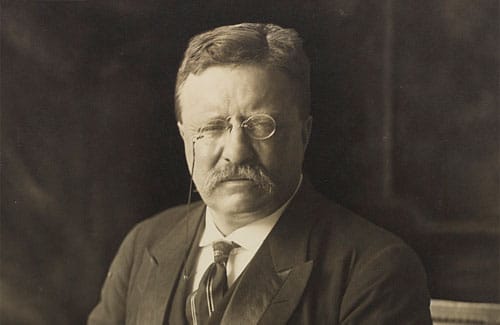
Speech at the Sorbonne, Paris, France on April 23, 1910Strange and impressive associations rise in the mind of a man from the New World who speaks before this august body in this ancient institution of learning. Before his eyes pass the shadows of mighty kings and war-like nobles, of great masters of law and theology; through the shining dust of the dead centuries he sees crowded figures that tell of the power and learning and splendor of times gone by; and he sees also the innumerable host of humble students to whom clerkship meant emancipation, to whom it was well-nigh the only outlet from the dark thraldom of the Middle Ages.
This was the most famous university of mediaeval Europe at a time when no one dreamed that there was a New World to discover. Its services to the cause of human knowledge already stretched far back into the remote past at a time when my forefathers, three centuries ago, were among the sparse bands of traders, ploughmen, wood-choppers, and fisherfolk who, in hard struggle with the iron unfriendliness of the Indian-haunted land, were laying the foundations of what has now become the giant republic of the West.
To conquer a continent, to tame the shaggy roughness of wild nature, means grim warfare; and the generations engaged in it cannot keep, still less add to, the stores of garnered wisdom which where once theirs, and which are still in the hands of their brethren who dwell in the old land. To conquer the wilderness means to wrest victory from the same hostile forces with which mankind struggled on the immemorial infancy of our race. The primaeval conditions must be met by the primaeval qualities which are incompatible with the retention of much that has been painfully acquired by humanity as through the ages it has striven upward toward civilization. In conditions so primitive there can be but a primitive culture.
At first only the rudest school can be established, for no others would meet the needs of the hard-driven, sinewy folk who thrust forward the frontier in the teeth of savage men and savage nature; and many years elapse before any of these schools can develop into seats of higher learning and broader culture. The pioneer days pass; the stump-dotted clearings expand into vast stretches of fertile farm land; the stockaded clusters of log cabins change into towns; the hunters of game, the fellers of trees, the rude frontier traders and tillers of the soil, the men who wander all their lives long through the wilderness as the heralds and harbingers of an oncoming civilization, themselves vanish before the civilization for which they have prepared the way.
The children of their successors and supplanters, and then their children and their children and children’s children, change and develop with extraordinary rapidity. The conditions accentuate vices and virtues, energy and ruthlessness, all the good qualities and all the defects of an intense individualism, self-reliant, self-centered, far more conscious of its rights than of its duties, and blind to its own shortcomings.
To the hard materialism of the frontier days succeeds the hard materialism of an industrialism even more intense and absorbing than that of the older nations; although these themselves have likewise already entered on the age of a complex and predominantly industrial civilization. As the country grows, its people, who have won success in so many lines, turn back to try to recover the possessions of the mind and the spirit, which perforce their fathers threw aside in order better to wage the first rough battles for the continent their children inherit.
The leaders of thought and of action grope their way forward to a new life, realizing, sometimes dimly, sometimes clear-sightedly, that the life of material gain, whether for a nation or an individual, is of value only as a foundation, only as there is added to it the uplift that comes from devotion to loftier ideals. The new life thus sought can in part be developed afresh from what is roundabout in the New World; but it can developed in full only by freely drawing upon the treasure-houses of the Old World, upon the treasures stored in the ancient abodes of wisdom and learning, such as this is where I speak to-day.
It is a mistake for any nation to merely copy another; but it is even a greater mistake, it is a proof of weakness in any nation, not to be anxious to learn from one another and willing and able to adapt that learning to the new national conditions and make it fruitful and productive therein. It is for us of the New World to sit at the feet of Gamaliel of the Old; then, if we have the right stuff in us, we can show that Paul in his turn can become a teacher as well as a scholar. Today I shall speak to you on the subject of individual citizenship, the one subject of vital importance to you, my hearers, and to me and my countrymen, because you and we a great citizens of great democratic republics.
A democratic republic such as ours – an effort to realize its full sense government by, of, and for the people – represents the most gigantic of all possible social experiments, the one fraught with great responsibilities alike for good and evil. The success or republics like yours and like ours means the glory, and our failure of despair, of mankind; and for you and for us the question of the quality of the individual citizen is supreme. Under other forms of government, under the rule of one man or very few men, the quality of the leaders is all-important. If, under such governments, the quality of the rulers is high enough, then the nations for generations lead a brilliant career, and add substantially to the sum of world achievement, no matter how low the quality of average citizen; because the average citizen is an almost negligible quantity in working out the final results of that type of national greatness.
But with you and us the case is different. With you here, and with us in my own home, in the long run, success or failure will be conditioned upon the way in which the average man, the average women, does his or her duty, first in the ordinary, every-day affairs of life, and next in those great occasional cries which call for heroic virtues. The average citizen must be a good citizen if our republics are to succeed. The stream will not permanently rise higher than the main source; and the main source of national power and national greatness is found in the average citizenship of the nation. Therefore it behooves us to do our best to see that the standard of the average citizen is kept high; and the average cannot be kept high unless the standard of the leaders is very much higher.
It is well if a large proportion of the leaders in any republic, in any democracy, are, as a matter of course, drawn from the classes represented in this audience to-day; but only provided that those classes possess the gifts of sympathy with plain people and of devotion to great ideals. You and those like you have received special advantages; you have all of you had the opportunity for mental training; many of you have had leisure; most of you have had a chance for enjoyment of life far greater than comes to the majority of your fellows. To you and your kind much has been given, and from you much should be expected.
Yet there are certain failings against which it is especially incumbent that both men of trained and cultivated intellect, and men of inherited wealth and position should especially guard themselves, because to these failings they are especially liable; and if yielded to, their- your- chances of useful service are at an end. Let the man of learning, the man of lettered leisure, beware of that queer and cheap temptation to pose to himself and to others as a cynic, as the man who has outgrown emotions and beliefs, the man to whom good and evil are as one. The poorest way to face life is to face it with a sneer.
There are many men who feel a kind of twister pride in cynicism; there are many who confine themselves to criticism of the way others do what they themselves dare not even attempt. There is no more unhealthy being, no man less worthy of respect, than he who either really holds, or feigns to hold, an attitude of sneering disbelief toward all that is great and lofty, whether in achievement or in that noble effort which, even if it fails, comes to second achievement. A cynical habit of thought and speech, a readiness to criticise work which the critic himself never tries to perform, an intellectual aloofness which will not accept contact with life’s realities – all these are marks, not as the possessor would fain to think, of superiority but of weakness.
They mark the men unfit to bear their part painfully in the stern strife of living, who seek, in the affection of contempt for the achievements of others, to hide from others and from themselves in their own weakness. The rôle is easy; there is none easier, save only the rôle of the man who sneers alike at both criticism and performance. It is not the critic who counts; not the man who points out how the strong man stumbles, or where the doer of deeds could have done them better. The credit belongs to the man who is actually in the arena, whose face is marred by dust and sweat and blood; who strives valiantly; who errs, who comes short again and again, because there is no effort without error and shortcoming; but who does actually strive to do the deeds; who knows great enthusiasms, the great devotions; who spends himself in a worthy cause; who at the best knows in the end the triumph of high achievement, and who at the worst, if he fails, at least fails while daring greatly, so that his place shall never be with those cold and timid souls who neither know victory nor defeat.
Shame on the man of cultivated taste who permits refinement to develop into fastidiousness that unfits him for doing the rough work of a workaday world. Among the free peoples who govern themselves there is but a small field of usefulness open for the men of cloistered life who shrink from contact with their fellows. Still less room is there for those who deride of slight what is done by those who actually bear the brunt of the day; nor yet for those others who always profess that they would like to take action, if only the conditions of life were not exactly what they actually are. The man who does nothing cuts the same sordid figure in the pages of history, whether he be a cynic, or fop, or voluptuary.
There is little use for the being whose tepid soul knows nothing of great and generous emotion, of the high pride, the stern belief, the lofty enthusiasm, of the men who quell the storm and ride the thunder. Well for these men if they succeed; well also, though not so well, if they fail, given only that they have nobly ventured, and have put forth all their heart and strength. It is war-worn Hotspur, spent with hard fighting, he of the many errors and valiant end, over whose memory we love to linger, not over the memory of the young lord who “but for the vile guns would have been a valiant soldier.”
France has taught many lessons to other nations: surely one of the most important lesson is the lesson her whole history teaches, that a high artistic and literary development is compatible with notable leadership im arms and statecraft. The brilliant gallantry of the French soldier has for many centuries been proverbial; and during these same centuries at every court in Europe the “freemasons of fashion: have treated the French tongue as their common speech; while every artist and man of letters, and every man of science able to appreciate that marvelous instrument of precision, French prose, had turned toward France for aid and inspiration. How long the leadership in arms and letters has lasted is curiously illustrated by the fact that the earliest masterpiece in a modern tongue is the splendid French epic which tells of Roland’s doom and the vengeance of Charlemange when the lords of the Frankish hosts where stricken at Roncesvalles. Let those who have, keep, let those who have not, strive to attain, a high standard of cultivation and scholarship. Yet let us remember that these stand second to certain other things.
There is need of a sound body, and even more of a sound mind. But above mind and above body stands character – the sum of those qualities which we mean when we speak of a man’s force and courage, of his good faith and sense of honor. I believe in exercise for the body, always provided that we keep in mind that physical development is a means and not an end. I believe, of course, in giving to all the people a good education. But the education must contain much besides book-learning in order to be really good. We must ever remember that no keenness and subtleness of intellect, no polish, no cleverness, in any way make up for the lack of the great solid qualities. Self restraint, self mastery, common sense, the power of accepting individual responsibility and yet of acting in conjunction with others, courage and resolution – these are the qualities which mark a masterful people.
Without them no people can control itself, or save itself from being controlled from the outside. I speak to brilliant assemblage; I speak in a great university which represents the flower of the highest intellectual development; I pay all homage to intellect and to elaborate and specialized training of the intellect; and yet I know I shall have the assent of all of you present when I add that more important still are the commonplace, every-day qualities and virtues. Such ordinary, every-day qualities include the will and the power to work, to fight at need, and to have plenty of healthy children. The need that the average man shall work is so obvious as hardly to warrant insistence. There are a few people in every country so born that they can lead lives of leisure.
These fill a useful function if they make it evident that leisure does not mean idleness; for some of the most valuable work needed by civilization is essentially non-remunerative in its character, and of course the people who do this work should in large part be drawn from those to whom remuneration is an object of indifference. But the average man must earn his own livelihood. He should be trained to do so, and he should be trained to feel that he occupies a contemptible position if he does not do so; that he is not an object of envy if he is idle, at whichever end of the social scale he stands, but an object of contempt, an object of derision. In the next place, the good man should be both a strong and a brave man; that is, he should be able to fight, he should be able to serve his country as a soldier, if the need arises. There are well-meaning philosophers who declaim against the unrighteousness of war.
They are right only if they lay all their emphasis upon the unrighteousness. War is a dreadful thing, and unjust war is a crime against humanity. But it is such a crime because it is unjust, not because it is a war. The choice must ever be in favor of righteousness, and this is whether the alternative be peace or whether the alternative be war. The question must not be merely, Is there to be peace or war? The question must be, Is it right to prevail? Are the great laws of righteousness once more to be fulfilled? And the answer from a strong and virile people must be “Yes,” whatever the cost. Every honorable effort should always be made to avoid war, just as every honorable
effort should always be made by the individual in private life to keep out of a brawl, to keep out of trouble; but no self-respecting individual, no self-respecting nation, can or ought to submit to wrong.
Finally, even more important than ability to work, even more important than ability to fight at need, is it to remember that chief of blessings for any nations is that it shall leave its seed to inherit the land. It was the crown of blessings in Biblical times and it is the crown of blessings now. The greatest of all curses in is the curse of sterility, and the severest of all condemnations should be that visited upon willful sterility. The first essential in any civilization is that the man and women shall be father and mother of healthy children, so that the race shall increase and not decrease. If that is not so, if through no fault of the society there is failure to increase, it is a great misfortune. If the failure is due to the deliberate and wilful fault, then it is not merely a misfortune, it is one of those crimes of ease and self-indulgence, of shrinking from pain and effort and risk, which in the long run Nature punishes more heavily than any other.
If we of the great republics, if we, the free people who claim to have emancipated ourselves form the thraldom of wrong and error, bring down on our heads the curse that comes upon the willfully barren, then it will be an idle waste of breath to prattle of our achievements, to boast of all that we have done. No refinement of life, no delicacy of taste, no material progress, no sordid heaping up riches, no sensuous development of art and literature, can in any way compensate for the loss of the great fundamental virtues; and of these great fundamental virtues the greatest is the race’s power to perpetuate the race. Character must show itself in the man’s performance both of the duty he owes himself and of the duty he owes the state.
The man’s foremast duty is owed to himself and his family; and he can do this duty only by earning money, by providing what is essential to material well-being; it is only after this has been done that he can hope to build a higher superstructure on the solid material foundation; it is only after this has been done that he can help in his movements for the general well-being. He must pull his own weight first, and only after this can his surplus strength be of use to the general public. It is not good to excite that bitter laughter which expresses contempt; and contempt is what we feel for the being whose enthusiasm to benefit mankind is such that he is a burden to those nearest him; who wishes to do great things for humanity in the abstract, but who cannot keep his wife in comfort or educate his children.
Nevertheless, while laying all stress on this point, while not merely acknowledging but insisting upon the fact that there must be a basis of material well-being for the individual as for the nation, let us with equal emphasis insist that this material well-being represents nothing but the foundation, and that the foundation, though indispensable, is worthless unless upon it is raised the superstructure of a higher life. That is why I decline to recognize the mere multimillionaire, the man of mere wealth, as an asset of value to any country; and especially as not an asset to my own country. If he has earned or uses his wealth in a way that makes him a real benefit, of real use- and such is often the case- why, then he does become an asset of real worth. But it is the way in which it has been earned or used, and not the mere fact of wealth, that entitles him to the credit. There is need in business, as in most other forms of human activity, of the great guiding intelligences.
Their places cannot be supplied by any number of lesser intelligences. It is a good thing that they should have ample recognition, ample reward. But we must not transfer our admiration to the reward instead of to the deed rewarded; and if what should be the reward exists without the service having been rendered, then admiration will only come from those who are mean of soul. The truth is that, after a certain measure of tangible material success or reward has been achieved, the question of increasing it becomes of constantly less importance compared to the other things that can be done in life. It is a bad thing for a nation to raise and to admire a false standard of success; and their can be no falser standard than that set by the deification of material well-being in and for itself. But the man who, having far surpassed the limits of providing for the wants; both of the body and mind, of himself and of those depending upon him, then piles up a great fortune, for the acquisition or retention of which he returns no corresponding benefit to the nation as a whole, should himself be made to feel that, so far from being desirable, he is an unworthy, citizen of the community: that he is to be neither admired nor envied; that his right-thinking fellow countrymen put him low in the scale of citizenship, and leave him to be consoled by the admiration of those whose level of purpose is even lower than his own.
My position as regards the moneyed interests can be put in a few words. In every civilized society property rights must be carefully safeguarded; ordinarily, and in the great majority of cases, human rights and property rights are fundamentally and in the long run identical; but when it clearly appears that there is a real conflict between them, human rights must have the upper hand, for property belongs to man and not man to property. In fact, it is essential to good citizenship clearly to understand that there are certain qualities which we in a democracy are prone to admire in and of themselves, which ought by rights to be judged admirable or the reverse solely from the standpoint of the use made of them. Foremost among these I should include two very distinct gifts – the gift of money-making and the gift of oratory. Money-making, the money touch I have spoken of above.
It is a quality which in a moderate degree is essential. It may be useful when developed to a very great degree, but only if accompanied and controlled by other qualities; and without such control the possessor tends to develop into one of the least attractive types produced by a modern industrial democracy. So it is with the orator. It is highly desirable that a leader of opinion in democracy should be able to state his views clearly and convincingly. But all that the oratory can do of value to the community is enable the man thus to explain himself; if it enables the orator to put false values on things, it merely makes him power for mischief. Some excellent public servants have not that gift at all, and must merely rely on their deeds to speak for them; and unless oratory does represent genuine conviction based on good common sense and able to be translated into efficient performance, then the better the oratory the greater the damage to the public it deceives. Indeed, it is a sign of marked political weakness in any commonwealth if the people tend to be carried away by mere oratory, if they tend to value words in and for themselves, as divorced from the deeds for which they are supposed to stand.
The phrase-maker, the phrase-monger, the ready talker, however great his power, whose speech does not make for courage, sobriety, and right understanding, is simply a noxious element in the body politic, and it speaks ill for the public if he has influence over them. To admire the gift of oratory without regard to the moral quality behind the gift is to do wrong to the republic. Of course all that I say of the orator applies with even greater force to the orator’s latter-day and more influential brother, the journalist. The power of the journalist is great, but he is entitled neither to respect nor admiration because of that power unless it is used aright. He cna do, and often does, great good. He can do, and he often does, infinite mischief. All journalists, all writers, for the very reason that they appreciate the vast possibilities of their profession, should bear testimony against those who deeply discredit it. Offenses against taste and morals, which are bad enough in a private citizen, are infinitely worse if made into instruments for debauching the community through a newspaper.
Mendacity, slander, sensationalism, inanity, vapid triviality, all are potent factors for the debauchery of the public mind and conscience. The excuse advanced for vicious writing, that the public demands it and that demand must be supplied, can no more be admitted than if it were advanced by purveyors of food who sell poisonous adulterations. In short, the good citizen in a republic must realize that the ought to possess two sets of qualities, and that neither avails without the other. He must have those qualities which make for efficiency; and that he also must have those qualities which direct the efficiency into channels for the public good. He is useless if he is inefficient. There is nothing to be done with that type of citizen of whom all that can be said is that he is harmless.
Virtue which is dependant upon a sluggish circulation is not impressive. There is little place in active life for the timid good man. The man who is saved by weakness from robust wickedness is likewise rendered immune from robuster virtues. The good citizen in a republic must first of all be able to hold his own. He is no good citizen unless he has the ability which will make him work hard and which at need will make him fight hard. The good citizen is not a good citizen unless he is an efficient citizen. But if a man’s efficiency is not guided and regulated by a moral sense, then the more efficient he is the worse he is, the more dangerous to the body politic. Courage, intellect, all the masterful qualities, serve but to make a man more evil if they are merely used for that man’s own advancement, with brutal indifference to the rights of others.
It speaks ill for the community if the community worships these qualities and treats their possessors as heroes regardless of whether the qualities are used rightly or wrongly. It makes no difference as to the precise way in which this sinister efficiency is shown. It makes no difference whether such a man’s force and ability betray themselves in a career of money-maker or politician, soldier or orator, journalist or popular leader. If the man works for evil, then the more successful he is the more he should be despised and condemned by all upright and far-seeing men. To judge a man merely by success is an abhorrent wrong; and if the people at large habitually so judge men, if they grow to condone wickedness because the wicked man triumphs, they show their inability to understand that in the last analysis free institutions rest upon the character of citizenship, and that by such admiration of evil they prove themselves unfit for liberty.
The homely virtues of the household, the ordinary workaday virtues which make the woman a good housewife and housemother, which make the man a hard worker, a good husband and father, a good soldier at need, stand at the bottom of character. But of course many other must be added thereto if a state is to be not only free but great. Good citizenship is not good citizenship if only exhibited in the home. There remains the duties of the individual in relation to the State, and these duties are none too easy under the conditions which exist where the effort is made to carry on the free government in a complex industrial civilization. Perhaps the most important thing the ordinary citizen, and, above all, the leader of ordinary citizens, has to remember in political life is that he must not be a sheer doctrinaire.
The closest philosopher, the refined and cultured individual who from his library tells how men ought to be governed under ideal conditions, is of no use in actual governmental work; and the one-sided fanatic, and still more the mob-leader, and the insincere man who to achieve power promises what by no possibility can be performed, are not merely useless but noxious. The citizen must have high ideals, and yet he must be able to achieve them in practical fashion. No permanent good comes from aspirations so lofty that they have grown fantastic and have become impossible and indeed undesirable to realize. The impractical visionary is far less often the guide and precursor than he is the embittered foe of the real reformer, of the man who, with stumblings and shortcoming, yet does in some shape, in practical fashion, give effect to the hopes and desires of those who strive for better things. Woe to the empty phrase-maker, to the empty idealist, who, instead of making ready the ground for the man of action, turns against him when he appears and hampers him when he does work!
Moreover, the preacher of ideals must remember how sorry and contemptible is the figure which he will cut, how great the damage that he will do, if he does not himself, in his own life, strive measurably to realize the ideals that he preaches for others. Let him remember also that the worth of the ideal must be largely determined by the success with which it can in practice be realized. We should abhor the so-called “practical” men whose practicality assumes the shape of that peculiar baseness which finds its expression in disbelief in morality and decency, in disregard of high standards of living and conduct. Such a creature is the worst enemy of the body of politic. But only less desirable as a citizen is his nominal opponent and real ally, the man of fantastic vision who makes the impossible better forever the enemy of the possible good.
We can just as little afford to follow the doctrinaires of an extreme individualism as the doctrinaires of an extreme socialism. Individual initiative, so far from being discouraged, should be stimulated; and yet we should remember that, as society develops and grows more complex, we continually find that things which once it was desirable to leave to individual initiative can, under changed conditions, be performed with better results by common effort. It is quite impossible, and equally undesirable, to draw in theory a hard-and-fast line which shall always divide the two sets of cases.
This every one who is not cursed with the pride of the closest philosopher will see, if he will only take the trouble to think about some of our closet phenomena. For instance, when people live on isolated farms or in little hamlets, each house can be left to attend to its own drainage and water-supply; but the mere multiplication of families in a given area produces new problems which, because they differ in size, are found to differ not only in degree, but in kind from the old; and the questions of drainage and water-supply have to be considered from the common standpoint. It is not a matter for abstract dogmatizing to decide when this point is reached; it is a
matter to be tested by practical experiment. Much of the discussion about socialism and individualism is entirely pointless, because of the failure to agree on terminology. It is not good to be a slave of names.
I am a strong individualist by personal habit, inheritance, and conviction; but it is a mere matter of common sense to recognize that the State, the community, the citizens acting together, can do a number of things better than if they were left to individual action. The individualism which finds its expression in the abuse of physical force is checked very early in the growth of civilization, and we of to-day should in our turn strive to shackle or destroy that individualism which triumphs by greed and cunning, which exploits the weak by craft instead of ruling them by brutality. We ought to go with any man in the effort to bring about justice and the equality of opportunity, to turn the tool-user more and more into the tool-owner, to shift burdens so that they can be more equitably borne. The deadening effect on any race of the adoption of a logical and extreme socialistic system could not be overstated; it would spell sheer destruction; it would produce grosser wrong and outrage, fouler immortality, than any existing system.
But this does not mean that we may not with great advantage adopt certain of the principles professed by some given set of men who happen to call themselves Socialists; to be afraid to do so would be to make a mark of weakness on our part. But we should not take part in acting a lie any more than in telling a lie. We should not say that men are equal where they are not equal, nor proceed upon the assumption that there is an equality where it does not exist; but we should strive to bring about a measurable equality, at least to the extent of preventing the inequality which is due to force or fraud. Abraham Lincoln, a man of the plain people, blood of their blood, and bone of their bone, who all his life toiled and wrought and suffered for them, at the end died for them, who always strove to represent them, who would never tell an untruth to or for them, spoke of the doctrine of equality with his usual mixture of idealism and sound common sense.
He said (I omit what was of merely local significance):
“I think the authors of the Declaration of Independence intended to include all men, but they did not mean to declare all men equal in all respects. They did not mean to say all men were equal in color, size, intellect, moral development or social capacity. They defined with tolerable distinctness in what they did consider all men created equal-equal in certain inalienable rights, among which are life, liberty and pursuit of happiness. This they said, and this they meant. They did not mean to assert the obvious untruth that all were actually enjoying that equality, or yet that they were about to confer it immediately upon them. They meant to set up a standard maxim for free society which should be familiar to all – constantly looked to, constantly labored for, and, even though never perfectly attained, constantly approximated, and thereby constantly spreading and deepening its influence, and augmenting the happiness and value of life to all people, everywhere.”
We are bound in honor to refuse to listen to those men who would make us desist from the effort to do away with the inequality which means injustice; the inequality of right, opportunity, of privilege. We are bound in honor to strive to bring ever nearer the day when, as far is humanly possible, we shall be able to realize the ideal that each man shall have an equal opportunity to show the stuff that is in him by the way in which he renders service. There should, so far as possible, be equal of opportunity to render service; but just so long as there is inequality of service there should and must be inequality of reward. We may be sorry for the general, the painter, the artists, the worker in any profession or of any kind, whose misfortune rather than whose fault it is that he does his work ill. But the reward must go to the man who does his work well; for any other course is to create a new kind of privilege, the privilege of folly and weakness; and special privilege is injustice, whatever form it takes.
To say that the thriftless, the lazy, the vicious, the incapable, ought to have reward given to those who are far-sighted, capable, and upright, is to say what is not true and cannot be true. Let us try to level up, but let us beware of the evil of leveling down. If a man stumbles, it is a good thing to help him to his feet. Every one of us needs a helping hand now and then. But if a man lies down, it is a waste of time to try and carry him; and it is a very bad thing for every one if we make men feel that the same reward will come to those who shirk their work and those who do it. Let us, then, take into account the actual facts of life, and not be misled into following any proposal for achieving the millennium, for recreating the golden age, until we have subjected it to hardheaded examination. On the other hand, it is foolish to reject a proposal merely because it is advanced by visionaries. If a given scheme is proposed, look at it on its merits, and, in considering it, disregard formulas. It does not matter in the least who proposes it, or why. If it seems good, try it. If it proves good, accept it; otherwise reject it.
There are plenty of good men calling themselves Socialists with whom, up to a certain point, it is quite possible to work. If the next step is one which both we and they wish to take, why of course take it, without any regard to the fact that our views as to the tenth step may differ. But, on the other hand, keep clearly in mind that, though it has been worth while to take one step, this does not in the least mean that it may not be highly disadvantageous to take the next. It is just as foolish to refuse all progress because people demanding it desire at some points to go to absurd extremes, as it would be to go to these absurd extremes simply because some of the measures advocated by the extremists were wise. The good citizen will demand liberty for himself, and as a matter of pride he will see to it that others receive liberty which he thus claims as his own.
Probably the best test of true love of liberty in any country in the way in which minorities are treated in that country. Not only should there be complete liberty in matters of religion and opinion, but complete liberty for each man to lead his life as he desires, provided only that in so he does not wrong his neighbor. Persecution is bad because it is persecution, and without reference to which side happens at the most to be the persecutor and which the persecuted. Class hatred is bad in just the same way, and without regard to the individual who, at a given time, substitutes loyalty to a class for loyalty to a nation, of substitutes hatred of men because they happen to come in a certain social category, for judgement awarded them according to their conduct. Remember always that the same measure of condemnation should be extended to the arrogance which would look down upon or crush any man because he is poor and to envy and hatred which would destroy a man because he is wealthy.
The overbearing brutality of the man of wealth or power, and the envious and hateful malice directed against wealth or power, are really at root merely different manifestations of the same quality, merely two sides of the same shield. The man who, if born to wealth and power, exploits and ruins his less fortunate brethren is at heart the same as the greedy and violent demagogue who excites those who have not property to plunder those who have. The gravest wrong upon his country is inflicted by that man, whatever his station, who seeks to make his countrymen divide primarily in the line that separates class from class, occupation from occupation, men of more wealth from men of less wealth, instead of remembering that the only safe standard is that which judges each man on his worth as a man, whether he be rich or whether he be poor, without regard to his profession or to his station in life. Such is the only true democratic test, the only test that can with propriety be applied in a republic. There have been many republics in the past, both in what we call antiquity and in what we call the Middle Ages. They fell, and the prime factor in their fall was the fact that the parties tended to divide along the wealth that separates wealth from poverty. It made no difference which side was successful; it made no difference whether the republic fell under the rule of and oligarchy or
the rule of a mob. In either case, when once loyalty to a class had been substituted for loyalty to the republic, the end of the republic was at hand. There is no greater need to-day than the need to keep ever in mind the fact that the cleavage between right and wrong, between good citizenship and bad citizenship, runs at right angles to, and not parallel with, the lines of cleavage between class and class, between occupation and occupation. Ruin looks us in the face if we judge a man by his position instead of judging him by his conduct in that position. In a republic, to be successful we must learn to combine intensity of conviction with a broad tolerance of difference of conviction. Wide differences of opinion in matters of religious, political, and social belief must exist if conscience and intellect alike are not be stunted, if there is to be room for healthy growth.
Bitter internecine hatreds, based on such differences, are signs, not of earnestness of belief, but of that fanaticism which, whether religious or antireligious, democratic or antidemocratic, it itself but a manifestation of the gloomy bigotry which has been the chief factor in the downfall of so many, many nations. Of one man in especial, beyond any one else, the citizens of a republic should beware, and that is of the man who appeals to them to support him on the ground that he is hostile to other citizens of the republic, that he will secure for those who elect him, in one shape or another, profit at the expense of other citizens of the republic. It makes no difference whether he appeals to class hatred or class interest, to religious or antireligious prejudice.
The man who makes such an appeal should always be presumed to make it for the sake of furthering his own interest. The very last thing an intelligent and self-respecting member of a democratic community should do is to reward any public man because that public man says that he will get the private citizen something to which this private citizen is not entitled, or will gratify some emotion or animosity which this private citizen ought not to possess. Let me illustrate this by one anecdote from my own experience. A number of years ago I was engaged in cattle-ranching on the great plains of the western Unite States. There were no fences. The cattle wandered free, the ownership of each one was determined by the brand; the calves were branded with the brand of the cows they followed. If on a round-up and animal was passed by, the following year it would appear as an unbranded yearling, and was then called a maverick. By the custom of the country these mavericks were branded with the brand of the man on whose range they were found.
One day I was riding the range with a newly hired cowboy, and we came upon a maverick. We roped and threw it; then we built a fire, took out a cinch-ring, heated it in the fire; and then the cowboy started to put on the brand. I said to him, “It So-and-so’s brand,” naming the man on whose range we happened to be. He answered: “That’s all right, boss; I know my business.” In another moment I said to him: “Hold on, you are putting on my brand!” To which he answered: “That’s all right; I always put on the boss’s brand.” I answered: “Oh, very well. Now you go straight back to the ranch and get whatever is owing to you; I don’t need you any longer.” He jumped up and said: “Why, what’s the matter? I was putting on your brand.” And I answered: “Yes, my friend, and if you will steal for me then you will steal from me.” Now, the same principle which applies in private life applies also in public life. If a public man tries to get your vote by saying that he will do something wrong in your interest, you can be absolutely certain that if ever it becomes worth his while he will do something wrong against your interest. So much for the citizenship to the individual in his relations to his family, to his neighbor, to the State.
There remain duties of citizenship which the State, the aggregation of all the individuals, owes in connection with other States, with other nations. Let me say at once that I am no advocate of a foolish cosmopolitanism. I believe that a man must be a good patriot before he can be, and as the only possible way of being, a good citizen of the world. Experience teaches us that the average man who protests that his international feeling swamps his national feeling, that he does not care for his country because he cares so much for mankind, in actual practice proves himself the foe of mankind; that the man who says that he does not care to be a citizen of any one country, because he is the citizen of the world, is in fact usually and exceedingly undesirable citizen of whatever corner of the world he happens at the moment to be in. In the dim future all moral needs and moral standards may change; but at present, if a man can view his own country and all others countries from the same level with tepid indifference, it is wise to distrust him, just as it is wise to distrust the man who can take the same dispassionate view of his wife and mother. However broad and deep a man’s sympathies, however intense his activities, he need have no fear that they will be cramped by love of his native land. Now, this does not mean in the least that a man should not wish to good outside of his native land.
On the contrary, just as I think that the man who loves his family is more apt to be a good neighbor than the man who does not, so I think that the most useful member of the family of nations is normally a strongly patriotic nation. So far from patriotism being inconsistent with a proper regard for the rights of other nations, I hold that the true patriot, who is as jealous of the national honor as a gentleman of his own honor, will be careful to see that the nations neither inflicts nor suffers wrong, just as a gentleman scorns equally to wrong others or to suffer others to wrong him. I do not for one moment admit that a man should act deceitfully as a public servant in his dealing with other nations, any more than he should act deceitfully in his dealings as a private citizen with other private citizens. I do not for one moment admit that a nation should treat other nations in a different spirit from that in which an honorable man would treat other men. In practically applying this principle to the two sets of cases there is, of course, a great practical difference to be taken into account.
We speak of international law; but international law is something wholly different from private of municipal law, and the capital difference is that there is a sanction for the one and no sanction for the other; that there is an outside force which compels individuals to obey the one, while there is no such outside force to compel obedience as regards to the other. International law will, I believe, as the generations pass, grow stronger and stronger until in some way or other there develops the power to make it respected. But as yet it is only in the first formative period. As yet, as a rule, each nation is of necessity to judge for itself in matters of vital importance between it and its neighbors, and actions must be of necessity, where this is the case, be different from what they are where, as among private citizens, there is an outside force whose action is all-powerful and must be invoked in any crisis of importance.
It is the duty of wise statesman, gifted with the power of looking ahead, to try to encourage and build up every movement which will substitute or tend to substitute some other agency for force in the settlement of international disputes. It is the duty of every honest statesman to try to guide the nation so that it shall not wrong any other nation. But as yet the great civilized peoples, if they are to be true to themselves and to the cause of humanity and civilization, must keep in mind that in the last resort they must possess both the will and the power to resent wrong-doings from others. The men who sanely believe in a lofty morality preach righteousness; but they do not preach weakness, whether among private citizens or among nations. We believe that our ideals should be so high, but not so high as to make it impossible measurably to realize them. We sincerely and earnestly believe in peace; but if peace and justice conflict, we scorn the man who would not stand for justice though the whole world came in arms against him. And now, my hosts, a word in parting. You and I belong to the only two republics among the great powers of the world.
The ancient friendship between France and the United States has been, on the whole, a sincere and disinterested friendship. A calamity to you would be a sorrow to us. But it would be more than that. In the seething turmoil of the history of humanity certain nations stand out as possessing a peculiar power or charm, some special gift of beauty or wisdom of strength, which puts them among the immortals, which makes them rank forever with the leaders of mankind. France is one of these nations. For her to sink would be a loss to all the world. There are certain lessons of brilliance and of generous gallantry that she can teach better than any of her sister nations. When the French peasantry sang of Malbrook, it was to tell how the soul of this warrior-foe took flight upward through the laurels he had won.
Nearly seven centuries ago, Froisart, writing of the time of dire disaster, said that the realm of France was never so stricken that there were not left men who would valiantly fight for it. You have had a great past. I believe you will have a great future. Long may you carry yourselves proudly as citizens of a nation which bears a leading part in the teaching and uplifting of mankind.

Mary, Helen, Margaret, Ruth, Dorothy, John, William, James, George, Robert
Men: 50.5 years Women:53.8 years
Condé Montrose Nast founded Condé Nast Inc..
Maksymilian Faktorowicz founded Max Factor.
The first pig to fly was on November 4, 1909. Pioneering English aviator John Moore-Brabazon (The 1st Baron Brabazon of Tara) passed overhead with the pig in a basket, attached to his plane.
The “customer is always right” slogan was created by Harry Gordon Selfridge, the founder of Selfridge’s department store in London, in 1909 to provide better customer service.
Carlisle Trust Bank opened the first Christmas Club, saving money for Christmas gifts.
The Oval Office was constructed in 1909.
Philadelphia’s Shibe Park (later Connie Mack Stadium) opened.
The National Association for the Advancement of Colored People (NAACP) was formed.
The Hudson Motor Car Company (1909 – 1954) was founded.
New York was first mentioned as “The Big Apple” in the 1909 book The Wayfarer in New York by Edward S. Martin.
Soren Sorensen created the pH scale in 1909 while working for Carlsberg Beer. The development was used to control the beer’s acidity and minimize fermentation problems.
Abercrombie & Fitch published their first catalog.
The superstition that said “Rabbit, Rabbit, Rabbit” when waking on the first day of the month to bring good luck originated in 1909.
The first president to drive an electric car was William Howard Taft.
364,545 Pianos were sold in the United States, a record.
Henry Burr, Arthur Collins, Byron G. Harlan, The Hayden Quartet, Ralph Herz, Harold Jarvis, Ada Jones, Harry Lauder, Harry Macdonugh, Billy Murray, Will Oakland, The Peerless Quartet, Prince’s Orchestra, Arthur Pryor’s Band, Blanche Ring, Manuel Romain, John Philip Sousa’s Band, Frank Stanley, Elise Stevenson, Harry Tally, Nat Wills, Walter Van Brunt
March 4, 1909 (Thursday) Inauguration of William Howard Taft
The Eiffel Tower was initially planned to be demolished in 1909 but was saved because it was re-purposed as a giant radio antenna. In 1913, the tower transmitted a signal to Washington DC.
Alice Ramsey was the first woman to drive across the United States, in 1909. It took her 59 days.
Harry Houdini wrote a book in 1909 called “Handcuff Secrets,” in which he revealed many of the tricks behind his famous escapes.
Henry Ford offered his Model T automobile a few options. “Any customer can have a car painted any color they like, as long as it’s black.”
Joan of Arc receives beatification by the Roman Catholic Church. She was canonized as a saint on May 16, 1920.
The Indianapolis Motor Speedway complex was built in 1909, and the Indianapolis 500 started in 1911.
Ty Cobb lead the American League in home runs, without hitting a single one over the fence.
Warren Remedy (1905-1912), a Smooth Fox Terrier owned by Winthrop Rutherfurd, was awarded Best in Show at the Westminster Kennel Club for the third straight year in a row (1907, 1908, 1909), the only dog to do so.
The 1909 T206 Honus Wagner baseball card is the highest-valued card ever, last auctioned off at over $2.1 million in 2012. He ended the production of his card because a tobacco company distributed them, and he didn’t want to be associated with smoking.
The first International Women’s Day was a socialist political event in New York City in 1909.
The world’s oldest operating airport, College Park, Maryland, was established when Wilbur Wright arrived to train two US Army officers.
Founded in 1902, Cadillac joined General Motors.
The Eton Wall Game is played on a narrow strip 110 meters long up against a wall. Moving the ball along the wall with your feet and scoring a goal at the far end is the idea. Goals are scarce; the last one scored was at the annual St Andrew’s Day match in 1909. Other matches end up with a goal every ten years or so.
Construction of the US Navy base began at Pearl Harbor, Hawaii.
Mark Twain (November 30, 1835 – April 21, 1910) predicted his death in 1909: “I came in with Halley’s Comet in 1835. It is coming again next year, and I expect to go out with it.” He died in 1910, a day after the comet returned.
There is a conspiracy theory that Egyptian treasures and tunnels were found in the Grand Canyon in 1909 and subsequently covered up by the Smithsonian. The area in question has numerous Egyptian landmark names and is currently off-limits to all hikers.
In 1909, the presidential salary was $75,000. Adjusting for inflation, that’s about $1.7 million, or more than four times the current presidential pay of $400,000.
The US government had a “Conscience Fund” where people could send money if they felt guilty. The most considerable sum ever received was from 1909 when someone mailed in $18,669.
The 1909 Cherry Mine Disaster in Illinois killed 259 men and boys.
Milton Hershey’s inability to have children founded the Milton Hershey School for Orphans in 1909. He donated 30% of all future Hershey profits. It now has 7 billion in assets and continues to serve orphans in financial need. Milton also prohibited its use in any advertising.
Physics – Guglielmo Marconi and Karl Ferdinand Braun
Chemistry – Wilhelm Ostwald
Medicine – Emil Theodor Kocher
Literature – Selma Lagerlöf
Peace – Auguste Marie François Beernaert and Paul-Henri-Benjamin d’Estournelles de Constant
1. The Inner Shrine by Basil King
2. Katrine by Elinor Macartney Lane
3. The Silver Horde by Rex Beach
4. The Man in Lower Ten by Mary Roberts Rinehart
5. The Trail of the Lonesome Pine by John Fox Jr
6. Truxton King by George Barr McCutcheon
7. 54-40 or Fight by Emerson Hough
8. The Goose Girl by Harold MacGrath
9. Peter by F. Hopkinson Smith
10. Septimus by William J. Locke
The Promise of American Life by Herbert Croly
A Pluralistic Universe by William James
American Prose Masters by W.C. Brownell
World Series Champions: Pittsburgh Pirates
Challenge Cup Champs: Ottawa Hockey Club
U.S. Open Golf: George Sargent
U.S. Tennis (Men/Ladies): William Larned/Hazel Hotchkiss Wightman
Wimbledon (Men/Women): Arthur Gore/Dora Boothby
NCAA Football Champions: Yale
Kentucky Derby Winner: Wintergreen
Boston Marathon Winner: Henri Renaud Time: 2:53:36
Most Popular Baby Names (BabyCenter.com)
Popular and Notable Books (popculture.us)
Broadway Shows that Opened in 1909
1909 Calendar, courtesy of Time and Date.com
1909 in Movies (according to IMDB)
Wikipedia 1909

Mary, Helen, Margaret, Ruth, Anna, John, William, James, George, Robert
(1908) Males: 49.5 years, Females: 52.8 years
Adolph Spreckels, of the Spreckels Sugar Company, was the first Sugar Daddy, nicknamed by his 24-years-younger wife, Alma de Bretteville.
The word “empathy” did not enter the English language until 1908.
I Got the Blues, published by New Orleans musician Antonio Maggio, and it is probably the first published “Blues” song.
Gideon Bibles started appearing in Hotel rooms.
The first ‘spork’ (cutting spoon) was patented (#904553A) 1908.
Around 400 BC, the Greek philosopher Democritus codified four basic tastes (sweet, sour, salty, bitter). No one challenged this until Auguste Escoffier, who claimed another, un-named taste, until a Japanese chemist, Kikunae Ikeda, ‘discovered’ the fifth flavor (umami) in L-glutamate.
Sunshine made Hydrox Cookies in 1908, and Oreo copied it in 1912.
Rolex founder Hans Wilsdorf came up with the name Rolex when, as he said, “I tried combining the letters of the alphabet in every possible way. This gave me some hundred names, but none felt right. One morning, a genie whispered’ Rolex’ in my ear while riding on the upper deck of a horse-drawn omnibus along Cheapside in the City of London.”
Tea Bags became popular.
The American term “Melting Pot” was first used in Israel Zangwill’s play of the same name.
The recipe for Tootsie Rolls calls for the previous day’s batch to be mixed with the new batch each day. Theoretically, this means there could be a bit of the first, starting in 1908, Tootsie Rolls in every new roll made today.
Until 1908, Philadelphia City Hall was the tallest building in the world.
John Beiling, Henry Burr, Albert Campbell, Enrico Caruso, Arthur Collins, Emilio DeGogorza, Geraldine Farrar, Byron G. Harlon, The Hayden Quartet, Harvey Hindermyer, Ada Jones, Harry Macdonough, Isabelle Marsh, Eddie Morton, Billy Murray, The Peerless Quartet, Arthur Pryor’s Band, Antonio Scotti, Frank Stanley, Cal Stewart, Elise Stevenson, Alan Turner, The Victor Orchestra, Reinald Werrenrath
London was the first city to have ever hosted the Olympics three times. 1908, 1948, and 2012.
The Tunguska Event, an explosion in Siberia in 1908, was 1,000 times greater than the atomic bomb dropped in Hiroshima, wiped out 80 million trees, and some say it was from a Nikola Tesla experiment. #itwasnt #probablyameteor
“SOS” (· · · – – – · · ·) distress signal officially became the worldwide standard for help.
Six thousand two hundred ten fans showed up to see the Cubs win the 1908 World Series, the smallest crowd for a World Series game. Chicago Cubs playoff games are scheduled at 7:08 pm or 19:08 in military time, and this is because 1908 was the last year the Cubs won the World Series. Merkle’s Boner was an incident in which rookie baseball player Fred Merkle of the New York Giants failed to advance to second base on what should have been a game-winning hit. This would lead to the Giants losing the National League pennant to the Chicago Cubs.
Take Me Out to the Ball Game is a 1908 Tin Pan Alley song by Jack Norworth and Albert Von Tilzer, which has become the unofficial anthem of North American baseball.
HIV made the jump from chimps to humans around 1908.
Ford’s Model T went on sale, at $825.00.
Mother’s Day was created by Anna Jarvis of West Virginia in 1908. It soon became so commercial that Jarvis spent the rest of her life trying to remove it from the calendar.
Sears sold mail-order homes, 75,000 between 1908 and 1940, as part of their Modern Homes program. They arrived as a kit and included many modern conveniences, such as indoor plumbing.
In 1908 in England, William “Bigfoot” Anakin, a local champion, was taken to court by a defense lawyer to help demonstrate that darts were not gambling but a game of skill. He threw three darts in the center; no other court official could do the same. The judge ruled that darts were a game of skill.
The Phaistos Disc was discovered in 1908 by the Italian archaeologist Luigi Pernier
The United States is the only country that does not ‘dip’ its flag to the host country at the Olympics opening ceremonies. When the US flag-holder, Ralph Rose, was asked to do so for King Edward VII at the 1908 London games, he supposedly responded, “This flag dips to no earthly king.”
Pistol dueling was a sport in the 1908 Summer Olympics. Contestants used wax bullets and metal masks for safety.
The United Kingdom won 146 medals in their 1908 London Olympic Games – 56 were gold medals, more than every other country in that year.
The 1908 Olympics were moved from Rome to London due to the 1906 eruption of Mount Vesuvius.
A marathon is 40.195 km (26.2 miles) because the British Queen Alexandra wanted the Olympic marathon in the 1908 Olympics in London to finish on the grass field. This changed the then-current distance of a marathon, but it was later formalized as the official distance and never changed back.
Finland and Sweden are the only countries that have earned a medal at every Olympic game since 1908.
When introduced to the Olympics in 1908, figure skating was part of the Summer Games. It remained so until 1924.
The Russian Olympic team arrived at the Olympics in London 12 days late because it was still using the Julian calendar instead of the Gregorian calendar.
English newspaper The Daily Telegraph printed an interview with Germany’s Emperor Wilhelm II, who characterized himself as ‘personally friendly’ to Britain but suggested the German people are hostile. It did not go well in either country, which is why, even today, it refers separately between governments and citizens of nations.
In his 1908 South Pole expedition, Ernest Shackleton included in his supplies cigars, 42 cases of alcohol, a car, and cocaine.
One hundred seventy-two students died in the Collinwood School Fire. One hundred seventy-one people died in a fire at the Rhoads Opera House. The crush of the crowds toward the exit made it impossible to open the inward-swinging doors. This is why doors now open outward in the United States.
Physics – Gabriel Lippmann
Chemistry – Ernest Rutherford
Medicine – Élie Metchnikoff, Paul Ehrlich
Literature – Rudolf Christoph Eucken
Peace – Klas Pontus Arnoldson, Fredrik Bajer
1. Mr. Crewe’s Career by Winston Churchill
2. The Barrier by Rex Beach
3. The Trail of the Lonesome Pine by John Fox Jr
4. The Lure of the Mask by Harold MacGrath
5. The Shuttle by Frances Hodgson Burnett
6. Peter by F. Hopkinson Smith
7. Lewis Rand by Mary Johnston
8. The Black Bag by Louis J. Vance
9. The Man from Brodney’s by George Barr McCutcheon,
10. The Weavers Critically Acclaimed and Historically Significant by Gilbert Parker
The Wind and The Willows by Kenneth Grahame
Process of Government by Arthur Bentley
Materialism and Empirio-Criticism by Vladimir Lenin
Human Nature and Politics by Graham Wallas
A Room with a View by E. M. Forster
The Old Wives’ Tale by Arnold Bennett
Hind Swaraj by Mohandas Gandhi
The Melting Pot by Israel Zangwill
World Series Champions: Chicago Cubs
Challenge Cup Champs: Montreal Wanderers
U.S. Open Golf: Fred McLeod
U.S. Tennis (Men/Ladies): William Larned/Maud Barger-Wallach
Wimbledon (Men/Women): Arthur Gore/Charlotte Sterry
NCAA Football Champions: Pennsylvania & LSU
Kentucky Derby Winner: Stone Street
Boston Marathon Winner: Thomas Morrissey Time: 2:25:43
Most Popular Baby Names (BabyCenter.com)
Popular and Notable Books (popculture.us)
Broadway Shows that Opened in 1908
1908 Calendar, courtesy of Time and Date.com
Fact Monster
1908 in Movies (according to IMDB)
Wikipedia 1908

Samuel L. Clemen’s notice for his next burglar
September 9, 1908
NOTICE.
To the next Burglar.
There is nothing but plated ware in this house, now and henceforth. You will find it in that brass thing in the dining-room over in the corner by the basket of kittens. If you want the basket, put the kittens in the brass thing. Do not make a noise- it disturbs the family. You will find rubbers in the front hall, by that thing which has the umbrellas in it, chiffonier, I think they call it, or pergola, or something like that.
Please close the door when you go away!
Very truly yours,
S.L. Clemens
John Swain’s Letter to his son, who was entering Yale University
~1908
My Dear Son:
I am writing a few things I meant to say to you when we took our last walk together, the day before you left for Yale. l intended to say them then and I will even confess that l shamelessly inveigled you into taking a stroll on the quiet street that l might rehearse a carefully prepared bit of Chesterfield up-to-date; but somehow I could not seem to begin,—and, after all, perhaps I can write what was in my mind more freely and plainly than l could have spoken it.
I think I had never realized before that I was getting old.
Of course I have known that my hair is causing your mother much solicitude. and that l am hopelessly wedded to my pince-nez while reading my daily paper, and at the opera; but in some incomprehensible way I had forgotten to associate these trifles with the encroachments of time. It was the sudden realization that you were about to become a Freshman in the college from which, as it seems to me, l but yesterday graduated, that “froze the genial current of my soul,” and spared you my paternal lecture.
Why, l can shut my eyes and still hear the Ivy Song, as we sang it that beautiful June morning; and yet but a few nights more and you will be locked in the deadly Rush on the same field where I triumphantly received two blackened eyes, and, l trust, gave many more!
Another thing, trifling in itself, opened my eyes to the fact of my advancing years. My son, my loyal and affectionate boy, some day it may be yours to know the pain, the unreasonable pain that comes over a man to know that between him and his boy, and his boy’s friends, an unseen but unassailable barrier has arisen, erected by no human agency; and to feel that while they may experience a vague respect and even curiosity to know what exists on your side of the barrier, you on your part would give all- wealth, position, influence, honor- to get back to theirs! All the world, clumsily or gracefully, is crawling over this barrier; but not one ever crawls back again!
You have ever seemed happy to be with me; you have worked with me, read and smoked with me, even played golf with me; but the subtle change in your attitude, the kindling of your eye when we met young men of your age, is the keenest pain I have ever known; yet one which, God knows! I would not reproach you with.
It explains what I used to see on my father’s face and did not understand.
For the tyranny of youth, my son, is the one tyranny which never has been, never can be overthrown. Nothing can displace it, nothing shake its power.
I usually beat you at golf, and occasionally at tennis; I suppose that if we were to spar together I might still make a respectable showing, and at least “save my face.” It avails no thing. I am on my side of the barrier, you on yours.
It seems but a year and a day since I tucked the ball under my arm and sped down the gridiron, sustained by the yells of my partisans; and if our game lacked the machine-like precision of the mass formations you are already somewhat familiar with, it was a good game, and we were good men, and all on the right side of the barrier!
So bear with me if l pause a moment and gaze back across this inevitable gulf into the pleasant land that lies behind me, -a picture evoked by your dawning college career.
I would not have you think me regretful, or melancholy. Life has been good to me- and every age has its gifts for the man who is willing to work for them and use them temperately. And nothing is more ungraceful, more ludicrous, than the spectacle of one who attempts to linger over the pleasures of an age he had outlived, and ignore the advantages of his own time of life.
Yet, as the years bring weakness, the mind persistently drifts back to the earlier periods of life, until the aged actually enter a phase we not inaptly name “second childhood,” from which Heaven forefend me!
I can still appreciate a pair of sparkling blue eyes, and I am not oblivious to the turn of a pretty shoulder; although I devoutly trust that my interest is now impersonal, and merely artistic . . .
Some fathers say to their sons upon the first home leaving,—”Beware of wine and women!” I do not.
If your home life has not taught you the virtues of a temperate, clean life, as I hope, then no words of mine can do it, and you must learn, as too many others have, from a bitter intimacy with its antithesis.
As to women, I never avoided them; I sought them out, from the time when, a red-cheeked youngster, I trudged to school beside a red-cheeked lassìe- asleep these many years in the little village lot where lie so many with whom I fought and played these many years gone by.
I have no advice to offer you on this great subject; its ethics are not taught by letter. If I have any regrets, they are not for your ear, nor any man’s. And if, of some women I have known, I cannot say that I lifted them up, at least of no woman can it be said that I thrust her down!
I ask of you no more than this and the guidance of your own heart; that, in the latter years, when you, too, pass over the barrier, you may not leave behind you shadows on the flower-decked meadows of your youth.
You will probably play cards in college; most men do, -I did. The gambling instinct in man is primordial. Kept under due bounds, if not useful, it is at least comparatively harmless. This is the very best that I or any honest man can say of it. I should be glad if you never cared to gamble; but l do not ask it. Assuming that you will, l do not insult you, and myself equally, by warning you against unfairness; to suppose you capable of cheating at cards is to suppose an impossibility. You could not do so without forfeiting the right ever to enter your home again. But some careless and insidious practices, not unknown in my day and class, savor to the upright mind of cheating, without always incurring its penalties.
To play with men whom you know cannot afford to lose, and who must either cheat or suffer privation; to play when you yourself must win your bet to square yourself; that is, when you do not reasonably see how you are going to raise the money to pay providing you lose,—this is a gambler’s chance to which no gentleman will ever expose his fellow players.
There is nothing heroic about these desperate casts of the die; one risks only the other fellow’s money. These practices I ask and expect you to avoid.
l ask nothing of you in the way of a declared position on religion. Your mother may have demanded more of you here,—entreated more; I cannot. I ask but this: that you will give earnest, serious consideration to the fact that we exist on this planet for a shockingly brief fraction of Eternity; that it behooves every man to diligently seek an answer to the great question,—Why am I here? And then, as best he can, to live up to the ideal enjoined by his answer. And if this carries you far, and if it leads you to embrace any of the great creeds of Christendom, this will be to your mother an unspeakable joy, and perhaps not less so to me; but it is a question which cannot be settled by the mere filial desire to please.
Last of all, while you are in college, be of it and support its every healthful activity.
I ask no academic honor your natural inclinations may not lead you to strive for; no physical supremacy your animal spirits may not instinctively reach out and grasp.
You will, I presume, make the fraternity I made, and, I hope, the societies; you will probably then learn that your father was not always a dignified, bearded man in pince-nez and frock coat, and that on his side of the barrier he cut not a few capers which, seen in the clear light of his summer, gain little grace. Yet, were he to live his life over again, he would cut the same, or worse.
Finally, if you make any of the teams, never quit. That is all the secret of success. Never quit!
Quitting, I like to believe, has not been a striking characteristic of our family, and it is not tolerated in our college.
If you can’t win the scholarship, fight it out to the end of the examination.
If you can’t win your race, at least finish- somewhere.
If your boat can’t win, at least keep pulling on your oar, even if your eye glazes and the taste of blood comes into your throat with every heave.
If you cannot make your five yards in football, keep bucking the line—never let up—if you can’t see, or hear, keep plugging ahead! Never quit! If you forget all else I have said, remember these two words, through all your life, and come success or failure, I shall proudly think of you as my own dear son.
And so, from the old home-life, farewell, and Godspeed!
Your Affectionate Father

Mary, Helen, Margaret, Anna, Ruth, John, William, James, George, Robert
(1907) Males: 45.6 years, Females: 49.9 years
Morris Michtom, the inventor of the Teddy Bear in 1902, opened the Ideal Novelty and Toy Company.
The Plaza Hotel opened in New York City (5th Ave& 59th St). The Price for one night was $2.50.
Before 1907, a carat, the unit of measurement for gemstones and pearls, could be anywhere between 187 milligrams to 215.99 milligrams, depending on what part of the world you were in. An agreement in Paris put it at 200 mg, and the United States started using that number in 1913.
UPS was initially called American Messenger Company and was started in 1907 by two teenagers, Claude Ryan and Jim Casey, in Seattle.
The First AA Battery was invented.
The Bank of Italy (later Bank of America) opened at 3433 Mission Street, San Francisco.
E.W. Scripps founded United Press (International).
The first Ziegfeld Follies was produced in 1907 at Jardin de Paris’s roof theatre.
The word “blurb” was invented in 1907 by humorist Gelett Burgess.
Scott introduced paper towels in 1907 for public bathroom use and kitchen use in 1931.
The world’s first fully synthetic plastic was Bakelite, invented in New York in 1907 by Leo Baekeland, who coined the term ‘plastics’.
The first trial to be called the “trial of the century” was in 1907, when Harry K. Thaw was tried for the murder of Stanford White.
A Mexican railroad brakeman named Jesus Garcia saved the entire town of Nacozari, Sonora, by single-handedly driving a damaged and burning train containing dynamite six kilometers away from the town before it exploded, killing him
Henry Burr, Albert Campbell, Enrico Caruso, Arthur Collins, Byron G. Harlan, The Hayden Quartet, Ada Jones, Harry Lauder, Harry Macdonough, Corinne Morgan, Billy Murray, The Peerless Quartet, Prince’s Orchestra, Frank Stanley, Elise Stevenson, Cal Stewart, Harry Tally, Helen Trix, The United States Marine Band, The Victor Orchestra, Bert Williams
Until 1907, marrying your dead wife’s sister was illegal in England.
Father’s Day was inspired, in part, by the 1907 Monongah Mining Disaster in West Virginia that killed 361 men, 250 of them fathers, leaving around a thousand fatherless children.
Joseph Stalin said at the funeral of his first wife: “This creature softened my heart of stone. She died, and with her died my last warm feelings for humanity.”
Joseph Stalin, Vladimir Lenin, and Maxim Litvinov were all involved in a 1907 armed robbery that resulted in the deaths of 40 people and injured 50 others, stealing $3.4 in 2017 million dollars.
Ringling Brothers Greatest Show on Earth bought Barnum & Bailey Circus.
“Gentleman’s Agreement” refers to an informal agreement between the US and Japan in 1907.
Kellogg’s promoted their cornflakes with something called the Wink Day campaign. Women were encouraged to “wink at your grocer and see what you get”; they got a free cereal box.
Ben-Hur (2016) was a remake of Ben-Hur (1959), a remake of a 1925 silent film and a 1907 silent film.
The ball atop One Times Square started on December 31, 1907, as 100 incandescent light bulbs on a wood and iron structure hoisted with a rope. The ball drop tradition has been observed yearly since, except in 1942 and 1943, in observance of wartime blackouts.
The Huia bird went extinct in 1907, but its song exists today because an elderly Maori man recorded them 1949 from childhood memories.
The Irish Crown Jewels were stolen in 1907, and the crime has never been solved.
Australian swimmer Anette Kellerman was the first woman to wear a one-piece bathing suit and was arrested for indecency in 1907. She was also one of the first women to attempt to swim the English Channel.
During the Panic of 1907, John D. Rockefeller, the wealthiest man in America, pledged half of his wealth to maintain America’s credit and got other bankers to help. The Panic of 1907 led to the formation of The Federal Reserve Bank.
Polio has existed throughout written human history, but there was never a significant epidemic until 1907, when 2,700 contracted polio in Vermont; by 1952, there were over 50,000 cases in just the United States.
John “Babbacombe” Lee (1864 – March 19, 1945) survived three attempts to arrest him for murder in 1885 when the gallows malfunctioned and were released in 1907.
Dropping a bomb from a balloon is, to this day, a violation of the Hague Conventions of 1899 and 1907, although there is no such prohibition for dropping a bomb from an aircraft.
Harvard’s Widener Library is named after a 1907 alum, Harry Elkins Widener, who died on the Titanic.
Researcher George Soper published the results of his investigation into recent typhoid outbreaks in the New York area. He said that Mary Mallon (Typhoid Mary) was the likely source of the outbreak.
“Uncle Fed” Messer lived in North Carolina, US, from August 21, 1791, until February 8, 1907.
In Nigeria, a local tribe worshiped the god of smallpox, Sopona. The priests secretly infected people they didn’t like. Based on this information, the British colonial rulers banned the worship of Sopona in 1907.
The phrase “the whole 9 yards” is unrelated to football or sports. No one knows the origins; it is “the most prominent etymological riddle of our time.” It is based on an earlier “whole 6 yards” phase traced to circa 1907.
From 1907 to 1922, U.S. citizen women lost citizenship if they married foreigners.
On January 1, 1907, Theodore Roosevelt shook the hands of 8,510 people, setting a world record he held for over 70 years.
Physics – Albert Abraham Michelson
Chemistry – Eduard Buchner
Medicine – Charles Louis Alphonse Laveran
Literature – Rudyard Kipling
Peace – Ernesto Teodoro Moneta, Louis Renault
1. The Lady of the Decoration by Frances Little
2. The Weavers by Gilbert Parker
3. The Port of Missing Men by Meredith Nicholson
4. The Shuttle by Frances Hodgson Burnett
5. The Brass Bowl by Louis J. Vance
6. Satan Sanderson by Hallie Erminie Rives
7. The Daughter of Anderson Crow by George Barr McCutcheon
8. The Younger Set by Robert W. Chambers
9. The Doctor by Ralph Connor
10. Half a Rogue by Harold MacGrath
Pragmatism by William James
Christianity and the Social Crisis by Walter Rauschenbusch
The American Scene by Henry James
New Basis for Civilization by Simon Patten
Creative Evolution by Henri Bergson
World Series Champions: Chicago Cubs
Challenge Cup Champs: Kenora Thistles/Montreal Wanderers
U.S. Open Golf: Alec Ross
U.S. Tennis (Men/Ladies): William Larned/Evelyn Sears
Wimbledon (Men/Women): Norman Brookes/May Sutton
NCAA Football Champions: Yale
Kentucky Derby Winner: Pink Star
Boston Marathon Winner: Thomas Longboat Time: 2:24:24
Most Popular Baby Names (BabyCenter.com)
Popular and Notable Books (popculture.us)
Broadway Shows that Opened in 1907
1907 Calendar, courtesy of Time and Date.com
Fact Monster
1907 in Movies (according to IMDB)
Wikipedia 1907

Mary, Helen, Margaret, Anna, Ruth, John, William, James, George, Robert
(1906) Males: 46.9 years, Females: 50.8 years
The first Victor Victrola phonographic record player was manufactured.
Willis Carrier received his US patent (#808,897) for the world’s first air conditioner (“apparatus for treating air,”).
The first animated cartoon, Humorous Phases of Funny Faces, was copyrighted.
Filed three years earlier, the US Patent (#821,393) was granted on May 22, 1906, to Wilbur and Orville Wright for “new and useful improvement in Flying Machines.”
Finland was the first country in the world to give women the right to vote and run for office. One year later, the world’s first female MPs were elected.
Federated Boys’ Club (Boys’ Club of America) was organized among 53 independent organizations.
Alpha Phi Alpha, 1st Black Greek Letter Fraternity, was formed at Cornell. Initial members were Henry Arthur Callis, Charles Henry Chapman, Eugene Kinckle Jones, George Biddle Kelley, Nathaniel Allison Murray, Robert Harold Ogle, and Vertner Woodson Tandy.
The Devil’s Tower in Crook County, Wyoming, was the first declared United States National Monument, established on September 24, 1906.
The first French Grand Prix occurred on a 64-mile circuit at Le Mans.
Pure Food and Drug Act and Meat Inspection Act adopted by the US Congress.
The Story of the Kelly Gang was released.
Will Keith Kellogg and Charles D. Bolin founded the Battle Creek Toasted Corn Flake Company, now known as Kellogg’s.
On January 12, 1, the Dow Jones closed above 100 (100.26) for the first time.
The British Labour Party organized.
Sweden adopted their (yellow cross on a blue background) flag.
After two years of digging the Hudson River Tunnel (now one of the North River Tunnels), workers for the Pennsylvania Railroad Company connected Manhattan’s West Side with Weehawken, NJ. They met in the middle of the Hudson, completing the tunnel, and the two ends were only off by 1/16 of an inch.
Henry Burr, Albert Campbell, Enrico Caruso, Arthur Collins, Byron G. Harlan, The Hayden Quartet, DeWolf Hopper, Ada Jones, Richard Jose, Harry Macdonough, James McCool, Corrine Morgan, Billy Murray, Voss Ossman, Arthur Pryor’s Band, Antonio Scotty, John Philip Sousa’s Band, Len Spencer, Frank Stanley, Harry Tally, Bert Williams
When Dr. Alois Alzheimer presented his groundbreaking research on the disease, later known as Alzheimer’s Disease, the audience asked zero questions. It made zero comments because they wanted to hear the following lecture (about compulsive pleasure seeking). Auguste Deter was the first person diagnosed with Alzheimer’s Disease.
Jack London’s novel White Fang began serialization in the magazine Outing.
Written by journalist Upton Sinclair, The Jungle was published.
Mary Astor planned the release of 10,000 imported Brazilian butterflies at her Debutante Ball, housed in nets lining the ceiling. They didn’t consider the lights’ heat, and her party ended with 10,000 dead insects showering her guests.
An underground fire sparked a massive explosion that spread through a series of mines, killing over 1,000 men in Courrieres, France.
Umpires were placed in charge of all Baseball Games.
1906 World Series: Chicago White Sox (A.L.) won 4-2 over across-town rivals Chicago Cubs (N.L.)
Rolls-Royce rolled out the Silver Ghost. It is considered the most valuable car in the world.
The Ford Model N was released, replacing Models A, C, and F.
Mount Vesuvius Erupted: Vesuvius erupted from April 4th through the 21st, devastating Naples and killing over 100 people.
The scattered population of black squirrels on the East Coast are all thought to have descended from 8 Canadian squirrels acquired through a great squirrel exchange between Canada’s Rondeau Provincial Park and the National Zoo in Washington, DC. They were subsequently released from the zoo in 1906.
The “Census of the British Empire” showed England ruled 1/5 of the world in 1906.
SOS (. . . ___ ___ ___ . . .) became the international distress signal, announced by The International Radiotelegraph Conference in Berlin.
The San Francisco Earthquake, measuring 7.8 on the Richter scale, shook the town of San Francisco, California, and thirty thousand homes were either partially or wholly destroyed. An estimated 3,000 people were reported killed. In response to the rioting and looting that followed the San Francisco 1906 earthquake, Mayor Eugene Schmitz authorized federal troops and local officers to “kill any persons found engaging in Looting or the Commission of Any Other Crime.”
Roald Amundsen discovered the Magnetic South Pole.
Physics – J.J. Thomson
Chemistry – Henri Moissan
Medicine – Camillo Golgi and Santiago Ramón y Cajal
Literature – Giosuè Carducci
Peace – Theodore Roosevelt
1. Coniston by Winston Churchill
2. Lady Baltimore by Owen Wister
3. The Fighting Chance by Robert W. Chambers
4. The House of a Thousand Candles by Meredith Nicholson
5. Jane Cable by George Barr McCutcheon
6. The Jungle by Upton Sinclair
7. The Awakening of Helena Ritchie by Margaret Deland
8. The Spoilers by Rex Beach
9. The House of Mirth, by Edith Wharton
10. The Wheel of Life by Ellen Glasgow
World Series Champions: Chicago White Sox
Challenge Cup Champs: Ottawa Hockey Club/Montreal Wanderers
U.S. Open Golf: Alex Smith
U.S. Tennis (Men/Ladies): William Clothier/Helen Homans
Wimbledon (Men/Women): Laurence Doherty/Dorothea Douglass
NCAA Football Champions: Princeton
Kentucky Derby Winner: Sir Huon
Boston Marathon Winner: Tim Ford Time: 2:45:45
Most Popular Baby Names (BabyCenter.com)
Popular and Notable Books (popculture.us)
Broadway Shows that opened in 1906
1906 Calendar, courtesy of Time and Date.com
1900 US Census Fast Facts
Fact Monster
1906 in Movies (according to IMDB)
Wikipedia 1906
“The Man with the Muck-rake”
by President Theodore Roosevelt, on April 14, 1906, in Washington, D.C.
*Given as President Roosevelt laid the cornerstone of the office of the House of Representatives
[1] Over a century ago Washington laid the corner stone of the Capitol in what was then little more than a tract of wooded wilderness here beside the Potomac. We now find it necessary to provide by great additional buildings for the business of the Government. This growth in the need for the housing of the Government is but a proof and example of the way in which the nation has grown and the sphere of action of the National Government has grown. We now administer the affairs of a nation in which the extraordinary growth of population has been outstripped by the growth of wealth and the growth in complex interests. The material problems that face us to-day are not such as they were in Washington’s time, but the underlying facts of human nature are the same now as they were then. Under altered external form we war with the same tendencies toward evil that were evident in Washington’s time, and are helped by the same tendencies for good. It is about some of these that I wish to say a word to-day.
[2] In Bunyan’s Pilgrim’s Progress you may recall the description of the Man with the Muck-rake, the man who could look no way but downward, with the muck-rake in his hand; who was offered a celestial crown for his muck-rake, but who would neither look up nor regard the crown he was offered, but continued to rake to himself the filth of the floor.
[3] In Pilgrim’s Progress the Man with the Muck-rake is set forth as the example of him whose vision is fixed on carnal instead of on spiritual things. Yet he also typifies the man who in this life consistently refuses to see aught that is lofty, and fixes his eyes with solemn intentness only on that which is vile and debasing. Now, it is very necessary that we should not flinch from seeing what is vile and debasing. There is filth on the floor, and it must be scraped up with the muck-rake; and there are times and places where this service is the most needed of all the services that can be performed. But the man who never does anything else, who never thinks or speaks or writes, save of his feats with the muck-rake, speedily becomes, not a help to society, not an incitement to good, but one of the most potent forces for evil.
[4] There are, in the body politic, economic and social, many and grave evils, and there is urgent necessity for the sternest war upon them. There should be relentless exposure of and attack upon every evil man whether politician or business man, every evil practice, whether in politics, in business, or in social life. I hail as a benefactor every writer or speaker, every man who, on the platform, or in book, magazine, or newspaper, with merciless severity makes such attack, provided always that he in his turn remembers that the attack is of use only if it is absolutely truthful. The liar is no whit better than the thief, and if his mendacity takes the form of slander, he may be worse than most thieves. It puts a premium upon knavery untruthfully to attack an honest man, or even with hysterical exaggeration to assail a bad man with untruth. An epidemic of indiscriminate assault upon character does not good, but very great harm. The soul of every scoundrel is gladdened whenever an honest man is assailed, or even when a scoundrel is untruthfully assailed.
[5] Now, it is easy to twist out of shape what I have just said, easy to affect to misunderstand it, and, if it is slurred over in repetition, not difficult really to misunderstand it. Some persons are sincerely incapable of understanding that to denounce mud slinging does not mean the endorsement of whitewashing; and both the interested individuals who need whitewashing, and those others who practice mud slinging, like to encourage such confusion of ideas. One of the chief counts against those who make indiscriminate assault upon men in business or men in public life, is that they invite a reaction which is sure to tell powerfully in favor of the unscrupulous scoundrel who really ought to be attacked, who ought to be exposed, who ought, if possible, to be put in the penitentiary. If Aristides is praised overmuch as just, people get tired of hearing it; and overcensure of the unjust finally and from similar reasons results in their favor.
[6] Any excess is almost sure to invite a reaction; and, unfortunately, the reaction, instead of taking the form of punishment of those guilty of the excess, is very apt to take the form either of punishment of the unoffending or of giving immunity, and even strength, to offenders. The effort to make financial or political profit out of the destruction of character can only result in public calamity. Gross and reckless assaults on character, whether on the stump or in newspaper, magazine, or book, create a morbid and vicious public sentiment, and at the same time act as a profound deterrent to able men of normal sensitiveness and tend to prevent them from entering the public service at any price. As an instance in point, I may mention that one serious difficulty encountered in getting the right type of men to dig the Panama Canal is the certainty that they will be exposed, both without, and, I am sorry to say, sometimes within, Congress, to utterly reckless assaults on their character and capacity.
[7] At the risk of repetition let me say again that my plea is, not for immunity to but for the most unsparing exposure of the politician who betrays his trust, of the big business man who makes or spends his fortune in illegitimate or corrupt ways. There should be a resolute effort to hunt every such man out of the position he has disgraced. Expose the crime, and hunt down the criminal; but remember that even in the case of crime, if it is attacked in sensational, lurid, and untruthful fashion, the attack may do more damage to the public mind than the crime itself. It is because I feel that there should be no rest in the endless war against the forces of evil that I ask that the war be conducted with sanity as well as with resolution. The men with the muck-rakes are often indispensable to the well-being of society; but only if they know when to stop raking the muck, and to look upward to the celestial crown above them, to the crown of worthy endeavor. There are beautiful things above and round about them; and if they gradually grow to feel that the whole world is nothing but muck, their power of usefulness is gone.
If the whole picture is painted black there remains no hue whereby to single out the rascals for distinction from their fellows. Such painting finally induces a kind of moral color-blindness; and people affected by it come to the conclusion that no man is really black, and no man really white, but they are all gray. In other words, they neither believe in the truth of the attack, nor in the honesty of the man who is attacked; they grow as suspicious of the accusation as of the offense; it becomes well-nigh hopeless to stir them either to wrath against wrongdoing or to enthusiasm for what is right; and such a mental attitude in the public gives hope to every knave, and is the despair of honest men.
[8] To assail the great and admitted evils of our political and industrial life with such crude and sweeping generalizations as to include decent men in the general condemnation means the searing of the public conscience. There results a general attitude either of cynical belief in and indifference to public corruption or else of a distrustful inability to discriminate between the good and the bad. Either attitude is fraught with untold damage to the country as a whole. The fool who has not sense to discriminate between what is good and what is bad is well-nigh as dangerous as the man who does discriminate and yet chooses the bad. There is nothing more distressing to every good patriot, to every good American, than the hard, scoffing spirit which treats the allegation of dishonesty in a public man as a cause for laughter. Such laughter is worse than the crackling of thorns under a pot, for it denotes not merely the vacant mind, but the heart in which high emotions have been choked before they could grow to fruition.
[9] There is any amount of good in the world, and there never was a time when loftier and more disinterested work for the betterment of mankind was being done than now. The forces that tend for evil are great and terrible, but the forces of truth and love and courage and honesty and generosity and sympathy are also stronger than ever before. It is a foolish and timid, no less than a wicked thing, to blink the fact that the forces of evil are strong, but it is even worse to fail to take into account the strength of the forces that tell for good. Hysterical sensationalism is the very poorest weapon wherewith to fight for lasting righteousness. The men who with stern sobriety and truth assail the many evils of our time, whether in the public press or in magazines, or in books, are the leaders and allies of all engaged in the work for social and political betterment. But if they give good reason for distrust of what they say, if they chill the ardor of those who demand truth as a primary virtue, they thereby betray the good cause, and play into the hands of the very men against whom they are nominally at war.
[10] In his “Ecclesiastical Polity” that fine old Elizabethan divine, Bishop Hooker, wrote:
[11] “He that goeth about to persuade a multitude that they are not so well governed as they ought to be, shall never want attentive and favorable hearers; because they know the manifold defects whereunto every kind of regimen is subject, but the secret lets and difficulties, which in public proceedings are innumerable and inevitable, they have not ordinarily the judgment to consider.”
[12] This truth should be kept constantly in mind by every free people desiring to preserve the sanity and poise indispensable to the permanent success of self-government. Yet, on the other hand, it is vital not to permit this spirit to sanity and self-command to degenerate into mere mental stagnation. Bad though a state of hysterical excitement is, and evil though the results are which come from the violent oscillations such excitement invariably produces, yet a sodden acquiescence in evil is even worse. At this moment we are passing through a period of great unrest- social, political, and industrial unrest.
It is of the utmost importance for our future that this should prove to be not the unrest of mere rebelliousness against life, of mere dissatisfaction with the inevitable inequality of conditions, but the unrest of a resolute and eager ambition to secure the betterment of the individual and the nation. So far as this movement of agitation throughout the country takes the form of a fierce discontent with evil, of a determination to punish the authors of evil, whether in industry or politics, the feeling is to be heartily welcomed as a sign of healthy life.
[13] If, on the other hand, it turns into a mere crusade of appetite against appetite, of a contest between the brutal greed of the “have-nots” and the brutal greed of the “haves,” then it has no significance for good, but only for evil. If it seeks to establish a line of cleavage, not along the line which divides good men from bad, but along that other line, running at right angles thereto, which divides those who are well off from those who are less well off, then it will be fraught with immeasurable harm to the body politic.
[14] We can no more and no less afford to condone evil in the man of capital than evil in the man of no capital. The wealthy man who exults because there is a failure of justice in the effort to bring some trust magnate to an account for his misdeeds is as bad as, and no worse than, the so-called labor leader who clamorously strives to excite a foul class feeling on behalf of some other labor leader who is implicated in murder. One attitude is as bad as the other, and no worse; in each case the accused is entitled to exact justice; and in neither case is there need of action by others which can be construed into an expression of sympathy for crime.
[15] It is a prime necessity that if the present unrest is to result in permanent good the emotion shall be translated into action, and that the action shall be marked by honesty, sanity, and self-restraint. There is mighty little good in a mere spasm of reform. The reform that counts is that which comes through steady, continuous growth; violent emotionalism leads to exhaustion.
[16] It is important to this people to grapple with the problems connected with the amassing of enormous fortunes, and the use of those fortunes, both corporate and individual, in business. We should discriminate in the sharpest way between fortunes well-won and fortunes ill-won; between those gained as an incident to performing great services to the community as a whole, and those gained in evil fashion by keeping just within the limits of mere law-honesty. Of course no amount of charity in spending such fortunes in any way compensates for misconduct in making them.
As a matter of personal conviction, and without pretending to discuss the details or formulate the system, I feel that we shall ultimately have to consider the adoption of some such scheme as that of a progressive tax on all fortunes, beyond a certain amount either given in life or devised or bequeathed upon death to any individual- a tax so framed as to put it out of the power of the owner of one of these enormous fortunes to hand on more than a certain amount to any one individual; the tax, of course, to be imposed by the National and not the State government. Such taxation should, of course, be aimed merely at the inheritance or transmission in their entirety of those fortunes swollen beyond all healthy limits.
[17] Again, the National Government must in some form exercise supervision over corporations engaged in interstate business- and all large corporations are engaged in interstate business- whether by license or otherwise, so as to permit us to deal with the far-reaching evils of overcapitalization. This year we are making a beginning in the direction of serious effort to settle some of these economic problems by the railway-rate legislation. Such legislation, if so framed, as I am sure it will be, as to secure definite and tangible results, will amount to something of itself; and it will amount to a great deal more in so far as it is taken as a first step in the direction of a policy of superintendence and control over corporate wealth engaged in interstate commerce, this superintendence and control not to be exercised in a spirit of malevolence toward the men who have created the wealth, but with the firm purpose both to do justice to them and to see that they in their turn do justice to the public at large.
[18] The first requisite in the public servants who are to deal in this shape with corporations, whether as legislators or as executives, is honesty. This honesty can be no respecter of persons. There can be no such thing as unilateral honesty. The danger is not really from corrupt corporations; it springs from the corruption itself, whether exercised for or against corporations.
[19] The eighth commandment reads, “Thou shalt not steal.” It does not read, “Thou shalt not steal from the rich man.” It does not read, “Thou shalt not steal from the poor man.” It reads simply and plainly, “Thou shalt not steal.” No good whatever will come from that warped and mock morality which denounces the misdeeds of men of wealth and forgets the misdeeds practiced at their expense; which denounces bribery, but blinds itself to blackmail; which foams with rage if a corporation secures favors by improper methods, and merely leers with hideous mirth if the corporation is itself wronged. The only public servant who can be trusted honestly to protect the rights of the public against the misdeed of a corporation is that public man who will just as surely protect the corporation itself from wrongful aggression. If a public man is willing to yield to popular clamor and do wrong to the men of wealth or to rich corporations, it may be set down as certain that if the opportunity comes he will secretly and furtively do wrong to the public in the interest of a corporation.
[20] But, in addition to honesty, we need sanity. No honesty will make public man useful if that man is timid or foolish, if he is a hot-headed zealot or an impracticable visionary. As we strive for reform we find that it is not at all merely the case of a long uphill pull. On the contrary, there is almost as much of breeching work as of collar work; to depend only on traces means that there will soon be a runaway and an upset. The men of wealth who to-day are trying to prevent the regulation and control of their business in the interest of the public by the proper Government authorities will not succeed, in my judgment, in checking the progress of the movement. But if they did succeed they would find that they had sown the wind and would surely reap the whirlwind, for they would ultimately provoke the violent excesses which accompany a reform coming by convulsion instead of by steady and natural growth.
[21] On the other hand, the wild preachers of unrest and discontent, the wild agitators against the entire existing order, the men who act crookedly, whether because of sinister design or from mere puzzle-headedness, the men who preach destruction without proposing any substitute for what they intend to destroy, or who propose a substitute which would be far worse than the existing evils- all these men are the most dangerous opponents of real reform. If they get their way they will lead the people into a deeper pit than any into which they could fall under the present system. If they fail to get their way they will still do incalculable harm by provoking the kind of reaction which, in its revolt against the senseless evil of their teaching, would enthrone more securely than ever the very evils which their misguided followers believe they are attacking.
[22] More important than aught else is the development of the broadest sympathy of man for man. The welfare of the wage-worker, the welfare of the tiller of the soil, upon these depend the welfare of the entire country; their good is not to be sought in pulling down others; but their good must be the prime object of all our statesmanship.
[23] Materially we must strive to secure a broader economic opportunity for all men, so that each shall have a better chance to show the stuff of which he is made. Spiritually and ethically we must strive to bring about clean living and right thinking. We appreciate that the things of the body are important; but we appreciate also that the things of the soul are immeasurably more important. The foundation stone of national life is, and ever must be, the high individual character of the average citizen.