The March on Washington for Jobs and Freedom: Civil Rights Demonstration
The March on Washington for Jobs and Freedom, held on August 28, 1963, was a seminal event in the American Civil Rights Movement, as thousands gathered in Washington, D.C., to demand equal rights and economic opportunities for African Americans. The demonstration aimed to emphasize the need for civil rights legislation and the end of racial segregation in public schools.
Organized by a coalition of civil rights organizations, including the Southern Christian Leadership Conference (SCLC), the National Association for the Advancement of Colored People (NAACP), the Congress of Racial Equality (CORE), and the Student Nonviolent Coordinating Committee (SNCC), the March on Washington drew an estimated 250,000 participants.
Prominent civil rights leaders, including Martin Luther King Jr., John Lewis, and A. Philip Randolph, delivered powerful speeches at the event. King’s iconic “I Have a Dream” speech, in which he envisioned a future of racial harmony and equality, became a defining moment of the Civil Rights Movement and one of the most famous speeches in American history.
The March on Washington significantly impacted popular culture and inspired various works of art, music, and literature. The media widely covered the event, and images of the march became symbols of the struggle for civil rights. The demonstration also influenced subsequent protests and events, such as the 1965 Selma to Montgomery marches and the 1968 Poor People’s Campaign.
The March on Washington played a pivotal role in the passage of the Civil Rights Act of 1964 and the Voting Rights Act of 1965. These legislative achievements marked major victories for the Civil Rights Movement and helped dismantle the system of racial segregation in the United States.
In summary, the March on Washington for Jobs and Freedom was a historic civil rights demonstration that brought together a diverse group of activists to demand equal rights and opportunities for African Americans. The event, marked by Martin Luther King Jr.’s “I Have a Dream” speech, influenced popular culture and played a critical role in the passage of landmark civil rights legislation.
Martin Luther King Jr.’s “I Have a Dream” speech was a defining moment in the American civil rights movement, delivered on August 28, 1963, during the March on Washington for Jobs and Freedom.
The March on Washington was a massive gathering of civil rights activists, labor union members, and supporters from across the United States, with an estimated 250,000 people in attendance. The event aimed to promote racial equality and economic opportunities for African Americans and took place at the Lincoln Memorial in Washington, D.C.
Martin Luther King Jr., a Baptist minister and one of the most influential leaders of the civil rights movement, was among the key speakers at the event. His speech, now known as the “I Have a Dream” speech, has become one of the most famous and influential speeches in American history.
In his speech, King shared his vision of a future where people would be judged not by the color of their skin but by the content of their character. He called for an end to racism and segregation in the United States and urged Americans to come together in the pursuit of freedom, justice, and equality for all.
The “I Have a Dream” speech garnered widespread media coverage and helped to galvanize the civil rights movement, leading to significant advancements in civil rights legislation, such as the Civil Rights Act of 1964 and the Voting Rights Act of 1965. The speech continues to be celebrated as a powerful symbol of the fight for racial equality and social justice in the United States and around the world.
The Great Train Robbery of 1963 was a notorious heist in which a gang of thieves stole £2.6 million (equivalent to over £50 million today) from a Royal Mail train in the United Kingdom.
On the night of August 8, 1963, a 15-member gang led by Bruce Reynolds targeted a Royal Mail train traveling from Glasgow to London. The train was carrying large quantities of cash, mainly in small denominations, intended for banks and post offices in the south of England. The robbery took place near Bridego Railway Bridge in Ledburn, Buckinghamshire, England.
The gang tampered with the railway signals, causing the train to stop. They then attacked the train’s driver, Jack Mills, and uncoupled the locomotive and the first two carriages from the rest of the train. The thieves loaded the stolen money into their vehicles and fled to a nearby farmhouse, which they used as a hideout.
The investigation that followed the robbery was one of the largest in British history. Several of the robbers were soon arrested, and by the end of 1963, 12 of the 15 gang members had been convicted and sentenced to long prison terms. However, two key figures, Ronnie Biggs and Charles Wilson, managed to escape from prison and went on the run for many years. Biggs, in particular, gained notoriety for his life on the run and was eventually arrested in Brazil in 1974. He later voluntarily returned to the UK in 2001 and was imprisoned until he was released on compassionate grounds in 2009.
The Great Train Robbery captivated the public’s imagination and inspired numerous books, films, and television programs, making it one of the most infamous heists in British history.
The 1963 Partial Nuclear Test Ban Treaty was an agreement signed by the United States, the Soviet Union, and the United Kingdom, prohibiting nuclear weapon tests in the atmosphere, outer space, and underwater.
The treaty, officially known as the Treaty Banning Nuclear Weapon Tests in the Atmosphere, in Outer Space, and Under Water, was signed in Moscow on August 5, 1963, by representatives of the US, USSR, and UK. It came into effect on October 10, 1963. The treaty was a result of increasing concerns about the harmful effects of radioactive fallout from nuclear tests, as well as escalating tensions during the Cold War.
During the late 1950s and early 1960s, nuclear testing by the US and the USSR led to a growing awareness of the dangers of radioactive fallout for the environment and human health. This increased public pressure for a test ban treaty. The Cuban Missile Crisis in October 1962 further highlighted the urgent need to reduce tensions and curb the arms race between the two superpowers.
Prominent figures involved in the negotiations included US President John F. Kennedy, Soviet Premier Nikita Khrushchev, and British Prime Minister Harold Macmillan. The treaty negotiations faced several obstacles, including disagreements over inspection and verification measures and opposition from France and China, who continued to conduct atmospheric tests after the treaty’s signing.
The 1963 Partial Nuclear Test Ban Treaty marked a significant step towards nuclear disarmament, as it encouraged further negotiations and agreements to reduce the nuclear threat. However, it did not ban underground nuclear tests, which continued for several decades. The Comprehensive Nuclear-Test-Ban Treaty (CTBT), signed in 1996, aimed to ban all nuclear explosions, including those conducted underground. Still, it has not yet entered into force due to the non-ratification by some key countries.
The Skopje earthquake, a devastating disaster in North Macedonia, occurred on July 26, 1963, leaving more than 1,000 people dead, thousands injured, and a large portion of the city destroyed.
Skopje, then part of the Socialist Federal Republic of Yugoslavia, experienced a massive 6.1 magnitude earthquake that struck at 5:17 a.m. local time. The tremor lasted for about 20 seconds, causing widespread devastation and rendering over 200,000 people homeless.
The catastrophe left approximately 75% of the city’s buildings in ruins, including many vital infrastructures such as hospitals, schools, and government institutions. As a result, the entire city needed to be rebuilt, and the reconstruction efforts spanned several decades.
In response to the disaster, countries worldwide offered their assistance. 78 nations provided financial aid, technical support, and other resources to help Skopje recover from the earthquake. The city’s motto, “The City of International Solidarity, ” recognized international solidarity.”
The Skopje earthquake had a significant impact on popular culture. The disaster inspired Yugoslav filmmaker Veljko Bulajić’s 1964 film “Skopje ’63,” which documented the aftermath of the earthquake and the ensuing reconstruction efforts. Additionally, several books and articles were published about the disaster, further raising awareness about the importance of earthquake preparedness and urban planning.
The earthquake also influenced the city’s architectural development, as renowned Japanese architect Kenzo Tange was invited to design the new city center. His modernist urban plan for Skopje became an iconic symbol of the city’s rebirth and resilience. Today, Skopje is a thriving capital city with a rich cultural heritage and a mix of architectural styles, serving as a testament to its tragic past and subsequent recovery.
The introduction of the ZIP Code system revolutionized mail delivery in the United States by streamlining the sorting and distribution process.
The Zone Improvement Plan (ZIP) Code system was introduced by the United States Postal Service (USPS) on July 1, 1963. This system was implemented by Postmaster General J. Edward Day, who recognized the need for a more efficient method of sorting and delivering the growing volume of mail in the country.
The ZIP Code system is a five-digit code that identifies a specific geographic area within the United States. The first three digits represent a Sectional Center Facility (SCF), a central mail processing facility serving a particular region. The next two digits represent a specific region’s post office or delivery area.
An extended ZIP+4 Code was introduced in 1983 to improve the system’s efficiency further. The additional four digits help identify a more precise location, such as a particular building or group of apartments.
Introducing the ZIP Code system greatly improved the speed and accuracy of mail delivery in the United States. It allowed for the automation of mail sorting and enabled the USPS to handle the ever-increasing volume of mail more effectively. Today, the ZIP Code system remains an essential part of the postal service infrastructure in the United States, and it is widely used for various purposes beyond mail delivery, including demographic analysis and marketing.
The “Hotline” Agreement: U.S. and USSR Direct Communication
The “Hotline” Agreement, established on June 20, 1963, between the United States and the Soviet Union, created a direct communication line between the two superpowers to facilitate dialogue and prevent potential misunderstandings that could escalate into conflict. This agreement was a response to the Cuban Missile Crisis of 1962, nearly leading to a nuclear war.
The Hotline, formally known as the Washington-Moscow Direct Communications Link, was designed to allow swift communication between the two nations’ leaders. The initial setup included teletype terminals, with messages exchanged in written form to avoid misinterpretations due to language barriers or poor audio quality. The Hotline was later upgraded to include voice communication, fax machines, and email.
Prominent figures in the Hotline Agreement included President John F. Kennedy of the United States and Premier Nikita Khrushchev of the Soviet Union. The Hotline was first used in 1963 during the Cuban Missile Crisis when President Kennedy and Premier Khrushchev exchanged messages to de-escalate the tense situation.
The Hotline Agreement significantly impacted pop culture, as it became a symbol of diplomacy and communication between rival nations during the Cold War era. The concept of a direct line between the leaders of the U.S. and the USSR was popularized in movies, television, and literature, most notably in the 1964 film “Dr. Strangelove or: How I Learned to Stop Worrying and Love the Bomb,” directed by Stanley Kubrick. The film satirizes the Cold War and highlights the importance of communication to prevent disastrous conflicts.
The Hotline Agreement between the U.S. and the USSR established a direct communication link between the two superpowers to prevent misunderstandings and potential conflicts. The Hotline became an iconic symbol of diplomacy and communication during the Cold War era, inspiring various works in popular culture and emphasizing the significance of dialogue in international relations.
Valentina Tereshkova First Woman in Space: Vostok 6 Mission
Valentina Tereshkova, a Soviet cosmonaut, became the first woman in space on June 16, 1963, during the Vostok 6 mission, marking a significant milestone in the history of space exploration and the ongoing space race between the United States and the Soviet Union.
Born on March 6, 1937, in the village of Maslennikovo, Russia, Tereshkova was an amateur skydiver before joining the Soviet space program. She was selected to become a cosmonaut in 1962, along with four other female candidates, out of more than 400 applicants. Tereshkova was eventually chosen to pilot the Vostok 6 mission due to her exceptional training performance and working-class background, which aligned with the Soviet Union’s ideological principles.
On June 16, 1963, Vostok 6 launched from the Baikonur Cosmodrome in Kazakhstan, with Tereshkova aboard. She orbited the Earth 48 times during her three-day mission, spending approximately 71 hours in space. The international media closely followed Tereshkova’s historic flight, and she became a symbol of Soviet space achievements and women’s capabilities in traditionally male-dominated fields.
Tereshkova’s mission significantly impacted pop culture, as it inspired and empowered women worldwide to pursue careers in science, technology, engineering, and mathematics (STEM). Her accomplishment also led to the production of various films, books, and documentaries highlighting her life and achievements, such as the 2013 Russian film “Gagarin: First in Space,” which portrayed Tereshkova’s role in the Soviet space program.
Valentina Tereshkova’s historic flight as the first woman in space during the Vostok 6 mission served as a major milestone in space exploration and a turning point in the perception of women’s roles in STEM fields. Her accomplishments inspired generations of women to break boundaries and continue pushing the limits of human achievement.
Medgar Evers, a prominent African American civil rights activist and field secretary for the NAACP (National Association for the Advancement of Colored People), was assassinated by white supremacist Byron De La Beckwith on June 12, 1963, in Jackson, Mississippi.
Born on July 2, 1925, in Decatur, Mississippi, Medgar Evers dedicated his life to fighting racial segregation and advocating for equal rights for African Americans. After serving in World War II, Evers returned to the United States and became involved in the civil rights movement. He attended Alcorn State University and later became the first field secretary for the NAACP in Mississippi, where he organized voter registration drives, boycotts, and civil rights protests.
On the night of June 12, 1963, Medgar Evers was shot in the back in the driveway of his home. He was taken to a local hospital, where he was pronounced dead. The assassination made national headlines and deeply affected the civil rights movement and American society.
Byron De La Beckwith, a White Citizens’ Council member, and the Ku Klux Klan, was arrested and charged with Evers’ murder. However, two all-white juries failed to reach a verdict in his trials, and he was set free. It wasn’t until 1994, more than 30 years after Evers’ assassination, that Beckwith was convicted of murder and sentenced to life in prison. He died in 2001 while serving his sentence.
The assassination of Medgar Evers significantly impacted the civil rights movement and American popular culture. The event inspired various songs, poems, and books, including works by Bob Dylan, Nina Simone, and Eudora Welty. In 1996, the film “Ghosts of Mississippi” was released, chronicling the story of Evers’ assassination and the eventual conviction of his murderer.
Medgar Evers’ life and tragic death continue to inspire those fighting for racial equality and justice. His assassination further galvanized the civil rights movement, leading to the passage of the Civil Rights Act of 1964 and the Voting Rights Act of 1965.
The release of the film “Cleopatra” in 1963 was a major event in cinema history, known for its lavish production, record-breaking budget, and the infamous love affair between its two stars, Elizabeth Taylor and Richard Burton.
“Cleopatra” was a historical epic directed by Joseph L. Mankiewicz, based on the life of the famous Egyptian queen, Cleopatra VII. The film starred Elizabeth Taylor in the title role, with Richard Burton as Mark Antony and Rex Harrison as Julius Caesar. Production began in 1960, with the film initially set to be directed by Rouben Mamoulian.
The production of “Cleopatra” was plagued with difficulties from the start, including multiple script rewrites, director changes, and illness. Elizabeth Taylor suffered from severe pneumonia during the shooting, which led to a tracheotomy and halted production for months. These delays, coupled with the extravagant sets, costumes, and visual effects, caused the film’s budget to skyrocket. At the time, “Cleopatra” became the most expensive movie ever made, with a final cost of over $44 million (equivalent to over $350 million today).
While the film was in production, Elizabeth Taylor and Richard Burton began a highly publicized extramarital affair. The scandal generated intense media coverage and added to the film’s notoriety.
“Cleopatra” premiered in New York City on June 12, 1963. Despite mixed critical reviews, the film was a box-office success, grossing over $57 million in its initial release. However, due to its astronomical production costs, it took several years for the film to break even.
In terms of pop culture relevance, “Cleopatra” is remembered not only for its lavish production and extravagant budget but also for the off-screen romance between Taylor and Burton, which captivated the public’s attention. Their love affair and subsequent marriages and divorces became one of the most famous Hollywood romances of all time. The film also influenced fashion trends, with women emulating Elizabeth Taylor’s Cleopatra-inspired eye makeup and hairstyles. Today, “Cleopatra” is considered a classic of Hollywood’s golden age and a landmark in the history of epic filmmaking.
The Organization of African Unity (OAU) was established in 1963 to promote African states’ unity and solidarity and work towards the continent’s decolonization.
On May 25, 1963, 32 African countries met in Addis Ababa, Ethiopia, to create the Organization of African Unity (OAU). Emperor Haile Selassie of Ethiopia played a significant role in the formation of the OAU, and the organization’s headquarters were based in Addis Ababa. The founding countries aimed to foster cooperation, unity, and development among African nations and to eliminate colonialism and apartheid from the continent.
The OAU was instrumental in supporting the liberation of African countries still under colonial rule and provided a platform for member states to coordinate their efforts to fight against apartheid in South Africa. The organization also focused on mediating conflicts among member states and promoting economic development and social progress across the continent.
Over time, the OAU faced criticism for its inability to effectively address conflicts and human rights issues within member states. In response to these challenges, the OAU transformed, and on July 9, 2002, it was replaced by the African Union (AU). The AU retained many of the OAU’s objectives but was designed to be a more effective and robust organization, better equipped to address the complex political, social, and economic challenges facing African nations in the 21st century.
Winners Announced: May 15, 1963 Televised: December 8, 1963 Held at: Chicago, Los Angeles and New York Host: Frank Sinatra Eligibility Year: December 1, 1961 – November 30, 1962
Musical Highlights and Achievements
Vaughn Meader Stuns: A relatively unknown comic, Vaughn Meader took home the Album of the Year for The First Family, a comedy album parodying President Kennedy.
Tony Bennett’s Big Night: Tony Bennett won Record of the Year for I Left My Heart in San Francisco, which became one of his signature songs.
Pioneering Female Award: The first Best Female Pop Vocal Performance went to Ella Fitzgerald for Ella Swings Brightly with Nelson.
Classical Milestone: Leonard Bernstein won multiple awards for his conducting, solidifying his place in classical music history.
Trivia
Sinatra Double-Duty: Sinatra hosted both the Grammys and the Oscars in 1963, proving his versatility as an entertainer.
Posthumous Honors: Country legend Patsy Cline, who had passed away earlier that year, was nominated posthumously.
Mancini’s Continual Success: Henry Mancini, fresh off an Oscar win for “Moon River,” won a Grammy for Hatari!.
Televised Delay: Although winners were announced in May, the ceremony wasn’t televised until December as “Best on Record.”
Record of the Year: I Left My Heart in San Francisco, Tony Bennett
Album of the Year: The First Family, Vaughn Meader (Cadence)
Song of the Year: What Kind of Fool Am I, Leslie Bricusse and Anthony Newley, songwriters
Best New Artist of 1962: Robert Goulet
Best Solo Vocal Performance, Male: I Left My Heart in San Francisco, Tony Bennett
Best Solo Vocal Performance, Female: Ella Swings Brightly With Nelson Riddle, Ella Fitzgerald
Best Performance By a Vocal Group: If I Had a Hammer, Peter, Paul and Mary
Best Performance By a Chorus: Presenting the New Christy Minstrels, New Christy Minstrels
Best Rock and Roll Recording: Alley Cat, Bent Fabric (Atco)
Best Rhythm and Blues Recording: I Can’t Stop Loving You, Ray Charles (ABC)
Best Jazz Performance, Soloist or Small Group (Instrumental): Desafinado, Stan Getz
Best Jazz Performance, Large Group (Instrumental): Adventures in Jazz, Stan Kenton
Best Original Jazz Composition: Cast Your Fate to the Winds, Vince Guaraldi, composer
Best Country and Western Recording: Funny Way of Laughin’, Burl Ives (Decca)
Best Gospel or Other Religious Recording: Great Songs of Love and Faith, Mahalia Jackson (Columbia)
Best Folk Recording: If I Had a Hammer, Peter, Paul and Mary (Warner Bros.)
Best Performance By an Orchestra for Dancing: Fly Me to the Moon Bossa Nova, Joe Harnell
Best Performance By an Orchestra or Instrumentalist With Orchestra, Not for Jazz or Dancing: The Colorful Peter Nero, Peter Nero
Best Instrumental Arrangement: Baby Elephant Walk, Henry Mancini, arranger
Best Background Arrangement: I Left My Heart in San Francisco, Marty Manning, arranger
Best Instrumental Theme: A Taste of Honey, Bobby Scott and Ric Marlow, composers
Best Original Cast Show Album: No Strings, Richard Rodgers, composer (Capitol)
Album of the Year, Classical: Columbia Records Presents Vladimir Horowitz, Vladimir Horowitz (Columbia)
Best Classical Performance, Orchestra: Stravinsky, The Firebird Ballet, Igor Stravinsky conducting Columbia Symphony
Best Classical Performance, Chamber Music: The Heifetz-Piatigorsky Concerts With Primrose, Pennario and Guests, Jascha Heifetz, Gregor Piatigorsky and William Primrose
Best Classical Performance, Instrumental Soloist(s) (With Orchestra): Stravinsky, Concerto in D for Violin, Isaac Stern; Igor Stravinsky conducting Columbia Symphony
Best Classical Performance, Instrumental Soloist or Duo (Without Orchestra): Columbia Records Presents Vladimir Horowitz, Vladimir Horowitz
Best Opera Recording: Verdi, Aïda, Georg Solti conducting Rome Opera House Orchestra and Chorus; solos: Price, Vickers, Gorr, Merrill and Tozzi (RCA)
Best Classical Performance, Choral: Bach, St. Matthew Passion, Philharmonia Choir, Wilhelm Pitz, choral director; Otto Klemperer conducting Philharmonic Orchestra
Best Classical Performance, Vocal Soloist (With or Without Orchestra): Wagner, Götterdämerung Brunnhilde’s Immolation Scene; Wesendonck, Songs, Eileen Farrell; Leonard Bernstein conducting New York Philharmonic
Best Classical Composition By Contemporary Composer: The Flood, Igor Stravinsky, composer
Best Comedy Performance: The First Family, Vaughn Meader
Best Documentary or Spoken Word Recording (Other Than Comedy): The Story-Teller: A Session With Charles Laughton, Charles Laughton (Capitol)
Best Recording for Children: Saint-Saëns, Carnival of the Animals; Britten, Young Person’s Guide to the Orchestra, Leonard Bernstein (Columbia)
Best Album Cover: Lena… Lovely and Alive, Robert Jones, art director (RCA)
Best Album Cover, Classical: The Intimate Bach, Marvin Schwartz, art director (Capitol)
The Buddhist Crisis was a series of protests and civil unrest in South Vietnam, fueled by religious tensions between the majority Buddhist population and the Catholic-led government, culminating in a military coup in 1963.
The crisis began in May 1963, when the South Vietnamese government, led by President Ngo Dinh Diem, a devout Catholic, prohibited the flying of Buddhist flags during the celebration of Vesak, the birthday of Gautama Buddha. This decision sparked widespread outrage among the country’s Buddhist majority, as the government had allowed the display of Catholic flags just a few days earlier.
Protests erupted in the city of Hue on May 8, 1963, leading to a violent confrontation between demonstrators and government forces. Nine people were killed when the police opened fire on the protesters, further escalating tensions.
In response to the violence, prominent Buddhist monk Thich Quang Duc self-immolated on a busy street in Saigon on June 11, 1963, to protest the government’s religious discrimination. His shocking act of protest garnered international attention and increased pressure on the Diem regime to address the grievances of the Buddhist community.
Over the following months, protests continued to escalate, and the government’s brutal crackdown on dissent further alienated the domestic and international communities. The United States, supporting South Vietnam in its fight against communist North Vietnam, began to distance itself from Diem’s government.
On November 1, 1963, a group of South Vietnamese generals, led by General Duong Van Minh, staged a coup against Diem’s government. Diem and his brother, Ngo Dinh Nhu, were arrested and executed the following day.
The Buddhist Crisis marked a turning point in the Vietnam War, as it exposed deep religious and political divisions within South Vietnam and strained the relationship between the United States and its South Vietnamese ally. The instability and frequent changes in government following the coup further weakened South Vietnam’s ability to resist the communist forces from the North.
Maurice Sendak’s “Where the Wild Things Are” Published
“Where the Wild Things Are,” a children’s book written and illustrated by Maurice Sendak, was published on April 9, 1963, and quickly became a classic in children’s literature, impacting popular culture and inspiring generations of readers, artists, and writers.
The book tells the story of Max, a young boy who, after being sent to his room for misbehaving, goes on a wild imaginary adventure to an island inhabited by fierce creatures called “Wild Things.” After taming the Wild Things and becoming their king, Max ultimately decides to return home, where he finds his warm dinner waiting for him.
Upon its release, “Where the Wild Things Are” received mixed reviews. Some critics praised its innovative storytelling and striking artwork, while others found the content too dark and frightening for young readers. Despite the initial controversy, the book went on to win the Caldecott Medal in 1964, a prestigious award given to the most distinguished American picture book for children.
“Where the Wild Things Are” has had a lasting impact on popular culture. The book has been adapted into various forms of media, including an animated short film in 1973 and a live-action feature film directed by Spike Jonze in 2009. The story has also inspired plays, operas, and countless references in music, television, and movies.
Maurice Sendak’s work in “Where the Wild Things Are” has influenced many contemporary children’s book authors and illustrators. The book has been translated into numerous languages and has sold millions of copies worldwide. Its enduring popularity can be attributed to its powerful exploration of the themes of imagination, childhood, and the complexity of emotions, which still resonate with readers of all ages.
Winners Announced: April 8, 1963 Held at: Santa Monica Civic Auditorium, Santa Monica, California Host: Frank Sinatra Eligibility Year: 1962
Cinematic Highlights and Achievements
Lawrence of Arabia Sweeps: The epic Lawrence of Arabia was the night’s big winner, capturing seven Oscars, including Best Picture and Best Director for David Lean.
Gregory Peck’s Moment: Peck won Best Actor for his iconic role as Atticus Finch in To Kill a Mockingbird, a career-defining win.
Patty Duke’s Youthful Win: At just 16, Patty Duke won Best Supporting Actress for The Miracle Worker, becoming one of the youngest Oscar winners ever.
Animated Achievements: The Hole, a short film by John Hubley and Faith Hubley, nabbed Best Animated Short, an early nod to the potential of animation to tackle serious themes.
Trivia
Marilyn Monroe Snub: Many were surprised that Marilyn Monroe wasn’t nominated for her role in Some Like It Hot.
Sinatra as Host: Sinatra was not just a Grammy host that year; he also brought his Rat Pack charm to the Oscars.
French Sophistication: Sundays and Cybele took home the Oscar for Best Foreign Language Film, marking France’s third win.
Bob Hope’s Absence: Notably absent was Bob Hope, who had hosted the Oscars multiple times before; Sinatra stepping in was seen as a change of pace.
Best Picture: Lawrence of Arabia – Sam Spiegel (WINNER) The Longest Day – Darryl F. Zanuck The Music Man[3] – Morton DaCosta Mutiny on the Bounty – Aaron Rosenberg To Kill a Mockingbird – Alan J. Pakula
Best Director: David Lean – Lawrence of Arabia (WINNER) Frank Perry – David and Lisa Pietro Germi – Divorce Italian Style Arthur Penn – The Miracle Worker Robert Mulligan – To Kill a Mockingbird
Best Actor: Gregory Peck – To Kill a Mockingbird (WINNER) Burt Lancaster – Birdman of Alcatraz Jack Lemmon – Days of Wine and Roses Marcello Mastroianni – Divorce Italian Style Peter O’Toole – Lawrence of Arabia
Best Actress: Anne Bancroft – The Miracle Worker (WINNER) Bette Davis – What Ever Happened to Baby Jane? Katharine Hepburn – Long Day’s Journey into Night Geraldine Page – Sweet Bird of Youth Lee Remick – Days of Wine and Roses
Best Supporting Actor: Ed Begley – Sweet Bird of Youth (WINNER) Victor Buono – What Ever Happened to Baby Jane? Telly Savalas – Birdman of Alcatraz Omar Sharif – Lawrence of Arabia Terence Stamp – Billy Budd
Best Supporting Actress: Patty Duke – The Miracle Worker (WINNER) Mary Badham – To Kill a Mockingbird Shirley Knight – Sweet Bird of Youth Angela Lansbury – The Manchurian Candidate Thelma Ritter – Birdman of Alcatraz
Best Story and Screenplay Written Directly for the Screen: Divorce Italian Style – Ennio de Concini, Alfredo Giannetti and Pietro Germi (WINNER) Freud: The Secret Passion – Story by Charles Kaufman; Screenplay by Charles Kaufman and Wolfgang Reinhardt Last Year at Marienbad – Alain Robbe-Grillet That Touch of Mink – Stanley Shapiro and Nate Monaster Through a Glass Darkly – Ingmar Bergman
Best Screenplay Based on Material from Another Medium: To Kill a Mockingbird – Horton Foote (WINNER) David and Lisa – Eleanor Perry Lawrence of Arabia – Robert Bolt and Michael Wilson Lolita – Vladimir Nabokov The Miracle Worker – William Gibson
Best Foreign Language Film: Sundays and Cybele (France) (WINNER) Electra (Greece) The Four Days of Naples (Italy) Keeper of Promises (The Given Word) (Brazil) Tlayucan (Mexico)
Best Documentary Feature: Black Fox (WINNER) Alvorada
Best Documentary Short: Dylan Thomas (WINNER) The John Glenn Story The Road to the Wall
Best Live Action Short Subject: Heureux Anniversaire (WINNER) Big City Blues The Cadillac The Cliff Dwellers Pan
Best Short Subjects – Cartoons: The Hole (WINNER) Icarus Montgolfier Wright Now Hear This Self Defense … for Cowards A Symposium on Popular Songs
Best Music Score – Substantially Original: Lawrence of Arabia – Maurice Jarre (WINNER) Freud – Jerry Goldsmith Mutiny on the Bounty – Bronislaw Kaper Taras Bulba – Franz Waxman To Kill a Mockingbird – Elmer Bernstein
Best Scoring of Music – Adaptation or Treatment: Meredith Willson’s The Music Man – Ray Heindorf (WINNER) Billy Rose’s Jumbo – Georgie Stoll Gigot – Michel Magne Gypsy – Frank Perkins The Wonderful World of the Brothers Grimm – Leigh Harline
Best Song: “Days of Wine and Roses” from Days of Wine and Roses – Music by Henry Mancini; Lyric by Johnny Mercer (WINNER) “Love Song From Mutiny on the Bounty (Follow Me)” from Mutiny on the Bounty – Music by Bronislaw Kaper; Lyric by Paul Francis Webster “Song From Two for the Seesaw (Second Chance)” from Two for the Seesaw – Music by André Previn; Lyric by Dory Langdon “Tender Is the Night” from Tender Is the Night – Music by Sammy Fain; Lyric by Paul Francis Webster “Walk on the Wild Side” from Walk on the Wild Side – Music by Elmer Bernstein; Lyric by Mack David
Best Sound: Lawrence of Arabia – John Cox (WINNER) Bon Voyage! – Robert O. Cook Meredith Willson’s The Music Man – George R. Groves That Touch of Mink – Waldon O. Watson What Ever Happened to Baby Jane? – Joseph D. Kelly
Best Art Direction, Black-and-White: To Kill a Mockingbird – Art Direction: Alexander Golitzen and Henry Bumstead; Set Decoration: Oliver Emert (WINNER) Days of Wine and Roses – Art Direction: Joseph C. Wright; Set Decoration: George James Hopkins The Longest Day – Art Direction: Ted Haworth, Léon Barsacq and Vincent Korda; Set Decoration: Gabriel Béchir Period of Adjustment – Art Direction: George Davis and Edward Carfagno; Set Decoration: Henry Grace and Richard Pefferle The Pigeon That Took Rome – Art Direction: Hal Pereira and Roland Anderson; Set Decoration: Samuel M. Comer and Frank R. McKelvy
Best Art Direction, Color: Lawrence of Arabia – Art Direction: John Box and John Stoll; Set Decoration: Dario Simoni (WINNER) Meredith Willson’s The Music Man – Art Direction: Paul Groesse; Set Decoration: George James Hopkins Mutiny on the Bounty – Art Direction: George Davis and Joseph McMillan Johnson; Set Decoration: Henry Grace and Hugh Hunt That Touch of Mink – Art Direction: Alexander Golitzen and Robert Clatworthy; Set Decoration: George Milo The Wonderful World of the Brothers Grimm – Art Direction: George Davis and Edward Carfagno; Set Decoration: Henry Grace and Richard
Best Cinematography, Black-and-White: Pefferle (WINNER) The Longest Day – Jean Bourgoin and Walter Wottitz Birdman of Alcatraz – Burnett Guffey To Kill a Mockingbird – Russell Harlan Two for the Seesaw – Ted D. McCord What Ever Happened to Baby Jane? – Ernest Haller
Best Cinematography, Color: Lawrence of Arabia – Freddie Young (WINNER) Gypsy – Harry Stradling Hatari! – Russell Harlan Mutiny on the Bounty – Robert Surtees The Wonderful World of the Brothers Grimm – Paul C. Vogel
Best Costume Design, Black-and-White: What Ever Happened to Baby Jane? – Norma Koch (WINNER) Days of Wine and Roses – Don Feld The Man Who Shot Liberty Valance – Edith Head The Miracle Worker – Ruth Morley Phaedra – Denny Vachlioti
Best Costume Design, Color: The Wonderful World of the Brothers Grimm – Mary Wills (WINNER) Bon Voyage! – Bill Thomas Gypsy – Orry-Kelly Meredith Willson’s The Music Man – Dorothy Jeakins My Geisha – Edith Head
Best Film Editing: Lawrence of Arabia – Anne V. Coates (WINNER) The Longest Day – Samuel E. Beetley The Manchurian Candidate – Ferris Webster Meredith Willson’s The Music Man – William H. Ziegler Mutiny on the Bounty – John McSweeney Jr.
Best Special Effects: The Longest Day – Visual Effects by Robert MacDonald; Audible Effects by Jacques Maumont (WINNER) Mutiny on the Bounty – Visual Effects by A. Arnold Gillespie; Audible Effects by Milo B. Lory
Honorary Academy Awards: Jean Hersholt Humanitarian Award Steve Broidy
The Beatles’ first album, “Please Please Me,” marked the beginning of their unprecedented musical success and influence, and it was released in the United Kingdom on March 22, 1963.
The Beatles, consisting of John Lennon, Paul McCartney, George Harrison, and Ringo Starr, formed in Liverpool, England, in 1960. Under Brian Epstein’s management and with producer George Martin’s guidance, the band signed a recording contract with EMI’s Parlophone label in 1962. Their first single, “Love Me Do,” was released in October 1962 and reached number 17 on the UK charts.
In early 1963, the Beatles recorded their debut album, “Please Please Me,” at EMI’s Abbey Road Studios in London. The recording process was remarkably quick, with the majority of the album’s 14 tracks recorded in a single day on February 11, 1963. The album featured eight original compositions by Lennon and McCartney, along with six cover songs. The title track, “Please Me, ” was released as a single in January 1963 and became their first top 10 hit in the UK.
“Please Please Me” received positive reviews and commercial success after its release. The album topped the UK Albums Chart, staying at number one for 30 consecutive weeks before being replaced by the Beatles’ second album, “With the Beatles.” The success of “Please Please Me” marked the beginning of the Beatles’ meteoric rise to fame and their profound impact on popular music and culture worldwide.
Alcatraz Federal Penitentiary, a maximum-security prison on Alcatraz Island in San Francisco Bay, closed on March 21, 1963, after 29 years of operation, due to high operating costs and deteriorating facilities.
Alcatraz was a military prison before becoming a federal penitentiary in 1934. The isolated island location and the frigid waters surrounding it made escape nearly impossible. The prison housed some of the most notorious criminals in U.S. history, including Al Capone, George “Machine Gun” Kelly, and Robert Stroud, known as the “Birdman of Alcatraz.”
Despite the prison’s reputation for being escape-proof, there were several attempts, the most famous being the 1962 escape by Frank Morris and the Anglin brothers. Their daring breakout inspired numerous books, movies, and television shows, making the story an enduring part of popular culture.
Due to the high cost of maintaining the facility, the poor state of the infrastructure, and concerns about the environmental impact on San Francisco Bay, U.S. Attorney General Robert F. Kennedy decided to close the prison in 1963. After its closure, the island was occupied by a group of Native American activists from 1969 to 1971, asserting their right to unused federal land under a 19th-century treaty.
The closure of Alcatraz Federal Penitentiary had a lasting impact on pop culture. The prison’s mystique and the stories of the inmates served there have been the subject of numerous books, films, and television shows. Among the most famous is the 1979 film “Escape from Alcatraz,” starring Clint Eastwood as Frank Morris.
Today, Alcatraz Island is managed by the National Park Service and is a popular tourist destination. The former prison offers guided tours, allowing visitors to learn about its history and the lives of the inmates once held there.
The Profumo Affair was a political scandal in the United Kingdom that occurred in 1963, involving the Secretary of State for War, John Profumo, and his extramarital affair with a young woman named Christine Keeler.
In 1961, John Profumo, a member of the British Conservative Party and an influential politician, began an affair with Christine Keeler, a 19-year-old model and dancer. Unbeknownst to Profumo, Keeler was also involved with Yevgeny Ivanov, a Soviet naval attaché and alleged spy. This connection raised concerns about the potential risk to national security, as it was feared that Keeler could be passing sensitive information to the Soviet Union through her relationship with Ivanov.
The affair became public knowledge in March 1963 when it was revealed in the press. Profumo initially denied the allegations in a statement to the House of Commons, claiming that there had been “no impropriety” in his relationship with Keeler. However, as more details emerged, the pressure mounted, and Profumo ultimately confessed to the affair in June 1963. He resigned from his position as Secretary of State for War and from his parliamentary seat.
The scandal severely damaged the reputation of Prime Minister Harold Macmillan’s government, contributing to the Conservatives’ defeat in the general election held in October 1964. The Profumo Affair remains one of the most notorious political scandals in British history and has been the subject of various books, films, and television series, including the 1989 film “Scandal.”
Country music star Patsy Cline died in a plane crash in 1963, along with fellow musicians Hawkshaw Hawkins, Cowboy Copas, and pilot Randy Hughes.
On March 5, 1963, Patsy Cline, Hawkshaw Hawkins, and Cowboy Copas were traveling from Kansas City, Kansas, to Nashville, Tennessee, after performing at a benefit concert. The group was flying in a single-engine Piper Comanche aircraft, piloted by Randy Hughes, Cline’s manager and Cowboy Copas’ son-in-law. Due to inclement weather, the flight encountered difficulties and ultimately crashed near Camden, Tennessee.
Patsy Cline, born Virginia Patterson Hensley, was a leading figure in the country music scene, known for her rich, emotive voice and a string of hits, including “Crazy,” “I Fall to Pieces,” and “Sweet Dreams.” At the time of her death, she was only 30 years old and was already a member of the Grand Ole Opry, a prestigious weekly country music stage concert in Nashville.
Hawkshaw Hawkins and Cowboy Copas were also well-known country music artists. Hawkins was best known for his hits “Lonesome 7-7203” and “Slow Poke,” while Copas gained fame for songs like “Signed, Sealed, and Delivered” and “Tennessee Waltz.”
The tragic plane crash deeply impacted the country music community, and Cline’s death marked the end of an era in the genre. Patsy Cline’s influence on the country and pop music scenes, however, continues to be felt, and she remains an enduring icon of American music history.
The publication of Betty Friedan’s “The Feminine Mystique” on February 19, 1963, became a pivotal moment in the feminist movement, exposing the dissatisfaction and frustration of American housewives.
Betty Friedan, an American feminist writer and activist, surveyed her former college classmates at Smith College for their 15-year reunion in 1957. She discovered that many of these well-educated women were unhappy and unfulfilled in their roles as housewives and mothers. Intrigued by her findings, Friedan decided to delve deeper into the issue and interviewed numerous women across the United States.
In her book “The Feminine Mystique,” Friedan explored the widespread discontent among American women, coining the term “the problem that has no name” to describe their dissatisfaction. She argued that society had imposed a false and limiting image of femininity on women, expecting them to find fulfillment solely in their roles as wives and mothers. Friedan challenged this notion and encouraged women to pursue their interests, education, and careers outside of the home.
The book quickly became a bestseller and sparked a widespread debate on the role of women in society. It is often credited with inspiring the second wave of feminism, which led to significant social and political changes, such as the passage of Title IX in 1972, prohibiting sex discrimination in education, and the legalization of abortion in the United States with the landmark Supreme Court decision in Roe v. Wade in 1973. Betty Friedan went on to become a prominent figure in the feminist movement, co-founding the National Organization for Women (NOW) in 1966.
Oldies: Pre-Beatles The post-50s-pre-Beatles brought an amazing and often under-estimated, even forgotten, selection of quality popular music. This Era of Pop Music brought us the Girl Groups, Phil Spectre, and the post-do-wop sound of rock and roll. After this era, the Beatles changed music again.
The Top Instrumentals 1959-1963/4
1. Yakety Sax – Boots Randolph
2. Miserlou – Dick Dale
3. The Stripper – Davis Rose
4. Take Five – Dave Brubeck Quartet
5. Wipe Out – The Surfaris
6. Green Onions – Booker T and the MG’s
7. Desafinado – Stan Getz and Charlie Byrd
8. Raw-Hide – Link Wray
9. Bunny Hop – The Applejacks
10. Alley Cat – Bent Fabric and His Piano
The Top Oldies With Words 1959-1963/4
1. Mack The Knife – Bobby Darin
2. At Last – Etta James
3. The Twist – Chubby Checker
4. Crazy – Patsy Cline
5. Stand By Me – Ben E. King
6. The Lion Sleeps Tonight – The Tokens
7. Under The Boardwalk – The Drifters
8. Runaround Sue – Dion
9. Surfin’ USA – Beach Boys
10. What’d I Say – Ray Charles
11. Breaking Up Is Hard To Do – Neil Sedaka
12. It’s Just A Matter Of Time – Brooke Benton
13. Heat Wave – Martha Reeves and the Vandellas
14. Happy Birthday Sweet Sixteen – Neil Sedaka
15. Sleep Walk – Santo and Johnny
16. Surfin’ Safari – Beach Boys
17. La Bamba – Ritchie Valens
18. Big Girls Don’t Cry – The 4 Seasons
19. Chapel Of Love – Dixie Cups
20. Pretty Little Angel Eyes – Curtis Lee
21. Louie Louie – The Kingsmen
22. Volare – Bobby Rydell
23. Beyond The Sea – Bobby Darin
24. Bristol Stomp – The Dovells
25. I Only Have Eyes For You – The Flamingos
26. Do You Love Me – The Contours
27. Wild One – Bobby Rydell
28. Be My Baby – The Ronettes
29. Lonely Teardrops – Jackie Wilson
30. Daddy’s Home – Sheb and the Limelites
31. A Teenager In Love – Dion & the Belmonts
32. South Street – The Orlons
33. The Loco-Motion – Little Eva
34. My Boyfriend’s Back – The Angels
35. Save The Last Dance For Me – The Drifters
36. Sherry – The 4 Seasons
37. Harbor Lights – The Platters
38. Hey! Baby – Bruce Channel
39. Leader of the Pack – Shangri-Las
40. Kansas City – Wilbert Harrison
41. Up On The Roof – The Drifters
42. Some Kind of Wonderful – The Drifters
43. I Fall To Pieces – Patsy Cline
44. Back In The U.S.A. – Chuck Berry
45. Mickey’s Monkey – The Miracles
46. Only Sixteen – Sam Cooke
47. You Can’t Sit Down – Dovells
48. There’s a Moon Out Tonight – The Capris
49. Our Day Will Come – Ruby and the Romantics
50. Come Softly Yo Me – Fleetwoods
51. Misty – Johnny Mathis
52. Johnny Angel – Shelly Fabres
53. Sealed With A Kiss – Brian Hyland
54. Let’s Twist Again – Chubby Checker
55. Pride and Joy – Marvin Gaye
56. Party Lights – Claudine Clark
57. Put Your Head On My Shoulder – Paul Anka
58. Monkey Time – Major Vance
59. The Wah Watusi – The Orlons
60. Denise – Randy and the Rainbows
61. Georgia On My Mind – Ray Charles
62. On Broadway – The Drifters
63. Wonderful World – Sam Cooke
64. Hey Paula – Paul and Paula
65. Dedicated To The One I Love – The Shirelles
66. I Adore Him – The Angels
67. Lovers Who Wander – Dion
68. Surfer Girl – Beach Boys
69. (Night Time Is) The Right Time – Ray Charles
70. Then He Kissed Me – The Crystals
71. Hello Mary Lou – Ricky Nelson
72. Wildwood Days – Bobby Rydell
73. When Will I Be Loved – The Every Brothers
74. One Fine Day – The Chiffons
75. This Magic Moment – The Drifters
76. Remember (Walkin’ In The Sand) – The Shangri-Las
77. Are You Lonesome To-Night? – Elvis Presley
78. Don’t Hang Up – The Orlons
79. Personality – Lloyd Price
80. Having A Party – Sam Cooke
81. He’s A Rebel – The Crystals
82. (The Best Part Of) Breakin’ Up – The Ronettes
83. Hushabye – The Mystics
84. 409 – Beach Boys
85. Will You Love Me Tomorrow – The Shirelles
86. Dream Baby – Roy Orbison
87. It Doesn’t Matter Anymore – Buddy Holly
88. Baby Its You – The Shirelles
89. Tossin’ and Turnin’ – Bobby Lewis
90. The End of the World – Skeeter Davis
91. Hit The Road Jack – Ray Charles
92. Last Kiss – J. Frank Wilson and the Cavaliers
93. Who Put The Bomp – Barry Mann
94. Busted – Ray Charles
95. There Goes My Baby – The Drifters
96. Surfin – The Beach Boys
97. Swingin’ School – Bobby Rydell
98. 1-2-3 – Len Barry
99. Charlie Brown – The Coasters
100. Shout! Shout! Knock Yourself Out – Ernie Mareska
101. Spanish Harlem – Ben E. King
102. Baby It’s Cold Outside – Ray Charles and Betty Carter
103. Runaway – Del Shannon
104. Let’s Stomp – Bbby Comstock
105. Sweet Nothins – Brenda Lee
106. Dead Man’s Curve – Jan & Dean
107. Sea Cruise – Frankie Ford
108. Be True To Your School – Beach Boys
109. Where Or When – Dion and the Belmonts
110. Chains – The Cookies
111. Money – Barrett Strong
112. Bongo Stomp – Little Joey and the Flips
113. Shimmy Shimmy Ko-Ko-Bop – Little Anthony and the Imperials
December 18, 1961 – January 12, 1962: The Tokens – The Lion Sleeps Tonight January 13, 1962 – January 26, 1962: Chubby Checker – The Twist January 27, 1962 – February 16, 1962: Joey Dee and the Starliters – Peppermint Twist – Part 1 February 17, 1962 – March 9, 1962: Gene Chandler – Duke of Earl March 10, 1962 – March 30, 1962: Bruce Channel – Hey! Baby March 31, 1962 – April 6, 1962: Connie Francis – Don’t Break the Heart That Loves You April 7, 1962 – April 20, 1962: Shelley Fabares – Johnny Angel April 21, 1962 – May 4, 1962: Elvis Presley – Good Luck Charm May 5, 1962 – May 25, 1962: The Shirelles – Soldier Boy May 26, 1962 – June 1, 1962: Mr. Acker Bilk – Stranger on the Shore June 2, 1962 – July 6, 1962: Ray Charles – I Can’t Stop Loving You July 7, 1962 – July 13, 1962: David Rose – The Stripper July 14, 1962 – August 10, 1962: Bobby Vinton – Roses Are Red (My Love) August 11, 1962 – August 24, 1962: Neil Sedaka – Breaking Up Is Hard to Do August 25, 1962 – August 31, 1962: Little Eva – The Loco-Motion September 1, 1962 – September 14, 1962: Tommy Roe – Sheila September 15, 1962 – October 19, 1962: The Four Seasons – Sherry October 20, 1962 – November 2, 1962: Bobby “Boris” Pickett and the Crypt-Kickers – Monster Mash November 3, 1962 – November 16, 1962: The Crystals – He’s a Rebel November 17, 1962 – December 21, 1962: The Four Seasons – Big Girls Don’t Cry December 22, 1962 – January 11, 1963: The Tornados – Telstar
(Data is compiled from various charts including Billboard’s “Pop,” “Airplay,” “R&B” and “Singles” Charts. “Hot 100” is the primary chart used starting October, 1958)
World Changing Event: The Cuban Missile Crisis between The United States, The USSR, and Cuba between Oct 16, 1962, and Oct 28, 1962.
Space Race: John Glenn became the first American to orbit the earth, keeping the Space Race with the USSR about even.
The Top Song was I Can’t Stop Loving You by Ray Charles
The Movies to Watch include Lawrence of Arabia, The Manchurian Candidate, and Girls! Girls! Girls!
The Most Famous Person in America was probably Elvis Presley
Notable books include A Wrinkle in Time by Madeleine L’Engle and Silent Spring by Rachel Carson
Price of a Men’s 100% Wool Suit in 1962: $45.00 Price of a movie ticket: 70 cents
The Funny Guys were The Smothers Brothers The Funny Guy was Ernie Kovacs The Funny Lady was Moms Mabley The Funny Late Night Host Johnny Carson The Other Funny Late Show Host Steve Allen The Guy Who Had One Successful Funny Album (The First Family): Vaughn Meader
The Superstores: Walton opened Wal-Mart Discount City in Rogers, Arkansas. Woolco, Target, and Kmart also opened.
The Crazy Conspiracy: Marilyn Monroe was found dead in her home on August 5, 1962. Did she take her own life as the news reports said? Was it the CIA? The Kennedys? The Mob?
Sean Connery, Robert Goulet, Elvis Presley, Gregory Peck
Oscars: 34th Academy Awards (1962)
Held on April 9, 1962, at the Santa Monica Civic Auditorium, the 34th Academy Awards showcased the power of historical epics. Bob Hope was the emcee of the evening. Lawrence of Arabia dominated the ceremony, winning seven awards, including Best Picture and Best Director for David Lean.
Grammy Awards: 1962 Grammys (4th Annual Grammy Awards)
In the music realm, the 4th Annual Grammy Awards, better known as the 1962 Grammys, took place on May 29. The big winners were Henry Mancini’s Breakfast at Tiffany’s soundtrack for Album of the Year and Tony Bennett for Record of the Year with “I Left My Heart in San Francisco.”
Emmy Awards: 14th Primetime Emmy Awards (1962)
Bob Newhart hosted the 14th Primetime Emmy Awards on May 22, 1962. The Bob Newhart Show secured the award for Outstanding Program Achievement in the Field of Humor, which was the equivalent of today’s Outstanding Comedy Series. The Defenders, a legal drama, received the Emmy for Outstanding Program Achievement in the Field of Drama.
“The Quotes”
“Heeere’s Johnnny!” – Ed McMahon on the Tonight Show
“With a name like Smucker’s, it has to be good.” -Smucker’s Jelly
“We Try Harder” -Avis
“Think small” – Volkswagen
“Bond. James Bond.” – Sean Connery, in Dr. No
Time Magazine’s Man of the Year
Pope John XXIII
Miss America
Maria Fletcher (Asheville, NC)
Miss USA
Macel Leilani (Hawaii)
The Scandals
An overdose of sleeping pills caused Marilyn Monroe’s death. Conspiracy theories involve the mob, President John F. Kennedy, and his brother Robert Kennedy. Ex-husband and baseball great Joe DiMaggio took care of all funeral arrangements, although the couple divorced in 1954.
October 22-28 was probably the closest we ever came to nuclear war – The Cuban Missile Crisis was officially over on November 2.
Rock and Roll Death: ex-Beatle Stuart Sutcliff (brain hemorrhage)
1962 Firsts
Telstar was launched as the first working communications satellite.
The light-emitting diode (LED) was invented by Nick Holonyak while working for General Electric.
Glenn Bell’s first Taco Bell opened in Downey, California.
The first computer video game, Spacewar, was invented.
The first Vail Ski Resort opened in 1962.
The first Target (Tar-zhay) store opened in Roseville, Minnesota.
The Philips Company of the Netherlands invented and released the first audio cassette
The Biggest Films of 1962
1. The Longest Day
2. Lawrence of Arabia (Pop Culture Classic)
3. In Search of Castaways
4. That Touch of Mink
5. The Music Man
6. Mutiny on The Bounty (Pop Culture Classic)
7. To Kill A Mockingbird (Pop Culture Classic)
8. Hatari!
9. Gypsy
10. Lolita
11. The Interns
12. Bon Voyage!
13. The Wonderful World of the Brothers Grimm
14. Whatever Happened to Baby Jane?
15. The Man Who Shot Liberty Valance (Pop Culture Classic)
16. The Manchurian Candidate (Pop Culture Classic)
17. Days of Wine and Roses
18. State Fair (Pop Culture Classic)
19. Taras Bulba
20. Girls! Girls! Girls!
21. The Premature Burial
22. King Kong vs. Godzilla
23. The Day of the Triffids (Pop Culture Classic)
24. How the West was Won (Pop Culture Classic)
25. The Miracle Worker
26. Hell is for Heroes
27. Dr. No
28. The Tower of London
29. Kid Gahahad (Elvis Presley)
30. Cape Fear
31. Jack The Giant Killer
32. Kid Galahad
33. Carnival of Souls (Pop Culture Classic)
34. Gigot
35. Tales of Terror
36. Pressure POint
37. Something’s Got To Give
38. Requiem for a Heavyweight
39. The Road to Hong Kong
40. Birdman of Alcatraz
Movies beyond the Top Ten are based on (a somewhat subjective) ranking based on how much they had a long-lasting effect on Pop Culture.
Uh-oh
From 1962 to 1977, the US Nuclear Launch code was 00000000. This was due to an effort to allow the weapons to be armed and ready to launch as soon as possible.
A small town called Centralia, PA, is completely abandoned because of a coal-seam fire at depths of up to 300 feet and a stretch of 3,700 acres ignited on May 27, 1962, and is only speculated to be extinguished in the year 2256.
Starfish Prime was the largest nuclear test conducted in outer space. The electromagnetic pulse knocked out streetlights and alarms in Waikiki. The explosion was visible around Hawaii.
The CIA’s concern over soccer fields along the coast of Cuba led to the Cuban Missile Crisis. In September 1962, a CIA analyst noticed the fields and became concerned because, as he put it, “Cubans play baseball, Russians play soccer.”
World News
The US signed the independence treaty for the Philippines on the 4th of July, giving them both the same “Independence Day” until 1962.
Seattle’s Space Needle, Pacific Science Center, Monorail, Seattle Center, and many other buildings were built for the 1962 World Fair.
James Dresnok was an American soldier who defected to North Korea in 1962 and lived there until he died in 2016.
Interesting Politics
US President John F Kennedy got 1200 Cuban cigars for himself in the hours before he banned their import.
The Heroes
Frances Oldham Kelsey received the US President’s Award for Distinguished Federal Civilian Service in 1962 for not giving FDA approval to Thalidomide. This German medication caused over 10,000 severe birth defects in Europe, Canada, and South America.
On October 27, 1962, Vasili Arkhipov, a senior officer on the Soviet B-59 submarine, refused permission to launch its nuclear torpedo during the Cuban Missile Crisis, avoiding World War III.
The Outliers
Sam Panopoulos, a Greek Canadian restaurateur who owned the Satellite Restaurant in Chatham, Ontario, decided to put ham and pineapple on a pizza, aiming for something sweet and savory. He called it the Hawaiian pizza.
The Tanganyika, Tanzania, laughter epidemic affected 14 schools and over 1000 people. #masshysteria
The White House Correspondent’s Dinner was men-only until 1962 when JFK refused to attend unless women did.
Elephant bones were discovered under the Vatican. Decades later, it was found that they were the bones of Pope Leo X’s pet elephant, Hanno, who died in 1516.
Constance Smith went to jail for stabbing her boyfriend in 1962. She stabbed him again in 1968 and was charged with attempted murder. They married in 1974.
1962 Pop Culture Facts & History
Episode 122 of The Twilight Zone, An Occurrence at Owl Creek Bridge, was a French film short that won the Cannes Film Festival in 1962 and an Oscar for Live Action Short Film in 1963. Producers paid $25,000 for rights that limited them to airing the story no more than two times.
The Jetsons’ original run consisted of only 24 episodes that first aired on ABC from September 1962 to March 1963. Reruns of those same 24 episodes were broadcast on Saturday mornings on ABC (1963-64), CBS (1964–65 and 1969–71), and NBC (1965–67, 1971–76, 1979–81 and 1982–83).
Do you remember, before 1962, when you could not get Goldfish Crackers at your local store? Pepperidge Farm remembers.
You could buy a fall-out shelter for as little as $100, feeding your family radiation-free for up to two weeks. Models were priced at $5000 and even higher as well.
Decca Records A&R executive Dick Rowe turned down the Beatles for a record deal and reportedly told their manager, “Guitar groups are on the way out.” He made up for the mistake by signing the Rolling Stones the following year.
James Earl Jones Was in the First Production of NYC’s Shakespeare in the Park in 1962.
Marlon Brando was the first actor to command a $1 million salary for his starring role in 1962’s Mutiny on the Bounty.
The shortest Oscar Speech ever was given by Patty Duke in 1962; at age 16, the youngest person to accept an Oscar in a competitive category, said “Thank You” and walked off the stage.
Decca Records turned down a band auditioning with them by saying, “Guitar groups are on the way out.” The band they turned down: the Beatles.
A question mark superimposed onto an exclamation mark, often seen as ?!, is called an Interrobang. Martin K. Speckter is credited with inventing the mark in 1962, making it the first new punctuation mark to be introduced in 300 years. It hasn’t caught on (yet).
McDonald’s Filet-O-Fish was created in 1962 for Catholics abstaining from meat on Fridays during Lent.
The Sedan Crater in Nevada, created in August 1962 using a 104-kiloton nuclear blast, was used by Apollo astronauts in February 1965 to train on geological formations similar to those they might encounter on the moon’s surface.
The first modem was invented in 1962 with a speed of 300 bits per second.
The 1996 movie Mars Attacks was based on a set of controversial trading cards from Topps.
The record for most interceptions in a season is 42, in 1962, by Houston Oiler George Blanda.
The Habit
Spacewar!, a 1962 scientist-only lab game, became the Galaxy game, the first coin-operated video game.
Limbo! Reading Rachel Carson’s book, ‘Silent Spring’, which started the environmentalist movement.
1st Appearances & 1962’s Most Popular Christmas Gifts, Toys and Presents
Tammy fashion doll, Mille Bornes Card Game, King Zor, LEGO Model Sets (with wheels), Boob Tube, Slinky*, Password TV Game home version, smooth & plastic Wiffle bat is introduced, Limbo Party Kit *Slinky was originally mass-released in 1945. This comeback was due to the catchy “Slinky” Commercial jingle
Best Film Oscar Winner
West Side Story (presented in 1962)
Broadway Show
Never Too Late (Play) Opened on November 27, 1962, and closed on April 24, 1965
Popular and Best-selling Books From 1962
A Shade of Difference by Allen Drury A Wrinkle in Time by Madeleine L’Engle The Agony and the Ecstasy by Irving Stone Capitalism and Freedom by Milton Friedman Dearly Beloved by Anne Morrow Lindbergh Fail-Safe by Eugene Burdick and Harvey Wheeler Franny and Zooey by J.D. Salinger The Man in the High Castle by Philip K. Dick Man’s Search for Meaning by Victor Frankl The Prize by Irving Wallace The Reivers by William Faulkner Dr. Seuss’s Sleep Book by Dr. Seuss Seven Days in May by Fletcher Knebel Ship of Fools by Katherine Anne Porter Silent Spring – Rachel Carson The Snowy Day by Ezra Jack Keats The Spy Who Loved Me by Ian Fleming The Structure of Scientific Revolutions by Thomas Kuhn Youngblood Hawke by Herman Wouk
1962 Most Popular TV Shows
1. Beverly Hillbillies (CBS) 2. Candid Camera (CBS) 3. The Red Skelton Show (CBS) 4. Bonanza (NBC) 5. The Lucy Show (CBS) 6. The Andy Griffith Show (CBS) 7. Ben Casey (ABC) 8. The Danny Thomas Show (CBS) 9. The Dick Van Dyke Show (CBS) 10. Gunsmoke (CBS)
1962 Billboard Number One Songs
December 18, 1961 – January 12, 1962: The Lion Sleeps Tonight – The Tokens
January 13 – January 26: The Twist – Chubby Checker
August 11 – August 24: Breaking Up Is Hard To Do – Neil Sedaka
August 25 – August 31: The Loco-Motion – Little Eva
September 1 – September 14: Sheila – Tommy Roe
September 15 – October 19: Sherry – The Four Seasons
October 20 – November 2: Monster Mash – Bobby ‘Boris’ Pickett & The Crypt-Kickers
November 3 – November 16: He’s A Rebel – The Crystals
November 17 – December 21: Big Girls Don’t Cry – The Four Seasons
December 22, 1962 – January 11, 1963: Telstar – The Tornadoes
Sports
World Series Champions: New York Yankees NFL Champions: Green Bay Packers AFL Champions: Dallas Texans NBA Champions: Boston Celtics Stanley Cup Champs: Toronto Maple Leafs U.S. Open Golf Jack Nicklaus U.S. Tennis: (Men/Ladies) Rodney Laver/Margaret Smith Wimbledon (Men/Women): Rod Laver/Karen Susman NCAA Football Champions: USC NCAA Basketball Champions: Cincinnati Kentucky Derby: Decidedly World Cup (Soccer): Brazil
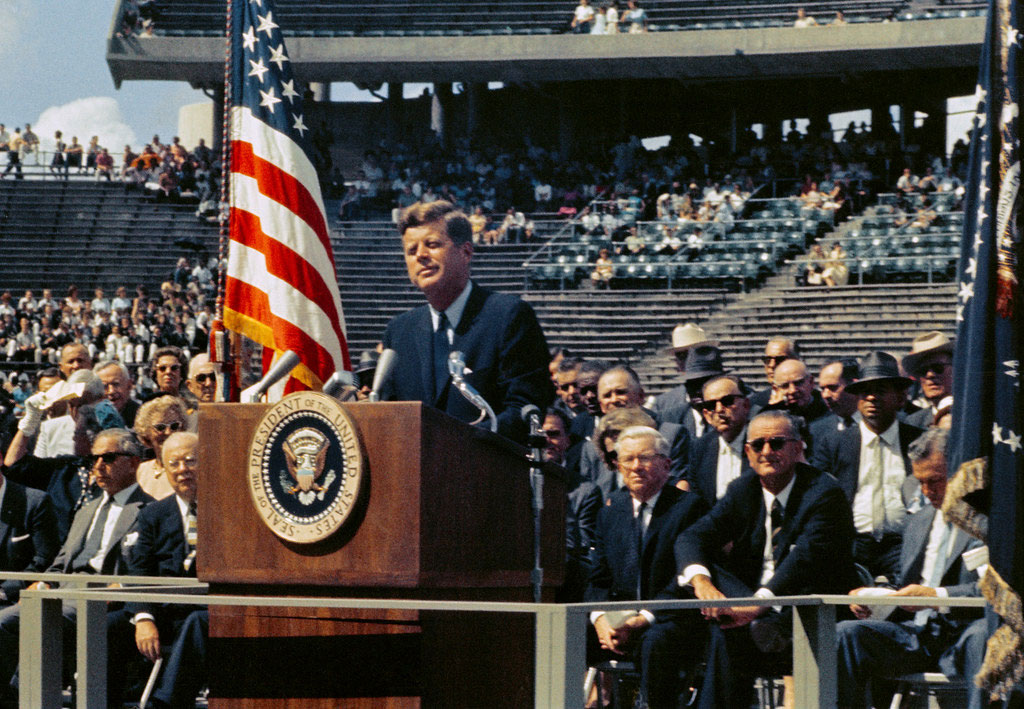
President Pitzer, Mr. Vice President, Governor, Congressman Thomas, Senator Wiley, and Congressman Miller, Mr. Webb, Mr. Bell, scientists, distinguished guests, and ladies and gentlemen:
I appreciate your president having made me an honorary visiting professor, and I will assure you that my first lecture will be very brief.
I am delighted to be here, and I’m particularly delighted to be here on this occasion.
We meet at a college noted for knowledge, in a city noted for progress, in a State noted for strength, and we stand in need of all three, for we meet in an hour of change and challenge, in a decade of hope and fear, in an age of both knowledge and ignorance. The greater our knowledge increases, the greater our ignorance unfolds.
Despite the striking fact that most of the scientists that the world has ever known are alive and working today, despite the fact that this Nation¹s own scientific manpower is doubling every 12 years in a rate of growth more than three times that of our population as a whole, despite that, the vast stretches of the unknown and the unanswered and the unfinished still far outstrip our collective comprehension.
No man can fully grasp how far and how fast we have come, but condense, if you will, the 50,000 years of man¹s recorded history in a time span of but a half-century. Stated in these terms, we know very little about the first 40 years, except at the end of them advanced man had learned to use the skins of animals to cover them. Then about 10 years ago, under this standard, man emerged from his caves to construct other kinds of shelter. Only five years ago man learned to write and use a cart with wheels. Christianity began less than two years ago. The printing press came this year, and then less than two months ago, during this whole 50-year span of human history, the steam engine provided a new source of power.
Newton explored the meaning of gravity. Last month electric lights and telephones and automobiles and airplanes became available. Only last week did we develop penicillin and television and nuclear power, and now if America’s new spacecraft succeeds in reaching Venus, we will have literally reached the stars before midnight tonight.
This is a breathtaking pace, and such a pace cannot help but create new ills as it dispels old, new ignorance, new problems, new dangers. Surely the opening vistas of space promise high costs and hardships, as well as high reward.
So it is not surprising that some would have us stay where we are a little longer to rest, to wait. But this city of Houston, this State of Texas, this country of the United States was not built by those who waited and rested and wished to look behind them. This country was conquered by those who moved forward–and so will space.
William Bradford, speaking in 1630 of the founding of the Plymouth Bay Colony, said that all great and honorable actions are accompanied with great difficulties, and both must be enterprised and overcome with answerable courage.
If this capsule history of our progress teaches us anything, it is that man, in his quest for knowledge and progress, is determined and cannot be deterred. The exploration of space will go ahead, whether we join in it or not, and it is one of the great adventures of all time, and no nation which expects to be the leader of other nations can expect to stay behind in the race for space.
Those who came before us made certain that this country rode the first waves of the industrial revolutions, the first waves of modern invention, and the first wave of nuclear power, and this generation does not intend to founder in the backwash of the coming age of space. We mean to be a part of it–we mean to lead it. For the eyes of the world now look into space, to the moon and to the planets beyond, and we have vowed that we shall not see it governed by a hostile flag of conquest, but by a banner of freedom and peace. We have vowed that we shall not see space filled with weapons of mass destruction, but with instruments of knowledge and understanding.
Yet the vows of this Nation can only be fulfilled if we in this Nation are first, and, therefore, we intend to be first. In short, our leadership in science and in industry, our hopes for peace and security, our obligations to ourselves as well as others, all require us to make this effort, to solve these mysteries, to solve them for the good of all men, and to become the world’s leading space-faring nation.
We set sail on this new sea because there is new knowledge to be gained, and new rights to be won, and they must be won and used for the progress of all people. For space science, like nuclear science and all technology, has no conscience of its own. Whether it will become a force for good or ill depends on man, and only if the United States occupies a position of pre-eminence can we help decide whether this new ocean will be a sea of peace or a new terrifying theater of war. I do not say the we should or will go unprotected against the hostile misuse of space any more than we go unprotected against the hostile use of land or sea, but I do say that space can be explored and mastered without feeding the fires of war, without repeating the mistakes that man has made in extending his writ around this globe of ours.
There is no strife, no prejudice, no national conflict in outer space as yet. Its hazards are hostile to us all. Its conquest deserves the best of all mankind, and its opportunity for peaceful cooperation many never come again. But why, some say, the moon? Why choose this as our goal? And they may well ask why climb the highest mountain? Why, 35 years ago, fly the Atlantic? Why does Rice play Texas?
We choose to go to the moon. We choose to go to the moon in this decade and do the other things, not because they are easy, but because they are hard, because that goal will serve to organize and measure the best of our energies and skills, because that challenge is one that we are willing to accept, one we are unwilling to postpone, and one which we intend to win, and the others, too.
It is for these reasons that I regard the decision last year to shift our efforts in space from low to high gear as among the most important decisions that will be made during my incumbency in the office of the Presidency.
In the last 24 hours we have seen facilities now being created for the greatest and most complex exploration in man’s history. We have felt the ground shake and the air shattered by the testing of a Saturn C-1 booster rocket, many times as powerful as the Atlas which launched John Glenn, generating power equivalent to 10,000 automobiles with their accelerators on the floor. We have seen the site where the F-1 rocket engines, each one as powerful as all eight engines of the Saturn combined, will be clustered together to make the advanced Saturn missile, assembled in a new building to be built at Cape Canaveral as tall as a 48 story structure, as wide as a city block, and as long as two lengths of this field.
Within these last 19 months at least 45 satellites have circled the earth. Some 40 of them were “made in the United States of America” and they were far more sophisticated and supplied far more knowledge to the people of the world than those of the Soviet Union.
The Mariner spacecraft now on its way to Venus is the most intricate instrument in the history of space science. The accuracy of that shot is comparable to firing a missile from Cape Canaveral and dropping it in this stadium between the the 40-yard lines.
Transit satellites are helping our ships at sea to steer a safer course. Tiros satellites have given us unprecedented warnings of hurricanes and storms, and will do the same for forest fires and icebergs.
We have had our failures, but so have others, even if they do not admit them. And they may be less public.
To be sure, we are behind, and will be behind for some time in manned flight. But we do not intend to stay behind, and in this decade, we shall make up and move ahead.
The growth of our science and education will be enriched by new knowledge of our universe and environment, by new techniques of learning and mapping and observation, by new tools and computers for industry, medicine, the home as well as the school. Technical institutions, such as Rice, will reap the harvest of these gains.
And finally, the space effort itself, while still in its infancy, has already created a great number of new companies, and tens of thousands of new jobs. Space and related industries are generating new demands in investment and skilled personnel, and this city and this State, and this region, will share greatly in this growth. What was once the furthest outpost on the old frontier of the West will be the furthest outpost on the new frontier of science and space. Houston, your City of Houston, with its Manned Spacecraft Center, will become the heart of a large scientific and engineering community. During the next 5 years the National Aeronautics and Space Administration expects to double the number of scientists and engineers in this area, to increase its outlays for salaries and expenses to $60 million a year; to invest some $200 million in plant and laboratory facilities; and to direct or contract for new space efforts over $1 billion from this Center in this City.
To be sure, all this costs us all a good deal of money. This year¹s space budget is three times what it was in January 1961, and it is greater than the space budget of the previous eight years combined. That budget now stands at $5,400 million a year–a staggering sum, though somewhat less than we pay for cigarettes and cigars every year. Space expenditures will soon rise some more, from 40 cents per person per week to more than 50 cents a week for every man, woman and child in the United Stated, for we have given this program a high national priority–even though I realize that this is in some measure an act of faith and vision, for we do not now know what benefits await us.
But if I were to say, my fellow citizens, that we shall send to the moon, 240,000 miles away from the control station in Houston, a giant rocket more than 300 feet tall, the length of this football field, made of new metal alloys, some of which have not yet been invented, capable of standing heat and stresses several times more than have ever been experienced, fitted together with a precision better than the finest watch, carrying all the equipment needed for propulsion, guidance, control, communications, food and survival, on an untried mission, to an unknown celestial body, and then return it safely to earth, re-entering the atmosphere at speeds of over 25,000 miles per hour, causing heat about half that of the temperature of the sun–almost as hot as it is here today–and do all this, and do it right, and do it first before this decade is out–then we must be bold.
I’m the one who is doing all the work, so we just want you to stay cool for a minute. [laughter]
However, I think we’re going to do it, and I think that we must pay what needs to be paid. I don’t think we ought to waste any money, but I think we ought to do the job. And this will be done in the decade of the sixties. It may be done while some of you are still here at school at this college and university. It will be done during the term of office of some of the people who sit here on this platform. But it will be done. And it will be done before the end of this decade.
I am delighted that this university is playing a part in putting a man on the moon as part of a great national effort of the United States of America.
Many years ago the great British explorer George Mallory, who was to die on Mount Everest, was asked why did he want to climb it. He said, “Because it is there.”
Well, space is there, and we’re going to climb it, and the moon and the planets are there, and new hopes for knowledge and peace are there. And, therefore, as we set sail we ask God’s blessing on the most hazardous and dangerous and greatest adventure on which man has ever embarked.
Winners Announced: May 29, 1962 Held at: Chicago, Los Angeles and New York Host: Frank Sinatra Eligibility Year: December 1, 1960 – November 30, 1961
Music Highlights and Achievements
Sinatra’s Hosting Charm: The Rat Pack’s very own Frank Sinatra took on the hosting duties, adding a layer of elegance and swagger to the ceremony.
Henry Mancini’s Night: Composer Henry Mancini dominated with his Breakfast at Tiffany’s soundtrack, including the iconic song “Moon River.”
Judy Garland’s Comeback: Judy Garland won Album of the Year for her live recording Judy at Carnegie Hall, marking a powerful comeback in her career.
Ernest Gold’s Exodus: The song “Exodus” by Ernest Gold from the movie of the same name grabbed Song of the Year, showing that film music could also steal the Grammy spotlight.
Trivia
Multiple City Hosting: This was one of the early Grammy ceremonies to be held in multiple cities: Chicago, Los Angeles, and New York.
Peter Nero’s Break: Pianist Peter Nero won Best New Artist, a huge boost to his budding career.
Mancini’s Run: Henry Mancini’s “Moon River” also won at the Oscars, a rare feat of capturing both film and music industry accolades.
Sinatra’s Debut: This was Frank Sinatra’s first time hosting the Grammys, making the event particularly special for Ol’ Blue Eyes fans.
Album of the Year: Judy at Carnegie Hall, Judy Garland (Capitol)
Song of the Year: Moon River, Henry Mancini and Johnny Mercer, songwriters
Best New Artist of 1961: Peter Nero
Best Solo Vocal Performance, Male: Lollipops and Roses, Jack Jones
Best Solo Vocal Performance, Female: Judy at Carnegie Hall, Judy Garland
Best Performance By a Vocal Group: High Flying, Lambert, Hendricks and Ross
Best Performance By a Chorus: Great Band With Great Voices, Johnny Mann Singers and Si Zentner Orchestra
Best Rock and Roll Recording: Let’s Twist Again, Chubby Checker (Parkway)
Best Rhythm and Blues Recording: Hit the Road Jack, Ray Charles (ABC/Paramount)
Best Jazz Performance, Soloist or Small Group (Instrumental): André Previn Plays Harold Arlen, André Previn
Best Jazz Performance, Large Group: West Side Story, Stan Kenton
Best Original Jazz Composition: African Waltz, Galt MacDermott, composer
Best Country and Western Recording: Big Bad John, Jimmy Dean (Columbia)
Best Gospel or Other Religious Recording: Everytime I Feel the Spirit, Mahalia Jackson (Columbia)
Best Folk Recording: Belafonte Folk Singers at Home and Abroad, Belafonte Folk Singers (RCA)
Best Performance By an Orchestra for Dancing: Up a Lazy River, Si Zentner
Best Performance By an Orchestra for Other Than Dancing: Breakfast at Tiffany’s, Henry Mancini
Best Arrangement: Moon River, Henry Mancini, arranger
Best Instrumental Theme or Instrumental Version of a Song: African Waltz, Galt MacDermott, composer
Best Original Cast Show Album: How to Succeed in Business Without Really Trying, Frank Loesser, composer (RCA)
Best Soundtrack Album or Recording of Score From a Motion Picture or Television: Breakfast at Tiffany’s, Henry Mancini (RCA)
Best Soundtrack Album or Recording of Original Cast From a Motion Picture or Television: West Side Story, Johnny Green, Saul Chaplin, Sid Ramin and Irwin Kostal (Columbia)
Album of the Year, Classical: Stravinsky Conducts, 1960: Le Sacre du Printemps; Petrouchka, lgor Stravinsky conducting Columbia Symphony (Columbia)
Best Classical Performance, Orchestra: Ravel, Daphnis et Chloe, Charles Munch conducting Boston Symphony Orchestra
Best Classical Performance, Chamber Music: Beethoven, Serenade, Op. 8; Kodaly, Duo for Violin and Cello, Op. 7, Jascha Heifetz, Gregor Piatigorsky and William Primrose
Best Classical Performance, Instrumental Soloist (With Orchestra): Bartók, Concerto No. 1 for Violin and Orchestra, Isaac Stern; Eugene Ormandy conducting Philharmonic Orchestra
Best Classical Performance, Instrumental Soloist or Duo (Without Orchestra): Reverie for Spanish Guitars, Laurindo Almeida
Best Opera Recording: Puccini, Madame Butterfly, Gabriele Santini conducting Rome Opera Chorus and Orchestra (Capitol)
Best Classical Performance, Choral: Bach, B Minor Mass, Robert Shaw conducting Robert Shaw Chorale
Best Classical Performance, Vocal Soloist: The Art of the Prima Donna, Joan Sutherland; Francesco Molinari-Pradelli conducting Royal Opera House Orchestra
Best Contemporary Classical Composition (tie): Discantus, Laurindo Almeida, composer Movements for Piano and Orchestra, Igor Stravinsky, composer
Best Comedy Performance: An Evening With Mike Nichols and Elaine May, Mike Nichols and Elaine May
Best Documentary or Spoken Word Recording (Other Than Comedy): Humor in Music, Leonard Bernstein conducting New York Philharmonic Symphony (Columbia)
Best Recording for Children: Prokofiev, Peter and the Wolf, Leonard Bernstein conducting New York Philharmonic Orchestra (Columbia)
Best Album Cover: Judy at Carnegie Hall, Jim Silke, art director (Capitol)
Best Album Cover, Classical: Puccini, Madame Butterfly, Marvin Schwartz, art director (Angel)
by General Douglas MacArthur His Sylvanus Thayer Award Acceptance Address on May 12, 1962
General Westmoreland, General Grove, distinguished guests, and gentlemen of the Corps!
As I was leaving the hotel this morning, a doorman asked me, “Where are you bound for, General?” And when I replied, “West Point,” he remarked, “Beautiful place. Have you ever been there before?”
No human being could fail to be deeply moved by such a tribute as this Award. Coming from a profession I have served so long, and a people I have loved so well, it fills me with an emotion I cannot express. But this award is not intended primarily to honor a personality, but to symbolize a great moral code — the code of conduct and chivalry of those who guard this beloved land of culture and ancient descent. That is the animation of this medallion. For all eyes and for all time, it is an expression of the ethics of the American soldier. That I should be integrated in this way with so noble an ideal arouses a sense of pride and yet of humility which will be with me always
Duty, Honor, Country: Those three hallowed words reverently dictate what you ought to be, what you can be, what you will be. They are your rallying points: to build courage when courage seems to fail; to regain faith when there seems to be little cause for faith; to create hope when hope becomes forlorn.
Unhappily, I possess neither that eloquence of diction, that poetry of imagination, nor that brilliance of metaphor to tell you all that they mean.
The unbelievers will say they are but words, but a slogan, but a flamboyant phrase. Every pedant, every demagogue, every cynic, every hypocrite, every troublemaker, and I am sorry to say, some others of an entirely different character, will try to downgrade them even to the extent of mockery and ridicule.
But these are some of the things they do: They build your basic character. They mold you for your future roles as the custodians of the nation’s defense. They make you strong enough to know when you are weak, and brave enough to face yourself when you are afraid. They teach you to be proud and unbending in honest failure, but humble and gentle in success; not to substitute words for actions, not to seek the path of comfort, but to face the stress and spur of difficulty and challenge; to learn to stand up in the storm but to have compassion on those who fall; to master yourself before you seek to master others; to have a heart that is clean, a goal that is high; to learn to laugh, yet never forget how to weep; to reach into the future yet never neglect the past; to be serious yet never to take yourself too seriously; to be modest so that you will remember the simplicity of true greatness, the open mind of true wisdom, the meekness of true strength. They give you a temper of the will, a quality of the imagination, a vigor of the emotions, a freshness of the deep springs of life, a temperamental predominance of courage over timidity, of an appetite for adventure over love of ease. They create in your heart the sense of wonder, the unfailing hope of what next, and the joy and inspiration of life. They teach you in this way to be an officer and a gentleman.
And what sort of soldiers are those you are to lead? Are they reliable? Are they brave? Are they capable of victory? Their story is known to all of you. It is the story of the American man-at-arms. My estimate of him was formed on the battlefield many, many years ago, and has never changed. I regarded him then as I regard him now — as one of the world’s noblest figures, not only as one of the finest military characters, but also as one of the most stainless. His name and fame are the birthright of every American citizen. In his youth and strength, his love and loyalty, he gave all that mortality can give.
He needs no eulogy from me or from any other man. He has written his own history and written it in red on his enemy’s breast. But when I think of his patience under adversity, of his courage under fire, and of his modesty in victory, I am filled with an emotion of admiration I cannot put into words. He belongs to history as furnishing one of the greatest examples of successful patriotism. He belongs to posterity as the instructor of future generations in the principles of liberty and freedom. He belongs to the present, to us, by his virtues and by his achievements. In 20 campaigns, on a hundred battlefields, around a thousand campfires, I have witnessed that enduring fortitude, that patriotic self-abnegation, and that invincible determination which have carved his statue in the hearts of his people. From one end of the world to the other he has drained deep the chalice of courage.
As I listened to those songs [of the glee club], in memory’s eye I could see those staggering columns of the First World War, bending under soggy packs, on many a weary march from dripping dusk to drizzling dawn, slogging ankle-deep through the mire of shell-shocked roads, to form grimly for the attack, blue-lipped, covered with sludge and mud, chilled by the wind and rain, driving home to their objective, and for many, to the judgment seat of God.
I do not know the dignity of their birth, but I do know the glory of their death. They died unquestioning, uncomplaining, with faith in their hearts, and on their lips the hope that we would go on to victory. Always, for them: Duty, Honor, Country; always their blood and sweat and tears, as we sought the way and the light and the truth.
And 20 years after, on the other side of the globe, again the filth of murky foxholes, the stench of ghostly trenches, the slime of dripping dugouts; those boiling suns of relentless heat, those torrential rains of devastating storms; the loneliness and utter desolation of jungle trails; the bitterness of long separation from those they loved and cherished; the deadly pestilence of tropical disease; the horror of stricken areas of war; their resolute and determined defense, their swift and sure attack, their indomitable purpose, their complete and decisive victory – always victory. Always through the bloody haze of their last reverberating shot, the vision of gaunt, ghastly men reverently following your password of: Duty, Honor, Country.
The code which those words perpetuate embraces the highest moral laws and will stand the test of any ethics or philosophies ever promulgated for the uplift of mankind. Its requirements are for the things that are right, and its restraints are from the things that are wrong.
The soldier, above all other men, is required to practice the greatest act of religious training — sacrifice.
In battle and in the face of danger and death, he discloses those divine attributes which his Maker gave when he created man in his own image. No physical courage and no brute instinct can take the place of the Divine help which alone can sustain him.
However horrible the incidents of war may be, the soldier who is called upon to offer and to give his life for his country is the noblest development of mankind.
You now face a new world – a world of change. The thrust into outer space of the satellite, spheres, and missiles mark the beginning of another epoch in the long story of mankind. In the five or more billions of years the scientists tell us it has taken to form the earth, in the three or more billion years of development of the human race, there has never been a more abrupt or staggering evolution. We deal now not with things of this world alone, but with the illimitable distances and as yet unfathomed mysteries of the universe. We are reaching out for a new and boundless frontier.
We speak in strange terms: of harnessing the cosmic energy; of making winds and tides work for us; of creating unheard synthetic materials to supplement or even replace our old standard basics; to purify sea water for our drink; of mining ocean floors for new fields of wealth and food; of disease preventatives to expand life into the hundreds of years; of controlling the weather for a more equitable distribution of heat and cold, of rain and shine; of space ships to the moon; of the primary target in war, no longer limited to the armed forces of an enemy, but instead to include his civil populations; of ultimate conflict between a united human race and the sinister forces of some other planetary galaxy; of such dreams and fantasies as to make life the most exciting of all time.
And through all this welter of change and development, your mission remains fixed, determined, inviolable: it is to win our wars.
Everything else in your professional career is but corollary to this vital dedication. All other public purposes, all other public projects, all other public needs, great or small, will find others for their accomplishment. But you are the ones who are trained to fight. Yours is the profession of arms, the will to win, the sure knowledge that in war there is no substitute for victory; that if you lose, the nation will be destroyed; that the very obsession of your public service must be: Duty, Honor, Country.
Others will debate the controversial issues, national and international, which divide men’s minds; but serene, calm, aloof, you stand as the Nation’s war-guardian, as its lifeguard from the raging tides of international conflict, as its gladiator in the arena of battle. For a century and a half you have defended, guarded, and protected its hallowed traditions of liberty and freedom, of right and justice.
Let civilian voices argue the merits or demerits of our processes of government; whether our strength is being sapped by deficit financing, indulged in too long, by federal paternalism grown too mighty, by power groups grown too arrogant, by politics grown too corrupt, by crime grown too rampant, by morals grown too low, by taxes grown too high, by extremists grown too violent; whether our personal liberties are as thorough and complete as they should be. These great national problems are not for your professional participation or military solution. Your guidepost stands out like a ten-fold beacon in the night: Duty, Honor, Country.
You are the leaven which binds together the entire fabric of our national system of defense. From your ranks come the great captains who hold the nation’s destiny in their hands the moment the war tocsin sounds. The Long Gray Line has never failed us. Were you to do so, a million ghosts in olive drab, in brown khaki, in blue and gray, would rise from their white crosses thundering those magic words: Duty, Honor, Country.
This does not mean that you are war mongers.
On the contrary, the soldier, above all other people, prays for peace, for he must suffer and bear the deepest wounds and scars of war.
But always in our ears ring the ominous words of Plato, that wisest of all philosophers: “Only the dead have seen the end of war.”
The shadows are lengthening for me. The twilight is here. My days of old have vanished, tone and tint. They have gone glimmering through the dreams of things that were. Their memory is one of wondrous beauty, watered by tears, and coaxed and caressed by the smiles of yesterday. I listen vainly, but with thirsty ears, for the witching melody of faint bugles blowing reveille, of far drums beating the long roll. In my dreams I hear again the crash of guns, the rattle of musketry, the strange, mournful mutter of the battlefield.
But in the evening of my memory, always I come back to West Point.
Always there echoes and re-echoes: Duty, Honor, Country.
Today marks my final roll call with you, but I want you to know that when I cross the river my last conscious thoughts will be of The Corps, and The Corps, and The Corps.
Winners Announced: April 9, 1962 Held at: Santa Monica Civic Auditorium, Santa Monica, California Host: Bob Hope Eligibility Year: 1961
Cinematic Highlights and Achievements
West Side Story Sweeps: The musical adaptation of Shakespeare’s Romeo and Juliet took home 10 Academy Awards including Best Picture, Best Director for Robert Wise and Jerome Robbins, and Best Supporting Actress for Rita Moreno.
First Black Actor to Win: Sidney Poitier made history by becoming the first Black actor to win an Academy Award for Best Actor for his role in Lilies of the Field.
Gregory Peck’s Moral High Ground: Peck won Best Actor for his iconic role as Atticus Finch in To Kill a Mockingbird, which also won Best Adapted Screenplay.
Through a Glass Darkly Shines: Ingmar Bergman’s drama won Best Foreign Language Film.
Little-Known Trivia
Musical Firsts: Jerome Robbins became the first director to receive an Oscar specifically for directing a musical, sharing the honor with Robert Wise for West Side Story.
Youngest Supporting Actress: At 16, Patty Duke became the youngest actress to win in a supporting role for The Miracle Worker.
The First Televised Oscars: This was the first Oscars ceremony to be televised live via satellite.
Four-Hour Marathon: The ceremony lasted over four hours, one of the longest in the Academy’s history.
Sophia Loren became the first actress to win an acting Oscar for a non-English-speaking role.
West Side Story and Judgment at Nuremberg each earned 11 nominations. West Side Story won 10 Oscars. Judgment at Nuremberg won 2 Oscars.
Best Motion Picture: West Side Story – Robert Wise, producer (WINNER) Fanny – Joshua Logan, producer The Guns of Navarone – Carl Foreman, producer The Hustler – Robert Rossen, producer Judgment at Nuremberg – Stanley Kramer, producer
Best Director: Robert Wise and Jerome Robbins – West Side Story (WINNER) Federico Fellini – La Dolce Vita J. Lee Thompson – The Guns of Navarone Robert Rossen – The Hustler Stanley Kramer – Judgment at Nuremberg
Best Actor: Maximilian Schell – Judgment at Nuremberg (WINNER) Charles Boyer – Fanny Paul Newman – The Hustler Spencer Tracy – Judgment at Nuremberg Stuart Whitman – The Mark
Best Actress: Sophia Loren – Two Women (WINNER) Audrey Hepburn – Breakfast at Tiffany’s Piper Laurie – The Hustler Geraldine Page – Summer and Smoke Natalie Wood – Splendor in the Grass
Best Supporting Actor: George Chakiris – West Side Story (WINNER) Montgomery Clift – Judgment at Nuremberg Peter Falk – Pocketful of Miracles Jackie Gleason – The Hustler George C. Scott – The Hustler
Best Supporting Actress: Rita Moreno – West Side Story (WINNER) Fay Bainter – The Children’s Hour Judy Garland – Judgment at Nuremberg Lotte Lenya – The Roman Spring of Mrs. Stone Una Merkel – Summer and Smoke
Best Story and Screenplay Written Directly for the Screen: Splendor in the Grass – William Inge (WINNER) Ballad of a Soldier – Valentin Ezhov and Grigori Chukhrai La Dolce Vita – Federico Fellini, Tullio Pinelli, Ennio Flaiano and Brunello Rondi General Della Rovere – Sergio Amidei, Diego Fabbri and Indro Montanelli Lover Come Back – Stanley Shapiro and Paul Henning
Best Screenplay Based on Material from Another Medium: Judgment at Nuremberg – Abby Mann (WINNER) Breakfast at Tiffany’s – George Axelrod The Guns of Navarone – Carl Foreman The Hustler – Robert Rossen and Sidney Carroll West Side Story – Ernest Lehman
Best Foreign Language Film: Through a Glass Darkly (Sweden) (WINNER) Harry and the Butler (Denmark) Immortal Love (Japan) The Important Man (Mexico) Plácido (Spain)
Best Documentary Feature: Sky Above and Mud Beneath (WINNER) The Grand Olympics
Best Documentary Short Subject: Project Hope (WINNER) Breaking the Language Barrier Cradle of Genius Kahl The Man in Gray
Best Live Action Short Subject: Seawards the Great Ships (WINNER) The Face of Jesus Play Ball! Rooftops of New York Very Nice, Very Nice
Best Short Subject – Cartoons: Surogat (WINNER) Aquamania Beep Prepared Nelly’s Folly The Pied Piper of Guadalupe
Best Music Score of a Dramatic or Comedy Picture: Breakfast at Tiffany’s – Henry Mancini (WINNER) El Cid – Miklós Rózsa Fanny – Morris Stoloff and Harry Sukman The Guns of Navarone – Dimitri Tiomkin Summer and Smoke – Elmer Bernstein
Best Scoring of a Musical Picture: West Side Story – Saul Chaplin, Johnny Green, Sid Ramin and Irwin Kostal (WINNER) Babes in Toyland – George Bruns Flower Drum Song – Alfred Newman and Ken Darby Khovanshchina – Dmitri Shostakovich Paris Blues – Duke Ellington
Best Song: “Moon River” from Breakfast at Tiffany’s – Music by Henry Mancini; Lyric by Johnny Mercer (WINNER) “Bachelor in Paradise” from Bachelor in Paradise – Music by Henry Mancini; Lyric by Mack David “Love Theme from El Cid (The Falcon and the Dove)” from El Cid – Music by Miklós Rózsa; Lyric by Paul Francis Webster “Pocketful of Miracles” from Pocketful of Miracles – Music by Jimmy Van Heusen; Lyric by Sammy Cahn “Town Without Pity” from Town Without Pity – Music by Dimitri Tiomkin; Lyric by Ned Washington
Best Sound: West Side Story – Gordon E. Sawyer and Fred Hynes (WINNERS) The Children’s Hour – Gordon E. Sawyer Flower Drum Song – Waldon O. Watson The Guns of Navarone – John Cox The Parent Trap – Robert O. Cook
Best Art Direction, Black-and-White: The Hustler – Art Direction: Harry Horner; Set Decoration: Gene Callahan (WINNERS) The Absent-Minded Professor – Art Direction: Carroll Clark; Set Decoration: Emile Kuri and Hal Gausman The Children’s Hour – Art Direction: Fernando Carrere; Set Decoration: Edward G. Boyle La Dolce Vita – Art Direction and Set Decoration: Piero Gherardi Judgment at Nuremberg – Art Direction: Rudolph Sternad; Set Decoration: George Milo
Best Art Direction, Color: West Side Story – Art Direction: Boris Leven; Set Decoration: Victor A. Gangelin (WINNER) Breakfast at Tiffany’s – Art Direction: Hal Pereira and Roland Anderson; Set Decoration: Samuel M. Comer and Ray Moyer El Cid – Art Direction and Set Decoration: Veniero Colasanti and John Moore Flower Drum Song – Art Direction: Alexander Golitzen and Joseph C. Wright; Set Decoration: Howard Bristol Summer and Smoke – Art Direction: Hal Pereira and Walter H. Tyler; Set Decoration: Samuel M. Comer and Arthur Krams
Best Cinematography, Black-and-White: The Hustler – Eugen Schüfftan (WINNER) The Absent-Minded Professor – Edward Colman The Children’s Hour – Franz Planer Judgment at Nuremberg – Ernest Laszlo One, Two, Three – Daniel L. Fapp
Best Cinematography, Color: West Side Story – Daniel L. Fapp (WINNER) Fanny – Jack Cardiff Flower Drum Song – Russell Metty A Majority of One – Harry Stradling One-Eyed Jacks – Charles Lang
Best Costume Design, Black-and-White: La Dolce Vita – Piero Gherardi (WINNER) The Children’s Hour – Dorothy Jeakins Claudelle Inglish – Howard Shoup Judgment at Nuremberg – Jean Louis Yojimbo – Yoshiro Muraki
Best Costume Design, Color: West Side Story – Irene Sharaff (WINNER) Babes in Toyland – Bill Thomas Back Street – Jean Louis Flower Drum Song – Irene Sharaff Pocketful of Miracles – Edith Head and Walter Plunkett
Best Film Editing: West Side Story – Thomas Stanford (WINNER) Fanny – William H. Reynolds The Guns of Navarone – Alan Osbiston Judgment at Nuremberg – Frederic Knudtson The Parent Trap – Philip W. Anderson
Best Special Effects: The Guns of Navarone – Visual Effects by Bill Warrington; Audible Effects by Vivian C. Greenham (WINNER) The Absent-Minded Professor – Visual Effects by Robert A. Mattey and Eustace Lycett
Academy Honorary Awards: William L. Hendricks “for his outstanding patriotic service in the conception, writing and production of the Marine Corps film, A Force in Readiness, which has brought honor to the Academy and the motion picture industry.
Fred L. Metzler “for his dedication and outstanding service to the Academy of Motion Picture Arts and Sciences.”
Jerome Robbins “for his brilliant achievements in the art of choreography on film.”
November 28, 1960 – January 8, 1961: Elvis Presley – Are You Lonesome Tonight? January 9, 1961 – January 29, 1961: Bert Kaempfert – Wonderland by Night January 30, 1961 – February 12, 1961: The Shirelles – Will You Love Me Tomorrow February 13, 1961 – February 26, 1961: Lawrence Welk – Calcutta February 27, 1961 – March 19, 1961: Chubby Checker – Pony Time March 20, 1961 – April 2, 1961: Elvis Presley – Surrender April 3, 1961 – April 23, 1961: The Marcels – Blue Moon April 24, 1961 – May 21, 1961: Del Shannon – Runaway May 22, 1961 – May 28, 1961: Ernie K-Doe – Mother-in-Law May 29, 1961 – June 4, 1961: Ricky Nelson – Travelin’ Man June 5, 1961 – June 18, 1961: Roy Orbison – Running Scared June 19, 1961 – June 25, 1961: Pat Boone – Moody River June 26, 1961 – July 9, 1961: Gary U.S. Bonds – Quarter to Three July 10, 1961 – August 27, 1961: Bobby Lewis – Tossin’ and Turnin’ August 28, 1961 – September 3, 1961: Joe Dowell – Wooden Heart (Muss I Denn) September 4, 1961 – September 17, 1961: The Highwaymen – Michael September 18, 1961 – October 8, 1961: Bobby Vee – Take Good Care of My Baby October 9, 1961 – October 22, 1961: Ray Charles – Hit the Road Jack October 23, 1961 – November 5, 1961: Dion – Runaround Sue November 6, 1961 – December 10, 1961: Jimmy Dean – Big Bad John December 11, 1961 – December 17, 1961: The Marvelettes – Please Mr. Postman December 18, 1961 – January 12, 1962: The Tokens – The Lion Sleeps Tonight
(Data is compiled from various charts including Billboard’s “Pop,” “Airplay,” “R&B” and “Singles” Charts. “Hot 100” is the primary chart used starting October, 1958)
Mary, Lisa, Susan, Linda, Karen, Michael, David, John, James, Robert
Fashion Icons and Sex Symbols
Carroll Baker, Brigitte Bardot, Claudia Cardinale, Doris Day, Angie Dickinson, Annette Funicello, Audrey Hepburn, Jayne Mansfield, Gina Lollobrigida, Sophia Loren, Marilyn Monroe, Julie Newmar, Kim Novak, Leslie Parrish, Stella Stevens, Elizabeth Taylor, Tina Turner, Mamie Van Doren, Natalie Wood
Sex Symbols and Hollywood Hunks
Elvis Presley, Gregory Peck
Oscars: 33rd Academy Awards (1961)
The 33rd Academy Awards took place on April 17, 1961, at the Santa Monica Civic Auditorium, with Bob Hope serving as host. West Side Story emerged as the big winner, collecting 10 Oscars, including Best Picture and Best Director for Robert Wise and Jerome Robbins. Intriguingly, this ceremony marked the first time a directing award was shared between two individuals.
Grammy Awards: 1961 Grammys (3rd Annual Grammy Awards)
The 3rd Annual Grammy Awards, also referred to as the 1961 Grammys, unfolded on April 12. Henry Mancini had a night to remember, winning both Album of the Year for The Music from Peter Gunn and Song of the Year for “Moon River.” Meanwhile, Bob Newhart clinched the Best New Artist award, a category that had been introduced only a year earlier.
Emmy Awards: 13th Primetime Emmy Awards (1961)
The Emmy Awards held its 13th Primetime ceremony on May 16, 1961. Hosted by Dick Powell, The Jack Benny Show snagged the Emmy for Outstanding Comedy Series. Rod Serling, the mind behind The Twilight Zone, received an Emmy for Outstanding Writing Achievement in Drama.
“The Quotes”
“Sorry, Charlie. Starkist wants tuna that tastes good, not tuna with good taste” – Starkist tuna
“Yabba Dabba Do” – Fred Flintstone
“Ask not what your country can do for you – ask what you can do for your country. – President John F. Kennedy
“For those who think young” – Pepsi
“Hertz puts you in the driver’s seat” – Hertz
“In the councils of government, we must guard against the acquisition of unwarranted influence, whether sought or unsought, by the military-industrial complex. The potential for the disastrous rise of misplaced power exists and will persist. ” – From Dwight Eisenhower’s Farewell Address to the Nation
“Today, the solitary inventor, tinkering in his shop, has been overshadowed by task forces of scientists in laboratories and testing fields. In the same fashion, the free university, historically the fountainhead of free ideas and scientific discovery, has experienced a revolution in the conduct of research. Partly because of the huge costs involved, a government contract becomes virtually a substitute for intellectual curiosity…
The prospect of domination of the nation’s scholars by Federal employment, project allocations, and the power of money is ever-present – and is gravely to be regarded.
Yet, in holding scientific research and discovery in respect, as we should, we must also be alert to the equal and opposite danger that public policy could itself become the captive of a scientific-technological elite” – Also from Dwight Eisenhower’s Farewell Address to the Nation
Time Magazine’s Man of the Year
John F. Kennedy
Miss America
Nancy Fleming (Montague, MI)
Miss USA
Sharon Brown (Louisiana)
US Politics
January 20, 1961 (Friday) Inauguration of John F. Kennedy
Doctor In The House
When Rogozov developed acute appendicitis on a remote expedition in the middle of Antarctica in 1961, he was the only doctor on site. He had to perform his appendectomy. The surgery did not go as planned. As he started to move his intestines to get to his appendix, he accidentally sliced open his lower intestine, which he then had to suture. From the opening incision to the removal of the appendix and final suture, the surgery took nearly two hours. Rogozov never lost consciousness. Leonid Rogozov not only survived, but he also returned to his normal duties as a team member two weeks later.
Oops: America accidentally dropped a nuke on South Carolina in 1958 and two Hydrogen bombs on North Carolina in 1961. The traditional explosives on the nuke exploded, while only a low-voltage trigger kept one of the H-bombs from detonating.
The largest nuclear bomb ever detonated by humans was the Tsar Bomba in 1961. The Russians tested the bomb in Novaya Zemlya, an island in the Russian Arctic Sea. It had the equivalent explosive power of 3,800 Hiroshima bombs.
World News
The Antarctic Treaty of 1961, which recognizes no sovereign claim of Antarctica, prohibits mining, prohibits military activity & only allows scientific activity on the continent. Article V specifically prohibits any nuclear explosions in Antarctica and the disposal of any radioactive waste material there.
The Terra Nova Islands were seen/discovered in 1961 by an Australian research expedition, but when geologists went to map them in 1989, they found no islands because they don’t exist.
1961 Pop Culture Facts & History
Elvis Presley’s Can’t Help Falling in Love peaked at #2 on the Billboard Hot 100. In 1993, the UB40 version spent seven weeks in the #1 spot.
The first song a computer sang was Daisy Bell (1892) by an IBM 704 in 1961. Hal 9000 also sang the song in 2001: A Space Odyssey.
The earliest use of the found footage genre in the film is the 1961 feature The Connection, which states on its title card that the film is an assemblage of found footage. This predates Cannibal Holocaust by nearly two decades, which is often claimed to be the first example of found footage in the movie.
The 1961 film Homicidal featured a ‘fright break’ before the climax. The break allowed the audience to leave and get a refund before it got too scary. People who left got their pictures taken and added to ‘Coward’s Corner,’ which was used to advertise how scary the film was.
Jackie Gleason once was an actual pool shark. He made all his trick shots in 1961’s The Hustler.
Washington D.C. residents were officially allowed to vote in Presidential Elections, thanks to the 23rd amendment, but they still don’t have actual representatives in Congress.
The first Six Flags amusement park opened near Dallas, Texas. Named “Six Flags Over Dallas,” it was named after the six different flags Texas has over the past few hundred years.
Human rights organization Amnesty International was founded in London.
Le Bateau (“The Boat”) by Henri Matisse caused a minor stir when the Museum of Modern Art, New York, which housed it, hung the work upside-down for 47 days in 1961 until Genevieve Habert, a stockbroker, noticed the mistake and notified a guard.
Black Friday was coined in 1952, made famous in 1961, and became the busiest shopping day in 2005.
Black and Decker introduced the first cordless power drill powered by nickel-cadmium.
Pampers disposable diapers were available for the first time.
Ibuprofen was introduced to the public, and it became available as an over-the-counter drug in 1984.
Denny’s was previously named Danny’s Donuts. Following separation in ownership and to avoid confusion with another LA restaurant, owner Harold Butler changed the name to Denny’s Coffee Shop in 1959; Then and most recognizably shortened to just Denny’s in 1961.
Chase’s octagon-shaped logo, designed in 1961, is a stylized representation of the water pipes laid by its predecessor, the Manhattan Company, which Aaron Burr had formed as a water company in 1799.
In the ’40s and ’50s, Coca-Cola ads gave Santa Claus a sidekick named Sprite Boy – named such because he was a sprite, not because of the drink Sprite, which would not be introduced under that name until 1961.
The NFL doesn’t play on Friday and Saturday because the 1961 Sports Broadcasting Act prohibits them from doing so to protect fans of college and high school football.
The Habit
Reading Rachel Carson’s Silent Spring.
Nobel Prizes
Physics – Robert Hofstadter, Rudolf Mössbauer Chemistry – Melvin Calvin Physiology or Medicine – Georg von Békésy Literature – Ivo Andrić Peace – Dag Hammarskjöld (posthumously)
C.S. Lewis nominated J.R.R. Tolkien for the 1961 Nobel Prize for Literature. He was rejected because his writing “has not in any way measured up to storytelling of the highest quality.”
The Scandal
Writer Death by Suicide: Ernest Hemingway
1st Appearances & 1961’s Most Popular Christmas Gifts, Toys and Presents
LEGO Building Sets, Stratego, Ken Carson (Barbie’s boyfriend), Slip ‘n Slide water slide, Trolls
Best Film Oscar Winner
The Apartment (presented in 1961)
Broadway Show
Mary, Mary (Play) Opened on March 8, 1961, and Closed on December 12, 1964 How to Succeed in Business Without Really Trying (Musical) Opened on October 14, 1961, and closed on March 6, 1965
Popular and Best-selling Books From 1961
The Agony and the Ecstasy by Irving Stone The Carpetbaggers by Harold Robbins Catch-22 by Joseph Heller Daughter of Silence by Morris West The Edge of Sadness by Edwin O’Connor For the New Intellectual by Ayn Rand Franny and Zooey by J.D. Salinger Go, Dog, Go! by P.D. Eastman The Last of the Just by Andre Schwarz-Bart Mila 18 by Leon Uris Eloise Wilkin’s Mother Goose by Eloise Wilkin Stranger in a Strange Land by Robert A. Heinlein Ten Apples Up On Top! by Theo. LeSieg and Roy McKie Thunderball by Ian Fleming The Touch Me Book by Pat and Eve Witte Tropic of Cancer by Henry Miller Winnie Ille Pu by Alexander Lenard (translation of Winnie the Pooh by A. A. Milne) The Winter of Our Discontent by John Steinbeck
1961 Most Popular TV Shows
1. Wagon Train (NBC) 2. Bonanza (NBC) 3. Gunsmoke (CBS) 4. Hazel (NBC) 5. Perry Mason (CBS) 6. The Red Skelton Show (CBS) 7. The Andy Griffith Show (CBS) 8. The Danny Thomas Show (CBS) 9. Dr. Kildare (NBC) 10. Candid Camera (CBS)
1961 Billboard Number One Songs
November 28, 1960 – January 8, 1961: Are You Lonesome Tonight? – Elvis Presley
January 9 – January 29: Wonderland By Night – Bert Kaempfert
January 30 – February 12: Will You Love Me Tomorrow – The Shirelles
February 13 – February 26: Calcutta – Lawrence Welk
February 27 – March 19: Pony Time – Chubby Checker
September 18 – October 8: Take Good Care Of My Baby – Bobby Vee
October 9 – October 22: Hit The Road Jack – Ray Charles
October 23 – November 5: Runaround – Sue Dion
November 6 – December 10: Big Bad John – Jimmy Dean
December 11 – December 17: Please Mr. Postman – The Marvelettes
December 18, 1961 – January 12, 1962: The Lion Sleeps Tonight – The Tokens
Sports
World Series Champions: New York Yankees NFL Champions: Green Bay Packers AFL Champions: Houston Oilers NBA Champions: Boston Celtics Stanley Cup Champs: Chicago Blackhawks U.S. Open Golf Gene Littler U.S. Tennis: (Men/Ladies) Roy Emerson/Darlene R. Hard Wimbledon (Men/Women): Rod Laver/Angela Mortimer NCAA Football Champions: Alabama & Ohio State NCAA Basketball Champions: Cincinnati Kentucky Derby: Carry Back