Non-Aligned Movement During the Belgrade Conference
The Non-Aligned Movement (NAM) was established during the height of the Cold War as an organization of countries that did not want to formally align themselves with either the United States or the Soviet Union. The NAM sought to promote the interests of its members, many of which were newly independent countries, and to foster cooperation and peaceful resolution of conflicts. The first summit of the Non-Aligned Movement took place in Belgrade, Yugoslavia, from September 1-6, 1961, under the leadership of Yugoslav President Josip Broz Tito.
Dates and Details:
The Belgrade Conference was held from September 1-6, 1961.
The conference was attended by 25 member countries, representing nearly two-thirds of the world’s population.
The movement was founded on the principles of mutual respect for sovereignty, territorial integrity, non-aggression, non-interference, and peaceful coexistence.
NAM Facts:
The term “non-aligned” was coined by Indian Prime Minister Jawaharlal Nehru during a 1956 speech in Colombo, Sri Lanka.
The founding members of the Non-Aligned Movement were Yugoslavia, India, Egypt, Indonesia, and Ghana.
The first summit in Belgrade was organized by Yugoslav President Josip Broz Tito, considered one of the movement’s founding fathers.
Fidel Castro, the then Prime Minister of Cuba, attended the conference and delivered a seven-hour-long speech.
DURING THE BELGRADE CONFERENCE, the NAM adopted its official emblem, depicting three interlocking rings.
Effects on Pop Culture:
The Non-Aligned Movement and the Belgrade Conference were significant events in world politics, representing the emergence of a “third force” in international affairs.
The movement has been mentioned in various books, articles, and documentaries about the Cold War and the history of international relations.
The idea of non-alignment has inspired and influenced the foreign policies of many countries, even beyond the official membership of the NAM.
Prominent People and Countries Involved:
Josip Broz Tito, the President of Yugoslavia, played a central role in organizing the Belgrade Conference and shaping the Non-Aligned Movement.
Jawaharlal Nehru, the Prime Minister of India, was another key figure in the development of the NAM and its founding principles.
Gamal Abdel Nasser, the President of Egypt, and Kwame Nkrumah, the Prime Minister of Ghana, were also instrumental in the formation of the movement.
The Non-Aligned Movement has grown to include over 120 member countries, making it one of the largest international organizations outside of the United Nations.
The Belgrade Conference and the establishment of the Non-Aligned Movement marked a significant shift in the global balance of power during the Cold War, as countries sought to maintain their sovereignty and independence while navigating a world divided between two superpowers.
We’re here to mark that day in history when the Allied armies joined in battle to reclaim this continent to liberty. For four long years, much of Europe had been under a terrible shadow. Free nations had fallen, Jews cried out in the camps, millions cried out for liberation. Europe was enslaved and the world prayed for its rescue. Here, in Normandy, the rescue began. Here, the Allies stood and fought against tyranny, in a giant undertaking unparalleled in human history.
We stand on a lonely, windswept point on the northern shore of France. The air is soft, but forty years ago at this moment, the air was dense with smoke and the cries of men, and the air was filled with the crack of rifle fire and the roar of cannon. At dawn, on the morning of the 6th of June, 1944, two hundred and twenty-five Rangers jumped off the British landing craft and ran to the bottom of these cliffs.
Their mission was one of the most difficult and daring of the invasion: to climb these sheer and desolate cliffs and take out the enemy guns. The Allies had been told that some of the mightiest of these guns were here, and they would be trained on the beaches to stop the Allied advance.
The Rangers looked up and saw the enemy soldiers at the edge of the cliffs, shooting down at them with machine guns and throwing grenades. And the American Rangers began to climb. They shot rope ladders over the face of these cliffs and began to pull themselves up. When one Ranger fell, another would take his place. When one rope was cut, a Ranger would grab another and begin his climb again. They climbed, shot back, and held their footing. Soon, one by one, the Rangers pulled themselves over the top, and in seizing the firm land at the top of these cliffs, they began to seize back the continent of Europe. Two hundred and twenty-five came here. After two days of fighting, only ninety could still bear arms.
And behind me is a memorial that symbolizes the Ranger daggers that were thrust into the top of these cliffs. And before me are the men who put them there. These are the boys of Pointe du Hoc. These are the men who took the cliffs. These are the champions who helped free a continent. And these are the heroes who helped end a war. Gentlemen, I look at you and I think of the words of Stephen Spender’s poem. You are men who in your “lives fought for life and left the vivid air signed with your honor.”
I think I know what you may be thinking right now — thinking “we were just part of a beggir effort; everyone was brave that day.” Well everyone was. Do you remember the story of Bill Millin of the 51st Highlanders? Forty years ago today, British troops were pinned down near a bridge, waiting desperately for help. Suddenly, they heard the sound of bagpipes, and some thought they were dreaming. Well, they weren’t. They looked up and saw Bill Millin with his bagpipes, leading the reinforcements and ignoring the smack of the bullets into the ground around him.
Lord Lovat was with him — Lord Lovat of Scotland, who calmly announced when he got to the bridge, “Sorry, I’m a few minutes late,” as if he’d been delayed by a traffic jam, when in truth he’d just come from the bloody fighting on Sword Beach, which he and his men had just taken.
There was the impossible valor of the Poles, who threw themselves between the enemy and the rest of Europe as the invasion took hold; and the unsurpassed courage of the Canadians who had already seen the horrors of war on this coast. They knew what awaited them there, but they would not be deterred. And once they hit Juno Beach, they never looked back.
All of these men were part of a roll call of honor with names that spoke of a pride as bright as the colors they bore; The Royal Winnipeg Rifles, Poland’s 24th Lancers, the Royal Scots’ Fusiliers, the Screaming Eagles, the Yeomen of England’s armored divisions, the forces of Free France, the Coast Guard’s “Matchbox Fleet,” and you, the American Rangers.
Forty summers have passed since the battle that you fought here. You were young the day you took these cliffs; some of you were hardly more than boys, with the deepest joys of life before you. Yet you risked everything here. Why? Why did you do it? What impelled you to put aside the instinct for self-preservation and risk your lives to take these cliffs? What inspired all the men of the armies that met here? We look at you, and somehow we know the answer. It was faith and belief. It was loyalty and love.
The men of Normandy had faith that what they were doing was right, faith that they fought for all humanity, faith that a just God would grant them mercy on this beachhead, or on the next. It was the deep knowledge — and pray God we have not lost it — that there is a profound moral difference between the use of force for liberation and the use of force for conquest. You were here to liberate, not to conquer, and so you and those others did not doubt your cause. And you were right not to doubt.
You all knew that some things are worth dying for. One’s country is worth dying for, and democracy is worth dying for, because it’s the most deeply honorable form of government ever devised by man. All of you loved liberty. All of you were willing to fight tyranny, and you knew the people of your countries were behind you.
The Americans who fought here that morning knew word of the invasion was spreading through the darkness back home. They fought — or felt in their hearts, though they couldn’t know in fact, that in Georgia they were filling the churches at 4:00 am. In Kansas they were kneeling on their porches and praying. And in Philadelphia they were ringing the Liberty Bell.
Something else helped the men of D-day; their rock-hard belief that Providence would have a great hand in the events that would unfold here; that God was an ally in this great cause. And so, the night before the invasion, when Colonel Wolverton asked his parachute troops to kneel with him in prayer, he told them: “Do not bow your heads, but look up so you can see God and ask His blessing in what we’re about to do.” Also, that night, General Matthew Ridgway on his cot, listening in the darkness for the promise God made to Joshua: “I will not fail thee nor forsake thee.”
These are the things that impelled them; these are the things that shaped the unity of the Allies.
When the war was over, there were lives to be rebuilt and governments to be returned to the people. There were nations to be reborn. Above all, there was a new peace to be assured. These were huge and daunting tasks. But the Allies summoned strength from the faith, belief, loyalty, and love of those who fell here. They rebuilt a new Europe together. There was first a great reconciliation among those who had been enemies, all of whom had suffered so greatly. The United States did its part, creating the Marshall Plan to help rebuild our allies and our former enemies. The Marshall Plan led to the Atlantic alliance — a great alliance that serves to this day as our shield for freedom, for prosperity, and for peace.
In spite of our great efforts and successes, not all that followed the end of the war was happy or planned. Some liberated countries were lost. The great sadness of this loss echoes down to our own time in the streets of Warsaw, Prague, and East Berlin. The Soviet troops that came to the center of this continent did not leave when peace came. They’re still there, uninvited, unwanted, unyielding, almost forty years after the war. Because of this, allied forces still stand on this continent. Today, as forty years ago, our armies are here for only one purpose: to protect and defend democracy. The only territories we hold are memorials like this one and graveyards where our heroes rest.
We in America have learned bitter lessons from two world wars. It is better to be here ready to protect the peace, than to take blind shelter across the sea, rushing to respond only after freedom is lost. We’ve learned that isolationism never was and never will be an acceptable response to tyrannical governments with an expansionist intent. But we try always to be prepared for peace, prepared to deter aggression, prepared to negotiate the reduction of arms, and yes, prepared to reach out again in the spirit of reconciliation. In truth, there is no reconciliation we would welcome more than a reconciliation with the Soviet Union, so, together, we can lessen the risks of war, now and forever.
It’s fitting to remember here the great losses also suffered by the Russian people during World War II. Twenty million perished, a terrible price that testifies to all the world the necessity of ending war. I tell you from my heart that we in the United States do not want war. We want to wipe from the face of the earth the terrible weapons that man now has in his hands. And I tell you, we are ready to seize that beachhead. We look for some sign from the Soviet Union that they are willing to move forward, that they share our desire and love for peace, and that they will give up the ways of conquest. There must be a changing there that will allow us to turn our hope into action.
We will pray forever that someday that changing will come. But for now, particularly today, it is good and fitting to renew our commitment to each other, to our freedom, and to the alliance that protects it.
We’re bound today by what bound us 40 years ago, the same loyalties, traditions, and beliefs. We’re bound by reality. The strength of America’s allies is vital to the United States, and the American security guarantee is essential to the continued freedom of Europe’s democracies. We were with you then; we’re with you now. Your hopes are our hopes, and your destiny is our destiny.
Here, in this place where the West held together, let us make a vow to our dead. Let us show them by our actions that we understand what they died for. Let our actions say to them the words for which Matthew Ridgway listened: “I will not fail thee nor forsake thee.”
Strengthened by their courage and heartened by their value [valor] and borne by their memory, let us continue to stand for the ideals for which they lived and died.
Winners Announced: April 17, 1961 Held at: Santa Monica Civic Auditorium, Santa Monica, California Host: Bob Hope Eligibility Year: 1960
Cinematic Highlights and Achievements
The Apartment Dominates: Billy Wilder’s The Apartment swept the Oscars with five wins, including Best Picture and Best Director. The wins extended to its stars, Jack Lemmon for Best Actor and Shirley MacLaine for Best Actress.
Elizabeth Taylor’s Emotional Win: Elizabeth Taylor took home Best Actress for her role in Butterfield 8, just after recovering from a near-fatal illness.
Historic Score: Breakfast at Tiffany’s left its mark with “Moon River” by Henry Mancini and Johnny Mercer winning Best Original Song.
Breakthrough in Art Direction: Spartacus clinched Best Art Direction for a color film, showcasing the technical mastery of the historical drama genre.
Trivia
Gary Cooper’s Farewell: James Stewart accepted an honorary Oscar for Cooper’s lifetime contributions to film.
Bob Hope, the Perennial Host: This year marked Bob Hope’s 11th time as the Oscars host, adding another milestone to his record.
Foreign Film Milestone: Ingmar Bergman’s The Virgin Spring won Best Foreign Language Film, Sweden’s third win in the category.
First Live Broadcast in Color: The Oscars ceremony was broadcast live in full color, a first for the ceremony.
Red Carpet Debut: 1961 the red carpet was introduced, becoming a lasting tradition.
The Apartment was the last black-and-white film to win Best Picture until Schindler’s List in 1993.
Best Motion Picture: The Apartment – Billy Wilder, producer (WINNER) The Alamo – John Wayne, producer Elmer Gantry – Bernard Smith, producer Sons and Lovers – Jerry Wald, producer The Sundowners – Fred Zinnemann, producer
Best Director: Billy Wilder – The Apartment (WINNER) Jules Dassin – Never on Sunday Alfred Hitchcock – Psycho Jack Cardiff – Sons and Lovers Fred Zinnemann – The Sundowners
Best Actor: Burt Lancaster – Elmer Gantry as Elmer Gantry (WINNER) Trevor Howard – Sons and Lovers as Walter Morel Jack Lemmon – The Apartment as Calvin Clifford “Bud” Baxter Laurence Olivier – The Entertainer as Archie Rice Spencer Tracy – Inherit The Wind as Henry Drummond
Best Actress: Elizabeth Taylor – Butterfield 8 as Gloria Wandrous (WINNER) Greer Garson – Sunrise at Campobello as Eleanor Roosevelt Deborah Kerr – The Sundowners as Ida Carmody Shirley MacLaine – The Apartment as Fran Kubelik Melina Mercouri – Never on Sunday as Ilya
Best Supporting Actor: Peter Ustinov – Spartacus as Batiatus (WINNER) Peter Falk – Murder, Inc. as Abe “Kid Twist” Reles Jack Kruschen – The Apartment as Dr. Dreyfuss Sal Mineo – Exodus as Dov Landau Chill Wills – The Alamo as Beekeeper
Best Supporting Actress: Shirley Jones – Elmer Gantry as Lulu Bains (WINNER) Glynis Johns – The Sundowners as Mrs. Firth Shirley Knight – The Dark at the Top of the Stairs as Reenie Flood Janet Leigh – Psycho as Marion Crane Mary Ure – Sons and Lovers as Clara Dawes
Best Story and Screenplay Written Directly for the Screen: The Apartment – Billy Wilder and I. A. L. Diamond (WINNER) The Angry Silence – Richard Gregson, Michael Craig and Bryan Forbes The Facts of Life – Melvin Frank and Norman Panama Hiroshima, My Love – Marguerite Duras Never on Sunday – Jules Dassin
Best Screenplay Based on Material from Another Medium: Elmer Gantry – Richard Brooks based on the novel by Sinclair Lewis (WINNER) Inherit the Wind – Nedrick Young and Harold Jacob Smith based on the play by Jerome Lawrence and Robert E. Lee Sons and Lovers – Gavin Lambert and T. E. B. Clarke based on the novel by D. H. Lawrence The Sundowners – Isobel Lennart based on the novel by Jon Cleary Tunes of Glory – James Kennaway based on his novel
Best Foreign Language Film: The Virgin Spring (Sweden) (WINNER) Kapo (Italy) Macario (Mexico) The Ninth Circle (Yugoslavia) La Vérité (France)
Best Documentary Feature: The Horse with the Flying Tail (WINNER) Rebel in Paradise
Best Documentary Short Subject: Giuseppina (WINNER) Beyond Silence A City Called Copenhagen George Grosz’ Interregnum Universe
Best Live Action Short Subject: Day of the Painter (WINNER) The Creation of Woman Islands of the Sea A Sport Is Born
Best Short Subjects – Cartoons: Munro (WINNER) Goliath II High Note Mouse and Garden A Place in the Sun
Best Music Score of a Dramatic or Comedy Picture: Exodus – Ernest Gold (WINNER) The Alamo – Dimitri Tiomkin Elmer Gantry – André Previn The Magnificent Seven – Elmer Bernstein Spartacus – Alex North
Best Scoring of a Musical Picture: Song Without End – Morris Stoloff and Harry Sukman (WINNER) Bells Are Ringing – André Previn Can-Can – Nelson Riddle Let’s Make Love – Lionel Newman and Earle H. Hagen Pepe – Johnny Green
Best Song: “Never on Sunday” from Never on Sunday – Music and Lyrics by Manos Hatzidakis (WINNER) “The Second Time Around” from High Time – Music by Jimmy Van Heusen and Lyrics by Sammy Cahn “Faraway Part of Town” from Pepe – Music by André Previn; Lyrics by Dory Previn “The Green Leaves of Summer” from The Alamo – Music by Dimitri Tiomkin; Lyrics by Paul Francis Webster “The Facts of Life” from The Facts of Life – Music and Lyrics by Johnny Mercer
Best Sound: The Alamo – Gordon E. Sawyer and Fred Hynes (WINNER) The Apartment – Gordon E. Sawyer Cimarron – Franklin Milton Pepe – Charles Rice Sunrise at Campobello – George Groves
Best Art Direction, Black-and-White: The Apartment – Art Direction: Alexandre Trauner; Set Decoration: Edward G. Boyle (WINNER) The Facts of Life – Art Direction: Joseph McMillan Johnson and Kenneth A. Reid; Set Decoration: Ross Dowd Psycho – Art Direction: Joseph Hurley and Robert Clatworthy; Set Decoration: George Milo Sons and Lovers – Art Direction: Thomas N. Morahan; Set Decoration: Lionel Couch Visit to a Small Planet – Art Direction: Hal Pereira and Walter Tyler; Set Decoration: Samuel M. Comer and Arthur Krams
Best Art Direction, Color: Spartacus – Art Direction: Alexander Golitzen and Eric Orbom (posthumous award); Set Decoration: Russell A. Gausman and Julia Heron (WINNER) Cimarron – Art Direction: George Davis and Addison Hehr; Set Decoration: Henry Grace, Hugh Hunt and Otto Siegel It Started in Naples – Art Direction: Hal Pereira and Roland Anderson; Set Decoration: Samuel M. Comer and Arrigo Breschi Pepe – Art Direction: Ted Haworth; Set Decoration: William Kiernan Sunrise at Campobello – Art Direction: Edward Carrere; Set Decoration: George James Hopkins
Best Cinematography, Black-and-White: Sons and Lovers – Freddie Francis (WINNER) The Apartment – Joseph LaShelle The Facts of Life – Charles Lang Inherit the Wind – Ernest Laszlo Psycho – John L. Russell
Best Cinematography, Color: Spartacus – Russell Metty (WINNER) The Alamo – William H. Clothier BUtterfield 8 – Joseph Ruttenberg and Charles Harten Exodus – Sam Leavitt Pepe – Joseph MacDonald
Best Costume Design, Black-and-White: The Facts of Life – Edith Head and Edward Stevenson (WINNER) Never on Sunday – Deni Vachlioti The Rise and Fall of Legs Diamond – Howard Shoup Seven Thieves – Bill Thomas The Virgin Spring – Marik Vos
Best Costume Design, Color: Spartacus – Bill Thomas and Valles (WINNER) Can-Can – Irene Sharaff Midnight Lace – Irene Lentz Pepe – Edith Head Sunrise at Campobello – Marjorie Best
Best Film Editing: The Apartment – Daniel Mandell (WINNER) The Alamo – Stuart Gilmore Inherit the Wind – Frederic Knudtson Pepe – Viola Lawrence and Al Clark Spartacus – Robert Lawrence
Best Special Effects: The Time Machine – Gene Warren and Tim Baar (WINNER) The Last Voyage – Augie Lohman
Academy Honorary Awards: Gary Cooper “for his many memorable screen performances and the international recognition he, as an individual, has gained for the motion picture industry.”
Stan Laurel “for his creative pioneering in the field of cinema comedy.”
Winners Announced: April 12, 1961 Held in: Los Angeles and New York Host/Emcee: Mort Sahl Eligibility Year: September 1, 1959 – November 30, 1960
Highlights and Achievements
Ray Charles Makes Waves: The man behind hits like What’d I Say won two awards, including Best Vocal Performance Single Record or Track, Male for Georgia On My Mind.
First Female Winner in Country: The groundbreaking artist Marty Robbins won the Grammy for Best Country & Western Performance for El Paso. Did you know it was also the first year a woman won in a country category? The Carter Sisters won for their song He Will Set Your Fields on Fire.
Little-Known Trivia
First Grammy Telecast: This 1961 event was the first-ever Grammy Awards to be telecast. A closed-circuit television feed linked the Los Angeles and New York ceremonies.
Record of the Year: Theme From A Summer Place, Percy Faith
Album of the Year: Button Down Mind, Bob Newhart (Warner Bros.)
Song of the Year: Theme From Exodus, Ernest Gold, songwriter
Best New Artist of 1960: Bob Newhart
Best Performance By a Pop Single Artist: Georgia on My Mind, Ray Charles
Best Vocal Performance Single Record or Track, Male: Georgia on My Mind, Ray Charles (ABC)
Best Vocal Performance Single Record or Track, Female: Mack the Knife, Ella Fitzgerald (Verve)
Best Vocal Performance, Album, Male: Genius of Ray Charles, Ray Charles (Atlantic)
Best Vocal Performance, Album, Female: Mack the Knife?Ella in Berlin, Ella Fitzgerald (Verve)
Best Performance By a Vocal Group: We Got Us, Eydie Gormé and Steve Lawrence
Best Performance By a Chorus: Songs of the Cowboy, Norman Luboff Choir
Best Rhythm and Blues Performance: Let the Good Times Roll, Ray Charles
Best Jazz Performance, Solo or Small Group: West Side Story, André Previn
Best Jazz Performance, Large Group: Blues and the Beat, Henry Mancini
Best Jazz Composition of More Than Five Minutes: Sketches of Spain, Miles Davis and Gil Evans, composers
Best Performance By a Band for Dancing: Dance With Basie, Count Basie
Best Country and Western Performance: El Paso, Marty Robbins
Best Performance, Folk: Swing Dat Hammer, Harry Belafonte
Best Performance By an Orchestra: Mr. Lucky, Henry Mancini
Best Arrangement: Mr. Lucky, Henry Mancini, arranger
Best Show Album (Original Cast): The Sound of Music, Richard Rodgers and Oscar Hammerstein, composers (Columbia)
Best Soundtrack Album or Recording of Music Score From Motion Picture or Television: Exodus, Ernest Gold, composer (RCA)
Best Soundtrack Album or Recording of Original Cast From Motion Picture or Television: Can-Can, Cole Porter, composer (Capital)
Best Classical Performance, Orchestra: Bartók, Music for Strings, Percussion and Celeste, Fritz Reiner conducting Chicago Symphony
Best Classical Performance, Vocal or Instrumental: Chamber Music Conversations With the Guitar, Laurindo Almeida
Best Classical Performance, Concerto or Instrumental Soloist: Brahms, Piano Concerto No. 2 in B-Flat, Sviatoslav Richter; Erich Leinsdorf conducting Chicago Symphony
Best Classical Performance, Instrumental Soloist or Duo (Other Than Orchestral): The Spanish Guitars of Laurindo Almeida, Laurindo Almeida
Best Classical Opera Production: Puccini, Turandot, Erich Leinsdorf conducting Rome Opera House Chorus and Orchestra; solos: Tebaldi, Nilsson, Björling and Tozzi
Best Classical Performance, Choral (Including Oratorio): Handel, The Messiah, Sir Thomas Beecham conducting Royal Philharmonic Orchestra and Chorus
Best Classical Performance, Vocal Soloist: A Program of Song, Leontyne Price
Best Contemporary Classical Composition: Orchestral Suite From Tender Land Suite, Aaron Copland, composer
Best Comedy Performance (Spoken Word): Button Down Mind Strikes Back, Bob Newhart
Best Comedy Performance (Musical): Jonathan and Darlene Edwards in Paris, Jo Stafford and Paul Weston
Best Performance, Documentary or Spoken Word (Other Than Comedy): F.D.R. Speaks, Robert Bialek
Best Album Created for Children: Let’s All Sing With the Chipmunks, David Seville (Liberty)
Best Album Cover: Latin a la Lee, Marvin Schwartz, art director (Capitol)
Adolf Eichmann, one of the key architects of the Holocaust, was captured, tried, and executed in a series of events that captured international attention and impacted public perceptions of the Holocaust, war crimes trials, and the State of Israel. His trial, which began on April 11, 1961, in Jerusalem, was the first trial to be televised and marked a turning point in the global understanding of the Holocaust and its perpetrators.
Adolf Eichmann was a high-ranking SS officer and a key figure in implementing the “Final Solution,” the Nazi plan to exterminate Europe’s Jews. During World War II, Eichmann organized the deportation and mass murder of millions of Jews in extermination camps across occupied Europe. After the war, Eichmann escaped capture, eventually fleeing to Argentina in 1950, where he lived under a false identity.
His capture by Israeli intelligence agents in Buenos Aires on May 11, 1960, was a dramatic and highly secretive operation. The Israeli government had been tipped off about Eichmann’s whereabouts by Holocaust survivors and conducted a covert operation to confirm and capture his identity. Once in Israeli custody, Eichmann was secretly flown to Israel, where his arrest was announced on May 23, 1960.
The trial of Adolf Eichmann was held in a converted theater in Jerusalem and was presided over by three Israeli judges. The lead prosecutor was Gideon Hausner, Israel’s Attorney General, while German lawyer Dr. Robert Servatius defended Eichmann. The charges against Eichmann included crimes against humanity, war crimes, and crimes against the Jewish people.
The trial had several significant aspects:
It was the first trial to be televised, with journalists worldwide covering the proceedings. This allowed millions of people to follow the trial and learn about the Holocaust and Eichmann’s role in it.
The trial featured testimony from over 100 Holocaust survivors, which was crucial in establishing the scale and nature of the atrocities committed. Their accounts had a profound impact on the public’s understanding of the Holocaust and helped to dispel myths and misconceptions about the genocide.
The trial raised questions about the concept of “following orders” as a defense for war crimes. Eichmann claimed that he was simply following orders and was not personally responsible for the mass murder of Jews. The court ultimately rejected this argument, but it sparked debates about individual responsibility and the nature of evil.
The trial was significant for the State of Israel, which had only been established in 1948. It demonstrated the country’s commitment to bringing Holocaust perpetrators to justice and served as a powerful symbol of the resilience of the Jewish people.
The Eichmann trial contributed to a renewed interest in Holocaust education and research, which had been neglected immediately following the war. The trial helped to refocus attention on the importance of documenting and preserving the memory of the Holocaust.
Some interesting and lesser-known facts about the trial and its aftermath include:
Eichmann’s capture was so secretive that even his Argentina family was unaware of his true identity until his arrest was announced.
Eichmann was housed in a bulletproof glass booth during the trial for his own protection.
The trial led to the coining of the term “banality of evil” by philosopher and political theorist Hannah Arendt, who covered the trial for The New Yorker magazine.
Eichmann’s trial was the first time the term “genocide” was used in a legal context.
Eichmann’s memoirs, written while he was in prison awaiting execution, were later published in “The Eichmann Diaries,” offering a chilling insight into his mindset and actions during the Holocaust.
The trial sparked controversy over the jurisdiction of Israeli courts to try Eichmann, as he was a German citizen and the crimes were committed outside of Israel. However, the Israeli government argued that they had the right to prosecute him on behalf of the Jewish people.
The trial inspired other countries to pursue Nazi war criminals who had escaped justice after World War II, leading to a wave of arrests and prosecutions in the following years.
The Israeli government received criticism for the death penalty imposed on Eichmann, as it was the only time in the country’s history that capital punishment was carried out. However, many viewed the execution as a necessary act of justice for the millions of lives lost during the Holocaust.
Eichmann’s execution took place on May 31, 1962, by hanging. His body was cremated, and his ashes were scattered in the Mediterranean Sea, outside of Israeli territorial waters, to ensure that no grave or memorial could be established for him.
The Eichmann trial had a profound effect on pop culture, with numerous films, documentaries, and books being produced about the trial and Eichmann’s role in the Holocaust. The trial’s impact on global awareness of the Holocaust and the importance of confronting and understanding this dark chapter of history cannot be overstated.
The trial and execution of Adolf Eichmann marked a pivotal moment in the global understanding and remembrance of the Holocaust. The televised proceedings brought the horrors of the genocide to the forefront of public consciousness, and the trial served as a powerful reminder of the need for justice and accountability for the crimes committed during World War II. The impact of the Eichmann trial on pop culture, legal proceedings, and the world’s understanding of the Holocaust continues to be felt today, ensuring that the memory of the millions of lives lost will never be forgotten.
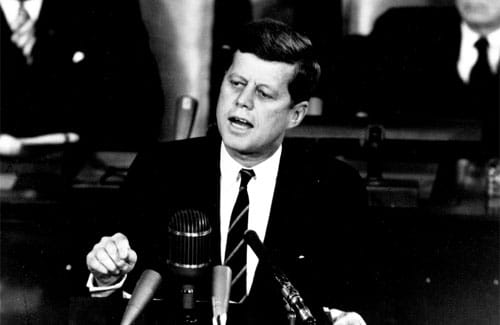
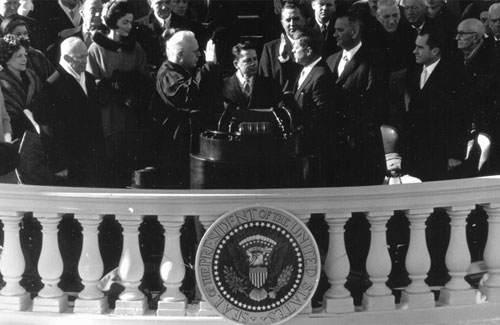
Inauguration Address by John F. Kennedy
on January 20, 1961, in Washington, DC
Vice President Johnson, Mr. Speaker, Mr. Chief Justice, President Eisenhower, Vice President Nixon, President Truman, reverend clergy, fellow citizens:
We observe today not a victory of party but a celebration of freedom – symbolizing an end as well as a beginning – signifying renewal as well as change. For I have sworn before you and Almighty God the same solemn oath our forbears prescribed nearly a century and three-quarters ago.
The world is very different now. For man holds in his mortal hands the power to abolish all forms of human poverty and all forms of human life. And yet the same revolutionary beliefs for which our forebears fought are still at issue around the globe – the belief that the rights of man come not from the generosity of the state but from the hand of God.
We dare not forget today that we are the heirs of that first revolution. Let the word go forth from this time and place, to friend and foe alike, that the torch has been passed to a new generation of Americans-born in this century, tempered by war, disciplined by a hard and bitter peace, proud of our ancient heritage-and unwilling to witness or permit the slow undoing of those human rights to which this nation has always been committed, and to which we are committed today at home and around the world.
Let every nation know, whether it wishes us well or ill, that we shall pay any price, bear any burden, meet any hardship, support any friend, oppose any foe to assure the survival and the success of liberty.
This much we pledge – and more.
To those old allies whose cultural and spiritual origins we share, we pledge the loyalty of faithful friends. United there is little we cannot do in a host of cooperative ventures. Divided there is little we can do – for we dare not meet a powerful challenge at odds and split asunder.
To those new states whom we welcome to the ranks of the free, we pledge our word that one form of colonial control shall not have passed away merely to be replaced by a far more iron tyranny. We shall not always expect to find them supporting our view. But we shall always hope to find them strongly supporting their own freedom-and to remember that, in the past, those who foolishly sought power by riding the back of the tiger ended up inside.
To those people in the huts and villages of half the globe struggling to break the bonds of mass misery, we pledge our best efforts to help them help themselves, for whatever period is required – not because the communists may be doing it, not because we seek their votes, but because it is right. If a free society cannot help the many who are poor, it cannot save the few who are rich.
To our sister republics south of our border, we offer a special pledge-to convert our good words into good deeds-in a new alliance for progress-to assist free men and free governments in casting off the chains of poverty. But this peaceful revolution of hope cannot become the prey of hostile powers. Let all our neighbors know that we shall join with them to oppose aggression or subversion anywhere in the Americas. And let every other power know that this Hemisphere intends to remain the master of its own house.
To that world assembly of sovereign states, the United Nations, our last best hope in an age where the instruments of war have far outpaced the instruments of peace, we renew our pledge of support – to prevent it from becoming merely a forum for invective – to strengthen its shield of the new and the weak – and to enlarge the area in which its writ may run.
Finally, to those nations who would make themselves our adversary, we offer not a pledge but a request: that both sides begin anew the quest for peace, before the dark powers of destruction unleashed by science engulf all humanity in planned or accidental self-destruction.
We dare not tempt them with weakness. For only when our arms are sufficient beyond doubt can we be certain beyond doubt that they will never be employed.
But neither can two great and powerful groups of nations take comfort from our present course – both sides overburdened by the cost of modern weapons, both rightly alarmed by the steady spread of the deadly atom, yet both racing to alter that uncertain balance of terror that stays the hand of mankind’s final war.
So let us begin anew – remembering on both sides that civility is not a sign of weakness, and sincerity is always subject to proof. Let us never negotiate out of fear. But let us never fear to negotiate.
Let both sides explore what problems unite us instead of belaboring those problems which divide us.
Let both sides, for the first time, formulate serious and precise proposals for the inspection and control of arms-and bring the absolute power to destroy other nations under the absolute control of all nations.
Let both sides seek to invoke the wonders of science instead of its terrors. Together let us explore the stars, conquer the deserts, eradicate disease, tap the ocean depths and encourage the arts and commerce.
Let both sides unite to heed in all corners of the earth the command of Isaiah – to “undo the heavy burdens… (and) let the oppressed go free.”
And if a beachhead of cooperation may push back the jungle of suspicion, let both sides join in creating a new endeavor, not a new balance of power, but a new world of law, where the strong are just and the weak secure and the peace preserved.
All this will not be finished in the first one hundred days. Nor will it be finished in the first one thousand days, nor in the life of this Administration, nor even perhaps in our lifetime on this planet. But let us begin.
In your hands, my fellow citizens, more than mine, will rest the final success or failure of our course. Since this country was founded, each generation of Americans has been summoned to give testimony to its national loyalty. The graves of young Americans who answered the call to service surround the globe.
Now the trumpet summons us again-not as a call to bear arms, though arms we need – not as a call to battle, though embattled we are – but a call to bear the burden of a long twilight struggle, year in and year out, “rejoicing in hope, patient in tribulation” – a struggle against the common enemies of man: tyranny, poverty, disease and war itself.
Can we forge against these enemies a grand and global alliance, North and South, East and West, that can assure a more fruitful life for all mankind? Will you join in that historic effort?
In the long history of the world, only a few generations have been granted the role of defending freedom in its hour of maximum danger. I do not shrink from this responsibility-I welcome it. I do not believe that any of us would exchange places with any other people or any other generation. The energy, the faith, the devotion which we bring to this endeavor will light our country and all who serve it-and the glow from that fire can truly light the world.
And so, my fellow Americans: ask not what your country can do for you – ask what you can do for your country.
My fellow citizens of the world: ask not what America will do for you, but what together we can do for the freedom of man.
Finally, whether you are citizens of America or citizens of the world, ask of us here the same high standards of strength and sacrifice which we ask of you. With a good conscience our only sure reward, with history the final judge of our deeds, let us go forth to lead the land we love, asking His blessing and His help, but knowing that here on earth God’s work must truly be our own.
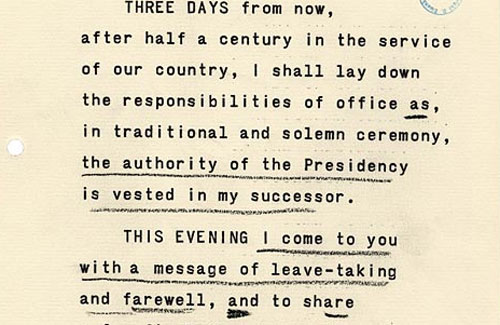
Dwight D. Eisenhower’s Farewell Address
Given on January 17, 1961, in Washington, D.C.
My fellow Americans:
Three days from now, after half a century in the service of our country, I shall lay down the responsibilities of office as, in traditional and solemn ceremony, the authority of the Presidency is vested in my successor.
This evening I come to you with a message of leave-taking and farewell, and to share a few final thoughts with you, my countrymen.
Like every other citizen, I wish the new President, and all who will labor with him, Godspeed. I pray that the coming years will be blessed with peace and prosperity for all.
Our people expect their President and the Congress to find essential agreement on issues of great moment, the wise resolution of which will better shape the future of the Nation.
My own relations with the Congress, which began on a remote and tenuous basis when, long ago, a member of the Senate appointed me to West Point, have since ranged to the intimate during the war and immediate post-war period, and, finally, to the mutually interdependent during these past eight years.
In this final relationship, the Congress and the Administration have, on most vital issues, cooperated well, to serve the national good rather than mere partisanship, and so have assured that the business of the Nation should go forward. So, my official relationship with the Congress ends in a feeling, on my part, of gratitude that we have been able to do so much together.
II
We now stand ten years past the midpoint of a century that has witnessed four major wars among great nations. Three of these involved our own country. Despite these holocausts America is today the strongest, the most influential and most productive nation in the world. Understandably proud of this pre-eminence, we yet realize that America’s leadership and prestige depend, not merely upon our unmatched material progress, riches and military strength, but on how we use our power in the interests of world peace and human betterment.
III
Throughout America’s adventure in free government, our basic purposes have been to keep the peace; to foster progress in human achievement, and to enhance liberty, dignity and integrity among people and among nations. To strive for less would be unworthy of a free and religious people. Any failure traceable to arrogance, or our lack of comprehension or readiness to sacrifice would inflict upon us grievous hurt both at home and abroad.
Progress toward these noble goals is persistently threatened by the conflict now engulfing the world. It commands our whole attention, absorbs our very beings. We face a hostile ideology-global in scope, atheistic in character, ruthless in purpose, and insidious in method. Unhappily the danger it poses promises to be of indefinite duration. To meet it successfully, there is called for, not so much the emotional and transitory sacrifices of crisis, but rather those which enable us to carry forward steadily, surely, and without complaint the burdens of a prolonged and complex struggle-with liberty at stake. Only thus shall we remain, despite every provocation, on our charted course toward permanent peace and human betterment.
Crises there will continue to be. In meeting them, whether foreign or domestic, great or small,there is a recurring temptation to feel that some spectacular and costly action could become the miraculous solution to all current difficulties. A huge increase in newer elements of our defense; development of unrealistic programs to cure every ill in agriculture; a dramatic expansion in basic and applied research-these and many other possibilities, each possibly promising in itself, may be suggested as the only way to the road we which to travel.
But each proposal must be weighed in the light of a broader consideration: the need to maintain balance in and among national programs-balance between the private and the public economy, balance between cost and hoped for advantage-balance between the clearly necessary and the comfortably desirable; balance between our essential requirements as a nation and the duties imposed by the nation upon the individual; balance between action of the moment and the national welfare of the future. Good judgment seeks balance and progress; lack of it eventually finds imbalance and frustration.
The record of many decades stands as proof that our people and their government have, in the main, understood these truths and have responded to them well, in the face of stress and threat. But threats, new in kind or degree, constantly arise. I mention two only.
IV
A vital element in keeping the peace is our military establishment. Our arms must be mighty, ready for instant action, so that no potential aggressor may be tempted to risk his own destruction.
Our military organization today bears little relation to that known by any of my predecessors in peace time, or indeed by the fighting men of World War II or Korea.
Until the latest of our world conflicts, the United States had no armaments industry. American makers of plowshares could, with time and as required, make swords as well. But now we can no longer risk emergency improvisation of national defense; we have been compelled to create a permanent armaments industry of vast proportions. Added to this, three and a half million men and women are directly engaged in the defense establishment. We annually spend on military security more than the net income of all United State corporations.
This conjunction of an immense military establishment and a large arms industry is new in the American experience. The total influence-economic, political, even spiritual-is felt in every city, every state house, every office of the Federal government. We recognize the imperative need for this development. Yet we must not fail to comprehend its grave implications. Our toil, resources and livelihood are all involved; so is the very structure of our society.
In the councils of government, we must guard against the acquisition of unwarranted influence, whether sought or unsought, by the military-industrial complex. The potential for the disastrous rise of misplaced power exists and will persist.
We must never let the weight of this combination endanger our liberties or democratic processes. We should take nothing for granted only an alert and knowledgeable citizenry can compel the proper meshing of huge industrial and military machinery of defense with our peaceful methods and goals, so that security and liberty may prosper together.
Akin to, and largely responsible for the sweeping changes in our industrial-military posture, has been the technological revolution during recent decades.
In this revolution, research has become central; it also becomes more formalized, complex, and costly. A steadily increasing share is conducted for, by, or at the direction of, the Federal government.
Today, the solitary inventor, tinkering in his shop, has been over shadowed by task forces of scientists in laboratories and testing fields. In the same fashion, the free university, historically the fountainhead of free ideas and scientific discovery, has experienced a revolution in the conduct of research. Partly because of the huge costs involved, a government contract becomes virtually a substitute for intellectual curiosity. For every old blackboard there are now hundreds of new electronic computers.
The prospect of domination of the nation’s scholars by Federal employment, project allocations, and the power of money is ever present and is gravely to be regarded.
Yet, in holding scientific research and discovery in respect, as we should, we must also be alert to the equal and opposite danger that public policy could itself become the captive of a scientific-technological elite.
It is the task of statesmanship to mold, to balance, and to integrate these and other forces, new and old, within the principles of our democratic system-ever aiming toward the supreme goals of our free society.
V
Another factor in maintaining balance involves the element of time. As we peer into society’s future, we-you and I, and our government-must avoid the impulse to live only for today, plundering, for our own ease and convenience, the precious resources of tomorrow. We cannot mortgage the material assets of our grandchildren without risking the loss also of their political and spiritual heritage. We want democracy to survive for all generations to come, not to become the insolvent phantom of tomorrow.
VI
Down the long lane of the history yet to be written America knows that this world of ours, ever growing smaller, must avoid becoming a community of dreadful fear and hate, and be, instead, a proud confederation of mutual trust and respect.
Such a confederation must be one of equals. The weakest must come to the conference table with the same confidence as do we, protected as we are by our moral, economic, and military strength. That table, though scarred by many past frustrations, cannot be abandoned for the certain agony of the battlefield.
Disarmament, with mutual honor and confidence, is a continuing imperative. Together we must learn how to compose difference, not with arms, but with intellect and decent purpose. Because this need is so sharp and apparent I confess that I lay down my official responsibilities in this field with a definite sense of disappointment. As one who has witnessed the horror and the lingering sadness of war-as one who knows that another war could utterly destroy this civilization which has been so slowly and painfully built over thousands of years-I wish I could say tonight that a lasting peace is in sight.
Happily, I can say that war has been avoided. Steady progress toward our ultimate goal has been made. But, so much remains to be done. As a private citizen, I shall never cease to do what little I can to help the world advance along that road.
VII
So-in this my last good night to you as your President-I thank you for the many opportunities you have given me for public service in war and peace. I trust that in that service you find somethings worthy; as for the rest of it, I know you will find ways to improve performance in the future.
You and I-my fellow citizens-need to be strong in our faith that all nations, under God, will reach the goal of peace with justice. May we be ever unswerving in devotion to principle, confident but humble with power, diligent in pursuit of the Nation’s great goals.
To all the peoples of the world, I once more give expression to America’s prayerful and continuing inspiration:
We pray that peoples of all faiths, all races, all nations, may have their great human needs satisfied; that those now denied opportunity shall come to enjoy it to the full; that all who yearn for freedom may experience its spiritual blessings; that those who have freedom will understand, also, its heavy responsibilities; that all who are insensitive to the needs of others will learn charity; that the scourges of poverty, disease and ignorance will be made to disappear from the earth, and that, in the goodness of time, all peoples will come to live together in a peace guaranteed by the binding force of mutual respect and love.
December 28, 1959 – January 3, 1960: Frankie Avalon – Why January 4, 1960 – January 17, 1960: Marty Robbins – El Paso January 18, 1960 – February 7, 1960: Johnny Preston – Running Bear February 8, 1960 – February 21, 1960: Mark Dinning – Teen Angel February 22, 1960 – April 24, 1960: Percy Faith – Theme from ‘A Summer Place’ April 25, 1960 – May 22, 1960: Elvis Presley – Stuck on You May 23, 1960 – June 26, 1960: The Everly Brothers – Cathy’s Clown June 27, 1960 – July 10, 1960: Connie Francis – Everybody’s Somebody’s Fool July 11, 1960 – July 17, 1960: Hollywood Argyles – Alley-Oop July 18, 1960 – August 7, 1960: Brenda Lee – I’m Sorry August 8, 1960 – August 14, 1960: Brian Hyland – Itsy Bitsy Teenie Weenie Yellow Polka Dot Bikini August 15, 1960 – September 18, 1960: Elvis Presley – It’s Now or Never September 19, 1960 – September 25, 1960: Chubby Checker – The Twist September 26, 1960 – October 9, 1960: Connie Francis – My Heart Has a Mind of Its Own October 10, 1960 – October 16, 1960: Larry Verne – Mr. Custer October 17, 1960 – October 23, 1960: The Drifters – Save the Last Dance for Me October 24, 1960 – November 13, 1960: Brenda Lee – I Want to Be Wanted November 14, 1960 – November 20, 1960: Ray Charles – Georgia on My Mind November 21, 1960 – November 27, 1960: Maurice Williams and the Zodiacs – Stay November 28, 1960 – January 8, 1961: Elvis Presley – Are You Lonesome Tonight?
(Data is compiled from various charts including Billboard’s “Pop,” “Airplay,” “R&B” and “Singles” Charts. “Hot 100” is the primary chart used starting October, 1958)
January 1 – Cameroon Achieved Independence: Cameroon gained independence from France and the United Kingdom, becoming a sovereign nation.
February 1 – Greensboro Sit-ins Began: Four African American students initiated sit-ins at a segregated Woolworth’s lunch counter in Greensboro, North Carolina, sparking a nationwide civil rights movement.
February 13 – France Conducted First Nuclear Test: France became the fourth nuclear power by detonating its first atomic bomb, “Gerboise Bleue,” in the Algerian Sahara desert.
March 21 – Sharpeville Massacre Occurred: In Sharpeville, South Africa, police opened fire on a crowd protesting apartheid pass laws, killing 69 people and injuring 180.
April 21 – Brasília Inaugurated as Brazil’s Capital: Brazil officially inaugurated Brasília as its new capital, relocating the government from Rio de Janeiro to promote inland development.
May 1 – U-2 Incident Heightened Cold War Tensions: An American U-2 spy plane piloted by Francis Gary Powers was shot down over the Soviet Union, leading to a diplomatic crisis.
May 9 – U.S. Approved Birth Control Pill: The U.S. Food and Drug Administration approved the first oral contraceptive pill, revolutionizing family planning.
May 16 – First Laser Operated Successfully: Physicist Theodore Maiman operated the first functional laser at Hughes Research Laboratories in California, marking a significant technological advancement.
May 22 – Great Chilean Earthquake Devastated Region: The most powerful earthquake ever recorded, with a magnitude of 9.5, struck Valdivia, Chile, causing widespread destruction and triggering tsunamis.
June 23 – First Contraceptive Pill Available for Purchase: The first contraceptive pill was made available for purchase in the United States, providing women with more control over reproduction.
July 1 – Somalia Gained Independence: British and Italian Somaliland territories united to form the independent Republic of Somalia.
August 1 – Dahomey (Benin) Achieved Independence: Dahomey, now known as Benin, gained independence from France, becoming a sovereign nation.
August 16 – Cyprus Became Independent: Cyprus gained independence from the United Kingdom, establishing itself as the Republic of Cyprus.
September 14 – OPEC Established: Iran, Iraq, Kuwait, Saudi Arabia, and Venezuela formed the Organization of the Petroleum Exporting Countries to coordinate oil policies.
September 26 – First Televised U.S. Presidential Debate Held: John F. Kennedy and Richard Nixon participated in the first televised presidential debate, influencing public perception through visual media.
October 12 – Inejiro Asanuma Assassinated on Live Television: Japanese socialist politician Inejiro Asanuma was fatally stabbed during a televised debate, shocking the nation.
November 8 – John F. Kennedy Elected U.S. President: John F. Kennedy defeated Richard Nixon in a closely contested election, becoming the 35th President of the United States.
December 9 – First Episode of Coronation Street Aired: The British television soap opera Coronation Street premiered, becoming the world’s longest-running TV soap opera.
“Year of Africa” Saw Multiple Nations Gain Independence: Seventeen African countries gained independence from colonial powers, marking a significant shift in the continent’s political landscape.
Sino-Soviet Split Began: Ideological differences between China and the Soviet Union led to a gradual estrangement, impacting global communist movements.
Carroll Baker, Brigitte Bardot, Claudia Cardinale, Doris Day, Angie Dickinson, Anita Ekberg, Annette Funicello, Audrey Hepburn, Gina Lollobrigida, Sophia Loren, Marilyn Monroe, Julie Newmar, Kim Novak, Leslie Parrish, Stella Stevens, Elizabeth Taylor, Tina Turner, Mamie Van Doren
Sex Symbols and Hollywood Hunks
Paul Newman, Robert Goulet, Elvis Presley
Oscars: 32nd Academy Awards (1960)
The Oscars on April 4, 1960, were hosted by Bob Hope at the RKO Pantages Theatre. The night belonged to Ben-Hur, which swept 11 Oscars, a record that stood until 1997. Charlton Heston received the Best Actor award for his role in the film, while Simone Signoret won Best Actress for Room at the Top.
Grammy Awards: 2nd Annual Grammy Awards (1960)
The 2nd Annual Grammy Awards were held on November 29, 1960. Bobby Darin made a splash by winning Record of the Year and Best New Artist for his hit “Mack the Knife.” The event saw the introduction of the Best Jazz Performance and Best Comedy Performance categories, adding more diversity to the awards.
Emmy Awards: 12th Primetime Emmy Awards (1960)
Hosted at the NBC Studios in Burbank on June 20, 1960, the Emmy Awards had Robert Stack winning Best Actor for The Untouchables and Jane Wyatt snagging Best Actress for Father Knows Best. Playhouse 90 secured the Best Dramatic Series with a continuing story, while Art Carney Special received the Best Comedy award.
“The Quotes”
“Smile! You’re on Candid Camera!” – Candid Camera
“A boy’s best friend is his mother.” – Anthony Perkins, as Norman Bates in Psycho
Time Magazine’s Men of the Year
United States Scientists, Represented by George Beadle, Charles Draper, John Enders, Donald A. Glaser, Joshua Lederberg, Willard Libby, Linus Pauling, Edward Purcell, Isidor Rabi, Emilio Segrè, William Shockley, Edward Teller, Charles Townes, James Van Allen, and Robert Woodward
Miss America
Lynda Mead (Natchez, MS)
Miss USA
Linda Bement (Utah)
The Scandals
Chuck Berry (age 34) got in legal trouble when he took a 14-year-old girl from Arizona to Missouri to work at his Bandstand club.
Comedic actress and producer Lucille Ball filed for divorce from her husband, Desi Arnaz, after 19 years of marriage.
JFK was elected President of the United States reportedly with much help from the votes of dead Americans in Cook County, Illinois, and in Texas.
The Space Mystery
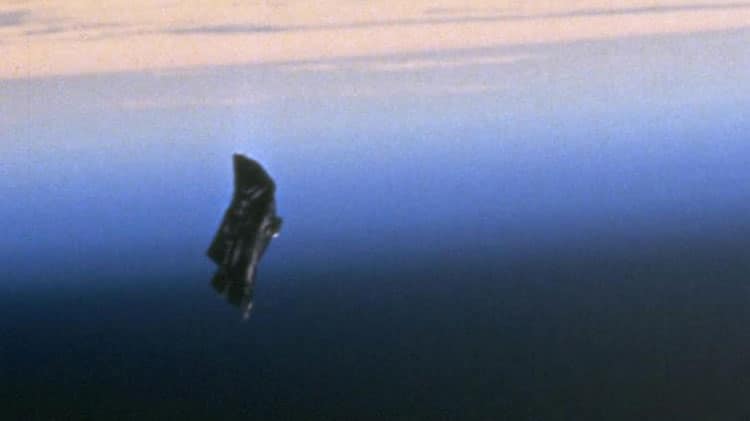
Russian and American Air Defense units saw the mysterious BLACK KNIGHT Satellite. At 15 tons, it was bigger than any country could have sent then. It ‘disappeared’ after about three weeks but has been spottily reported for decades; it is possible that Nikola Tesla heard radio broadcasts from it as early as 1899.
Some internet sources say it has been orbiting for around 13,000 years. NASA and other space agencies have been silent about the craft, although they do allow the occasional picture.
August 1, 1960 – The Twist by Chubby Checker was released. On August 6, Chubby Checker (Ernest Evans) performed his version of The Twist, written by Hank Ballard, on The Dick Clark Show. It reached number one on The Billboard chart for the first time on September 19, 1960.
USAF Captain Joseph Kittinger set three records on August 16th – the highest parachute jump (102,800 feet), the longest parachute free-fall (4 minutes 36 seconds), and the first person to exceed the speed of sound without an aircraft or space vehicle (714 mph during free fall).
Morely Cigarettes are a fake brand of cigarettes used across mass media since April 5, 1961, first used on an episode of The Naked City.
The largest polar bear on record, reportedly weighing 2,209 pounds, was a male shot at Kotzebue Sound in northwestern Alaska in 1960. When mounted, he stood 11 feet, 1 inch tall on its hind legs.
Motown, founded by Berry Gordy Jr., was incorporated as Motown Record Corporation.
On July 20, 1960, The world’s first-ever female head of government in the modern era was elected in Ceylon (now Sri Lanka), Sirimavo Bandaranaike as Prime Minister.
The first CERN particle accelerator became operational in Geneva, Switzerland.
The PLATO computer system, introduced at the University of Illinois in 1960, invented forums, message boards, chat rooms, instant messaging, remote screen sharing, and multiplayer video games years before the internet existed.
Standard showtimes for films were not expected until 1960. Previously, most films would just play on a loop, and people could enter anytime. Thriller Psycho was one of the first films set to viewing times.
On September 30, 1960, The Flintstones premiered at 8:30 PM on ABC.
Joanne Woodward received one of the first stars on the Hollywood Walk of Fame.
The AFL began placing players’ names on the back of their jerseys. Major League Baseball’s Chicago White Sox started the practice earlier that year. NOB – Names On Back. The New York Yankees have traditionally never worn the names.
KISS is an acronym for “Keep it simple, stupid,” as a design principle noted by the US Navy in 1960.
When Eisenhower planned to visit Japan in 1960, the government called on Yakuza bosses to lend an army of their men as security guards. The visit was later canceled.
Amos ‘n’ Andy, an American radio sitcom set in Harlem with black characters, ran from 1928 through 1960, was created, written, and voiced by two white actors.
February and Late August through September, CBS broadcast the 1960 Winter Olympics and Summer Olympics exclusively for $60,000.
The record for the fastest propeller passenger aircraft (541.45 MPH) was set on 24 March 1960 by the Russian Tupolev Tu-114.
The X-15 jet has held the record for the world’s fastest plane since 1960 (2,196 MPH), 1961 (4,093 MPH), 19612 (4,104 MPH), and 1967 (4,534 MPH).
Mariana Trench: Only three people ever went into The Mariana Trench. Don Walsh and Jacques Piccard, two scientists aboard the Trieste on January 4, 1960, and film director James Cameron in 2012.
Starting on February 24, the first submerged circumnavigation of Earth was completed by USS submarine Triton on April 25th (Operation Sandblast, 60 days, 21 hours).
December 31, 1960: The last day on which the farthing, a coin first minted in England in the 13th century, was legal tender in the United Kingdom. The value at that point was less than a penny.
Paleoanthropologist Louis Leakey discovered 1.4 million-year-old Homo erectus (Olduvai Hominid 9) in Olduvai Gorge, Tanzania.
There are three dots on every Domino’s Pizza box because when founder Tom Monaghan started his chain, he planned on adding a dot with each new store. Looking back, 8,000+ stores later, stopping with the three dots was a good idea, forming a simple domino.
The term paparazzi originated with Italian director Federico Fellini’s La Dolce Vita. One of the minor characters in the film is a photographer named Paparazzo. Fellini took Paparazzo’s name from the Italian word for a noisy mosquito.
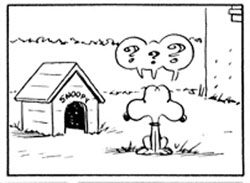
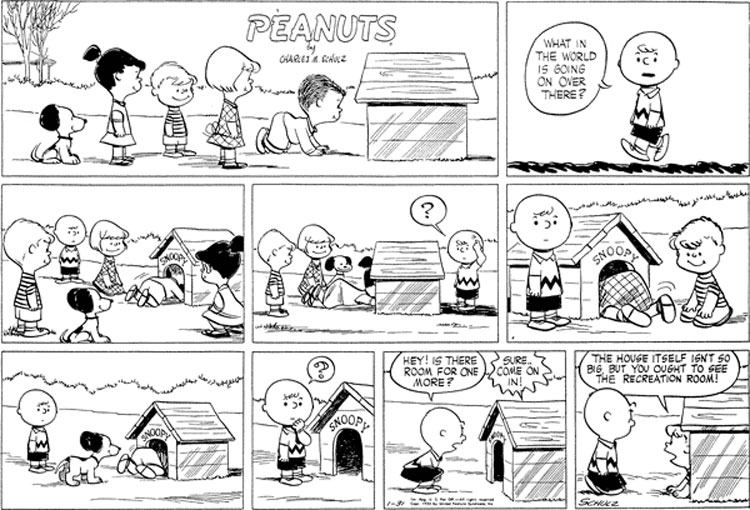
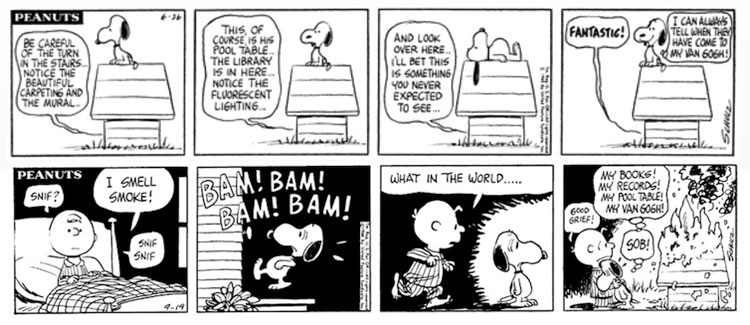
Snoopy’s Doghouse
Snoopy’s doghouse is always shown from the side so as never to reveal the interior, leaving what’s inside to the reader’s imagination. On May 8, 1960, the inside of the doghouse can be seen, but it seems empty. It is apparently not empty.
Civil Rights
February 1, 1960 – In Greensboro, North Carolina, four black students from North Carolina Agricultural and Technical State University began a sit-in at a segregated Woolworth’s lunch counter. Although they were refused service, they were allowed to stay at the counter.
July 25, 1960 – The same Woolworth Company’s lunch counter in Greensboro, North Carolina, served a meal to its first black customer.
May 6 – United States President Dwight D. Eisenhower signed the Civil Rights Act of 1960 into law.
In 1960, Republican Frank R. Beckwith was the first African American to run as a candidate for President of the United States in a major-party primary
Cold War
In 1960, the President of France told the President of the United States, John F. Kennedy, “I do not know what Khrushchev is going to do, nor what is going to happen, but whatever he does… I want you to know that I am with you to the end.”
May 1 – Several Soviet surface-to-air missiles shot down an American Lockheed U-2 spy plane. Its pilot, Francis Gary Powers of the Central Intelligence Agency, is captured.
July 1 – A Soviet Air Force MiG-19 fighter plane flying north of Murmansk, Russia, over the Barents Sea, shot down a six-man RB-47 Stratojet US Air Force reconnaissance plane. Four of the Air Force officers were killed, and the two survivors were held prisoner in the Soviet Union.
October 12 – Soviet Premier Nikita Khrushchev pounds his shoe on a table at a meeting of the United Nations General Assembly, protesting the discussion of the Soviet Union’s policies toward Eastern Europe.
Doomsday Clock
Seven minutes to midnight, according to the Bulletin of Atomic Scientists. 1960: “Political actions belie the tough talk of “massive retaliation.” For the first time, the United States and Soviet Union appear eager to avoid direct confrontation in regional conflicts such as the 1956 Egyptian-Israeli dispute. Joint projects that build trust and constructive dialogue between third parties also quell diplomatic hostilities. Scientists initiate many of these measures, helping establish the International Geophysical Year, a series of coordinated, worldwide scientific observations, and the Pugwash Conferences, which allow Soviet and American scientists to interact.”
The Habit
Reading To Kill a Mockingbird by Harper Lee. OR watching Alfred Hitchcock’s Psycho in theaters.
1st Appearances & 1960’s Most Popular Christmas Gifts, Toys and Presents
Green Eggs and Ham, by Dr. Seuss, Game of Life*, Etch-A-Sketch, Barbie, Chatty Cathy, Mattel’s Lie Detector Game, Mr. Machine, Play-Doh Fun Factory
Best Film Oscar Winner
Ben-Hur (presented in 1960)
Popular and Best-selling Books From 1960
Dr. Seuss’s ABC by Dr. Seuss Advise and Consent by Allen Drury Are You My Mother? by P.D. Eastman The Chapman Report by Irving Wallace The Constant Image by Marcia Davenport For Your Eyes Only by Ian Fleming Green Eggs and Ham by Dr. Seuss Hawaii by James A. Michener To Kill a Mockingbird by Harper Lee The Leopard by Giuseppe Tomasi di Lampedusa The Listener by Taylor Caldwell Love Is a Special Way of Feeling by Joan Walsh Anglund The Lovely Ambition by Mary Ellen Chase One Fish, Two Fish, Red Fish, Blue Fish by Dr. Seuss Ourselves to Know by John O’Hara Put Me in the Zoo by Robert Lopshire Sermons and Soda-Water by John O’Hara The Sneetches and Other Stories by Dr. Seuss Trustee from the Toolroom by Nevil Shute
1960 Most Popular TV Shows
1. Gunsmoke (CBS) 2. Wagon Train (NBC) 3. Have Gun Will Travel (CBS) 4. The Andy Griffith Show (CBS) 5. The Real McCoys (ABC) 6. Rawhide (CBS) 7. Candid Camera (CBS) 8. The Untouchables (ABC) 9. The Jack Benny Show (CBS) 10. Dennis The Menace (CBS)
1960 Billboard Number One Songs
December 28, 1959 – January 3, 1960: Why – Frankie Avalon
January 4, 1960 – January 17: El Paso – Marty Robbins
January 18 – February 7: Running Bear – Johnny Preston
February 8 – February 21: Teen Angel – Mark Dinning
February 22 – April 24: The Theme From A Summer Place – Percy Faith & his Orchestra
April 25 – May 22: Stuck On You – Elvis Presley
May 23 – June 26: Cathy’s Clown – The Everly Brothers
June 27 – June 10: Everybody’s Somebody’s Fool – Connie Francis
July 11 – July 17: Alley-Oop – Hollywood Argyles
July 18 – August 7: I’m Sorry – Brenda Lee
August 8 – August 17: Itsy Bitsy Teenie Weenie Yellow Polkadot Bikini – Brian Hyland
August 15 – September 18: It’s Now Or Never – Elvis Presley
September 19 – September 25: The Twist – Chubby Checker
September 26 – October 9: My Heart Has A Mind Of Its Own – Connie Francis
October 10 – October 16: Mr. Custer – Larry Verne
October 17 – October 23: Save The Last Dance For Me – The Drifters
October 24 – November 13: I Want To Be Wanted – Brenda Lee
November 14 – November 20: Georgia On My Mind – Ray Charles
November 21 – November 27: Stay – Maurice Williams & The Zodiacs
November 28, 1960 – January 8, 1961: Are You Lonesome Tonight? – Elvis Presley
1960 United States Census
Total US Population: 179,323,175 1. New York, New York – 7,781,984 2. Chicago, Illinois – 3,550,404 3. Los Angeles, California – 2,479,015 4. Philadelphia, Pennsylvania – 2,002,512 5. Detroit, Michigan – 1,670,144 6. Baltimore, Maryland – 939,024 7. Houston, Texas – 938,219 8. Cleveland, Ohio – 876,050 9. Washington, District of Columbia – 783,956 10. St. Louis, Missouri – 750,026
Sports Highlights
Wilt Chamberlain scored 58 points, the most ever by an NBA rookie, as Philadelphia Warriors beat Detroit Pistons, 127-117 in Bethlehem, PA.
In 1960, the National Basketball Association player Wilt Chamberlain got 55 rebounds in a game versus the Boston Celtics.
Wilma Rudolph (June 23, 1940 – November 12, 1994) had polio as an infant and was unable to walk properly until she was 11. For several years, her family had to massage her legs four times a day, and she had to wear a metal brace. In 1960, she became the first American woman to win three gold medals in an Olympic event.
October 29 – In Louisville, Kentucky, Cassius Clay (Muhammad Ali) won his first professional boxing match over Tunney Hunsaker.
On September 9, 1960, The first regular-season game in the American Football League took place at Boston’s Nickerson Field. The Denver Broncos defeated the Boston Patriots, 13–10.
On September 10, 1960, during the Summer Olympics in Rome, Ethiopian runner Abele Bikila became the first Sub-Saharan African to win a gold medal. He ran barefoot.
Sports
World Series Champions: Pittsburgh Pirates NFL Champions: Philadelphia Eagles AFL Champions: Houston Oilers NBA Champions: Boston Celtics Stanley Cup Champs: Montreal Canadians U.S. Open Golf Arnold Palmer U.S. Tennis: (Men/Ladies) Neale Fraser/Darlene R. Hard Wimbledon (Men/Women): Neale Fraser/Maria Bueno NCAA Football Champions: Minnesota & Mississippi NCAA Basketball Champions: Ohio State Kentucky Derby: Venetian Way
The 1960 United States presidential election marked the beginning of a new era in American politics, as John F. Kennedy, a young and charismatic senator from Massachusetts, won the election to become the 35th President of the United States. His election campaign and subsequent victory significantly impacted American society and pop culture.
Political Parties: John F. Kennedy was a Democrat, while Richard Nixon was a Republican.
In the midst of the Cold War, Kennedy’s election campaign focused on addressing the perceived “missile gap” with the Soviet Union and promoting civil rights. His youthful energy and charisma, along with his eloquent speeches, captured the American public’s attention. Kennedy’s victory in the election was close, with a narrow popular vote margin of just 0.17%.
JFK Details:
John F. Kennedy was the first Roman Catholic president in U.S. history.
At 43, Kennedy was the youngest person ever elected to the presidency.
The 1960 presidential debates between Kennedy and Nixon were the first televised debates in U.S. history.
Kennedy’s wife, Jacqueline Kennedy, became a fashion icon during his presidency.
The famous slogan “A Time for Greatness” was used in Kennedy’s campaign.
Kennedy’s campaign was also the first to use television advertising effectively.
Kennedy’s father, Joseph P. Kennedy, played a crucial role in financing and supporting his son’s campaign.
Kennedy’s inaugural address, with the famous line “Ask not what your country can do for you; ask what you can do for your country,” is considered one of the most memorable speeches in American history.
Kennedy’s presidency inspired the term “Camelot” to describe his administration, based on the popular musical about King Arthur’s court.
Kennedy’s election marked a shift in American politics, as his administration was more focused on social issues, civil rights, and foreign policy than previous administrations.
The election of John F. Kennedy as the 35th President of the United States marked a turning point in American history and profoundly impacted popular culture. His youthful image, charismatic personality, and idealistic vision for America captivated the nation and influenced subsequent generations of politicians and leaders.
The Organization of Petroleum Exporting Countries (OPEC) is an influential international organization founded on September 14, 1960, in Baghdad, Iraq. It was established to coordinate and unify petroleum policies among member countries to secure stable oil prices and steady supply to oil-consuming nations.
The founding members of OPEC were Iran, Iraq, Kuwait, Saudi Arabia, and Venezuela. These five countries possessed substantial oil reserves and aimed to gain more control over the oil market and pricing.
As of 2021, OPEC has 13 member countries, including Algeria, Angola, Congo, Equatorial Guinea, Gabon, Iran, Iraq, Kuwait, Libya, Nigeria, Saudi Arabia, the United Arab Emirates, and Venezuela.
OPEC’s headquarters were initially in Geneva, Switzerland, but were relocated to Vienna, Austria, in 1965.
OPEC was crucial in the 1973 oil crisis, also known as the first “oil shock.” The organization’s Arab members imposed an oil embargo on the United States and other Western countries in response to their support for Israel during the Yom Kippur War. This led to a sharp increase in oil prices and widespread economic turmoil.
The organization’s influence on global oil prices led to the term “OPEC price” being used as a reference for crude oil prices in the global market.
OPEC member countries control approximately 80% of the world’s proven oil reserves, accounting for around 44% of global oil production.
OPEC decisions and policies often significantly affect global politics and economies, as the price and availability of oil can have wide-ranging implications.
In 2016, OPEC and non-OPEC oil-producing countries (led by Russia) agreed to cut oil production to stabilize prices. This marked the first agreement of its kind since 2001.
OPEC’s influence on pop culture can be seen in various movies, TV shows, and books that address or mention the organization and its impact on global politics and the economy.
OPEC has faced criticism for its perceived monopolistic practices and manipulation of oil prices. Some argue that the organization’s policies have led to economic and environmental issues.
OPEC has significantly shaped global energy policies and the oil market for over six decades. As a powerful organization composed of major oil-producing nations, OPEC’s actions and decisions continue to have a considerable impact on the global economy, international relations, and popular culture.
The 1960 Summer Olympics, officially known as the Games of the XVII Olympiad, were held in Rome, Italy, from August 25 to September 11, 1960. This historic event marked the first time that the Summer Olympics were held in Rome and showcased numerous athletic achievements, political and social developments, and the rise of several prominent sports figures.
Dates and Details:
Rome was awarded the hosting rights for the 1960 Summer Olympics in 1955, defeating cities such as Lausanne, Detroit, Budapest, and Brussels.
The Games featured 150 events in 17 sports, with 5,338 athletes from 83 countries participating.
The official motto of the 1960 Rome Olympics was “Citius, Altius, Fortius,” which means “Faster, Higher, Stronger” in Latin.
Rome’s ancient landmarks, such as the Basilica of Maxentius and the Arch of Constantine, provided a stunning backdrop for various Olympic events.
1960 Rome Olympics Facts:
The 1960 Rome Olympics were the first Games to be covered by television on a large scale, with an estimated 30 million viewers tuning in worldwide.
These Olympics marked the first time that doping control tests were carried out, albeit on a limited scale and focused on narcotics only.
The 1960 Games featured the debut of the Paralympics, a competition for athletes with disabilities, held in Rome immediately after the main event.
South Africa competed in the 1960 Olympics for the last time before being banned due to the country’s apartheid policies. They would not return until the 1992 Barcelona Games.
Danish sailor Paul Elvstrøm won his fourth consecutive gold medal in the same event, a record that still stands today.
Ethiopia’s Abebe Bikila became the first African athlete to win a gold medal in the marathon, running the race barefoot and setting a new world record.
Soviet Union’s Larisa Latynina won six medals in gymnastics, bringing her total Olympic medal count to 18, a record that stood until 2012 when it was broken by American swimmer Michael Phelps.
Effects on Pop Culture:
The 1960 Rome Olympics introduced several iconic sports figures who went on to have a lasting impact on popular culture. The most notable among them was Cassius Clay, later known as Muhammad Ali, who won the gold medal in light heavyweight boxing at the age of 18. Ali’s charisma, showmanship, and outspokenness made him a global icon both in and out of the ring.
The Games also featured the legendary sprinter Wilma Rudolph, who overcame polio and went on to win three gold medals in track and field, becoming a symbol of resilience and determination for millions of people.
The 1960 Rome Olympics helped to cement the tradition of the Olympic Torch Relay, which captured the imagination of people around the world and has since become an integral part of the Olympic experience.
Prominent People and Countries Involved:
Italy, as the host nation, played a significant role in organizing and executing the Games. Rome’s historic architecture and cultural legacy provided a unique setting that captured the attention of audiences worldwide.
The United States and the Soviet Union were locked in a heated competition for dominance in the medal count, reflecting the larger political tensions of the Cold War era. The Soviet Union ultimately topped the medal table with 43 gold medals, while the United States came in second with 34 gold medals.
Abebe Bikila of Ethiopia became a symbol of African excellence in sports, paving the way for future African athletes to achieve success on the world stage.
The 1960 Rome Olympics also featured notable athletes such as Australian swimmer Dawn Fraser and Russian gymnast Boris Shakhlin, who each achieved remarkable success in their respective disciplines.
Dawn Fraser, an Australian swimmer, won gold medals in both the 100-meter freestyle and the 4×100-meter freestyle relay, setting world records in both events. Fraser became the first woman to win the 100-meter freestyle in consecutive Olympics and would go on to win the event for the third time in the 1964 Tokyo Olympics.
Boris Shakhlin, a Soviet gymnast, won a total of seven medals in Rome, including four gold medals, two silver medals, and one bronze medal. Shakhlin’s performance at the 1960 Games contributed to the Soviet Union’s dominance in gymnastics during that period.
The 1960 Rome Olympics had a lasting impact on the world of sports, popular culture, and the Olympic movement itself. The Games showcased the power of athletic competition to unite people from diverse backgrounds and inspired generations of athletes to pursue excellence in their respective disciplines. The historic backdrop of Rome and the introduction of television coverage on a large scale helped to captivate audiences worldwide, further cementing the Olympics as a global event.
The rise of iconic sports figures like Muhammad Ali, Wilma Rudolph, and Abebe Bikila not only provided memorable moments during the Games but also had lasting effects on popular culture. These athletes became symbols of determination, resilience, and excellence, transcending the boundaries of sports and serving as inspiration for millions of people around the world.
Additionally, the 1960 Rome Olympics marked significant advancements in the Olympic movement, including the introduction of doping control tests and the debut of the Paralympics, which expanded the reach and inclusivity of the Games.
“To Kill a Mockingbird” is a classic American novel by Harper Lee, published on July 11, 1960. Set in the fictional town of Maycomb, Alabama, during the Great Depression, the story revolves around the young girl Scout Finch, her brother Jem, and their father, the lawyer Atticus Finch. The novel tackles themes such as racial inequality, moral growth, and social justice, and its characters and storyline continue to resonate with readers worldwide.
Dates and Details:
Harper Lee began writing “To Kill a Mockingbird” in the mid-1950s. It took her about two and a half years to complete the manuscript.
The novel was immediately successful in its publication in 1960, winning the Pulitzer Prize for Fiction in 1961.
“To Kill a Mockingbird” was Harper Lee’s first and only published novel until “Go Set a Watchman” was published in 2015, a sequel to the original book, featuring the same characters.
Mockingbird Facts:
The character of Atticus Finch was inspired by Harper Lee’s own father, Amasa Coleman Lee, who was also a lawyer and defended two black men accused of murder in 1919.
Harper Lee was friends with fellow author Truman Capote, and she even helped him research his book “In Cold Blood.” The character of Dill in “To Kill a Mockingbird” was inspired by Capote.
The novel’s original title was “Atticus,” but Lee’s editor suggested a change to better reflect the story’s broader themes.
Harper Lee received an honorary degree from the University of Alabama in 1990, despite not having graduated from college herself.
2007 President George W. Bush awarded Harper Lee the Presidential Medal of Freedom for her contribution to literature.
Effects on Pop Culture:
“To Kill a Mockingbird” has been widely studied in American high schools and colleges due to its themes of racial injustice, morality, and empathy.
The novel was adapted into a successful and critically acclaimed film in 1962, starring Gregory Peck as Atticus Finch. Peck won an Academy Award for his portrayal of the iconic character.
The book’s popularity has led to numerous stage adaptations, including a 1990 version by Christopher Sergel and a 2018 adaptation by Aaron Sorkin, which premiered on Broadway.
The novel has inspired various songs, such as “Atticus” by The Noisettes and “Harper Lee” by Little Green Cars.
The character of Atticus Finch has become a symbol of moral integrity and has influenced the legal profession, with many lawyers citing him as an inspiration.
Prominent People and Countries Involved:
Harper Lee, the American author who wrote: “To Kill a Mockingbird.”
Gregory Peck, the actor who portrayed Atticus Finch in the 1962 film adaptation.
Aaron Sorkin, the playwright who adapted the novel for the 2018 Broadway production.
The United States, where the novel is set and where it has significantly impacted discussions of race and morality.
In conclusion, Harper Lee’s “To Kill a Mockingbird” is a seminal work of American literature that has captivated readers since its publication in 1960. The novel’s exploration of racial injustice, moral growth, and empathy has resonated with generations of readers and has impacted pop culture through film, theater, and music. The story of Scout, Jem, and Atticus Finch continues to inspire and challenge readers to confront the complexities of human nature and society.
The Congo Crisis was a tumultuous period in the history of the Democratic Republic of the Congo (DRC), then known as the Republic of the Congo. This complex political and social upheaval lasted from 1960 to 1965, and involved various factions, foreign interventions, and power struggles.
Dates and Details:
On June 30, 1960, the Congo gained independence from Belgium, with Patrice Lumumba becoming the first Prime Minister and Joseph Kasa-Vubu as President.
In July 1960, the Congolese army mutinied against their remaining Belgian officers, leading to violence against European civilians and widespread chaos.
On July 11, 1960, the resource-rich province of Katanga, led by Moise Tshombe, seceded from the Congo, backed by Belgian forces and European mercenaries.
UN peacekeeping forces were deployed to Congo in July 1960 in response to the crisis (ONUC – United Nations Operation in the Congo).
History Facts:
The Congo Crisis is considered one of the most significant events in the Cold War in Africa, as both the United States and the Soviet Union attempted to gain influence over the newly independent nation.
In September 1960, Kasa-Vubu dismissed Lumumba as Prime Minister, causing a power struggle that led to Lumumba’s arrest and eventual assassination on January 17, 1961.
Lumumba’s assassination was allegedly carried out with the complicity of the US and Belgian governments, fearing his potential alignment with the Soviet Union.
In August 1961, UN forces launched Operation Rumpunch, arresting foreign mercenaries and removing them from Katanga.
In 1964, an anti-government rebellion called the Simba Rebellion erupted in eastern Congo, adding to the instability.
In November 1964, a joint operation between Belgian paratroopers and the US Air Force rescued over 1,800 hostages held by the Simba rebels in Stanleyville (now Kisangani).
Effects on Pop Culture:
The Congo Crisis inspired various works of literature, film, and television, such as the 2000 film “Lumumba,” which portrays the life and assassination of Patrice Lumumba.
The crisis has been the subject of numerous documentaries and historical analyses, shedding light on the complexities of post-colonial African politics and the Cold War’s impact on the continent.
Prominent People and Countries:
Patrice Lumumba (Congo): The first Prime Minister of the independent Congo, whose assassination remains a controversial and emblematic event in African history.
Joseph Kasa-Vubu (Congo): The first President of the Congo, who dismissed Lumumba as Prime Minister.
Moise Tshombe (Congo): Leader of the secessionist Katanga province and later Prime Minister of the Congo.
Belgium: The former colonial power, which intervened in the Congo Crisis, supporting the secession of Katanga.
United States and Soviet Union: Both superpowers were involved in the crisis, seeking influence in the Congo amid Cold War tensions.
The Congo Crisis had long-lasting effects on the country and the African continent. The instability and violence that characterized this period continue to influence the DRC’s politics and society, and the crisis remains a crucial case study for understanding post-colonial African history and the wider impact of the Cold War.
Election of Patrice Lumumba as the First Prime Minister of Congo
The story of Patrice Lumumba’s election as the first Prime Minister of Congo is a fascinating tale of political intrigue, Cold War tensions, and the struggle for African independence. Lumumba, a charismatic and influential leader, played a pivotal role in Congo’s transition from a Belgian colony to an independent nation. However, his election would prove to be a turning point in Congolese history, ultimately leading to his tragic assassination.
Dates and Details:
Belgian Congo: Before gaining independence, Congo was a Belgian colony known as the Belgian Congo. The colonial period was marked by widespread exploitation of the Congolese people and their resources.
Independence Movement: In the 1950s, a strong independence movement emerged in the Belgian Congo, led by Lumumba and other nationalists. The movement gained significant momentum, and in January 1960, Belgium agreed to grant Congo independence.
Elections: In May 1960, the first general elections were held in Congo. Lumumba’s party, the Mouvement National Congolais (MNC), won the largest number of seats in the parliament. Consequently, on June 23, 1960, Patrice Lumumba was appointed as the first Prime Minister of the newly independent Congo.
The Facts:
Lumumba was a self-taught man who spoke several languages, including French, Lingala, Swahili, and Tshiluba.
He worked as a postal clerk and a traveling beer salesman before becoming involved in politics.
Lumumba was influenced by the pan-Africanist ideas of Ghanaian leader Kwame Nkrumah and aimed to unite the diverse ethnic groups in Congo.
He was imprisoned by Belgian authorities in 1959 for inciting riots but was released in time for the independence negotiations in Brussels.
Lumumba was known for his fiery speeches and was often seen as radical by both his opponents and foreign powers.
Effects on Pop Culture:
Lumumba’s life and assassination have been the subject of numerous books, documentaries, and films, such as the 2000 film “Lumumba,” directed by Raoul Peck.
His name has become synonymous with the struggle for African independence and the fight against neo-colonialism.
Lumumba’s story has been referenced in various songs, including “Patrice Lumumba” by Miriam Makeba and “Lumumba” by Alpha Blondy.
Prominent People and Countries Involved:
Patrice Lumumba: As the first Prime Minister of Congo, Lumumba played a crucial role in shaping the country’s political landscape during its early years of independence.
Joseph Kasa-Vubu: Elected as the first President of Congo, Kasa-Vubu had a contentious relationship with Lumumba, ultimately dismissing him from office.
Belgium: As the former colonial power, Belgium had a vested interest in the political developments in Congo. Some believe that Belgian officials were involved in Lumumba’s assassination.
The United States and the Soviet Union: The Cold War superpowers were keenly interested in Congo’s vast mineral wealth and strategic location. Both the U.S. and the Soviet Union sought to influence the political situation in Congo, with some reports suggesting that the CIA may have played a role in Lumumba’s assassination.
The election of Patrice Lumumba as the first Prime Minister of Congo was a watershed moment in African history, symbolizing the struggle for independence and self-determination. His leadership, however, was cut short by his tragic assassination, which has left a lasting legacy on Congolese politics and the fight for social justice around the world.
“Psycho” is a groundbreaking horror film directed by Alfred Hitchcock and released in 1960. It is based on the 1959 novel of the same name by Robert Bloch. The film, starring Anthony Perkins, Janet Leigh, Vera Miles, and John Gavin, has become a classic, significantly influencing the horror genre and popular culture.
The film was produced on a low budget of approximately $800,000 but grossed over $50 million worldwide.
Alfred Hitchcock chose to shoot the film in black and white to save costs and to make the violent scenes less graphic.
The famous shower scene took seven days to shoot, with 77 different camera angles and over 50 cuts.
Psycho Facts:
Hitchcock purchased the rights to Robert Bloch’s novel for $9,500 and reportedly bought as many copies of the book as possible to keep the ending a secret.
The Bates Motel and house were constructed on the backlot of Universal Studios, where they still stand as a tourist attraction.
The film’s score, composed by Bernard Herrmann, consists primarily of string instruments, creating the movie’s iconic, eerie sound.
“Psycho” was the first American film to show a toilet flushing on-screen.
Chocolate syrup was used for blood in the shower scene due to its appearance in black and white.
Hitchcock made a cameo in the film, as he did in many of his movies. In “Psycho,” he can be seen wearing a cowboy hat through a window.
Anthony Perkins, who played Norman Bates, did not receive an Oscar nomination for his performance, despite the acclaim he received.
“Psycho” was initially met with mixed reviews but went on to receive four Academy Award nominations, including Best Director for Hitchcock.
Effects on Pop Culture:
“Psycho” has had a lasting impact on the horror genre, inspiring numerous films, including the slasher subgenre.
The film has been referenced and parodied in various forms of media, such as television shows, movies, and music.
The shower scene has become one of cinema’s most famous and studied scenes.
The character Norman Bates has become a cultural icon, with the name “Bates” being synonymous with homicidal, disturbed individuals.
Prominent People and Countries:
Alfred Hitchcock (United Kingdom): Director of the film, one of the most influential filmmakers of all time.
Anthony Perkins (United States): Actor who portrayed Norman Bates, garnering widespread praise for his performance.
Janet Leigh (United States): Actress who played Marion Crane, earning a Golden Globe and an Academy Award nomination for her role.
Bernard Herrmann (United States): Composer of the film’s iconic score, which has become a classic in its own right.
“Psycho” remains a significant milestone in cinema’s history, illustrating Alfred Hitchcock’s genius and innovative storytelling power. Its influence can still be felt in contemporary horror films, and the film’s characters, scenes, and music continue to resonate with audiences worldwide.
The Great Chilean Earthquake, also known as the Valdivia Earthquake, was the most powerful earthquake ever recorded in human history. Occurring on May 22, 1960, near the city of Valdivia in southern Chile, it registered a staggering 9.5 on the moment magnitude scale. The earthquake, its aftershocks, and the resulting tsunamis caused widespread devastation and loss of life in Chile and across the Pacific Ocean.
Dates and Details:
The main earthquake struck at 3:11 pm local time on May 22, 1960.
It lasted approximately 10 minutes, with several powerful aftershocks following.
The earthquake caused tsunamis that reached as far as Japan, Hawaii, the Philippines, and New Zealand.
Facts:
The earthquake released almost 25% of the total global seismic energy between 1906 and 1986.
The epicenter of the quake was roughly 100 miles (160 kilometers) off the coast of Chile.
The rupture zone of the earthquake extended for about 620 miles (1,000 kilometers) along the Nazca and South American tectonic plates.
The maximum vertical displacement during the earthquake was 65 feet (20 meters) near the city of Valdivia.
The earthquake treggired a volcanic eruption of Cordón Caulle in the Andean mountain range, which began on May 24, 1960, and lasted several weeks.
Effects on Pop Culture:
The Great Chilean Earthquake increased global awareness of the devastating potential of natural disasters, particularly earthquakes, and tsunamis.
The event has been featured in various documentaries, television programs, and books about earthquakes and natural disasters.
The earthquake led to significant advancements in seismology and the study of plate tectonics.
Prominent People and Countries Involved:
Chile was the country most directly affected by the earthquake, with widespread damage, thousands of casualties, and millions left homeless.
The Chilean government, led by President Jorge Alessandri, coordinated national and international relief efforts in the aftermath of the disaster.
The United States, the Soviet Union, and numerous other countries provided humanitarian aid and assistance to Chile.
The international scientific community, including seismologists and geologists, studied the earthquake to better understand the processes underlying such catastrophic events.
The Great Chilean Earthquake remains a stark reminder of the destructive power of nature and the importance of ongoing research and preparedness to minimize the impact of future disasters.
The approval of the birth control pill by the United States Food and Drug Administration (FDA) in 1960 was a milestone event in the history of reproductive rights and women’s health. The development and subsequent approval of the pill would have far-reaching social, cultural, and political implications that continue to shape conversations around contraception and women’s rights today.
The birth control pill, also known as the oral contraceptive pill or simply “the pill,” was first developed in the 1950s by a team of researchers led by biologist Dr. Gregory Pincus and gynecologist Dr. John Rock. Margaret Sanger, a prominent birth control advocate, and heiress Katharine McCormick funded the team’s work. Their goal was to create a safe, effective, and discreet method of contraception that would allow women greater control over their reproductive choices.
On May 9, 1960, the FDA approved the first oral contraceptive pill, Enovid, manufactured by G.D. Searle and Company. The pill’s approval marked a turning point in the history of contraception and women’s reproductive rights, offering women a new level of control over their fertility.
Details:
The FDA approved the first birth control pill, Enovid, on May 9, 1960.
Key figures involved in the development of the pill include Dr. Gregory Pincus, Dr. John Rock, Margaret Sanger, and Katharine McCormick.
The pill’s approval had far-reaching effects on popular culture, sexual norms, and the feminist movement.
The pill contributed to the sexual revolution of the 1960s and 1970s. It sparked reproductive rights debates, leading to landmark legal cases such as Griswold v. Connecticut and Eisenstadt v. Baird.
The global spread of the pill helped address population growth and promoted women’s health and empowerment worldwide.
The active ingredients in the first birth control pill, Enovid, were synthetic hormones, progesterone, and estrogen, which work to prevent ovulation and make the uterus inhospitable to a fertilized egg.
Margaret Sanger, one of the key figures behind the development of the pill, was a controversial figure in her time due to her advocacy for birth control and her involvement in the eugenics movement.
The first clinical trials for the pill were conducted in Puerto Rico in the late 1950s, where access to contraception was limited, and the birth rate was high.
Due to the social and political climate surrounding birth control, G.D. Searle and Company, the manufacturer of Enovid, initially marketed the pill as a treatment for menstrual disorders rather than as a contraceptive.
The Comstock Laws, which were in effect in the United States until the 1960s, made it illegal to distribute information about contraception or to mail contraceptives across state lines.
The pill’s approval profoundly impacted popular culture and society in the United States and beyond. The pill gave women unprecedented control over their reproductive choices, allowing them to delay or prevent pregnancy to pursue education, careers, and other opportunities. As a result, the pill became closely associated with the feminist movement and the broader struggle for women’s rights.
The widespread availability of the pill also contributed to shifting sexual norms and attitudes. With a reliable method of contraception, women and couples could engage in premarital and extramarital sexual relationships with less fear of unintended pregnancy. This change in sexual behavior contributed to the sexual revolution of the 1960s and 1970s, which challenged traditional societal expectations surrounding sex and relationships.
In addition to its effects on popular culture and sexual norms, the approval of the birth control pill also had significant political implications. The pill’s introduction sparked debates about reproductive rights, the role of the state in regulating contraception, and the moral implications of birth control. These debates would eventually lead to landmark legal cases such as Griswold v. Connecticut (1965) and Eisenstadt v. Baird (1972), which recognized the constitutional right to privacy and expanded contraception access for married and unmarried individuals.
Prominent people involved in developing and promoting the birth control pill include Dr. Gregory Pincus, Dr. John Rock, Margaret Sanger, and Katharine McCormick. These individuals played crucial roles in advancing the science of contraception and advocating for women’s reproductive rights.
The approval of the birth control pill had global implications as well. As the pill became more widely available in the United States and other developed countries, it played a significant role in helping to address population growth and related social issues. International organizations, such as the World Health Organization and the United Nations, began to support family planning programs and the distribution of contraceptives, including the pill, in developing countries. This global push for family planning and reproductive rights has impacted women’s health and empowerment worldwide.
The history of the birth control pill is a testament to the power of scientific innovation and social change to transform society. It is important to recognize the contributions of the researchers, advocates, and activists who were instrumental in developing and promoting the pill and the broader cultural, political, and social forces that shaped its reception and impact.
Despite its relatively recent introduction, the birth control pill has had an immense impact on society in the United States and worldwide. Its legacy is intertwined with the ongoing struggle for reproductive rights and women’s empowerment, and its effects continue to be felt today.
The Civil Rights Act of 1960 was a landmark piece of legislation in the United States that sought to address racial discrimination, particularly in voting rights and desegregation. Building on the Civil Rights Act of 1957, the 1960 Act provided additional mechanisms to enforce voting rights and combat racial segregation in schools and public spaces. The Act was signed into law by President Dwight D. Eisenhower on May 6, 1960. It marked a significant step forward in the ongoing struggle for racial equality and civil rights in the United States.
The Act addressed racial discrimination in voting rights by providing federal referees to assist in voter registration and ensuring that voting records were preserved for inspection.
The Act also contained provisions to combat racial segregation in schools and public spaces, requiring federal funds be withheld from projects or programs that practiced discrimination.
History Facts:
The Civil Rights Act of 1960 was the second major civil rights legislation in the 20th century, following the Civil Rights Act of 1957.
The United States Congress passed the Act with bipartisan support, though some Southern Democrats opposed the legislation.
The 1960 Act laid the groundwork for the more comprehensive Civil Rights Act of 1964, which would go on to outlaw many forms of racial discrimination.
The Act empowered the U.S. Attorney General to file lawsuits to desegregate public schools, though enforcement of this provision was limited at the time.
President Eisenhower signed the Act into law on the same day that a federal court ordered the University of Georgia to admit its first two African American students, reflecting the ongoing struggle for desegregation in the United States.
Effects on Pop Culture:
The Civil Rights Act of 1960 and the era’s broader civil rights movement profoundly impacted American popular culture.
The struggle for civil rights inspired numerous books, films, songs, and works of art that sought to capture the experiences of African Americans and promote racial equality.
The Act and the civil rights movement served as a catalyst for the emergence of a distinct African American artistic and cultural identity in the United States.
The Civil Rights Act of 1960 has been referenced in various movies, documentaries, and television series dealing with the history of civil rights in America.
Prominent People and Countries Involved:
President Dwight D. Eisenhower played a key role in the passage of the Civil Rights Act of 1960, signing the legislation into law and advocating for its enforcement.
Attorney General William P. Rogers, who served under Eisenhower, strongly supported the Act and pushed for its provisions to be enforced by the federal government.
Civil rights leaders like Martin Luther King Jr., Roy Wilkins, and A. Philip Randolph were instrumental in raising awareness about the need for federal action to address racial discrimination and promote civil rights.
Members of the United States Congress, both Democrats and Republicans, worked together to draft and pass the Civil Rights Act of 1960, overcoming opposition from some Southern lawmakers who sought to maintain the status quo.
The Civil Rights Act of 1960 was a critical milestone in the ongoing struggle for racial equality in the United States. While the Act was limited in its scope and enforcement, it helped pave the way for future civil rights legislation and increased federal involvement in addressing racial discrimination. The Act’s passage and the broader civil rights movement had a lasting impact on American society and popular culture, inspiring countless individuals to join the fight for equality and justice.
The European Free Trade Association (EFTA) was established on May 3, 1960, as an alternative to the European Economic Community (EEC), which later became the European Union (EU). The EFTA was a response to the increasing economic integration in Europe. It aimed to promote free trade and economic cooperation among its members while allowing them to maintain their individual trade policies. The founding member countries were Austria, Denmark, Norway, Portugal, Sweden, Switzerland, and the United Kingdom. Over the years, the EFTA evolved and underwent numerous changes, with some members leaving to join the EU and others joining EFTA.
Dates and Details:
January 4, 1960: The EFTA was formally established with the signing of the Stockholm Convention.
May 3, 1960: The EFTA came into effect, marking the beginning of its operations.
1973: The United Kingdom and Denmark left the EFTA to join the European Economic Community (EEC), now known as the European Union (EU).
1991: Finland joined the EFTA, becoming its eighth member.
1995: Austria, Finland, and Sweden left the EFTA to join the EU. Liechtenstein became a full EFTA member.
Today, the EFTA has four member countries: Iceland, Liechtenstein, Norway, and Switzerland.
EFTA Facts:
EFTA was created to serve as an alternative to the EEC, providing a free trade area for non-EEC countries in Europe.
EFTA countries do not share a common external tariff, which means they have individual trade agreements with non-EFTA countries.
EFTA countries are not part of the EU’s customs union, which allows them to have their own trade policies.
The EFTA Secretariat is located in Geneva, Switzerland, while its Surveillance Authority is in Brussels, Belgium, and its Court is in Luxembourg.
EFTA countries, except for Switzerland, are part of the European Economic Area (EEA), which allows them to participate in the EU’s single market without being full EU members.
The EFTA is not to be confused with the European Free Trade Area, a proposed free trade area consisting of all EU and EFTA countries.
In 2001, EFTA countries signed a Free Trade Agreement with the countries of the Southern African Customs Union (SACU), marking the first time EFTA engaged in free trade negotiations with a group of developing countries.
Effects on Pop Culture:
The establishment of the EFTA demonstrated the increasing importance of international economic cooperation and integration in the post-World War II era, influencing the development of similar free trade agreements around the world.
The EFTA played a role in shaping the European economic landscape, as it provided an alternative to the EU, offering countries the opportunity to participate in free trade without being part of the EU’s political structures.
The EFTA has contributed to the development of European economic policy, as its successes and challenges have influenced the thinking of EU policymakers.
Prominent People and Countries:
Founding members: Austria, Denmark, Norway, Portugal, Sweden, Switzerland, and the United Kingdom were the founding members of the EFTA.
Finland, Liechtenstein, and Iceland: These countries joined the EFTA later, with Finland joining in 1991, Liechtenstein in 1995, and Iceland in 1970.
United Kingdom: The UK played a crucial role in establishing the EFTA, as it sought to create an alternative to the EEC. The UK eventually left the EFTA to join the EEC in 1973.
Harold Macmillan, the British Prime Minister from 1957 to 1963, formed the EFTA. His government saw EFTA as a way to maintain British influence in Europe while staying outside of the EEC.
Paul-Henri Spaak: A Belgian statesman and one of the founding fathers of the European Union, Paul-Henri Spaak also played a key role in establishing the EFTA. He served as its first president from 1959 to 1961.
Oskar R. Lange: An influential Polish economist and diplomat, Lange served as the EFTA Secretary-General from 1961 to 1965. He contributed to shaping the organization’s policies and overseeing its operations.
Jan Tore Sanner: As the current EFTA Council Chair, Jan Tore Sanner, the Norwegian Minister of Finance, plays a vital role in steering the organization’s activities and ensuring its continued relevance in today’s global economic landscape.
As an economic organization, the EFTA has not had a significant direct impact on popular culture. However, its existence and the economic policies it promotes have indirectly influenced the cultural exchanges between member countries and their trading partners. The EFTA has helped create an environment conducive to sharing ideas, products, and cultural expressions across borders by fostering economic cooperation and integration.
In summary, the European Free Trade Association was established in 1960 as an alternative to the European Economic Community. It aimed to promote free trade and economic cooperation among its members while allowing them to maintain their individual trade policies. Over the years, the EFTA has seen changes in its membership, with some countries leaving to join the EU and others joining EFTA. Today, the EFTA has four member countries: Iceland, Liechtenstein, Norway, and Switzerland. Although the EFTA has not directly impacted popular culture, its role in fostering economic cooperation and integration has indirectly influenced cultural exchanges between its members and their trading partners.
The U-2 incident, which occurred on May 1, 1960, refers to when an American U-2 spy plane, piloted by Francis Gary Powers, was shot down over the Soviet Union during the height of the Cold War. The aircraft, on a high-altitude reconnaissance mission, was taken down by a Soviet surface-to-air missile near Sverdlovsk (now Yekaterinburg) in the Ural Mountains region. The event significantly heightened tensions between the United States and the Soviet Union and had long-lasting effects on pop culture and international relations.
The U.S. initially claimed that the plane was on a weather research mission, but later admitted it was on a covert intelligence-gathering mission.
The pilot, Francis Gary Powers, was captured by the Soviets and put on trial for espionage, sentenced to ten years in prison, but was released after 21 months in exchange for Soviet spy Rudolf Abel in 1962 during a famous spy swap on the Glienicke Bridge in Berlin.
The U-2 aircraft was specifically designed for high-altitude reconnaissance and could fly at heights of up to 70,000 feet.
The U-2 was nicknamed “Dragon Lady” due to its unique design and difficulty flying it.
Powers was awarded the Intelligence Star by the CIA in 1963 after his return to the United States.
During his imprisonment, Powers learned some Russian and taught his fellow prisoners English.
The U-2 incident and the subsequent spy swap have been the subject of various books, movies, and documentaries, contributing to the cultural narrative of the Cold War.
The high-profile nature of the event further fueled the public’s fascination with espionage and spy stories.
The incident played a significant role in the worsening of U.S.-Soviet relations, leading to the collapse of the Paris Summit in 1960.
Prominent people and countries involved in the U-2 incident include U.S. President Dwight D. Eisenhower, the CIA, pilot Francis Gary Powers, Soviet Premier Nikita Khrushchev, Soviet Armed Forces, and the Soviet legal system.
The distribution of the Sabin oral polio vaccine had a transformative impact on global public health, significantly reducing the incidence of polio and the debilitating effects associated with the disease. The first large-scale use in the United States was April 24, 1960, on “Sabin Sunday”, when thousands of residents of Greater Cincinnati received Sabin’s polio vaccine on cubes of sugar.
In the early 1960s, Dr. Albert Sabin, an American medical researcher, developed an oral polio vaccine (OPV) that used a weakened, live form of the poliovirus. This was a significant advancement over the existing injectable polio vaccine developed by Dr. Jonas Salk, which used a killed virus. The oral vaccine offered several advantages, including ease of administration, lower cost, and the ability to provide longer-lasting immunity.
The Sabin oral polio vaccine was first distributed in the United States in 1961, and its use rapidly expanded to other countries. By the mid-1960s, mass vaccination campaigns were underway in many parts of the world, including the Soviet Union, which played a significant role in testing and promoting the vaccine. The vaccine’s success was evident as the number of polio cases began to decline dramatically in countries where it was introduced.
The widespread use of the Sabin oral polio vaccine profoundly affected pop culture and public perception of disease prevention. Polio, which had once been a terrifying and crippling disease, was now seen as a preventable condition. The vaccine’s success helped to build public trust in the power of immunization and the importance of science in addressing public health challenges.
Furthermore, the development and distribution of the Sabin oral polio vaccine inspired global cooperation and collaboration in the fight against infectious diseases. In 1988, the World Health Organization (WHO), UNICEF, and Rotary International launched the Global Polio Eradication Initiative (GPEI) to eradicate polio worldwide. As a result of these efforts, polio cases have decreased by more than 99% globally, and the disease remains endemic in only two countries, Afghanistan and Pakistan.
In summary, the distribution of the Sabin oral polio vaccine played a pivotal role in reducing the incidence of polio worldwide, altered public perception of disease prevention, and set the stage for global collaboration in combating infectious diseases.
1960 Oscars 32nd Academy Awards: An Unforgettable Night of Cinema
Winners Announced: April 4, 1960 Held at: RKO Pantages Theatre, Hollywood, California Host: Bob Hope Eligibility Year: 1959
Highlights and Achievements:
Ben-Hur Dominates: The historical epic didn’t just win; it swept the floor with 11 Oscars, including Best Picture and Best Director for William Wyler. This set a record that stood alone for decades until Titanic in 1997 and The Lord of the Rings: The Return of the King in 2003 matched it.
Simone Signoret Makes History: Winning Best Actress for her role in Room at the Top, Simone Signoret became the first French actress to capture an Academy Award. A remarkable feat that added a touch of international flair to the ceremony.
Animated Excellence: UPA’s Moonbird claimed the Best Animated Short Film award. This win highlighted UPA’s unique approach to animation, which often utilized innovative storytelling techniques.
Trivia:
Bob Hope’s Legacy: This was Bob Hope’s ninth time hosting the Academy Awards. He’s the all-time champ, having hosted a record 19 times over the years.
Charlton Heston’s Dedication: To fully embody his role in Ben-Hur, Charlton Heston trained rigorously to become proficient in chariot driving. Heston’s dedication to authenticity shone through while a stunt double was used for some scenes.
Best Motion Picture: Ben-Hur – Sam Zimbalist, producer (posthumous award) (WINNER) Anatomy of a Murder – Otto Preminger, producer The Diary of Anne Frank – George Stevens, producer The Nun’s Story – Henry Blanke, producer Room at the Top – John Woolf and James Woolf, producers
Best Director: William Wyler – Ben-Hur (WINNER) George Stevens – The Diary of Anne Frank Fred Zinnemann – The Nun’s Story Jack Clayton – Room at the Top Billy Wilder – Some Like It Hot
Best Actor: Charlton Heston – Ben-Hur as Judah Ben-Hur (WINNER) Laurence Harvey – Room at the Top as Joe Lampton Jack Lemmon – Some Like It Hot as Jerry/”Daphne” Paul Muni – The Last Angry Man as Dr. Sam Abelman James Stewart – Anatomy of a Murder as Paul Biegler
Best Actress: Simone Signoret – Room at the Top as Alice Aisgill (WINNER) Doris Day – Pillow Talk as Jan Morrow Audrey Hepburn – The Nun’s Story as Sister Luke Katharine Hepburn – Suddenly, Last Summer as Violet Venable Elizabeth Taylor – Suddenly, Last Summer as Catherine Holly
Best Supporting Actor: Hugh Griffith – Ben-Hur as Sheik Ilderim (WINNER) Arthur O’Connell – Anatomy of a Murder as Parnell McCarthy George C. Scott – Anatomy of a Murder as Claude Dancer Robert Vaughn – The Young Philadelphians as Chester A. “Chet” Gwynn Ed Wynn – The Diary of Anne Frank as Albert Dussell
Best Supporting Actress: Shelley Winters – The Diary of Anne Frank as Petronella van Daan (WINNER) Hermione Baddeley – Room at the Top as Elspeth Susan Kohner – Imitation of Life as Sarah Jane Juanita Moore – Imitation of Life as Annie Johnson Thelma Ritter – Pillow Talk as Alma
Best Story and Screenplay Written Directly for the Screen: Pillow Talk – Story by Russell Rouse and Clarence Greene; Screenplay by Stanley Shapiro and Maurice Richlin (WINNER) The 400 Blows – François Truffaut and Marcel Moussy North by Northwest – Ernest Lehman Operation Petticoat – Story by Paul King, Joseph J. Stone; Screenplay by Stanley Shapiro and Maurice Richlin Wild Strawberries – Ingmar Bergman (Refused Nomination)
Best Screenplay Based on Material from Another Medium: Room at the Top – Neil Paterson based on the novel by John Braine (WINNER) Anatomy of a Murder – Wendell Mayes based on the novel by Robert Traver Ben-Hur – Karl Tunberg based on the novel by Lew Wallace The Nun’s Story – Robert Anderson based on the novel by Kathryn Hulme Some Like It Hot – Billy Wilder and I. A. L. Diamond based on a story by Robert Thoeren and M. Logan
Best Foreign Language Film: Black Orpheus (France) (WINNER) The Bridge (Germany) The Great War (Italy) Paw (Denmark) The Village on the River (Netherlands)
Best Documentary Feature: Serengeti Shall Not Die (WINNER) The Race for Space
Best Documentary Short Subject: Glass (WINNER) Donald in Mathmagic Land From Generation to Generation
Best Live Action Short Subject: The Golden Fish – Jacques Cousteau (WINNER) Between the Tides – Ian Ferguson Mysteries of the Deep – Walt Disney The Running Jumping & Standing Still Film – Peter Sellers Skyscraper – Shirley Clarke and Willard Van Dyke
Best Short Subjects – Cartoons: Moonbird (WINNER) Mexicali Shmoes Noah’s Ark The Violinist
Best Scoring of a Dramatic or Comedy Picture: Ben-Hur – Miklós Rózsa (WINNER) The Diary of Anne Frank – Alfred Newman The Nun’s Story – Franz Waxman On the Beach – Ernest Gold Pillow Talk – Frank De Vol
Best Scoring of a Musical Picture: Porgy and Bess – André Previn and Ken Darby (WINNER) The Five Pennies – Leith Stevens Li’l Abner – Nelson Riddle and Joseph J. Lilley Say One for Me – Lionel Newman Sleeping Beauty – George Bruns
Best Song: “High Hopes” from A Hole in the Head – Music by Jimmy Van Heusen; Lyrics by Sammy Cahn (WINNER) “The Best of Everything” from The Best of Everything – Music by Alfred Newman; Lyrics by Sammy Cahn “The Five Pennies” from The Five Pennies – Music and Lyrics by Sylvia Fine “The Hanging Tree” from The Hanging Tree – Music by Jerry Livingston; Lyrics by Mack David “Strange Are The Ways of Love” from The Young Land – Music by Dimitri Tiomkin; Lyrics by Ned Washington
Best Sound: Ben-Hur – Franklin Milton (WINNER) Journey to the Center of the Earth – Carlton W. Faulkner Libel – A. W. Watkins The Nun’s Story – George Groves Porgy and Bess – Gordon E. Sawyer and Fred Hynes
Best Art Direction, Black-and-White: The Diary of Anne Frank – Art Direction: Lyle R. Wheeler and George W. Davis; Set Decoration: Walter M. Scott and Stuart A. Reiss (WINNER) Career – Art Direction: Hal Pereira and Walter Tyler; Set Decoration: Samuel M. Comer and Arthur Krams The Last Angry Man – Art Direction: Carl Anderson; Set Decoration: William Kiernan Some Like It Hot – Art Direction: Ted Haworth; Set Decoration: Edward G. Boyle Suddenly, Last Summer – Art Direction: Oliver Messel and William Kellner; Set Decoration: Scott Slimon
Best Art Direction, Color: Ben-Hur – Art Direction: William A. Horning (posthumous award) and Edward Carfagno; Set Decoration: Hugh Hunt (WINNER) The Big Fisherman – Art Direction: John DeCuir; Set Decoration: Julia Heron Journey to the Center of the Earth – Art Direction: Lyle R. Wheeler, Franz Bachelin and Herman A. Blumenthal; Set Decoration: Walter M. Scott and Joseph Kish North by Northwest – Art Direction: William A. Horning (posthumous nomination), Robert F. Boyle, and Merrill Pye; Set Decoration: Henry Grace and Frank R. McKelvy Pillow Talk – Art Direction: Richard H. Riedel (posthumous nomination); Set Decoration: Russell A. Gausman and Ruby R. Levitt
Best Cinematography, Black-and-White: The Diary of Anne Frank – William C. Mellor (WINNER) Anatomy of a Murder – Sam Leavitt Career – Joseph LaShelle Some Like It Hot – Charles Lang The Young Philadelphians – Harry Stradling, Sr.
Best Cinematography, Color: Ben-Hur – Robert Surtees (WINNER) The Big Fisherman – Lee Garmes The Five Pennies – Daniel L. Fapp The Nun’s Story – Franz Planer Porgy and Bess – Leon Shamroy
Best Costume Design, Black-and-White: Some Like It Hot – Orry-Kelly (WINNER) Career – Edith Head The Diary of Anne Frank – Charles LeMaire and Mary Wills The Gazebo – Helen Rose The Young Philadelphians – Howard Shoup
Best Costume Design, Color: Ben-Hur – Elizabeth Haffenden (WINNER) The Best of Everything – Adele Palmer The Big Fisherman – Renié The Five Pennies – Edith Head Porgy and Bess – Irene Sharaff
Best Film Editing: Ben-Hur – Ralph E. Winters and John D. Dunning (WINNER) Anatomy of a Murder – Louis R. Loeffler North by Northwest – George Tomasini The Nun’s Story – Walter Thompson On the Beach – Frederic Knudtson
Best Special Effects: Ben-Hur – Visual Effects by A. Arnold Gillespie and Robert MacDonald; Audible Effects by Milo B. Lory (WINNER) Journey to the Center of the Earth – Visual Effects by L. B. Abbott and James B. Gordon; Audible Effects by Carl Faulkner
Academy Honorary Awards: Buster Keaton “for his unique talents which brought immortal comedies to the screen.” (Statuette)
Lee De Forest “for his pioneering inventions which brought sound to the motion picture.” (Statuette)
TIROS-1, or Television Infrared Observation Satellite-1, marked a significant milestone in the history of meteorology and satellite technology. Launched on April 1, 1960, it was the first successful weather satellite, providing valuable data on weather patterns and revolutionizing weather forecasting.
Dates and Details:
April 1, 1960: TIROS-1 was launched from Cape Canaveral, Florida, by the United States.
April 2, 1960: The satellite transmitted its first weather images back to Earth.
June 15, 1960: After 78 days of operation, TIROS-1 was deactivated.
TIROS-1 Facts:
TIROS-1 was designed and constructed by the Radio Corporation of America (RCA) and the US Army Signal Research and Development Laboratory.
The satellite was equipped with two television cameras that took images of Earth’s cloud cover and transmitted them back to tracking stations on the ground.
TIROS-1 was placed in a polar orbit at approximately 400 miles (640 km) and had an orbital period of 98.8 minutes.
The satellite was shaped like a drum, with a diameter of 42 inches (107 cm) and a height of 22 inches (56 cm).
TIROS-1 was stabilized by spinning around its long axis, similar to a gyroscope.
During its operational period, TIROS-1 transmitted over 22,000 images of Earth’s cloud cover, providing valuable information for weather forecasting.
The success of TIROS-1 led to the development of more advanced weather satellites and the establishment of the National Oceanic and Atmospheric Administration (NOAA) in the United States.
TIROS-1’s polar orbit allowed it to observe nearly the entire Earth’s surface within a 24-hour period.
The satellite’s primary mission was to test the feasibility of using satellites for global weather observation and forecasting.
Effects on Pop Culture:
The launch and success of TIROS-1 captured the public’s imagination, further fueling interest in the Space Race and satellite technology.
The success of TIROS-1 and subsequent weather satellites changed how weather forecasting was conducted and reported, with satellite images becoming a common feature in weather reports and news broadcasts.
TIROS-1’s achievements contributed to a better understanding of Earth’s atmosphere and the importance of satellite technology in studying climate change and environmental issues.
Prominent People and Countries:
United States: The US government and its agencies, including NASA and the US Army Signal Research and Development Laboratory, played a critical role in developing and launching TIROS-1.
RCA (Radio Corporation of America): RCA was responsible for designing and constructing the satellite, collaborating closely with the US government.
TIROS-1 set the stage for developing advanced weather satellites and revolutionized how weather forecasting was conducted. Its success demonstrated the potential of satellite technology in various fields, including meteorology, communication, and Earth observation, paving the way for future innovations and research.
The Sharpeville Massacre is a tragic and pivotal event in South African history on March 21, 1960. It marked a turning point in the struggle against apartheid, the South African government’s brutal system of racial segregation and discrimination.
The massacre occurred in Sharpeville, a black township about 40 miles south of Johannesburg, South Africa.
The event was a response to a non-violent protest organized by the Pan Africanist Congress (PAC) against the pass laws, which required black South Africans to carry passbooks (also known as “dompas”) to control their movements in white-designated areas.
An estimated 5,000 to 7,000 protesters gathered outside the Sharpeville police station to hand in their passbooks in a symbolic act of defiance.
The police, vastly outnumbered by the crowd, panicked when someone in the crowd threw a stone at the police station, and they began firing into the crowd.
In the ensuing chaos, 69 people were killed, and around 180 were injured, most of them shot in the back while attempting to flee the scene.
The Sharpeville Massacre garnered international attention and outrage, which contributed to the isolation of the apartheid regime.
The South African government declared a state of emergency on March 30, 1960, and arrested thousands of protesters in the following weeks, including many PAC and African National Congress (ANC) leaders.
The South African government banned both the PAC and the ANC in the aftermath of the massacre.
The massacre led to a radicalization of anti-apartheid movements, with the ANC and other organizations eventually embracing armed resistance against the apartheid regime.
The United Nations General Assembly condemned the massacre and the apartheid system in Resolution 134, passed on April 1, 1960, marking the first time the UN officially addressed apartheid.
The Sharpeville Massacre is now commemorated annually in South Africa as Human Rights Day, a public holiday established in 1996 after the end of apartheid.
The Sharpeville Massacre affected the struggle against apartheid and the global perception of South Africa. It brought the brutal realities of apartheid to the forefront of the international community’s consciousness and highlighted the need for change in the country. Many prominent individuals and organizations within South Africa and internationally became more actively involved in the fight against apartheid following the massacre, ultimately leading to the system’s dismantling in the early 1990s.
The Greensboro sit-ins were a pivotal moment in the American civil rights movement, as they marked the beginning of a new era of nonviolent protests against racial segregation in the United States. The sit-ins took place in Greensboro, North Carolina, from February 1, 1960, to July 25, 1960, and led to the eventual desegregation of lunch counters in Woolworths and other department stores nationwide. This significant event involved a group of young African American students who bravely challenged the status quo and helped to inspire a new generation of activists in the fight for racial equality.
On February 1, 1960, four young African American students from North Carolina Agricultural and Technical State University (NC A&T) – Ezell Blair Jr. (later known as Jibreel Khazan), Franklin McCain, Joseph McNeil, and David Richmond – took their seats at the “whites-only” lunch counter in the F.W. Woolworth store in Greensboro. This act of defiance directly responded to racial segregation in the South, where African Americans were denied equal access to public facilities, including restaurants and lunch counters. The student’s decision to sit at the lunch counter and request service was a deliberate act of civil disobedience that aimed to challenge the system of segregation and draw attention to the injustice faced by African Americans daily.
When the store manager refused to serve the four students, they remained seated and refused to leave. This initial protest attracted national attention; the following day, over 20 more students joined the sit-in. As news of the protest spread, more students from other colleges and universities in the area, both black and white, joined the sit-ins. By the third day, over 60 protesters were occupying the lunch counter. On the fifth day, more than 300 people had joined the sit-ins, making it impossible for the store to continue operating as usual.
The sit-ins were not without their challenges. The protesters faced verbal and physical abuse from white counter-protesters, but they remained committed to the principles of nonviolence and passive resistance. They were often arrested on various charges, including trespassing, but their actions inspired other sit-ins across the South, and the movement quickly gained momentum. By the end of February, sit-ins had spread to over 30 cities in seven states.
The Greensboro sit-ins received extensive media coverage, both nationally and internationally, highlighting the struggle for civil rights in the United States. The protesters’ bravery and commitment to nonviolence attracted widespread support, and many people across the country began questioning segregation’s morality. The sit-ins were crucial in raising awareness about the civil rights movement and galvanizing support for the cause.
Sit-in Facts:
The original four students who initiated the sit-in, Blair, McCain, McNeil, and Richmond, became known as the “Greensboro Four.”
During the sit-ins, protesters often studied or read books while sitting at the lunch counter, demonstrating their commitment to education and their peaceful intentions.
The American Jewish Congress and other civil rights organizations, including the National Association for the Advancement of Colored People (NAACP), offered legal and financial support to the Greensboro protesters.
The iconic Woolworth’s lunch counter where the sit-ins took place is now preserved at the International Civil Rights Center & Museum in Greensboro.
The Greensboro sit-ins inspired other forms of nonviolent protests, such as the “Freedom Rides,” in which activists rode buses throughout the South to challenge segregated interstate transportation.
Prominent People and Organizations Involved:
Martin Luther King Jr.: The renowned civil rights leader publicly supported the Greensboro sit-ins and praised the courage of the protesters. He met with the Greensboro Four and other student leaders, offering guidance and encouragement for their nonviolent resistance efforts.
Ella Baker: A key civil rights activist, Ella Baker played a significant role in organizing and supporting the sit-in movement. She helped to establish the Student Nonviolent Coordinating Committee (SNCC) in April 1960, which brought together student activists from across the country and provided a platform for further civil rights actions.
James Farmer: As the national director of the Congress of Racial Equality (CORE), Farmer was influential in the civil rights movement. He supported the Greensboro sit-ins and later organized the Freedom Rides, inspired by the sit-in movement.
The Student Nonviolent Coordinating Committee (SNCC): The SNCC played a pivotal role in organizing and coordinating sit-ins and other nonviolent protests throughout the South. It provided support, resources, and training to local activists and helped to sustain the momentum of the civil rights movement.
National Association for the Advancement of Colored People (NAACP): The NAACP was a prominent civil rights organization that supported the Greensboro sit-ins and other protest actions. It provided legal and financial assistance to arrested protesters and helped build public support for the desegregation movement.
Effects on Pop Culture:
Music: The civil rights movement, including the sit-ins, inspired various songs that reflected the struggle for racial equality. Popular artists like Sam Cooke (“A Change is Gonna Come”), Bob Dylan (“The Times They Are a-Changin’”), and Nina Simone (“Mississippi Goddam”) addressed the movement in their music.
Literature: The sit-ins and the broader civil rights movement profoundly impacted literature, with many authors addressing themes of racial inequality and social justice in their works. Examples include James Baldwin’s “The Fire Next Time” and Harper Lee’s “To Kill a Mockingbird.”
Film and Television: The sit-ins and the civil rights movement were portrayed in various films and television programs during the 1960s and later years. Some notable examples include the 2014 film “Selma,” which depicts the 1965 Selma to Montgomery marches, and the 2013 film “The Butler,” which portrays the life of a White House butler who witnessed the civil rights movement firsthand.
Art: The sit-ins and the civil rights movement inspired numerous artists to create works that reflected the struggle for racial equality. African American artists like Elizabeth Catlett, Romare Bearden, and Jacob Lawrence created powerful visual narratives that captured the spirit and challenges of the movement.
Fashion: The civil rights movement also influenced fashion, as activists often wore clothing that symbolized their commitment to the cause. For example, members of the Black Panther Party wore black leather jackets and berets, while college students participating in sit-ins often dressed in their Sunday best to convey a sense of dignity and respectability.
The Greensboro sit-ins were a transformative moment in American history, demonstrating the power of nonviolent protest and the resilience of the civil rights movement. The actions of the Greensboro Four and the countless others who joined them helped to dismantle racial segregation in public spaces and contributed to the passage of the Civil Rights Act of 1964. The sit-ins remain a powerful symbol of courage and resistance, inspiring future generations in their fight for social justice.
The construction of the Aswan High Dam in Egypt was a massive engineering project that aimed to harness the power of the Nile River for economic development and improve water management in the region. Its construction took place between 1960 and 1970, and the dam has had lasting effects on Egypt’s economy, ecology, and culture.
Dates:
In 1952, the Egyptian Revolution led by Gamal Abdel Nasser overthrew the monarchy, and he became president in 1956. Nasser had ambitious plans for Egypt’s development, and the construction of the Aswan High Dam was central to these plans.
In 1954, Nasser signed a contract with the Soviet Union to design and construct the dam. The agreement included financial and technical support from the Soviets.
Construction began on January 9, 1960, involving over 30,000 workers.
The dam was completed in 1970, after a decade of construction. It stands 111 meters tall and stretches 3,830 meters across the Nile River.
Details:
The British initially proposed the project in the early 20th century but abandoned the idea due to the massive costs and potential risks.
The dam was initially intended to be financed by the United States and the United Kingdom, but they withdrew their support in 1956. This led Nasser to nationalize the Suez Canal, sparking the Suez Crisis.
The dam’s construction displaced over 100,000 Nubian people, who had to be resettled in other parts of Egypt and Sudan.
The dam led to the creation of Lake Nasser, one of the largest artificial lakes in the world, which covers an area of 5,250 square kilometers.
The dam’s construction required the relocation of 22 ancient monuments, including the temples of Abu Simbel and Philae, to prevent them from being submerged by the rising waters of Lake Nasser.
Effects on Pop Culture:
The construction of the Aswan High Dam captured the world’s imagination as a symbol of modernity and progress.
Several documentaries and news reports covered the construction process and the challenges involved in relocating the ancient monuments.
The dam has been featured in novels and films, often as a backdrop for stories set in Egypt.
Prominent People and Countries Involved:
Gamal Abdel Nasser, Egypt’s President, championed the project and secured funding from the Soviet Union.
Nikita Khrushchev, the leader of the Soviet Union, provided financial and technical assistance for the dam’s construction.
UNESCO, coordinated the international effort to save and relocate the ancient monuments threatened by the rising waters of Lake Nasser.
The construction of the Aswan High Dam was a monumental engineering project that transformed Egypt’s economy and infrastructure. It provided a reliable water source for agriculture, generating hydroelectric power, and enabled better control of the Nile’s floods. However, the dam’s construction also had significant social and environmental consequences, including the displacement of the Nubian people and the inundation of important cultural heritage sites. The dam remains a symbol of Egypt’s progress and development but also serves as a reminder of the challenges and trade-offs of large-scale infrastructure projects.
The year 1960 marked a significant turning point in the history of Africa, as 17 nations gained independence from their European colonial rulers. This wave of decolonization, often called the “Year of Africa,” marked the beginning of a new era of self-determination and nation-building on the continent.
Cameroon (January 1, 1960) – After decades of French rule, Cameroon became independent under President Ahmadou Ahidjo. Tensions between French and British colonial authorities and internal divisions between Anglophone and Francophone Cameroonians marked the country’s struggle for independence.
Senegal (April 4, 1960) – Senegal gained independence from France, with Léopold Sédar Senghor becoming the first president. A renowned poet, Senghor was a key figure in the Negritude movement, which sought to celebrate African culture and challenge European colonialism.
Togo (April 27, 1960) – Togo, a small West African nation, gained independence from France. Sylvanus Olympio, a prominent nationalist leader, became the country’s first president but was later assassinated in a military coup.
Madagascar (June 26, 1960) – The island nation of Madagascar achieved independence from France, with Philibert Tsiranana as its first president. Madagascar’s struggle for independence was marked by a violent uprising in 1947 that was brutally suppressed by French forces.
Congo-Kinshasa (June 30, 1960) – Present-day Democratic Republic of Congo, then known as Congo-Kinshasa or Congo-Leopoldville, gained independence from Belgium. The country’s first prime minister, Patrice Lumumba, was a key figure in the independence movement but was later assassinated in a political crisis that plunged the nation into decades of conflict.
Somalia (July 1, 1960) – The former British and Italian colonies of Somaliland and Somalia united to form the independent Somali Republic. Aden Abdullah Osman Daar became the country’s first president.
Congo-Brazzaville (August 15, 1960) – Present-day Republic of Congo, then known as Congo-Brazzaville, gained independence from France. Fulbert Youlou, a former Roman Catholic priest, served as the first president.
Gabon (August 16, 1960) – This Central African nation gained independence from France under the leadership of Léon M’ba, who became the country’s first president.
Nigeria (October 1, 1960) – Nigeria, the most populous country in Africa, gained independence from British rule. Sir Abubakar Tafawa Balewa became the first prime minister, while Nnamdi Azikiwe served as the first president.
Mauritania (November 28, 1960) – Mauritania, a vast desert nation in West Africa, gained independence from France. Moktar Ould Daddah became the country’s first president.
Mali (September 22, 1960) – Mali, a landlocked nation in West Africa, gained its independence from France. Modibo Keïta, a key leader in the struggle for independence, became the country’s first president. Keïta pursued socialist policies and established close ties with the Soviet Union and other socialist countries during his time in office.
Niger (August 3, 1960) – Niger, another landlocked West African country, achieved independence from France. Hamani Diori, a prominent nationalist leader, became the first president of the newly independent nation. Niger faced numerous challenges in its early years, including political instability, economic hardship, and periodic droughts.
Burkina Faso (August 5, 1960) – Known as Upper Volta until 1984, Burkina Faso gained independence from France. Maurice Yaméogo, a key figure in the independence movement, became the country’s first president. However, his rule was marked by corruption and repression, leading to a series of military coups in the following decades.
Côte d’Ivoire (August 7, 1960) – Côte d’Ivoire, also known as Ivory Coast, achieved independence from France. Félix Houphouët-Boigny, a key figure in the country’s nationalist movement, served as the first president. Under his leadership, Côte d’Ivoire pursued a policy of close cooperation with France and experienced significant economic growth, earning it the nickname “African Miracle.”
Chad (August 11, 1960) – Chad, a landlocked nation in Central Africa, gained independence from France. François Tombalbaye, a trade union leader and prominent nationalist, became the country’s first president. However, his rule was marked by ethnic tensions and a brutal civil war that lasted for decades.
Central African Republic (August 13, 1960) – The Central African Republic, located in the heart of Africa, achieved independence from France. David Dacko, a key figure in the country’s nationalist movement, became the first president. However, political instability and military coups have plagued the nation since its independence.
Senegal (April 4, 1960) – Senegal gained independence from France. However, it initially formed a short-lived federation with Mali, called the Mali Federation, before becoming a fully independent nation on August 20, 1960. Léopold Sédar Senghor, a poet and key figure in the Negritude movement, became Senegal’s first president and was instrumental in building strong political and cultural ties with France.
These 17 newly-independent nations faced various challenges during their transition to self-rule, including political instability, economic hardship, and the need to forge a national identity. Nevertheless, the “Year of Africa” marked a significant step forward in the continent’s struggle for self-determination and freedom from colonial rule.
{% if featuredImage and featuredImage != "" %}
{% endif %}
{% if excerpt %}