Opening of the First McDonald’s Franchise by Ray Kroc
The opening of the first McDonald’s franchise by Ray Kroc in Des Plaines, Illinois, marked the beginning of a new era in the fast-food industry. McDonald’s, originally a small drive-in restaurant founded by Richard and Maurice McDonald in San Bernardino, California, in 1940, gained nationwide and eventually global recognition due to Ray Kroc’s vision and franchising strategy.
Details:
Ray Kroc, a Multimixer milkshake machine salesperson, discovered the McDonald brothers’ successful and efficient fast-food operation in 1954. Impressed by their “Speedee Service System,” Kroc proposed to the McDonald brothers that they expand their business model across the United States through franchising. The brothers agreed, and Kroc opened the first McDonald’s franchise in Des Plaines, Illinois, on April 15, 1955.
The first day’s revenue at the Des Plaines location totaled $366.12.
Ray Kroc’s first McDonald’s franchise (Store #1) was demolished in 1984, and a replica was built on the original site, which later became a museum.
Ray Kroc eventually bought out the McDonald brothers for $2.7 million in 1961.
The original McDonald’s mascot was not Ronald McDonald but rather a chef named “Speedee,” symbolizing the fast service at the restaurant.
Effects on Pop Culture: The McDonald’s franchise has had an enormous impact on popular culture, influencing various aspects of society, including food, film, and advertising. Some examples include:
McDonald’s has become synonymous with fast food, shaping food culture worldwide and popularizing items such as the Big Mac and Happy Meal.
The company’s advertising campaigns, featuring memorable slogans and characters like Ronald McDonald, have left an indelible mark on popular culture.
The McDonald’s Monopoly game promotion has been a recurring event since 1987, attracting millions of customers and becoming a pop culture phenomenon.
Films such as “Super Size Me” (2004) and “The Founder” (2016) have explored different aspects of McDonald’s impact on society, from public health concerns to the story of Ray Kroc and the McDonald brothers.
Prominent People Involved:
Ray Kroc: The driving force behind McDonald’s expansion and success, Kroc turned a small California-based operation into a global fast-food empire.
Richard and Maurice McDonald: The founders of the original McDonald’s drive-in, their innovative “Speedee Service System” laid the groundwork for modern fast-food service.
The opening of the first McDonald’s franchise by Ray Kroc in 1955 signaled the start of a fast-food revolution that has left a lasting impact on popular culture and food habits worldwide. McDonald’s rapid growth and success have influenced various aspects of society, from advertising and film to daily life, making it an iconic brand globally recognized.
Development of the Polio Vaccine by Dr. Jonas Salk
Polio, also known as poliomyelitis, is a highly infectious viral disease that primarily affects children and can lead to paralysis or death. In the early 20th century, polio epidemics were common worldwide, causing widespread fear and prompting an urgent search for a vaccine. Dr. Jonas Salk, an American medical researcher, and virologist, led the team that developed the first effective polio vaccine, which was announced on April 12, 1955. This groundbreaking achievement greatly reduced the incidence of polio and is considered a major milestone in the history of medicine.
Dr. Jonas Salk began working on the polio vaccine in 1947 at the University of Pittsburgh. He focused on creating an inactivated (killed) virus vaccine that would provide immunity without causing the disease. Salk’s team grew large quantities of the poliovirus and then inactivated them using formaldehyde. The inactivated viruses were used to develop the vaccine, tested on animals and eventually on human subjects, including Salk and his family.
Details:
In 1954, a large-scale clinical trial involving nearly two million children, known as the “Polio Pioneers,” was conducted to test the vaccine’s safety and effectiveness. The trial was a success, and on April 12, 1955, the vaccine was declared safe and effective, marking a turning point in the fight against polio.
Dr. Jonas Salk chose not to patent the polio vaccine, stating that it belonged to the public. As a result, the vaccine was made widely available at a low cost.
Salk became an international celebrity after the success of the polio vaccine, receiving numerous awards and honors for his work, including a Presidential Citation from President Dwight D. Eisenhower.
In 1963, Dr. Albert Sabin developed an oral polio vaccine using a live attenuated virus, which eventually replaced Salk’s inactivated virus vaccine in many parts of the world due to its ease of administration and lower cost.
Effects on Pop Culture: The development of the polio vaccine by Dr. Jonas Salk had several notable effects on popular culture, including:
Salk’s achievement made him a household name, and his status as a medical hero was celebrated in various forms of media, including television, radio, and print.
The success of the polio vaccine contributed to a sense of optimism and confidence in scientific progress, which was reflected in popular culture during the post-World War II era.
The polio vaccine’s development and distribution provided a model for large-scale public health campaigns and helped shape how vaccines are perceived and discussed in popular culture.
Prominent People and Countries Involved:
Dr. Jonas Salk: As the lead researcher behind the polio vaccine development, Salk played a pivotal role in this historic medical breakthrough.
United States: The polio vaccine development took place primarily in the US, with funding and support from organizations such as the National Foundation for Infantile Paralysis (now known as the March of Dimes).
In summary, the development of the polio vaccine by Dr. Jonas Salk in the 1950s marked a major milestone in the history of medicine and public health. The vaccine’s success greatly reduced the incidence of polio, saving countless lives and alleviating the fear of this devastating disease. Salk’s achievement significantly impacted popular culture, contributing to a sense of optimism in scientific progress and shaping the way vaccines are perceived and discussed in society.
Venues: RKO Pantages Theatre, Hollywood, California and NBC Century Theatre, New York City, New York
Hosts: Bob Hope (Hollywood) and Thelma Ritter (New York City)
Eligibility Year: 1954
Major Wins:
On the Waterfront clinched the Best Picture Award.
Marlon Brando won Best Actor for his unforgettable role in On the Waterfront.
Grace Kelly took home the Best Actress statuette for The Country Girl.
Directing & Screenplay:
Elia Kazan received the Best Director award for On the Waterfront.
On the Waterfront also won for Best Story and Screenplay.
Additional Info:
Edmond O’Brien received Best Supporting Actor for The Barefoot Contessa.
Eva Marie Saint got the Best Supporting Actress nod for On the Waterfront.
On The Waterfront had twelve Oscar nominations and eight wins.
“This is one night I wish I smoked and drank.” – Grace Kelly, Best Actress, The Country Girl
Dorothy Dandridge was the first African-American actress to receive a nomination for Best Actress.
Trivia:
This ceremony saw the first-ever awards for Best Animated Short Subject.
The category of Best Original Song had a major shakeup: Three songs from Seven Brides for Seven Brothers were nominated, but all lost to Three Coins in the Fountain.
The Best Documentary Feature was awarded to Walt Disney for The Vanishing Prairie.
1955 Oscar Nominees and Winners
Best Motion Picture: On the Waterfront – Sam Spiegel for Columbia Pictures (WINNER) The Caine Mutiny – Stanley Kramer for Columbia Pictures The Country Girl – William Perlberg for Paramount Pictures Seven Brides for Seven Brothers – Jack Cummings for Metro-Goldwyn-Mayer Three Coins in the Fountain – Sol C. Siegel for 20th Century Fox
Best Director: Elia Kazan – On the Waterfront (WINNER) George Seaton – The Country Girl William A. Wellman – The High and the Mighty Alfred Hitchcock – Rear Window Billy Wilder – Sabrina
Best Actor: Marlon Brando – On the Waterfront as Terry Malloy (WINNER) Humphrey Bogart – The Caine Mutiny as Lieutenant Commander Philip Francis Queeg Bing Crosby – The Country Girl as Frank Elgin James Mason – A Star Is Born as Norman Maine Dan O’Herlihy – Robinson Crusoe as Robinson Crusoe
Best Actress: Grace Kelly – The Country Girl as Georgie Elgin (WINNER) Dorothy Dandridge – Carmen Jones as Carmen Jones Judy Garland – A Star Is Born as Esther Blodgett Audrey Hepburn – Sabrina as Sabrina Fairchild Jane Wyman – Magnificent Obsession as Helen Phillips
Best Supporting Actor: Edmond O’Brien – The Barefoot Contessa as Oscar Muldoon (WINNER) Lee J. Cobb – On the Waterfront as Michael J. Skelly aka “Johnny Friendly” Karl Malden – On the Waterfront as Father Barry Rod Steiger – On the Waterfront as Charley “the Gent” Malloy Tom Tully – The Caine Mutiny as Lieutenant Commander William H. De Vriess
Best Supporting Actress: Eva Marie Saint – On the Waterfront as Edie Doyle (WINNER) Nina Foch – Executive Suite as Erica Martin Katy Jurado – Broken Lance as Señora Devereaux Jan Sterling – The High and the Mighty as Sally McKee Claire Trevor – The High and the Mighty as May Holst
Best Screenplay: The Country Girl – George Seaton based on the play by Clifford Odets (WINNER) The Caine Mutiny – Stanley Roberts based on the novel by Herman Wouk Rear Window – John Michael Hayes based on the story “It Had To Be Murder” by Cornell Woolrich Sabrina – Billy Wilder, Samuel A. Taylor, and Ernest Lehman based on the novel by Samuel Taylor Seven Brides for Seven Brothers – Albert Hackett, Frances Goodrich, and Dorothy Kingsley based on the story “The Sobbin’ Women” by Stephen Vincent Benét
Best Story and Screenplay: On the Waterfront – Budd Schulberg (WINNER) The Barefoot Contessa – Joseph L. Mankiewicz Genevieve – William Rose The Glenn Miller Story – Valentine Davies and Oscar Brodney Knock on Wood – Norman Panama and Melvin Frank
Best Story: Broken Lance – Philip Yordan (WINNER) Bread, Love and Dreams – Ettore Maria Margadonna Forbidden Games – Francois Boyer Night People – Jed Harris and Tom Reed There’s No Business Like Show Business – Lamar Trotti (posthumous nomination)
Best Short Subject – Cartoons: When Magoo Flew (WINNER) Crazy Mixed Up Pup Pigs Is Pigs Sandy Claws Touché, Pussy Cat!
Best Documentary Feature: The Vanishing Prairie – Walt Disney (WINNER) The Stratford Adventure – Guy Glover
Best Documentary Short Subject: Thursday’s Children (WINNER) Jet Carrier Rembrandt: A Self-Portrait
Best Live Action Short Subject, One-Reel: This Mechanical Age – Robert Youngson (WINNER) The First Piano Quartette – Otto Lang The Strauss Fantasy – Johnny Green
Best Live Action Short Subject, Two-Reel: A Time Out of War – Denis Sanders and Terry Sanders (WINNER) Beauty and the Bull – Cedric Francis Jet Carrier – Otto Lang Siam – Walt Disney Productions
Best Music Score of a Dramatic or Comedy Picture: The High and the Mighty – Dimitri Tiomkin (WINNER) The Caine Mutiny – Max Steiner Genevieve – Larry Adler On the Waterfront – Leonard Bernstein The Silver Chalice – Franz Waxman
Best Scoring of a Musical Picture: Seven Brides for Seven Brothers – Adolph Deutsch and Saul Chaplin (WINNER) Carmen Jones – Herschel Burke Gilbert The Glenn Miller Story – Joseph Gershenson and Henry Mancini A Star Is Born – Ray Heindorf There’s No Business Like Show Business – Alfred Newman and Lionel Newman
Best Song: “Three Coins in the Fountain” from Three Coins in the Fountain – Music by Jule Styne; Lyrics by Sammy Cahn (WINNER) “Count Your Blessings Instead of Sheep” from White Christmas – Music and Lyrics by Irving Berlin “The High and the Mighty” from The High and the Mighty – Music by Dimitri Tiomkin; Lyrics by Ned Washington “Hold My Hand” from Susan Slept Here – Music and Lyrics by Jack Lawrence and Richard Myers “The Man That Got Away” from A Star Is Born – Music by Harold Arlen; Lyrics by Ira Gershwin
Best Sound Recording: The Glenn Miller Story – Leslie I. Carey (WINNER) Brigadoon – Wesley C. Miller The Caine Mutiny – John P. Livadary Rear Window – Loren L. Ryder Susan Slept Here – John O. Aalberg
Best Art Direction, Black-and-White: On the Waterfront – Art Direction and Set Decoration: Richard Day (WINNER) The Country Girl – Art Direction: Hal Pereira and Roland Anderson; Set Decoration: Samuel M. Comer and Grace Gregory Executive Suite – Art Direction: Cedric Gibbons and Edward Carfagno; Set Decoration: Edwin B. Willis and Emile Kuri Le Plaisir – Art Direction and Set Decoration: Max Ophüls Sabrina – Art Direction: Hal Pereira and Walter Tyler; Set Decoration: Samuel M. Comer and Ray Moyer
Best Art Direction, Color: 20,000 Leagues Under the Sea – Art Direction: John Meehan; Set Decoration: Emile Kuri (WINNER) A Star Is Born – Art Direction: Malcolm Bert, Gene Allen and Irene Sharaff; Set Decoration: George James Hopkins Brigadoon – Art Direction: Cedric Gibbons and E. Preston Ames; Set Decoration: Edwin B. Willis and Keogh Gleason Désirée – Art Direction: Lyle R. Wheeler and Leland Fuller; Set Decoration: Walter M. Scott and Paul S. Fox Red Garters – Art Direction: Hal Pereira and Roland Anderson; Set Decoration: Samuel M. Comer and Ray Moyer
Best Cinematography, Black-and-White: On the Waterfront – Boris Kaufman (WINNER) The Country Girl – John F. Warren Executive Suite – George Folsey Rogue Cop – John Seitz Sabrina – Charles Lang
Best Cinematography, Color: Three Coins in the Fountain – Milton Krasner (WINNER) The Egyptian – Leon Shamroy Rear Window – Robert Burks Seven Brides for Seven Brothers – George Folsey The Silver Chalice – William V. Skall
Best Costume Design, Black-and-White: Sabrina – Edith Head (WINNER) The Earrings of Madame de… – Georges Annenkov and Rosine Delamare Executive Suite – Helen Rose Indiscretion of an American Wife – Christian Dior It Should Happen to You – Jean Louis
Best Costume Design, Color: Gate of Hell – Sanzo Wada (WINNER) Brigadoon – Irene Sharaff Désirée – Charles LeMaire and René Hubert A Star Is Born – Jean Louis, Mary Ann Nyberg and Irene Sharaff There’s No Business Like Show Business – Charles LeMaire, Travilla and Miles White
Best Film Editing: On the Waterfront – Gene Milford (WINNER) 20,000 Leagues Under the Sea – Elmo Williams The Caine Mutiny – William A. Lyon and Henry Batista The High and the Mighty – Ralph Dawson Seven Brides for Seven Brothers – Ralph E. Winters
Best Special Effects: 20,000 Leagues Under the Sea (WINNER) Hell and High Water Them!
Academy Honorary Awards: Bausch and Lomb Optical “for their contributions to the advancement of the motion picture industry.”
Kemp R. Niver “for the development of the Renovare Process which has made possible the restoration of the Library of Congress Paper Film Collection.”
Greta Garbo “for her unforgettable screen performances.”
Danny Kaye “for his unique talents, his service to the Academy, the motion picture industry, and the American people.”
Jon Whiteley “for his outstanding juvenile performance in The Little Kidnappers
Vincent Winter “for his outstanding juvenile performance in The Little Kidnappers
Best Foreign Language Film: Jigokumon (Gate of Hell) (Japan)
November 21, 1953 – January 1, 1954: Tony Bennett – Rags To Riches January 2, 1954 – February 26, 1954: Eddie Fisher – Oh! My Pa-pa (O Mein Papa) February 27, 1954 – March 12, 1954: Doris Day – Secret Love March 13, 1954 – April 9, 1954: Jo Stafford – Make Love To Me! April 10, 1954 – June 4, 1954: Perry Como – Wanted June 5, 1954 – August 6, 1954: Kitty Kallen – Little Things Mean A Lot August 7, 1954 – September 24, 1954: The Crew-Cuts – Sh-Boom September 25, 1954 – November 5, 1954: Rosemary Clooney – Hey There November 6, 1954 – November 12, 1954: Rosemary Clooney – This Ole House November 13, 1954 – December 3, 1954: Eddie Fisher – I Need You Now December 4, 1954 – January 21, 1955: The Chordettes – Mr. Sandman
(Data is compiled from various charts including Billboard’s “Pop,” “Airplay,” “R&B” and “Singles” Charts. “Hot 100” is the primary chart used starting October, 1958)
World Changing Event: RCA produced the first color televisions for public use
Biggest Songs include Three Coins In The Fountain by Four Aces featuring Al Alberts, Secret Love by Doris Day and Goodnight, Sweetheart, Goodnight by The Spaniels.
Influential Songs include Mr. Sandman by The Chordettes, Gee by The Crows, Shake, Rattle and Roll by Joe Turner and His Blues Kings, Earth Angel by The Penguins.
The Movies to Watch include Godzilla, Rear Window, Animal Farm, Creature From the Black Lagoon, Sabrina, Demetrius and the Gladiators, Seven Brides for Seven Brothers, On the Waterfront, and Dial M for Murder.
The Most Famous Person in America was probably John Wayne.
Notable books include The Lord of the Rings by J.R.R. Tolkien and Lord of the Flies by William Golding.
Price of Redwood Picnic table set in 1954: $22.00 RCA Victor Color TV: $1000.00
US Life Expectancy: Males: 66.7 years, Females: 72.8 years
The Funny Comedy Duo were: Dean Martin and Jerry Lewis The Funniest TV Duo: Sid Caesar and Imogene Coca The Funny Late Show Host: Steve Allen The Funny Guy was Milton Berle The Funny Girl was Jean Carroll The Funny TV Lady: Lucille Ball
The Look: Maurice Tillet, a wrestler (The French Angel) suffering from acromegaly who died in 1954, was the physical inspiration for the character Shrek.
Top Ten Baby Names of 1954: Mary, Linda, Deborah, Patricia, Susan, Michael, Robert, James, John, David
Fashion Icons and Sex Symbols: Martine Carol, Dorothy Dandridge, Doris Day, Diana Dors, Anita Ekberg, Ava Gardner, Audrey Hepburn, Grace Kelly, Gina Lollobrigida, Sophia Loren, Jayne Mansfield, Marilyn Monroe, Julie Newmar, Kim Novak, Bettie Page, Jane Russell, Elizabeth Taylor, Mamie Van Doren
Sex Symbols and Hollywood Hunks: Marlon Brando, Harry Belafonte, Humphrey Bogart, Montgomery Clift
Oscars: 26th Academy Awards
The 26th Academy Awards took place on March 25, 1954, at the RKO Pantages Theatre in Hollywood and the NBC Century Theatre in New York City. The night was hosted by Donald O’Connor in Hollywood and Fredric March in New York, and from Here to Eternity dominated the ceremony, bagging eight Oscars, including Best Picture. Audrey Hepburn charmed her way to the Best Actress title for her role in Roman Holiday, and William Holden clinched Best Actor for Stalag 17.
Emmy Awards: 6th Primetime Emmy Awards
Meanwhile, the 6th Primetime Emmy Awards unfolded on February 11, 1954, at the Hollywood Palladium in Los Angeles, with hosts Lucille Ball and Desi Arnaz. I Love Lucy again secured its spot as a fan and critic favorite, winning Best Situation Comedy. Danny Thomas was celebrated with a Best Actor trophy for his performance in Make Room for Daddy, and Eve Arden was named Best Actress for Our Miss Brooks.
Eligibility for the Oscars stretched from January 1, 1953, to December 31, 1953. As for the Emmys, the focus was mainly on shows produced within the United States.
“The Quotes:”
“Hey Kids, What time is it?” – It’s Howdy Doody time!
“Melts in your mouth, not in your hands.” – M&Ms
“You don’t understand! I coulda had class. I coulda been a contender. I could’ve been somebody instead of a bum, which is what I am.” – Marlon Brando, in On The Waterfront
“Winston tastes good like a cigarette should.” – Winston Cigarettes
Time Magazine’s Man of the Year
John Foster Dulles
Miss America
Evelyn Ay (Ephrata, PA)
Miss USA
Miriam Stevenson (South Carolina)
The Scandals
Rock and Roll Death: Rhythm-and-blues singer Johnny Ace died after jokingly pointing a gun toward himself and accidentally shooting himself with it. His last words were, “It’s okay! Gun’s not loaded… see?”
Fringe psychologist Fredric Wertham’s book Seduction of the Innocent claimed that most juvenile delinquents read comic books. It also asserted that Batman and Robin were gay lovers and that Wonder Woman was a lesbian, causing an outcry that led to the establishment of the Comics Code Authority. The new rules by the Comics Code Authority included: In every instance, good shall triumph over evil, no comics magazine shall use the word horror or terror in its title, and all characters shall be depicted in dress reasonably acceptable to society.
The CIA financed and re-wrote the animated film version of Animal Farm.
Bombay, India, had such a bad rat problem that they began accepting dead rats instead of taxes. This led to the mass breeding and killing of rats to use them for payment.
Actor Paul Newman took an ad out in Variety Magazine apologizing for his performance in The Silver Chalice.
1954 Pop Culture Facts & History
Roger Bannister was the first human to run a mile in less than four minutes (3:59) on May 6th. Mr. Bannister stopped running shortly after that and became a neurologist. He was knighted (for his neurologist work) in 1975.
Godzilla is the world’s longest continuously-running movie franchise, in on-going production since 1954.
The Fast and the Furious movie series is “loosely” based on an original film from 1954 – “The Fast and the Furious”
Philly-born pool player Willie Mosconi sunk 526 pool balls without missing in Springfield, Ohio. No one has come close to breaking that record.
In late 1954 and early 1955, Edgar Hetteen and David Johnson started making and selling their Polaris snowmobiles.
Jimmy the Raven, a trained crow, appeared in over 1,000 feature films between 1934 and 1954.
The term “mondegreen,” which is the term for misunderstood lyrics, was coined by writer Sylvia Green in 1954 while writing about how, as a girl, she had misheard the lyric “…and laid him on the green” in a Scottish ballad as “…and Lady Mondegreen”.
April 11, 1954, was the most boring day in history, according to a computer program tracking news. The most noteworthy events of that day included a general election in Belgium and the birth of a Turkish academic.
NBC-TV (the network), the studios of New York affiliate WPIX, with a young Marjorie Hellen as its ‘human test pattern’ regarding color tones. She sat for hours on a stool in front of color cameras while engineers adjusted the tints and the lighting and worked with costumes in different tints. Marjorie changed her name to Leslie Parrish in 1959.
Although it started as a fruit-packing business in 1947, Tropicana owner Anthony Rossi developed a ‘flash pasteurization’ process that made OJ more easily transported fresh across the country.
Until the introduction of The Marlboro Man in 1954, Marlboro cigarettes were considered feminine and marketed to women with the slogan “Mild as May.”
Before 1954, Thanksgiving turkeys were supplied by the local farmer or butcher, but Frank Swift’s well-bred, larger-than-typical Butterball turkeys changed all that.
Ann Hodges is the only verified person in history who was hit by a meteorite and survived. The Sylacauga meteorite fell on November 30, 1954.
The words ‘under God’ were added to the Pledge of Allegiance in response to the Communist threat of the times.
The call sign “Air Force One” was created to avoid confusion after an incident where a commercial flight and President Dwight D. Eisenhower’s plane carried the same number in the same airspace.
The US Senate used the same gavel for 165 years until (then vice-president) Richard Nixon cracked it on November 17, 1954. India gifted them with a new one. #oops
American surgeon Joseph Murray completed the first successful organ transplant when he moved a living kidney from one identical twin to the other. The operation took about 4 hours.
1st Appearances & 1954’s Most Popular Christmas Gifts, Toys, and Presents
The Piña Colada was invented in Puerto Rico in 1954 at the Caribe Hilton. Matchbox Cars, Yahtzee, Lincoln Logs*, Scrabble**, and thin wooden Wiffle bats were invented to go with 1953’s Wiffleball *Lincoln Logs originally came out in 1916 **Released in 1948, this was Scrabble’s biggest sales unit year
Nobel Prize Winners
Physics – Max Born, Walther Bothe Chemistry – Linus Pauling Medicine – John Franklin Enders, Thomas Huckle Weller, Frederick Chapman Robbins Literature – Ernest Hemingway Peace – The Office of the United Nations High Commissioner for Refugees.
Best Film Oscar Winner
From Here to Eternity (presented in 1954)
Broadway Show
The Pajama Game (Musical) Opened on May 13, 1954, and Closed November 24, 1956
Popular and Best-selling Books From 1954
The Chronicles of Narnia: The Horse and His Boy by C.S. Lewis Benton’s Row by Frank Yerby The Egyptian by Mika Waltari Live and Let Die by Ian Fleming Lord of the Flies by William Golding The Lord of the Rings: The Fellowship of the Ring by J.R.R. Tolkien The Lord of the Rings: The Two Towers by J.R.R. Tolkien (1954) Love Is Eternal by Irving Stone Mary Anne by Daphne du Maurier Never Victorious, Never Defeated by Taylor Caldwell No Time for Sergeants by Mac Hyman Not as a Stranger by Morton Thompson The Royal Box by Frances Parkinson Keyes Seduction of the Innocent by Fredric Wertham Sweet Thursday by John Steinbeck The View from Pompey’s Head by Hamilton Basso
1954 Most Popular TV Shows
1. I Love Lucy (CBS) 2. The Jackie Gleason Show ((CBS) 3. Dragnet (NBC) 4. You Bet Your Life (NBC) 5. The Toast of the Town (CBS) 6. Disneyland (ABC) 7. The Jack Benny Show (CBS) 8. The George Gobel Show (NBC) 9. Ford Theatre (NBC) 10. December Bride (CBS)
1954 Billboard Number One Songs
November 21, 1953 – January 1, 1954: Rags To Riches – Tony Bennett
January 2 – February 26: Oh My Papa – Eddie Fisher
February 27 – March 12: Secret Love – Doris Day
March 13 – March 19: Make Love To Me – Jo Stafford
May 29 – August 6: Little Things Mean A Lot – Kitty Kallen
August 7 – September 24: Sh-Boom – Crew – Cuts
September 25 – November 5: Hey There – Rosemary Clooney
November 6 – November 12: This Ole House – Rosemary Clooney
November 13 – December 3: I Need You Now – Eddie Fisher
December 4, 1954 – January 21, 1955: Mr. Sandman – The Chordettes
Sports
World Series Champions: New York Giants NFL Champions: Cleveland Browns NBA Champions: Minneapolis Lakers Stanley Cup Champs: Detroit Red Wings U.S. Open Golf Ed Furgol U.S. Tennis: (Men/Ladies) E. Victor Seixas, Jr./Doris Hart Wimbledon (Men/Women): Jaroslav Drobny/Maureen Connolly NCAA Football Champions: Ohio State & UCLA NCAA Basketball Champions: La Salle Kentucky Derby: Determine World Cup (Soccer): West Germany
The transistor radio revolutionized the electronics industry by offering a portable, battery-powered alternative to bulky vacuum tube radios. This innovation was made possible by the development of the transistor, a breakthrough in semiconductor technology that had a wide-ranging impact on modern electronics. The transistor radio’s portability and affordability made it a popular consumer product, shaping the listening habits of millions worldwide.
Details:
The first commercially available transistor radio, the Regency TR-1, was developed by the Regency Division of Industrial Development Engineering Associates (IDEA) in Indianapolis, Indiana. Texas Instruments, a pioneer in transistor technology, provided the transistors for the radio. The Regency TR-1 was officially released on October 18, 1954, and featured four transistors, a 3-inch speaker, and a simple tuning dial.
The Regency TR-1 was available in several colors: black, ivory, mandarin red, and cloud gray.
The original retail price of the Regency TR-1 was $49.95, equivalent to around $475 in today’s currency, adjusted for inflation.
The development of the Regency TR-1 took only six months from concept to production, an impressive feat for the time.
The transistor, the key innovation behind the transistor radio, was invented in 1947 by Bell Labs researchers John Bardeen, Walter Brattain, and William Shockley, who were later awarded the Nobel Prize in Physics in 1956 for their invention.
Effects on Pop Culture: The invention of the transistor radio had a profound impact on popular culture, influencing music, communication, and entertainment. Some examples include:
The transistor radio’s portability allowed people to listen to music, news, and sports events anywhere they went, significantly expanding the reach of broadcast media.
The popularity of transistor radios contributed to the rise of rock ‘n’ roll music and the youth culture of the 1950s and 1960s, as teenagers could now listen to their favorite tunes without disturbing their parents.
Transistor radio played a crucial role in the Civil Rights Movement in the United States, enabling African Americans to listen to news, speeches, and updates about the movement without being detected.
The technology used in transistor radios paved the way for developing other portable electronic devices, such as cassette players, CD players, and digital music players like the iPod.
Prominent People and Countries Involved:
John Bardeen, Walter Brattain, and William Shockley: The inventors of the transistor, their groundbreaking work in semiconductor technology made the development of the transistor radio possible.
Texas Instruments: A leader in transistor technology, the company played a crucial role in developing the Regency TR-1 by supplying the transistors used in the radio.
United States: As the country where both the transistor and the transistor radio were developed, the United States was a major player in the invention and popularization of this transformative technology.
The invention of the transistor radio in 1954 marked a turning point in the electronics industry, offering a portable and affordable alternative to traditional vacuum tube radios. This innovation changed how people consumed music, news, and entertainment and significantly shaped popular culture throughout the 1950s and beyond.
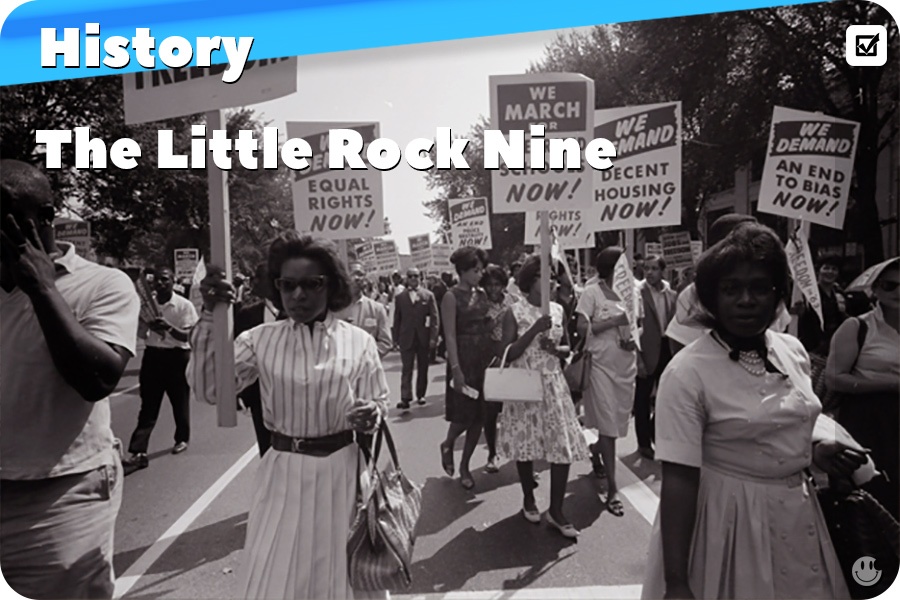
America’s history of racial discrimination has been quite ugly. However, when the year 1954 witnessed an end to segregation in schools, it brought about a wave of change the nation had long been desperate for.
Who knew that only three years later, nine teenagers would appear to be symbols of this change? The nine teenagers in question here were the first African Americans to get into Little Rock’s Central High School. However, the school’s decision to desegregate was not received well. As a result, only a day before what was supposed to be the teens’ first day at school, the governor of Arkansas gave ordered to block their entrance.
They were: Melba Pattillo, Ernest Green, Elizabeth Eckford, Minnijean Brown, Terrence Roberts, Carlotta Walls, Jefferson Thomas, Gloria Ray, and Thelma Mothershed.
Two days later, on September 4, another mob tried to stop the teens from getting inside the school. After almost two weeks, when a federal judge ordered to remove the National Guard, the Little Rock Nine again tried entering the school on September 23.
Finally, when the teens managed to enter inside, they were again threatened by an angry mob of people and fearing for the lives of these teenagers; the school authority decided to send them home. Fortunately, they were able to attend three hours’ worth of classes.
Finally, on September 25, 1957, Little Rock’s mayor pleaded to send the National Guard away, and the President agreed and decided to send army troops to the scene. After receiving security of this caliber, the Little Rock Nine were finally able to attend classes regularly. Unfortunately, their bad days weren’t entirely over yet.
Despite a smooth entrance, their day-to-day routine at school was filled with threats and harassment from the white students. Somehow, one of the nine, Ernest Green, managed to graduate from central high in 1958 and made the day historical for everyone in his community.
The courage they mustered every day and the harassment they faced every day was finally starting to pay off. Imagine being white and supporting a bunch of black students in that day and age. There’s a reason African Americans hold a special place in entire American history. There’s a reason these events existed. They weren’t merely supposed to be added into books or revisited every once in a while.
They are meant to take lessons from, and they are intended to be used to stir our souls and minds. Today, an average African American leads a much better life, but it doesn’t mean that their ordeals have been put to rest.
Discrimination still exists and demands our attention, if nothing else. Moreover, understanding African American history is the only way to understand American history as a whole.
The Smithsonian’s National Museum is a living artifact of African American history that holds a collection of several objects pertaining to the subject. It showcases the role African Americans have played in the emergence of contemporary America.
All in all, the Little Rock Nine were not only nine teenagers who attended a regular high school but were also a huge part of the African American history that the world looks up to.
Venues: RKO Pantages Theatre, Hollywood, California and NBC Century Theatre, New York City, New York
Hosts: Donald O’Connor (Los Angeles) and Fredric March (New York City)
Eligibility Year: 1953
Major Wins:
From Here to Eternity reigned supreme, taking home the Best Picture award.
William Holden secured the Best Actor trophy for his role in Stalag 17.
Audrey Hepburn was the night’s darling, winning Best Actress for Roman Holiday.
Directing & Screenplay:
Fred Zinnemann scored Best Director for From Here to Eternity.
Titanic won for its screenplay, though not the one you’re probably thinking of—this was the 1953 version.
Additional Info:
Frank Sinatra, the ultimate triple threat, won Best Supporting Actor for From Here to Eternity.
Donna Reed snagged Best Supporting Actress for the same film.
Trivia:
This Oscars ceremony was a night to remember for From Here to Eternity, which won eight Oscars.
Audrey Hepburn’s win for Roman Holiday was her first nomination and first win.
Walt Disney won four Academy Awards this year, including for Best Documentary Feature (The Living Desert) and another for Best Documentary Short Subject (The Alaskan Eskimo).
Best Motion Picture: From Here to Eternity – Buddy Adler for Columbia Pictures (WINNER) Julius Caesar – John Houseman for Metro-Goldwyn-Mayer The Robe – Frank Ross for 20th Century Fox Roman Holiday – William Wyler for Paramount Pictures Shane – George Stevens for Paramount Pictures
Best Director: Fred Zinnemann – From Here to Eternity (WINNER) Charles Walters – Lili William Wyler – Roman Holiday George Stevens – Shane Billy Wilder – Stalag 17
Best Actor: William Holden – Stalag 17 as J. J. Sefton (WINNER) Marlon Brando – Julius Caesar as Mark Antony Richard Burton – The Robe as Marcellus Gallio Montgomery Clift – From Here to Eternity as Private Robert E. Lee “Prew” Prewitt Burt Lancaster – From Here to Eternity as First Sergeant Milton Warden
Best Actress: Audrey Hepburn – Roman Holiday as Princess Ann (WINNER) Leslie Caron – Lili as Lili Daurier Ava Gardner – Mogambo as Eloise Kelly Deborah Kerr – From Here to Eternity as Karen Holmes Maggie McNamara – The Moon Is Blue as Patty O’Neill
Best Supporting Actor: Frank Sinatra – From Here to Eternity as Private Angelo Maggio (WINNER) Eddie Albert – Roman Holiday as Irving Radovich Brandon deWilde – Shane as Joey Starrett Jack Palance – Shane as Jack Wilson Robert Strauss – Stalag 17 as Stanislas “Animal” Kuzawa
Best Supporting Actress: Donna Reed – From Here to Eternity as Alma Burke/Lorene (WINNER) Grace Kelly – Mogambo as Linda Nordley Geraldine Page – Hondo as Angie Lowe Marjorie Rambeau – Torch Song as Mrs. Stewart Thelma Ritter – Pickup on South Street as Moe
Best Screenplay: From Here to Eternity – Daniel Taradash from From Here to Eternity by James Jones (WINNER) The Cruel Sea – Eric Ambler from The Cruel Sea by Nicholas Monsarrat Lili – Helen Deutsch from “Love of Seven Dolls” by Paul Gallico Roman Holiday – Ian McLellan Hunter and John Dighton from a story by Dalton Trumbo Shane – A. B. Guthrie Jr. from Shane by Jack Schaefer
Best Story and Screenplay: Titanic – Charles Brackett, Walter Reisch and Richard L. Breen (WINNER) The Band Wagon – Betty Comden and Adolph Green The Desert Rats – Richard Murphy The Naked Spur – Sam Rolfe and Harold Jack Bloom Take the High Ground! – Millard Kaufman
Best Story: Roman Holiday – Dalton Trumbo (WINNER) (awarded posthumously as Trumbo was on the Hollywood blacklist) Above and Beyond – Beirne Lay Jr. The Captain’s Paradise – Alec Coppel Hondo – Louis L’Amour (disqualified) Little Fugitive – Ray Ashley, Morris Engel, and Ruth Orkin
Best Short Subject – Cartoons: Toot, Whistle, Plunk and Boom – Walt Disney (WINNER) Christopher Crumpet From A to Z-Z-Z-Z Rugged Bear The Tell Tale Heart
Best Documentary Feature: The Living Desert – Walt Disney (WINNER) The Conquest of Everest A Queen Is Crowned
Best Documentary Short Subject: The Alaskan Eskimo – Walt Disney (WINNER) The Living City Operation Blue Jay They Planted a Stone The Word
Best Live Action Short Subject, One-Reel: Overture to The Merry Wives of Windsor – Johnny Green (WINNER) Christ Among the Primitives Herring Hunt Joy of Living Wee Water Wonders
Best Live Action Short Subject, Two-Reel: Bear Country – Walt Disney (WINNER) Ben and Me Return to Glennascaul Vesuvius Express Winter Paradise
Best Music Score of a Dramatic or Comedy Picture: Lili – Bronislaw Kaper (WINNER) Above and Beyond – Hugo Friedhofer From Here to Eternity – Morris Stoloff and George Duning Julius Caesar – Miklós Rózsa This Is Cinerama – Louis Forbes
Best Scoring of a Musical Picture: Call Me Madam – Alfred Newman (WINNER) The 5,000 Fingers of Dr. T. – Frederick Hollander and Morris Stoloff The Band Wagon – Adolph Deutsch Calamity Jane – Ray Heindorf Kiss Me Kate – André Previn and Saul Chaplin
Best Song: “Secret Love” from Calamity Jane – Music by Sammy Fain; Lyrics by Paul Francis Webster (WINNER) “The Moon Is Blue” from The Moon Is Blue – Music by Herschel Burke Gilbert; Lyrics by Sylvia Fine “My Flaming Heart” from Small Town Girl – Music by Nicholas Brodszky; Lyrics by Leo Robin “Sadie Thompson’s Song” from Miss Sadie Thompson – Music by Lester Lee; Lyrics by Ned Washington “That’s Amore” from The Caddy – Music by Harry Warren; Lyrics by Jack Brooks
Best Sound Recording: From Here to Eternity – John P. Livadary (WINNER) Calamity Jane – William A. Mueller Knights of the Round Table – A. W. Watkins The Mississippi Gambler – Leslie I. Carey The War of the Worlds – Loren L. Ryder
Best Art Direction, Black-and-White: Julius Caesar – Art Direction: Cedric Gibbons and Edward Carfagno; Set Decoration: Edwin B. Willis and Hugh Hunt (WINNER) Martin Luther – Art Direction and Set Decoration: Fritz Maurischat and Paul Markwitz The President’s Lady – Art Direction: Lyle R. Wheeler and Leland Fuller; Set Decoration: Paul S. Fox Roman Holiday – Art Direction and Set Decoration: Hal Pereira and Walter Tyler Titanic – Art Direction: Lyle R. Wheeler and Maurice Ransford; Set Decoration: Stuart A. Reiss
Best Art Direction, Color: The Robe – Art Direction: Lyle R. Wheeler and George Davis; Set Decoration: Walter M. Scott and Paul S. Fox (WINNER) Knights of the Round Table – Art Direction: Alfred Junge and Hans Peters; Set Decoration: John Jarvis Lili – Art Direction: Cedric Gibbons and Paul Groesse; Set Decoration: Edwin B. Willis and Arthur Krams The Story of Three Loves – Art Direction: Cedric Gibbons, E. Preston Ames, Edward Carfagno and Gabriel Scognamillo; Set Decoration: Edwin B. Willis, F. Keogh Gleason, Arthur Krams and Jack D. Moore Young Bess – Art Direction: Cedric Gibbons and Urie McCleary; Set Decoration: Edwin B. Willis and Jack D. Moore
Best Cinematography, Black-and-White: From Here to Eternity – Burnett Guffey (WINNER) The Four Poster – Hal Mohr Julius Caesar – Joseph Ruttenberg Martin Luther – Joseph C. Brun Roman Holiday – Franz Planer and Henri Alekan
Best Cinematography, Color: Shane – Loyal Griggs (WINNER) All the Brothers Were Valiant – George Folsey Beneath the 12-Mile Reef – Edward Cronjager Lili – Robert Planck The Robe – Leon Shamroy
Best Costume Design, Black-and-White: Roman Holiday – Edith Head (WINNER) The Actress – Walter Plunkett Dream Wife – Helen Rose and Herschel McCoy From Here to Eternity – Jean Louis The President’s Lady – Charles LeMaire and Renié
Best Costume Design, Color: The Robe – Charles LeMaire and Emile Santiago (WINNER) The Band Wagon – Mary Ann Nyberg Call Me Madam – Irene Sharaff How to Marry a Millionaire – Charles LeMaire and William Travilla Young Bess – Walter Plunkett
Best Film Editing: From Here to Eternity – William Lyon (WINNER) Crazylegs – Irvine (Cotton) Warburton The Moon Is Blue – Otto Ludwig Roman Holiday – Robert Swink The War of the Worlds – Everett Douglas
Academy Honorary Awards: Pete Smith – “For his witty and pungent observations on the American scene in his series of “Pete Smith Specialties”.”
Twentieth Century-Fox Film Corporation – “In recognition of their imagination, showmanship and foresight in introducing the revolutionary process known as CinemaScope.”
Joseph I. Breen – “For his conscientious, open-minded and dignified management of the Motion Picture Production Code.”
Bell and Howell Company – “For their pioneering and basic achievements in the advancement of the motion picture industry.”
December 27, 1952 – January 9, 1953: Jimmy Boyd – I Saw Mommy Kissing Santa Claus January 10, 1953 – February 13, 1953: Perry Como – Don’t Let the Stars Get in Your Eyes February 14, 1953 – March 20, 1953: Teresa Brewer – Till I Waltz Again With You March 21, 1953 – May 15, 1953: Patti Page – The Doggie In The Window May 16, 1953 – July 24, 1953: Percy Faith – The Song From Moulin Rouge (Where Is Your Heart) July 25, 1953 – August 7, 1953: Eddie Fisher – I’m Walking Behind You August 8, 1953 – October 9, 1953: Les Paul and Mary Ford – Vaya Con Dios (May God Be With You) October 10, 1953 – November 20, 1953: Stan Freberg – St. George And The Dragonet November 21, 1953 – January 1, 1954: Tony Bennett – Rags To Riches
(Data is compiled from various charts including Billboard’s “Pop,” “Airplay,” “R&B” and “Singles” Charts. “Hot 100” is the primary chart used starting October, 1958)
Color television technology had been developing for several years before the first commercially available color television set was introduced. RCA (Radio Corporation of America) was a major player in the development of television technology and played a significant role in creating and popularizing color television.
Details:
On December 30, 1953, RCA introduced the CT-100, the first commercially available color television set in the United States. The CT-100 was a 15-inch screen TV, priced at $1,000 (equivalent to about $10,000 today, adjusted for inflation). Initially, limited color broadcasts were available, with the first nationwide color broadcast occurring on January 1, 1954, during the Tournament of Roses Parade.
The CT-100 was nicknamed “The Merrill” after RCA executive George H. C. Merrill.
Only around 5,000 units of the CT-100 were produced, making it a rare collector’s item today.
Color television sets were initially very expensive, and it took several years to become more affordable for the average consumer. By the mid-1960s, color TVs became more widespread in American households.
Effects on Pop Culture: The introduction of color television profoundly impacted popular culture, changing how people consumed media and experienced entertainment. Some effects on pop culture include:
An increased emphasis on visual storytelling and color in television programming leads to more vibrant and engaging content.
The rise of iconic TV shows in the 1960s and 1970s, such as “Star Trek,” “The Brady Bunch,” and “Sesame Street,” utilized color television technology to create memorable and visually striking television experiences.
The popularization of color television commercials enabled advertisers to create more visually appealing and persuasive ads, further shaping consumer culture.
Prominent People and Countries Involved:
David Sarnoff: As the president of RCA, Sarnoff played a crucial role in developing and marketing the first color television sets. He was a visionary leader in the field of electronic communication and helped shape the modern television industry.
George H. C. Merrill: An RCA executive who was instrumental in developing and promoting the CT-100 color television set.
The United States: The U.S. played a significant role in developing and popularizing color television technology, with RCA leading the charge. The introduction of color TV in the United States paved the way for its adoption in other countries around the world.
In conclusion, the introduction of the first color television by RCA marked a turning point in the history of television and popular culture. The development and popularization of color TV transformed the way people experienced entertainment and advertising, making television a more immersive and visually engaging medium. The United States, particularly RCA, played a significant role in bringing color television technology to the masses, influencing television programming and consumer culture for decades.
World-Changing Event: The structure of DNA was discovered at the Cavendish Laboratory at the University of Cambridge.
The First Big Bubblegum Pop Song? (How Much is That) Doggie in the Window by Patti Page
The Movies to Watch include From Here to Eternity, Houdini, The Robe, Stalag 17, The Caddy, House of Wax, The Wild One, It Came from Outer Space, and War of the Worlds.
The Most Famous Person in America was probably Gary Cooper.
Notable books include Fahrenheit 451by Ray Bradbury, From Here to Eternity by James Jones, and Casino Royale by Ian Fleming.
Price of Packard Clipper automobile in 1953: $2,679.00
Arthur Miller’s play The Crucible premiered.
The Funny Comedy Team were: Dean Martin and Jerry Lewis The Funniest TV Duo: Sid Caesar and Imogene Coca The Funny Late Show Host: Steve Allen The Funny Guy was Milton Berle The Funny TV Lady: Lucille Ball
Atomic Espionage: Julius and Ethel Rosenberg were both found guilty of secret information about the atomic bomb to the Soviet Union and executed in 1953, becoming the first civilians to be executed for espionage in the United States.
MKUltra: The super-secret CIA program reputedly began in 1953 and ended in 1967.
Ray Bradbury wrote the first draft of Fahrenheit 451 on a coin-operated typewriter in the basement of the UCLA library. It charged 10¢ for 30 minutes, and he spent $9.80 on the machine.
Here are some significant events that took place in 1953
Queen Elizabeth II was coronated in Westminster Abbey on June 2, 1953.
The Korean War ended with the signing of the Korean Armistice Agreement on July 27, 1953.
Julius and Ethel Rosenberg were executed on June 19, 1953, after being found guilty of conspiracy to commit espionage for the Soviet Union.
The first issue of Playboy magazine was published in December 1953, featuring Marilyn Monroe as the cover model.
DNA structure was first described by James Watson and Francis Crick, who published their findings in the scientific journal Nature in April 1953. This discovery was later recognized as one of the most important scientific discoveries of the 20th century.
Top Ten Baby Names of 1953
Mary, Linda, Deborah, Patricia, Susan, Robert, James, Michael, John, David
Fashion Icons and Sex Symbols
Marilyn Monroe, Ava Gardner, Rita Hayworth, Audrey Hepburn, Doris Day, Lana Turner
Sex Symbols and Hollywood Hunks
Marlon Brando, Montgomery Clift
Oscars: 25th Academy Awards
The silver anniversary of the Oscars, also known as the 25th Academy Awards, was a spectacle held on March 19, 1953, at the RKO Pantages Theatre in Hollywood and the NBC International Theatre in New York City. This year was significant for being the first Oscars telecast, which was broadcast in black and white. Bob Hope served as host in Hollywood, while Conrad Nagel took on the role in New York. The Greatest Show on Earth secured Best Picture in a controversial win that still fuels debate among film aficionados. Gary Cooper took home Best Actor for his role in High Noon, and Shirley Booth was awarded Best Actress for her performance in Come Back, Little Sheba.
Emmy Awards: 5th Primetime Emmy Awards
For TV enthusiasts, the 5th Primetime Emmy Awards were celebrated on February 5, 1953, at the Statler Hotel in Los Angeles. Art Linkletter was the evening’s host. I Love Lucy still rode high, bagging the Best Situation Comedy award. A young and not-yet-famous James Dean was nominated for Best Actor, although the trophy ultimately went to Thomas Mitchell for The Doctor. The Best Actress accolade went to Helen Hayes for Schlitz Playhouse of Stars.
The Oscars had an eligibility period that ran from January 1, 1952, to December 31, 1952. The Emmy Awards, still in their infancy, were focused primarily on programming from the Los Angeles area.
“The Quotes:”
“The physician can bury his mistakes, but the architect can only advise his client to plant vines – so they should go as far as possible from home to build their first buildings.” – Frank Lloyd Wright
“You’ll wonder where the yellow went when you brush your teeth with Pepsodent.” Pepsodent toothpaste
“Shane. Shane. Come back!” – Brandon De Wilde, in Shane
“Sometimes you feel like a nut, sometimes you don’t.” – Peter Paul Mounds/Almond Joy
Time Magazine’s Man of the Year
Konrad Adenauer
Miss America
Neva Langley (Macon, GA)
Miss USA
Myrna Hansen (Illinois)
The Scandals
Piltdown Man, an archaeological find from 1912, was exposed as a forgery, consisting of the lower jawbone of an orangutan combined with the skull of a fully developed, modern man. The theory of Evolution took several steps back with this scandal.
Country Pop Star Death
Hank Williams (drugs and alcohol poisoning)
US Politics
January 20, 1953 (Tuesday): First inauguration of Dwight D. Eisenhower
1953 Pop Culture Facts & History
The first modern use of the word word ‘Frenemy” was first used in the 1953 article titled Howz about calling the Russians Your Frienemies? by gossip columnist Walter Winchell in the Nevada State Journal.
The Coppertone Girl was introduced to the American public. It is probably the most popular ‘butt crack’ of all time.
RCA invented the first musical synthesizer.
Officially, Ohio is listed as the 17th state in the US, but it is technically number 47. Congress forgot to vote on the formal resolution to admit Ohio to the Union but finally did on August 7, 1953.
Kenneth H. Rowe (born No Kum-Sok), a North Korean fighter pilot, defected to South Korea with his MiG-15 and was rewarded $100,000 from the United States.
Swanson had 260 tons of leftover turkey from Thanksgiving and didn’t know how to get rid of it. They asked their workers for ideas, and one man thought they should package it in individual trays with sides and freeze it. Thus, the TV Dinner was born.
Colgate-Palmolive-Peet became Colgate-Palmolive. We are not sure why, but we think that the Peet brothers suffered the same fate as Alvah Curtis Roebuck, of Sears and Roebuck fame.
Playwright and Nobel laureate Eugene O’Neill was born on October 16, 1888, in a hotel at Times Square; he also died on November 27, 1953, in another hotel in Boston. His last words were, “I knew it. I knew it. Born in a hotel room and died in a hotel room.”
The Cincinnati Reds baseball team was renamed the “Redlegs” this year through 1958 to avoid being associated with The Red Scare and communism.
Radios manufactured in the US between 1953 and 1963 had a white triangle on the dial at 640 AM to indicate where Civil Defense information would be broadcast.
Rolling Stone Keith Richards was a choirboy at the Queen’s 1953 Coronation.
Coca-Cola attempted to persuade the US Treasury to mint a 7.5-cent coin; a can of Coke had been a nickel since 1886 and needed to be raised due to inflation, but they felt a dime was too much.
Ore-Ida offered ‘Tater Tots’ in grocery stores. There were just pressed leftovers from their french fry line.
A Pennsylvania town named Mauch Chunk managed to get the remains of an early 20th-century athlete and bought the rights to his name. They renamed the town ‘Jim Thorpe,’ a tourist attraction in PA.
The first issue of Playboy, published in December 1953, featured Marilyn Monroe from her 1949 nude calendar shoot and sold over 50,000 copies.
Isaac Asimov wrote a short story, Sally, that claimed the first self-driving cars would be released around 2015.
In 1951, Ray Bradbury wrote a short story about a giant, fire-breathing lizard, which was made into the 1953 film The Beast from 20,000 Fathoms. This film inspired Ishirō Honda, a Japanese producer, to make Godzilla in 1954.
Biologists James D. Watson and Francis Crick published “Molecular Structure of Nucleic Acids: A Structure for Deoxyribose Nucleic Acid.” With little more than a drawing and some accompanying text, Watson and Crick discovered the structure of DNA.
Arthur Holly Compton (the Nobel Prize-winning chancellor of Washington University) was irritated by how fast people drove through the campus. To combat this, he designed the modern speed bump.
Doomsday Clock
Two minutes to midnight, according to the Bulletin of Atomic Scientists. 1953: After much debate, the United States decides to pursue the hydrogen bomb, a weapon far more powerful than any atomic bomb. In October 1952, the United States tests its first thermonuclear device, obliterating a Pacific Ocean islet in the process; nine months later, the Soviets test an H-bomb of their own. “The hands of the Clock of Doom have moved again,” the Bulletin announces. “Only a few more swings of the pendulum, and, from Moscow to Chicago, atomic explosions will strike midnight for Western civilization.”
1st Appearances & 1953’s Most Popular Christmas gifts, toys, and presents: Scrabble, Mrs. Potato Head, Wiffle Ball invented, Matchbox (U.K.)
Nobel Prize Winners
Physics – Frits (Frederik) Zernike Chemistry – Hermann Staudinger Medicine – Hans Adolf Krebs, Fritz Albert Lipmann Literature – Sir Winston Leonard Spencer Churchill Peace – George Catlett Marshall
Best Film Oscar Winner
1952’s The Greatest Show On Earth
The Biggest Films of 1953
1. Peter Pan (Disney)
2. The Robe (Pop Culture Classic)
3. From Here to Eternity (Pop Culture Classic)
4. How to Marry a Millionaire
5. Shane
6. Gentlemen Prefer Blondes
7. Hondo
8. House of Wax (Pop Culture Classic)
9. The War of the Worlds (Pop Culture Classic)
10. The Beast from 20,000. Fathoms
11. Niagara
12. Abbott and Costello Meet Dr. Jekyll and Mr. Hyde
*Movies beyond the Top Five are based on (a somewhat subjective) ranking based on how much they had a long-lasting effect on Pop Culture.
Broadway Show
The Teahouse of the August Moon (Play) Opened on October 15, 1953, and Closed on March 24, 1956
Popular and Best-selling Books From 1953
Battle Cry by Leon M. Uris Beyond This Place by A. J. Cronin Casino Royale by Ian Fleming The Chronicles of Narnia: The Silver Chair by C.S. Lewis The Crucible by Arthur Miller. Desirée by Annemarie Selinko Fahrenheit 451 by Ray Bradbury, From Here to Eternity by James Jones The High and the Mighty by Ernest K. Gann Lord Vanity by Samuel Shellabarger The Robe by Lloyd C. Douglas The Silver Chalice by Thomas B. Costain Time and Time Again by James Hilton The Unconquered by Ben Ames Williams
1953 Most Popular TV Shows
1. I Love Lucy (CBS) 2. Dragnet (NBC) 3. Arthur Godfrey’s Talent Scouts (CBS) 4. You Bet Your Life (NBC) 5. The Milton Berle Show (NBC) 6. Arthur Godfrey and his Friends (CBS) 7. Ford Theatre (NBC) 8. The Jackie Gleason Show (CBS) 9. Fireside Theatre (NBC) 10. The Colgate Comedy Hour (NBC)
1953 Billboard Number One Songs
December 27, 1952 – January 9, 1953: I Saw Mommy Kissing Santa Claus – Jimmy Boyd
January 10 – February 13: Don’t Let The Stars Get In Your Eyes – Perry Como
February 14 – March 20: Till I Waltz Again With You – Teresa Brewer
March 21 – May 15: The Doggie In The Window – Patti Page
May 16 – July 24: Song From Moulin Rouge – Percy Faith & his Orchestra
July 25 – August 7: I’m Walking Behind You – Eddie Fisher
August 8 – October 9: Vaya Con Dios – Les Paul & Mary Ford
October 10 – November 6: St. George And The Dragonet – Stan Freberg
November 21, 1953 – January 1, 1954: Rags To Riches – Tony Bennett
Sports
World Series Champions: New York Yankees NFL Champions: Detroit Lions NBA Champions: Minneapolis Lakers Stanley Cup Champs: Montreal Canadiens U.S. Open Golf Dick Mayer U.S. Tennis: (Men/Ladies) Tony Trabert/Maureen Connolly Wimbledon (Men/Women): Vic Seixas/Maureen Connolly NCAA Football Champions: Maryland NCAA Basketball Champions: Indiana Kentucky Derby: Dark Star
Playboy Magazine, founded by Hugh Hefner, was a groundbreaking men’s magazine that combined articles on various topics, including lifestyle, politics, and culture, with photographs of nude or semi-nude women. At its peak, the magazine influenced popular culture, and Hefner became a well-known figure in the entertainment industry.
Details:
Hugh Hefner published the first issue of Playboy Magazine in December 1953. The debut issue featured a nude photograph of Marilyn Monroe, which Hefner had purchased to use as the magazine’s first centerfold. The issue sold over 50,000 copies and established Playboy as a major player in the magazine industry.
Hefner initially planned to name the magazine “Stag Party,” but changed the name to “Playboy” after a trademark dispute with an existing magazine called “Stag.”
The iconic Playboy logo, featuring a rabbit wearing a tuxedo bow tie, was designed by Art Paul for the magazine’s second issue.
Hefner created the first issue of Playboy using a $1,000 loan from his mother and $8,000 from other investors.
Effects on Pop Culture: Playboy Magazine significantly impacted popular culture, particularly during the 1960s and 1970s. Some of its effects on pop culture include:
Challenging societal norms and taboos surrounding sexuality and nudity, making discussions about sex more mainstream.
Providing a platform for renowned writers, including Ray Bradbury, Margaret Atwood, and Norman Mailer, who contributed fiction and non-fiction pieces to the magazine.
The “Playboy lifestyle” concept emphasized sophistication, luxury, and sexual freedom and was embodied by the Playboy Mansion and Hefner’s own lifestyle.
Launching the careers of numerous “Playboy Playmates,” who became well-known models and actresses, such as Pamela Anderson and Jenny McCarthy.
Prominent People and Countries Involved:
Hugh Hefner: The founder and editor-in-chief of Playboy Magazine, who played a crucial role in shaping its content and image. Hefner became a symbol of sexual freedom and the Playboy lifestyle, hosting lavish parties at his Playboy Mansion.
Marilyn Monroe: The Hollywood icon was featured in the first issue of Playboy as the magazine’s inaugural centerfold, helping to establish the magazine’s reputation and boost sales.
The United States: Playboy Magazine was launched in the United States and quickly influenced American popular culture. The magazine’s impact extended to other countries as it gained international popularity.
In conclusion, the launch of Playboy Magazine by Hugh Hefner in December 1953 marked a turning point in popular culture, challenging societal norms surrounding sexuality and introducing the concept of the “Playboy lifestyle.” The magazine played a significant role in shaping popular culture in the United States and beyond, featuring prominent writers, celebrities, and models, and influencing discussions about sex and relationships for decades to come.
The Publication of Ray Bradbury’s “Fahrenheit 451”
“Fahrenheit 451” is a dystopian novel by American author Ray Bradbury, published on October 19, 1953. The story is set in a future society where the state banned and burned books to suppress dissenting ideas and critical thought. The novel explores themes of censorship, conformity, and the impact of mass media on society.
Details:
“Fahrenheit 451” follows the story of Guy Montag, a fireman who burns books. In this dystopian society, the government employs firemen to destroy books and the houses of those who possess them, as books are considered the source of unhappiness and dissent. Montag’s journey begins when he meets a free-spirited young woman named Clarisse, who opens his eyes to the importance of books and the value of individual thought. Montag eventually rebels against the system, joining a group of outcasts who seek to preserve knowledge and literature.
The title “Fahrenheit 451” refers to the temperature at which paper supposedly ignites (451 degrees Fahrenheit or 233 degrees Celsius), symbolizing the novel’s central theme of book burning.
The novel was initially published as a shorter novella, titled “The Fireman,” in Galaxy Science Fiction magazine in 1951 before being expanded into a full-length novel.
Ray Bradbury claimed to have written the first draft of “Fahrenheit 451” in just nine days, using a typewriter he rented at the UCLA library.
Effects on Pop Culture: “Fahrenheit 451” has significantly impacted popular culture, influencing various forms of media and becoming a staple in discussions about censorship and the importance of free thought. Some examples include:
The novel has been adapted into multiple forms, including a 1966 film directed by François Truffaut, a 1984 stage play by Ray Bradbury, and a 2018 HBO film directed by Ramin Bahrani.
“Fahrenheit 451” is often taught in schools and has become a classic of American literature, frequently appearing on lists of must-read books.
The novel has inspired several songs and musical works, such as “Fahrenheit 451” by Hawkwind and “The Sound of Silence” by Simon & Garfunkel.
The book-burning theme in “Fahrenheit 451” has been referenced and explored in various other works of fiction, such as the film “Equilibrium” (2002) and the novel “The Book Thief” (2005).
Prominent People and Countries Involved:
Ray Bradbury: An American author known for his contributions to science fiction, fantasy, and horror, Bradbury wrote “Fahrenheit 451” as a response to the political climate of the time, particularly the fear of censorship and the loss of individuality.
United States: As the country of both the author and the novel’s setting, the United States serves as a backdrop for the story’s exploration of themes like censorship, mass media influence, and the power of literature.
Overall, Ray Bradbury’s “Fahrenheit 451” is a significant work of literature that has impacted popular culture and discussions surrounding censorship and free thought. Since its publication in 1953, the novel has inspired various adaptations and has been widely recognized for its powerful commentary on the importance of preserving knowledge and the dangers of conformity.
Rapid Eye Movement (REM) sleep is a phase of the sleep cycle characterized by rapid eye movements, increased brain activity, and vivid dreams. The discovery of REM sleep in the early 1950s by researchers Eugene Aserinsky and Nathaniel Kleitman at the University of Chicago significantly advanced our understanding of sleep and its various stages. This discovery led to further research on the relationship between sleep, dreaming, and brain function.
Details:
Eugene Aserinsky, a graduate student under Nathaniel Kleitman’s supervision, conducted a series of experiments to study eye movements during sleep using electroencephalogram (EEG) and electrooculogram (EOG) recordings. He observed periods of rapid eye movement and increased brain activity that coincided with the occurrence of dreams. Aserinsky and Kleitman’s findings were published in the journal Science in 1953, introducing the concept of REM sleep to the scientific community.
REM sleep was discovered almost accidentally, as Aserinsky initially set out to study the relationship between eye movements and brain function, not sleep.
Nathaniel Kleitman, sometimes referred to as the “father of modern sleep research,” also played a significant role in establishing the 24-hour circadian rhythm of humans.
Aserinsky and Kleitman’s discovery of REM sleep paved the way for future sleep research, including identifying non-REM (NREM) sleep stages.
Effects on Pop Culture: While the discovery of REM sleep might not have directly impacted popular culture, it has certainly contributed to a greater understanding of sleep and dreaming, which are common themes in various forms of art and entertainment. Some examples include:
The scientific study of dreams has inspired movies, such as “Inception” (2010) and “Waking Life” (2001), which explore the complexities of the dreaming mind.
The concept of lucid dreaming, or the ability to control one’s dreams, has gained popularity recently, with numerous books, websites, and workshops devoted to the subject. Lucid dreaming often occurs during REM sleep.
The understanding of sleep stages, including REM sleep, has influenced discussions around sleep disorders and the importance of quality sleep for overall health and well-being.
Prominent People and Countries Involved:
Eugene Aserinsky: A graduate student at the University of Chicago, Aserinsky was the first to observe and record rapid eye movement during sleep, leading to the discovery of REM sleep.
Nathaniel Kleitman: A prominent sleep researcher and mentor to Aserinsky, Kleitman co-authored the groundbreaking study on REM sleep and played a pivotal role in advancing sleep research.
United States: The discovery of REM sleep took place at the University of Chicago, marking a significant contribution to the field of sleep research by American scientists.
In summary, the discovery of REM sleep in 1953 by Eugene Aserinsky and Nathaniel Kleitman at the University of Chicago marked a crucial advancement in our understanding of sleep and its various stages. Their research has had a lasting impact on sleep studies, inspiring further investigation into the relationships between sleep, dreaming, and brain function. While the influence on popular culture may be limited, the increased understanding of sleep and dreaming has informed various artistic and scientific discussions.
Nikita Khrushchev Becomes Leader of the Soviet Union
Nikita Khrushchev, a prominent Soviet politician, and statesman, emerged as the leader of the Soviet Union after the death of Joseph Stalin in 1953. Khrushchev’s leadership marked a period of de-Stalinization, which sought to reform some of the harsh policies implemented under Stalin’s rule and a new direction in foreign policy during the early years of the Cold War.
Details:
Nikita Khrushchev (April 15, 1894 – September 11, 1971) was appointed First Secretary of the Central Committee of the Communist Party of the Soviet Union on September 7, 1953, following a power struggle in the wake of Stalin’s death. On March 27, 1958, Khrushchev was elected Premier of the Soviet Union, consolidating his leadership. Khrushchev’s time in power was marked by several key events and policies.
The “Secret Speech” (1956): Khrushchev denounced Stalin’s policies and cult of personality in a speech to the 20th Congress of the Communist Party, initiating a period of de-Stalinization and political reform in the Soviet Union.
The Suez Crisis (1956): Khrushchev supported Egypt during the Suez Crisis, which strained relations between the Soviet Union and Western powers.
The Hungarian Revolution (1956): Khrushchev ordered Soviet troops to suppress the anti-communist revolution in Hungary, resulting in thousands of deaths and international condemnation.
The Cuban Missile Crisis (1962): The Soviet Union’s decision to place nuclear missiles in Cuba led to a tense 13-day standoff with the United States, which ultimately ended with the removal of the missiles and a temporary easing of Cold War tensions.
Khrushchev was known for his often colorful and blunt rhetoric, famously banging his shoe on a table during a United Nations General Assembly session in 1960.
As part of his agricultural policies, Khrushchev launched the “Virgin Lands Campaign,” which sought to cultivate vast areas of previously unused land in the Soviet Union, with mixed results.
Effects on Pop Culture: Khrushchev’s time as leader of the Soviet Union significantly impacted popular culture, both within the Soviet Union and internationally. Some examples include:
The film “Dr. Strangelove” (1964), directed by Stanley Kubrick, satirized Cold War tensions and the threat of nuclear war during the Khrushchev era.
Khrushchev’s famous “kitchen debate” with U.S. Vice President Richard Nixon in 1959 showcased the competition between the Soviet Union and the United States in various aspects of life, including technology and consumer goods.
Khrushchev’s policies, such as de-Stalinization and the Virgin Lands Campaign, influenced Soviet literature and cinema during his time in power, with works reflecting the changing political and social climate.
Prominent People and Countries Involved:
Nikita Khrushchev: The leader of the Soviet Union during a crucial period of the Cold War, Khrushchev implemented domestic and foreign policies that shaped the course of Soviet history.
The Soviet Union: Under Khrushchev’s leadership, the Soviet Union underwent significant political and social changes and tense confrontations with Western powers.
The United States: The U.S. was a key adversary of the Soviet Union during the Khrushchev era, with events like the Cuban Missile Crisis highlighting the escalating tensions between the two superpowers during the Cold War.
Nikita Khrushchev’s leadership of the Soviet Union marked a significant period in global history and popular culture. His policies, such as de-Stalinization, and key events during his tenure, like the Cuban Missile Crisis, had far-reaching effects on both the Soviet Union and the world. Khrushchev’s actions and rhetoric also left a lasting impact on popular culture, with films, literature, and other artistic expressions reflecting the political and social climate of the time.
“Roman Holiday” is a romantic comedy film directed by William Wyler, starring Audrey Hepburn and Gregory Peck. The film marked Audrey Hepburn’s first major role, launching her to stardom and establishing her as a Hollywood icon. Set in Rome, Italy, the film tells the story of a European princess who escapes her royal duties for a day of adventure with an American reporter. “Roman Holiday” is known for its charming performances, beautiful cinematography, and heartwarming story.
Details:
“Roman Holiday” was released in the United States on August 27, 1953. The screenplay was written by Dalton Trumbo, John Dighton, and Ian McLellan Hunter. However, due to Trumbo’s blacklisting during the Hollywood Red Scare, he did not receive credit for his work on the film until 1991. The film was shot on location in Rome, Italy, using the city’s picturesque settings as a backdrop for the story.
Audrey Hepburn was relatively unknown before being cast in “Roman Holiday.” She was initially offered a smaller role, but director William Wyler insisted on casting her as the lead after seeing her screen test.
Audrey Hepburn won the Academy Award for Best Actress for her role as Princess Ann in “Roman Holiday,” making it her first and only Oscar win.
The film’s famous scene, in which Hepburn’s character receives a haircut at a Roman barber shop, was actually inspired by Hepburn’s own experience of impulsively cutting her hair short.
“Roman Holiday” was the first American film to be entirely shot on location in Italy.
Effects on Pop Culture: “Roman Holiday” has had a lasting impact on popular culture in various ways, including:
Audrey Hepburn’s performance in the film solidified her status as a Hollywood icon and fashion inspiration, influencing generations of actresses and fans.
The film’s romantic portrayal of Rome contributed to the city’s enduring appeal as a popular tourist destination and a backdrop for countless films and television shows.
“Roman Holiday” has been referenced and parodied in numerous films and television episodes, including “The Simpsons,” “The Princess Diaries,” and “Gossip Girl.”
The film’s success helped pave the way for other romantic comedies set in picturesque European locations, such as “An Affair to Remember” (1957), “Three Coins in the Fountain” (1954), and “To Catch a Thief” (1955).
Prominent People and Countries Involved:
Audrey Hepburn: The film’s lead actress, Hepburn’s performance in “Roman Holiday” propelled her to stardom and made her a lasting symbol of grace, elegance, and charm.
Gregory Peck: As the male lead, Peck’s portrayal of the American reporter, Joe Bradley, was instrumental in the film’s success and further solidified his status as a Hollywood leading man.
William Wyler: The director of “Roman Holiday,” Wyler was known for his meticulous filmmaking style and insistence on shooting on location in Rome.
Italy: The film’s picturesque setting in Rome played a significant role in its enduring appeal, showcasing the city’s historic sites and charming streets to audiences worldwide.
“Roman Holiday” is a beloved romantic comedy that introduced the world to Audrey Hepburn’s captivating charm and talent. Released in 1953, the film has left a lasting impact on popular culture, influencing fashion, film, and tourism. Its timeless story, set against the enchanting backdrop of Rome, has captured the hearts of audiences for decades.
Iranian coup d’état Ousting Prime Minister Mohammad Mossadegh
The 1953 Iranian coup d’état, also known as Operation Ajax, was a covert operation orchestrated by the United States Central Intelligence Agency (CIA) and the United Kingdom’s Secret Intelligence Service (MI6) to overthrow Iran’s democratically-elected Prime Minister Mohammad Mossadegh. Mossadegh’s nationalization of the Iranian oil industry and his efforts to reduce foreign influence in Iran had led to tensions with Western powers, particularly the UK.
In April 1951, Mohammad Mossadegh became Prime Minister of Iran. He nationalized the Iranian oil industry, previously controlled by the British-owned Anglo-Iranian Oil Company (later British Petroleum, or BP). This move led to a boycott of Iranian oil by the UK and its allies, causing economic turmoil in Iran. In response to Mossadegh’s policies and the growing influence of communism in Iran, the United States and the United Kingdom orchestrated a coup to remove him from power.
On August 19, 1953, the coup led by CIA agent Kermit Roosevelt Jr. and MI6 operative Donald Wilber successfully ousted Mossadegh, and Iran’s monarch, Shah Mohammad Reza Pahlavi, was reinstated with increased authority. Mossadegh was arrested, tried, and placed under house arrest until his death in 1967.
Operation Ajax was the CIA’s first covert operation to overthrow a foreign government.
The CIA officially acknowledged its role in the coup in 2013, when it released previously classified documents related to Operation Ajax.
The Shah’s reign following the coup lasted until the Iranian Revolution in 1979, which led to the establishment of the Islamic Republic of Iran.
Effects on Pop Culture: The Iranian coup d’état and its aftermath have influenced popular culture, particularly in literature, film, and political discourse. Some examples include:
The novel and subsequent film “The Falcon and the Snowman” (1979) explore themes of espionage and government corruption, partly inspired by the events surrounding the Iranian coup.
The film “Argo” (2012), which won the Academy Award for Best Picture, is based on the 1979 Iranian hostage crisis and touches upon the historical context of the coup and its consequences.
The coup has been referenced and discussed in various political documentaries, such as “The End of Empire: Iran” (1985) and “The Oil Factor: Behind the War on Terror” (2005).
Prominent People and Countries Involved:
Mohammad Mossadegh: The democratically-elected Prime Minister of Iran, who was ousted in the coup due to his nationalization of the Iranian oil industry and his attempts to reduce foreign influence.
Shah Mohammad Reza Pahlavi: The Shah of Iran was reinstated with increased authority following the coup and ruled until the Iranian Revolution in 1979.
The United States: The U.S., through the CIA, played a significant role in orchestrating and executing the coup in response to concerns about Mossadegh’s policies and the growing influence of communism in Iran.
The United Kingdom: The UK, via MI6, was heavily involved in planning and carrying out the coup in response to the nationalization of the Iranian oil industry, which threatened British interests in the region.
In conclusion, the 1953 Iranian coup d’état was a pivotal event in the history of Iran and U.S.-Iran relations, as it led to the ousting of Prime Minister Mohammad Mossadegh and the reinstatement of Shah Mohammad Reza Pahlavi. The coup had significant long-term consequences, including the consolidation of power under the Shah, which ultimately contributed to the Iranian Revolution in 1979 and the establishment of the Islamic Republic of Iran. The event has also had a lasting impact on popular culture, influencing literature and film and shaping the discourse around the role of foreign intervention in the political affairs of other nations. The involvement of the United States and the United Kingdom in the coup continues to shape the political landscape and the perceptions of these countries in the Middle East.
The Korean War Armistice Agreement was signed on July 27, 1953, after three years of fighting between North Korea and South Korea. The war began on June 25, 1950, when North Korean forces invaded South Korea, and the conflict quickly drew in international support, with the United States and its allies backing South Korea and China supporting North Korea.
Representatives from the United Nations Command, North Korea, and China negotiated the armistice agreement. It was signed in Panmunjom, a village in the demilitarized zone (DMZ) between the two Koreas. The agreement called for a ceasefire and the creation of a demilitarized zone to buffer the two Koreas.
The armistice did not formally end the war, as no peace treaty was ever signed. Still, it effectively ended the fighting and ceased hostilities that have lasted until now. The agreement also established the Korean Demilitarized Zone (DMZ), a 4 km-wide buffer zone that spans the entire Korean Peninsula and is the most heavily fortified border in the world.
The effects of the Korean War Armistice Agreement on pop culture have been significant, with numerous books, movies, and TV shows depicting the conflict and its aftermath. Some prominent works include the book “The Korean War” by Max Hastings, the movie “MAS*H” (which was also adapted into a popular TV show), and the TV series “Mister Sunshine.”
Prominent people involved in the Korean War Armistice Agreement include the chief negotiators, Lieutenant General William K. Harrison Jr. of the United States and General Nam Il of North Korea, and the Chinese commander, General Peng Dehuai. Countries involved in the agreement include the United States, China, North Korea, South Korea, and the United Nations Command.
In conclusion, the Korean War Armistice Agreement was signed on July 27, 1953, after three years of fighting between North Korea and South Korea. It established a ceasefire and created a demilitarized zone, effectively ending the fighting, although no peace treaty was ever signed. The agreement has had significant effects on pop culture, with numerous books, movies, and TV shows depicting the conflict and its aftermath, and prominent people and countries involved in the negotiations include Lieutenant General William K. Harrison Jr., General Nam Il, General Peng Dehuai, the United States, China, North Korea, South Korea, and the United Nations Command.
That’s Amore
This song is widely associated with Dean Martin and is often considered his signature tune. Written in 1953 by Harry Warren and Jack Brooks, it debuted as part of the soundtrack for the Jerry Lewis and Dean Martin comedy film The Caddy. It was nominated for an Academy Award for Best Original Song in 1953 but lost to Doris Day’s Secret Love. The song experienced a resurgence in popularity when it was featured in the 1987 film Moonstruck, starring Cher and Nicolas Cage.
Eddie Fisher
Oh! My Pa-Pa
The original version of this song, O Mein Papa, was composed for the Swiss musical Der Schwarze Hecht in 1939, not a German musical. It gained popularity in the UK as an instrumental before being translated into English. Eddie Fisher’s emotional rendition became a hit, reaching No. 1 on the Billboard charts in 1954.
Frank Sinatra
I’ve Got the World on a String
This song, written by Harold Arlen and Ted Koehler in 1932, was introduced at The Cotton Club Parade. While initially performed by Bing Crosby and Cab Calloway, Frank Sinatra’s 1953 recording brought the song renewed attention, peaking at No. 14 on the Billboard charts. It has since become a Sinatra classic, showcasing his charismatic phrasing and vocal style.
Joni James
Your Cheatin’ Heart
Written and recorded by Hank Williams in 1952, this country classic was not released until after his death in January 1953. Joni James’s pop rendition introduced the song to a broader audience, cementing its place as one of the greatest country songs of all time.
Kay Starr
Side by Side
Originally written by Harry M. Woods and Gus Kahn in 1927, this song became a standard of American music. Kay Starr’s 1953 recording helped propel the song into the mainstream, solidifying its enduring legacy.
Patti Page
(How Much Is) That Doggie in the Window?
Composed by Bob Merrill and Ingrid Reuterskiöld in 1952, this whimsical tune became a chart-topping hit in 1953 with Patti Page’s playful rendition. The song reached No. 1 on the Billboard charts and is noted as the first No. 1 hit with a question in the title.
Tony Bennett
Stranger in Paradise
This song, part of the 1953 Broadway musical Kismet, was written by Robert Wright and George Forrest, with its melody based on Alexander Borodin’s Gliding Dance of the Maidens from the Polovtsian Dances. While Vic Damone and Ann Blyth performed the song in the 1955 film adaptation of Kismet, Tony Bennett’s version became a definitive hit, popularizing the song outside the context of the musical.
Rags to Riches
Written by Richard Adler and Jerry Ross, Rags to Riches reached No. 1 on the Billboard charts in 1953. The song later gained comedic fame as Carmine Ragusa’s serenade in Laverne & Shirley. Elvis Presley performed the song impromptu during his 1976 Pittsburgh concert, showing its enduring appeal.
Frankie Laine
I Believe
This inspirational song, written by Ervin Drake, Irvin Graham, Jimmy Shirl, and Al Stillman in 1953, was commissioned by Jane Froman for her television show to inspire hope during challenging times. Frankie Laine’s recording became a massive hit and holds the UK record for the longest stay at No. 1—18 weeks. The song has since been covered by numerous artists, including The Lettermen, and is often regarded as a hymn for its uplifting message.
Top Artists and Songs of 1953
Ames Brothers
You You You, The Man With The Banjo
Art Lund
Crying In The Chapel
Bill Haley and his Comets
Crazy Man Crazy
Darrell Glenn
Crying In The Chapel
Dean Martin
That’s Amore
Don Cornell
Heart of My Heart
Doris Day
Mister Tap Toe
Drifters
Money Honey
Eddie Calvert
Oh Mein Papa
Eddie Fisher
Downhearted
Ella Fitzgerald
Crying In The Chapel
Fats Domino
Roe Mary
Faye Adams
Shake a Hand
Four Aces
The gang that Sang ‘Heart of My Heart’
Frank Chacksfield Orchestra
Limelight
Frank Sinatra
I’ve Got The World On a String, South of the Border, From Here To Eternity
Frankie Laine
I Believe, Where The Winds Blow, Answer Me Lord Above, Blowing Wind
Guy Mitchell
She Wears Red Feathers
Hank Williams
Your Cheatin’ Heart, Kaw-Liga
Jimmy Boyd and Frankie Laine
Tell Me A Story
Johnny Ace
The Clock
Johnny Ray
Somebody Stole My gal
Joni James
Your Cheatin’ Heart, Have You Heard?
June Valli
Crying In The Chapel
Kay Starr
Side By Side, Changing Partners
Lawrence Welk
Oh Happy Day
Les Baxter
Ruby, Gigi/I Love Paris, April in Portugal
Les Paul and Mary Ford
Bye Bye Blues, Vaya Con Dios, Johnny (Is The Boy For Me)
Mantovani
Where Is Your Heart (From Moulin Rouge), Swedish Rhapsody
Nat ‘King’ Cole
Pretend, Blue Gardenia, can’t I
Patti Page
Changing Partners, Doggie In The Window
Percy Faith
Song From Moulin Rouge (Where Is Your Heart)
Perry Como
Don’t Let The Stars Get In Your Eyes, You Alone, No Other Love, Say Your Mine Again
Ray Anthony & His Orchestra
Dragnet
Red Buttons
The Ho Ho Song
Rex Allen
Crying In The Chapel
Richard Hayman
Ruby
Ruth Brown
(Mama) He Treats Your Daughter Mean
Stan Freberg
St. George and the Dragonette
Teresa Brewer Richochet (Rick-O-Shay), Till I Waltz Again With You
The Slinky is a classic and iconic toy that has entertained children and adults for generations. A helical spring can perform a series of movements, such as “walking” down a flight of stairs or stretching and recoiling. The Slinky was invented in 1943 by Richard James, a naval engineer, and was introduced to the market in 1945.
Details: In 1943, Richard James was working at the Cramp Shipbuilding Company in Philadelphia when he accidentally knocked a tension spring off his desk. He observed the spring’s unique movement as it “walked” across the floor, which sparked the idea for the Slinky. Richard James and his wife, Betty James, experimented with different materials and sizes to perfect Slinky’s design. They eventually settled on a steel spring with 80 coils, creating the iconic Slinky that is still popular today.
After securing a $500 loan, Richard and Betty formed James Industries and began manufacturing the Slinky (US Patent #US691981A). The toy debuted at the Gimbels Department Store in Philadelphia in November 1945. All 400 Slinky toys available at the store sold out within 90 minutes, making it an instant success.
Effects on Pop Culture:
The Slinky has become a symbol of childhood nostalgia and has been featured in numerous movies, TV shows, and commercials, showcasing its enduring appeal.
The Slinky has inspired various spin-off toys and products, such as the Slinky Dog and Slinky Jr.
The Slinky has been mentioned in songs and parodies, further cementing its place in popular culture.
The Slinky was inducted into the National Toy Hall of Fame in 2000, recognizing its impact on the world of toys and play.
Prominent People and Countries Involved:
United States: The Slinky was invented and first produced in the United States, and it remains a popular toy in the country and around the world.
Richard James: The American naval engineer who invented the Slinky in 1943 and co-founded James Industries with his wife, Betty.
Betty James: The wife of Richard James, who played a crucial role in perfecting the Slinky’s design and marketing the toy. After Richard left the company in the 1960s, Betty took over and continued the success of the Slinky brand.
The Slinky was invented in 1943 by American naval engineer Richard James, who co-founded James Industries with his wife, Betty. The iconic toy debuted in 1945 and quickly became a symbol of childhood nostalgia, featured in various forms of media and inspiring spin-off products. The Slinky was inducted into the National Toy Hall of Fame in 2000, recognizing its impact on the world of toys and play.
Julius and Ethel Rosenberg were American citizens convicted of conspiracy to commit espionage for the Soviet Union, specifically relating to passing information about the atomic bomb. Their trial and execution took place during the early years of the Cold War when anti-communist sentiment was high in the United States.
Julius and Ethel Rosenberg were arrested in 1950, and their trial began on March 6, 1951. The prosecution’s case relied heavily on the testimony of Ethel’s brother, David Greenglass, who had worked as a machinist at the Los Alamos National Laboratory during the development of the atomic bomb. Greenglass testified that Julius had recruited him to pass information to the Soviet Union and that Ethel had typed up the notes. On March 29, 1951, the Rosenbergs were convicted of conspiracy to commit espionage, and on April 5, they were sentenced to death.
The Rosenbergs were the first American civilians executed for espionage during peacetime.
Their two sons, Michael and Robert Meeropol were orphaned after their parents’ execution and were later adopted by Abel and Anne Meeropol.
Abel Meeropol, their adoptive father, composed the anti-lynching song “Strange Fruit,” famously performed by Billie Holiday.
Effects on Pop Culture: The trial and execution of the Rosenbergs became a symbol of anti-communist fervor in the United States during the 1950s. Their case has been depicted in various books, plays, and films, including:
E.L. Doctorow’s novel “The Book of Daniel” (1971), is a fictional account of the lives of Rosenberg’s sons.
The play “Angels in America” (1991) by Tony Kushner references the Rosenberg case and features Ethel’s ghost as a character.
The film “Daniel” (1983) was directed by Sidney Lumet and based on Doctorow’s novel.
Prominent People and Countries Involved:
David Greenglass: Ethel’s brother, whose testimony was crucial in the conviction of the Rosenbergs. He later admitted to lying about some aspects of his testimony, particularly regarding Ethel’s involvement, to protect his wife, Ruth Greenglass.
Roy Cohn: A young prosecutor on the Rosenberg case who later became a prominent lawyer and political figure, eventually serving as an advisor to Senator Joseph McCarthy during the “Red Scare” period.
The United States: The Rosenberg trial and execution took place during the early years of the Cold War, and their case symbolized anti-communist sentiment in the country.
The Soviet Union: While the Rosenbergs were accused of passing information to the Soviet Union, the extent of the information they provided and its impact on the development of the Soviet atomic bomb program remains a subject of debate among historians.
The execution of Julius and Ethel Rosenberg marked a significant moment in Cold War history. It served as a symbol of the anti-communist sentiment that gripped the United States during the 1950s. The trial and its aftermath have had a lasting impact on popular culture, with various works of fiction and non-fiction exploring the consequences of the case and the broader context of the Cold War.
I was only three years old when my mother and father separated and divorced, so I never knew very much about my dad except that he was a strong person with a short temper. He came to visit us a few times as I was growing up until the last time I saw him he was in the VA hospital. I knew he had been a sergeant in the army and had fought in World War Two. Given the state of photography back in the 50s, we didn’t take many pictures, so I don’t have a photograph of him.
As I grew older and realized that life wasn’t easy for Black men in the fifties, especially those who had been in combat. They may have been gallant warriors over in Europe, but back home, they were just ordinary Negroes.
Over the years, my mom never said a bad word about him., he was just gone from our lives. My mom never remarried.
One day, browsing the internet, I goggled his name only to find his obituary. Having been in combat, and much older, I realized that there was a lot that I didn’t know about him, but wanted to know. I knew that he wasn’t a bad person, but had been changed by what he had experienced. Combat changes people. He was one of those forgotten Black soldiers that landed on Normandy on D-Day and served all the way from France and into Germany.
So, one day, I gathered all the information I could find and contacted the Army.
A few weeks later, I received a package with all the medals he had earned. during the war. Needless to say, even though I never really knew him, I am extremely proud to be his son. He was a true American hero.
The Coronation of Queen Elizabeth II was a ceremony held on June 2, 1953, at Westminster Abbey in London, England. Elizabeth ascended to the throne following the death of her father, King George VI, on February 6, 1952. The ceremony was attended by thousands of guests, including heads of state, diplomats, and other dignitaries from around the world.
The coronation ceremony itself was a lavish affair, with Elizabeth wearing a stunning white gown designed by Norman Hartnell and a diamond-studded crown known as the St. Edward’s Crown. The ceremony also included the anointing of the queen with holy oil and the presentation of various symbols of royalty, including the Sceptre, the Orb, and the Royal Ring of Saphire.
Trivial facts surrounding the Coronation of Queen Elizabeth II include that the ceremony was the first to be televised, with an estimated 27 million viewers tuning in to watch the event. The ceremony was also the first to be held in Westminster Abbey since the coronation of King George VI in 1937.
The effects of the Coronation of Queen Elizabeth II on pop culture have been significant, with the event sparking a renewed interest in the monarchy and increasing the popularity of the Queen. The ceremony also served as a symbol of Britain’s post-war recovery and helped to boost national morale.
Prominent people involved in the Coronation of Queen Elizabeth II include the Archbishop of Canterbury, who conducted the ceremony, and the Duke of Edinburgh, who accompanied the Queen during the procession to and from Westminster Abbey. Countries involved in the ceremony include the United Kingdom and various Commonwealth nations, with representatives from across the globe attending the event.
In conclusion, the Coronation of Queen Elizabeth II was a lavish ceremony held on June 2, 1953, at Westminster Abbey in London, England. Elizabeth ascended to the throne following the death of her father, King George VI, on February 6, 1952. The ceremony was the first to be televised and included the anointing of the queen with holy oil and the presentation of various symbols of royalty. Trivial facts surrounding the event include that it was the first coronation ceremony to be held in Westminster Abbey since 1937, and the effects of the ceremony on pop culture have been significant. Prominent people involved in the Coronation of Queen Elizabeth II include the Archbishop of Canterbury and the Duke of Edinburgh, and countries involved include the United Kingdom and various Commonwealth nations.
First Ascent of Mount Everest by Sir Edmund Hillary and Tenzing Norgay
The first ascent of Mount Everest was made on May 29, 1953, by Sir Edmund Hillary of New Zealand and Tenzing Norgay, a Sherpa of Nepal. Mount Everest is the highest mountain in the world, with an elevation of 29,029 feet (8,848 meters).
Hillary and Norgay began their ascent from the South Col, a base camp on the mountain’s southern side. They climbed for several days, battling harsh weather conditions and dangerous terrain, before finally reaching the summit.
Details surrounding the first ascent of Mount Everest include that Hillary and Norgay carried several scientific instruments to the summit, including a camera and a barometer. They also left behind a small cross on the summit, which has since become a famous landmark for climbers.
The effects of the first ascent of Mount Everest on pop culture have been significant, with Hillary and Norgay becoming famous overnight and inspiring generations of climbers and adventurers. The ascent was also seen as a symbol of national pride for both New Zealand and Nepal.
Prominent people involved in the first ascent of Mount Everest include Sir Edmund Hillary and Tenzing Norgay, as well as several other climbers who attempted to reach the summit before them. Countries involved in the first ascent include New Zealand, Nepal, and the United Kingdom.
In conclusion, the first ascent of Mount Everest was made on May 29, 1953, by Sir Edmund Hillary of New Zealand and Tenzing Norgay, a Sherpa of Nepal. The ascent was a significant achievement in mountaineering and inspired generations of climbers and adventurers. Trivial facts surrounding the ascent include the scientific instruments carried by Hillary and Norgay and the small cross left behind on the summit. The ascent significantly impacted pop culture, and prominent people involved included Hillary and Norgay. Countries involved include New Zealand, Nepal, and the United Kingdom.
First Successful Open-heart Surgery by Dr. John Gibbon
Open-heart surgery, a medical procedure that involves operating directly on the heart while it is exposed, was a groundbreaking development in cardiothoracic surgery. Dr. John H. Gibbon, an American surgeon, successfully performed the first open-heart surgery using a heart-lung machine on May 6, 1953. This milestone marked a significant advancement in cardiac care, paving the way for more complex heart procedures and saving countless lives.
Details:
Dr. John H. Gibbon was inspired to develop a heart-lung machine after witnessing a patient’s death due to a blood clot in the heart. He believed that a device capable of temporarily taking over the functions of the heart and lungs during surgery would allow surgeons to operate on the heart without risking the patient’s life. After years of research and experimentation, Dr. Gibbon developed a prototype of the heart-lung machine, known as the Gibbon-Mayo pump.
On May 6, 1953, Dr. Gibbon performed the first successful open-heart surgery using his heart-lung machine at Thomas Jefferson University Hospital in Philadelphia. The patient was an 18-year-old woman named Cecelia Bavolek, who suffered from an atrial septal defect (a hole in the wall separating the heart’s upper chambers). The surgery was successful, and Bavolek’s heart was repaired without complications.
Dr. Gibbon’s research on the heart-lung machine began in the 1930s and took almost two decades to come to fruition.
Dr. Gibbon’s wife, Mary, a fellow physician, played a crucial role in developing the heart-lung machine by assisting him in his research and providing valuable support.
Although Dr. Gibbon’s machine was groundbreaking, it was large, cumbersome, and expensive. Later versions of the heart-lung machine would become more efficient, compact, and cost-effective.
Effects on Pop Culture: While the first successful open-heart surgery using a heart-lung machine may not have directly impacted popular culture, it has undoubtedly influenced the way medical procedures and advancements are portrayed in various forms of media. Some examples include:
The success of open-heart surgery and other medical breakthroughs has contributed to the popularity of medical dramas on television, such as “Grey’s Anatomy,” “ER,” and “House.”
Stories of miraculous recoveries and life-saving surgeries, often inspired by real-life events like Dr. Gibbon’s pioneering work, are frequently featured in films, books, and other forms of storytelling.
The depiction of groundbreaking medical procedures in media can influence public perception and understanding of healthcare and the importance of medical research.
Prominent People and Countries Involved:
Dr. John H. Gibbon: An American surgeon who developed the heart-lung machine and performed the first successful open-heart surgery using the device.
Cecelia Bavolek: The patient who underwent the first successful open-heart surgery using the heart-lung machine, paving the way for countless other patients to receive life-saving treatment.
United States: As the country where Dr. Gibbon developed the heart-lung machine and performed the first successful open-heart surgery, the United States played a significant role in this medical milestone.
In summary, the first successful open-heart surgery using a heart-lung machine, performed by Dr. John Gibbon in 1953, marked a significant advancement in cardiothoracic surgery. This groundbreaking procedure demonstrated the potential for life-saving heart surgeries and contributed to developing more advanced cardiac care techniques. Although its direct impact on popular culture may be limited, the story of this medical breakthrough has undoubtedly inspired countless films, books, and television shows that celebrate the power of medical innovation and its impact on people’s lives. Dr. Gibbon’s pioneering work, along with the support of his wife, Mary, and the bravery of patient Cecelia Bavolek, has left a lasting legacy in cardiac surgery, ultimately saving and improving the lives of countless individuals worldwide.
First James Bond Novel, “Casino Royale” by Ian Fleming
“Casino Royale” is the first novel in the James Bond series by British author Ian Fleming. The book introduced the world to the iconic character of James Bond, a British Secret Service agent known for his suave demeanor, daring adventures, and affinity for gadgets, cars, and romance. The James Bond series would become a cultural phenomenon, spanning numerous novels, films, and adaptations, with a lasting impact on popular culture.
Details:
Ian Fleming, a former naval intelligence officer, drew on his own experiences and interests to create the character of James Bond. “Casino Royale” was published on April 13, 1953, by Jonathan Cape in the United Kingdom. The story follows Bond as he is sent to the fictional French coastal resort of Royale-les-Eaux to bankrupt a high-stakes card player and Soviet agent, Le Chiffre, in a baccarat game. The novel features the first appearance of iconic characters like M, the head of the British Secret Service, and Miss Moneypenny, M’s secretary.
Ian Fleming wrote “Casino Royale” while on vacation at his Goldeneye estate in Jamaica.
The character of James Bond was named after an American ornithologist, also named James Bond, whose book on Caribbean birds Fleming owned.
Casino Royale’s main antagonist, Le Chiffre, means “The Number” or “The Cipher” in French, reflecting his role as a Soviet agent.
The novel was initially met with mixed reviews but sold well, prompting Fleming to write a new Bond novel every year until his death in 1964.
Effects on Pop Culture: The James Bond series has had a significant impact on popular culture in various ways, including:
The success of “Casino Royale” and subsequent novels led to the creation of a long-running and successful film franchise, beginning with “Dr. No” in 1962, making Bond one of the most recognizable characters in the world.
The James Bond films have popularized many catchphrases, such as “Bond, James Bond,” “shaken, not stirred,” and “license to kill.”
The Bond series has influenced the action-adventure and spy genres in literature, film, and television, inspiring numerous imitations and parodies.
James Bond’s affinity for luxury cars, gadgets, and clothing has impacted fashion trends and marketing strategies, with many products associated with the Bond brand.
Prominent People and Countries Involved:
Ian Fleming: The British author who created the character of James Bond and wrote the first novel, “Casino Royale.”
United Kingdom: The birthplace of both Ian Fleming and the James Bond character, the UK has played a significant role in developing and popularizing the series.
Sean Connery: The first actor to portray James Bond on the big screen, Connery’s portrayal in the film “Dr. No” (1962) set the standard for the character and cemented Bond’s place in popular culture.
In summary, the publication of “Casino Royale” by Ian Fleming in 1953 marked the beginning of the immensely popular James Bond series. The novel introduced the world to the suave and sophisticated British Secret Service agent, whose adventures would capture the imagination of millions of readers and viewers around the globe. The impact of the James Bond series on popular culture is immense, influencing literature, film, fashion, and more.
Project MKUltra was a top-secret CIA program to research and develop mind control and chemical interrogation techniques. The program was officially sanctioned in 1953 and was halted in 1973 after being exposed to the public. MKUltra involved numerous unethical and illegal experiments on unwitting and consenting subjects, including administering various drugs, hypnosis, sensory deprivation, and psychological and physical abuse.
Then-CIA Director Allen Dulles officially sanctioned Project MKUltra on April 13, 1953. The project was largely inspired by fears of Soviet, Chinese, and North Korean mind control techniques, which led to a desire for the U.S. to develop similar capabilities. MKUltra was divided into 149 subprojects, which took place at various institutions, including universities, hospitals, prisons, and pharmaceutical companies.
One of the most notorious experiments within MKUltra involved the administration of LSD to unwitting subjects, including CIA employees, military personnel, and the general public. These experiments aimed to test the drug’s potential use in interrogations and mind control.
In 1953, biochemist Dr. Frank Olson, a CIA employee, was unwittingly dosed with LSD as part of an MKUltra experiment. Nine days later, Olson died after falling from a hotel window. Although officially ruled a suicide, there have been allegations of foul play, and his family received a settlement from the U.S. government in 1975.
MKUltra was first exposed to the public in 1974 by investigative journalist Seymour Hersh. In 1975, the U.S. Congress and the Rockefeller Commission investigated the project, revealing further details about its scope and activities.
Effects on Pop Culture: Project MKUltra has captured the public’s imagination and featured in numerous books, films, and TV series. Examples include:
The 1990 film “Jacob’s Ladder,” directed by Adrian Lyne, explores the consequences of secret government experiments on soldiers during the Vietnam War.
The novel “The Men Who Stare at Goats” (2004) by Jon Ronson and its 2009 film adaptation draw on the MKUltra program and other mind control experiments conducted by the U.S. government.
The TV series “Stranger Things” (2016-present), features Eleven, who has psychic powers due to her mother’s unwitting participation in an MKUltra experiment.
Prominent People and Countries Involved:
Allen Dulles: CIA Director who officially sanctioned Project MKUltra in 1953.
Dr. Sidney Gottlieb: A CIA chemist who played a key role in the development and execution of MKUltra, particularly the experiments involving LSD.
Dr. Ewen Cameron: A Canadian psychiatrist who conducted controversial experiments on patients at the Allan Memorial Institute in Montreal as part of MKUltra’s subprojects. These experiments involved electroconvulsive therapy, drug-induced sleep, and sensory deprivation.
The United States: The U.S. government, specifically the CIA, was responsible for initiating and conducting Project MKUltra, which has left a dark legacy in the nation’s history.
Project MKUltra was a CIA mind control program involving various unethical and illegal experiments on unwitting and consenting subjects. The program has had a lasting impact on popular culture, with numerous works of fiction and non-fiction exploring the consequences of the project and the broader context of government secrecy and manipulation.
Creation of the US Department of Health, Education, and Welfare
The United States Department of Health, Education, and Welfare (HEW) was a cabinet-level department of the federal government responsible for overseeing the administration and implementation of various health, education, and social welfare programs. Established on April 11, 1953, under President Dwight D. Eisenhower, the HEW aimed to consolidate various agencies dealing with these sectors, streamlining the government’s efforts to address public health, education, and social needs.
Details:
The Department of Health, Education, and Welfare was created by the Reorganization Plan No. 1 of 1953, signed by President Eisenhower. The plan combined the existing Federal Security Agency with several other health, education, and social services agencies. The department’s mission was to improve the American people’s lives by fostering better health, educational opportunities, and social conditions.
The Department of Health, Education, and Welfare was renamed the Department of Health and Human Services (HHS) in 1979 after the Department of Education was separated from it, becoming a standalone cabinet-level agency.
The Social Security Administration, initially part of the HEW, became an independent agency in 1995.
The HEW was the first federal department to have an African-American woman, Patricia Roberts Harris, as its secretary. She was appointed by President Jimmy Carter in 1977.
Effects on Pop Culture: While the Department of Health, Education, and Welfare may not have had a direct impact on popular culture, it played a significant role in shaping public policy and influencing the lives of millions of Americans through its various programs and initiatives. Some of its indirect contributions to popular culture include:
Promoting public health campaigns that have become ingrained in American culture, such as anti-smoking and anti-drug initiatives and efforts to improve nutrition and exercise habits.
Supporting arts and culture through grants and other forms of financial assistance, thereby helping to foster the growth of various cultural movements and institutions.
Implementing policies and regulations that have influenced how health, education, and social issues are portrayed and discussed in media, such as film, television, and literature.
Prominent People and Countries Involved:
President Dwight D. Eisenhower: As the president who established the Department of Health, Education, and Welfare, Eisenhower played a pivotal role in its creation and development.
Oveta Culp Hobby: Appointed as the first Secretary of Health, Education, and Welfare by President Eisenhower, Hobby was the first woman to hold a cabinet position under a Republican president and oversaw the department’s early years.
United States: As the country where the HEW was established and operated, the United States was the primary beneficiary of the department’s efforts to improve public health, education, and social welfare.
The creation of the US Department of Health, Education, and Welfare in 1953 marked a significant step in consolidating the federal government’s efforts to address public health, education, and social welfare issues. Over the years, the department has played a crucial role in shaping public policy and has indirectly influenced popular culture through its various programs and initiatives.
The Greatest Show on Earth is considered one of the weakest Best Picture winners, according to critics.
High Noon won four Academy Awards but missed out on Best Picture and Best Director.
1953 Oscar Nominees and Winners
Best Motion Picture: The Greatest Show on Earth – Cecil B. DeMille for Paramount Pictures (WINNER) High Noon – Stanley Kramer for United Artists Ivanhoe – Pandro S. Berman for Metro-Goldwyn-Mayer Moulin Rouge – John Huston for United Artists The Quiet Man – John Ford and Merian C. Cooper for Republic Pictures
Best Director: John Ford – The Quiet Man (WINNER) Joseph L. Mankiewicz – Five Fingers Cecil B. DeMille – The Greatest Show on Earth Fred Zinnemann – High Noon John Huston – Moulin Rouge
Best Actor: Gary Cooper – High Noon as Marshall Will Kane (WINNER) Marlon Brando – Viva Zapata! as Emiliano Zapata Kirk Douglas – The Bad and the Beautiful as Jonathan Shields José Ferrer – Moulin Rouge as Henri de Toulouse-Lautrec/Comte Alphonse de Toulouse-Lautrec Alec Guinness – The Lavender Hill Mob as Henry “Dutch” Holland
Best Actress: Shirley Booth – Come Back, Little Sheba as Lola Delaney (WINNER) Joan Crawford – Sudden Fear as Myra Hudson Bette Davis – The Star as Margaret “Maggie” Elliot Julie Harris – The Member of the Wedding as Frankie Addams Susan Hayward – With a Song in My Heart as Jane Froman
Best Supporting Actor: Anthony Quinn – Viva Zapata! as Eufemio Zapata (WINNER) Richard Burton – My Cousin Rachel as Philip Ashley Arthur Hunnicutt – The Big Sky as Zeb Calloway Victor McLaglen – The Quiet Man as Squire “Red” Will Danaher Jack Palance – Sudden Fear as Lester Blaine
Best Supporting Actress: Gloria Grahame – The Bad and the Beautiful as Rosemary Bartlow (WINNER) Jean Hagen – Singin’ in the Rain as Lina Lamont Colette Marchand – Moulin Rouge as Marie Charlet Terry Moore – Come Back, Little Sheba as Marie Burkholder Thelma Ritter – With a Song in My Heart as Clancy
Best Story and Screenplay: The Bad and the Beautiful – Charles Schnee from “Tribute to a Badman” by George Bradshaw (WINNER) Five Fingers – Michael Wilson from Operation Cicero by Ludwig Carl Moyzisch High Noon – Carl Foreman from “The Tin Star” by John W. Cunningham The Man in the White Suit – Roger MacDougall, John Dighton and Alexander Mackendrick from The Man in the White Suit by Roger MacDougall The Quiet Man – Frank S. Nugent from “Green Rushes” by Maurice Walsh
Best Screenplay: The Lavender Hill Mob – T. E. B. Clarke (WINNER) The Atomic City – Sydney Boehm Breaking the Sound Barrier – Terence Rattigan Pat and Mike – Ruth Gordon and Garson Kanin Viva Zapata! – John Steinbeck
Best Story: The Greatest Show on Earth – Fredric M. Frank, Theodore St. John and Frank Cavett (WINNER) My Son John – Leo McCarey The Narrow Margin – Martin Goldsmith and Jack Leonard The Pride of St. Louis – Guy Trosper The Sniper – Edna Anhalt and Edward Anhalt
Best Short Subject – Cartoons: Johann Mouse (WINNER) Little Johnny Jet Madeline Pink and Blue Blues The Romance of Transportation in Canada
Best Documentary Feature: The Sea Around Us (WINNER) The Hoaxters Navajo
Best Documentary Short Subject: Neighbours (WINNER) Devil Take Us The Garden Spider Man Alive!
Best Live Action Short Subject, One-Reel: Light in the Window (WINNER) Athletes of the Saddle Desert Killer Neighbours Royal Scotland
Best Live Action Short Subject, Two-Reel: Water Birds (WINNER) Bridge of Time Devil Take Us Thar She Blows!
Best Scoring of a Dramatic or Comedy Picture: High Noon – Dimitri Tiomkin (WINNER) Ivanhoe – Miklós Rózsa The Miracle of Our Lady of Fatima – Max Steiner The Thief – Herschel Burke Gilbert Viva Zapata! – Alex North
Best Scoring of a Musical Picture: With a Song in My Heart – Alfred Newman (WINNER) Hans Christian Andersen – Walter Scharf The Jazz Singer – Ray Heindorf and Max Steiner The Medium – Gian Carlo Menotti Singin’ in the Rain – Lennie Hayton
Best Song: “The Ballad of High Noon (“Do Not Forsake Me, O My Darlin’”)” from High Noon – Music by Dimitri Tiomkin; Lyrics by Ned Washington (WINNER) “Am I in Love?” from Son of Paleface – Music and Lyrics by Jack Brooks “Because You’re Mine” from Because You’re Mine – Music by Nicholas Brodszky; Lyrics by Sammy Cahn “Thumbelina” from Hans Christian Andersen – Music and Lyrics by Frank Loesser “Zing a Little Zong” from Just for You – Music by Harry Warren; Lyrics by Leo Robin
Best Sound Recording: Breaking the Sound Barrier – London Films Sound Department (WINNER) The Card – Pinewood Studios Sound Department Hans Christian Andersen – Gordon E. Sawyer The Quiet Man – Daniel J. Bloomberg With a Song in My Heart – Thomas T. Moulton
Best Art Direction, Black-and-White: The Bad and the Beautiful – Art Direction: Cedric Gibbons and Edward Carfagno; Set Decoration: Edwin B. Willis and F. Keogh Gleason (WINNER) Carrie – Art Direction: Hal Pereira and Roland Anderson; Set Decoration: Emile Kuri My Cousin Rachel – Art Direction: Lyle R. Wheeler and John DeCuir; Set Decoration: Walter M. Scott Rashomon – Art Direction: So Matsuyama; Set Decoration: H. Matsumoto Viva Zapata! – Art Direction: Lyle R. Wheeler and Leland Fuller; Set Decoration: Thomas Little and Claude Carpenter
Best Art Direction, Color: Moulin Rouge – Art Direction: Paul Sheriff; Set Decoration: Marcel Vertès (WINNER) Hans Christian Andersen – Art Direction: Richard Day and Antoni Clavé; Set Decoration: Howard Bristol The Merry Widow – Art Direction: Cedric Gibbons and Paul Groesse; Set Decoration: Edwin B. Willis and Arthur Krams The Quiet Man – Art Direction: Frank Hotaling; Set Decoration: John McCarthy Jr. and Charles Thompson The Snows of Kilimanjaro – Art Direction: Lyle R. Wheeler and John DeCuir; Set Decoration: Thomas Little and Paul S. Fox
Best Cinematography, Black-and-White: The Bad and the Beautiful – Robert Surtees (WINNER) The Big Sky – Russell Harlan My Cousin Rachel – Joseph LaShelle Navajo – Virgil Miller Sudden Fear – Charles Lang
Best Cinematography, Color: The Quiet Man – Winton C. Hoch and Archie Stout (WINNER) Hans Christian Andersen – Harry Stradling Ivanhoe – F. A. Young Million Dollar Mermaid – George Folsey The Snows of Kilimanjaro – Leon Shamroy
Best Costume Design, Black-and-White: The Bad and the Beautiful – Helen Rose (WINNER) Affair in Trinidad – Jean Louis Carrie – Edith Head My Cousin Rachel – Charles LeMaire and Dorothy Jeakins Sudden Fear – Sheila O’Brien
Best Costume Design, Color: Moulin Rouge – Marcel Vertès (WINNER) The Greatest Show on Earth – Edith Head, Dorothy Jeakins and Miles White Hans Christian Andersen – Antoni Clavé, Mary Wills and Barbara Karinska The Merry Widow – Helen Rose and Gile Steele (posthumous nomination) With a Song in My Heart – Charles LeMaire
Best Film Editing: High Noon – Elmo Williams and Harry W. Gerstad (WINNER) Come Back, Little Sheba – Warren Low Flat Top – William Austin The Greatest Show on Earth – Anne Bauchens Moulin Rouge – Ralph Kemplen
Academy Honorary Awards: George Alfred Mitchell “for the design and development of the camera which bears his name and for his continued and dominant presence in the field of cinematography.”
Joseph M. Schenck “for long and distinguished service to the motion picture industry.”
Merian C. Cooper “for his many innovations and contributions to the art of motion pictures.”
Harold Lloyd “master comedian and good citizen.”
Bob Hope “for his contribution to the laughter of the world, his service to the motion picture industry, and his devotion to the American premise.”
Plymouth Adventure for Best Special Effects.
Best Foreign Language Film: Forbidden Games (France)
Irving G. Thalberg Memorial Award: Cecil B. DeMille