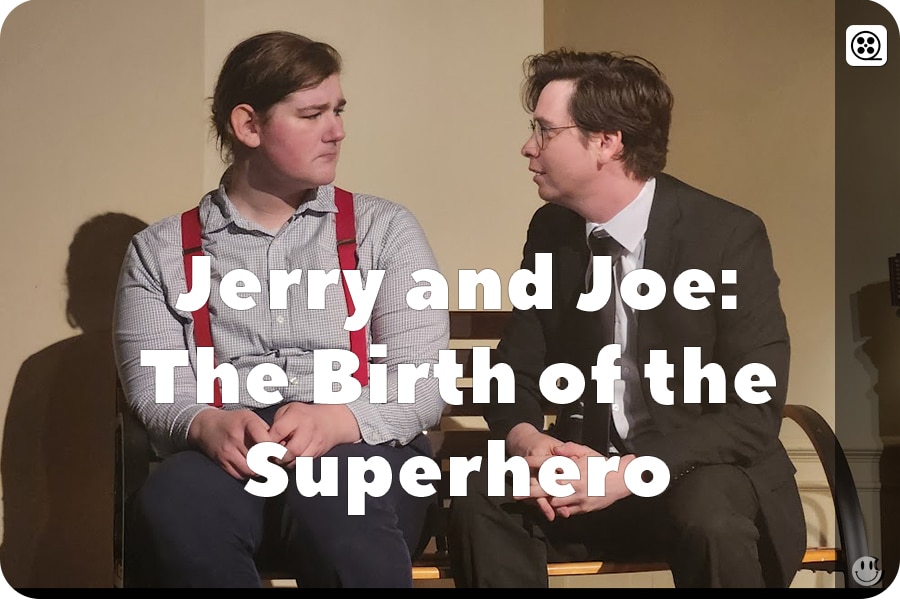
The Birth of the Superhero
Superman has been part of our culture and heritage since 1938. The character has entertained us, amused us, and inspired us for over 90 years. But where did Superman come from? No, not his origin story. We all know that. But where did he come from? In whose mind did he leap from the page and into the imagination of the world?
Recently, an advertisement appeared on Facebook for a new play opening in Rhode Island. The title of the play? Jerry and Joe: The Birth of the Superhero. I was excited to see the advertisement, and knowing I couldn’t get to Rhode Island, where the play would debut, I wrote a note to the author and director requesting a copy of the script and telling him I could read the play and see it in my mind. And then interview him. To my surprise, Lenny Schwartz, the author, answered me immediately, and I received the play via email almost as fast. What follows is an interview with a fascinating playwright whose body of work includes plays on such subjects as Buster Keaton, The Marx Brothers, and Bill Finger, the co-creator of Batman.
The performances begin at The Bell Street Chapel, 5 Bell Street in Providence, Rhode Island, on May 15, 16 ,17 ,22 ,23, and 25, 2025, at 8 pm.
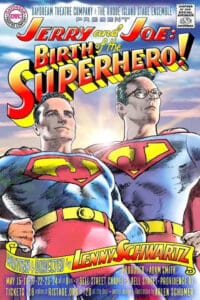 Writer/creator Lenny Schwartz discussed his play about Jerry Siegel and Joe Schuster, focusing on the challenges of creating a budget-friendly production and the historical context of Superman’s creation. Lenny emphasized the importance of accurate portrayals and the impact of anti-Semitism on the characters. The conversation also touched on the potential for the play to be performed in New York and the significance of the upcoming James Gunn-directed Superman film. Lenny shared his background in writing biographical plays and his commitment to historical accuracy, including his Jewish identity and its relevance to the play’s themes.
Mike: After reading the script, I found the new play exciting, poignant, romantic, and hopeful. It tells the story of two young men who dream of making something that the world will love, and they do—only to have it ripped from their hands by greedy businessmen. I’m assuming it’s a single set show.
Lenny: It is a single set show. It doesn’t like change; it’s just certain lighting changes that happen. But it’s a real low budget, like a real shoestring, a few thousand dollars at most. And you know it’s mostly because you know when you do work like this, where you spend four years on a script, and you go through all the channels. It may or may not happen, but to get that bigger budget, sometimes it’s better to do it. At the same time, I hate to say, the iron is hot, so strike it, and strike it, and then somebody else wants to do it in the future. You can keep going with things, but it doesn’t sacrifice the quality.
As far as the performances, you’re gonna get very creative with things, because the actors are all top of the line, people they honestly with, even without a set and lights, they draw you so into the show and so into the actual story, that they’ve actually become the effect of the show for me, and that’s that is always from my way to start off with, and everything else, kind of balls and around that.
Now we might eventually take the show to New York. Well, that will give us a bigger stage and that will give us a bigger kind of audience. Basically, we only have 100 seats here, but it’s a beautiful theater. It’s just a matter of, you know, expanding the audience more.
Mike: I can understand your actors pulling the people in, because that’s sort of the way it should be. I liked a lot of the different kinds of nuances, the idea of keeping all of the rotten publishers as the same actor. I liked that idea because somehow they all look like large men smoking cigars. You know, in my head, that’s what I saw, especially at that time…
Lenny: Uep. It’s tough because, you know, you don’t want to offend, like, you know, national or anyone from DC or their families, but at a certain point you have to let history speak for itself and what actually happens. I’m always the underdog, kind of a person who doesn’t think that’s where we are as people. We like the underdog story in a certain sense, it’s tough, because, you know, worse were these, you know, there were definitely people taking advantage of other people, but it happens in any business.
If you even work for Walmart, there’s always that; there are always people who are opportunists at every job, and that is no different. It doesn’t make them particularly, you know, there are evil things they do, but are they evil people? And that’s kind of the question that a lot of my shows ask, are these? Are these evil people? Um, you know, was DC evil for doing that? I mean, in a certain sense, looking back on it with this and someone like Bill Finger, and something like, where Bill Finger is gonna get credit for Batman for so long? You know, the Bob Kane contract with all those things, it’s well, and that happens in business all the time. It doesn’t mean that you know the things they do are evil, but are these genuinely evil people?
And I like to ask those questions, because you also gotta remember too, that this in comics. You look like a comic story, just looking at what you have behind you when you’re in comics. You know, back then, it was the wild, wild west. There was nothing like this before; there was no Superman, no Batman. So a lot of these things, like the stories, what ends up happening, warrant, you know, just it was just like, you know, comics at that time, she created a character. You moved on to the next issue, and now that some a lot of these characters have become so popular, you know, now you start to see people kind of, kind of, know, really kind of push on those but, you know, there’s, there comes a point where, um, comes a point where we do, like I said, we do ask those questions, what is evil? What is the nature of evil? And I think that is very, very important question to ask, you know, with things. So, yeah, thank you. I appreciate that.
Mike: Let’s talk about you a little bit. Just give me your background. This isn’t your first play, and you already mentioned at least two others.
Lenny: I’ve been running plays since 1996 and not just about superheroes, but like all sorts of subjects, some are comedies, some aren’t historical. Some are just in regular narratives. But every time I see a biographical film or a bio anything, they always have the they only tell you you know so much about the person, and they always tell you you know something that you know if you want to learn more, that’s the best kind of bio story, like something like, um, I think Raging Bull is probably one of the best bio, one of the best biographical films I’ve ever seen.
I ran this play about Bill Finger after doing stuff about Buster Keaton, doing stuff about the Marx Brothers, and it became an idea that conflict history is an untapped story that no one has brought to the stage or the screen. But what if you can bring an interesting play, like, how did Batman come to be? And, you know, find out what those things are. And you know that to me, it came to me in 2014, I said, this could be. I originally was supposed to be a screenplay, but I was like, well, let’s see what happens with the play. So I’d written that, and then I had written a play about Steve Ditko. I think Steve Ditko is fascinating, and I, and so then I read a play about Frederick Wertham, and that was just before the pandemic, and all those things I would learn about these people, but also meet their families as well.
And so I got to meet, I got to meet, you know, Athena Finger, who, if you ever meet her, she’s wonderful and has a lot to say about Bill Finger. And I think she’s phenomenal. Same thing with the Ditko family, Mark Ditko, I met him. He is phenomenal. And it’s not just those families you meet, but you meet those fandoms. But I decided that if I ever were going to do one, I would make a play about Siegel and Schuster because that would be the hardest play you could ever write. Because it is. It’s the hardest play. It’s like to tell that story right. You have to do it right.
And just when I started writing it, I’ve done a couple of drafts, and I said, Okay, I’m going to do it in 2024, and then it was announced that James Gunn was going to direct a Superman movie. I’m like, okay, when’s this movie getting released? 2025, I’ll do it in 2025, you know, just before James Gunn’s movie. So people have that extra boost. And they say, Hey, you know what this movie is coming out, about Superman, but it’s about, but okay, before you go see it, you know you’ll go see the show. I’ll tell you more about the background of how Superman came to be. And I think the James Gunn film looks great, and so all the support in the world. But it’s an extra boost as extra notice to say, hey, when you see those credits in the screen, Siegel and Schuster, you know why those exist, basically.
Mike: Very few people know that those poor guys sold over their rights for $130…
Lenny: It’s the Summer of Superman.That’s great but it should be the summer of Jerry Siegel and Joe Schuster as well.
Mike: There’s a quote. I don’t remember who said it, but it goes, there are three characters that every child will recognize. I’m not sure this is exactly accurate, but the three are Sherlock Holmes, Mickey Mouse and Superman. It’s a Sherlock Holmes who I’m not sure it will fit in anymore, but it did back when I think it was originally said. Now it might be Batman, Mickey Mouse, and Superman, right?
Lenny: I agree with that. I think Mickey Mouse will definitely be one of those characters and Batman. I think it definitely, I think Batman has almost in some regards, like Batman and Superman are just like, you know, hand in hand. It’s so interesting to me too, the thing you said about the James Gunn Superman, they just need to get that right, basically, or right enough for an audience, and that will make, that’ll be a money maker like you’ve never seen money be made before, you know.
And same, and even with even the Batman film, whether you like him or hate him, or anything like that, you know, the bat, even like the Robert Pattinson Batman film, The Robert Pattinson Batman from where people are like, love it, hate it, whatever, that made a lot of money, you know, it’s not for everybody. I mean, you know, but it still makes money because it’s the Batman. If they get that Superman character just right for people, and that’s it, they bet the Batman is just right for the audience that they were looking for. If they can do that for the Superman movie, that’s gonna be like printed money at this point.
Mike: I can’t make it to Rhode Island for the performance. Tell me about the set.
Lenny: It’s the idea of almost like an apartment in the 1940s. It has a radio as well. Actually, 1930s I should say, radio, all style, radio, all star chess, also, you know, all sorts of things. And it’s also got a couple of walls, the actors can enter and exit, and stuff like that. On one side we have a really nice, really nice, like, old chair, almost like an old dad chair. And on the other side of the stage, we have a park bench. And so the park bench represents where Joe Schuster, basically, anytime it’s a scene that happens on the park bench. Looking at the stars, we actually have fairy lights up to make stars, but they’re always looking up to the sky, those guys, and that’s what those guys are always doing when Joe would draw, that’s kind of what he’s doing in the show.
The guy who plays him, Derek Laurendeau, thought he was always on that bench. Eventually, that bench becomes a, you know, on the left side of the stage, it becomes Joe’s kind of like, almost like his security blanket. And eventually we get to the point where Joe Schuster was sleeping in that bench. You know, we also have room in front of the stage where actors come in and out, as far as different things. We play with a little bit of the audience, who are sitting behind. So it is a smaller stage, but it is very, very adaptable to what we want to do for every scene. And that was part of the the issue with the show, he has become as general enough that people can go in from scene to scene and make it believable, no matter where they are, if they’re outside, inside, on the stage, where they are, there’s never a place, a point, where the audience is confused with where they are. But also, it doesn’t have enough details for each of those scenes to fill in. It’s hard, but it works.
Mike: Tell me about your cast; they are young people for the most part.
Lenny: Well, yeah, so weird, because this one kind of brought out a lot of young, younger people. We do have some older people as well. I think our lead (David O. Weber II) just turned 23 playing Jerry Siegel, who’s a good gentleman, plays Joe Schuster, who’s in his early 30s, but he looks like he’s 19, so that’s fine, but he’s in his 20s, early 20s. We have some older people in their 40s, 50s, and 60s. It’s kind of like a good cross-section going on. But I kind of enjoyed that.
Actually, most of the median, I say, is in the late 20s now, which is cool. And I think that for theater, for people who are interested in theater like this and people who are interested in theater, I think that’s a very encouraging thing, because you have to get new people in constantly, or younger people. But you know, and let them know about comics as well. Same thing with comics that I don’t think comics has learned just yet. If we can get younger people into the theater, they will come back and they will be people. It will always replenish itself. The same thing with comics, I think that James Gunn is doing very well. If you give people a reason to come into the comic story and they’re younger, then that’s a good sign. And I think for a long time, we’ve come across points where it’s like, okay, the comics have almost aged out their audience in a certain regard – I think that’s always been the problem too, especially with someone like Spider-Man. They kept aging him, and that’s why Ultimate Spider-Man worked.
Mike: You and your main characters have something in common – you are all Jewish. Can you speak to that?
Lenny: And for me, being Jewish is very important. But also, you know, with Siegel and Schuster, there was that fear, and that’s in a lot of the older comic books. Superman and Batman were a reaction to what was going on at that time for Jews. So that’s what creators were Jewish. That’s just what it was. And the fear of World War II, and the fear of being Jewish at that time, does come through Superman, and it does come through the Batman story.
I never thought of myself before as someone who would put that into my work, but here we are, which doesn’t scare me. And I think it can be very scary, and I think it can be very horrible, for the sentiment for Jewish people. A lot of Jewish people are scared right now, and they are scared of, you know, of the hate that it will come forth. In a sense, we have to, you know, we can’t be scared. And I can’t be scared of my work to put that out there. I can’t be scared to write a film about the film I wrote, which was about my friend’s grandmother’s experiences during the Holocaust. Same thing with Siegel and Schuster. It is something that I can’t be scared to take out of the show, because there’s a factual thing. Same thing with the film, I ran out of the Holocaust, which is a factual thing. I still have to push forth and make sure that I put my best foot forward and to honor those who are scared.

Jerry and Joe: The Birth of the Superhero Cast List
Jerry Siegel – David O. Weber II
Joe Schuster – Derek Laurendeau
The Reporter – Julian Trilling
Mr. Strong – Tom Chen
Russell and Albert – Greyson Yarger
Major Malcolm and Neal Adams – Jon Govoni
Joanne – Julia Levine
Harry – Lionel Lafleur
Jack, Judge, Jay, and Man – Geoff White
Bella – Emily Partington
Francine and Judy – Arianna DePalma
Nazi – Timothy DeLisle
Cop and Teacher – Dennise Kowalczyk
Jerry Robinson – Nathan Suher